Article

Hieracium petrocastellanum, sp. nov., and Other New Records in the Genus Hieracium (Asteraceae) from the Pollino National Park (Southern Italy)


by
Emilio Di Gristina
1,
Enrico Bajona
1,*,
Günter Gottschlich
2,
Raimondo Pardi
1,*,
Gianniantonio Domina
1 and
Giuseppe Venturella
1
1
Department of Agricultural, Food and Forest Sciences, University of Palermo, Viale delle Scienze Bldg. 5, 90128 Palermo, Italy
2
Independent Researcher, Hermann-Kurz-Straße 35, 72074 Tübingen, Germany
*
Authors to whom correspondence should be addressed.
Appl. Sci. 2026, 16(5), 2398; https://doi.org/10.3390/app16052398
Submission received: 29 January 2026 / Revised: 25 February 2026 / Accepted: 27 February 2026 / Published: 28 February 2026
(This article belongs to the Special Issue Advances in Diversity of Plant Species, Communities, and Ecology)

Abstract

Hieracium L. s. str. is a taxonomically critical genus of perennial herbaceous plants widely distributed across temperate regions of Europe, Asia, and North America. In Italy, its diversity is mainly concentrated in the Alps and northern Apennines, whereas southern Italy hosts only a limited number of relict taxa. Recent floristic surveys conducted in the Pollino National Park (southern Italy) revealed the presence of five Hieracium taxa, which were subsequently subjected to critical taxonomic evaluation. Detailed morphological analyses, supported by original herbarium comparisons and multivariate morphometric analyses, resulted in the description of a new species, here named H. petrocastellanum, the confirmation of H. pallescens subsp. tephrochlorum in the Italian flora after nearly 130 years from its discovery, and the first record for the Pollino area of H. symphytifolium, previously considered endemic to the Madonie Mountains (north-central Sicily), as well as H. pellitum subsp. pellitum and H. caesioides subsp. caesioides. The new species, Hieracium petrocastellanum, differs in having basal leaves with cuneate bases, only 0–1 cauline leaves, and bracts with sparse simple hairs and moderately dense glandular hairs. Ecological information and data on taxonomic relationships are also provided. The conservation status is assessed for H. petrocastellanum, H. pallescens subsp. tephrochlorum, and H. symphytifolium. An analytical key is presented to distinguish the new species from its closest relatives. These results confirm the Pollino National Park as a biodiversity hotspot and improve current knowledge of Hieracium.

1. Introduction

Hieracium L. s. str. (Asteraceae) comprises perennial herbaceous plants broadly distributed across temperate regions of Europe, Asia, and North America—capable of occupying a wide range of habitats, from forests and forest margins to grasslands, alpine pastures, and rocky outcrops—from sea level to high mountains [1]. Traditionally, the genus comprised two subgenera, Hieracium and Pilosella Vaill. However, based on morphological, cytological, and molecular evidence, Pilosella is now generally recognized as an independent genus [2,3].
The genus Hieracium is among the most complex and species-rich groups of the European flora. Traditionally, it has been divided into sections, comprising groups of species that share morphological similarities and a presumed common ancestry, encompassing between 500 and 5000 taxa depending on the taxonomic criteria adopted [4,5,6,7].
Indeed, its taxonomic identification is hampered by the scarcity of stable diagnostic characters, combined with widespread hybridization, polyploidy, and apomixis [8,9,10,11]. This complexity is further compounded by differing species concepts and contrasting regional taxonomic approaches, particularly between Central European and Scandinavian schools, which complicates a unified continental-scale classification [3,4,5,6,11]. The genus is predominantly composed of polyploid taxa, mainly triploids and tetraploids, which are generally apomictic, whereas diploid forms are comparatively rare and of particular evolutionary significance [12,13]. During the glacial periods, only a limited number of diploid Hieracium species are thought to have persisted, experiencing demographic bottlenecks followed by speciation in newly deglaciated areas. Secondary contact among previously isolated lineages promoted hybridization, and crosses between taxa with different genome sizes likely disrupted normal meiotic processes, leading to the emergence of polyploid apomictic forms. These agamospermous lineages subsequently spread rapidly, colonizing available habitats more effectively than their diploid progenitors [1,14].
Hieracium also represents an important model system for the study of apomixis, a reproductive process characterized by embryo development in the absence of meiosis and by the maternal inheritance of plastid DNA. Nevertheless, instances of facultative apomixis and occasional sexual reproduction have been documented, suggesting a degree of reproductive flexibility; moreover, polyploid species may exhibit variable levels of male fertility [1].
In Italy, the genus is common in the Alps and the northern and central Apennines, while southern regions, due to warmer climatic conditions, host only a few relict taxa but of notable phytogeographical interest [15,16]. Among these, H. lucidum Guss. stands out as one of the few diploid and sexually reproducing species of the genus, requiring specific conservation measures [17]. It holds particular systematic importance, as it may represent an ancestral lineage from which several European species of Hieracium subsequently evolved [18,19,20,21].
The Pollino National Park covers an area of approximately 196,000 hectares [22] straddling the regions of Calabria and Basilicata in Southern Italy. It encompasses three main mountain ranges: the Pollino Massif, the Orsomarso Mountains, and Mount Alpi [23]. Over time, this area has attracted the attention of several distinguished botanists, including Tenore, Huter, Porta, Rigo, Terracciano, Gavioli, Lacaita, and Fiori, whose research has significantly contributed to the understanding of its flora and vegetation [24]. According to available estimates, the vascular flora of the park comprises about 1500 taxa [25]. Despite its geographical position, Pollino National Park is an important hotspot for the genus Hieracium. A total of 11 taxa are currently documented for this territory: Hieracium humile subsp. brachycaule Vuk. ex Zahn, H. jurassicum subsp. serrapretense Di Grist., Gottschl. and Scafidi, H. murorum L. s.l., H. pollinense Zahn, H. portanum Belli, H. racemosum subsp. crinitum (Sm.) Rouy, H. racemosum subsp. lucanum Di Grist., Domina, Gottschl. and Scafidi, H. racemosum subsp. virgaurea (Coss.) Zahn, H. scorzonerifolium subsp. divaricatum Huter, Porta and Rigo ex Nägeli and Peter, H. terraccianoi Di Grist., Gottschl. and Raimondo, H. umbrosum subsp. abietinum (Boiss. and Heldr.) Greuter [26,27,28,29,30].
In the past, Gavioli [31] also reported three narrowly endemic taxa from the Pollino area, namely, H. oxyodon var. hastatum Arv.-Touv., H. pallescens subsp. tephrochlorum (Zahn) Gottschl., and H. valoddae subsp. austroitalicum (Zahn) Zahn, as well as the amphiatriatically distributed taxon, H. naegelianum subsp. andreae (Degen and Zahn) Zahn. However, none of these taxa have been confirmed in subsequent surveys, and in the case of the three endemic taxa, they remain known solely from their type specimens. Moreover, the Pollino area is very extensive and has not yet been fully explored from a botanical and hieraciological perspective.
In the summer of 2025, we conducted an extensive botanical survey in the Pollino National Park; five populations of Hieracium were identified. Indeed, based on a preliminary morphological examination carried out in the field, one population immediately appeared to be of particular interest, exhibiting peculiar morphological characters; for another population, a possible correlation with H. pallescens subsp. tephrochlorum was hypothesized. The remaining three populations showed affinities with known taxa, but had not yet been recorded for the Pollino area. An in-depth morphological study confirmed all our hypotheses. In this study, we describe and discuss a hawkweed species new to science, which we name Hieracium petrocastellanum. We also confirm, after nearly 130 years of its first discovery, the presence of H. pallescens subsp. tephrochlorum in the Italian flora, and we report for the first time in the flora of the Pollino the occurrence of H. symphytifolium Froel., hitherto known as an endemic species restricted to the Madonie Mountains (NC-Sicily), H. pellitum Fr. subsp. pellitum, and H. caesioides Arv.-Touv. subsp. caesioides.

2. Materials and Methods

2.1. Study Area

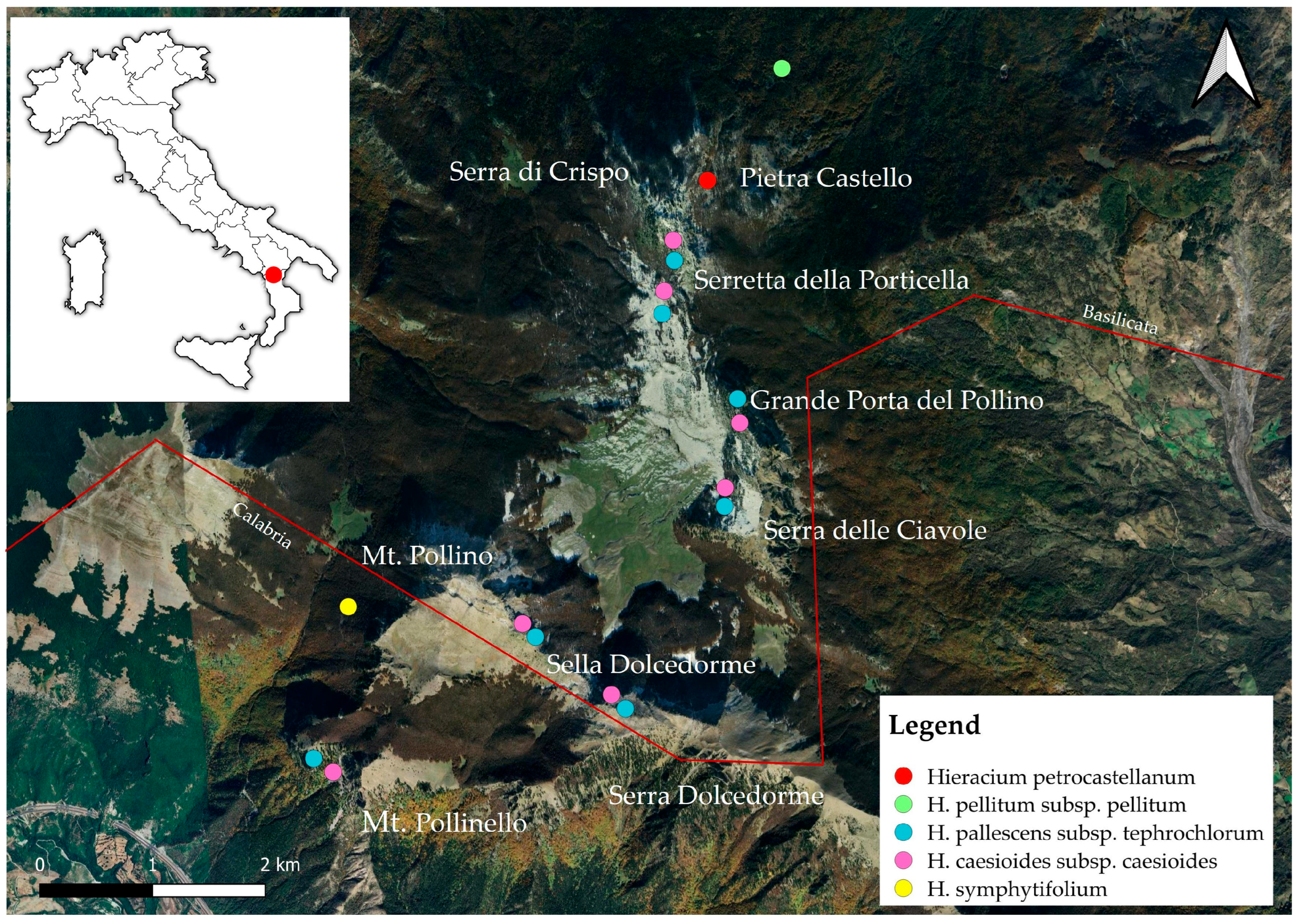
The Pollino National Park area investigated includes Serra di Crispo (2.054 m a.s.l.) and Serra delle Ciavole (2.130 m a.s.l.), both entirely within the Basilicata region; Serra Dolcedorme (2.267 m a.s.l.) and Mt. Pollino (2.248 m a.s.l.), which extend across both Basilicata and Calabria regions; and Mt. Pollinello (2.044 m a.s.l.), located entirely within Calabria region (Figure 1).
The investigated area falls within the Mediterranean macro-bioclimate [32]. According to the Worldwide Bioclimatic Classification System (WBCS) [33], the climatic conditions of the highest sectors of the Pollino massif, including Serra di Crispo, Serra delle Ciavole, Serra Dolcedorme, Monte Pollino, and Monte Pollinello (>1800–2000 m a.s.l.), correspond to upper supratemperate to orotemperate thermotypes, reflecting low mean annual temperatures, short growing seasons, and prolonged snow cover [32,33]. The prevailing ombrotypes range from subhumid to humid, largely influenced by orographic precipitation and local exposure [32]. These bioclimatic conditions sustain high-mountain and subalpine-like vegetation, representing cold-climate biogeographical enclaves within the southern Apennines [34].
From a geolithological perspective, the summit areas of the Pollino Massif are mainly composed of Mesozoic carbonate successions, predominantly massive and thick-bedded limestones and dolostones, belonging to the Apennine carbonate platform units [35,36]. These lithologies are intensely affected by karst processes, resulting in widespread rocky outcrops, shallow and discontinuous soils, sinkholes, and high surface permeability. Structural uplift and quaternary tectonics further shaped the present high-mountain morphology, favoring steep slopes, wind-exposed ridges, and debris-covered surfaces, which strongly influence hydrology, soil development, and the distribution of alpine and subalpine vegetation types in the Pollino highlands [35,36].

2.2. Morphological Study

The morphological study was conducted by direct comparison with the original herbarium specimens (preserved in BOZ, BP, GRM, FI, PAL, TUB, UPS, Herbarium acronyms follow [37]) of the taxa included in this study, as well as with material previously collected by the third author. A total of 193 herbarium samples were examined and studied. Fieldwork was carried out in June, July, and August 2025, the period during which the plants reach their maximum development and are in full flower and fruit. Ten specimens were studied in the field from each population, limiting the impact on numerically reduced populations. Micromorphological characters were examined using a stereomicroscope Leica Microsystems (Wetzlar, Germany), and measurements were taken with an ocular micrometer (12 mm divided into 120 units) or, for larger structures, with a ruler. For the morphological analysis, we systematically examined the characters considered most informative for the delimitation of taxa within the genus Hieracium [38]. The list of potentially diagnostic characters was also derived from the original descriptions of the taxa involved. In particular, we considered the morphology of basal and cauline leaves (number, shape, and size) together with their indumentum (type of hair, distribution, and density), as well as the indumentum of the peduncles and involucral bracts. The newly collected specimens were deposited in the herbarium SAF and in the Herbarium Gottschlich. The nomenclature of the taxa is described in the following [39].
To assess the taxonomic validity of Hieracium petrocastellanum as a species new to science, a comparative morphological statistical analysis also was conducted including all Hieracium taxa with spotted leaves occurring in the outer Alpine Italy (Table 1).
Morphological data were analyzed using multivariate statistical methods implemented in CANOCO 5 software [40] and R software (version 4.4.0; [41]). Specifically, morphological differentiation among taxa was tested using ten characters measured on ten specimens per taxon (Table 2). Specimens were selected from the type of material and from the third author’s collections. Characters describing hair density (glandular hairs on peduncles; simple, glandular, and stellate hairs on the involucral bracts) were converted into discrete quantitative variables (none, sparse, moderate, dense, coded as 0, 1, 2, and 3, respectively) in order to reflect increasing hair density and to enhance the statistical performance of the ordination model.
In particular, a Principal Coordinates Analysis (PCoA) based on Gower distance, which is suitable for mixed variable types, and a Principal Component Analysis (PCA) were performed on the specimens per morphological characters matrix using CANOCO.
To evaluate the discriminant power of the recorded morphological characters and to test the separation among the 14 taxa considered, a Random Forest (RF) classification analysis was carried out. This method was chosen for its robustness and its ability to handle quantitative and qualitative variables simultaneously.
All RF analyses were conducted in the R environment using the Random Forest package [42]. The model was built using 1000 trees (ntree = 1000) to ensure stability and reliable estimates of variable importance. Model performance was assessed using the Out-of-Bag (OOB) error estimate, which provides an unbiased measure of classification accuracy without requiring an independent validation dataset and is functionally comparable to a leave-one-out cross-validation procedure.
The diagnostic importance of each morphological character was evaluated using two standard Random Forest metrics: (i) Mean Decrease in Accuracy (MDA), which quantifies the reduction in classification accuracy following permutation of a given variable, and (ii) Mean Decrease in Gini (MDG), which measures the contribution of each variable to node purity within the decision trees.

2.3. Conservation Status Assessment

We assessed the conservation status of the new species, Hieracium petrocastellanum, as well as that of H. pallescens subsp. tephrochlorum. In addition, we considered it appropriate to reassess the conservation status of H. symphytifolium, previously classified as Endangered (EN) [43], based solely on data from Sicily, as the species was at that time known exclusively from the Madonie Mountains. Regarding H. caesioides subsp. caesioides and H. pellitum subsp. pellitum, given that these are taxa with a broader distribution range and for which we lack data to rely on, their conservation status was not taken into consideration.
The evaluation of the conservation status was conducted in accordance with the IUCN criteria and guidelines [44,45,46]. The Extent of Occurrence (EOO) and Area of Occupancy (AOO) were estimated using the Geospatial Conservation Assessment Tool (GeoCAT version 6.04.0011) [47]. Population size estimates were obtained by counting mature individuals in sites where plants were clearly visible and could be reliably distinguished. In areas where direct counts were not possible, the number of mature individuals was inferred through careful estimation.

3. Results

The morphological analysis conducted in this study allowed the identification of a new species of Hieracium from the Pollino Massif, together with the rediscovery of a historically recorded taxon and three new records for the Pollino area. In addition, the statistical analyses provided support for the taxonomic validity of the newly identified species as new to science.

3.1. Taxonomic Assessment

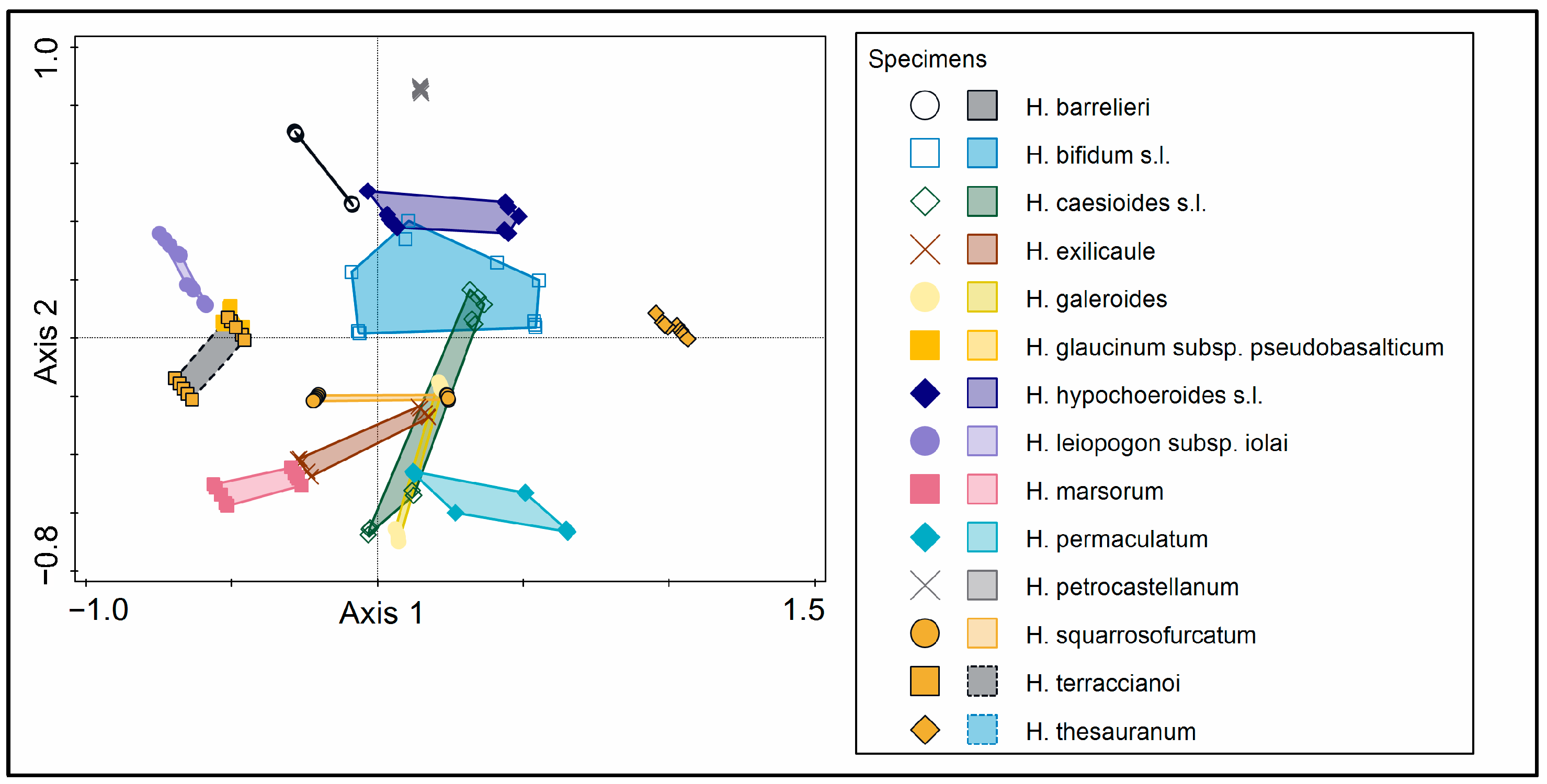
Both unconstrained ordination methods, PCoA and PCA, proved effective in delimiting taxa based on morphological variation. In the PCoA, Axis 1 and Axis 2 accounted for 21.08% and 18.50% of the total variation, respectively. The separation between the population of Hieracium petrocastellanum and the other 13 taxa is clearly supported by the PCoA results, which show a distinct and well-defined cluster (Figure 2). As illustrated in the ordination scatterplot, H. petrocastellanum specimens exhibit very limited morphological variability.
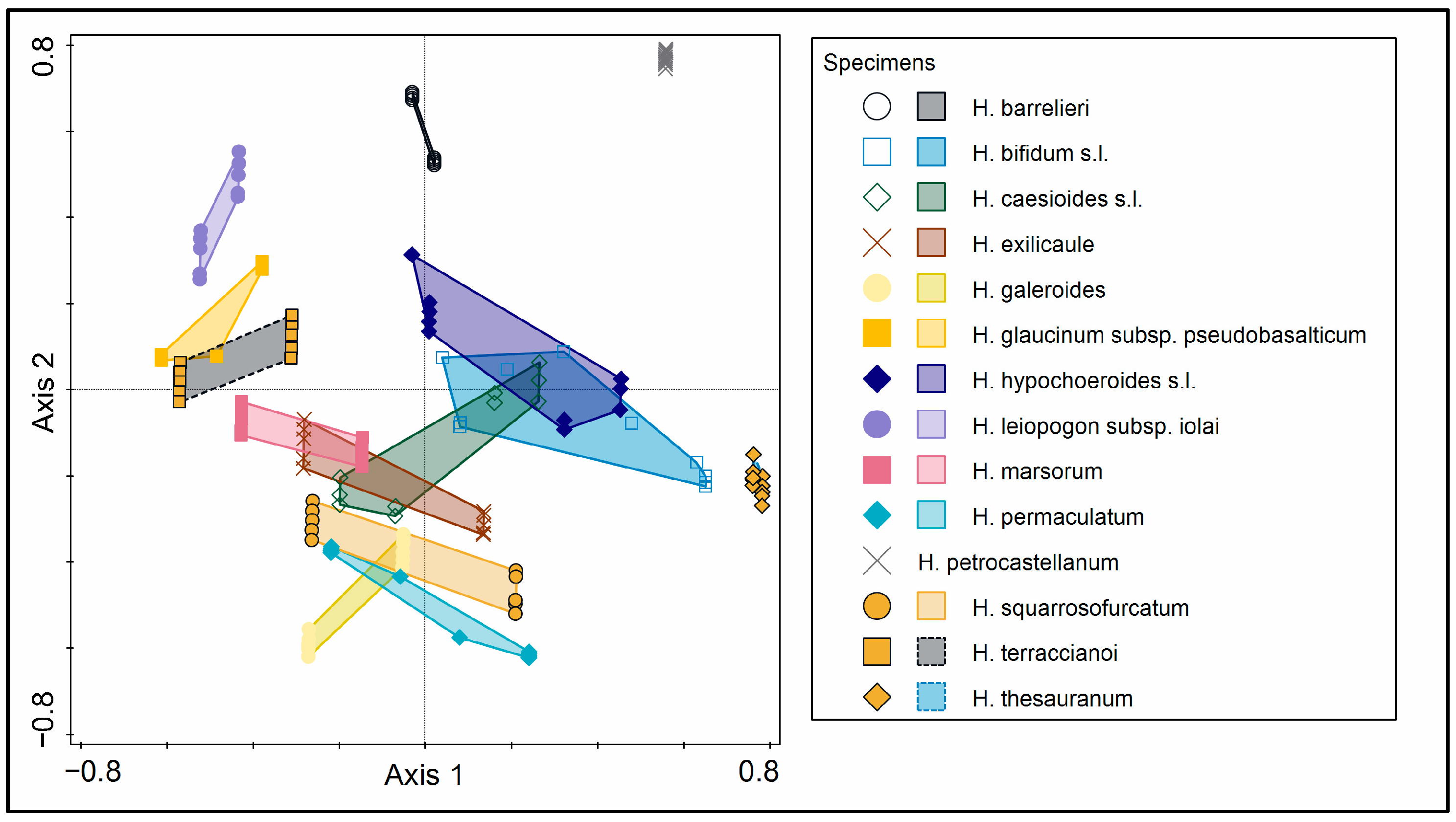
Similarly, in the PCA, Axis 1 and Axis 2 explained 15.78% and 14.66% of the total variation, respectively. Hieracium petrocastellanum specimens are clearly separated from the remaining taxa, corroborating the pattern observed in the PCoA (Figure 3).
Accordingly, both ordination analyses consistently identify H. petrocastellanum as a morphologically independent taxon.
The Random Forest analysis achieved complete separation among all analyzed taxa, resulting in a global classification accuracy of 100%. The Out-of-Bag (OOB) error rate was 0%, indicating that the selected set of morphological characters is sufficient to uniquely discriminate specimens belonging to the 14 taxa considered. This outcome likely reflects the presence of highly diagnostic morphological characters combined with limited within-taxon variability. Given that taxa were defined a priori and that multiple specimens shared identical character states, these results should be interpreted as an evaluation of discriminant power rather than predictive performance.
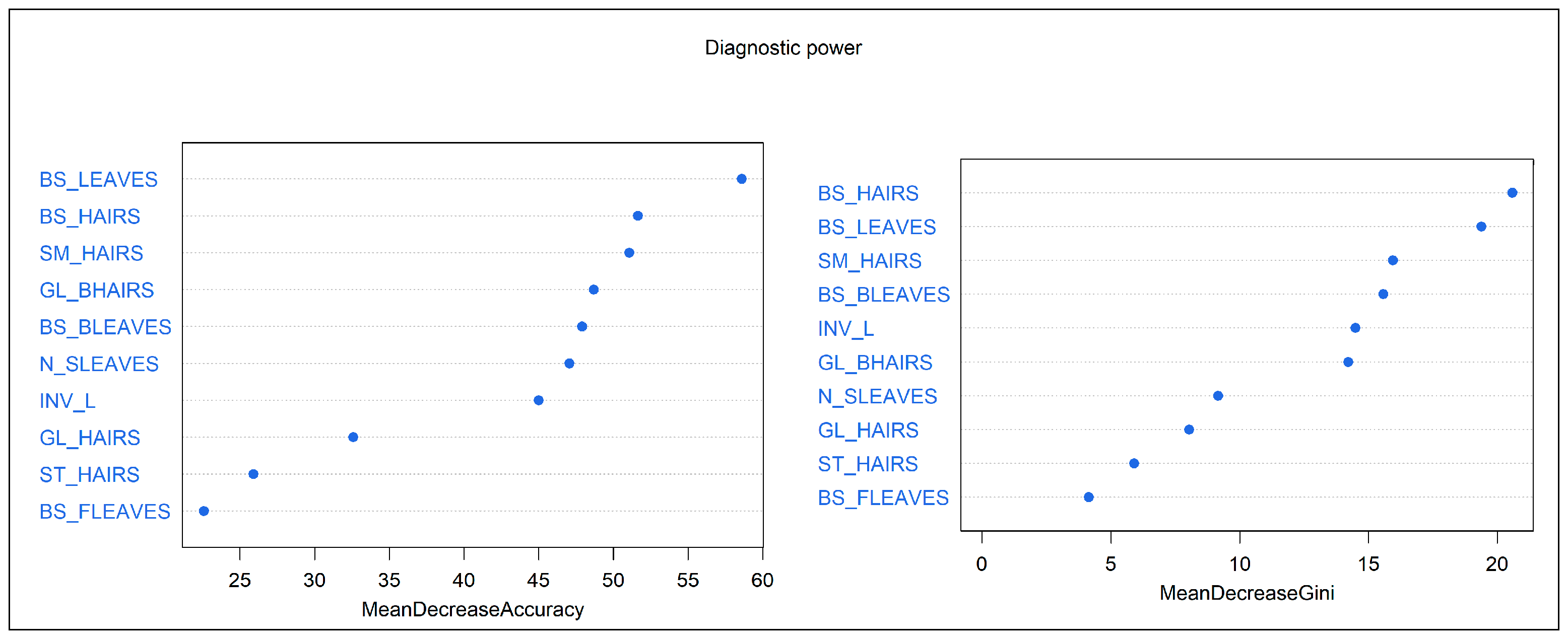
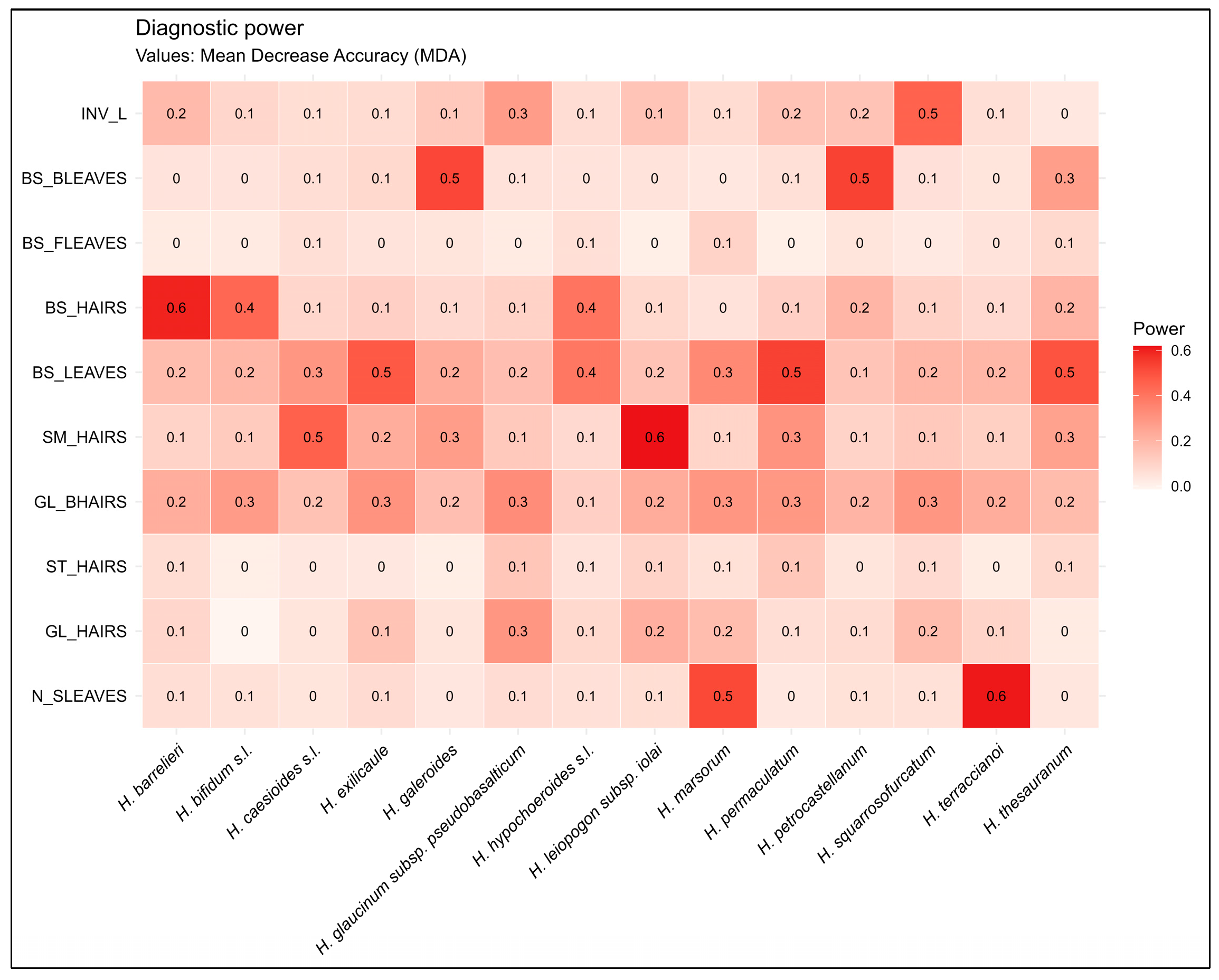
Variable importance analysis (Figure 4) identified the morphological characters most influential in taxonomic discrimination across all taxa. Diagnostic relevance was assessed using both Mean Decrease in Accuracy (MDA) and Mean Decrease in Gini (MDG) metrics. Among all characters, lamina and petiole hairiness of basal leaves (BS_LEAVES) and margin simple hair type of basal leaves (BS_HAIRS) emerged as the most informative for species-level delimitation.
Taxon-specific importance patterns were further explored using an MDA-based heatmap (Figure 5; the complete MDA matrix is provided in Table S1). This analysis revealed that while some characters exhibit broad diagnostic value (e.g., BS_LEAVES, GL_BHAIRS), others function as highly specific markers for individual taxa.
Notably, the shape of the base of basal leaves (BS_BLEAVES) played a key role in discriminating H. petrocastellanum and H. galeroides specimens (MDA = 0.5). Likewise, the number of stem leaves (N_SLEAVES) represented an exclusive and highly informative character for H. terraccianoi (MDA = 0.6) and H. marsorum (MDA = 0.5).
In conclusion, all applied multivariate analytical approaches (PCoA, PCA, and Random Forest) consistently and strongly support the recognition of Hieracium petrocastellanum as an independent species.

Taxonomic Treatment

In its habitat, Hieracium petrocastellanum resembles several mostly endemic Hieracium taxa that have been identified in central and southern Italy (Table 1). They have only one or at most two stem leaves and, above all, conspicuously spotted basal leaves.
These taxa can be differentiated by the following key:
1 Stem leaves 22
– Stem leaves 0–13
2 Peduncles without glandular hairs, involucral bracts only at margin with dense stellate hairs, stellate hairs with long rays(acanthodontoides > schmidtii) H. marsorum
– Peduncles with sparce to moderate glandular hairs, involucral bracts throughout with sparse to moderate stellate hairs, stellate hairs with short raysH. terraccianoi
3 Involucre with dense (sometimes fur-like) simple hairs4
– Involucre without, sparse or moderate simple hairs7
4 Lamina of basal leaves glabrous or with sparse simple hairs or simple hairs only at margin5
– Lamina of basal leaves with dense simple hairs6
5 Plant robust, lamina of the outer basal leaves rounded, involucre 12–14 mm long(schmidtii—pulchellum) H. galeroides
– Plant slender, lamina of the outer basal leaves elliptical to ovate, involucre 8–11 mm long(bifidum > pulchellum)
H. caesioides
6 Simple hairs of the basal leaves (petiole and margin of the lamina) slightly plumose (teeth of the hairs 2–3 times as long as the diameter of the hairs(pellitum—acanthodontoides)
H. thesauranum
– Simple hairs of the basal leaves (petiole and margin of the lamina) denticulate to strong dentate (teeth of the hairs 1–2 times as long as the diameter of the hairs(bifidum > pellitum)
H. permaculatum
7 Peduncles and involucre with moderate to dense glandular hairs8
– Peduncles and involucre with sparse or without glandular hairs9
8 Involucre with sparse to moderate simple hairsH. glaucinum subsp. pseudobasalticum
– Involucre without simple hairsH. leiopogon subsp. iolai
9 Involucre without glandular hairs10
– Involucre with sparse glandular hairs12
10 Involucre 13–16 mm longH. squarrosofurcatum
– Involucre 8–12 mm long11
11 Petiole and lamina completely glabrousH. exilicaule
– Petiole and lamina at least at margin with sparse simple hairsH. bifidum
12 Involucre 8–9 mm long13
– Involucre 11–12 mm long14
13 Basal leaves cuneate at base; stem leaf reduced with petiole at base not wingedH. petrocastellanum
– Basal leaves truncate at base; stem leaf well developed with a short-winged petioleH. barrelieri
14 Margin of basal leaves with rigid curved simple hairsH. hypochoeroides
– Margin of basal leaves with soft sidled simple hairsH. bifidum
Hieracium Linnaeus, Species Plantarum: 799. 1753 [48].
Diagnosis:—Foliis integris subdenticulatis lanceo-incanum, latis scabris, scapo unifloro.
Description:—Perennial herbs. Stems 1-numerous. Leaves are entire to deeply dentate, rarely lobate, and the basal usually rosulate. Involucral bracts in several irregularly imbricate rows, linear-lanceolate. Receptacle without scales, flat, pitted; margins of the pits shortly dentate to fimbriate-dentate. Ligules are usually yellow (sometimes with a red stripe on the outer face), rarely reddish, green, or white. Achenes 10- to 13-ribbed, narrowly obconical, never beaked. Pappus of 1 or 2 rows of unequal, brittle, white to pale yellowish-brown hairs [49].
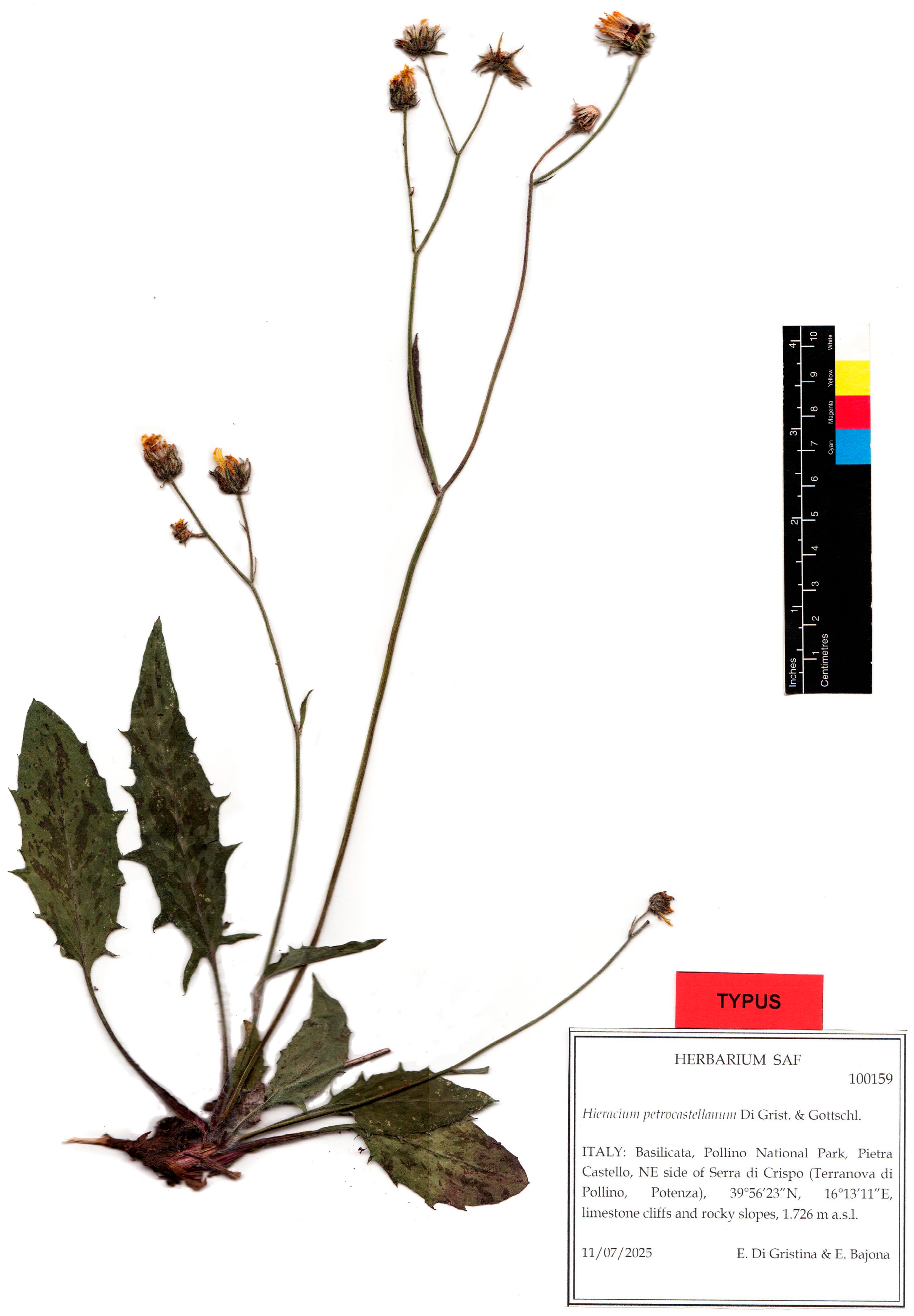
Hieracium petrocastellanum Di Grist. and Gottschl., spec. nov. (Figure 6).
Type:—ITALY. Basilicata, Pollino National Park, Pietra Castello, NE side of Serra di Crispo (Terranova di Pollino, Potenza), 39°56′23″ N–16°13′11″ E, limestone cliffs and rocky slopes, 1.726 m a.s.l., 11.7.2025, E. Di Gristina and E. Bajona 100159! (holotype: SAF; Isotypes: B, FI, Hb. Gottschlich 86204!).
Diagnosis:—Folia basalia eximie maculata, differt a speciebus similibus Italiae foliis basalibus basi cuneatis, caulinis tantum 0–1, involucro pilis simplicibus sparsis, pilis glanduliferis modice densis.
Description:—Plant perennial, pseudorosulate. Rhizome stout or slender, oblique or horizontal. Stem erect, stout (Ø 1.5–2 mm), (20–)25–30(–35) cm tall, green, often brownish-purple at the base, subtly striate, beneath with sparse to moderately dense, 1.5–5.0 mm long, subplumous (teeth of the hairs one and a half time longer than diameter of hairs) to distinctly dentate (teeth of hairs as long as diameter of hairs) whitish, rather soft, simple hairs, few 0.1 mm long, glandular hairs, and sparse stellate hairs; above with sparse to moderate stellate hairs, sparse 0.2–0.3 mm long glandular hairs and scattered 1.5–2 mm long dentate, simple hairs. Basal leaves (3–)4–6(–7), petiolate; petiole (1.5–)3–5(–7) cm long, mostly brownish-purple, indument like the basal part of the stem; lamina ovate to ovate-lanceolate, (3–)5–6(–8) × (1.5-)2–2.5(3) cm, glaucous green, strongly or slightly spotted, margin denticulate, or serrate-dentate; all basal leaves acuminate, narrowed or cuneate at base, subglabrous above, with whitish, 1.5–2 mm long, rather soft, dentate simple hairs that are moderately dense on the margin and beneath but rather dense along the midrib, beneath also with sparse, on the mibrib with subdense stellate hairs. Cauline leaves (0–)1, shortly petiolate, lamina like basal leaves or distinctly reduced, color and indumentum similar to those of the basal leaves. Synflorescence furcate, seldom racemose-paniculate; branches 1–2, (1–)3–3(–8) cm long, each with 1(–2) capitula; capitula 2–3(–5); acladium (1–)2–3(–4) cm long. Peduncles with 1–2 linear, green 1–2 mm long bracts, with moderate 0.3 mm long yellowish glandular hairs, and subdense stellate hairs. Involucre subglobose, 8–9 mm long. Involucral bracts in few series, olive-green, paler at the margin, the inner light green, lanceolate, at base 1.1–1.3 mm wide, acute, with sparse, at the base moderate, 1.5 mm long, rather soft, dentate simple hairs, moderate 0.4–0.8 mm long glandular hairs with yellow heads and a black-based stipe, and moderate stellate hairs. Corolla limb ligulate, yellow, glabrous. Styles yellow. Achenes 3 mm long, dark brown.
Etymology:—The species epithet refers to the Latin name of the rocky outcrop, Pietra Castello, where the plant grows.
Life form:—Scapose hemicryptophyte with chasmophyte habit.
Phenology:—Flowering time: June to first decade of July. Fruiting time: June to July.
Distribution and ecology:—Hieracium petrocastellanum grows exclusively on limestone cliffs and rocky slopes at Pietra Castello, a calcareous rocky outcrop located on the north-eastern side of Serra di Crispo (Terranova di Pollino, Potenza), on the Lucanian side of the Pollino National Park. The only known population comprises approximately 320 individuals occurring within a restricted area between 1700 and 1850 m of elevation.
Conservation status:—The species is currently documented from a single location within the protected territory of the Pollino National Park. Using the Geospatial Conservation Assessment Tool (GeoCAT), the Area of Occupancy (AOO) was estimated at 4 km2 (1 cell grid 2 × 2 km). The population comprises approximately 300 mature individuals. At present, information on population trends is inadequate to evaluate or forecast demographic dynamics. Nevertheless, the presence of a noticeable number of grazed plants (around 5% of the total population) indicates that extensive, free-ranging cattle grazing (threat 2.3.1, IUCN [45]) in the area may constitute a significant threat to the long-term viability of the species.
Based on currently available data, a provisional conservation assessment can be formulated solely under Criterion D (very small or restricted population). According to the IUCN Guidelines [44,45,46], owing to the limited number of mature individuals (< 1000), the restricted Area of Occupancy (AOO < 20 km2), and the very small number of known locations (<5), Hieracium petrocastellanum should be assigned to the category Vulnerable (VU): D1 + D2.
Taxonomic remarks:—Hieracium petrocastellanum may be assigned to sect. Bifida (Arv.-Touv.) Clapham; however, the presence of distinctly dentate to subplumose simple hairs on the petioles suggests the possibility of slight introgression from species belonging to sect. Lanatella (Arv.-Touv.) Zahn or to Andryaloidea Monnier. Among the taxa considered in this study, H. petrocastellanum appears similar to H. barrelieri, a taxon belonging to sect. Acanthodontoidea Gottschl. [38]. However, the two species are clearly distinguished by the morphology of the basal and cauline leaves. In particular, H. petrocastellanum is characterized by basal leaves that are cuneate at the base and by reduced stem leaves with a non-winged petiole at the base, whereas H. barrelieri exhibits basal leaves that are truncate at the base and well-developed stem leaves with a short-winged petiole.

3.2. Taxon Rediscovery

Hieracium pallescens subsp. tephrochlorum (Zahn) Gottschlich, Veröffentlichungen des Tiroler Landesmuseums Ferdinandeum 86, Sonderband: 48. 2007 [50].
≡ Hieracium incisum subsp. tephrochlorum Zahn, Allgemeine Botanische Zeitschrift für Systematik, Floristik, Pflanzengeographie etc. 7: 115. 1901 [51].
Diagnosis:—Stems erect or ascending, rather thin to slender, almost down to the base, curly hairy. Basal leaves about 6, petiolate, ovate, elliptic to oblong and oblong-lanceolate, rounded-obtuse to somewhat pointed, the innermost acute; on both sides shortly and softly hairy (1–2 mm), with the margin, the midrib on the back, and the petiole abundantly covered with short whitish shaggy hairs; on the upper surface sometimes becoming somewhat glabrescent and tending to become blotched, slightly glaucescent deep green; on the lower surface whitish-green, the midrib densely floccose; margins finely toothed, at the base toothed or with a few coarser teeth; rather firm. Stem leaves are absent or linear-lanceolate, elongated, or linear. Inflorescence usually strongly forked above; acladium 2–8 cm (up to about one third of the stem); branches obliquely erect, 1–2(–3), distant, single-headed. Heads 2–4; involucre 13–14 mm, swollen-globose, later somewhat depressed; bracts narrow, long-acuminate, acute to very acute, dark, the inner ones with a strong pale margin, rather abundantly covered with short whitish shaggy hairs (2–3 mm), without glands, moderately floccose. Peduncles whitish grey, with very sparse glands, above moderately shortly white hairy. Upper stem parts densely floccose, otherwise sparsely with moderately short hairs, without glands. Flowers dark yellow, styles of the same color, fruits black, corolla teeth weakly ciliate. Bracteoles about 2–3, subulate. Height 12–35 mm.
Description:—Perennial herb with a slender to stout rhizome, horizontal or oblique. Stem straight or slightly sinuous, erect, 10–30(–50) cm tall, glaucous-green, sometimes wine-red at the base, finely striate, with sparse to numerous soft, white simple hairs; stellate hairs few to numerous (especially in the upper part); glandular hairs absent. Basal leaves (2–)4–6(–12), petiolate, ovate to oblong-lanceolate, 1–12 × 1–4 cm, green to glaucous-green (often paler beneath), margin entire or coarsely toothed, slightly spotted; lamina base shortly or long-attenuate, rarely truncate or cordate; apex obtuse to acute; simple hairs soft, white, denticulate, numerous (petioles often slightly villous) to moderate, or upper surface glabrescent; stellate hairs, if present, only sparse to moderate on the midrib abaxially; glandular hairs absent. Cauline leaves 0–2, usually decreasing in size, from petiolate to long-attenuate and sessile, margin entire, similar in color and appearance to the basal leaves. Inflorescence unbranched to forked, rarely forked-paniculate. Peduncles slender to rather stout, with numerous to dense simple hairs, soft, white, black-based; glandular hairs absent to sparse; stellate hairs moderate to numerous. Involucre (9–)11–13(–15) mm long, hemispherical to ovoid; involucral bracts generally all similar, dark green to blackish-green, linear-lanceolate, mostly appressed, acute to aristate, covering with numerous to dense simple hairs white, black-based; glandular hairs few, rarely numerous; stellate hairs on the margins moderate to abundant (especially basally), on the surface sparse to moderate. Florets yellow, ligule teeth glabrous; styles mostly dark; achenes 3–4 mm long, blackish brown.
ITALY: Basilicata, Pollino National Park, Grande Porta del Pollino (Terranova di Pollino, Potenza), 39°55′37″ N–16°12′51″ E, limestone cliffs and rocky slopes, 1.884 m a.s.l., 09.07.2025, E. Di Gristina (SAF 100160!).
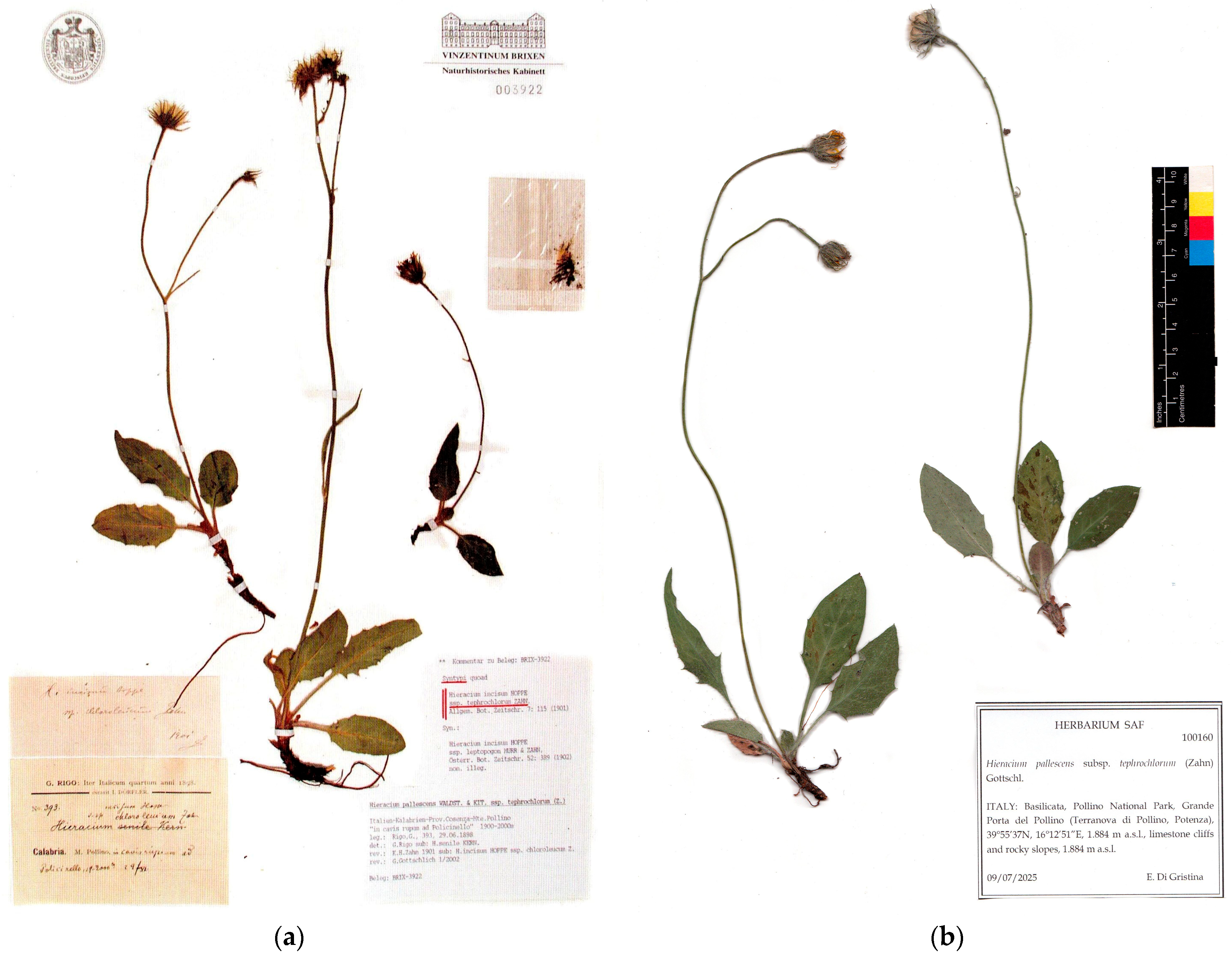
Hieracium pallescens subsp. tephrochlorum was described by Murr and Zahn [52] sub H. incisum subsp. leptopogon (nom. superfl.) based on material collected in 1898 by Rigo in “Calabria. M. Pollino, in cavis rupum ad Policinello, 1900–2000 m, 29.VI.1898” and distributed in the exsiccata “G. Rigo: Iter Italicum quartum anni 1898 Nr. 393”. The specimen was initially identified by Rigo as H. senile and later revised by Zahn as H. incisum Hoppe subsp. chloroleucum Zahn. Lectotype: GJO; Isolectotype: BOZ [BRIX-3922] (Figure 7a) [50]. Subsequently, however, Zahn [51] transferred the taxon to H. incisum subsp. tephrochlorum Zahn, and more recently Gottschlich [50] placed it under Hieracium pallescens subsp. tephrochlorum (Zahn) Gottschl.
In the first edition of Flora d’Italia [19], Pignatti probably referred the plant to ×H. incisum Hoppe, as he also cites the Pollino area within the taxon’s distribution. Similarly, Conti et al. [53], in their checklist of the Italian flora, list H. pallescens Waldst. and Kit. for Calabria, presumably alluding to the same taxon. More recently, Pignatti [21] treats the plant under its currently accepted name, relegating it to the section of Italian critical taxa, but adds Friuli Venezia Giulia as its Italian distribution area.
The comparative study between the original material collected by Rigo (Figure 7a) and our specimens (Figure 7b) enabled us to confirm the identity of our plants as H. pallescens subsp. tephrochlorum and to validate, after almost 130 years, its definitive presence in the Italian flora.
Life form:—Scapose hemicryptophyte with chasmophyte habit.
Phenology:—Flowering time: June to the first decade of July. Fruiting time: June to July.
Distribution and ecology:—Hieracium pallescens subsp. tephrochlorum has been observed at several sites within the Pollino area, including Serra di Crispo, Serretta della Porticella, Grande Porta del Pollino, Serra delle Ciavole, Sella Dolcedorme, Monte Pollino, and Pollinello. Its population comprises approximately 800 individuals growing on limestone cliffs and rocky slopes between 1750 and 2100 m in elevation. The third author has also observed the subspecies at some localities in the Dinaric Alps of Croatia, particularly on the Velebit Mountains (Paklenica National Park) and Mount Dinara, comprising a total of about 200 individuals distributed between 1200 and 1800 m a.s.l. (unpublished data). These observations suggest treating the subspecies as endemic to Italy and Croatia, as well as an additional example of an amphi-Adriatic disjunction for the Pollino area [26,30].
Conservation status:—Considering the populations from both the Pollino massif and the Dinaric Alps, the subspecies is currently known from a total of three locations (one corresponding to the Pollino area and the other two to the Dinaric Alps), occupying an overall Extent of Occurrence (EOO) of 22,364.167 km2 and an Area of Occupancy (AOO) of 24 km2 (6 cells grid 2 × 2 km), and comprising an estimated 900 mature individuals (approximately 750 in the Pollino and 150 in the Dinaric Alps). Based on the data presently available, it is not possible to reliably determine or predict population trends. Consequently, on the basis of the information available to date, only a provisional conservation assessment can be proposed. According to the IUCN criteria [44,45,46], Hieracium pallescens subsp. tephrochlorum could be classified as Least Concern (LC) at the global level.

3.3. New Records for the Pollino National Park

1. Hieracium symphytifolium Froelich, Prodromus Systematis Naturalis Regni Vegetabilis [A.P. de Candolle] 7: 232. 1838 [54].
= Hieracium siculum Gussone, Florae Siculae Synopsis 2: 404. 1843 [55].
Diagnosis:—Caule erecto folioso sub-3-cephalo foliisque petiolatis ovatio-lanceolatis acuminatis subintegerrimis subplumoso-villosis, pedunculis tomentosis involucroque subacuto-villosis.
Description:—Perennial herb with a horizontal or oblique, slender rhizome. Stem slightly curved or erect, slender, (10–)20–35(–40) cm tall, green, sometimes wine-red at the base, finely striate, with numerous to dense simple hairs and sparse stellate hairs; glandular hairs absent. Basal leaves 3–5, often marcescent, petiolate, elliptic-oblong to lanceolate-oblong (2–8 × 1.5–3 cm), acute, attenuate, margins entire, sometimes denticulate, with few to numerous white simple hairs and with sparse minute glandular hairs, especially along the margin. Cauline leaves 3–6, often crowded in a false rosette towards the base; the lowermost petiolate, elliptic-lanceolate (2–6 × 1–2.5 cm), entire, attenuate, acute; the upper more or less amplexicaul, smaller but not bracteiform, often exceeding the capitula; all with few to numerous white simple hairs and sparse minute glandular hairs. Inflorescence subracemose or paniculate. Peduncles slender, with numerous to dense simple hairs, soft, white, black-based; glandular hairs numerous; stellate hairs moderate to numerous. Involucre (9–)10–12(–15) mm long, cylindrical; involucral bracts light green to blackish-green, linear-lanceolate, acuminate to obtuse, with numerous simple hairs, white, black-based, numerous yellow or blackish-yellow glandular hairs, and sparse stellate hairs. Florets yellow; ligule teeth glabrous; styles dark; achenes 3–4 mm long, dark brown to blackish.
ITALY: Calabria, Parco Nazionale del Pollino, WSW side of Mt. Pollino (Morano Calabro, Cosenza), 39°54′11″ N–16°10′34″ E, limestone cliffs and rocky slopes, 1.768 m a.s.l., 10.07.2025, E. Di Gristina (SAF 100161!).
Hieracium symphytifolium has been subject to varying taxonomic interpretations. The taxon was first described by Froelich [54] and is also known under the synonym H. siculum Guss. [55,56]. Initially, it was generally accepted as a valid species [57,58,59]. Subsequently, however, Zahn [60] proposed a hybrid origin between H. lucidum and H. racemosum subsp. crinitum. Nevertheless, the results of karyological and isoenzymatic analyses conducted to verify the hybrid status of the taxon did not support Zahn’s hypothesis [61].
In its morphology, H. symphytifolium is easily characterized: the plants are pseudophyllopod, i.e., the lower stem leaves are densely crowded at the base of the stem and resemble a rosette. The lower or the two lower stem leaves are characterized by a distinctly winged petiole. The yellowish-green cylindrical involucre corresponds in structure to that of H. racemosum, and in its indumentum (silky hairs, delicate yellowish glands) to that of H. racemosum subsp. crinitum. However, H. symphytofolium differs from H. racemosum in a significantly lower number of stem leaves.
H. symphytifolium is a chasmophyte previously known only as an endemic species restricted to the Madonie Mountains in Sicily. The discovery of a new population on Mount Pollino, showing a strong affinity to the Sicilian H. symphytifolium, enabled us to undertake a comparative study between our specimens and the original material used by Froelich to describe the species.
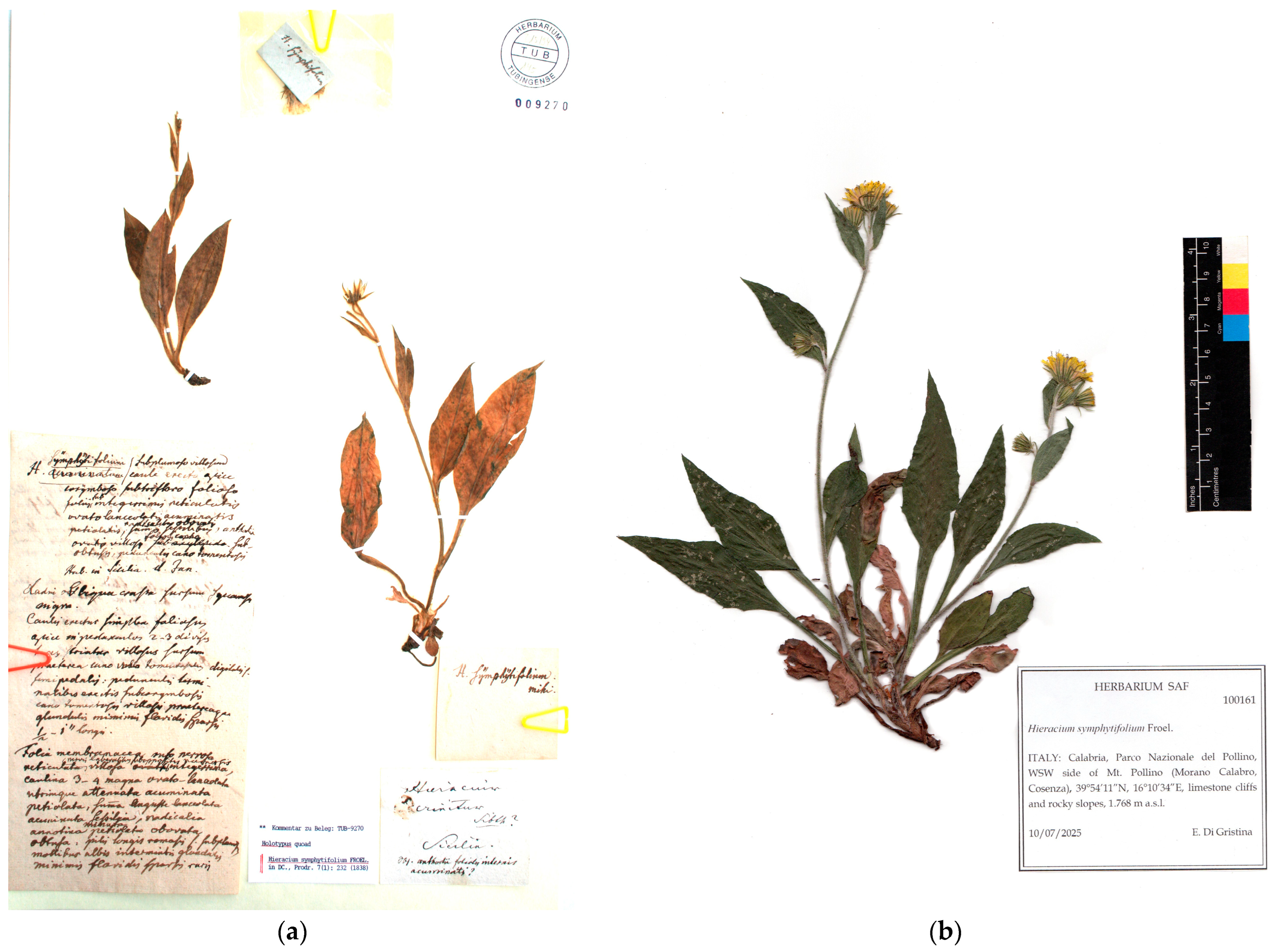
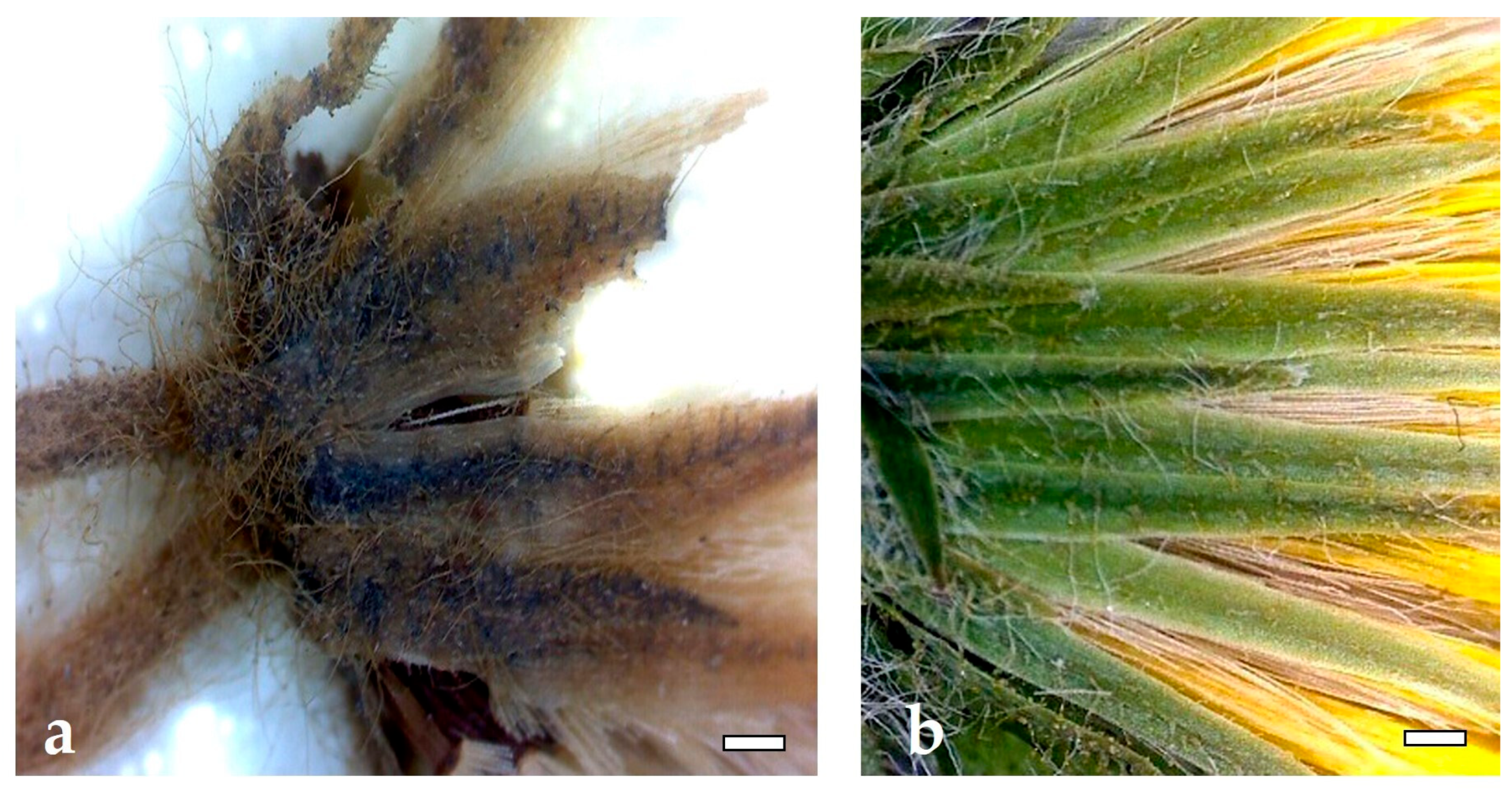
The plants from the two populations differ slightly in overall habit. On Monte Pollino, individuals tend to be somewhat taller and bear a greater number of stem leaves (Figure 8). In addition, their bracts are light green, whereas those of the Sicilian plants may occasionally appear blackish green (Figure 9). These, however, represent phenotypic modifications attributable to ecological differences. In Sicily, the species grows under markedly drier conditions, while on Mount Pollino, the associated vegetation indicates a comparatively more humid environment. Variation in bract color influenced by environmental factors is also documented in other species of Hieracium. For example, in Central Europe, H. sabaudum L. typically exhibits black-green bracts, whereas green to light-green bracts are more common further south; such differences are taxonomically insignificant. Given that the morphological differences observed between the specimens from the Pollino Massif and those from the Madonie Mountains are most likely attributable to environmental influences, we therefore conclude that the populations of H. symphytifolium from the Madonie Mountains and from Mount Pollino are not taxonomically distinct. The new finding consequently extends the species’ distribution to the mainland of southern Italy.
Life form:—Scapose hemicryptophyte with chasmophyte habit.
Phenology:—Flowering time: June, July. Fruiting time: June to the first decade of August.
Distribution and ecology:—Currently, in the Pollino National Park, the population of Hieracium symphytifolium, consisting of approximately 200 individuals, is known only from the W–SW Calabrian side of Mount Pollino, where it grows on calcareous cliffs and rocky slopes between 1700 and 1800 m a.s.l.
In the Madonie Mountains in Sicily, the species occurs on calcareous cliffs and rocky slopes at several sites, including Monte Cervi, Monte Carbonara, Monte Mufara, Monte Quacella, Monte Scalone, Monte Daino, Passo della Botte, Rocca di Mele, and Stretto Canna, at elevations ranging from 1350 to 1850 m a.s.l. Despite its occurrence across multiple localities, the total population is estimated at no more than 200 individuals [43].
Conservation status:—Upon integrating the data of the populations from the Pollino massif and the Madonie Mountains, Hieracium symphytifolium is documented from two locations overall, with an estimated Extent of Occurrence (EOO) of 1537.639 km2 and an Area of Occupancy (AOO) of 32 km2 (corresponding to eight 2 × 2 km grid cells). The total number of mature individuals is estimated at approximately 370, of which roughly 180 occur in the Pollino massif and about 190 in the Madonie Mountains [43]. Based on the information currently available for the Pollino population, it is not yet feasible to determine or anticipate population trends. Nonetheless, extensive nomadic grazing by cattle and horses (threat 2.3.1, [45]) has been observed within the area occupied by the species.
Given the existing data, the conservation assessment can be conducted only under Criterion D (Very small or restricted population). According to the IUCN guidelines [44,45,46], due to the low number of mature individuals (<1000), H. symphytifolium should presently be assigned to the category Vulnerable (VU): D1.
2. Hieracium pellitum Fries subsp. pellitum, Epicrisis Generis Hieraciorum: 79. 1862 [57].
Diagnosis:Phyllopodum, pilis mollibus plumosis hirsutissimum. Caulis paucifolius, apice pedúnculos subdicephalos exserens. Folia lanceolata, tomentosa, radicalia inferioraque basin versus dentata. Involucra globosa, lanata, squamis acuminatis. Ligulae eximie ciliatae. Achaenia nigricantia.
Description:—Perennial herb with a robust, horizontal or oblique rhizome. Stems erect, slightly curved, stout, (10–)20–40(–50) cm tall, glaucous green, finely striate, with simple hairs numerous to dense, soft, white, weakly plumose (with lateral branches 2–3 times as long as the hair diameter); glandular hairs absent; stellate hairs scattered to moderate. Basal leaves (2–)3–5(–7), petiolate; blade elliptic to broadly lanceolate, 3–15 × 1.5–5 cm, rather rigid, firm, glaucous green, rarely spotted, margin entire to toothed; blade base long-attenuate into the petiole; apex obtuse to acute; simple hairs weakly plumose, numerous to dense, soft, white, forming a loose tomentum through which the leaf color shows; glandular and stellate hairs absent, or stellate hairs on the lower surface scattered to moderate (especially on the midrib). Cauline leaves 1–2(–4), rapidly decreasing in size, shortly petiolate to subpetiolate or shortly attenuate to weakly rounded and sessile, usually narrower and shorter than the basal leaves, similar in appearance. Inflorescence strongly dichotomous to dichotomously paniculate. Peduncles with 0–2 subulate bracts 5–10 mm long, dark green; simple hairs dense, forming a loose tomentum or spreading, soft, strongly dentate to weakly plumose; glandular hairs rare; stellate hairs moderate to numerous. Involucre 10–15 mm long, hemispherical to broadly ovoid; involucral bracts olive-green to dark green, arranged in a few series, oblong-lanceolate, acute to long-acuminate; simple hairs numerous to dense, moderately to markedly obscuring the outline of the involucre, soft, dentate to strongly dentate; glandular hairs rare; stellate hairs scattered to moderate. Florets all ligulate, pale yellow to yellow, often slightly ciliate; styles yellow to blackish; achenes 3–4 mm long, dark brown to blackish.
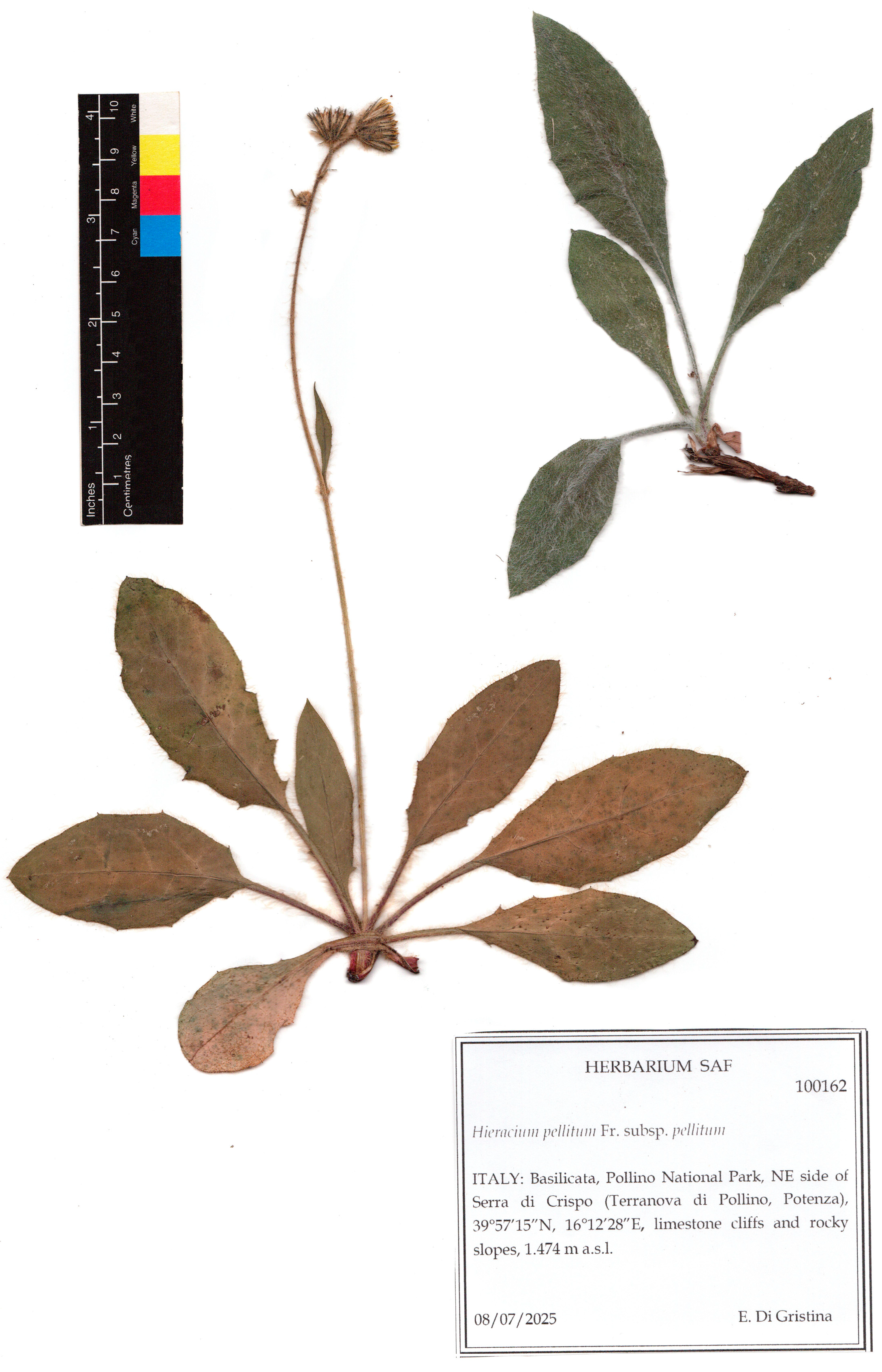
ITALY: Basilicata, Pollino National Park, NE side of Serra di Crispo (Terranova di Pollino, Potenza), 39°57′15″ N–16°12′28″ E, limestone cliffs and rocky slopes, 1474 m a.s.l., 8.7.2025, E. Di Gristina (SAF 100162! Figure 10).
Hieracium pellitum subsp. pellitum is a scapose hemicryptophyte with a chasmophyte habit belonging to sect. Lanatella (Arv.-Touv.) Zahn, a section characterized by the presence of plumose hairs, generally in lower density, and by pronounced morphological transitions toward other Hieracium taxa. In fact, the H. pellitum aggregate represents a transitional complex leading toward the H. bifidum group [38].
The typical indumentum of subplumous hairs of H. pellitum is otherwise only found in one other species from the Basilicata region, namely H. portanum. However, this species belongs to the sect. Pannosa, which is mainly found in the Balkans and Asia Minor. H. portanum has more stem leaves, it is aphyllopodous, i.e., has no basal rosette, and has a more glabrous stem and fewer simple hairs on the involucre than H. pellitum.
Hieracium pellitum subsp. pellitum is reported from Italy, France, and Switzerland, with its main distribution centered in the Western Alps [38]. In Italy, the southernmost occurrences were previously known from the Molise region [62]. The taxon is currently recorded also from Valle d’Aosta, Piedmont, Lombardy, Liguria, Emilia–Romagna, Marche, and Abruzzo [39].
The new record from the Pollino area, therefore, represents an additional southern outpost of the subspecies and should be interpreted as a relic occurrence. In the Pollino area, the taxon has, so far, been observed at a single locality, specifically on the northern slope of Serra di Crispo, where it grows at elevations between 1400 and 1500 m of altitude. Based on the data currently available, the population consists of approximately 20 individuals.
3. Hieracium caesioides Arvet-Touvet subsp. caesioides, Supplément a la Monographie des Pilosella et des Hieracium du Dauphine, suivie de l’analyse de quelques autres Plantes: 15. 1876 [63].
Diagnosis:— Stem densely stellate-farinose almost from the base, pubescent toward the apex, scapiform and usually leafless, more rarely with a single leaf, nearly always bi-trifid and bearing two to a few flowers at the summit; peduncles and involucre strongly stellate-farinose, the latter additionally provided with simple white hairs with a black base, more or less abundant, rendering it more or less villous; glandular hairs absent or nearly absent; receptacle strongly fibrillose; achenes black at maturity; styles usually yellow; leaves lanceolate, oblong, or ovate-lanceolate, attenuate or sometimes slightly cordate at the base, more or less toothed, often subpinnatifid at the base, usually strongly stellate-farinose on the lower surface.
Description:—Perennial herb with a horizontal or oblique rhizome. Stems erect, 15–30(–50) cm tall, light green to glaucous, sometimes reddish at the base, with sparse or absent simple hairs and scattered stellate hairs. Basal leaves numerous, petiolate, with blades oblong to narrowly lanceolate (1.5–10 × 1.3 cm), often rust-spotted and sometimes reddish beneath; leaf margin denticulate or strongly toothed, at the base sometimes pinnately lobed; blade base shortly to long attenuate; apex obtuse or acute. Upper surface nearly glabrous, margin and lower surface with moderately to densely white simple hairs generally stiff and contorted to curly, denticulate to strongly dentate; marginal microglandular hairs rare; stellate hairs on the lower surface sparse to moderate. Cauline leaves are usually absent or rarely one, reduced. Inflorescence corymbose-dichotomous to dichotomously paniculate; peduncles with 0–2 subulate bracts 1–2 mm long, mostly olive- to dark green; simple hairs absent to scattered, with the base or up to the upper third blackish, otherwise white; glandular hairs absent to scattered; stellate hairs moderately to densely distributed. Involucre (7–)8–11(–13) mm long, hemispherical to cylindric-ellipsoid; involucral bracts mostly blackish green, often with paler margins, arranged in few series, oblong-lanceolate, acute to acuminate, with dense recurved simple hairs to weakly shaggy; simple hairs with black bases, otherwise white to dark grey; glandular hairs absent to scattered; stellate hairs scattered to abundant. Florets all ligulate and yellow; styles yellow to dark; achenes dark brown to blackish, 2–3.5 mm long.
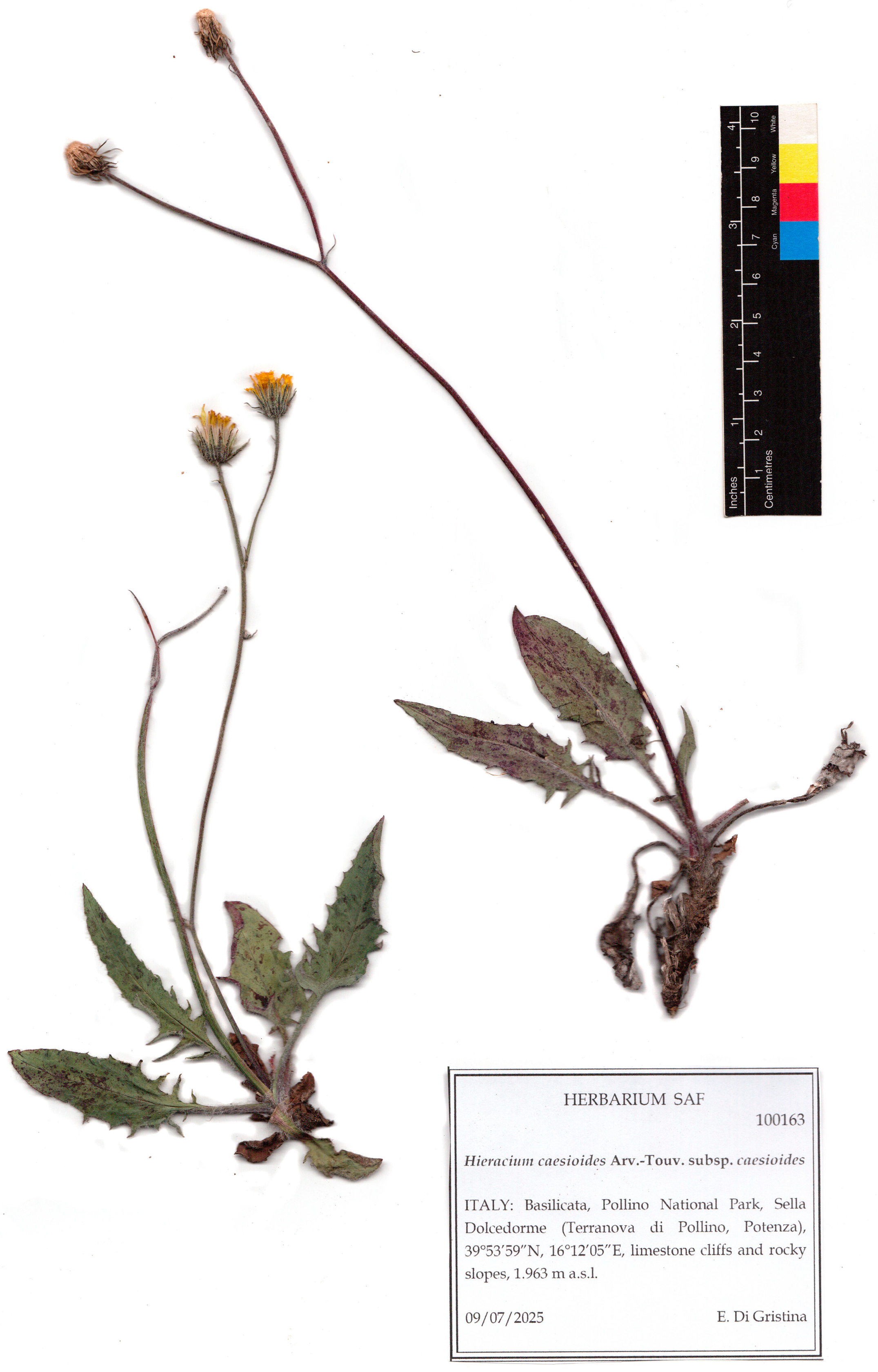
ITALY: Basilicata, Pollino National Park, Sella Dolcedorme (Terranova di Pollino, Potenza), 39°53′59″ N–16°12′05″ E, limestone cliffs and rocky slopes, 1.963 m a.s.l., 9.7.2025, E. Di Gristina (SAF 100163! Figure 11).
Hieracium caesioides subsp. caesioides is a scapose hemicryptophyte with a chasmophyte habit and belongs to sect. Bifida (Arv.-Touv.) Clapham. Members of this section are characterized by the presence of a single cauline leaf, a reduced number of capitula, and markedly elongated involucral bracts tapering into a bristle-like apex, with numerous stellate hairs. Owing to its distinct, toughed simple hairs of the petioles, the subspecies shows small affinity with taxa of sect. Lanatella [38].
To distinguish between similar species, occurring in Basilicata, which are characterized by a basal rosette and only 0–1(–2) stem leaves, see the key.
H. caesioides subsp. caesioides is documented from Italy and France, with the main center of its distribution located in the Western Alps. The southernmost Italian populations were historically reported from the Abruzzo region [38]. The taxon is also detected in Piedmont and Liguria [39]. The new finding in the Pollino area, therefore, represents a further peripheral occurrence of the taxon and may be regarded as a relic population. The taxon has been observed across multiple localities within the Pollino National Park, including Serra di Crispo, Serretta della Porticella, Grande Porta del Pollino, Serra delle Ciavole, Sella Dolcedorme, Monte Pollino, and Pollinello. The population is estimated at roughly 700 individuals growing on limestone cliffs and rocky slopes between approximately 1750 and 2100 m a.s.l.

4. Discussion

This study significantly advances the taxonomy of the genus Hieracium and the floristic knowledge of the Pollino National Park. The discovery of H. petrocastellanum, along with the confirmation of H. pallescens subsp. tephrochlorum after nearly 130 years of its first discovery, and new records of H. symphytifolium, H. pellitum subsp. pellitum, and H. caesioides subsp. caesioides underscores the importance of this area as both a center of endemism and a refuge for several Hieracium taxa.
The identification of H. petrocastellanum as a species new to science highlights that the flora of the Pollino, despite numerous historical and recent explorations, remains incompletely documented. The rediscovery of H. pallescens subsp. tephrochlorum and the finding of populations in the Balkans suggest considering this taxon as endemic to Italy and Croatia. Its distribution represents an additional example of the well-known amphi-Adriatic disjunctions characterizing numerous montane and subalpine taxa, a recurring pattern in the high-altitude flora of the southern Apennines. Several taxa in the Pollino National Park exhibit amphi-Adriatic disjunctions. In addition to the above-mentioned case, examples include H. portanum, H. scorzonerifolium subsp. divaricatum [26], and H. umbrosum subsp. abietinum [30], as well as other plant groups, such as the Campanula “garganica” group [64], Sesleria juncifolia [65], and Genista sericea [66].
The discovery of a new population of Hieracium symphytifolium in the Pollino area extends the species’ range to southern Italy and indicates a broader ecological amplitude than previously known for this taxon.
The records of H. caesioides subsp. caesioides and H. pellitum subsp. pellitum, both more widespread in the western Alps, support the interpretation that some isolated Apennine massifs, such as the Pollino mountains, may function as microrefugia capable of maintaining small disjunct populations of predominantly northern taxa. This pattern aligns with previous observations recognizing certain Apennine Mountain systems as important refugia during Pleistocene climatic oscillations, allowing the long-term survival of cold-adapted chasmophytic species [67,68,69,70].
Regarding conservation status, H. petrocastellanum and H. symphytifolium are currently classified as “Vulnerable” under Criterion D1 + D2 and Criterion D1, respectively, whereas H. pallescens subsp. tephrochlorum qualifies as “Least Concern”. These assessments may require revision should new threats emerge, or negative demographic trends be detected, particularly since populations are often exposed to pressures such as grazing by free-ranging animals.

5. Conclusions

The results presented in this study further demonstrate that the Pollino National Park represents a significant biodiversity hotspot for the genus Hieracium. The concurrent presence of narrowly endemic taxa alongside species with northern or amphi-Adriatic distribution patterns indicates that the Pollino massif plays a dual biogeographical role: (1) as a center of persistence for relict taxa that were formerly more widespread, and (2) as a contact zone where northern or Balkan lineages reach their southern or southwestern limits. These findings also underscore the need for further intensive botanical research, as a substantial portion of the Pollino massif remains incompletely explored. Indeed, owing to its geomorphological heterogeneity, pronounced altitudinal gradients, and complex climatic mosaic, the Pollino area provides ecological conditions favorable to the local differentiation of new taxa and to the long-term persistence of narrowly distributed chasmophytic species.
From a conservation perspective, the small population sizes, extremely limited distribution, and localized threats affecting the documented taxa necessitate targeted management measures. Given the general protection of the area, conservation strategies should include monitoring demographic trends, mitigating grazing pressure in sensitive sites, and preserving the integrity of limestone outcrops that serve as refugia for specialized chasmophytic flora.
Overall, the results of this study reinforce the role of southern Italian mountain systems as key areas for understanding the processes of diversification, persistence, and biogeographical history of the genus Hieracium in the central Mediterranean. Future research integrating morphological, ecological, molecular, and biogeographical approaches will be essential to further refine the taxonomy of this complex genus and to safeguard the unique botanical heritage of the Pollino massif.

Supplementary Materials

The following supporting information can be downloaded at https://www.mdpi.com/article/10.3390/app16052398/s1, Table S1: MDA matrix for the analysis of diagnostic power of morphological characters.

Author Contributions

Conceptualization, E.D.G., G.G. and G.V.; methodology, E.D.G., G.G., G.V. and G.D.; software, E.B., R.P. and G.D.; validation, E.D.G., G.G., G.V. and G.D.; formal analysis, E.D.G., G.G., G.V., E.B., R.P. and G.D.; investigation, E.D.G. and G.G.; resources, E.D.G.; data curation, E.D.G., G.G., G.V., E.B., R.P. and G.D.; writing—original draft preparation, E.D.G. and G.G.; writing—review and editing, E.D.G., G.G., G.V., E.B. and G.D.; visualization, E.D.G., G.G., G.V. and G.D.; supervision, E.D.G., G.G. and G.V.; project administration, E.D.G., G.G. and G.V.; funding acquisition, E.D.G. All authors have read and agreed to the published version of the manuscript.

Funding

This research was funded by “Fondo per il Finanziamento della Ricerca di Ateneo” (FFR 2025 E. Di Gristina, Project Code PJ_GEST_FFR, University of Palermo).

Data Availability Statement

Data are contained within the article.

Acknowledgments

The authors extend their gratitude to the curators of the herbaria consulted (BOZ, BP, GRM, FI, PAL, TUB, UPS). We also wish to express our sincere thanks to Silvio Carrieri, official guide of the Pollino National Park, for his valuable assistance during the fieldwork.

Conflicts of Interest

The authors declare no conflicts of interest.

References

  1. Baldesi, G.; Tison, J.M.; Orsenigo, S. Preliminary Review of the Diploid Taxa in Hieracium s. s. Plants 2025, 14, 1057. [Google Scholar] [CrossRef] [PubMed]
  2. Bräutigam, S.; Greuter, W. A new Treatment of Pilosella for the Euro-Mediterranean Flora. Willdenowia 2007, 37, 123–137. [Google Scholar] [CrossRef][Green Version]
  3. Di Gristina, E.; Domina, G.; Gottschlich, G.; Mazzola, P.; Geraci, A. Morphological and Genetic Diversity within Pilosella hoppeana aggr. (Asteraceae) in Italy and Taxonomic Implications. Plant Biosyst. 2013, 147, 788–799. [Google Scholar] [CrossRef]
  4. Sell, P.D. An Introduction to the Study of the British Hieracia, 1. History and Classification. Watsonia 1987, 16, 365–371. [Google Scholar]
  5. Schuhwerk, F. Some Thoughts on the Taxonomy of Hieracium. Ber. Bayer. Bot. Ges. 2002, 72, 193–198. [Google Scholar]
  6. Tyler, T. Patterns of Morphometric Variation and a New Supraspecific Classification of Apomictic Taxa of Hieracium (Asteraceae) from Denmark and Southern Sweden. Plant Syst. Evol. 2006, 261, 39–88. [Google Scholar] [CrossRef]
  7. Majeský, Ľ.; Krahulec, F.; Vašut, R.J. How Apomictic Taxa are Treated in Current Taxonomy: A Review. Taxon 2017, 66, 1017–1040. [Google Scholar] [CrossRef]
  8. Mráz, P.; Chrtek, J.; Fehrer, J.; Plačková, I. Rare Recent Natural Hybridization in Hieracium s. str.–Evidence from Morphology, Allozymes and Chloroplast DNA. Plant Syst. Evol. 2005, 255, 177–192. [Google Scholar] [CrossRef]
  9. Mráz, P.; Paule, J. Experimental Hybridization in the Genus Hieracium s. str.: Crosses between Diploid Taxa. Preslia 2006, 78, 1–26. [Google Scholar]
  10. Mráz, P.; Chrtek, J.; Fehrer, J. Interspecific Hybridization in the Genus Hieracium s. str.: Evidence for Bidirectional Gene Flow and Spontaneous Allopolyploidization. Plant Syst. Evol. 2011, 293, 237–245. [Google Scholar] [CrossRef]
  11. Fehrer, J.; Krak, K.; Chrtek, J. Intra-individual Polymorphism in Diploid and Apomictic Polyploid Hawkweeds (Hieracium, Lactuceae, Asteraceae): Disentangling Phylogenetic Signal, Reticulation, and Noise. BMC Evol. Biol. 2009, 9, 239. [Google Scholar] [CrossRef]
  12. Chrtek, J.J.; Mraz, P.; Severa, M. Chromosome Numbers in Selected Species of Hieracium s. str. (Hieracium subgen. Hieracium) in the Western Carpathians. Preslia 2004, 76, 119–140. [Google Scholar]
  13. Chrtek, J.J.; Mraz, P.; Zahradniček, J.; Mateo, G.; Szelag, Z. Chromosome Numbers and DNA Ploidy Levels of Selected Species of Hieracium s.str. (Asteraceae). Folia Geobot. 2007, 42, 411–430. [Google Scholar] [CrossRef]
  14. Mraz, P.; Zdvořak, P.; Hartmann, M.; Štefanek, M.; Chrtek, J. Can Obligate Apomixis and more Stable Reproductive Assurance Explain the Distributional Successes of Asexual Triploids in Hieracium alpinum (Asteraceae)? Plant Biol. 2019, 21, 227–236. [Google Scholar] [CrossRef]
  15. Tison, J.M. L’étude du Genre Hieracium L. (Asteraceae): Possibilités et Impossibilités Actuelles du Système Zahnien, Adaptation à la Flore Pratique de la Région Méditerranéenne Française. Bull. Soc. Éch. Pl. Vasc. Eur. Bass. Medit. 2004, 29, 27–103. [Google Scholar]
  16. Di Gristina, E.; Gottschlich, G.; Raimondo, F.M. Hieracium hypochoeroides subsp. cilentanum (Asteraceae), a New Taxon from S Italy. Phytotaxa 2016, 246, 192–197. [Google Scholar] [CrossRef]
  17. Gianguzzi, V.; Di Gristina, E.; Barone, G.; Sottile, F.; Domina, G. Seed Germination and Vegetative and In Vitro Propagation of Hieracium lucidum subsp. lucidum (Asteraceae), a Critically Endangered Endemic Taxon of the Sicilian Flora. PeerJ 2024, 12, e16839. [Google Scholar] [CrossRef] [PubMed]
  18. Pignatti, S. Plant Geographical and Morphological Evidences in the Evolution of the Mediterranean Flora (with particular reference to the Italian representatives). Webbia 1979, 34, 243–255. [Google Scholar] [CrossRef]
  19. Pignatti, S. Flora d’Italia, 3; Edagricole: Bologna, Italy, 1982. [Google Scholar]
  20. Pignatti, S. Landscape Ecology; UTET: Torino, Italy, 1994. [Google Scholar]
  21. Pignatti, S. Flora d’Italia, 2nd ed.; New Business Media: Milano, Italy, 2018. [Google Scholar]
  22. Bernardo, L. Fiori e Piante del Parco del Pollino; Edizioni Prometeo: Castrovillari, Italy, 1995; 254p. [Google Scholar]
  23. Cocca, C.; Campanile, D.; Campanile, G. The Pollino National Park in between Ecology and Development. Forest 2006, 3, 310–314. [Google Scholar] [CrossRef]
  24. Di Gristina, E.; Gottschlich, G.; Raimondo, F.M. Hieracium terraccianoi (Asteraceae), a New Species Endemic to the Pollino National Park (Southern Italy). Phytotaxa 2014, 188, 55–60. [Google Scholar] [CrossRef][Green Version]
  25. Gargano, D.; Bonacci, A.; De Vivo, G.; Marchianò, V.; Schettino, A.; Bernardo, L. A Permanent Field Laboratory in the Pollino National Park: Vegetation Dynamics in Mountain Herbaceous Communities. Ital. J. For. Mount. Environ. 2014, 69, 125–133. [Google Scholar] [CrossRef][Green Version]
  26. Di Gristina, E.; Barone, G.; Bajona, E.; Gottschlich, G. Rediscovery of Hieracium scorzonerifolium subsp. divaricatum (Asteraceae), a Neglected Hawkweed Endemic to the Pollino National Park (Southern Italy). Phytotaxa 2025, 700, 295–300. [Google Scholar] [CrossRef]
  27. Di Gristina, E.; Gottschlich, G.; Raimondo, F.M. Taxonomic Remarks on Hieracium sartorianum var. lucanicum (Asteraceae), a Little Known Taxon of Cilento (Campania, southern Italy). Nord. J. Bot. 2015, 33, 465–468. [Google Scholar] [CrossRef]
  28. Di Gristina, E.; Gottschlich, G.; Raimondo, F.M. Hieracium hypochoeroides subsp. peracutisquamum (Asteraceae), a New Taxon from Basilicata, Southern Italy. Ann. Bot. Fenn. 2015, 52, 376–380. [Google Scholar] [CrossRef]
  29. Gottschlich, G.; Scafidi, F.; Di Gristina, E. Hieracium pollinense (Asteraceae), an Endemic Species to the Pollino National Park (Southern Italy) Rediscovered. Acta Bot. Croat. 2017, 76, 95–97. [Google Scholar] [CrossRef][Green Version]
  30. Gottschlich, G.; Domina, G.; Di Gristina, E. Hieracium umbrosum subsp. abietinum (Asteraceae), a Further Example of Amphi-Adriatic Disjunction. Plant Biosyst. 2017, 151, 792–794. [Google Scholar] [CrossRef]
  31. Gavioli, O. Synopsis Florae Lucanae. G. Bot. Ital. 1947, 54, 10–272. [Google Scholar] [CrossRef]
  32. Pesaresi, S.; Biondi, E.; Casavecchia, S. Bioclimates of italy. J. Maps 2017, 13, 955–960. [Google Scholar] [CrossRef]
  33. Rivas-Martínez, S.; Rivas-Sáenz, S.; Penas, A. Worldwide Bioclimatic Classification System. Glob. Geobot. 2011, 1, 1–634. [Google Scholar] [CrossRef]
  34. Biondi, E.; Blasi, C.; Allegrezza, M.; Anzellotti, I.; Azzella, M.M.; Carli, E.; Casavecchia, S.; Copiz, R.; Del Vico, E.; Facioni, L.; et al. Plant Communities of Italy: The Vegetation Prodrome. Plant Biosyst. 2014, 148, 728–814. [Google Scholar] [CrossRef]
  35. Ogniben, L. Schema Introduttivo alla Geologia del Confine Calabro-Lucano. Mem. Soc. Geol. Ital. 1969, 8, 453–763. [Google Scholar]
  36. Iannace, A.; Bonardi, G.; D’Errico, M.; Mazzoli, S.; Perrone, V.; Vitale, S. Structural Setting and Tectonic Evolution of the Apennine Units of Northern Calabria. Comptes Rendus Géosci. 2005, 337, 1541–1550. [Google Scholar] [CrossRef]
  37. Thiers, B.M. Index Herbariorum. Available online: https://sweetgum.nybg.org/science/ih (accessed on 22 November 2025).
  38. Gottschlich, G. Die Gattung Hieracium (Compositae) in der Region Abruzzen (Italien). Stapfia 2009, 89, 1–328. [Google Scholar]
  39. Bartolucci, F.; Peruzzi, L.; Galasso, G.; Alessandrini, A.; Ardenghi, N.M.G.; Bacchetta, G.; Banfi, E.; Barberis, G.; Bernardo, L.; Bouvet, D.; et al. A Second Update to the Checklist of the Vascular Flora Native to Italy. Plant Biosyst. 2024, 158, 219–296. [Google Scholar] [CrossRef]
  40. Šmilauer, P.; Lepš, J. Multivariate Analysis of Ecological Data Using CANOCO 5; Cambridge University Press: Cambridge, UK, 2014. [Google Scholar]
  41. RStudio Team. RStudio: Integrated Development Environment for R; RStudio, PBC: Boston, MA, USA, 2020. [Google Scholar]
  42. Liaw, A.; Wiener, M. randomForest: Breiman and Cutler’s Random Forests for Classification and Regression, R Package Version 4.7-1.1. 2022. Available online: https://CRAN.R-project.org/package=randomForest (accessed on 5 January 2026).
  43. Di Gristina, E.; Raimondo, F.M.; Domina, G. Conservation Status Assessment of the Endemic Hieracium s. str. (Asteraceae) Occurring in Sicily. Ann. Bot. 2022, 12, 1–10. [Google Scholar] [CrossRef]
  44. IUCN. IUCN Red List Categories and Criteria: Version 3.1, Second Edition. IUCN Species Survival Commission, IUCN, Gland, Switzerland. Available online: http://s3.amazonaws.com/iucnredlist-newcms/staging/public/attachments/3097/redlist_cats_crit_en.pdf (accessed on 26 November 2025).
  45. IUCN. Unified Classification of Direct Threats: Version 3.2. Available online: http://s3.amazonaws.com/iucnredlist-newcms/staging/public/attachments/3127/dec_2012_guidance_threats_classification_scheme.pdf (accessed on 26 November 2025).
  46. IUCN. Guidelines for Using the IUCN Red List Categories and Criteria: Version 16; IUCN-SSC, Biodiversity Sub-committee: Gland, Switzerland, 2024; pp. 1–122. [Google Scholar]
  47. Bachman, S.; Moat, J.; Hill, A.W.; de la Torre, J.; Scott, B. Supporting Red List Threat Assessments with GeoCAT: Geospatial Conservation Assessment Tool. ZooKeys 2011, 150, 117–126. [Google Scholar] [CrossRef] [PubMed]
  48. Linnaeus, C. Species Plantarum; Laurentius Salvius: Stockholm, Sweden, 1753. [Google Scholar]
  49. Sell, P.D.; West, C. Hieracium L. in Flora Europaea; Tutin, T.G., Heywood, V.H., Burges, N.A., Moore, D.M., Valentine, D.H., Walters, S.M., Webb, D.A., Eds.; Cambridge University Press: Cambridge, UK, 1976; Volume 4, pp. 1–400. [Google Scholar]
  50. Gottschlich, G. Die Gattung Hieracium L. (Compositae) im Herbarium Rupert Huter (Vinzentinum Brixen, BRIX). Veröffentlichungen Tirol. Landesmus. Ferdinandeum 2007, 86, 5–416. [Google Scholar]
  51. Zahn, K.H. Beitrag Zur Kenntnis Südeuropäischer Hieracien. Allg. Bot. Z. Syst. 1901, 7, 113–115. [Google Scholar]
  52. Murr, J. Weitere Beiträge zur Kenntnis der Eu-Hieracien Tirols, Südbayerns und der österreichischen Alpenländer. Österreichische Bot. Z. 1902, 52, 389. [Google Scholar] [CrossRef]
  53. Conti, F.; Abbate, G.; Alessandrini, A.; Blasi, C. An Annotated Checklist of the Italian Vascular Flora; Palombi: Roma, Italy, 2005; pp. 1–428. [Google Scholar]
  54. Froelich, J.A.  Hieracium. In Prodromus Systematis Naturalis Regni Vegetabilis; De Candolle, A.P., Ed.; Sumptibus Sociorum Treuttel et Würtz: Paris, France, 1838; Volume 7, pp. 198–240. [Google Scholar]
  55. Gussone, G.  Hieracium. In Florae Siculae Synopsis; Typis Regii Typographii: Neapoli, Italy, 1844; Volume 2, pp. 402–405. [Google Scholar]
  56. Di Gristina, E.; Raimondo, F.M.; Domina, G.; Gottschlich, G. Typification of Eight Names in Hieracium (Asteraceae). Taxon 2012, 61, 1317–1320. [Google Scholar] [CrossRef]
  57. Fries, E.M. Epicrisis Generis Hieraciorum; Uppsala Universitets Årsskrift; Typis Academicis: Uppsala, Sweden, 1862; pp. 1–158. [Google Scholar]
  58. Lojacono Pojero, M.  Hieracium. In Flora Sicula; Stabilimento Tipografico Virzì: Palermo, Italy, 1903; Volume 2, pp. 214–222. [Google Scholar]
  59. Belli, S. Chiave dicotomica per la Determinazione delle Principali Specie Crescenti in Italia del Gen. Hieracium. In Flora Analitica d’Italia; Fiori, A., Paoletti, A., Eds.; Tipografia del Seminario: Padova, Italy, 1904; Volume 3, pp. 442–506. [Google Scholar]
  60. Zahn, K.H.  Compositae-Hieracium. In Das Pflanzenreich; Engler, H.G.A., Ed.; Engelmann: Leipzig, Germany, 1922; Volume 79 (IV.280), pp. 865–1146. [Google Scholar]
  61. Di Gristina, E.; Geraci, A.; Raimondo, F.M. Biosystematic Investigation on Hieracium symphytifolium (Asteraceae). Bocconea 2006, 19, 275–286. [Google Scholar]
  62. Bartolucci, F.; Domina, G.; Ardenghi, N.M.G.; Bacchetta, G.; Bernardo, L.; Buccomino, G.; Buono, S.; Caldararo, F.; Calvia, G.; Carruggio, F.; et al. Notulae to the Italian Native Vascular Flora: 6. Ital. Bot. 2018, 6, 45–64. [Google Scholar] [CrossRef]
  63. Arvet-Touvet, C.J.M. Supplement à la Monographie des Pilosella et des Hieracium du Dauphiné Suivie de L’analyse de Quelques Autres Plantes; Rigaudin: Grenoble, France, 1876; pp. 1–33. [Google Scholar]
  64. Park, J.M.; Kovačić, S.; Liber, Z.; Eddie, W.M.; Schneeweiss, G.M. Phylogeny and Biography of the Isophyllous Species of Campanula (Campanulaceae) in the Mediterranean Area. Syst. Bot. 2006, 31, 862–880. [Google Scholar] [CrossRef]
  65. Di Pietro, R.; Wagensommer, R. A new Sesleria juncifolia Association from the South-Eastern Italy and its Position in the Amphi-Adriatic Biogeographical Context. Acta Bot. Croat. 2014, 73, 171–207. [Google Scholar] [CrossRef]
  66. Conti, F.; Bernardo, L.; Cusma Velari, T.; Kosovel, V.; Feoli Chiapella, L. Morphometric and Karyological Study of Genista sericea (Cytiseae, Fabaceae). Phytotaxa 2014, 181, 61–78. [Google Scholar] [CrossRef][Green Version]
  67. Hampe, A.; Petit, R.J. Conserving Biodiversity Under Climate Change: The Rear Edge Matters. Ecol. Lett. 2005, 8, 461–467. [Google Scholar] [CrossRef]
  68. Schönswetter, P.; Stehlik, I.; Holderegger, R.; Tribsch, A. Molecular Evidence for Glacial Refugia of Mountain Plants in the European Alps. Mol. Ecol. 2005, 14, 3547–3555. [Google Scholar] [CrossRef] [PubMed]
  69. Médail, F.; Diadema, K. Glacial Refugia Influence Plant Diversity Patterns in the Mediterranean Basin. J. Biogeogr. 2009, 36, 1333–1345. [Google Scholar] [CrossRef]
  70. Gentili, R.; Bacchetta, G.; Fenu, G.; Cogoni, D.; Abeli, T.; Rossi, G.; Maria Cristina, S.; Baroni, C.; Citterio, S. From Cold to Warm-Stage Refugia for Boreo-Alpine Plants in Southern European and Mediterranean mountains: The Last Chance to Survive or an Opportunity for Speciation? Biodiversity 2015, 16, 247–261. [Google Scholar] [CrossRef]
Figure 1. Study area and distribution of the new recorded Hieracium taxa in the Pollino National Park.
Applsci 16 02398 g001
Figure 2. PCoA scatterplot of 140 specimens from 14 taxa (10 specimens per taxon). Envelopes delineate specimens assigned to each taxon. The population of Hieracium petrocastellanum (top-central part of the ordination space) is clearly separated from the remaining taxa.
Applsci 16 02398 g002
Figure 3. PCA scatterplot of 140 specimens belonging to 14 taxa (10 specimens per taxon). Envelopes group specimens from the related taxon.
Applsci 16 02398 g003
Figure 4. Diagnostic power of morphological characters assessed using Random Forest analysis. Character importance is expressed as Mean Decrease in Accuracy (left panel) and Mean Decrease in Gini (right panel). Character codes follow Table 2.
Applsci 16 02398 g004
Figure 5. Heatmap of the diagnostic power of morphological characters for each analyzed taxon. The heatmap illustrates the relative importance of the ten morphological characters in discriminating among the 14 Hieracium taxa. Numerical values and color intensity represent Mean Decrease in Accuracy (MDA); darker red tones (values approaching 0.6) indicate higher diagnostic power, whereas values close to 0 (white) indicate minimal contribution to taxon discrimination. MDA values shown are approximated. Character codes follow Table 2.
Applsci 16 02398 g005
Figure 6. Hieracium petrocastellanum: holotype (SAF).
Applsci 16 02398 g006
Figure 7. Comparison between (a) the isolectotype of Hieracium pallescens subsp. tephrochlorum conserved at BOZ (BRIX-3922!) with original label on the left coming from collection of the historical botanical expedition of G. Rigo (Iter Italicum quartum 1898) and (b) our specimens collected during the summer of 2025 (SAF 100160!).
Applsci 16 02398 g007
Figure 8. Comparison between (a) lectotype of Hieracium symphytifolium from Madonie Mountains (NC-Sicily), with original extensive description by Froelich in the label on the left, preserved at TUB (TUB 009270!) and (b) our specimen collected in the Mt. Pollino (SAF 100161!).
Applsci 16 02398 g008
Figure 9. Comparison of the bracts of Hieracium symphytifolium: (a) lectotype with blackish green bracts, scale bar 1 mm; (b) Mt. Pollino specimen with light green bracts, scale bar 1 mm.
Applsci 16 02398 g009
Figure 10. Specimens of Hieracium pellitum subsp. pellitum from Serra di Crispo in the Pollino National Park (SAF! 100162).
Applsci 16 02398 g010
Figure 11. Specimens of Hieracium caesioides subsp. caesioides collected in the Pollino area (SAF! 100163).
Applsci 16 02398 g011
Table 1. Taxa included in the comparative morphological statistical analysis, with their distribution (chorology; country: administerial region).
TaxonDistribution
(Chorology; Country: Administerial Region)
Hieracium barrelieri Gottschl. et al.Endemic; Italy: Campania
H. bifidum Kit. ex Hornem. s.l.South European orophyte; Several countries in Europe
H. caesioides Arv.-Touv. s.l.NW-Mediterranean montane; France, Italy, Switzerland
H. exilicaule Gottschl.Endemic; Italy: Abruzzo
H. galeroides Gottschl.Endemic; Italy: Abruzzo, Marche
H. glaucinum subsp. pseudobasalticum Gottschl.Endemic; Italy: Abruzzo, Lazio, Marche, Umbria
H. hypochoeroides S. Gibson s.l.South European orophyte; Several countries in Europe
H. leiopogon subsp. iolai (Arrigoni) GreuterEndemic; Italy: Sardinia
H. marsorum Gottschl.Endemic; Italy: Abruzzo
H. permaculatum Gottschl.Endemic; Italy: Abruzzo, Marche
H. petrocastellanum Di Grist. and Gottschl.Endemic; Italy: Basilicata
H. squarrosofurcatum Gottschl.Endemic; Italy: Tuscany
H. terraccianoi Di Gristina et al.Endemic; Italy: Calabria
H. thesauranum Gottschl.Endemic; Italy: Abruzzo
Table 2. The morphometric characters analyzed in the multivariate statistical analysis of the 14 Hieracium taxa.
CodeDescription of the CharacterType
BS_FLEAVESShape of basal leaves: O (ovate); L (lanceolate); E (elliptical)Qualitative
BS_BLEAVESShape of the base of basal leaves: CU (cuneate); T (truncate); C (cordate); R (rounded); A (attenuate)Qualitative
BS_LEAVESLamina and petiole hairiness of basal leaves (density): 0 = without; 1 = sparse; 2 = moderate; 3 = denseDiscrete quantitative
BS_HAIRSMargin simple hair type of basal leaves: SD (soft sid-led); D (dentate); CD (curved dentate); CR (rigid curved); P (plumose)Qualitative
N_SLEAVESNumber of stem leaves (number): 1 = 0–1; 2 = 2Discrete quantitative
GL_HAIRSGlandular hairs of peduncles (density): 0 = without; 1 = sparse; 2 = moderate; 3 = denseDiscrete quantitative
INV_LInvolucre length (mm)Continuous quantitative
SM_HAIRSSimple hairs of involucral bracts (density): 0 = without; 1 = sparse; 2 = moderate; 3 = denseDiscrete quantitative
GL_BHAIRSGlandular hairs of involucral bracts (density): 0 = without; 1 = sparse; 2 = moderate; 3 = denseDiscrete quantitative
ST_HAIRSStellate hairs of involucral bracts—(density): 0 = without; 1 = sparse; 2 = moderate; 3 = denseDiscrete quantitative
Disclaimer/Publisher’s Note: The statements, opinions and data contained in all publications are solely those of the individual author(s) and contributor(s) and not of MDPI and/or the editor(s). MDPI and/or the editor(s) disclaim responsibility for any injury to people or property resulting from any ideas, methods, instructions or products referred to in the content.