1. Introduction
Developing radiation-tolerant materials is critical for nuclear reactor applications. As nuclear technologies evolve toward Generation IV reactors, small modular reactors, microreactors, and fusion systems, final material optimization must consider, in addition to radiation performance, other key factors, including scalability, manufacturability, cost, and market readiness. Advanced manufacturing (AM) has become highly attractive for nuclear structural components because it offers cost and material savings, the ability to fabricate complex geometries, and on-demand or on-site repair of critical parts. In addition, AM enables architected or functionally graded structures and composite-like microstructures that can provide multiple functionalities within a single component [
1,
2,
3]. For austenitic stainless steels such as 316L, both electron-beam and laser powder-bed fusion routes have already been explored specifically for nuclear applications, demonstrating that fully dense AM 316L can meet or exceed mechanical property requirements for fusion and fission service [
2,
3]. However, the complex solidification structures, cellular sub-grains, and residual porosity produced by AM differ substantially from conventional wrought materials, and their long-term stability under irradiation remains incompletely quantified [
1,
2,
3,
4].
Recent irradiation studies show that these unique AM microstructures can significantly modify radiation damage evolution [
1,
2,
3,
4,
5,
6,
7]. Heavy-ion and surrogate irradiation experiments on AM 316L/316LN reveal that dense cellular dislocation networks and sub-grain boundaries act as efficient defect sinks, often reducing void swelling and cavity density relative to wrought counterparts at the same nominal displacement per atom (dpa) [
4]. At the same time, the as-built materials contain lack-of-fusion pores, compositional banding, or columnar grain structures; several works have reported that such features can evolve under load or irradiation, for example, through twinning–pore interactions or phase transformation at pore edges [
3,
4,
7]. Heavy-ion experiments at doses on the order of 30–100 dpa have further shown that post-processing (solution annealing or recrystallization) can strongly reduce swelling by modifying the initial dislocation density and precipitate population [
4,
8]. Overall, the available database suggests that many AM austenitic steels exhibit equal or improved swelling resistance compared with wrought materials at high dpa, but the parameter space remains far from fully explored.
A critical gap is the limited amount of data at low to intermediate doses (a few dpa), which are most relevant to many reactor components over practical service lifetimes. Heavy-ion irradiation, while extremely valuable for rapid screening, inherently produces very high damage rates and shallow damage layers, with typical penetration depths below about 2 µm for Fe ions in the few-MeV range used on commercial accelerators [
9,
10,
11,
12,
13]. Consequently, most heavy-ion campaigns have focused on high-dose conditions, and their interpretability can be complicated by strong gradients in damage and injected ions. Proton irradiation, by contrast, can produce damage layers on the order of 10–30 µm with considerably lower dpa rates, and thus offers a complementary pathway to investigate AM steels in the technologically important low-dpa regime. For AM 316L, recent work combining proton irradiation with orientation-selected micro-pillar testing has begun to reveal orientation-dependent deformation mechanisms [
14]. These studies highlight the promise of proton irradiation, but also emphasize that a rigorous framework is needed to select the depth range from which microstructural and mechanical data are extracted.
This requirement leads directly to the concept of the “safe zone” in ion-irradiated materials. Because ion irradiation is inherently a surface-modification technique, the presence of the free surface and the non-uniform dpa distribution introduces regions where the local defect population is strongly perturbed by sinks and injected interstitials. Near the surface, the free surface serves as an efficient sink for both vacancies and self-interstitial atoms (SIAs), producing a void-denuded zone that is commonly observed. Because interstitials are typically more mobile than vacancies in austenitic steels, SIAs are preferentially lost to the surface. Under suitable temperature and dpa-rate conditions, this imbalance can generate a vacancy-rich layer adjacent to the surface void-denuded zone, although its presence depends on the strength of the surface sink [
15,
16].
At greater depths, a vacancy-rich region extends up to the onset of the rising damage (dpa) profile, followed by an interstitial-rich region near the projected ion range. This defect imbalance arises from two effects: (i) spatial separation of point defects, with forward momentum transfer displacing interstitials slightly deeper than vacancies, and (ii) direct ion implantation, which introduces excess interstitials. Together, these effects lead to pronounced interstitial enrichment near the projected range and a corresponding local suppression of void swelling [
17,
18,
19,
20].
To address these challenges, Li and co-workers [
8] developed a quantitative method to identify the region that is not influenced by injected interstitial and surface effects during void swelling in ion-irradiated metals. Their approach uses pairs of irradiations at low and high fluence, calculates the local dpa as a function of depth, and then examines whether the swelling–dpa relationship collapses onto a single curve when low- and high-dose data are plotted together. Depth intervals where swelling from the two fluences is self-consistent are defined as the safe zone, whereas deviations near the surface or near the ion range indicate regions dominated by surface sinks or injected interstitials. Heavy-ion data drawn from outside the safe zone may substantially over- or under-estimate swelling relative to neutron benchmarks.
For proton irradiation, analogous considerations apply, but important details differ. MeV protons generate much smaller and more isolated collision cascades, and the forward momentum transfer is less strongly biased. As a result, many primary knock-on atoms are produced under relatively large (glancing) scattering angles, so that subcascades tend to develop approximately transverse to the beam (depth) direction. Consequently, the spatial variation in point-defect populations along the beam direction is much less pronounced than in the heavy-ion case. Another major difference between the two types of irradiation appears in the deeper region: proton irradiation often promotes void nucleation near the proton projected range, whereas heavy self-ion irradiation tends to suppress void nucleation in the corresponding region.
Li et al. extended the safe-zone analysis to 2 MeV proton irradiation of 316L stainless steel [
15]. A similar strategy was adopted, in which irradiations at two different fluences were compared to identify the depth region where the local dpa dependence of swelling is consistent with the fluence dependence of swelling; the latter refers to data points taken from the same depth but under different fluences. In regions shallower than ~2 µm, swelling is locally enhanced due to the strong surface sink effect, which preferentially removes self-interstitial atoms because of their high mobility. At depths greater than ~16 µm, swelling is also enhanced, attributed to significant hydrogen implantation effects. Based on these observations, a safe zone extending from approximately 2 µm to 16 µm below the surface was identified. In the present study, the same irradiation conditions are employed on both AM and wrought 316L, and only data points within this depth range are used for the swelling analysis. The key objective is to compare the swelling behaviour of these two materials within the safe zone, thereby minimizing artifacts associated with near-surface sinks and the proton range region.
2. Materials and Methods
The wrought 316L stainless steel was purchased from Goodfellow (Pittsburgh, PA, USA). The material was supplied in an annealed condition, conducted at temperatures on the order of ~1000 °C followed by rapid cooling, resulting in a fully austenitic microstructure with minimized dislocation density and residual stress. No additional thermomechanical processing was applied prior to irradiation. The AM 316L stainless steel was fabricated by direct energy deposition (DED). A LENS MTS 500 system (Optomec Inc., Albuquerque, NM, USA) equipped with a 400 W laser was used, operating in an Ar atmosphere. The laser spot size was approximately 600 µm, with a scanning speed of 12.7 mm s
−1. The hatch spacing between adjacent scan paths was about 250 µm. The 316L powder was purchased from John Galt Steel (Houston, TX, USA). The average particle size was approximately 20 μm. The alloy compositions of both wrought 316L and AM 316L are listed in
Table 1.
Wrought and AM 316L steels were irradiated using a 2 MeV proton beam in rastering mode at 360 °C. The proton fluence of 1.09 × 10
19 cm
−2 corresponds to 1 dpa at a depth of 10 µm, as calculated by SRIM (Stopping and Range of Ions in Matter) [
21]. The corresponding dpa rate at 5 µm is 4.3 × 10
−6 dpa s
−1.
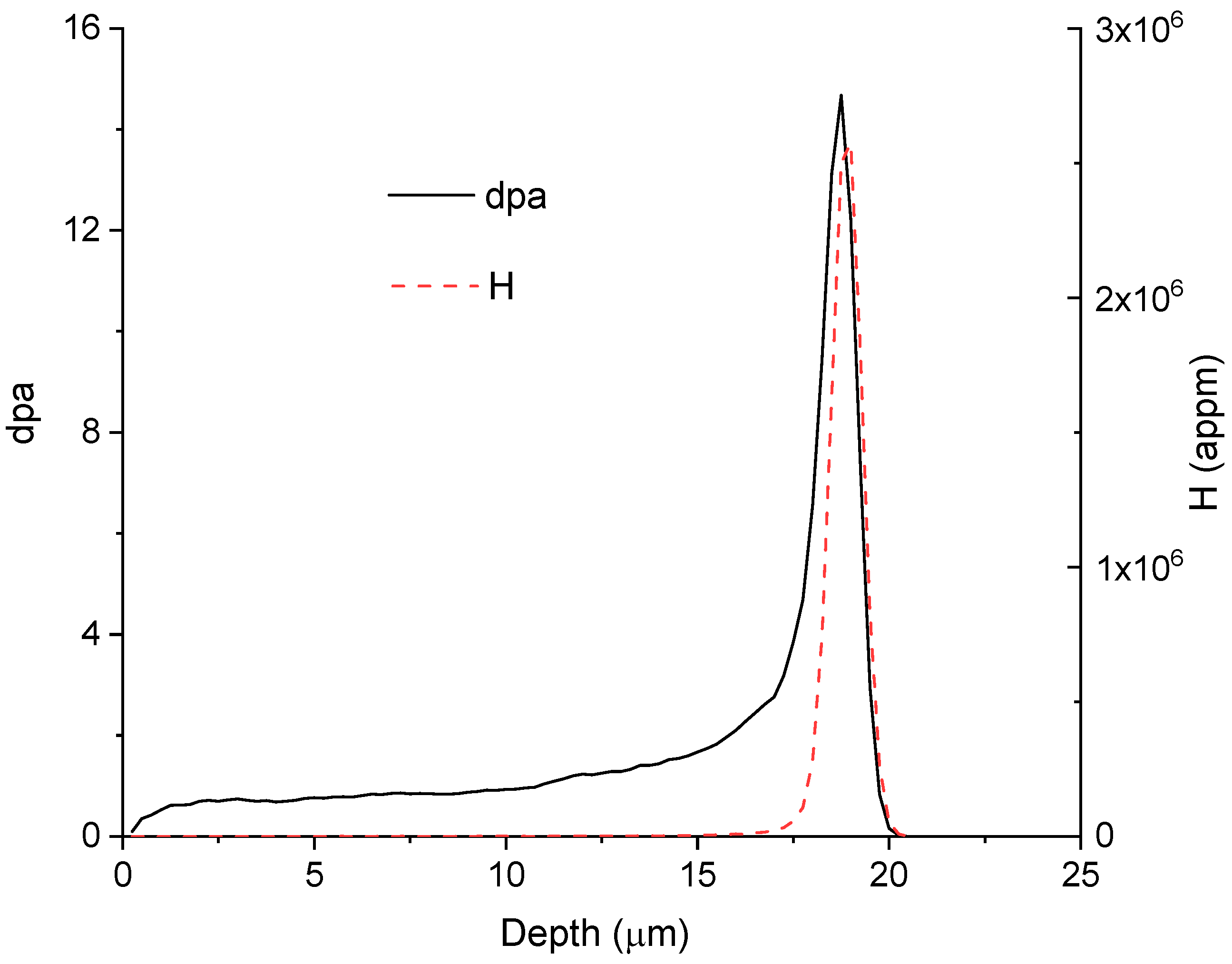
Figure 1 shows the dpa profile and the hydrogen implantation profile calculated using the SRIM code. The dpa profile peaks at a depth of 18.7 µm, while the hydrogen concentration peaks at approximately 19 µm. The dpa was calculated using the Kinchin–Pease (KP) model, assuming a displacement energy of 40 eV for Fe, Ni, and Cr [
22]. The chemical composition (wt.%) of the wrought 316L used in this study is listed in
Table 1.
Transmission electron microscopy (TEM) specimens were prepared using a standard focused ion beam (FIB) lift-out procedure. The initial lift-out and coarse thinning were performed in a Tescan Lyra-3 using 30 keV Ga+ ions, followed by final polishing at 5 keV Ga+. The resulting lamellae were approximately 30 µm × 5 µm in plan view, with the long dimension aligned parallel to the proton irradiation direction.
Microstructural analysis was carried out using a Titan Themis
3 300 S/TEM operated at 300 kV at Texas A&M University. Voids were characterized and quantified using ImageJ software (version 1.54r) [
23]. Void swelling was calculated as S(%) = ΔV/[V (1 − ΔV/V)] × 100, where ΔV/V is the local volume fraction of voids. The lamella thickness was measured by electron energy-loss spectroscopy (EELS); measurements were performed every 1 µm in depth from the original surface, with six approximately equally spaced measurements across the lamella width at each depth.
3. Results
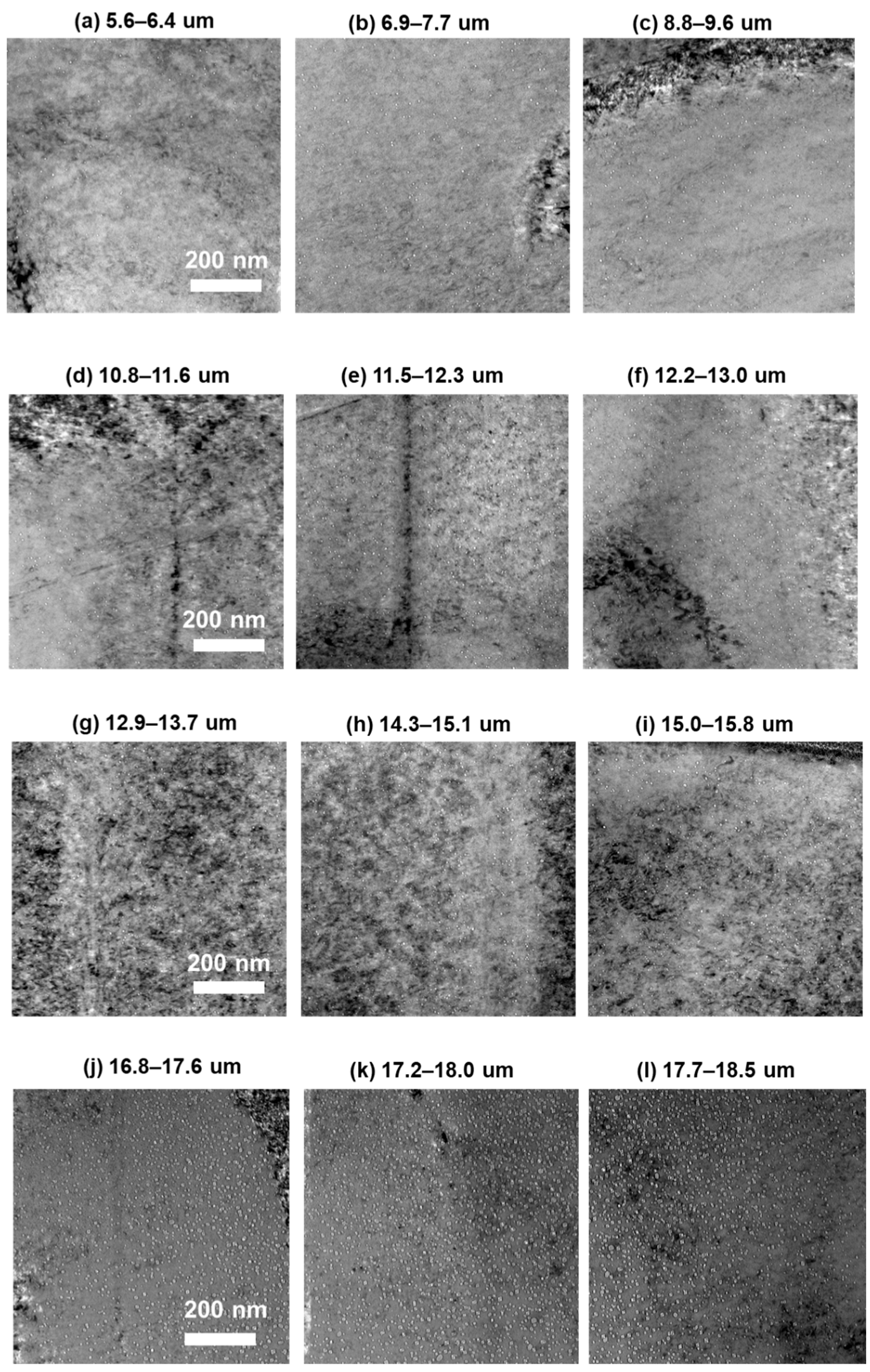
Figure 2 and
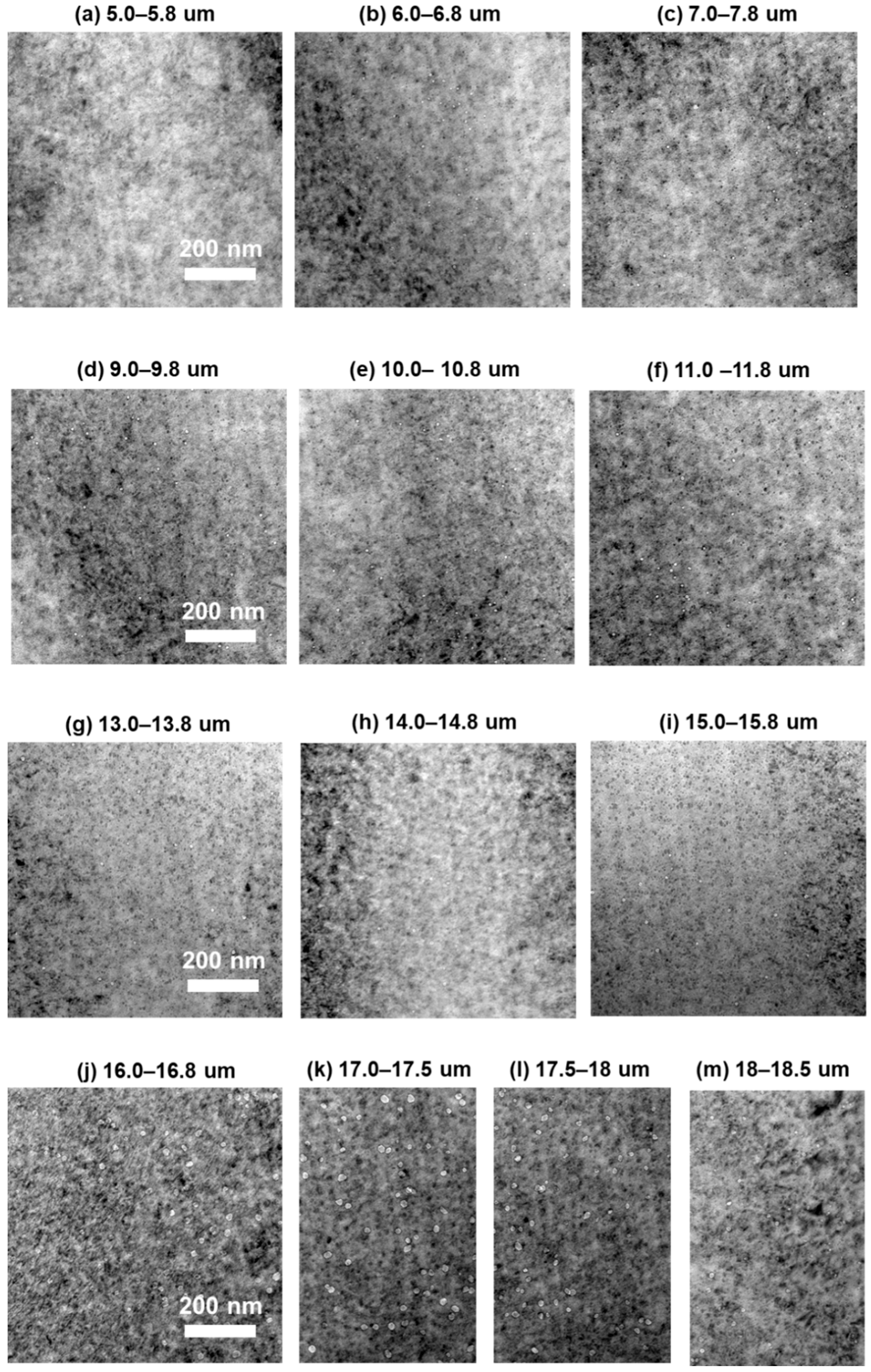
Figure 3 show cross-sectional bright-field TEM images of wrought and AM 316L, respectively, after 2 MeV proton irradiation at 360 °C. A series of TEM images was acquired at successive depth intervals from the irradiated surface into the interior, allowing void swelling to be evaluated continuously as a function of depth; only representative images are shown in
Figure 2 and
Figure 3. Both samples exhibit common features, namely randomly distributed nanometer-sized voids that appear bright in the TEM images. In both cases, a pronounced increase in void size is observed near a depth of about 17 µm. Around this depth, many voids adopt faceted or truncated crystal shapes rather than the nearly spherical morphology seen at shallower depths. With the same 200 nm scale bar used for both materials, it is evident that AM 316L develops larger voids at a lower number density than the wrought 316L.
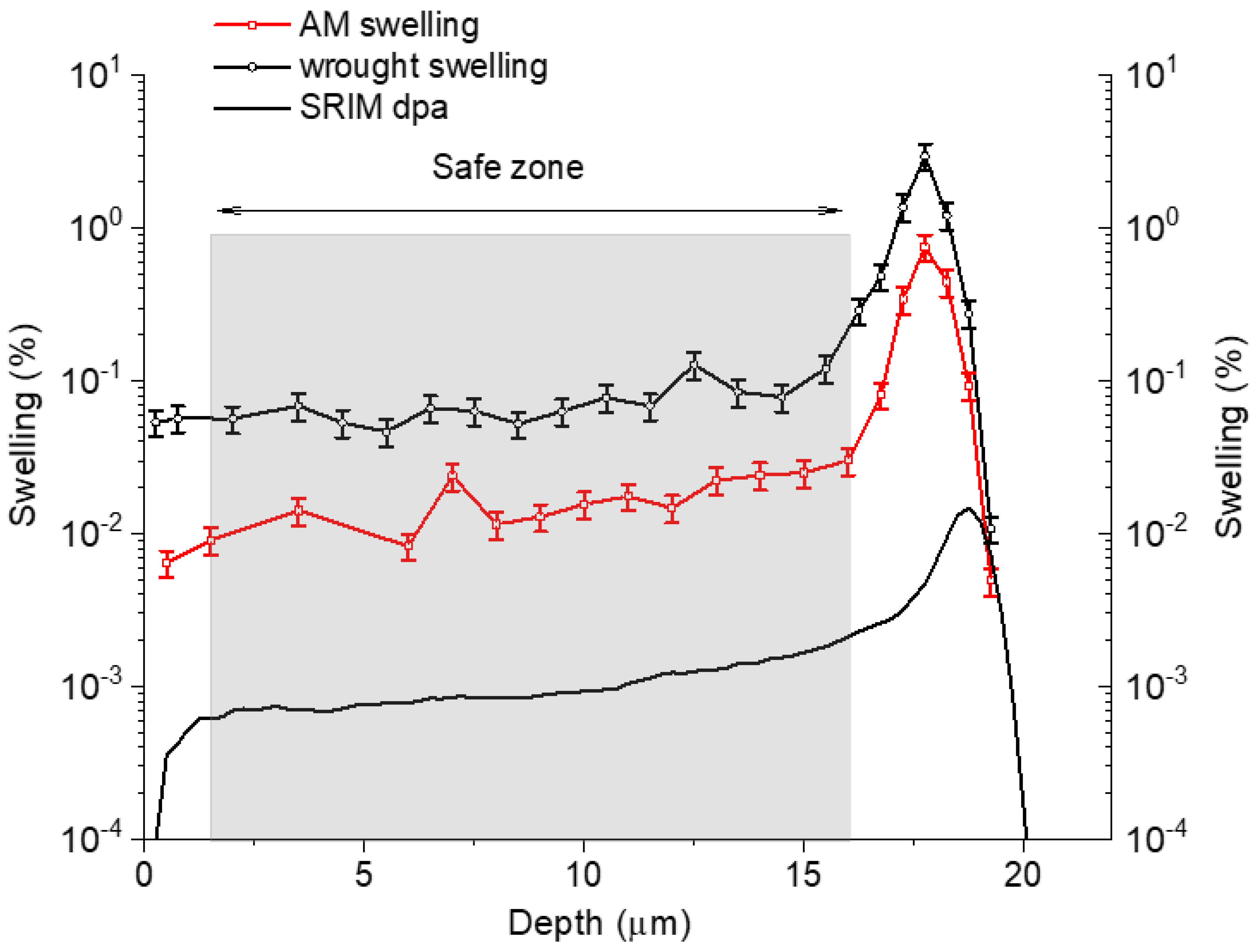
Figure 4 compares the void swelling as a function of depth for both wrought and AM 316L. For reference, the SRIM-predicted dpa profile is superimposed as a solid line. First, the swelling of the AM material is systematically lower than that of the wrought material. Second, the depth dependence of swelling largely follows the dpa profile: swelling increases gradually with depth and then rises sharply to a maximum. However, the swelling maximum occurs at a depth of ≈17.7 µm, whereas the SRIM dpa peak is located at ≈18.7 µm. This discrepancy is attributed to a small inaccuracy in the electronic stopping power used in SRIM. Discrepancies between SRIM stopping power predictions and experimental data have been reported in the literature [
24,
25,
26]. In comparative studies by Paul and Schinner, the accuracy of SRIM was estimated to be on the order of 7–8% for solids [
26]. The observed discrepancy cannot be explained by imperfect alignment during focused ion beam specimen cutting in lamella preparation, since such misalignment would result in a deeper hydrogen distribution rather than a shallower one. In addition, sputtering by 2 MeV protons is negligible. To account for this, in the following discussion, the SRIM dpa profile is rescaled by a factor of 0.947 so that the dpa peak coincides with the swelling peak. This rescaling is helpful when converting depth to local dpa for quantitative comparison. There are fluctuations in the local swelling data points, for example, at a depth of approximately 7 µm. This behavior is typical in swelling profiling, considering statistical variation.
Using the SRIM dpa curve, the depth corresponding to each TEM sampling region was converted to the local dpa.
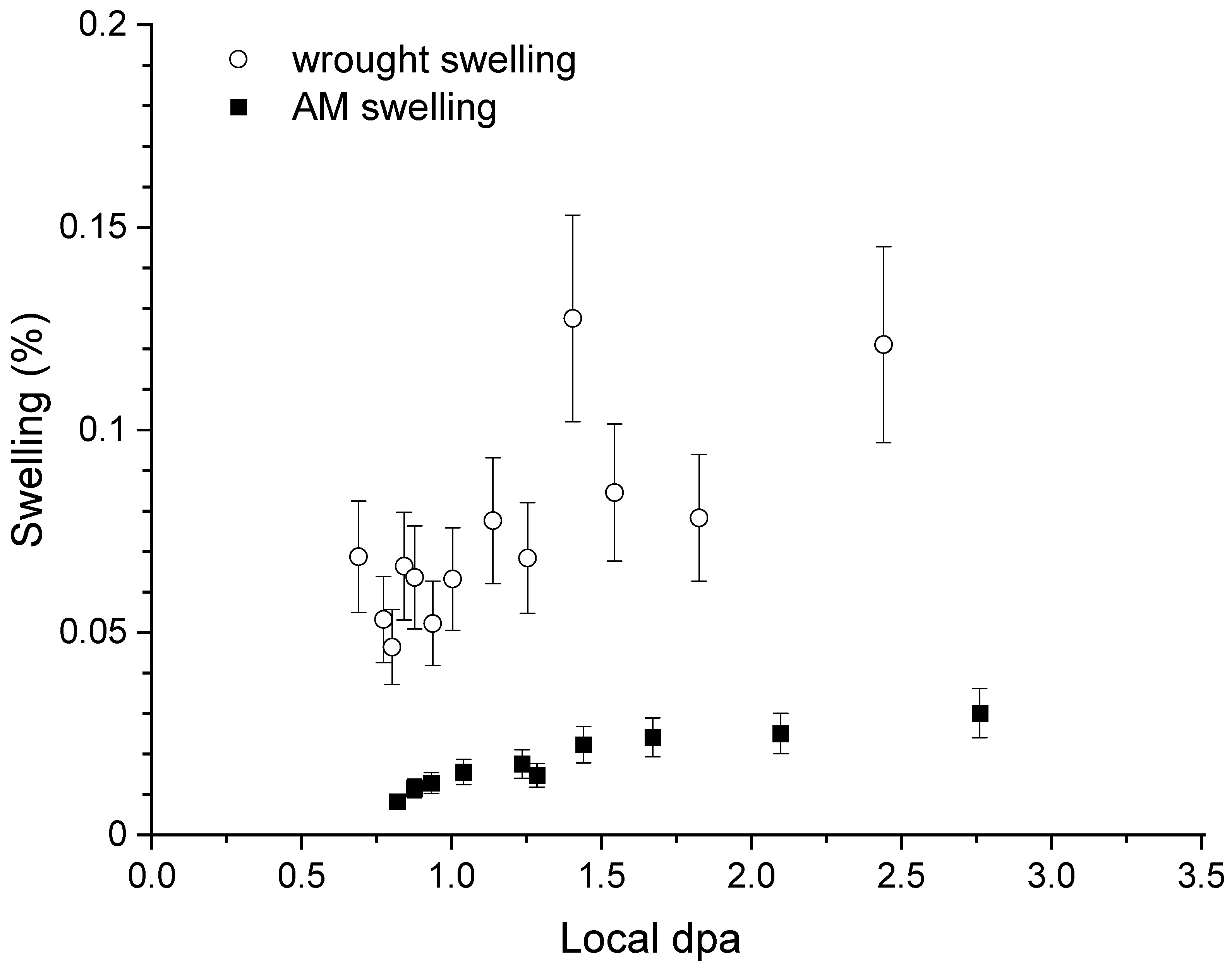
Figure 5 plots the void swelling as a function of local dpa for both materials; only swelling data within the respective safe zones are included. No functional fitting is applied to the data, as the limited dpa range and associated scatter do not justify assuming a specific dose–swelling relationship. Instead, the figure highlights the directly observed trends. The wrought material exhibits a clear increase in swelling with increasing local dpa, with values reaching approximately 0.1–0.15% at damage levels above ~1.5 dpa. In contrast, the AM material shows consistently suppressed swelling across the entire investigated dpa range. Although a modest increase in swelling with dpa is observed for the AM samples, the absolute swelling remains below ~0.03%, substantially lower than that of the wrought material at comparable damage levels.
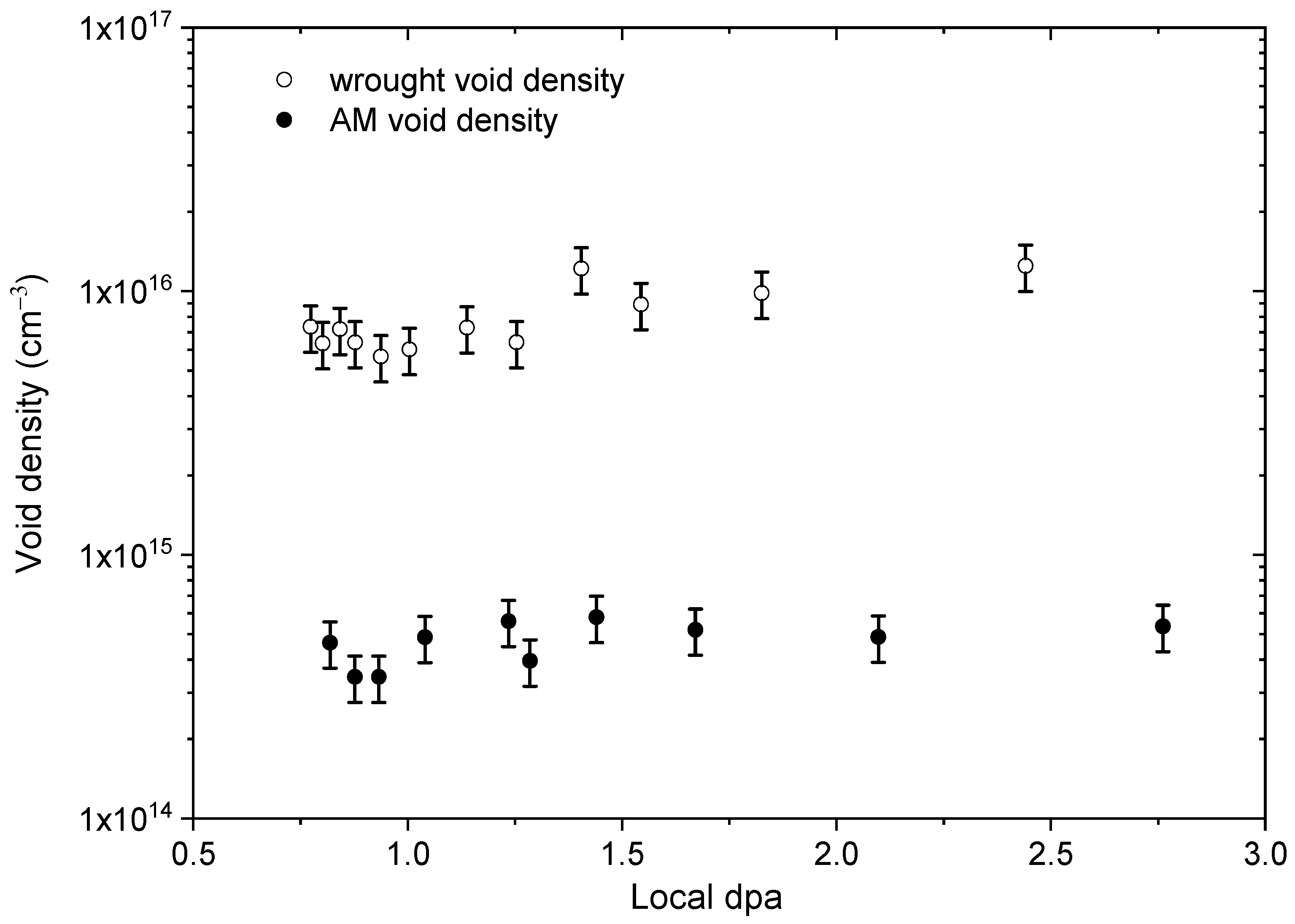
Figure 6 shows the void number density as a function of local dpa for wrought and AM 316L. The void density in the wrought alloy is more than one order of magnitude higher than that in the AM alloy, which is the primary reason that swelling in wrought 316L exceeds that in AM 316L. Beyond this magnitude difference, subtle differences in the response to local dpa are observed between the two materials. In the wrought material, the void density shows a weak increase with increasing local dpa. For example, the void density increases from 7.3 × 10
15 cm
−3 at the lowest data point (0.77 dpa) to 1.24 × 10
16 cm
−3 at the highest data point (2.44 dpa). This trend is subtle and partially obscured by point-to-point fluctuations. The void density in the AM alloy remains approximately constant at ~5 × 10
14 cm
−3 over the examined dpa range; for example, it is 4.7 × 10
14 cm
−3 at the lowest dpa point and 5.3 × 10
14 cm
−3 at the highest dpa point shown in the plot.
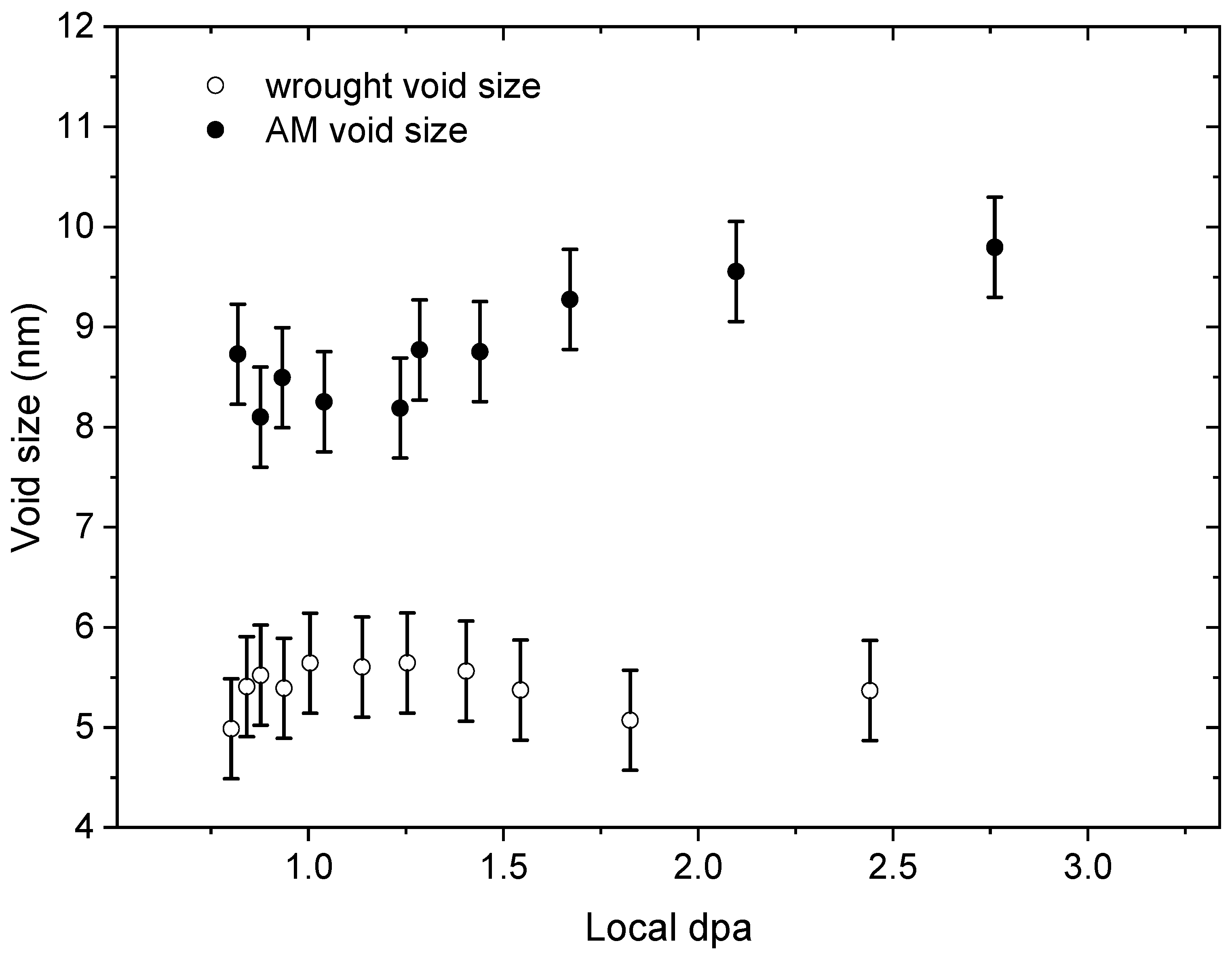
Figure 7 plots the void size as a function of local dpa for both materials. In contrast to the void density, the average void size in the AM alloy is larger than in the wrought alloy. However, the contribution of this size difference to swelling is smaller than the effect of the density difference, so the overall swelling in the AM alloy remains lower than in the wrought alloy. Another notable observation is the different dpa dependences. As shown in
Figure 6, the AM alloy is almost dpa-insensitive in terms of void density, but it exhibits a clear increase in void size with local dpa. The mean void size is about 8.6 nm at the lowest dpa point and increases to approximately 9.5 nm at the highest dpa point. The combined effect of nearly constant density and increasing size leads to a dpa-dependent swelling in the AM alloy. By contrast, the wrought alloy shows an approximately constant void size of about 5–6 nm, but a dpa-dependent increase in void density (as shown in
Figure 6) leads to dpa-dependent swelling (as shown in
Figure 5).
4. Discussion
The present results demonstrate that additively manufactured (AM) 316L stainless steel exhibits a fundamentally different swelling evolution from its wrought counterpart under 2 MeV proton irradiation at 360 °C. Although both materials begin to swell from the lowest measured damage level, their subsequent microstructural evolution diverges markedly. The AM alloy develops larger voids but at a much lower void number density, whereas the wrought alloy forms a high density of smaller voids. These contrasting trends indicate that, even at relatively low dpa, the two materials occupy different regimes of the void swelling process.
A fully quantitative understanding of this behavior would require comprehensive rate-theory calculations, which are beyond the scope of the present study. This limitation arises from both the incomplete availability of defect-kinetics parameters and the difficulty of explicitly accounting for all relevant microstructural features and impurity effects. Nevertheless, a physically grounded, descriptive interpretation can still be developed. The discussion below is based primarily on classical void nucleation theory originally developed by Katz, Wiedersich, and Russell [
27,
28], and more recently revisited and extended by Shao [
29].
In irradiated metals, void swelling generally proceeds through two sequential stages: an initial void nucleation stage, followed by a void growth stage. Whether void nucleation occurs at the onset of irradiation is determined by whether the vacancy supersaturation exceeds a critical threshold value [
27,
29]. Void nucleation theory shows that, at a given temperature, the nucleation rate increases very rapidly with increasing vacancy supersaturation. The nucleation behavior is also strongly influenced by the ratio of interstitial to vacancy arrival fluxes at the void surface; when the arrival rate of interstitials becomes comparable to that of vacancies, void nucleation is effectively suppressed and may not occur [
27,
29]. In addition, the nucleation curves shift with irradiation temperature, such that lower temperatures require higher levels of vacancy supersaturation to sustain a given nucleation rate. Consequently, if irradiation conditions do not generate a sufficiently high vacancy supersaturation, void nucleation will not take place.
Even when vacancy supersaturation is high enough for nucleation to occur, the nucleation process cannot persist indefinitely. As voids nucleate, the newly formed cavities themselves become effective defect-trapping centers, progressively reducing the vacancy supersaturation. Once the vacancy supersaturation drops below the threshold required for nucleation, further void formation is shut down. The duration of the void nucleation stage is therefore governed by how far the initial vacancy supersaturation exceeds the threshold value. In other words, the transition from void nucleation to void growth is controlled by the separation between the initial vacancy supersaturation and the critical vacancy concentration for nucleation. When the initial vacancy supersaturation is sufficiently high, a larger number of voids can nucleate before the system transitions into the growth-dominated stage.
Void nucleation may occur directly within the damage cascade region, even for light-ion irradiation such as proton irradiation. Damage cascade production dominates near the peak damage depth. In heavy-ion irradiation, the peak damage region is well known to exhibit little or no void swelling due to the strong injection of self-interstitial atoms. This observation suggests that void formation is not the limiting factor; rather, void stabilization is critical. Voids can nucleate immediately following damage cascade production, but their survivability requires equilibration with the surrounding supersaturated point-defect population. Furthermore, in both light ion and heavy ion irradiation, the peak damage region lies outside the defined safe zone. Therefore, at least within the safe zone, discussions based on homogeneous void nucleation, without explicitly accounting for damage cascade effects, remain a valid mechanistic framework.
The behavior observed in the AM 316L is consistent with a material that enters the void growth-dominated regime at an early stage. Within the safe zone, the void number density remains approximately constant over the examined dpa range, while the average void size increases monotonically with damage. This indicates that the formation of new voids is strongly suppressed and that swelling proceeds primarily through the growth of a limited population of existing cavities. In contrast, the wrought 316L remains in a nucleation-dominated regime over the same dpa range, as evidenced by the continuous increase in void number density accompanied by nearly constant void sizes.
These differences imply that the initial void nucleation rate is significantly lower in the AM alloy than in the wrought material under the present irradiation conditions. Alternatively, this behavior can be interpreted as indicating a lower initial vacancy supersaturation in the AM alloy compared with the wrought material. Several mechanisms may contribute to this difference. First, AM 316L contains a high density of microstructural features such as sub-grain boundaries, cellular dislocation networks, and internal interfaces produced during rapid solidification. These features are known to act as efficient recombination sites for vacancies and self-interstitial atoms, thereby reducing the steady-state supersaturation of point defects available to drive void nucleation. Second, impurity effects may also play an important role. Additive manufacturing processes can introduce differences in impurity content and distribution relative to wrought materials, particularly for interstitial solutes such as carbon. The binding energies of vacancy-carbon complexes in Fe are 0.41 eV for VC, 1.18 eV for VC
2, and 1.30 eV for VC
3 [
30]. Early studies have shown that the contribution from VC
2 is dominant. The VC complex plays a less significant role due to its much lower binding energy, while VC
3 is also less significant because of its relatively low concentration [
30]. Consequently, even a difference in a few appm in carbon concentration can significantly alter the effective vacancy diffusivity, thereby suppressing void nucleation while still allowing the growth of existing voids [
30].
Dislocation loop analysis was not performed in the present study due to artifacts introduced by FIB damage, which produced numerous small black dot–like features throughout the specimens. Void formation is clearly correlated with dislocation loop evolution. The development of dislocation loops and dislocation network structures is worthy of further investigation after appropriate application of ultra-low-energy ion milling or flash etching.
The wrought and AM materials exhibit measurable differences in Mn, Ni, and Cu contents, with the AM alloy containing higher Ni and lower Mn and Cu concentrations. Variations in Ni content can influence stacking fault energy and, consequently, dislocation behavior and defect clustering. It is well established that Ni can help suppress void swelling in steels [
31,
32,
33]. While such compositional differences may contribute to quantitative variations in swelling behavior, they are unlikely to account for the pronounced reduction in swelling observed in the AM material. Nevertheless, continued comparative studies using more closely composition-matched materials are needed to further isolate the effects of the manufacturing route.
Finally, the combination of proton irradiation and safe-zone analysis provides an effective framework for bridging traditional heavy-ion irradiation studies and reactor-relevant conditions. The relatively deep damage layer and lower damage rate allow swelling behavior to be examined in a regime where both nucleation and growth processes are active, while minimizing artifacts associated with near-surface sinks and injected interstitials. Within this framework, the present results demonstrate that AM 316L stainless steel possesses an intrinsic microstructural advantage in swelling resistance, rooted in altered defect kinetics rather than purely geometric effects.