1. Introduction
High-Intensity Focused Ultrasound (HIFU) has emerged as a rapidly evolving non-invasive therapeutic modality with expanding applications in oncology, neurology, dermatology, and aesthetic medicine [
1,
2,
3]. Unlike conventional diagnostic ultrasound, HIFU enables targeted delivery of acoustic energy to discrete tissue volumes, generating localized biological effects while largely preserving surrounding structures. Focused acoustic pressure, thermal deposition, and mechanical stress allow controlled micro-injury and tissue remodeling at predefined depths [
4,
5].
Advances in biomedical engineering and biophysics have improved understanding of tissue–energy interactions, facilitating the development of therapeutic platforms with enhanced precision and compatibility [
6]. In parallel, scientific attention has focused on skin aging, a multifactorial process influenced by genetics, environmental exposure, and redox imbalance. Cutaneous aging involves collagen degradation, loss of elasticity, impaired regenerative capacity, and increased oxidative stress due to imbalance between reactive oxygen species (ROS) production and antioxidant defenses [
7,
8,
9].
Within aesthetic medicine, HIFU-based technologies are increasingly used for facial and neck rejuvenation. By creating discrete thermal coagulative zones and mechanical micro-injuries, ultrasound exposure stimulates collagen synthesis, elastin reorganization, and dermal structural remodeling. While clinical and morphological outcomes are well documented, accompanying biochemical and molecular responses—particularly those related to redox signaling—remain incompletely characterized in humans [
10,
11,
12].
Mechanistic studies suggest that HIFU can influence signaling pathways involved in extracellular matrix turnover and fibroblast activation, including Caveolin-1–dependent processes [
13]. Experimental evidence also demonstrates that acoustic energy can modulate oxidative and inflammatory pathways, generating ROS and activating antioxidant responses depending on exposure parameters, tissue context, and intensity [
14,
15]. Notably, low-intensity focused ultrasound can modulate oxidative balance without overt tissue damage, suggesting a role for non-thermal mechanisms in redox signaling [
8].
Despite these advances, whether localized HIFU in aesthetic treatments elicits measurable, short-term systemic oxidative responses in humans remains unclear. Most studies focus on histological changes, delayed inflammatory markers, or clinical outcomes, leaving immediate circulating redox dynamics largely unexplored. Understanding these early responses is essential for optimizing treatment safety and explaining inter-individual variability.
Previous clinical studies of HIFU, as an aesthetic procedure, have primarily reported transient localized effects—such as erythema, swelling, tenderness, and mild discomfort—which are generally interpreted as indirect indicators of tissue stress or inflammation. However, no studies to date have systematically evaluated immediate systemic oxidative or redox responses using peripheral blood biomarkers following HIFU exposure in humans. This distinction highlights a critical knowledge gap and provides the rationale for introducing the concept of the ‘oxidative echo’ as a hypothesis-generating framework.
Accordingly, this pilot study prospectively evaluates early changes in circulating oxidative index following a single facial and neck HIFU session. We hypothesized that localized ultrasound exposure would induce a transient, quantifiable oxidative signal, representing an acute increase in oxidative index followed by compensatory antioxidant activity. By characterizing these early dynamics, we aim to provide mechanistic insight into HIFU-mediated tissue remodeling in non-invasive aesthetic interventions.
2. Materials and Methods
2.1. Participants
Only participants aged 45–55 years were included, as this age range represents a characteristic decade during which visible signs of skin aging typically emerge, making it suitable for evaluating biochemical responses to HIFU. Initially, forty individuals were screened for eligibility. Ten were excluded based on predefined criteria (age outside 45–55 years, relevant medical conditions, recent HIFU treatment within the past month, or contraindications for energy-based cosmetic procedures). One volunteer withdrew due to anxiety related to venipuncture, resulting in a final sample of nineteen healthy adults (n = 19).
Participants were allocated to the HIFU intervention group (n = 14) or the control group (n = 5) based on participant preference. Laboratory analysts were blinded to group allocation to ensure independent outcome assessment.
All participants were healthy and free of dermatological or systemic disease. They refrained from smoking for at least 2 h before the first and 3 h before the second blood draw and avoided intense physical activity for 24–48 h prior to sampling. No topical irritants were used during the study period.
Exclusion criteria included pregnancy or lactation, active dermatological conditions, inflammatory acne, known allergies, cardiovascular, hepatic or renal disease, immunosuppression, pacemakers or metallic implants, prior facial plastic surgery, recent dermal filler injections, or use of topical irritants.
All participants provided written informed consent. Ethical approval was obtained from the Bioethics Committee of the National and Kapodistrian University of Athens (Protocol Code PN1072, 30 June 2025), in accordance with the Declaration of Helsinki.
2.2. HIFU Procedure
A standardized HIFU protocol was applied by the first author, who has over 8 years of daily clinical experience and academic training in aesthetic medicine. Each participant underwent a single treatment session lasting 40–60 min, with one or two short breaks provided as needed depending on treatment area and participant comfort.
CE-certified HIFU transducers (2–3 MHz) were selected according to target depth (3–4.5 mm for neck and cheeks; 1.5–3 mm for periorbital region and forehead). No commercial brand names are reported to avoid promotional bias. All procedures strictly followed manufacturer safety guidelines.
Treatment parameters included:
Energy per shot: 0.6–1.2 J (where measurable);
Treatment sequence: neck, cheeks, periorbital region, forehead;
Pain assessment on a 0–10 numerical scale every 10 min, with breaks provided as required;
Total number of shots per participant: 380–480 for face and neck.
2.3. Blood Sampling, Oxidative Stress Assays, and Quality Control
Venous blood samples were collected at baseline (pre-treatment) and immediately after HIFU application. An additional sample was obtained 1 h post-treatment to capture potential delayed oxidative responses. Blood was collected in serum separator tubes (SSTs) (SSTs; Vacutainer SST Lab Tubes, 4.0 mL; BD, Franklin Lakes, NJ, USA). and gently inverted five times to ensure adequate mixing. Samples were allowed to clot at room temperature for 30–60 min and centrifuged at 2000× g for 15 min at either room temperature or 4 °C.
Serum was transferred to clean tubes and stored at −80 °C within 30 min of centrifugation until analysis. All assays were performed in duplicate. Oxidative stress was quantified using a commercially available Total Oxidant Status (TOS) colorimetric ELISA kit (Abcam, Cambridge, UK), following the manufacturer’s instructions. Quantification was based on standard curves generated within the same analytical run.
Additional immunoassay-based biomarkers—including 8-oxo-dG, oxidized LDL (oxLDL), malondialdehyde (MDA), and protein carbonyls—were selected based on established literature and validated benchmarking studies. These assays captured complementary aspects of oxidative damage, including DNA oxidation, lipid peroxidation, and protein oxidation.
Each ELISA run included blanks, multi-point calibration curves, low/medium/high quality control samples, duplicate coefficient of variation (CV) calculations, and monitoring of between-run QC performance. Limits of detection (LODs), limits of quantification (LOQs), linear ranges, and intra- and inter-assay CVs were documented for each assay lot. This structured quality-control framework ensured accuracy, reproducibility, and analytical reliability.
2.4. Statistical Analysis
Data are presented as mean ± standard deviation (SD). The normality of paired differences between pre- and post-treatment measurements was assessed using the Shapiro–Wilk test. As normality assumptions were met, within-group comparisons between baseline and post-treatment values were performed using the paired Student’s t-test.
Statistical significance was evaluated using two-sided tests, with a significance threshold set at
p < 0.05. In addition to
p-values, effect sizes were calculated using Cohen’s d to quantify the magnitude of treatment-related changes, accompanied by 95% confidence intervals (
CIs), in accordance with current recommendations for statistical reporting in applied research [
16,
17].
To evaluate differences in oxidative index changes (Δ values) between the control and HIFU groups over time, a linear mixed-effects model was applied, incorporating fixed effects for time (pre/post), group (control/HIFU), and the time × group interaction. A statistically significant interaction was interpreted as evidence of an HIFU-specific oxidative response.
All statistical analyses were performed using IBM SPSS Statistics for Windows, version 26 (IBM Corp., Armonk, NY, USA). Given the exploratory nature of this pilot study, no a priori sample size calculation was conducted, and results were interpreted accordingly [
17].
2.5. Pilot Sample-Size Justification
This study was designed as an exploratory pilot investigation; therefore, a formal a priori power analysis was not performed. A sample size of 14 participants falls within commonly recommended ranges for pilot studies aimed at estimating effect sizes and evaluating methodological feasibility in preparation for future adequately powered trials. The primary objective was methodological optimization rather than confirmatory hypothesis testing, and the sample was deemed sufficient for detecting preliminary within-subject changes pre- and post-HIFU treatment [
18,
19,
20].
3. Results
3.1. Participant Characteristics
Nineteen healthy adult volunteers (n = 19) completed the study, comprising seventeen women and two men. Five participants (four women and one man) constituted the control group and did not undergo HIFU treatment. For control participants, blood samples were collected at baseline and again after 40 min, matching the timing of post-HIFU measurements in the intervention group.
Baseline demographic and lifestyle characteristics, including age, smoking status, sunscreen use, sun exposure habits, alcohol consumption, physical activity, water intake, self-reported stress levels, medication use, and prior HIFU exposure, are summarized in
Table 1. Smoking status was categorized as smoker (≥1 cigarette/day) or non-smoker, and alcohol consumption as none, occasional (<3 drinks/week), or regular (≥3 drinks/week). Overall, the cohort represented a clinically stable, middle-aged population with no uncontrolled systemic or dermatologic conditions.
The inclusion of a control group (as shown in
Table 2), allowed the assessment of short-term physiological variability in oxidative index measurements. No significant changes were observed in controls over the sampling interval, supporting the attribution of subsequent biochemical changes to the HIFU procedure.
3.2. Oxidative Stress Outcomes
Analysis of oxidative index measurements revealed a distinct acute biochemical response following HIFU treatment, contrasted with stable values in the control group. In HIFU-treated participants, mean oxidative index values increased from 19.99 ± 1.54 μmol/L at baseline to 22.39 ± 2.29 μmol/L immediately post-treatment (
Table 3). Individual responses demonstrated consistent directionality, with all treated participants exhibiting an increase relative to baseline. The mean paired difference was 2.63 ± 2.22 μmol/L, with observed changes ranging from 0.41 to 6.85 μmol/L, indicating moderate inter-individual variability.
Normality of paired differences was confirmed using the Shapiro–Wilk test (W = 0.910, p = 0.156), supporting the use of parametric analyses. A paired-sample t-test demonstrated a statistically significant post-treatment increase in oxidative index values (t(13) = 4.43, p = 0.0007). The magnitude of the within-subject effect was large (Cohen’s d = 1.18, 95% CI [0.52, 1.83]).
In contrast, oxidative index values in the control group remained stable across the corresponding sampling interval (baseline vs. 40 min: 18.55 ± 0.57 μmol/L at both time points). Paired-sample analysis confirmed the absence of significant change (t(4) = 0.00, p = 1.00), with a mean Δ of 0.00 ± 0.00 μmol/L and minimal within-group variability.
Direct comparison of change scores (Δ values) between groups demonstrated a statistically significant difference between HIFU-treated participants (2.63 ± 2.22 μmol/L) and controls (0.00 ± 0.00 μmol/L; p = 0.0007). A mixed-effects model incorporating fixed effects for time (pre/post), group (HIFU/control), and their interaction further confirmed these findings, revealing a statistically significant time × group interaction (p < 0.001). This interaction indicates that the observed increase in oxidative index was specifically associated with the HIFU intervention rather than short-term physiological fluctuation.
3.3. Clinical Outcomes and Safety Observations
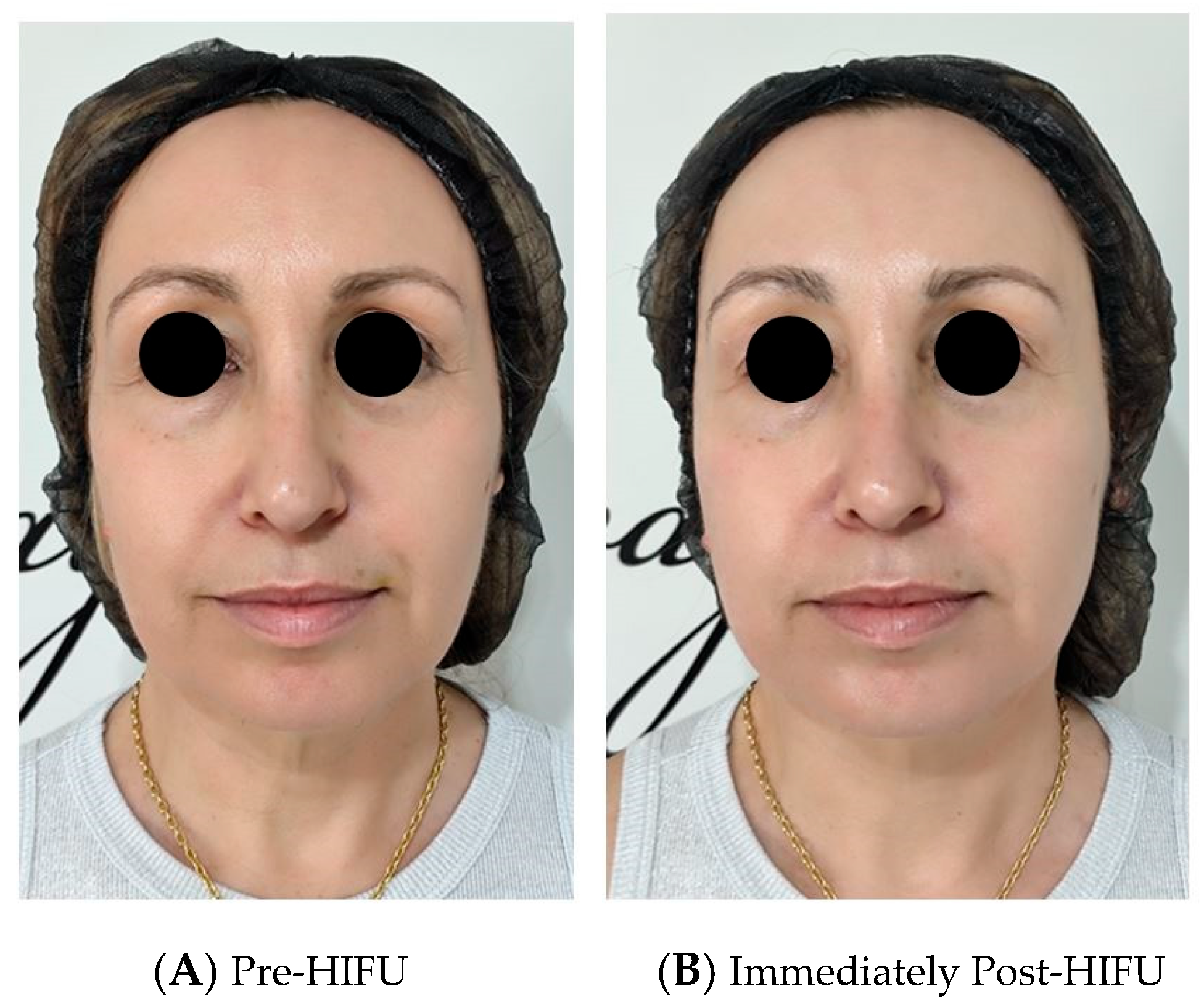
Clinical evaluation performed immediately following HIFU treatment revealed visible aesthetic changes in all treated participants (n = 14). Observed outcomes included skin tightening of the facial contour and neck, improved skin texture and tonicity, and a subtle lifting effect. These findings were documented through standardized photographic assessment.
No adverse clinical effects were observed during or immediately after the procedure. In particular, there were no signs of erythema, edema, burns, or inflammatory reactions attributable to the treatment. The absence of acute adverse events supports the short-term tolerability of the procedure under the applied treatment parameters.
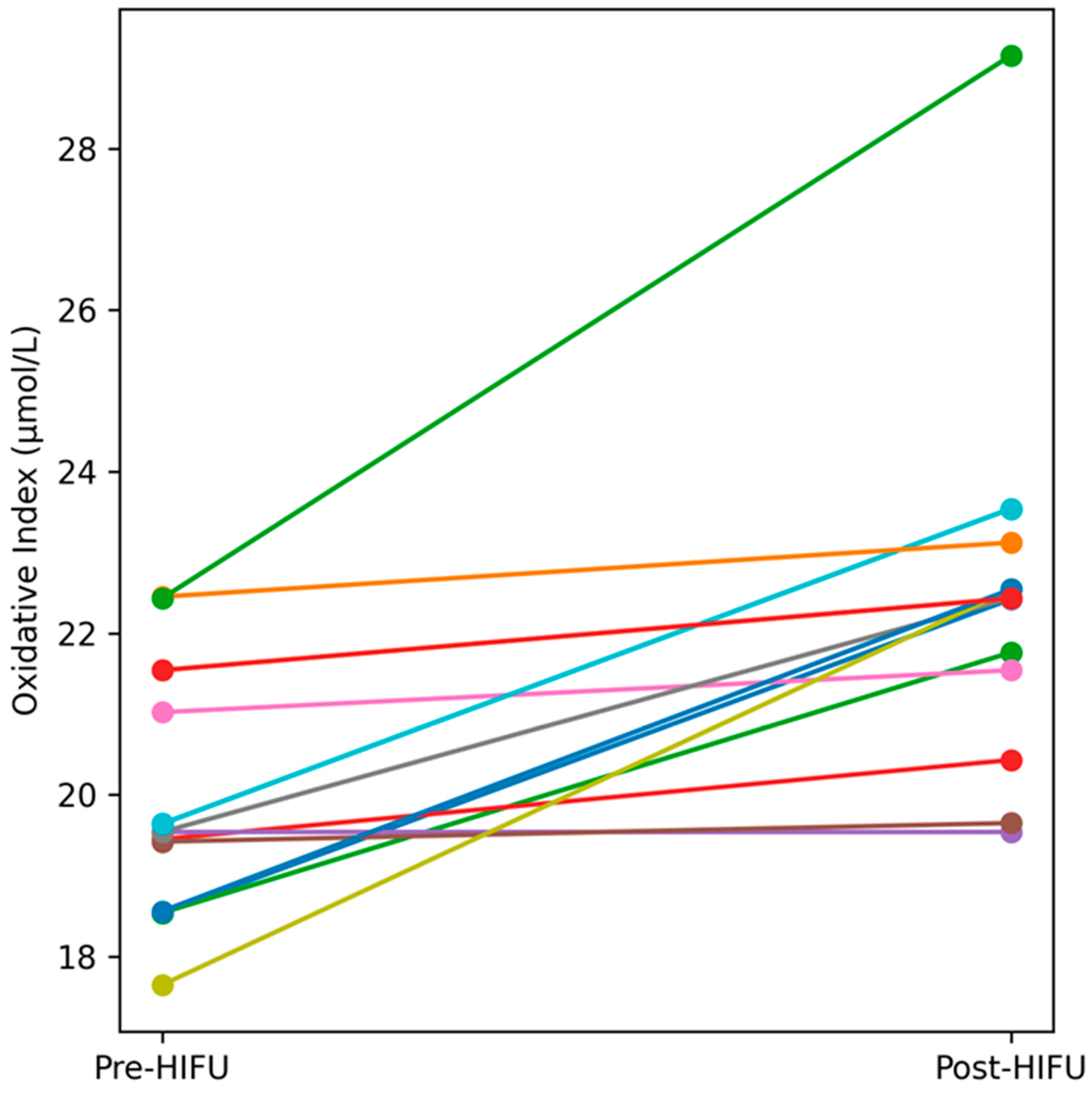
As illustrated in
Figure 1, oxidative index values showed a consistent increase immediately after HIFU treatment compared with baseline measurements, while remaining stable in control participants. The figure provides a visual representation of the within-subject changes observed across the study cohort.
The procedure demonstrated favorable safety and tolerability characteristics. No adverse events were reported. No participant exhibited erythema, edema, irritation, or persistent discomfort. Mild transient numbness or tingling occurred in a few cases, resolving spontaneously within minutes. In four participants, momentary pauses were required when treating bony regions. Use of verbal guidance and calming auditory stimuli improved comfort. No delayed reactions or complications were observed. These findings indicate that the transient oxidative activation elicited by HIFU was not associated with clinically relevant adverse effects.
3.4. Subgroup Analyses
Exploratory subgroup analyses were performed to evaluate potential associations between the magnitude of oxidative index change (Δ) and key demographic or behavioral variables, including age, sex, smoking status, alcohol consumption, and self-reported stress level. No statistically or clinically meaningful associations were detected between these variables and the acute oxidative response following HIFU treatment.
The absence of detectable subgroup effects likely reflects both the relative homogeneity of the study population and the limited sample size, which inherently reduces statistical power and the ability to identify subtle inter-individual differences. Consequently, these findings should be interpreted with caution and do not allow for definitive conclusions regarding the influence of demographic or lifestyle characteristics on the oxidative response to HIFU.
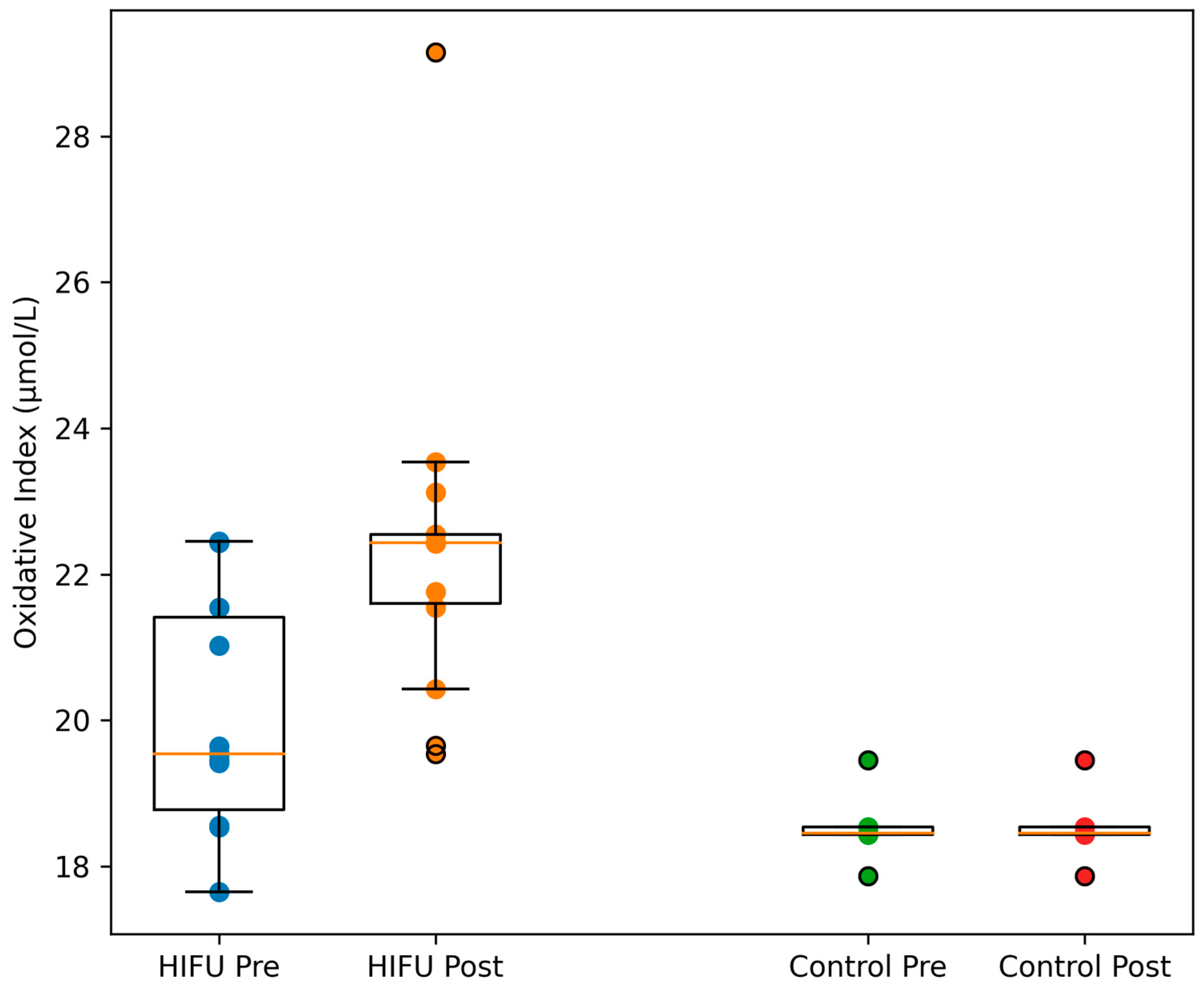
As illustrated in
Figure 2, oxidative index values in the HIFU group exhibited a clear and consistent upward shift immediately following treatment compared with baseline measurements. Boxplot analysis demonstrates an increase in median values and overall distribution post-treatment, with individual participant data points confirming the uniformity of this response across the treated cohort. In contrast, the control group showed no measurable change in oxidative index between baselines and the 40 min follow-up, further supporting biomarker stability in the absence of intervention.
The statistically significant difference between pre- and post-HIFU measurements (p = 0.0007) reinforces the interpretation that the observed oxidative elevation represents a direct, procedure-related effect rather than spontaneous physiological fluctuation, circadian variation, or analytical variability.
Collectively, these results demonstrate that HIFU induces a rapid, reproducible, and treatment-specific acute increase in oxidative index immediately following application (
Figure 3). The consistency of the oxidative response across participants, combined with the absence of significant subgroup effects and adverse clinical reactions, suggests that this phenomenon reflects a generalized biological response to focused ultrasound exposure. This pattern is compatible with the concept of a transient “oxidative echo,” representing an early redox signal associated with controlled tissue stress and subsequent remodeling processes rather than pathological oxidative damage.
4. Discussion
This pilot study is the first clinical investigation to systematically evaluate immediate oxidative index responses following a single HIFU session in human facial and neck tissues. HIFU induced a transient but statistically significant increase in systemic oxidative index shortly after treatment, whereas untreated controls showed no change. This indicates a treatment-specific biochemical response rather than nonspecific fluctuations due to circadian rhythm, venipuncture, procedural stress, or analytical variability.
The consistent increase in oxidative index observed across treated participants supports the presence of a rapid and reproducible procedure-related redox response. One participant exhibited a pronounced oxidative index increase, likely reflecting inter-individual variability in baseline antioxidant capacity, skin type, microvascular responsiveness, lifestyle-related oxidative status, or local tissue sensitivity to acoustic energy. While most participants showed moderate and consistent changes, this variability highlights the heterogeneity of acute oxidative responses and the need for future larger, stratified studies.
Mechanistically, HIFU delivers acoustic energy to defined tissue depths, generating localized temperatures of 60–70 °C within the dermis, subcutaneous fat, and SMAS. This controlled thermal exposure creates localized thermal micro-injuries that trigger tissue contraction and activate wound-healing cascades [
3,
8,
10]. Thermal and mechanical stress provoke rapid mitochondrial activation, transient Reactive oxygen species (ROS) formation, and short-lived inflammatory signaling, contributing to tissue remodeling and collagen synthesis.
Previous studies show that HIFU promotes fibroblast activation, extracellular matrix turnover, and increased collagen and elastin synthesis [
1,
3,
8]. Mild, self-limited discomfort during treatment likely reflects this controlled tissue stress rather than injury. The observed increase in oxidative index represents a physiological, transient oxidative signal accompanying tissue remodeling rather than pathological oxidative damage [
7,
9,
11,
15].
Including a matched control group strengthens the study’s internal validity by showing the stability of the oxidative index in the absence of HIFU. The combination of a transient oxidative response with immediate aesthetic improvements suggests that controlled redox activation may contribute to the therapeutic effects of ultrasound-based rejuvenation.
Future studies should employ larger, randomized designs with extended follow-up (e.g., 3 and 6 months) to examine persistence or resolution of oxidative responses. Incorporating a broader biomarker panel—including DNA oxidation (8-oxodG), lipid peroxidation (oxidized LDL), protein carbonylation, and cysteine oxidation—would allow more comprehensive assessment of redox homeostasis and tissue remodeling [
12,
14]. Such multidimensional approaches will help distinguish adaptive oxidative signaling from maladaptive oxidative stress and clarify links to long-term aesthetic outcomes.
Overall, these findings provide preliminary evidence that HIFU induces a controlled, transient increase in oxidative index consistent with its known mechanisms of action. This study highlights HIFU as a biologically active, safe, non-invasive modality in aesthetic medicine and underscores the value of oxidative index as a sensitive biomarker for tissue-level responses to energy-based interventions.
5. Limitations
This pilot study provides evidence of acute systemic oxidative responses following HIFU; however, several limitations should be acknowledged. First, the small sample size (n = 19) and pilot design restrict statistical power, particularly for subgroup analyses, and limit the generalizability of the findings. Second, allocation based on participant preference rather than randomization may have introduced selection bias, although blinded biochemical assessments were employed to mitigate this effect. Third, the investigation focused primarily on immediate and short-term biochemical responses, precluding conclusions regarding the temporal evolution, persistence, or long-term clinical relevance of HIFU-induced redox changes. Additionally, peripheral blood biomarkers may not fully capture local tissue-specific oxidative and inflammatory processes.
Future studies with larger, randomized cohorts, extended follow-up periods (e.g., 3 and 6 months), and comprehensive biomarker panels—including DNA oxidation, lipid peroxidation, protein carbonylation, and cysteine oxidation—are warranted to more thoroughly characterize redox homeostasis, inflammatory adaptation, and tissue remodeling dynamics following HIFU interventions.
Accordingly, the present findings should be interpreted as preliminary and hypothesis-generating, providing a foundation for future research rather than conclusive evidence of HIFU-induced tissue remodeling or long-term clinical effects.
6. Conclusions
In conclusion, this pilot study demonstrates that a single HIFU session is associated with a statistically significant acute increase in oxidative index in human participants, while oxidative markers in matched control subjects remain stable, confirming a procedure-specific biochemical effect [
7,
12,
13].
This transient oxidative activation occurs in the absence of adverse clinical effects and coincides with immediate aesthetic improvements, including enhanced skin tightening, improved texture, and increased tonicity. These findings support the overall safety, tolerability, and potential efficacy of HIFU as a non-invasive aesthetic intervention [
5,
9,
11]. Mechanistically, the observed effects are consistent with the focal thermal injury induced by HIFU, which initiates a controlled inflammatory response, activates dermal fibroblasts, and promotes extracellular matrix remodeling, aligning with the concept of a transient “oxidative echo” [
1,
3,
7].
Taken together, these results highlight the need for further longitudinal investigations to elucidate the temporal dynamics, underlying mechanisms, and clinical relevance of HIFU-induced oxidative and inflammatory responses. Structured follow-up assessments at 3- and 6-month intervals will be particularly valuable for evaluating the persistence of biochemical alterations and aesthetic outcomes. Moreover, larger randomized controlled studies incorporating multiple biomarkers of oxidative stress and tissue remodeling are warranted to validate these preliminary findings, explore potential subgroup-specific responses, and contribute to the development of standardized, optimized HIFU treatment protocols that maximize efficacy while maintaining safety [
12,
15].
Overall, this study provides the first clinical evidence linking HIFU treatment to immediate oxidative activation, offering novel mechanistic insights and supporting the continued investigation of HIFU as a safe and biologically active non-invasive modality for facial rejuvenation.
Author Contributions
Conceptualization, F.B. and A.C.L.; methodology, F.B.; I.A.A. and A.C.L.; software, D.C. and F.C.; validation, F.C., A.V. and E.P.; formal analysis, V.P.; investigation, F.B.; resources, A.M.M.; data curation, V.P. and G.S.; writing—original draft preparation, F.B. and I.A.A.; writing—review and editing, F.B. and I.A.A.; visualization, G.S.; supervision, E.P.; A.V. and A.C.L.; project administration, D.C., N.T. and A.C.L.; funding acquisition, F.B. All authors have read and agreed to the published version of the manuscript.
Funding
This research received no external funding.
Institutional Review Board Statement
The study was conducted in accordance with the Declaration of Helsinki and received institutional ethics approval from the National and Kapodistrian University of Athens (Protocol Code PN1072, approval date 30 June 2025). The study protocol was reviewed and approved by the Ethics Committee of NKUA, ensuring that all procedures involving human participants adhered to the highest ethical standards.
Informed Consent Statement
Informed consent was obtained from all subjects involved in the study. Written informed consent has been obtained from the patient(s) to publish this paper.
Data Availability Statement
The data supporting the findings of this study are not available due to privacy and/or ethical restrictions.
Acknowledgments
We thank Alexandra Noussi for her contribution to the blood sampling.
Conflicts of Interest
The authors declare no conflicts of interest.
Abbreviations
The following abbreviations are used in this manuscript:
| HIFU | High Intensity Focused Ultrasound |
| SD | Standard Deviation |
| QC | Quality Control |
| CV | Coefficient of Variation |
| LOD | Limit of Detection |
| Within-run CV | Within-run Coefficient of Variation |
| Between-run QC | Between-run Quality Control |
| Δ | Change (post − pre) |
| P01 | Participant 1 |
| LOQ | Limit of Quantification |
| T4 | Thyroxine (Levothyroxine) |
References
- Pollet, B.G.; Foroughi, F.; Faid, A.Y.; Emberson, D.R.; Islam, M. Biological effects of high-intensity focused ultrasound (HIFU): Mechanisms and clinical applications in medicine and aesthetic therapy. Ultrason. Sonochem. 2021, 70, 105238. [Google Scholar] [CrossRef] [Scilit]
- Bachu, V.S.; Kedda, J.; Suk, I.; Green, J.J.; Tyler, B. High-Intensity Focused Ultrasound: A Review of Mechanisms and Clinical Applications. Ann. Biomed. Eng. 2021, 49, 1975–1991. [Google Scholar] [CrossRef] [Scilit] [PubMed]
- Choi, J.W.; Lee, J.H. Safety and efficacy of high-intensity focused ultrasound in aesthetic medicine: A review. Lasers Surg. Med. 2022, 54, 430–438. [Google Scholar] [CrossRef] [Scilit]
- Suh, D.H.; Lee, S.J.; Rho, J.H.; Kim, N.I. Clinical safety and efficacy of microfocused ultrasound in facial rejuvenation. J. Cosmet. Dermatol. 2020, 19, 2317–2324. [Google Scholar] [CrossRef] [Scilit]
- Kim, H.J.; Kim, J.Y.; Lee, J.H.; Park, K.Y.; Li, K.; Seo, S.J. Histological and clinical evaluation of high-intensity focused ultrasound treatment for skin rejuvenation. Skin Res. Technol. 2021, 27, 792–799. [Google Scholar] [CrossRef] [Scilit]
- Oh, S.; Rhee, D.Y.; Batsukh, S.; Son, K.H.; Byun, K. High-Intensity Focused Ultrasound increases collagen and elastin fiber synthesis by modulating Caveolin-1 in aging skin. Cells 2023, 12, 2275. [Google Scholar] [CrossRef] [Scilit] [PubMed]
- Melde, K.; Athanassiadis, A.G.; Missirlis, D.; Shi, M.; Seneca, S.; Fischer, P. Ultrasound-assisted tissue engineering. Nat. Rev. Bioeng. 2024, 2, 486–500. [Google Scholar] [CrossRef] [Scilit]
- Cao, Q.; Liu, L.; Hu, Y.; Cao, S.; Tan, T.; Huang, X.; Deng, Q.; Chen, J.; Guo, R.; Zhou, Q. Low-intensity focused ultrasound regulates oxidative stress responses in biological tissues. Ultrasound Med. Biol. 2023, 49, 2213–2224. [Google Scholar] [CrossRef] [Scilit]
- Biskanaki, F.; Tertipi, N.; Sfyri, E.; Kefala, V.; Rallis, E. Complications and Risks of High-Intensity Focused Ultrasound (HIFU) in Esthetic Procedures: A Review. Appl. Sci. 2025, 15, 4958. [Google Scholar] [CrossRef] [Scilit]
- Chen, H.; Li, Y.; Sang, P. Advances in biomedical engineering technologies: Applications in human physiology, disease mechanisms, and therapeutic innovation. Biomed. Pharmacother. 2024, 170, 115055. [Google Scholar]
- Mello, L.D. Potential contribution of ELISA and LFI assays to assessment of oxidative stress based on the 8-oxodG biomarker. Anal. Biochem. 2021, 628, 114215. [Google Scholar] [CrossRef] [Scilit] [PubMed]
- Wonisch, W.; Tatzber, F.; Lindschinger, M.; Falk, A.; Resch, U.; Mörkl, S.; Zarkovic, N.; Cvirn, G. Clinical relevance of antibodies against oxidized LDL within three decades by ELISA technology. Antioxidants 2024, 13, 1560. [Google Scholar] [CrossRef] [Scilit] [PubMed]
- Yang, J.; Luo, J.; Tian, X.; Zhao, Y.; Li, Y.; Wu, X. Progress in understanding oxidative stress, aging, and aging-related diseases. Antioxidants 2024, 13, 394. [Google Scholar] [CrossRef] [Scilit] [PubMed]
- Tuncay, A.; Crabtree, D.R.; Muggeridge, D.J.; Husi, H.; Cobley, J.N. Performance benchmarking of microplate immunoassays for quantifying cysteine oxidation. Free Radic. Biol. Med. 2023, 204, 252–265. [Google Scholar] [CrossRef] [Scilit] [PubMed]
- Poljšak, B.; Fink, R. The protective role of antioxidants against ROS/RNS-mediated damage. Oxid. Med. Cell. Longev. 2021, 2021, 8567392. [Google Scholar] [CrossRef] [Scilit]
- Rittié, L.; Fisher, G.J. Natural and sun-induced aging of human skin. Cold Spring Harb. Perspect. Med. 2020, 10, a015370. [Google Scholar] [CrossRef] [Scilit] [PubMed]
- Meteyard, L.; Davies, R.A.I. Best practice guidance for linear mixed-effects models in experimental research. J. Mem. Lang. 2020, 112, 104092. [Google Scholar] [CrossRef] [Scilit]
- Hertzog, M.A. Considerations in determining sample size for pilot studies. Res. Nurs. Health 2020, 43, 194–203. [Google Scholar] [CrossRef] [Scilit] [PubMed]
- Billingham, S.A.; Whitehead, A.L.; Julious, S.A. An audit of sample sizes for pilot and feasibility trials. BMC Med. Res. Methodol. 2023, 23, 12. [Google Scholar] [CrossRef] [Scilit]
- Sim, J.; Lewis, M. The size of a pilot study for a clinical trial should be calculated in relation to considerations of precision and efficiency. J. Clin. Epidemiol. 2021, 135, 301–308. [Google Scholar] [CrossRef] [Scilit] [PubMed]
| Disclaimer/Publisher’s Note: The statements, opinions and data contained in all publications are solely those of the individual author(s) and contributor(s) and not of MDPI and/or the editor(s). MDPI and/or the editor(s) disclaim responsibility for any injury to people or property resulting from any ideas, methods, instructions or products referred to in the content. |




 ,
,