Review

Porphyrin-Conjugated Hybrid Nanomaterials for Photocatalytic Wastewater Remediation

School of Chemical Materials Engineering, Kumoh National Institute of Technology, Gumi 39177, Republic of Korea
*
Author to whom correspondence should be addressed.
Appl. Sci. 2026, 16(3), 1557; https://doi.org/10.3390/app16031557
Submission received: 27 November 2025 / Revised: 22 January 2026 / Accepted: 2 February 2026 / Published: 4 February 2026
(This article belongs to the Special Issue Applications of Nanoparticles in the Environmental Sciences)

Abstract

Advanced oxidation processes using porphyrin-based heterogeneous catalysts hold promise for removing hazardous pollutants from wastewater. Their high visible-light absorption coefficients enable absorption of light from the solar spectrum. Moreover, their conjugated aromatic skeletons and intrinsic electronic properties facilitate the delocalization of photogenerated electrons during photodegradation. Delaying the recombination of photogenerated electron–hole pairs by introducing specific materials increases efficiency, as separated charges have more time to participate in redox reactions, boosting photocatalytic activities. However, applying these photocatalysts for wastewater treatment is challenging owing to facile agglomeration, deactivation, and recovery of the photocatalyst for reuse, which can significantly increase the overall cost. Therefore, new photocatalytic systems comprising porphyrin molecules must be developed. For this purpose, porphyrins can be conjugated to nanomaterials to create hybrid materials with photocatalytic efficiencies superior to those of free-standing starting porphyrins. Various transition metal oxides (TiO2, ZnO, and Fe3O4) nanoparticles, main-group-element oxides (Al2O3 and SiO2) nanoparticles, metal plasmons (silver nanoparticles), carbon-based platforms (graphene, graphene oxide, and g-C3N4), and polymer matrices have been used as nanostructured solid supports for the successful fabrication of porphyrin-conjugated hybrid materials. The conjugation of porphyrin molecules to solid supports improves the photocatalytic degradation activity in terms of visible-light conversion ability, recyclability, active porous sites, substrate mobility, separation of photogenerated charge species, recovery for reuse, and chemical stability, along with preventing the generation of secondary pollution. This review discusses the ongoing development of porphyrin-conjugated hybrid nanomaterials for the heterogeneous photocatalytic degradation of organic dyes, pharmaceutical pollutants, heavy metals, pesticides, and human care in water. Several important results and advancements in the field allow for a more efficient wastewater remediation process.

1. Introduction

Environmental pollution resulting from the rapid growth of industrialization and civilization is increasing. Every year, large quantities of toxic compounds such as synthetic dyes, pesticides, biphenyls, phenols, plasticizers, pigments, herbicides, and nitro/amino molecules are released from leather, textile, paper printing, and pharmaceutical industries into water bodies. These hazardous contaminants not only harm water potability but also pose a major threat to the entire ecosystem and negatively impact aquatic homeostasis [1,2]. This has prompted researchers and environmentalists to develop advanced approaches for wastewater treatment [3,4,5,6]. Several physicochemical and biological processes for removing hazardous compounds from wastewater have been reported, including advanced oxidation processes (AOPs) [7], adsorption [8], chemical coagulation [9], precipitation [10], and bacterial treatments [11].
Among different methods used in wastewater treatment, the advanced oxidative processes (AOPs) are an increasingly adopted process for wastewater treatment owing to their simplicity, economic affordability, and high degradation activity. Moreover, this technique oxidizes toxic contaminants to less toxic CO2 and H2O, without causing additional pollution. In these techniques, reactive oxygen species (ROS) are generated after light absorption by an ideal photocatalyst and oxidize toxic molecules [12,13,14,15,16,17]. Heterogenous photodegradation reaction has received significant attention owing to the ecological and economic advantages associated with the use of freely available solar light. The degradation mechanism consists of several simple steps. Light harvesting and exciton diffusion occur first, followed by charge separation and transport. Therefore, light absorption and subsequent electron transfer play crucial roles in the degradation of toxic compounds in water. Microscale or nanoscale architectures generally exhibit interesting electronic and optical characteristics, depending on their morphologies. Consequently, the design and construction of micro and nanoscale frameworks are fundamental for fabricating photocatalytic systems with special functions and properties [18,19,20,21,22,23].
Owing to the benefits of catalytic photodegradation of pollutants in water, numerous organic and inorganic micro- and nanomaterials have been used as building blocks to develop photocatalytic systems. Several inorganic nano and microstructures such as metal-oxide nanoparticles (TiO2 [24], ZnO [25], SnO2 [26], Fe3O4 [27], CuO [28]), MgO [29], V2O5 [30], CeO2 [31], silicates [32], CdS [33], zeolites [34], and bismuth-based catalysts [35] have been employed to remove hazardous contaminants from sewerage. Among these nanomaterials, TiO2 and ZnO have emerged as the most useful photocatalysts owing to their large permanent porosity, low cost, eco-friendliness, low toxicity, high stability, and high degree of degradation efficiency for the catalytic photodegradation of toxic compounds in H2O. However, the large band gap energies (Eg) of ZnO (approximately 3.37 eV) and TiO2 (approximately 3.20 eV) restrict the absorption of solar light under the visible-light region (λ < 370 nm). Moreover, a high degree of recombination between the photoinduced electrons and holes limits its practical application. This lowers their visible-light photodegradation activity. Additionally, a high amount of TiO2 or ZnO is required for initial loading in the catalytic photodegradation reaction to attain fruitful decomposition rates [36,37,38,39].
Compared with inorganic photocatalysts, organic-based micro- and nanostructures have received ample attention. This is because of the considerable flexibility in molecular design, outstanding solution-phase characteristics, and excellent tunability of the optoelectronic properties, which make them unique for catalytic photodegradation systems. Various organic building blocks such as graphene oxide (GO) or reduced graphene oxide (rGO) [40], fullerene [41], carbon quantum dots (CQDs) [42], graphitic carbon nitride (g-C3N4) [43], and porphyrins [44] have been used to fabricate organic photocatalytic systems for the removal of toxic pollutants from wastewater. Distinguished π-conjugated planar porphyrins are of great interest for their variable coordination geometries and excellent optoelectronic properties [45,46,47,48,49,50]. Owing to their high absorption coefficients, porphyrins can absorb light in the UV–Vis range and initiate ROS production via a spin-forbidden intersystem crossing route. Moreover, their conjugated aromatic skeleton and inherent electronic properties facilitate self-assembly in solution as well as in the solid phase. Owing to these properties, porphyrin-based compounds exhibit outstanding photocatalytic activity and have applications in photocatalytic degradation activities towards organic dyes (rhodamine B: RhB, methylene blue: MB, methyl orange: MO), pharmaceutical pollutants (Tetracycline: TC), and many more pollutants. However, their application is restricted because they easily agglomerate in water, are prone to deactivation, have poor recyclability, and are difficult to recover after catalyzing the photodegradation reaction [51,52,53,54,55,56].
Therefore, new porphyrin-based photocatalytic systems that overcome the aforementioned limitations must be developed. For this aim, porphyrins can be conjugated to solid supports to fabricate hybrid materials with outstanding photocatalytic efficiencies compared with those of free-standing starting porphyrins. Numerous nanoparticles, hydrogels, and zeolites have been used as solid supports for the successful formation of porphyrin-integrated hybrid materials. Additionally, the conjugation of porphyrins to solid supports not only enhances chemical stability but also increases their use several times. Fabrication of solid-supported porphyrin hybrid materials not only uses solar or artificial light efficiently but also lowers the recombination of photoinduced ion-pairs compared to their starting porphyrin. This type of hybridization facilitates complete recovery from the reaction medium and prevents the generation of secondary pollution [57,58,59,60].
Recently, several reports have described the recent advancements in porphyrin-based materials and their utilization in energy-linked sectors [61,62,63,64]. Owing to their vast array of functional properties and considerable morphology, porphyrin-containing materials have been investigated for the removal of toxic pollutants from wastewater. Porphyrin-based materials can be easily fabricated, and their morphology can be regulated. The morphology of photoactive materials is closely related to their properties, such as photon absorption and conversion, permanent porosity, separation and transportation of photogenerated pairs, active and defect sites, and the interaction of pollutants. However, a substantial understanding of the correlation between porphyrin-conjugated hybrid materials and their catalytic photodegradation efficiencies for wastewater treatment is lacking. In this report, we discuss the recent developments in the fabrication of porphyrin-conjugated materials, their applications in wastewater treatment, and the future directions of these hybrid materials as prospective candidates for other applications. The authors hope that this systematic review can serve as a guide for new researchers for selecting appropriate porphyrin-conjugated hybrid materials and assist in the future development in energy-related applications as well as water remediation.

2. Fundamentals of the Photocatalytic Degradation Process

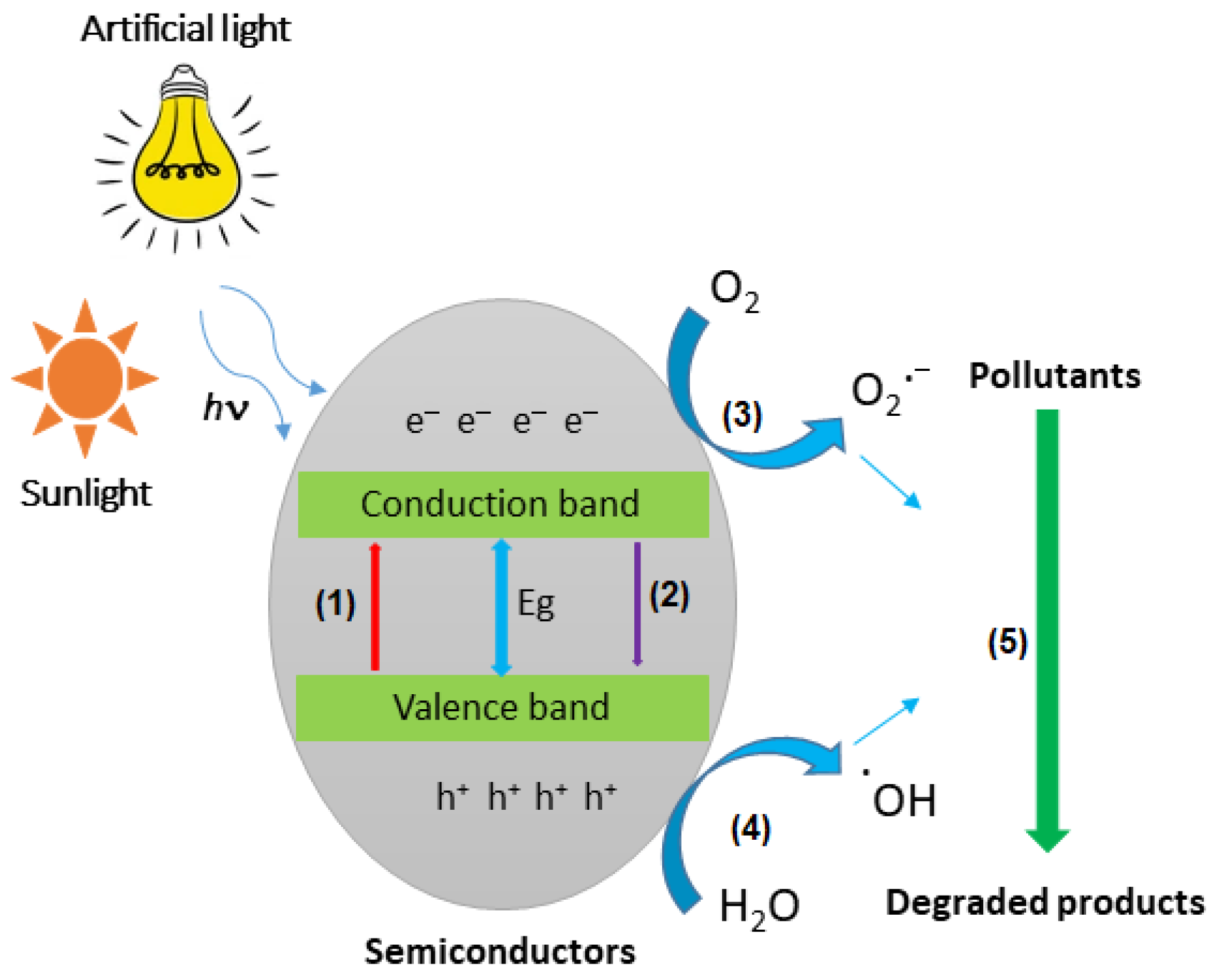
As depicted in Figure 1, a suitable photocatalyst is energized by the absorption of a photon (hv) with adequate energy (equal to or higher than the bandgap energy (Eg) of the semiconducting materials). This process will generate a pair of holes (e in the highest energy conduction band (CB) and h+ in the lowest energy valence band (VB)). Eg determines the light-harvesting properties of a photocatalyst: a photocatalyst with a low band gap energy can convert more visible-light photons than a material with a high band gap energy. The next step involves the separation and recombination of the photogenerated pairs (holes and electrons). A photocatalytic reaction can proceed smoothly if the recombination rate of the hole pairs is suppressed. Otherwise, recombination reduces the number of excited charge carriers. The photogenerated holes react with the substrate to produce an oxidized product, and the excited electrons react with the substrate to produce a reduced product. Simply, the photogenerated excited electrons can react with dissolved oxygen (O2) in water and reduce it to superoxide radical anion (O2−•). The reaction of H2O with photogenerated reactive holes leads to the formation of highly reactive hydroxyl radicals (OH). In some cases, peroxide radicals are generated during photodegradation. The resulting strong oxidizing species OH and O2−• can degrade pollutants to smaller fragments and finally mineralize to CO2 and H2O. It should be noted that the generation of reactive oxygen species such as OH, O2−•, H2O2, OOH, and singlet oxygen 1O2 depends on the reaction conditions (pH of the solution, catalytic materials, and the presence of any scavenger) [7,12].
The relevant steps for the photocatalytic decomposition of contaminants in H2O at the catalyst surface are illustrated in Equations (1)–(9).
P + hv → P*(eCB + h+VB)
P*(h+VB) + H2O → H+ + P + OH
P*(h+VB) + OH → P + OH
P*(eCB) + O2 → O2−• + P
H+ + O2−• → HO2
Pollutant + eCB → reduction products
Pollutant + h+VB → oxidation products
Pollutant + O2−• → degradation products
Pollutant + OH → degradation products
where hv is the photon energy essential for the promotion of electrons from the VB to the CB.
The catalytic performance of an ideal catalyst depends on various crucial features, such as the band gap energy of semiconducting materials, recombination time of electrons and holes, surface area and surface morphology, phase composition, crystallinity, active sites, absorption of light through catalysts, and surface interaction of the substrate with the catalyst. Thus far, photogenerated holes and electrons have been shown to engage in several surface chemical reactions. These pairs of charged carriers can also combine at the surface. Pollutants are first adsorbed on the active sites of the photocatalyst, which enhances charge mobility and redox capacity. Subsequently, a series of chemical reactions with the photogenerated active species occurs, forming degradation products. A higher band gap energy limits the light-harvesting properties. The rapid recombination of the photogenerated reactive species remarkably suppresses the photocatalytic efficiency. Enhancing photocatalytic performance by lowering the band gap energy and delaying the recombination of photogenerated pairs has received increasing attention from the materials chemistry community [59,60,61].
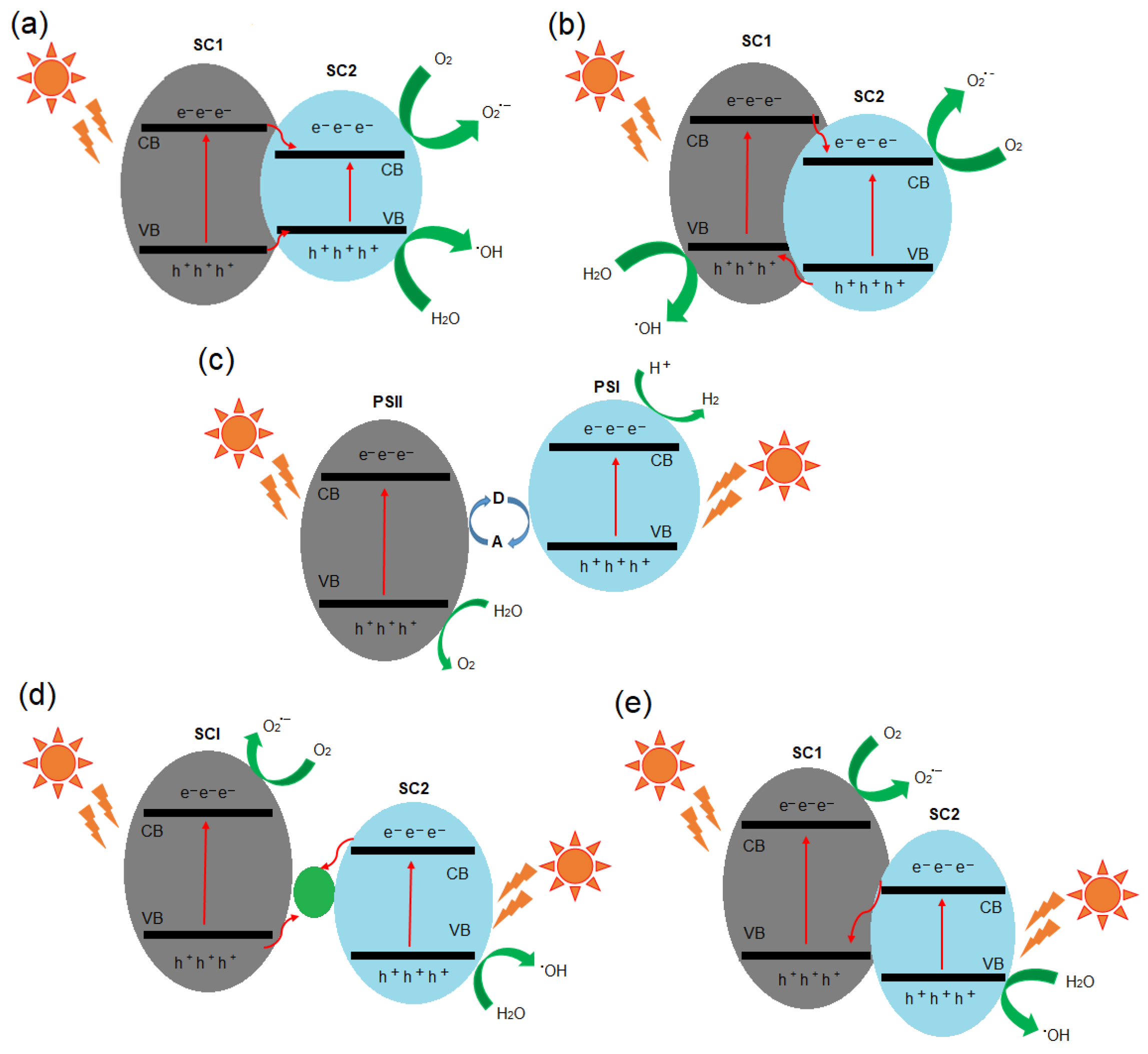
Several modifications have been developed to overcome these limitations. The introduction of heterogeneous photocatalytic systems consisting of various porphyrins with solid supports (inorganic oxides, metal plasmons, carbonaceous compounds, and polymer substrates) has contributed to outstanding results in the photocatalytic degradation of hazardous compounds in water compared with the starting porphyrin. The incorporation of porphyrin molecules onto the surface of solid supports not only controls the electronic properties but also significantly enhances the visible-light harvesting capacity, which provides interesting results for the design of excellent photocatalysts for the degradation of pollutants in water. The formation of heterojunctions between porphyrins and semiconductors can directly convert photon energy to generate radicals, resist the destruction of active species, and hence improve recyclability. The recombination time of the photogenerated active pairs is enhanced owing to extensive electronic delocalization over the surface of heterojunctions composed of two semiconducting materials. Based on the electron transport method and the type of semiconductor, heterojunctions can be classified into three categories: type I, type II, and Z-scheme (Figure 2). Owing to their intrinsic benefits, such as high redox capacity and effective separation of photogenerated holes and electrons, Z-scheme heterojunction photocatalysts prominently improve the photodegradation performance of catalysts [65,66]. Z-scheme heterojunction photocatalysts can be further divided into three subgroups depending on the nature of the semiconductor materials used to fabricate the heterojunctions (Figure 2a–c). Furthermore, the Z-scheme hybrid junction can increase the separation of photogenerated reactive pairs, delay the recombination time, and improve the transportation of charged species; hence, more reactive species are produced for the photodegradation of toxic materials in water.

3. Porphyrin-Conjugated Metal Oxide Hybrid Nanomaterials

This section describes the conjugation of porphyrin molecules to the surfaces of various metal oxides, fabricating heterogeneous photocatalytic systems. The synthesis procedure and photocatalytic efficiency for the photodegradation of toxic pollutants are discussed, along with the advantages and disadvantages of these solid-supported porphyrin-conjugated heterojunctions.

3.1. Porphyrin–TiO2 Hybrid Nanomaterials

Considering the importance of photodegradation reactions, titanium dioxide (TiO2) and TiO2-supported materials are widely utilized as catalysts for the photodegradation of hazardous compounds in wastewater [67]. This is primarily owing to its significant catalytic activity, low cost, high UV adsorption, biocompatibility, and excellent stability under extreme reaction conditions. However, the application of TiO2-supported materials in photocatalytic processes faces many drawbacks. The main limitations are the relatively high degree of recombination of photogenerated electron–hole pairs, high fabrication costs, the need for a large amount of catalyst to achieve significant photodegradation rates, and low light-harvesting properties under cheap visible light. To overcome these drawbacks, porphyrin molecules can be integrated onto the surface of TiO2 to construct heterogeneous photocatalytic systems for the photodegradation of toxic contaminants in water. The incorporation of porphyrin molecules on the TiO2 surface lowers the band gap energy (Eg) due to the band alignment between the two materials. This also improves the visible-light harvesting capacity, stabilizes the photogenerated excited electrons, and delays the recombination of the photoinduced active species. This improved the photocatalytic photodegradation performance of the hybrid materials compared with that of either the free porphyrin or bare TiO2 nanoparticles. Moreover, the entrapment of porphyrin on TiO2 improves the stability of the catalyst during photodegradation to avoid secondary pollution and ensure complete recovery from the medium for reuse [68,69].
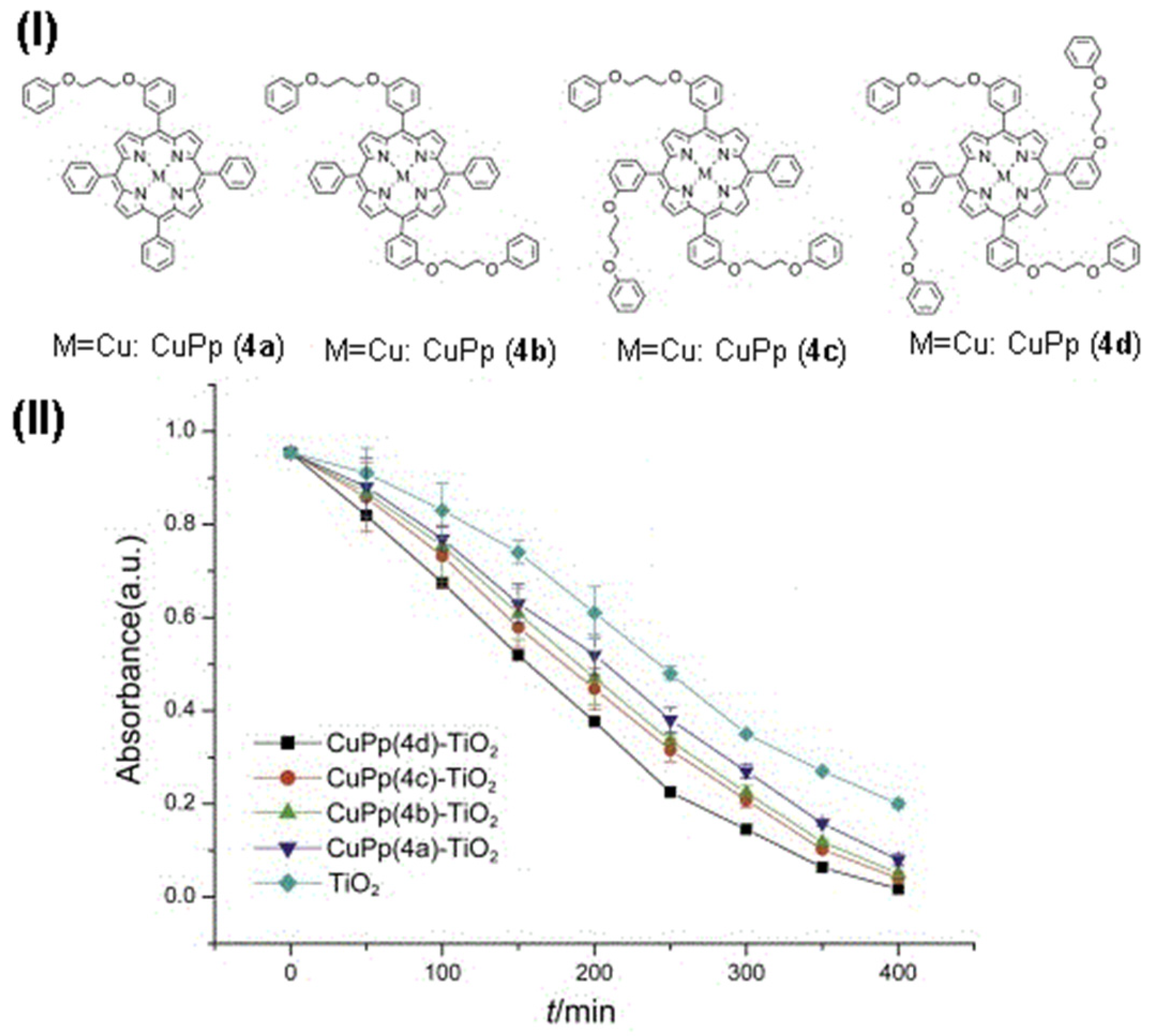
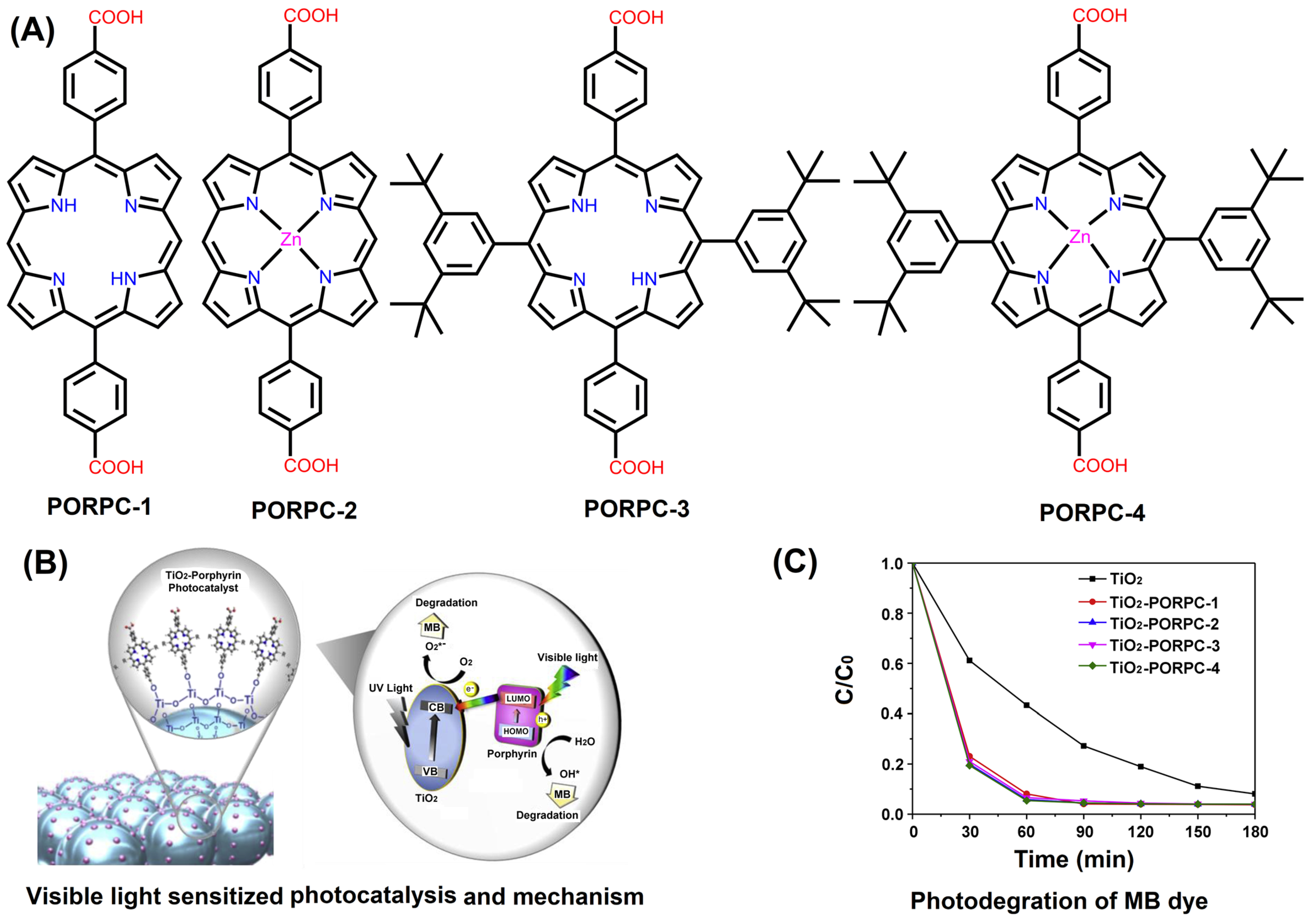
In 2010, Wang et al. constructed porphyrin-sensitized visible-light photocatalysts for the degradation of 4-nitrophenol [70]. Several porphyrin derivatives were sensitized to TiO2 nanoparticles using a simple absorption method in chloroform. The integration of porphyrin onto the surface of TiO2 nanoparticles lowered the band gap energy and improved the visible-light harvesting properties. Sensitized porphyrin-integrated TiO2 photocatalysts exhibited higher catalytic photodegradation performance than TiO2 nanoparticles. The photocatalytic performance depends not only on the amount of porphyrin incorporated in the hybrid materials but also on the substituent on the porphyrin core (Figure 3).
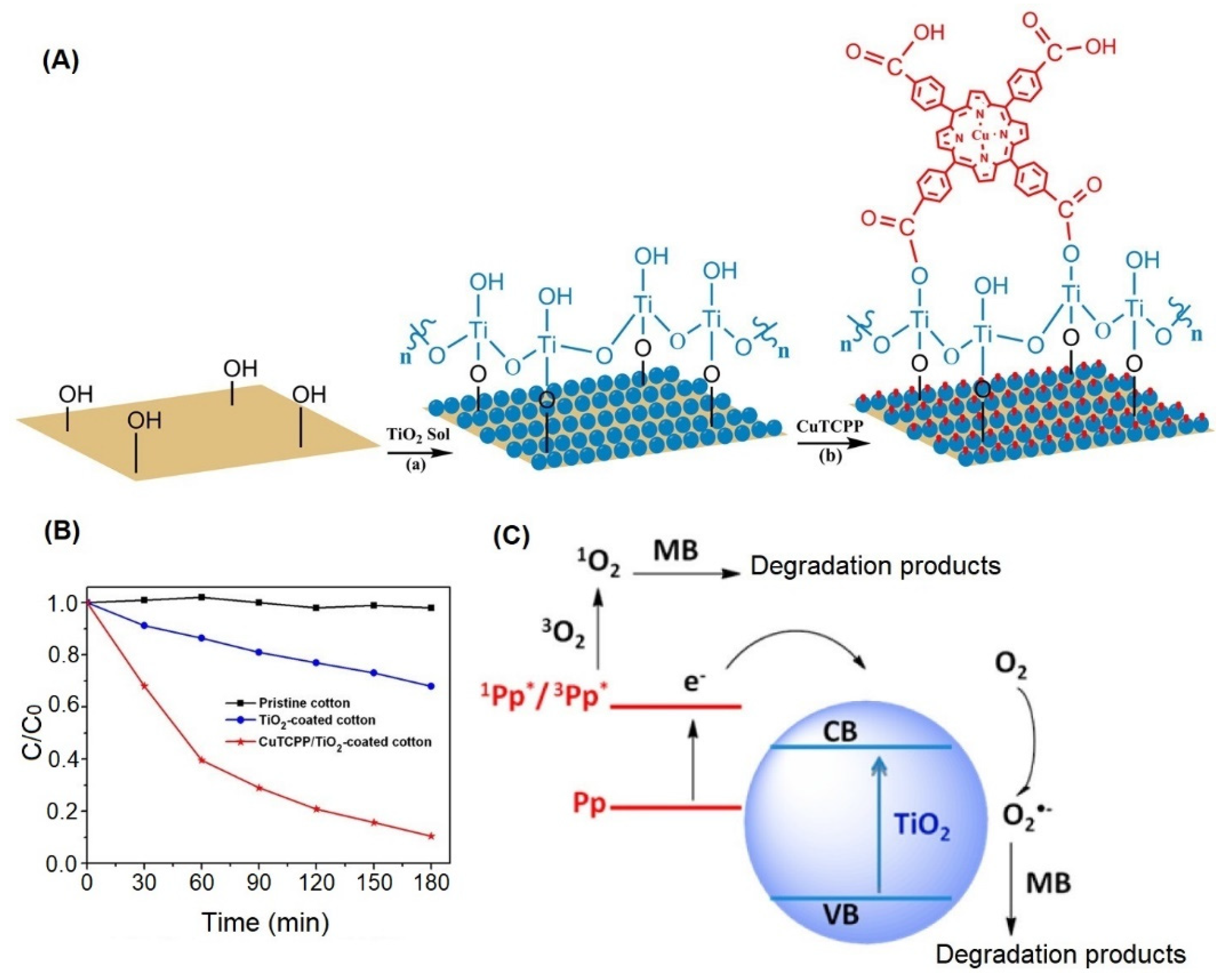
Langford et al. (Figure 4) observed a substantial improvement in the photocatalytic reaction of CuTCPP/TiO2/cotton only in 60 min [71]. Using an adsorption method, CuTCPP (meso-tetra(4-carboxyphenyl)porphyrinato copper(II)) was linked to anatase TiO2 nanoparticles. Within 180 min of visible-light irradiation, CuTCPP/TiO2-coated cotton exhibited higher photodegradation performance of MB dye in water than free porphyrin CuTCPP or TiO2-coated samples. The degradation ratios were 99% for CuTCPP/TiO2-coated cotton, 32% for the TiO2-coated sample, and 28% for CuTCPP. A simple mechanism for the enhanced photodegradation reaction was proposed by the authors (Figure 4). After irradiation with visible light, the porphyrin molecules are excited to generate a porphyrin singlet state [Pp]*. This excited porphyrin single-state [Pp]* is converted into the porphyrin triplet-excited state 3[Pp]* via intersystem crossing. Subsequently, the excited electrons from both the singlet and triplet states move to the CB of the TiO2 NPs. Afterwards, the excited electrons react with adsorbed O2 to form a highly reactive superoxide radical anion (O2−•) and facilitate the decomposition of MB dye.
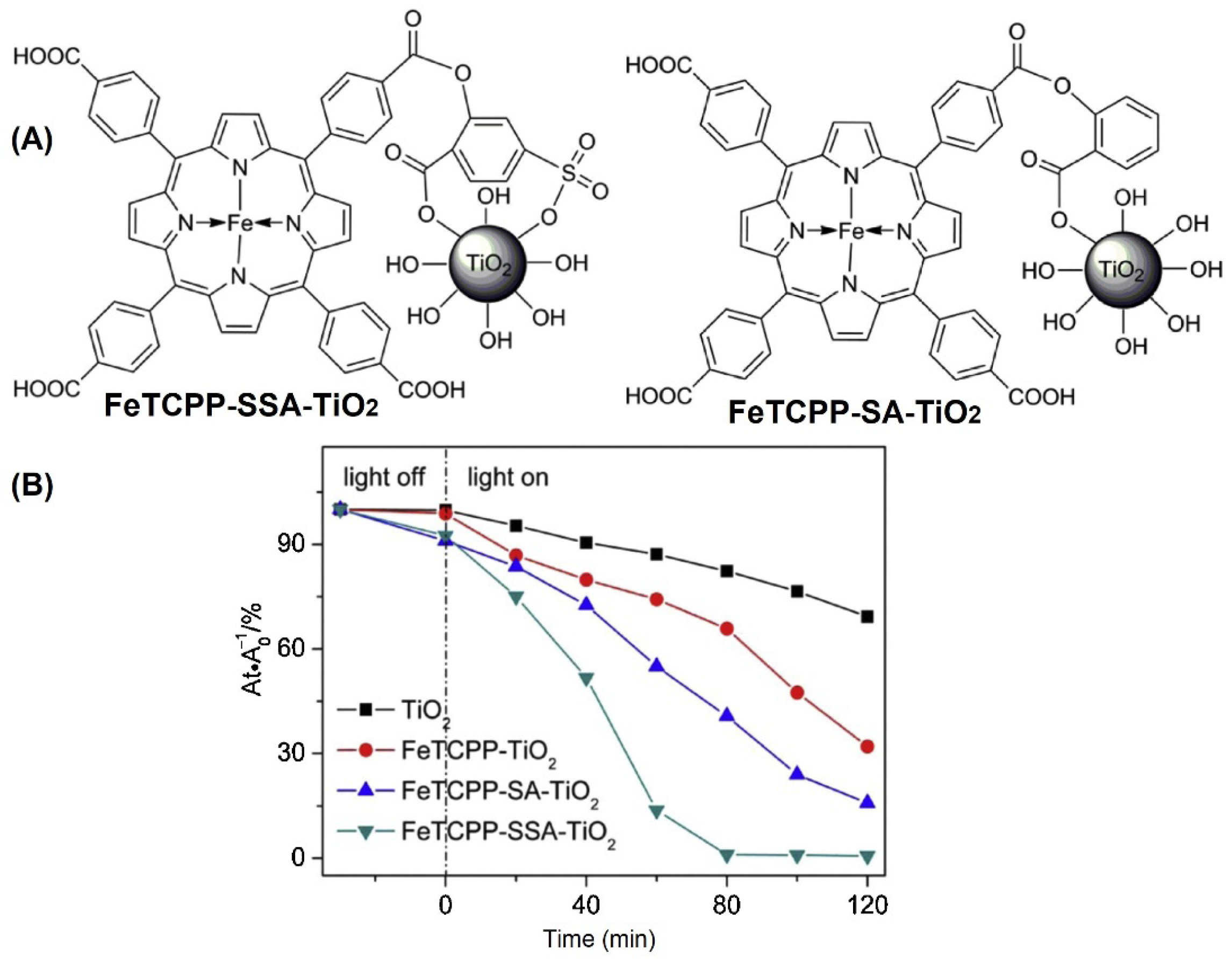
In 2015, Yao et al. (Figure 5) showed a significant degradation of MB dye using FeTCPP-SSA-TiO2 in 60 min compared to the porphyrin-TiO2 [72]. In this study, salicylic acid (SA) or 2-hydroxy-5-sulfosalicylic acid (SSA) was used as an anchoring ligand between Fe(III)porphyrin and TiO2 particles (Figure 5). The photocatalytic MB dye degradation performance was found to be 99.3% for FeTCPP-SSA-TiO2, 85.2% for FeTCPP-SA-TiO2, and 30.7% for bare TiO2. Therefore, bridging the Fe(III)porphyrin with TiO2 not only increases the catalytic degradation activity but also improves the surface area and prevents the dissociation of the constituent molecules during degradation experiments. Photocatalytic activity is directly linked to the nature of the bridging ligands between the porphyrin and TiO2 particles.
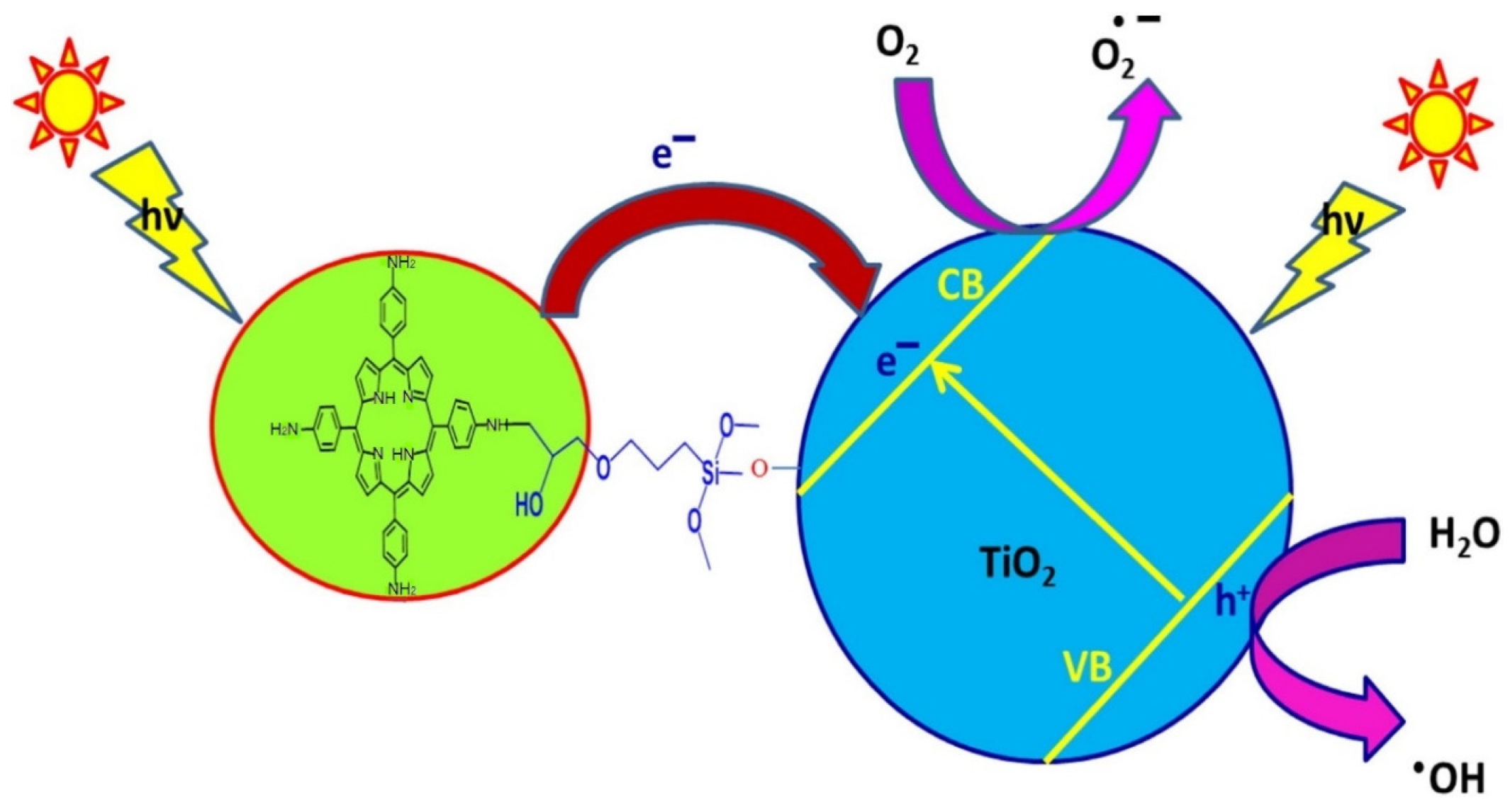
Chemically modified tetra-(para-amino)-phenylporphyrin (TPAPP)/TiO2 hybrid nanocomposite materials were fabricated for the photocatalytic decomposition of Acid Black 1 dye under direct sunlight [73]. Glycidoxypropyltrimethoxysilane was used as the coupling agent between 5,10,15,20-meso-TPAPP and TiO2 nanoparticles. From the diffuse reflectance spectra (DRS), the observed band gap energy of bare TiO2 was 3.33 eV, and that of 0.004 wt% TPAPP/TiO2 was 3.32 eV. The integration of porphyrin molecules onto the surface of TiO2 in the presence of coupling agents not only increased the photocatalytic efficiency for the removal of Acid Black 1 dye but also improved the stability of the composite nanomaterials during the photodegradation experiments. Within 90 min of direct sunlight irradiation, the TPAPP/TiO2 nanocomposite degraded 91.3% of the Acid Black 1 dye in water (Figure 6).
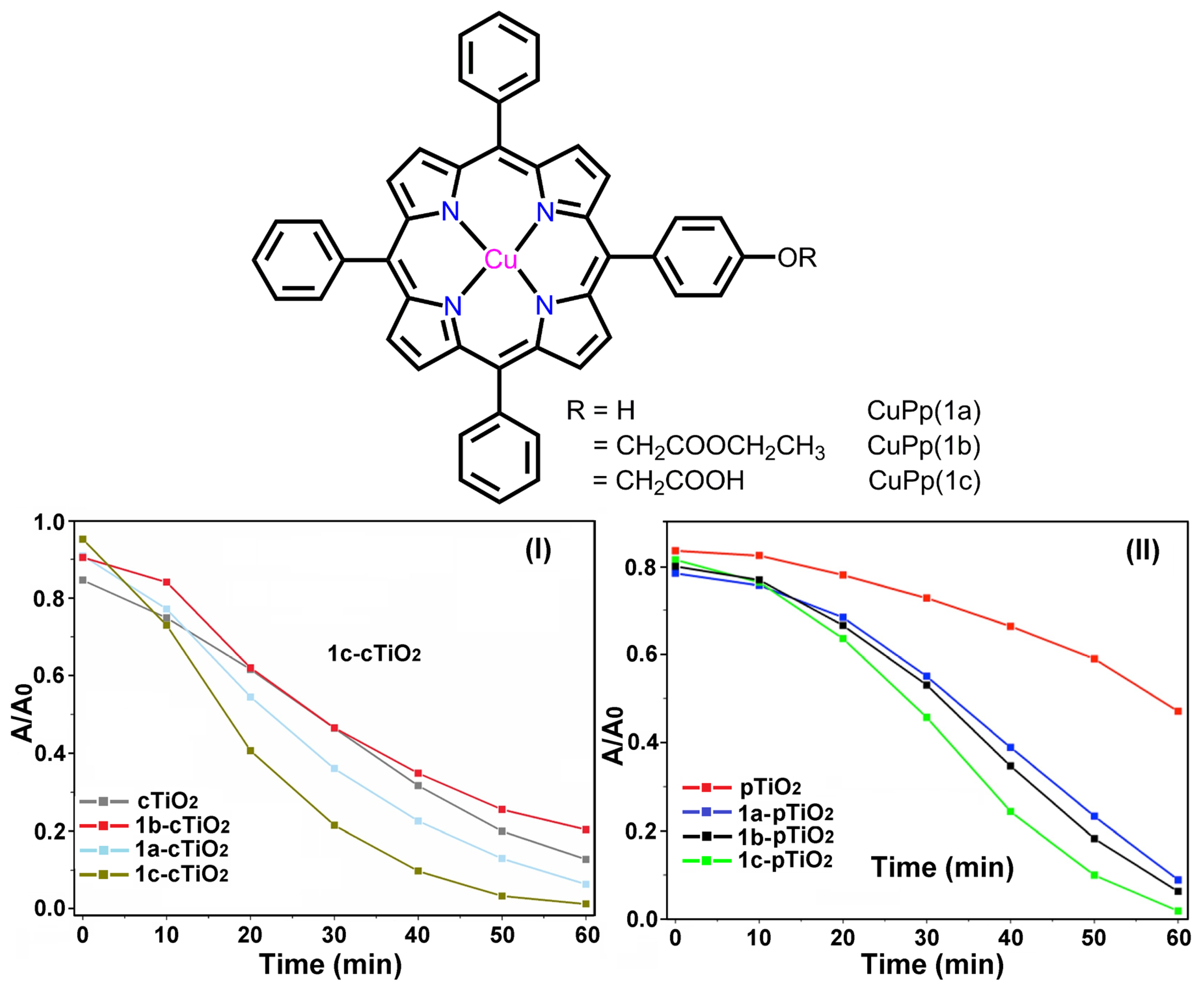
Hu et al. studied an organic–inorganic hybrid material for the catalytic photodegradation of 4-nitrophenol (4-NP) in water [74]. Several Cu(II)porphyrin derivatives (CuPp 1a–1c) were successfully immobilized on the synthesized TiO2 (p-TiO2) and commercial TiO2 (c-TiO2) (Figure 7). Within 60 min, the photodegradation ratio of 4-NP was 85% for c-TiO2 compared with p-TiO2 under metal halide lamp irradiation. Interestingly, cTiO2@CuPp (1c) exhibited better results than pTiO2@CuPp (1c). The hydroxylated surface of c-TiO2 likely affects the interaction of the sensitizer with TiO2, unlike the other CuPp derivatives.
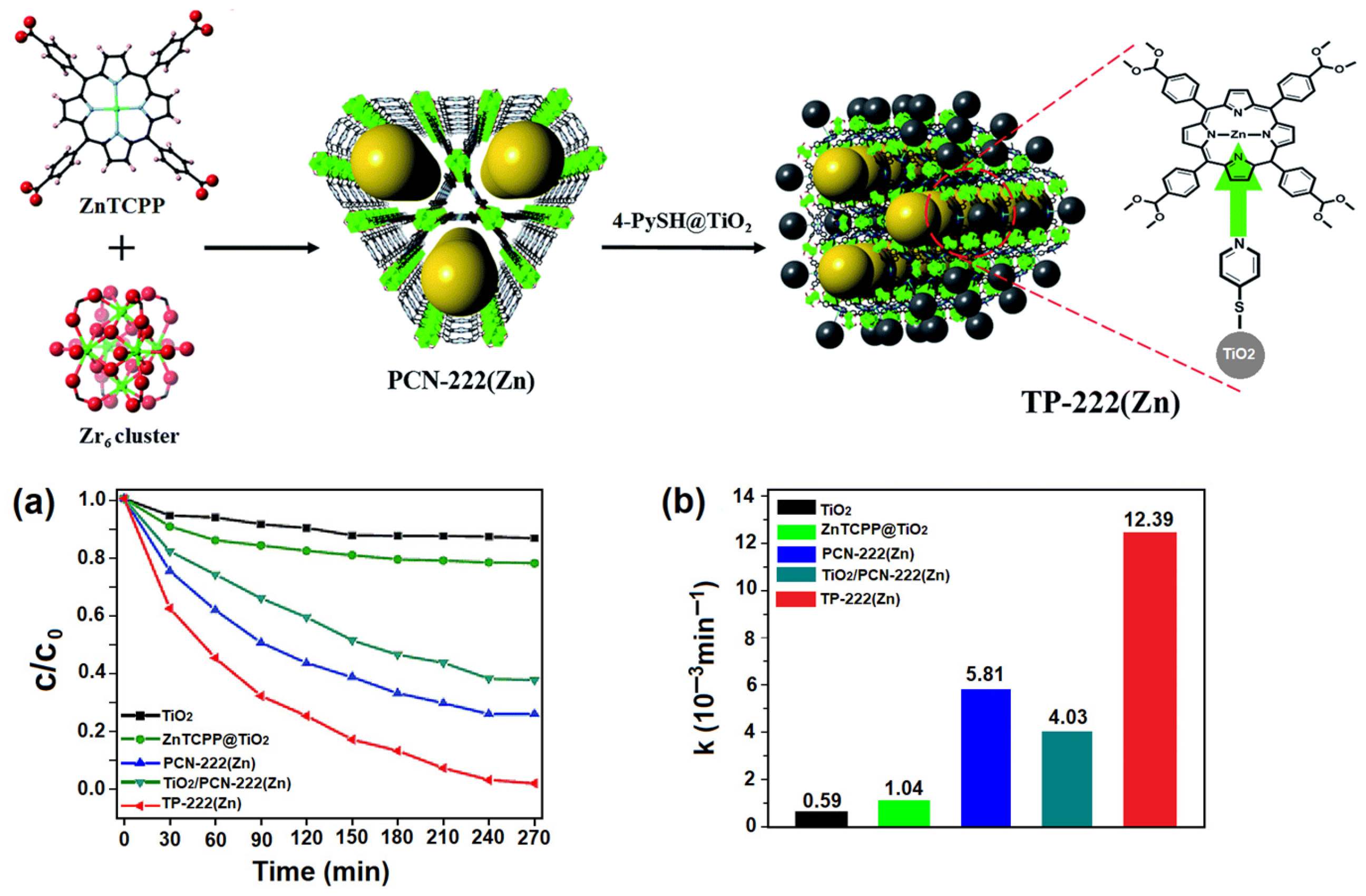
A composite photocatalyst, TP-222(Zn), was constructed for the photocatalytic photodegradation of RhB dye in water under visible-light irradiation [75]. In a typical procedure, TiO2 nanoparticles were axially coupled to the Zn2+ metal center in PCN-222(Zn) using 4-mercaptopyridine (4-PySH). From the DRS analysis, Eg was found to be 3.2 eV for the bare TiO2 nanoparticles and 1.74 eV for PCN-222(Zn). The conjugation of the porphyrin framework to TP-222(Zn) significantly lowered the bandgap energy and enhanced the visible-light harvesting capacity. The aromatic conjugated frameworks in TP-222(Zn) facilitated electron transfer from PCN-222(Zn) to the TiO2 nanoparticles, stabilized the photogenerated charge carriers, enhanced the recombination time, and boosted the photocatalytic degradation activity. Within 270 min, the first-order degradation rate constant was found to be 0.01239 min−1. Additionally, the incorporation of TiO2 nanoparticles into TP-222(Zn) produced a large number of active sites, improving the interaction between the substrate molecules and enhancing the photodegradation performance (Figure 8).
In 2019, Min et al. investigated various porphyrin-integrated TiO2 composite photocatalysts for MB degradation in water. Various hybrid materials have been fabricated by reacting anatase TiO2 with carboxyphenyl derivatives of porphyrins [76]. Effective binding between TiO2 nanoparticles and the carboxyphenyl derivatives of porphyrins reduced the band gap energy and improved the visible-light harvesting activity. All composite catalysts showed higher catalytic photodegradation activity than pure anatase TiO2 under visible-light irradiation. Within 60 min of irradiation, the photodegradation efficiency of the MB dye was 95%, which was better than that of pure TiO2 (55%). Moreover, the authors observed that Zn(II)-metalated porphyrin-based hybrid materials exhibited better photocatalytic activity than the metal-free porphyrin-based hybrid materials. The high electronic coupling between the Zn(II)porphyrins and the CB of TiO2 leads to the crucial separation of the photogenerated charged species, thereby delaying recombination of the photogenerated reactive species. Surface modification via strong chemical bonding between TiO2 nanoparticles and carboxyphenyl porphyrin not only improved the photocatalytic activity but also prevented the separation of porphyrin molecules from the TiO2 surface (Figure 9).
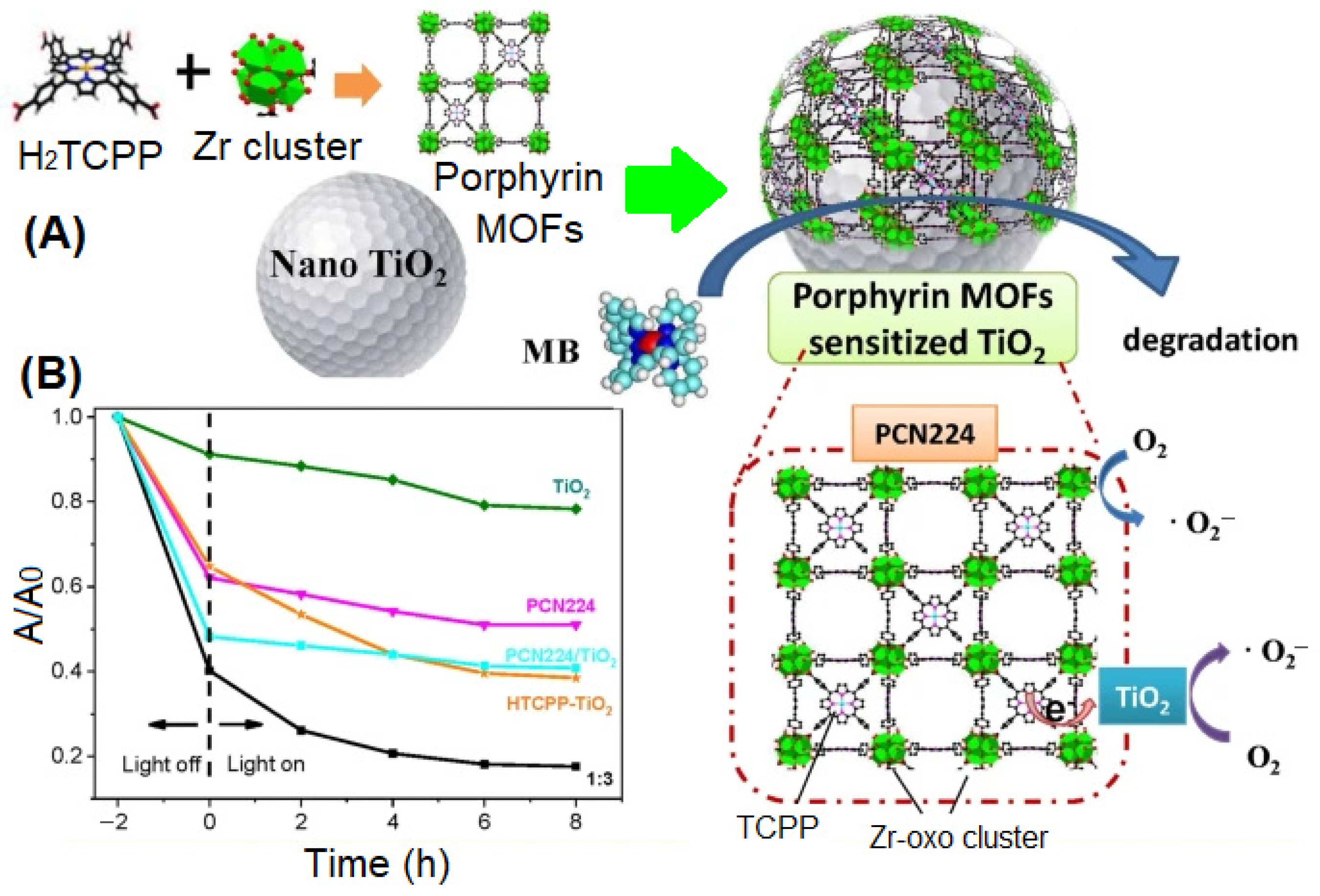
A Zr-porphyrin-based metal–organic framework (Zr-MOF) containing TiO2 (PCN-224@TiO2) hybrid composite was fabricated for the catalytic photodecomposition of MB dye in water [77]. The solvothermal reaction of ZrCl4, H2TCPP, and the TiO2 NPs led to the construction of a hybrid material, PCN-224@TiO2. The incorporation of porphyrin frameworks onto the surface of TiO2 reduces the band gap energy and improves the solar-light harvesting properties. Aromatic conjugated systems stabilize the photogenerated charged species, increase the recombination time, and improve the photocatalytic properties. Under Xe lamp irradiation, the MB dye degradation ratio was found to be 93.2% for PCN-224@TiO2. Moreover, the construction of a robust porphyrin framework onto the surface of TiO2 not only improved the photodegradation activities compared with those of PCN-224 or TiO2 but also prevented hydrolysis during the photodegradation reactions (Figure 10).
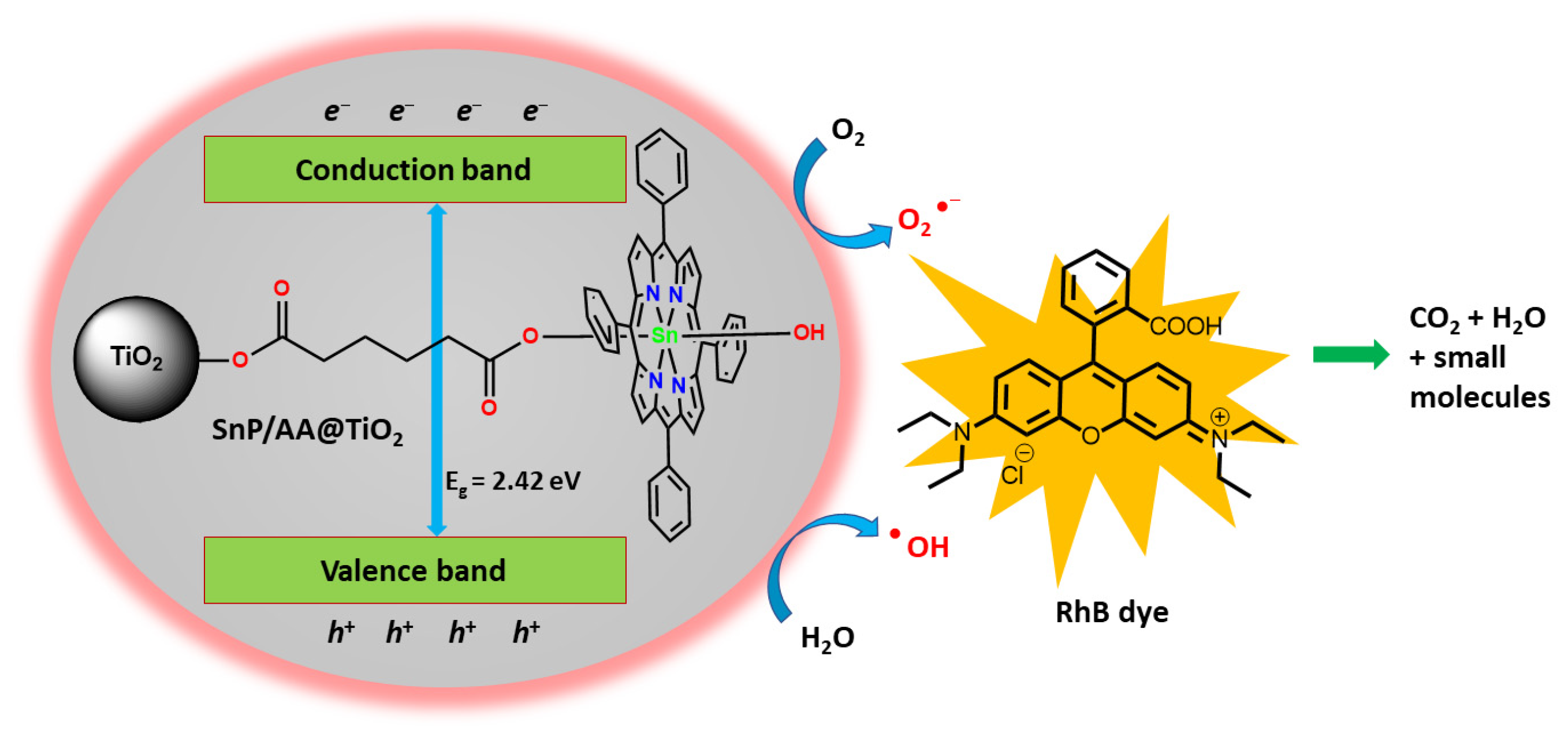
Two organic–inorganic hybrid photocatalysts (SnP/AA@TiO2 or SnP@TiO2) were developed for the visible-light photocatalytic decomposition of RhB dye [78]. The reaction of (trans-dihydroxo)(5,10,15,20-tetraphenylporphyrinato)tin(IV) with anatase TiO2, with and without adipic acid (AA), led to the formation of SnP/AA@TiO2 and SnP@TiO2, respectively. From the Tauc plot, Eg was calculated to be 2.46 eV for SnP/AA@TiO2 and 3.12 eV for bare TiO2. The integration of tin porphyrin onto the surface of TiO2 not only altered Eg but also enhanced the visible-light harvesting capacity (Figure 11). Within 80 min of irradiation, the RhB dye photodegradation rate constants were found to be 0.0366, 0.0078, 0.0060, and 0.0016 min−1 for SnP/AA@TiO2 (0.0366 min−1), SnP@TiO2 (0.0078 min−1), TiO2 (0.0060 min−1), and SnP (0.0016 min−1). Mechanistic investigation indicated that the synergistic effect between TiO2 and SnP via bridging adipic acid was responsible for the significant increase in the photocatalytic performance of SnP/AA@TiO2 compared with that of SnP@TiO2. Additionally, the anchoring ligands firmly prevented the isolation of tin porphyrin from the surface of TiO2 during the catalytic photodegradation reactions, thereby improving catalytic stability. After 10 consecutive cycles, SnP/AA@TiO2 still maintained a high degradation activity, with only a 3% reduction, indicating that the SnP/AA@TiO2 possesses remarkable stability. The structure of SnP/AA@TiO2 was examined after the degradation reaction to confirm its stability. FE-SEM (Field Emission Scanning Electron Microscopy), PXRD (Powder X-Ray Diffraction), and FT-IR (Fourier Transform Infrared Spectroscopy) spectra of the used SnP/AA@TiO2 were similar to the fresh sample, indicating that the framework of this catalyst remained intact during the degradation reaction.
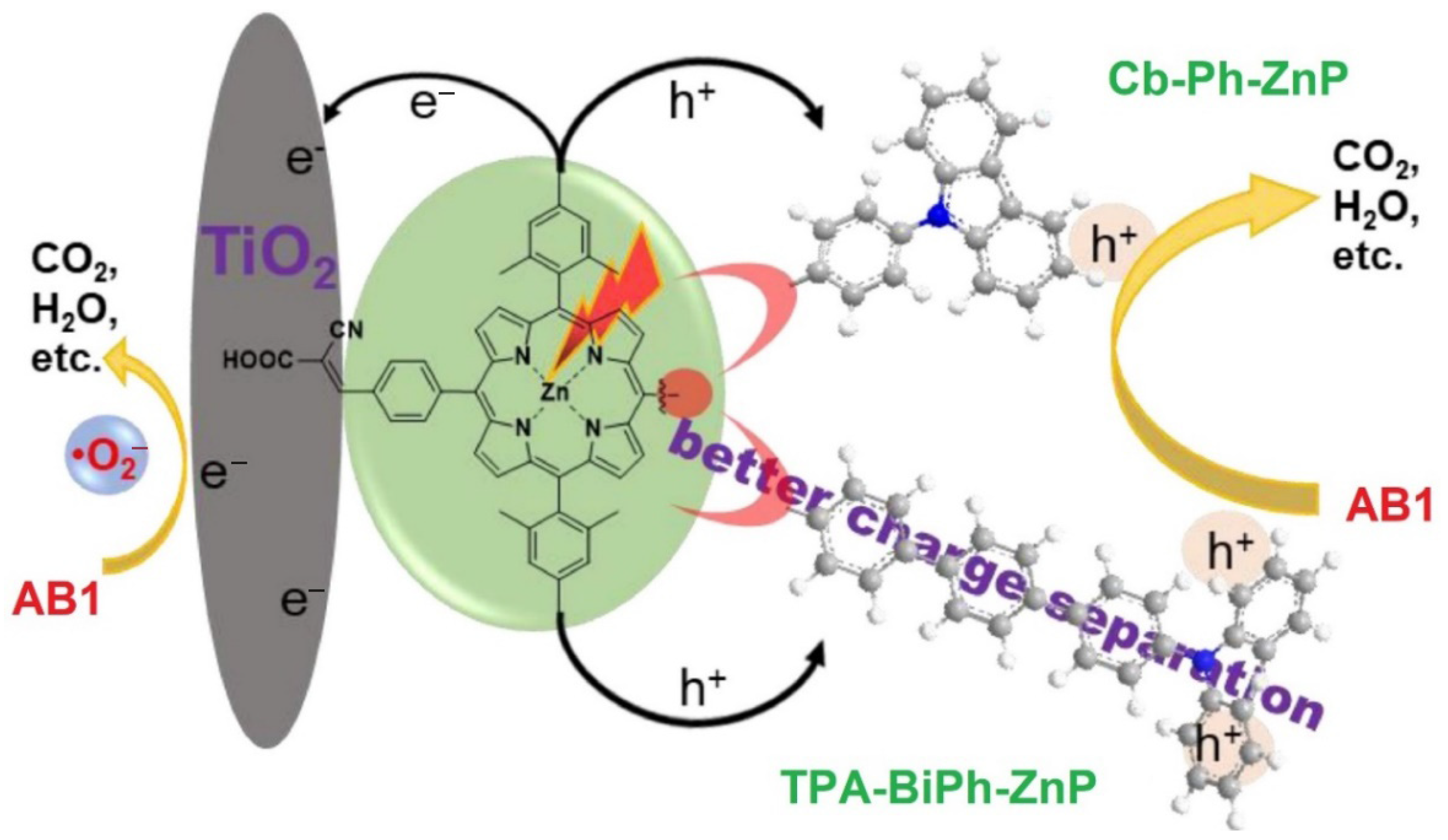
Zhao et al. also investigated two porphyrin-sensitized TiO2 materials (Cb-Ph-ZnP/TiO2 and TPA-BiPh-ZnP/TiO2) for the solar-light photodegradation of AB1 [79]. The integration of porphyrin onto the surface of TiO2 lowered the band gap energy (approximately 1.94 eV for composite catalysts and 3.28 eV for bare TiO2) and also improved the light-harvesting efficiency in the visible-light range. Within 60 min, the AB1 degradation ratio was 90% for TPA-BiPh-ZnP/TiO2 and 80% for Cb-Ph-ZnP/TiO2. The interfacial charge transfer, separation, and electron delocalization are likely more facile in TPA-BiPh-ZnP/TiO2 than in Cb-Ph-ZnP/TiO2. Mechanistic investigations indicated that the superoxide holes and radicals were the most reactive components in the catalytic photoreduction of AB1 in water (Figure 12).
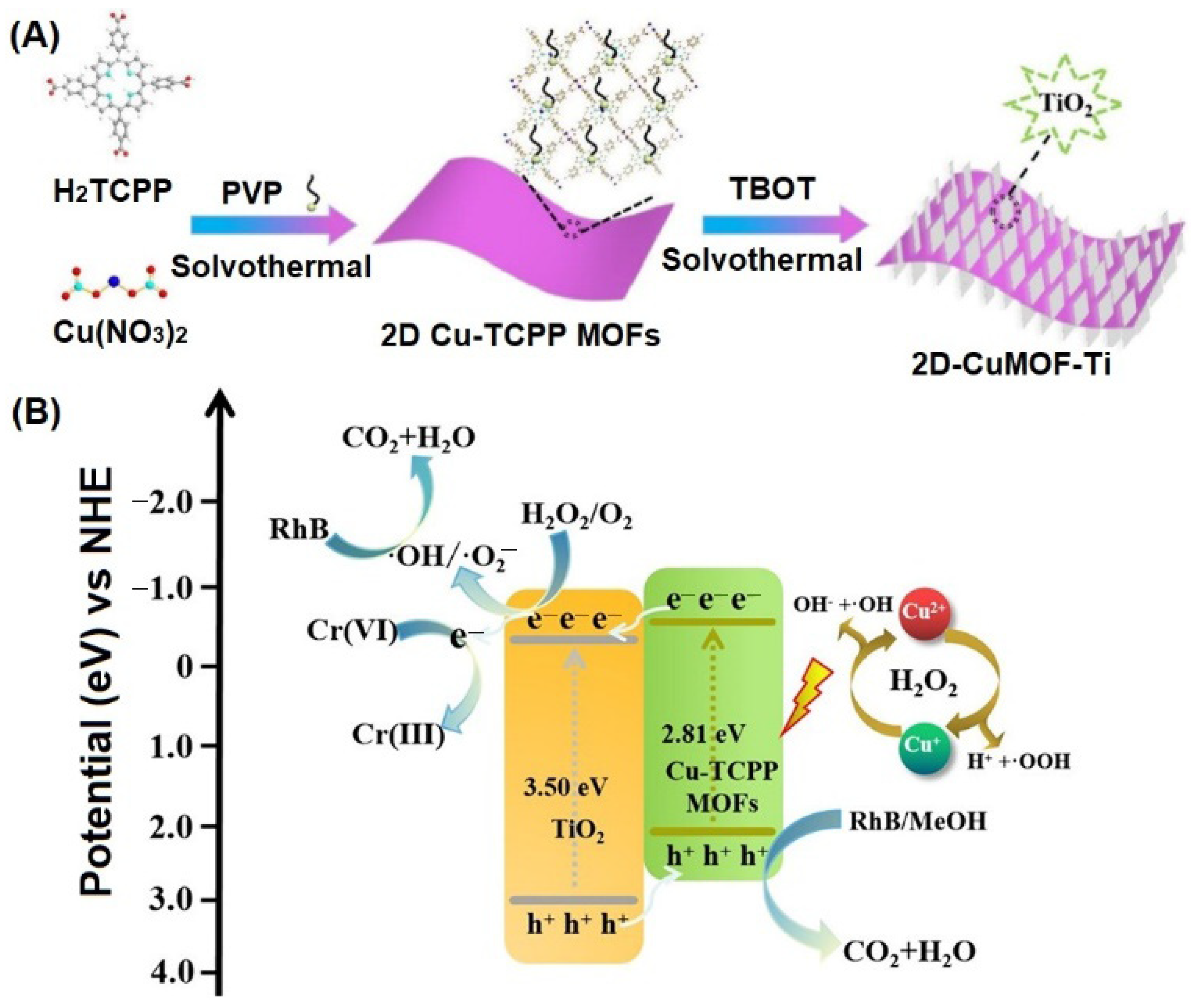
An organic–inorganic composite catalyst (2D CuMOF-Ti) was studied for the decomposition of hazardous pollutants in wastewater [80]. The solvothermal reaction between H2TCPP and Cu(NO3)2 in the presence of a polyvinylpyrrolidone surfactant led to the fabrication of 2D CuTCPP MOF nanosheets. Subsequently, a solvothermal reaction between tetrabutyl titanate and 2D CuTCPP MOFs led to the fabrication of the desired hybrid photocatalyst (2D CuMOF-Ti). The bandgap energy for the 2D CuTCPP MOFs was found to be 2.81 eV and is lower than 3.5 eV for TiO2. The immobilization of TiO2 on the core of the CuTCPP MOFs reduced the band gap energy and improved the light-harvesting properties in the visible range. Moreover, the conjugated porphyrin system facilitates the separation, transportation, and stabilization of photogenerated electron–hole pairs. This delays the recombination time and hence increases the photocatalytic decomposition activity. The composite catalyst 2D CuMOF-Ti exhibited significant photodegradation of toxic Cr(IV) and RhB dyes in water under solar-light exposure. The photodegradation rate of RhB dye for 2D CuMOF-Ti is found to be 12.6 and 2.8 times better than that of 2D CuTCPP MOFs and TiO2, respectively. Additionally, the robust framework resists hydrolysis of the catalyst during the photodegradation reaction (Figure 13).
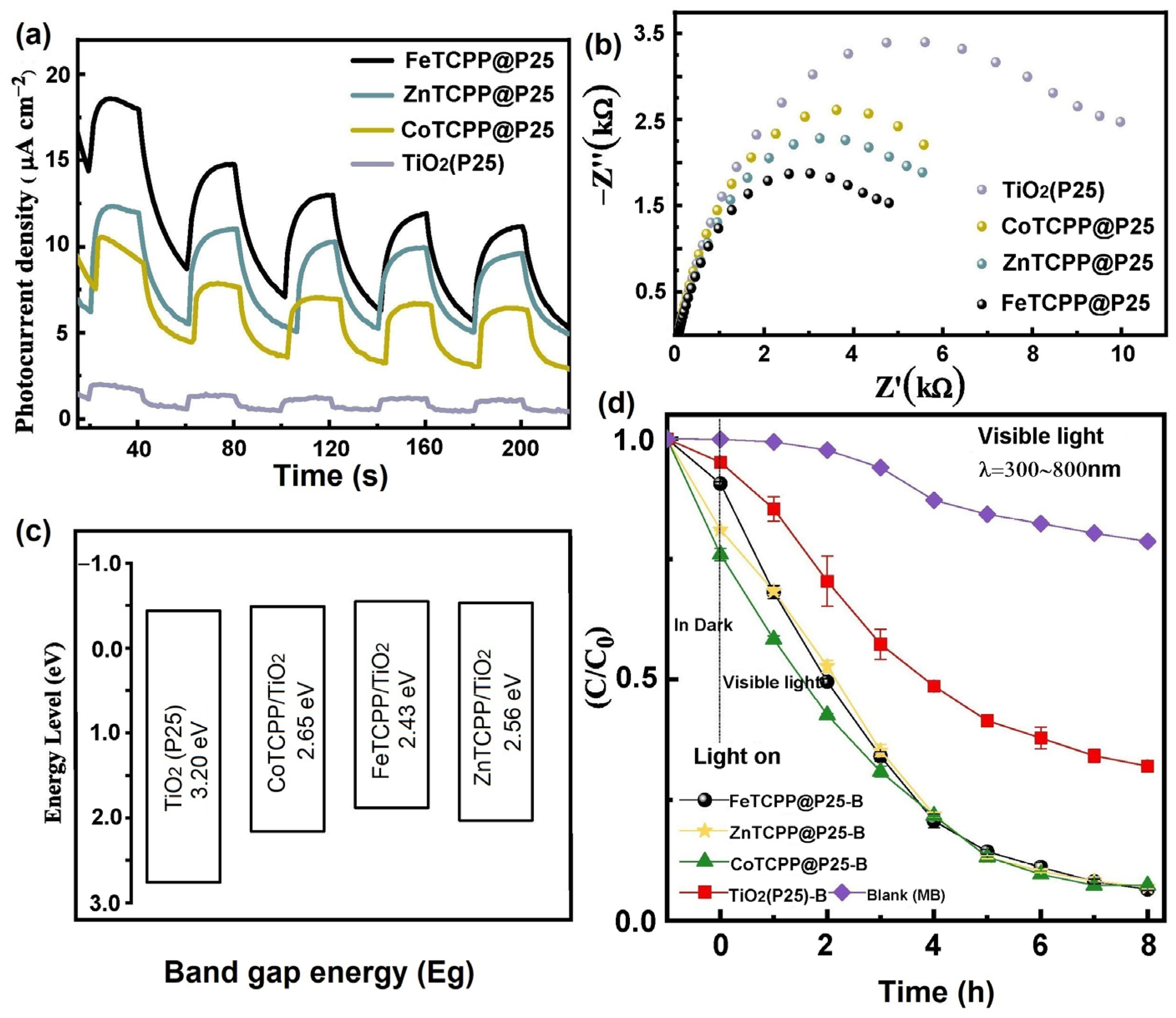
Several porphyrin-sensitized TiO2 materials were recently fabricated for the photocatalytic decomposition of MB [81]. The reaction of numerous metal salts of the tetra(4-carboxylphenyl)porphyrin MTCPP (M = Fe(III), Zn(II), and Co(III)) with TiO2 (P25) in ethanol led to the formation of hybrid photocatalysts MTCPP@TiO2. From the DRS plot, Eg for FeTCPP@TiO2 was found to be lower than that of TiO2 (2.43 eV vs. 3.2 eV). The integration of metal porphyrins onto the surface of TiO2 not only alters Eg but also improves the visible-light harvesting capacity. Moreover, electronic delocalization over the conjugated framework assists charge transport and separation, thereby delaying the recombination of excited holes and electrons. This enhanced the photodegradation performance of MTCPP@TiO2 compared with that of either MTCPP or TiO2. Among the MTCPP@TiO2 photocatalysts, FeTCPP@TiO2 exhibited the highest photodegradation performance for MB dye degradation in water. Therefore, the nature of the metals in the metalloporphyrin controls the photocatalytic performance of MTCPP@TiO2 (Figure 14).

3.2. Porphyrin–ZnO Hybrid Nanomaterials

Aside from TiO2, ZnO and ZnO-based catalysts have been extensively utilized for the catalytic decomposition of toxic contaminants in wastewater, owing to their high chemical stability, low cost, good photosensitivity, low toxicity, and significant photocatalytic activity [82]. However, their high bandgap energies prevent them from participating in photocatalytic reactions under visible-light irradiation. Moreover, the quick recombination rate of the photogenerated pairs and low recovery are disadvantages. To overcome these obstacles, researchers have developed strategies for incorporating porphyrins onto the surface of ZnO nanostructures.
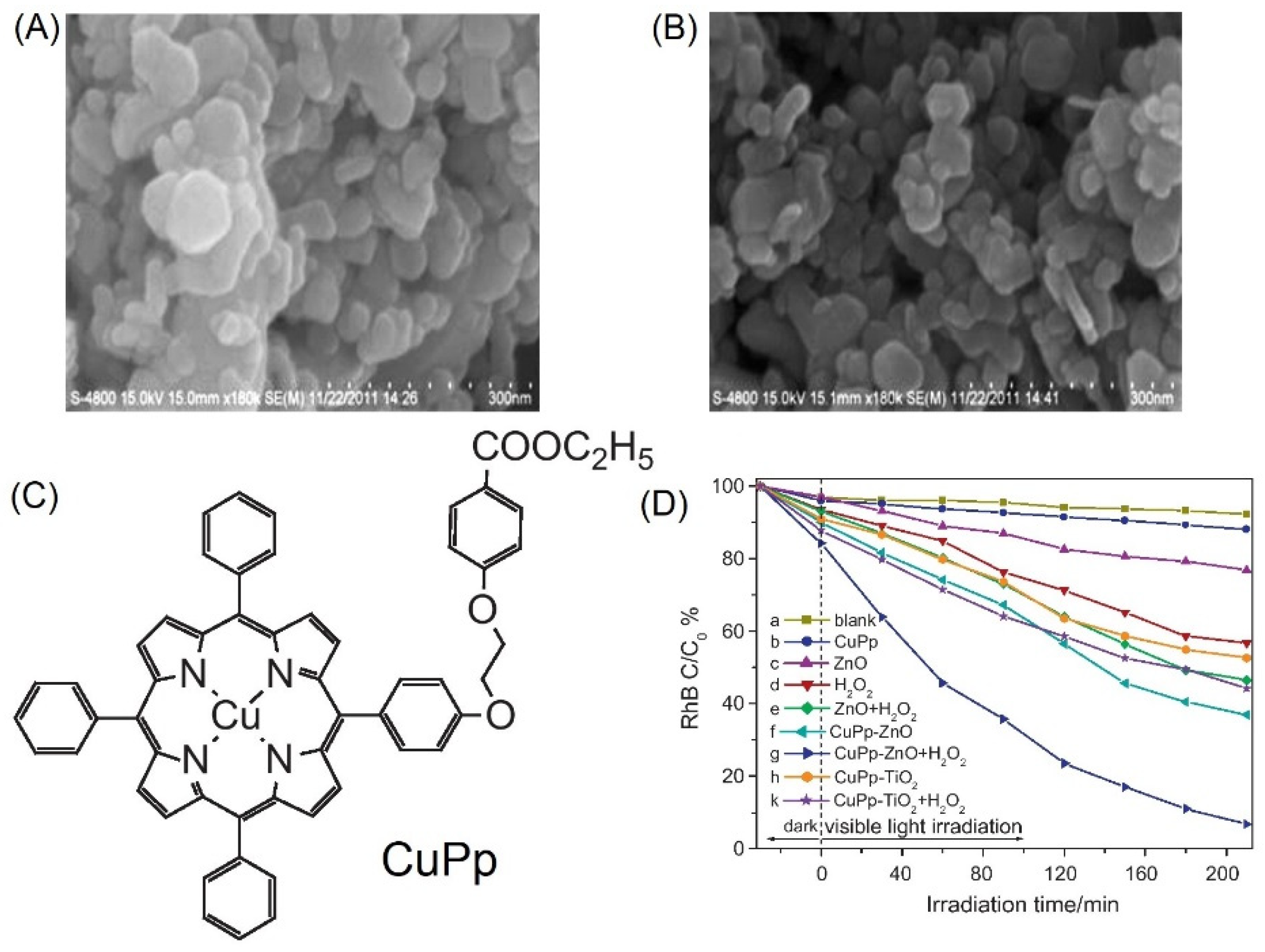
In 2013, Zhang et al. constructed an organic–inorganic composite photocatalytic system for the catalytic photodegradation of RhB dye in H2O under solar-light exposure [83]. The reaction of mono-[4-(2-ethyl-p-hydroxybenzoate)ethoxyl]-10,15,20-tri(phenyl)porphyrin copper(II)) (CuPp) with ZnO via a mixing method led to the formation of a CuPp–ZnO hybrid material. Scanning electron microscopy (SEM) images of CuPp–ZnO confirmed that CuPp was successfully incorporated onto the surface of the ZnO NPs. Within 210 min, the RhB degradation ratios were 63% and 23% for CuPp–ZnO and ZnO, respectively. The incorporation of porphyrin onto the surface of ZnO enhanced the visible-light harvesting activity and increased the recombination time by stabilizing the excited electrons over the aromatic conjugated metalloporphyrin CuPp. However, the authors observed a reduction in photocatalytic activity during the recyclability test of CuPp–ZnO (Figure 15).
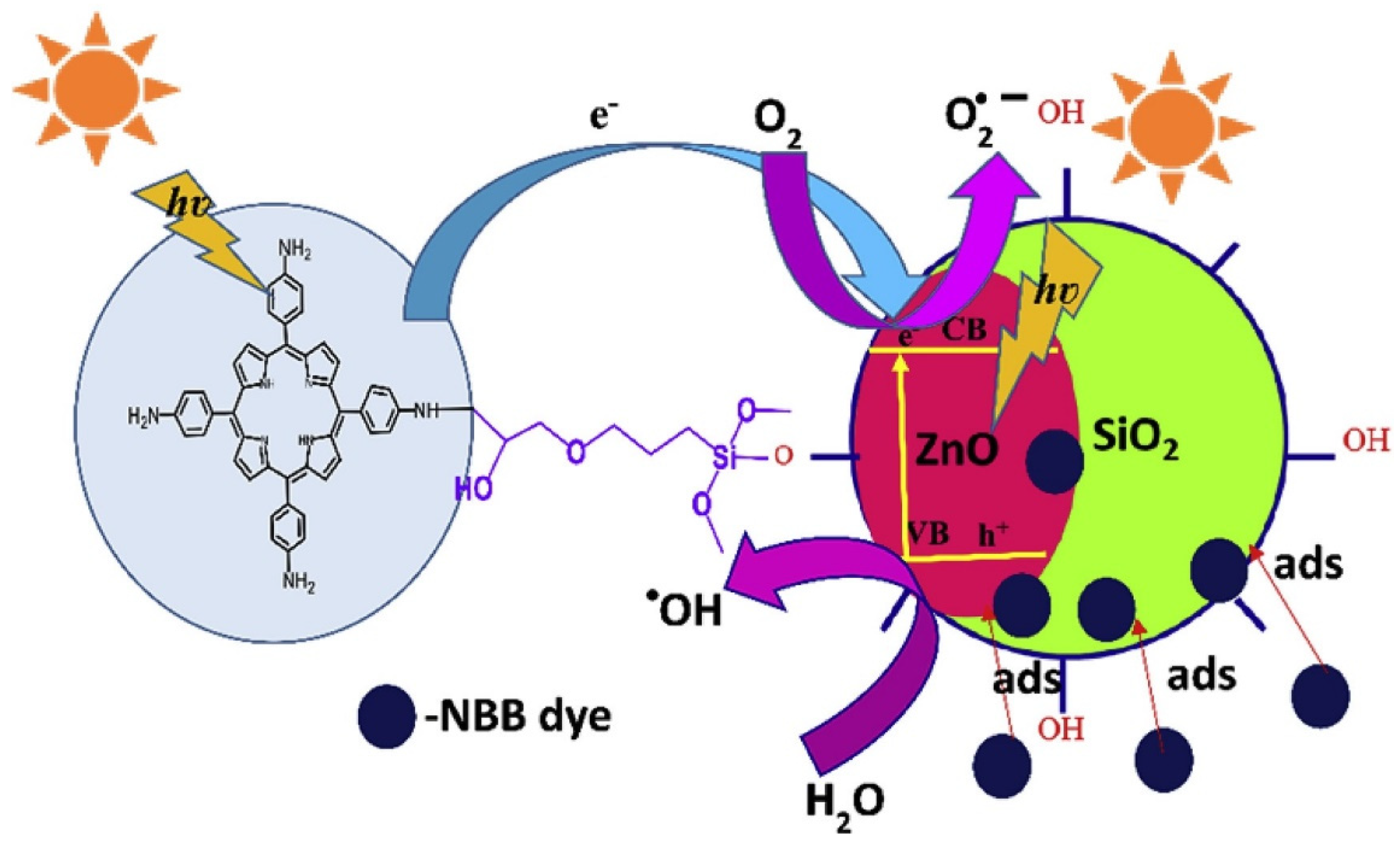
TPAPP/SiO2-ZnO hybrid materials were investigated for the photodegradation of toxic compounds in H2O under visible-light irradiation [84]. The authors demonstrated the chemical modification of mixed inorganic oxides (70% SiO2 and 30% ZnO) with TPAPP, using 3-glycidoxypropyltrimethoxysilane as the coupling agent. The DRS plot indicated Eg values of 3.23 eV and 3.30 eV for TPAPP/SiO2-ZnO and ZnO, respectively. Within 180 min, the photodecomposition ratio of naphthol blue black in H2O reached 60% under visible-light exposure. Chemical modification not only prevents catalyst hydrolysis during the photodegradation reaction but also allows the catalyst to be used multiple times without degrading its performance (Figure 16).
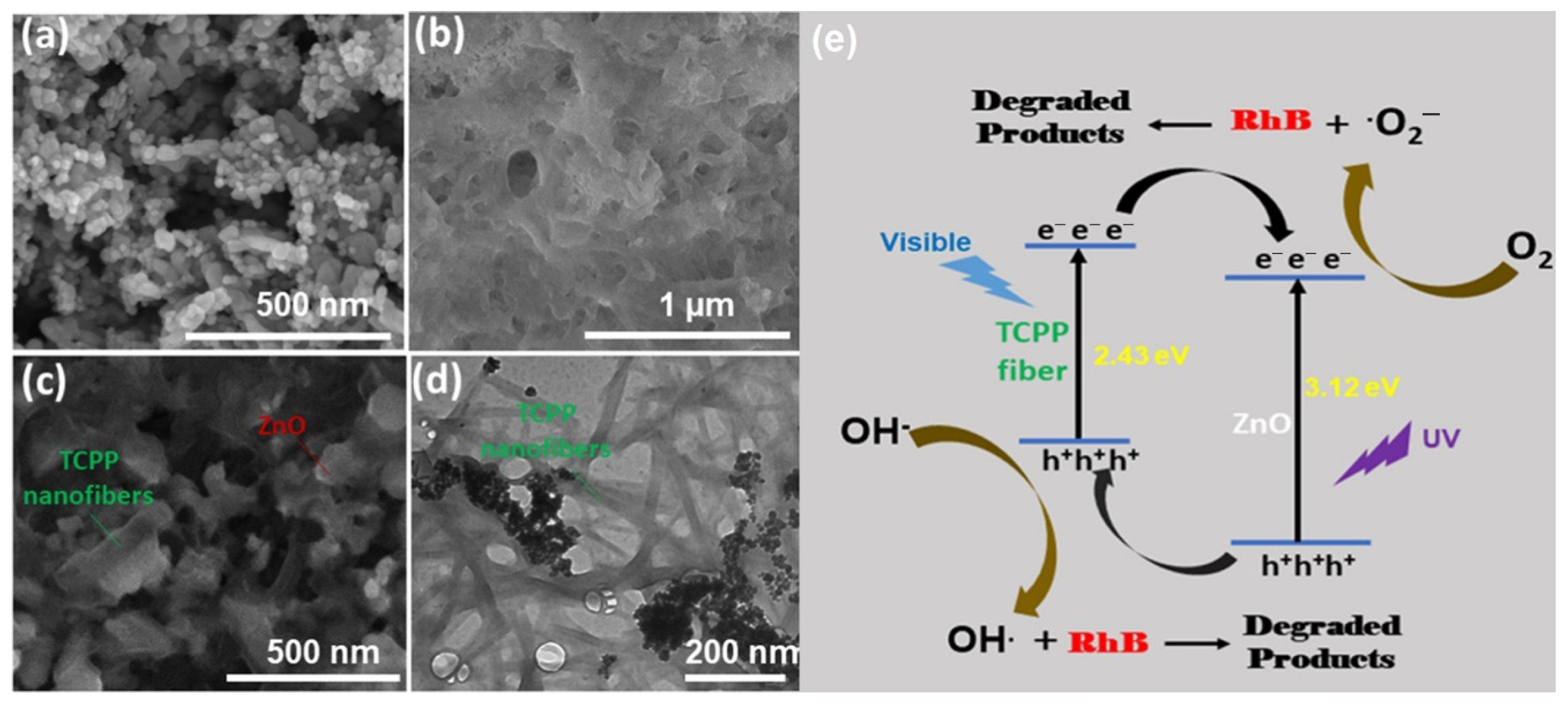
In 2021, Vo et al. reported enhanced photocatalytic degradation performance of H2TCPP@ZnO nanofibers [85]. A self-assembly approach was used to fabricate the H2TCPP@ZnO nanofibers. The SEM images of H2TCPP@ZnO reveal that the ZnO NPs were uniformly dispersed on the self-assembled H2TCPP nanofiber matrix. From the DRS plot, Eg for H2TCPP@ZnO and ZnO were found to be 2.43 eV and 3.21 eV, respectively. The incorporation of porphyrin onto the surface of ZnO not only lowered the band gap energy of H2TCPP@ZnO (3.12 and 2.43 eV) compared with the free-standing H2TCPP nanofibers (2.6 eV) and ZnO nanostructures (3.21 eV), but also improved the visible-light harvesting activity. Within 180 min of visible-light irradiation, the ZnO@H2TCPP nanofibers showed significant catalytic activity for the photodecomposition of the RhB dye. The high photodegradation rate constant (0.02 min−1) of the ZnO@H2TCPP nanofiber is attributed to the synergistic activity between ZnO NPs and H2TCPP nanofibers (Figure 17).
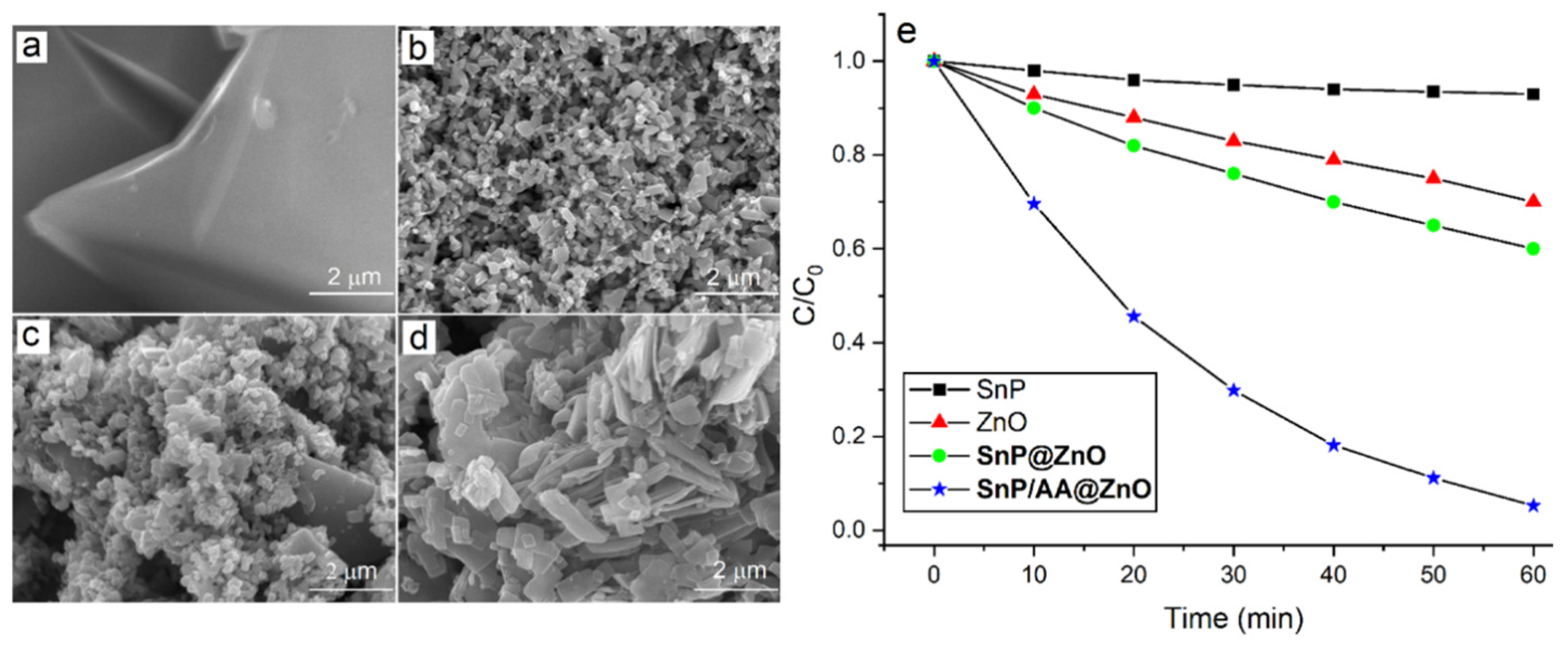
Organic–inorganic hybrid photocatalysts (SnP@ZnO and SnP/AA@ZnO) were investigated for the solar-light-induced photodegradation of amaranth dye [86]. The reaction of trans-dihydroxo[5,10,15,20-tetrakis(4-pyridyl)porphyrinato]tin(IV) with ZnO, with and without AA pretreatment, led to the production of SnP/AA@ZnO and SnP@ZnO, respectively. From the Tauc plot, the Eg values of SnP/AA@ZnO and the ZnO NPs were calculated to be 2.45 eV and 3.24 eV, respectively. The integration of SnP onto the surface of the ZnO NPs not only altered the morphology but also enhanced the visible-light photocatalytic activity (Figure 18). Within 90 min of irradiation, the degradation rate constants were found to be 0.048 min−1 (SnP/AA@ZnO), 0.008 min−1 (SnP@ZnO), 0.006 min−1 (ZnO), and 0.001 min−1 (SnP). The synergistic effect between the ZnO NPs and tin porphyrin via the bridging AA group was responsible for the significantly enhanced catalytic photodegradation activity of SnP/AA@ZnO over that of SnP@ZnO. Moreover, the anchoring effect of the bridging ligands promptly restrained ZnO from interacting with SnP during photocatalytic reactions. After 10 consecutive cycles, SnP/AA@ZnO maintained a high efficiency for the degradation of AM dye with a reduction of only 5%, which indicates that the SnP/AA@ZnO exhibited a remarkable stability.

3.3. Other Porphyrin-Conjugated Metal Oxide Hybrid Nanomaterials

In addition to TiO2 and ZnO, porphyrin molecules can be immobilized on other inorganic oxides to fabricate hybrid solar-light photocatalysts for the photodegradation of toxic compounds in H2O.
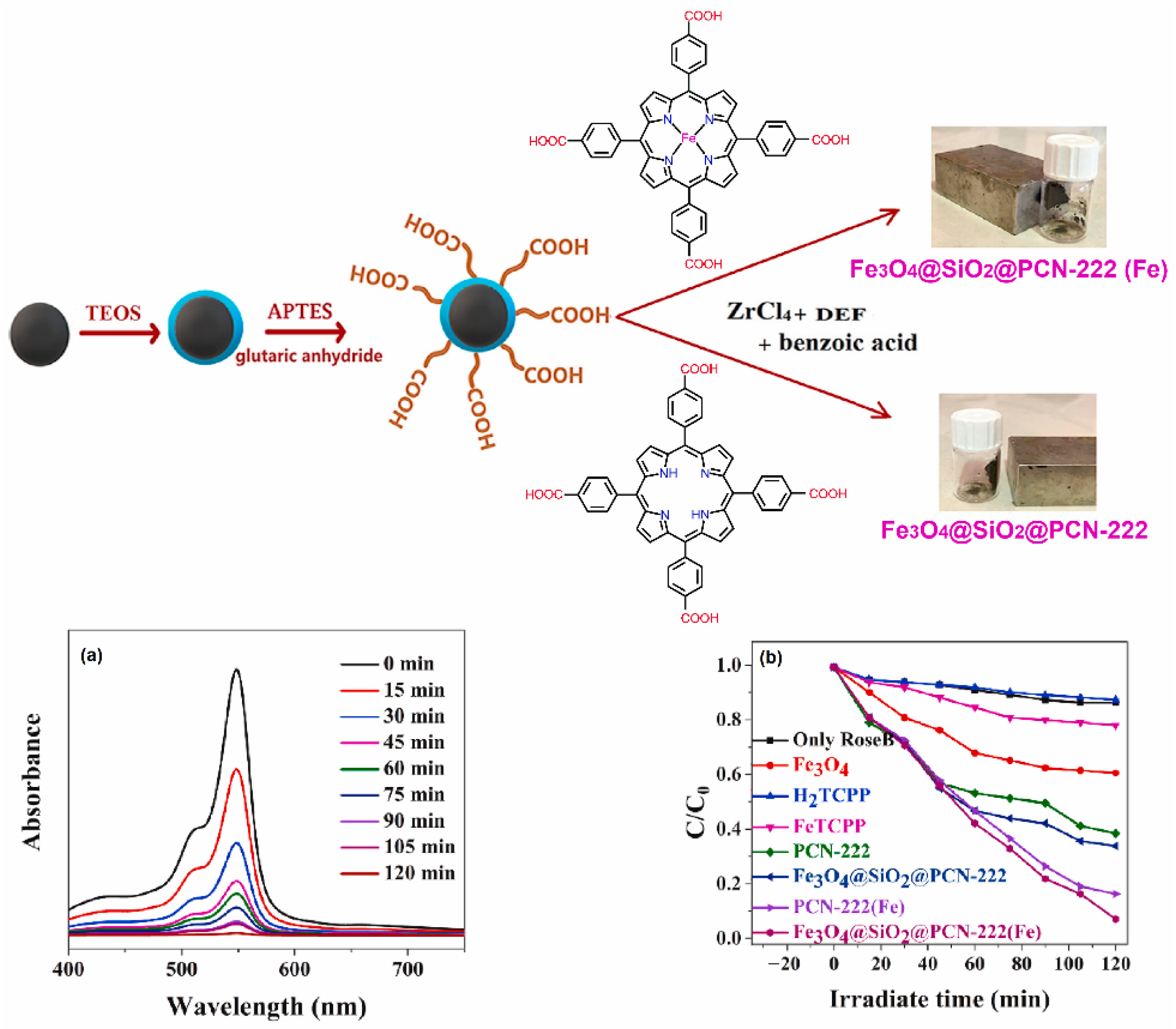
Two Zr porphyrin-based magnetic visible-light photocatalysts, Fe3O4@SiO2@PCN-222(Fe) and Fe3O4@SiO2@PCN-222, were synthesized and investigated for their photodegradation of toxic dyes in H2O [87]. Eg for Fe3O4 was found to be 1.53 eV and 1.9 eV for PCN-222(Fe). The incorporation of porphyrin ligands into these photocatalysts reduced the bandgap energy and improved the solar-light harvesting properties. Moreover, the aromatic conjugated porphyrin framework stabilizes the photogenerated species and increases the recombination time. This improved the photocatalytic activity compared with that of Fe3O4@SiO2. Under visible-light irradiation, this photocatalyst exhibited significant photocatalytic activity for the degradation of EryB, RhB, and Rose Bengal dyes. Mechanistic experiments confirmed that the highly reactive superoxide radical anion (O2−•) is the principal reactive species involved in dye photodegradation. Owing to the magnetic properties of these photocatalysts, separating them after the degradation reactions is simple, requiring only a normal magnet (Figure 19).
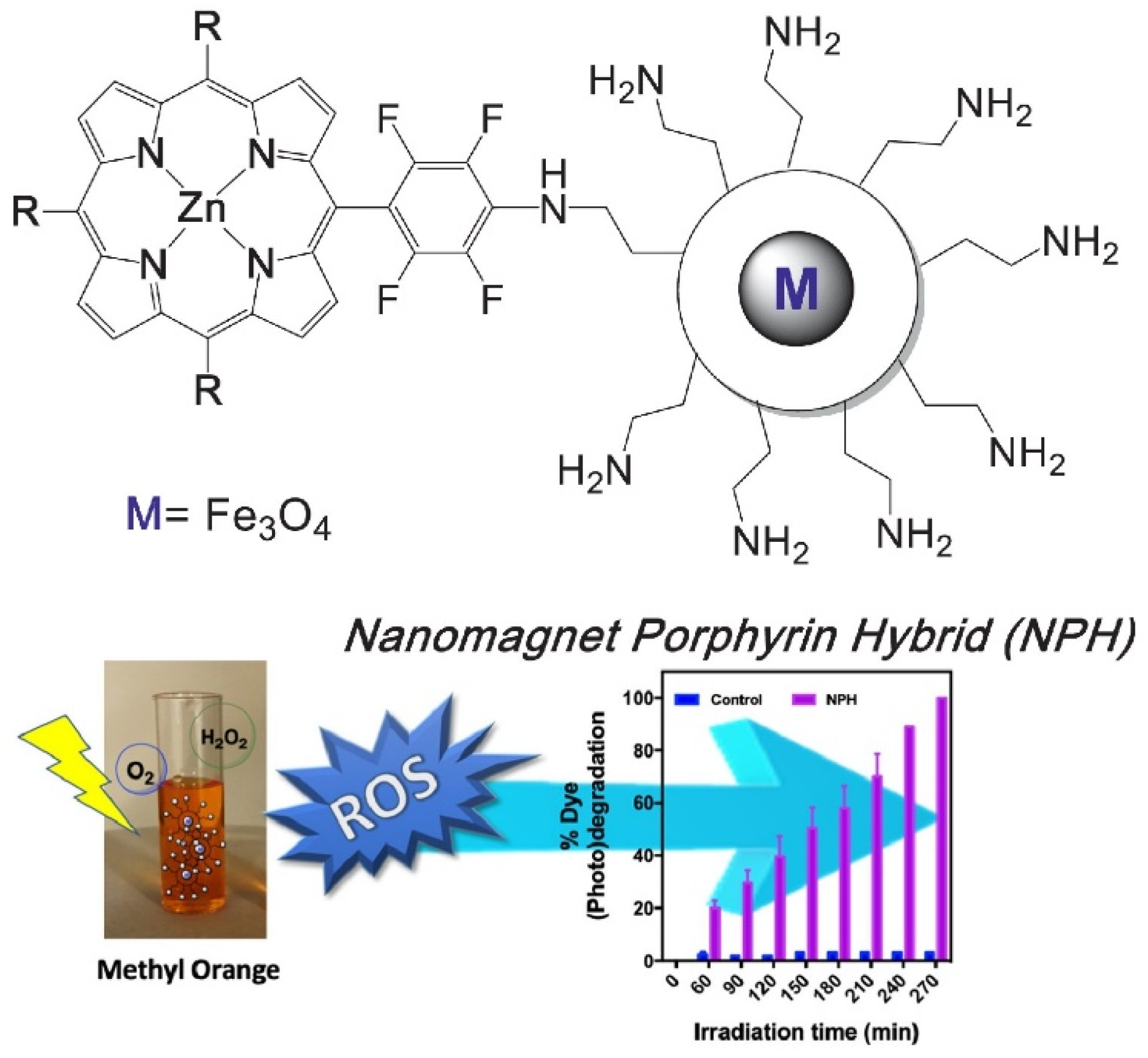
In 2021, Castro et al. reported the synthesis of a porphyrin-based nanomagnetic hybrid photocatalyst for methyl orange (MO) degradation in water [88]. The reaction of Zn(II)porphyrin with silica-coated Fe3O4 led to the formation of a nanomagnetic porphyrin hybrid. The incorporation of porphyrin into the core of the silica nanoparticles not only enhanced the photodegradation activity but also prevented the separation of porphyrin from the surface of the hybrid catalyst during the degradation reaction. Within 270 min of visible-light irradiation, the MO dye degradation ratio of the hybrid photocatalyst reached 99% in the presence of H2O2 (hydrogen peroxide). Additionally, the catalyst could be recovered from the reaction chamber using a simple magnetic bar (Figure 20).
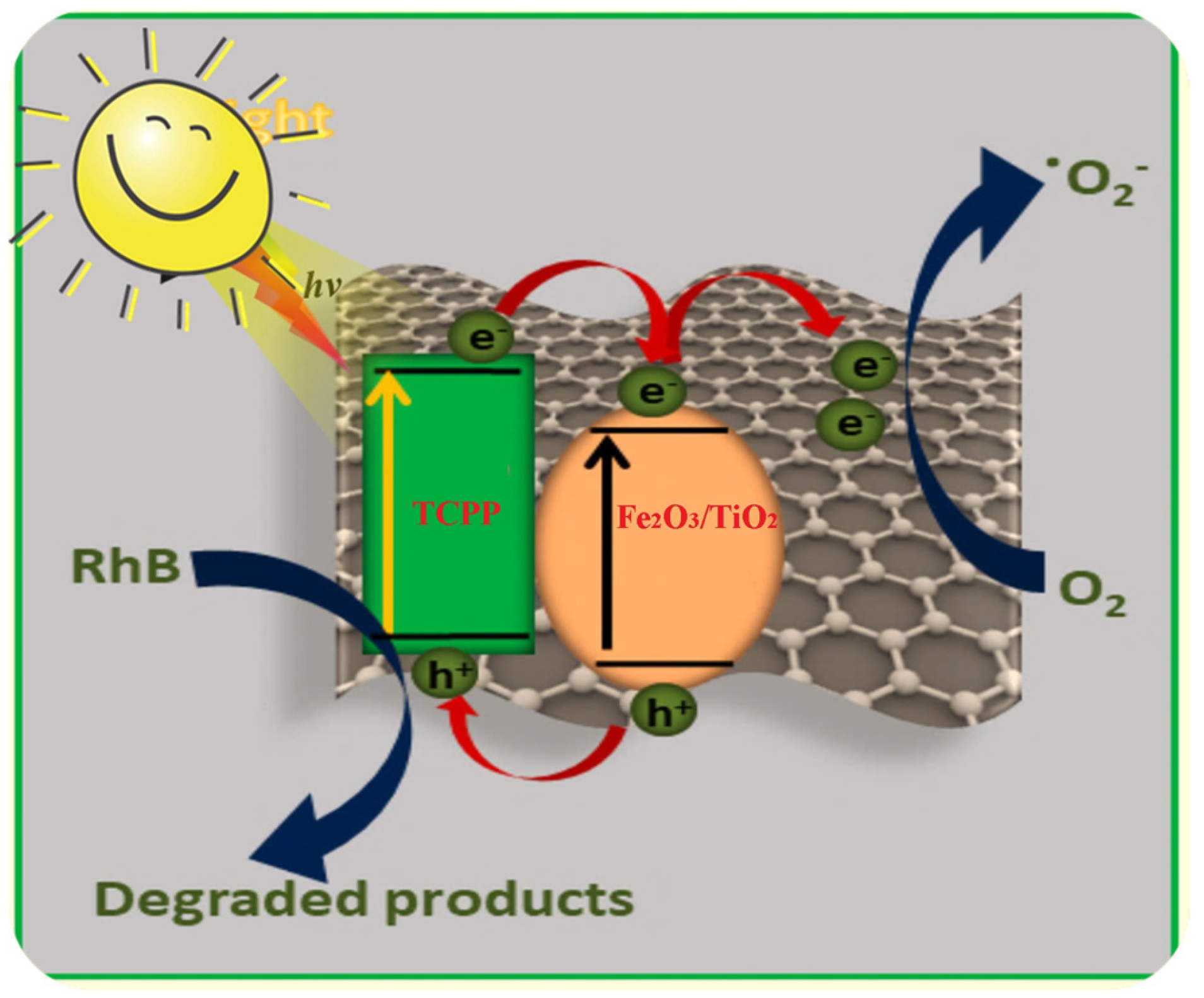
Nguyen et al. also demonstrated the construction of porphyrin-based hybrid materials for visible-light photodegradation of pollutant dyes [89]. The acid–base neutralization self-assembly of H2TCPP in the presence of the graphene@Fe2O3-TiO2 nanohybrid led to the production of graphene@Fe2O3-TiO2@porphyrin composite materials. From the DRS plot, the Eg values for Fe2O3-TiO2 and TiO2 were determined to be 2.83 eV and 3.2 eV, respectively. The integration of H2TCPP onto the core of the graphene@Fe2O3-TiO2 nanohybrid increased the visible-light harvesting properties and enhanced the photocatalytic degradation activity. Within 100 min of visible-light irradiation, the photodegradation ratio of RhB was 90% for the graphene@Fe2O3-TiO2@porphyrin composite in water (Figure 21).
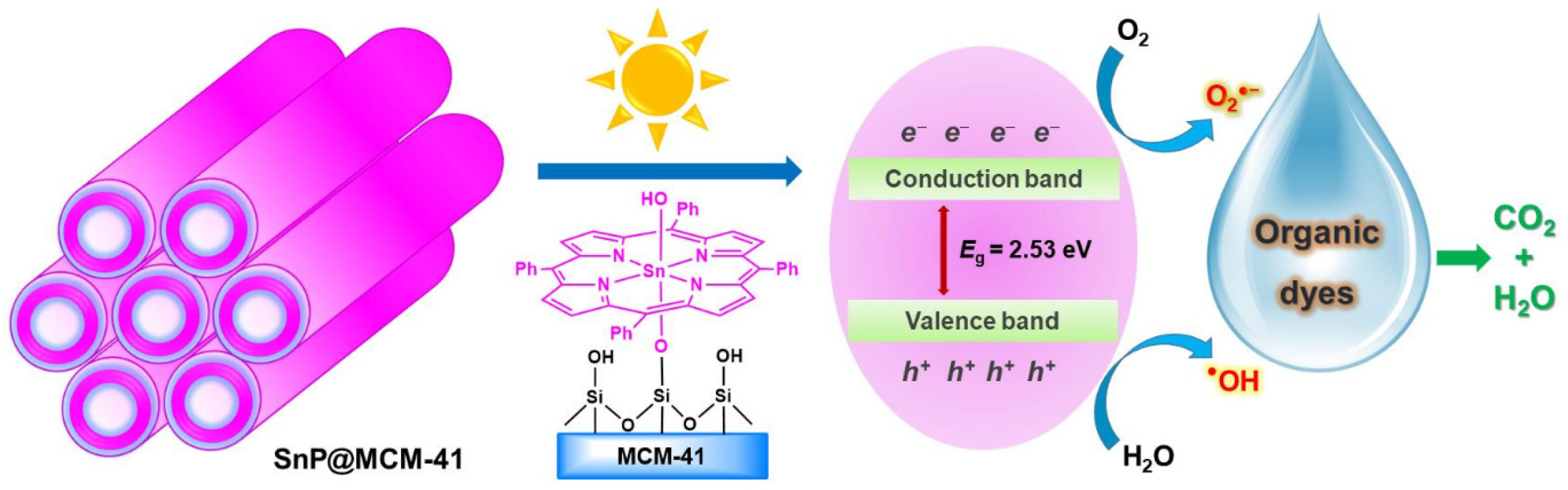
Hybrid nanocomposites (SnP@SiO2 and SnP@MCM-41) were fabricated by the chemisorption of (trans-dihydroxo)(5,10,15,20-tetraphenylporphyrinato)tin(IV) (SnP) on SiO2 and mesoporous MCM-41 (Mobil Composition of Matter No. 41) powder [90]. As determined from the Tauc plot, the Eg values for SnP, SnP@SiO2, and SnP@MCM−41 were 2.85, 2.64, and 2.53 eV, respectively. The integration of tin porphyrin onto the surfaces of SiO2 and MCM-41 not only altered the surface morphology but also enhanced the catalytic performance for the photodegradation of organic contaminants in water. Under solar-light exposure, these two hybrid nanocomposites exhibited significant catalytic photodegradation activities for cationic RhB, anionic erioglaucine, and neutral m-cresol purple in H2O. The degradation activity of SnP@MCM-41 was higher than that of SnP@SiO2. Moreover, SnP@MCM-41 exhibits excellent photostability compared to SnP@SiO2 (Figure 22). After 10 consecutive cycles, SnP@MCM−41 still maintains a high performance for the degradation of the anionic erioglaucine dye with a removal of only 8%, which shows the remarkable stability of SnP@MCM−41. The FTIR spectrum and FE−SEM image of the used sample SnP@MCM−41 were closely resemble that of the fresh sample, which indicates that the mesoporous framework of this photocatalyst was intact during the photocatalytic reaction. Moreover, the process for the recovery of these catalysts from the reaction vessel was very simple through successive filtration, washing, and drying procedures.
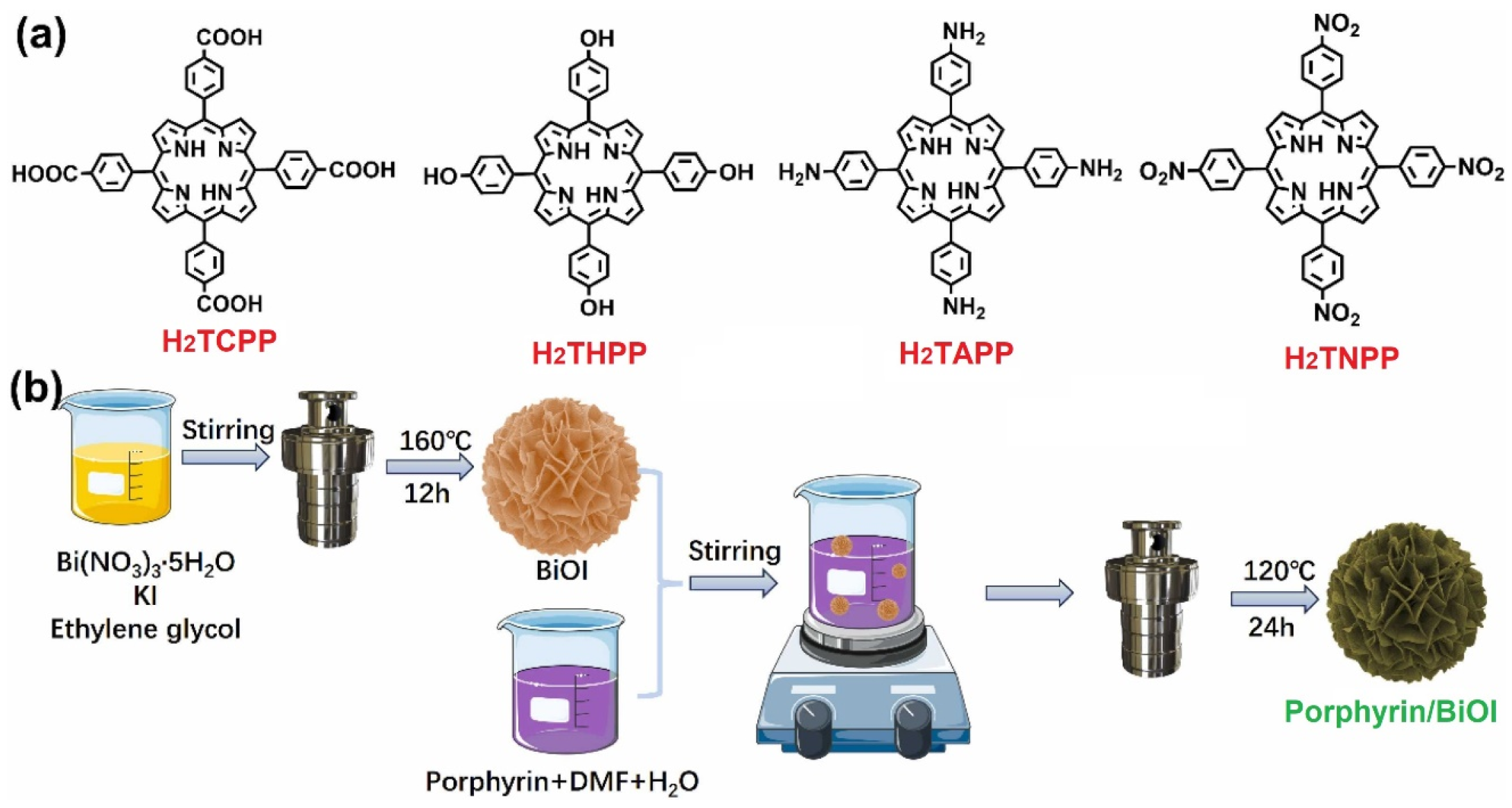
Recently, Zhu et al. reported the formation of several inorganic–organic hybrid photocatalysts for the photodegradation of 4-chlorophenol under visible-light irradiation [91]. Several porphyrins with various polar groups (–NO2, –NH2, –OH, and –COOH) have been integrated into BiOI to construct hybrid materials via impregnation. The incorporation of porphyrin onto the surface of BiOI not only increased the light-harvesting properties of the hybrid materials but also improved the photocatalytic activity. Within 60 min, all hybrid catalysts accomplished the degradation of >90% 4-chlorophenol. Interestingly, the photodegradation performance varies with the polarity and dipole moment of the porphyrin cores. The photodegradation performances of all the hybrid catalysts followed the order H2TNPP/BiOI < H2TAPP/BiOI < H2THPP/BiOI < H2TCPP/BiOI (Figure 23).
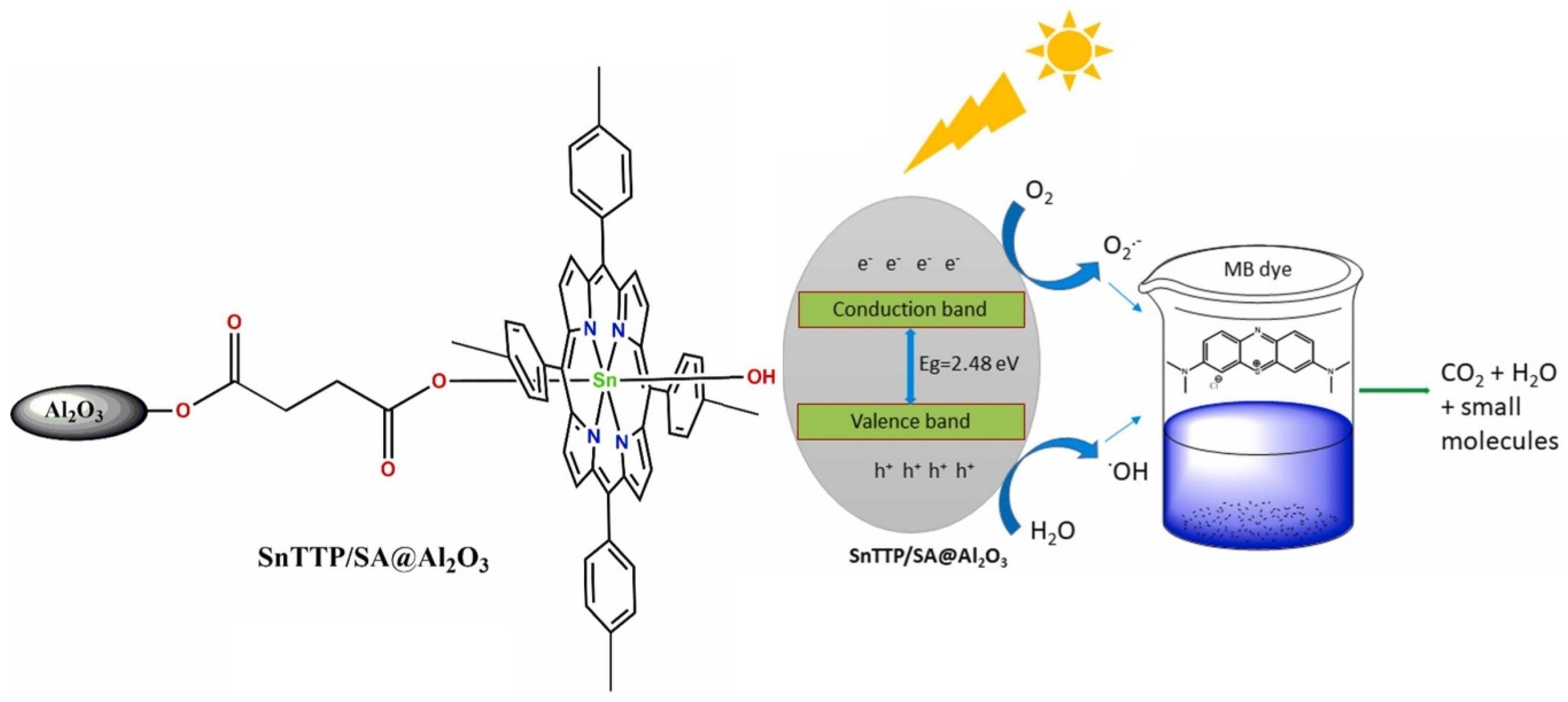
Alumina-supported porphyrin nanocomposite (SnTTP/SA@Al2O3) was utilized for MB degradation under exposure to solar light [92]. The reaction of SnTTP {trans-dihydroxo-[5,10,15,20-tetrakis(p-tolyl)porphyrinato]tin(IV)} with Al2O3 in the presence of dibasic succinic acid (SA) guided the fabrication of the hybrid nanocomposite SnTTP/SA@Al2O3. From the Tauc plot, the Eg values were found to be 3.95 eV for Al2O3, 2.96 eV for SnTTP, 2.85 eV for SnTTP@Al2O3, and 2.48 eV for SnTTP/SA@Al2O3. The incorporation of SnTTP onto the surface of alumina via the bridging anchoring ligand (SA) in SnTTP/SA@Al2O3 lowered Eg but also increased the light-harvesting properties compared with SnTTP. Within 90 min, the MB dye degradation rate constant was found to be 0.0406 min−1 for SnTTP/SA@Al2O3 and 0.0024 min−1 for SnTTP. Moreover, the strong attachment between SnTTP and Al2O3 via SA not only prevented SnTTP hydrolysis during the photodegradation reaction in water but also increased the amount of SnTTP on the surface of alumina, facilitating the transfer of electrons from the excited SnTTP molecules to the CB of alumina (Figure 24). Radical trapping experiments have been performed to determine the details of the photogenerated reactive species during the photodegradation process. Various scavengers (tert-butanol, sodium azide, para-benzoquinone, ethylenediaminetetraacetic acid disodium: Na2-EDTA) were employed during the degradation reaction of MB. It was observed that the decay rate of MB was significantly reduced in the presence of either Na2-EDTA, tert-butanol, or para-benzoquinone. The degree of reduction rate is higher in the presence of Na2-EDTA compared to tert-butanol or para-benzoquinone. These results confirmed that photogenerated h+ is the main reactive species compared to either OH or O2−•. However, the MB decay was unaffected by the presence of sodium azide. This indicated that singlet oxygen had no effect on the degradation of MB in water in this system [92].

4. Porphyrin-Conjugated Metal Plasmon Nanoparticles

In addition to metal oxides or inorganic oxides, the fabrication of metal plasmons on porphyrin or porphyrin-based frameworks improves the photocatalytic activity.
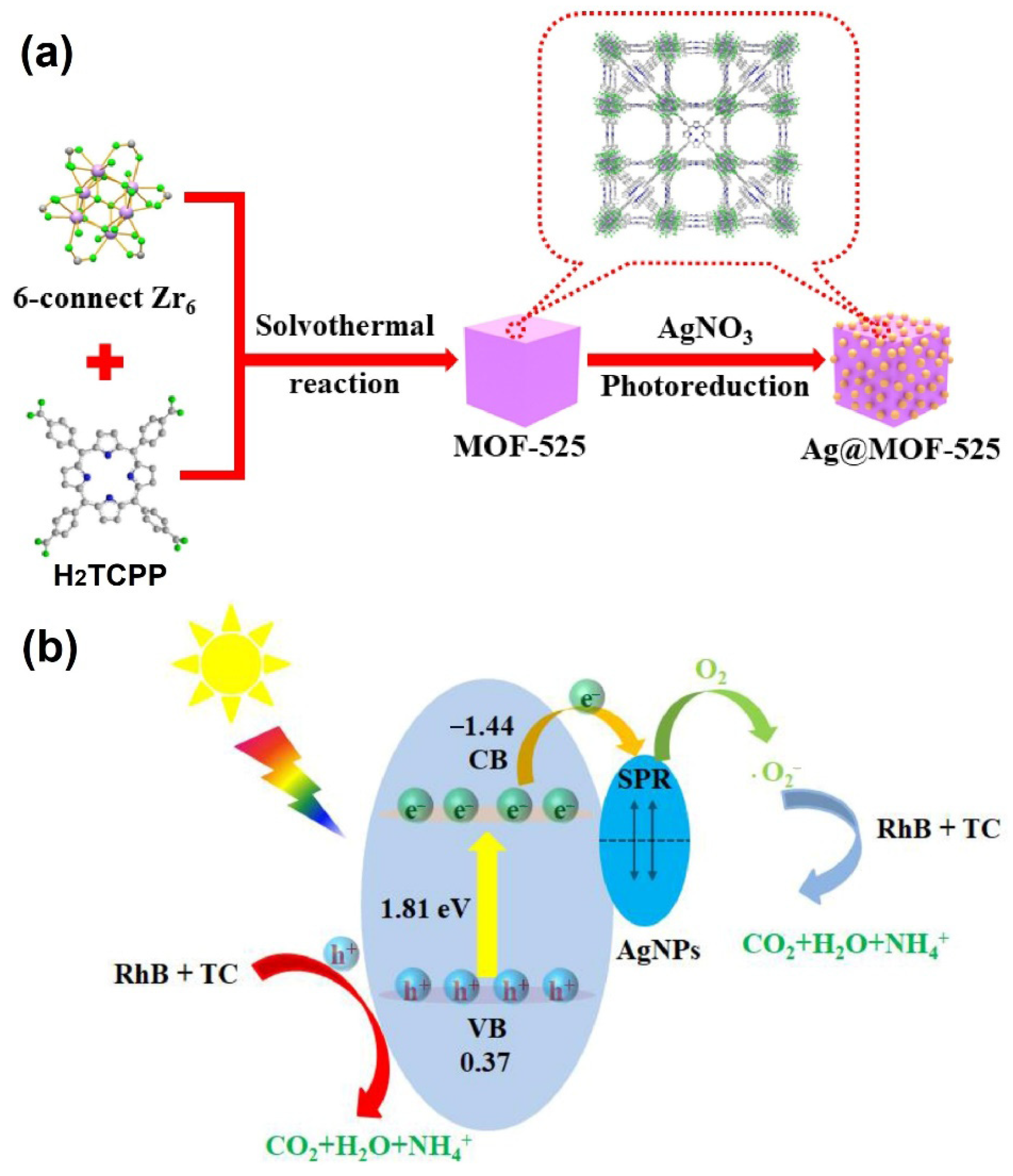
Yang et al. fabricated a porphyrin-containing hybrid material (Ag@MOF-525) for the catalytic photodecomposition of dyes [93]. Under visible-light exposure, the photoreduction of AgNO3 on the surface of a Zr-based porphyrin metal–organic framework (MOF-525) led to the fabrication of the hybrid photocatalyst Ag@MOF-525. The integration of Ag plasmon (Ag NPs) onto the core of MOF-525 improved not only the visible-light harvesting efficiency but also electron transportation, separation, and delay of the recombination rate of the photogenerated reactive species. The RhB photodegradation rate of Ag@MOF-525 was 91% within 60 min. By contrast, the photodegradation ratio of TC for Ag@MOF-525 was 200 min. The degradation efficiency of Ag@MOF-525 was higher than that of either H2TCPP or MOF-525 (Figure 25). Radical trapping experiments advocated that h+ and O2−• are the dominant reactive species produced during the degradation reactions.
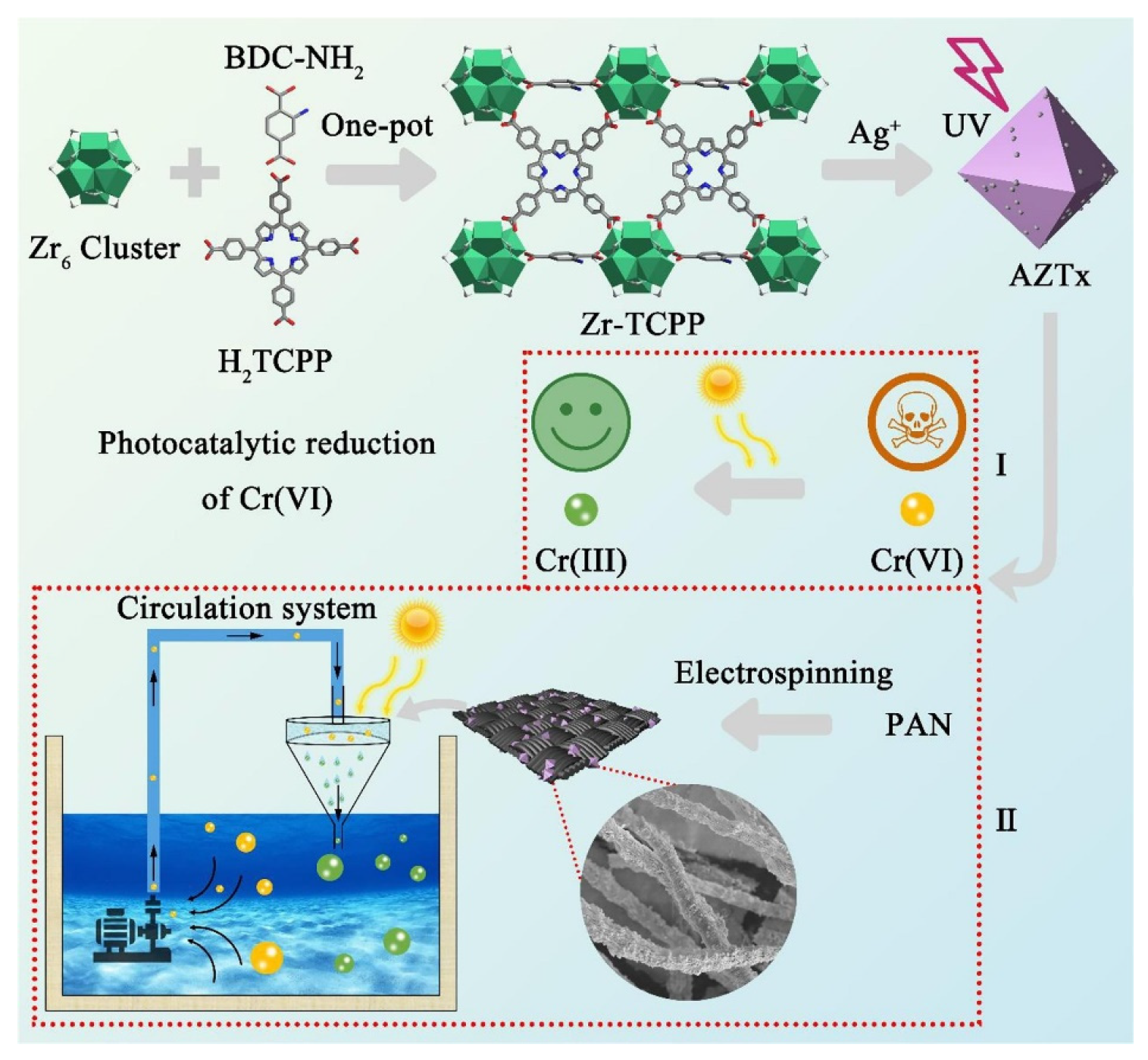
In addition, Yang et al. published a porphyrin-based composite visible-light catalyst (AZTx) for the reduction in toxic Cr(VI) ions in water [94]. In a typical procedure, Zr–TCPP was synthesized via a one-pot reaction between H2TCPP, UiO-66-NH2, and Zr6 precursors. Under UV-light irradiation, the photoreduction of AgNO3 on the core of Zr–TCPP led to the fabrication of the desired hybrid catalyst, AZTx (Ag@Zr–TCPP). From the DRS plot, Eg was determined to be 2.35 eV for AZTx (x = 5), 2.69 eV for Zr–TCPP, and 2.83 eV for UiO-66-NH2. The integration of H2TCPP into Zr–TCPP increased its visible-light harvesting capacity. The integration of silver plasmons onto the surface of Zr–TCPP further intensified its photocatalytic activity for the reduction in an aqueous solution of toxic Cr(VI) ions to less toxic Cr(III). Under 30 min of visible-light irradiation, AZT5 (5 wt% ratio of Ag nanoparticles to Zr–TCPP) converted 94.1% of the toxic Cr(VI) ions into less toxic Cr(III) under acidic conditions. The degradation rate constant of Ag@Zr–TCPP was 3.6–5.4 times superior to that of Zr–TCPP. The integration of Ag nanoparticles onto the core of Zr–TCPP improves the light-harvesting activity, enhances the separation of electron–hole pairs, delays the recombination time, and improves the photocatalytic activity (Figure 26). Interestingly, bimetallic MOFs increase the active site of the compound, encourage internal electron transfer, and change the activation path via the synergistic effect of bimetals compared to monometallic MOFs [95,96].
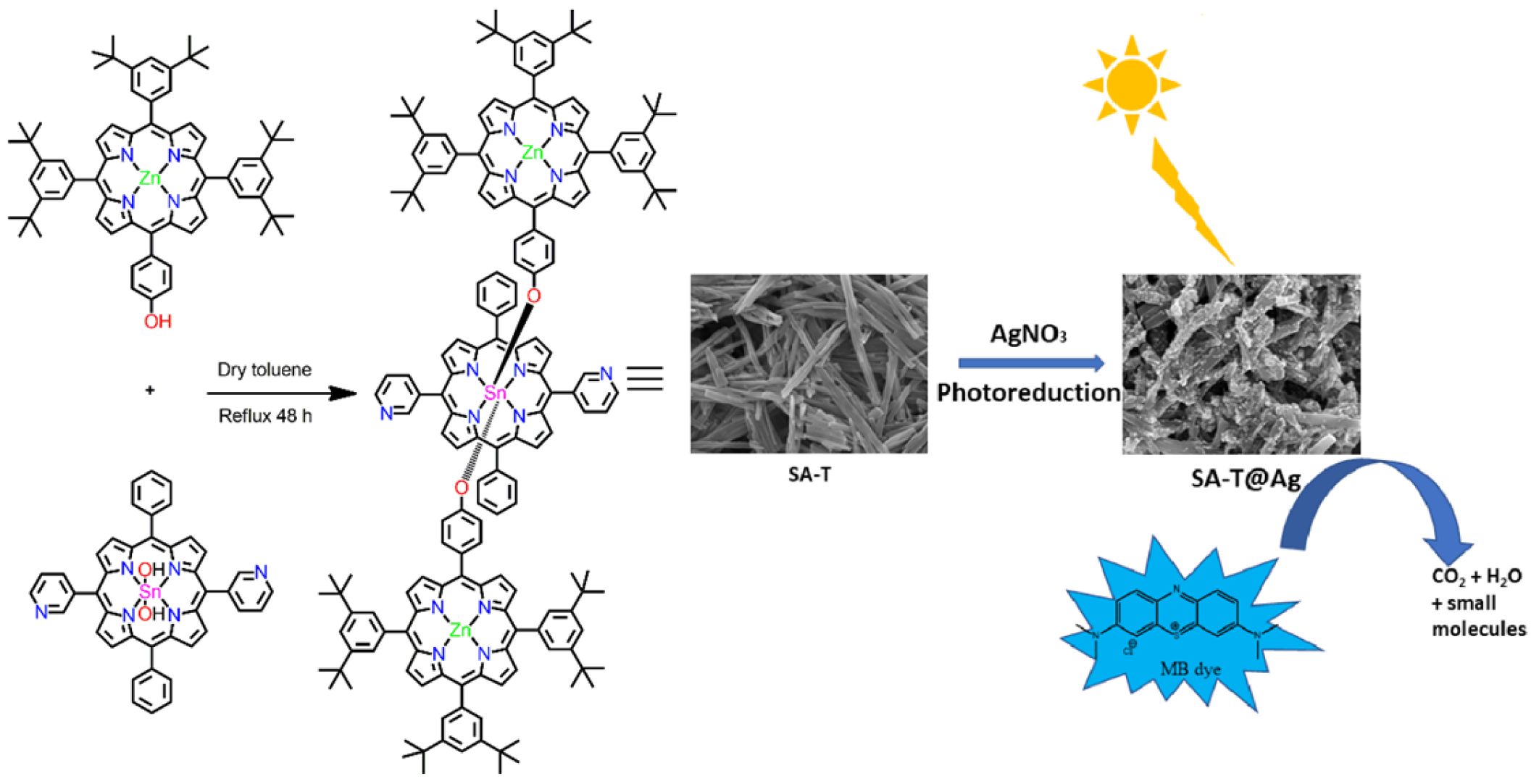
In 2024, Kim et al. constructed SA-T@Ag nanocomposite materials for catalytic MB dye degradation under visible-light exposure [97]. The reaction of Zn(II)porphyrin with tin(IV)porphyrin led to the formation of the Zn(II)–Sn(IV)–Zn(II) triad (SA–T). Silver NPs were then successfully decorated onto the surface of the porphyrin nanofibers (SA–T) via photoreduction to construct the nanocomposite SA-T@Ag. The Eg values of SA–T and SA-T@Ag calculated from the Tauc plot were calculated to be 2.55 eV and 2.44 eV, respectively. The formation of SA-T@Ag reduced the Eg but enhanced the visible-light harvesting properties compared with those of SA-T. This delays the recombination of the photogenerated reactive pairs and hence improves the photodegradation rate. Within 45 min, the first-order MB dye photodecomposition rate constant was found to be 0.081 min−1 for the SA-T@Ag nanocomposite and 0.028 min−1 for SA-T only (Figure 27). To know the degradation products of the MB dye, mass spectra of the reaction mixture were taken after 30 min for each photodegradation experiment. New peaks appeared in the mass spectra that confirm the degradation of the MB dye into new fractions. Initially, the base peak (m/z =284.1; [MB-Cl]+) corresponds to the MB dye. It can undergo oxidative ring opening with an m/z of 304.1. This species can be further fragmented into lower-molecular-weight molecules with m/z of 175.0 or 95.0. These low-molecular-weight aromatic compounds can then undergo successive ring cleavage and hydrolysis, giving rise to compounds with an m/z of 119.0. In contrast, MB underwent N-de-ethylation to form a chromophoric species with an m/z of 228.0. After successive ring cleavages, it was fragmented into low-molecular-weight molecules with an m/z of 119.0 or 111.0. Finally, all low-molecular-weight molecules were mineralized into nontoxic H2O and CO2 [97].

5. Conjugation of Porphyrin to Carbon-Based Nanomaterials

Various carbon-based materials (graphene/g-C3N4-based) have emerged as excellent catalytic systems for the photodegradation of hazardous pollutants owing to their low toxicity, narrow bandgap, and high stability [98,99]. However, the utilization of these photoactive compounds is limited by their low dispersibility in organic solvents and water. The integration of porphyrins into these materials can improve their photodegradation efficiency.

5.1. Porphyrin–C3N4 Hybrid Nanomaterials

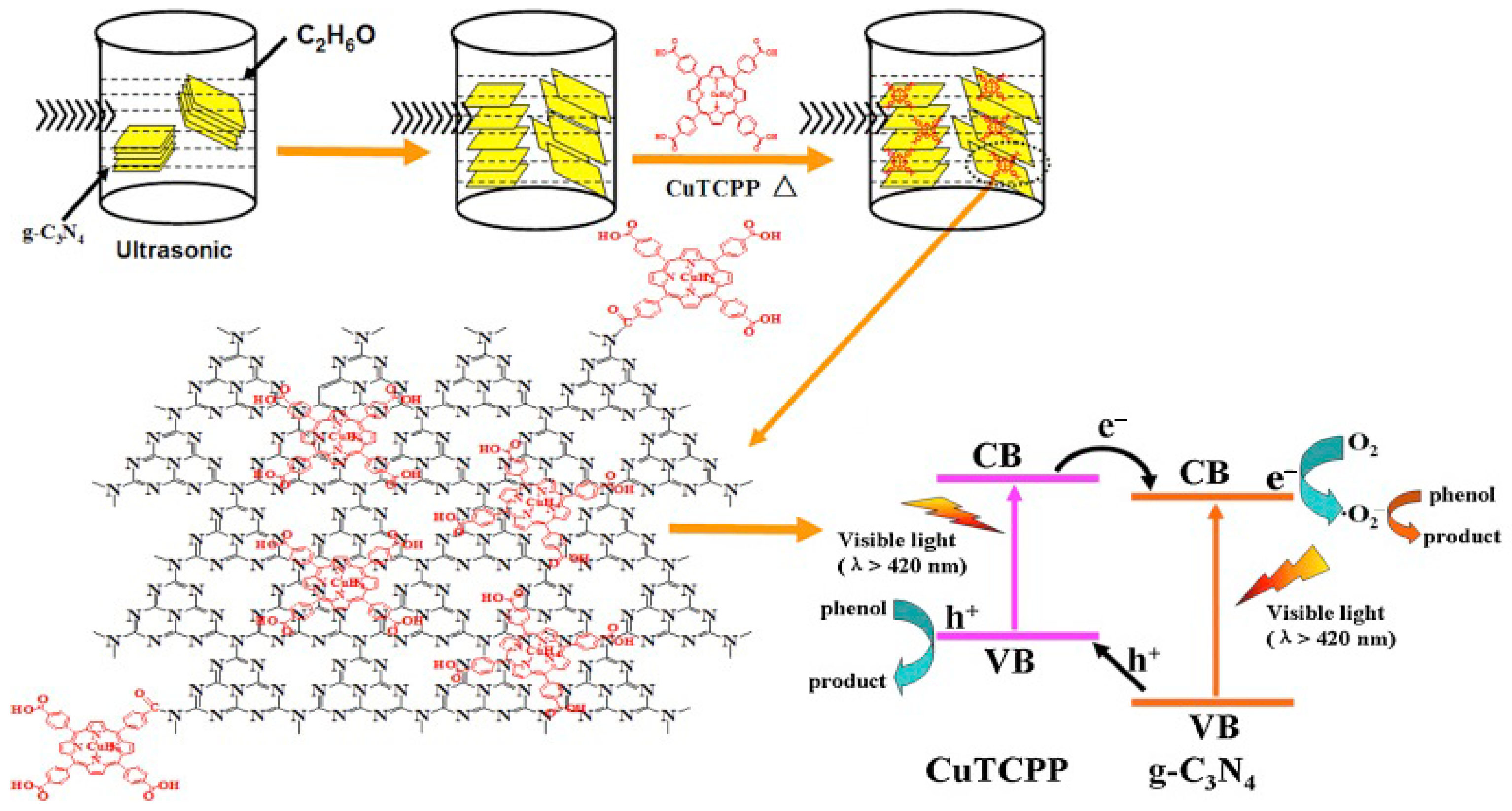
A hybrid CuTCPP/g-C3N4 composite was fabricated using the ethanol interspersion approach [100]. CuTCPP compounds were easily incorporated onto the surface of the g-C3N4 nanosheets via covalent bonds. However, various intermolecular interactions (π–π stacking and electrostatic interactions) between CuTCPP and the g-C3N4 nanosheets were responsible for the association of these two materials. Within 10 h of white-light irradiation, the first-order photocatalytic phenol degradation rate constants were determined to be 0.024 h−1 for the CuTCPP/g-C3N4 composite, 0.011 h−1 for g-C3N4, and 0.0012 h−1 for CuTCPP. The improved photocatalytic performance arises from the significant electron transfer to g-C3N4 originating from the photoexcited CuTCPP. The incorporation of CuTCPP onto the surface of g-C3N4 not only increased the photodegradation performance but also enhanced the visible-light harvesting activity (Figure 28).
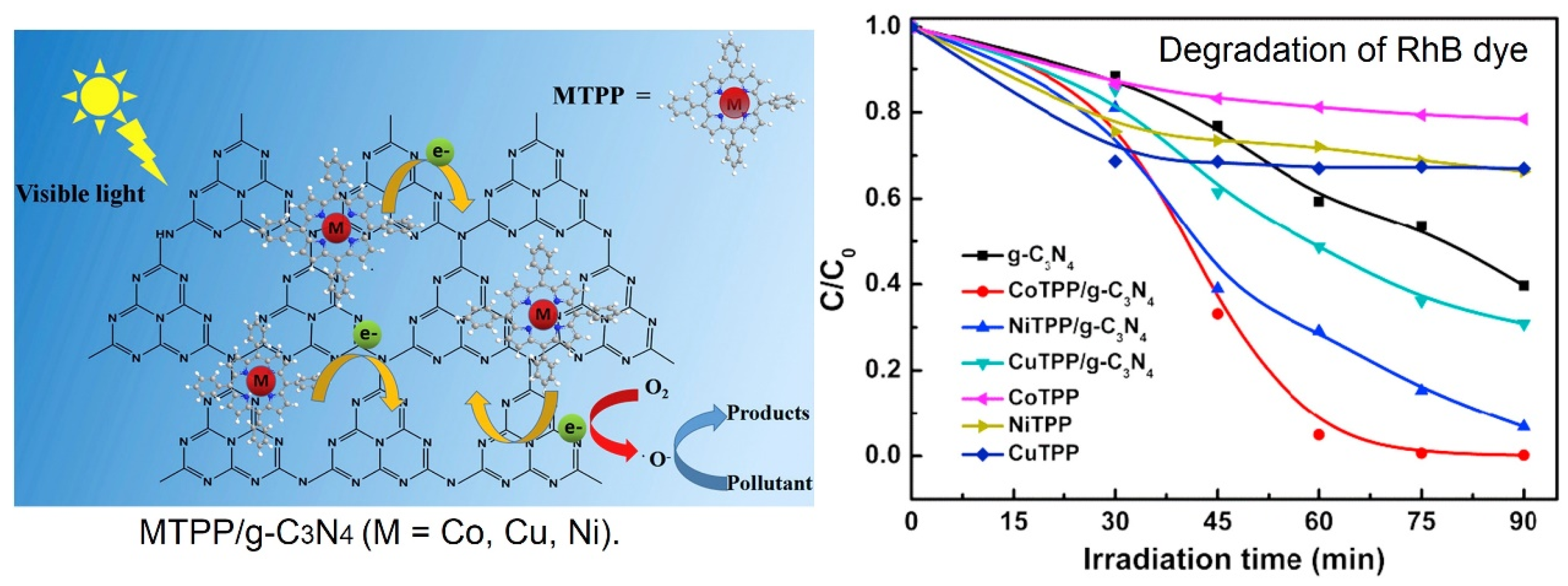
In 2018, Zhang et al. synthesized hybrid nanomaterials with several metalloporphyrins and g-C3N4 [101]. The solvothermal reaction between g-C3N4 and the metalloporphyrin leads to the formation of these composite nanomaterials. The integration of porphyrin onto the surface of g-C3N4 not only intensifies the visible-light harvesting property but also lowers the band gap energy of the hybrid materials compared with either metalloporphyrin or g-C3N4. From the DRS, the Eg values were found to be 2.37 eV for g-C3N4, 2.22 eV for CoTPP/g-C3N4, 2.25 eV for NiTPP/g-C3N4, and 2.27 eV for CuTPP/g-C3N4. Under visible-light irradiation, all these hybrid nanomaterials exhibited an amplified catalytic photodegradation activity for RhB dye in water. The CoTPP/g-C3N4 composite was much more efficient than CuTPP/g-C3N4, NiTPP/g-C3N4, and pristine g-C3N4. This enhanced photodegradation performance was attributed to the more effective interfacial charge transfer between g-C3N4 and CoTPP (Figure 29).
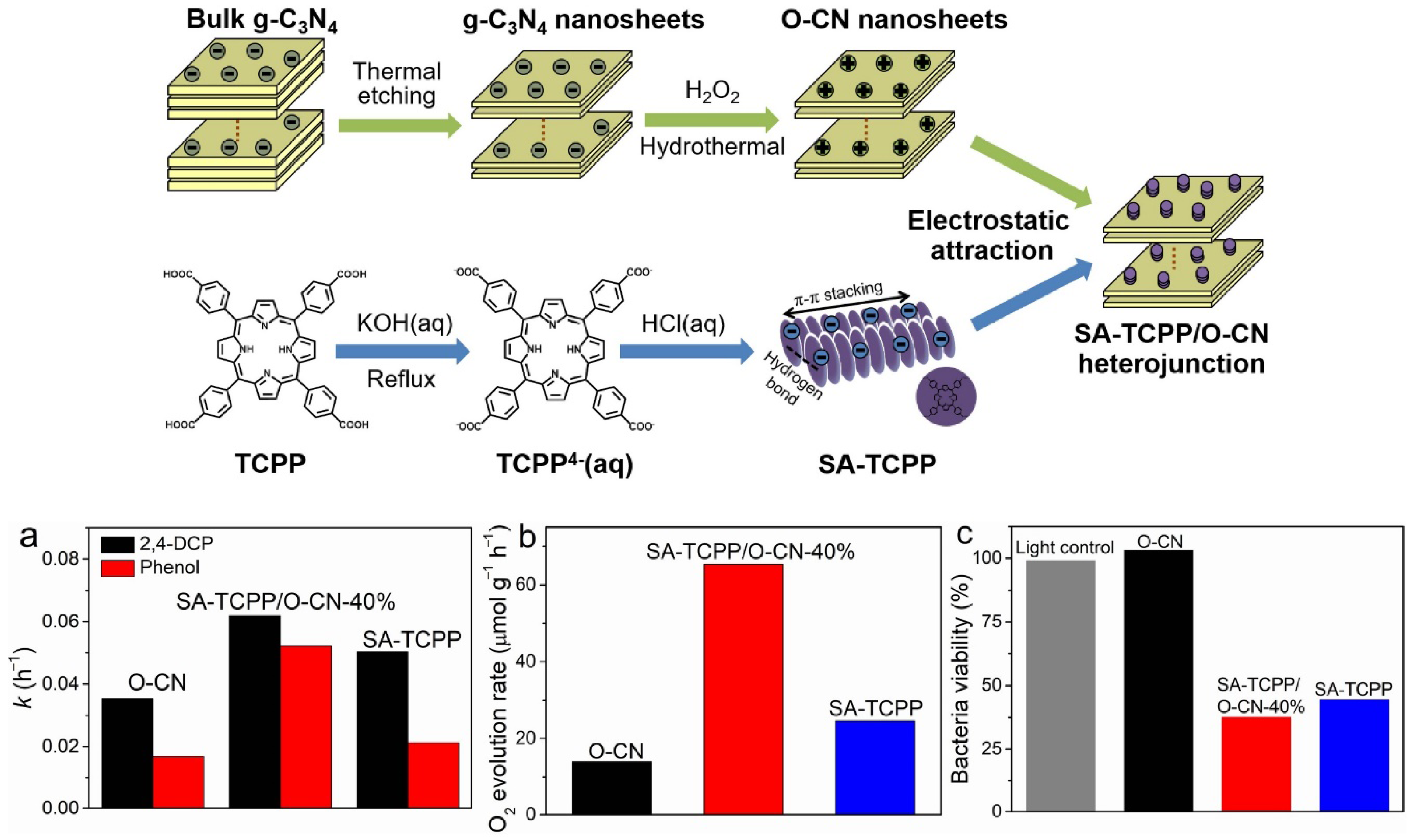
An all-organic hybrid nanomaterial, SA-TCPP/O-CN, was synthesized for photocatalytic application under visible-light irradiation [102]. Oxygen-doped g-C3N4 (O-CN) nanosheets and self-assembled porphyrin (SA-TCPP) nanostructures were integrated to fabricate 0D/2D hybrid nanostructures via in situ electrostatic interactions. From the DRS plot, the Eg values for O-CN and SA-TCPP were found to be 2.31 eV and 1.78 eV, respectively. The integration of SA-TCPP with O-CN improved the visible-light harvesting properties of SA-TCPP/O-CN. Interfacial carrier transfer and electron delocalization between SA-TCPP and O-CN occurred readily owing to highly similar π–π interactions and band structures of these two materials. This improved the visible-light catalytic activity of the hybrid material. Compared with SA-TCPP or O-CN, SA-TCPP/O-CN showed efficient catalytic performance for O2 evolution, toxic pollutant decomposition, and disinfection (Figure 30).
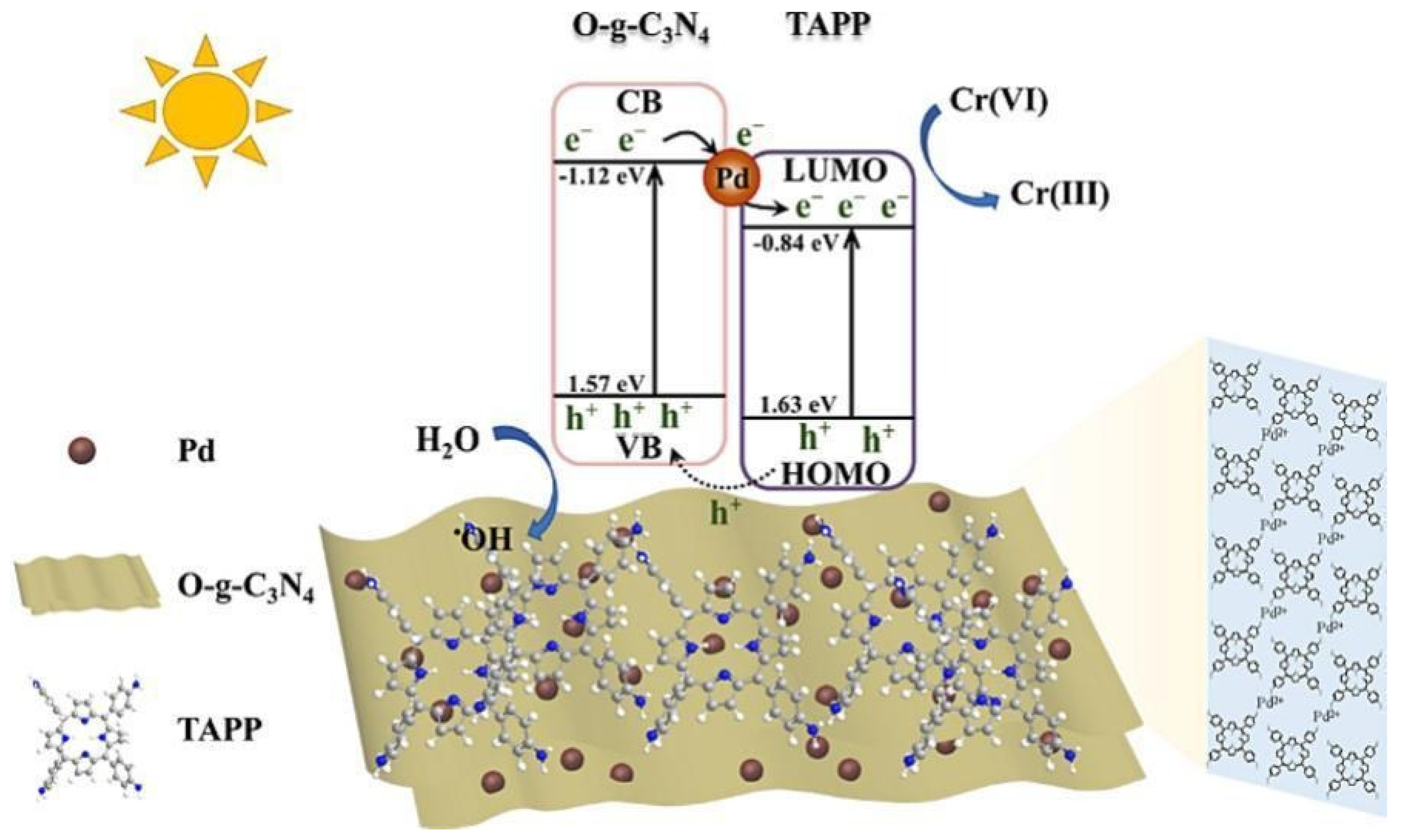
Recently, a Pd(II)-mediated multiporphyrin-sensitized g-C3N4 hybrid catalyst was constructed for Cr(VI) reduction in water [103]. The reaction of oxidized graphitic carbon nitride (O-g-C3N4) with Pd(II)-mediated multiporphyrin arrays of tetrakis(4-aminophenyl)porphyrin (TAPP) led to the fabrication of hybrid photocatalyst O-g-C3N4@(Pd-TAPP)n. From the DRS, the Eg values for O-g-C3N4 were found to be 2.69 eV and 1.98 eV for O-g-C3N4@(Pd-TAPP). The integration of porphyrinic materials onto the surface of O-g-C3N4 improved the visible-light harvesting ability and enhanced the transportation and separation of photogenerated carriers, thereby increasing the catalytic photodegradation activity. Under solar-light exposure, >90% Cr(VI) was reduced using the hybrid photocatalyst O-g-C3N4@(Pd-TAPP)3 (K = 0.107 min−1) within 60 min (Figure 31).
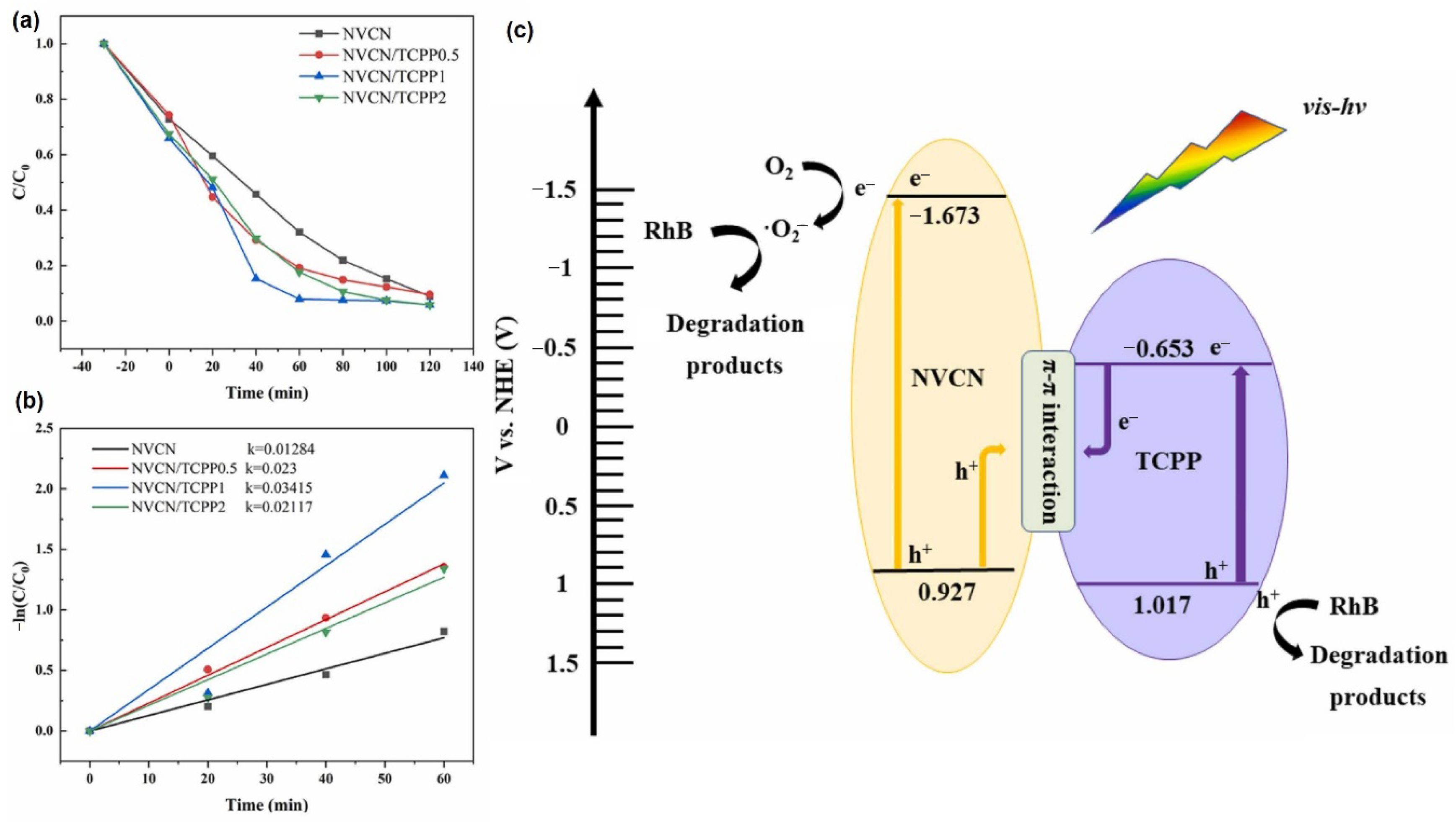
Zhao et al. also reported the formation of a porphyrin-based heterojunction NVCN/TCPP for the visible-light photodecomposition of RhB dye in H2O [104]. The reaction of tetra(4-carboxylphenyl) porphyrin (TCPP) with nitrogen-vacancy-enriched g-C3N4 (NVCN) led to the fabrication of an NVCN/TCPP heterojunction. A mechanistic investigation indicated that π–π interactions between g-C3N4 and TCPP were responsible for the formation of this heterojunction. From the DRS, the Eg values were 1.67 eV and 2.60 eV for TCPP and NVCN, respectively. The integration of TCPP molecules onto the surface of nitrogen-vacancy-enriched g-C3N4 in the NVCN/TCPP heterojunction reduced the bandgap energy and boosted the photocatalytic performance via the Z-scheme strategy. Within 60 min, the degradation rate constant was 0.034 min−1 for the NVCN/TCPP heterojunction vs. 0.012 min−1 for NVCN (Figure 32).

5.2. Porphyrin–Graphene Hybrid Nanomaterials

Graphene, GO, and rGO have been examined as promising photocatalysts owing to their huge active surface area, excellent electron mobility, peculiar two-dimensional honeycomb morphology, and flexible functional groups [105]. Additionally, the fabrication of porphyrin with these compounds leads to the fabrication of hybrid photocatalysts with high conductivity, excellent stability, and photocatalytic performance.
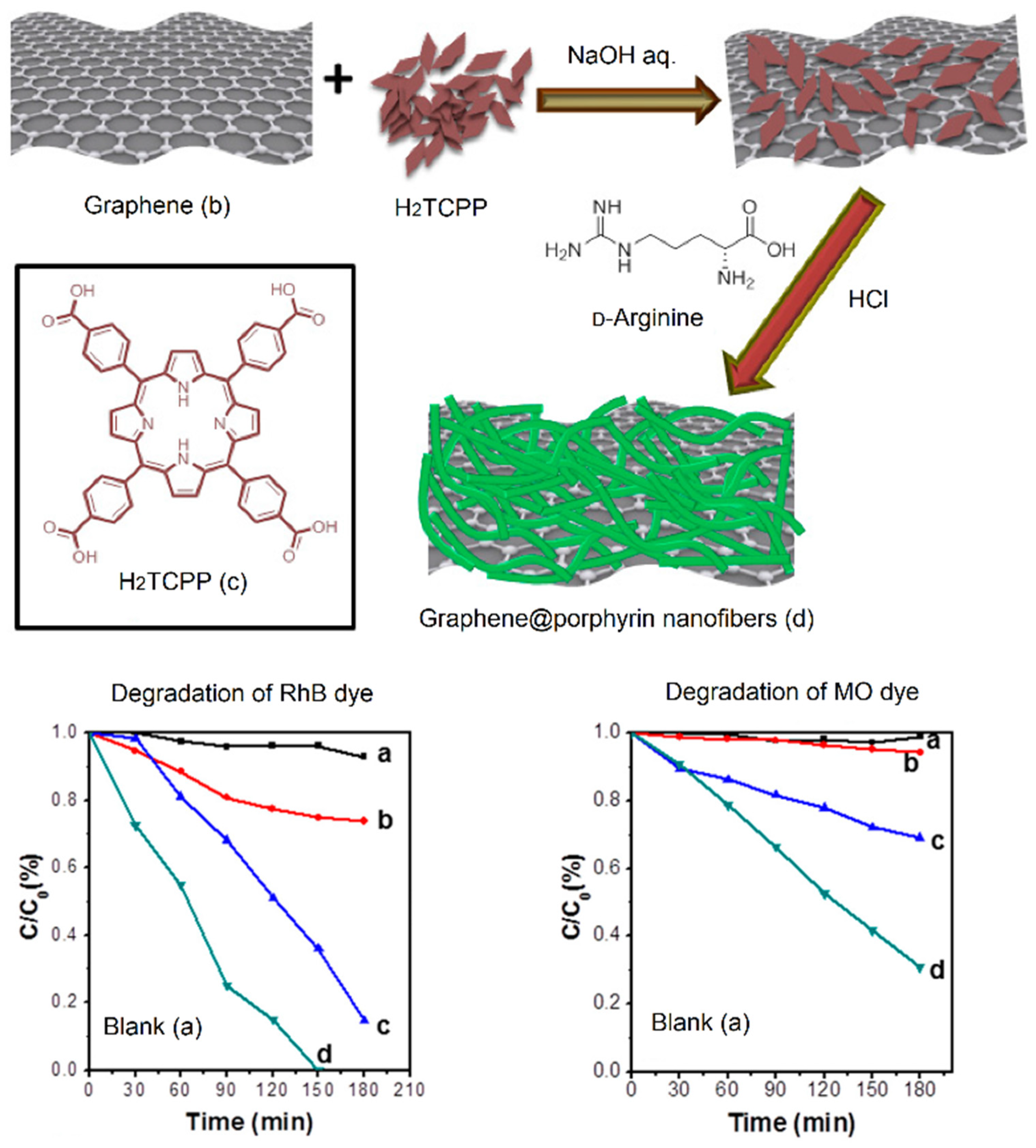
In 2017, La et al. constructed a graphene@porphyrin nanofiber composite material for visible-light photocatalysis [106]. In the presence of D-arginine, the acid–base neutralization reaction of tetrakis(4-carboxyphenyl) porphyrin (H2TCPP) with graphene nanoplates (GNPs) led to the fabrication of graphene@TCPP nanofibers (Figure 33). The self-assembled porphyrin nanofibers were consistently spread on the graphene surface. The synthesized composite materials exhibited enhanced catalytic photodegradation of RhB and MO dyes compared with the starting materials (graphene nanoplates or free-standing H2TCPP). Within 150 min, the RhB photodegradation ratio was 100% for the graphene@porphyrin nanofibers under solar-light irradiation. However, within 180 min of irradiation, the MO degradation ratio was 80% for graphene@porphyrin nanofibers.
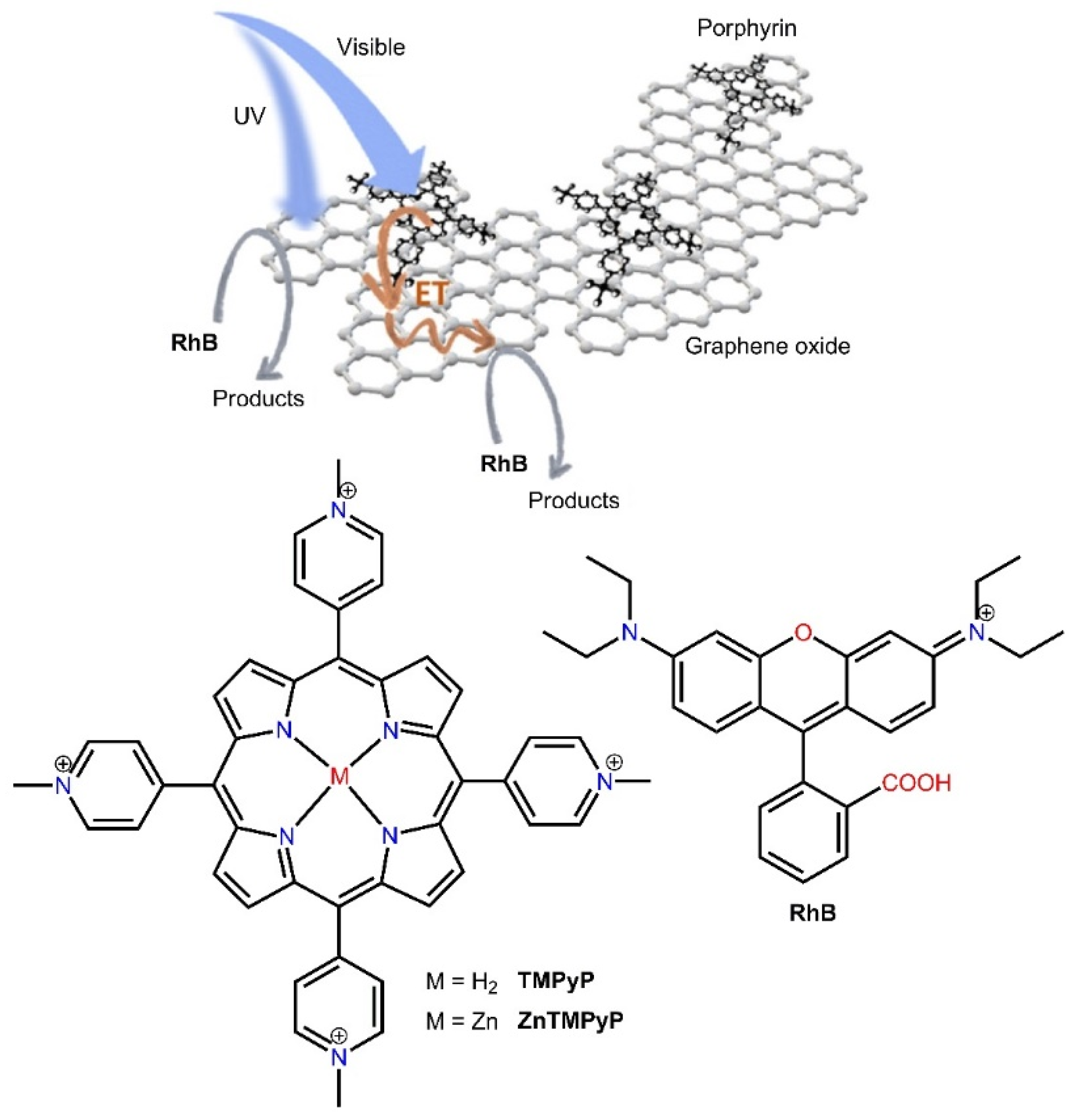
Andralojc et al. reported improved photocatalytic decomposition of RhB dye using a porphyrin/graphene oxide-based nanohybrid [107]. Two cationic porphyrins (TMPyP and ZnTMPyP) were immobilized over GO via non-covalent interactions to form TMPyP-GO and ZnTMPyP-GO nanohybrids. The incorporation of GO into porphyrins not only amplifies the surface area and electron conductivity but also enhances the optical properties. Within 120 min, the photodegradation ratio of RhB was 19% for ZnTMPyP-GO, which was higher than that of TMPyP-GO (10%) and GO (3.7%). Various spectroscopic measurements confirmed that ZnTMPyP can enhance the affinity of the metalloporphyrin for the GO surface, facilitate charge separation, and hence increase the photodegradation activity under visible-light irradiation (Figure 34).
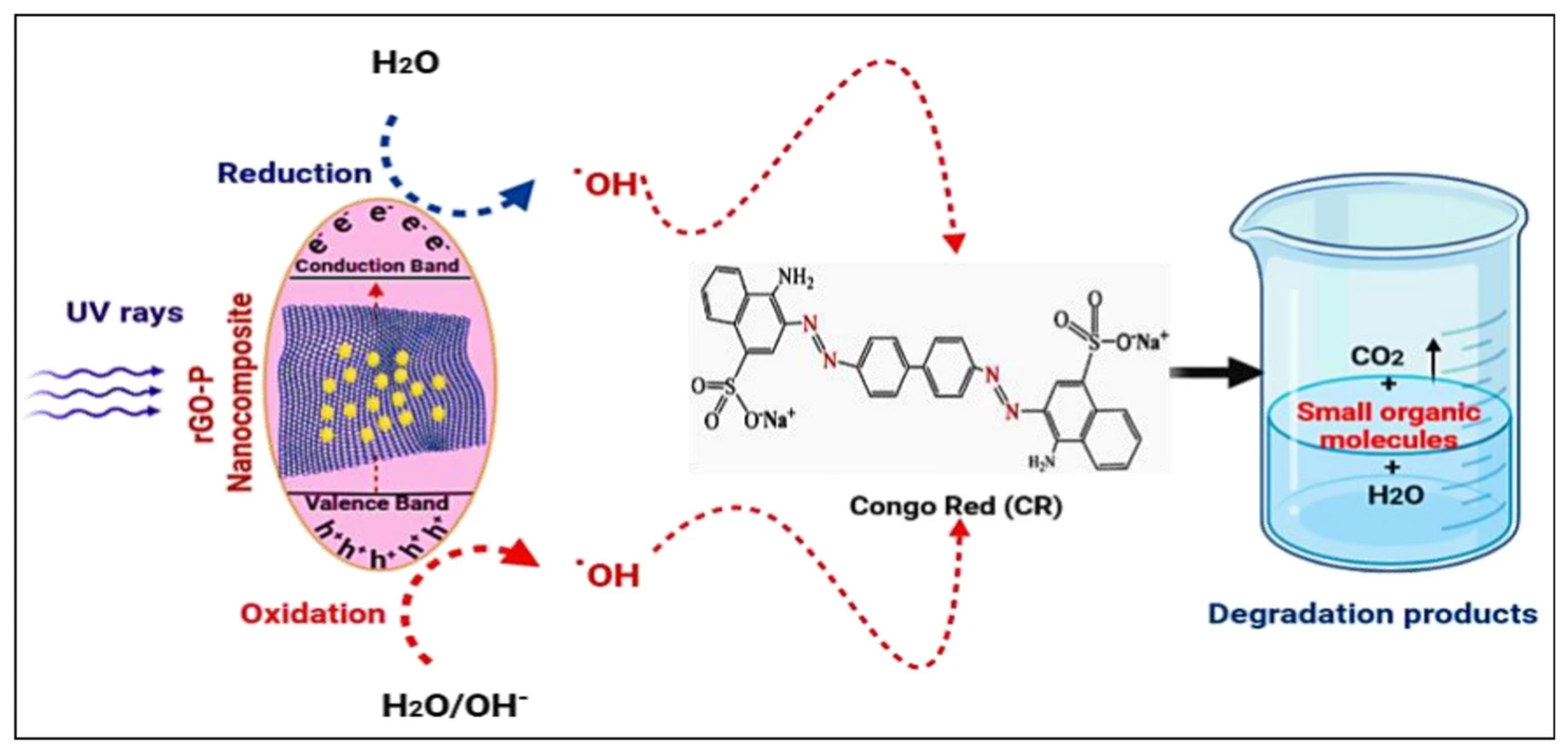
Porphyrin-based reduced graphene oxide composites (rGO-P) were constructed for Congo Red (CR) degradation in water [108]. Sonicating reduced graphene oxide (rGO) with 5,15-bisdodecyl porphyrin led to the fabrication of rGO-P. The incorporation of porphyrin with rGO not only boosts the visible-light harvesting capacity but also generates a large active surface for the interaction and diffusion of substrate molecules. Within 90 min of UV-light irradiation, the CR degradation ratio was 57% for rGO-P and 30% for rGO (Figure 35). The improved degradation activity was attributed to the synergistic effect between rGO and the porphyrin.
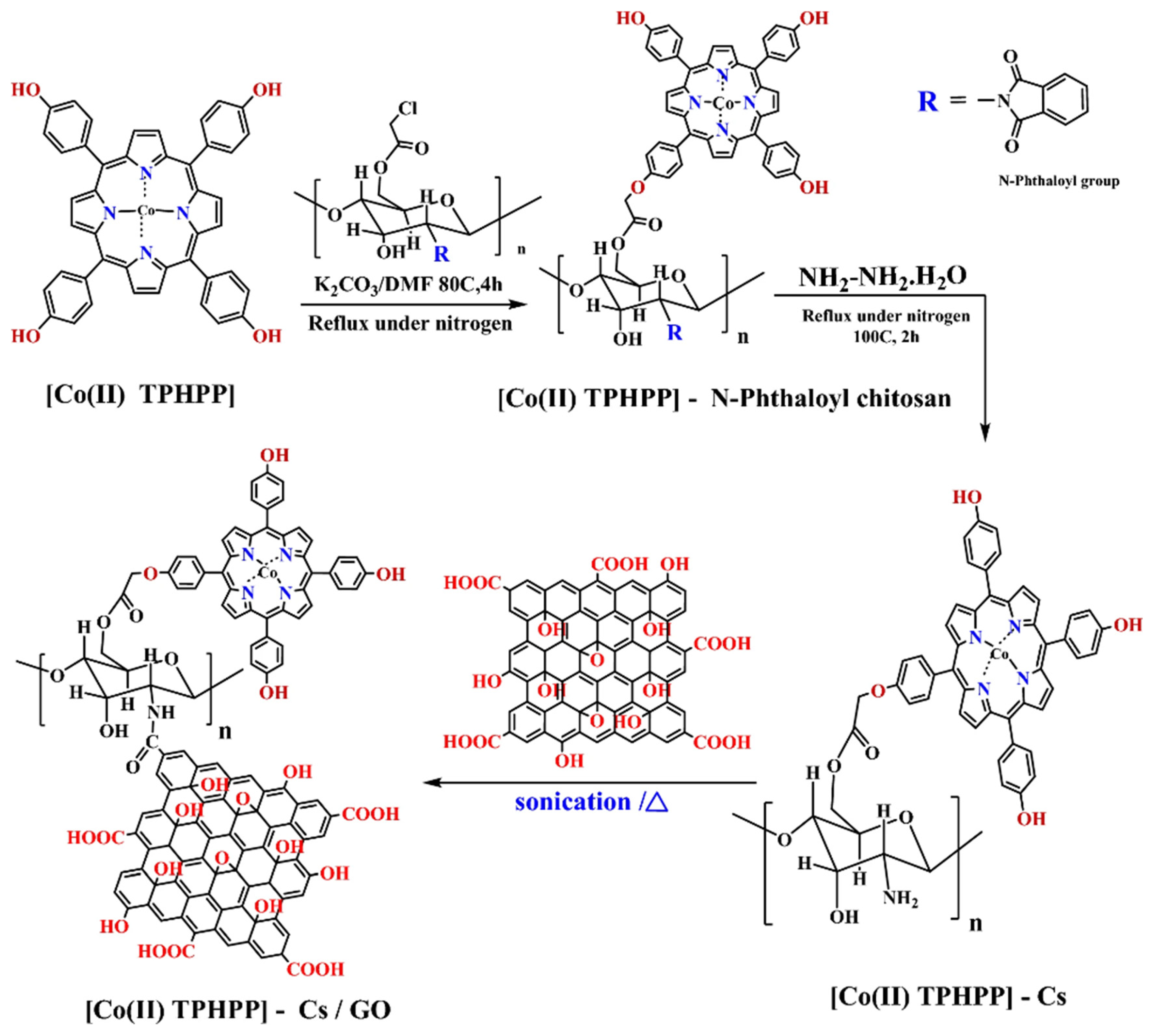
Recently, a porphyrin-sensitized GO nanohybrid [Co(II) TPHPP]-Cs/GO was fabricated for the visible-light catalytic photodegradation of Acid Orange 7 dye in H2O [109]. Sonication of 5-, 10-, 15-, and 20-tetrakis[4-(hydroxy)phenyl] porphyrin [Co(II) TPHPP] covalently supported chitosan with GO led to the formation of a [Co(II) TPHPP]-Cs/GO nanocomposite. The integration of porphyrin with GO not only enhanced the visible-light harvesting properties but also generated a large active surface area. The substrate dye molecules were speculated to interact with the [Co(II) TPHPP]-Cs/GO nanohybrid, thereby improving the transportation of charged species. The high stability of the nanocomposite prevents hydrolysis during photodegradation and can be used without loss of catalytic activity. Within 60 min, the degradation ratio of Acid Orange 7 dye was found to be 94% for the [Co(II) TPHPP]-Cs/GO/H2O2 system. Mechanistic investigations indicated that reactive hydroxyl radicals were the main reactive species during the photodegradation reaction (Figure 36).

6. Porphyrin-Conjugated Organic Polymer Nanomaterials

The conjugation of porphyrin to organic polymeric matrices provided significant results for the photocatalytic decomposition of hazardous contaminants in water with respect to the starting porphyrins. Moreover, the strong covalent backbone prevents the hydrolysis and separation of porphyrins during photodegradation.
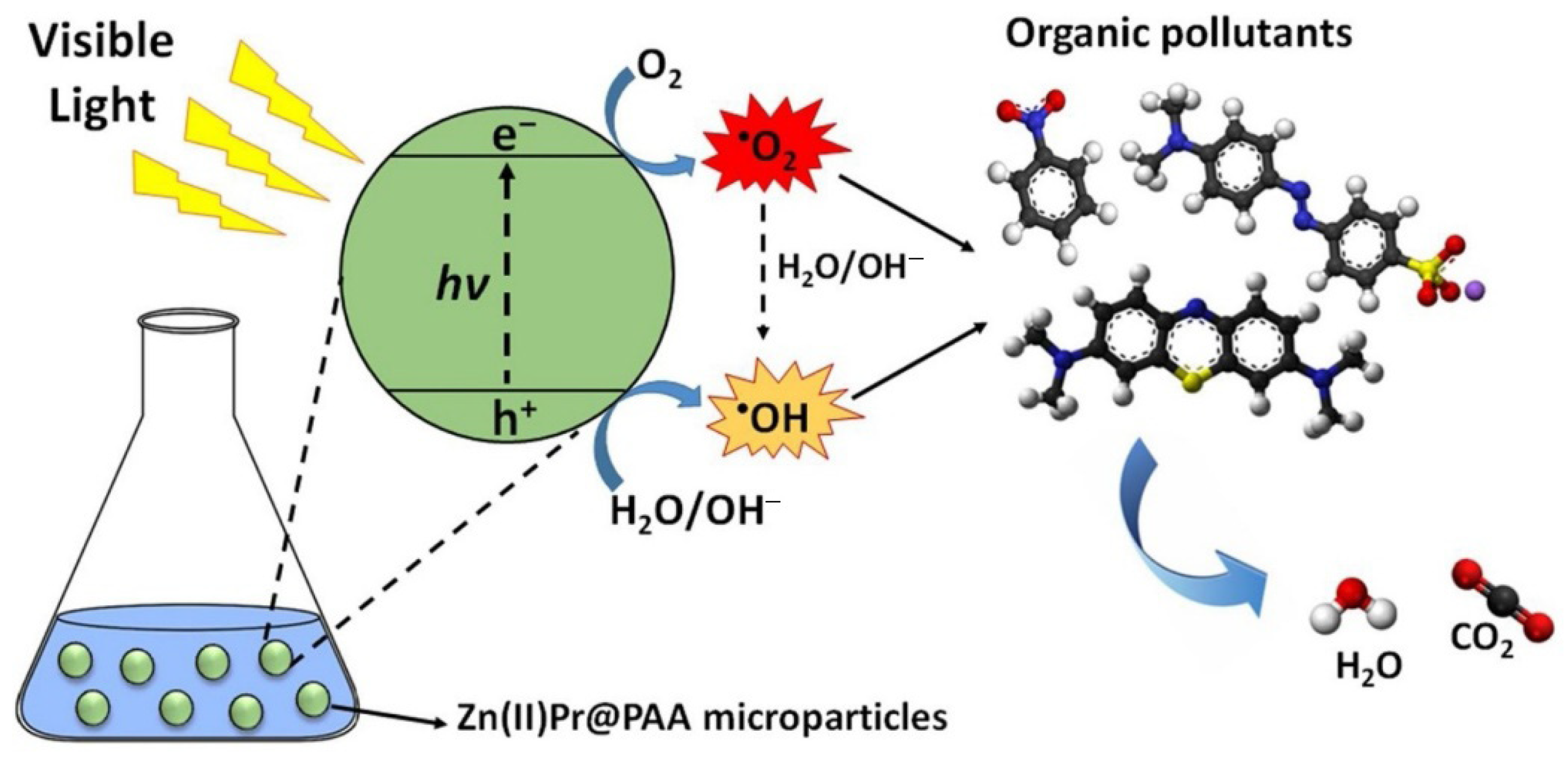
In 2020, Mota et al. demonstrated the effective incorporation of a water-soluble [5,10,15,20-tetrakis(N-methyl-4-pyridinium)]zinc(II) porphyrin cation into a polyacrylic acid (PAA) matrix, leading to Zn(II)-porphyrin/poly(acrylic acid) hybrid materials [110]. Under visible-light irradiation, the as-synthesized hybrid microparticles were excellent catalysts for the photodegradation of organic contaminants such as nitrobenzene (NB), MO dye, and MB dye in water, compared with the starting monomeric porphyrin unit. The immobilization of metalloporphyrin not only improved the interaction of porphyrin molecules with the polymeric matrix but also increased the stability of the microparticles for further use (Figure 37).
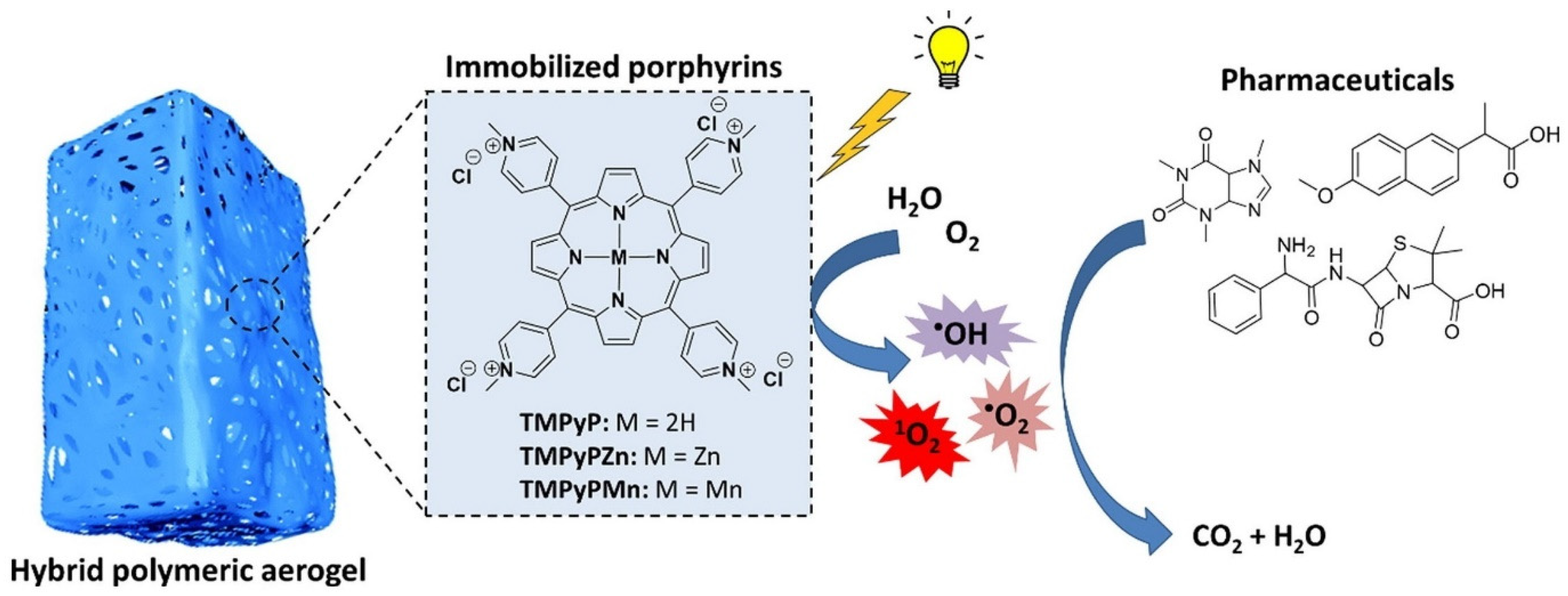
Several cationic porphyrins (TMPyP, TMPyPZn, and TMPyPMn) were integrated into a polymer aerogel to form hybrid porphyrin-integrated photocatalysts (CPA-TMPyP, CPA-TMPyPZn, and CPA-TMPyPMn) in situ [111]. Polyacrylic acid (PAAc)/polyvinyl alcohol (PVA) was used as the source of the polymer matrix (CPA). These cationic porphyrins were successfully immobilized inside the polymeric aerogels via hydrogen bonding and electrostatic interactions and exhibited excellent photocatalytic activity for the decomposition of various pharmaceuticals (naproxen, caffeine, and amoxicillin) under visible-light irradiation in water. Within 60 min, CPA-TMPyPMn exhibited higher photocatalytic activity than the free porphyrin, TMPyPMn, or the other hybrid materials (CPA-TMPyP and CPA-TMPyPZn). Recycling experiments confirmed that this hybrid-porphyrin-integrated aerogel maintained superior photocatalytic performance, even after 15 cycles (Figure 38).
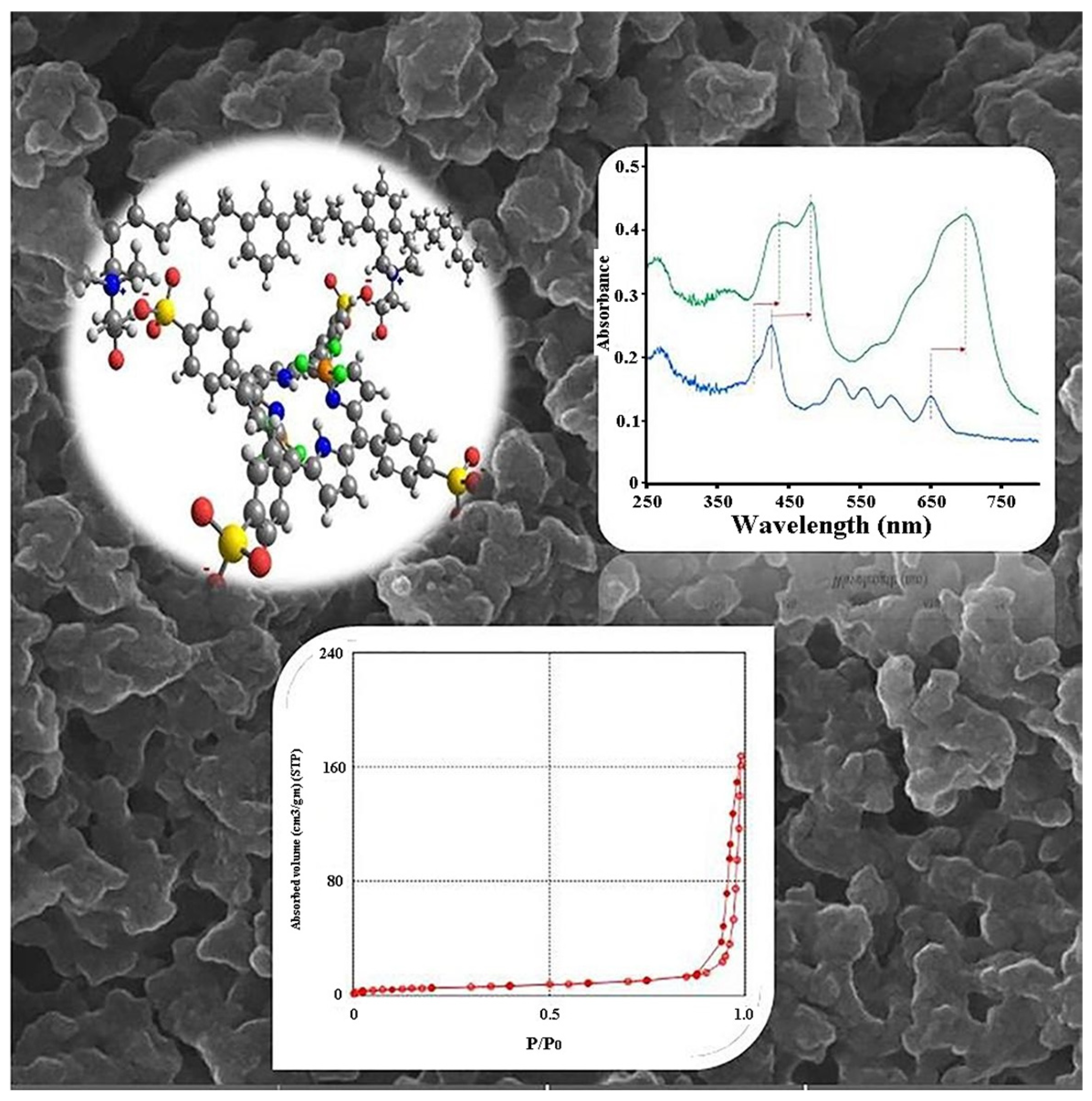
A mesoporous porphyrin-based Amberlite photocatalytic system was studied for the photodegradation of pollutants under visible-light irradiation [112]. The top-down method between the anion exchange polymer nanoAmbN(Me)3Cl (Amb = Amberlite IRA-410(Cl)) and the BF3 complex meso-tetrakis(4-sulfonatophenyl)porphyrin (H2TPPS4) led to the construction of the highly porous porphyrin-based photocatalyst nanoAmbN(Me)3@H2TPPS4(BF3)2. The incorporation of porphyrin into the core of polymeric matrices not only changes the surface morphology but also creates a large active porous site for catalysis. Within 320 min of visible-light irradiation, 99% 1,5-dihydroxynaphthalene (DHN) was degraded using nanoAmbN(Me)3@H2TPPS4(BF3)2 in acetonitrile (Figure 39). The high degradation rate was attributed to the synergistic effect between the porphyrin and Amberlite and was better than that of either nanoAmbN(Me)3Cl or H2TPPS4(BF3)2.
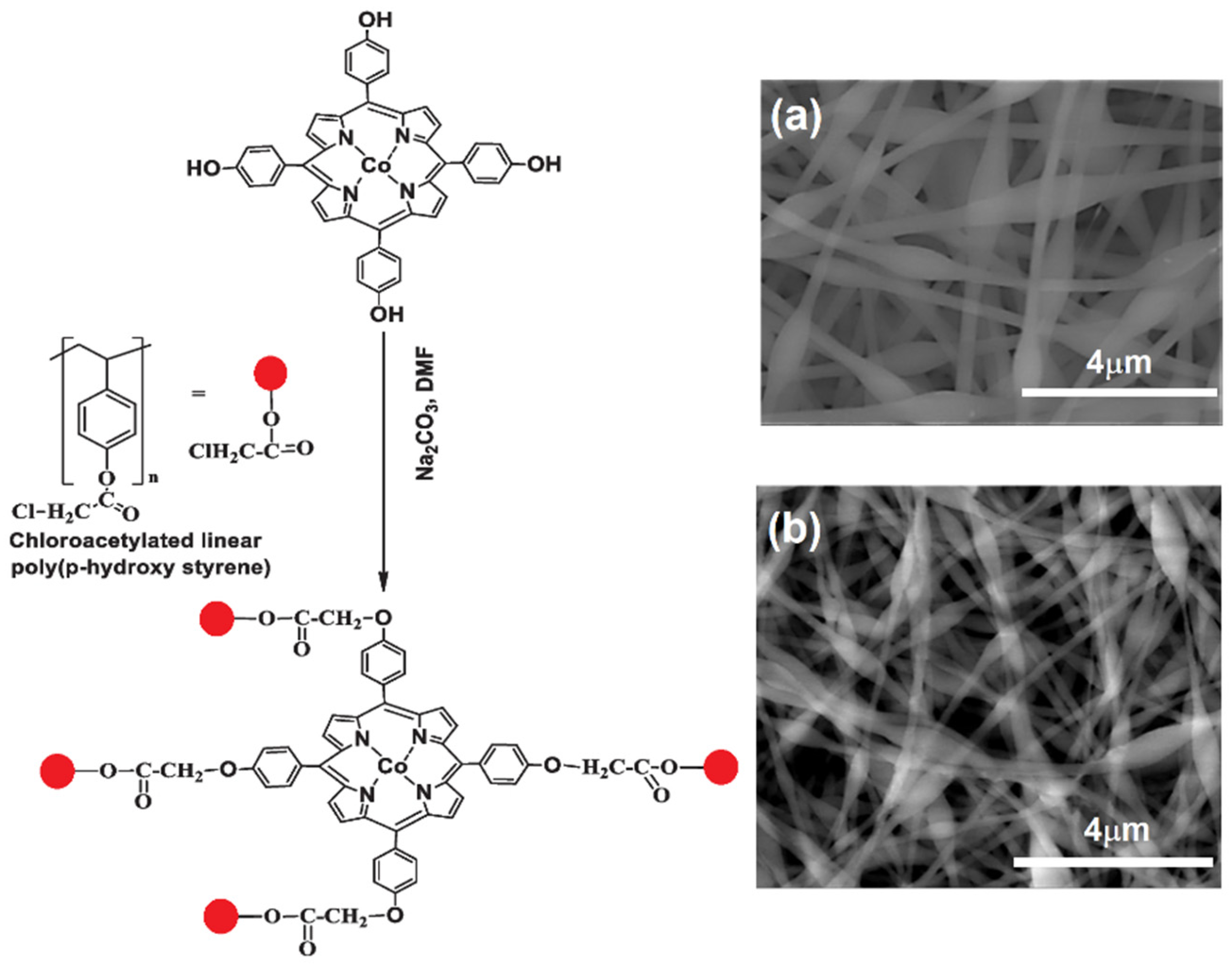
In 2025, Kenawy et al. fabricated a porphyrin in polyacrylonitrile (PAN) matrices for crystal violet dye degradation in the presence of H2O2 [113]. Electrospinning of Co(II)-porphyrin with chloroacetylated poly(p-hydroxystyrene) led to the formation of porphyrin-supported nanofiber materials. The incorporation of porphyrin into PAN matrices not only changes the surface morphology but also enhances the degradation performance in water. Within 60 min, the crystal violet degradation ratio was 99% for porphyrin-supported nanofiber materials in the presence of H2O2. Immobilization of the rigid porphyrin framework onto the polymeric backbone aided the recovery process while maintaining catalyst rigidity (Figure 40).
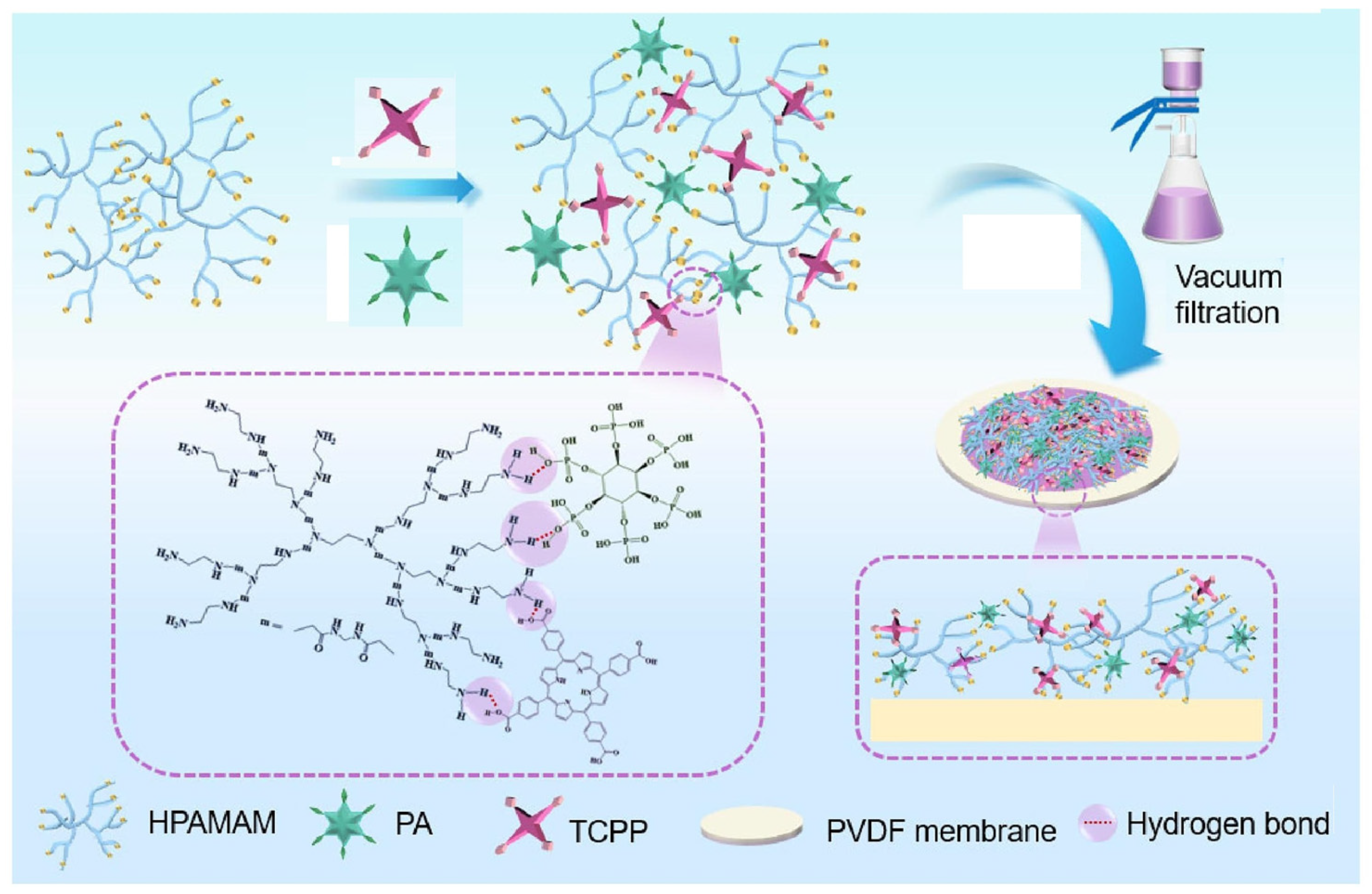
A porphyrin-based polyelectrolyte composite membrane was constructed for the catalytic photodecomposition of RhB and MB dyes in H2O [114]. A multistep reaction between tetrakis(4-carboxyphenyl)porphyrin (TCPP) and hyperbranched polyamide-amine (HPAMAM) in the presence of phytic acid (PA) guided the fabrication of TCPP@HPAMAM@PA/PVDF composite membranes through electrostatic interactions. The integration of porphyrin with the polyamide-amine not only enhanced the catalytic performance but also prevented the separation of the porphyrin from the TCPP@HPAMAM@PA/PVDF membrane during the photodegradation reactions. The visible-light photodecomposition ratios of RhB and MB dyes for the TCPP@HPAMAM@PA/PVDF composite membrane reached 93% and 96%, respectively (Figure 41).

7. Other Porphyrin-Conjugated Hybrid Nanomaterials

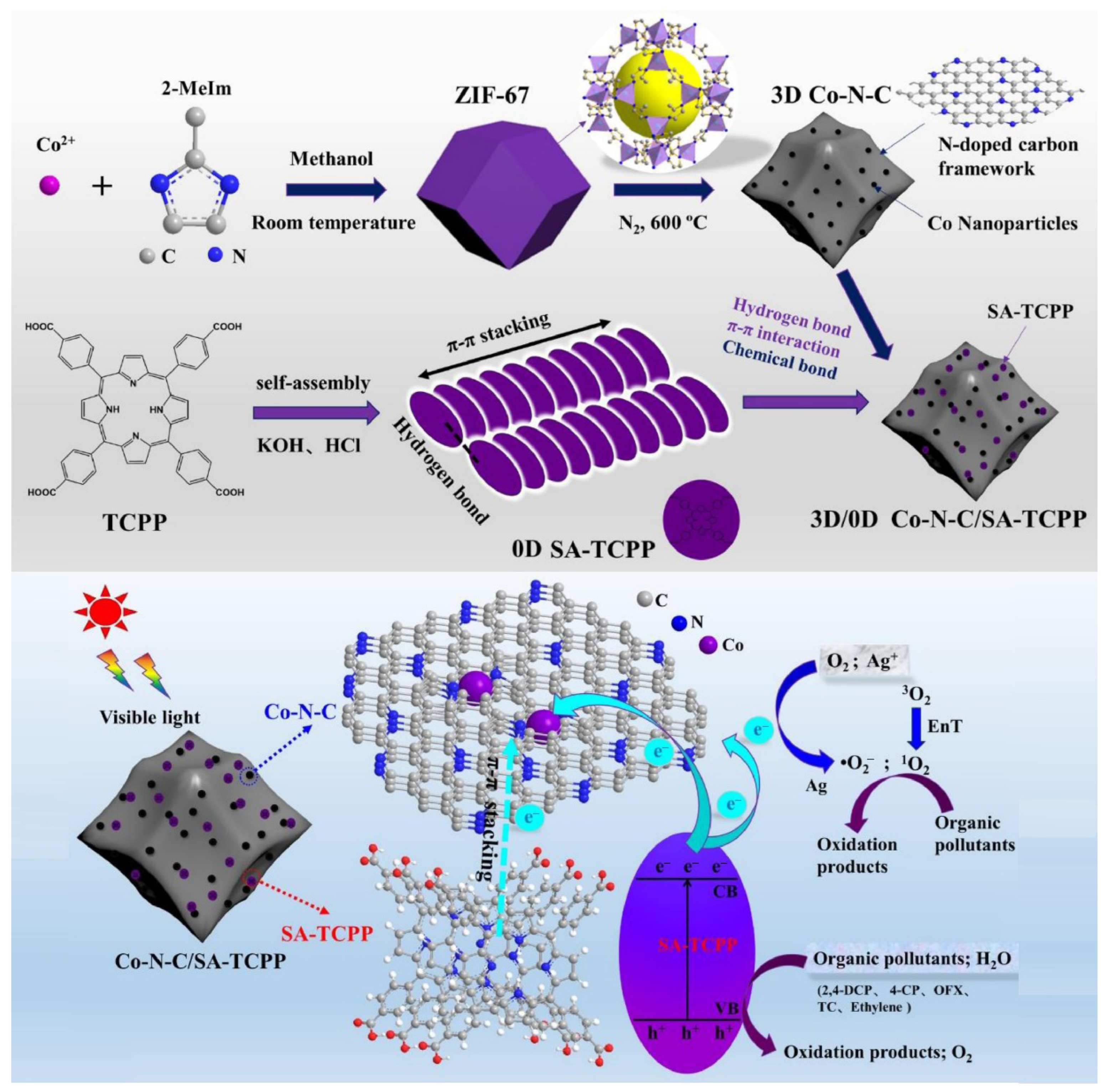
A Co-N-C/SA-TCPP hybrid photocatalyst for water remediation was studied [115]. The self-assembled porphyrin nanostructures of H2TCPP were integrated over the surface of the N-doped carbon framework materials in situ. In the Co-N-C/SA-TCPP heterojunction, Co-N-C nanocubes were tightly coupled with porphyrin nanostructures to fabricate a 3D/0D hybrid composite via chemical bonding, hydrogen bonding, and π–π interactions. Eg derived from the Tauc plot was found to be 1.79 eV for SA-TCPP and 1.30 eV for Co-N-C/SA-TCPP. The integration of the porphyrin nanostructure onto the surface of Co-N-C not only lowered the band gap energy in Co-N-C/SA-TCPP but also exhibited photocatalytic degradation activity against organic pollutants as well as oxygen evolution in water under visible-light irradiation. The photocatalytic efficiency of Co-N-C/SA-TCPP was several times higher than that of Co-N-C and SA-TCPP. The synergistic effect between the Co-N-C nanocubes and SA-TCPP nanostructures has been reported to be responsible for the improved photocatalytic oxidation performance. The incorporation of porphyrin nanostructures onto the surface of the Co-N-C nanocubes not only strengthened light utilization but also facilitated charge separation, improved oxidation capacity, and better recyclability for further use (Figure 42).
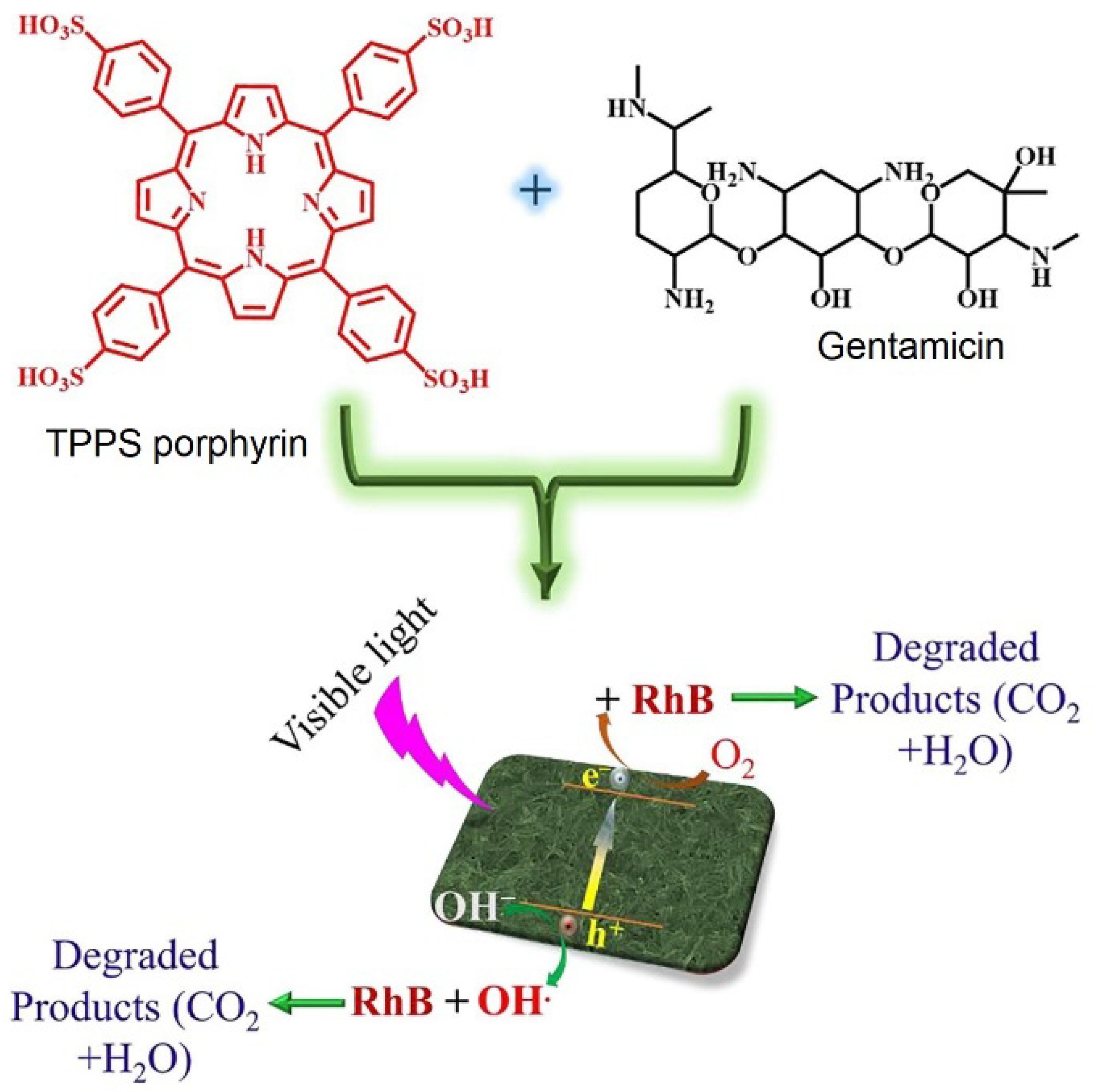
Bhosale et al. also developed porphyrin-integrated supramolecular architectures for solar-light photodecomposition of the RhB dye [116]. The reaction of gentamicin with meso-tetrakis(4-sulfonatophenyl)porphyrin (TPPS) led to the fabrication of nanorod-like architectures with lengths of several micrometers. Their diameters varied from 50 to 100 nm. Mechanistic investigations indicated that H-bonding interactions between the –OH and –NH2 groups of gentamicin and the sulfonate groups of porphyrins were the main driving force for the fabrication of self-assembled nanostructures. Moreover, aromatic π–π interactions between porphyrin and gentamicin contribute to the nanoaggregation. The integration of TPPS porphyrin with gentamicin not only lowered the band gap energy (Eg varied from 2.7 eV to 3.0 eV) but also enhanced the photodegradation activity. Within 240 min of visible-light irradiation, this supramolecular nanostructure degraded 99% of RhB dye with a rate constant of 2 × 10⁻² min−1 (Figure 43).
Additional porphyrin-conjugated hybrid nanomaterials used for the photodegradation of toxic contaminants are summarized in Table 1.

8. Conclusions and Future Perspectives

Heterogeneous advanced oxidation process using a porphyrin-based catalyst is a promising method for wastewater remediation. This is because the operation is simple, cost-effective, and efficient. Owing to their superior visible-light absorption coefficients, porphyrin-based materials can absorb light from freely available solar light. Moreover, their structural skeletons and intrinsic aromatic electronic properties facilitate the delocalization of photogenerated electrons during photodegradation. This delays the recombination of the photogenerated excited pair, thus increasing the catalytic performance. However, as mentioned earlier, the application of porphyrin-based materials for wastewater treatment is hindered by limitations such as facile agglomeration in solution, deactivation, difficult separation of the photocatalyst after the degradation process, and limited reuse of the photocatalyst, which can significantly increase the overall cost of the method. Therefore, the fabrication of new photocatalytic systems comprising porphyrin molecules is required to overcome these challenges.
For this purpose, porphyrins can be integrated on solid supports to fabricate hybrid materials with photocatalytic efficiencies superior to those of free-standing starting porphyrins. Numerous transition metal oxides (TiO2, ZnO, and Fe3O4), main element oxides (Al2O3 and SiO2), metal plasmons (Ag NPs), carbon-based micro- and nanoparticles (graphene, graphene oxide, and g-C3N4), gels, and polymeric matrices have been used as solid supports for the smooth fabrication of porphyrin-conjugated hybrid materials. The incorporation of porphyrins onto the solid supports not only shortens the band gap energy but also amplifies the photocatalytic degradation performance of the hybrid materials compared with the starting components. Hybridization of porphyrins onto solid supports enhances visible-light harvesting activity, recyclability for reuse, permanent porosity, substrate mobility owing to active sites, and charge separation owing to electronic delocalization over the conjugated aromatic porphyrin frameworks. Additionally, the incorporation of porphyrins on solid supports not only enhances the chemical stability but also facilitates the full recovery of the catalyst after the photodegradation experiments and prevents the generation of secondary pollution. Therefore, the fabrication of porphyrins with photoactive functional components can facilitate the generation of visible-light nanohybrid photocatalytic systems. Further experiments with porphyrin-conjugated materials are required to optimize their photocatalytic degradation activities. To date, analyses have been restricted to the photocatalytic degradation of toxic contaminants in H2O. The construction of a robust porphyrin-conjugated hybrid heterojunction with good visible-light harvesting properties could also be paramount to future research in many important sectors.
Previously, we reported the development of the photocatalytic degradation activity of single-component porphyrin-based photocatalysts derived from the self-assembly of porphyrin molecules for water treatment [59]. Fabrication of solid-supported porphyrin hybrid nanomaterials not only uses solar or artificial light efficiently but also lowers the recombination of photoinduced ion-pairs compared to their starting bare porphyrin unit. Moreover, the hybrid nano-ensembles prevent the hydrolysis of the catalysis during the reaction. On the other hand, this review focuses on porphyrin-conjugated hybrid photocatalysts for water treatment. In this review, the current progress in the fabrication of porphyrin-conjugated hybrid nanomaterials for the catalytic decomposition of toxic pollutants in water is discussed. Throughout, several important results and progress have emerged that enable the development of an improved and significant process for wastewater remediation. Despite this progress, many pivotal aspects of this field remain to be addressed by researchers in materials chemistry. The evolution and utilization of these porphyrin-conjugated hybrid nanomaterials should be explored in greater depth for the remediation of toxic molecules from wastewater, addressing the following points:
  • The recombination of photogenerated electrons and holes remains an obstacle to achieving efficient photodegradation in water. Several techniques, such as metal oxides, inorganic oxides, metal plasmon doping, heterojunctions, and ternary junctions, have been used to minimize this problem. However, more coherent processes are required to improve the photodegradation activities of porphyrin-based photocatalytic systems.
  • The incorporation of porphyrins into solid-supported materials lowers the band gap energy and increases the visible-light harvesting capacity. This reduces the treatment costs. More than 50% of the solar light is infrared. Therefore, more efficient photocatalysts need to be designed such that they are more suitable for the application of solar light as well as infrared light. The effect of the support material (especially those in micro- and macro-scale) on the ability of the porphyrin to absorb electromagnetic radiation. As noticed, the effect of the support material on the quantum efficiency of the supported porphyrin is barely addressed by the studies published in the literature.
  • The light-harvesting capacities of porphyrin-conjugated hybrid nanomaterials compared with those of bare porphyrin should be examined in future studies. This will provide some insight into how the quantum efficiency of photocatalytic systems controls visible-light photodegradation performance.
  • The fabrication of porphyrin on a solid support not only improves the surface area but also creates a large, accessible active site for the substrate or dye molecules. The functional groups of the contaminants can interact with these active sites. This increases substrate transportation and thus the degradation activity.
  • Most photodegradation experiments have been conducted in the laboratory rather than the actual environment. Other compounds or contaminants can perturb photodegradation experiments. Therefore, interference from other compounds must be investigated and developed on an industrial scale.
  • Most pollutants (dyes, pharmaceuticals, and pesticides) discussed in the literature do not represent the actual compounds present in industrial wastewater. A more reliable photodegradation process should be developed using pollutants procured directly from the pharmaceutical, food, and textile industries.
  • Most photodegradation reactions have been investigated at the laboratory scale. Likely, small-scale experiments do not mimic real-life scenarios. Therefore, photodegradation reactions with high degradation efficiency should be investigated on a large scale. This reduces the time and cost of treatment.
  • The toxicity of these porphyrin-conjugated hybrid nanomaterials, as well as the byproducts or secondary pollutants from the photodegradation process, must be properly examined and understood.
  • The recovery and reuse of these hybrid catalysts are important for industrial applications. Therefore, the separation and reuse of catalysts after photodegradation must be optimized to reduce the treatment costs, and the increase in the sustainable aspect of these catalysts must be conducted more effectively since this area covers lines of multidisciplinary research.
  • The chemical stabilities of the hybrid catalysts during the photodegradation experiments are directly related to their efficiencies. Porphyrin molecules may hydrolyze and separate during photodegradation experiments. Therefore, strongly attaching porphyrins to solid supports may improve their photocatalytic performance. In this regard, polymeric backbones or MOF-like materials may be useful in preventing separation and hydrolysis.
  • The porphyrin synthesis procedure is simple for symmetrical molecules. However, the synthesis cost of unsymmetrical molecules is high, and this process is not easy. This increases the fabrication cost of porphyrin-conjugated catalysts. For industrialization, the cost of photocatalysts should be lower. Recently, cost-effective and sustainable materials, including activated carbon, bentonite, biochar, and biomass, have been integrated to enhance the photodegradation activity of hybrid composites and lower the cost of treatment. Therefore, more attention is required to upgrade catalytic photodegradation activity using cost-effective and sustainable components.
  • Generally, for the fabrication of porphyrin-based photocatalyst, the solvothermal method has been used. Conventional heating was the primary energy source for these reactions. However, the microwave-assisted method has been increasingly used for the construction of high-purity materials compared to the solvothermal method [182,183]. Therefore, more attention is required to alter the synthesis method from solvothermal to microwave-assisted in the future.
  • The fabrication of porphyrin on a solid support not only increases the photodegradation performance but also improves the effectiveness of the photocatalyst under extreme conditions, such as highly acidic or basic media, high temperature, and the presence of various salts. Therefore, more attention is required to improve the photocatalytic degradation activity under extreme conditions.
  • The catalytic photodegradation rate of a photocatalyst is believed to be significantly affected by light source characteristics, pH, pollutant concentration, and catalyst content. Therefore, further attention is needed to identify a universal system whose photocatalytic degradation activity is unaffected by these factors.
  • The interpretation of the photodegradation mechanisms of the selected pollutants can be complex, since the pollutants can be absorbed by the support material. Moreover, depending on the type of compound used in the photocatalytic process, several ROS may be at work, making the reaction less selective.
In addition to these factors, studies on the progress of porphyrins, solid-support photocatalysts, and fabrication processes will be the basis for future research. The photodecomposition of other hazardous chemicals using porphyrin-conjugated materials should also be investigated. The distinctive physio-chemical properties of some selected carrier systems are summarized in Table 2.
Finally, we believe that this organized discussion of porphyrin-conjugated hybrid nanomaterials will help guide materials chemists and encourage progress in photocatalytic wastewater remediation.

Author Contributions

Conceptualization, validation, and writing—original draft, N.K.S.; funding acquisition, project administration, resources, review, and writing—review and editing, H.-J.K. All authors have read and agreed to the published version of the manuscript.

Funding

This study was supported by the National Research Foundation of Korea (grant no. 2022R1F1A1074420), funded by the Korean government (MSIT).

Institutional Review Board Statement

Not applicable.

Informed Consent Statement

Not applicable.

Data Availability Statement

No new data were created or analyzed in this study. Data sharing is not applicable to this article.

Acknowledgments

We acknowledge the support by the Regional Innovation System & Education (RISE)-(Regional Growth Innovation LAB unit) program through the Gyeongbuk RISE Center.

Conflicts of Interest

The authors declare no conflicts of interest.

Abbreviations

The following abbreviations are used in this manuscript:
SEMscanning electron microscopy
TEMtransmission electron microscopy
AOPsadvanced oxidation processes
PXRDpowder X-ray diffraction
DRSdiffuse reflectance spectra
MOmethyl orange
MBmethylene blue
RhBrhodamine B
4-NP4-nitrophenol
TCtetracycline
VBvalence band
CBconduction band
EgBand gap energy
GOgraphene oxide
AAadipic acid
rGOreduced graphene oxide
g-C3N4graphitic carbon nitride
H2TCPP5,10,15,20-tetrakis(4-carboxyphenyl)porphyrin
CuTCPP[meso-tetrakis(4-carboxyphenyl)porphyrinato]copper(II))
H2TPyP5,10,15,20-tetrakis(4-pyridyl)porphyrin
ZnTPyP[5,10,15,20-tetrakis(4-pyridyl)porphyrinato]zinc(II)
ROSreactive oxygen species
MOFmetal–organic framework
THFtetrahydrofuran
MeOHmethanol
DCMdichloromethane
H4TPPS42−[5,10,15,20-tetrakis(sulfonatophenyl)]porphyrin
SnCl2TPPDichloro(5,10,15,20-tetraphenylporphyrinato)tin(IV)

References

  1. Schwarzenbach, R.P.; Egli, T.; Hofstetter, T.; Von Gunten, U.; Wehrli, B. Global Water Pollution and Human Health. Annu. Rev. Environ. Resour. 2010, 35, 109–136. [Google Scholar] [CrossRef]
  2. Wang, Z.; Walker, G.W.; Muir, D.C.G.; Nagatani-Yoshida, K. Toward a global understanding of chemical pollution: A first comprehensive analysis of national and regional chemical inventories. Environ. Sci. Technol. 2020, 54, 2575–2584. [Google Scholar] [CrossRef]
  3. Parvulescu, V.I.; Epron, F.; Garcia, H.; Granger, P. Recent Progress and Prospects in Catalytic Water Treatment. Chem. Rev. 2022, 122, 2981–3121. [Google Scholar] [CrossRef]
  4. Rafaqat, S.; Ali, N.; Torres, C.; Rittmann, B. Recent progress in treatment of dyes wastewater using microbial-electro-Fenton technology. RSC Adv. 2022, 12, 17104–17137. [Google Scholar] [CrossRef]
  5. Sangamnere, R.; Misra, T.; Bherwani, H.; Kapley, A.; Kumar, R. A Critical Review of Conventional and Emerging Wastewater Treatment Technologies. Sustain. Water Resour. Manag. 2023, 9, 58. [Google Scholar] [CrossRef]
  6. Mishra, S.; Sundaram, B. A Review of the Photocatalysis Process Used for Wastewater Treatment. Mater. Today Proc. 2024, 102, 393–409. [Google Scholar] [CrossRef]
  7. Bartolomeu, M.; Neves, M.G.P.M.S.; Faustino, M.A.F.; Almeida, A. Wastewater chemical contaminants: Remediation by advanced oxidation processes. Photochem. Photobiol. Sci. 2018, 17, 1573–1598. [Google Scholar] [CrossRef]
  8. Zango, Z.U.; Jumbri, K.; Sambudi, N.S.; Ramli, A.; Abu Bakar, N.H.H.; Saad, B.; Rozaini, M.N.H.; Isiyaka, H.A.; Jagaba, A.H.; Aldaghri, O.; et al. A Critical Review on Metal-Organic Frameworks and Their Composites as Advanced Materials for Adsorption and Photocatalytic Degradation of Emerging Organic Pollutants from Wastewater. Polymers 2020, 12, 2648. [Google Scholar] [CrossRef]
  9. Xu, Q.; Huang, Q.-S.; Luo, T.-Y.; Wu, R.-L.; Wei, W.; Ni, B.-J. Coagulation removal and photocatalytic degradation of microplastics in urban waters. Chem. Eng. J. 2021, 416, 129123. [Google Scholar] [CrossRef]
  10. Thamer, B.M.; Aldalbahi, A.; Moydeen, A.M.; El-Newehy, M.H. In Situ Preparation of Novel Porous Nanocomposite Hydrogel as Effective Adsorbent for the Removal of Cationic Dyes from Polluted Water. Polymers 2020, 12, 3002. [Google Scholar] [CrossRef]
  11. Saratale, R.G.; Saratale, G.D.; Chang, J.S.; Govindwar, S.P. Bacterial decolorization and degradation of azo dyes: A review. J. Taiwan Inst. Chem. Eng. 2011, 42, 138–157. [Google Scholar] [CrossRef]
  12. Lv, S.W.; Liu, J.M.; Li, C.Y.; Zhao, N.; Wang, Z.H.; Wang, S. Two novel MOFs@COFs hybrid-based photocatalytic platforms coupling with sulfate radical-involved advanced oxidation processes for enhanced degradation of bisphenol A. Chemosphere 2020, 243, 125378. [Google Scholar] [CrossRef] [PubMed]
  13. Cardoso, I.M.F.; Cardoso, R.M.F.; da Silva, J.C.G.E. Advanced Oxidation Processes Coupled with Nanomaterials for Water Treatment. Nanomaterials 2021, 11, 2045. [Google Scholar] [CrossRef] [PubMed]
  14. Rana, A.G.; Tasbihi, M.; Schwarze, M.; Minceva, M. Efficient Advanced Oxidation Process (AOP) for Photocatalytic Contaminant Degradation Using Exfoliated Metal-Free Graphitic Carbon Nitride and Visible Light-Emitting Diodes. Catalysts 2021, 11, 662. [Google Scholar] [CrossRef]
  15. Shee, N.K.; Kim, H.-J. Sn(IV) Porphyrin-Based Ionic Self-Assembled Nanostructures and Their Application in Visible Light Photo-Degradation of Malachite Green. Catalysts 2022, 12, 799. [Google Scholar] [CrossRef]
  16. Jain, K.; Patel, A.S.; Pardhi, V.P.; Flora, S.J.S. Nanotechnology in Wastewater Management: A New Paradigm Towards Wastewater Treatment. Molecules 2021, 26, 1797. [Google Scholar] [CrossRef]
  17. Singh, K.K.; Singh, A.; Rai, S. A study on nanomaterials for water purification. Mater. Today Proc. 2022, 51, 1157–1163. [Google Scholar] [CrossRef]
  18. Shee, N.K.; Kim, H.-J. Self-Assembled Nanomaterials Based on Complementary Sn(IV) and Zn(II)-Porphyrins, and Their Photocatalytic Degradation for Rhodamine B Dye. Molecules 2021, 26, 3598. [Google Scholar] [CrossRef]
  19. Shee, N.K.; Kim, H.-J. Three Isomeric Zn(II)–Sn(IV)–Zn(II) Porphyrin-Triad-Based Supramolecular Nanoarchitectures for the Morphology-Dependent Photocatalytic Degradation of Methyl Orange. ACS Omega 2022, 7, 9775–9784. [Google Scholar] [CrossRef]
  20. Khader, E.H.; Muslim, S.A.; Saady, N.M.C.; Ali, N.S.; Salih, I.K.; Mohammed, T.J.; Albayati, T.M.; Zendehboudi, S. Recent advances in photocatalytic advanced oxidation processes for organic compound degradation: A review. Desalin. Water Treat. 2024, 318, 100384. [Google Scholar] [CrossRef]
  21. Satyam, S.; Patra, S. The Evolving Landscape of Advanced Oxidation Processes in Wastewater Treatment: Challenges and Recent Innovations. Processes 2025, 13, 987. [Google Scholar] [CrossRef]
  22. Shee, N.K.; Kim, H.-J. Tin(IV)Porphyrin-Based Porous Coordination Polymers as Efficient Visible Light Photocatalyst for Wastewater Remediation. Nanomaterials 2025, 15, 59. [Google Scholar] [CrossRef]
  23. Shee, N.K.; Kim, H.-J. Two-dimensional porous porphyrin materials composed of robust tin(iv)-porphyrin linkages for photocatalytic wastewater remediation. Dalton Trans. 2025, 54, 2448–2459. [Google Scholar] [CrossRef] [PubMed]
  24. Bakbolat, B.; Daulbayev, C.; Sultanov, F.; Beissenov, R.; Umirzakov, A.; Mereke, A.; Bekbaev, A.; Chuprakov, I. Recent Developments of TiO2-Based Photocatalysis in the Hydrogen Evolution and Photodegradation: A Review. Nanomaterials 2020, 10, 1790. [Google Scholar] [CrossRef] [PubMed]
  25. Franco, P.; Sacco, O.; De Marco, I.; Vaiano, V. Zinc Oxide Nanoparticles Obtained by Supercritical Antisolvent Precipitation for the Photocatalytic Degradation of Crystal Violet Dye. Catalysts 2019, 9, 346. [Google Scholar] [CrossRef]
  26. Al-Hamdi, A.M.; Rinner, U.; Sillanpää, M. Tin Dioxide as a Photocatalyst for Water Treatment: A Review. Process Saf. Environ. Prot. 2017, 107, 190–205. [Google Scholar] [CrossRef]
  27. Shen, Y.; Tang, J.; Nie, Z.; Wang, Y.; Ren, Y.; Zuo, L. Preparation and application of magnetic Fe3O4 nanoparticles for wastewater purification. Sep. Purif. Technol. 2009, 68, 312–319. [Google Scholar] [CrossRef]
  28. Ighalo, J.O.; Sagboye, P.A.; Umenweke, G.; Ajala, O.J.; Omoarukhe, F.O.; Adeyanju, C.A.; Ogunniyi, S.; Adeniyi, A.G. CuO nanoparticles (CuO NPs) for water treatment: A review of recent advances. Environ. Nanotechnol. Monit. Manag. 2021, 15, 100443. [Google Scholar] [CrossRef]
  29. Mehanathan, S.; Jaafar, J.; Nasir, A.M.; Ismail, A.F.; Matsuura, T.; Othman, M.H.D.; Rahman, M.A.; Yusof, N. Magnesium Oxide Nanoparticles for the Adsorption of Pentavalent Arsenic from Water: Effects of Calcination. Membranes 2023, 13, 475. [Google Scholar] [CrossRef]
  30. Abdullah, T.A.; Juzsakova, T.; Rasheed, R.T.; Salman, A.D.; Adelikhah, M.; Cuong, L.P.; Cretescu, I. V2O5 Nanoparticles for Dyes Removal from Water. Chem. J. Mold. 2021, 16, 102–111. [Google Scholar] [CrossRef]
  31. Li, H.; Wang, G.; Zhang, F.; Cai, Y.; Wang, Y.; Djerdj, I. Surfactant-assisted synthesis of CeO2 nanoparticles and their application in wastewater treatment. RSC Adv. 2012, 2, 12413–12423. [Google Scholar] [CrossRef]
  32. McIntyre, H.M.; Hart, M.L. Photocatalytic Porous Silica-Based Granular Media for Organic Pollutant Degradation in Industrial Waste-Streams. Catalysts 2021, 11, 258. [Google Scholar] [CrossRef]
  33. Prakash, J.; Kumar, P.; Saxena, N.; Pu, Z.; Chen, Z.; Tyagi, A.; Zhang, G.; Sun, S. CdS based 3D nano/micro-architectures: Formation mechanism, tailoring of visible light activities and emerging applications in photocatalytic H2 production, CO2 reduction and organic pollutant degradation. J. Mater. Chem. A 2023, 11, 10015–10064. [Google Scholar] [CrossRef]
  34. Guang, H.; Yang, J.; Duan, X.; Farnood, R.; Yang, C.; Yang, J.; Liu, W.; Liu, Q. Recent developments and challenges in zeolite-based composite photocatalysts for environmental applications. Chem. Eng. J. 2021, 417, 129209. [Google Scholar] [CrossRef]
  35. Subhiksha, V.; Kokilavani, S.; Khan, S.S. Recent advances in degradation of organic pollutant in aqueous solutions using bismuth based photocatalysts: A review. Chemosphere 2022, 290, 133228. [Google Scholar] [CrossRef]
  36. Schneider, J.; Matsuoka, M.; Takeuchi, M.; Zhang, J.; Horiuchi, Y.; Anpo, M.; Bahnemann, D.W. Understanding TiO2 Photocatalysis: Mechanisms and Materials. Chem. Rev. 2014, 114, 9919–9986. [Google Scholar] [CrossRef]
  37. Ong, C.B.; Ng, L.Y.; Mohammad, A.W. A review of ZnO nanoparticles as solar photocatalysts: Synthesis, mechanisms and applications. Renew. Sustain. Energy Rev. 2018, 81, 536–551. [Google Scholar] [CrossRef]
  38. Lee, K.M.; Lai, C.W.; Ngai, K.S.; Juan, J.C. Recent developments of zinc oxide based photocatalyst in water treatment technology: A review. Water Res. 2016, 88, 428–448. [Google Scholar] [CrossRef]
  39. Armaković, S.J.; Savanović, M.M.; Armaković, S. Titanium Dioxide as the Most Used Photocatalyst for Water Purification: An Overview. Catalysts 2023, 13, 26. [Google Scholar] [CrossRef]
  40. Sandhu, I.S.; Chitkara, M.; Rana, S.; Dhillon, G.; Taneja, A.; Kumar, S. Photocatalytic performances of stand-alone graphene oxide (GO) and reduced graphene oxide (rGO) nanostructures. Opt. Quantum Electron. 2020, 52, 359. [Google Scholar] [CrossRef]
  41. Yao, S.; Yuan, X.; Jiang, L.; Xiong, T.; Zhang, J. Recent Progress on Fullerene-Based Materials: Synthesis, Properties, Modifications, and Photocatalytic Applications. Materials 2020, 13, 2924. [Google Scholar] [CrossRef]
  42. Heng, Z.W.; Chong, W.C.; Pang, Y.L.; Koo, C.H. An Overview of the Recent Advances of Carbon Quantum Dots/metal Oxides in the Application of Heterogeneous Photocatalysis in Photodegradation of Pollutants towards Visible-Light and Solar Energy Exploitation. J. Environ. Chem. Eng. 2021, 9, 105199. [Google Scholar] [CrossRef]
  43. Xu, Y.F.; Guo, Q.Q.; Huang, L.; Feng, H.J.; Zhang, C.; Xu, H.Q.; Wang, M.Z. Toward efficient preconcentrating photocatalysis: 3D g-C3N4 monolith with isotype heterojunctions assembled from hybrid 1D and 2D nanoblocks. ACS Appl. Mater. Interfaces 2019, 11, 31934–31942. [Google Scholar] [CrossRef] [PubMed]
  44. Shee, N.K.; Kim, H.-J. Supramolecular Self-Assembled Nanostructures Derived from Amplified Structural Isomerism of Zn(II)−Sn(IV)−Zn(II) Porphyrin Triads and Their Visible Light Photocatalytic Degradation of Pollutants. Nanomaterials 2024, 14, 1104. [Google Scholar] [CrossRef] [PubMed]
  45. Durot, S.; Taesch, J.; Heitz, V. Multiporphyrinic Cages: Architectures and Functions. Chem. Rev. 2014, 114, 8542–8578. [Google Scholar] [CrossRef]
  46. Shao, S.; Rajendiran, V.; Lovell, J.F. Metalloporphyrin nanoparticles: Coordinating diverse theranostic functions. Coord. Chem. Rev. 2019, 379, 99–120. [Google Scholar] [CrossRef]
  47. Liu, R.; Jia, Y.; Xia, Y.; Wang, S. Metalloporphyrin-Based Covalent Organic Frameworks: Design, Construction, and Photocatalytic Applications. Catalysts 2026, 16, 76. [Google Scholar] [CrossRef]
  48. Wei, Y.; You, Y.; Shen, X.; Jin, Y.; Pan, M.; Wang, J. A robust hydrogel embed a hangman porphyrin for scalable electrochemical nitrate to ammonia conversion. Adv. Funct. Mater. 2025, 36, e16637. [Google Scholar] [CrossRef]
  49. Niu, H.; Zhu, G.; Zhang, S.; Wang, T.; Wang, Q.; Yang, X.; Li, X.; Zhu, F.; Wu, G.; Yu, H. Porphyrin-based heterojunction photocatalysts: Design principles and applications in solar-to-chemical energy conversion. J. Mater. Chem. A 2025, 13, 32030–32055. [Google Scholar] [CrossRef]
  50. Charisiadis, A.; Nikolaou, V.; Nikoloudakis, E.; Ladomenou, K.; Charalambidis, G.; Coutsolelos, A.G. Metalloporphyrins in bio-inspired photocatalytic conversions. Chem. Commun. 2025, 61, 4630–4646. [Google Scholar] [CrossRef]
  51. Shee, N.K.; Kim, H.-J. Sn(IV)-Porphyrin-Based Nanostructures Featuring Pd(II)-Mediated Supramolecular Arrays and Their Photocatalytic Degradation of Acid Orange 7 Dye. Int. J. Mol. Sci. 2022, 23, 13702. [Google Scholar] [CrossRef] [PubMed]
  52. Shee, N.K.; Jo, H.J.; Kim, H.-J. Synthesis of Two Novel Polymeric Open Framework Materials Constructed from Self-assembly of Silver(I) with Tin(IV) Porphyrin Building Blocks for Photocatalytic Degradation of Organic Dyes in Wastewater. Inorg. Chem. Front. 2022, 9, 1270–1280. [Google Scholar] [CrossRef]
  53. Shee, N.K.; Kim, H.-J. Morphology-controlled self-assembled nanostructures of complementary metalloporphyrin triads through intermolecular coordination tuning and their photocatalytic degradation for Orange II. Inorg. Chem. Front. 2022, 9, 5538–5548. [Google Scholar] [CrossRef]
  54. Shee, N.K.; Kim, H.-J. Supramolecular squares of Sn(IV)porphyrins with Re(I)-corners for the fabrication of self-assembled nanostructures performing photocatalytic degradation of Eriochrome Black T dye. Inorg. Chem. Front. 2023, 10, 174–183. [Google Scholar] [CrossRef]
  55. Wang, Y.; Cui, X.; Zhang, P.; Wang, Y.; Lu, W. Synthesis of porphyrin porous organic polymers and their application of water pollution treatment: A review. Environ. Technol. Innov. 2023, 29, 102972. [Google Scholar] [CrossRef]
  56. Rana, G.; Dhiman, P.; Kumar, A.; Wang, T.; Sharma, G. Recent advances in Porphyrin-based metal organic frameworks and composites for photocatalytic hydrogen evolution and water treatment. Chem. Eng. Res. Des. 2023, 199, 620–638. [Google Scholar] [CrossRef]
  57. Vaz, B.; Pérez-Lorenzo, M. Unraveling Structure–Performance Relationships in Porphyrin-Sensitized TiO2 Photocatalysts. Nanomaterials 2023, 13, 1097. [Google Scholar] [CrossRef]
  58. Balu, K.; Kaliyamoorthy, S.; Durai, M.; Aguiar, A.; Sobral, M.C.M.; Muthuvel, I.; Kumaravel, S.; Avula, B.; Sobral, A.J.F.N.; Ahn, Y.-H. Porphyrins and ZnO hybrid semiconductor materials: A review. Inorg. Chem. Commun. 2023, 154, 110973. [Google Scholar] [CrossRef]
  59. Shee, N.K.; Kim, H.-J. Porphyrin-Based Nanomaterials for the Photocatalytic Remediation of Wastewater: Recent Advances and Perspectives. Molecules 2024, 29, 611. [Google Scholar] [CrossRef]
  60. Shee, N.K.; Kim, H.-J. Recent Developments in Porphyrin-Based Metal–Organic Framework Materials for Water Remediation under Visible-Light Irradiation. Int. J. Mol. Sci. 2024, 25, 4183. [Google Scholar] [CrossRef]
  61. Silvestri, S.; Fajardo, A.R.; Iglesias, B.A. Supported Porphyrins for the Photocatalytic Degradation of Organic Contaminants in Water: A Review. Environ. Chem. Lett. 2022, 20, 731–771. [Google Scholar] [CrossRef]
  62. Gkika, D.A.; Ladomenou, K.; Bououdina, M.; Mitropoulos, A.C.; Kyzas, G.Z. Adsorption and photocatalytic applications of porphyrin-based materials for environmental separation processes: A review. Sci. Total Environ. 2024, 908, 168293. [Google Scholar] [CrossRef] [PubMed]
  63. Gamelas, S.R.D.; Tomé, J.P.C.; Tomé, A.C.; Lourenço, L.M.O. Porphyrin-containing materials for photodegradation of organic pollutants in wastewaters: A review. Catal. Sci. Technol. 2024, 14, 2352–2389. [Google Scholar] [CrossRef]
  64. Liu, F.; Rincón, I.; Baldoví, H.G.; Dhakshinamoorthy, A.; Horcajada, P.; Rojas, S.; Navalón, S.; Fateeva, A. Porphyrin-based MOFs for photocatalysis in water: Advancements in solar fuels generation and pollutants degradation. Inorg. Chem. Front. 2024, 11, 2212–2245. [Google Scholar] [CrossRef]
  65. Natarajan, T.S.; Thampi, K.R.; Tayade, R.J. Visible light driven redox-mediator-free dual semiconductor photocatalytic systems for pollutant degradation and the ambiguity in applying Z-scheme concept. Appl. Catal. B Environ. 2018, 227, 296–311. [Google Scholar] [CrossRef]
  66. Xue, Y.; Kamali, M.; Zhang, X.; Askari, N.; De Preter, C.; Appels, L.; Dewil, R. Immobilization of photocatalytic materials for (waste)water treatment using 3D printing technology-advances and challenges. Environ. Pollut. 2023, 316, 120549. [Google Scholar] [CrossRef]
  67. Guo, Q.; Zhou, C.; Ma, Z.; Yang, X. Fundamentals of TiO2 Photocatalysis: Concepts, Mechanisms, and Challenges. Adv. Mater. 2019, 31, 1901997. [Google Scholar] [CrossRef]
  68. Zhou, X.-T.; Ji, H.-B.; Huang, X.-J. Photocatalytic Degradation of Methyl Orange over Metalloporphyrins Supported on TiO2 Degussa P25. Molecules 2012, 17, 1149–1158. [Google Scholar] [CrossRef]
  69. Shee, N.K.; Lee, G.-S.; Kim, H.-J. Sn(IV)porphyrin-Incorporated TiO2 Nanotubes for Visible Light-Active Photocatalysis. Molecules 2024, 29, 1612. [Google Scholar] [CrossRef]
  70. Wang, C.; Li, J.; Mele, G.; Duan, M.; Lu, X.; Palmisano, L.; Vasapollo, G.; Zhang, F. The photocatalytic activity of novel substituted porphyrin/TiO2-based composites. Dyes Pigments 2010, 84, 183–189. [Google Scholar] [CrossRef]
  71. Afzal, S.; Daoud, W.A.; Langford, S.J. Photostable Self-cleaning Cotton by a Copper (II) Porphyrin/TiO2 Visible-Light Photocatalytic System. ACS Appl. Mater. Interfaces 2013, 5, 4753–4759. [Google Scholar] [CrossRef] [PubMed]
  72. Yao, B.; Peng, C.; Zhang, W.; Zhang, Q.; Niu, J.; Zhao, J. A Novel Fe(III) Porphyrin-Conjugated TiO2 Visible-Light Photocatalyst. Appl. Catal. B Environ. 2015, 174–175, 77–84. [Google Scholar] [CrossRef]
  73. Krishnakumar, B.; Balakrishna, A.; Arranja, C.T.; Dias, C.M.F.; Sobral, A.J. Chemically modified amino porphyrin/TiO2 for the degradation of Acid Black 1 under day light illumination. Spectrochim. Acta Part A Mol. Biomol. Spectrosc. 2017, 176, 134–141. [Google Scholar] [CrossRef] [PubMed]
  74. Lü, X.-F.; Qian, H.; Mele, G.; De Riccardis, A.; Zhao, R.; Chen, J.; Wu, H.; Hu, N.-J. Impact of different TiO2 samples and porphyrin substituents on the photocatalytic performance of TiO2@copper porphyrin composites. Catal. Today 2017, 281, 45–52. [Google Scholar] [CrossRef]
  75. Zhao, Y.; Dong, Y.; Lu, F.; Ju, C.; Liu, L.; Zhang, J.; Zhang, B.; Feng, Y. Coordinative Integration of a Metal-Porphyrinic Framework and TiO2 Nanoparticles for the Formation of Composite Photocatalysts with Enhanced Visible-Light-Driven Photocatalytic Activities. J. Mater. Chem. A 2017, 5, 15380–15389. [Google Scholar] [CrossRef]
  76. Min, K.S.; Kumar, R.S.; Lee, J.H.; Kim, K.S.; Lee, S.G.; Son, Y.A. Synthesis of New TiO2/Porphyrin-Based Composites and Photocatalytic Studies on Methylene Blue Degradation. Dye. Pigment. 2019, 160, 37–47. [Google Scholar] [CrossRef]
  77. Zhu, L.; Zhu, X.; Zhang, C.; Huo, T.; Hou, X.; Guo, D.; Zhang, H.; Xia, D. Enhanced visible-light catalytic degradation of methylene blue by improving adsorption of porous zirconium-based porphyrin MOFs sensitized TiO2 photocatalyst. J. Mater. Res. 2021, 36, 2961–2972. [Google Scholar] [CrossRef]
  78. Shee, N.K.; Kim, H.-J. Sn(IV)porphyrin-Anchored TiO2 Nanoparticles via Axial-Ligand Coordination for Enhancement of Visible Light-Activated Photocatalytic Degradation. Inorganics 2023, 11, 336. [Google Scholar] [CrossRef]
  79. Wei, Y.; Chen, Y.; Yuan, R.; Xue, Z.; Zhao, L. Substitution effects of zinc porphyrin-sensitized TiO2 nanoparticles for photodegradation of AB1. J. Mol. Struct. 2023, 1277, 134889. [Google Scholar] [CrossRef]
  80. Zhu, W.; Xia, Z.; Shi, B.; Lü, C. Two-Dimensional Cu-Porphyrin Metal–Organic Framework Nanosheet-Supported Flaky TiO2 as an Efficient Visible-Light-Driven Photocatalyst for Dye Degradation and Cr(VI) Reduction. Langmuir 2023, 39, 15665–15675. [Google Scholar] [CrossRef]
  81. Liang, F.-y.; Peng, Y.-P.; Huang, P.-J. Role of metal (Fe(III), Zn(II), and Co(III)) and porphyrin in enhancing photocatalytic performance of MTCPP/TiO2 photocatalysts. J. Photochem. Photobiol. A Chem. 2024, 454, 115695. [Google Scholar] [CrossRef]
  82. Spoială, A.; Ilie, C.-I.; Trușcă, R.-D.; Oprea, O.-C.; Surdu, V.-A.; Vasile, B.Ș.; Ficai, A.; Ficai, D.; Andronescu, E.; Dițu, L.-M. Zinc Oxide Nanoparticles for Water Purification. Materials 2021, 14, 4747. [Google Scholar] [CrossRef] [PubMed]
  83. Sun, W.-J.; Li, J.; Mele, G.; Zhang, Z.-Q.; Zhang, F.-X. Enhanced photocatalytic degradation of rhodamine B by surface modification of ZnO with copper (II) porphyrin under both UV–vis and visible light irradiation. J. Mol. Catal. A Chem. 2013, 366, 84–91. [Google Scholar] [CrossRef]
  84. Krishnakumar, B.; Balakrishna, A.; Nawabjan, S.A.; Pandiyan, V.; Aguiar, A.; Sobral, A.J.F.N. Solar and Visible Active Amino Porphyrin/SiO2ZnO for the Degradation of Naphthol Blue Black. J. Phys. Chem. Solids 2017, 111, 364–371. [Google Scholar] [CrossRef]
  85. Vo, H.T.; Nguyen, A.T.; Tran, C.V.; Nguyen, S.X.; Tung, N.T.; Pham, D.T.; Nguyen, D.D.; La, D.D. Self-Assembly of Porphyrin Nanofibers on ZnO Nanoparticles for the Enhanced Photocatalytic Performance for Organic Dye Degradation. ACS Omega 2021, 6, 23203–23210. [Google Scholar] [CrossRef]
  86. Shee, N.K.; Kim, H.-J. Surface Modification of ZnO with Sn(IV)-Porphyrin for Enhanced Visible Light Photocatalytic Degradation of Amaranth Dye. Molecules 2023, 28, 6481. [Google Scholar] [CrossRef]
  87. Hariri, R.; Dehghanpour, S. Adsorptive Removal and Visible-Light Photocatalytic Degradation of Large Cationic and Anionic Dyes Induced by Air-Bubbles in the Presence of a Magnetic Porphyrinic Metal-Organic Framework (Fe3O4@SiO2@PCN-222(Fe)). J. Phys. Chem. Solids 2021, 155, 110126. [Google Scholar] [CrossRef]
  88. Castro, K.A.D.F.; Rodrigues, J.M.M.; Faustino, M.A.F.; Tomé, J.P.C.; Cavaleiro, J.A.S.; Neves, M.d.G.P.M.S.; Simões, M.M.Q. Photocatalytic degradation of methyl orange mediated by a silica coated nanomagnet porphyrin hybrid. J. Organomet. Chem. 2021, 938, 121751. [Google Scholar] [CrossRef]
  89. La, D.D.; Nguyen, T.A.; Nguyen, X.S.; Truong, T.N.; Ninh, H.D.; Vo, H.T.; Bhosale, S.V.; Chang, S.W.; Rene, E.R.; Nguyen, T.H.; et al. Self-assembly of porphyrin on the surface of a novel composite high performance photocatalyst for the degradation of organic dye from water: Characterization and performance evaluation. J. Environ. Chem. Eng. 2021, 9, 106034. [Google Scholar] [CrossRef]
  90. Shee, N.K.; Park, B.-H.; Kim, H.-J. Hybrid Composite of Sn(IV)-Porphyrin and Mesoporous Structure for Enhanced Visible Light Photocatalytic Degradation of Organic Dyes. Molecules 2023, 28, 1886. [Google Scholar] [CrossRef]
  91. Ma, S.-H.; Jin, W.-L.; Zhang, H.-X.; Li, S.-C.; Kong, D.-M.; Zhu, L.-N. Polar peripheral substituent-regulated organic/inorganic hybrid photocatalysts promoting the degradation of phenolic pollutants. J. Environ. Chem. Eng. 2024, 12, 112347. [Google Scholar] [CrossRef]
  92. Shee, N.K.; Kim, H.-J. Integration of Sn (IV) porphyrin on Mesoporous Alumina Support and Visible Light Catalytic Photodegradation of Methylene Blue. Mater. Today Commun. 2024, 39, 109033. [Google Scholar] [CrossRef]
  93. Guo, A.; Wang, X.; Liu, H.; Li, X.; Yang, L.; Yang, W. Efficient photocatalytic degradation of water contaminants via Ag decorated porphyrin-based organic framework materials. Surf. Interfaces 2023, 38, 102843. [Google Scholar] [CrossRef]
  94. Gu, D.; Liu, Y.; Li, X.; Zhu, H.; Cui, Y.; Yang, W.; Hao, J. Porphyrin-Based Metal–Organic Frameworks Loaded with Ag Nanoparticles and Their Nanofibrous Filters for the Photocatalytic Reduction of Cr (VI). Appl. Surf. Sci. 2023, 614, 156192. [Google Scholar] [CrossRef]
  95. Fan, M.; Yan, J.; Cui, Q.; Shang, R.; Zuo, Q.; Gong, L.; Zhang, W. Synthesis and Peroxide Activation Mechanism of Bimetallic MOF for Water Contaminant Degradation: A Review. Molecules 2023, 28, 3622. [Google Scholar] [CrossRef]
  96. Qi, X.C.; Lang, F.; Li, C.; Liu, M.W.; Wang, Y.F.; Pang, J. Synergistic Effects of MOFs and Noble Metals in Photocatalytic Reactions: Mechanisms and Applications. Chempluschem 2024, 89, e202400158. [Google Scholar] [CrossRef]
  97. Shee, N.K.; Kim, H.-J. Complementary metalloporphyrin-based nanostructure decorated with silver nanoparticles for photocatalytic degradation of organic dyes. Inorg. Chem. Commun. 2024, 163, 112252. [Google Scholar] [CrossRef]
  98. Liu, X.; Ma, R.; Zhuang, L.; Hu, B.; Chen, J.; Liu, X.; Wang, X. Recent developments of doped g-C3N4 photocatalysts for the degradation of organic pollutants. Crit. Rev. Environ. Sci. Technol. 2021, 51, 751–790. [Google Scholar] [CrossRef]
  99. Xu, D.; Cai, H.; Li, D.; Chen, F.; Han, S.; Chen, X.; Li, Z.; He, Z.; Chen, Z.; He, J.; et al. Recent Advances in Graphitic Carbon Nitride-Based Materials in the Photocatalytic Degradation of Emerging Contaminants. Inorganics 2025, 13, 319. [Google Scholar] [CrossRef]
  100. Chen, D.; Wang, K.; Hong, W.; Zong, R.; Yao, W.; Zhu, Y. Visible light photoactivity enhancement via CuTCPP hybridized g-C3N4 nanocomposite. Appl. Catal. B Environ. 2015, 166–167, 366–373. [Google Scholar] [CrossRef]
  101. Zhang, J.; Wang, A.; Zhao, W.; Li, C.; Chen, X.; Wang, Y.; Zhu, W.; Zhong, Q. Influence of Metal-Porphyrins on the Photocatalysis of Graphitic Carbon Nitride. Dye. Pigment. 2018, 153, 241–247. [Google Scholar] [CrossRef]
  102. Xu, J.; Gao, Q.Z.; Wang, Z.P.; Zhu, Y. An all-organic 0D/2D supramolecular porphyrin/g-C3N4 heterojunction assembled via π-π interaction for efficient visible photocatalytic oxidation. Appl. Catal. B Environ. 2021, 291, 120059. [Google Scholar] [CrossRef]
  103. Ye, C.-N.; Wang, W.-Z.; Qian, D.-J. Surface sensitization of graphitic carbon nitride with well-defined, organized Pd(II)-directed multiporphyrin array multilayers as ternary photocatalysts for Cr(VI) reduction in aqueous solution. Diam. Relat. Mater. 2024, 141, 110616. [Google Scholar] [CrossRef]
  104. Zhao, B.; Lu, D.; Kondamareddy, K.K.; Gu, W.; Li, J.; Tian, T.; Li, L.; Fan, H.; Ho, W. Nitrogen vacancies contained all-organic g-C3N4/tetra (4-carboxylphenyl) porphyrin heterojunction formed with π-π interactions for efficient visible light photocatalytic performance. J. Alloys Compd. 2024, 984, 174004. [Google Scholar] [CrossRef]
  105. Ma, R.; Xue, Y.; Ma, Q.; Chen, Y.; Yuan, S.; Fan, J. Recent Advances in Carbon-Based Materials for Adsorptive and Photocatalytic Antibiotic Removal. Nanomaterials 2022, 12, 4045. [Google Scholar] [CrossRef]
  106. La, D.D.; Hangarge, R.V.; V. Bhosale, S.; Ninh, H.D.; Jones, L.A.; Bhosale, S.V. Arginine-Mediated Self-Assembly of Porphyrin on Graphene: A Photocatalyst for Degradation of Dyes. Appl. Sci. 2017, 7, 643. [Google Scholar] [CrossRef]
  107. Larowska, D.; O’Brien, J.M.; Senge, M.O.; Burdzinski, G.; Marciniak, B.; Lewandowska-Andralojc, A. Graphene oxide functionalized with cationic porphyrins as materials for the photodegradation of rhodamine B. J. Phys. Chem. C 2020, 124, 15769–15780. [Google Scholar] [CrossRef]
  108. El-Khawaga, A.M.; Tantawy, H.; Elsayed, M.A.; Abd El-Mageed, A.I. Synthesis and applicability of reduced graphene oxide/porphyrin nanocomposite as photocatalyst for waste water treatment and medical applications. Sci. Rep. 2022, 12, 17075. [Google Scholar] [CrossRef]
  109. El-Khalafy, S.H.; Hassanein, M.T.; Alaskary, M.M.; Salahuddin, N.A. Synthesis and characterization of Co(II) porphyrin complex supported on chitosan/graphene oxide nanocomposite for efficient green oxidation and removal of Acid Orange 7 dye. Sci. Rep. 2024, 14, 17073. [Google Scholar] [CrossRef]
  110. Mota, H.P.; Quadrado, R.N.; Iglesias, B.A.; Fajardo, A.R. Enhanced photocatalytic degradation of organic pollutants mediated by Zn(II)-porphyrin/poly(acrylic acid) hybrid microparticles. Appl. Catal. B Environ. 2020, 277, 119208. [Google Scholar] [CrossRef]
  111. Quadrado, R.F.N.; Vitoria, H.F.V.; Ferreira, D.C.; Krambrock, K.; Moreira, K.S.; Burgo, T.A.L.; Iglesias, B.A.; Fajardo, A.R. Hybrid polymer aerogels containing porphyrins as catalysts for efficient photodegradation of pharmaceuticals in water. J. Colloid Interface Sci. 2022, 613, 461–476. [Google Scholar] [CrossRef]
  112. Zakavi, S.; Nazari, N.; Sardivand-chegini, I.; Qodrati-nasrabadi, F. A porphyrin derivative with highly red shifted and intensified absorption bands immobilized into the mesopores of nanostructured amberlite: Synthesis, characterization and photocatalytic activity. J. Photochem. Photobiol. A Chem. 2023, 442, 114751. [Google Scholar] [CrossRef]
  113. El-Khalafy, S.H.; Azaam, M.M.; El-nshar, E.M.; Kamoun, E.A.; Kenawy, E.R. Catalytic activity of Co(II)-porphyrin anchored onto polymeric support of electrospun polyacrylonitrile nanofiber: Synthesis and efficient green oxidation of crystal violet dye with hydrogen peroxide. Biomass Conv. Bioref. 2025, 15, 775–786. [Google Scholar] [CrossRef]
  114. Xu, M.; Zhang, H.; Peng, W.H.; Ruan, X.M.; Chen, L.; Dai, X.H.; Dai, J.D. Eco-friendly fabrication of porphyrin@hyperbranched polyamide-amine@phytic acid/PVDF membrane for superior oil-water separation and dye degradation. Appl. Surf. Sci. 2023, 608, 155075. [Google Scholar] [CrossRef]
  115. Ning, L.; Xu, J.; Lou, Y.; Pan, C.; Wang, Z.; Zhu, Y. A 3D/0D cobalt-embedded nitrogen-doped porous carbon/supramolecular porphyrin magnetic-separation photocatalyst with highly efficient pollutant degradation and water oxidation performance. J. Mater. Sci. Technol. 2022, 124, 53–64. [Google Scholar] [CrossRef]
  116. Jadhav, R.W.; La, D.D.; Nguyen, C.Q.; Bhosale, S.V. Supramolecular nanoarchitectonics with TPPS porphyrin as a fluorescent probe for detection of aminoglycoside antibiotics and their photocatalytic applications for the degradation of rhodamine B dye. J. Photochem. Photobiol. A Chem. 2023, 437, 114436. [Google Scholar] [CrossRef]
  117. Wang, C.; Li, J.; Mele, G.; Yang, G.-M.; Zhang, F.-X.; Palmisano, L.; Vasapollo, G. Efficient degradation of 4-nitrophenol by using functionalized porphyrin-TiO2 photocatalysts under visible irradiation. Appl. Catal. B Environ. 2007, 76, 218–226. [Google Scholar] [CrossRef]
  118. Granados-Oliveros, G.; Páez-Mozo, E.A.; Ortega, F.M.; Ferronato, C.; Chovelon, J.-M. Degradation of Atrazine Using Metalloporphyrins Supported on TiO2 under Visible Light Irradiation. Appl. Catal. B Environ. 2009, 89, 448–454. [Google Scholar] [CrossRef]
  119. Duan, M.Y.; Li, J.; Mele, G.; Wang, C.; Lu, X.F.; Vasapollo, G.; Zhang, F.X. Photocatalytic Activity of Novel Tin Porphyrin/TiO2 Based Composites. J. Phys. Chem. C 2010, 114, 7857–7862. [Google Scholar] [CrossRef]
  120. Li, X.; Cheng, Y.; Kang, S.; Mu, J. Preparation and enhanced visible light-driven catalytic activity of ZnO microrods sensitized by porphyrin heteroaggregate. Appl. Surf. Sci. 2010, 256, 6705–6709. [Google Scholar] [CrossRef]
  121. Sun, W.-J.; Li, J.; Yao, G.-P.; Zhang, F.-X.; Wang, J.-L. Surface-modification of TiO2 with new metalloporphyrins and their photocatalytic activity in the degradation of 4-notrophenol. Appl. Surf. Sci. 2011, 258, 940–945. [Google Scholar] [CrossRef]
  122. Zhang, J.; Zhang, L.; Li, X.; Kang, S.-Z.; Mu, J. Visible Light Photocatalytic Activity of Porphyrin Tin(IV) Sensitized TiO2 Nanoparticles for the Degradation of 4-Nitrophenol and Methyl Orange. J. Dispersion Sci. Technol. 2011, 32, 943–947. [Google Scholar] [CrossRef]
  123. Páez, C.A.; Lambert, S.D.; Poelman, D.; Pirard, J.P.; Heinrichs, B. Improvement in the methylene blue adsorption capacity and photocatalytic activity of H2-reduced rutile-TiO2 caused by Ni(II)porphyrin preadsorption. Appl. Catal. B Environ. 2011, 106, 220–227. [Google Scholar] [CrossRef][Green Version]
  124. Li, X.; Liu, L.; Kang, S.-Z.; Mu, J.; Li, G. Differences between Zn-porphyrin-coupled titanate nanotubes with various anchoring modes: Thermostability, spectroscopic, photocatalytic and photoelectronic properties. Appl. Surf. Sci. 2011, 257, 5950–5956. [Google Scholar] [CrossRef]
  125. Duan, M.; Li, J.; Li, M.; Zhang, Z.; Wang, C. Pt(II) porphyrin modified TiO2 composites as photocatalysts for efficient 4-NP degradation. Appl. Surf. Sci. 2012, 258, 5499–5504. [Google Scholar] [CrossRef]
  126. Shao, L.; Xie, H.; Mo, J.; Yang, Z.; Fan, Z.; Qi, C. Preparation of a novel nanofibrous mat-supported Fe(III) porphryin/TiO2 photocatalyst and its application in photodegradation of azo-dyes. Environ. Eng. Sci. 2012, 29, 807–813. [Google Scholar] [CrossRef]
  127. Murphy, S.; Saurel, C.; Morrissey, A.; Tobin, J.; Oelgemoller, M.; Nolan, K. Photocatalytic Activity of a Porphyrin/TiO2 Composite in the Degradation of Pharmaceuticals. Appl. Catal. B Environ. 2012, 119, 156–165. [Google Scholar] [CrossRef]
  128. Ma, Z.L.; Huang, G.F.; Xu, D.S.; Xia, M.G.; Huang, W.Q.; Tian, Y. Coupling effect of la doping and porphyrin sensitization on photocatalytic activity of nanocrystalline TiO2. Mater. Lett. 2013, 108, 37–40. [Google Scholar] [CrossRef]
  129. Rahimi, R.; Moghaddas, M.M.; Zargari, S. Investigation of the anchoring silane coupling reagent effect in porphyrin sensitized mesoporous V–TiO2 on the photodegradation efficiency of methyl orange under visible light irradiation. J. Sol-Gel Sci. Technol. 2013, 65, 420–429. [Google Scholar] [CrossRef]
  130. Shao, L.; Xing, G.; Lv, W.; Yu, H.; Qiu, M.; Zhang, X.-M.; Qi, C. Photodegradation of azo-dyes in aqueous solution by polyacrylonitrile nanofiber mat-supported metalloporphyrins. Polym. Int. 2013, 62, 289–294. [Google Scholar] [CrossRef]
  131. Zhang, Z.; Zhang, M.; Deng, J.; Deng, K.; Zhang, B.; Lv, K.; Sun, J.; Chen, L. Potocatalytic Oxidative Degradation of Organic Pollutant with Molecular Oxygen Activated by a Novel Biomimetic Catalyst ZnPz(Dtn-COOH)4. Appl. Catal. B Environ. 2013, 132–133, 90–97. [Google Scholar] [CrossRef]
  132. Niu, J.F.; Yao, B.H.; Chen, Y.Q.; Peng, C.; Yu, X.J.; Zhang, J.; Bai, G.H. Enhanced photocatalytic activity of nitrogen doped TiO2 photocatalysts sensitized by metallo Co, Ni-porphyrins. Appl. Surf. Sci. 2013, 271, 39–44. [Google Scholar] [CrossRef]
  133. Huang, C.; Lv, Y.; Zhou, Q.; Kang, S.; Li, X.; Mu, J. Visible photocatalytic activity and photoelectrochemical behavior of TiO2 nanoparticles modified with metal porphyrins containing hydroxyl group. Ceram. Int. 2014, 40, 7093–7098. [Google Scholar] [CrossRef]
  134. Liu, Q.; Zhu, R.; Jiang, Y.; Jia, Q.; Tang, S.; Shao, Q.; Wang, D.; Cui, P. The facile preparation of 5,10,15,20-tetrakis(4-carboxyl phenyl) porphyrin-CdS nanocomposites and their photocatalytic activity. Mater. Sci. Eng. B 2014, 188, 106–113. [Google Scholar] [CrossRef]
  135. Peng, C.; Yao, B.H.; Zhang, W.; Niu, J.F.; Zhao, J. Synthesis of CuAPTPP-TDI-TiO2 conjugated microspheres and its photocatalytic activity. Chin. J. Chem. Phys. 2014, 27, 200–208. [Google Scholar] [CrossRef]
  136. Kar, P.; Sardar, S.; Alarousu, E.; Sun, J.; Seddigi, Z.S.; Ahmed, S.A.; Danish, E.Y.; Mohammed, O.F.; Pal, S.K. Impact of Metal Ions in Porphyrin-Based Applied Materials for Visible-Light Photocatalysis: Key Information from Ultrafast Electronic Spectroscopy. Chem. Eur. J. 2014, 20, 10475–10483. [Google Scholar] [CrossRef]
  137. Ruan, C.; Zhang, L.; Qin, Y.; Xu, C.; Zhang, X.; Wan, J.; Peng, Z.; Shi, J.; Li, X.; Wang, L. Synthesis of porphyrin sensitized TiO2/graphene and its photocatalytic property under visible light. Mater. Lett. 2015, 141, 362–365. [Google Scholar] [CrossRef]
  138. Wang, H.; Fu, Y.; Han, T.; Wan, J.; Zheng, X. Adsorption and photocatalytic behavior of titanate nanotubes sensitized with zinc tetra(4-carboxyphenyl) porphyrin. RSC Adv. 2015, 5, 33570–33578. [Google Scholar] [CrossRef]
  139. Rabbani, M.; Bathaee, H.; Rahimi, R.; Maleki, A. Photocatalytic degradation of p -nitrophenol and methylene blue using Zn-TCPP/Ag doped mesoporous TiO2 under UV and visible light irradiation. Desalin. Water Treat. 2016, 57, 25848–25856. [Google Scholar] [CrossRef]
  140. Rahimi, R.; Zargari, S.; Ghaffarinejad, A.; Morsali, A. Investigation of the Synergistic Effect of Porphyrin Photosensitizer on Graphene–TiO2 Nanocomposite for Visible Light Photoactivity Improvement. Environ. Prog. Sustain. Energy 2016, 35, 642–652. [Google Scholar] [CrossRef]
  141. Xiao, Z.; Zhou, Y.; Xin, X.; Zhang, Q.; Zhang, L.; Wang, R.; Sun, D. Iron (III) Porphyrin-Based Porous Material as Photocatalyst for Highly Efficient and Selective Degradation of Congo Red. Macromol. Chem. Phys. 2016, 217, 599–604. [Google Scholar] [CrossRef]
  142. Han, C.; Shao, Q.; Liu, M.; Ge, S.; Liu, Q.; Lei, J. 5,10,15,20-tetrakis(4-chlorophenyl)porphyrin decorated TiO2 nanotube arrays: Composite photoelectrodes for visible photocurrent generation and simultaneous degradation of organic pollutant. Mater. Sci. Semicond. Process. 2016, 56, 166–173. [Google Scholar] [CrossRef]
  143. Zhang, Z.; Liu, H.; Xu, J.; Zeng, H. CuTCPP/BiPO4 Composite with Enhanced Visible Light Absorption and Charge Separation. J. Photochem. Photobiol. A Chem. 2017, 336, 25–31. [Google Scholar] [CrossRef]
  144. Zhao, X.; Liu, X.; Yu, M.; Wang, C.; Li, J. The highly efficient and stable Cu, Co, Zn-porphyrin–TiO2 photocatalysts with heterojunction by using fashioned one-step method. Dye. Pigment. 2017, 136, 648–656. [Google Scholar] [CrossRef]
  145. Wei, M.; Wan, J.; Hu, Z.; Peng, Z.; Wang, B.; Wang, H. Preparation, characterization and visible-light-driven photocatalytic activity of a novel Fe(III) porphyrin-sensitized TiO2 nanotube photocatalyst. Appl. Surf. Sci. 2017, 391, 267. [Google Scholar] [CrossRef]
  146. Radhika, S.; Thomas, J. Solar light driven photocatalytic degradation of organic pollutants using ZnO nanorods coupled with photosensitive molecules. J. Environ. Chem. Eng. 2017, 5, 4239–4250. [Google Scholar] [CrossRef]
  147. Ahmed, M.A.; Abou-Gamra, Z.M.; Medien, H.A.A.; Hamza, M.A. Effect of porphyrin on photocatalytic activity of TiO2 nanoparticles toward Rhodamine B photodegradation. J. Photochem. Photobiol. B Biol. 2017, 176, 25–35. [Google Scholar] [CrossRef]
  148. Ribeiro, V.G.P.; Marcelo, A.M.P.; Da Silva, K.T.; Da Silva, F.L.F.; Mota, J.P.F.; Do Nascimento, J.P.C.; Sombra, A.S.B.; Clemente, C.D.S.; Mele, G.; Carbone, L.; et al. New ZnO@Cardanol Porphyrin Composite Nanomaterials with Enhanced Photocatalytic Capability under Solar Light Irradiation. Materials 2017, 10, 1114. [Google Scholar] [CrossRef]
  149. Rahimi, R.; Mehrehjedy, A.; Zargari, S. BiVO4/Mn3O4 a novel p–n heterojunction photocatalyst functionalized with metalloporphyrins: Synthesis, charge transfer mechanism, and enhanced visible-light photocatalysis for degradation of dye pollutant Environ. Prog. Sustain. Energy 2017, 36, 1439–1448. [Google Scholar] [CrossRef]
  150. Kharazi, P.; Rahimi, R.; Rabbani, M. Study on porphyrin/ZnFe2O4@polythiophene nanocomposite as a novel adsorbent and visible light driven photocatalyst for the removal of methylene blue and methyl orange. Mater. Res. Bull. 2018, 103, 133–141. [Google Scholar] [CrossRef]
  151. Chen, L.; Zhang, C.; Wu, L.; Lv, K.; Deng, K.; Wu, T. A Facile One-Pot Synthesis of Biomimetic Photocatalyst Zn (II)-Porphyrin-Sensitized 3D TiO2 Hollow Nanoboxes and Synergistically Enhanced Visible-Light Degradation. Nanoscale Res. Lett. 2018, 13, 336. [Google Scholar] [CrossRef]
  152. Youssef, Z.; Arnoux, P.; Colombeau, L.; Toufaily, J.; Hamieh, T.; Frochot, C.; Roques-Carmes, T. Comparison of two procedures for the design of dye-sensitized nanoparticles targeting photocatalytic water purification under solar and visible light. J. Photochem. Photobiol. A Chem. 2018, 356, 177–192. [Google Scholar] [CrossRef]
  153. Sułek, A.; Pucelik, B.; Kuncewicz, J.; Dubin, G.; Dąbrowski, J.M. Sensitization of TiO2 by halogenated porphyrin derivatives for visible light biomedical and environmental photocatalysis. Catal. Today 2019, 335, 538–549. [Google Scholar] [CrossRef]
  154. Cui, Z.; Zhou, J.; Liu, T.; Wang, Y.; Hu, Y.; Wang, Y.; Zou, Z. Porphyrin-containing polyimide with enhanced light absorption and photocatalysis activity. Chem.-Asian J. 2019, 14, 2138–2148. [Google Scholar] [CrossRef] [PubMed]
  155. Cintra, T.E.; Saltarelli, M.; Salmazo, R.M.F.; Silva, T.H.; Nassar, E.J.; Trujillano, R.; Rives, V.; Vicente, M.A.; de Faria, E.H.; Ciuffi, K.J. Catalytic activity of porphyrin-catalysts immobilized on kaolinite. Appl. Clay Sci. 2019, 168, 469–477. [Google Scholar] [CrossRef]
  156. Yua, Y.; Lia, Y.; Lia, Y.; Wanga, H.; Zuoa, Q.; Duana, Q. A 1D porphyrin-based rigid conjugated polymer as efficient and recyclable visible-light driven photocatalyst. React. Funct. Polym. 2019, 143, 104340. [Google Scholar] [CrossRef]
  157. Wang, L.; Jin, P.; Duan, S.; Huang, J.; She, H.; Wang, Q.; An, T. Accelerated Fenton-like kinetics by visible-light-driven catalysis over iron(iii) porphyrin functionalized zirconium MOF: Effective promotion on the degradation of organic contaminants. Environ. Sci. Nano 2019, 6, 2652–2661. [Google Scholar] [CrossRef]
  158. Dai, Z.; Li, D.; Chi, L.; Li, Y.; Gao, B.; Qiu, N.; Duan, Q.; Li, Y. Preparation of porphyrin sensitized three layers magnetic nanocomposite Fe3O4@SiO2@TiO2 as an efficient photocatalyst. Mater. Lett. 2019, 241, 239–242. [Google Scholar] [CrossRef]
  159. Kim, H.; Manivannan, R.; Heo, G.; Ryu, J.W.; Son, Y.A. Porphyrin dye/TiO2 entrenched in PET to attain self-cleaning property through visible light photocatalytic activity. Res. Chem. Intermediat. 2019, 45, 3655–3671. [Google Scholar] [CrossRef]
  160. Min, K.S.; Manivannan, R.; Son, Y.A. Porphyrin Dye/TiO2 imbedded PET to improve visible-light photocatalytic activity and organosilicon attachment to enrich hydrophobicity to attain an efficient self-cleaning material. Dye. Pigment. 2019, 162, 8–17. [Google Scholar] [CrossRef]
  161. Ma, Z.; Zeng, C.; Hu, L.; Zhao, Q.; Yang, Q.; Niu, J.; Yao, B.; He, Y. A high-performance photocatalyst of ZnTCPP sensitized porous graphitic carbon nitride for antibiotic degradation under visible light irradiation. Appl. Surf. Sci. 2019, 484, 489–500. [Google Scholar] [CrossRef]
  162. Neves, C.M.B.; Filipe, O.M.S.; Mota, N.; Santos, S.A.O.; Silvestre, A.J.D.; Santos, E.B.H.; Neves, M.G.P.M.S.; Simões, M.M.Q. Photodegradation of Metoprolol Using a Porphyrin as Photosensitizer under Homogeneous and Heterogeneous Conditions. J. Hazard. Mater. 2019, 370, 13–23. [Google Scholar] [CrossRef]
  163. Hou, Y.; Cui, C.-X.; Zhang, E.; Wang, J.-C.; Li, Y.; Zhang, Y.; Zhang, Y.; Wang, Q.; Jiang, J. A hybrid of g-C3N4 and porphyrin-based covalent organic frameworks via liquid-assisted grinding for enhanced visible-light-driven photoactivity. Dalton Trans. 2019, 48, 14989–14995. [Google Scholar] [CrossRef] [PubMed]
  164. Yaghoubi-berijani, M.; Bahramian, B.; Zargari, S. Synthesis, characterization, and design of a photocatalyst based on BiOBr nanoplates and tin porphyrin with enhanced visible light photocatalytic activity. Res. Chem. Intermed. 2020, 46, 197–213. [Google Scholar] [CrossRef]
  165. Moosavifar, M.; Heidari, S.M.; Fathyunes, L.; Ranjbar, M.; Wang, Y.; Arandiyan, H. Photocatalytic Degradation of Dye Pollutant Over FeTPP/NaY Zeolite Nanocomposite. J. Inorg. Organomet. Polym. Mater. 2020, 30, 1621–1628. [Google Scholar] [CrossRef]
  166. Wang, M.; Zhang, Y.; Yu, G.; Zhao, J.; Chen, X.; Yan, F.; Li, J.; Yin, Z.; He, B. Monolayer porphyrin assembled SPSf/PES membrane reactor for degradation of dyes under visible light irradiation coupling with continuous filtration. J. Taiwan Inst. Chem. Eng. 2020, 109, 62–70. [Google Scholar] [CrossRef]
  167. Khajone, V.B.; Bhagat, P.R. Synthesis of polymer-supported Brønsted acid-functionalized Zn-porphyrin complex, knotted with benzimidazolium moiety for photodegradation of azo dyes under visible-light irradiation. Res. Chem. Intermed. 2020, 46, 783–802. [Google Scholar] [CrossRef]
  168. Fang, H.; Wang, M.; Yi, H.; Zhang, Y.; Li, X.; Yan, F.; Zhang, L. Electrostatic assembly of porphyrin-functionalized porous membrane toward biomimetic photocatalytic degradation dyes. ACS Omega 2020, 5, 8707–8720. [Google Scholar] [CrossRef]
  169. Yaghoubi-Berijani, M.; Bahramian, B. Synthesis, and New Design into Enhanced Photocatalytic Activity of Porphyrin Immobilization on the Surface of Bismuth Oxyhalides Modified with Polyaniline. J. Inorg. Organomet. Polym. Mater. 2020, 30, 4637–4654. [Google Scholar] [CrossRef]
  170. Li, M.; Zhao, H.; Lu, Z.-Y. Porphyrin-based porous organic polymer, Py-POP, as a multifunctional platform for efficient selective adsorption and photocatalytic degradation of cationic dyes. Microporous Mesoporous Mater. 2020, 292, 109774. [Google Scholar] [CrossRef]
  171. He, Y.; Lv, H.; Daili, Y.; Yang, Q.; Junior, L.B.; Liu, D.; Liu, H.; Ma, Z. Construction of a New Cascade Photogenerated Charge Transfer System for the Efficient Removal of Bio-Toxic Levofloxacin and Rhodamine B from Aqueous Solution: Mechanism, Degradation Pathways and Intermediates Study. Environ. Res. 2020, 187, 109647. [Google Scholar] [CrossRef]
  172. Kumar, R.S.; Min, K.S.; Lee, S.H.; Mergu, N.; Son, Y.A. Synthesis of novel panchromatic porphyrin-squaraine dye and application towards TiO2 combined photocatalysis. J. Photochem. Photobiol. A 2020, 397, 112595. [Google Scholar] [CrossRef]
  173. Xia, Y.; Li, N.; Lu, W.; Wang, W.; Yao, Y.; Zhu, Z.; Xu, T.; Gu, Y.; Chen, W. High-valent iron-oxo species on pyridine-containing MWCNTs generated in a solar-induced H2O2 activation system for the removal of antimicrobials. Chemosphere 2021, 273, 129545. [Google Scholar] [CrossRef]
  174. Jafarizadeh, T.; Hayati, P.; Neyrizi, H.Z.; Mehrabadi, Z.; Farjam, M.H.; Gutiérrez, A.; Adarsh, N.N. Synthesis and Structural Characterization of a Novel Zn(II) Metal Organic Complex (Zn-Moc) and Elimination of Highly Consumed Antibiotic; Tetracycline from Aqueous Solution by Their Nanostructures Photocatalyst under Visible Light. J. Mol. Struct. 2021, 1228, 129448. [Google Scholar] [CrossRef]
  175. Yang, Y.; Tao, F.; Zhang, L.; Zhou, Y.; Zhong, Y.; Tian, S.; Wang, Y. Preparation of a porphyrin-polyoxometalate hybrid and its photocatalytic degradation performance for mustard gas simulant 2-chloroethyl ethyl sulfide. Chin. Chem. Lett. 2022, 33, 2625–2629. [Google Scholar] [CrossRef]
  176. Nguyen, T.T.; Bui, H.T.; Nguyen, G.T.; Hoang, T.N.; Van Tran, C.; Ho, P.H.; Hoai Nguyen, P.T.; Kim, J.Y.; Chang, S.W.; Chung, W.J.; et al. Facile preparation of porphyrin@g-C3N4/Ag nanocomposite for improved photocatalytic degradation of organic dyes in aqueous solution. Environ. Res. 2023, 231, 115984. [Google Scholar] [CrossRef] [PubMed]
  177. Piccirillo, G.; Maldonado-Carmona, N.; Marques, D.L.; Villandier, N.; Calliste, C.A.; Leroy-Lhez, S.; Eusébio, M.E.S.; Calvete, M.J.F.; Pereira, M.M. Porphyrin@Lignin Nanoparticles: Reusable Photocatalysts for Effective Aqueous Degradation of Antibiotics. Catal. Today 2023, 423, 113903. [Google Scholar] [CrossRef]
  178. Xiong, T.; Chen, M.; Li, M.; Chen, Q.; Liu, G.; Li, Y.; He, Y.; Tang, W.; Liu, X. Organic-inorganic palladium porphyrin/NiFe-LDH hybrids with accelerated interfacial charge separation for efficient photocatalytic degradation of tetracycline and hydrogen evolution. Mater. Lett. 2023, 352, 135114. [Google Scholar] [CrossRef]
  179. Xu, Q.; Guo, X.; Hou, C.; Wang, Z. A multifunctional Tb-porphyrin aerogel for ratiometric fluorescent sensing of Cu(II) and photocatalytic degradation of rhodamine B. Appl. Organomet. Chem. 2023, 37, e7211. [Google Scholar] [CrossRef]
  180. He, Y.; Mei, M.; Yang, Q.; Yang, Y.; Ma, Z. Covalently grafting porphyrin on SnO2 nanorods for hydrogen evolution and tetracycline hydrochloride removal from real pharmaceutical wastewater with significantly improved efficiency. Chem. Eng. J. 2023, 472, 144859. [Google Scholar] [CrossRef]
  181. Bayarkhuu, B.; Cho, H.; Cho, G.; Hong, J.; Hong, Y.; Baek, S.-W.; Yang, S.; Yavuz, C.T.; Kim, H.S.; Byun, J. Engineering Single-Atom Catalysts on Conjugated Porphyrin Polymer Photocatalysts via E-Waste for Sustainable Photocatalysis. Adv. Funct. Mater. 2024, 35, 2411661. [Google Scholar] [CrossRef]
  182. Ren, Y.; Chen, Y.; Li, Q.; Li, H.; Bian, Z. Microwave-Assisted Photocatalytic Degradation of Organic Pollutants via CNTs/TiO2. Catalysts 2022, 12, 940. [Google Scholar] [CrossRef]
  183. Khamkhash, L.; Bazenova, A.; Rustembekkyzy, K.; Balarabe, B.Y.; Atabaev, T.S. Microwave-assisted synthesis of graphene–ZnO (Gr–ZnO) nanorods for efficient solar photocatalytic removal of methylene blue as a model pollutant dye. Mater. Adv. 2025, 6, 9495. [Google Scholar] [CrossRef]
Figure 1. General mechanism for photocatalytic processes over a photocatalyst in H2O. Excitation and recombination of photogenerated pairs (1) and (2); generation of reactive oxygen species (3) and (4); and photodegradation (5).
Applsci 16 01557 g001
Figure 2. Schematic of various heterojunctions in water: (a) type-I heterojunctions, (b) type-II heterojunctions, and (c) Z-scheme heterojunctions (ce). Reproduced from [65].
Applsci 16 01557 g002
Figure 3. Molecular structure of porphyrin derivatives for the construction of hybrid photocatalysts (I). Photocatalytic degradation of 4-nitrophenol (II). Adapted from [70].
Applsci 16 01557 g003
Figure 4. Fabrication of CuTCPP/TiO2-coated cotton (A). Visible-light catalytic degradation of MB dye in H2O (B). Photodegradation mechanism (C). Adapted from [71].
Applsci 16 01557 g004
Figure 5. Molecular structure of porphyrin-based hybrid materials (A). Catalytic decomposition of MB dye in H2O (B). Adapted from [72].
Applsci 16 01557 g005
Figure 6. Photocatalytic photodegradation of Acid Black 1 dye in water using TPAPP/TiO2 hybrid nanocomposite materials. Adapted from [73].
Applsci 16 01557 g006
Figure 7. TiO2@CuPp composite material. Chemical structure of CuPp (1a–1c). Photocatalytic degradation of 4-NP by using cTiO2 series (I) and p- cTiO2 series (II). Adapted from [74].
Applsci 16 01557 g007
Figure 8. Schematic of TP-222(Zn) fabrication. (a) Visible-light photodegradation of RhB dye. (b) Rate constant of RhB dye. Adapted from [75].
Applsci 16 01557 g008
Figure 9. Molecular structure of several porphyrins (A). Visible-light photodegradation mechanism (B). Photodegradation of MB dye in water (C). Adapted from [76].
Applsci 16 01557 g009
Figure 10. Construction of Zr–MOF-sensitized TiO2 (PCN-224@TiO2) hybrid materials (A). Photocatalytic photodegradation of MB dye (B). Adapted from [77].
Applsci 16 01557 g010
Figure 11. Schematic of visible-light catalytic photodegradation of RhB using SnP/AA@TiO2 hybrid nanostructures. Adapted from [78].
Applsci 16 01557 g011
Figure 12. Diagram showing two porphyrin-sensitized TiO2 photocatalysts for the photodegradation of pollutant AB1 in water. Adapted from [79].
Applsci 16 01557 g012
Figure 13. Fabrication of 2D CuMOF-Ti hybrid photocatalyst (A). Photodegradation mechanism of RhB dye and Cr(VI) ions in water (B). Adapted from [80].
Applsci 16 01557 g013
Figure 14. MTCPP@TiO2 photocatalysts (where M = Zn(II), Co(III), and Fe(III)). (a) Transient photocurrent response, (b) EIS Nyquist plots, (c) band energy diagram, and (d) photodegradation of MB dye. Adapted from [81].
Applsci 16 01557 g014
Figure 15. Cu(II)porphyrin@ZnO hybrid nanocomposite materials. SEM images of ZnO (A) and CuPp–ZnO (B). Chemical structure of CuPp (C). Visible-light catalytic degradation of RhB dye (D). Adapted from [83].
Applsci 16 01557 g015
Figure 16. Visible-light decomposition of naphthol blue black dye using porphyrin/SiO2-ZnO hybrid nanocomposite materials in H2O. Adapted from [84].
Applsci 16 01557 g016
Figure 17. SEM images of (a) ZnO NPs, (b) H2TCPP nanofiber, and (c) ZnO/H2TCPP nanofiber. (d) TEM images of ZnO/H2TCPP nanofiber. (e) Degradation mechanism of RhB dye. Adapted from [85].
Applsci 16 01557 g017
Figure 18. Field-emission scanning electron microscope images of (a) SnP; (b) ZnO; (c) SnP@ZnO; and (d) SnP/AA@ZnO. Catalytic photodegradation of AM dye (e). Adapted from [86].
Applsci 16 01557 g018
Figure 19. Fabrication of hybrid composite Fe3O4@SiO2@PCN-222(Fe). Photodegradation of RB dye under solar-light exposure: (a) UV–Vis spectra and (b) photodegradation kinetics. Adapted from [87].
Applsci 16 01557 g019
Figure 20. Schematic of silica-coated nanomagnet porphyrin hybrid (NPH) for MO dye degradation. Adapted from [88].
Applsci 16 01557 g020
Figure 21. Diagram of graphene@Fe2O3-TiO2@porphyrin composite materials for RhB dye degradation. Adapted from [89].
Applsci 16 01557 g021
Figure 22. Schematic of the composite material SnP@MCM-41 for catalytic degradation of organic dyes in H2O. Adapted from [90].
Applsci 16 01557 g022
Figure 23. Chemical structures of several porphyrins (a); schematic of the synthesis of porphyrin-sensitized photocatalysts (b). Adapted from [91].
Applsci 16 01557 g023
Figure 24. SnTTP/SA@Al2O3 hybrid materials for catalytic photodegradation of MB dye. Adapted from [92].
Applsci 16 01557 g024
Figure 25. Hybrid photocatalyst Ag@MOF-525: (a) synthesis and (b) photodegradation mechanism. Adapted from [93].
Applsci 16 01557 g025
Figure 26. Mechanistic procedure for the visible-light catalytic reduction in Cr(VI) in H2O. Adapted from [94].
Applsci 16 01557 g026
Figure 27. SA-T@Ag composite material for catalytic photodecomposition of MB dye. Adapted from [97].
Applsci 16 01557 g027
Figure 28. CuTCPP@g-C3N4 composite material for photocatalytic photodegradation of phenol. Adapted from [100].
Applsci 16 01557 g028
Figure 29. Decomposition of RhB dye in H2O using porphyrin/g-C3N4-based hybrid materials under visible light. Adapted from [101].
Applsci 16 01557 g029
Figure 30. Schematic of the fabrication of the SA-TCPP/O-CN hybrid photocatalyst. Photocatalytic degradation rate constants of phenol and 2,4-dichlorophenol (2,4-DCP) (a). O2 evolution reaction (b). Bacterial viabilities of S. aureus cells under visible light (c). Adapted from [102].
Applsci 16 01557 g030
Figure 31. Pd(II)-mediated multiporphyrin-sensitized g-C3N4 hybrid photocatalyst for Cr(VI) reduction in water. Adapted from [103].
Applsci 16 01557 g031
Figure 32. Porphyrin-based heterojunction NVCN/TCPP: (a) photodegradation of RhB dye, (b) rate kinetics, and (c) mechanism. Adapted from [104].
Applsci 16 01557 g032
Figure 33. Photocatalytic decomposition of RhB dye in H2O using graphene@porphyrin nanofiber hybrid material under visible light. Adapted from [106].
Applsci 16 01557 g033
Figure 34. Catalytic photodegradation of RhB dye in water using graphene oxide-based porphyrin under visible-light irradiation. Adapted from [107].
Applsci 16 01557 g034
Figure 35. Schematic of rGO-P hybrid material for CR dye degradation. Adapted from [108].
Applsci 16 01557 g035
Figure 36. Schematic of the synthesis of [Co(II) TPHPP]-Cs/GO nanohybrid for photocatalytic decomposition of Acid Orange 7 dye in H2O. Adapted from [109].
Applsci 16 01557 g036
Figure 37. Zn(II)-porphyrin/poly(acrylic acid) hybrid materials for catalytic decomposition of organic contaminants. Adapted from [110].
Applsci 16 01557 g037
Figure 38. Visible-light catalytic photodegradation of various pharmaceuticals in water using porphyrin-based hybrid polymer aerogels. Adapted from [111].
Applsci 16 01557 g038
Figure 39. Porphyrin-integrated highly mesoporous Amberlite hybrid photocatalyst for water treatment. Adapted from [112].
Applsci 16 01557 g039
Figure 40. Schematic of the synthesis of porphyrin-based electrospun polyacrylonitrile nanofiber for visible-light photodegradation of crystal violet dye. SEM images of a (a) fresh sample and a (b) used sample. Adapted from [113].
Applsci 16 01557 g040
Figure 41. Diagram of the synthesis of the TCPP@HPAMAM@PA/PVDF composite membrane for dye degradation. Adapted from [114].
Applsci 16 01557 g041
Figure 42. Co-N-C@SA-TCPP composite for catalytic photodecomposition of water contaminants. Adapted from [115].
Applsci 16 01557 g042
Figure 43. Diagram of the synthesis of TPPS porphyrin-conjugated supramolecular architectonics for catalytic degradation of RhB dye in water. Adapted from [116].
Applsci 16 01557 g043
Table 1. Reaction parameters for the photodecomposition of water contaminants using porphyrin-conjugated hybrid photocatalysts.
PhotocatalystsPollutantPollutant
Concentration
(mg L−1)
Catalyst
Dosage
(mg L−1)
Energy Source LampIrradiation Time
(min)
Degradation Efficiency (%)Ref.
TiO24-NP14200125 W Iodine–Tungsten4009.19[117]
CuPp-TiO24-NP14200125 W Iodine–Tungsten40099.1[117]
H2O2Atrazine201000300 W Xenon605[118]
TCPPCu/TiO2@H2O2Atrazine201000300 W Xenon6082[118]
SnP-TiO24-NP14200500 W Xe lamp50098[119]
ZnORhB520001000 W Halogen–Tungsten6030[120]
ZnO/TAPPI–CoTPPSRhB520001000 W Halogen–Tungsten60100[120]
NiPp-TiO24-NP14200400 W Halogen lamp6678[121]
SnP-TiO24-NP1410001000 W Iodine–Tungsten18085[122]
Ti-700MB101000150 W Halogen lamp12030[123]
NiTCPP/Ti-700MB101000150 W Halogen lamp12064[123]
TNTs–ZnTPPMO1510001000 W Iodine–Tungsten6085[124]
PtPp(1)–TiO24-NP14250500 W Xe lamp30099[125]
Poly(styrene)@FeTPP/TiO2/H2O2MO5066640 W Incandescent30099[126]
P25-TiO2Famotidine280310500 W Halogen lamp18010[127]
TCPP/P25-TiO2Famotidine280310500 W Halogen lamp180100[127]
CuPp-TiO2MO10100050 W Fluorescent24045[128]
CuPp-La-TiO2MO10100050 W Fluorescent24050[128]
TCPP-NH2-V-TiO2MO6500400 W Xe lamp 18062[129]
TCPP-V-TiO2MO6500400 W Xe lamp18095[129]
FeTPP/Poly(acrylonitrile)Reactive orange566640 W Incandescent12083[130]
ZnPz(COOH)4@Amberlite CG-400 resinRhB10800500 W Halogen72080[131]
CoTPP/N-TiO2MB51000150 W Xe lamp 18094[132]
CoTHPP/N-TiO2MB51000150 W Xe lamp18092[132]
ZnTPP/TiO2MO1010001000 W Iodine–Tungsten
1000 W Iodine–Tungsten
18070[133]
HTPP/TiO2MO10100018086[133]
SnHTPP/TiO2MO10100018050[133]
H2TCPP-CdSRhB41000Sunlight12092[134]
CuAPTPP-TDI-TiO2MB20 1000150 W Xe lamp12099[135]
PP-ZnOMBNANA8 W UV light6025[136]
(Fe)PP-ZnOMBNANA8 W UV light60100[136]
(Cu)PP-ZnOMBNANA8 W UV light6080[136]
TiO2-nanowireMB9.2 180200 W Fluorescence Xe42051[137]
TiO2/grapheneMB9.2180200 W Fluorescence Xe42072[137]
TNO2PP-TiO2/grapheneMB9.2180200 W Fluorescence Xe42085[137]
P25- TiO2MB20500250 W Iodine–Tungsten505[138]
ZnTCPP–TNTSMB20500250 W Iodine–Tungsten50100[138]
ZnTCPP/Ag-TiO24-NP101000500 W Hg lamp150100[139]
Graphene/TiO2/H2TCPPMO101200450 W Xe lamp24093[140]
UPC-CMP-1Congo red28NA300 W Xe lamp288[141]
TiO2 nanotubeRhB5330300 W Xe lamp24061[142]
H2TClPP-TNTsRhB5330300 W Xe lamp24093[142]
CuTCPPPhenol201000500 W Xe lamp1204[143]
BiPO4Phenol201000500 W Xe lamp12018[143]
CuTCPP/BiPO4Phenol201000500 W Xe lamp12036[143]
CoCPpTiO24-NP14200400 W Halogen 70100[144]
FeTCPP/TNTMB10100500 W Halogen12090[145]
PTCDA-ZnOEosin yellow505000Sunlight8085[146]
TCPP-TiO2RhB5500015 W UV30086[147]
CuPp–ZnORhB51000300 W Halogen15096[148]
BiVO4/Mn3O4-CuTCPPMB1010005 W LED18095[149]
BiVO4/Mn3O4-CoTCPPMB1010005 W LED180100[149]
Porphyrin/ZnFe2O4@polythiopheneMO1010005 W LED18094[150]
TiO2 (hollow nanobox)RhB101000210 W Xe lamp18030[151]
ZnTCPRhB101000210 W Xe lamp18035[151]
ZnTCP-TiO2(hollow nanobox)RhB101000210 W Xe lamp15099[151]
TiO2-APTES-P1MB101000Solar light18092[152]
ZnF2POH@TiO2Tramadol1066620 J cm−2 LED1065[153]
F2POH@TiO2Tramadol1066620 J cm−2 LED1075[153]
Porphyrin-polyimideMO4 1000300 W Xenon48084[154]
Si-ClPTMS-FeTHPPOrange II2510,00015 W UV light144084[155]
P(PPor-BBO)RhB5250318 mw cm−2 Xe15098[156]
FeIII–TCPPClRhB30 2500800 W Xe lamp6051[157]
Fe3O4@SiO2@TiO2-TAPPRhB15NA300 W Xe lamp18095[158]
TPyP/TiO2RhB5NAVisible light18040[159]
Si/CuTPPS/TiO2RhB5NAVisible light24050[160]
g-C3N4MB10 1500Visible light3050[161]
ZnTCPPMB101500Visible light3077[161]
ZnTCPP/g-C3N4MB101500Visible light3096[161]
H2TF5PP-silicaMetoprolol50 NA1500 W Xe arc lamp72090[162]
g-C3N4RhB10 400300 W Xenon lamp9020[163]
CuPor-Ph-COFRhB10400300 W Xenon lamp9030[163]
CuPor-Ph-COF/g-C3N4RhB10400300 W Xenon lamp9086[163]
BiOBr/SnTCPP2,4-Dichlorophenol106005 W White LED24080[164]
FeTPP/NaY (zeolite)/H2O24-NP28100012 W UV12085[165]
TMPyP@SPSf/PESMO20 NA300 W Xenon12093[166]
polymer-supported Zn–porphyrin PSBAZnPPMO10 4005 W LED lamp1898[167]
TPPS@Quaternized polysulfoneMO10NA300 W Xenon30092[168]
BiOBr/BiOCl/PANI@TCPPMO10305 W White LED1095[169]
BiOBr/BiOCl/PANI@SnTCPPMO10305 W White LED1096[169]
Porphyrin-based porous organic polymerRhB10 200400 W Xenon32082[170]
SnTCPP/g-C3N4/Bi2WO6Levofloxacin10NA250 W Xe lamp15086[171]
TCPP/TiO2MB20666400 W Halogen4050[172]
SP-TBU-TiO2MB20666400 W Halogen4075[172]
FePcCl16-Py-MWCNTs/H2O24-Chloro-3,5-dimethylphenol40150500 Xe lamp60100[173]
Zn-MOCTetracycline51000500 W Halogen5096[174]
H2TClPP-H2PVMo2-chloroethyl ethyl sulfide53300 W Xe lamp3099[175]
H2TCPP@g-C3N4/AgRhB101000350 W Xenon9090[176]
Porphyrin@ligninTrimethoprim30NAHg vapor lamp24099[177]
NiFe-LDHTetracycline30200400 W Xe lamp12067[178]
PdTCPP/NiFe-LDHTetracycline30200400 W Xe lamp12091[178]
Tb-porphyrin aerogelRhB101000250 W Xenon7561[179]
SnO2Tetracycline20200300 W Xe lamp2107[180]
CuTPP-N3Tetracycline20200300 W Xe lamp21090[180]
10%CuTPP-N3/SnO2Tetracycline20200300 W Xe lamp21032[180]
Au-COP-180/H2O2microcystin-LRNA50020 W White LED12097[181]
Table 2. Comparison of some selected carrier systems for the degradation of pollutants in water.
Carrier SystemsMechanism of ActionPerformance Differences and AdvantagesDisadvantages and Limitations Best Degradation Efficiency/Pollutants Treated
Metal oxidesUV light activation generates h+/e pairs; OH radicals oxidize pollutants.High surface area, high catalytic efficiency, good mechanical/chemical stability, non-toxic, cost-effective synthesis, excellent for dyes.Primarily UV-active; poor visible light utilization; rapid electron–hole recombination (limits efficiency).Effective for many dyes, phenols, organophosphorus pesticides (OPPs).
Porphyrins/metall-oporphyrinsVisible light activation generates h+/e pairs; O2−•/OH radicals oxidize pollutants.Efficient use of the solar and artificial light spectrum, tailorable structure and functions, assembly in well-defined nanostructures, elevated molar absorptivity, applicable in oxidative and reductive processes.Burdensome synthesis; fast recombination of photoinduced electron–hole pairs; potential for agglomeration; deactivation-limited recyclability.Low efficiency for dyes (e.g., MB, RhB), phenols.
Porphyrins/metall-oporphyrins conjugated metal oxidesVisible light activation generates h+/e pairs; O2−•, OH, OOH, and singlet oxygen 1O2 oxidize pollutants.Tunable structures, large surface area, controllable porosity for pollutant adsorption and catalysis, low catalyst loading, easy catalyst separation, good visible light response, effective for most organic dyes.Efficiency depends heavily on extreme conditions (high temperature, low or high pH), stability issues in water, and difficult synthesis for unsymmetrical porphyrin.)Excellent for dyes, pesticides, pharmaceuticals; <90% for complex organics.
Disclaimer/Publisher’s Note: The statements, opinions and data contained in all publications are solely those of the individual author(s) and contributor(s) and not of MDPI and/or the editor(s). MDPI and/or the editor(s) disclaim responsibility for any injury to people or property resulting from any ideas, methods, instructions or products referred to in the content.