Article

Analysis of Kafirin Content in Sorghum Sprouts Cultivated in a Temperate Climate

by
Anna Przybylska-Balcerek
1,*,
Jakub Frankowski
2 and
Kinga Stuper-Szablewska
1
1
Department of Chemistry, Faculty of Forestry and Wood Technology, Poznań University of Life Sciences, ul. Wojska Polskiego 75, 60-101 Poznań, Poland
2
School of Medical and Health Sciences, VIZJA University, Okopowa 59, 01-043 Warszawa, Poland
*
Author to whom correspondence should be addressed.
Appl. Sci. 2026, 16(3), 1485; https://doi.org/10.3390/app16031485
Submission received: 27 December 2025 / Revised: 23 January 2026 / Accepted: 24 January 2026 / Published: 2 February 2026

Abstract

Previous studies on kafirins in sorghum (Sorghum bicolor Moench) have focused mainly on grain and sprouts grown under tropical and subtropical climate conditions, while data on the content and fractional composition of kafirins in sorghum sprouts cultivated in temperate climates are scarce. In particular, the influence of the northern growing conditions, characteristic of Central Europe, on sorghum storage proteins has not yet been described, despite the fact that sorghum is currently cultivated in Poland. This study aimed to determine the total kafirin content and the distribution of α-, β-, and γ-kafirin fractions in sprouts of white and red sorghum grown under temperate climate conditions in Poland. Six-day-old sprouts were freeze-dried and extracted using a Tris-HCl/SDS/β-mercaptoethanol buffer. Kafirin content was quantified using the Bradford assay, SDS-PAGE, and HPLC, with method validation performed for accuracy, precision, and linearity. Total kafirin content ranged from 5.5 to 7.0 g/100 g dry matter (DM), with α-kafirin as the predominant fraction (4.2–5.0 g/100 g DM), followed by β-kafirin (0.5–1.0 g/100 g DM) and γ-kafirin (0.2–0.6 g/100 g DM). Sprouts of red sorghum varieties showed significantly higher total kafirin levels and a greater proportion of the γ-fraction, which may be associated with differences in protein structural properties and could suggest potential bioactivity, as indicated by previous literature. However, no direct functional or bioactivity assays were performed in this study. Statistical analysis revealed significant differences among selected sorghum varieties in total kafirin content and the proportion of the γ fraction (p < 0.05), with α being the dominant fraction in all tested samples. These results provide, for the first time, detailed data on the kafirin composition of sorghum sprouts grown in a temperate climate and address a key gap in the literature concerning the effect of environmental conditions on sorghum storage proteins. The findings support further research on the use of sorghum sprouts as a raw material for functional foods, protein-enriched products, and animal feed under European growing conditions.

1. Introduction

Sorghum (Sorghum bicolor Moench) represents a cereal crop of considerable agronomic, nutritional, and industrial significance, extensively cultivated across marginal agro-ecological zones where abiotic stresses such as drought, high temperatures, and nutrient limitation predominate [1,2,3]. Its intrinsic adaptive traits—including high water-use efficiency, enhanced osmotic adjustment, and activation of stress-responsive metabolic pathways—enable sustainable cultivation under conditions unfavorable for other cereals, positioning sorghum as a pivotal component of global food security [4,5,6].
The compositional and structural attributes of sorghum grains, particularly the protein fraction, exert profound influences on both nutritional quality and functional performance, thereby determining their applicability in food, feed, and bioprocessing industries [1,7,8]. The cultivation of sorghum under temperate conditions, typical for Poland (>50° N latitude), has significant biological and metabolic implications that may influence the composition and distribution of kafirin fractions in sprouts. In temperate regions, plants experience lower average temperatures and a shorter growing season than in tropical or subtropical regions, which can slow the synthesis of storage proteins, including kafirins. Additionally, the photoperiod affects the regulation of genes involved in seed protein biosynthesis, potentially altering the proportions of α-, β-, and γ-kafirins. Environmental stress factors, such as periods of cold, limited water availability, or fluctuations in soil moisture, may accelerate the degradation of specific protein fractions or modify their spatial distribution within grains and sprouts. Considering these climatic and environmental aspects strengthens the geographic and biological rationale of the study, demonstrating that analyzing kafirin fractions in sorghum cultivated under Polish conditions provides valuable data for both nutritional and breeding purposes.
In sorghum grains, kafirins are the dominant fraction of storage proteins located in the endosperm, accounting for about 50–70% of the total protein content [9,10]. In the process of germination, these reserves are gradually enzymatically degraded and mobilized, and the products of hydrolysis of kafirin are an important source of nitrogen and amino acids necessary for the growth and development of sorghum sprouts. Although the sprouts themselves do not contain the endosperm as tissue, the presence of kafirins or fragments of them in the sprouts is due to the translocation of the breakdown products of reserve proteins from the endosperm cells to the developing tissues of the seedling. Kafirins are classified as prolamins and are characterized by high hydrophobicity and limited solubility in the aqueous environment, with preferential solubility in alcohol solvents. In a mature grain, these proteins are deposited in specialized intracellular protein bodies embedded in the starchy matrix of endosperm cells. During germination, these structures are disorganized by protease activity, which allows the gradual release and transport of proteolysis products into the germ tissues. Kafirins are found in several fractions, referred to as α-, β-, γ-, and δ-, which differ in molecular weight, amino acid composition, cysteine residue content, degree of disulfide cross-linking, and organization of the tertiary and quaternary structures. This differentiation determines their susceptibility to enzymatic proteolysis during germination. α-kafirin fractions are typically degraded more rapidly, while fractions rich in disulfide bonds, such as γ- and β-kafirins, show greater resistance to hydrolysis. As a result, the quantitative and qualitative profile of kafirins and their derivatives present in the sprouts differs significantly from the profile characteristic of the starting grain. These changes affect the amino acid composition and potential nutritional value of sorghum sprouts. They may also be important for their functional properties in the context of nutritional and health-promoting applications [9,10,11,12,13].
Functionally, kafirins provide a critical nitrogen source, supporting embryonic growth and metabolic activation during germination. Their high hydrophobicity and propensity to form tightly packed, disulfide-stabilized protein bodies confer mechanical rigidity to the endosperm but also impose steric hindrance that limits enzymatic access, thereby constraining digestibility and amino acid bioavailability. Notably, kafirins are intrinsically deficient in essential amino acids, particularly lysine and tryptophan, further reducing their nutritional value in monogastric diets in which sorghum serves as a primary protein source. The compact tertiary structures, extensive hydrophobic domains, and inter-protein cross-linking contribute to resistance against gastric and pancreatic proteases, highlighting the need for targeted interventions to enhance bioaccessibility [10,14,15].
Kafirins, in addition to their nutritional role as a protein reserve, also exhibit bioactive properties. Studies indicate that they may act as antioxidants, modulate digestive enzymes, influence lipid profiles, and have the potential to mitigate oxidative stress in the gastrointestinal system [10,13,16,17]. Therefore, the extraction and quantitative assessment of kafirins have become important tools for evaluating the quality of functional foods and for designing products with enhanced biological value. In crops grown in temperate climates, identifying varieties with higher levels of bioactive kafirins may be significant for both human and animal nutrition.
The aim of this study was to investigate total kafirin content and α-, β-, and γ-fractions in sorghum sprouts cultivated in the temperate climates of Poland. Quantitative analysis enables assessment of raw material quality and potential protein functionality. The novelty lies in the comparative analysis of kafirin content in red and white varieties grown at latitudes above 50° N.

2. Materials and Methods

2.1. Sorghum Sprouts

White and red sorghum (Sorghum bicolor Moench) varieties were selected not only for grain color but also for their distinct genetic background and previously reported agronomic performance under temperate climate conditions. The selected varieties represent different breeding lines that have been tested or recommended for cultivation in Central Europe, including Poland, making them suitable plant material for evaluating kafirin content and fractional composition in sorghum sprouts grown under temperate conditions. The material used for laboratory analyses consisted of sorghum seeds harvested in two regions of Poland: Greater Poland (Stary Sielec, 51°39′36″ N, 17°08′48″ E) and Western Pomerania (Białogard, 54°00′29″ N, 15°59′09″ E). A total of four varieties were analyzed, as shown in Table 1. These varieties were selected based on seed color (red/white), cold tolerance suitable for a temperate transitional climate, and a short growing season.
After harvesting, the seeds were cleaned and stored at cold temperatures for several months. Seeds for sprout production were obtained from material collected during previous pot experiments. Prior to sowing, seeds were sorted by size and quality and cleaned of any substrate residues. Only non-chemically treated seeds were used for germination.
Germination was performed in a phytotron under controlled conditions: 21 °C, 60–70% relative humidity, and a 16 h light/8 h dark photoperiod. Lignin served as the germination substrate and was placed in disinfected 10 × 10 cm containers. Ten seeds were sown per container at approximately 2 cm spacing. Containers were watered daily with 20 mL of tap water. The cultivation lasted 6 days, during which sprouts reached an average height of 6 cm. Biological replicates represented independent germination batches. For each sorghum variety, the germination process was performed in triplicate using separate seed lots and independently prepared germination setups. Each batch was treated as an independent biological sample, and subsequent chemical analyses were performed on homogenized material from each batch. Plant material was collected in the morning, immediately frozen at −80 °C, and stored for further analyses. Samples were maintained at a constant temperature of −80 °C for a period of one week (until analysis), without interruptions in cooling. No freeze–thaw cycles occurred during storage. The material was stored in sealed, sterile cryogenic containers suitable for long-term storage at low temperatures.

2.2. Kafirin Extraction Methods

Numerous methods for kafirin extraction have been described, varying in the use of solvents, temperature, extraction time, and the use of reducing agents [8,10]. In the present study, the Tris-HCl/SDS/β-mercaptoethanol method was used (Table 2). Other common approaches include the following:
Alcohol extraction (70–80% ethanol): high selectivity but limited α-kafirin yield.
Enzymatic extraction (e.g., proteases such as trypsin): improves solubility and bioactivity but requires precise pH and temperature control.
Pressure-assisted/ultrasound extraction: shortens extraction time and increases the yield of the soluble fraction while preserving bioactive peptides.
The Tris-HCl/SDS/β-mercaptoethanol method provided high yield, reproducibility, and minimal fraction degradation. The choice of extraction method affects both total protein yield and kafirin fraction composition, which has implications for food functionality and quality assessment. The extracted supernatant was used without additional filtration, and the sample preparation and buffer conditions effectively limited potential interference, ensuring methodological rigor and reproducibility.

2.3. Determination of Total Kafirin and Fractional Composition

Six-day-old frozen sprouts of white and red sorghum were freeze-dried and ground. Samples (0.5 g) were extracted with 0.1 M Tris-HCl, pH 8.0, containing 2% SDS and 5% β-mercaptoethanol at 60 °C for 1 h with mixing. After centrifugation (10,000× g, 15 min), the supernatant containing prolamin proteins (kafirins) was collected.
Total kafirin content was determined spectrophotometrically using the Bradford method with BSA as a standard, expressed as g/100 g dry mass (DM). Fractional composition (α-, β-, γ-kafirins) was analyzed by SDS-PAGE (10–15% gel) or HPLC. Quantification was performed by gel densitometry or HPLC peak integration. Total kafirin was calculated as the sum of all fractions. Analyses were performed in at least three independent replicates, and results are presented as mean ± SD. All procedures were conducted under conditions minimizing protein degradation (≤60 °C, no UV exposure).

2.4. Validation of the Kafirin Determination Method

2.4.1. Scope and Purpose

Purpose: To confirm that the method for quantitative determination of total kafirins and their α-, β-, and γ-fractions is reliable, precise, selective, and robust.
Matrix: Freeze-dried, ground sorghum sprouts (white and red).
Analytes: Total kafirin (Bradford, g/100 g DM) and α-, β-, γ-fractions (SDS-PAGE/HPLC, g/100 g DM).
Reporting format: Mean ± SD, at least 3 independent replicates.

2.4.2. Validation Procedures

  • Accuracy and Recovery:
Bovine serum albumin (BSA) was used as a calibration standard in the Bradford assay due to its availability and routine use. However, the Bradford response depends on protein amino acid composition, and kafirins are rich in hydrophobic amino acids and low in arginine, which may affect absolute quantification. BSA calibration was therefore applied mainly for comparative assessment of samples under identical analytical conditions. Both SDS-PAGE and HPLC were used to analyze kafirin and provide complementary information on protein composition [18]. SDS-PAGE allows visualization of the relative molecular weight distribution of α-, β-, and γ-kafirins, while HPLC provides precise quantitative separation of individual fractions. Using both methods ensures a more comprehensive characterization of kafirin profiles than either technique alone, without redundancy. Samples were spiked with BSA (Bradford) or reference kafirin isolates (SDS-PAGE/HPLC) at low, medium, and high levels (e.g., 0.1; 0.5; 1.0 mg/mL). Recovery [%] = (assayed − original)/added × 100; acceptance 90–110%.
  • Precision: Repeatability assessed on six independent 0.5 g samples in one day by the same analyst; reproducibility assessed over three days with ≥2 analysts and new sample preparations. RSD recorded.
  • Linearity and Range: Bradford: BSA standard curve, 7–8 points (0.05–1.0 mg/mL) in duplicates; evaluate R2 and residuals. HPLC/SDS-PAGE: serial masses of α-, β-, γ-kafirins; calibration curves with R2 ≥ 0.990.
  • LOQ/LLOD: LOD = 3.3 σ/S; LOQ = 10 σ/S, determined separately for Bradford and each fraction.
  • Selectivity/Specificity: SDS-PAGE: correct MW, no band overlap; HPLC: resolution Rs ≥ 1.5, no coelution.
  • Robustness: Tested variables: temperature 54–66 °C; time 54–66 min; buffer pH 7.8–8.2; SDS 1.8–2.2%; β-mercaptoethanol 4–6%. Acceptable change ≤ 10%, without loss of resolution.
  • Stability: Extracts stored at 4 °C up to 72 h, 1–2 freeze/thaw cycles; monitor Bradford absorbance and fraction integrity. Standards (BSA, kafirin isolates) signal loss ≤ 10%.
  • Matrix Effect: Compare calibration slopes in solvent vs. matrix; acceptable suppression factor 0.9–1.1.
  • Fraction Sum Consistency: Total kafirin (Bradford) vs. sum of α + β + γ (SDS-PAGE/HPLC); difference ≤ 10%.

3. Results and Discussion

3.1. Validation of Assay Methods for Total Kafirin and α-, β-, and γ-Kafirin Fractions

3.1.1. Precision and Linearity

The assay demonstrated high precision with relative standard deviations (RSD) of 3.3% for white sorghum and 3.5% for red sorghum. All measurements fell within the linear range of the BSA calibration curve. Observed differences were within the acceptable limit of ≤10%, with no evidence of analyte loss or coelution.

3.1.2. Signal Quality and Calibration Parameters

Bradford Assay (BSA calibration): The assay exhibited excellent linearity (R2 = 0.998) over a concentration range of 0.05–1.00 mg/mL. The limits of detection (LOD) and quantification (LOQ) were 0.012 mg/mL and 0.038 mg/mL, respectively. A minor matrix effect (factor 0.97) was observed and corrected using the standard addition method.
HPLC Analysis of Kafirin Fractions: Linearity was confirmed for α-Kafirin (R2 = 0.996), β-Kafirin (R2 = 0.993), and γ-Kafirin (R2 = 0.992). LOD and LOQ values (calculated per extract) were: α, 0.05/0.16 g/100 g DM; β, 0.03/0.10 g/100 g DM; γ, 0.03/0.10 g/100 g DM. Resolution between all fractions was Rs ≥ 1.7, with retention time stability within ± 1.3%.
SDS-PAGE (densitometry): The Useful range was 10–15% gels without band saturation. Repeatability of band intensities for reference proteins showed a coefficient of variation (CV) ≤ 8%.
Quantitative analysis of kafirins, both as total protein and as α-, β-, and γ-fractions, allows for the assessment of raw material quality and the potential functionality of the protein in food products. The α-kafirin content correlates with endosperm hardness and limited digestibility. At the same time, γ-kafirins, rich in cysteine, are responsible for the stability of three-dimensional protein structures and resistance to technological processing. Therefore, differences in the proportion of kafirin fractions among the studied varieties may influence the selection of cultivars for industrial purposes, such as bakery products, functional beverages, or animal feed.

3.1.3. Extraction Recovery and Stability

Recovery experiments with spiked kafirin isolates showed 94–103% for white sorghum and 92–101% for red sorghum, with an overall average recovery of 97%. Extracts remained stable during storage at 4 °C for 48 h, with Bradford signal reduction ≤ 6% and no change in HPLC profiles. One freeze–thaw cycle caused ≤5% change in total fractions.

3.1.4. Robustness

Controlled variations in extraction conditions demonstrated the method’s robustness:
Extraction temperature (54/60/66 °C) resulted in total fraction changes of +2%, 0%, and −4%, respectively.
Buffer pH (7.8/8.0/8.2) resulted in total changes of −3%, 0%, and +2%, respectively.
Variations in SDS (1.8/2.0/2.2%) and β-mercaptoethanol (4/5/6%) led to ≤6% change in total fractions, with no loss of resolution.

3.2. Description of the Quantitative Results Obtained

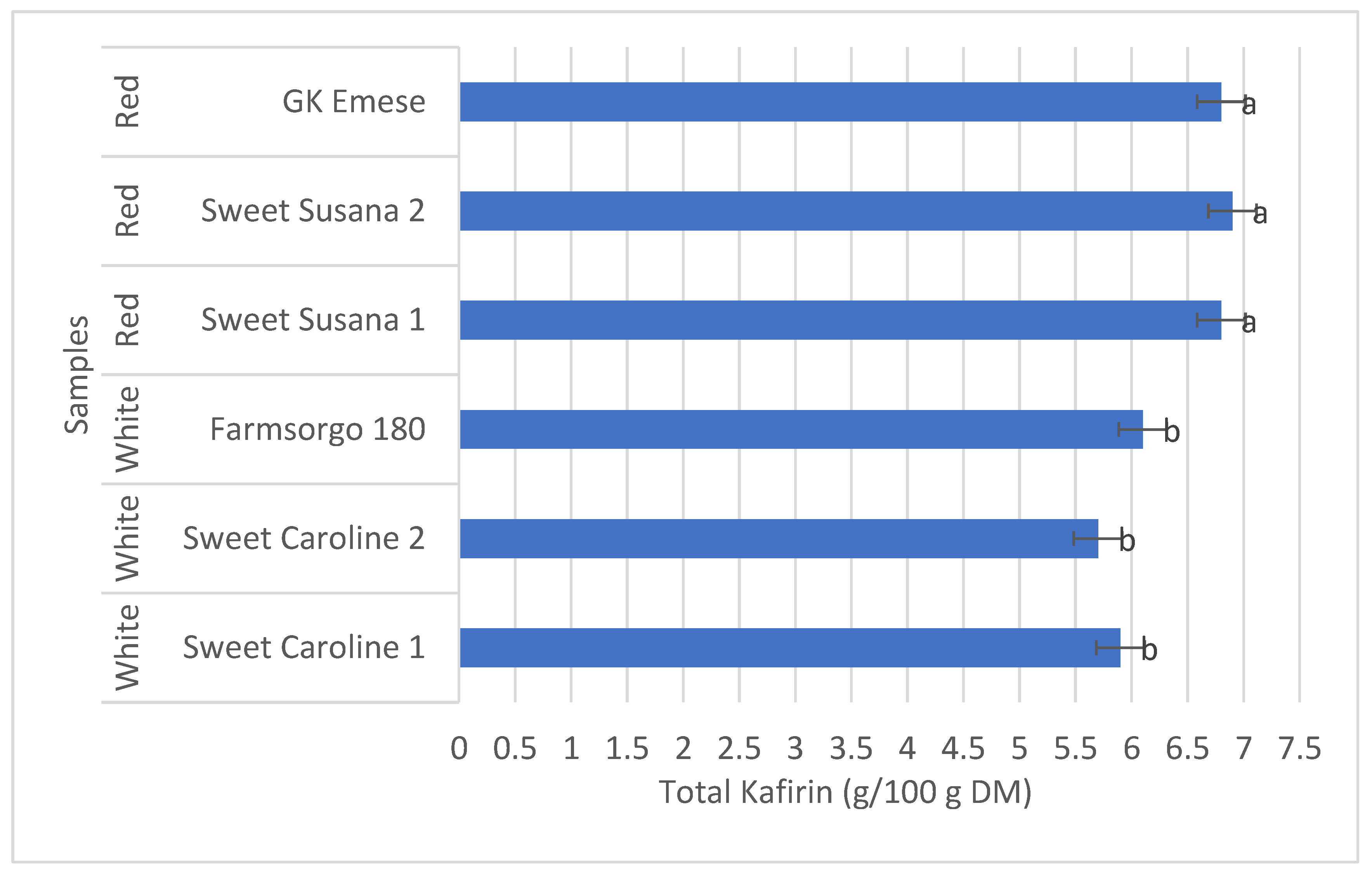
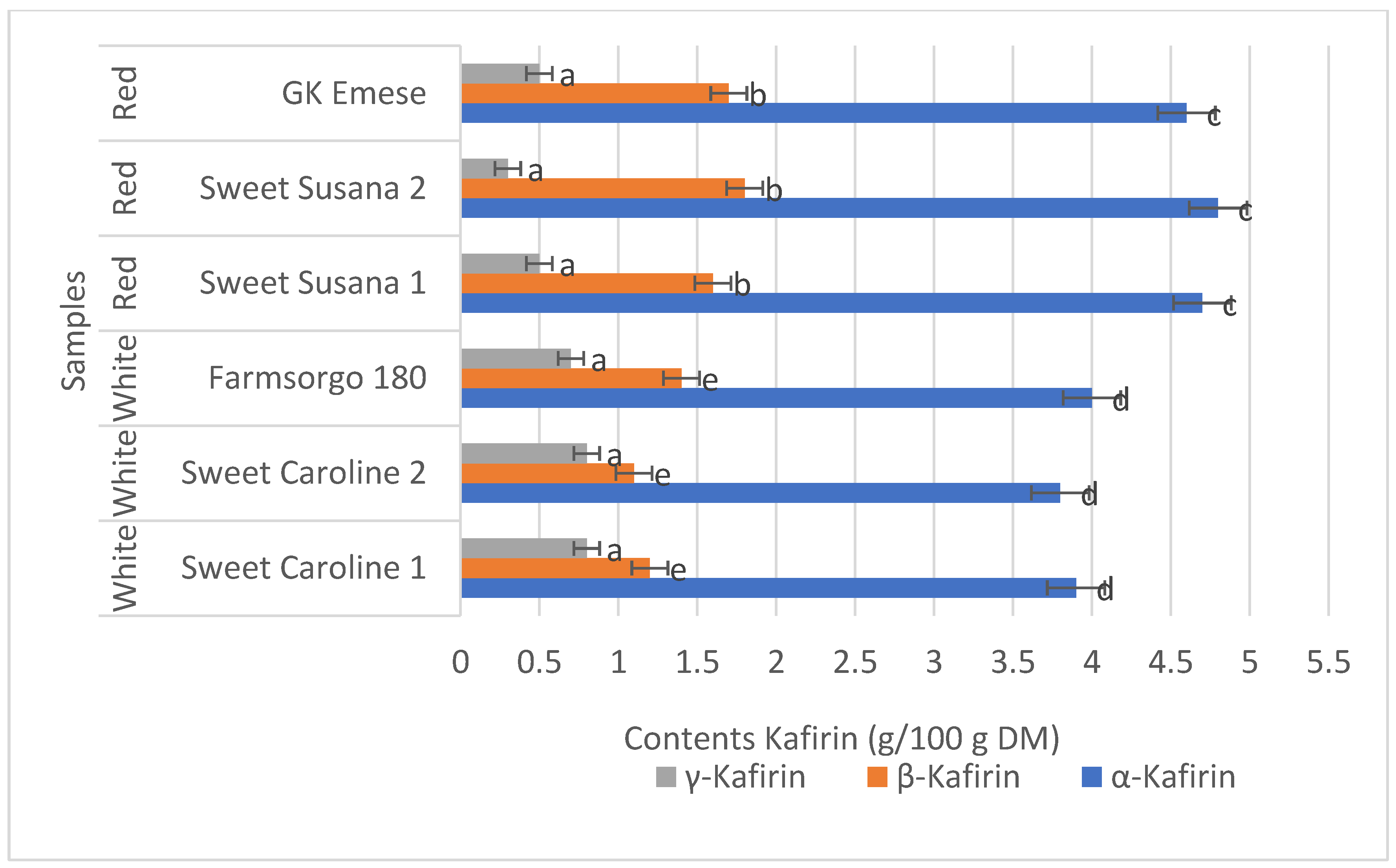
In the present study, sorghum varieties exhibited differentiated total kafirin content, ranging from approximately 5.5 to 7.0 g/100 g dry matter (Figure 1). The highest kafirin content was observed in the red varieties Sweet Susana 1 and Sweet Susana 2, while the lowest was found in the white variety Farmsorgo 180. Fractional analysis showed that across all studied varieties, the dominant fraction was α-kafirin, with levels of approximately 4.2–5.0 g/100 g DM, constituting the majority of total kafirin (Figure 2). The contents of β- and γ-kafirin were relatively low, approximately 0.5–1.0 g/100 g DM and 0.2–0.6 g/100 g DM, respectively, with red varieties showing a tendency toward slightly higher γ-kafirin levels. The white varieties Sweet Caroline 1 and 2 exhibited α-kafirin levels similar to those of the red varieties but had lower β-kafirin levels and variable γ-kafirin levels. In the case of the Farmsorgo 180 variety, markedly lower total kafirin and individual fraction levels were observed. Based on the literature, the dominance of α-kafirin may be associated with increased endosperm hardness and limited protein digestibility [19,20,21], while higher γ-kafirin content in red varieties may stabilize protein structures and enhance resistance to processing. It should be emphasized, however, that these interpretations are context-based and supported by prior studies, rather than being directly derived from the quantitative data of the present study.
The total kafirin content in sorghum sprouts ranged from approximately 5.8 to 6.9 g/100 g dry matter (DM) (Figure 1). The highest values were observed for red varieties (GK Emese, Sweet Susana 1, and Sweet Susana 2), while the white variety Farmsorgo 180 showed the lowest content. Statistical analysis revealed significant differences (p < 0.05) among selected varieties, with a clear trend of higher total kafirin content in red varieties than in white varieties.
Fractional analysis of kafirins showed that in all tested varieties, the α-kafirin fraction was dominant, with contents ranging from approximately 3.9 to 4.8 g/100 g DM (Figure 2). The β- and γ-kafirin fractions were present in much smaller amounts, ranging from about 1.2 to 1.7 g/100 g DM and 0.3 to 0.6 g/100 g DM, respectively. Red varieties tended to have higher γ-fraction contents compared to white varieties, whereas differences in α- and β-fractions were mainly quantitative and reflected varietal trends. Statistically significant differences (p < 0.05) were observed for selected comparisons, particularly for the γ-fraction.
The results indicate that both red and white sorghum varieties have high kafirin content, with red varieties exhibiting slightly higher total prolamin protein concentrations. This is consistent with previous reports suggesting that varieties with colored seed coats may exhibit higher accumulation of storage proteins [13]. The dominance of α-kafirin is typical for sorghum endosperm and is responsible for the structural properties of zein-like proteins [20,22]. This fraction is responsible for most of the functional properties of sorghum proteins, including their limited digestibility, which results from their high hydrophobicity [8,10]. The observed lower levels of β- and γ-kafirin in the white varieties may indicate a different endosperm maturation profile and differences in the expression of genes encoding the individual prolamin fractions, as also reported in the literature [23]. The exceptionally low kafirin content in the Farmsorgo 180 variety suggests specific genotypic traits or cultivation conditions affecting the synthesis of storage proteins. The variation in kafirin content has important nutritional implications. A high proportion of the α fraction, combined with a low amount of γ-kafirin, may influence endosperm hardness and the limited digestibility of proteins, as observed in many sorghum varieties [19]. Varieties with lower γ-kafirin content, such as Sweet Caroline, may potentially exhibit better susceptibility to thermal processing and higher digestibility, making them attractive for food technology as well as human and animal nutrition.
Red varieties exhibited higher total kafirin content than white varieties, consistent with reports linking seed coat color to storage protein accumulation [24]. α-Kafirin was dominant across all varieties and is responsible for endosperm hardness and limited digestibility. γ-Kafirins, rich in cysteine, stabilize protein bodies, enhancing resistance to processing. Varieties with lower γ-kafirin content may have improved digestibility and suitability for bakery and functional food applications [16,19].
The choice of extraction method affects both yield and fraction composition. The Tris-HCl/SDS/β-mercaptoethanol approach achieved high recovery while preserving bioactive structures, critical for functional and comparative studies. Kafirins’ bioactivity, including antioxidant and digestive enzyme modulation, underscores their importance in functional food design [10,25].
Varietal differences in the content and composition of kafirin fractions are of significant biological relevance, as they reflect the genetic diversity and the specific expression patterns of prolamin genes in the studied cultivars [26]. The observed kafirin profiles, particularly the proportions of α-, β-, and γ-fractions, may have direct implications for practical applications of sorghum [27,28]. Varieties with high α-kafirin content and relatively low γ-fraction may exhibit greater endosperm hardness and reduced digestibility, which can influence processing in bakery products or functional foods. In contrast, varieties with higher γ-kafirin content, which stabilizes protein structures, may be more resistant to technological processing but less digestible in animal or human diets. Considering these relationships allows the analytical results to be linked to potential scenarios for using sorghum sprouts in the production of bread, functional beverages, or high-protein feed, highlighting the importance of cultivar selection based on their technological and nutritional properties.

3.3. Kafirin Biosynthesis Pathway (α-, β-, and γ-Kafirins) in Sorghum Sprouts

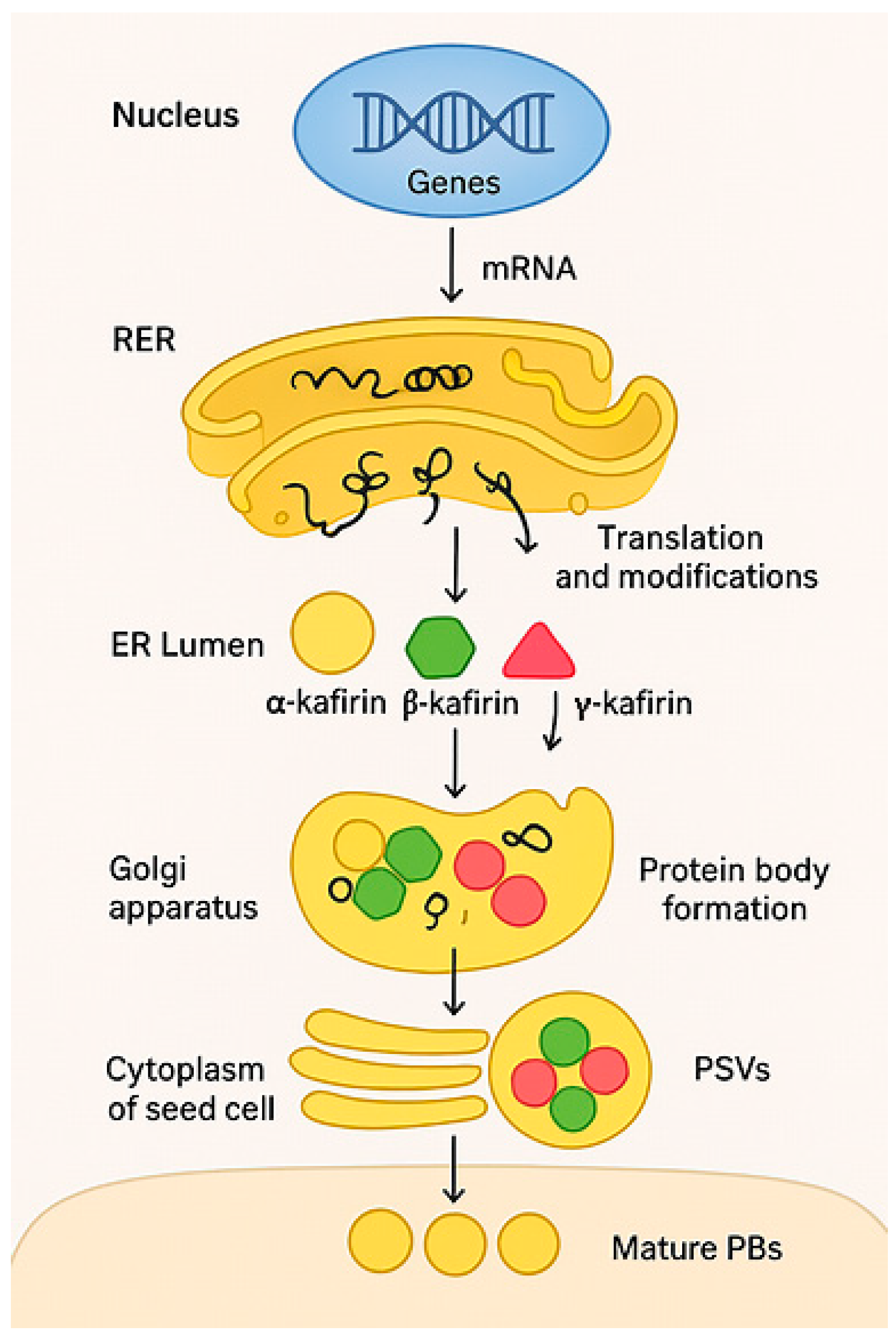
Kafirins constitute the main group of prolamins in sorghum sprouts. They are synthesized both in the endosperm cells and, during germination, in the cells responsible for storing storage proteins within the sprout. Kafirin biosynthesis proceeds analogously to the well-studied zein pathway in maize and involves multilevel regulation of gene expression, transcriptional and translational processes, and the formation of characteristic protein bodies (Figure 3) [29]. The description of the kafirin biosynthesis pathway (α-, β-, and γ-fractions) in sorghum sprouts presented here is conceptual and based on literature data. It does not report new experimental results but rather supports the interpretation of the quantitative data obtained in this study. By outlining gene expression, transcriptional and translational regulation, post-translational modifications, and protein body formation, this framework provides a mechanistic context for the observed kafirin profiles and varietal differences, helping to explain the distribution and relative abundance of α-, β-, and γ-kafirins in sprouts [29,30].

3.4. Regulation of Kafirin Gene Expression

The genes encoding α-, β-, and γ-kafirins (including KAF1, KAF2, and related paralogous copies) are under tight transcriptional control. Their promoters contain conserved cis elements, such as the prolamin box, O2 box, and TATA box, which determine tissue-specific expression. Transcription initiation requires the action of specific OPAQUE2-like (O2-like) protein factors and bZIP family factors—including ABF and PBF—that co-form the RNA polymerase II activation complex. This results in the formation of a kafirin precursor transcript (pre-mRNA), containing intronic sequences necessary for further maturation [31].

3.5. Transcription and Maturation of Kafirin mRNA

The pre-mRNA undergoes splicing, during which introns are removed, followed by polyadenylation at the 3′ end. Mature mRNAs are exported from the nucleus through the nuclear pore complex (NPC) and then recruited to polyribosomes bound to the membranes of the rough endoplasmic reticulum (RER). This translational targeting to the RER is possible thanks to the presence of signal sequences in the nascent polypeptides [31].

3.6. Translation of Kafirin Precursors on the RER Ribosomes

Precursors of three main classes of kafirins are synthesized on ribosomes associated with the RER: α-kafirin (approximately 20–25 kDa), β-kafirin (approximately 14 kDa), and γ-kafirin (approximately 27 kDa, rich in cysteine) [29]. All of these proteins contain a signal peptide at their N-terminus, which directs newly synthesized polypeptides to the lumen of the endoplasmic reticulum during their elongation.

3.7. Post-Translational Modifications in the ER Lumen

After passing through the translocon in the ER membrane, the signal peptide is cleaved by specific signal peptidases. In the ER lumen, proper folding of kafirins begins, facilitated by chaperones such as BiP, PDI, and HSP70 family proteins. The process of disulfide bond formation is particularly intense, particularly important for γ- and β-kafirins, which are rich in cysteine. Due to their low cysteine residue content, α-kafirins stabilize their structure primarily through interactions with polymerizing γ-kafirins, which constitute the aggregation scaffold.

3.8. Protein Body Formation

In the ER lumen, spontaneous prolamin aggregation occurs, leading to the formation of spherical protein bodies (PBs), characteristic of sorghum sprouts. γ-kafirins initiate the formation of the PB core through polymerization and cross-linking via S-S bridges. β-kafirins stabilize the outer layers of the aggregates, while α-kafirins constitute the bulk of the maturing PB-I protein bodies. The resulting PBs have an ordered structure, enabling long-term storage of the storage protein.

3.9. Transport and Maturation in the Golgi Apparatus

Although most kafirins remain deposited within the ER, some—particularly γ-kafirins—can be sorted towards protein storage vacuoles (PSVs). This process involves the recognition of carbohydrate sorting signals and the involvement of receptors related to the BP-80 protein. In PSVs, kafirins can co-form complex aggregates with other germinal storage proteins.

3.10. Kafirin Deposition in Germinal Cells

During germination, kafirin-containing PBs accumulate in the cytoplasm of specialized germinal cells. γ- and β-kafirins provide high stability to the PB structure. At the same time, α-kafirins play a key storage role, providing a source of amino acids used in later stages of embryonic development and seedling growth. Final kafirin deposition enables efficient use of protein resources during the phase of intensive biosynthesis and tissue differentiation.

4. Conclusions

Sorghum varieties in temperate climates show significant variation in total kafirin content and fractional composition, with red varieties exhibiting higher protein levels. α-kafirin is the dominant fraction, while γ-kafirins contribute to protein body stability and processing resistance; lower γ-fraction levels favor digestibility. The Tris-HCl/SDS/β-mercaptoethanol extraction method is efficient, reproducible, and preserves the integrity of all kafirin fractions. Study limitations include the limited number of cultivars and focus on a single germination stage. Future research should incorporate digestibility tests, bioactivity assessments, and gene expression analyses to better understand the mechanisms shaping kafirin fraction profiles in sprouts. These findings support the use of selected sorghum varieties for industrial and nutritional applications in temperate regions north of 50° N.

Author Contributions

Conceptualization, A.P.-B. and J.F.; methodology, A.P.-B.; software, A.P.-B. and K.S.-S.; validation, A.P.-B.; formal analysis, A.P.-B.; investigation, A.P.-B.; resources, A.P.-B. and J.F.; data curation, A.P.-B.; writing—original draft, A.P.-B. and J.F.; writing—review and editing, K.S.-S.; visualization, A.P.-B.; supervision, A.P.-B.; project administration, A.P.-B.; funding acquisition, A.P.-B. All authors have read and agreed to the published version of the manuscript.

Funding

This research received no external funding.

Institutional Review Board Statement

Not applicable.

Informed Consent Statement

Not applicable.

Data Availability Statement

The data presented in this study are available on request from the corresponding author. The data are not publicly available due to privacy.

Conflicts of Interest

The authors declare no conflicts of interest.

References

  1. Abah, C.R.; Ishiwu, C.N.; Obiegbuna, J.E.; Oladejo, A.A. Sorghum Grains: Nutritional Composition, Functional Properties and Its Food Applications. Eur. J. Nutr. Food Saf. 2020, 12, 101–111. [Google Scholar] [CrossRef]
  2. Khalid, W.; Arshad, M.S.; Aslam, N.; Mukhtar, S.; Rahim, M.A.; Ranjha, M.M.A.N.; Noreen, S.; Afzal, M.F.; Aziz, A.; Awuchi, C.G. Food applications of sorghum derived kafirins potentially valuable in celiac disease. Int. J. Food Prop. 2022, 25, 2348–2363. [Google Scholar] [CrossRef]
  3. Khalid, W.; Ali, A.; Arshad, M.S.; Afzal, F.; Akram, R.; Siddeeg, A.; Kousar, S.; Rahim, M.A.; Aziz, A.; Maqbool, Z. Nutrients and bioactive compounds of Sorghum bicolor L. used to prepare functional foods: A review on the efficacy against different chronic disorders. Int. J. Food Prop. 2022, 25, 1045–1062. [Google Scholar] [CrossRef]
  4. Teferra, T.F.; Awika, J.M. Sorghum as a Healthy Global Food Security Crop: Opportunities and Challenges. Cereal Foods World 2019, 64. [Google Scholar] [CrossRef]
  5. Hossain, S.; Islam, N.; Rahman, M.; Mostofa, M.G.; Khan, A.R. Sorghum: A prospective crop for climatic vulnerability, food and nutritional security. J. Agric. Food Res. 2022, 8, 100300. [Google Scholar] [CrossRef]
  6. Hassan, S.; Imran, M.; Ahmad, M.H.; Khan, M.I.; Xu, C.; Khan, M.K.; Muhammad, N. Phytochemical characterization of ultrasound-processed sorghum sprouts for the use in functional foods. Int. J. Food Prop. 2020, 23, 853–863. [Google Scholar] [CrossRef]
  7. Bean, S.R.; Wilson, J.D.; Moreau, R.A.; Galant, A.; Awika, J.M.; Kaufman, R.C.; Adrianos, S.L.; Ioerger, B.P. Structure and Composition of the Sorghum Grain. In Sorghum: A State of the Art and Future Perspetives; CSSA: Madison, WI, USA, 2019; pp. 173–214. [Google Scholar] [CrossRef]
  8. Pontieri, P.; Troisi, J.; Bean, S.R.; Tilley, M.; di Salvo, M.; Boffa, A.; Pignone, D.; del Giudice, F.; Aletta, M.; Alifano, P.; et al. Comparison of extraction methods for isolating kafirin protein from food grade sorghum flour. Aust. J. Crop Sci. 2019, 13, 1297–1304. [Google Scholar] [CrossRef]
  9. Borgonovi, S.M.; Marzocchi, S.; Pasini, F.; Bordoni, A.; Barbiroli, A.; Marti, A.; Iametti, S.; Di Nunzio, M. Exploring Germination to Unlock the Nutritional Potential of Sorghum (Sorghum bicolor). Molecules 2025, 30, 3622. [Google Scholar] [CrossRef]
  10. Shah, U.; Bhattarai, R.; Al-Salami, H.; Blanchard, C.; Johnson, S.K. Advances in Extraction, Structure, and Physiochemical Properties of Sorghum Kafirin for Biomaterial Applications: A Review. J. Funct. Biomater. 2024, 15, 172. [Google Scholar] [CrossRef]
  11. Belton, P.S.; Delgadillo, I.; Halford, N.G.; Shewry, P.R. Kafirin structure and functionality. J. Cereal Sci. 2006, 44, 272–286. [Google Scholar] [CrossRef]
  12. Cremer, J.E.; Bean, S.R.; Tilley, M.M.; Ioerger, B.P.; Ohm, J.B.; Kaufman, R.C.; Wilson, J.D.; Innes, D.J.; Gilding, E.K.; Ian, D. Godwin Grain Sorghum Proteomics: Integrated Approach toward Characterization of Endosperm Storage Proteins in Kafirin Allelic Variants. J. Agric. Food Chem. 2014, 62, 9819–9831. [Google Scholar] [CrossRef]
  13. Shah, U.; Dwivedi, D.; Hackett, M.; Al-Salami, H.; Utikar, R.P.; Blanchard, C.; Gani, A.; Rowles, M.R. Physicochemical characterisation of kafirins extracted from sorghum grain and dried distillers grain with solubles related to their biomaterial functionality. Sci. Rep. 2021, 11, 15204. [Google Scholar] [CrossRef] [PubMed]
  14. Cabrera-Ramírez, A.H.; Luzardo-Ocampo, I.; Ramírez-Jiménez, A.K.; Morales-Sánchez, E.; Campos-Vega, R.; Gaytán-Martínez, M. Effect of the nixtamalization process on the protein bioaccessibility of white and red sorghum flours during in vitro gastrointestinal digestion. Food Res. Int. 2020, 134, 109234. [Google Scholar] [CrossRef] [PubMed]
  15. Song, X.; Kang, Y.; Dai, L.; Zhang, S.; Wang, C.; Li, Z. A review of bioinformatics analysis and its digestibility of Sorghum bicolor Kafirins. J. Food Compos. Anal. 2024, 134, 106595. [Google Scholar] [CrossRef]
  16. Frankowski, J.; Wawro, A.; Batog, J.; Szambelan, K.; Łacka, A. Bioethanol Production Efficiency from Sorghum Waste Biomass. Energies 2022, 15, 3132. [Google Scholar] [CrossRef]
  17. D’Almeida, C.T.S.; Oliveira, M.E.A.S.; da Silva Lima, L.R.; Carvalho, C.W.P.; Mameri, H.; Ferreira, M.S.L. Sorghum. In Millets: Crops for Climate Resilience and for Food and Nutritional Security; Springer Nature: Singapore, 2025; pp. 239–269. [Google Scholar] [CrossRef]
  18. Kuktaite, R.; Larsson, H.; Johansson, E. Protein composition in different phases obtained by the ultracentrifugation of dough. Acta Agron. Hung. 2003, 51, 163–172. [Google Scholar] [CrossRef][Green Version]
  19. Duodu, K.G.; Taylor, J.R.N.; Belton, P.S.; Hamaker, B.R. Factors affecting sorghum protein digestibility. J. Cereal Sci. 2003, 38, 117–131. [Google Scholar] [CrossRef]
  20. Oria, M.P.; Hamaker, B.R.; Axtell, J.D.; Huang, C.-P. A highly digestible sorghum mutant cultivar exhibits a unique folded structure of endosperm protein bodies. Proc. Natl. Acad. Sci. USA 2000, 97, 5065–5070. [Google Scholar] [CrossRef]
  21. da Silva, L.S.; Taylor, J.; Taylor, J.R.N. Transgenic Sorghum with Altered Kafirin Synthesis: Kafirin Solubility, Polymerization, and Protein Digestion. J. Agric. Food Chem. 2011, 59, 9265–9270. [Google Scholar] [CrossRef]
  22. Anglani, C. Sorghum endosperm texture—A review. Plant Foods Hum. Nutr. 1998, 52, 67–76. [Google Scholar] [CrossRef]
  23. Taylor, J.R.N.; Emmambux, M.N. REVIEW: Developments in Our Understanding of Sorghum Polysaccharides and Their Health Benefits. Cereal Chem. 2010, 87, 263–271. [Google Scholar] [CrossRef]
  24. Saud, S.; Salamatullah, A.M. Relationship between the Chemical Composition and the Biological Functions of Coffee. Molecules 2021, 26, 7634. [Google Scholar] [CrossRef]
  25. Frankowski, J.; Przybylska-Balcerek, A.; Stuper-Szablewska, K. Concentration of Pro-Health Compound of Sorghum Grain-Based Foods. Foods 2022, 11, 216. [Google Scholar] [CrossRef]
  26. Grootboom, A.W.; Mkhonza, N.L.; Mbambo, Z.; O’Kennedy, M.M.; da Silva, L.S.; Taylor, J.; Taylor, J.R.N.; Chikwamba, R. Co-suppression of synthesis of major α-kafirin sub-class together with γ-kafirin-1 and γ-kafirin-2 required for substantially improved protein digestibility in transgenic sorghum. Plant Cell Rep. 2014, 33, 521–537. [Google Scholar] [CrossRef]
  27. Upadhyaya, H.D.; Vetriventhan, M. Ensuring the genetic diversity of sorghum. In Achieving Sustainable Cultivation of Sorghum, Volume 1: Genetics, Breeding and Production Techniques; Burleigh Dodds Science Publishing Limited: Cambridge, UK, 2018; pp. 83–110. [Google Scholar] [CrossRef]
  28. Laidlaw, H.K.C.; Mace, E.S.; Williams, S.B.; Sakrewski, K.; Mudge, A.M.; Prentis, P.J.; Jordan, D.R. Godwin Allelic variation of the β-, γ- and δ-kafirin genes in diverse Sorghum genotypes. Theor. Appl. Genet. 2010, 121, 1227–1237. [Google Scholar] [CrossRef] [PubMed]
  29. Shull, J.M.; Watterson, J.J.; Kirleis, A.W. Purification and immunocytochemical localization of kafirins in Sorghum bicolor (L. Moench) endosperm. Protoplasma 1992, 171, 64–74. [Google Scholar] [CrossRef]
  30. Liu, G.; Lamont, K.C.; Ahmad, N.; Tomkins, A.; Mudge, S.R.; Gilding, E.K. The functionality of α-kafirin promoter and α-kafirin signal peptide. Plant Cell Tissue Organ Cult. (PCTOC) 2017, 128, 133–143. [Google Scholar] [CrossRef]
  31. Ahmad, N.; Sant, R.; Bokan, M.; Steadman, K.J.; Godwin, I.D. Expression Pattern of the Alpha-Kafirin Promoter Coupled with a Signal Peptide from Sorghum bicolor L. Moench. J. Biomed. Biotechnol. 2012, 2012, 752391. [Google Scholar] [CrossRef]
Figure 1. Total kafirin content in sorghum sprouts (g/100 g DM). Values are presented as mean ± standard deviation (SD) from three independent replicates. Different letters indicate statistically significant differences between samples (ANOVA, Tukey’s test, p < 0.05). a, b: Bars marked with the same letter do not differ significantly (p > 0.05). Bars marked with different letters differ significantly (p < 0.05).
Applsci 16 01485 g001
Figure 2. Contents of α-, β-, and γ-kafirin fractions in sorghum sprouts (g/100 g DM). Values are expressed as mean ± SD from three independent replicates. Statistical differences between varieties were assessed using one-way ANOVA followed by Tukey’s post hoc test (p < 0.05). a, b, c, d, e: Bars marked with the same letter do not differ significantly (p > 0.05). Bars marked with different letters differ significantly (p < 0.05).
Applsci 16 01485 g002
Figure 3. Diagram illustrating the stepwise formation of mature protein bodies (PBs) in the cytoplasm of a sorghum sprout cell, starting from the cell nucleus. The diagram shows the localization of kafirins in the grain endosperm, their transport to the cytoplasm, and accumulation in protein bodies, which serve as nitrogen and amino acid reserves for developing sprout tissues.
Applsci 16 01485 g003
Table 1. Raw material for research.
NoVarietySeed ColorHarvest RegionGeographic Location
1Sweet Caroline 1WhiteWestern PomeraniaBiałogard, 54°00′29″ N, 15°59′09″ E
2Sweet Caroline 2WhiteGreater PolandStary Sielec, 51°39′36″ N, 17°08′48″ E
3Farmsorgo 180WhiteGreater PolandStary Sielec, 51°39′36″ N, 17°08′48″ E
4Sweet Susana 1RedWestern PomeraniaBiałogard, 54°00′29″ N, 15°59′09″ E
5Sweet Susana 2RedGreater PolandStary Sielec, 51°39′36″ N, 17°08′48″ E
6GK EmeseRedWestern PomeraniaBiałogard, 54°00′29″ N, 15°59′09″ E
Table 2. Comparison of extraction methods.
Extraction MethodTotal Kafirin Yield (%)α-Kafirin (%)β-Kafirin (%)γ-Kafirin (%)Extraction TimeReferences
Tris-HCl + SDS + β-mercaptoethanol96–9760–6515–185–760 minPresent study
Alcohol 70–80%85–9055–60155–7120 min[8]
Enzymatic (proteases)88–9250–6018–205–845 min[10]
Ultrasound + ethanol93–9558–6316–186–720 min[13]
Disclaimer/Publisher’s Note: The statements, opinions and data contained in all publications are solely those of the individual author(s) and contributor(s) and not of MDPI and/or the editor(s). MDPI and/or the editor(s) disclaim responsibility for any injury to people or property resulting from any ideas, methods, instructions or products referred to in the content.