1. Introduction
Visual field assessment is a cornerstone of functional evaluation in ophthalmology and optometry, playing a critical role in the early detection and monitoring of diseases such as glaucoma, optic neuropathies, and retinal disorders [
1,
2]. Functional alterations in the visual field may precede detectable structural changes, making perimetry an essential diagnostic and follow-up tool [
3]. However, the accuracy, reproducibility, and clinical interpretability of visual field measurements are strongly influenced by the characteristics of the perimetric device, which complicates direct comparison across different systems.
Traditionally, visual field testing has been performed using conventional perimeters, evolving from kinetic Goldmann perimetry to static automated perimetry systems such as the Humphrey Field Analyzer (HFA) and the Octopus perimeter [
1,
3]. These devices are specifically designed to quantify differential light sensitivity at predefined retinal locations using standardized testing strategies. Despite their widespread clinical adoption and well-established normative databases, conventional automated perimeters present several limitations [
4]. Their large physical footprint, high acquisition and maintenance costs, and dependence on controlled clinical environments restrict their accessibility in certain settings. In addition, these tests require sustained fixation, attention, and cooperation from the patient, often leading to fatigue and reduced test reliability, particularly in elderly subjects or those with limited mobility.
Recent technological advances have introduced virtual reality (VR)-based solutions as an alternative approach to visual field assessment [
5,
6]. Head-mounted VR perimeters offer increased portability, controlled visual environments, and enhanced flexibility in test design, while potentially improving patient comfort and engagement [
6]. Several studies have demonstrated the feasibility of VR-based perimetry for visual field screening and monitoring, highlighting its potential role in clinical practice, telemedicine, and home-based assessment [
7].
Among these emerging technologies, the Dicopt-Pro system represents a portable VR-based perimetric platform designed to evaluate central visual field sensitivity using strategies comparable to those employed in standard automated perimetry [
8]. However, the integration of VR-based perimetry into routine clinical workflows and longitudinal studies requires a rigorous understanding of how its measurements relate quantitatively to those obtained with established gold-standard devices such as the HFA using the 30-2 test pattern [
1,
3]. Without a clear characterization of the inter-device scale relationship, direct comparison of sensitivity values across devices remains problematic [
9].
From an applied perspective, the lack of interoperability between perimetric devices represents a relevant limitation in both clinical practice and research settings. Visual field data obtained with different instruments cannot be directly compared or pooled without a clear understanding of the systematic scale-related differences between devices, which complicates longitudinal follow-up, multi-center studies, and the integration of emerging technologies into established clinical workflows [
9,
10].
This issue becomes particularly relevant when novel perimetric platforms are intended to complement rather than replace conventional devices, as is the case with virtual reality-based systems. In this context, clearly characterizing the systematic scale-related differences between devices enables continuity with existing normative databases, facilitates interpretation by clinicians familiar with standard automated perimetry, and supports the adoption of portable or remote assessment tools without disrupting current diagnostic paradigms.
A key challenge in this context arises from scale effects inherent to perimetric measurements. Visual field sensitivity is expressed in decibels (dB), representing the logarithmic attenuation of the maximum stimulus luminance [
4]. Because different perimeters operate with distinct maximum stimulus luminances while often sharing similar background luminance levels, identical sensitivity values expressed in dB may correspond to substantially different physical luminance levels.
To address the relationship between conventional automated perimetry and virtual reality-based perimetry from a rigorous scientific perspective, it is essential to emphasize that differences in sensitivity values expressed in decibels arise directly from how each device defines its dB scale relative to its own maximum stimulus luminance (Lmax) [
10,
11]. Because both instruments operate under Weber’s law, retinal sensitivity remains physiologically constant, while numerical dB values differ due to distinct luminance reference levels [
11,
12]. Consequently, systematic inter-device differences in dB do not imply differences in perceptual sensitivity, but rather reflect scale-dependent reference shifts inherent to each perimetric system [
10,
11].
From a theoretical standpoint, differences in maximum stimulus luminance between conventional and VR-based perimeters suggest the existence of a predictable and approximately constant scale offset between their sensitivity measurements. Characterizing this offset is essential to enable meaningful comparison with historical HFA data and to support the clinical interpretation of VR-based perimetry. Moreover, the availability of age-stratified normative data is crucial for the correct interpretation of VR-based visual field results in healthy populations.
Therefore, the aims of the present study were threefold: to compare differential light sensitivity values obtained with Humphrey Automated Perimetry (HFA, 30-2 test pattern) and the Dicopt-Pro virtual reality-based perimeter in healthy younger and older subjects; to characterize the systematic inter-device sensitivity offset between both systems; and to establish normative sensitivity profiles for the Dicopt-Pro in a population without ocular pathology.
By addressing these objectives, this study seeks to bridge classical automated perimetry and virtual reality-based perimetry within a coherent, scale-aware quantitative reference framework.
2. Materials and Methods
2.1. Study Design and Participants
This prospective, observational, analytical, cross-sectional study included 60 healthy volunteers of different ages, with no history of ocular or systemic disease affecting visual function. Inclusion criteria required a best-corrected visual acuity (BCVA) of 0.30 logMAR or better in the tested eye. Exclusion criteria included the presence of ocular pathology (e.g., cataract, glaucoma, macular or retinal disease), previous ocular surgery, or current systemic or topical medication with known effects on visual performance (e.g., corticosteroids or antiepileptic drugs).
To explore the influence of age on visual field sensitivity, participants were stratified into two age groups: younger than 50 years and 50 years or older. Only the right eye of each participant was included in the analysis to avoid inter-eye correlation effects.
All procedures adhered to the tenets of the Declaration of Helsinki. The study protocol was reviewed and approved by the Ethics Committee of Hospital Clínico San Carlos (Madrid, Spain; approval code 23/614-E). Written informed consent was obtained from all participants after a detailed explanation of the study procedures.
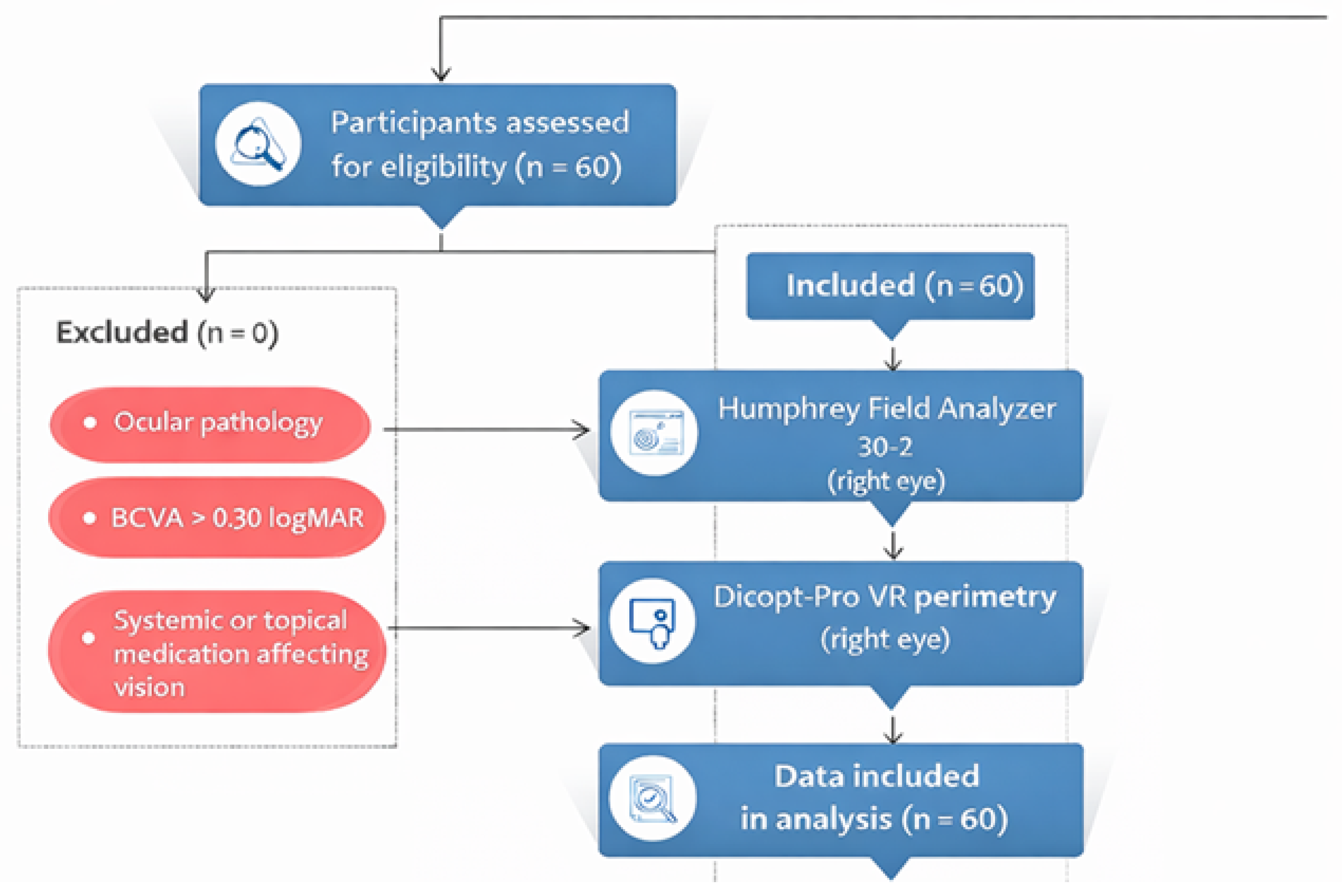
The study workflow, including participant selection, perimetric testing, and data inclusion, is summarized in
Figure 1. All participants underwent automated perimetry using the Humphrey Field Analyzer (HFA; Carl Zeiss Meditec, Dublin, CA, USA) with the 30-2 test pattern and Dicopt-Pro virtual reality-based perimetry (Dicopt-Pro, V-Vision Tech, Madrid, Spain) in randomized order, with only the right eye included for analysis.
2.2. Clinical Examination
All participants underwent a comprehensive optometric examination to confirm eligibility. Visual acuity was measured monocularly using an ETDRS chart (Precision Vision, La Salle, IL, USA) and recorded in logMAR units. The anterior segment was evaluated using a slit lamp biomicroscope (SL-D2, Topcon, Tokyo, Japan). Objective refraction, pupillometry, pachymetry, and non-contact tonometry were assessed using a multi-diagnostic platform (Visionix VX120, Luneau Technology, Chartres, France).
2.3. Perimetric Testing
Each participant underwent two visual field examinations in randomized order: a standard automated perimetry test using the Humphrey Field Analyzer (HFA; Carl Zeiss Meditec, Dublin, CA, USA) with the 30-2 test pattern and an equivalent visual field assessment using the Dicopt-Pro virtual reality-based perimeter. The order of device testing was randomized to minimize learning and fatigue effects, and both examinations were performed on the same day with a rest period between tests.
2.3.1. Humphrey Field Analyzer (HFA)
Standard 30-2 testing was performed using a Goldmann size III stimulus with a duration of 200 ms, a background luminance of 31.5 apostilbs (asb), and the SITA-Standard strategy, in accordance with ISO 12866 [
13]. The maximum stimulus luminance was 10,000 asb.
2.3.2. Dicopt-Pro
An equivalent 30° visual field test was performed using the Dicopt-Pro system. Stimulus characteristics were quantitatively matched to those used in Humphrey Automated Perimetry performed with the Humphrey Field Analyzer (HFA). Stimulus size was equivalent to a Goldmann size III target, stimulus duration was set to 200 ms, and stimuli were presented as achromatic (white) targets on a uniform background luminance of 31.5 apostilbs (asb), consistent with standard automated perimetry. The maximum stimulus luminance of the Dicopt-Pro system was 273.63 asb.
Threshold estimation in Dicopt-Pro was performed using a conventional 4-2-1 staircase procedure, reflecting the native thresholding strategy of the system, whereas the Humphrey Field Analyzer employed the SITA-Standard strategy.
Visual field sensitivity values from both devices were recorded in decibels (dB) and compared on a point-by-point basis according to corresponding test locations.
The Dicopt-Pro visual field test was explicitly designed to replicate the spatial sampling of the Humphrey 30-2 test pattern. Stimulus locations were defined using the same polar angular coordinates as the HFA 30-2 grid, resulting in equivalent eccentricities and angular separations across the central 30° visual field. Three-dimensional geometric transformations were applied to project these angular coordinates onto the virtual reality display, ensuring a nominal inter-point spacing of approximately 6° between adjacent test locations, consistent with the standard Humphrey 30-2 configuration.
For Humphrey Automated Perimetry, standard reliability indices (fixation losses, false positives, and false negatives) were monitored, and only tests meeting the manufacturer’s recommended reliability criteria were included. For Dicopt-Pro, fixation control was implemented through a central fixation target combined with continuous gaze and head-position monitoring inherent to the head-mounted display. If fixation was not maintained, stimulus presentation was automatically interrupted, preventing the generation of both false-positive and false-negative responses during periods of unstable fixation. Although classical reliability indices are not reported numerically as in conventional bowl perimetry, this real-time fixation monitoring provides an active reliability control mechanism. Only tests judged clinically reliable by the examiner were included in the analysis.
2.4. Data Analysis and Inter-Device Scale Relationship
Linear regression analysis was used to evaluate the relationship between sensitivity values obtained with the HFA and the Dicopt-Pro systems and to characterize the systematic inter-device offset between sensitivity scales, arising from differences in maximum stimulus luminance reference. The theoretical relationship between decibel attenuation, maximum stimulus luminance (Lmax), and Weber fractions for both devices is detailed in
Table S1 (Supplementary Materials). Based on this characterization, Dicopt-Pro sensitivity data were expressed relative to the HFA reference framework to generate normative sensitivity profiles as a function of visual field eccentricity.
Eccentricity was calculated for each test location based on its angular distance from fixation using the standard Humphrey 30-2 grid geometry and treated as a continuous variable; no binning of eccentricities into predefined ranges was applied. All regression analyses were performed at the level of individual test locations; no averaging or weighting by eccentricity level was applied.
2.5. Statistical Analysis
Statistical analyses were performed using standard statistical software (IBM SPSS Statistics, version 30; IBM Corp., Armonk, NY, USA). Prior to inferential analyses, data distribution was assessed using the Shapiro–Wilk test and visual inspection of histograms and Q–Q plots.
Quantitative variables are presented as mean ± standard deviation when normally distributed, or as median and interquartile range otherwise. Visual field sensitivity values obtained with both devices were analyzed descriptively and comparatively.
To evaluate the relationship between sensitivity measurements obtained with the Humphrey Field Analyzer (HFA) and the Dicopt-Pro system, simple linear regression analysis was performed, considering pointwise sensitivity values as continuous variables. The slope, intercept, and correlation coefficient (R) were used to characterize the strength of the linear association between both systems and to quantify the systematic inter-device sensitivity offset arising from differences in stimulus luminance reference.
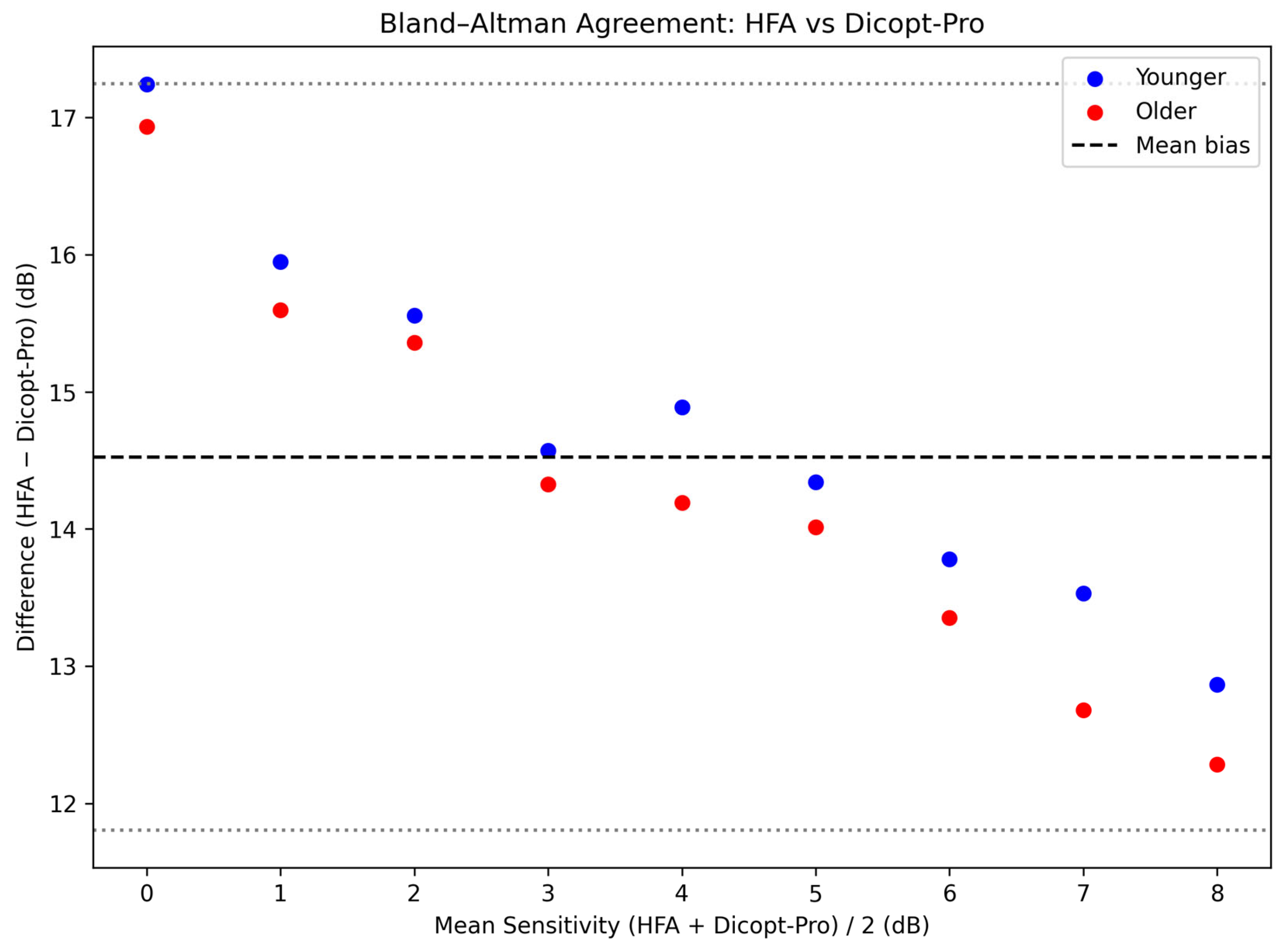
Agreement between the two measurement methods was further explored using Bland–Altman plots in order to identify potential systematic bias and assess the consistency of differences across the range of measured sensitivities.
To analyze the influence of age, participants were stratified into two groups (<50 years and ≥50 years), and between-group differences in sensitivity values were evaluated using parametric (independent-samples Student’s t-test) or non-parametric (Mann–Whitney U test) methods, depending on data distribution.
After accounting for the systematic inter-device sensitivity offset, Dicopt-Pro sensitivity values were expressed relative to the HFA reference framework to generate normative sensitivity profiles as a function of visual field eccentricity. A two-tailed p-value < 0.05 was considered statistically significant for all analyses.
3. Results
A total of 60 healthy participants were included, with one eye per subject (right eye) analyzed according to the study design. Participants were stratified into two age groups: a younger group (<50 years) and an older group (≥50 years).
Table 1 summarizes the demographic and clinical characteristics of both groups. As expected, a significant difference in age was observed between groups (
p < 0.001). Significant between-group differences were also found for objective spherical equivalent and photopic pupil diameter (
p < 0.05). No statistically significant differences were observed in subjective refraction, intraocular pressure, central corneal thickness, or mesopic pupil diameter (
p > 0.05).
Although photopic pupil diameter differed statistically between groups, the absolute difference was very small (0.07 mm) and is unlikely to be clinically meaningful; this finding may reflect measurement resolution and/or truncation effects rather than a biologically relevant age-related change.
Visual field sensitivity values obtained with the Humphrey Field Analyzer (HFA) using the 30-2 test pattern and the Dicopt-Pro system were compared on a point-by-point basis across corresponding test locations.
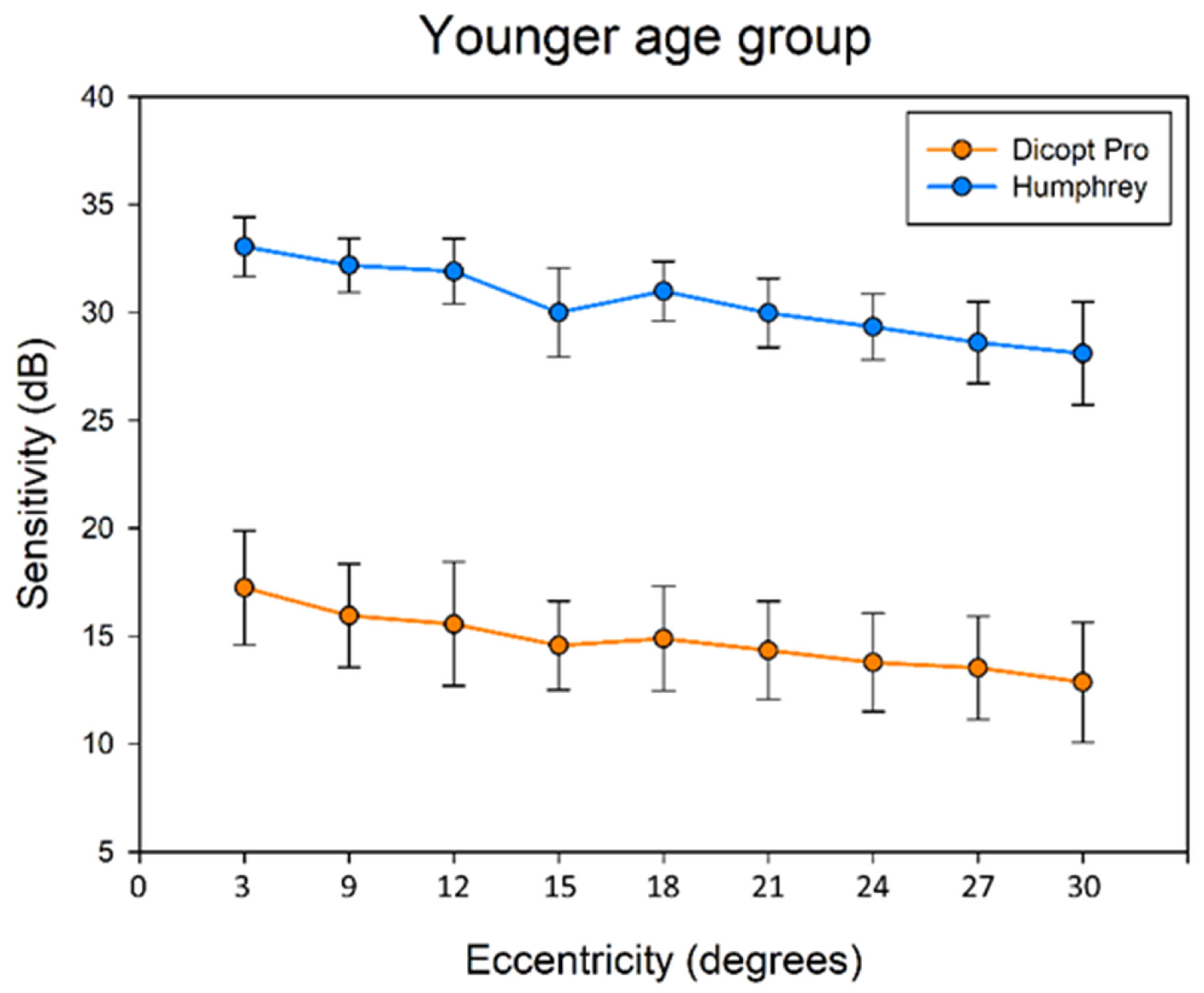
Figure 2 illustrates the distribution of sensitivity values across visual field eccentricities for both devices in the younger group.
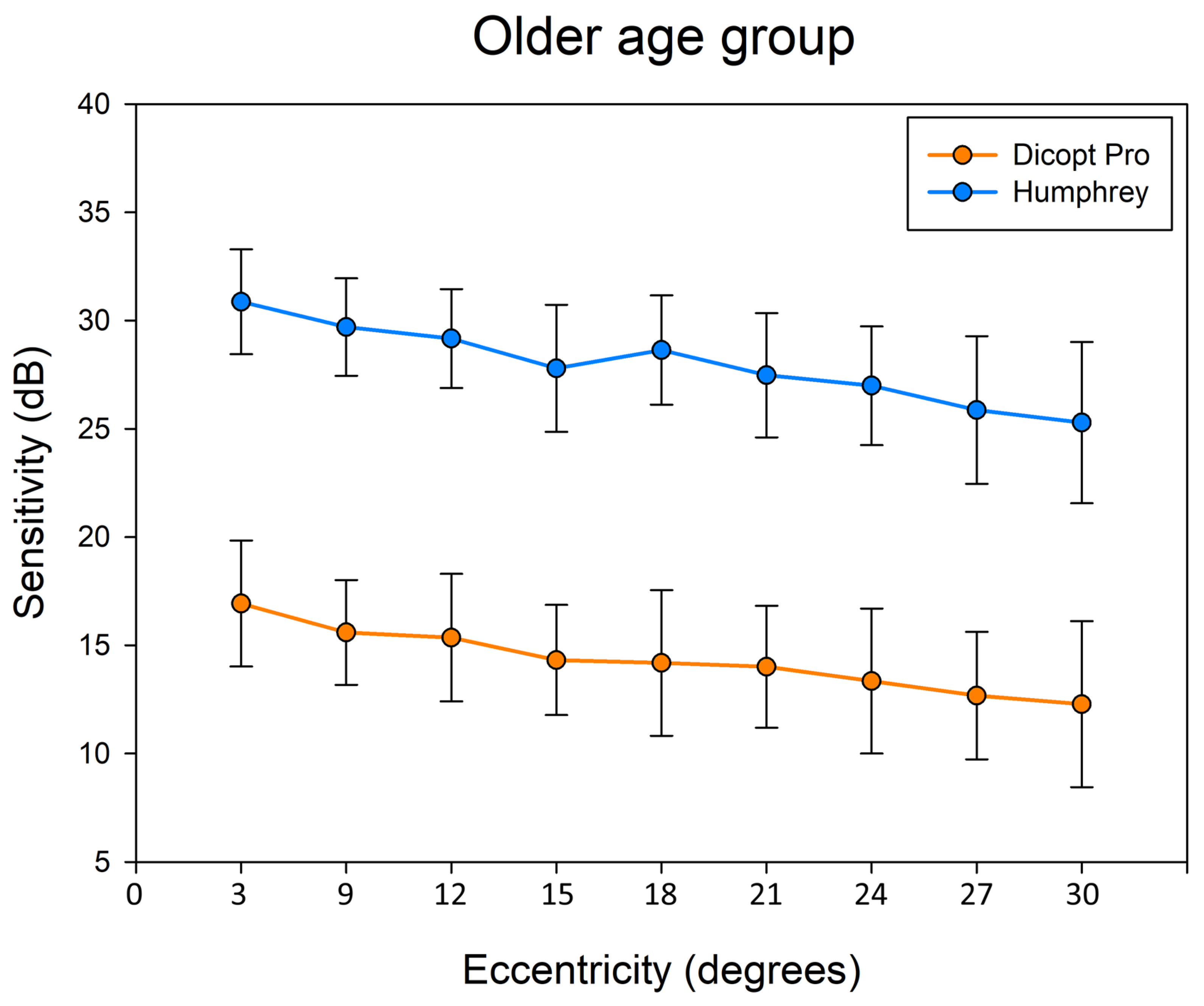
Figure 3 illustrates the eccentricity-dependent sensitivity profile in the older group for both perimetric systems. As observed in the younger group, differential light sensitivity decreased progressively with increasing eccentricity, with consistently higher absolute sensitivity values obtained with HFA compared to Dicopt-Pro across all tested locations. The overall shape of the sensitivity decline was comparable between devices, indicating similar spatial sensitivity patterns in older subjects.
A relatively constant offset between HFA and Dicopt-Pro sensitivity values was observed across eccentricities, suggesting a systematic difference between the two measurement scales rather than location-dependent variability.
Linear regression analysis demonstrated a strong linear relationship between pointwise sensitivity values obtained with HFA and Dicopt-Pro in both age groups (
Table 2). In the younger group, regression analysis revealed a high correlation coefficient (R), indicating a strong linear association between sensitivity values measured by both devices. A similarly strong linear relationship was observed in the older group.
Although regression parameters were calculated separately for each device as a function of eccentricity, the inter-device offset was estimated from pointwise sensitivity differences across corresponding visual field locations.
The regression intercepts revealed a systematic and approximately constant offset between the two devices. Mean pointwise sensitivity differences, calculated across corresponding visual field locations, were 15.7 ± 0.4 dB in the younger group and 13.7 ± 0.5 dB in the older group, characterizing an age-dependent inter-device sensitivity offset rather than a conversion factor.
The limits of agreement were comparable between age groups, suggesting similar variability in inter-device differences across the studied age range.
After accounting for the systematic inter-device sensitivity offset, Dicopt-Pro sensitivity values were expressed relative to the HFA reference framework.
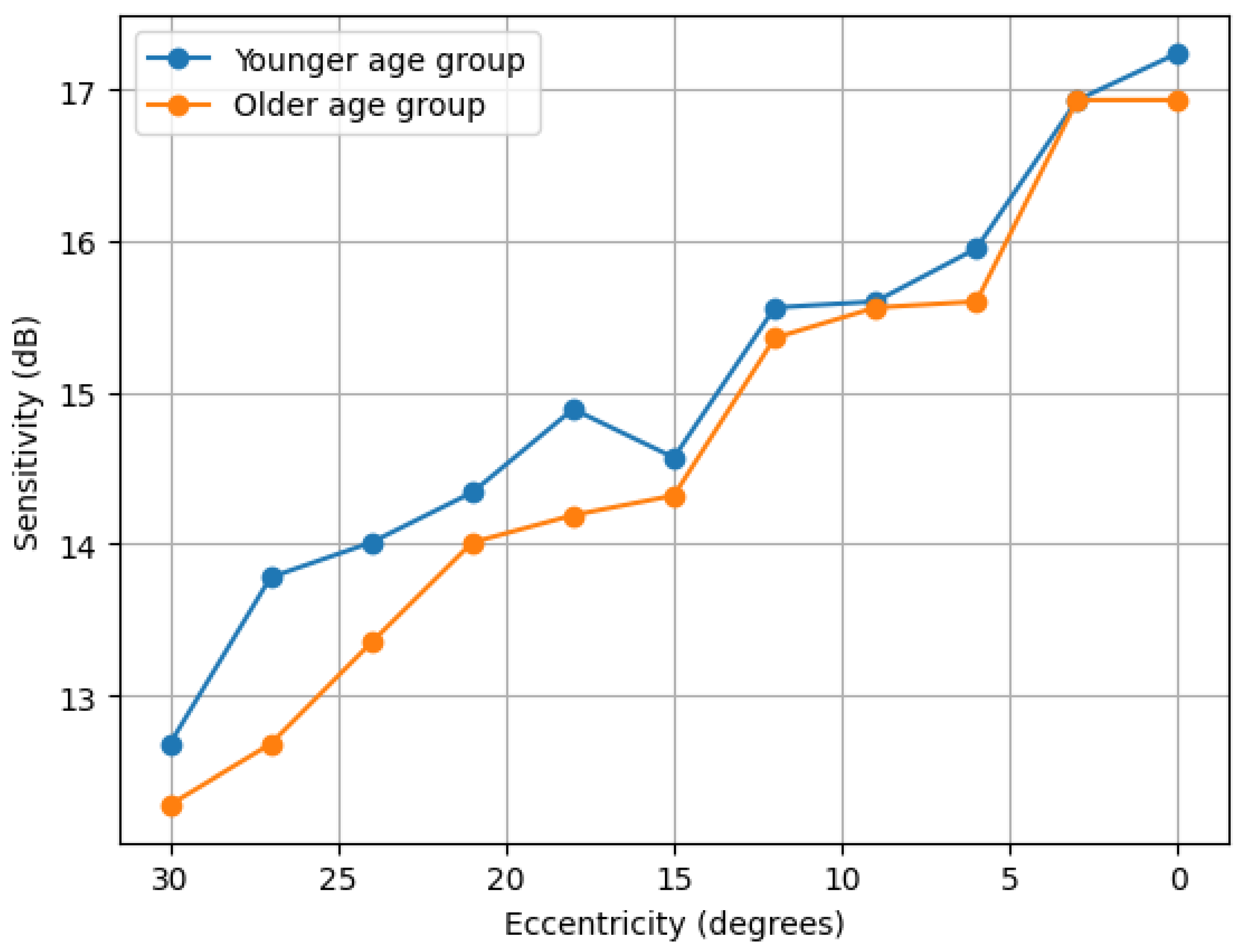
Figure 4 illustrates the resulting normative sensitivity profiles as a function of visual field eccentricity for both age groups.
Dicopt-Pro sensitivity profiles showed an eccentricity-dependent decline comparable in shape to that observed with Humphrey Automated Perimetry, while preserving expected age-related differences. These results provide normative reference profiles for Dicopt-Pro measurements in healthy subjects, independent of direct numerical equivalence with conventional perimeters.
Agreement between HFA and Dicopt-Pro sensitivity measurements was further evaluated using Bland–Altman analysis (
Figure 5). The analysis revealed a consistent mean bias across the sensitivity range, with no evidence of proportional error. The limits of agreement were comparable between younger and older subjects, supporting the presence of a systematic and approximately constant offset between devices.
4. Discussion
The present study investigated the relationship between conventional automated perimetry and virtual reality-based perimetry by directly comparing sensitivity measurements obtained with the Humphrey Field Analyzer (HFA, 30-2 test pattern) and the Dicopt-Pro system in healthy subjects across two age groups. The main findings demonstrate that, despite systematic differences in absolute sensitivity values attributable to device-specific scaling characteristics, both devices exhibit highly comparable eccentricity-dependent sensitivity profiles.
From a psychophysical standpoint, the observed constant offset between HFA and Dicopt-Pro sensitivity values reflects an isomorphic sensory response despite differences in numerical representation. Because perimetric sensitivity is expressed as a logarithmic attenuation relative to each device’s maximum stimulus luminance, identical perceptual thresholds correspond to different dB values when Lmax differs between instruments.
In this context, the preservation of equal spacing between sensitivity values across devices indicates an equidistant relationship between logarithmic scales, rather than a true conversion of thresholds. This scale equidistance allows sensitivity profiles obtained with Dicopt-Pro to be interpreted within the clinical reference framework of Humphrey Automated Perimetry without violating Weber’s law or altering the physical meaning of the stimulus.
The observed inter-device displacement can therefore be described as a factor of equidistance, defined as the constant offset between parallel logarithmic dB scales that preserves Weber proportionality and sensory isomorphism across devices.
A consistent and approximately constant offset in sensitivity values was observed between HFA and Dicopt-Pro across visual field locations, as evidenced by linear regression analysis and Bland–Altman agreement assessment. This offset amounted to approximately 15.7 dB in younger subjects and 13.7 dB in older subjects, supporting the existence of a scale-related difference rather than location-dependent variability. Similar systematic inter-device differences have been reported in previous comparisons of automated perimeters, where uniform offsets were attributed primarily to differences in stimulus luminance scaling and dynamic range rather than to fundamental discrepancies in visual field sensitivity measurement [
9,
10]. In addition, Hutchings et al. [
14] demonstrated that absolute sensitivity values and their variability are strongly influenced by instrument-specific characteristics, reinforcing the need for device-dependent calibration or conversion approaches.
The modest age-dependency observed in the inter-device offset (15.7 dB in younger subjects versus 13.7 dB in older subjects) is likely attributable to secondary psychophysical and measurement-related factors rather than to a fundamental change in the scale relationship between devices. Aging is associated with reduced retinal illuminance due to senile miosis and increased intraocular light scatter, which can subtly influence perimetric threshold estimates and may interact differently with the optical and display characteristics of head-mounted VR systems compared with conventional bowl perimetry [
11,
12,
14].
No directional asymmetries in sensitivity were observed between vertically and horizontally displaced test locations, suggesting that display or lens-related non-uniformities of the VR system did not measurably influence the results.
In addition, age-related differences in response variability, fixation stability, and adaptation state may differentially affect threshold estimation when distinct testing strategies are used (SITA-Standard versus a 4-2-1 algorithm). Importantly, Bland–Altman analysis did not reveal proportional bias, supporting that the dominant relationship between devices remains an approximately constant, scale-related offset within each age group.
Differences in thresholding strategies (SITA-Standard versus 4-2-1) are therefore expected to influence absolute sensitivity values; however, the absence of proportional bias and the consistency of the inter-device offset across eccentricities indicate that this methodological difference does not compromise the comparison of sensitivity patterns or relative spatial profiles.
In line with these findings, recent studies comparing head-mounted or virtual reality-based perimetry with conventional Humphrey automated perimetry have reported good agreement for global indices and pointwise sensitivity metrics, together with shorter examination times and high patient acceptance. Studies by Hekmatjah et al., Najdawi et al., and Zeppieri et al. [
15,
16,
17] have shown that VR-based perimeters can achieve clinically acceptable concordance with HFA measurements, supporting their feasibility as alternative or complementary tools for visual field assessment.
The observation of a largely constant offset across eccentricities suggests that both systems rely on comparable psychophysical principles and assess similar perceptual thresholds, despite operating with markedly different maximum stimulus luminances. It is well established that perimetric sensitivity expressed in decibels is inherently device-dependent, as the dB scale represents a logarithmic attenuation relative to each instrument’s maximum achievable stimulus intensity and background luminance. Consequently, identical sensitivity values expressed in decibels may correspond to different physical luminance levels when devices operate with different dynamic ranges, as discussed in classical and contemporary perimetric modeling studies [
11,
12]. Within this context, the present findings should be interpreted as demonstrating systematic, scale-related differences between devices rather than numerical equivalence of sensitivity values.
Importantly, when Dicopt-Pro sensitivity profiles are examined in relation to Humphrey Automated Perimetry measurements, they closely match the overall shape and eccentricity-dependent decline observed with HFA, while preserving expected age-related differences. These profiles provide preliminary normative reference data for Dicopt-Pro measurements in healthy individuals and support the feasibility of integrating VR-based perimetry into existing clinical and research frameworks without implying direct numerical equivalence between devices.
Age-related differences observed in visual function parameters, including visual acuity, pupil diameter, and refractive status, are consistent with well-documented physiological changes associated with aging and served primarily as contextual variables in the present study. Previous research has shown that aging is associated with a gradual decline in visual acuity and changes in both optical and neural components of the visual system [
18]. However, the preservation of similar sensitivity gradients and regression slopes across age groups in the present study indicates that the performance of the Dicopt-Pro system remains stable across different age ranges, reinforcing the robustness and consistency of the observed inter-device relationship across age groups.
From an applied perspective, the systematic characterization of sensitivity differences between conventional automated perimetry and VR-based perimetry substantially enhances the clinical and research utility of Dicopt-Pro. Rather than transforming or converting sensitivity values between devices, the present results provide device-specific normative reference data for Dicopt-Pro measurements in healthy individuals, contextualized by their relationship with Humphrey Automated Perimetry. This approach facilitates informed comparison with historical datasets, supports longitudinal interpretation within the same device, and enables multi-center studies employing different perimetric platforms without assuming numerical equivalence across instruments. Recent studies have highlighted the feasibility and potential advantages of VR-based perimetry, including improved portability, patient comfort, and applicability in remote or non-clinical environments [
5,
6]. These features are particularly relevant in populations with limited mobility and in screening or telemedicine contexts.
This applied perspective is consistent with broader reviews of visual field testing modalities, in which emerging technologies such as VR-based perimetry are highlighted as promising solutions for expanding access to functional visual assessment beyond conventional clinical environments [
19].
Several limitations of the present study should be acknowledged. First, the study was conducted exclusively in a healthy population, and therefore the applicability of the observed inter-device relationship to patients with visual field defects, such as those with glaucoma or neuro-ophthalmological conditions, remains to be determined. Second, the analysis was limited to central visual field testing, and the behavior of Dicopt-Pro sensitivity measurements in peripheral visual field regions was not assessed. In addition, test–retest variability was not explicitly evaluated, which is particularly relevant given previous evidence showing that fatigue effects and measurement variability can substantially influence automated perimetry outcomes and their interpretation in longitudinal follow-up [
20,
21,
22].
Finally, although age stratification was included, larger samples covering a wider age range would allow more refined characterization of age-related effects on device-specific sensitivity profiles. Future studies including clinical populations, peripheral field assessment, and repeatability analysis will be essential to further evaluate the clinical utility and robustness of VR-based perimetry using Dicopt-Pro.
Overall, the present results indicate that sensitivity measurements obtained with Dicopt-Pro follow patterns closely comparable to those observed with conventional Humphrey automated perimetry once scale-related differences are accounted for, supporting the integration of VR-based perimetry within existing visual field assessment frameworks.




 ,
,