1. Introduction
As urban rail transit systems evolve toward network-oriented operations, the proportion of cross-line passenger trips continues to increase, making timetable coordination critical to transfer efficiency and overall travel experience. Meanwhile, passenger demand fluctuates substantially throughout the operating day, requiring operators to adjust service frequency and train deployment dynamically. The interim period between off-peak and peak operations is particularly challenging because headways on different lines are being adjusted, and cross-line connections are more prone to mismatch. If headways are not well synchronized across lines, transfer passengers may experience prolonged waiting, and operators often rely on more conservative or redundant service supply to ensure reliability, thereby increasing operating costs.
Timetable design in the interim period differs markedly from conventional peak or off-peak planning. First, to accommodate rapid demand changes, headways during the interim period are often difficult to represent using steady-state or uniform-headway assumptions. Second, transfer waiting time depends on the departure times of connecting trains at transfer stations and passengers’ arrival times at transfer platforms; the latter is further influenced by upstream train arrival and departure times, dwell times, and walking times. Third, because network-level decisions are highly coupled, adjusting headways on one line can alter transfer supply–demand relationships across the network and subsequently affect waiting times and capacity allocation on multiple lines. Therefore, interim-period timetable synchronization is essentially a network-scale optimization problem that is highly sensitive to both passenger demand and train operations.
Extensive research has investigated timetable coordination in urban rail transit systems, with objectives including reducing passenger waiting [
1,
2] and transfer times [
3], improving accessibility [
4], and lowering operating costs [
5], among others. However, existing studies predominantly focus on typical operating periods such as peak [
6], off-peak [
7], or first/last-train services [
8], whereas the interim period is often treated as a subsidiary transition stage or optimized under simplified objectives. In addition, passenger waiting time, particularly transfer waiting time, is frequently approximated by half of the headway or other aggregated measures. While such approximations may be acceptable under stable and uniform service, they can lead to substantial bias during interim periods, when headways vary noticeably and connecting opportunities exhibit pronounced time-varying characteristics.
Taken together, the above considerations point to several research needs that motivate this study. First, a network-level synchronization framework tailored to interim-period operations is still required to explicitly capture the trade-off between transfer efficiency and operating costs. If the optimization objective is limited to maximizing the number of connections or a single passenger-related indicator, the resulting solution may be inclined toward higher service intensity, thereby increasing costs. Second, transfer waiting time in the interim period calls for a more refined representation. Under non-uniform headways and time-dependent connecting opportunities, half-headway approximations may introduce noticeable errors and weaken the consistency between the optimization objective and realized passenger experience. Third, under network-scale settings with realistic constraints, computationally tractable solution methods are still needed, together with further evidence on solution stability under typical demand fluctuations.
Accordingly, this paper proposes a passenger-oriented timetable synchronization method for network-wide interim-period operations. Using AFC data, passengers are assigned to time-dependent shortest travel-time paths, and transfer flows are associated with feasible connecting train pairs. Transfer waiting time is evaluated by matching passengers’ arrival times at transfer platforms with the departure times of candidate connecting trains, thereby providing a more realistic representation of transfer experience under non-uniform headways. On this basis, we develop a mixed-integer nonlinear optimization model that jointly optimizes key timetable decisions, including departure headways at each line’s first station, dwell times at transfer stations, running times between adjacent transfer stations, and train deployment decisions, subject to operational and safety constraints. The objective is to minimize total cost, which consists of transfer waiting time cost and train operating cost.
The remainder of this paper is organized as follows:
Section 2 reviews the related literature,
Section 3 presents the model formulation,
Section 4 introduces the solution algorithm,
Section 5 reports the case study and results, and
Section 6 concludes the paper.
2. Literature Review
In large-scale public transport systems, network-level timetable synchronization focuses on coordinating multiple lines to improve operational efficiency and passenger service quality. The objectives typically cover both operator-oriented metrics, such as headway, fleet deployment, and energy use, and passenger-oriented metrics, such as waiting time, transfer connectivity, delay, and accessibility, with increasing attention to their joint trade-offs. To represent complex constraints and network coupling, prior studies commonly formulate synchronization problems using IP, MIP, or MILP models and propose corresponding modeling frameworks. For example, Yin et al. develop a network synchronization model for urban rail transit that incorporates time-varying transfer demand and capacity constraints and uses a bi-objective MIP to balance passenger waiting and synchronization quality [
9]. Related metro-bus synchronization models coordinate departure times under passenger distribution and operational constraints [
10], and additional work introduces comprehensive synchronization quality measures, such as SQI, to better evaluate transfer service at the network level [
11]. Overall, networkization strengthens inter-line coupling and substantially increases problem scale and complexity, motivating more refined passenger-experience modeling.
Passenger-side modeling is often built on OD inference and AFC-supported assignment, with time-dependent route choice and dynamic flow distributions. In many formulations, passenger waiting is estimated under a random arrival assumption using the half-headway approximation or aggregated variants [
12]. While operationally convenient under frequent and stable services, this approximation can become systematically biased when headways vary over time or when connection opportunities are highly discrete, such as during off-peak to peak transitions or when transfer windows evolve with the timetable [
13]. More behaviorally consistent evaluation, therefore, calls for explicitly linking passengers’ platform arrival times with the departures of feasible connecting trains, rather than relying on the half-headway assumption.
Within this network-level setting, timetable optimization priorities differ across planning periods. Peak-period studies mainly address overcrowding and capacity–demand conflicts, often coupling timetabling with passenger flow control or rescheduling to improve robustness at line and network levels [
6,
14,
15,
16]. Off-peak studies shift toward operating efficiency, using skip-stop patterns, flexible train formation, and frequency adjustment to reduce energy use and operating costs while maintaining acceptable service [
17,
18,
19]. First and last train studies emphasize network accessibility and service continuity within limited time windows through cross-line coordination to preserve feasible transfers [
4,
20,
21]. These studies largely target relatively stable regimes, whereas transition operations require further attention.
Interim periods are increasingly treated as a distinct operational stage. Existing work can be grouped into three streams: enhancing transfer coordination by increasing feasible cross-line connections and improving robustness [
22]; multi-period coordinated planning that jointly adjusts service plans across periods and evaluates interim schemes for full-day stability [
23]; and disruption-aware rescheduling or multi-objective optimization that mitigates delay propagation and passenger accumulation while balancing adjustment cost and operational robustness [
24,
25].
Synthesizing the above studies indicates that interim-period operations involve network-level requirements that differ from stable peak, off-peak, and first-/last-train regimes, and existing approaches do not yet provide sufficient coverage of these needs. For passenger-oriented synchronization during interim periods, several issues still warrant further investigation:
- (1)
As cross-line coupling becomes stronger and headways are being adjusted, transfer mismatches are more likely to occur, which calls for a network-wide synchronization framework capable of coordinating services across lines under time-varying conditions.
- (2)
In interim periods, transfer waiting is determined by the matching between passengers’ platform arrival times and the departures of feasible connecting trains. Transfer experience evaluation, therefore, requires a more behaviorally consistent representation, and aggregated half-headway approximations may no longer be robust under time-varying headways.
- (3)
Under realistic operational and safety constraints, interim-period implementation further requires an explicit characterization of the trade-off between passenger service quality and operating cost, together with solution methods that remain feasible at the network scale.
Motivated by these considerations, this study leverages AFC data to support passenger-oriented transfer-waiting evaluation and, on this basis, develops a network-level joint optimization framework to address interim-period synchronization. The main contributions of this study are threefold. First, we develop an interim-period, network-level synchronization framework that explicitly balances transfer waiting time and operating costs under a unified objective. Second, we propose an AFC-driven transfer waiting evaluation approach that explicitly couples passenger platform arrival times with the departures of feasible connecting trains, avoiding half-headway approximations and improving the behavioral realism of the objective. Third, we design a simulated-annealing-based genetic algorithm (SA-GA) to efficiently solve the resulting large-scale NP-hard problem, and we demonstrate the effectiveness and stability of the proposed approach through a real network case study and sensitivity analyses.
3. Model Formulation
An overview of the proposed research framework, illustrating the main stages from inputs to outputs, is provided in the graphical abstract to support the understanding of the methodology.
3.1. Problem Description
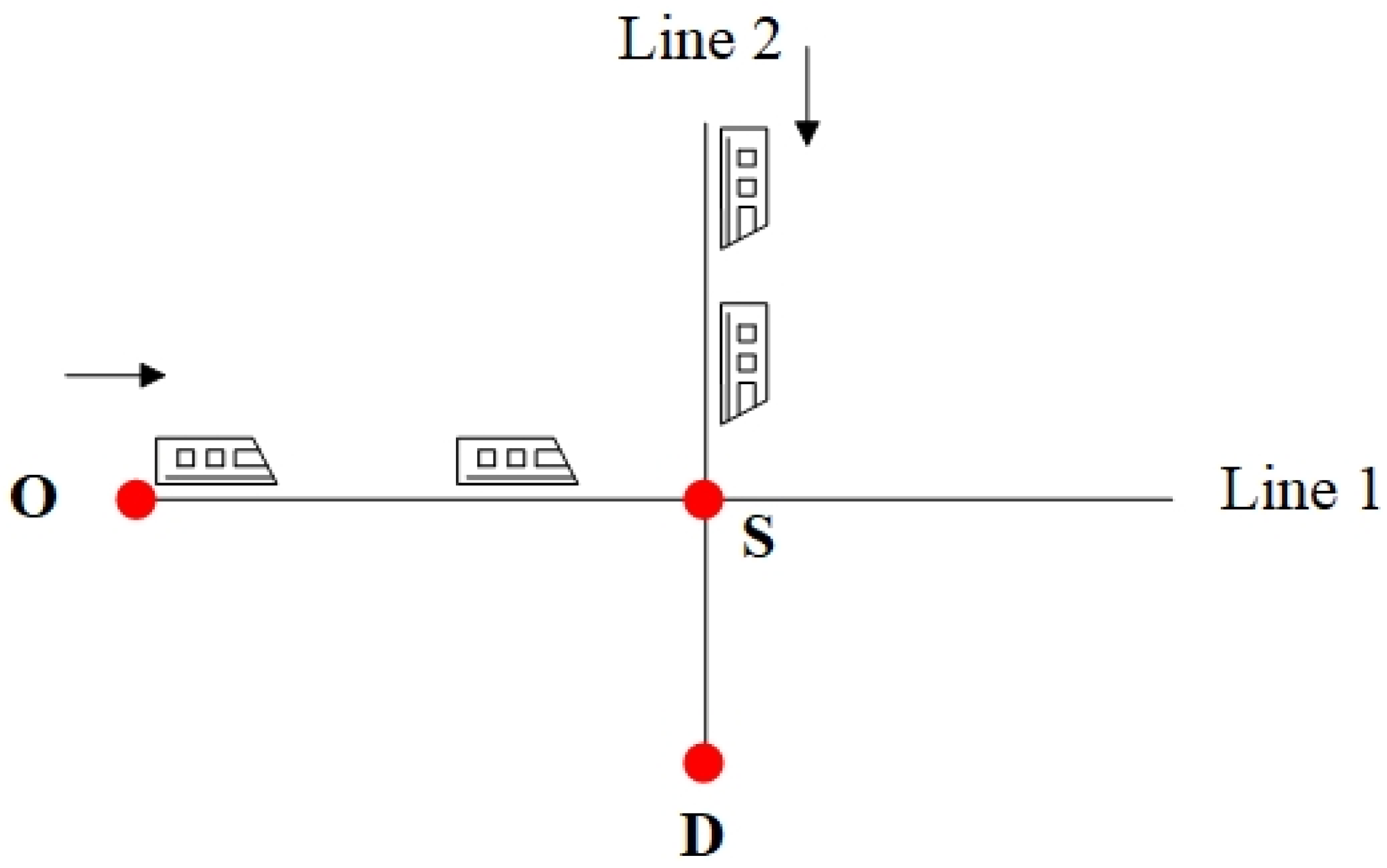
To describe the problem studied in this paper more clearly, we use a small network to show the travel process of passengers. As shown in
Figure 1, the passenger starts from Station O of Line 1 and needs to transfer at Station S to his destination, i.e., Station D of Line 2. The headways in different periods are provided in
Table 1.
According to the headways in
Table 1, the transfer waiting time of the passenger in different periods is calculated according to Algorithm A1 in
Appendix A, and the results are shown in
Table 2. Specifically, the train of Line 1 departs on time at the first station. After three minutes, it departs from Station O and then arrives at Transfer Station S seven minutes later. In the meantime, the passenger walks from the platform of Line 1 to the platform of Line 2 for five minutes and takes the first train to Station D. The passenger transfer waiting time is the departure time of the first train passenger boarding on Line 2 at Station S minus the arrival time of the passenger at the platform of Line 2. In order to simplify the calculation, the boarding time is assumed to be 0 min and the walking time in the transfer station is assumed to be 5 min.
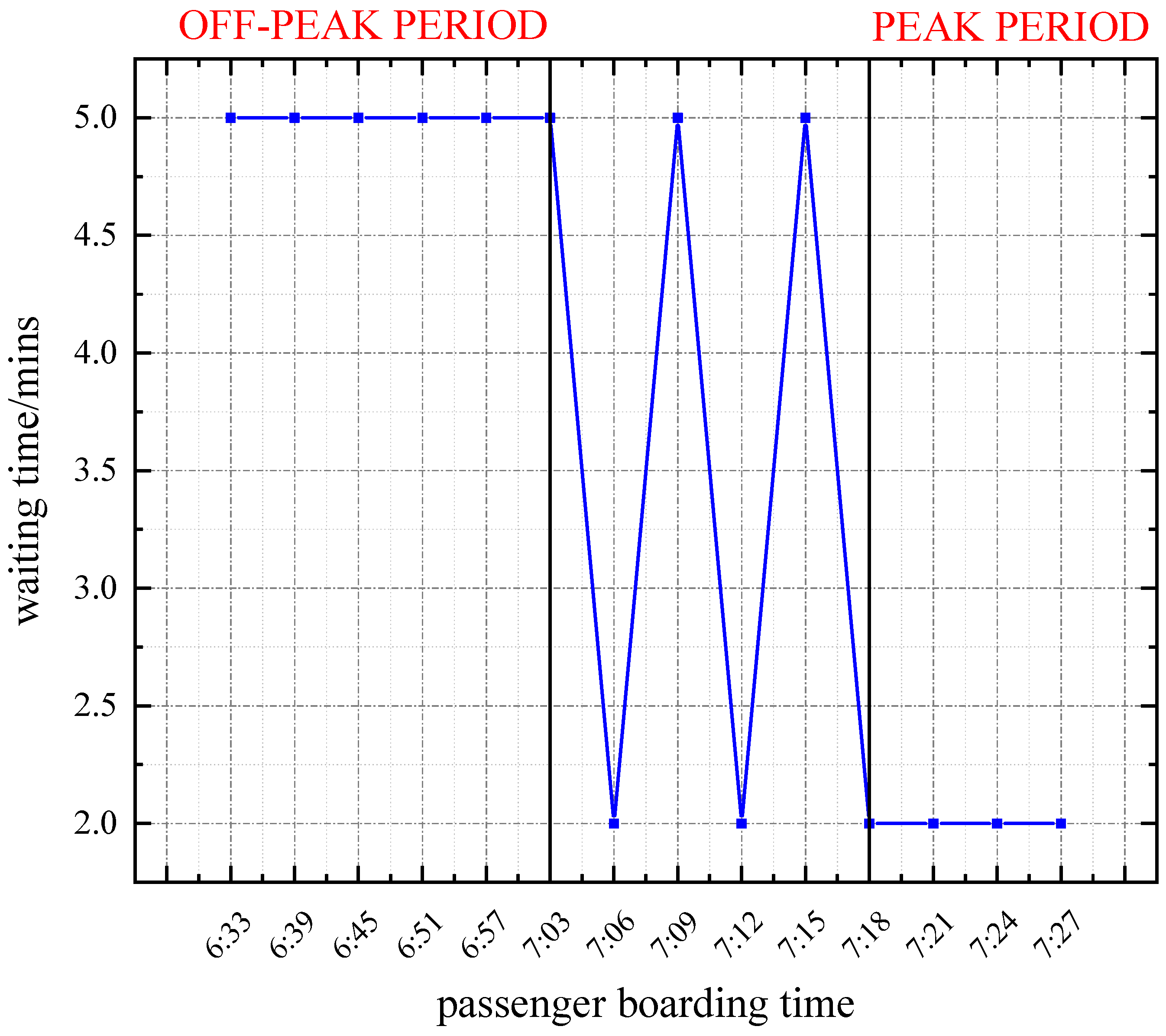
According to the passenger transfer waiting times reported in
Table 2,
Figure 2 is illustrated. It can be clearly observed that passenger transfer waiting times remain relatively stable during the off-peak and peak periods, whereas a pronounced imbalance arises during the interim period from off-peak to peak. Specifically, passengers boarding before 7:03 experience a transfer waiting time of 5 min in the off-peak period, while those boarding after 7:18 in the peak period only need to wait for 2 min. However, among passengers boarding between 7:03 and 7:18, approximately half are required to wait 3 min longer than the others.
This phenomenon indicates that, during the interim period between off-peak and peak operations, improper train connections may force some passengers to wait for an additional connecting train, thereby reducing transfer efficiency, whereas simply shortening train headways to improve connections would significantly increase operating costs. Consequently, during the interim period, neither fixed headways nor simple adjustments to the number of trains can simultaneously achieve efficient passenger transfers and reasonable operational costs. Owing to the complex network structure and the highly coupled nature of urban rail transit operations, service organization strategies during the interim period are generally required to remain consistent with those adopted in off-peak and peak periods; in practice, train services are typically organized based on existing service patterns, with fine-grained train timetable synchronization optimization of headways, running times, and dwell times implemented within the allowable operational range to gradually accommodate evolving passenger demand.
Based on the above operational characteristics, this study focuses on the coordinated organization of train departure times across different lines during the interim period, aiming to improve transfer connections through timetable synchronization. From an operational perspective, under existing service patterns and within a given service horizon, the number of trains operated during the interim period is implicitly determined by the departure schedule, while the service organization patterns of each line are preserved throughout the transition. The time-related elements illustrated in
Table 2, including departure times, headways, as well as running and dwell times along different sections, represent key and practically adjustable factors that affect passenger transfer waiting times in real-world operations. Accordingly, in the proposed model, such time-related elements are abstracted as decision variables describing train operation organization under operational constraints, in order to characterize feasible dispatching strategies during the interim period. The proposed strategy, therefore, emphasizes the temporal distribution of trains and their synchronization at transfer stations, with the objective of improving passenger transfer efficiency while ensuring operational feasibility and reasonable operating costs.
3.2. Notations
Notations used throughout this paper are listed in
Table 3, including parameters, decision variables, and intermediate variables.
3.3. Modeling Assumptions
Assumption 1. All stations in the network are divided into two parts: one is the key stations that include the transfer station, the first station, and the last station; the other is the common station. The running time of trains and the dwell time at common stations are assumed to be fixed.
Assumption 2. All passengers travel rationally and choose the path of spending the shortest time [22]. Assumption 3. Considering the small difference in passenger walking speed, the transfer walking time of each passenger in the same station is assumed to be the same [26]. Assumption 4. In the interim period, the train capacity can accommodate the demand of passenger flow [23]. Therefore, passengers will take the first available train after arriving at the boarding platform of the entry station or transfer station. Assumption 5. The train timetable is known and fixed for periods except the interim period [22]. 3.4. Objective Function
In this paper, the optimization model is constructed from two objectives: improving passenger travel efficiency and reducing operating costs for the operator, which are different from the single optimization objective in [
22]. The first objective is to minimize the value of passenger transfer waiting time, while the second is to minimize the cost of train operating.
It is worth noting that the value of transfer waiting time in the interim period is the sum of the waiting time value of all transfer passengers in the urban rail network:
The train operation cost is defined as the sum of the depreciation cost and the running-related cost of each train dispatched on the line during the interim period. Accordingly, the train operation cost can be expressed as (2) where
indicates whether train
is dispatched on Line
;
(CNY/(veh·min)) and
(CNY/(veh·km)) denote the unit depreciation cost and unit running cost, respectively;
is the scheduled operating duration obtained directly from the timetable; and
is computed as the sum of track-segment lengths actually traversed by the train within interim periods with only the in-window part counted for boundary trains.
In addition, it should be particularly noted that since the time horizon of the interim period is predefined and fixed, the running distance of a train is defined as the actual distance traveled by the train within the interim period. Accordingly, the running distance is calculated as the sum of the lengths of the track segments that are actually traversed by the train during the interim period.
For example, for trains that have already entered service before the start of the interim period or continue operating after the end of the interim period, such as the first or the last train in the interim period, only the distance traveled within the interim period is counted, while the distance traveled outside the interim period is excluded.
Based on the above analysis, the optimization function in the interim period is expressed as
3.5. Model Constraints
The constraints of the proposed optimization model are formulated to describe the operational processes of trains and the interactions between train movements and passenger transfers during the interim period. These constraints mainly include train operation constraints, departure scheduling constraints at the first stations, transfer waiting time constraints, and constraints related to the number of transfer passengers.
3.5.1. Train Operational Constraints
In the urban rail network, as shown in Equation (4), the arrival time of train
at Transfer Station
of Line
is the sum of the departure time of train
at the first station of Line
, the running time of train
of Line
from the first station to Transfer Station
and the dwell time of train
of Line
from the first station to Transfer Station
.
For the same train , the symbol denotes the train index. At Station , train may experience different operational events, including arrival, dwell, departure, and running processes. These events are distinguished by different superscripts, through which train undergoes a complete operational process.
In Equation (5), the dwell time of train
of Line
at the Transfer Station
is the departure time of train
at Station
of Line
minus the arrival time of train
of Line
at the Station
.
Since the dwell time of trains at the transfer station is variable, it should be limited for the operation of safety. In (6),
and
are the lower bound and upper bound of the dwell time of train
at Station
of Line
.
Since the running time of trains between two adjacent transfer stations is variable, it should be limited for the operation of safety. In (7),
and
are the lower bound and upper bound of the running time of train
from Transfer Station
to Transfer Station
of Line
.
In order to ensure the safety of trains’ departure and arrival, the headway of departure and arrival should be limited. (8) and (9) give the minimum value of departure and arrival headways between train and train at the same Station of Line .
It should be noted that these headway constraints do not introduce additional decision variables. Instead, they act as feasibility constraints imposed on the train timetables, where the actual headways at stations are implicitly determined by the recursively generated arrival and departure times. These times are derived from the line headways at the origin stations, together with the running times between stations and the dwell times at stations.
3.5.2. Train Departure Constraints
Since the departure time of trains at the first station is variable, it should be limited for the operation of safety. In (10),
and
are the lower bound and upper bound of the departure headway between train
and train
at the first station of Line
.
In order to ensure the trains’ departure time at the first station of each line belonging to the interim period, (11) limited the departure time range
. Afterwards, as shown in (12), a binary variable
is imported to calculate the number of trains which have been dispatched in the interim period
.
is an infinite number if, and only if
, (11) is true, i.e., and train
has been dispatched on the Line
. The operation cost of dispatched trains in the interim period in (2) will be added to the total operation cost.
3.5.3. Transfer Waiting Time Constraints
Passengers’ transfer waiting time from train
of Line
to train
of Line
at Transfer Station
depends on the arrival time of train
at Station
of Line
, the transfer walking time from Line
to Line
at Station
and the departure time of train
at Station
of Line
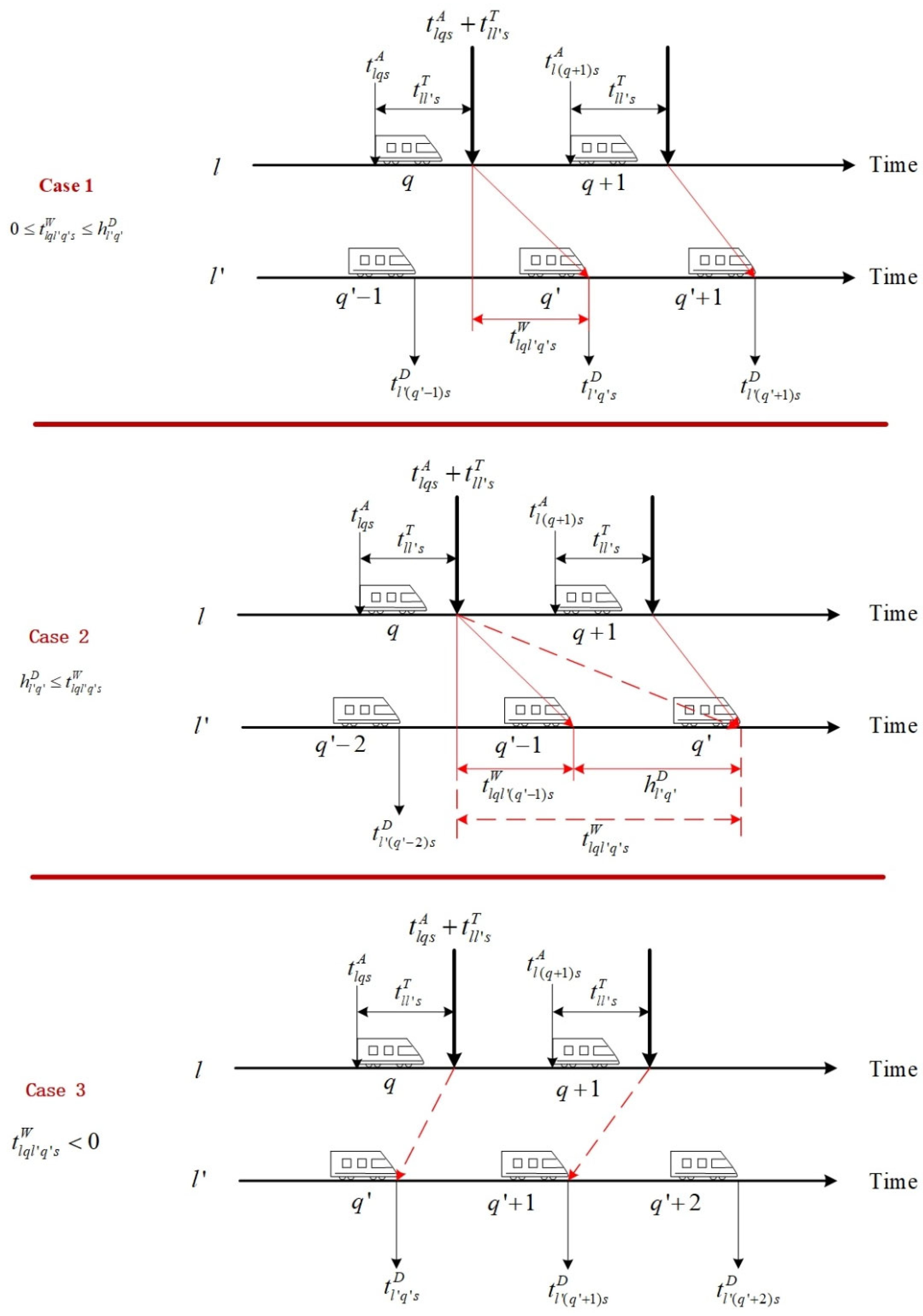
. There are three cases, as shown in
Figure 3, to describe the connection of trains when passengers transfer.
Case 1: The passengers from train of Line can transfer to train of Line successfully. In this situation, the transfer waiting time is greater than or equal to 0 and less than or equal to the departure headway between train and train at Transfer Station of Line .
Case 2: It describes the connection process of train of Line and train of Line . The transfer waiting time is greater than or equal to the departure headway between train and train at Transfer Station of Line . According to Assumption 1, all passengers take the first train to leave. Therefore, the transfer waiting time is equal to the departure time of train minus the arrival time of train and the transfer walking time, and then minus the sum of the departure headways of preceding trains.
Case 3: When the passengers from train of Line fail to transfer to train of Line , the transfer waiting time is equal to .
So, the waiting time of the passengers in Transfer Station
can be calculated by the following equation:
In order to ensure that every passenger can transfer successfully in the interim period, the transfer waiting time should be less than or equal to the maximum acceptable waiting time for passengers and more than or equal to 0, as shown in (14).
3.5.4. The Number of Transfer Passengers
According to the AFC data, the number of passengers transferring from train
of Line
to train
of Line
is obtained by the dynamic passenger assignment based on the Dijkstra algorithm. If the transfer waiting time is greater than or equal to 0 and less than or equal to the maximum acceptable waiting time, that is, the passengers from train
can transfer to train
successfully, the number of transfer passengers is all the passengers who need to transfer on the train
. Otherwise, when the transfer waiting time is greater than the maximum acceptable waiting time for passengers, the transfer fails, and the number of transfer passengers is 0.
4. Solution Algorithm
The optimization of urban rail network train timetable synchronization has been proven to be an NP-hard problem [
27]. The train timetable optimization model of the interim period proposed in this paper is aimed at train synchronization in the whole network. Moreover, the train direction is distinguished when solving, which expands the solving scale several times. Therefore, a more efficient heuristic algorithm is selected in this chapter.
The genetic algorithm (GA) and simulated annealing algorithm (SA) are widely used to solve timetable optimization problems. GA is a population-based global search heuristic used to find exact or high-quality solutions for various optimization problems. In contrast, SA is a metaheuristic optimization approach that is effective in escaping local optima and has been widely used for solving combinatorial optimization problems.
According to the characteristics of the proposed model, a hybrid algorithm, called simulated-annealing-based genetic algorithms (SA-GAs), developed by [
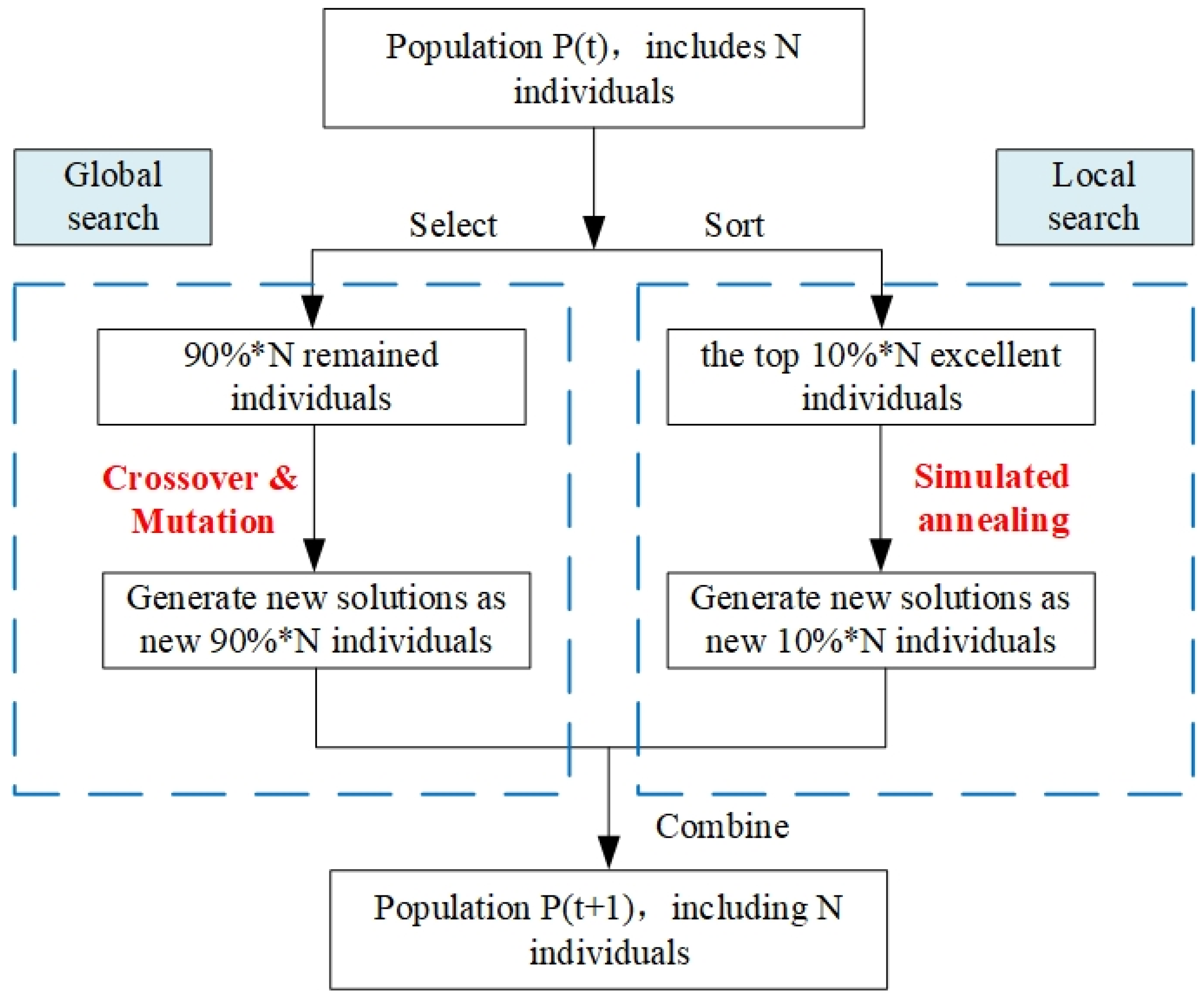
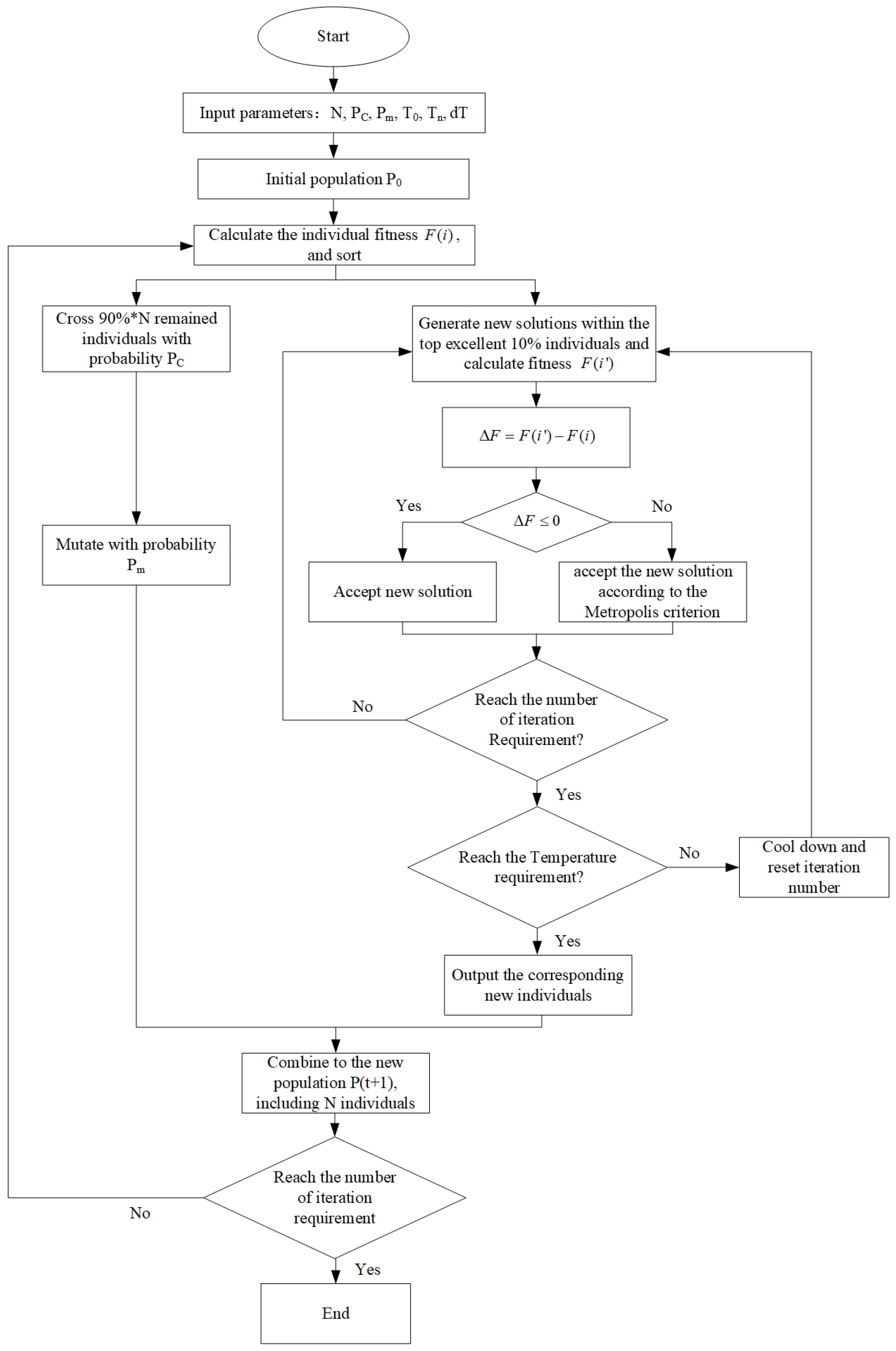
28], is designed in this paper by uniting the respective advantages of GA and SA. The structure of SA-GA is as illustrated in
Figure 4. SA is embedded into the selection operation of the outer cycle genetic algorithm as the inner cycle. Through comparative experiments in [
28], the results of GA, SA, and SA-GA are verified. It is concluded that SA-GA makes full use of the significant characteristics of GA in global search and SA in local search, and has significant advantages such as high efficiency and short processing time. In
Figure 4, the symbol “*” denotes the multiplication operator.
The specific steps are as follows.
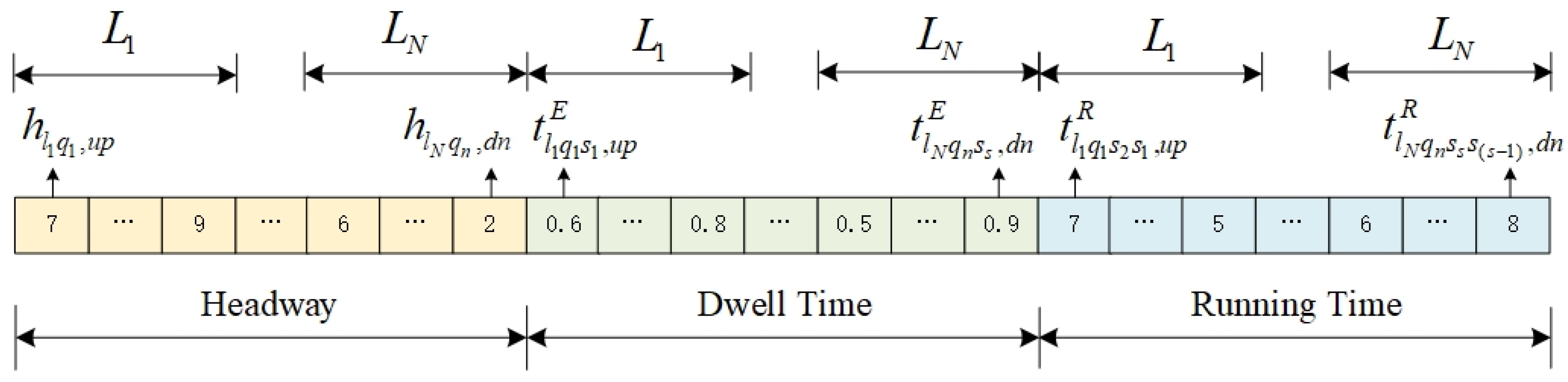
Step 1. Chromosome coding. Each chromosome can be divided into three parts, and each part is composed of the decision variables of the proposed model, respectively, train departure headway, dwell time, and running time. Due to the large number of variables and the large search space of this model in the interim period, real number coding is adopted for encoding, as shown in
Figure 5.
Step 2. Initializing the population. The model data and algorithm parameters were input. Set the number of population size N = 80 and the number of iterations n = 500, and the initial population was generated within the constraint range of each variable by random initialization.
Step 3. Calculating fitness. When calculating the fitness function of every individual in the population, this paper takes the objective function F(i) as the fitness function Fitness (i) directly. The objective function includes two parts: the passenger transfer waiting time cost and the train operating cost. The train operating cost is directly determined by the train depreciation cost and mileage within the interim period. While the transfer waiting time is calculated based on the coupling relationship between the transfer passengers’ activity time in the station and the timetable of available trains. The method of calculating transfer waiting time is as follows.
Step 3.1. Read the OD data within each time interval ΔT, ΔT = 1 min. Input the origin and destination station (OD) of each AFC data, inbound card swiping time , and timetable of the urban rail transit network. Then, build the adjacency matrix.
Step 3.2. Dijkstra’s algorithm is used to search all feasible paths traversally, and the path of the shortest travel time within the urban rail transit network is selected as the passenger’s travel path.
Step 3.3. According to the OD pair, the up or down direction of the train which passenger take after entering the urban rail transit network is obtained. Estimate , that is, whether the time of passengers’ arrival at the origin station is less than the departure time of the train in the same direction at this station. If so, this train will be taken as the available train. If not, redo Step 3.3.
Step 3.4. Read the timetable when train arrives at Transfer Station and the transfer walking time from Line l to Line at Transfer Station .
Step 3.5. According to the OD pair, the up or down direction of the train which passenger take after transfer is obtained. Estimate , that is, whether the sum of the arrival time of train q at the transfer station s and the transfer walking time is less than or equal to the departure time of the train from the destination line at the transfer station. If so, this train q′ will be taken as the available train. If not, redo Step 3.5.
Step 3.6. Read the departure time of train q′ at the transfer station s in the timetable, and calculate the transfer waiting time of this OD pair.
Step 4. Selection operation (including SA).
Step 4.1. Upon sorting the value of F(i), if the top 10% excellent individuals are selected to Step 4.2, and the remaining 90% are general individuals, cease Step 4 cycle and continue to Step 5.
Step 4.2. Set the initial temperature T0 = 3000 °C, termination temperature Tn = 0.01 °C, and temperature attenuation rate dT = 0.9.
Step 4.3. Generate new solutions and calculate F(i′).
Step 4.4. Let ; if , the new current solution is to be accepted, or accept the new solution according to the Metropolis criterion.
Step 4.5. Judge whether the current temperature reaches the termination temperature. If it meets the requirements, output the corresponding new individual and continue to Step 6; otherwise, reduce the temperature with the temperature attenuation rate and return to Step 4.3.
Step 5. Crossover and mutation operation. The crossover operation is carried out on chromosomes with crossover probability Pc = 0.45. Two crossover points are randomly set in the two paired chromosomes, and then part of the genes between the two crossover points are exchanged. The chromosomes in the population were randomly selected with mutation probability Pm = 0.05 to produce new individuals.
Step 6. Regroup. The new individual output from Step 4 and Step 5 is formed into a new generation population.
Step 7. Termination criterion. The algorithm terminates based on whether the maximum number of iterations is satisfied. If so, terminate the algorithm and output the optimal solution; Otherwise, return to Step 3.
The complete procedure of SA-GA in this paper is shown in
Figure 6. The symbol “*” denotes the multiplication operator. And the pseudocode is described as Algorithm A2 in
Appendix A.
5. Case Study
This section presents a case study based on the Nanjing urban rail transit network to demonstrate the applicability and effectiveness of the proposed timetable synchronization model during the interim period. The case study includes a description of the network and data, model parameter settings, optimization results, a comparative analysis between the original and optimized timetables, and sensitivity analysis of dynamic passenger demand.
5.1. Overview of Nanjing Rail Transit Network
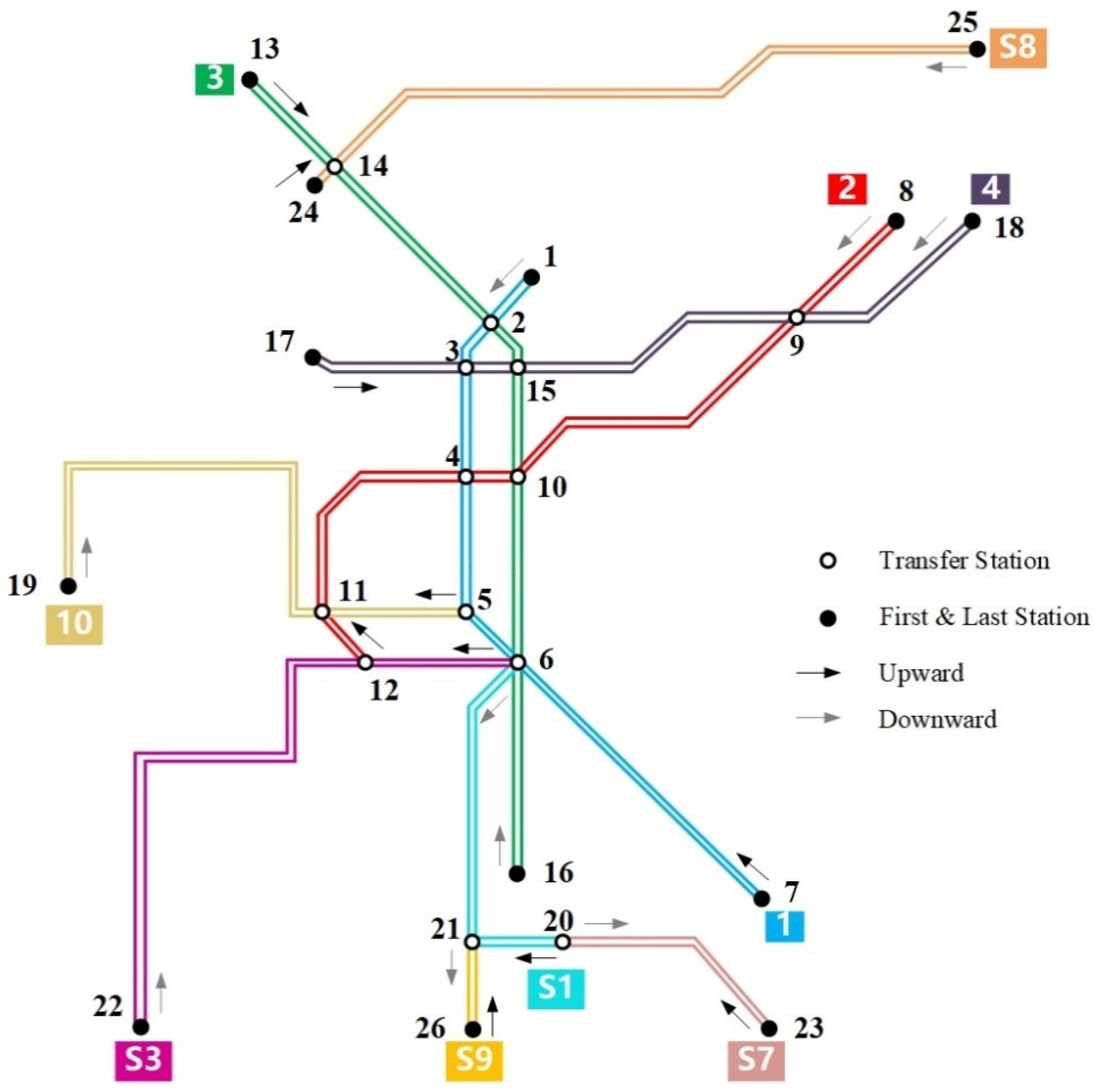
This paper makes a case study of the Nanjing urban rail network. The data source is the subway AFC data in the Nanjing urban rail network. Nanjing rail network consists of 10 lines, including 159 stations, among which there are 13 transfer stations. There are five central urban lines: Lines 1, 2, 3, 4, and 10. There are also five suburban lines distributed outside downtown: Lines S1, S3, S7, S8, and S9. The optimization model proposed in this paper merges the common stations into an interval between key stations, and only 13 transfer stations and 13 first and last stations are retained, with a total of 26 key stations. The simplified rail network topology diagram is shown in
Figure 7.
5.2. Basic Data and Model Parameters
The data of timetable and the running distance of the Nanjing rail network are all from the Nanjing rail network. The departure headway of trains in the peak period is set as 3 min, and that of trains in the off-peak period is set as 6 min. According to the passenger flow characteristics and operation requirements of the interim period, the upper and lower limits of dwell time at the transfer station are set as 60 s and 30 s. The departure headway is set between the peak and off-peak periods, which is [2, 7] mins. The value of passenger time is 5 CNY/(min·person) (According to the average salary of Nanjing, the value is 0.63 CNY/(min·person). In order to weigh the dimension of the time cost and the train operation cost, the value of passenger time is expanded approximately eight-fold. The depreciation cost of the train is 6 CNY/(veh·min), and the running cost of the train is 0.04 CNY/(veh·m) [
29].
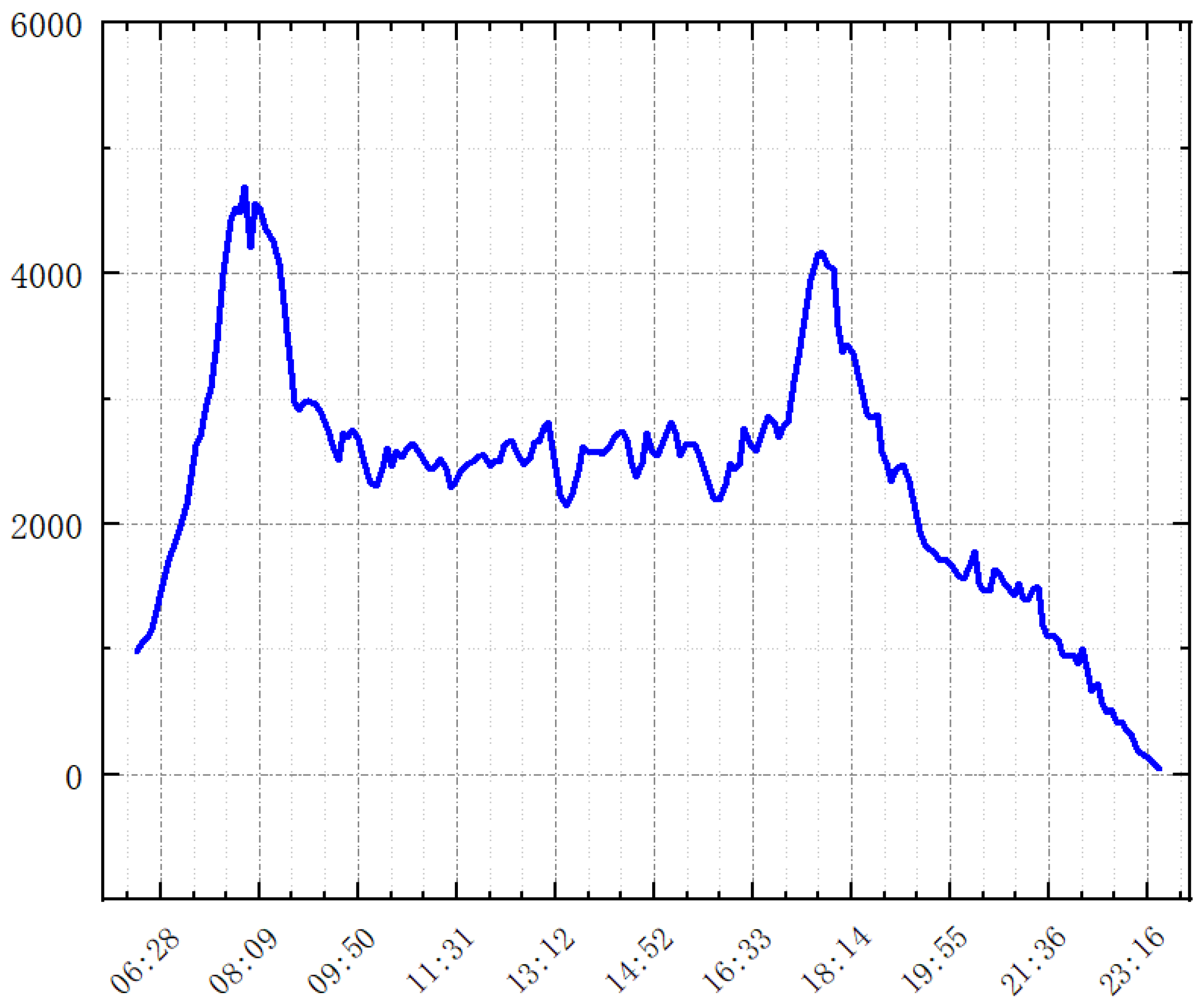
According to the statistics of the AFC data of the passenger flow in a whole day, as shown in
Figure 8, the morning peak period is concentrated at 7:00–9:00, the evening peak period is concentrated at 16:30–18:30, and the interim period of this study is set at 6:30–7:30.
From the perspective of passenger flow,
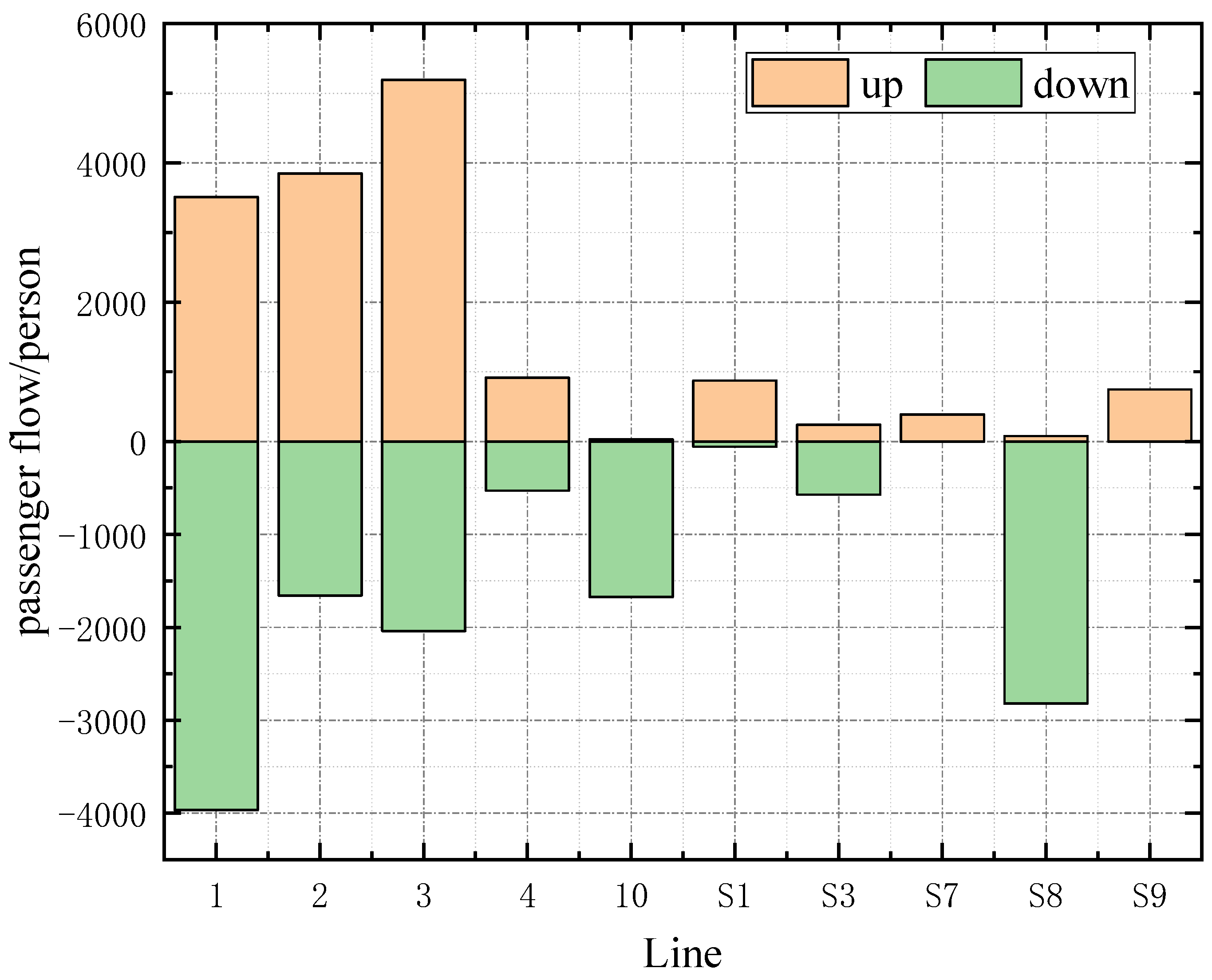
Figure 9 shows the inbound passenger flow statistics of Nanjing urban rail network AFC data from 6:30 to 7:30. The passenger flow of central urban lines, especially Lines 1, 2, and 3, is significantly greater than that of suburban lines. Line 10 is more remote than other central urban lines and has few upwardly passenger flow. As for the suburban lines, Line S8 connects the other side of the Yangtze River with relatively high passenger flow. However, due to the remote location of Line S7 and S9, the passenger flow is small and no passenger takes the downward direction train between 6:30 and 7:30.
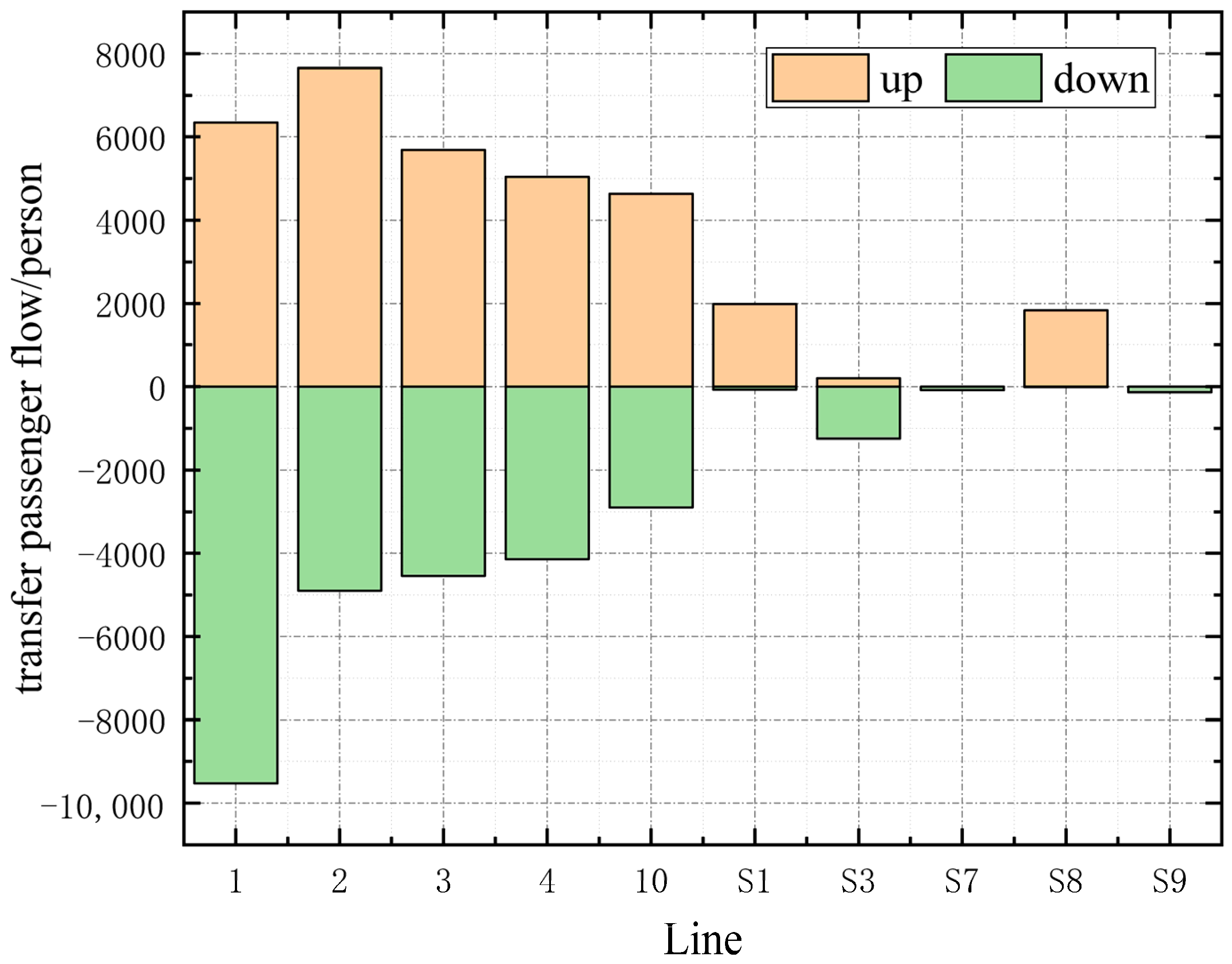
Figure 10 shows the statistics of transfer passenger flow from 6:30 to 7:30. It can be seen that the transfer passenger flow of central urban lines is significantly greater than that of suburban line, and more passengers transfer to Line 1 and Line 3 in the upward direction. Among the suburban lines, there are more transfer passengers on Lines S1 and S8. The destination of most passengers who transfer to Line S1 is the airport, while the passengers going to Line S8 mainly go across the Yangtze River, so the transfer passenger flow of these two lines is also large. The transfer station of the Line S7 and S9 is the first station, so passengers who transfer to these two lines can only go in the downward direction.
5.3. Optimization Result Analysis
The optimization results obtained from the proposed model are analyzed from multiple aspects. These aspects include algorithm convergence behavior, changes in train dispatching schemes, passenger transfer waiting time performance, train connection characteristics, and overall optimization effects during the interim period.
5.3.1. Algorithm Convergence and Solution Stability
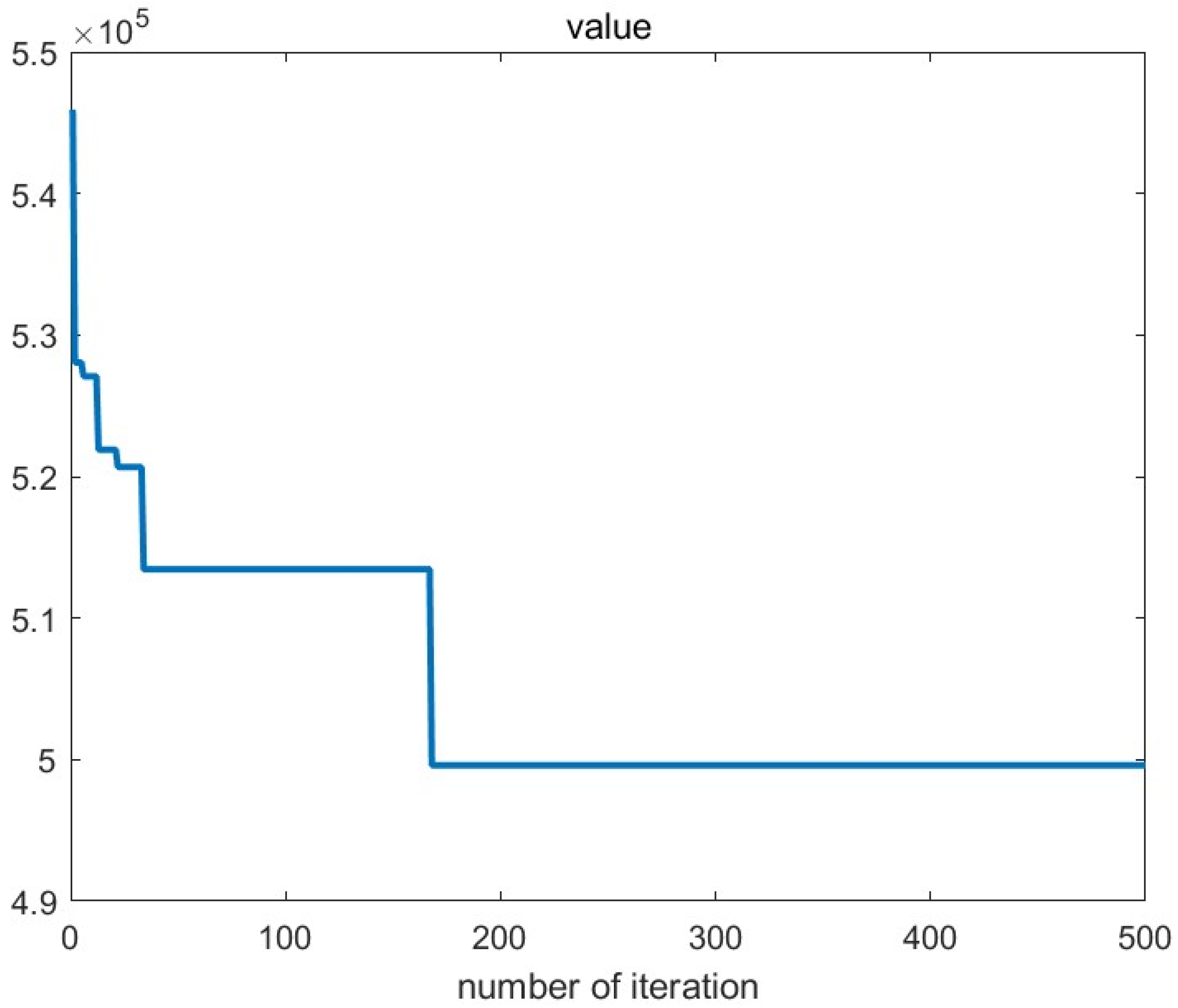
In this subsection, the comparison results are analyzed. Through MATLAB programming (R2018a), experimental result shows that the SA-GA hybrid heuristic algorithm can effectively solve the optimal solution of the model, as shown in
Figure 11. The algorithm begins to converge in generation 168.
5.3.2. The Total Number of Dispatched Trains
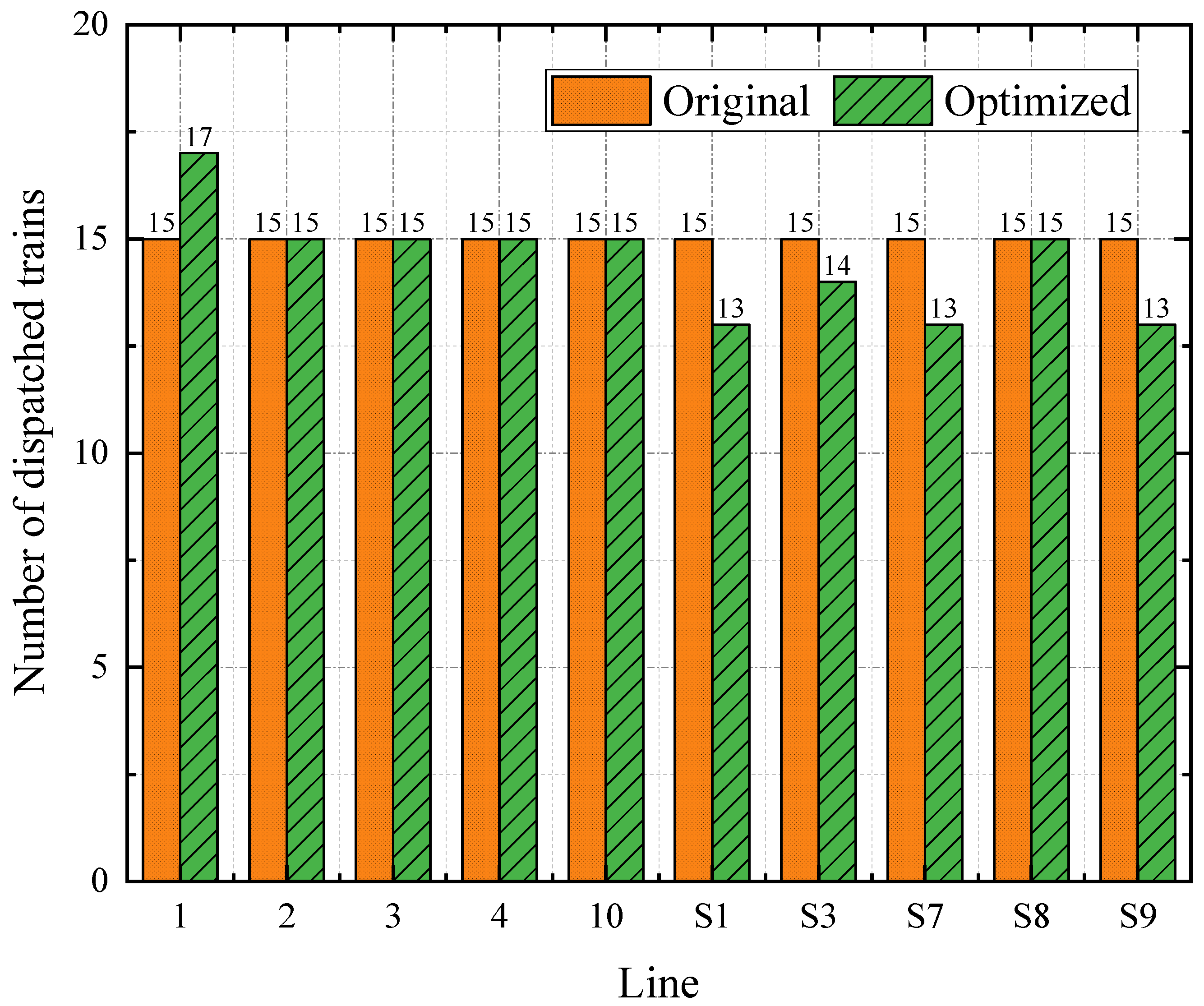
Figure 12 and
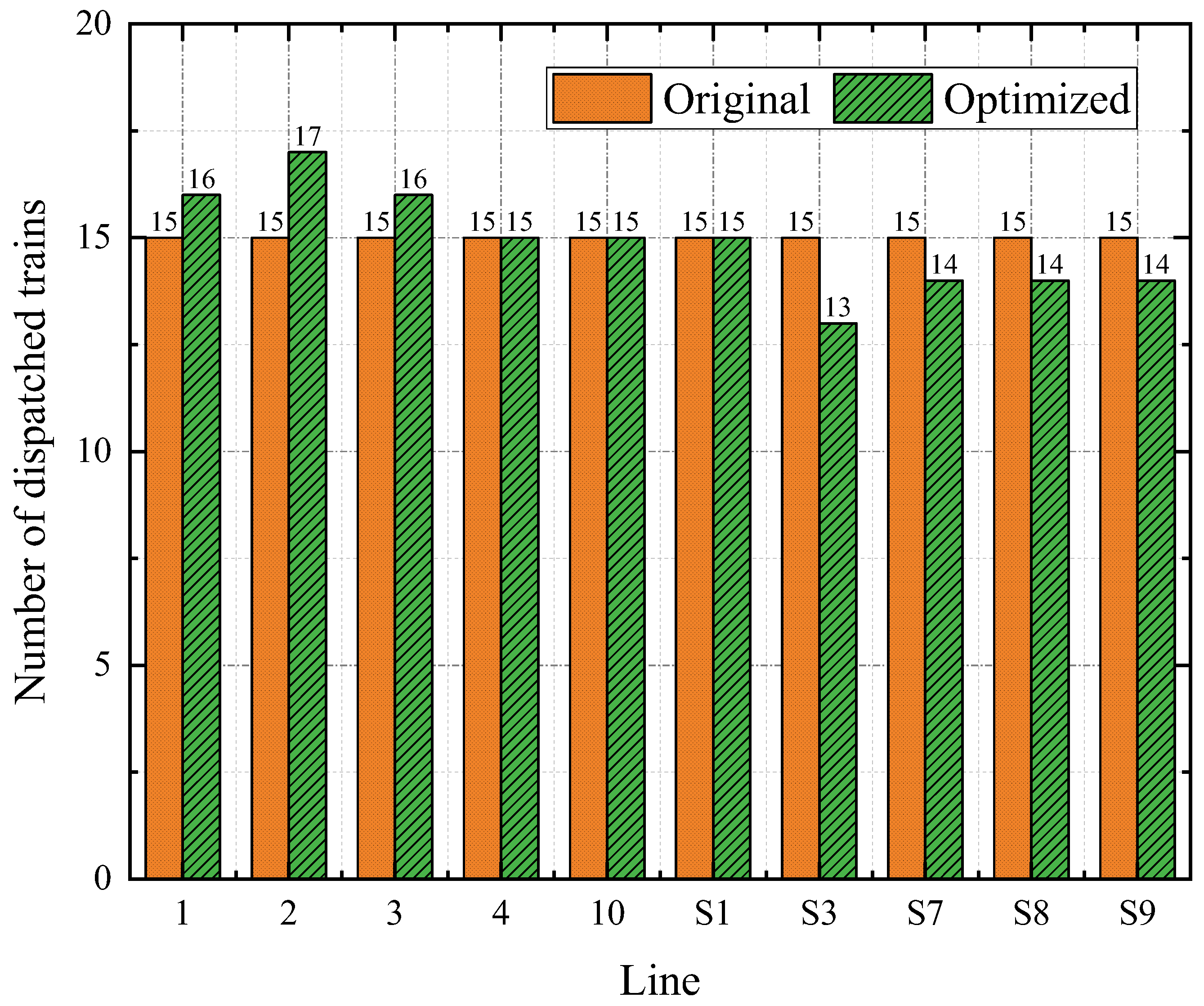
Figure 13 demonstrate the total number of dispatched trains on each line in the upward and downward direction, respectively. The total number of trains in the upward direction is reduced by one, while that in the downward direction is reduced by five. As for the central urban lines, the number of trains in both upward and downward directions is increased, such as Lines 1, 2, and 3, and that of Lines 4 and 10 remains unchanged in both directions, mainly because the passenger flow of Lines 1, 2, and 3 is significantly large, as the characteristics of passenger flow shown in
Figure 9 and
Figure 10. By contrast, most of the lines reduced are suburban lines, for instance, Line S3, S7, and S9 in both directions, and these were reduced by a total of 12 trains. Line S1 upward and S8 downward stayed the same. In the face of a huge number of commuters, central urban lines increase the number of trains to meet the needs of transfer passengers. The suburban lines reduce the number of trains to balance the cost of train operation.
5.3.3. Average Transfer Waiting Time
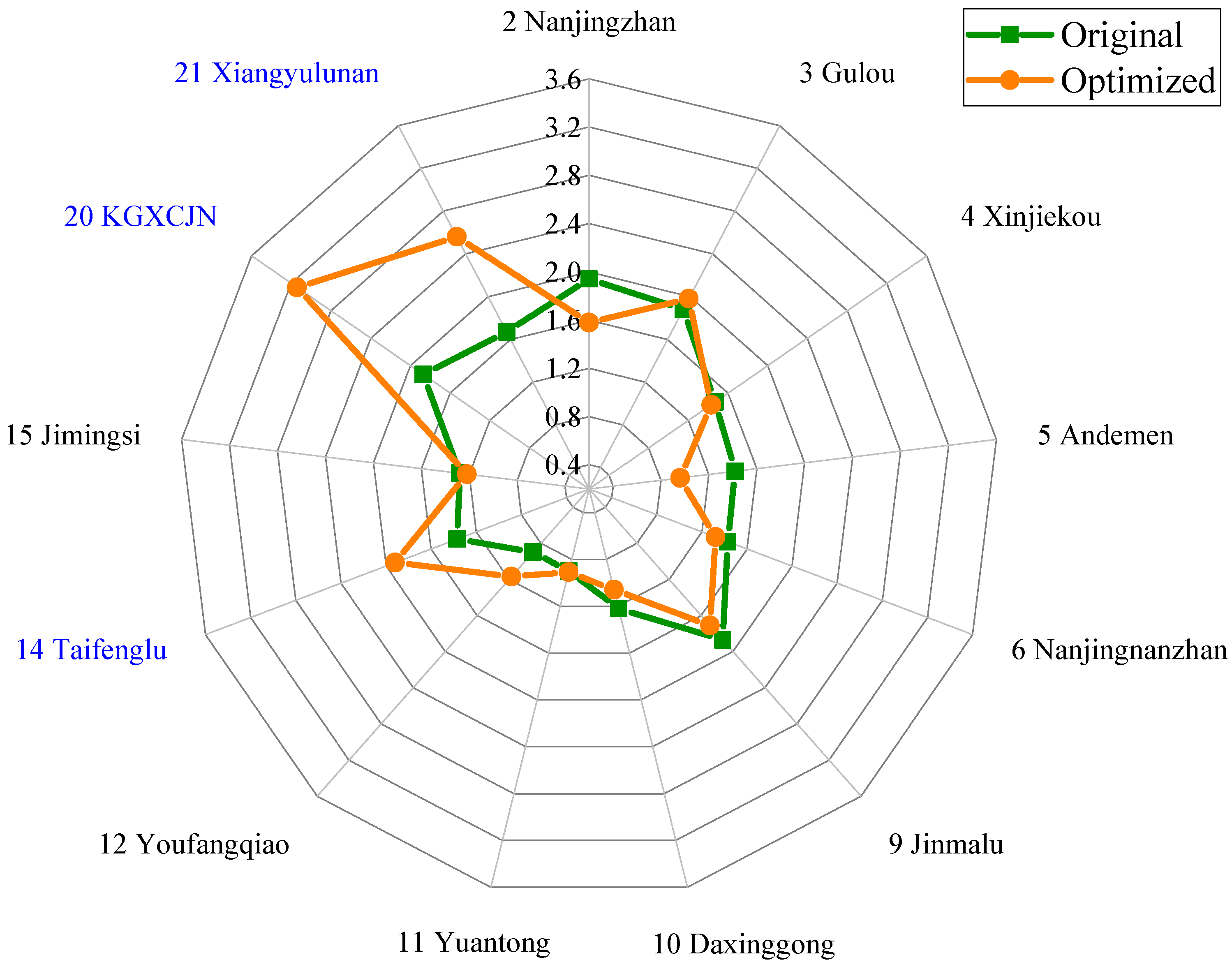
Figure 14 shows the optimization comparison of passengers’ average transfer waiting time at each transfer station. There are three stations marked blue from suburban lines, which are No. 14, No. 20, and No. 21. The average transfer waiting time is below 2 min at most transfer stations on the central urban lines, while that from suburban lines is over 2 min. The average waiting time increases at suburban line transfer stations because of the reduction in the number of dispatched trains, resulting in a longer departure headway. Moreover, by comparing the stations from central urban lines, the average transfer waiting time at Station No. 12 increases more obviously, going from 0.9 min to 1.17 min, because No. 12 is a transfer station for both the central urban line and suburban lines. The longer headway of the suburban line will also influence this kind of transfer station.
5.3.4. Train Connection
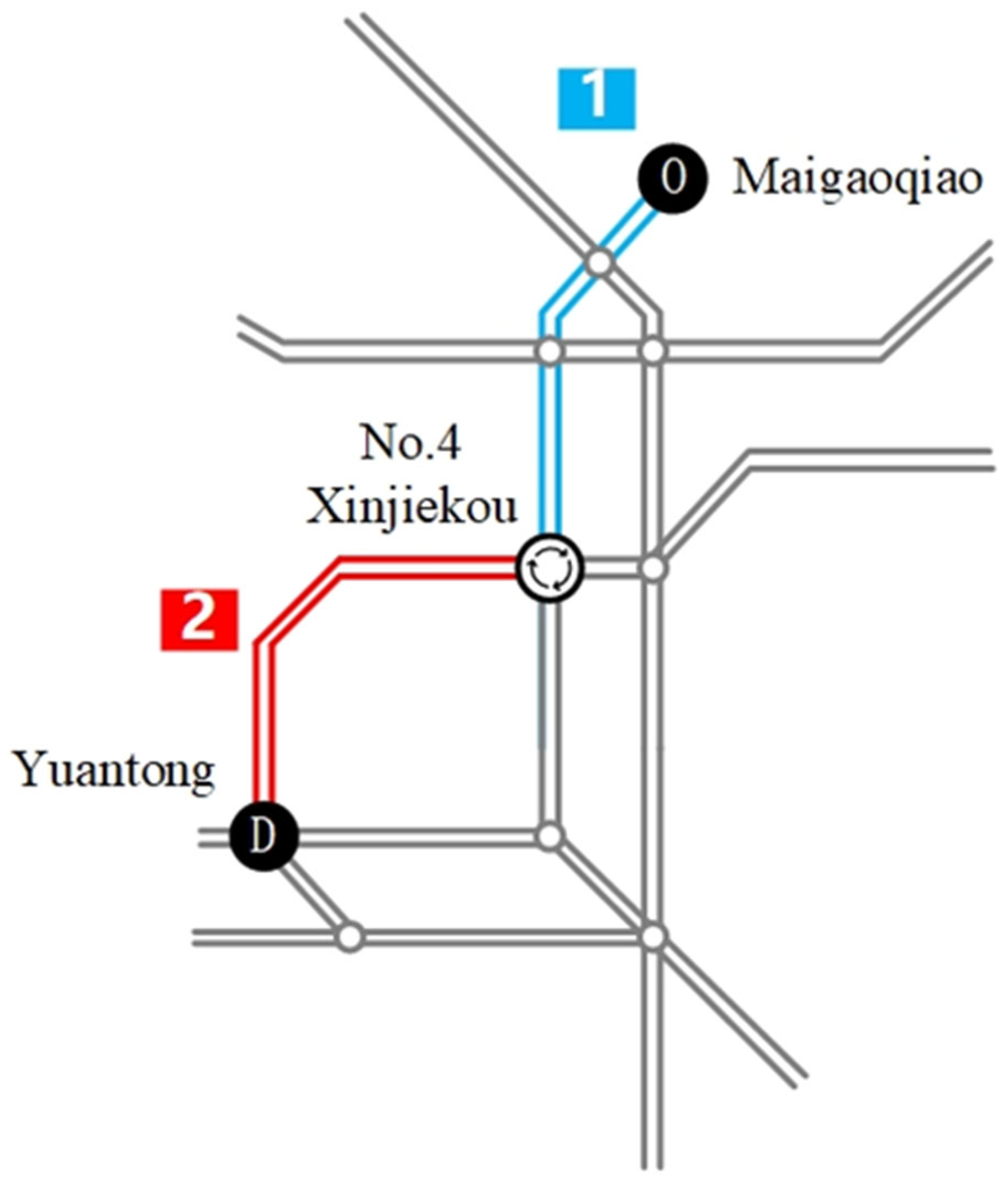
According to the AFC data of Nanjing rail transit network, the OD pair Maigaoqiao-Yuantong with the largest number of trips is selected for analysis, and the travel path between Maigaoqiao and Yuantong is shown in
Figure 15. In this kind of OD pair, the travel process of each passenger can be expressed by the following: the departure time of Line 1 train at Maigaoqiao, the arrival time of Line 1 train at the transfer station No. 4 Xinjiekou, the transfer walking time at Xinjiekou, the transfer waiting time, the arrival time of Line 2 train at the transfer station, and the arrival time of Line 2 train at Yuantong.
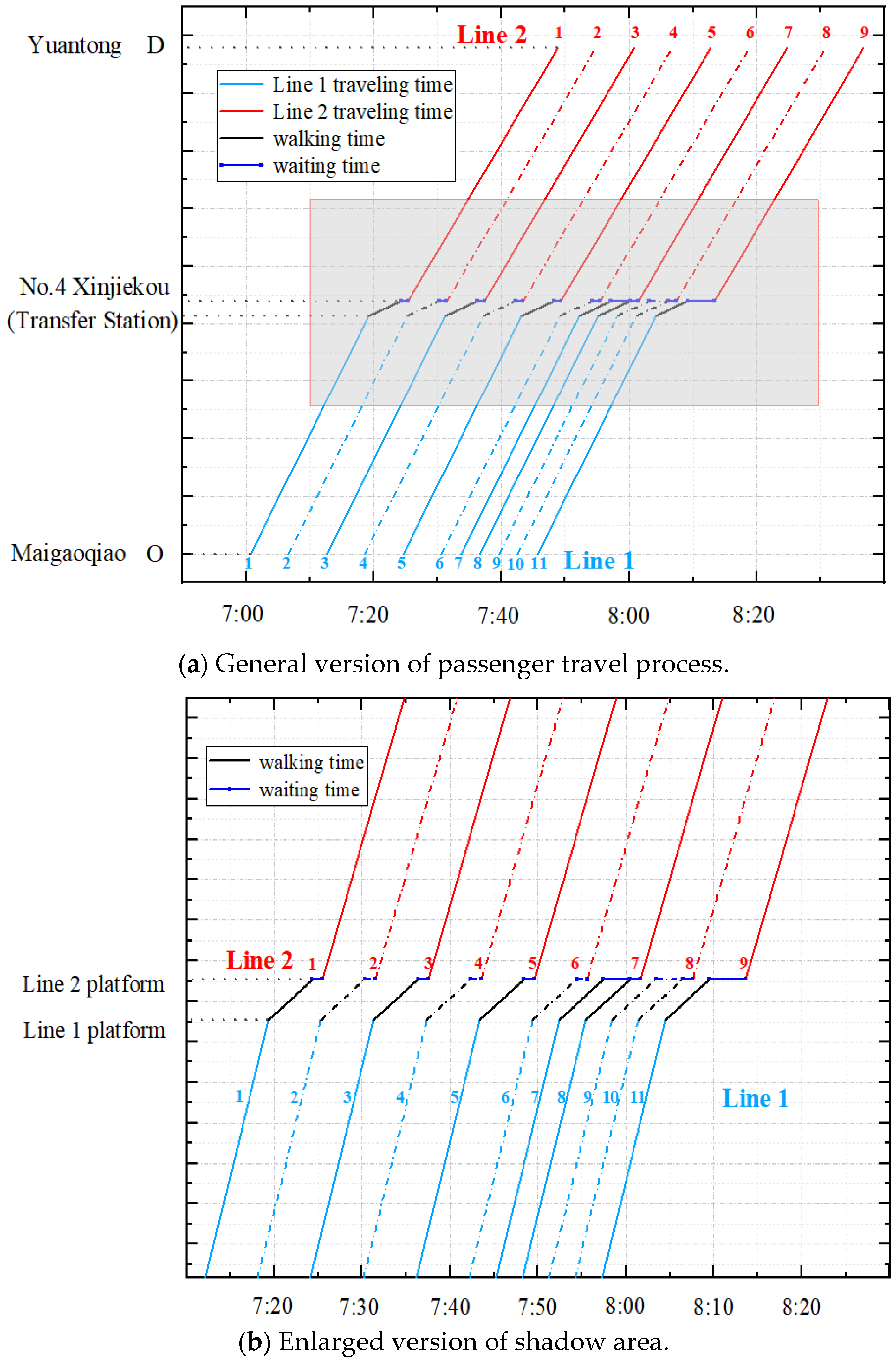
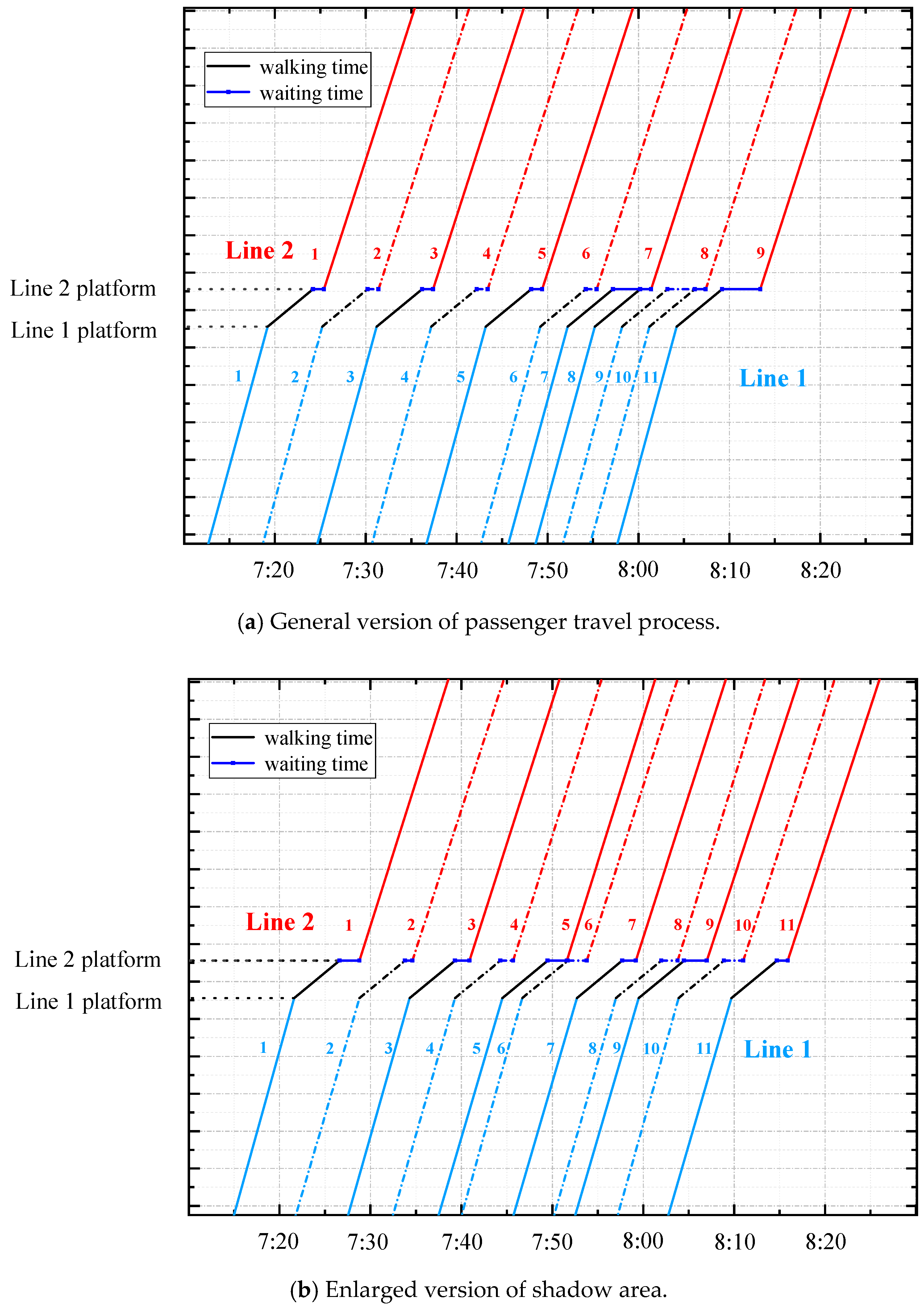
Figure 16a shows the travel process of passengers within the original timetable from Maigaoqiao of Line 1 to Yuantong of Line 2. And
Figure 16b is the enlarged version of the shadow area in
Figure 16a, so as to describe the train connection distinctly. The horizontal axis represents time, and the vertical axis represents the travel distance. In
Figure 16a,b, the blue lines represent trains of Line 1, and the red lines represent trains of Line 2, consistent with the actual color scheme used in the Nanjing rail transit system.To avoid overlapping trajectories, different train connection processes during the interim period are illustrated using alternating solid and dotted lines in the timetable; the dotted lines are solely for visual distinction and carry no additional operational meaning.
Before the peak period, the connecting trains of Line 1 and Line 2 can correspond one by one to achieve a good connection. Since 7:30 am, the departure headway of trains on Line 1 has been shortened. As the first station of Line 1, the departure time of trains will be adjusted first. At this time, the departure headway of trains on Line 2 is still in the off-peak period. Therefore,
Figure 16b clearly shows that trains 7 and 8 of Line 1 will connect with train 7 of Line 2, also train 9 and 10 of Line 1 will connect with train 8 of Line 2. For the transfer passengers on Line 1, passengers on train 7 have to wait one more departure headway than those on train 8. The connection of trains 9 and 10 of Line 1 to train 8 of Line 2 is in a similar way. Therefore, the connections of train 7 and train 9 on Line 1 to trains on Line 2 are failing.
The passenger travel process within the optimized timetable is shown in
Figure 17, where the graphical representation follows the same conventions as in
Figure 16. Every train of Line 1 taken by passengers after entering the station is connected with only one train on Line 2 by coordinating the headway, running time, and dwell time. There is no case where passengers need to wait for an extra departure headway to transfer, as shown in
Figure 17b. After the optimization, the departure frequency of trains on Line 2 increased according to the transfer demand of passengers. But the headway of 2 lines is more coordinated, so that the connections of trains on different lines are also more coordinated. Compared with the original, the number of successful connections has increased from 9 to 11.
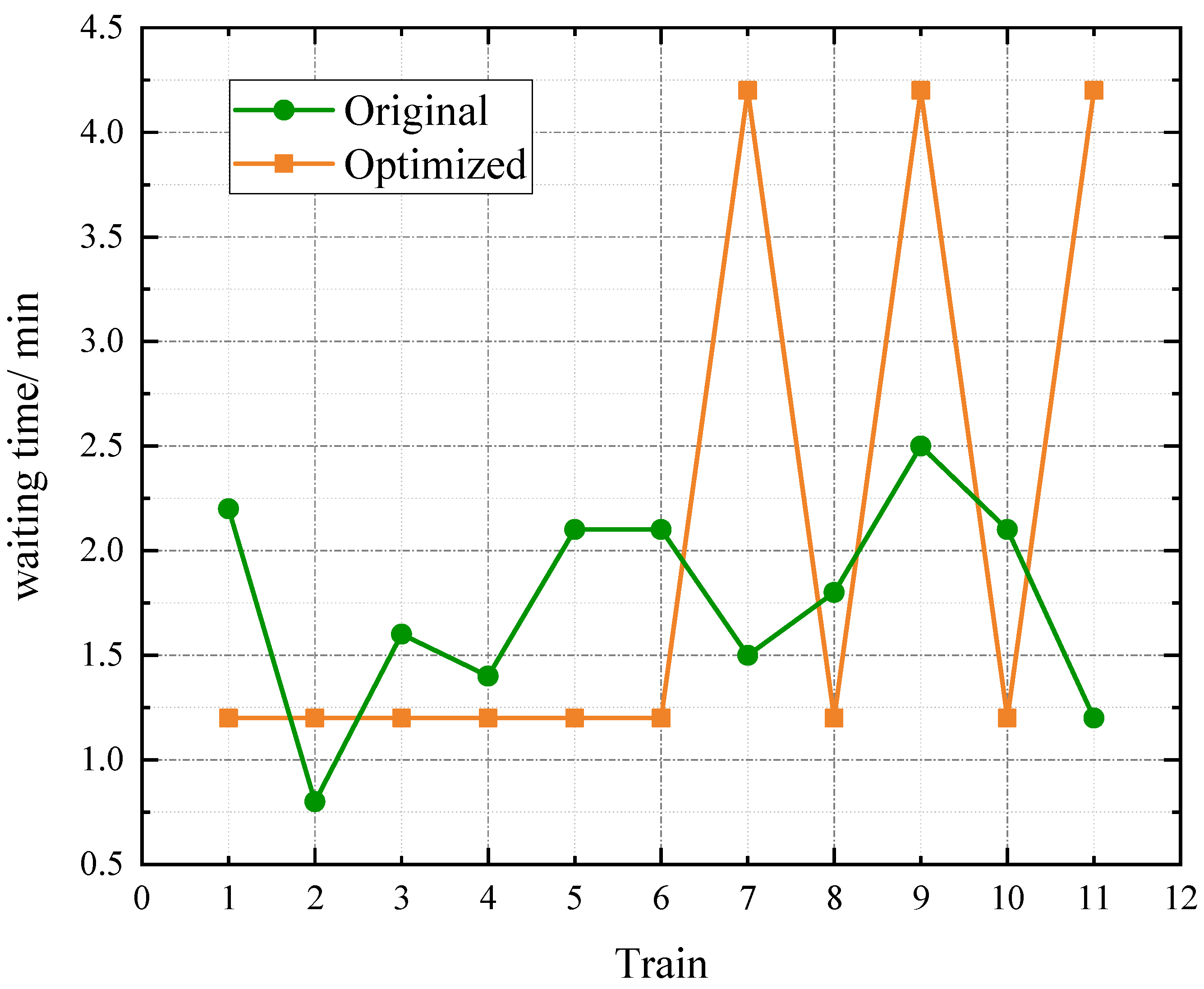
The comparison of the transfer waiting time of passengers on Line 1 at No. 4 Xinjiekou is shown in
Figure 18. After optimization, the total transfer waiting time of passengers from different trains is more average than that in the original timetable. In No. 4 Xinjiekou, the original average transfer waiting time is 2.42 min. Meanwhile, after optimization, it is reduced to 1.86 min, decreasing by 23.14%.
5.3.5. Overall Optimization Effects Comparison
Based on the above analyses of train dispatching patterns and passenger transfer waiting performance, the proposed optimization does not aim to uniformly minimize transfer waiting time at all stations. Instead, it seeks to achieve a balanced trade-off between passenger transfer service quality and operational efficiency during the interim period. As shown in
Figure 12 and
Figure 13, the optimization primarily reduces the number of dispatched trains on suburban lines with relatively lower passenger demand, while maintaining or slightly increasing service frequencies on core urban lines where transfer demand is concentrated. This strategy leads to a significant reduction in operational cost, which constitutes the major contribution to the overall cost savings, as summarized in
Table 4.
At the same time, the reduction in train frequency on certain suburban lines inevitably results in longer headways, causing localized increases in average transfer waiting time at some transfer stations, particularly those connecting urban and suburban lines, as observed in
Figure 18. Such increases represent an acceptable consequence of the dispatching adjustment, rather than a deficiency of the optimization model. From a system-level perspective, the coordinated adjustment of departure times, headways, and dwell times improves timetable synchronization for high-demand transfer flows, as illustrated by the case study in
Figure 16 to
Figure 17, thereby reducing the overall passenger transfer waiting time cost.
Table 1 quantitatively summarizes the overall optimization effects of the above trade-off. After optimization, both the passenger transfer waiting time cost and train operation cost are reduced, although with notably different magnitudes. Specifically, the reduction in transfer waiting time cost remains relatively moderate, whereas the operational cost exhibits a much larger decrease. This asymmetric improvement indicates that the proposed model prioritizes operational efficiency gains while maintaining an acceptable level of passenger transfer service performance, rather than pursuing the uniform minimization of transfer waiting time.
5.4. Sensitivity Analysis of Dynamic Passenger Demand
In reality, operational strategies are usually planned based on historical AFC data, but passengers’ transfer demand is dynamic, so the proposed model needs to have the ability to handle passenger demand fluctuations.
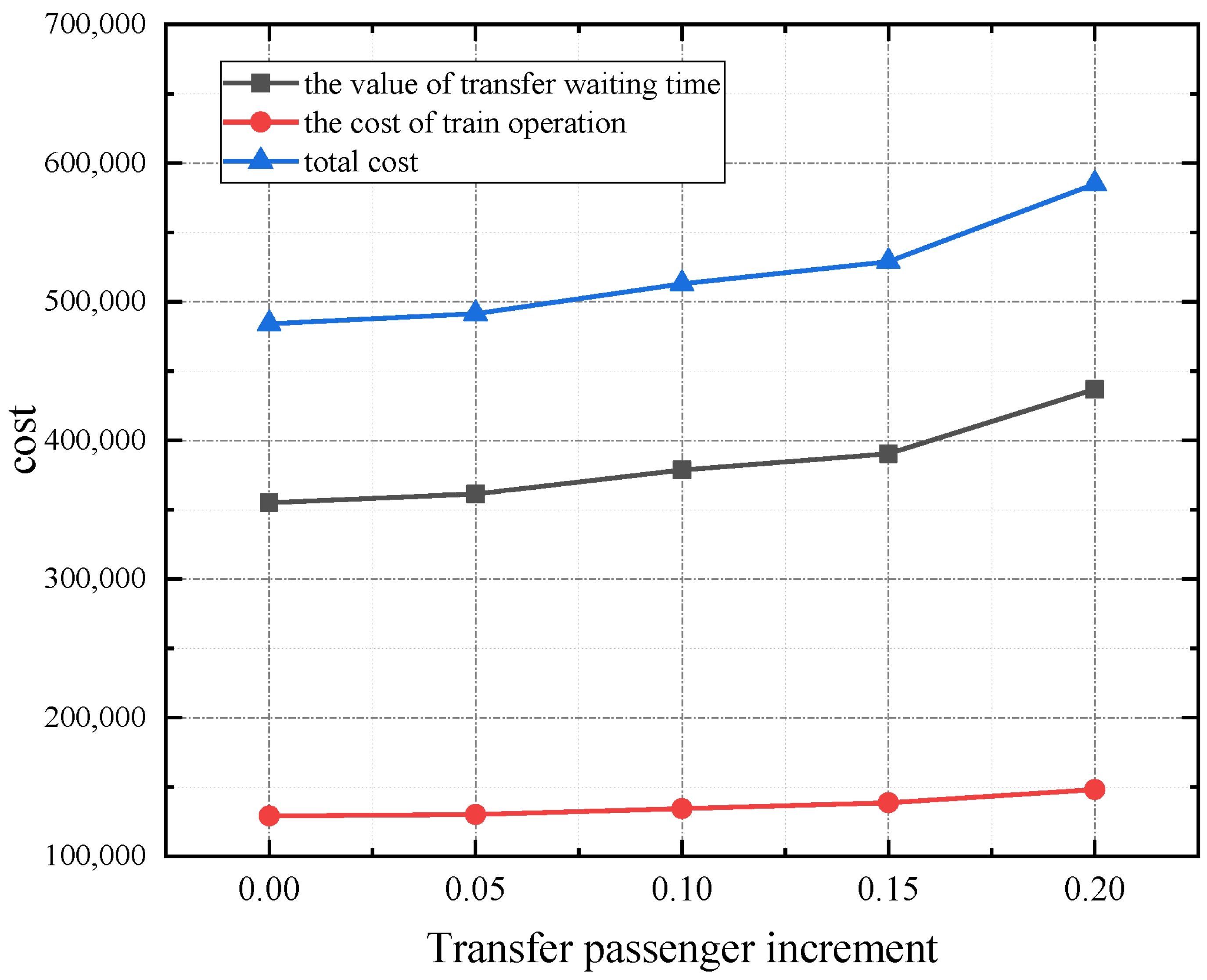
In order to set up cases with different transfer demands, this paper introduced the passenger transfer rate parameter, that is, the average transfer rate of passengers in the urban rail transit network. According to the historical AFC data of the Nanjing rail network, the general fluctuation range of the passenger transfer rate of the whole network in the interim period is no more than 0.11 person/s. When the passenger transfer rate fluctuation is less than or equal to 0.11 person/s, if the optimization result can remain stable, it means the proposed model is stable. Therefore, we increased the passenger transfer rate by 0, 0.05, 0.1, 0.15, and 0.2 person/s, respectively, and repeated the calculation 10 times to obtain the average value. The optimization results of different transfer rate increments are shown in
Figure 19.
With the increase in passenger transfer rate, the results of the proposed model increase. When the transfer passenger rate increases to 0.2 person/s, the values of the three observed indicators increased significantly. The above results show that the Nanjing rail transit network can maintain stable operation when the transfer rate increment reaches 0.11 person/s. Therefore, the model can maintain good stability in the face of dynamic passenger demands.
6. Conclusions
This study focuses on timetable synchronization during the interim period between off-peak and peak operations, when headways are being adjusted, and when transfer opportunities across lines become easily mismatched. Using AFC data, we associate transfer flows with feasible connecting train pairs and evaluate transfer waiting time by matching passengers’ platform arrival times with the departures of candidate connecting trains. On this basis, we formulate a mixed integer nonlinear optimization model that jointly adjusts line origin headways, dwell times at transfer stations, running times between key stations, and train dispatch decisions under operational and safety constraints.
A case study on the Nanjing urban rail network for the interim period from 6:30 to 7:30 demonstrates the effectiveness of the proposed approach. Compared with the original timetable, the optimized plan reduces the total cost by 6.88%, including a 3.77% reduction in transfer waiting time cost and a 14.49% reduction in train operating cost. The sensitivity analysis further indicates that the solution remains stable under typical fluctuations of transfer demand observed in the AFC data.
The proposed framework is expected to be applicable to other urban rail networks that operate multiple lines with transfer stations and need to coordinate services during periods of changing headways. To apply the approach to another city, the required inputs include the planned timetable, running information between key stations, transfer walking times, and AFC-based demand during the target interim period. The cost coefficients can be calibrated according to local operational accounting practices, while the overall modeling and solution procedure remains unchanged. Therefore, the proposed method can serve as a practical decision support tool for balancing transfer service performance and operating efficiency during interim period operations.
Several directions deserve further investigation. First, passenger route choice can be extended beyond the shortest path assumption to better capture heterogeneous preferences and multiple feasible transfer paths in large networks. Second, the passenger flow characteristics of different types of interim periods, such as peak-to-off-peak and off-peak-to-peak transitions, can be analyzed separately to support more targeted operational strategies. Third, the transfer waiting time evaluation can be further refined and accelerated to improve scalability and data processing capability in larger networks.