Long-Term Field Efficacy of Entomopathogenic Fungi Against Tetranychus urticae: Host Plant- and Stage-Specific Responses

 ,
, 
 ,
,  and
and
Abstract
1. Introduction
2. Materials and Methods
2.1. Experimental Design
2.2. Biopesticides
2.3. Field Control Experiments with Mites and Fungus
2.4. Data Analysis
3. Results
4. Discussion
5. Conclusions
Author Contributions
Funding
Institutional Review Board Statement
Informed Consent Statement
Data Availability Statement
Conflicts of Interest
Appendix A

| Treatment | Dose (mL/100 L) | Larval Population Density (Mites/Sampling Unit) at Selected Days After Treatment (DAT) | ||||||||
|---|---|---|---|---|---|---|---|---|---|---|
| 0 | 7 | 14 | 21 | 28 | 56 | 84 | 102 | 140 | ||
| Velifer | 100 | >10 | 19.4 ± 2.1 a | 24.4 ± 2.9 a | 38.3 ± 1.1 a | 46.6 ± 2.7 a | 20.0 ± 7.7 a | 29.6 ± 3.6 a | 25.6 ± 1.3 a | 24.2 ± 2.8 a |
| Metab | 100 | 20.0 ± 4.3 a | 28.8 ± 3.4 a | 49.1 ± 2.2 b | 53.3 ± 1.8 a | 78.3 ± 4.3 b | 60.0 ± 2.9 b | 24.4 ± 3.5 a | 34.1 ± 2.5 a | |
| Botanigard | 100 | 22.8 ± 4.6 a | 23.4 ± 3.9 a | 45.4 ± 2.9 b | 53.3 ± 2.1 a | 22.8 ± 2.5 a | 24.4 ± 1.6 a | 23.1 ± 2.9 a | 25.9 ± 1.2 a | |
| Valmec (Positive Control) | 50 | 16.4 ± 5.1 a | 20.0 ± 1.8 a | 26.6 ± 3.2 c | 47.6 ± 3.4 a | 39.3 ± 1.5 c | 35.4 ± 2.5 c | 13.8 ± 1.9 a | 21.4 ± 2.9 a | |
| dd H2O (Negative Control) | - | 43.8 ± 2.7 b | 117.4 ± 23.6 c | 151.2 ± 12.9 d | 186.3 ± 9.5 b | 156.6 ± 12.4 d | 93.9 ± 13.1 d | 219.1 ± 20.8 b | 202.8 ± 32.2 b | |
| Treatment | Dose (mL/100 L) | Protonymphs Population Density (Mites/Sampling Unit) at Selected Days After Treatment (DAT) | ||||||||
|---|---|---|---|---|---|---|---|---|---|---|
| 0 | 7 | 14 | 21 | 28 | 56 | 84 | 102 | 140 | ||
| Velifer | 100 | >10 | 11.1 ± 1.2 a | 25.2 ± 2.2 a | 28.6 ± 2.5 a | 36.6 ± 2.4 a | 47.3 ± 2.2 a | 39.5 ± 2.4 a | 45.2 ± 2.3 a | 44.1 ± 1.9 a |
| Metab | 100 | 12.6 ± 2.1 a | 32.4 ± 2.1 a | 39.1 ± 1.8 b | 43.3 ± 3.7 b | 63.3 ± 3.9 b | 50.0 ± 3.8 b | 54.5 ± 4.5 a | 44.9 ± 2.1 a | |
| Botanigard | 100 | 12.3 ± 1.8 a | 23.3 ± 1.2 a | 25.6 ± 2.4 a | 48.6 ± 2.2 b | 52.6 ± 1.1 a | 34.4 ± 2.6 c | 43.3 ± 2.8 a | 45.3 ± 2.8 a | |
| Valmec (Positive Control) | 50 | 10.4 ± 1.1 a | 19.5 ± 1.9 a | 21.1 ± 2.8 a | 37.3 ± 2.4 a | 49.2 ± 2.1 a | 25.9 ± 2.1 c | 33.3 ± 1.9 b | 41.4 ± 3.1 a | |
| dd H2O (Negative Control) | - | 34.2 ± 3.2 b | 42.2 ± 2.5 b | 51.6 ± 4.8 c | 86.6 ± 4.5 c | 136.6 ± 23.9 c | 144 ± 32.1 d | 193.4 ± 35.3 c | 198.6 ± 32.8 b | |
| Treatment | Dose (mL/100 L) | Larval Population Density (Mites/Sampling Unit) at Selected Days After Treatment (DAT) | ||||||||
|---|---|---|---|---|---|---|---|---|---|---|
| 0 | 7 | 14 | 21 | 28 | 56 | 84 | 102 | 140 | ||
| Velifer | 100 | >10 | 26.5 ± 2.2 a | 28.5 ± 2.4 a | 29.9 ± 1.9 a | 32.6 ± 2.4 a | 13.2 ± 2.8 a | 22.2 ± 3.5 a | 25.5 ± 2.9 a | 16.6 ± 2.1 a |
| Metab | 100 | 29.8 ± 1.3 a | 33.3 ± 4.8 a | 39.5 ± 3.1 a | 56.1 ± 1.2 b | 34.7 ± 3.2 b | 53.3 ± 2.7 b | 38.5 ± 1.9 a | 24.6 ± 2.9 a | |
| Botanigard | 100 | 25.6 ± 2.8 a | 26.7 ± 2.9 a | 31.5 ± 2.1 a | 43.3 ± 3.3 a | 13.9 ± 2.1 a | 28.6 ± 2.4 a | 32.4 ± 2.8 a | 29.3 ± 2.8 a | |
| Valmec (Positive Control) | 50 | 22.3 ± 1.8 a | 30.0 ± 0.0 a | 32.8 ± 1.3 a | 34.5 ± 2.8 a | 11.8 ± 4.8 a | 26.6 ± 3.2 a | 11.3 ± 1.7 b | 21.6 ± 1.8 a | |
| dd H2O (Negative Control) | - | 53.3 ± 4.7 b | 132.4 ± 33.4 b | 141.3 ± 22.1 b | 177.2 ± 21.1 c | 136.5 ± 25.2 c | 143.3 ± 10.8 c | 202.5 ± 21.1 c | 217.1 ± 35.1 b | |
| Treatment | Dose (mL/100 L) | Protonymph Population Density (Mites/Sampling Unit) at Selected Days After Treatment (DAT) | ||||||||
|---|---|---|---|---|---|---|---|---|---|---|
| 0 | 7 | 14 | 21 | 28 | 56 | 84 | 102 | 140 | ||
| Velifer | 100 | >10 | 12.9 ± 2.2 a | 34.6 ± 2.4 a | 45.6 ± 2.7 a | 56.6 ± 1.2 a | 50.0 ± 0.0 a | 49.3 ± 1.9 a | 44.4 ± 2.6 a | 34.7 ± 1.5 a |
| Metab | 100 | 15.6 ± 2.1 a | 38.3 ± 2.9 a | 49.3 ± 3.1 a | 63.6 ± 2.1 a | 58.4 ± 1.8 a | 60.0 ± 0.0 a | 54.6 ± 1.5 a | 44.2 ± 2.1 b | |
| Botanigard | 100 | 12.8 ± 1.5 a | 38.1 ± 2.1 a | 45.4 ± 2.5 a | 58.4 ± 1.9 a | 52.8 ± 2.1 a | 54.4 ± 2.6 a | 43.1 ± 2.2 a | 35.4 ± 2.3 a | |
| Valmec (Positive Control) | 50 | 13.3 ± 1.9 a | 28.9 ± 3.1 a | 32.3 ± 2.2 b | 47.2 ± 1.5 a | 49.6 ± 1.9 a | 45.2 ± 2.8 a | 33.3 ± 1.7 b | 21.1 ± 1.9 a | |
| dd H2O (Negative Control) | - | 33.3 ± 2.8 b | 47.6 ± 3.7 b | 54.8 ± 2.9 c | 86.6 ± 7.6 b | 106.4 ± 19.8 b | 125.4 ± 24.8 b | 284.5 ± 32.1 c | 243.6 ± 29.4 c | |
References
- Rodríguez, D.; Cantor, F.; Coy-Barrera, E. Survival and Oviposition of Tetranychus urticae Koch (Acari: Tetranychiidae) under Exposure to Unfractionated Botanical Extracts. Rev. Fac. Nac. Agron. Medellin 2025, 78, 11169–11180. [Google Scholar] [CrossRef]
- Nie, P.C.; Yang, R.L.; Zhou, J.J.; Dewer, Y.; Shang, S.Q. Elucidating the Effect of Temperature Stress on the Protein Content, Total Antioxidant Capacity, and Antioxidant Enzyme Activities in Tetranychus Urticae (Acari: Tetranychidae). Insects 2023, 14, 429. [Google Scholar] [CrossRef] [PubMed]
- Sim, C.; Seo, E.; Cho, K. Life Table and Sensitivity Analysis as Fitness Evaluation Method of Fenpyroximate and Pyridaben Resistant Twospotted Spider Mite (Tetranychus urticae Koch). J. Asia Pac. Entomol. 2003, 6, 193–199. [Google Scholar] [CrossRef]
- Assouguem, A.; Farah, A.; Ullah, R.; Korkmaz, Y.B.; Almeer, R.; Sayed, A.A.; Najda, A.; Lazraq, A. Evaluation of the Varietal Impact of Two Citrus Species on Fluctuations of Tetranychus urticae (Acari: Tetranychidae) and Beneficial Phytoseiid Mites. Sustainability 2022, 14, 3088. [Google Scholar] [CrossRef]
- El-Halawany, A.S.; Abd El-wahed, N.M. Effect of Temperature and Host Plant on Developmental Times and Life Table Parameters of Tetranychus urticae Koch on Persimmon Trees. (Acari: Tetranychidae). Egypt. J. Agric. Res. 2013, 91, 2013. [Google Scholar] [CrossRef]
- Aucejo, S.; Foó, M.; Gimeno, E.; Gómez-Cadenas, A.; Monfort, R.; Obiol, F.; Prades, E.; Ramis, M.; Ripollés, J.L.; Tirado, V.; et al. Management of Tetranychus Urticae in Citrus in Spain: Acarofauna Associated to Weeds; International Organization for Biological Control (IOBC)/West Palaearctic Regional Section (WPRS): Zürich, Switzerland, 2003. [Google Scholar]
- Hardman, J.M.; Jensen, K.I.N.; Franklin, J.L.; Moreau, D.L. Effects of Dispersal, Predators (Acari: Phytoseiidae), Weather, and Ground Cover Treatments on Populations of Tetranychus urticae (Acari: Tetranychidae) in Apple Orchards. J. Econ. Entomol. 2005, 98, 862–874. [Google Scholar] [CrossRef]
- Khan, M.A.; Khaliq, A.; Subhani, M.N.; Saleem, M.W. Incidence and Development of Thrips tabaci and Tetranychus urticae on Field Grown Cotton. Artic. Int. J. Agric. Biol. 2008, 10, 232–236. [Google Scholar]
- Franzin, M.L.; Coffler Botti, J.M.; Matiello Fadini, M.A.; Ferreira Melo, J.O.; Mendes, S.M. Multiple Infestations Induce Direct Defense of Maize to Tetranychus urticae (Acari: Tetranychidae). Fla. Entomol. 2020, 103, 307–315. [Google Scholar] [CrossRef]
- Meck, E.D.; Walgenbach, J.F.; Kennedy, G.G. Association of Tetranychus urticae (Acari: Tetranychidae) Feeding and Gold Fleck Damage on Tomato Fruit. Crop Prot. 2012, 42, 24–29. [Google Scholar] [CrossRef]
- Sousa, V.C.; Zélé, F.; Rodrigues, L.R.; Godinho, D.P.; de la Masselière, M.C.; Magalhães, S. Rapid Host-Plant Adaptation in the Herbivorous Spider Mite Tetranychus urticae Occurs at Low Cost. Curr. Opin. Insect Sci. 2019, 36, 82–89. [Google Scholar] [CrossRef]
- Shih, C.I.T.; Poe, S.L.; Cromroy, H.L. Cromroy Biology, Life Table, and Intrinsic Rate of Increase of Tetranychus urticae. Ann. Entomol. Soc. Am. 1976, 69, 362–364. [Google Scholar] [CrossRef]
- Tehri, K. A Review on Reproductive Strategies in Two Spotted Spider Mite, Tetranychus urticae Koch 1836 (Acari: Tetranychidae). J. Entomol. Zool. Stud. 2014, 2, 35–39. [Google Scholar]
- Naher, N.; Islam, W.; Khalequzzaman, M.; Haque, M.M. Study on the Developmental Stages of Spider Mite (Tetranychus urticae Koch) Infesting Country Bean. J. Bio-Sci. 2008, 16, 109–114. [Google Scholar] [CrossRef]
- Adesanya, A.W.; Lavine, M.D.; Moural, T.W.; Lavine, L.C.; Zhu, F.; Walsh, D.B. Mechanisms and Management of Acaricide Resistance for Tetranychus urticae in Agroecosystems. J. Pest Sci. 2021, 94, 639–663. [Google Scholar] [CrossRef]
- Assouguem, A.; Kara, M.; Mechchate, H.; Korkmaz, Y.B.; Benmessaoud, S.; Ramzi, A.; Abdullah, K.R.; Noman, O.M.; Farah, A.; Lazraq, A. Current Situation of Tetranychus urticae (Acari: Tetranychidae) in Northern Africa: The Sustainable Control Methods and Priorities for Future Research. Sustainability 2022, 14, 2395. [Google Scholar] [CrossRef]
- Estrella Santamaria, M.; Arnaiz, A.; Rosa-Diaz, I.; González-Melendi, P.; Romero-Hernandez, G.; Ojeda-Martinez, D.A.; Garcia, A.; Contreras, E.; Martinez, M.; Diaz, I. Plant Defenses against Tetranychus urticae: Mind the Gaps. Plants 2020, 9, 464. [Google Scholar] [CrossRef]
- Bensoussan, N.; Estrella Santamaria, M.; Zhurov, V.; Diaz, I.; Grbić, M.; Grbić, V. Plant-Herbivore Interaction: Dissection of the Cellular Pattern of Tetranychus urticae Feeding on the Host Plant. Front. Plant Sci. 2016, 7, 1105. [Google Scholar] [CrossRef] [PubMed]
- Golec, J.R.; Hoge, B.; Walgenbach, J.F. Effect of Biopesticides on Different Tetranychus urticae Koch (Acari: Tetranychidae) Life Stages. Crop Prot. 2020, 128, 105015. [Google Scholar] [CrossRef]
- Wang, L.; Zhang, Y.; Xie, W.; Wu, Q.; Wang, S. Sublethal Effects of Spinetoram on the Two-Spotted Spider Mite, Tetranychus urticae (Acari: Tetranychidae). Pestic. Biochem. Physiol. 2016, 132, 102–107. [Google Scholar] [CrossRef]
- Deangelis, J.; Berry, R.E.; Krantz, G.W. Photosynthesis, Leaf Conductance, and Leaf Chlorophyll Content in Spider Mite (Acari: Tetranychidae)-Injured Peppermint Leaves. Environ. Entomol. 1983, 12, 345–348. [Google Scholar] [CrossRef]
- De, J.D.; Larson, K.C.; Berry, R.E.; Krantz, G.W. Effects of Spider Mite Injury on Transpiration and Leaf Water Status in Peppermint. Environ. Entomol. 1982, 11, 975–978. [Google Scholar]
- Jakubowska, M.; Dobosz, R.; Zawada, D.; Kowalska, J. A Review of Crop Protection Methods against the Twospotted Spider Mite—Tetranychus urticae Koch (Acari: Tetranychidae)—With Special Reference to Alternative Methods. Agriculture 2022, 12, 898. [Google Scholar] [CrossRef]
- Kumral, N.A.; Çobanoğlu, S.; Yalcin, C. Acaricidal, Repellent and Oviposition Deterrent Activities of Datura stramonium L. against Adult Tetranychus urticae (Koch). J. Pest Sci. 2010, 83, 173–180. [Google Scholar] [CrossRef]
- El-Sayed, S.M.; Ahmed, N.; Selim, S.; Al-Khalaf, A.A.; El Nahhas, N.; Abdel-Hafez, S.H.; Sayed, S.; Emam, H.M.; Ibrahim, M.A.R. Acaricidal and Antioxidant Activities of Anise Oil (Pimpinella anisum) and the Oil’s Effect on Protease and Acetylcholinesterase in the Two-Spotted Spider Mite (Tetranychus urticae Koch). Agriculture 2022, 12, 224. [Google Scholar] [CrossRef]
- Nicastro, R.L.; Sato, M.E.; da Silva, M.Z. Milbemectin Resistance in Tetranychus urticae (Acari: Tetranychidae): Selection, Stability and Cross-Resistance to Abamectin. Exp. Appl. Acarol. 2010, 50, 231–241. [Google Scholar] [CrossRef]
- Sato, M.E.; Da Silva, M.Z.; Raga, A.; De, M.F.; Filho, S. Abamectin Resistance in Tetranychus urticae Koch (Acari: Tetranychidae): Selection, Cross-Resistance and Stability of Resistance. Crop Prot. 2005, 34, 991–998. [Google Scholar] [CrossRef]
- Di, N.; Shi, Z.; Harwood, J.D.; Chen, Y.; Wang, J.; Zhu, Z.; Wang, S.; Desneux, N.; Zhao, J.; Ren, W. Laboratory and Field Evaluation of Maize Resistance to the Two-Spotted Spider Mite, Tetranychus urticae. J. Pest Sci. 2024, 97, 1515–1523. [Google Scholar] [CrossRef]
- Xu, D.; He, Y.; Zhang, Y.; Xie, W.; Wu, Q.; Wang, S. Status of Pesticide Resistance and Associated Mutations in the Two-Spotted Spider Mite, Tetranychus urticae, in China. Pestic. Biochem. Physiol. 2018, 150, 89–96. [Google Scholar] [CrossRef]
- Lu, W.; Wang, M.; Xu, Z.; Shen, G.; Wei, P.; Li, M.; Reid, W.; He, L. Adaptation of Acaricide Stress Facilitates Tetranychus urticae Expanding against Tetranychus cinnabarinus in China. Ecol. Evol. 2017, 7, 1233–1249. [Google Scholar] [CrossRef]
- Wang, Z.; Cang, T.; Wu, S.; Wang, X.; Qi, P.; Wang, X.; Zhao, X. Screening for Suitable Chemical Acaricides against Two-Spotted Spider Mites, Tetranychus urticae, on Greenhouse Strawberries in China. Ecotoxicol. Environ. Saf. 2018, 163, 63–68. [Google Scholar] [CrossRef]
- Assouguem, A.; Kara, M.; Mechchate, H.; Al-Mekhlafi, F.A.; Nasr, F.; Farah, A.; Lazraq, A. Evaluation of the Impact of Different Management Methods on Tetranychus urticae (Acari: Tetranychidae) and Their Predators in Citrus Orchards. Plants 2022, 11, 623. [Google Scholar] [CrossRef]
- Oliveira, H.; Janssen, A.; Pallini, A.; Venzon, M.; Fadini, M.; Duarte, V. A Phytoseiid Predator from the Tropics as Potential Biological Control Agent for the Spider Mite Tetranychus urticae Koch (Acari: Tetranychidae). Biol. Control 2007, 42, 105–109. [Google Scholar] [CrossRef]
- Singh, R.N.; Saratchandra, B. The Development of Botanical Products with Special Reference to Seri-Ecosystem. Casp. J. Environ. Sci. 2005, 3, 1–8. [Google Scholar]
- Numa, S.; Rodríguez, L.; Rodríguez, D.; Coy-Barrera, E. Susceptibility of Tetranychus urticae Koch to an Ethanol Extract of Cnidoscolus Aconitifolius Leaves under Laboratory Conditions. Springerplus 2015, 4, 338. [Google Scholar] [CrossRef]
- Butt, T.M.; Jackson, C.; Magan, N. Fungi as Biocontrol Agents: Progress, Problems and Potential; CABI Publishing: Wallingford, UK, 2001. [Google Scholar]
- Chandler, D.; Bailey, A.S.; Mark Tatchell, G.; Davidson, G.; Greaves, J.; Grant, W.P. The Development, Regulation and Use of Biopesticides for Integrated Pest Management. Philos. Trans. R. Soc. B Biol. Sci. 2011, 366, 1987–1998. [Google Scholar] [CrossRef]
- Gehlot, P.; Singh, J. Fungi and Their Role in Sustainable Development: Current Perspectives; Springer: Singapore, 2018; p. 779. [Google Scholar]
- Dogan, Y.O.; Hazir, S.; Yildiz, A.; Butt, T.M.; Cakmak, I. Evaluation of Entomopathogenic Fungi for the Control of Tetranychus urticae (Acari: Tetranychidae) and the Effect of Metarhizium brunneum on the Predatory Mites (Acari: Phytoseiidae). Biol. Control 2017, 111, 6–12. [Google Scholar] [CrossRef]
- Chouikhi, S.; Assadi, B.H.; Lebdi, K.G.; Belkadhi, M.S. Efficacy of the Entomopathogenic fungus, Beauveria bassiana and Lecanicillium muscarium against Two Main Pests, Bemisia tabaci (Genn.) and Tetranychus urticae (Koch), under Geothermal Greenhouses of Southern Tunisia. Egypt. J. Biol. Pest Control 2022, 32, 125. [Google Scholar] [CrossRef]
- Cox, D.R. Regression Models and Life-Tables. J. R. Stat. Soc. Ser. B Stat. Methodol. 1972, 34, 187–202. [Google Scholar] [CrossRef]
- Fargues, J.; Goettel, M.S.; Smits, N.; Ouedraogo, A.; Vidal, C.; Lacey, L.A.; Lomer, C.J.; Rougier, M. Variability in Susceptibility to Simulated Sunlight of Conidia among Isolates of Entomopathogenic Hyphomycetes. Mycopathologia 1996, 135, 171–181. [Google Scholar] [CrossRef] [PubMed]
- Cox, P.D.; Wakefield, M.E.; Price, N.; Wildey, K.B.; Chambers, J.; Moore, D.; De Muro, M.A.; Bell, B.A. The Potential Use of Insect-Specific Fungi to Control Grain Storage Pests in Empty Grain Stores. HGCA Proj. Rep. 2004, 341, 1–49. [Google Scholar]


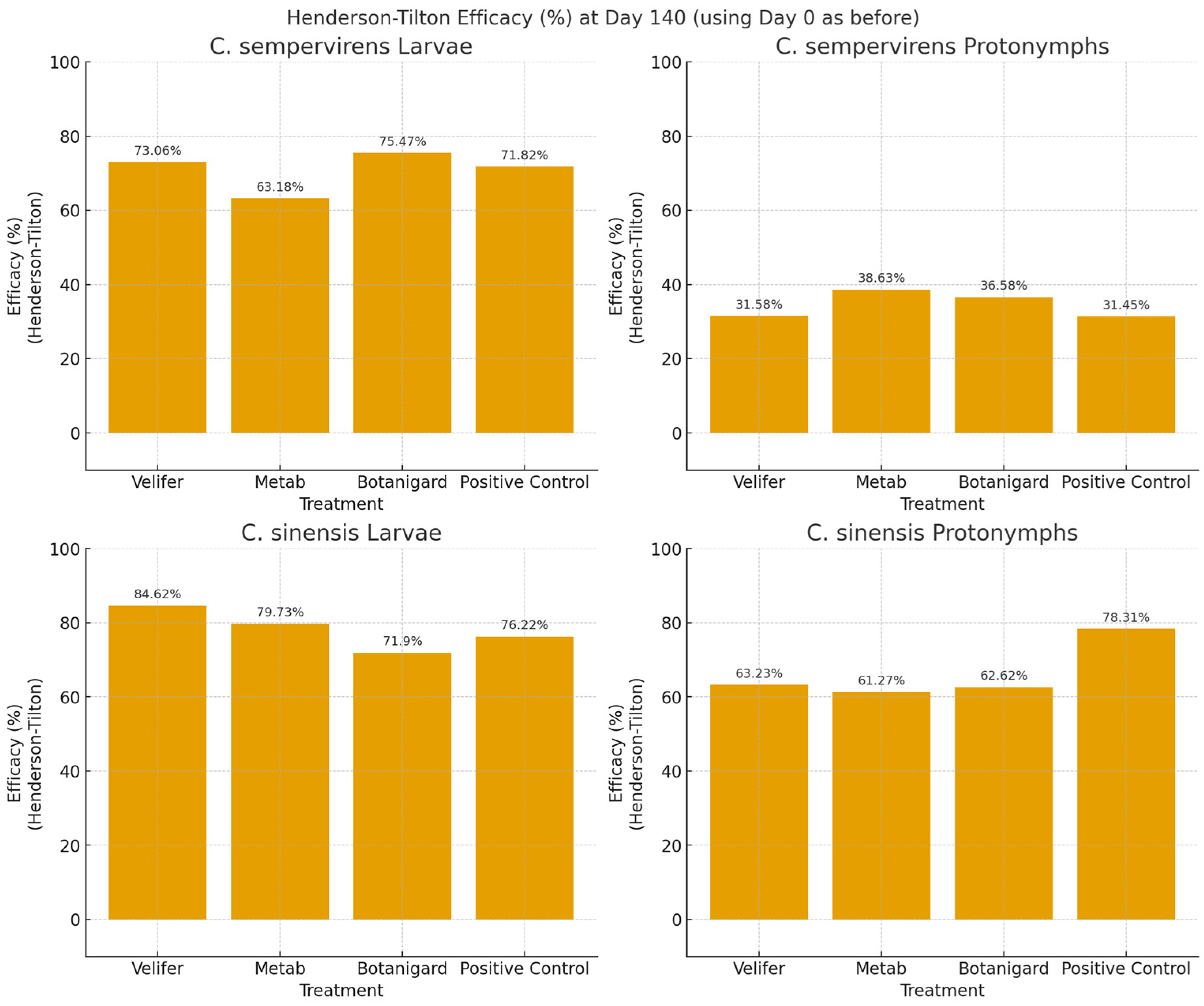
| Treatment | Dose (mL/100 L) | Larval Population Density (Mites/Sampling Unit) at Selected Days After Treatment (DAT) | |||
|---|---|---|---|---|---|
| 0 DAT | 28 DAT | 56 DAT | 140 DAT | ||
| Velifer | 100 | >10 | 46.6 ± 2.7 a | 20.0 ± 7.7 a | 24.2 ± 2.8 a |
| Metab | 100 | 53.3 ± 1.8 a | 78.3 ± 4.3 b | 34.1 ± 2.5 a | |
| Botanigard | 100 | 53.3 ± 2.1 a | 22.8 ± 2.5 a | 25.9 ± 1.2 a | |
| Valmec (Positive Control) | 50 | 47.6 ± 3.4 a | 39.3 ± 1.5 c | 21.4 ± 2.9 a | |
| dd H2O (Negative Control) | - | 186.3 ± 9.5 b | 156.6 ± 12.4 d | 202.8 ± 32.2 b | |
| Treatment | Dose (mL/100 L) | Protonymphs Population Density (Mites/Sampling Unit) at Selected Days After Treatment (DAT) | |||
|---|---|---|---|---|---|
| 0 DAT | 28 DAT | 56 DAT | 140 DAT | ||
| Velifer | 100 | >10 | 36.6 ± 2.4 a | 47.3 ± 2.2 a | 44.1 ± 1.9 a |
| Metab | 100 | 43.3 ± 3.7 b | 63.3 ± 3.9 b | 44.9 ± 2.1 a | |
| Botanigard | 100 | 48.6 ± 2.2 b | 52.6 ± 1.1 a | 45.3 ± 2.8 a | |
| Valmec (Positive Control) | 50 | 37.3 ± 2.4 a | 49.2 ± 2.1 a | 41.4 ± 3.1 a | |
| dd H2O (Negative Control) | - | 86.6 ± 4.5 c | 136.6 ± 23.9 c | 198.6 ± 32.8 b | |
| Treatment | Dose (mL/100 L) | Larval Population Density (Mites/Sampling Unit) at Selected Days After Treatment (DAT) | |||
|---|---|---|---|---|---|
| 0 DAT | 28 DAT | 56 DAT | 140 DAT | ||
| Velifer | 100 | >10 | 32.6 ± 2.4 a | 13.2 ± 2.8 a | 16.6 ± 2.1 a |
| Metab | 100 | 56.1 ± 1.2 b | 34.7 ± 3.2 b | 24.6 ± 2.9 a | |
| Botanigard | 100 | 43.3 ± 3.3 a | 13.9 ± 2.1 a | 29.3 ± 2.8 a | |
| Valmec (Positive Control) | 50 | 34.5 ± 2.8 a | 11.8 ± 4.8 a | 21.6 ± 1.8 a | |
| dd H2O (Negative Control) | - | 177.2 ± 21.1 c | 136.5 ± 25.2 c | 217.1 ± 35.1 b | |
| Treatment | Dose (mL/100 L) | Protonymphs Population Density (Mites/Sampling Unit) at Selected Days After Treatment (DAT) | |||
|---|---|---|---|---|---|
| 0 DAT | 28 DAT | 56 DAT | 140 DAT | ||
| Velifer | 100 | >10 | 56.6 ± 1.2 a | 50.0 ± 0.0 a | 34.7 ± 1.5 a |
| Metab | 100 | 63.6 ± 2.1 a | 58.4 ± 1.8 a | 44.2 ± 2.1 b | |
| Botanigard | 100 | 58.4 ± 1.9 a | 52.8 ± 2.1 a | 35.4 ± 2.3 a | |
| Valmec (Positive Control) | 50 | 47.2 ± 1.5 b | 49.6 ± 1.9 a | 21.1 ± 1.9 a | |
| dd H2O (Negative Control) | - | 86.6 ± 7.6 c | 106.4 ± 19.8 b | 243.6 ± 29.4 c | |
| Source | df | F | Sig. |
|---|---|---|---|
| Time (Days after Treatment) | 7.167 | 10.144 | <0.0001 |
| Treatment | 5.167 | 15.323 | <0.0001 |
| Time * Treatment | 53.167 | 14.435 | <0.0001 |
| Plant Species | Biological Stage | Treatment | Exposure Time (Days) | Survival | |
|---|---|---|---|---|---|
| Survival Effect * | Hazard Effect ** | ||||
| C. sempervirens | Nymphs | Velifer | 28 | 0.633 | 0.899 |
| 84 | 0.533 | 1.015 | |||
| 140 | 0.333 | 0.401 | |||
| Metab | 28 | 0.933 | 0.069 | ||
| 84 | 0.800 | 0.223 | |||
| 140 | 0.733 | 0.310 | |||
| Botanigard | 28 | 0.767 | 0.266 | ||
| 84 | 0.600 | 0.511 | |||
| 140 | 0.467 | 0.762 | |||
| Positive control | 28 | 0.600 | 0.511 | ||
| 84 | 0.533 | 0.629 | |||
| 140 | 0.400 | 0.916 | |||
| Protonymphs | Velifer | 28 | 0.800 | 0.223 | |
| 84 | 0.733 | 0.310 | |||
| 140 | 0.867 | 0.134 | |||
| Metab | 28 | 0.967 | 0.034 | ||
| 84 | 0.900 | 0.105 | |||
| 140 | 0.733 | 0.169 | |||
| Botanigard | 28 | 0.967 | 0.034 | ||
| 84 | 0.898 | 0.108 | |||
| 140 | 0.900 | 0.123 | |||
| Positive control | 28 | 0.900 | 0.105 | ||
| 84 | 0.700 | 0.357 | |||
| 140 | 0.900 | 0.105 | |||
| C. sinensis | Nymphs | Velifer | 28 | 0.500 | 0.405 |
| 84 | 0.400 | 0.916 | |||
| 140 | 0.567 | 0.568 | |||
| Metab | 28 | 0.933 | 0.069 | ||
| 84 | 0.900 | 0.105 | |||
| 140 | 0.700 | 0.357 | |||
| Botanigard | 28 | 0.800 | 0.223 | ||
| 84 | 0.633 | 0.457 | |||
| 140 | 0.500 | 0.693 | |||
| Positive Control | 28 | 0.467 | 0.334 | ||
| 84 | 0.400 | 0.916 | |||
| 140 | 0.433 | 0.582 | |||
| Protonymphs | Velifer | 28 | 0.898 | 0.108 | |
| 84 | 0.800 | 0.223 | |||
| 140 | 0.433 | 0.657 | |||
| Metab | 28 | 0.967 | 0.034 | ||
| 84 | 0.833 | 0.182 | |||
| 140 | 0.600 | 0.511 | |||
| Botanigard | 28 | 0.800 | 0.223 | ||
| 84 | 0.767 | 0.266 | |||
| 140 | 0.400 | 0.610 | |||
| Positive Control | 28 | 0.933 | 0.069 | ||
| 84 | 0.633 | 0.457 | |||
| 140 | 0.400 | 0.916 | |||
Disclaimer/Publisher’s Note: The statements, opinions and data contained in all publications are solely those of the individual author(s) and contributor(s) and not of MDPI and/or the editor(s). MDPI and/or the editor(s) disclaim responsibility for any injury to people or property resulting from any ideas, methods, instructions or products referred to in the content. |
© 2026 by the authors. Licensee MDPI, Basel, Switzerland. This article is an open access article distributed under the terms and conditions of the Creative Commons Attribution (CC BY) license.
Share and Cite
Mantzoukas, S.; Zarmakoupi, C.; Papantzikos, V.; Sourouni, T.; Eliopoulos, P.A.; Patakioutas, G. Long-Term Field Efficacy of Entomopathogenic Fungi Against Tetranychus urticae: Host Plant- and Stage-Specific Responses. Appl. Sci. 2026, 16, 1109. https://doi.org/10.3390/app16021109
Mantzoukas S, Zarmakoupi C, Papantzikos V, Sourouni T, Eliopoulos PA, Patakioutas G. Long-Term Field Efficacy of Entomopathogenic Fungi Against Tetranychus urticae: Host Plant- and Stage-Specific Responses. Applied Sciences. 2026; 16(2):1109. https://doi.org/10.3390/app16021109
Chicago/Turabian StyleMantzoukas, Spiridon, Chrysanthi Zarmakoupi, Vasileios Papantzikos, Thomais Sourouni, Panagiotis A. Eliopoulos, and George Patakioutas. 2026. "Long-Term Field Efficacy of Entomopathogenic Fungi Against Tetranychus urticae: Host Plant- and Stage-Specific Responses" Applied Sciences 16, no. 2: 1109. https://doi.org/10.3390/app16021109
APA StyleMantzoukas, S., Zarmakoupi, C., Papantzikos, V., Sourouni, T., Eliopoulos, P. A., & Patakioutas, G. (2026). Long-Term Field Efficacy of Entomopathogenic Fungi Against Tetranychus urticae: Host Plant- and Stage-Specific Responses. Applied Sciences, 16(2), 1109. https://doi.org/10.3390/app16021109