Early Implant Stability Improved by Nutraceutical Support: Results from a Prospective Randomized Clinical Trial Based on Resonance Frequency Analysis
Abstract
1. Introduction
2. Materials and Methods
2.1. Study Design and Ethical Approval
2.2. Population and Eligibility Criteria
2.3. Nutraceutical Supplementation
2.4. Surgical Procedure
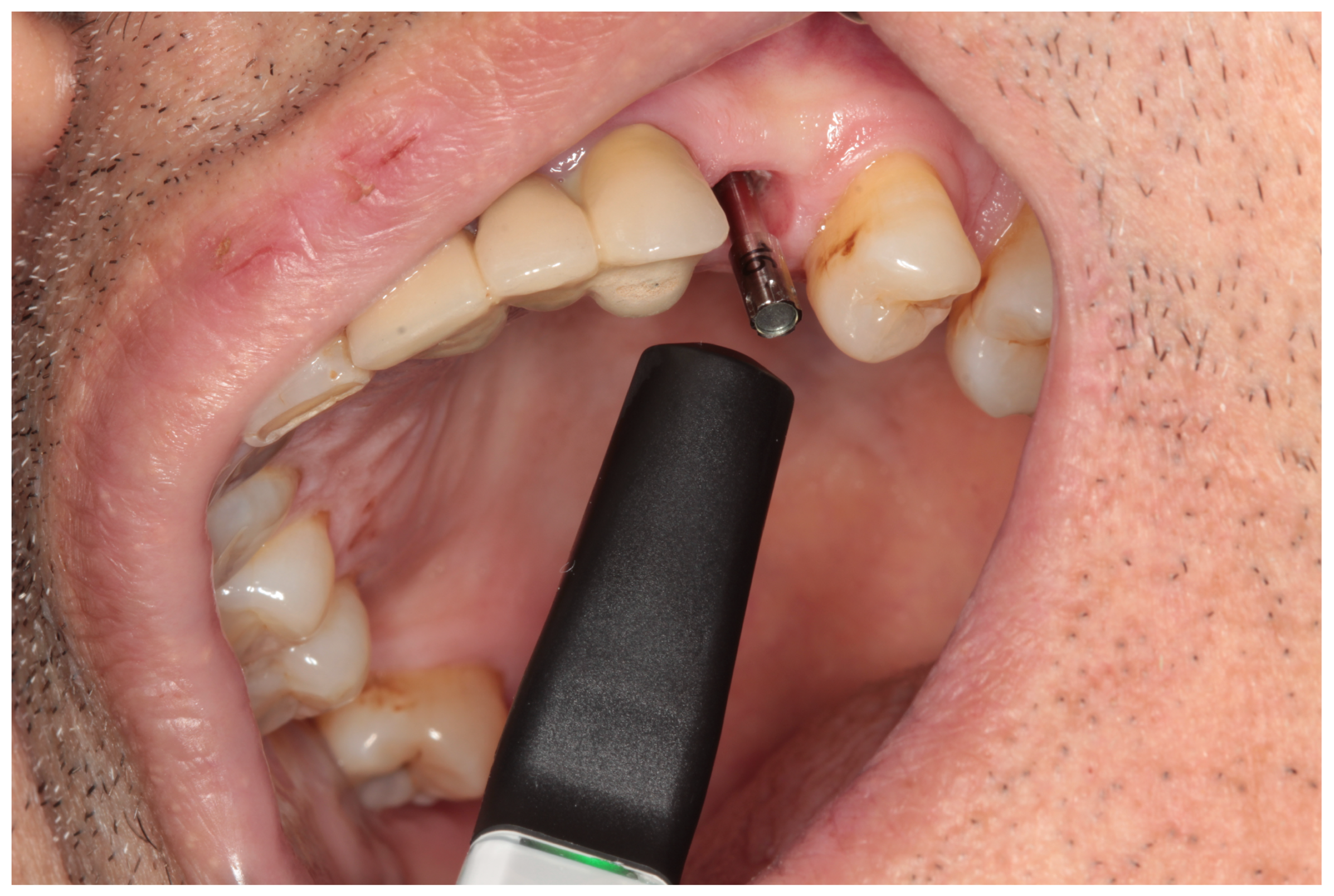
2.5. Outcome Measures
2.6. Randomization
2.7. Follow-Up and Data Collection
2.8. Statistical Analysis
3. Results
3.1. Participant Flow and Follow-Up
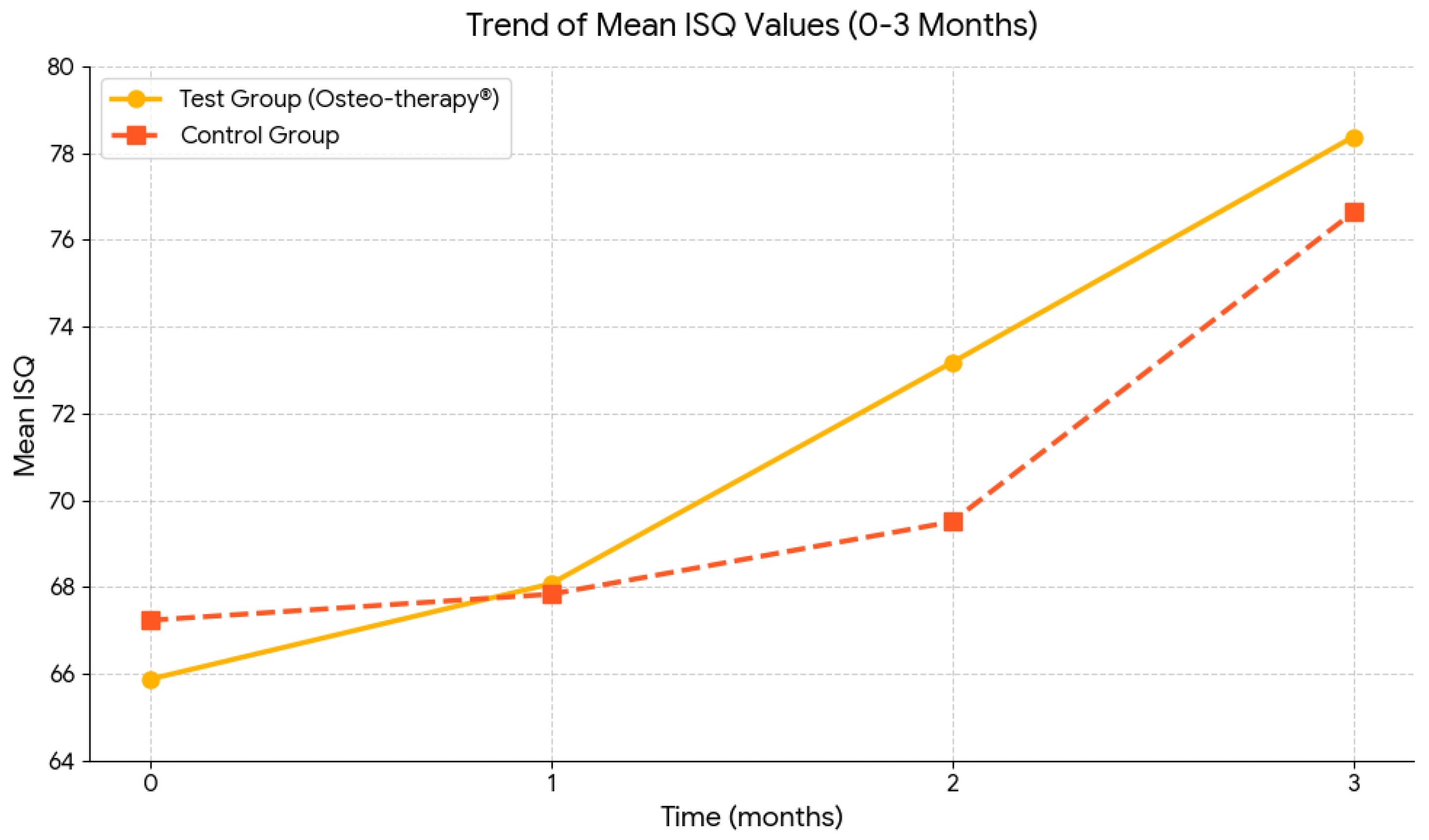
3.2. Primary Outcome: ISQ over Time
3.3. Confidence Intervals and Effect Sizes
3.4. Interpretation
- T2 (2 months) shows a large standardized effect (Hedges’ g ≈ 1.18), with a mean difference of +3.67 ISQ (95% CI +2.09 to +5.25).
- T3 (3 months) remains moderate-to-large (g ≈ 0.74), with +1.74 ISQ (95% CI +0.54 to +2.94).
- Early time points (T0–T1) are statistically and clinically indistinguishable, consistent with a biologically plausible lag before nutraceutical effects manifest.
3.5. Trajectory and Magnitude of Improvement
3.6. Measurement Quality and Clinical Observations
4. Discussion
4.1. How Our ISQ Data Compares with Clinical Literature
4.2. How Our Findings Align with Nutraceutical Evidence in Implantology
4.3. Comparative View: Compositions and Outcomes in Published Studies
- Omega-3, curcumin, or other nutraceuticals in implant patients: emerging and largely investigational; ongoing trials exist, but robust RCT evidence for ISQ endpoints is limited to date [16].
- Our combination (D3 + Ca + quercetin + spirulina/40% phycocyanin): introduces anti-resorptive (RANKL/NF-κB) and pro-osteogenic pathways beyond mineral/endocrine support alone, which may explain the earlier and larger ISQ gain observed at T2 versus what is typically reported with standard care. While direct head-to-head trials are lacking, the multi-target profile of our formulation contrasts with single-nutrient strategies, potentially offering additive or synergistic benefits [37,38].
4.4. Clinical Implications
4.5. Strengths and Limitations
4.6. Future Directions
5. Conclusions
6. Patents
Author Contributions
Funding
Institutional Review Board Statement
Informed Consent Statement
Acknowledgments
Conflicts of Interest
References
- Pjetursson, B.E.; Tan, K.; Lang, N.P.; Brägger, U.; Egger, M.; Zwahlen, M. A systematic review of the survival and complication rates of fixed partial dentures (FPDs) after an observation period of at least 5 years. Clin. Oral Implant. Res. 2004, 15, 625–642. [Google Scholar] [CrossRef]
- Jung, R.E.; Zembic, A.; Pjetursson, B.E.; Zwahlen, M.; Thoma, D.S. Systematic review of the survival rate and incidence of biological, technical, and aesthetic complications of single crowns on implants reported in longitudinal studies with a mean follow-up of 5 years. Clin. Oral Implant. Res. 2012, 23, 22–38. [Google Scholar] [CrossRef]
- Adell, R.; Lekholm, U.; Rockler, B.; Brånemark, P.I. A 15-year study of osseointegrated implants in the treatment of the edentulous jaw. Int. J. Oral Surg. 1981, 10, 387–416. [Google Scholar] [CrossRef]
- Monje, A.; Catena, A.; Borgnakke, W.S. Association between diabetes mellitus/hyperglycemia and peri-implant diseases: Systematic review and meta-analysis. J. Clin. Periodontol. 2017, 44, 636–648. [Google Scholar] [CrossRef]
- Alsaadi, G.; Quirynen, M.; Komárek, A.; van Steenberghe, D. Impact of local and systemic factors on the incidence of oral implant failures, up to abutment connection. Clin. Oral Implant. Res. 2007, 18, 668–679. [Google Scholar] [CrossRef] [PubMed]
- Oates, T.W.; Galloway, P.; Alexander, P.; Green, A.V.; Huynh-Ba, G.; Feine, J.; McMahan, C.A. The effects of elevated hemoglobin A1c in patients with type 2 diabetes on dental implants: Survival and stability at one year. Clin. Implant. Dent. Relat. Res. 2013, 15, 607–613. [Google Scholar]
- Javed, F.; Romanos, G.E. Impact of diabetes mellitus and glycemic control on the osseointegration of dental implants: A systematic literature review. Dent. Clin. N. Am. 2015, 59, 223–233. [Google Scholar] [CrossRef] [PubMed]
- Dvorak, G.; Arnhart, C.; Heuberer, S.; Huber, C.D.; Watzek, G.; Gruber, R. Peri-implantitis and late implant failures in postmenopausal women: A cross-sectional study. Clin. Oral Implant. Res. 2011, 22, 673–681. [Google Scholar] [CrossRef] [PubMed]
- Ferreira, S.D.; Silva, G.L.; Cortelli, J.R.; Costa, J.E.; Costa, F.O. Prevalence and risk variables for peri-implant disease in Brazilian subjects. J. Clin. Periodontol. 2011, 38, 732–742. [Google Scholar] [CrossRef]
- Buser, D.; Sennerby, L.; De Bruyn, H. Modern implant dentistry based on osseointegration: 50 years of progress, current trends, and open questions. Periodontol. 2000 2017, 73, 7–21. [Google Scholar] [CrossRef]
- Naujokat, H.; Kunzendorf, B.; Wiltfang, J. Dental implants and diabetes mellitus—A systematic review. Int. J. Implant. Dent. 2016, 2, 5. [Google Scholar] [CrossRef]
- Ruggiero, S.L.; Dodson, T.B.; Fantasia, J.; Goodday, R.; Aghaloo, T.; Mehrotra, B.; O’Ryan, F.; American Association of Oral and Maxillofacial Surgeons. Medication-related osteonecrosis of the jaw—2014 update. J. Oral Maxillofac. Surg. 2014, 72, 1938–1956. [Google Scholar] [CrossRef]
- Otto, S.; Pautke, C.; Van den Wyngaert, T.; Niepel, D.; Schiodt, M. Medication-related osteonecrosis of the jaw: Prevention, diagnosis and management in patients with cancer and bone metastases. J. Craniomaxillofac Surg. 2018, 46, 221–227. [Google Scholar] [CrossRef]
- Ten Bruggenkate, C.M.; van der Linden, M.W.; Oosterbeek, H.S. The success of Brånemark implants in the jaws of partially edentulous patients. Clin. Oral Implant. Res. 1992, 3, 27–30. [Google Scholar]
- Yamaguchi, M.; Weitzmann, M.N. The bone anabolic carotenoid β-cryptoxanthin enhances bone formation and suppresses bone resorption. Int. J. Mol. Med. 2012, 29, 269–275. [Google Scholar]
- Domazetovic, V.; Marcucci, G.; Iantomasi, T.; Brandi, M.L.; Vincenzini, M.T. Oxidative stress in bone remodeling: Role of antioxidants. Int. J. Mol. Sci. 2017, 18, 981. [Google Scholar] [CrossRef]
- Meredith, N. Assessment of implant stability as a prognostic determinant. Int. J. Prosthodont. 1998, 11, 491–501. [Google Scholar] [PubMed]
- Sennerby, L.; Meredith, N. Implant stability measurements using resonance frequency analysis: Biological and biomechanical aspects and clinical implications. Periodontol. 2000 2008, 47, 51–66. [Google Scholar] [CrossRef]
- Barewal, R.M.; Oates, T.W.; Meredith, N.; Cochran, D.L. Resonance frequency measurement of implant stability in vivo on implants with a sandblasted and acid-etched surface. Int. J. Oral Maxillofac. Implant. 2003, 18, 641–651. [Google Scholar]
- Herrero-Climent, M.; Santos-García, R.; Jaramillo-Santos, R.; Romero-Ruiz, M.M.; Fernández-Palacín, A.; Lázaro-Calvo, P.; Bullon, P.; Rios-Santos, J.V. Assessment of Osstell ISQ’s reliability for implant stability measurement: A cross-sectional clinical study. Med. Oral Patol. Oral Cir. Bucal 2013, 18, e877–e882. [Google Scholar] [CrossRef]
- Atsumi, M.; Park, S.H.; Wang, H.L. Methods used to assess implant stability: Current status. Int. J. Oral Maxillofac. Implant. 2007, 22, 743–754. [Google Scholar]
- Gallucci, G.O.; Benic, G.I.; Eckert, S.E.; Papaspyridakos, P.; Schimmel, M.; Schrott, A.; Weber, H.P. Consensus statements and clinical recommendations for implant loading protocols. Clin. Oral Implant. Res. 2014, 25, 885–892. [Google Scholar] [CrossRef]
- Degidi, M.; Piattelli, A.; Iezzi, G.; Carinci, F. Retrospective study on 200 immediately loaded implants. Clin. Implant. Dent. Relat. Res. 2007, 9, 15–22. [Google Scholar]
- Huang, H.; Ma, J.; Zhao, Q.; Wu, Y. Clinical significance of implant stability quotient (ISQ) in relation to implant stability and prognosis. J. Dent. Sci. 2020, 15, 417–426. [Google Scholar]
- Juboori, M.J.A.L.; Attas, M.A.A.; Gomes, R.Z.; Alanbari, B.F. Resonance frequency Using Resonance Frequency Analysis to Compare Delayed and Immediate Progressive Loading for Implants Placed in the Posterior Maxilla: A Pilot Study. Open Dent. J. 2018, 12, 801–810. [Google Scholar] [CrossRef]
- Baltayan, S.; Pi-Anfruns, J.; Aghaloo, T.; Moy, P. The Predictive Value of Resonance Frequency Analysis Measurements in the Surgical Placement and Loading of Endosseous Implants. J. Oral Maxillofac. Surg. 2016, 74, 1145–1152. [Google Scholar] [CrossRef]
- Díaz-Castro, M.C.; Falcao, A.; Lopez-Jarana, P.; Falcao, C.; Rios-Santos, J.V.; Fernandez-Palacin, A.; Herrero-Climent, M. Repeatability of resonance frequency analysis value in implants with a new technology. Med. Oral Patol. Oral Cir. Bucal 2019, 24, e636–e642. [Google Scholar] [CrossRef] [PubMed]
- Buzatu, B.L.R.; Buzatu, R.; Luca, M.M. The impact of vitamin D on osseointegration in dental implants: A systematic review. Nutrients 2024, 16, 209. [Google Scholar] [CrossRef]
- Paz, A.; Stanley, M.; Mangano, F.G.; Miron, R.J. Vitamin D Deficiency and Early Implant Failure: Outcomes from a Pre-surgical Supplementation Program on Vitamin D Levels and Antioxidant Scores. Oral Health Prev. Dent. 2021, 19, 495–502. [Google Scholar]
- Mangano, F.G.; Ghertasi Oskouei, S.; Paz, A.; Mangano, N.; Mangano, C. Low serum vitamin D and early implant failure: A retrospective clinical study on 1740 implants placed in 885 patients. Int. J. Oral Maxillofac. Surg. 2018, 47, 1474–1480. [Google Scholar] [CrossRef]
- Fretwurst, T.; Grunert, S.; Woelber, J.P.; Nelson, K.; Semper-Hogg, W. Vitamin D deficiency in early implant failure: Two case reports. Int. J. Implant. Dent. 2016, 2, 24. [Google Scholar] [CrossRef] [PubMed]
- Diachkova, E.; Skachkova, M.; Zhilkov, Y.; Kerimov, M.; Tarasenko, S.; Babkova, A.; Zhukova, N.; Bokareva, S.; Taschieri, S.; Unkovskiy, A.; et al. Dental implants rehabilitation in patients with vitamin D3 supplementation: A randomized controlled clinical trial. Appl. Sci. 2025, 15, 9490. [Google Scholar] [CrossRef]
- AlQranei, M.S.; Aljohani, H.; Majumdar, S.; Senbanjo, L.T.; Chellaiah, M.A. C-phycocyanin attenuates RANKL-induced osteoclastogenesis and bone resorption in vitro through inhibiting ROS levels, NFATc1 and NF-κB activation. Sci. Rep. 2020, 10, 2513. [Google Scholar] [CrossRef]
- Cho, J.A.; Baek, S.Y.; Cheong, S.H.; Kim, M.R. Spirulina supplementation improves bone modeling in growing rats. Nutrients 2020, 12, 1709. [Google Scholar]
- Wattel, A.; Kamel, S.; Prouillet, C.; Petit, J.P.; Lorget, F.; Offord, E.; Brazier, M. Flavonoid quercetin induces osteoblast differentiation and inhibits osteoclastogenesis. Biochem. Pharmacol. 2004, 67, 1209–1219. [Google Scholar]
- Casado-Díaz, A.; Santiago-Mora, R.; Dorado, G.; Quesada, J.M. The flavonoid quercetin differentially modulates osteoblast and osteoclast activity in vitro. J. Bone Min. Metab. 2016, 34, 327–338. [Google Scholar]
- Ku, C.S.; Pham, T.X.; Park, Y.; Kim, B.; Shin, M.S.; Kang, I.; Lee, J. Edible blue-green algae reduces proinflammatory cytokines via NF-κB inhibition in macrophages. J. Med. Food. 2013, 16, 530–541. [Google Scholar]
- Torres-Duran, P.V.; Ferreira-Hermosillo, A.; Juarez-Oropeza, M.A. Antioxidant and anti-inflammatory effects of Spirulina in humans. Nutr. Hosp. 2007, 22, 577–581. [Google Scholar]
- Cho, K.S.; Lee, E.H.; Choi, J.S.; Joo, C.K. Phycocyanin promotes osteoblastic differentiation and bone formation in vitro. Int. J. Mol. Med. 2010, 26, 273–278. [Google Scholar]
- Nastri, L.; Moretti, A.; Migliaccio, S.; Paoletta, M.; Annunziata, M.; Liguori, S.; Toro, G.; Bianco, M.; Cecoro, G.; Guida, L.; et al. Do dietary supplements and nutraceuticals affect implant osseointegration? A scoping review. Materials 2020, 13, 4826. [Google Scholar]
- Puleio, F.; Tosco, V.; Pirri, R.; Simeone, M.; Monterubbianesi, R.; Giudice, G.L.; Giudice, R.L. Augmented Reality in Dentistry: Enhancing Precision in Clinical Procedures—A Systematic Review. Clin. Pract. 2024, 14, 2267–2283. [Google Scholar] [CrossRef] [PubMed]
- Puleio, F.; Giudice, G.L.; Bellocchio, A.M.; Boschetti, C.E.; Giudice, R.L. Clinical, Research, and Educational Applications of ChatGPT in Dentistry: A Narrative Review. Appl. Sci. 2024, 14, 10802. [Google Scholar] [CrossRef]


| Time Point | Test Group (Osteo-Therapy®) | Control Group | Difference (Test–Control) | t | p-Value |
|---|---|---|---|---|---|
| T0 (Baseline) | 65.87 ± 4.34 | 67.23 ± 2.97 | −1.36 | −1.46 | 0.149 |
| T1 (1 month) | 68.07 ± 2.94 | 67.83 ± 2.76 | +0.24 | 0.34 | 0.737 |
| T2 (2 months) | 73.17 ± 3.38 | 69.50 ± 2.72 | +3.67 | 4.64 | <0.001 |
| T3 (3 months) | 78.37 ± 1.71 | 76.63 ± 2.82 | +1.74 | 2.90 | 0.006 |
| Source of Variation | df | F-Value | p-Value | Significance |
|---|---|---|---|---|
| Time (Within-subject factor) | 3 | 184.86 | <0.001 | *** |
| Group (Between-subject factor) | 1 | 3.51 | 0.062 | ns |
| Time × Group Interaction | 3 | 6.50 | <0.001 | *** |
| Time | Test Mean (95% CI) | Control Mean (95% CI) | Δ ISQ (Test–Control) (95% CI) | Cohen’s d (95% CI) | Hedges’ g |
|---|---|---|---|---|---|
| T0 | 65.87 (64.28–67.46) | 67.23 (66.14–68.32) | −1.36 (−3.22 to +0.50) | −0.38 (−0.89 to +0.13) | −0.37 |
| T1 | 68.07 (67.00–69.14) | 67.83 (66.82–68.84) | +0.24 (−1.17 to +1.65) | +0.09 (−0.42 to +0.59) | +0.09 |
| T2 | 73.17 (71.94–74.40) | 69.50 (68.51–70.49) | +3.67 (+2.09 to +5.25) ** | +1.20 (+0.65 to +1.75) | +1.18 |
| T3 | 78.37 (77.75–78.99) | 76.63 (75.60–77.66) | +1.74 (+0.54 to +2.94) ** | +0.75 (+0.22 to +1.27) | +0.74 |
Disclaimer/Publisher’s Note: The statements, opinions and data contained in all publications are solely those of the individual author(s) and contributor(s) and not of MDPI and/or the editor(s). MDPI and/or the editor(s) disclaim responsibility for any injury to people or property resulting from any ideas, methods, instructions or products referred to in the content. |
© 2026 by the authors. Licensee MDPI, Basel, Switzerland. This article is an open access article distributed under the terms and conditions of the Creative Commons Attribution (CC BY) license.
Share and Cite
Lo Giudice, R.; Denaro, M.; Cutè, E.; Quattrocchi, A. Early Implant Stability Improved by Nutraceutical Support: Results from a Prospective Randomized Clinical Trial Based on Resonance Frequency Analysis. Appl. Sci. 2026, 16, 1087. https://doi.org/10.3390/app16021087
Lo Giudice R, Denaro M, Cutè E, Quattrocchi A. Early Implant Stability Improved by Nutraceutical Support: Results from a Prospective Randomized Clinical Trial Based on Resonance Frequency Analysis. Applied Sciences. 2026; 16(2):1087. https://doi.org/10.3390/app16021087
Chicago/Turabian StyleLo Giudice, Roberto, Marcella Denaro, Erica Cutè, and Alessia Quattrocchi. 2026. "Early Implant Stability Improved by Nutraceutical Support: Results from a Prospective Randomized Clinical Trial Based on Resonance Frequency Analysis" Applied Sciences 16, no. 2: 1087. https://doi.org/10.3390/app16021087
APA StyleLo Giudice, R., Denaro, M., Cutè, E., & Quattrocchi, A. (2026). Early Implant Stability Improved by Nutraceutical Support: Results from a Prospective Randomized Clinical Trial Based on Resonance Frequency Analysis. Applied Sciences, 16(2), 1087. https://doi.org/10.3390/app16021087