


Featured Application
The findings of this study can be applied to the design and evaluation of external human-machine interfaces (eHMIs) for autonomous vehicles, supporting safer pedestrian-vehicle interactions in urban environments. The results may inform simulation-based testing frameworks, interface standardization efforts, and the development of decision-support tools to assess pedestrian safety, traffic flow, and risk behavior prior to the real-world deployment of autonomous mobility systems.
Abstract
As autonomous vehicles (AVs) become part of urban environments, pedestrian safety and interactions with these vehicles are critical to creating sustainable, walkable cities. Intuitive pedestrian-vehicle communication is essential not only for reducing crash risk but also for supporting policies that promote active mobility and efficient traffic flow. This study investigates pedestrian crossing behavior in a fully immersive virtual reality environment, building on previous work by the authors conducted in a CAVE-type simulator. Participants crossed between a conventional vehicle and an AV when they perceived it was safe. The analysis examines how external human–machine interfaces (eHMIs) influence crossing decisions, collisions, safety margins, and crossing initiation time (CIT) across different vehicle speeds and traffic gaps. Three hypotheses were tested regarding the effects of eHMIs on CIT, risk-taking behavior, and perceived safety. Results show that eHMIs significantly affect pedestrian decisions: participants delayed crossings when the eHMI indicated non-yielding behavior and initiated crossings earlier when yielding was signaled. Risk-taking behavior increased at higher vehicle speeds and shorter time gaps. Although perceived safety did not increase, behavioral results indicate reliance on visual cues. These findings underscore the importance of standardizing eHMIs to support pedestrian safety and sustainable urban mobility.
1. Introduction
As autonomous vehicles (AVs) gradually become part of urban transport systems, their interactions with pedestrians will increasingly affect the safety, usability, and environmental performance of future mobility. Understanding how pedestrians communicate and negotiate right-of-way with AVs is not only a safety concern but also a key issue for sustainable mobility policies. If pedestrian-AV interactions are unclear or perceived as unsafe, walking rates may decline, potentially undermining efforts to reduce motorized travel, congestion, noise, and emissions. Similarly, inefficient communication can slow traffic, leading to additional environmental issues and threatening initiatives to promote low-impact mobility systems.
Previous studies have indicated that pedestrians often feel uncertain when they cannot interpret a vehicle’s intention [1,2], especially in situations that require informal negotiation of priority [3]. This concern becomes more pronounced with AVs, where the driver is absent, and traditional eye contact or gestures are no longer possible [4]. To address this gap, researchers have proposed external human–machine interfaces (eHMIs), which utilize visual communication signals such as LED displays [5], projections [6], or light strips [7] to clarify the vehicle’s intention and operating mode.
Empirical studies suggest that eHMIs can improve perceived safety [8], comfort [9], and user experience [10], although their impact on traffic efficiency and overall safety remains debated [11,12,13]. Most previous research relies on desktop simulations or virtual reality (VR) environments where pedestrians signal their decisions without physically crossing [14], which may limit real-world applicability [15,16]. This is a common limitation of studies using VR environments and computer-based approaches. Although physical-crossing studies provide greater realism [5,10,17,18], they remain rare due to ethical concerns in safety-critical situations [19].
Crossing initiation time (CIT) is commonly used to evaluate pedestrian decision-making, either through physical movement or signaling via buttons [11,20] or gestures [21]. Despite evidence that eHMIs reduce decision times, little is known about how different AV signals affect risky pedestrian choices, especially when interacting with multiple vehicle types in sequence.
This study advances this debate by examining pedestrian crossing decisions between a conventional vehicle and an AV within a fully immersive VR environment featuring dynamic light-based eHMIs. Participants indicate when they would cross, enabling controlled measurement of CIT while maintaining perceptual immersion. Compared to the authors’ previous CAVE-based experiment [22,23], the current study introduces dynamic eHMIs, quantifies crossing decisions, and investigates how communication cues influence risk behavior under varying speeds and gap conditions. Since intuitive communication is vital for public acceptance and the seamless flow of pedestrian-oriented AV systems, understanding these behavioral mechanisms is essential to ensure the deployment of AVs and promote safer and more sustainable urban mobility.
Building on previous experiments and current research gaps, this study tests three hypotheses regarding how pedestrians interpret and respond to AV communication in a sequential interaction context. First, the influence of eHMIs on decision timing: pedestrians will start crossing earlier when interacting with an AV equipped with an eHMI, regardless of whether the signal indicates that the vehicle will yield. This hypothesis assumes that eHMIs reduce uncertainty and speed up decision-making.
Second, the influence of eHMIs on risk-taking behavior: lower CITs will be linked to riskier choices, especially when the eHMI indicates that the AV will not stop. This hypothesis examines whether clearer communication might inadvertently encourage unsafe decisions when pedestrians trust messages regardless of the level of risk.
And third, the influence of eHMIs on perceived safety: participants will report feeling safer when they encounter an AV equipped with an eHMI and will behave more cautiously when no eHMI is present. This hypothesis investigates whether explicit communication enhances safety and whether the absence of communication discourages risk-taking.
Although numerous studies have explored eHMIs, little is understood about how AV communication influences pedestrian decision-making when interacting with different vehicle types in controlled yet immersive settings. This research advances current knowledge by: (i) investigating crossings involving both a conventional vehicle and an AV, enabling analysis of behavioral adaptation across successive encounters; (ii) evaluating how dynamic light-based eHMIs affect not only CIT but also accepted crossings, collisions, and safety margins; and (iii) comparing these results with a previous physical-crossing CAVE experiment to understand how methodological choices shape behavioral outcomes. By linking observed behaviors to potential safety and traffic flow implications, the findings provide evidence to inform the standardization of AV-pedestrian communication within broader sustainable mobility policies. Hence, the study highlights both the benefits and risks of poorly designed AV communication, underlining the importance of interfaces that safeguard active travelers while supporting efficient, low-impact transportation systems.
2. Materials and Methods
2.1. Participants
The researchers recruited a total of 43 adult participants for this study. To be eligible, participants had to have resided in Portugal for at least one year and provide informed consent prior to participating. All participants volunteered and did not receive financial compensation. The team recruited the first two participants (one female and one male) specifically for equipment calibration and excluded them from the data analysis. As a result, the final sample comprised 41 participants (17 female and 24 male) aged between 23 and 48 years (M = 31.7, SD = 5.5). The study lasted approximately one hour, and the University of Minho Ethics Committee approved the research (ref. CEICSH 067/2023).
2.2. Simulator Setup and Virtual Environment
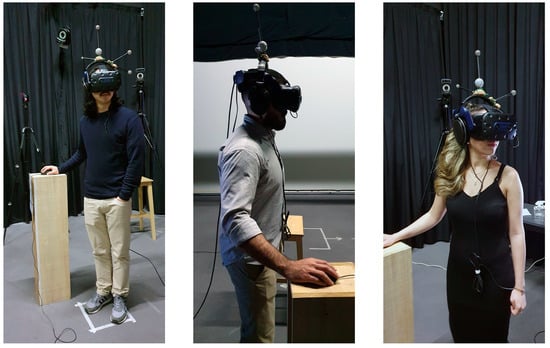
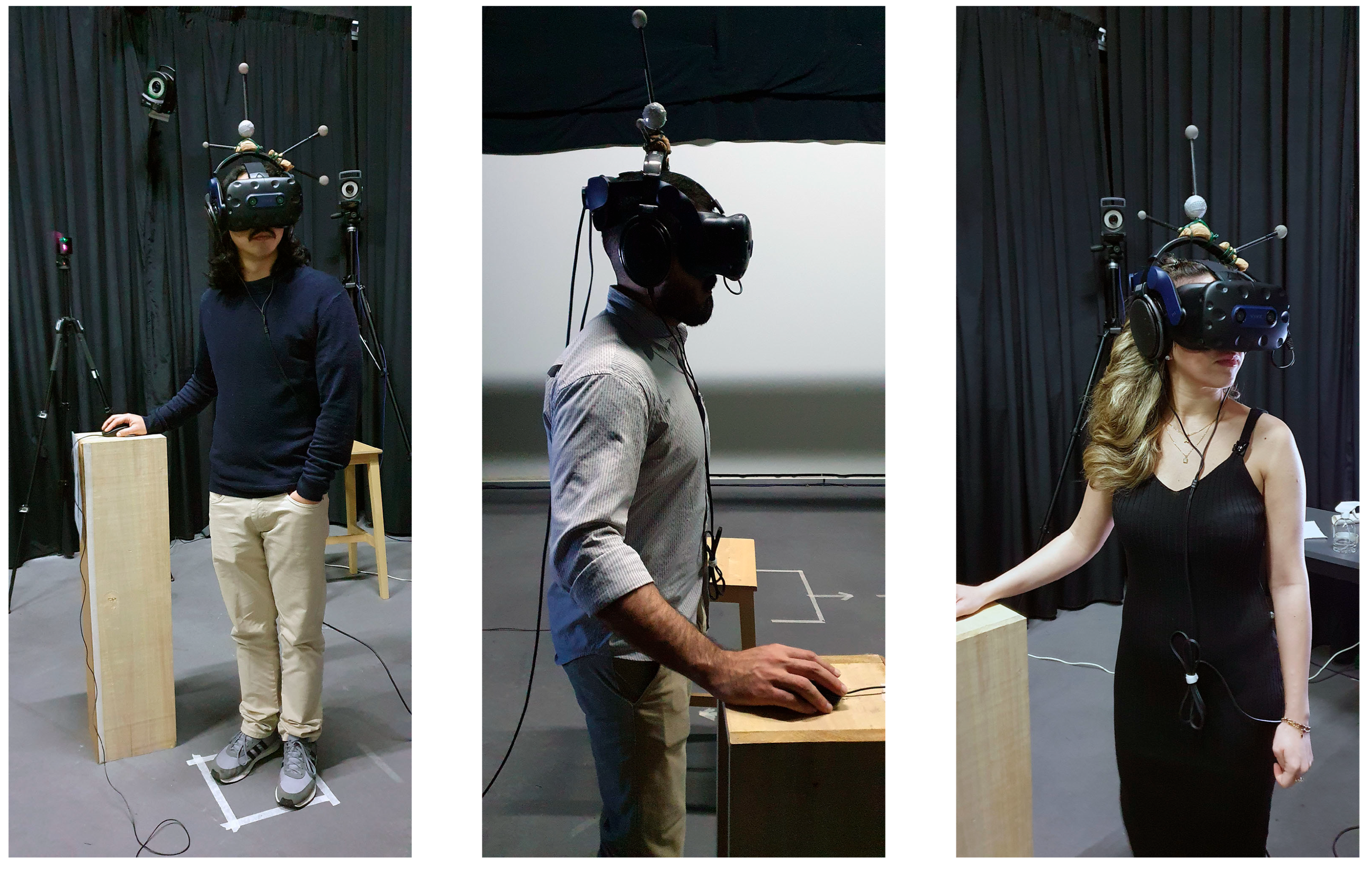
The researchers conducted the study at the Centre for Computer Graphics (CCG) at the University of Minho, utilizing a virtual reality head-mounted display (HMD), as shown in Figure 1. They used an HTC Vive Pro 2 (HTC Corporation, Taiwan), which provides an eye resolution of 2448 × 2448 pixels, operates at a refresh rate of 90 Hz, and offers a 120-degree field of view. Participants wore the headset and an external set of headphones to fully immerse themselves in the virtual environment. Infrared cameras tracked participants’ movements in the physical space and recorded their positions. The team calibrated the headphones for the experiment to realistically simulate the sounds of approaching vehicles and the ambient environment. Participants stood in the simulator room and pressed a button when they decided it was safe to cross the road. Their position in the room matched the starting point of the crosswalk within the virtual environment.
Figure 1.
Overview of experiments involving participants with the apparatus.
In this study, participants press a button instead of physically crossing the road. Although it may appear to be a step back compared to previous research by the same authors, some studies show that there is no significant difference between dynamic and static experiments when using virtual environments [24]. However, the authors acknowledge that this limitation decreases the ecological validity of the study and present it as a valid concern that should be addressed in future research.
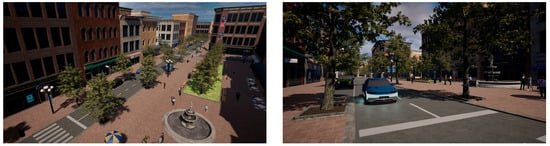
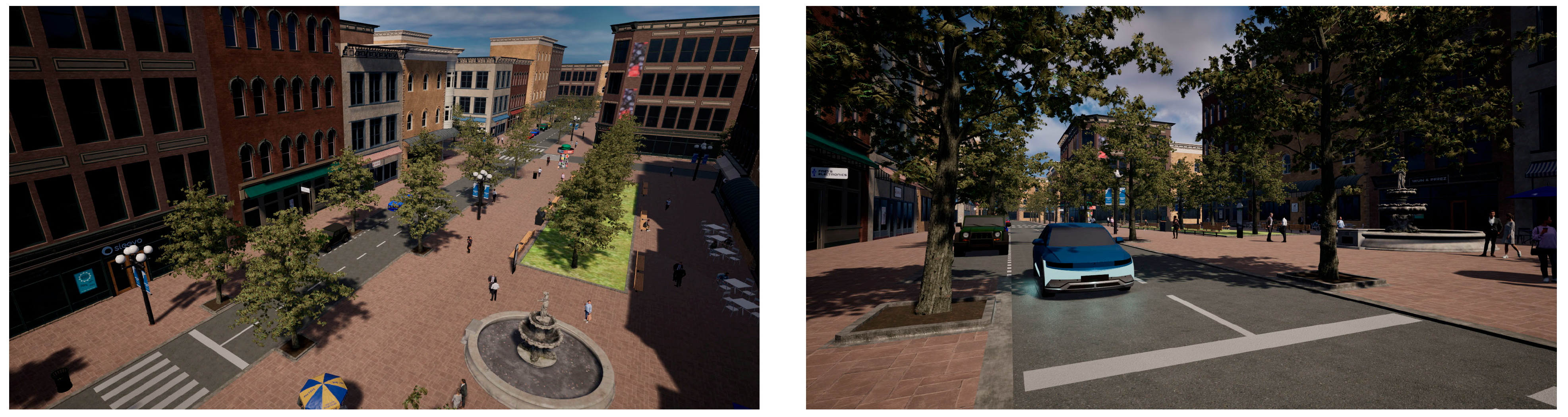
The researchers developed the virtual environment for this study using Unreal Engine software (version 5.3), as shown in Figure 2 on the left. They designed the environment to simulate a typical urban setting, including buildings, lampposts, trees lining both sides of the road, and various objects on the sidewalk. To enhance realism and avoid a sense of emptiness, the team randomly positioned multiple pedestrians on the sidewalk and in the main square of the virtual world. The traffic scenario included two vehicles traveling in a single column along the outer lane of a one-way street, approaching from the participant’s left side, as depicted in Figure 2 on the right. The lane measured approximately three meters in width. The researchers meticulously crafted and rendered the virtual environment to immerse participants and provide a realistic experience that aligns with the study’s specific objectives.
Figure 2.
The virtual environment created with Unreal Engine software: an overview of the road and crosswalk (left) and the approaching AV signaling with the eHMI (right).
2.3. Experimental Design
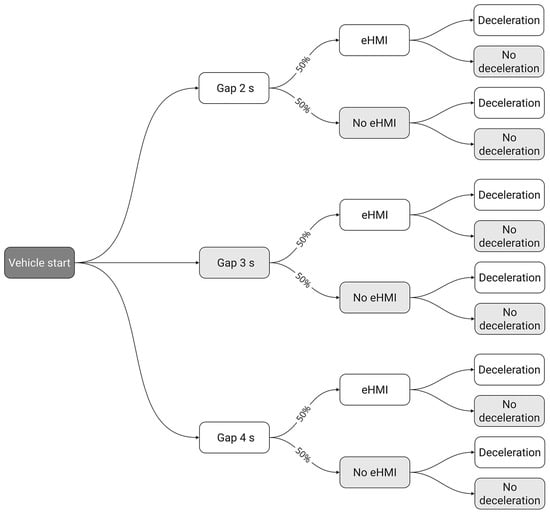
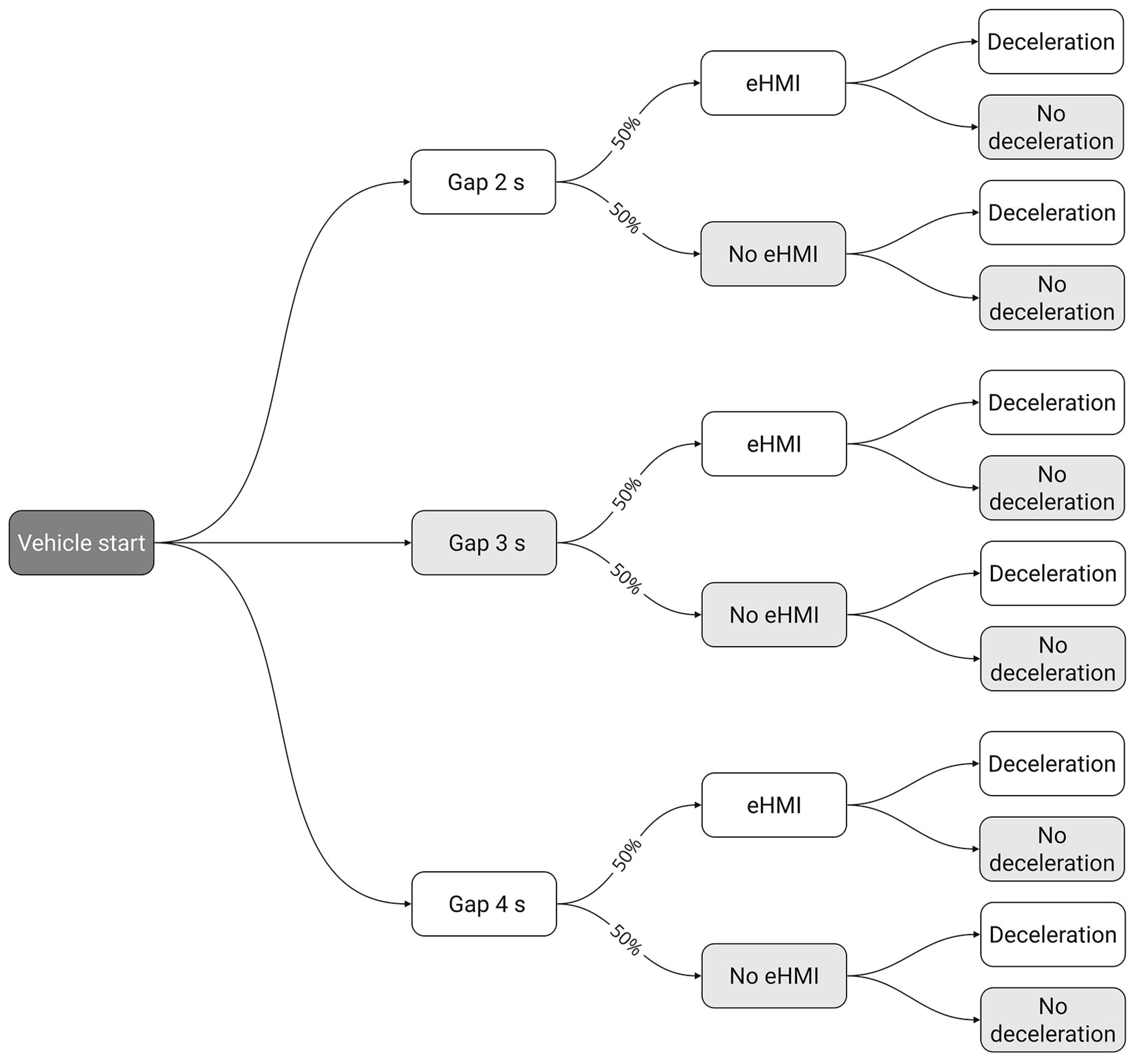
The experimental design of this study included four main factors: approaching vehicle speed (35, 40, 45, and 50 km/h), vehicle deceleration behavior (“no deceleration” or “deceleration”), time gap between vehicles (2, 3, or 4 s), and the eHMI message displayed by the AV (“yielding” or “not yielding”). The experiment consisted of three blocks, with conditions randomized within each one. Each block represented one repetition. During the trials, the approaching vehicle traveled at one of the four designated speeds and maintained one of the three specified time gaps between vehicles. In half of the trials, the AV either decelerated to a complete stop five meters before the crosswalk or continued without stopping. For the eHMI, half of the trials involved an active message, while the other half had an inactive eHMI (see Figure 3). These conditions mirrored those in the prior study, allowing for direct comparisons. The study included 48 unique conditions, with each participant completing a total of 144 trials.
Figure 3.
Outline of the vehicles’ behavior for each speed and block.
2.3.1. eHMI Design and Messages
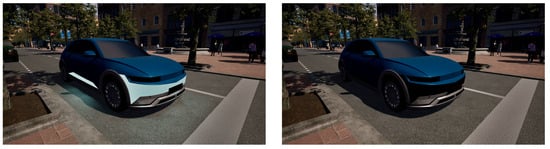
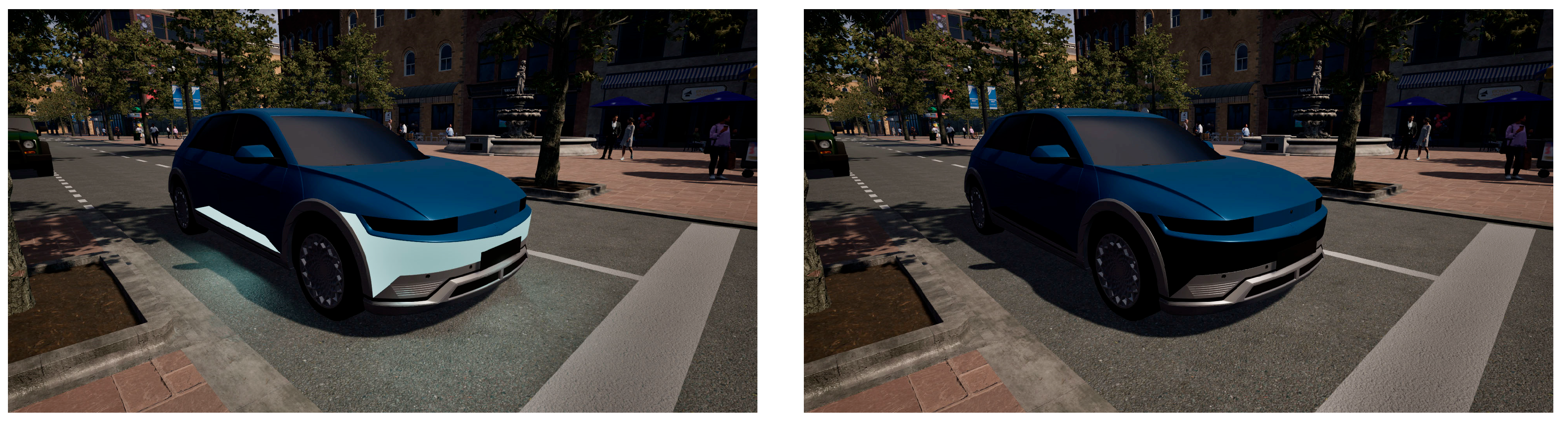
The researchers used two different eHMI designs to convey various messages, following a similar approach to previous research. In the first design, a static light signaled that the vehicle was “yielding”. In the second design, a flashing light band indicated the car was “not yielding”. The flashing effect was produced by pulsating the light band at consistent intervals (see Figure 4, left). In contrast to earlier experiments, the researchers chose neutral colors for the light bands, specifically light cyan blue, as recommended by recent research [25]. This choice aimed to reduce confusion linked to previously used colors and ensure compliance with updated standards and regulations, such as the Portuguese Highway Code [26], which discourages the use of red light bands on the front of vehicles.
Figure 4.
Frontal view of the AV: eHMI on with light band (left) and eHMI off (right).
Before the practice session, the researchers explained the meaning of each eHMI design to participants in detail, making sure everyone fully understood the messages conveyed by the eHMI designs. For improved visibility, the researchers placed the light bands at the front of the vehicle and projected them onto the ground (see Figure 4, left). The car also included an option where the eHMI remained inactive, as shown in Figure 4 (right).
2.3.2. Vehicle Behavior
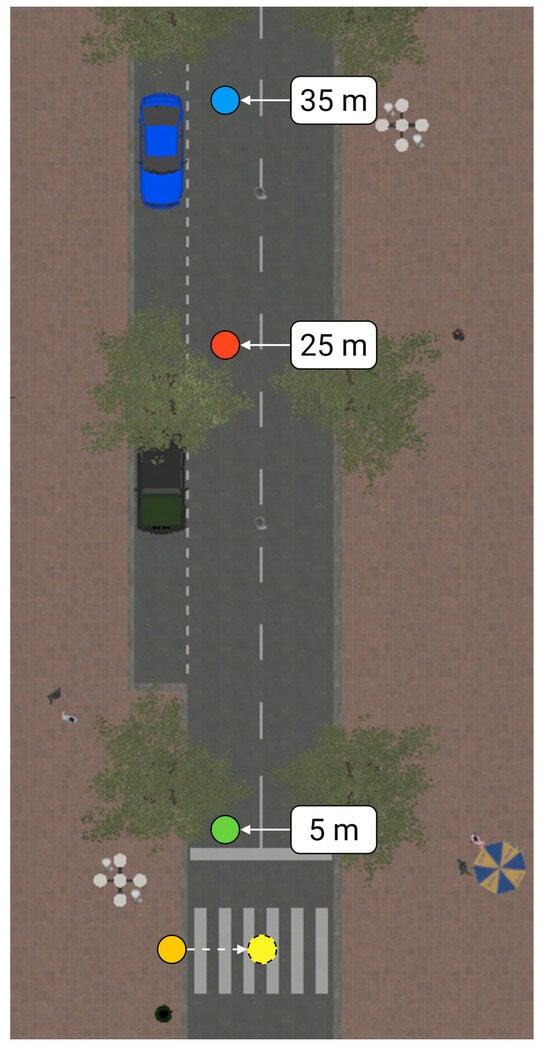
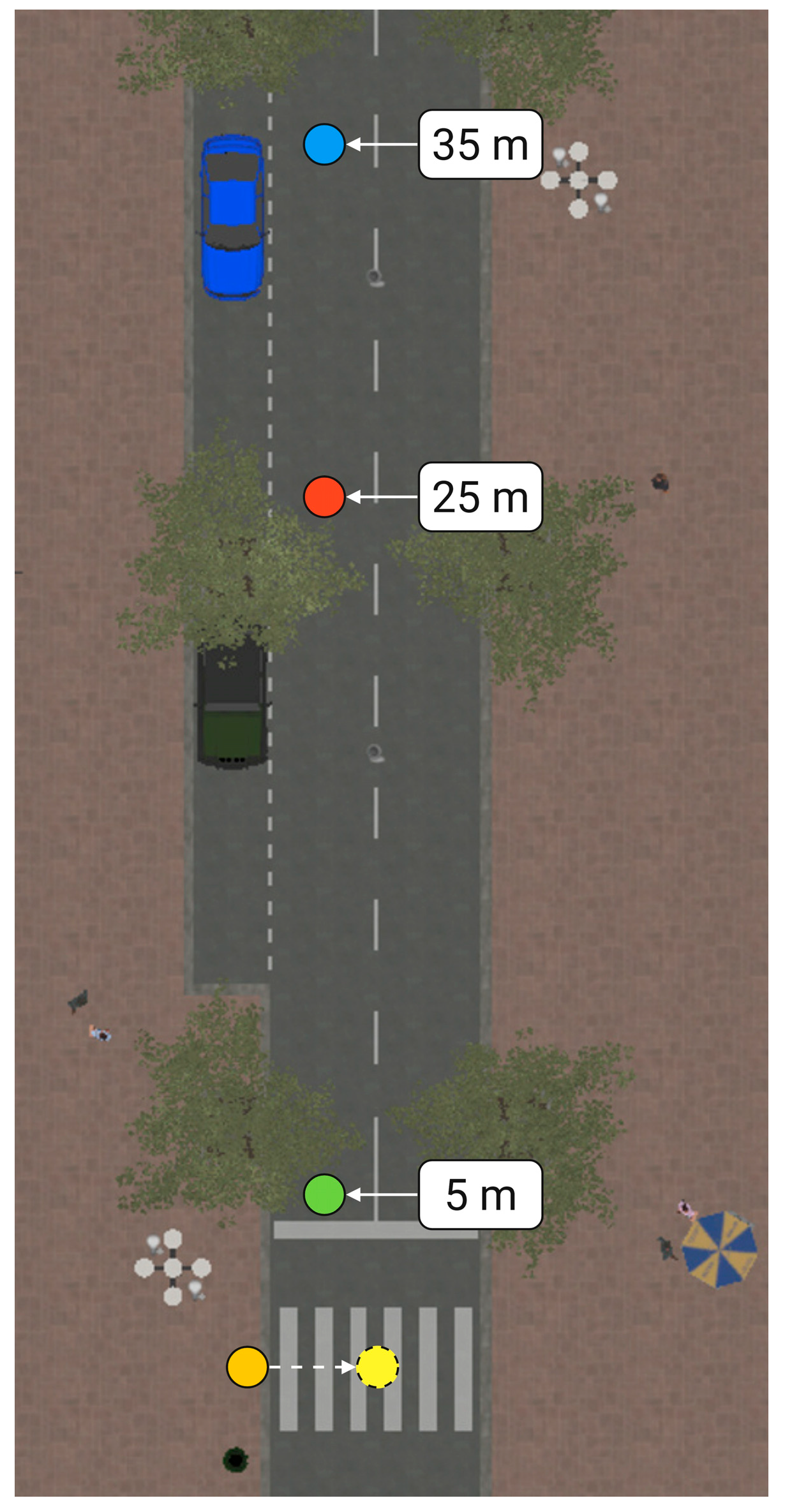
At the beginning of each trial, the participant pressed the button, causing the vehicles to start moving. Figure 5 shows the participant’s position within the virtual environment. The initial distance of the vehicles from the crosswalk depended on their approaching speed and the time gap between them. During non-deceleration trials, the vehicles maintained a constant speed (35, 40, 45, or 50 km/h) and a fixed time gap (2, 3, or 4 s), passing the pedestrian without stopping. The eHMI indicated either yielding or non-yielding behavior at 35 m from the pedestrian (see Figure 5). This activation distance was based on findings from earlier research [23], existing literature [12,27], and the experimental design requirements. Activating the eHMI earlier could lead to premature responses before the first vehicle passed, while later activation might lessen the signal’s relevance. The crosswalk’s dimensions and features are identical to those in previous research.
Figure 5.
Top-down view of the virtual environment displaying key points relevant to the experiment. The blue marker indicates the activation point for the eHMI, positioned 35 m from the pedestrian’s location, marked in yellow. The red marker shows the deceleration point 25 m from the pedestrian’s position. The green marker marks the vehicle’s stopping position.
In deceleration trials, the vehicles began to slow down 25 m from the pedestrian and consistently stopped 5 m from the crosswalk (see Figure 5). This stopping distance was consistent across all trials, with deceleration rates adjusted to match the four approaching speeds: 2.36 m/s2 for 35 km/h, 3.09 m/s2 for 40 km/h, 3.91 m/s2 for 45 km/h, and 4.83 m/s2 for 50 km/h. The researchers selected these deceleration rates to align with thresholds established in prior studies, such as gentle deceleration at 2.4 m/s2 [28] and hard braking at 5.17 m/s2 [29].
To prevent participants from exploiting the button-pressing mechanism or behaving unrealistically, the researchers sometimes introduced a random high-speed vehicle into the simulation. This vehicle traveled through the virtual environment at much higher speeds than typical urban traffic, reminding participants to make careful decisions when crossing the road.
2.4. Experimental Procedure
Upon arrival in the simulator room, participants were introduced to the VR equipment by the research team. Before the experiment began, participants were asked to read and sign a consent form outlining the study’s purpose and their role. The researchers then described the experimental process, which involved interacting with autonomous vehicles in a virtual environment. They indicated where participants should stand and explained the scenario: two vehicles would approach the pedestrian crossing, with the first a traditional human-operated car and the second an autonomous vehicle.
Participants were instructed to press a button when they determined it was safe to cross the street, aiming to cross between the two vehicles. If the button was pressed prematurely, a warning message was displayed. The researchers encouraged participants to act as naturally as they would in a real-life situation.
The research team briefed participants on the eHMI signals displayed by the autonomous vehicle, clarifying the meaning of each design. A steady light band indicated the vehicle was yielding, while a flashing light band signaled non-yielding behavior. After this explanation, participants were given the opportunity to ask questions. To ensure clarity, researchers also informed participants that the AV was a Level 5 fully autonomous vehicle with no driver present [30].
Before the main experiment, participants took part in a short practice session to familiarize themselves with the virtual environment and their task. During this session, they experienced different experimental conditions and learned that virtual accidents could occur if they attempted to cross too late. A crash sound and an on-screen message notified them of such incidents, while successful crossings were confirmed with a positive on-screen message.
At the start of each trial, participants began the simulation by pressing a button, which caused the vehicles to move towards the crosswalk. They could then press the button again to indicate their intention to cross between the vehicles or choose not to cross by not pressing the button at all. Once the last vehicle had passed, participants pressed the button to proceed to the next trial. This process continued until all conditions within the block were completed.
The experiment was organized into three blocks, each lasting around ten minutes. Participants were informed that they could take breaks between blocks as needed. Additionally, they were required to complete a Simulator Sickness Questionnaire (SSQ) both before and after the session, following the protocol of an earlier study by the same researchers using a CAVE-type simulator.
2.5. Statistical Analysis
The researchers examined four behavioral measures related to how participants crossed the street: accepted crossings, collisions, safety margin, and CIT, each of which is explained further in Section 3. Collisions and safety margin were calculated to enable comparison with findings from an earlier CAVE-based study. For the statistical evaluation, the team used Generalized Linear Mixed Models (GLMMs) with a binomial response and a logit link, as well as Linear Mixed Models (LMMs). The threshold for significance was set at 0.05, and Bonferroni-corrected post hoc tests were applied where appropriate.
The analysis included vehicle speed (35, 40, 45, or 50 km/h), eHMI status (On/Off), and the time gap between vehicles (2, 3, or 4 s) as fixed experimental variables. For participant-related factors, variables such as age, sex (coded as Female/Male), education level (coded as 1 to 4), familiarity with AVs (rated on a scale of 1 to 3), and trust in AVs (Yes/No) were considered. Within the models, eHMI presence (On/Off) and yielding behavior (Yes/No) were entered as distinct binary predictors, allowing the analysis to separate the influence of explicit communication from that of yielding intention. Their interaction term represented situations where yielding or non-yielding actions were signaled via the eHMI.
To simplify the models and ensure they would converge reliably, familiarity with AVs was recoded from an initial 5-point Likert scale to three levels: ratings of 1 were labeled as unfamiliar (level 1), ratings of 2 and 3 as familiar (level 2), and ratings of 4 and 5 as very familiar (level 3). Model development was guided by evaluation metrics such as the Akaike Information Criterion (AIC), Bayesian Information Criterion (BIC), Intraclass Correlation Coefficient (ICC), Root Mean Square Error (RMSE), and conditional R-squared. The researchers used Likelihood Ratio Tests with ANOVA to determine whether adding new variables significantly improved the models.
To address the non-independence of the data, random effects for individual participants were included. The team rigorously checked the assumptions underlying the LMMs, including linearity, normality, homoscedasticity, the absence of collinearity among fixed effects, and the absence of influential data points.
For the GLMMs, the researchers assessed the normality of the random effects and checked for multicollinearity. They confirmed that all assumptions for both LMMs and GLMMs were met. Variance Inflation Factors were also calculated for all predictors, indicating no significant multicollinearity among the model variables.
3. Results
The researchers conducted a total of 5904 trials, with 41 participants each completing 48 trials across three experimental blocks. The experiment ran smoothly, with no recording issues, which ensured the integrity and reliability of the data collected.
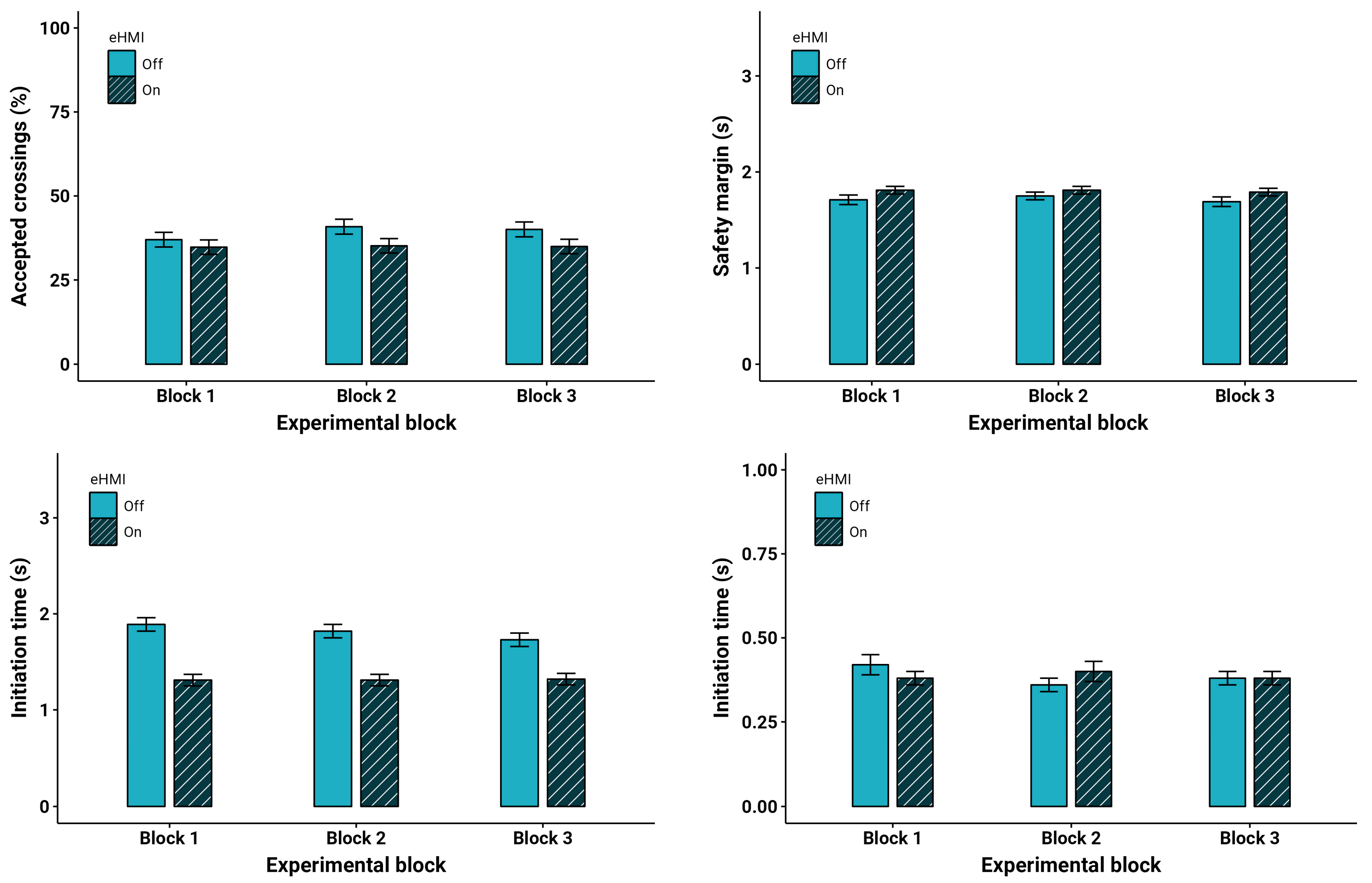
To evaluate potential learning effects, the researchers analyzed the data for trends across the three experimental blocks. These blocks appeared in a randomized order but had identical conditions. The influence of the experimental block on accepted crossings, safety margin, and CIT was found to be non-significant. The following sections offer a detailed description of these measures. Figure 6 shows the observations for each parameter according to eHMI status, divided by experimental block.
Figure 6.
Mean data of the observations in each experimental block: accepted crossings (top left), safety margin (top right), CIT for yielding vehicles (bottom left), and CIT for non-yielding vehicles (bottom right). Error bars indicate the Standard Error (SE).
3.1. Accepted Crossings
3.1.1. Non-Yielding Vehicles
The researchers determined the rate of accepted crossings by dividing the number of crossings by the total number of trials, focusing exclusively on the non-decelerating trials. Refer to Table 1 for the means and standard deviations (SD).
Table 1.
Mean and SD of accepted crossings (%) for each vehicle speed, time gap, and eHMI status in non-yielding vehicles.
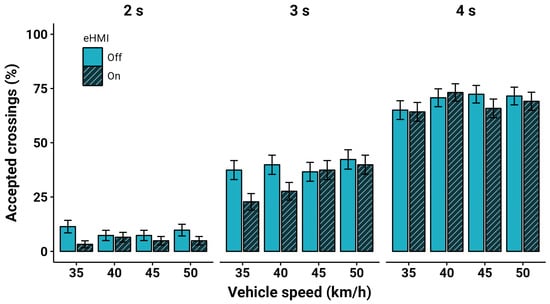
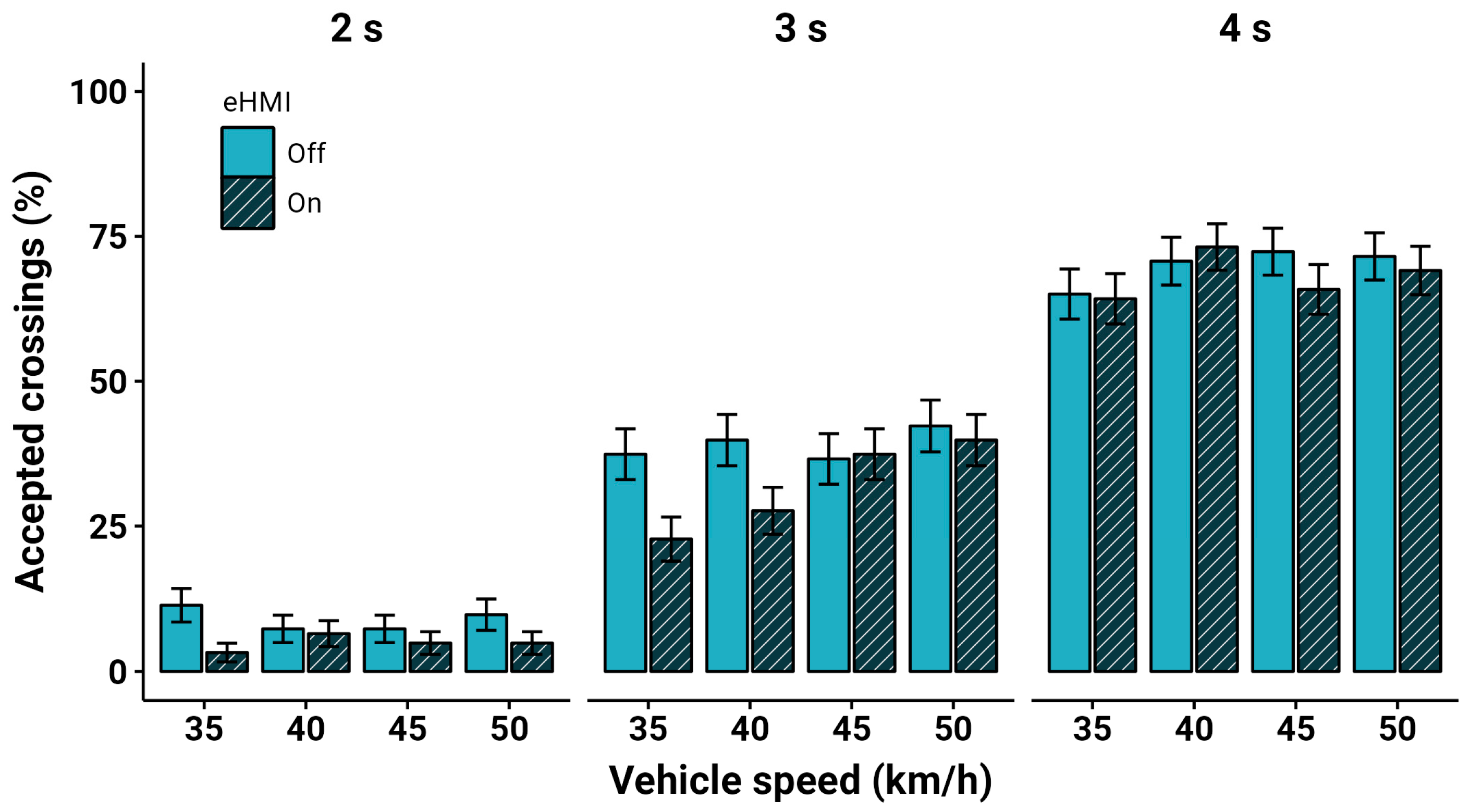
Figure 7 illustrates the accepted crossings for each time gap based on vehicle speed and eHMI status. All participants successfully crossed the road for the decelerating trials, as noted in Section 3.1.2.
Figure 7.
Mean acceptance rate of crossings (%) for non-yielding vehicles at each time gap, based on vehicle speed and eHMI status (error bars indicate the SE).
The analysis began by identifying the model that best fits the observed data, following the procedure described in Section 2.5. Vehicle speed, time gap, eHMI status, participants’ familiarity with AVs, and educational background all contributed significantly to the model’s performance. The researchers explored the inclusion of random slopes but found that adding them did not significantly improve the model’s performance. They also found no significant interactions among the factors. Table 2 presents a summary of the model outcomes.
Table 2.
Results of the GLMM estimation for accepted crossings in non-decelerating trials.
The statistical analysis and observed participant behavior identified several critical factors that influenced accepted crossings: vehicle speed, eHMI status, time gap, familiarity with AVs, and educational background. Interestingly, the model showed a higher likelihood of crossing for vehicles traveling at 50 km/h. This result contrasts with previous research by the authors, which reported lower crossing probabilities at higher vehicle speeds. The time gap may partly explain this discrepancy; however, researchers did not find any significant interaction between vehicle speed and time gap, or other factors.
Researchers conducted a supplementary analysis to test the interaction between vehicle speed and time gap. The analysis revealed that this interaction did not significantly improve the model’s performance, as determined by a Likelihood Ratio Test using ANOVA; therefore, it was excluded to avoid unnecessary model complexity.
Nonetheless, the results displayed a consistent pattern with the model presented in Table 2 for time gaps of 2 or 3 s. However, when the time gaps reached 4 s, the probability of crossing decreased as the vehicle speed increased. This finding suggests that, with smaller time gaps, pedestrians may focus less on vehicle speed and more on the perceived time available to cross the road.
Participants crossed more frequently when vehicles approached at 50 km/h, 45 km/h, and 40 km/h compared to those traveling at 35 km/h (refer to Table 1 and Figure 7). This pattern indicates that participants were more inclined to cross when vehicles approached at speeds exceeding 35 km/h.
In contrast to the previous study by the same authors, where participants tended to cross more often when the eHMI signaled that the vehicle was not stopping, participants in this experiment crossed less often when the eHMI indicated the car would not stop. The model revealed a lower probability of crossing in scenarios where the eHMI was active than in those without vehicle-pedestrian communication.
The experimental design and the level of immersion provided by the equipment likely account for these differences. The more realistic simulation environment in the current experiment likely heightened participants’ attention and changed their perception of risk, which influenced their crossing behavior.
Participants with higher levels of education crossed less frequently, while those with greater familiarity with AVs crossed more often. These findings align with previous studies, which suggest that increased familiarity with AVs encourages more cautious crossing behavior. However, the analysis did not reveal any significant interactions between these factors and others, so some aspects of these effects remain unexplained.
In the three-second gap condition for vehicle speeds of 35 and 40 km/h, participants’ behavior changed, especially with respect to the eHMI status (refer to Figure 7). The number of accepted crossings increased significantly when the eHMI was inactive. The timing of eHMI activation likely explains this phenomenon.
For a three-second gap, after the first vehicle passed, the AV’s distance from the participant was less than 35 m at 35 and 40 km/h (see Table 3). In these cases, the eHMI was already active as the gap opened, which led to significant differences between active and inactive eHMI conditions. At 45 and 50 km/h, however, the AV’s distance from the participant exceeded 35 m when the gap opened, so the eHMI remained inactive. As a result, differences between active and inactive eHMI conditions were negligible at these higher speeds, as Figure 7 shows.
Table 3.
Distance (m) between AV and participant after the first vehicle passes for each speed and time gap. The eHMI conditions (active vs. inactive) are represented by different colored cells.
Therefore, eHMI visibility significantly influenced participants’ crossing decisions in the three-second gap condition, particularly at lower vehicle speeds.
The AV’s communication of non-yielding behavior significantly reduces the crossing rate. However, when time gaps increase to 4 s, the eHMI often remains inactive when participants decide to cross. Although greater vehicle speeds predict a higher probability of crossing, the AV’s increased distance during decision-making means the eHMI does not activate.
While the statistical model did not detect any significant interactions, this observation may help explain why participants display atypical crossing behavior at higher vehicle speeds. The lack of eHMI communication at critical moments could influence participants’ decisions, especially in scenarios with higher speeds and larger gaps.
3.1.2. Yielding Vehicles
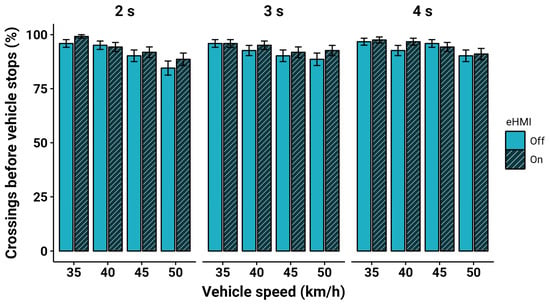
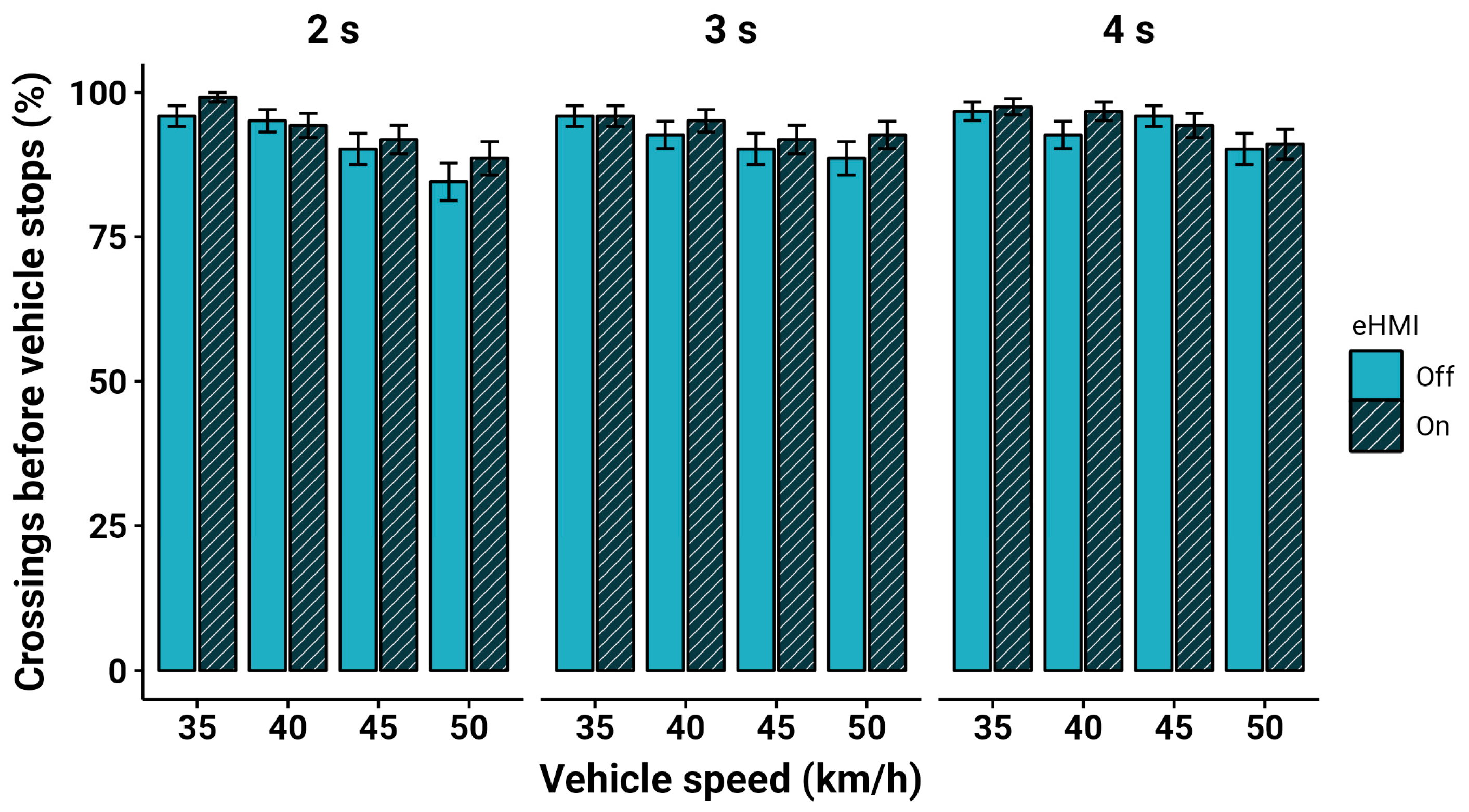
This section examines how often participants crossed before the vehicle fully stopped during the decelerating trials. To find this rate, we divided the number of crossings observed before the car came to a complete stop by the total number of trials (see Table 4 for means and standard deviations). Figure 8 illustrates the rate of crossings before the vehicle stops, plotted as a function of vehicle speed and eHMI status, and broken down by the time gap between vehicles.
Table 4.
Mean and SD of crossings before vehicle stops (%) for each vehicle speed, time gap, and eHMI status during yielding vehicles.
Figure 8.
Mean rate of crossings before vehicle stops (%) for yielding vehicles as a function of vehicle speed, time gap, and eHMI status (error bars represent the SE).
In the initial stage of the analysis, we focused on identifying the model that best fits the observed data. Following the procedure described in Section 2.5, we found that vehicle speed, eHMI status, and time gap were the key factors contributing to the model’s improved performance. We did not detect any significant interactions among these factors. Table 5 below summarizes the model outcomes.
Table 5.
Results of the GLMM estimation for crossings prior to vehicle stops during the decelerating trials.
The model suggests that as vehicle speed increases during the non-decelerating trials, participants are less likely to cross before the vehicle comes to a full stop. This suggests that participants prefer to cross earlier when the car yields and approaches at higher speeds.
The presence of the eHMI also greatly influences participants’ crossing decisions. When the vehicle signals its intention to stop through the eHMI, participants tend to cross earlier than in situations without an eHMI. The amount of time gap between vehicles further affects this behavior, as larger gaps make participants more likely to cross before the vehicle has fully stopped.
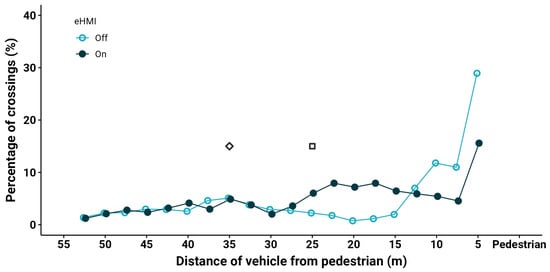
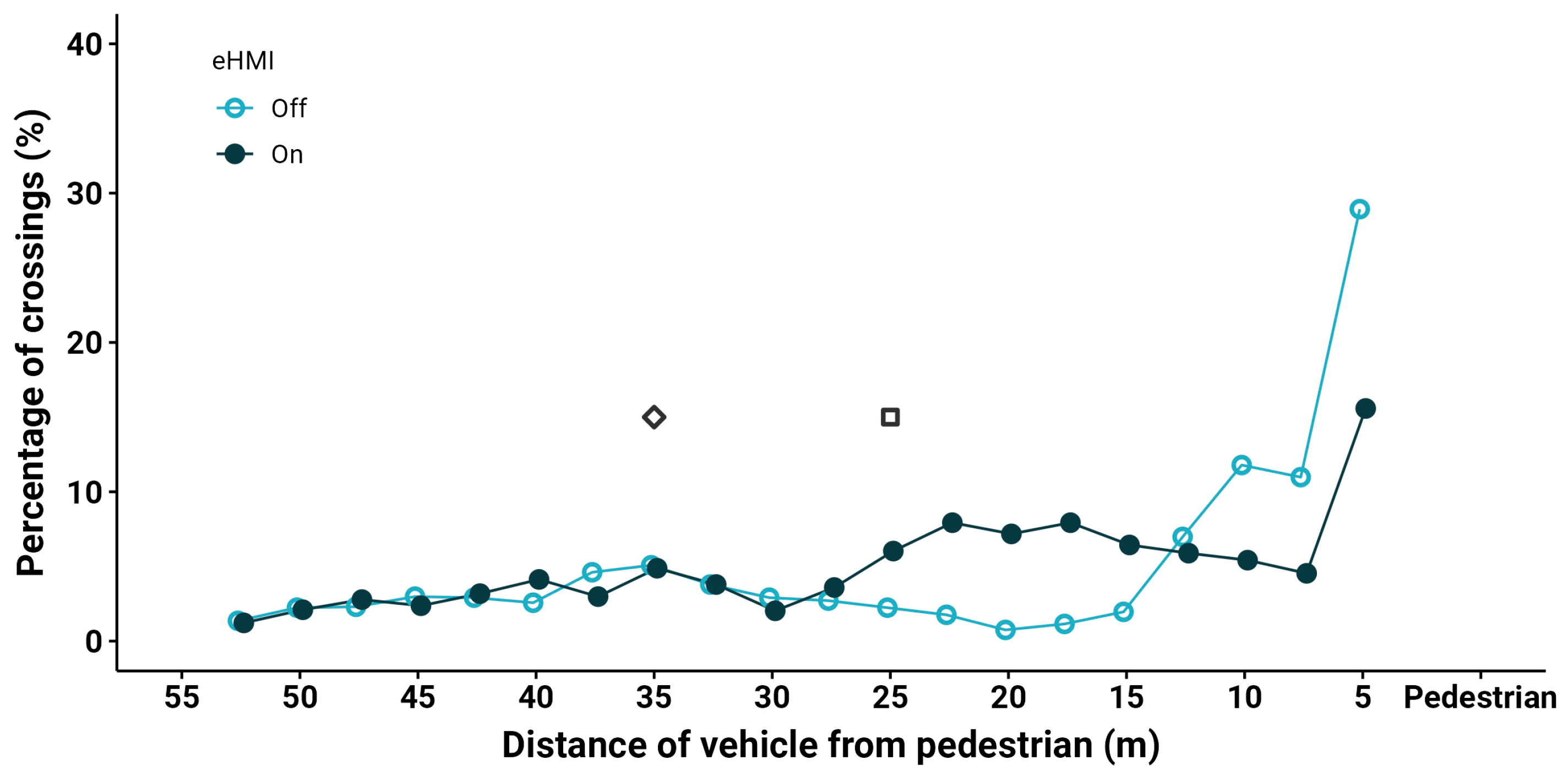
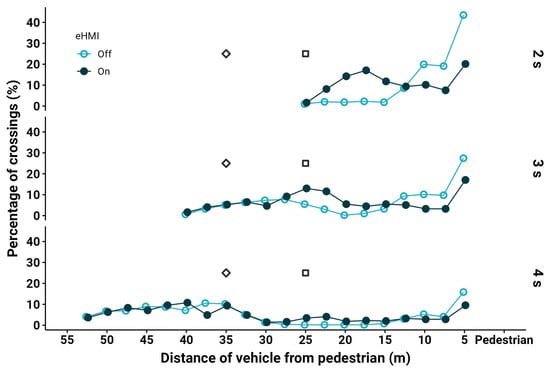
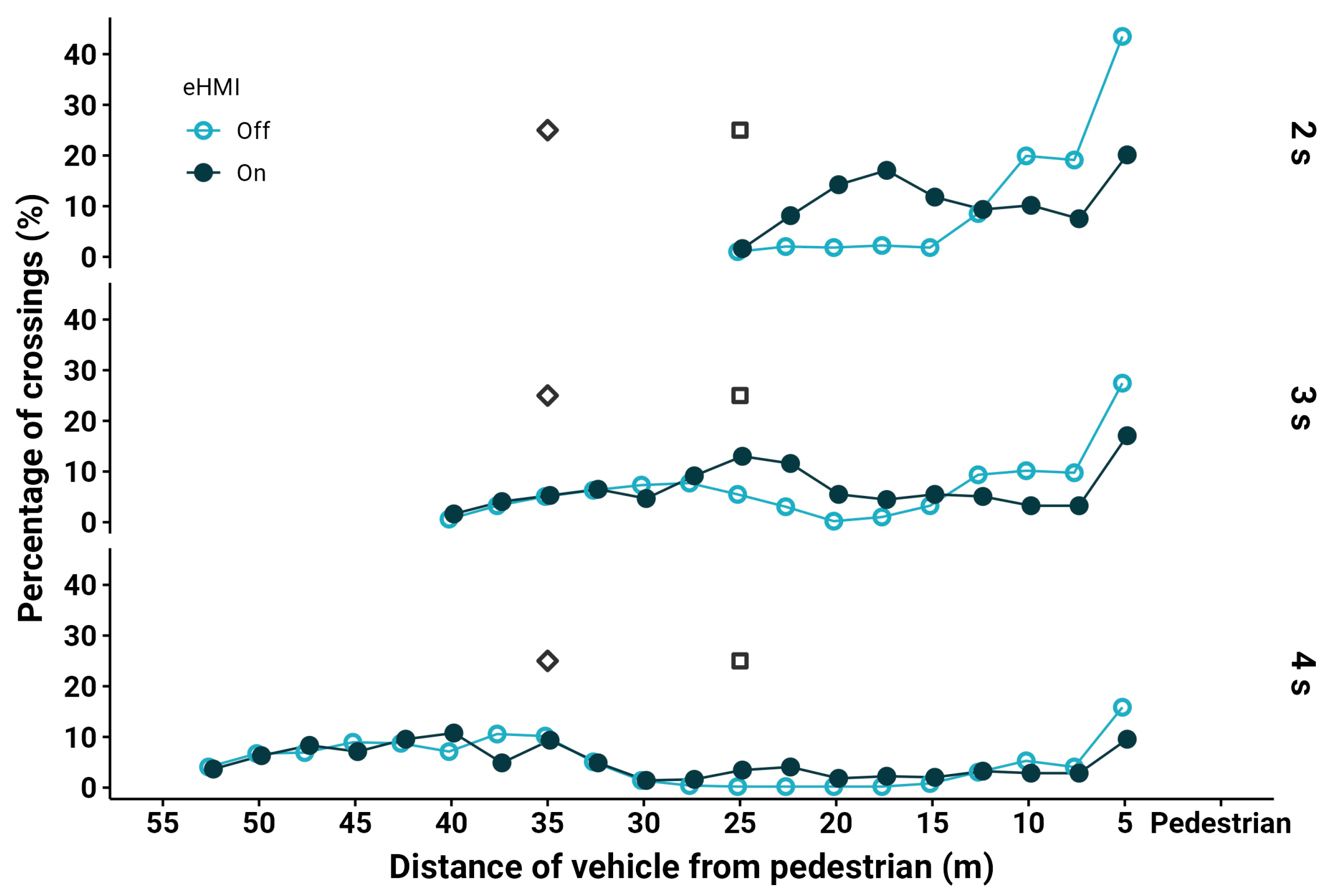
In the decelerating trials, all participants successfully crossed the road. Figure 9 and Figure 10 display the different patterns observed under conditions with and without the eHMI, emphasizing the estimated distance between the vehicle and the pedestrian when participants chose to cross.
Figure 9.
Percentage of crossings (%) for yielding vehicles based on the vehicle’s distance from pedestrians and eHMI status. The diamond marker indicates the distance at which the eHMI was activated for each participant. The square marker indicates the point where the vehicle begins to decelerate. The car always stopped five meters away from the pedestrian.
Figure 10.
Percentage of crossings (%) for yielding vehicles at each time gap based on the vehicle’s distance from pedestrians and eHMI status. The diamond marker shows where the eHMI was activated for the participants. The square marker indicates the point where the vehicle begins to decelerate. The car always stopped five meters away from the pedestrian.
Figure 9, when categorized by eHMI status, indicates that most crossings occur after the vehicle has decelerated. During the 2 s interval, the experimental constraints usually prevent participants from having enough time to start crossing before this point.
The eHMI most strongly influences crossing decisions when the pedestrian is within 25 m to 15 m. This influence is most evident in the 2 s and 3 s time gaps, as shown in Figure 10. However, once the vehicle is beyond 30 m, participants do not exhibit any significant changes in their crossing behavior, indicating that the eHMI does not encourage them to cross earlier at this distance.
As the vehicle approaches closer (between 15 m and 5 m), the influence of the eHMI diminishes. In this range, more crossings occur without the eHMI, indicating that the eHMI has a lesser effect on crossing behavior when the vehicle is nearby.
3.2. Collisions
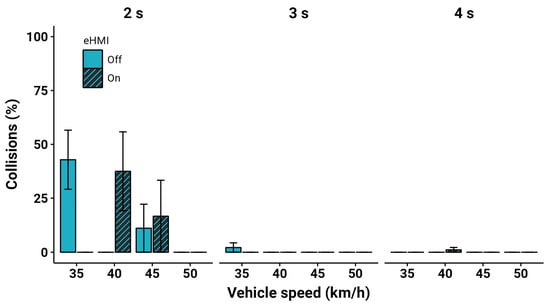
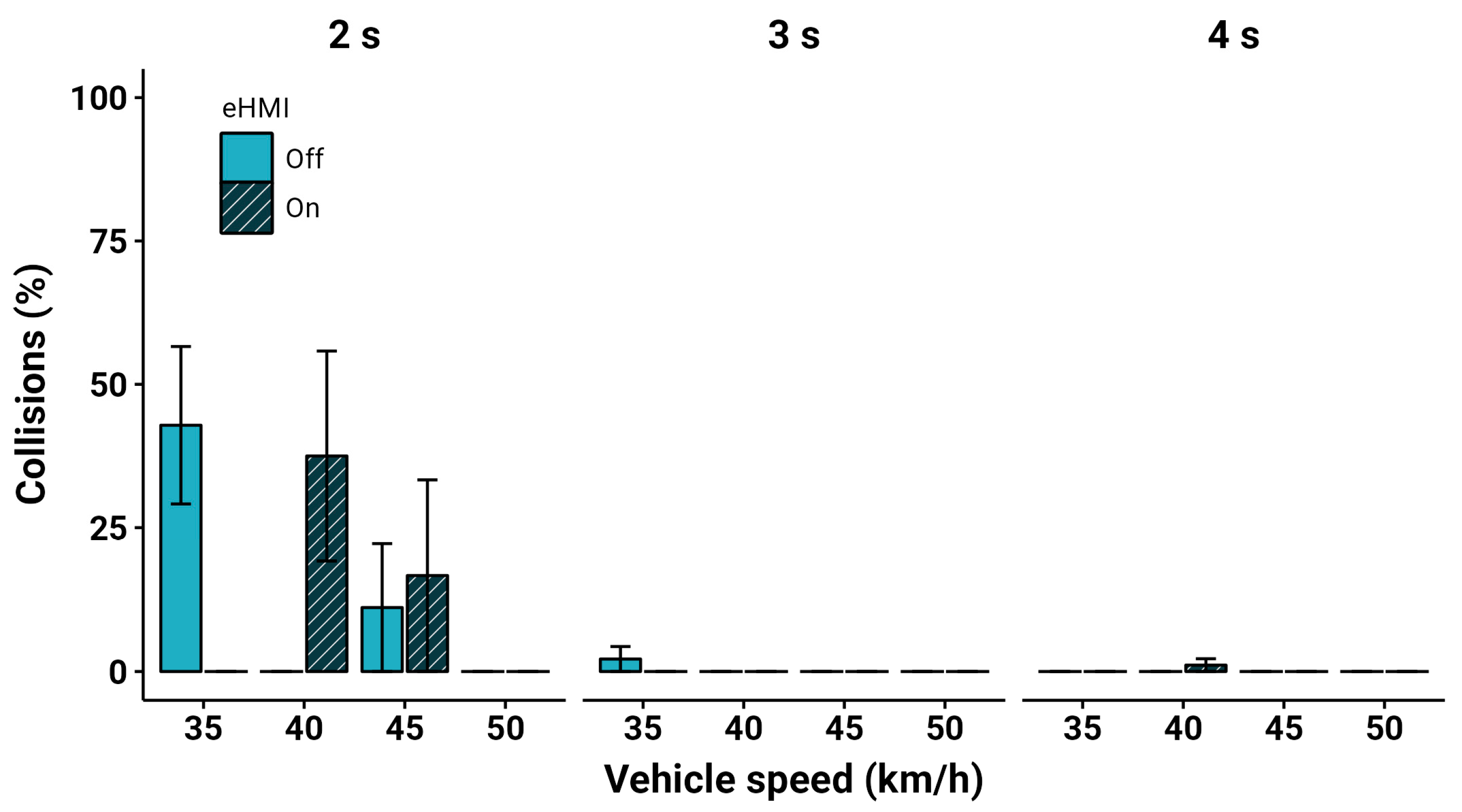
This study defined a collision as any virtual contact between the AV and the participant. The system played a sound whenever the vehicle approached the participant, allowing them to safely cross the road before the vehicle arrived. This ensured participants were aware of these incidents. Participants could only cross between cars, so only the AV and the participant could collide. Participants started crossing by pressing a button instead of physically walking, so the researchers used a predefined walking speed based on the vehicle’s speed. These average crossing speeds are from previous research [23]. Specifically, vehicle speeds of 35, 40, 45, and 50 km/h corresponded to crossing speeds of 1.38, 1.51, 1.69, and 1.82 m/s, respectively.
The researchers calculated the collision rate by dividing the number of collisions by the total accepted crossings, focusing only on non-decelerating trials (see Table 6 for means and SD). Figure 11 displays the collision rate as a function of vehicle speed and eHMI status, segmented by time gap.
Table 6.
Mean and SD of collision rates (%) for each vehicle speed, time gap, and eHMI status in non-yielding vehicles. Empty cells indicate no collisions.
Figure 11.
Mean collision rate (%) for the non-yielding vehicles for each time gap as a Mean collision rate (%) for non-yielding vehicles at each time gap as a function of vehicle speed and eHMI status (error bars represent the SE).
In this case, researchers observed only a small number of collisions, which did not provide enough subject-level variation to justify including random effects in the modeling process. Therefore, they fitted a binomial GLM instead. The model used vehicle speed, eHMI status, and time gap as factors. Researchers also found no significant interactions between these variables. Table 7 presents a summary of the model results.
Table 7.
Results of the GLMM estimation for collisions in the non-decelerating trials.
While the model explains a moderate amount of variance (Tjur’s R-squared = 0.21), the probability of a collision decreases as the time gap increases. The speed of the approaching vehicle and the eHMI condition did not significantly influence the likelihood of a crash in these trials. However, higher vehicle speeds increased the risk of collision. Although the model did not find the eHMI to be a statistically significant factor, having the eHMI active suggests a higher likelihood of collisions, indicating that the vehicle will not stop.
3.3. Safety Margin
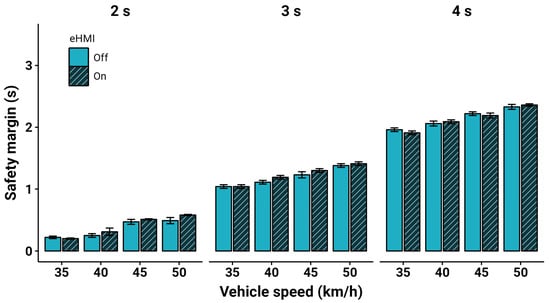
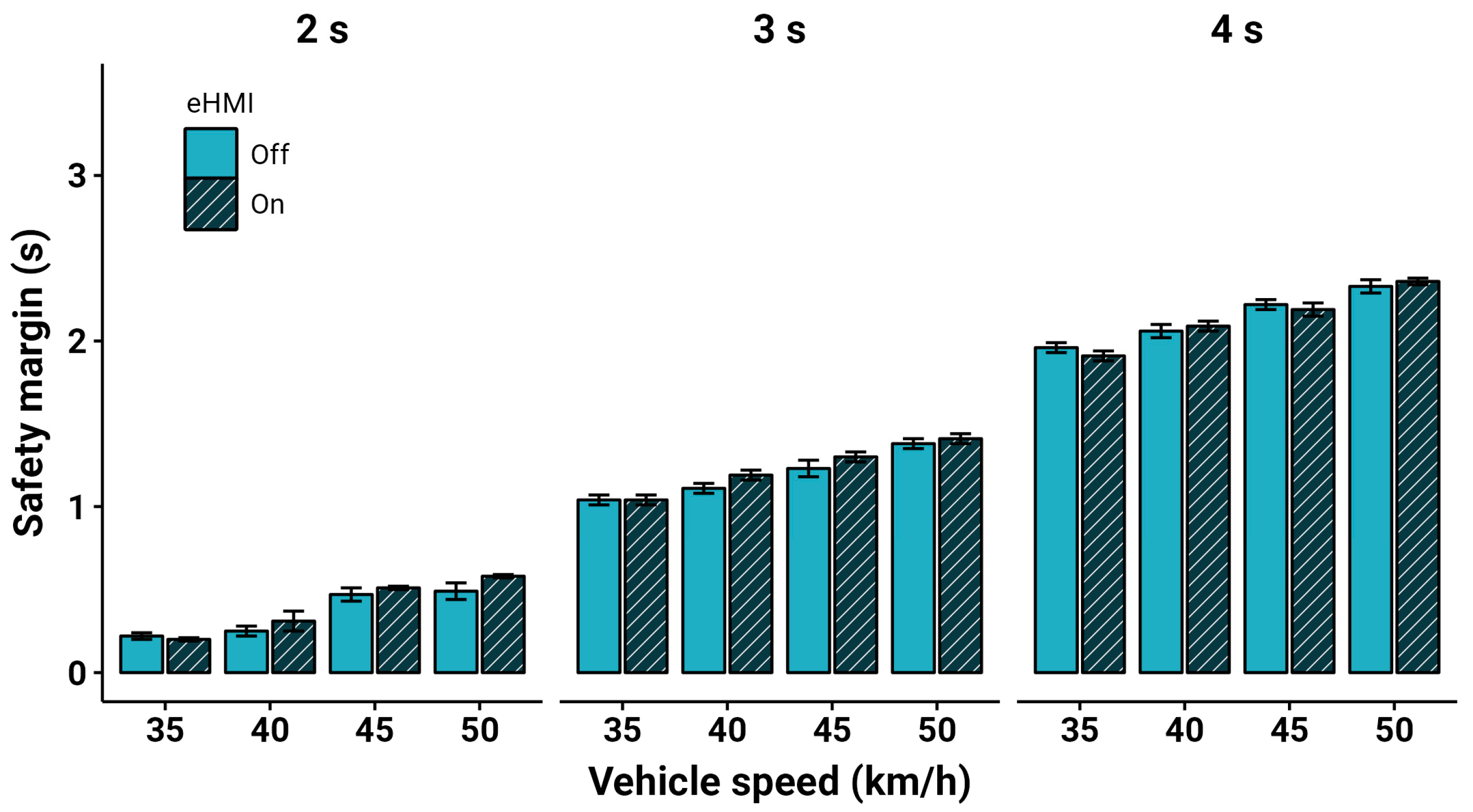
We calculated the safety margin for each crossing in the non-decelerating trials, excluding collisions. This measure represents the time between when the participant crosses the vehicle’s path (considering the vehicle’s front-end width) and when the car reaches the participant’s crossing line. We derived the safety margin using the pedestrian crossing speeds shown in Section 3.2. Table 8 presents the means and standard deviations, while Figure 12 displays the safety margin as a function of vehicle speed and eHMI status, divided by time gap.
Table 8.
Mean and SD of safety margin (s) for each vehicle speed, time gap, and eHMI status in non-yielding vehicles.
Figure 12.
Mean safety margin (s) for non-yielding vehicles at each time gap as a function of vehicle speed and eHMI status (error bars show the SE).
The researchers conducted the statistical analysis using LMMs, following the procedure outlined in Section 2.5. They excluded seven participants from the analysis: six who consistently behaved in a highly conservative manner and never attempted to cross before the vehicle reached the crosswalk, and one who became involved in a collision while trying to cross. These participants were excluded because a meaningful safety margin could not be defined for these trials. This exclusion does not reflect a judgment about participant behavior but rather a methodological constraint of the safety margin metric, which requires a completed, collision-free crossing to be computed.
Vehicle speed, time gap, eHMI status, and participants’ age explained the variations in the safety margin most effectively. The analysis did not reveal any significant interactions among these factors. Table 9 presents a summary of the model results.
Table 9.
Results of the LMM estimation for the safety margin in the non-decelerating trials.
In this experiment, vehicle speed, time gap, and participants’ age influenced the safety margin. Although the model did not identify eHMI status as statistically significant, vehicles that signaled they would not stop slightly reduced the safety margin. Compared to the author’s previous research using a CAVE-type pedestrian simulator [23], participants’ age showed a similar trend, but the effect was less pronounced, with the safety margin decreasing by 0.01 s for each additional year of age.
Interestingly, vehicle speed influenced the safety margin differently in the two studies. In the previous experiment, higher vehicle speeds resulted in a larger reduction in the safety margin, giving participants less time to avoid an accident. However, in this study, higher vehicle speeds resulted in increased safety margins. This difference likely comes from assigning fixed walking speeds to each vehicle speed. As shown in the previous experiment with a CAVE-type pedestrian simulator, participants walked faster when crossing in front of higher-speed vehicles.
In the previous experiment, vehicles signaling they would not stop led to an increased safety margin, highlighting the importance of the eHMI. In contrast, this experiment showed a different trend. Although the model did not find the eHMI statistically significant, its presence slightly lowered the safety margin. Additionally, the time gap between vehicles was a key factor, as larger gaps resulted in greater safety margins.
3.4. Crossing Initiation Time
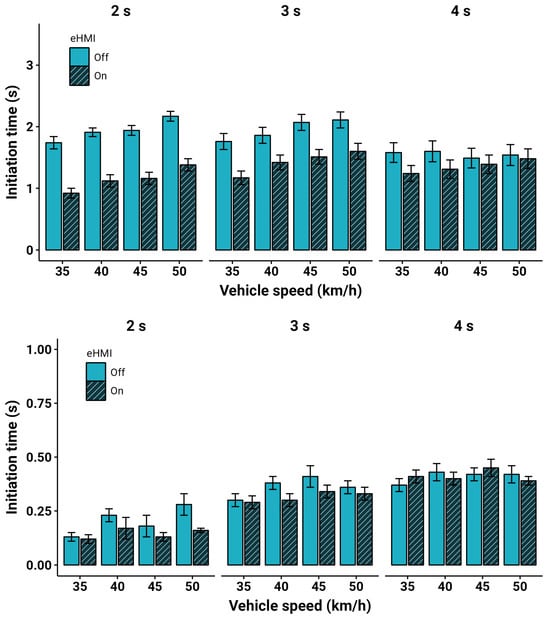
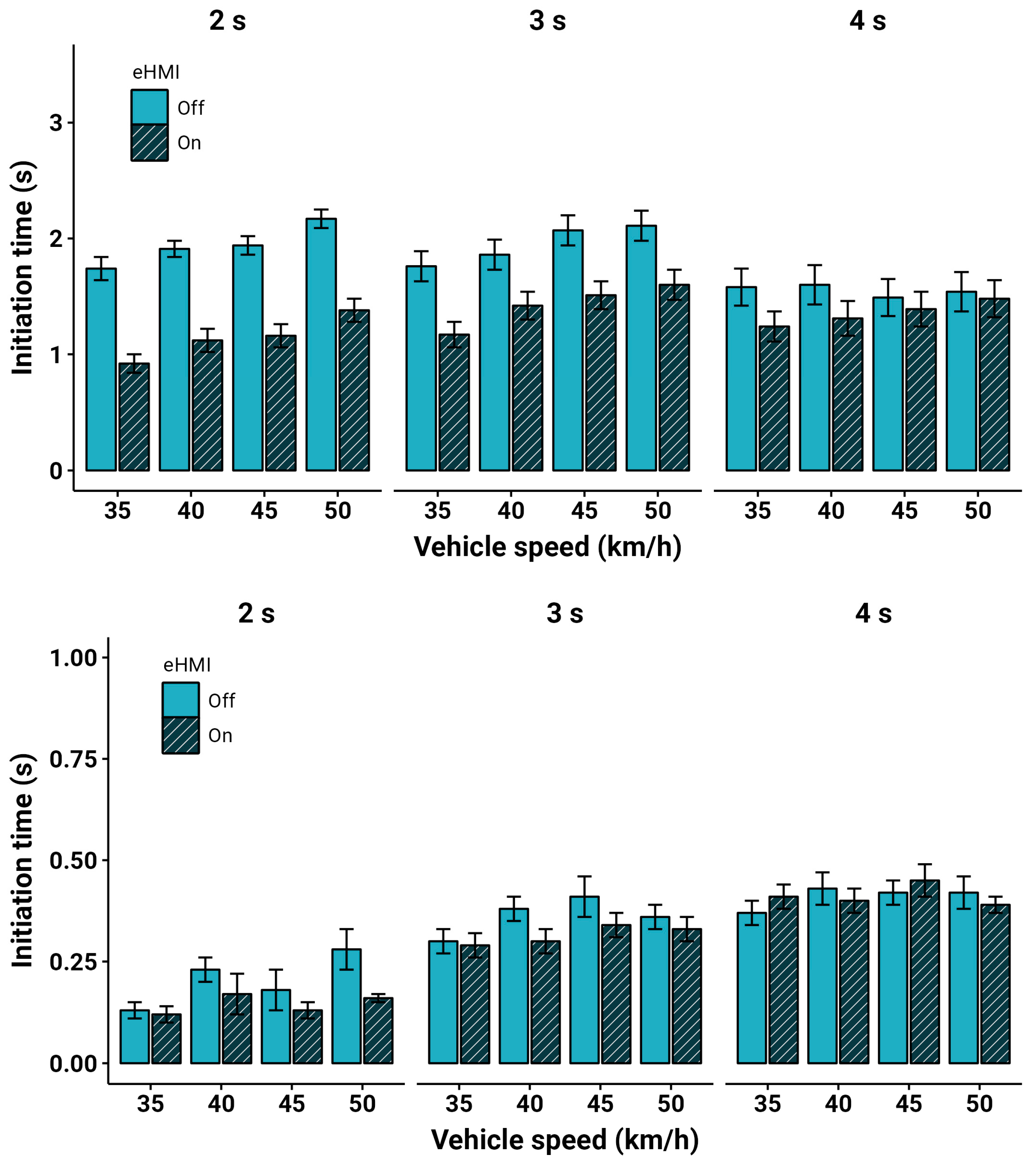
We calculated the initiation time for each accepted crossing in decelerating and non-decelerating trials (see Table 10 for means and standard deviations). We excluded collision data from the analysis. CIT indicates how long participants took to begin crossing after the rear of the first vehicle passed in front of them. According to the experimental design, participants could initiate crossing only after the first vehicle cleared their path. This approach prevented negative CIT values, which appeared in the study conducted by Pala et al. [31]. Figure 13 shows CIT as a function of vehicle speed and eHMI status, separated by time gap, for both decelerating and non-decelerating trials.
Table 10.
Mean and SD of CIT (s) for each vehicle speed, time gap, and eHMI status in non-yielding and yielding vehicles.
Figure 13.
Mean CIT (s) for each time gap as a function of vehicle speed and eHMI status (error bars show the SE): yielding vehicles (top), non-yielding vehicles (bottom).
The researchers conducted the statistical analysis using LMMs, in line with the method outlined in Section 2.5. Vehicle speed, time gap, eHMI status, vehicle yielding behavior, and participants’ familiarity with AVs emerged as the variables that best explained the safety margin. Table 11 summarizes the results of the model.
Table 11.
Results of the LMM estimation for the CIT in both the decelerating and non-decelerating trials.
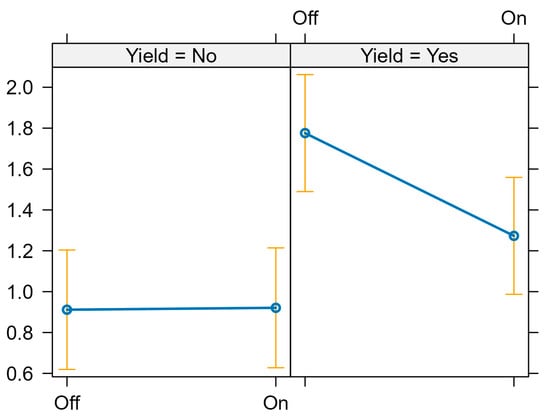
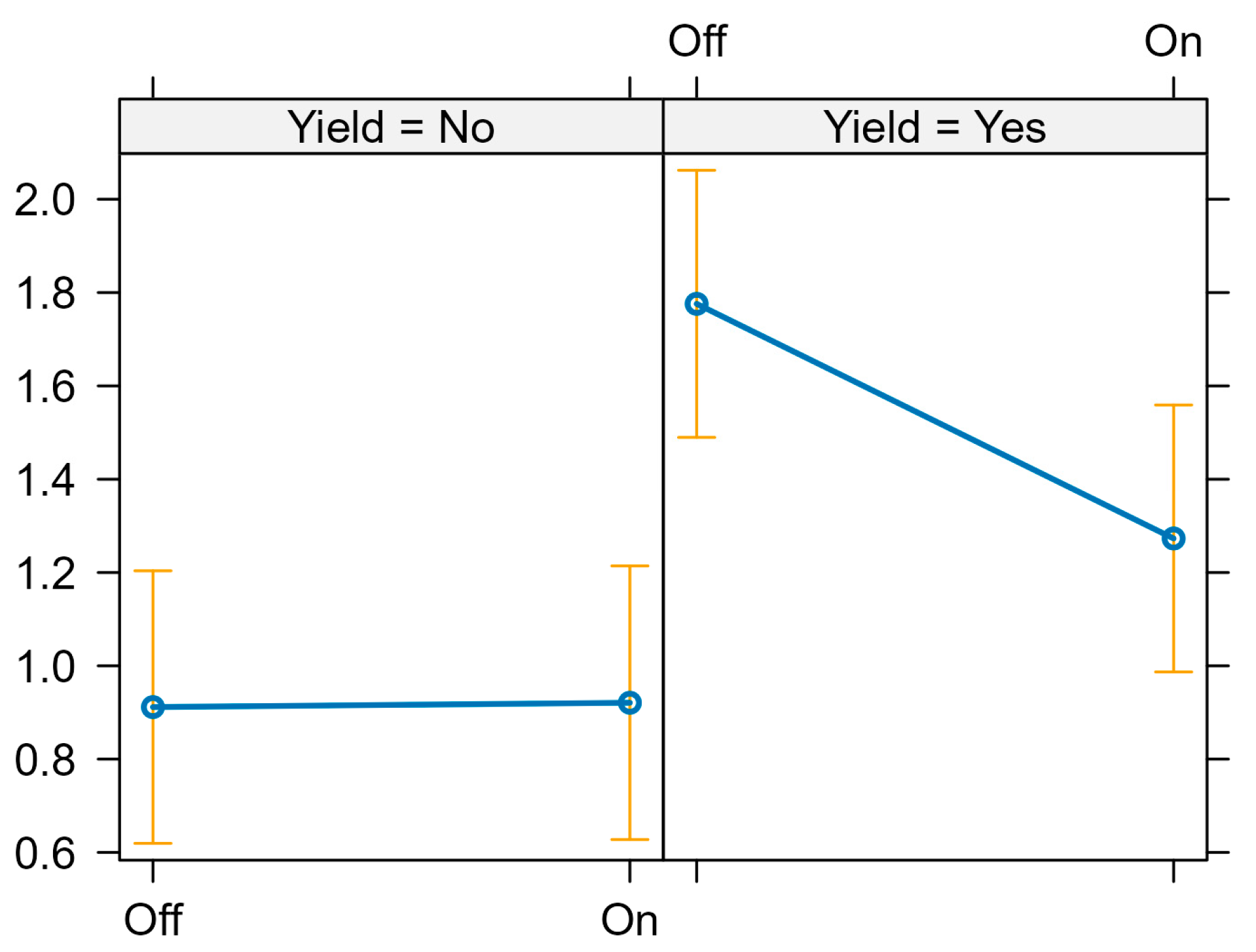
The analysis revealed a significant interaction between eHMI status and the vehicle’s yielding behavior. Table 12 presents the results of the post hoc analysis for this interaction, with t-tests estimated using Bonferroni’s method.
Table 12.
Post hoc analysis of the interaction between eHMI status and yielding behavior.
The model showed that vehicle speed, time gap, eHMI status, familiarity with AVs, and vehicle yielding behavior all significantly affected CIT. Notably, higher vehicle speeds led to increased CIT, meaning participants took longer to initiate crossing as vehicles approached more quickly. This pattern suggests that participants more easily perceived the available gap when vehicles approached at lower speeds, allowing them to make quicker crossing decisions. Previous studies have reported similar behavior [31].
Notably, the vehicle’s yielding behavior significantly influenced CIT, regardless of eHMI status, with participants showing significantly higher CIT values when the vehicle yielded. The impact of eHMI status on CIT became particularly clear in yielding scenarios, as participants took longer to initiate crossing when the eHMI remained inactive. This finding indicates that participants started crossing sooner when the vehicle signaled its intention to stop (see Figure 14).
Figure 14.
Effects of the interaction observed in the model between eHMI status and the vehicle’s yielding behavior.
The time gap unexpectedly influenced the decision to start crossing. Participants showed the highest CIT with a 3 s time gap and the lowest with a 4 s time gap, which deviates from a linear pattern. Although time gap, vehicle speed, and yielding behavior did not significantly interact, the results indicate that participants took longer to initiate crossing with a 3 s gap than with a 2 s gap, but responded more quickly when the time gap was 4 s. This effect may be related to the visibility of the eHMI during decision-making, as discussed in Section 3.1.1 (see Table 3).
Additionally, participants who were more familiar with AVs demonstrated shorter CITs, while those with lower familiarity took longer to initiate crossing. This pattern suggests that participants lacking familiarity with AVs hesitated for a longer period before crossing the road. However, interpret this finding with caution, as this factor showed higher standard errors.
3.5. Questionnaires
3.5.1. First Questionnaire
Participants rated their familiarity with AVs on a scale from 1 (not at all familiar) to 5 (extremely familiar). Approximately 41% indicated some knowledge of AVs, whereas 27% reported being unfamiliar. The mean score indicated a moderate level of familiarity (M = 2.2, SD = 1.0). These findings are comparable to those reported by Almeida et al. [23], suggesting similar familiarity levels across the two studies.
To gauge trust in AVs, participants responded to two questions: how comfortable they felt crossing in front of an AV and whether they believed AVs could recognize pedestrians better than human drivers. Both questions used a scale from 1 (strongly disagree) to 5 (strongly agree). On average, participants reported a neutral level of comfort when crossing in front of an AV (M = 3.2, SD = 0.9). Similarly, their average response to whether AVs could better detect pedestrians than human drivers was also neutral (M = 3.3, SD = 1.0). Responses to the second question tended to be neutral rather than in agreement, which is consistent with earlier research.
3.5.2. Second Questionnaire
Participants rated several AV features on a scale from 1 (not important) to 5 (extremely important). Regarding whether AVs should be visually distinct from traditional human-driven cars, the majority considered this important (mean = 3.6, SD = 1.1), reflecting a general desire for AVs to stand out in appearance. This finding is consistent with prior research using a CAVE-type pedestrian simulator.
When asked about the importance of AVs visually signaling their intentions to pedestrians, participants rated this feature highly (mean = 4.1, SD = 0.9). These results underscore the importance of AVs clearly communicating their actions, enhancing pedestrians’ comprehension and safety. Earlier studies have reported similar findings.
Spearman’s correlation analysis was conducted to examine possible links between participants’ attitudes and their behaviors towards AVs. The analysis identified a positive correlation ( = 0.312, p = 0.047) between participants who felt more at ease crossing in front of AVs and those who believed AVs could recognize pedestrians better than regular vehicles. This suggests that individuals who feel comfortable around AVs also tend to trust their ability to detect pedestrians, mirroring previous experimental outcomes.
The study also found a positive correlation ( = 0.312, p = 0.047) between participants who thought AVs should be visually distinguishable from conventional vehicles and those who favored AVs communicating their intent to pedestrians. However, no significant association was observed between participants’ familiarity with AVs and their opinions on these features, indicating that familiarity did not notably affect their perspectives.
When participants were asked which factor was most important to them when deciding to cross the road, vehicle speed was the most frequently cited criterion, mentioned 19 times. Five participants also highlighted the role of eHMI in their decision-making, and seven noted the interplay between vehicle distance and speed, which determines how much time is available to cross. This question was open-ended to reduce bias from preselected responses.
3.5.3. Simulation Sickness Questionnaire
Before and after the experiment, participants completed the SSQ to establish a baseline and measure any changes that occurred. The questionnaire covered 16 symptoms, with discomfort rated on a scale from 0 (none) to 3 (severe). The symptoms were grouped into three categories: nausea, oculomotor disturbance, and disorientation, following the categories set by Kennedy et al. [32].
Along with the recruited participants, the first two individuals involved in calibrating the equipment were also included in the analysis, bringing the total sample size to 43. Using the scoring procedure described by Deb et al. [33], the mean SSQ score was 5.2, corresponding to “minimal symptoms”.
Because participants remained standing rather than walking, discomfort was more noticeable, particularly after about ten minutes of standing per session before a break, and when they moved their heads. The most frequently reported symptoms were eyestrain (average score: 0.33), fatigue (0.21), and a feeling of fullness in the head (0.18).
Given that participants spent at least 30 min standing in the virtual reality environment, these symptoms were anticipated. The results indicate that the study’s setup is safe and causes only minor discomfort. Nevertheless, it is recommended that future studies avoid significantly increasing the session duration, as longer exposure might worsen these effects. Including walking tasks in subsequent experiments will be vital for evaluating discomfort under more active conditions.
4. Discussion
This study investigated pedestrian crossing behavior in a highly immersive VR environment, focusing on interactions with AVs equipped with dynamic eHMIs. By comparing these findings with earlier research conducted by the authors in a CAVE-style simulator, the study offers new insights into how communication design, traffic context, and immersive methodologies influence pedestrian decision-making. The experiment also explored how CIT varies under different vehicle speeds and gap conditions, providing safety-relevant evidence for the design and standardization of AV-pedestrian communication systems.
The finding that higher vehicle speeds were associated with increased crossing probability in certain scenarios may appear counterintuitive from a purely physical risk perspective. However, this pattern can be explained by well-documented perceptual and cognitive limitations in pedestrian gap assessment, e.g., [34,35]. Pedestrians tend to rely more on temporal cues (time-to-arrival) than on absolute speed or distance when making crossing decisions. When time gaps are fixed, higher vehicle speeds imply that the vehicle is farther away when the gap becomes available. This increased spatial distance can create a subjective impression of greater safety, even though the approaching vehicle is traveling faster. As a result, pedestrians may perceive the situation as less risky and be more willing to initiate a crossing, particularly when the available time gap appears sufficient.
This interpretation aligns with previous research showing that pedestrians often underestimate the risk posed by fast-moving vehicles when they are initially perceived as distant, and that distance-based heuristics can override accurate speed estimation [35]. In immersive virtual environments, where optic flow and motion cues are salient but still simplified compared with real-world settings, this tendency may be further amplified.
The observed nonlinear effect of time gaps on crossing initiation time, with longer initiation times at a 3 s gap than at both 2 s and 4 s gaps, can also be explained by perceptual and cognitive mechanisms. Very short gaps (e.g., 2 s) are often perceived as clearly unsafe, leading pedestrians either to reject the crossing opportunity or to act quickly and decisively when they do accept it. Equally, longer gaps (e.g., 4 s) are more clearly perceived as safe, reducing uncertainty and enabling quicker initiation of crossing. In the 3 s gap condition, an additional factor contributed to this pattern: because the eHMI was activated at a fixed distance of 35 m, in some trials, the vehicle was closer than this threshold when the gap became available. As a result, some participants made their crossing decision before the eHMI became visible, potentially increasing uncertainty and prolonging decision time.
Intermediate gaps, such as 3 s, may fall into an ambiguous zone, where the available time is neither clearly sufficient nor clearly insufficient. In these situations, pedestrians are more likely to engage in prolonged visual assessment and cognitive deliberation, resulting in longer decision times. This ambiguity may be exacerbated when vehicle speed, distance, and eHMI visibility interact, further increasing the cognitive load associated with interpreting the traffic situation.
Together, these findings suggest that pedestrian crossing behavior is shaped not only by objective kinematic parameters but also by heuristic decision-making and perceptual limitations. The nonlinear effects observed in this study underscore the need to consider how pedestrians interpret time, distance, and vehicle intent when designing AV behaviors and external communication strategies, particularly in mixed-traffic urban environments.
4.1. Hypothesis 1: The Influence of eHMIs on Pedestrian Behavior
The results provide partial support for the first hypothesis. While eHMIs did alter pedestrian behavior, their influence depended strongly on the meaning of the signal. Participants initiated crossings earlier when the eHMI indicated that the AV would yield, suggesting that clear communication can reduce uncertainty and support safer and more predictable interactions. However, when the eHMI signaled that the AV would not stop, participants crossed less frequently and delayed their decision, contrary to expectations that eHMIs generally reduce decision time.
This finding contrasts with earlier studies suggesting that eHMIs consistently speed up decisions, e.g., [11]. It emphasizes the importance of signal meaning and the potential risk of assuming that any eHMI will universally “improve” pedestrian behavior. The results suggest that eHMIs may enhance safety only when their message aligns with pedestrian expectations and when the communication is clear and straightforward. These details are crucial for future policy considerations regarding the standardization of AV communication signals.
4.2. Hypothesis 2: Risky Behavior and Lower CIT
The second hypothesis, that lower CIT indicates riskier behavior, was partly supported. Participants accepted shorter CITs when the AV did not yield, suggesting that some pedestrians began crossing despite the explicit non-yielding signal. This aligns with previous concerns that certain eHMI designs might unintentionally promote risk-taking or overreliance on visual cues.
Notably, at higher vehicle speeds (50 km/h), participants still crossed in front of non-yielding AVs, demonstrating a willingness to accept significant risk even with explicit non-yielding messages. This finding raises important safety concerns for AV design: communication clarity alone may not be enough to prevent risky pedestrian decisions in high-speed environments.
The nonlinear effect of the time gap was also unexpected. CIT was highest at a 3 s gap and lowest at a 4 s gap, suggesting that pedestrians may perceive intermediate gaps as more ambiguous or difficult to interpret. Such nonlinearities have implications for traffic modeling and should be considered when estimating pedestrian delays, safety margins, and AV behavioral planning in mixed-traffic environments.
4.3. Hypothesis 3: Perceived Safety and eHMIs
The third hypothesis, that eHMIs increase perceived safety, was only weakly supported. Participants reported neutral comfort levels regardless of whether the AV displayed an eHMI. However, their observed behavior demonstrated that eHMIs influenced crossing decisions, especially when the vehicle was yielding.
This dissociation between subjective perception and objective behavior aligns with previous research indicating that pedestrians might rely on eHMI cues unconsciously or through behavior without explicitly reporting increased feelings of safety. For policymakers and interface designers, this highlights the need for caution: eHMIs can influence pedestrian decisions even if pedestrians do not consciously acknowledge or notice their impact. Additionally, when the AV indicated a non-yielding intention, participants marginally reduced their safety margins, implying subtle overconfidence in interpreting the eHMI.
4.4. Study Limitations and Future Research
The primary methodological limitation is related to the design of the decision task. Participants pressed a button to indicate their crossing decision, rather than physically crossing the street. Although this method ensured safety and experimental control, it reduces ecological validity and might not fully reflect naturalistic speed-distance judgments or body-movement cues [16]. Future research should incorporate physical walking tasks, motion capture, or mixed-reality environments that allow participants to move naturally while ensuring their safety and well-being.
Furthermore, only dynamic light-based eHMIs were tested. Other interface types, such as icon-based, textual, projected, or multimodal designs, might trigger different behavioral responses. Future studies should compare various interface modalities under consistent traffic conditions to establish evidence-based recommendations for eHMI standardization. While VR allows controlled manipulation of high-risk scenarios, naturalistic field studies and large-scale behavioral datasets will be essential to determine whether laboratory-based findings apply to real-world traffic and to evaluate broader implications for pedestrian risk exposure, traffic flow, and sustainable active mobility.
Although several effects identified in this study are statistically significant, their practical safety implications should be interpreted with caution. Statistical significance indicates consistent behavioral differences under controlled experimental conditions, but it does not necessarily imply a meaningful change in real-world crash risk or pedestrian safety. Some observed effects, such as small variations in CIT or safety margin, may have limited practical impact in complex traffic environments where additional factors, such as driver behavior, pedestrian movement dynamics, environmental variability, and enforcement, play a critical role. Equally, effects that appear modest in magnitude may still be safety-relevant if they systematically influence decision-making across repeated interactions. Distinguishing between statistical detectability and real-world relevance is therefore essential when translating experimental findings into design recommendations or policy guidance for pedestrian-AV interactions.
5. Conclusions
This study offers new evidence on how pedestrians interpret and respond to AV communication signals and how these signals influence safety-critical decisions. The main contribution is demonstrating that eHMIs impact pedestrian behavior, but their effect depends on message meaning and traffic context. Risk-taking can still occur even with explicit non-yielding cues, especially at higher speeds. Behavioral reliance on eHMIs may happen without corresponding increases in perceived safety, and CIT and time-gap effects are more complex and nonlinear than previously believed.
For transportation planners and policymakers, these findings emphasize the importance of standardizing eHMI communication to ensure intuitive and consistent messages across vehicle models. Effective communication strategies could minimize uncertainty for pedestrians, promote safer interactions, and maintain walking as a practical and environmentally friendly mode of travel in AV-enabled cities. However, poorly designed or ambiguous eHMIs may unintentionally increase risk in certain conditions.
Ultimately, understanding how AVs communicate with pedestrians is crucial for creating safe, walkable, and environmentally friendly urban mobility systems. Ongoing interdisciplinary research is necessary to ensure that AV integration improves, rather than compromises, the safety of vulnerable road users and the wider sustainability objectives of modern transportation policies.
The findings of this study provide several practical implications for transportation policy, safety regulations, and the design of future automated mobility systems. As cities prepare for the integration of autonomous vehicles into mixed traffic, clear and intuitive communication channels between AVs and pedestrians will be vital to preserving walkability and reducing crash risk. Our results indicate that eHMIs can enhance safety-related decision-making under certain conditions, but their effects are dependent on context and may unintentionally promote risky behaviors when AV intentions are misunderstood. This underscores the need for evidence-based guidelines on eHMI design, standardization across manufacturers, and careful deployment in real-world environments.
Policymakers should integrate requirements for pedestrian-AV interaction into urban mobility planning, speed management strategies, and AV testing protocols to ensure that the deployment of autonomous technologies encourages safe, equitable, and low-carbon mobility systems. Ongoing research, utilizing high-fidelity simulations and real-world trials, will be vital in developing regulatory frameworks that protect vulnerable road users while fostering sustainable innovation in automated transportation.
Author Contributions
Conceptualization, R.A., E.S. and E.F.; methodology, R.A.; software, R.A., D.M. and F.P.; validation, R.A.; formal analysis, R.A.; investigation, R.A.; resources, R.A., E.S. and E.F.; data curation, R.A. and S.F.; writing—original draft preparation, R.A.; writing—review and editing, R.A., E.S. and E.F.; visualization, R.A. and D.M.; supervision, E.S. and E.F.; project administration, E.F. and E.S.; funding acquisition, R.A., E.S. and E.F. All authors have read and agreed to the published version of the manuscript.
Funding
This work was funded by the FCT (Foundation for Science and Technology) through the R&D project IMPACT—Improving users’ safety perception of shared streets: Auditory, visual and geometry-based strategies (reference 2022.06271.PTDC; https://doi.org/10.54499/2022.06271.PTDC). The work was also supported by the FCT/MCTES under the R&D Unit Institute for Sustainability and Innovation in Structural Engineering (ISISE) (reference UID/4029/2025; https://doi.org/10.54499/UID/04029/2025) and the Associate Laboratory Advanced Production and Intelligent Systems (ARISE) (reference LA/P/0112/2020). This work was also financed by national funds through the FCT under grant agreement SFRH/BD/145747/2019 (https://doi.org/10.54499/SFRH/BD/145747/2019) attributed to the first author.
Institutional Review Board Statement
The study was conducted in accordance with the Declaration of Helsinki and approved by the Ethics Committee of the University of Minho (ref. CEICSH 067/2023).
Informed Consent Statement
Informed consent was obtained from all subjects involved in the study.
Data Availability Statement
The data in this study are available upon request from the corresponding author.
Conflicts of Interest
The authors declare no conflicts of interest.
Abbreviations
The following abbreviations are used in this manuscript:
| AIC | Akaike Information Criterion |
| AV | Autonomous vehicle |
| BIC | Bayesian Information Criterion |
| CAVE | Cave Automatic Virtual Environment |
| CCG | Center for Computer Graphics |
| CIT | Crossing initiation time |
| eHMI | External Human–Machine Interface |
| HMD | Head Mounted Display |
| ICC | Intraclass Correlation Coefficient |
| GLMM | Generalized Linear Mixed Model |
| LMM | Linear Mixed Model |
| RMSE | Root Mean Square Error |
| SSQ | Simulation Sickness Questionnaire |
| VR | Virtual Reality |
References
- Risto, M.; Emmenegger, C.; Vinkhuyzen, E.; Cefkin, M.; Hollan, J. Human-Vehicle Interfaces: The Power of Vehicle Movement Gestures in Human Road User Coordination. In Proceedings of the Driving Assessment Conference; The University of Iowa: Iowa City, IA, USA, 2017; Volume 9, pp. 186–192. [Google Scholar]
- Rothenbucher, D.; Li, J.; Sirkin, D.; Mok, B.; Ju, W. Ghost Driver: A Field Study Investigating the Interaction between Pedestrians and Driverless Vehicles. In Proceedings of the 25th IEEE International Symposium on Robot and Human Interactive Communication, RO-MAN 2016; Institute of Electrical and Electronics Engineers Inc.: Piscataway, NJ, USA, 15 November 2016; pp. 795–802.
- Färber, B. Communication and Communication Problems between Autonomous Vehicles and Human Drivers. In Autonomous Driving: Technical, Legal and Social Aspects; Springer: Berlin/Heidelberg, Germany, 2016; pp. 125–144. ISBN 9783662488478. [Google Scholar]
- Schneemann, F.; Gohl, I. Analyzing Driver-Pedestrian Interaction at Crosswalks: A Contribution to Autonomous Driving in Urban Environments. In Proceedings of the 2016 IEEE Intelligent Vehicles Symposium (IV), Gothenburg, Sweden, 19–22 June 2016; pp. 38–43. [Google Scholar] [CrossRef] [Scilit]
- Othersen, I.; Conti-Kufner, A.S.; Dietrich, A.; Maruhn, P.; Bengler, K. Designing for Automated Vehicle and Pedestrian Communication: Perspectives on EHMIs from Older and Younger Persons. In Proceedings of the Human Factors and Ergonomics Society Europe Chapter 2018 Annual Conference; HFES: Washington, DC, USA, 2018; pp. 135–148. [Google Scholar]
- Nguyen, T.T.; Holländer, K.; Hoggenmueller, M.; Parker, C.; Tomitsch, M. Designing for Projection-Based Communication between Autonomous Vehicles and Pedestrians. In Proceedings of the 11th International Conference on Automotive User Interfaces and Interactive Vehicular Applications, Utrecht, The Netherlands, 21–25 September 2019; Volume 19, pp. 284–294. [Google Scholar] [CrossRef] [Scilit]
- Faas, S.M.; Mathis, L.A.; Baumann, M. External HMI for Self-Driving Vehicles: Which Information Shall Be Displayed? Transp. Res. Part F Traffic Psychol. Behav. 2020, 68, 171–186. [Google Scholar] [CrossRef] [Scilit]
- Song, Y.E.; Lehsing, C.; Fuest, T.; Bengler, K. External HMIs and Their Effect on the Interaction between Pedestrians and Automated Vehicles. In Proceedings of the Advances in Intelligent Systems and Computing; Springer Verlag: Berlin/Heidelberg, Germany, 2018; Volume 722, pp. 13–18. [Google Scholar]
- Ackermann, C.; Beggiato, M.; Schubert, S.; Krems, J.F. An Experimental Study to Investigate Design and Assessment Criteria: What Is Important for Communication between Pedestrians and Automated Vehicles? Appl. Ergon. 2019, 75, 272–282. [Google Scholar] [CrossRef] [Scilit] [PubMed]
- Faas, S.M.; Mattes, S.; Kao, A.C.; Baumann, M. Efficient Paradigm to Measure Street-Crossing Onset Time of Pedestrians in Video-Based Interactions with Vehicles. Information 2020, 11, 360. [Google Scholar] [CrossRef] [Scilit]
- Chang, C.M.; Toda, K.; Sakamoto, D.; Igarashi, T. Eyes on a Car: An Interface Design for Communication between an Autonomous Car and a Pedestrian. In Proceedings of the AutomotiveUI 2017—9th International ACM Conference on Automotive User Interfaces and Interactive Vehicular Applications; Association for Computing Machinery, Inc.: New York, NY, USA, 24 September 2017; pp. 65–73.
- de Clercq, K.; Dietrich, A.; Núñez Velasco, J.P.; de Winter, J.; Happee, R. External Human-Machine Interfaces on Automated Vehicles: Effects on Pedestrian Crossing Decisions. Hum. Factors 2019, 61, 1353–1370. [Google Scholar] [CrossRef] [Scilit]
- Eisma, Y.B.; van Bergen, S.; ter Brake, S.M.; Hensen, M.T.T.; Tempelaar, W.J.; de Winter, J.C.F. External Human–Machine Interfaces: The Effect of Display Location on Crossing Intentions and Eye Movements. Information 2019, 11, 13. [Google Scholar] [CrossRef] [Scilit]
- Burns, C.G.; Oliveira, L.; Hung, V.; Thomas, P.; Birrell, S. Pedestrian Attitudes to Shared-Space Interactions with Autonomous Vehicles—A Virtual Reality Study. Adv. Intell. Syst. Comput. 2020, 964, 307–316. [Google Scholar] [CrossRef] [Scilit]
- Baumeister, R.F.; Vohs, K.D.; Funder, D.C. Psychology as the Science of Self-Reports and Finger Movements: Whatever Happened to Actual Behavior? Perspect. Psychol. Sci. 2007, 2, 396–403. [Google Scholar] [CrossRef] [Scilit]
- Rouchitsas, A.; Alm, H. External Human-Machine Interfaces for Autonomous Vehicle-to-Pedestrian Communication: A Review of Empirical Work. Front. Psychol. 2019, 10, 2757. [Google Scholar] [CrossRef] [Scilit]
- Kooijman, L.; Happee, R.; de Winter, J.C.F. How Do EHMIs Affect Pedestrians’ Crossing Behavior? A Study Using a Head-Mounted Display Combined with a Motion Suit. Information 2019, 10, 386. [Google Scholar] [CrossRef] [Scilit]
- Clamann, M.; Aubert, M.; Cummings, M.L. Evaluation of Vehicle-to-Pedestrian Communication Displays for Autonomous Vehicles. In Proceedings of the Transportation Research Board 96th Annual Meeting, Washington, DC, USA, 8–12 January 2017. [Google Scholar]
- Bindschädel, J.; Krems, I.; Kiesel, A. Interaction between Pedestrians and Automated Vehicles: Exploring a Motion-Based Approach for Virtual Reality Experiments. Transp. Res. Part F Traffic Psychol. Behav. 2021, 82, 316–332. [Google Scholar] [CrossRef] [Scilit]
- Ackermans, S.; Dey, D.; Ruijten, P.; Cuijpers, R.H.; Pfleging, B. The Effects of Explicit Intention Communication, Conspicuous Sensors, and Pedestrian Attitude in Interactions with Automated Vehicles. In Proceedings of the Conference on Human Factors in Computing Systems, Honolulu, HI, USA, 23 April 2020. [Google Scholar] [CrossRef] [Scilit]
- Fuest, T.; Michalowski, L.; Traris, L.; Bellem, H.; Bengler, K. Using the Driving Behavior of an Automated Vehicle to Communicate Intentions—A Wizard of Oz Study. In Proceedings of the Conference on Intelligent Transportation Systems (ITSC), Maui, HI, USA, 4–7 November 2018; pp. 3596–3601. [Google Scholar] [CrossRef] [Scilit]
- Almeida, R.; Sousa, E.; Machado, D.; Freitas, E. Interaction between Pedestrians and Autonomous Vehicles: Protocol Analysis and Preliminary Results. Transp. Res. Procedia 2023, 72, 3268–3275. [Google Scholar] [CrossRef] [Scilit]
- Almeida, R.; Sousa, E.; Machado, D.; Pereira, F.; Faria, S.; Freitas, E. Analysis of the Interaction between Humans and Autonomous Vehicles Equipped with External Human–Machine Interfaces: The Effect of an Experimental Reward Mechanism on Pedestrian Crossing Behavior in a Virtual Environment. Sustainability 2024, 16, 3236. [Google Scholar] [CrossRef] [Scilit]
- Soares, F.; Pereira, F.; Faria, S.; Sousa, E.; Almeida, R.; Freitas, E.F. Pedestrian Behavior in Static and Dynamic Virtual Road Crossing Experiments. Appl. Syst. Innov. 2024, 7, 94. [Google Scholar] [CrossRef] [Scilit]
- Carmona, J.; Guindel, C.; Garcia, F.; de la Escalera, A. EHMI: Review and Guidelines for Deployment on Autonomous Vehicles. Sensors 2021, 21, 2912. [Google Scholar] [CrossRef] [Scilit]
- Lei n.o 72/2013, de 3 de Setembro; 2013; Diário da República n.º 169/2013, Série I de 2013-09-03; pp. 5446–5499. Available online: https://diariodarepublica.pt/dr/detalhe/lei/72-2013-499526 (accessed on 18 January 2026).
- Lee, Y.M.; Madigan, R.; Uzondu, C.; Garcia, J.; Romano, R.; Markkula, G.; Merat, N. Learning to Interpret Novel EHMI: The Effect of Vehicle Kinematics and EHMI Familiarity on Pedestrian’ Crossing Behavior. J. Saf. Res. 2022, 80, 270–280. [Google Scholar] [CrossRef] [Scilit] [PubMed]
- Dey, D.; Matviienko, A.; Berger, M.; Martens, M.; Pfleging, B.; Terken, J. Communicating the Intention of an Automated Vehicle to Pedestrians: The Contributions of EHMI and Vehicle Behavior. Inf. Technol. 2021, 63, 123–141. [Google Scholar] [CrossRef] [Scilit]
- Deligianni, S.P.; Quddus, M.; Morris, A.; Anvuur, A.; Reed, S. Analyzing and Modeling Drivers’ Deceleration Behavior from Normal Driving. Transp. Res. Rec. 2017, 2663, 134–141. [Google Scholar] [CrossRef] [Scilit]
- SAE Taxonomy and Definitions for Terms Related to Driving Automation Systems for On-Road Motor Vehicles 2021. Available online: https://saemobilus.sae.org/standards/j3016_202104-taxonomy-definitions-terms-related-driving-automation-systems-road-motor-vehicles (accessed on 18 January 2026).
- Pala, P.; Cavallo, V.; Dang, N.T.; Granié, M.A.; Schneider, S.; Maruhn, P.; Bengler, K. Analysis of Street-Crossing Behavior: Comparing a CAVE Simulator and a Head-Mounted Display among Younger and Older Adults. Accid. Anal. Prev. 2021, 152, 106004. [Google Scholar] [CrossRef] [Scilit]
- Kennedy, R.S.; Lane, N.E.; Berbaum, K.S.; Lilienthal, M.G. Simulator Sickness Questionnaire: An Enhanced Method for Quantifying Simulator Sickness. Int. J. Aerosp. Psychol. 1993, 3, 203–220. [Google Scholar] [CrossRef] [Scilit]
- Deb, S.; Carruth, D.W.; Sween, R.; Strawderman, L.; Garrison, T.M. Efficacy of Virtual Reality in Pedestrian Safety Research. Appl. Ergon. 2017, 65, 449–460. [Google Scholar] [CrossRef] [Scilit] [PubMed]
- Petzoldt, T. On the Relationship between Pedestrian Gap Acceptance and Time to Arrival Estimates. Accid. Anal. Prev. 2014, 72, 127–133. [Google Scholar] [CrossRef] [Scilit] [PubMed]
- DeLucia, P.R. Effects of Size on Collision Perception and Implications for Perceptual Theory and Transportation Safety. Curr. Dir. Psychol. Sci. 2013, 22, 199–204. [Google Scholar] [CrossRef] [Scilit]

Disclaimer/Publisher’s Note: The statements, opinions and data contained in all publications are solely those of the individual author(s) and contributor(s) and not of MDPI and/or the editor(s). MDPI and/or the editor(s) disclaim responsibility for any injury to people or property resulting from any ideas, methods, instructions or products referred to in the content. |
© 2026 by the authors. Licensee MDPI, Basel, Switzerland. This article is an open access article distributed under the terms and conditions of the Creative Commons Attribution (CC BY) license.