Blockchain-Based Detection of Invalid Vehicle Numbers While Preserving Privacy


Abstract
1. Introduction
1.1. Contributions
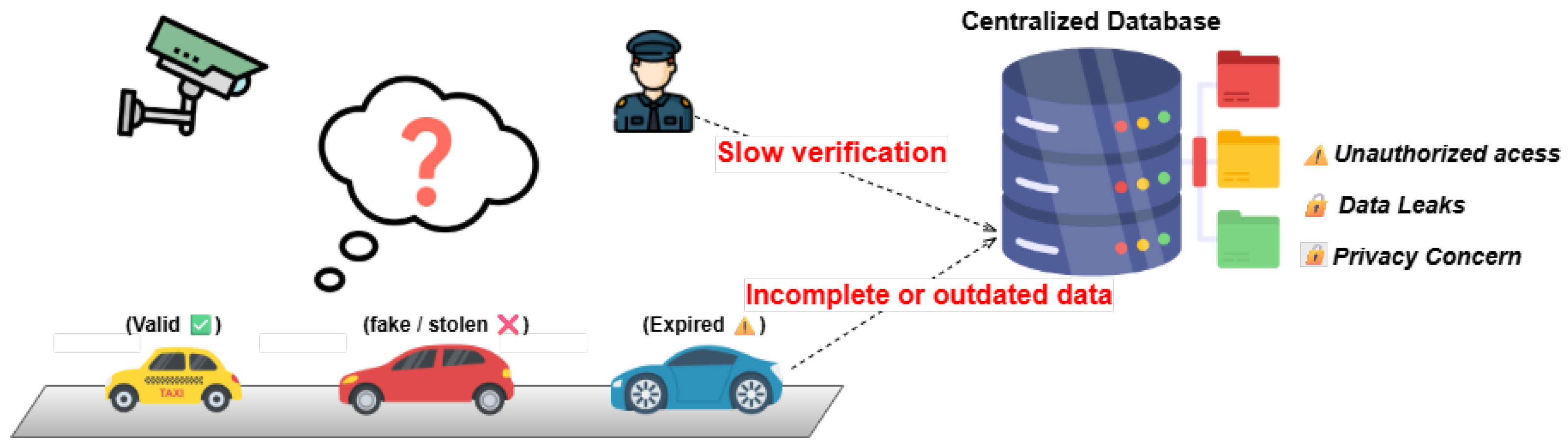
- A dedicated on-chain vehicle legitimacy verification service capable of detecting fake, stolen, cloned, or expired vehicle identifiers using irreversible modular exponentiation and efficient hash table lookup, without revealing raw vehicle data.
- A trust-minimized smart contract framework is designed to perform verification in a stateless manner, eliminating reliance on trusted authorities (TAs) or consortium-controlled entities.
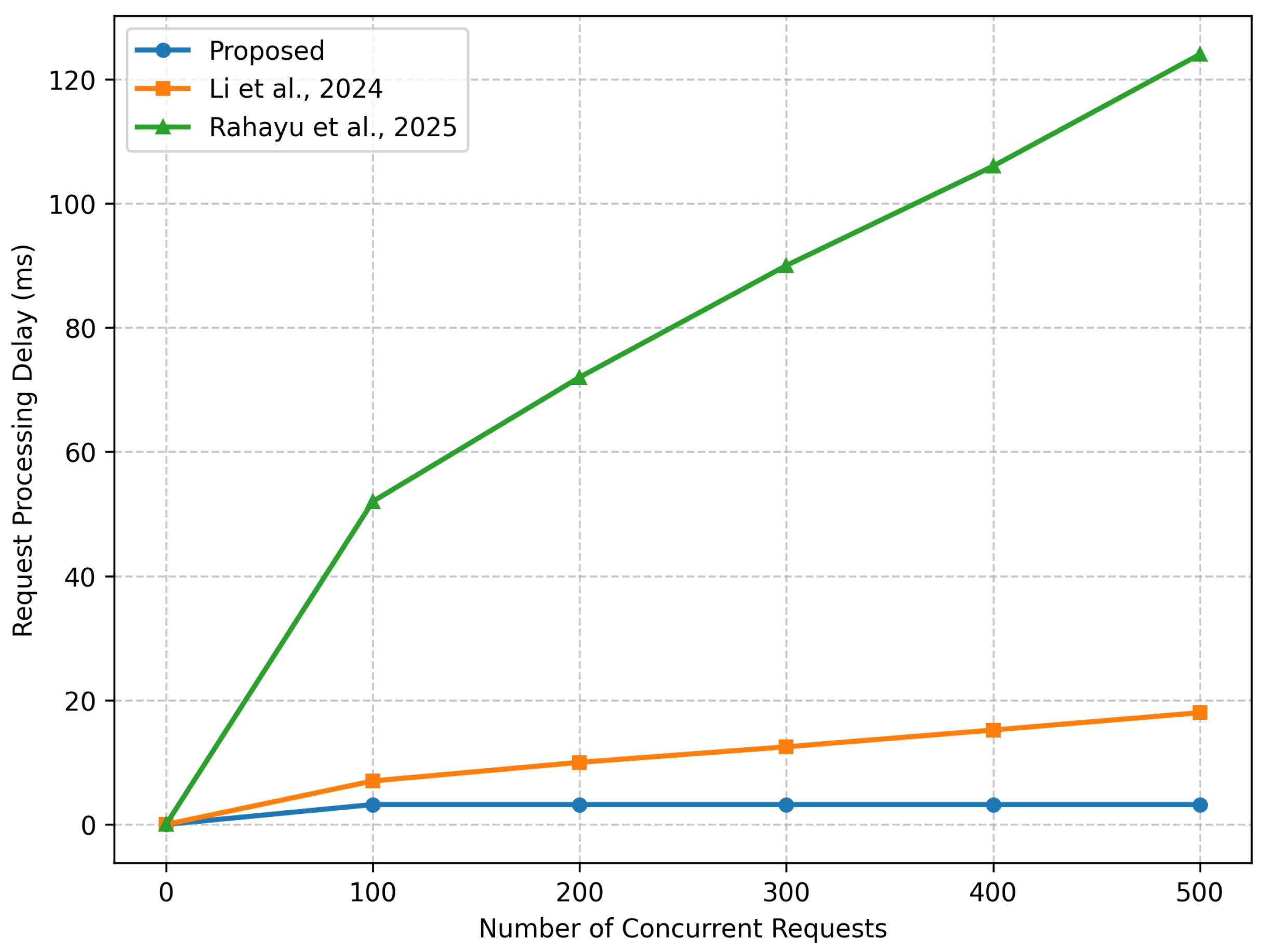
- The resilience of the proposed system against denial-of-service (DoS) attacks is evaluated, demonstrating significantly minimal delay compared to baseline approaches.
- A fully functional Ethereum-compatible prototype is implemented, and a comprehensive performance analysis is conducted, including verification latency, throughput, gas consumption, and scalability.
1.2. Paper Organization
2. Related Work
2.1. Authentication in Vehicular Communication
2.2. Vehicle Identity Management Systems
3. System Design
3.1. Participating Entities
3.1.1. Vehicle Nodes
3.1.2. Government Authorities
3.1.3. Smart Contract
3.1.4. Verifiers
4. Design Goals
4.1. Tamper-Proof Registry
4.2. Real-Time Legitimacy Verification
4.3. Online Revocation
4.4. Verifier Anonymity
4.5. Target-Plate Privacy
4.6. Scalability and Efficiency
5. Proposed Privacy-Preserving On-Chain Verification System
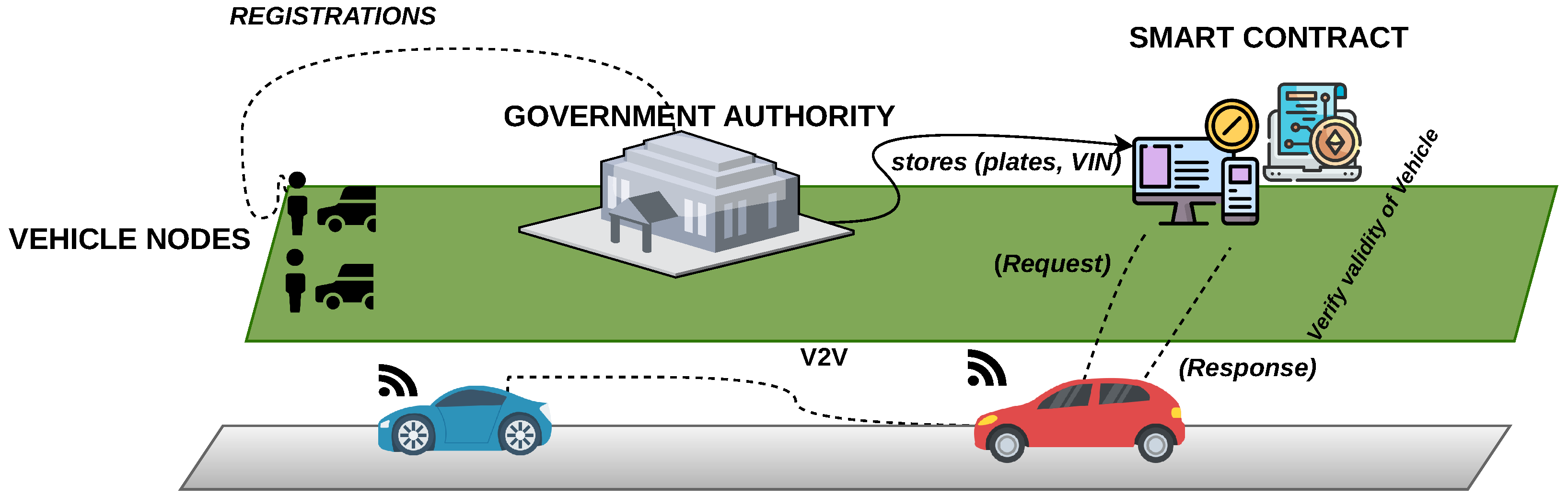
5.1. Overview of the Architecture
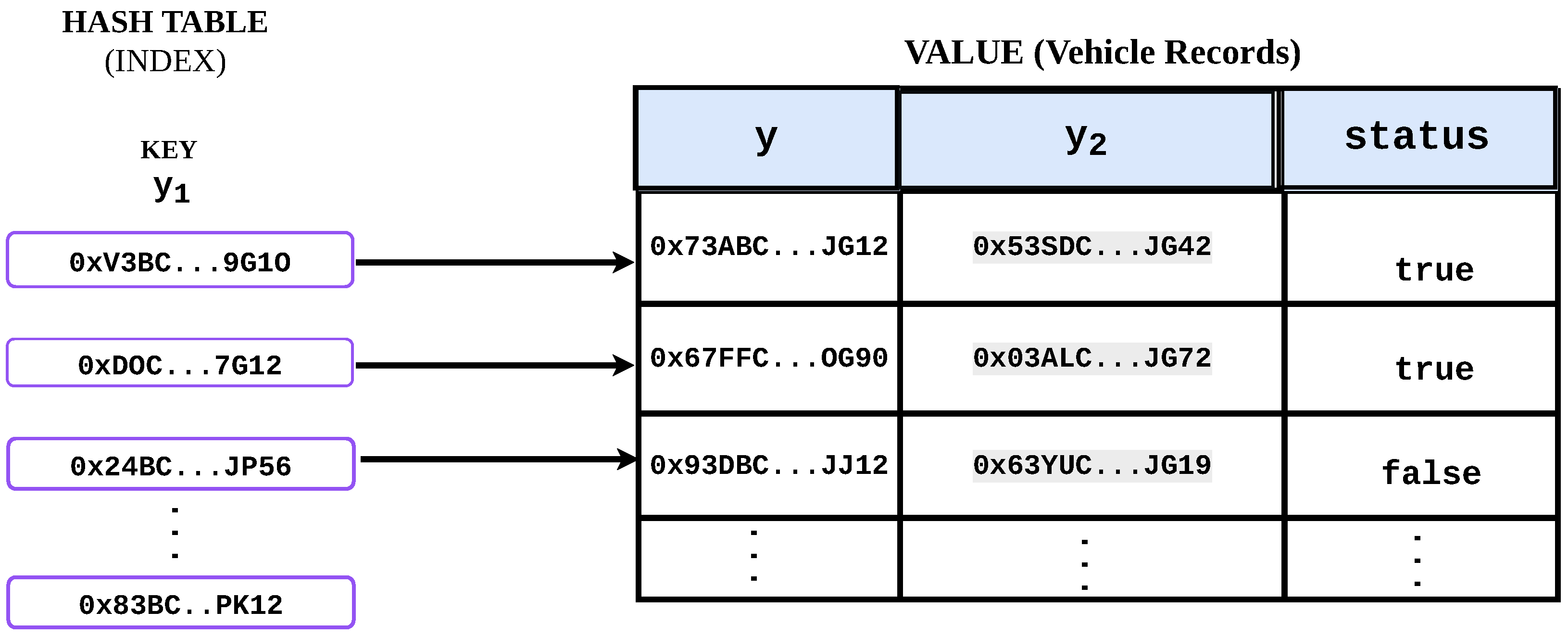
5.2. On-Chain Hash Table Construction
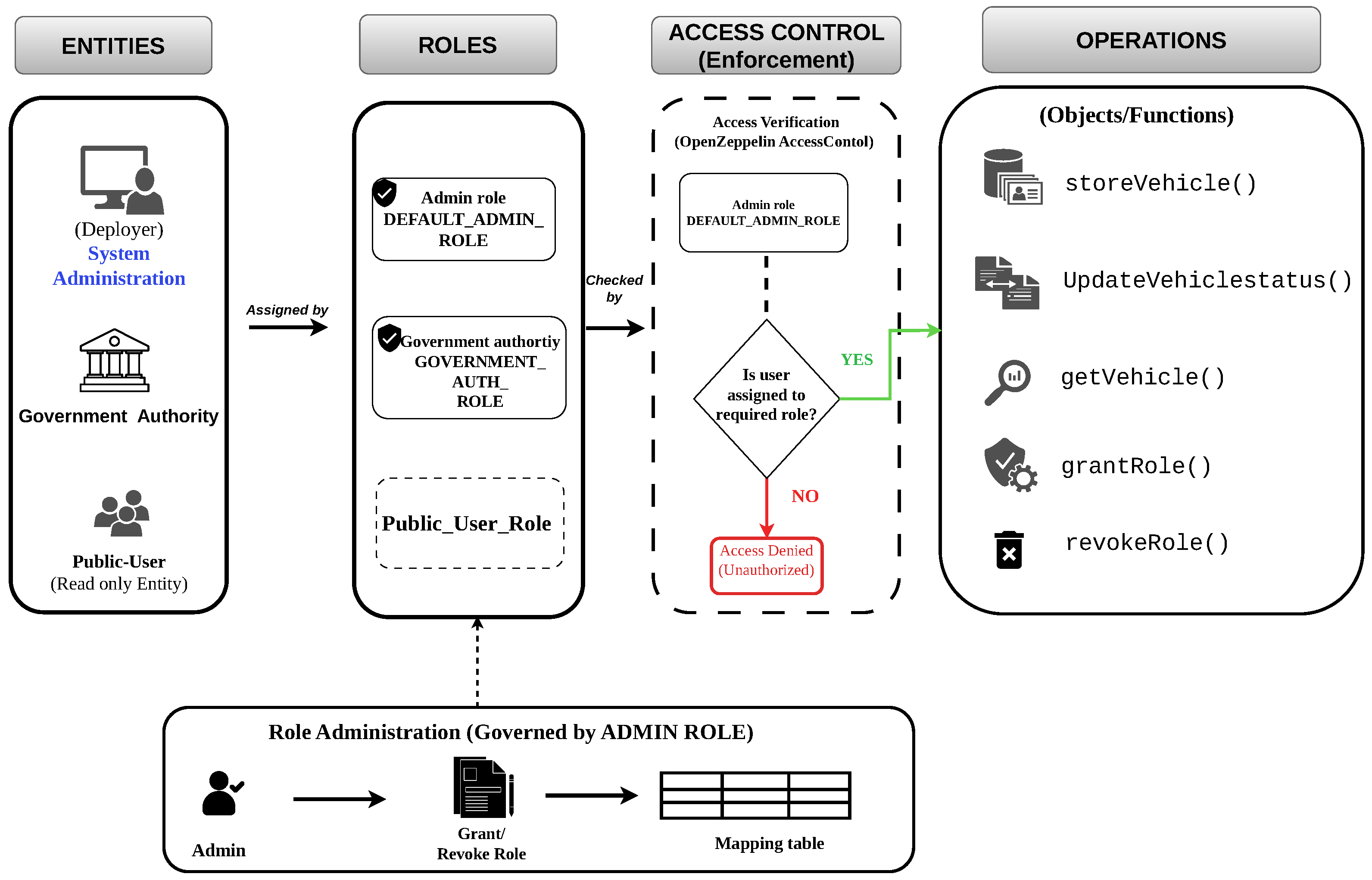
5.3. Access Control
5.3.1. Operations and Permissions
5.3.2. Access Enforcement Mechanism
5.3.3. Role Hierarchy and Administrative Control
5.3.4. Threshold-Based Role Assignment Scheme
5.4. Registration and Verification Procedures
6. Security Model
6.1. System and Adversarial Model
- Access to all publicly available on-chain data;
- Ability to generate arbitrary verification queries;
- Inability to break standard cryptographic primitives or alter on-chain state without authorization.
- Since verification is performed through read-only smart contract functions, the adversary is restricted to observation-based interactions and queries.
6.2. Cryptographic Security Properties
6.2.1. Assumption 1: Discrete Logarithm Hardness
6.2.2. Assumption 2: One-Wayness of Hash Functions
6.2.3. Identifier Encoding Security
6.2.4. Verification Query Construction
6.2.5. Correctness of Verification
6.2.6. Replay Attack Resistance
6.2.7. Isolation of Externally Owned Account Network Addresses
6.2.8. Resistance to Man-in-the-Middle Attack
6.2.9. Soundness and Inference Resistance
6.2.10. Public Verifiability
6.2.11. Overall Security Guarantee
- Correctness verification of legitimate vehicles;
- Identifier privacy;
- Soundness against false positives;
- Resistance to inference and replay attacks.
- These guarantees follow directly from the stated assumptions and the security properties of the encoding and verification mechanisms.
6.3. Smart Contract Security Design
6.3.1. Language-Level Safety Mechanisms
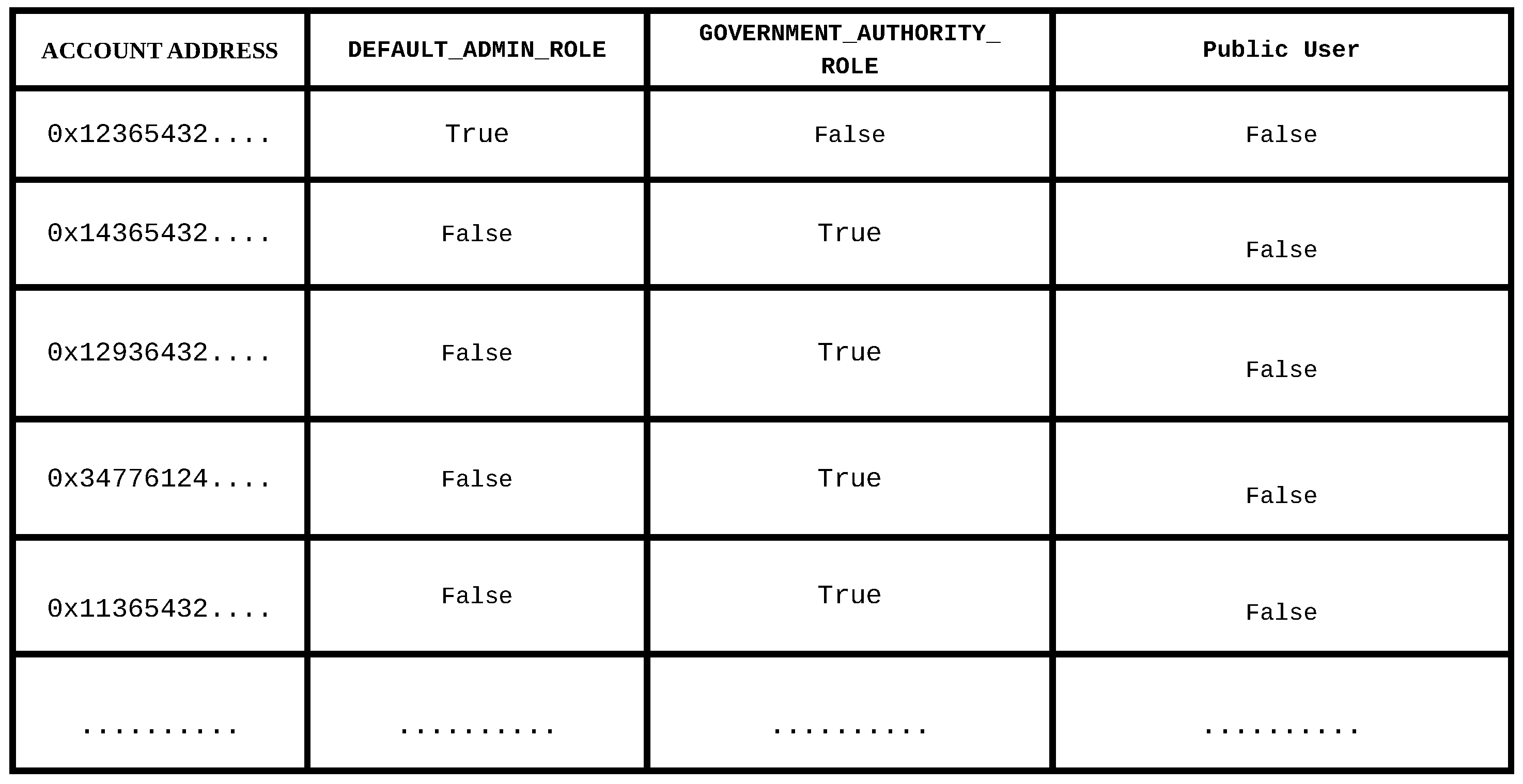
6.3.2. Role-Based Access Control
6.3.3. On Chain Integrity
6.4. Summary
- The security of the proposed scheme is evaluated through a comprehensive analysis of both its cryptographic foundations and smart contract-level protections. The objective is to ensure that the system provides strong guarantees in terms of correctness, privacy preservation, robustness against adversarial behavior, and secure on-chain execution.
- From a cryptographic perspective, the framework ensures that sensitive vehicle identifiers are never exposed in plain text form. Instead, identifiers are transformed into irreversible cryptographic representations prior to storage in the blockchain. This encoding mechanism prevents adversaries from reconstructing original vehicle information, even when full access to on-chain data is assumed. The security of this approach relies on the hardness of the discrete logarithm problem and the one-wayness of the employed hash function, ensuring that identifier privacy is preserved under standard cryptographic assumptions.
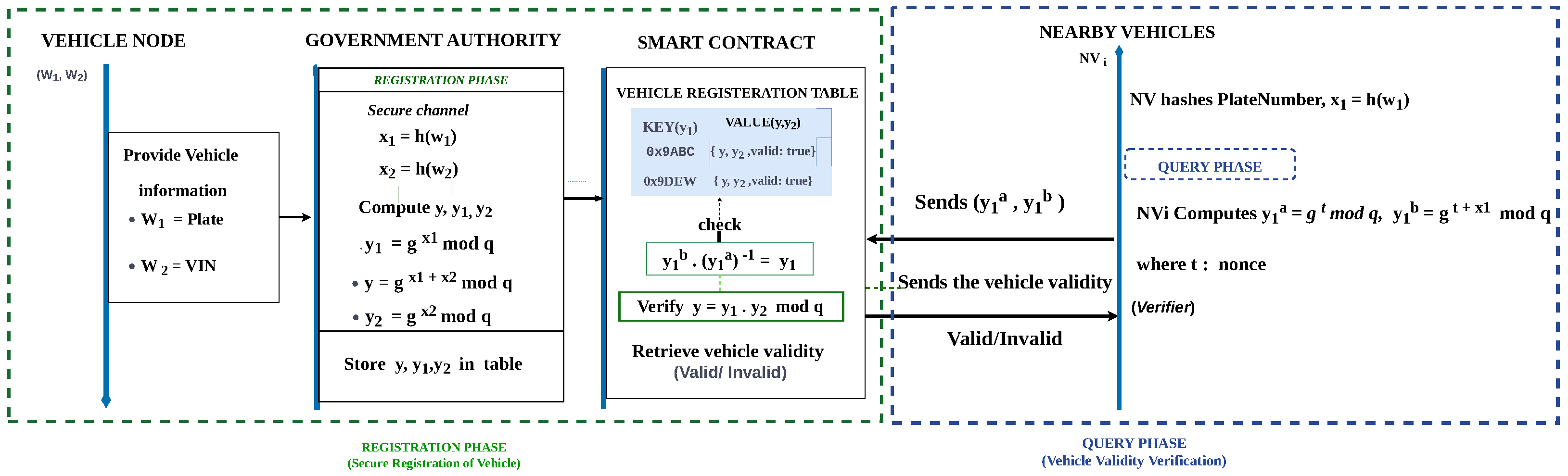
- The verification process is designed to maintain both correctness and privacy. Legitimate vehicle identifiers are consistently validated through deterministic reconstruction and matching of cryptographic components stored in the on-chain hash table. At the same time, the use of randomized query construction ensures that verification requests do not leak sensitive information. Each query incorporates a fresh nonce. As a result, query instances are statistically independent. This property prevents adversaries from linking multiple verification attempts to the same vehicle or verifier.
- The framework also provides inherent resistance to replay and forgery attacks. Since each verification request depends on a newly generated random nonce, previously observed query pairs cannot be reused to produce valid verification outcomes. Furthermore, generating a valid query without knowledge of the secret identifier components requires solving the discrete logarithm problem, which is computationally infeasible. This ensures that adversaries cannot impersonate legitimate vehicles or manipulate the verification process.
- In terms of system correctness and robustness, the proposed scheme guarantees that only valid and active vehicle records are accepted during verification. Invalid, expired, or revoked identifiers are detected through the absence of a corresponding active entry or through a flagging mechanism within the on-chain registry. This eliminates false positives and ensures reliable decision-making during real-time verification. The use of a flag-based update mechanism further ensures that revocation events are immediately reflected across the network while preserving historical records for auditability.
- The architecture guarantees high resilience against communication-layer vulnerabilities, specifically mitigating man-in-the-middle (MitM) attacks during query dissemination. By enforcing an RSU-mediated pipeline where vehicle nodes never connect directly to the exposed blockchain RPC endpoint, eavesdropping and malicious payload injection are effectively neutralized. The integrity of the transit channel is fully preserved via robust session keys and standard cryptographic architectures, preventing adversarial manipulation of the verification flow.
- The scheme preserves privacy during real-time verification by separating blockchain-facing identifiers from vehicle identities. Although EOA addresses are visible during blockchain interactions, the association between an EOA address, vehicle pseudonym, and physical plate number is not published on-chain. Therefore, blockchain observers cannot directly associate an exposed address with a real vehicle identity through publicly available data.
- Beyond cryptographic protections, the framework incorporates strong smart contract-level security mechanisms to safeguard on-chain operations. Role-based access control limits sensitive actions, such as vehicle registration information and status updates, to authorized entities. Any unauthorized attempts to modify contract state are automatically rejected by the Ethereum Virtual Machine, preventing malicious manipulation. Additionally, the immutability of blockchain data ensures that once a record is committed, it cannot be altered or removed, thereby guaranteeing data integrity and resistance to tampering. Overall, the integration of cryptographic protections, randomized verification, controlled access mechanisms, and immutable on-chain storage ensures that the proposed framework operates securely within a decentralized vehicular network environment. The system provides strong guarantees of privacy, correctness, and resistance to a wide range of adversarial attacks, making for real-time vehicle legitimacy verification at scale.
7. Implementation and Experimental Setup
7.1. Smart Contract Deployment
7.2. Data Storage and Verification Mechanism
7.3. Gas Consumption Analysis
8. Performance Evaluation
8.1. Storage and Registration Throughput
8.2. Computational Cost and Communication Analysis
8.3. Latency Performance
8.4. Throughput Performance
8.5. DoS Resilience Under Flooding Attacks
9. Conclusions
Author Contributions
Funding
Institutional Review Board Statement
Informed Consent Statement
Data Availability Statement
Conflicts of Interest
References
- Shrestha, R.; Bajracharya, R.; Shrestha, A.; Nam, S.Y. A New-Type of Blockchain for Secure Message Exchange in VANET. Digit. Commun. Netw. 2020, 6, 177–186. [Google Scholar] [CrossRef]
- Khatri, N.; Lee, S.; Nam, S.Y. Sybil Attack-Resistant Blockchain-Based Proof-of-Location Mechanism with Privacy Protection in VANET. Sensors 2024, 24, 8140. [Google Scholar] [CrossRef]
- Ahmed, M.; Moustafa, N.; Akhter, A.S.; Razzak, I.; Surid, E.; Anwar, A.; Shahen Shah, A.F.M.; Zengin, A. A Blockchain-Based Emergency Message Transmission Protocol for Cooperative VANET. IEEE Trans. Intell. Transp. Syst. 2022, 23, 19624–19633. [Google Scholar] [CrossRef]
- George, S.A.; Stephen, S.M.; Jaekel, A. Blockchain-Based Pseudonym Management Scheme for Vehicular Communication. Electronics 2021, 10, 1584. [Google Scholar] [CrossRef]
- He, D.; Zeadally, S.; Xu, B.; Huang, X. An Efficient Identity-Based Conditional Privacy-Preserving Authentication Scheme for Vehicular Ad Hoc Networks. IEEE Trans. Inf. Forensics Secur. 2015, 10, 2681–2691. [Google Scholar] [CrossRef]
- Azees, M.; Vijayakumar, P.; Deboarh, L.J. EAAP: Efficient Anonymous Authentication with Conditional Privacy-Preservation for Vehicular Ad Hoc Networks. IEEE Trans. Intell. Transp. Syst. 2017, 18, 2467–2476. [Google Scholar] [CrossRef]
- Tzeng, S.-F.; Horng, S.-J.; Li, T.; Wang, X.; Huang, P.-H.; Khan, M.K. Enhancing Security and Privacy for Identity-Based Batch Verification Scheme in VANETs. IEEE Trans. Veh. Technol. 2017, 66, 3235–3248. [Google Scholar] [CrossRef]
- Ali, I.; Wang, Y.; Chen, R. A Practical Authentication Framework for VANETs. Secur. Commun. Netw. 2019, 2019, 4752612. [Google Scholar]
- Lu, Z.; Wang, Q.; Qu, G.; Zhang, H.; Liu, Z. A Blockchain-Based Privacy-Preserving Authentication Scheme for VANETs. IEEE Access 2019, 7, 130954–130966. [Google Scholar] [CrossRef]
- Zhou, X.; He, D.; Khan, M.K.; Wu, W.; Choo, K.-K.R. An Efficient Blockchain-Based Conditional Privacy-Preserving Authentication Protocol for VANETs. IEEE Trans. Veh. Technol. 2023, 72, 81–92. [Google Scholar] [CrossRef]
- Deng, X.; Gao, T.; Guo, N.; Qi, J.; Zhao, C. PAS: Privacy-Preserving Authentication Scheme Based on SDN for VANETs. Appl. Sci. 2022, 12, 4791. [Google Scholar] [CrossRef]
- Moni, S.S.; Manivannan, D. CREASE: Certificateless and Reused-Pseudonym Based Authentication Scheme for Security and Privacy in VANETs. Internet Things 2022, 18, 100228. [Google Scholar] [CrossRef]
- Luo, H.; Zhang, J.; Li, X.; Li, Z.; Yu, H.; Sun, G.; Niyato, D. ESIA: An Efficient and Stable Identity Authentication for the Internet of Vehicles. IEEE Internet Things J. 2023, 73, 5602–5615. [Google Scholar] [CrossRef]
- Haider, M.H.A.; Fayaz, M.; Zhang, Y.; Noureen, H.; Haider, Z.A.; Khan, F.M.; Khan, I.U.; Rahman, M. Enhancing Authentication Security in Internet of Vehicles: A Blockchain-Driven Approach for Trustworthy Communication. ICCK Trans. Adv. Comput. Syst. 2024, 1, 48–62. [Google Scholar] [CrossRef]
- Rahayu, M.; Hossain, M.B.; Huda, S.; Nogami, Y. Integrated Authentication Server Design for Efficient Kerberos–Blockchain VANET Authentication. Sensors 2025, 25, 6651. [Google Scholar] [CrossRef]
- Juárez Cádiz, R.; Nicolas-Sans, R.; Fernández Tamámes, J. Improving Vehicular Network Authentication with Teegraph: A Hashgraph-Based Efficiency Approach. Sensors 2025, 25, 4856. [Google Scholar] [CrossRef]
- Son, S.; Lee, J.; Park, Y.; Park, Y.; Das, A.K. Design of Blockchain-Based Lightweight V2I Handover Authentication Protocol for VANET. IEEE Trans. Netw. Sci. Eng. 2022, 9, 1346–1358. [Google Scholar] [CrossRef]
- Li, L.; Ding, H.; Jiang, T.; Cui, X. B-DSPA: A Blockchain-Based Dynamically Scalable Privacy-Preserving Authentication Scheme. IEEE Internet Things J. 2024, 11, 17500–17512. [Google Scholar]
- Wang, Y.; Tang, C.; Zong, T.; Zeng, Z.; Xiong, Z.; He, D. RIC-SDA: A Reputation Incentive Committee-Based Secure Conditional Dual Authentication Scheme for VANETs. IEEE Trans. Veh. Technol. 2024, 73, 11234–11246. [Google Scholar]
- Ghajar, A.; Zhang, Y.; Cui, J.; Zhong, H.; Bolodurina, I.; He, D. A Threshold-Based Full-Decentralized Authentication and Key Agreement Scheme for VANETs. IEEE Trans. Veh. Technol. 2022, 71, 9876–9888. [Google Scholar]
- Benamar, N.; Kadri, B.; Bouridane, A.; Benkhelifa, E. Blockchain-Based Forgery Resilient Vehicle Registration System. Trans. Emerg. Telecommun. Technol. 2021, 32, e4237. [Google Scholar]
- Rifat, M.Z.; Shakil, S.; Hasan, R.; Zidan, F.; Nandi, D. A Proposed Model for Vehicle Registration Using Blockchain. Int. J. Inf. Eng. Electron. Bus. 2024, 16, 40–53. [Google Scholar]
- Das, D.; Dasgupta, K.; Biswas, U. A Secure Blockchain-Enabled Vehicle Identity Management Framework for Intelligent Transportation Systems. Comput. Commun. 2023, 200, 80–93. [Google Scholar] [CrossRef]
- Alharbi, F.; Zakariah, M.; Alshahrani, R.; Albakri, A.; Viriyasitavat, W.; Alghamdi, A.A. Intelligent Transportation Using Wireless Sensor Networks, Blockchain, and License Plate Recognition. Sensors 2023, 23, 2670. [Google Scholar] [CrossRef]
- Chen, J.; Ruan, Y.; Guo, L.; Lu, H. BCVehis: A Blockchain-Based Service Prototype of Vehicle History Tracking for Used-Car Trades in China. IEEE Access 2020, 8, 214842–214851. [Google Scholar] [CrossRef]
- Rak, R.; Kopencova, D.; Felcan, M. Digital Vehicle Identity—Digital VIN in Forensic and Technical Practice. Forensic Sci. Int. Digit. Investig. 2021, 39, 301307. [Google Scholar] [CrossRef]
- Singh, M.; Kim, S. Blockchain Based Intelligent Vehicle Data Sharing Framework. arXiv 2017, arXiv:1708.09721. [Google Scholar] [CrossRef]
- Zhang, H.; Liu, J.; Zhao, H.; Wang, P.; Kato, N. Blockchain-Based Trust Management for Internet of Vehicles. IEEE Trans. Emerg. Top. Comput. 2021, 9, 1397–1409. [Google Scholar] [CrossRef]
- OpenZeppelin. Access Control—OpenZeppelin Docs. Available online: https://docs.openzeppelin.com/contracts/5.x/access-control (accessed on 10 June 2026).
- Boldyreva, A. Threshold Signatures, Multisignatures and Blind Signatures BaseD on the Gap-Diffie-Hellman-Group Signature Scheme. In Public Key Cryptography (PKC 2003); Lecture Notes in Computer Science; Springer: Berlin/Heidelberg, Germany, 2003; Volume 2567, pp. 31–46. [Google Scholar] [CrossRef]
- Raya, M.; Hubaux, J.P. Securing vehicular ad hoc networks. J. Comput. Secur. 2007, 15, 39–68. [Google Scholar] [CrossRef]
- Liu, W.f.; Xu, W.; Cui, J.; Zhong, H.; Zhang, J.; Xu, Y.; Liu, L. A secure authentication and key exchange protocol for vehicles to infrastructure network. Int. J. Comput. Intell. Syst. 2025, 18, 26. [Google Scholar] [CrossRef]
- Solidity Team. Solidity Documentation. Available online: https://docs.soliditylang.org/ (accessed on 10 June 2026).
- Nomic Foundation. Hardhat: Ethereum Development Environment. Available online: https://hardhat.org (accessed on 10 June 2026).





| Scheme | Privacy | Replay | DoS | Traceability | Blockchain | Message Authentication | Vehicle Legitimacy Verification |
|---|---|---|---|---|---|---|---|
| Vehicle Communication Authentication Schemes | |||||||
| [1] Shrestha (2020) | ✓ | Δ | × | Δ | ✓ | ✓ | × |
| [2] Khatri (2024) | ✓ | ✓ | Δ | ✓ | ✓ | ✓ | × |
| [3] Ahmed (2022) | Δ | Δ | × | Δ | ✓ | ✓ | × |
| [4] George (2021) | ✓ | ✓ | Δ | ✓ | ✓ | ✓ | × |
| [9] Lu (2019) | ✓ | ✓ | Δ | ✓ | ✓ | ✓ | × |
| [11] Deng (2022) | ✓ | ✓ | Δ | ✓ | × | ✓ | × |
| [14] Haider (2024) | ✓ | ✓ | Δ | ✓ | ✓ | ✓ | × |
| [17] Son (2022) | × | ✓ | × | Δ | ✓ | ✓ | × |
| [18] Li (2024) | ✓ | ✓ | Δ | ✓ | ✓ | ✓ | × |
| Vehicle Identity Management Systems | |||||||
| [21] Benamar (2021) | × | × | × | Δ | ✓ | × | × |
| [23] Das (2023) | ✓ | Δ | × | ✓ | ✓ | × | × |
| [24] Alharbi (2023) | × | × | × | Δ | ✓ | × | × |
| [25] Chen (2020) | × | × | × | Δ | ✓ | × | × |
| [26] Rak (2021) | ✓ | Δ | × | ✓ | ✓ | × | × |
| [28] Zhang (2021) | ✓ | × | Δ | ✓ | ✓ | × | × |
| [27] Singh (2017) | ✓ | × | × | Δ | ✓ | × | × |
| Proposed Scheme | ✓ | ✓ | ✓ | ✓ | ✓ | × | ✓ |
| Operation | Gov. Authority | Admin | Public |
|---|---|---|---|
| Store Vehicle Data | ✓ | × | × |
| Modify Vehicle Status | ✓ | × | × |
| Verify Vehicle (Read-only) | ✓ | ✓ | ✓ |
| Stored Vehicle Records | Verification Gas (Units) |
|---|---|
| 100 | 71,825 |
| 1000 | 71,825 |
| 5000 | 71,825 |
| Operation | Count |
|---|---|
| 1 | |
| 2 | |
| 1 | |
| Total Computational Cost |
| Phase | Communication Cost |
|---|---|
| Registration Phase | 768 bits (96 bytes) |
| Verification Input | 512 bits (64 bytes) |
| Verification Output | ≈1 bit |
| Total (Verification Phase) | 512 bits (64 bytes) |
Disclaimer/Publisher’s Note: The statements, opinions and data contained in all publications are solely those of the individual author(s) and contributor(s) and not of MDPI and/or the editor(s). MDPI and/or the editor(s) disclaim responsibility for any injury to people or property resulting from any ideas, methods, instructions or products referred to in the content. |
© 2026 by the authors. Licensee MDPI, Basel, Switzerland. This article is an open access article distributed under the terms and conditions of the Creative Commons Attribution (CC BY) license.
Share and Cite
Prabhu, R.; Nam, S.Y. Blockchain-Based Detection of Invalid Vehicle Numbers While Preserving Privacy. Appl. Sci. 2026, 16, 5985. https://doi.org/10.3390/app16125985
Prabhu R, Nam SY. Blockchain-Based Detection of Invalid Vehicle Numbers While Preserving Privacy. Applied Sciences. 2026; 16(12):5985. https://doi.org/10.3390/app16125985
Chicago/Turabian StylePrabhu, Rathish, and Seung Yeob Nam. 2026. "Blockchain-Based Detection of Invalid Vehicle Numbers While Preserving Privacy" Applied Sciences 16, no. 12: 5985. https://doi.org/10.3390/app16125985
APA StylePrabhu, R., & Nam, S. Y. (2026). Blockchain-Based Detection of Invalid Vehicle Numbers While Preserving Privacy. Applied Sciences, 16(12), 5985. https://doi.org/10.3390/app16125985