Article

Open-Source Parametric Design and Automated Surgical Planning Pipeline for Total Knee Replacement

by
Aknazar Arysbek
*,
Chingiz Alimbayev
and
Kassymbek Ozhikenov
Department of Robotics and Technical Means of Automation, Satbayev University, Almaty 050013, Kazakhstan
*
Author to whom correspondence should be addressed.
Appl. Sci. 2026, 16(12), 5987; https://doi.org/10.3390/app16125987 (registering DOI)
Submission received: 1 May 2026 / Revised: 9 June 2026 / Accepted: 9 June 2026 / Published: 13 June 2026

Abstract

This paper presents an open-source, fully parametric three-component total knee arthroplasty (TKA) implant system and an automated surgical planning pipeline, addressing the absence of publicly available, modifiable TKA design frameworks in the literature. A cruciate-retaining femoral component, tibial baseplate, and polyethylene insert were designed in Autodesk Fusion with 160 parameters governing all anatomically significant geometry. The femoral articulation surface uses a tangency-constrained triple-radius J-curve. An automated Blender (v. 5.1) Python pipeline performs bone model alignment, size selection from a twelve-size chart, Boolean resection via parametric cutting blocks, and final component placement. Prototypes were 3D printed and validated on 1:1 anatomical bone models. The implant system achieved flush seating on all resection surfaces and impingement-free articulation through the full range of motion on all bone sets. The pipeline correctly aligned bone models, performed resections, and selected appropriately sized implants in all 11 cases, processing each in 1–1.5 min. The system is the first open-source TKA framework to simultaneously provide full parametric definition, documented design rationale, three-component coverage, an automated planning pipeline, and an additive manufacturing fabrication path. By releasing the complete parametric model and pipeline as open source, this work enables independent validation, population-specific adaptation, and iterative improvement by the global research community.

1. Introduction

Total knee arthroplasty (TKA) is among the most successful elective surgical interventions, with pooled 15-year implant survival of 93.0% across 299,291 procedures [1]. Yet, approximately 10% of recipients remain dissatisfied with outcomes [2], driven by component misalignment, kinematic deviation, and geometric mismatch between implant and patient morphology [3]. The mismatch problem is compounded by ethnic variation: most commercial implants were designed using Caucasian anthropometric data, producing systematic misfits in populations with different knee geometry [4,5]. Component overhang exceeding 3 mm is associated with a 54% reduced chance of acceptable pain at one year [6], whereas undercoverage beyond 2 mm predisposes patients to implant subsidence [7].
Contemporary systems address morphological diversity through discrete size catalogues of seven to twenty-one sizes [8], fundamentally partitioning a continuous morphological space into a fixed catalog. Patient-specific systems exist commercially: ConforMIS (acquired by restor3d, 2023) and Symbios ORIGIN. Both are fully proprietary, with no design files, parametric relationships, or geometric rationale available for independent validation or modification [9,10]. Clinical evidence remains insufficient: a systematic review of seven comparative studies (n = 1510) found no substantial benefit of custom implants in outcome scores, reoperation risk, or alignment [11]. An early ConforMIS design exhibited a 23% revision rate due to catastrophic tibial failure [12], underscoring that iterating implant geometry without documented, validated design principles carries risks.
Recent work has advanced automated CT-to-implant pipelines. Guezou-Philippe et al. presented a fully automated workflow using U-Net segmentation, statistical shape models (77 morphological parameters), and OpenCASCADE-based implant generation, processing each case in approximately 15 min with a bone implant RMSE of 0.9 ± 0.5 mm [13]. However, neither their design files nor their software are publicly available, and the clinical trial data are restricted. Burge et al. applied machine learning to customize implant geometry directly from CT data, but without kinematic consideration in the design logic [14]. In the parametric design space, Koh et al. developed a sTEA-based framework, achieving a geometric error below 2 mm [15]; Ghidotti et al. provided a systematic review of J-curve construction methods [16]; Khoo et al. established an early parametric framework on CATIA for Asian populations [17]; and Vitković et al. developed a Parametric Orthopaedic Model-View-Controller (POMVC) framework for personalized implant models [18]. None simultaneously achieves full parametric definition, three-component coverage, documented design rationale, an automated pipeline, open-source availability, and additive manufacturing (AM) readiness.
The kinematic alignment philosophy, now supported by randomized clinical trial (RCT) evidence at 10–16 years, fundamentally demands patient-specific implant geometry [19,20]. Rivière et al. stated explicitly that outcomes may be optimized with implants designed for kinematic alignment [21]. A fully parametric system in which every dimension derives from the patient’s own imaging data is inherently compatible with this philosophy.
This paper contributes: (1) a fully parametric, three-component, cruciate-retaining (CR) TKA system with 18 primary user-accessible parameters (160 total) and a documented design rationale; (2) an automated Blender Python pipeline for surgical planning from STL bone models; (3) proof-of-concept validation on reference and patient-derived bone models; and (4) open-source release of the complete system. To our knowledge, no TKA implant system combining these attributes exists in the open literature.

2. Materials and Methods

2.1. Reference Bone Model

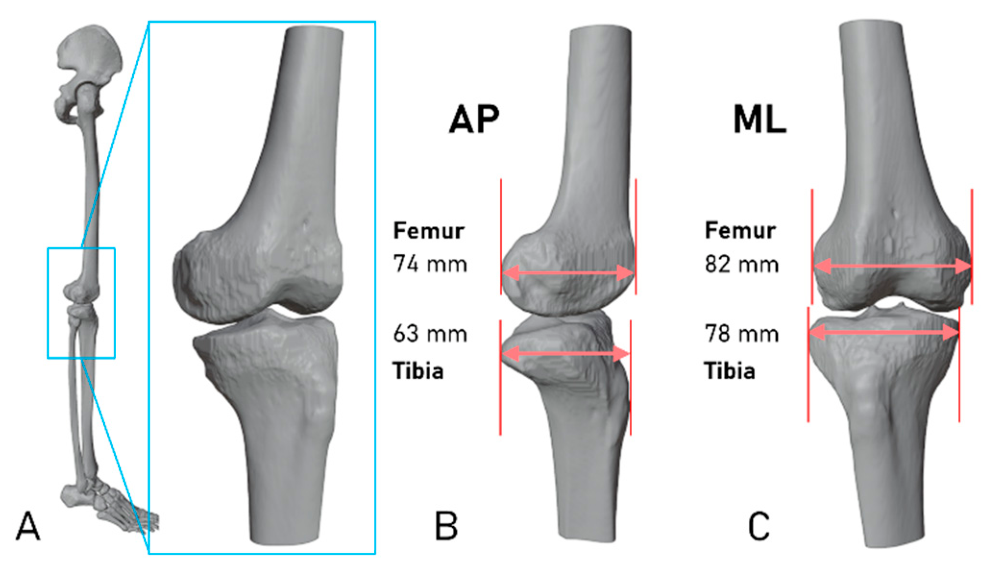
A lower-extremity bone model from the NIH 3D Print Exchange (entry 3DPX-016820) was imported into Autodesk Fusion with all bones removed except for the femur and tibia. Bounding boxes were used for measurement of anterior–posterior (AP) and medial–lateral (ML) distances. The model served as the base design reference; specific measurements are reported in the Section 3.

2.2. Femoral Component

The reference model was supplied in an arbitrary upright pose with its mechanical axis vertical. Two setup rotations established the joint coordinate frame for this specific model and are not fixed design constants. A 6° coronal rotation brought the femoral condylar contact points level, establishing a horizontal joint line; coronal (valgus) alignment is exposed as an adjustable parameter in the automated pipeline. A 3° rotation about the vertical axis, in the transverse plane, aligned the component with the surgical transepicondylar axis (sTEA) [15,22]; this is the External_rotation user parameter (default 3°). Both values are specific to this model’s geometry and are fully parameterized for patient-specific adjustment.
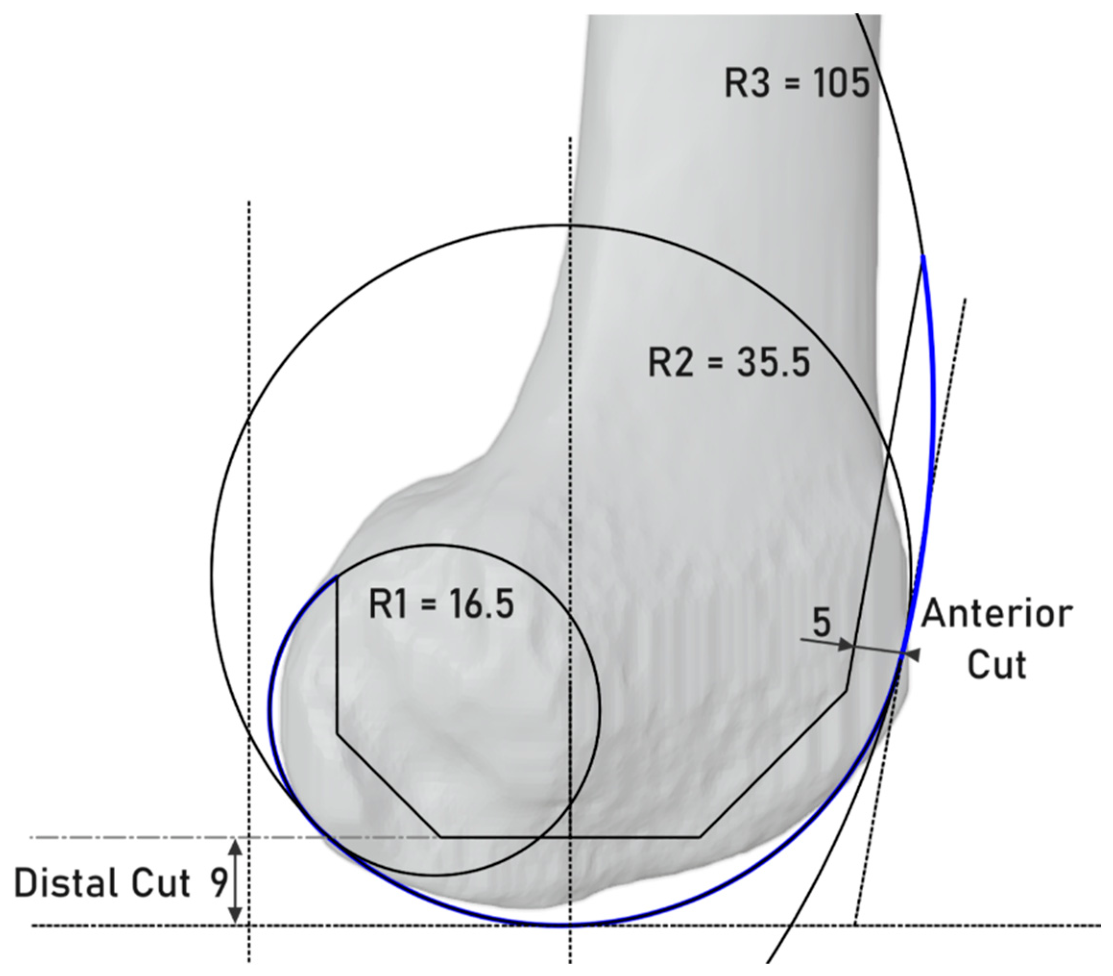
The sagittal articulation surface is defined by a triple-radius J-curve (Figure 1). R1 governs deep flexion (beyond 90°); R2 governs extension up to 90°; and R3 extends the trochlear groove to the anterior resection plane. Values for these radii were determined iteratively: each radius was adjusted until the swept sagittal articulation profile visually coincided with the reference condylar silhouette in the sagittal plane. Each pair of adjacent arcs is tangency constrained, ensuring G1 continuity with no slope discontinuity at the transition points. A second curve was created from this sketch with 5% larger radii to prevent the condylar sweep from intersecting the main body; this offset J-curve served as the condylar profile sweep path.
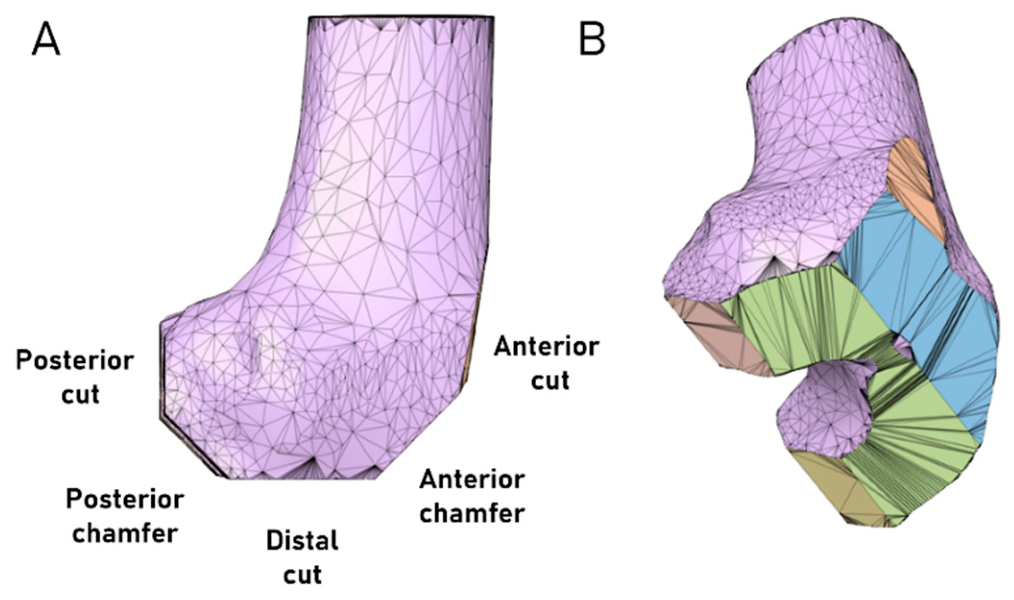
Five planar resections follow the standard protocol; resection depths were chosen based on commercially available systems for a bone of this size (Figure 2) [22,23]:
  • distal (9 mm);
  • anterior (3 mm at 10° draft);
  • posterior (6 mm);
  • two chamfer cuts at 45°.
These define the internal mating surfaces of the femoral shell. The J-curve profile was extruded to 80 mm ML width, and an intercondylar notch of 28 mm was removed in the center for cruciate clearance.
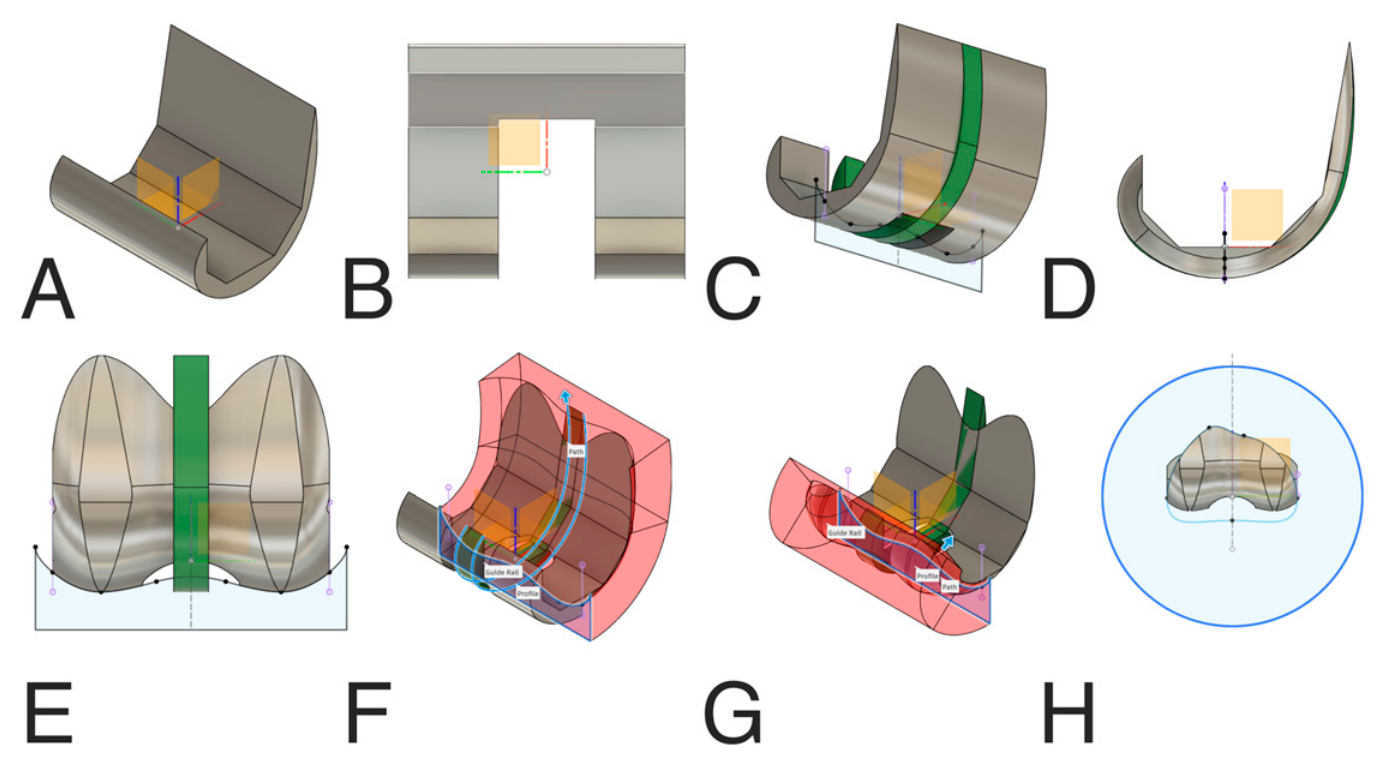
A Bezier coronal profile was created to approximate the original condylar profile and swept along the offset J-curve path to form the condylar surfaces. An asymmetric anterior coronal profile was cut to account for the differences in anterior condylar prominences. The lateral condyle is more pronounced, and more material is removed from it; therefore, its matching surface needs to be bigger. Two drafted cylindrical fixation pegs (9 mm diameter, 16 mm length) were placed at the condyle centroids. The process is shown in Figure 3.

2.3. Tibial Baseplate

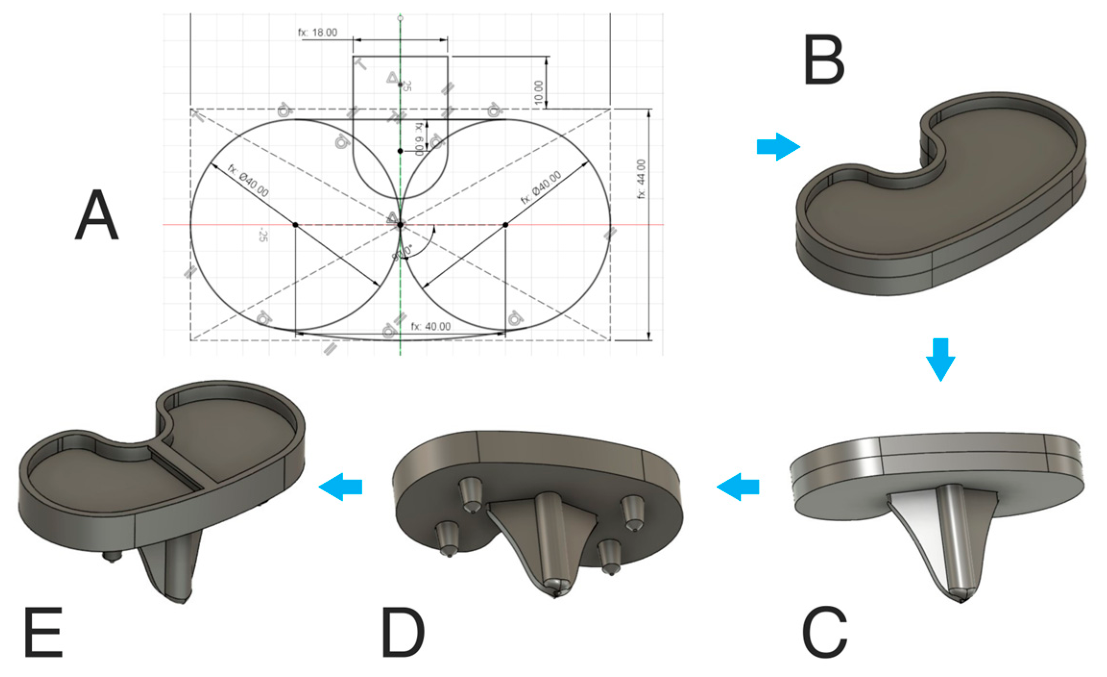
The tibial platform was derived from two overlapping circles with centers spaced along the ML axis, joined anteriorly by a tangent arc (Figure 4). Each condylar circle diameter is set to the tibial plateau AP dimension minus 4 mm of clearance, configurable independently for the medial and lateral condyles. The plateau AP is the usable articulating dimension and is smaller than the raw bounding box AP, which is inflated by the tibial eminence and posterior structures; for the reference bone, the plateau AP was 44 mm against a bounding box AP of 63 mm. In manual CAD design, the plateau is measured directly; in the automated pipeline, where the plateau cannot be isolated automatically, the bounding box is used, and the plateau dimension is estimated from it. A posterior slot accommodates cruciate attachments, producing the characteristic kidney bean platform. The baseplate was extruded to 5 mm, with a 4 mm peripheral locking ledge, a 30 mm tibial stem with triangular reinforcing fins, and four fixation pegs of 9 mm length. Posterior tibial slope is an independent parameter (default 0°, adjustable per clinical protocol). TEA-based rotational alignment is exposed as a separate parameter for intraoperative adjustment.

2.4. Polyethylene Insert

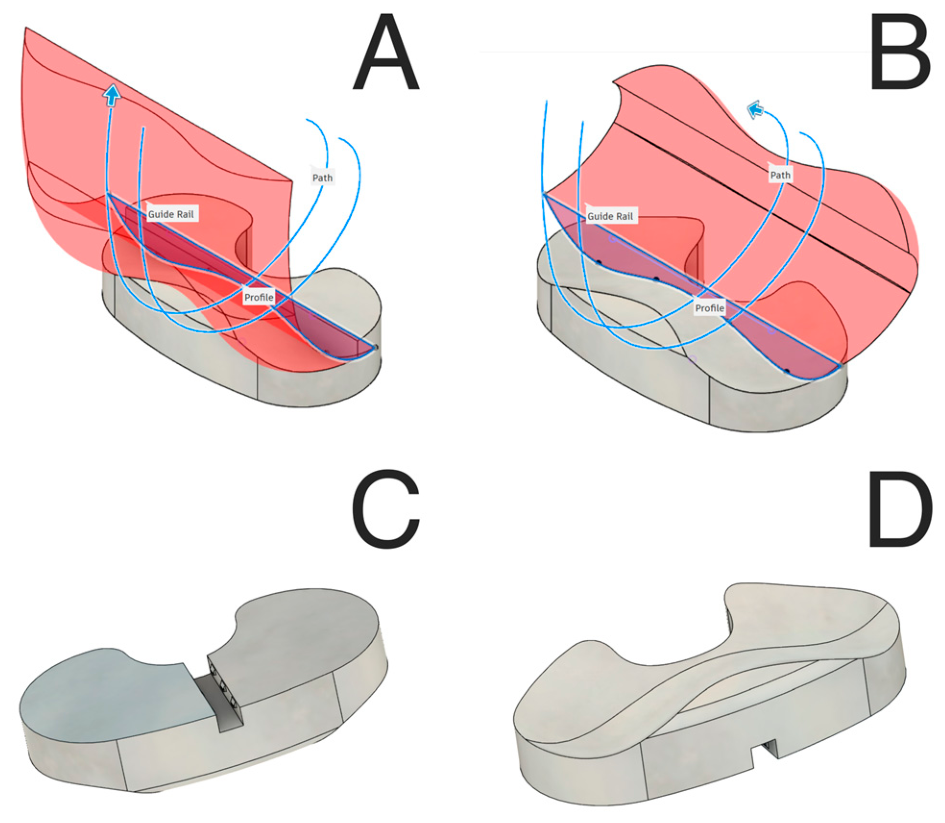
The insert’s bottom surface matches the tibial baseplate. The superior articulation surface was generated by a parametric sweep-cut: the femoral J-curve profile was swept along a path offset from the femoral component’s path by an adjustable conformity coefficient, which is defined as a scaling factor for all three radii of the J-curve (Figure 5). The conformity coefficient (default 5%) scales all three J-curve radii by (1 + coefficient/100). It sets the gap between the femoral articulation profile and the insert-bearing surface: larger values reduce constraint, smaller values increase conformity. Very small values (<5%) are avoided because the two surfaces approach coincidence. The insert locks to the baseplate via 6 snap-lock pins engaging the central ledge. These pins are designed for PETG material and are used only in testing prototypes; they need to be adjusted according to the material’s physical properties. Insert thickness is an independent parameter (7 mm at the thinnest point in this case), with the total joint-line height reconstructed as the sum of the baseplate thickness (5 mm), insert thickness, and distal cut depth.

2.5. Parametric Architecture

The complete system is governed by 18 primary user-accessible parameters across three components (Table 1), with 160 total model parameters linked through constraint equations. All dimensions scale with four primary inputs: femoral ML, femoral AP, tibial ML, and tibial AP. Linear scaling via a coefficient k = ML_target/ML_ref, where ML_ref is the reference model size (82 mm), generates the twelve-size range (Table 2); each parameter can also be adjusted independently for patient-specific cases where anatomy deviates from the linear model. The twelve sizes span the minimum to maximum femoral and tibial ML and AP dimensions of representative commercial systems (Stryker Triathlon, Zimmer Persona), incremented in 2 mm steps of femoral ML. The range can be extended or modified without affecting the underlying parametric relationships. The full parameter definitions are exported as CSV files and released with the CAD archive.

2.6. Automated Surgical Planning Pipeline

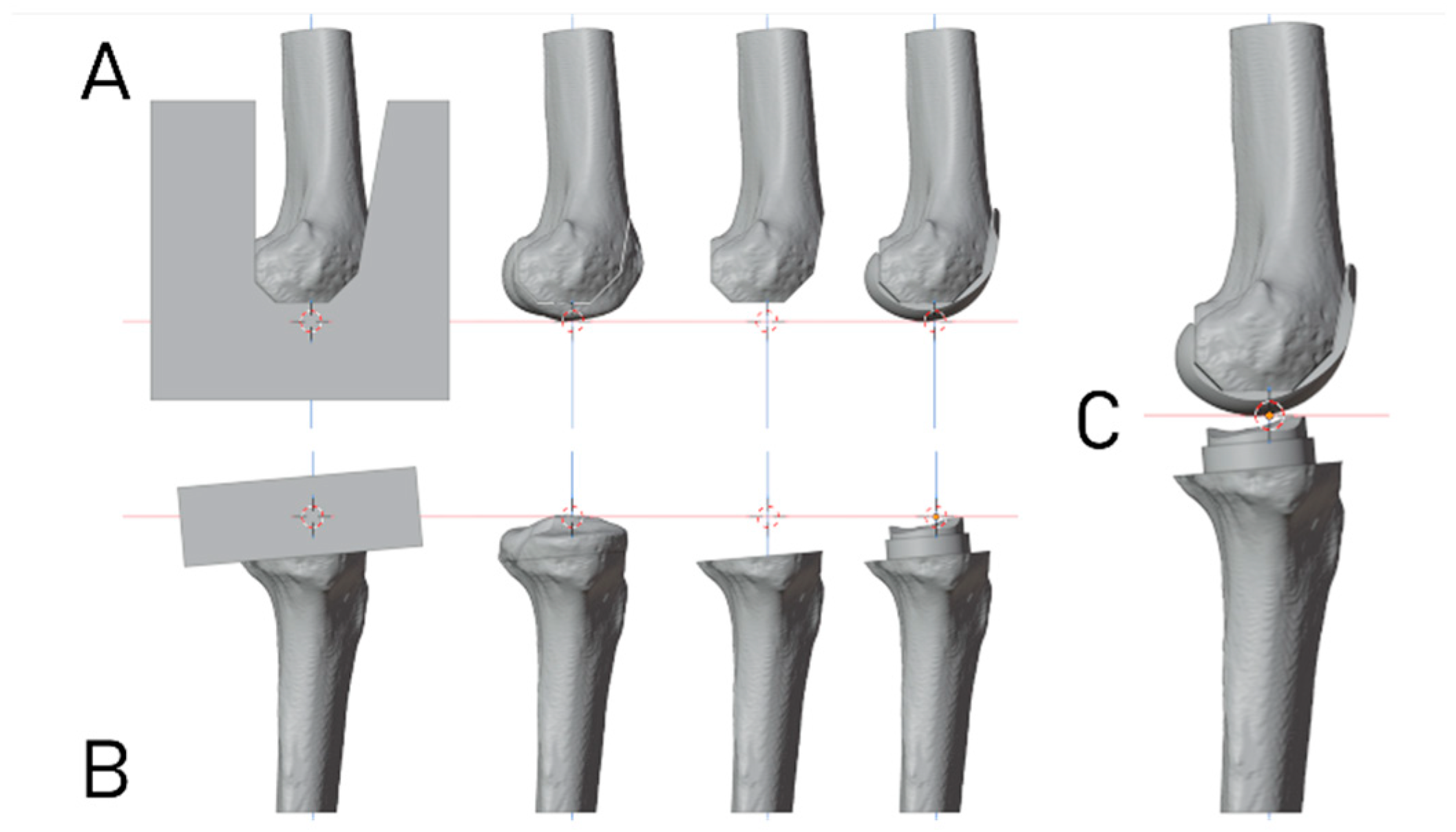
An automated pipeline was implemented as a Python script in Blender version 5.1 (Blender Foundation, Amsterdam, Netherlands).that processes STL bone models through the following stages (briefly shown in Figure 6):
  • Import and alignment: Femur and tibia STL meshes are imported and aligned to a canonical coordinate frame via principal component analysis (PCA). The longest principal axis, superior–inferior (SI), is mapped to Z, ML to Y, and AP to X. The femur is oriented condyles–down, the tibia plateau–up.
  • TEA detection: The surgical transepicondylar axis is identified by performing 2D principal component analysis on the epicondylar band of the distal femur, the transverse slice containing the widest mediolateral extent. The first principal component of this band approximates the medial-to-lateral epicondylar direction. The femur is then rotated so that this axis aligns with the world Y axis, establishing consistent rotational alignment in the transverse plane. This automated approach replaces the manual landmark digitization typically required in surgical planning software.
  • Measurement and size selection: Bounding box dimensions (ML, AP) are extracted from the aligned bones and matched against a twelve-size lookup table to select the closest standard size. Rounding behavior and other selection parameters are exposed for user configuration in the script.
  • Component placement: Pre-made implant STL components (femoral, tibial baseplate, insert) are imported and positioned on the aligned bones. Each component’s origin corresponds to the center of its mating surface in the Fusion model, enabling direct placement without additional offsets.
  • Boolean resection: Parametric cutting blocks, oversized Boolean primitives encoding the five-cut femoral protocol and proximal tibial resection, are applied via Boolean difference operations. A separate shell cutting block, recessed by 0.2 mm at each cutting surface, extracts the resected bone volume as a distinct mesh for visualization and 3D printing. This dual-block approach ensures the shell and resected bone fit together physically with manufacturing tolerance when printed for demonstration and planning.
  • Export: Cut bones, shells, and positioned components are exported as STL files for visualization, 3D printing, or further analysis. A complete log file with all process parameters is exported in the text format.
The pipeline supports batch processing of multiple patients and a size comparison mode that displays two sizes side by side for visual match assessment. The axis convention after alignment is X = AP, Y = ML, Z = SI; valgus correction is applied around X, posterior slope around Y.
Two complementary workflows are supported: (a) direct use of pre-made implant components from the twelve-size chart, selected automatically by the pipeline; and (b) generation of fully patient-specific geometry by entering pipeline-derived measurements into Fusion, which regenerates all three components parametrically. In workflow (b), bone measurements are currently transferred manually from the pipeline output to Fusion.

2.7. Prototype Fabrication and Validation

Three design iterations (V0, V1, V2) were fabricated by material extrusion 3D printing (Bambu Lab X1C, H2D) and tested on 1:1 PLA bone models. The print parameters were: PETG filament; layer height 0.08 mm (implants) and 0.2 mm (bone models); infill density 15% (implants) and 10% (bone models); 3 perimeters (implants) and 2 (bone models); triangular infill throughout. The final version was evaluated against four geometric validation criteria: (1) flush femoral seating across all five resection surfaces, (2) full-contact tibial baseplate seating with no coronal or sagittal tilt, (3) positive snap-lock engagement of the polyethylene insert, and (4) impingement-free articulation from full extension through deep flexion.
Patient-derived bone models were obtained from CT scans (segmented in 3D Slicer version 5.10.0 (3D Slicer Community, Boston, MA, USA), cleaned in Meshmixer version 3.5.474 (Autodesk Inc., San Rafael, CA, USA)) acquired in collaboration with EMIRMED medical center (Almaty, Kazakhstan). CT data were acquired from consenting adult volunteers. Eleven bone sets (femur + tibia) were available: ten healthy sets from 5 patients, and an osteoarthritic specimen from an additional patient was size matched to one of the healthy ones. All eleven sets were processed through the Blender pipeline, whereas only one damaged and one healthy size-matched pair of bone models were 3D printed for testing. The L1-sized V2 components were printed and assembled on these samples.

3. Results

3.1. Reference Geometry

Reference bone model bounding box measurements are presented in Figure 7: femoral AP = 74 mm, femoral ML = 82 mm, tibial AP = 63 mm, tibial ML = 78 mm. The model was classified as size L4, the largest one within the twelve-size range. The reference bone (femoral ML 82 mm, AP 74 mm) corresponds to discrete catalog size L4 (ML 84 mm, AP 74 mm); for catalog use, the bone rounds up to the nearest enclosing size, while the patient-specific method generates the geometry at the exact measured dimensions.

3.2. Implant Component Design

The triple-radius J-curve values for the L4 reference size were: R1 = 16.5 mm (deep flexion), R2 = 35.5 mm (extension to ~90°), R3 = 105 mm (trochlear extension).
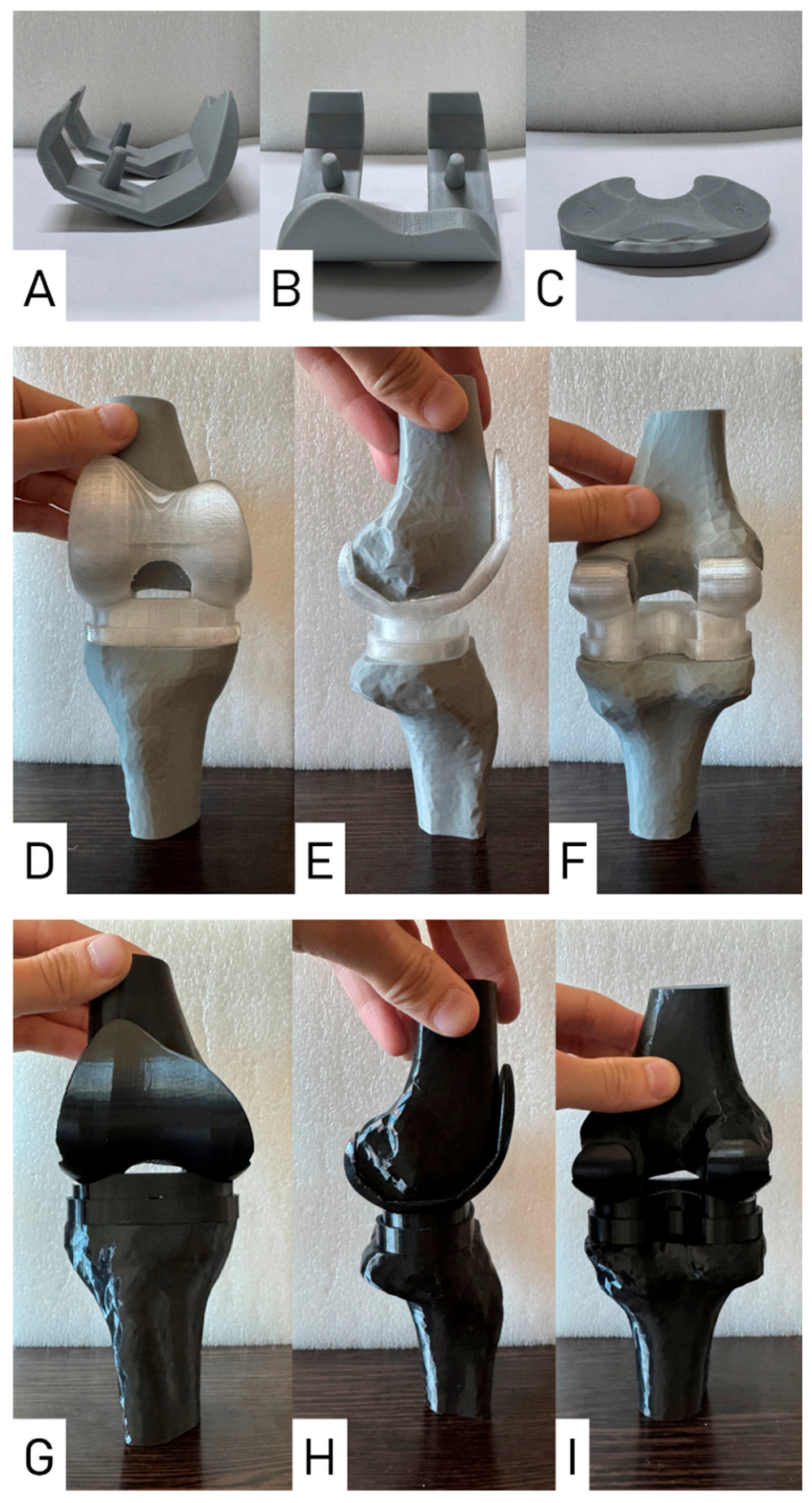
The design progressed through three iterations (Figure 8). V0 confirmed parametric framework viability but had inadequate articulation geometry: the condylar profile was insufficiently curved, and the insert surface was nearly flat. V1 introduced a more anatomical J-curve and matched it against the insert, but its anterior profile extended beyond the femoral shaft in the coronal plane, producing bone obstruction that would interfere with the surrounding tissue. This failure was not apparent in the isolated CAD review and was identified only through physical prototype assembly. V2 corrected the anterior profile, smoothed rough edges, and linked all relevant dimensions to the primary parameters in Table 1 via dynamic equations.

3.3. Geometric Validation

V2 satisfied all four validation criteria on the NIH reference bone (size L4): (1) flush femoral seating across all five resection surfaces, with no rocking or gap; (2) full-contact tibial baseplate seating, with no coronal or sagittal tilt; (3) audible and tactile snap-lock engagement of the polyethylene insert under manual insertion, with positive retention under axial distraction; and (4) smooth, impingement-free articulation from full extension through deep flexion, with an imperceptible transition between the R1 and R2 arcs.

3.4. Patient Bone Application

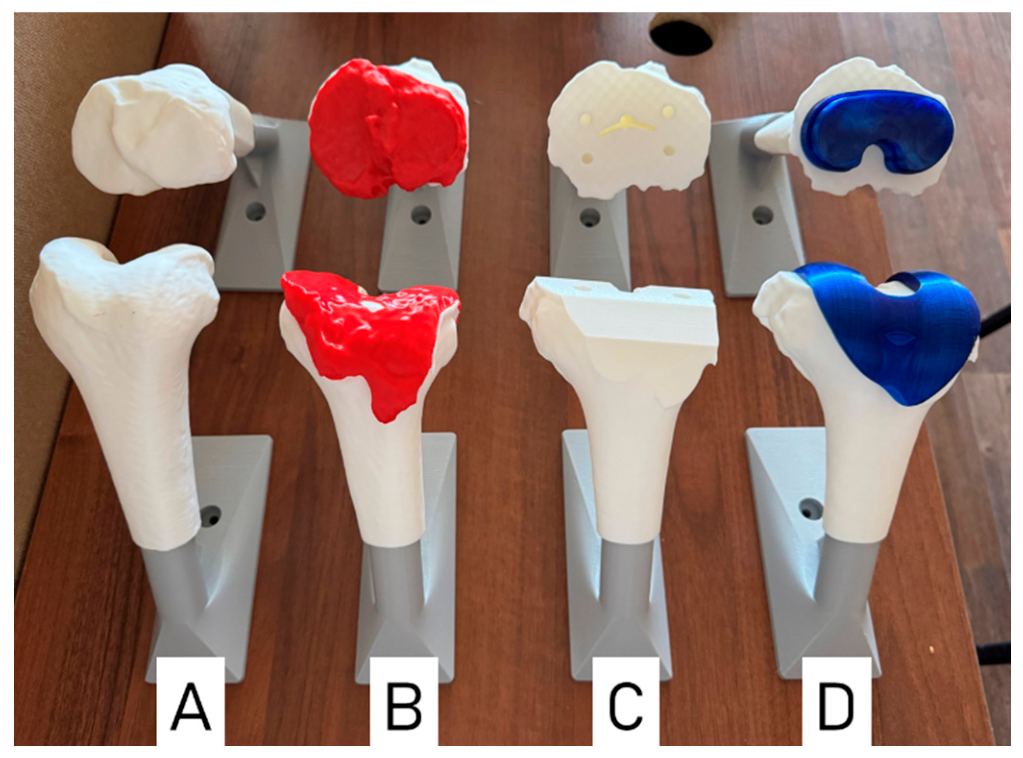
A pair of size-matched bones from different patients (healthy and osteoarthritic) was 3D printed for testing (Figure 9). The sizing for the damaged specimen was complicated because arthritic bony protrusions (osteophytes) inflated the apparent tibial and femoral dimensions. The size was chosen based on the femoral AP measurement since it was least affected by those artifacts. The tibial baseplate on the osteoarthritic specimen appears undersized relative to the visible plateau perimeter. The femoral component was seated, with the fit quality comparable to the NIH reference bone.

3.5. Pipeline Performance

The pipeline processed nine out of eleven bone sets without failure. For two of the samples, the script failed to position the implants correctly. One sample had the tibia bone lowered, and the implant moved forward; the other one had a similar issue, but also a giant block (1 m in height) was generated above the bone. For the rest of them, the implants and bones were positioned as expected; only manual positioning adjustments of up to 5 mm in AP and ML translation were required to fine-tune for the best visual fit.
PCA alignment either confirmed an already correct bone orientation or corrected it automatically; no manual axis correction was required in any case. TEA detection produced correct transepicondylar alignment. Automatic size selection identified the closest standard size in all cases: the healthy and osteoarthritic specimens were both classified as L1. Boolean resection completed without mesh errors (no non-manifold geometry or holes) in all cases. The total processing time was 1–1.5 min per bone set on a consumer laptop (AMD Ryzen 9 6900HS, 16 GB RAM).

4. Discussion

The central contribution of this work is not the claim that patient-specific implants yield superior clinical outcomes; the evidence for this remains ambiguous [11]. The contribution is methodological: an open, documented, modifiable framework for TKA implant design and surgical planning. Every existing patient-specific TKA system, commercial or academic, is closed. Vitković et al. released an open parametric framework (Parametric Orthopedic Model-View-Controller, POMVC), but it targets bone plates rather than total knee arthroplasty and does not cover all three TKA components [18]. The Guezou-Philippe pipeline, the most comprehensive automated TKA workflow published to date, restricts access to clinical trial data, does not release OpenCASCADE scripts, and publishes no parameter-to-geometry mappings [13]. Our system occupies a complementary position: Guezou-Philippe optimizes the CT-to-implant pipeline (automation, speed, clinical integration), and we optimize the implant design itself (transparency, reproducibility, modifiability). Their pipeline could theoretically use our parametric model as its output stage.
The triple-radius J-curve was selected as a compromise between parametric simplicity and anatomical fidelity. Single-radius designs maintain collateral ligament isometry but deviate from the natural condyle profile posteriorly, while continuously varying profiles require more parameters and offer little proven clinical superiority [23,24]. The R1/R2 ratio of 0.46 for the L4 reference size is consistent with published parametric models [15,16]. An alternative articulation philosophy called the medial pivot, in which each condyle is modeled with a single sphere and the medial insert dish is deeply congruent while the lateral is flat, has been advocated for reproducing native knee kinematics [25,26]. The Guezou-Philippe system uses this approach. Kour et al. found that medial-stabilized designs produced less paradoxical anterior translation than CR or PS designs [25]. However, the J-curve approach has been described as “by essence more anatomical”, and no consensus exists on the clinical superiority of either philosophy [13]. Our parametric framework is not locked to the J-curve: substituting the sagittal sweep-cut with a revolve-cut operation on two features in the design tree would implement medial pivot geometry, demonstrating the framework’s adaptability to different kinematic philosophies.
The adjustable conformity coefficient (5% default) governs the contact mechanics vs constraint tradeoff. Higher conformity reduces contact stress and volumetric wear but increases constraint, elevating fixation interface loads [27,28,29]. The default 5% offset represents the minimum value that avoids geometric self-intersection in the sweep-cut operation; biomechanical optimization of this parameter via FEA is planned. Exposing conformity as an explicit and tunable parameter rather than fixing it, as in commercial systems, enables systematic optimization for a given patient or constraint philosophy.
The Blender pipeline automates a workflow that is conventionally performed manually by a surgeon or engineer: bone axis identification, resection plane definition, size selection, and implant trial. PCA-based alignment eliminates subjective manual axis definition, and the cutting block approach executes the entire five-cut resection protocol in a single Boolean operation, avoiding the accumulation of angular errors across sequential planar cuts. Batch processing enables population-level studies, such as evaluating tibial coverage across a morphologically diverse CT dataset, that would be impractical with manual planning. Our pipeline processes pre-segmented STL meshes, completing each case in under 2 min, compared to approximately 15 min for the Guezou-Philippe CT-to-implant workflow [13]. Direct comparison is limited: their pipeline includes CT segmentation and statistical shape model fitting, which our pipeline does not perform. The manual parameter transfer between Blender and Fusion remains the principal integration gap; full automation of this step is planned as immediate future work.
Table 3 consolidates design attributes across published parametric works, automated pipelines, and commercial systems.
Several limitations must be acknowledged. First, the J-curve radii were determined by iterative visual fitting to a single bone model; a least-squares fitting protocol across a representative sample would provide a more rigorous basis. Second, validation is entirely qualitative—no FEA, contact stress measurement, or quantitative bone implant fit analysis (RMSE/Hausdorff distance) has been performed. In addition, the physical articulation assessment does not reproduce in vivo tibiofemoral kinematics: the printed femur and tibia were articulated by hand, without ligament tension or physiological loading, so the relative pose during the range-of-motion check was operator imposed rather than anatomically constrained. The physical test therefore verifies geometric clearance and seating, not kinematic fidelity. The Guezou-Philippe system’s quantitative fit metrics represent the target validation standard [13]. Third, no patellar component exists, and its effects on the system have not been tested. Fourth, the Blender-to-Fusion parameter transfer is manual. Fifth, clinical-grade materials (CoCrMo, Ti-6Al-4V, UHMWPE) have not been tested, though the AM pathway for these materials is clinically established [30,31]. Sixth, bone implant fit measurements across patient cases have not yet been quantified. Seventh, the parametric model has not been stress-tested at extreme sizes or atypical morphologies; fit quality at the boundaries of the size range is unknown. The 11% design failure rate reported by Guezou-Philippe provides a benchmark that our system is designed to avoid by adjusting validated geometry rather than generating it from scratch, though this advantage has not been verified across a large, morphologically diverse dataset [13].
The complete open-source release of our system includes the Autodesk Fusion archive (.f3z) with reference bone models, three parametric implant components, and cutting block geometry; the twelve-size CSV chart; and the Blender pipeline script with documentation. A researcher adapting the system to a different population would modify the four primary sizing parameters using measurements from their own CT dataset; all dependent geometry regenerates automatically through the constraint equations. The framework was developed in part to support a custom surgical robotic system under parallel development by the authors, where precise, modifiable implant geometry is a prerequisite for robotic path planning.
Future work priorities include: quantitative bone implant fit measurement across all patient cases; finite element analysis under physiological loading following established protocols [32,33]; full automation of the Blender-to-Fusion parameter transfer; implementation of the medial pivot variant; and an end-to-end clinical case study using metal AM components.

5. Conclusions

This paper presented an open-source, parametric TKA implant system and automated surgical planning pipeline. The system provides 18 primary user-accessible parameters (160 total) across three components, a documented geometric rationale for every design decision, and an automated Blender pipeline that processes patient bone models in 1–1.5 min. Three design iterations were fabricated and validated on anatomical bone models, including patient-derived CT specimens. The complete parametric CAD model, size chart, pipeline script, and cutting blocks will be released as open source to enable independent validation and adaptation, particularly for populations whose knee anthropometry is underrepresented in commercial implant design data. The framework is designed to serve as a foundation that researchers and clinicians with moderate CAD capabilities can modify to fit their specific research or practical needs, without having to model a TKA system from scratch.

Author Contributions

Conceptualization, A.A. and C.A.; methodology, A.A. and C.A.; software, A.A.; validation, A.A.; resources, C.A. and K.O.; writing—original draft preparation, A.A.; writing—review and editing, C.A.; supervision, C.A.; project administration, K.O.; funding acquisition, K.O. All authors have read and agreed to the published version of the manuscript.

Funding

This research was funded by the Committee of Science of the Ministry of Science and Higher Education of the Republic of Kazakhstan (Grant No. BR24992820).

Institutional Review Board Statement

Ethical approval for this study was obtained from the Local Bioethics Committee of the National Scientific Center of Traumatology and Orthopedics named after Academician N.D. Batpenov, Ministry of Health of the Republic of Kazakhstan (Protocol No. 1/4, dated 28 March 2024). The study was conducted in accordance with the principles of the Declaration of Helsinki.

Informed Consent Statement

CT scans were obtained from patients and the research group personnel with full consent.

Data Availability Statement

The complete design system is publicly available on GitHub: https://github.com/aqnazar/TKA-implant-design (accessed on 8 June 2026). The release includes the Autodesk Fusion 360 archive (.f3z) containing reference bone models, three parametric implant components, and cutting block geometry; the twelve-size chart (CSV); and the Blender Python pipeline script with documentation. Patient CT data are not included due to privacy restrictions.

Acknowledgments

The authors acknowledge the collaboration of EMIRMED medical center (Almaty, Kazakhstan) for providing patient CT data. During the preparation of this manuscript, the authors used the AI system Claude 4 (Anthropic) for the purposes of grammar correction, literature search assistance, and manuscript drafting support. The authors have reviewed and edited the output and take full responsibility for the content of this publication.

Conflicts of Interest

The authors declare no conflicts of interest. The funders had no role in the design of the study; in the collection, analyses, or interpretation of data; in the writing of the manuscript; or in the decision to publish the results.

Abbreviations

The following abbreviations are used in this manuscript:
AMAdditive Manufacturing
APAnterior–Posterior
CADComputer-Aided Design
CRCruciate-Retaining
CTComputed Tomography
CSVComma-Separated Values
FEAFinite Element Analysis
MLMedial–Lateral
NIHNational Institutes of Health
PCAPrincipal Component Analysis
PETGPolyethylene Terephthalate Glycol
PLAPolylactic Acid
POMVCParametric Orthopedic Model-View-Controller
PSPosterior-Stabilized
RCTRandomized Controlled Trial
RMSERoot Mean Square Error
HDHausdorff Distance
SISuperior–Inferior
SSMStatistical Shape Model
sTEASurgical Transepicondylar Axis
STLStandard Tessellation Language (file format)
TEATransepicondylar Axis
TKATotal Knee Arthroplasty
UHMWPEUltra-High-Molecular-Weight Polyethylene

References

  1. Evans, J.T.; Walker, R.W.; Evans, J.P.; Blom, A.W.; Sayers, A.; Whitehouse, M.R. How Long Does a Knee Replacement Last? A Systematic Review and Meta-Analysis of Case Series and National Registry Reports with More than 15 Years of Follow-Up. Lancet 2019, 393, 655–663. [Google Scholar] [CrossRef]
  2. DeFrance, M.J.; Scuderi, G.R. Are 20% of Patients Actually Dissatisfied Following Total Knee Arthroplasty? A Systematic Review of the Literature. J. Arthroplast. 2023, 38, 594–599. [Google Scholar] [CrossRef] [PubMed]
  3. Yamazaki, T.; Watanabe, T.; Nakajima, Y.; Sugamoto, K.; Tomita, T.; Maeda, D.; Sahara, W.; Yoshikawa, H.; Tamura, S. 3D Kinematics of Mobile-Bearing Total Knee Arthroplasty Using X-Ray Fluoroscopy. Int. J. Comput. Assist. Radiol. Surg. 2015, 10, 487–495. [Google Scholar] [CrossRef] [PubMed]
  4. Mahfouz, M.; Abdel Fatah, E.E.; Bowers, L.S.; Scuderi, G. Three-Dimensional Morphology of the Knee Reveals Ethnic Differences. Clin. Orthop. Relat. Res. 2012, 470, 172–185. [Google Scholar] [CrossRef] [PubMed]
  5. Chui, C.S.; Leung, K.S.; Qin, J.; Shi, D.; Augat, P.; Wong, R.M.Y.; Chow, S.K.H.; Huang, X.Y.; Chen, C.Y.; Lai, Y.X.; et al. Population-Based and Personalized Design of Total Knee Replacement Prosthesis for Additive Manufacturing Based on Chinese Anthropometric Data. Engineering 2021, 7, 386–394. [Google Scholar] [CrossRef]
  6. Nielsen, C.S.; Nebergall, A.K.; Huddleston, J.I.; Lidgren, L.; Greene, M.E.; Malchau, H. Medial Overhang of the Tibial Component Is Associated with Higher Risk of Inferior KOOS Pain after Knee Replacement. J. Arthroplast. 2018, 33, 1394–1398. [Google Scholar] [CrossRef]
  7. Burge, T.A.; Jeffers, J.R.T.; Myant, C.W. A Computational Tool for Automatic Selection of Total Knee Replacement Implant Size Using X-Ray Images. Front. Bioeng. Biotechnol. 2022, 10, 971096. [Google Scholar] [CrossRef]
  8. Zimmer Biomet. Persona: The Personalized Knee System–Brochure and Size Reference Guide; Zimmer Biomet: Warsaw, IN, USA, 2016. [Google Scholar]
  9. ConforMIS. FDA Clears First Patient-Specific Implant System for Total Knee Replacement. 2011. Available online: https://www.conformis.com/about-conformis/news/fda-clears-first-patient-specific-implant-system-for-total-knee-replacement/ (accessed on 8 June 2026).
  10. Moret, C.S.; Hirschmann, M.T.; Vogel, N.; Arnold, M.P. Customised, Individually Made Total Knee Arthroplasty Shows Promising 1-Year Clinical and Patient Reported Outcomes. Arch. Orthop. Trauma Surg. 2021, 141, 2217–2225. [Google Scholar] [CrossRef]
  11. Beit Ner, E.; Dosani, S.; Biant, L.C.; Tawy, G.F. Custom Implants in TKA Provide No Substantial Benefit in Terms of Outcome Scores, Reoperation Risk, or Mean Alignment: A Systematic Review. Clin. Orthop. Relat. Res. 2021, 479, 1237–1249. [Google Scholar] [CrossRef]
  12. Meheux, C.J.; Park, K.J.; Clyburn, T.A. A Retrospective Study Comparing a Patient-Specific Design Total Knee Arthroplasty with an off-the-Shelf Design: Unexpected Catastrophic Failure Seen in the Early Patient-Specific Design. J. Knee Surg. 2021, 34, 86–93. [Google Scholar] [CrossRef]
  13. Guezou-Philippe, A.; Clavé, A.; Maguet, E.; Cadène, A.; Guezou, B.; Cao, S.; Stindel, E. Fully Automated Workflow for Designing Patient-Specific Orthopaedic Implants: Application to Total Knee Arthroplasty. PLoS ONE 2025, 20, e0325587. [Google Scholar] [CrossRef]
  14. Burge, T.A.; Jeffers, J.R.T.; Myant, C.W. Applying Machine Learning Methods to Enable Automatic Customisation of Knee Replacement Implants from CT Data. Sci. Rep. 2023, 13, 3317. [Google Scholar] [CrossRef] [PubMed]
  15. Koh, Y.-G.; Jung, K.-T.; Hong, H.-Y.; Kim, K.-M.; Kang, K.-T. Optimal Design of Patient-Specific Total Knee Arthroplasty for Improvement in Wear Performance. J. Clin. Med. 2019, 8, 2023. [Google Scholar] [CrossRef]
  16. Ghidotti, A.; Vitali, A.; Regazzoni, D.; Rizzi, C. An Investigation of Innovative 3D Modelling Procedures for Patient-Specific Total Knee Arthroplasty. Comput.-Aided Des. Appl. 2022, 19, 306–319. [Google Scholar] [CrossRef]
  17. Khoo, L.P.; Goh, J.C.H.; Chow, S.L. Parametric CAD Model of a Knee Joint Prosthesis. Proc. Inst. Mech. Eng. H J. Eng. Med. 1993, 207, 115–120. [Google Scholar] [CrossRef]
  18. Vitković, N.; Mitić, J.; Manić, M.; Trajanović, M.; Husain, K.; Petrović, S.; Arsić, S. Software Framework for the Creation and Application of Personalized Bone and Plate Implant Geometrical Models. J. Healthc. Eng. 2018, 2018, 6025935. [Google Scholar] [CrossRef]
  19. Howell, S.M.; Shelton, T.J.; Hull, M.L. Implant Survival and Function Ten Years after Kinematically Aligned Total Knee Arthroplasty. J. Arthroplast. 2018, 33, 3678–3684. [Google Scholar] [CrossRef]
  20. Howell, S.M.; Akhtar, M.; Nedopil, A.J.; Hull, M.L. Reoperation, Implant Survival, and Clinical Outcome after Kinematically Aligned Total Knee Arthroplasty: A Concise Clinical Follow-up at 16 Years. J. Arthroplast. 2024, 39, 684–689. [Google Scholar] [CrossRef] [PubMed]
  21. Rivière, C.; Iranpour, F.; Auvinet, E.; Howell, S.; Vendittoli, P.-A.; Cobb, J.; Parratte, S. The Kinematic Alignment Technique for Total Knee Arthroplasty. In Personalized Hip and Knee Joint Replacement; Springer: Cham, Switzerland, 2020. [Google Scholar]
  22. Alyazji, Q. Custom Design of Knee Joint Prosthesis by Using Computerized Tomography (CT) Images and 3D Modelling. Master’s Thesis, Eastern Mediterranean University, Famagusta, Cyprus, 2014. [Google Scholar]
  23. Stryker Corporation. Triathlon Total Knee System: Design Rationale; Stryker Corporation: Kalamazoo, MI, USA, 2019. [Google Scholar]
  24. Lei, T.; Jiang, Z.; Qian, H.; Backstein, D.; Lei, P.; Hu, Y. Comparison of Single-Radius with Multiple-Radius Femur in Total Knee Arthroplasty: A Meta-Analysis of Prospective Randomized Controlled Trials. Orthop. Surg. 2022, 14, 2085–2095. [Google Scholar] [CrossRef]
  25. Kour, R.Y.N.; Guan, S.; Dowsey, M.M.; Choong, P.F.; Pandy, M.G. Kinematic Function of Knee Implant Designs across a Range of Daily Activities. J. Orthop. Res. 2023, 41, 1217–1227. [Google Scholar] [CrossRef]
  26. Sabatini, L.; Risitano, S.; Parisi, G.; Tosto, F.; Indelli, P.F.; Atzori, F.; Massè, A. Medial Pivot in Total Knee Arthroplasty: Literature Review and Our First Experience. Clin. Med. Insights Arthritis Musculoskelet. Disord. 2018, 11, 1179544117751431. [Google Scholar] [CrossRef] [PubMed]
  27. Han, Y.; Wang, X.; Chen, W.; Guo, Y.; Liu, Y. Parametric Design and Wear Study of Artificial Knee Prosthesis. In Proceedings of the SPIE International Conference on Future of Medicine and Biological Information Engineering (MBIE), Shenyang, China, 10–11 August 2024. [Google Scholar] [CrossRef]
  28. Brockett, C.L.; Carbone, S.; Fisher, J.; Jennings, L.M. Influence of conformity on the wear of total knee replacement: An experimental study. Proc. Inst. Mech. Eng. H J. Eng. Med. 2018, 232, 127–134. [Google Scholar] [CrossRef] [PubMed]
  29. Castellarin, G.; Bori, E.; Rapallo, L.; Pianigiani, S.; Innocenti, B. Biomechanical Analysis of Different Levels of Constraint in TKA during Daily Activities. Arthroplasty 2023, 5, 3. [Google Scholar] [CrossRef] [PubMed]
  30. Narra, S.P.; Mittwede, P.N.; DeVincent Wolf, S.; Urish, K.L. Additive Manufacturing in Total Joint Arthroplasty. Orthop. Clin. N. Am. 2019, 50, 13–20. [Google Scholar] [CrossRef]
  31. Zappley, N.R.; Restrepo, S.; Fraval, A.; Ong, A.C.; Hozack, W. 10-Year Follow-up for a New Three-Dimensional Printed Cementless Total Knee Arthroplasty. J. Arthroplast. 2025, 40, S250–S255. [Google Scholar] [CrossRef]
  32. Zhang, Z.-H.; Qi, Y.-S.; Wei, B.-G.; Bao, H.-R.-C.; Xu, Y.-S. Application Strategy of Finite Element Analysis in Artificial Knee Arthroplasty. Front. Bioeng. Biotechnol. 2023, 11, 1127289. [Google Scholar] [CrossRef]
  33. Loi, I.; Stanev, D.; Moustakas, K. Total Knee Replacement: Subject-Specific Modeling, Finite Element Analysis, and Evaluation of Dynamic Activities. Front. Bioeng. Biotechnol. 2021, 9, 648356. [Google Scholar] [CrossRef]
Figure 1. Sagittal J-curve construction (blue) and resection lines (dashed gray). R1 = 16.5 mm (deep flexion), R2 = 35.5 mm (extension to ~90°), R3 = 105 mm (trochlear extension). Tangency constraints ensure G1 continuity.
Applsci 16 05987 g001
Figure 2. (A) Five femoral cuts of a standard TKA protocol displayed on the NIH femur bone model. (B) An arbitrary view of the bone showing the cuts.
Applsci 16 05987 g002
Figure 3. Three-dimensional femoral component design process. (A) Mid-plane extrusion to 80 mm ML width. (B) Intercondylar notch cutout (28 mm ML). (CG) Condyle surface sweep with Bezier profile. (H) Asymmetric anterior coronal cutout. A green body in the center is the 5% enlarged J-curve used for the condylar profile sweep cut on the plastic insert.
Applsci 16 05987 g003
Figure 4. Tibial plate platform design process. (A) Sketch construction from two 40 mm circles, 102 mm anterior tangent arc, and posterior cruciate slot (18 × 15 mm). (B) Base plate with 2 mm rims. (C) Triangular wedge for insertion. (D) Four pins 9 mm in length. (E) Isometric view.
Applsci 16 05987 g004
Figure 5. Polyethylene insert design process. (A) Anterior side of the J-curve profile cutout. (B) Posterior side of the J-curve profile cutout. (C) Bottom view showing the snap-lock mating cutout with pins. (D) Top view.
Applsci 16 05987 g005
Figure 6. Bone model processing pipeline steps. (A) Processing of femur. (B) Processing of tibia. (C) Final result.
Applsci 16 05987 g006
Figure 7. (A) NIH reference bone model, femur and tibia taken from a lower-extremity bone model. (B,C) Anterior–posterior and medial–lateral dimensions annotated per bone.
Applsci 16 05987 g007
Figure 8. Design iteration comparison. (AC) Version 0: minimal condyle profile, excessive anterior cut, flat insert. (DF) Version 1: improved J-curve but coronal overhang obstructing bone. (GI) Version 2: corrected coronal profile matching bone anatomy. Views: coronal front, sagittal, coronal back.
Applsci 16 05987 g008
Figure 9. TKA procedure applied to a new bone model obtained from a patient CT scan. (A) Healthy bone. (B) Osteoarthritic bone with the damaged area shown in red. (C) Osteoarthritic bone with TKA cuts performed to remove damaged areas. (D) Osteoarthritic bone resurfaced with our implant system shown in blue.
Applsci 16 05987 g009
Table 1. Primary user-accessible parameters (Reference Size L4).
ComponentParameterValueDescription
FemoralFemur_ML/Femur_AP82/74 mmPrimary sizing inputs
R1/R2/R316.5/35.5/105 mmJ-curve radii (deep flex/extension/trochlear)
Distal_Cut9 mmDistal resection depth
Posterior/Anterior cut6/3 mmResection depths
TibialTibia_ML/Tibia_AP78/63 mmPrimary sizing inputs
Plate_Thickness5 mmBaseplate height
Posterior_SlopeTibial slope (adjustable)
TEA_Alignment90°Rotational alignment
L/R Condyle Diameter40/40 mmIndependently configurable
InsertInsert_Thickness7 mmMinimum bearing thickness
Distal_Cut (from femur)9 mmFemoral distal resection depth
J_Curve_Offset_Coeff5%Conformity control
Table 2. Twelve-size range for the implant system.
SIZEFemur ML (mm)Femur AP (mm)Tibia ML (mm)Tibia AP (mm)
S162525836
S264546238
S366566640
S468587042
M170607244
M272627446
M374647648
M476667850
L178688252
L280708454
L382728656
L484749058
Table 3. Comparative design attributes across parametric, automated, and commercial TKA systems.
SystemParam.3 Comp.ArticulationOpenAMValidation
Present workYesYesTriple radius J-curveYesYesPrototype
Guezou-Philippe [13]Yes *YesMedial pivotNoNoRMSE/HD
Burge [14]NoPartialBone-carvedNoNoCoverage %
Chui [5]YesPartialPopulationNoYesRMS fit
ConforMIS [9]No **YesPatient J-curveNoNoClinical
Symbios [10]No **YesPatient-specificNoNoClinical
Triathlon [23]NoYesSingle-radius J-curveNoNoClinical
Persona [8]NoYesMulti-radiusNoNoClinical
ATTUNE [30]NoYesGRADIUSNoNoClinical
* A total of 77 parameters derived from SSM, but design scripts not released. ** Custom per patient, not reusable parametric template.
Disclaimer/Publisher’s Note: The statements, opinions and data contained in all publications are solely those of the individual author(s) and contributor(s) and not of MDPI and/or the editor(s). MDPI and/or the editor(s) disclaim responsibility for any injury to people or property resulting from any ideas, methods, instructions or products referred to in the content.