Predictive Modeling and Contour Method Validation of Residual Stresses in Notched PBF-LB/M/Ti6Al4V Components Using the Inherent Strain Method


Abstract
1. Introduction
2. Materials and Methods
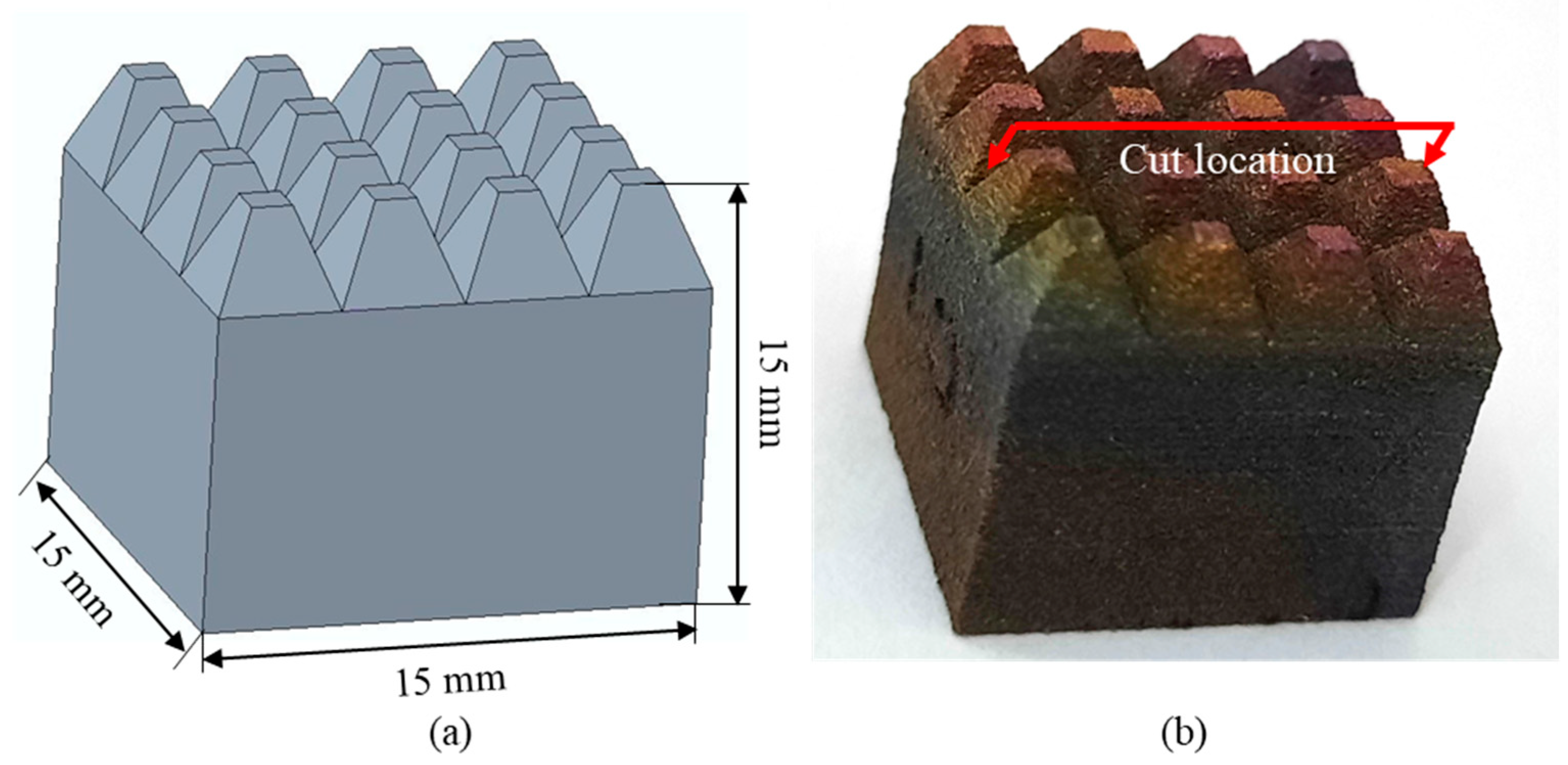
2.1. Material and PBF-LB Processing
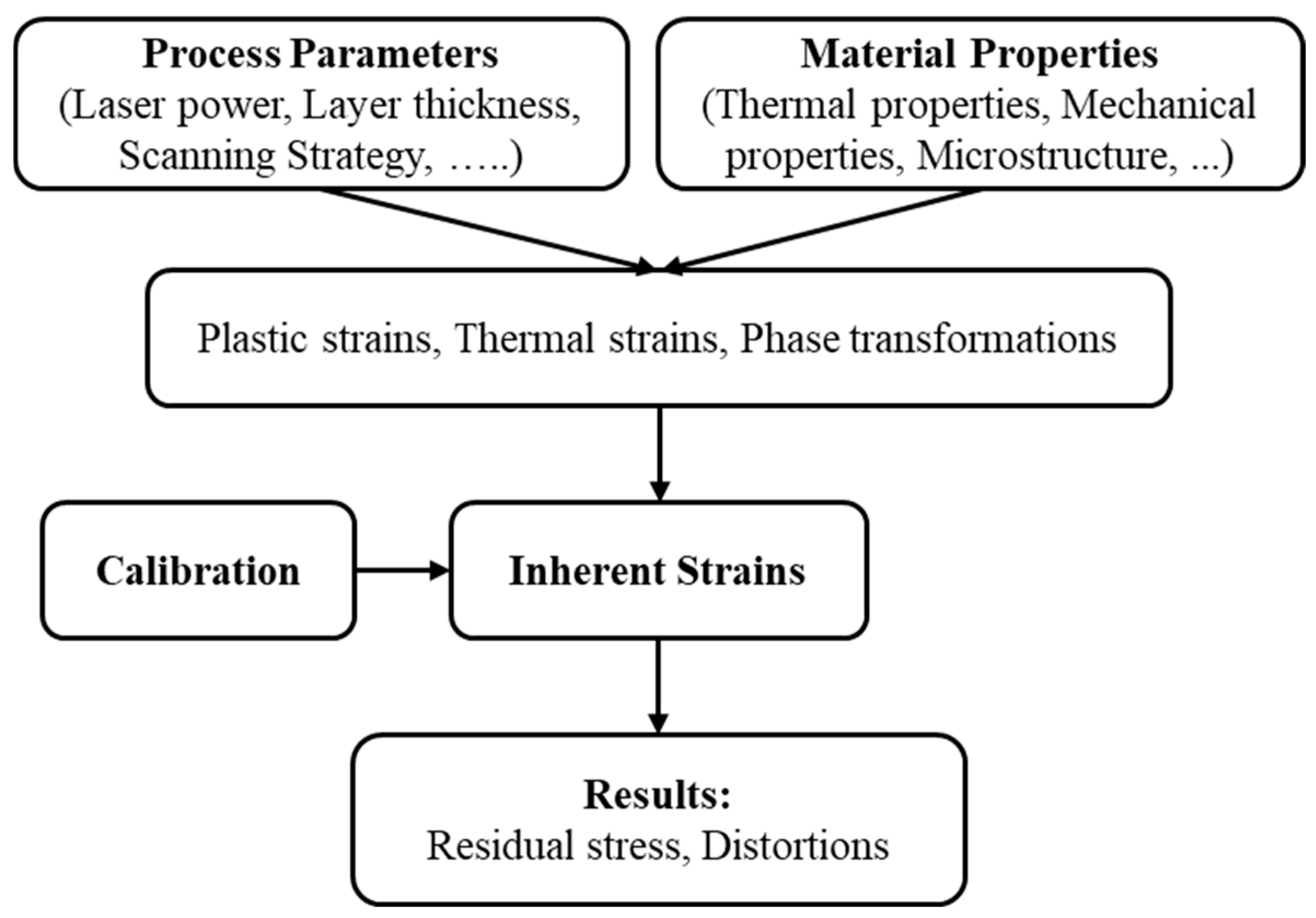
2.2. Numerical Simulation and ISM Calibration
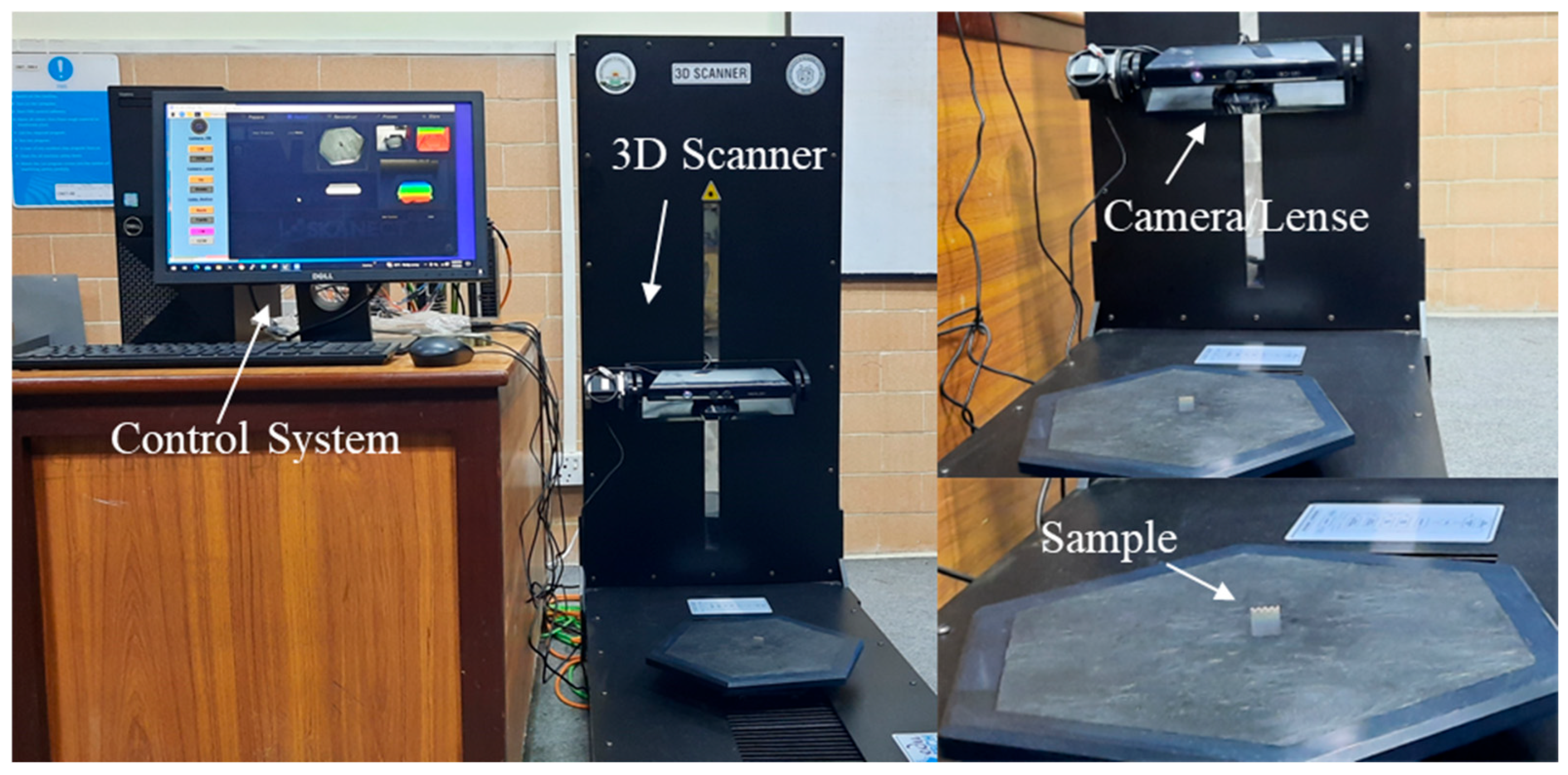
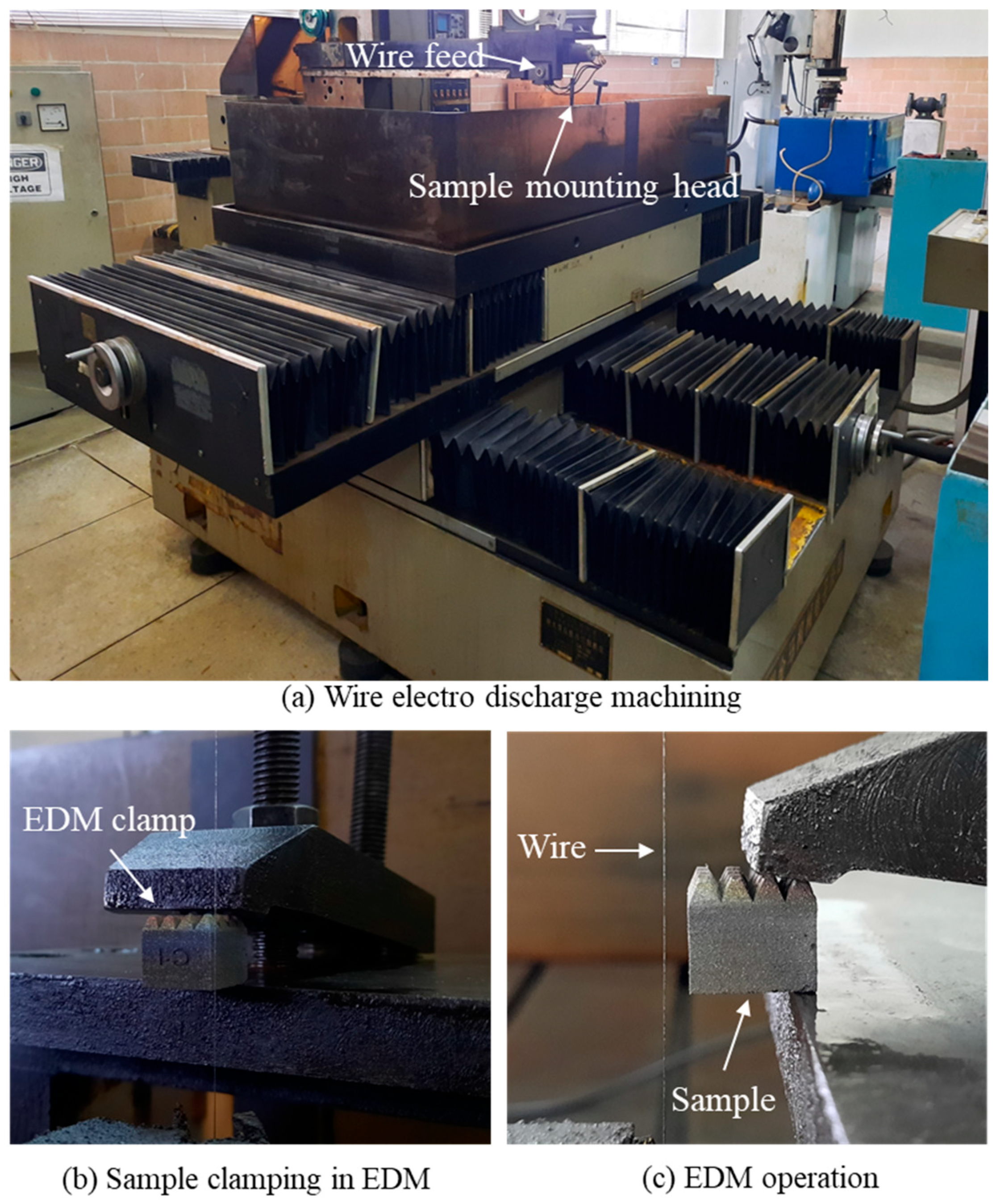
2.3. Experimental Setup
3. Results and Discussion
3.1. Experimental Stress and Distortion Mapping
3.2. Predictive Accuracy of Orthotropic ISM
3.2.1. Parametric Influence of Notch Geometry on Residual Stress Fields
3.2.2. Supplementary Error Analysis and Physical Limitations of the Macro Framework
3.2.3. Benchmarking ISM Against Conventional Transient Thermomechanical Solvers
3.3. Comparative Analysis
4. Conclusions
- Reduced-order macro-scale frameworks, when calibrated using directional inherent strain vectors, exhibit high fidelity for capturing severe, geometry-induced stress gradients. The framework successfully mapped localized tensile stress accumulations forced by geometric bottlenecks without requiring the intensive computational resources associated with transient thermomechanical simulations.
- The introduction of severe geometric discontinuities fundamentally alters the classical macro-scale residual stress profiles typical of plain prismatic additive elements. A quantitative comparison against an unnotched baseline control revealed a dramatic stress magnification at the notch roots, highlighting that structural variations disrupt standard thermal contraction paths and necessitate localized numerical forecasting tools during part design.
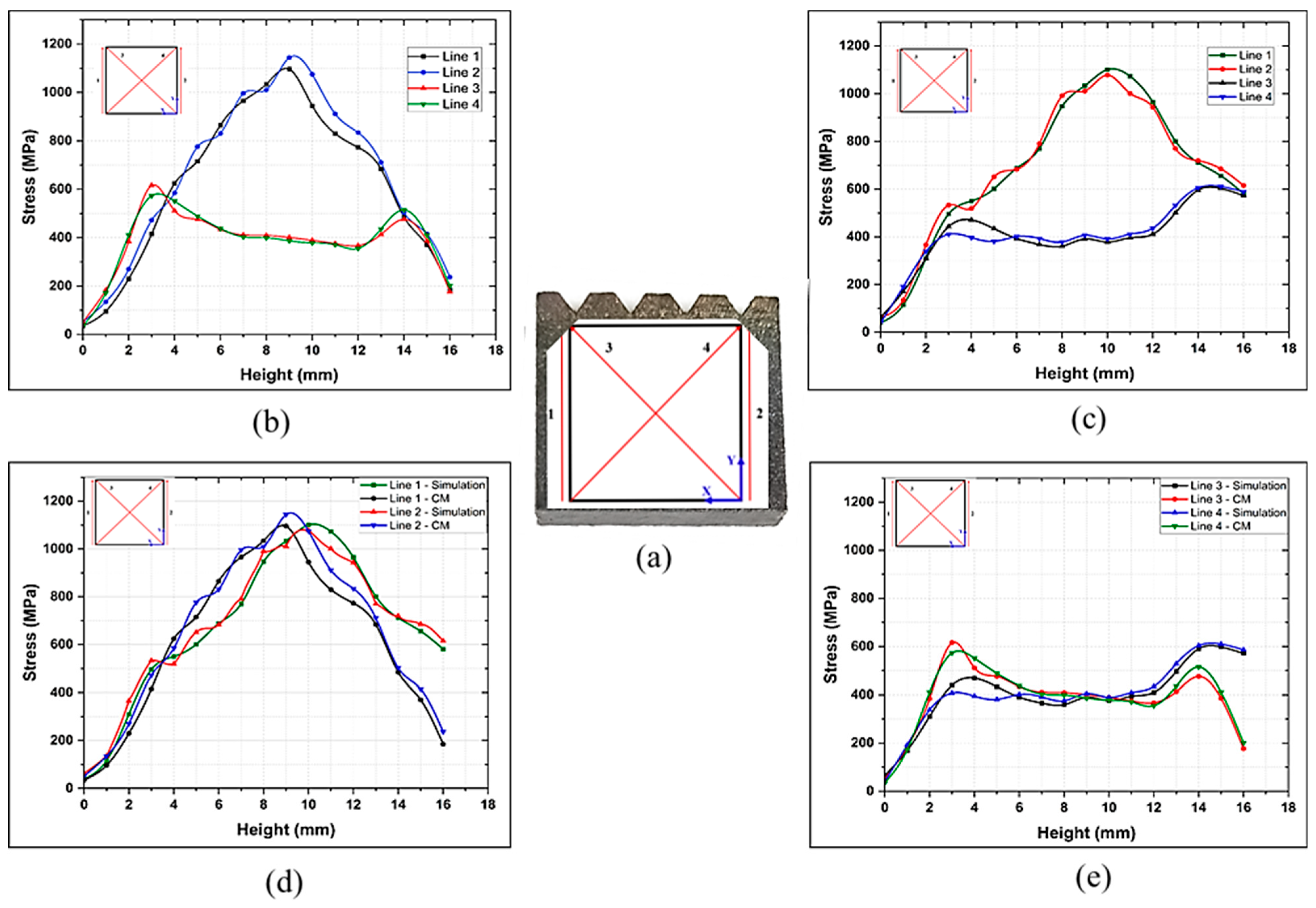
- The destructive contour method, augmented by specialized bivariate cubic spline smoothing routines, provides an exceptionally viable, high-resolution bulk validation metric for numerical modeling. The close alignment maintained across diverse structural directions confirms the viability of integrating reduced-order ISM models into industrial post-printing optimization and qualification pipelines.
Author Contributions
Funding
Institutional Review Board Statement
Informed Consent Statement
Data Availability Statement
Acknowledgments
Conflicts of Interest
Abbreviations
| PBF-LB | Laser beam powder bed fusion |
| ISM | Inherent strain method |
| XRD | X-ray diffraction |
| EDM | Electrical discharge machining |
References
- Kruth, J.P.; Levy, G.; Klocke, F.; Childs, T.H.C. Consolidation phenomena in laser and powder-bed based layered manufacturing. CIRP Ann.-Manuf. Technol. 2007, 56, 730–759. [Google Scholar] [CrossRef]
- Kruth, J.P.; Froyen, L.; Van Vaerenbergh, J.; Mercelis, P.; Rombouts, M.; Lauwers, B. Selective laser melting of iron-based powder. J. Mater. Process. Technol. 2004, 149, 616–622. [Google Scholar] [CrossRef]
- Ali, H.; Khan, A. Optimization of support structures for PBF-LB of Ti6Al4V part: A generative approach for reduced material usage and distortion. Prog. Addit. Manuf. 2026, 11, 59–72. [Google Scholar] [CrossRef]
- Vandenbroucke, B.; Kruth, J.P. Selective laser melting of biocompatible metals for rapid manufacturing of medical parts. Rapid Prototyp. J. 2007, 13, 196–203. [Google Scholar] [CrossRef]
- Clare, A.T.; Chalker, P.R.; Davies, S.; Sutcliffe, C.J.; Tsopanos, S. Selective laser melting of high aspect ratio 3D nickel-titanium structures two way trained for MEMS applications. Int. J. Mech. Mater. Des. 2008, 4, 181–187. [Google Scholar] [CrossRef]
- Hollander, D.A.; Von Walter, M.; Wirtz, T.; Sellei, R.; Schmidt-Rohlfing, B.; Paar, O.; Erli, H.J. Structural, mechanical and in vitro characterization of individually structured Ti-6Al-4V produced by direct laser forming. Biomaterials 2006, 27, 955–963. [Google Scholar] [CrossRef]
- Rochus, P.; Plesseria, J.Y.; Van Elsen, M.; Kruth, J.P.; Carrus, R.; Dormal, T. New applications of rapid prototyping and rapid manufacturing (RP/RM) technologies for space instrumentation. In Proceedings of the 57th International Astronautical Congress (IAC 2006), Valencia, Spain, 2–6 October 2006; Volume 8, pp. 5541–5548. [Google Scholar] [CrossRef]
- Ali, H.; Vasques, C.M.A.; Cavadas, A.M.S. Comparative Study of Rigid and Flexible Multibody Dynamics in a 3D-Printed Two-Link Robotic Mechanism. Eng. Proc. 2026, 124, 112. [Google Scholar] [CrossRef]
- Liu, Y.; Yang, Y.; Wang, D. A study on the residual stress during selective laser melting (SLM) of metallic powder. Int. J. Adv. Manuf. Technol. 2016, 87, 647–656. [Google Scholar] [CrossRef]
- Kalentics, N.; Boillat, E.; Peyre, P.; Gorny, C.; Kenel, C.; Leinenbach, C.; Jhabvala, J.; Logé, R. 3D Laser Shock Peening—A new method for the 3D control of residual stresses in Selective Laser Melting. Mater. Des. 2017, 130, 350–356. [Google Scholar] [CrossRef]
- Parry, L.A.; Ashcroft, I.A.; Wildman, R.D. Geometrical effects on residual stress in selective laser melting. Addit. Manuf. 2019, 25, 166–175. [Google Scholar] [CrossRef]
- Buchbinder, D.; Meiners, W.; Pirch, N.; Wissenbach, K.; Schrage, J. Investigation on reducing distortion by preheating during manufacture of aluminum components using selective laser melting. J. Laser Appl. 2014, 26, 012004. [Google Scholar] [CrossRef]
- Wu, A.S.; Brown, D.W.; Kumar, M.; Gallegos, G.F.; King, W.E. An Experimental Investigation into Additive Manufacturing-Induced Residual Stresses in 316L Stainless Steel. Metall. Mater. Trans. A 2014, 45, 6260–6270. [Google Scholar] [CrossRef]
- Savane, V.; Fu, R.; Gagorik, P.; Chin, C. Distortion prediction of ti6al4v parts in selective laser melting: An industrial case study. In Proceedings of the AIAA Scitech 2020 Forum, Orlando, FL, USA, 6–10 January 2020; p. 1475. [Google Scholar] [CrossRef]
- Dai, K.; Shaw, L. Thermal and mechanical finite element modeling of laser forming from metal and ceramic powders. Acta Mater. 2004, 52, 69–80. [Google Scholar] [CrossRef]
- Zaeh, M.F.; Ott, M. Investigations on heat regulation of additive manufacturing processes for metal structures. CIRP Ann.-Manuf. Technol. 2011, 60, 259–262. [Google Scholar] [CrossRef]
- Olleak, A.; Xi, Z. Simulation of layer-by-layer selective laser melting process with an efficient remeshing technique. Procedia Manuf. 2019, 34, 613–618. [Google Scholar] [CrossRef]
- Moat, R.J.; Pinkerton, A.J.; Li, L.; Withers, P.J.; Preuss, M. Residual stresses in laser direct metal deposited Waspaloy. Mater. Sci. Eng. A 2011, 528, 2288–2298. [Google Scholar] [CrossRef]
- Simson, T.; Emmel, A.; Dwars, A.; Böhm, J. Residual stress measurements on AISI 316L samples manufactured by selective laser melting. Addit. Manuf. 2017, 17, 183–189. [Google Scholar] [CrossRef]
- Li, C.; Liu, J.F.; Fang, X.Y.; Guo, Y.B. Efficient predictive model of part distortion and residual stress in selective laser melting. Addit. Manuf. 2017, 17, 157–168. [Google Scholar] [CrossRef]
- Hodge, N.E.; Ferencz, R.M.; Vignes, R.M. Experimental comparison of residual stresses for a thermomechanical model for the simulation of selective laser melting. Addit. Manuf. 2016, 12, 159–168. [Google Scholar] [CrossRef]
- Read, N.; Wang, W.; Essa, K.; Attallah, M.M. Selective laser melting of AlSi10Mg alloy: Process optimisation and mechanical properties development. Mater. Des. 2015, 65, 417–424. [Google Scholar] [CrossRef]
- Kempen, K.; Thijs, L.; Van Humbeeck, J.; Kruth, J.P. Processing AlSi10Mg by selective laser melting: Parameter optimisation and material characterisation. Mater. Sci. Technol. 2015, 31, 917–923. [Google Scholar] [CrossRef]
- Vrancken, B.; Cain, V.; Knutsen, R.; Van Humbeeck, J. Residual stress via the contour method in compact tension specimens produced via selective laser melting. Scr. Mater. 2014, 87, 29–32. [Google Scholar] [CrossRef]
- Siewert, M.; Neugebauer, F.; Ploshikhin, V. Advanced orthotropic calibration strategy of the inherent strain method for fast simulation of residual stresses and distortion in powder bed fusion. Comput. Mech. 2022, 70, 511–527. [Google Scholar] [CrossRef]
- Li, Y.; Dong, Y.; Chen, G. A numerical investigation of transformation rates from debris flows to turbidity currents under shearing mechanisms. Appl. Sci. 2023, 13, 4105. [Google Scholar] [CrossRef]
- Ahmad, B.; van der Veen, S.O.; Fitzpatrick, M.E.; Guo, H. Residual stress evaluation in selective-laser-melting additively manufactured titanium (Ti-6Al-4V) and inconel 718 using the contour method and numerical simulation. Addit. Manuf. 2018, 22, 571–582. [Google Scholar] [CrossRef]
- Ueda, Y.; Fukuda, K.; Tanigawa, M. Method of measuring inherent strains in a long welded joint and residual stresses in a row of joint. J. Ship Res. 1977, 21, 111–125. [Google Scholar]
- Keller, N.; Ploshikhin, V. New method for fast simulation of residual stress and distortion of AM parts. In Proceedings of the 25th Annual International Solid Freeform Fabrication Symposium, Austin, TX, USA, 4–6 August 2014; pp. 1217–1228. [Google Scholar]
- Setien, I.; Chiumenti, M.; San Sebastian, M.; Caicedo, M.A.; Moreira, C.A. Defining and optimising high-fidelity models for accurate inherent strain calculation in laser powder bed fusion. Metals 2025, 15, 180. [Google Scholar] [CrossRef]
- Prime, M.B. Cross-sectional mapping of residual stresses by measuring the surface contour after a cut. J. Eng. Mater. Technol. 2001, 123, 162–168. [Google Scholar] [CrossRef]
- Setien, I.; Chiumenti, M.; San Sebastian, M.; Moreira, C.A.; Caicedo, M.A. Integrating temperature history into inherent strain methodology for improved distortion prediction in laser powder bed fusion. Metals 2025, 15, 143. [Google Scholar] [CrossRef]
- Zhang, W.; Tong, M.; Harrison, N.M. Multipart build effects on temperature and residual stress by laser beam powder bed fusion additive manufacturing. 3D Print. Addit. Manuf. 2023, 10, 749–761. [Google Scholar] [CrossRef]
- Sun, W.; Ma, Y.; Li, P.; Zhang, W. Residual stress distribution and its effect on fatigue crack path of laser powder bed fusion Ti6Al4V alloy. Aerospace 2025, 12, 103. [Google Scholar] [CrossRef]
- Yadroitsev, I.; Thivillon, L.; Bertrand, P.; Smurov, I. Strategy of manufacturing components with designed internal structure by selective laser melting of metallic powder. Appl. Surf. Sci. 2007, 254, 980–983. [Google Scholar] [CrossRef]
- Schmeiser, F.; Krohmer, E.; Schell, N.; Uhlmann, E.; Reimers, W. Experimental observation of stress formation during selective laser melting using in situ X-ray diffraction. Addit. Manuf. 2020, 32, 101028. [Google Scholar] [CrossRef]



| Element | Titanium | Aluminum | Vanadium | Iron | Oxygen | Carbon | Nitrogen | Hydrogen |
|---|---|---|---|---|---|---|---|---|
| Weight (%) | Balance | 5.50–6.50 | 3.50–4.50 | ≤0.25 | ≤0.13 | ≤0.08 | ≤0.05 | ≤0.01 |
| Parameters | Values |
|---|---|
| Laser power (W) | 200 |
| Layer thickness (mm) | 0.03 |
| Scan speed (mm/s) | 1000 |
| Scan width (mm) | 10 |
| Scan overlap (mm) | 0.14 |
| Beam spot size (mm) | 0.08 |
| Hatch distance (mm) | 0.09 |
| Recoater spread speed (mm/s) | 120 |
| Hatch strategy | Strip-wise |
| Material type | Ti6Al4V |
| Performance Metric | Conventional Transient Thermomechanical FEM | Orthotropic Inherent Strain Method (ISM) |
|---|---|---|
| Primary Physical Mechanism | Time-dependent transient thermal dissipation, melt pool fluid dynamics, and temperature-dependent plastic flow. | Static application of calibrated macro-scale thermal contraction tensor () applied layer by layer. |
| Computational Time ( envelope) | (dependent on track-by-track mesh refinement). | (mesh independent of laser track spot size). |
| Data Storage/Disk Space Overhead | High ( due to micro-step transient increments). | Ultra-low ( via static structural increments). |
| Micro-scale Resolution | Captures localized track-scale melting behavior and microstructural thermal cycles. | Abstracted; cannot resolve localized melt-pool track edge phenomena. |
| Macro-scale Bulk Stress Fidelity | High accuracy across the entire volume. | High accuracy ( peak stress error verified at the core regions). |
Disclaimer/Publisher’s Note: The statements, opinions and data contained in all publications are solely those of the individual author(s) and contributor(s) and not of MDPI and/or the editor(s). MDPI and/or the editor(s) disclaim responsibility for any injury to people or property resulting from any ideas, methods, instructions or products referred to in the content. |
© 2026 by the authors. Licensee MDPI, Basel, Switzerland. This article is an open access article distributed under the terms and conditions of the Creative Commons Attribution (CC BY) license.
Share and Cite
Ali, H.; Vasques, C.M.A.; Cavadas, A.M.S. Predictive Modeling and Contour Method Validation of Residual Stresses in Notched PBF-LB/M/Ti6Al4V Components Using the Inherent Strain Method. Appl. Sci. 2026, 16, 5986. https://doi.org/10.3390/app16125986
Ali H, Vasques CMA, Cavadas AMS. Predictive Modeling and Contour Method Validation of Residual Stresses in Notched PBF-LB/M/Ti6Al4V Components Using the Inherent Strain Method. Applied Sciences. 2026; 16(12):5986. https://doi.org/10.3390/app16125986
Chicago/Turabian StyleAli, Hassan, César M. A. Vasques, and Adélio M. S. Cavadas. 2026. "Predictive Modeling and Contour Method Validation of Residual Stresses in Notched PBF-LB/M/Ti6Al4V Components Using the Inherent Strain Method" Applied Sciences 16, no. 12: 5986. https://doi.org/10.3390/app16125986
APA StyleAli, H., Vasques, C. M. A., & Cavadas, A. M. S. (2026). Predictive Modeling and Contour Method Validation of Residual Stresses in Notched PBF-LB/M/Ti6Al4V Components Using the Inherent Strain Method. Applied Sciences, 16(12), 5986. https://doi.org/10.3390/app16125986