Article

Application of Achiral and Chiral High-Performance Liquid Chromatography Methods for Determination of Lactic Acid in Cosmetic Products

Institute of Analytical Chemistry, Faculty of Chemical and Food Technology, Slovak University of Technology in Bratislava, Radlinského 9, 812 37 Bratislava, Slovakia
*
Author to whom correspondence should be addressed.
Appl. Sci. 2026, 16(12), 5942; https://doi.org/10.3390/app16125942
Submission received: 14 May 2026 / Revised: 6 June 2026 / Accepted: 9 June 2026 / Published: 12 June 2026
(This article belongs to the Special Issue Development of Innovative Cosmetics—2nd Edition)

Abstract

Lactic acid is a widely used component in cosmetics such as hair care products. High concentration of lactic acid or inappropriate enantiomeric form can have a negative impact on the skin. This study focuses on the development of methods of analysis for the separation, enantioseparation and determination of lactic acid in cosmetics and the confirmation of its enantiomeric form. Achiral reversed-phase high-performance liquid chromatography (RP-HPLC) on a C18 stationary phase and hydrophilic interaction liquid chromatography (HILIC) on an amino-propyl stationary phase, combined with diode array detection (DAD; 210 nm), were applied for analysis. Chiral HPLC-DAD on a teicoplanin-based stationary phase was an effective method for verification of the enantiomeric form, confirming L-lactic acid in tested samples. The complex samples were treated by solid-phase extraction using an anion-exchange adsorbent. Recovery studies showed good results, 76.1–91.8% (RSD ≤ 5.0%). The methods provide linearity of response in the concentration ranges tested (R2 > 0.996). This study demonstrated several approaches to the HPLC-DAD determination of lactic acid and proposed an effective sample preparation procedure. Developed methods were rapid, simple and applicable in the routine analysis of cosmetics for monitoring the safety of products.

1. Introduction

Lactic acid, L-enantiomeric form or racemate, is a widely used component in cosmetics and pharmaceuticals [1]. The cosmetic industry uses lactic acid or lactate esters (more hygroscopic and emulsifying properties) to produce hygiene and aesthetic products as components of moisturizers, washing agents (shampoos) and other skin and hair care products, products intended for wrinkle reduction. Lactic acid is also used as a reagent for the synthesis of drugs (e.g., dermatological drugs). While lactic acid helps with blocked pores of sebaceous vessels, it is therefore applied in products for treatment of acne [2]. Among the wide range of biological effects, the most important are the exfoliation effects, the reduction of irregular pigmentation in the skin, it tones and increases blood circulation in the skin, and has antibacterial effects. The function of lactic acid in hair cosmetics is mainly to reduce pH and create the impression of lighter hair. In addition, it helps to smooth the surface of the hair fibers and also has a positive effect on the scalp [3]. L-lactic acid is preferred in products over D-lactic acid due to higher biological activity. D-lactic acid, although a chemical exfoliant, is less effective in supporting the function of the skin barrier and may have a sharper and more irritating acidity. This enantiomeric form is slowly metabolized, leading to its accumulation in the blood, for example in people with specific metabolic disorders. An excessive amount of D-lactic acid can lead to D-lactic acidosis, characterized by symptoms such as confusion, difficulty breathing and fatigue [4].
Cosmetics rarely provide information about the content or the enantiomeric form of lactic acid. The content of lactic acid usually ranges from 1 to 10% with pH not less than 3.5. The maximum content for professional users is increased to 30% at a pH above 3.0 [3,5]. Changes in the concentration of lactic acid and product pH value, as well as inappropriate enantiomeric form of lactic acid, can have an adverse effect on the skin, such as irritation, burns, redness, and changes in skin sensitivity [6]. Therefore, the determination of lactic acid and its enantiomeric form in products can ensure consumer safety. Chiral sensing also improves the detection of pharmaceuticals and biomolecules, increasing the sensitivity and accuracy of analytical diagnostics [7].
Several analytical separation methods, including high-performance liquid chromatography (HPLC), gas chromatography, and capillary electrophoresis, have been developed for the determination of lactic acid individually or simultaneously with other α-hydroxycarboxylic acids (AHAs) [8,9,10,11]. HPLC with UV-spectrophotometric, refractive index, and fluorescence (after derivatization) detection, or combined with mass spectrometry, provides a rapid and simple strategy for the determination of lactic acid in complex samples such as biological fluids, biopolymers, fermented dairy and vegetable products, pharmaceuticals, and others [12,13,14,15]. While achiral methods are suitable to quantify lactic acid, they are unsuitable to confirm the enantiomeric form (with the exception of indirect methods based on separating diastereoisomers). The most frequently employed separation mechanism for achiral HPLC includes reversed-phase (RP) [12,16], and rarely ion-exchange (IEX) [13,17] or hydrophilic interaction (HILIC) liquid chromatography [18,19]. Direct chiral HPLC enantioseparation of DL-lactic acid mainly uses ligand exchange mode with L-proline-based chiral stationary phase (CSP) [20,21], RP mode on macrocyclic antibiotic-based CSP [14,22], or polar organic mode on amylose-based CSP [15]. An indirect chiral HPLC method has been reported for separating lactic acid enantiomers derivatized with (S)(+)-1-(2-pyrrolidinylmethyl)pyrrolidine [23] or 4-nitro-7-piperazino-2,1,3-benzoxadiazole [15]. The importance of enantioselective analytical methods is mainly to verify the enantiomeric form of a biologically active substance in a product, to determine enantiomeric impurities, or to monitor racemization during product storage and application. Although L-lactic acid is an additive in cosmetic and pharmaceutical products, spontaneous changes in optical activity have been reported in solutions prepared with different solvents, ethanol:water, ethanol:acetic acid, and ethanol:buffer (pH 9) (all in ratios of 7:3, v/v). The study of Sajewicz et al. [24] showed that L-lactic acid undergoes chiral transformation, forming a racemic mixture. The time of L-lactic acid transformation depended on the solvent type and the storage temperature. Authors found that the racemization occurred in the ethanol:buffer (pH > 7) mixture at 22 °C, while at 9 °C the chiral transformation did not occur. During conversion, specific optical rotation ranged from 1.2° to 3.8° (the specific optical rotation [α]D of L-lactic acid is 2.6°) [24].
The main purpose of this study was to develop rapid, (enantio)specific, precise and accurate HPLC-DAD methods for the determination of lactic acid in cosmetics, as well as to confirm its enantiomeric form. The methods were based on three separation modes, (i) achiral reversed-phase, (ii) achiral HILIC, and (iii) direct chiral reversed-phase on a teicoplanin-based column. The analytical performance and the application potential of methods were evaluated and compared. In order to select the optimal chromatographic conditions, the effects of mobile phase composition and stationary phase type were examined. The solid-phase extraction (SPE) procedure was proposed for the treatment of complex samples. The optimised methods were applied in the analysis of hair cosmetic products.

2. Material and Methods

2.1. Chemicals and Samples

Acetonitrile (HPLC gradient grade) and a solution of ammonia (26%), both obtained from Centralchem (Bratislava, Slovakia), phosphoric acid (85%) and ammonium acetate (for analysis), both obtained from Mikrochem (Pezinok, Slovakia), were used for the preparation of HPLC mobile phases. Ultrapure water (18.2 MΩ·cm) was prepared by an Aqua Mac Ultra 370 Series water purification system (YL Instruments, Anyang, Republic of Korea). L-lactic acid (98%) was purchased from Alfa Aesar (Karlsruhe, Germany), and DL-lactic acid (90%) from Sigma-Aldrich (St. Louis, MO, USA). Hair cosmetic samples were purchased from a local pharmacy and supermarkets (Sample 1: hair spray (without lactic acid—manufacturer information); Sample 2: hair conditioner with caffeine; Sample 3: hair regeneration with lavender oil; Sample 4: spray for hair volume). Samples were stored in original containers in a refrigerator at 8 °C.

2.2. Preparation of Standard Solutions and Samples

Stock solutions of L- and DL-lactic acid were prepared by dissolving standards in ultrapure water (concentration of 10 mg·mL−1). Working standard solutions were prepared by diluting the stock solutions in water (for achiral analysis) or in the mixture of acetonitrile:0.03 mol·L−1 ammonium acetate (85:15, v/v; mobile phase for chiral HPL C) to obtain a concentration range of 0.01–5.0 mg·mL−1. The solutions were stable for 2 weeks stored in a refrigerator. Samples were diluted with water (1:10, v/v) and filtered through a 0.45 µm nylon membrane filter before analysis.

2.3. Solid-Phase Extraction

A standard solution of L-lactic acid (1 mL; concentration of 0.1 mg·mL−1; pH 8.0) was passed through a SPE cartridge (Chromabond HR-XA (100 mg, Macherey-Nagel, Duren, Germany); Clean-up NAX and Clean-up PAX (100 mg, Chromservis SK, Bratislava, Slovakia)) preconditioned with methanol (2 mL) and deionized water (2 mL). The adsorbent was dried with a vacuum, and the analyte was eluted with an elution solvent (1 mL; elution solvents tested in this study: water, 1% phosphoric acid, 1% phosphoric acid in methanol, 1% phosphoric acid in acetonitrile, 5% formic acid in acetonitrile, or methanol).
The optimal SPE sample treatment procedure included conditioning of the Chromabond HR-XA cartridge with methanol (2 mL), deionized water (2 mL), and application of the sample (1 mL, pH 8). The adsorbent was vacuum-dried, and the analyte was eluted with 1% phosphoric acid in methanol (1 mL). The extract was dried by a stream of nitrogen and reconstituted in deionized water (1 mL) for achiral HPLC-DAD analysis or in the mixture of acetonitrile:0.03 mol·L−1 ammonium acetate (85:15, v/v; 1 mL) for chiral HPLC-DAD analysis.

2.4. Equipment and Chromatographic Conditions

The HPLC system (Agilent Technologies 1200 Series, Santa Clara, CA, USA) equipped with a binary pump, a manual injector valve, a column thermostat, and a diode array detector (DAD) was used for analyses. The data were processed using ChemStation software (version B.0403.SP1). Achiral RP HPLC separation was performed on the WRP-18 column (125 × 4 mm, 5 µm; Watrex, Prague, Czech Republic) with the mobile phase consisting of acetonitrile and 0.1% phosphoric acid (5:95, v/v) pumped at the flow rate of 0.6 mL·min−1. Achiral HILIC separation was performed on a Hypersil APS2 column (125 × 3 mm, 5 µm; Waltham, MA, USA). The mobile phase consisted of acetonitrile and 0.1 mol·L−1 ammonium acetate pH 8 (75:25, v/v). The flow rate was 0.6 mL·min−1. Other stationary phases for column screening included a Cortecs T3 (100 × 4.6 mm, 2.7 µm; Waters, Milford, MA, USA), Hypersil CPS2 (125 × 3 mm, 5 µm; Waltham, MA, USA) and a Nucleodur HILIC (125 × 4 mm, 5 µm; Macherey-Nagel, Duren, Germany). The Chirobiotic T column (250 × 4.6 mm, 5 µm; Sigma Aldrich, St. Louis, MO, USA) was used for chiral HPLC separation of DL-lactic acid. The mobile phase consisting of acetonitrile:0.03 mol·L−1 ammonium acetate (85:15, v/v) was pumped at the flow rate of 1.0 mL·min−1. Columns were maintained at 24 °C and the injection volume was 20 µL for all analyses. The chromatograms were recorded at 210 nm.

2.5. Method Validation

The system suitability, including the height equivalent to a theoretical plate (HETP), number of theoretical plates (N), peak symmetry (S; value from Agilent ChemStation data), and the relative standard deviation (RSD, in %) of peak area and retention time, was all determined with a chromatographic method. The results were evaluated for six consecutive injections of the L- and DL-lactic acid standard solutions (concentration of 0.5 mg·mL−1).
The linearity was evaluated over the concentration range of L-lactic acid standard solutions of 0.03–5.0 mg·mL−1 and DL-lactic acid standard solutions of 0.06–10.0 mg·mL−1 (six calibration levels). The calibration curve was plotted as the dependence of the mean value of the peak areas (three repeated injections of the solution) on analyte concentration. The regression equation was obtained by the least squares regression analysis, and the slope, intercept, and coefficient of determination (R2) values were acquired.
The limit of detection (LOD) and limit of quantification (LOQ) were estimated using Equations (1) and (2):
LOD = 3.3 σ/b
LOQ = 10 σ/b
where σ is the standard deviation of the responses from the calibration curve, and b is the slope of the calibration curve. The estimated LOQ was verified for sample 1 with the addition of L-lactic acid (concentration of 0.03 mg·mL−1 for achiral RP-HPLC-DAD or 0.3 mg·mL−1 for HILIC-DAD; three replicates) or DL-lactic acid (concentration of 0.06 mg·mL−1; three replicates). LOQ was determined by a 10:1 signal-to-noise ratio.
The accuracy of the study was assessed by preparing three replicates of sample 1 with the addition of L-lactic acid (the concentrations were 0.01, 0.02, 0.05, and 0.1 and 0.5 mg·mL−1) and DL-lactic acid (concentration of 0.2 mg·mL−1). The mean recovery values and RSDs % values were calculated. The intraday and interday precision (expressed by RSD % values) was determined for analysis of sample 1 with the addition of L-lactic acid at a concentration level of 0.1 mg·mL−1 (three replicates per day, six replicates during a three-day period).

3. Results and Discussion

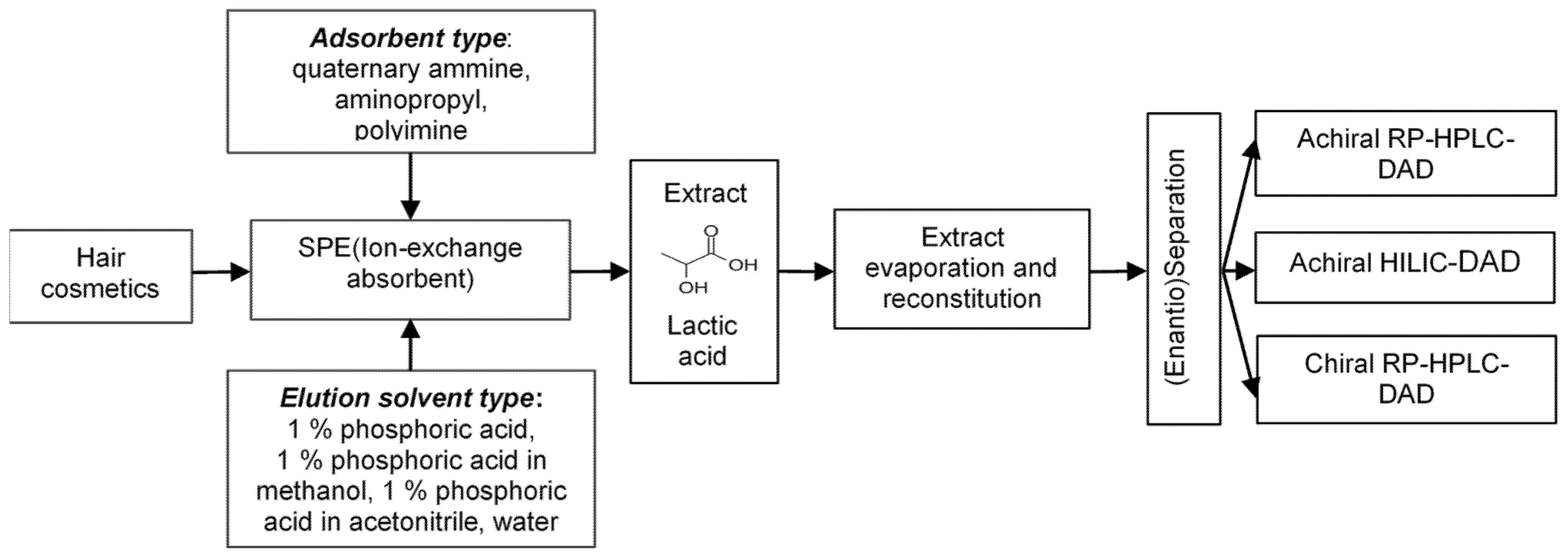
In this work, the methods for the quantification of lactic acid and its enantiomers in hair cosmetics were developed and compared. Figure 1 provides an overview of the study workflow. The SPE procedure for the extraction of lactic acid from hair cosmetics was optimised, including a selection of adsorbent type and elution solvent. The achiral and chiral HPLC methods with spectrophotometric detection were developed, compared, and applied for the analysis of extracts, determining lactic acid and its enantiomeric form.

3.1. Solid Phase Extraction

SPE is a suitable technique for analyte purification and preconcentration prior to liquid chromatography analysis. The optimisation of the extraction procedure included (i) selection of the adsorbent type, (ii) choice of the elution solvent, and (iii) testing of the extract evaporation/reconstitution. In addition, the sample treatment procedure considered compatibility with achiral and chiral HPLC-DAD methods used in this study.

3.1.1. The Type of SPE Adsorbent

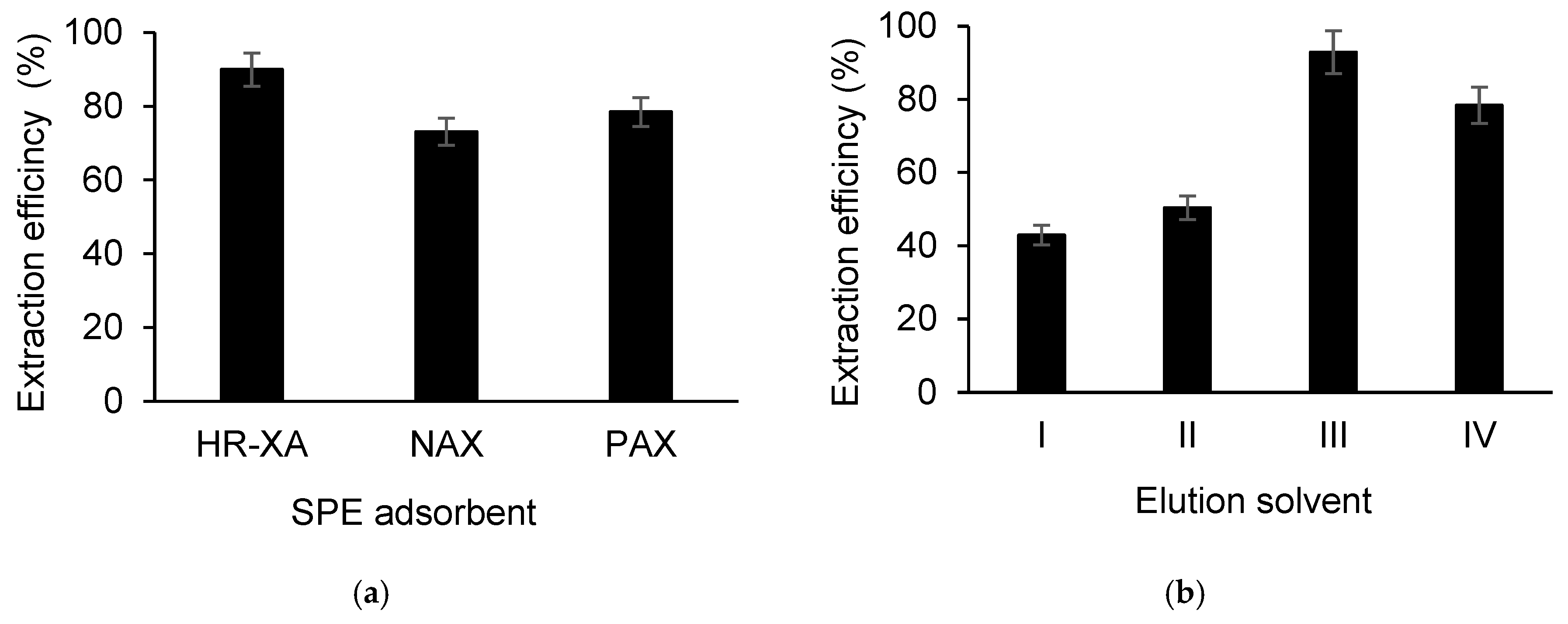
The ion-exchange SPE sorption mechanism is suitable for separation, purification, and preconcentration of polar analytes [25]. A SPE with an anion-exchange adsorbent was selected for lactic acid extraction (weak acid, pKa 3.85). The ion-exchange mechanism required adjusting the pH of the analyte solution/sample to pH 8 (with 5% ammonia). Three SPE adsorbents were used for screening: HR-XA (quaternary ammonium; a strong anion exchanger adsorbent), NAX (aminopropyl; a weaker anion exchange adsorbent), and PAX (polyimine; a mixed-mode non-polar/anion exchange polymeric adsorbent). The highest extraction efficiency, over 90%, was achieved for a quaternary ammonium-based adsorbent (Figure 2a; evaluated for a standard solution of L-lactic acid at a concentration level of 0.1 mg·mL−1 and 1% phosphoric acid in methanol as the elution solvent).

3.1.2. The Elution Solvent

The elution solvent type and the final treatment of the extract were optimised to ensure compatibility with the achiral and chiral HPLC-DAD separation system. Several types of solvents were tested for elution of lactic acid from HR-XA SPE cartridge, water, 1% phosphoric acid, 1% phosphoric acid in methanol or acetonitrile, and 5% formic acid in acetonitrile or methanol (Figure 2b; extraction efficiency was evaluated for standard solution of L-lactic acid at a concentration of 0.1 mg·mL−1). Significant coelution of analyte and extraction solvent was observed in the HPLC-DAD chromatogram of extracts eluted with solvents containing formic acid. A mixture of 1% phosphoric acid in methanol was selected as optimal. The final extract was dried and reconstituted in deionised water for achiral HPLC-DAD analysis or in the mixture of acetonitrile:0.03 mol·L−1 ammonium acetate (85:15, v/v) for chiral HPLC-DAD analysis. Reconstitution in the mobile phase minimizes interferences from the elution solvent detectable by the HPLC-DAD (210 nm).
The suitability of the extraction procedure for sample 1 was evaluated with the addition of L-lactic acid at five concentration levels (0.01–0.5 mg·mL−1) and preconcentration factors of 1, 5, and 10. The recovery values varied in the range of 76.1–91.8% (RSD ≤ 5.0%; Table 1).

3.2. Separation and Enantioseparation of Lactic Acid

3.2.1. Achiral HPLC-DAD

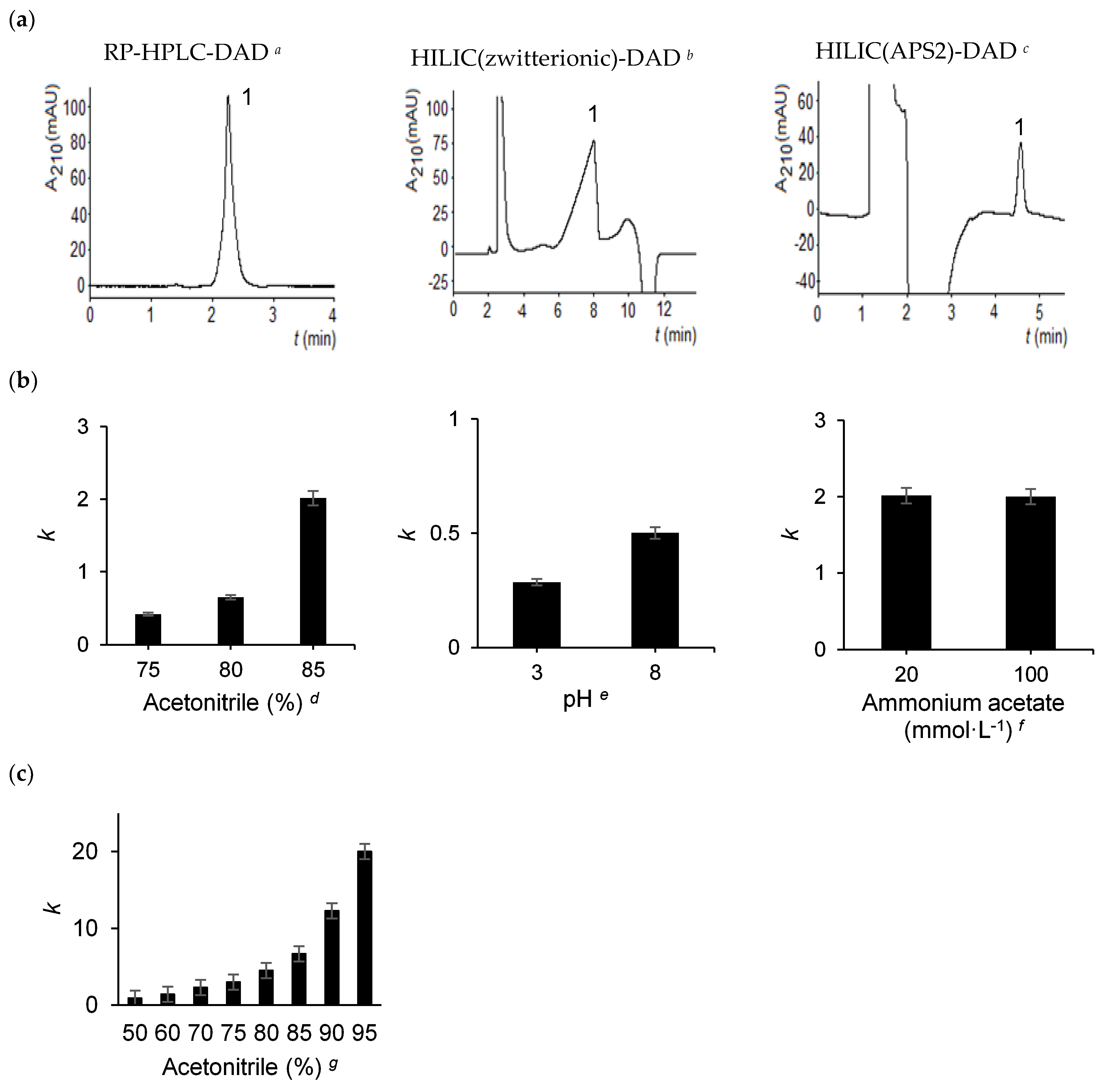
RP-HPLC-UV is a widely used analytical technique for the separation of AHAs like lactic acid, due to its high efficiency, robustness, and reproducibility. The separation was performed on a stationary phase of C18 type and a mobile phase consisting of acetonitrile and 0.1% phosphoric acid. Screening of acetonitrile content in the range of 2–25% resulted in the suitable mobile phase composition, acetonitrile:0.1% phosphoric acid 5:95 (v/v). Figure 3a documented the chromatogram of lactic acid separation. The Cortecs T3 column, compatible with 100% aqueous mobile phase, was also tested as a prospective separation system for retention of polar compounds. In addition, this phase system is advantageous in terms of environmental friendliness. However, the results showed lower peak symmetry (S = 0.74) and shorter retention time (less than 2 min) compared to the C18 type of stationary phase.
Columns with stationary phases of aminopropyl (Hypersil APS2), cyanopropyl (Hypersil CPS2), and sulfobetaine acid (zwitterionic; Nucleodur HILIC) types were tested for the separation of lactic acid in HILIC chromatographic mode. The ratio of the mobile phase components, acetonitrile and ammonium acetate (the content of acetonitrile varied from 50 to 95%), ammonium acetate concentration (0.02 or 0.1 mol·L−1), and pH (3 or 8) were optimised (Figure 3b,c). Although the retention factors of lactic acid in mobile phases with 0.02 and 0.1 mol·L−1 ammonium acetate were similar, lower peak symmetry was observed at 0.02 mol·L−1. The optimal mobile phases, consisting of acetonitrile:0.1 mol·L−1 ammonium acetate pH 8 (85:15 v/v) and (75:25 v/v) were selected for the zwitterionic and aminopropyl stationary phases, respectively. The chromatograms of lactic acid separation on zwitterionic and APS2 columns are documented in Figure 3a. Low retention of lactic acid (elution time near dead elution time ~1.5 min) was observed in HILIC mode with the cyanopropyl stationary phase and acetonitrile:0.1 mol·L−1 ammonium acetate buffer pH 8 as the mobile phase. Table 2 summarises the system suitability parameters, elution characteristics, and column efficiency characteristics (height equivalent to a theoretical plate, number of theoretical plates) for tested stationary phases and optimal mobile phase composition. The difference in RP and HILIC separation mechanisms resulted in significant differences in analyte retention. An advantage of the RP-HPLC-DAD method was shorter conditioning of the column (approximately 15–30 min) and repeatability of chromatographic characteristics. The RSDs of the retention factor and peak area (n = 6) were lower, 0.5% and 0.8%, in comparison to values (1.6% and 3.2%) obtained for the HILIC(APS2)-DAD method. The disadvantage of RP mode was washing out the sample matrix components before the next injection (e.g., with 100% acetonitrile applied by a step gradient). The lactic acid was more strongly retained on HILIC columns than on the C18 column, while non-polar/less-polar matrix components were not retained [26]. However, longer conditioning of the HILIC type of stationary phase (30–50 min) with the optimal mobile phase was necessary. HILIC(APS2) showed higher column efficiency and better peak symmetry compared to HILIC(zwitterionic).

3.2.2. Chiral HPLC-DAD

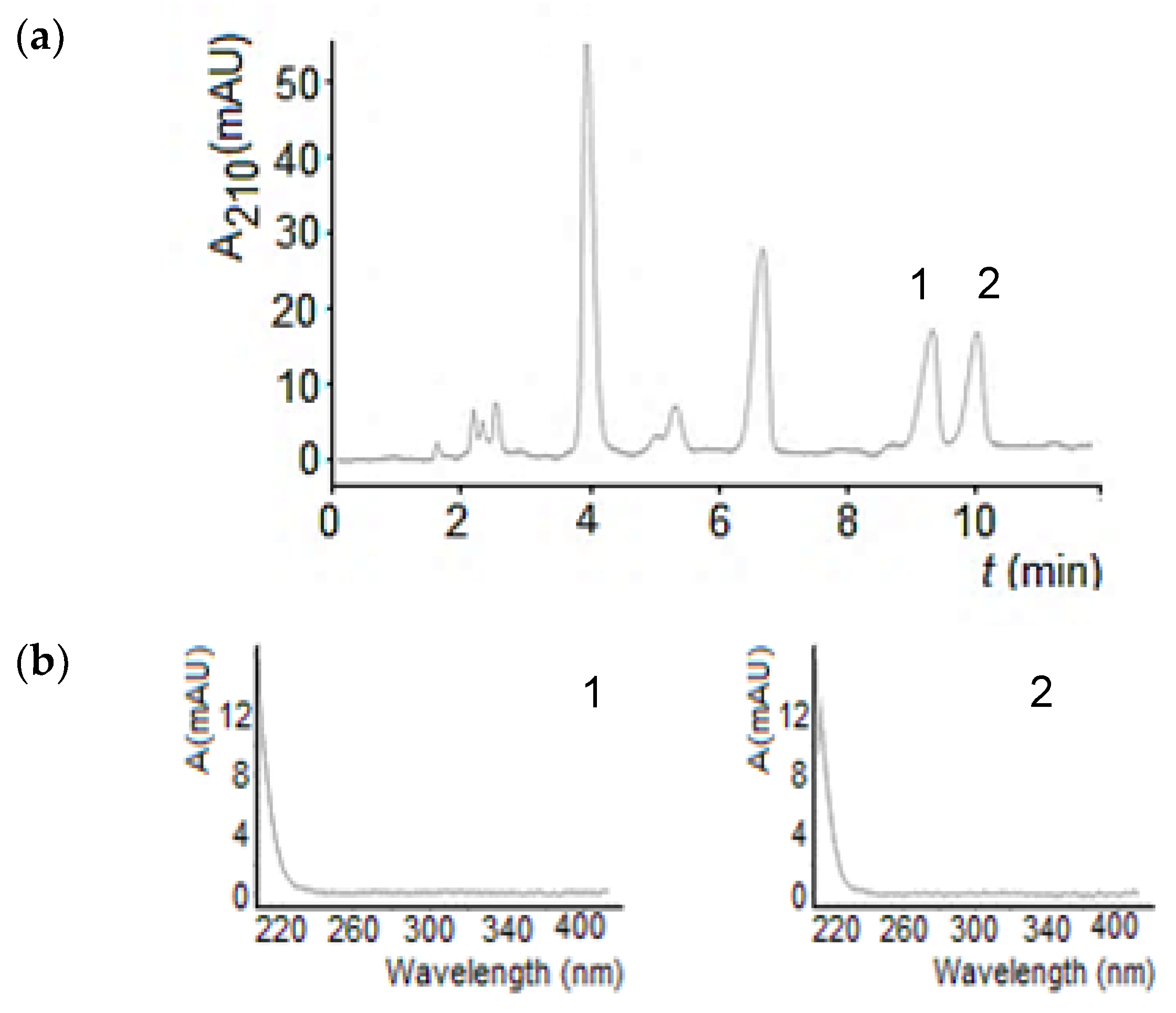
Several chiral stationary phases based on macrocyclic antibiotics [27] and on the effects of column temperatures were screened in our previous research focused on the HPLC separation of DL-lactic acid [22]. The results showed a preference of the reversed-phase separation mode on a teicoplanin-based column using the mobile phase consisting of acetonitrile:0.03 mol·L−1 ammonium acetate (85:15, v/v). This work expanded the study on system suitability and analytical parameters. Baseline resolution of the enantiomers (Rs = 1.58 ± 0.05) and satisfactory chromatographic characteristics were achieved (Table 2). The variation of column temperature by ± 0.2 °C around the setpoint (24 °C) did not have a significant effect on the value of the resolution (RSD% = 1.25%). The elution order of enantiomers was L-form before D-form (determined by comparing the retention factors of L-lactic acid and D- and L-lactic acid in racemate). A representative chromatogram of DL-lactic acid and the UV spectra of the enantiomers are shown in Figure 4. In addition, the mobile phase used for chiral RP-HPLC is compatible with the MS type of detection, which is advantageous in the case of method transfer.

3.3. Methods Performance Evaluation and Comparison with Other Studies

The optimal chromatographic conditions were implemented, and the proposed methods were validated, including tests for linearity, LODs and LOQs, precision, and spiked recovery. Table 3 demonstrates the analytical parameters of achiral and chiral RP-HPLC-DAD (210 nm) and HILIC-DAD (210 nm) methods. The results showed a satisfactory linearity for all methods, indicating the values of the coefficient of determination (R2) exceeding 0.996 within the specified concentration ranges. The concentration range of the RP-HPLC-DAD method encompasses the expected analyte concentrations in real samples. The achiral RP-HPLC-DAD method exhibited a lower LOD compared to the HILIC(APS2)-DAD method and demonstrated its ability to detect lactic acid in hair water cosmetics. The HILIC(APS2)-DAD method could be a suitable alternative for analysing samples with higher lactic acid content or after its preconcentration. The HILIC and RP-HPLC separation mechanisms are different, which makes them complementary and suitable for two-dimensional liquid chromatography (2D-LC) analysis of complex samples. In addition, the mobile phase used in the HILIC method is compatible for combining with MS, unlike RP-HPLC. The developed achiral RP-HPLC-DAD method also provided a shorter analysis time (3.5 min) in comparison to the methods reported in Table 4 (over 10 min) [8,16,28,29], which is also due to the separation of one analyte. LOQ of lactic acid achieved by achiral RP-HPLC-DAD method was slightly higher or comparable to the method presented by Huang et al. [8] or Meng et al. [12]. A lower LOQ was achieved for the developed method compared to the CE-UV-MS method [30]. In precision tests, the relative standard deviation (RSD) of lactic acid was less than 5.0%, demonstrating the method’s accuracy and consistency. Additionally, the recovery test showed values from 76.1% to 91.8%, meeting testing standards and validating the method’s reliability. The proposed methods are consistent with previously published methods for which comparable RSDs (1.1–9.2%) were achieved (Table 4).
To our knowledge, no HPLC-DAD method has been published for the determination of lactic acid enantiomers in cosmetic samples. The proposed chiral HPLC-DAD method showed a higher or comparable resolution of enantiomers and a shorter analysis time in comparison to the ligand-exchange liquid chromatography method on (S)-leucinol (Rs = 1.4, analysis time 20 min) [32], or L-proline (Rs = 1.7, analysis time 25 min) [20] based chiral stationary phases. Although immunoaffinity chromatography provided efficient enantioseparation (Rs = 1.7, analysis time 7 min), longer activation of the stationary phase was disadvantageous [33]. A chiral stationary phase based on ristocetin could be an alternative to the one chosen in this study, because of the satisfactory enantioresolution of DL-lactic acid (Rs = 1.7 [25]; Rs = 1.9 [18]). Montrone et al. [34] demonstrated the suitability of the polysaccharide type of chiral stationary phases (3,5-dimethylphenylcarbamate derivative of cellulose or amylose) in normal-phase separation mode for efficient separation of benzyl halide derivatives of lactic acid enantiomers (Rs > 3).
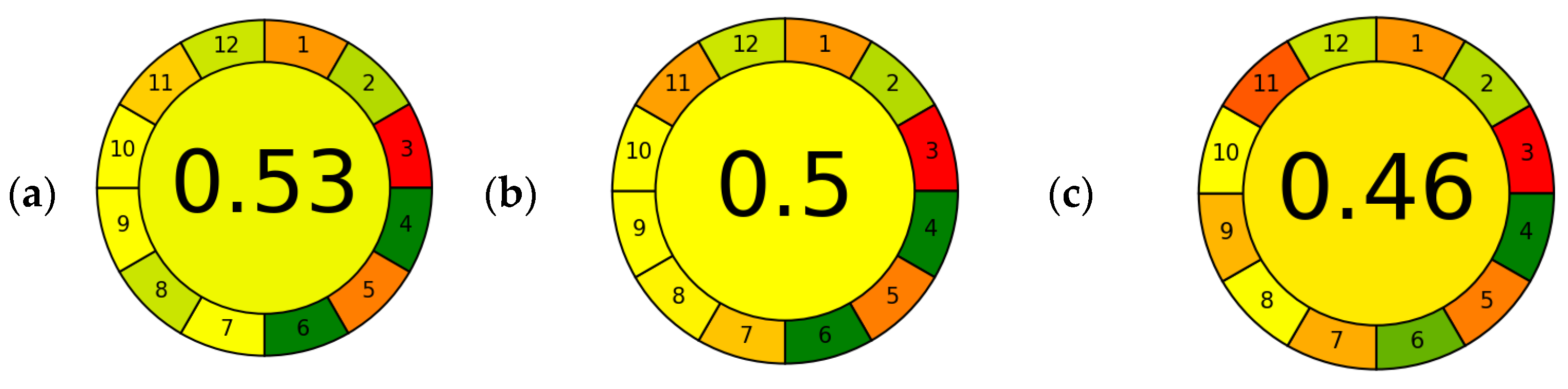
The evaluation of the environmental acceptability of an analytical method contributes to the preference of method selection and its adoption from a green chemistry perspective. The AGREE (Analytical GREEnness) metric approach was used for evaluating the environmental friendliness of the developed analytical methods (Figure 5; score values were calculated using the Analytical Greenness Calculator). This approach evaluates 12 criteria (derived directly from the Green Analytical Chemistry principle) transformed onto a 0–1 scale and visualizes it in an intuitive clock-like pictogram with the red-yellow-green color scale and the overall method score in the center (red—little to no compliance with a GAC principle, yellow—moderate or partial compliance, green—high compliance or an ideally green procedure). The metric assesses the entire analytical procedure—from the sample to final waste, including sample size, reagent toxicity, energy requirements, waste generation, sample treatment, operator safety and other [35].
The benefit of the developed achiral RP-HPLC-DAD method results not only from the reduction in analysis time and satisfactory accuracy in quantifying the analyte in hair cosmetics but also from its greater environmental friendliness compared to the HILIC(APS2)-DAD method. The mobile phase for the achiral RP-HPLC method was predominantly aqueous (containing only 5% acetonitrile) compared to the HILIC method (75% acetonitrile). Analysis in HILIC mode was time-consuming, thereby generating more organic solvent waste. The AGREE score of 0.50 for the achiral SPE-HILIC(APS2)-DAD method indicates lower environmental acceptance in comparison to the SPE-RP-HPLC-DAD method (AGREE score of 0.53). The SPE-chiral HPLC-DAD method shows a lower AGREE score (0.46) due to the mobile phase composition and longer analysis time.

3.4. Analysis of Real Samples

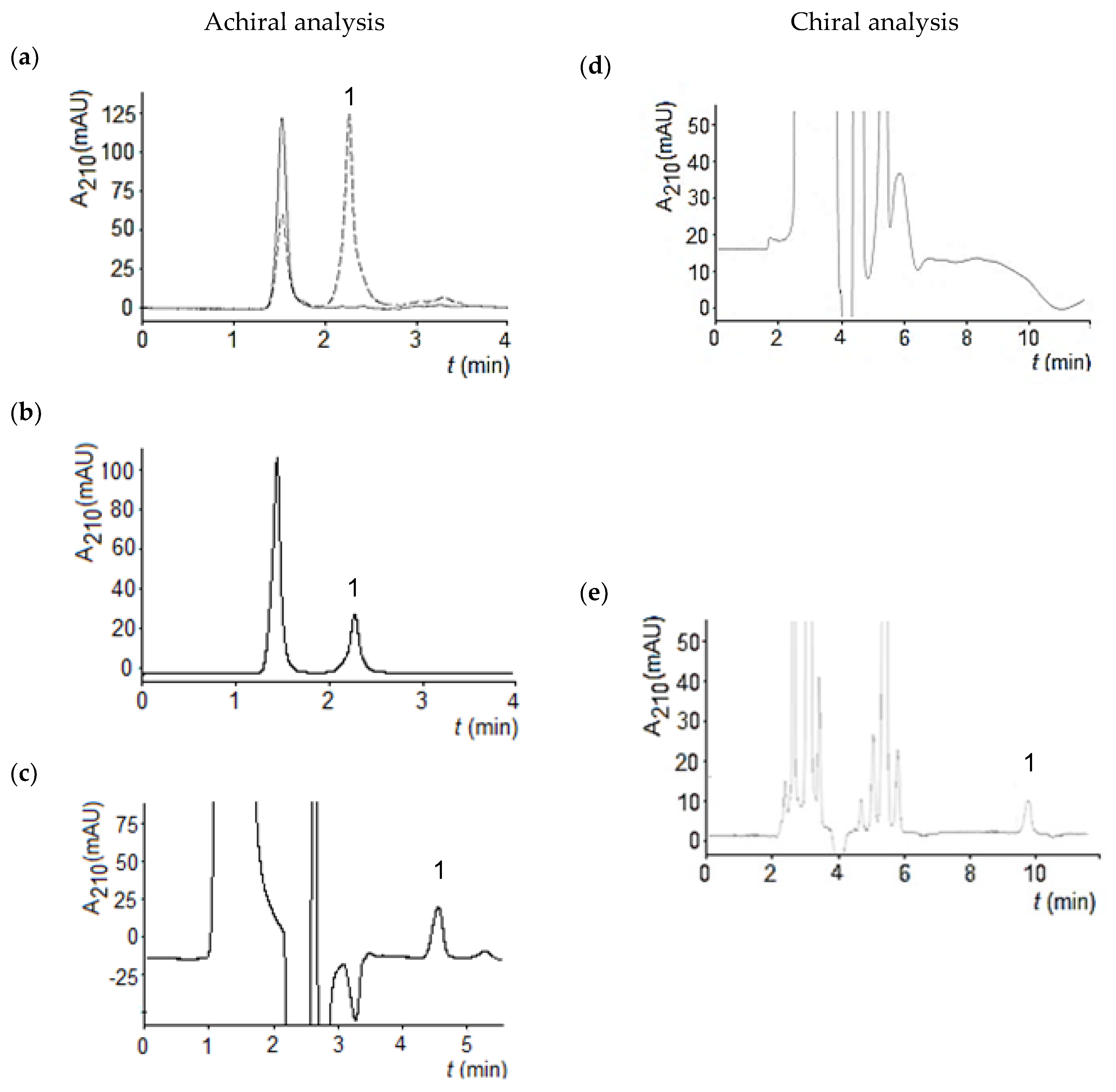
Selected separation conditions for achiral RP-HPLC-DAD and HILIC(APS2)-DAD and chiral HPLC-DAD methods, as well as the optimal SPE conditions, were applied for the analysis of hair cosmetic products. Chiral HPLC-DAD analysis was used to confirm the L-enantiomeric form of lactic acid in the analysed hair cosmetic samples. The manufacturers did not specify the enantiomeric form in the tested products; however, L-lactic acid is a widely used component in personal care cosmetics [1]. The L-lactic acid concentration in analysed samples varied depending on the sample type. The concentrations of 15.2 ± 0.5/16.0 ± 0.4 mg·mL−1 (sample 2), 11.1 ± 0.5 /13.3 ± 0.6 mg·mL−1 (sample 3), and 2.9 ± 0.1 /3.0 ± 0.1 mg·mL−1 (sample 4) were determined by RP-HPLC-DAD/HILIC(APS2)-DAD methods, respectively. Lactic acid was not detected in sample 1 (the sample without the addition of lactic acid—the manufacturer information). As demonstrated, the lactic acid content quantified by the RP-HPLC-DAD method showed no significant difference (p > 0.05) from that determined by the HILIC(APS2)-DAD method. The recommended lactic acid content in shampoos and conditioners ranged between 1 and 3% [5]. The representative chromatograms of achiral and chiral analysis of extracts from samples 1 and 3 are shown in Figure 6.

4. Conclusions

Three liquid chromatography methods differing in the separation mechanism, analysis time, accuracy, and environmental acceptability were presented for the determination of lactic acid in hair cosmetics and, additionally, for confirming the enantiomeric form. An extraction procedure using HR-XA SPE effectively removed impurities, and the extract was compatible with the achiral and chiral separation systems. Lactic acid was quantified by the PR-HPLC-DAD and HILIC-DAD methods, showing differences of less than 10%. Chiral HPLC-DAD was an effective method to verify the enantiomeric form, confirming L-lactic acid in the tested samples. This study showed several approaches to the HPLC-DAD determination of lactic acid and proposed simple and efficient extraction and (enantio)separation methods for the analysis of cosmetic samples. Extraction and separation conditions could be modified for simultaneous separation and quantification of other AHAs. The sample treatment procedure allows the analysis of extracts by both achiral and chiral HPLC-DAD methods, and provides the possibility for the analysis of other types of complex samples.

Author Contributions

Conceptualization, K.H.; methodology, K.H.; formal analysis, P.L. and E.S.; data curation, P.L. and E.S.; writing—original draft preparation, P.L.; writing—review and editing, K.H.; Visualization, P.L.; Supervision, K.H.; Project administration, K.H. All authors have read and agreed to the published version of the manuscript.

Funding

This research was funded by the Scientific Grant Agency of the Ministry of Education, Research, Development and Youth of the Slovak Republic and the Slovak Academy of Sciences under grant number VEGA 1/0332/24.

Institutional Review Board Statement

Not applicable.

Informed Consent Statement

Not applicable.

Data Availability Statement

The data presented in this study are available on request from the corresponding author.

Conflicts of Interest

The authors declare no conflicts of interest.

References

  1. Martinez, F.A.C.; Balciumas, E.M.; Salgado, J.M.; Gonzalez, J.M.D.; Converti, A.; de Souza Oliviera, R.P. Lactic acid properties, applications and production: A review. Trends Food Sci. Technol. 2013, 30, 70–83. [Google Scholar] [CrossRef]
  2. Feng, X.; Shang, J.; Gu, Z.; Luo, X.; Chen, Y.; Liu, Y. Lactic acid chemical peeling in skin disorders. Clin. Cosmet. Investig. Dermatol. 2024, 17, 901–909. [Google Scholar] [CrossRef]
  3. Abd Alsaheb, R.A.; Aladdin, A.; Othman, N.; Malek, R.; Leng, O.; Aziz, R.; El Enshasy, H. Lactic acid applications in pharmaceutical and cosmeceutical industries. J. Chem. Pharm. Res. 2015, 7, 729–735. [Google Scholar]
  4. Remund, B.; Yilmaz, B.; Sokollik, C. D-Lactate: Implications for gastrointestinal diseases. Children 2023, 10, 945. [Google Scholar] [CrossRef]
  5. Office of the Commissioner, Office of the Chief Scientist. Guidance Document, Guidance for Industry: Labeling for Cosmetics Containing Alpha Hydroxy Acids; Docket Number: FDA-2000-P-0063; Office of the Commissioner, Office of the Chief Scientist: Sydney, Australia, 2005.
  6. Lukić, M.; Pantelić, I.; Savić, S.D. Towards optimal pH of the skin and topical formulations: From the current state of the art to tailored products. Cosmetics 2021, 8, 69. [Google Scholar] [CrossRef]
  7. Asefa, S.A.; Shim, S.; Seong, M.; Lee, D. Chiral Metasurfaces: A Review of the Fundamentals and Research Advances. Appl. Sci. 2023, 13, 10590. [Google Scholar] [CrossRef]
  8. Huang, W.; Lin, C.C.; Huang, M.C.; Wen, K.C. Determination of a-hydroxyacids in cosmetics. J. Food Drug Anal. 2002, 10, 95–100. [Google Scholar] [CrossRef]
  9. Zhang, H.Y.; Tan, X.X.; Kang, K.; Wang, W.; Liann, K.Q.; Kang, W.J. Simultaneous determination of lactic acid and pyruvic acid in tissue and cell culture media by gas chromatography after in situ derivatization-ultrasound-assisted emulsification microextraction. Anal. Bioanal. Chem. 2019, 411, 787–795. [Google Scholar] [CrossRef]
  10. Zhang, H.Y.; Zhang, P.P.; Tan, X.X.; Wang, Z.Z.; Lian, K.Q.; Xu, X.D.; Kang, W.J. Derivatization method for the quantification of lactic acid in cell culture media via gas chromatography and applications in the study of cell glycometabolism. J. Chromatogr. B 2018, 1090, 1–6. [Google Scholar] [CrossRef]
  11. Ding, X.; Lin, S.; Weng, H.; Liang, J. Separation and determination of the enantiomers of lactic acid and 2-hydroxybutyric acid by chiral derivatization combined with gas chromatography—And mass spectrome-try. J. Sep. Sci. 2018, 41, 2576–2584. [Google Scholar] [CrossRef] [PubMed]
  12. Meng, Y.; Zhang, Y.; Chen, L.; Gao, W.; Wang, D.; Chen, X. Determination of the content of α-hydroxy acids in cosmetics by HPLC. Anal. Chem. A J. 2024, 3, 46–53. [Google Scholar] [CrossRef]
  13. Zaky, A.S.; Pensupa, N.; Andrade-Eiroa, A.; Tucker, G.A.; Du, C. A new HPLC method for simultaneously measuring chloride, sugars, organic acids and alcohols in food samples. J. Food Comp. Anal. 2017, 56, 25–33. [Google Scholar] [CrossRef]
  14. Henry, H.; Marmy Conus, N.; Steenhout, P.; Béguin, A.; Boulat, O. Sensitive determination of D-lactic acid and L-lactic acid in urine by high-performance liquid chromatography-tandem mass spectrometry. Biomed. Chromatogr. 2012, 26, 425–428. [Google Scholar] [CrossRef]
  15. Hasegawa, H.; Fukushima, T.; Lee, J.A.; Tsukamoto, K.; Moriya, K.; Ono, Y.; Imai, K. Determination of serum D-lactic and L-lactic acids in normal subjects and diabetic patients by column-switching HPLC with pre-column fluorescence derivatization. Anal. Bioanal. Chem. 2003, 377, 886–891. [Google Scholar] [CrossRef] [PubMed]
  16. Stojiljkovic, D.; Tadic, V.; Stankovic, M.; Roranovic, S.; Arsic, I. Standardized extract of wild apple fruit in alkyl-polyglucoside-based cosmetic cream–estimation of stability, safety, antioxidant activity and efficiency. Int. J. Cosmet. Sci. 2018, 40, 285–294. [Google Scholar] [CrossRef]
  17. Cruz, A.F.A.; Dias, G.P.; Bittencourt, F.R.; Gomes Aranda, D.A. Separation of lactic acid and by-products obtained by catalytic conversion of glycerol using high-performance liquid chromatography. Eclet. Quim. 2022, 47, 74–81. [Google Scholar] [CrossRef]
  18. Bonafe, S.; Protti, M.; Carotti, A.; Pagano, C.; Di Michele, A.; Migni, A.; Perioli, L.; Mercolini, L.; Sardella, R. Development of a MS compatible HPLC-HILIC method for the analysis of allantoin and glycolic acid in snail slime and related dosage forms: Focus on the enantioseparation of allantoin. Talanta 2025, 290, 127832. [Google Scholar] [CrossRef]
  19. Storton, M.; Exarchakis, J.; Waters, T.; Hao, Z.; Parker, B.; Knapp, M. Lactic acid quantification in hand dishwashing liquid using an HILIC-UV methodology. J. Sep. Sci. 2010, 33, 982–987. [Google Scholar] [CrossRef]
  20. Okubo, S.; Mashige, F.; Omori, M.; Hashimoto, Y.; Nakahara, K.; Kanazawa, H.; Matsushima, Y. Enantiomeric determination of L-and D-lactic acid in human cerebrospinal fluid by chiral ligand exchange high-performance liquid chromatography. Biomed. Chromatogr. 2000, 14, 474–477. [Google Scholar] [CrossRef]
  21. Olieman, K.; Vries, E. Determination of D- and L-lactic acid in fermented dairy products with HPLC. Neth. Milk Dairy J. 1988, 42, 111–120. [Google Scholar]
  22. Jánovová, L.; Hroboňová, K. Stationary phase type and temperature effect on HPLC separation of lactic acid enantiomers. Acta. Chim. Slov. 2021, 14, 60–65. [Google Scholar] [CrossRef]
  23. Tsutsi, H.; Mochizuki, T.; Maeda, T.; Noge, I.; Kitagawa, Y.; Min, J.Z.; Todoroki, K.; Inoue, K.; Toyooka, T. Simultaneous determination of DL-lactic acid and DL-3-hydroxybutyric acid enantiomers in saliva of diabetes mellitus patients by high-throughput LC-ESI-MS/MS. Anal. Bioanal. Chem. 2012, 404, 1925–1934. [Google Scholar] [CrossRef]
  24. Sajewicz, M.; Gontarska, M.; Kronenbach, D.; Kowalska, T. Investigation of the spontaneous oscillatory in-vitro chiral conversion of L-(+)-lactic acid. Acta Chromatogr. 2008, 20, 209–225. [Google Scholar] [CrossRef]
  25. Carson, M.C. Ion-pair solid-phase extraction. J. Chromatogr. A 2000, 885, 343–350. [Google Scholar] [CrossRef]
  26. Buszewski, B.; Noga, S. Hydrophilic interaction liquid chromatography (HILIC)—A powerful separation technique. Anal. Bioanal. Chem. 2012, 402, 231–247. [Google Scholar] [CrossRef] [PubMed]
  27. Armstrong, D.W.; Liu, Y.; Ekborgott, H.A. A covalently bonded teicoplanin chiral stationary phase for HPLC enantioseparation. Chirality 1995, 7, 474–497. [Google Scholar] [CrossRef]
  28. Zamanova, M.K.; Glotova, V.N.; Izhenbina, T.N.; Krutas, D.S.; Novikov, V.T. Simultaneous HPLC-UV determination of lactic acid, glycolic acid, glycolide, lactide and ethyl acetate in monomers for producing biodegradable polymers. Procedia Chem. 2014, 10, 244–251. [Google Scholar] [CrossRef]
  29. Couch, L.H.; Howard, P.C. Quantification of glycolic acid in cosmetic products using reversed phase high performance liquid chromatography. Int. J. Cosmet. Sci. 2002, 24, 89–95. [Google Scholar] [CrossRef] [PubMed]
  30. Chen, Y.L.; Jiang, S.J.; Feng, C.H.; Wang, S.W.; Lin, Y.H.; Liu, P.Y. Application of central composite design for the determination of exfoliating agents in cosmetics by capillary electrophoresis with electroosmotic flow modulation. Anal. Lett. 2014, 47, 1670–1682. [Google Scholar] [CrossRef]
  31. Dutra, E.A.; Santoro, M.I.R.M.; Micke, G.A.; Tavares, M.F.M.; Kedor-Hackmann, E.R.M. Determination of alpha-hydroxy acids in cosmetic products by capillary electrophoresis. J. Pharm. Biomed. Anal. 2006, 40, 242–248. [Google Scholar] [CrossRef] [PubMed]
  32. Hyun, M.H.; Kim, J.I.; Cho, Y.J.; Ryoo, J.J. Optical resolution of racemic α-hydroxyacarboxylic acids in a dynamic chiral stationary phase derived from (S)-leucinol by ligand exchange chromatography. Bull. Korean Chem. Soc. 2004, 25, 1707–1710. [Google Scholar] [CrossRef]
  33. Franco, E.J.; Hofstetter, H.; Hofstetter, O. Enantiomer separation of α-hydroxyacids in high-performance immunoaffinity chromatography. J. Pharm. Biomed. Anal. 2008, 46, 907–913. [Google Scholar] [CrossRef] [PubMed]
  34. Montrone, M.; Cardellicchio, C.; Capozzi, M.A.M. Alternative HPLC-DAD direct-phase approach to measurement of enantiopurity of lactic acid derivatives. Appl. Sci. 2025, 15, 6433. [Google Scholar] [CrossRef]
  35. Pena-Pereira, F.; Wojnowski, W.; Tobiszewski, M. AGREE-Analytical GREEnness metric approach and software. Anal. Chem. 2020, 92, 10076–10082. [Google Scholar] [CrossRef] [PubMed]
Figure 1. Overview of the study workflow.
Applsci 16 05942 g001
Figure 2. Optimization of SPE conditions: adsorbent type ((a); elution solvent III) and elution solvent volume ((b); adsorbent HR-XA). Legend: I—water, II—1% phosphoric acid, III—1% phosphoric acid in methanol, IV—1% phosphoric acid in acetonitrile; n = 3; evaluated for L-lactic acid standard solution, concentration of 0.1 mg·mL−1.
Applsci 16 05942 g002
Figure 3. RP-HPLC(C18)-DAD, HILIC(APS2)-DAD, and HILIC(zwitterionic)-DAD chromatograms of L-lactic acid separation at optimal mobile phase compositions (a), and optimization of mobile phase composition for HILIC(zwitterionic) (b) and APS2 (c) stationary phases. Mobile phases composition: a acetonitrile:0.1% phosphoric acid (5:95 v/v), b acetonitrile:0.1 mol·L−1 ammonium acetate pH 8 (85:15 v/v), c acetonitrile:0.1 mol·L−1 ammonium acetate pH 8 (75:25 v/v), d acetonitrile:0.1 mol·L−1 ammonium acetate pH 8, e acetonitrile:0.1 mol·L−1 ammonium acetate pH 3 or 8 (75:25 v/v), f acetonitrile:ammonium acetate pH 8 (85:15 v/v), g acetonitrile: 0.1 mol·L−1 ammonium acetate pH 8. Legend: 1—L-lactic acid (c = 0.5 mg·mL−1).
Applsci 16 05942 g003
Figure 4. HPLC-DAD chromatogram of separation of D- and L-lactic acid enantiomers in standard solution (concentration of 1 mg·mL−1) obtained on the Chirobiotic T chiral stationary phase (a) and UV spectra of the enantiomers (b). Legend: 1—L-lactic acid, 2—D-lactic acid.
Applsci 16 05942 g004
Figure 5. AGREE profiles of the proposed SPE-achiral RP-HPLC-DAD (a), SPE-achiral HILIC(APS2)-DAD (b), and SPE-chiral HPLC-DAD (c) methods for determination of lactic acid. Legend: 1—sample treatment, 2—sample size, 3—in situ measurements, 4—integration of steps, 5—automation and miniaturization, 6—derivatization, 7—waste, 8—analysis throughput, 9—energy consumption, 10—reagent sources, 11—toxic reagents, 12—operator safety.
Applsci 16 05942 g005
Figure 6. Chromatograms of samples extracts analysis (sample 1 (solid line), L-lactic acid fortified sample 1 (dashed line, concentration of L-lactic acid 0.5 mg·mL−1) (a,d); sample 3 (b,c,e)) obtained by achiral RP-HPLC-DAD (a,b), HILIC(APS2)-DAD (c) and chiral HPLC-DAD (d,e). Legend: 1—L-lactic acid, other peaks represent solvent peaks and matric components.
Applsci 16 05942 g006
Table 1. SPE recovery of L-lactic acid a.
Concentration b
(mg·mL−1)
Preconcentration FactorRecovery
(%)
RSD c (%)
Intraday
RSD c (%) Interday
0.01585.24.14.9
1081.32.54.8
0.02583.52.73.6
1083.45.06.3
0.05191.82.44.0
0.1189.01.63.7
0.5176.13.43.9
a—extract analysed by achiral RP-HPLC-DAD, b—sample 1 with spike of L-lactic acid, c—(three replicates per day, six replicates during three-day period).
Table 2. System suitability parameters for the separation of lactic acid by the proposed achiral and chiral liquid chromatography methods.
AnalytetR
(min)
kSNHETP
(µm)
Achiral methods
RP-HPLC-DADL-lactic acid2.22 ± 0.010.64 ± 0.010.8010,04312.4
HILIC(APC2)-DADL-lactic acid4.63 ± 0.082.74 ± 0.061.12846514.8
HILIC(zwitterionic)-DADL-lactic acid8.00 ± 0.122.00 ± 0.152.511232101.5
Chiral method
RP-HPLC-DADL-lactic acid9.47 ± 0.032.67 ± 0.011.64611940.8
D-lactic acid10.17 ± 0.042.91 ± 0.021.55779232.1
Results were evaluated for six injections of the L- or DL-lactic acid standard solutions (concentration of 0.5 mg·mL−1), tR—retention time, k—retention factor, S—peak symmetry (value from Agilent ChemStation data), N—number of a theoretical plates, and HETP—height equivalent to a theoretical plate.
Table 3. Analytical parameters of achiral and chiral RP-HPLC-DAD and HILIC-DAD methods for the determination of lactic acid and its enantiomers a.
Conc. Range
(mg·mL−1)
Equation
R2
LOD/LOQ
(mg·mL−1)
Achiral methods b
RP-HPLC0.03–5.0A = 1.9 + 1113.5 c
0.9992
0.01/0.03
HILIC(APC2)0.31–5.0A = −19.4 + 470.3 c
0.9968
0.10/0.31
HILIC(zwitterionic)0.50–5.0A = −133.7 + 1101.3 c
0.9985
0.14/0.46
Chiral method
L0.03–5.0A = −0.4 + 500.1 c
0.9972
0.01/0.03
D0.03–5.0A = −0.2 + 484.5 c
0.9984
0.01/0.03
A—peak area, c—concentration (mg·mL−1), a—evaluated for standard solution of L-lactic acid, and b—evaluated for L-lactic acid.
Table 4. Overview of achiral methods for the determination of lactic acid in cosmetics.
MethodLOQ a
(µg·mL−1)
Analysis Time b (min) (Analytes nr.) cSampleSamples PreparationR/RSD (%)Ref.
RP-HPLC-DAD15.217.5 (4)Cream, LotionUAE, Dilution99.0/1.1[8]
RP-HPLC-DAD30.0na (11)Cleansers, mask, shower gelUAE96.2/5.6[12]
RP-HPLC-DAD-10 (8)Cream, Body milkUAEna[16]
RP-HPLC-DAD0.313 (5)StandardsDilution97.2/2.9[28]
RP-HPLC-DAD-22 (4)Cream/milkDilution, SPE104.2/4.1[29]
CE-UV-MS81.112 (5)Cosmetic emulsionsSPE95.0/9.2[30]
CE-UV0.4 3 (3)Cream/milkUAE, Dilution99.7/0.58[31]
RP-HPLC-DAD30.03.5 (1)Hair cosmetic productsSPE (SAX) This work
HILIC-DAD310.06 (1)Hair cosmetic productsSPE (SAX) This work
a—LOQ of L-lactic acid, b—time of analysis without sample preparation, c—number of separated compounds, CE—capillary electrophoresis, DAD—diode array detection, HILIC—hydrophilic interaction chromatography, MS—mass spectrometry, na—not available, R—recovery, RP-HPLC—reversed phase high-performance liquid chromatography, RSD—relative standard deviation, SAX—strong anion exchange adsorbent, SPE—solid-phase extraction, UAE—ultrasound-assisted extraction, and UV—UV-spectrophotometric detection.
Disclaimer/Publisher’s Note: The statements, opinions and data contained in all publications are solely those of the individual author(s) and contributor(s) and not of MDPI and/or the editor(s). MDPI and/or the editor(s) disclaim responsibility for any injury to people or property resulting from any ideas, methods, instructions or products referred to in the content.