Fused Filament Fabrication of COC/Aluminum Composites for Structured Reactor Components




Abstract
1. Introduction
2. Materials and Methods
2.1. Materials
2.2. Composite Preparation and Filament Extrusion
2.3. Thermal Characterization
- -
- Heating from 25 °C to 260 °C at 10 °C/min;
- -
- Cooling from 260 °C to 0 °C at 10 °C/min, followed by a 1 min isothermal hold;
- -
- Reheating from 0 °C to 260 °C at 10 °C/min, with a 1 min hold;
- -
- Final cooling from 260 °C to 25 °C at 10 °C/min.
2.4. Melt Flow Rate (MFR) Measurement
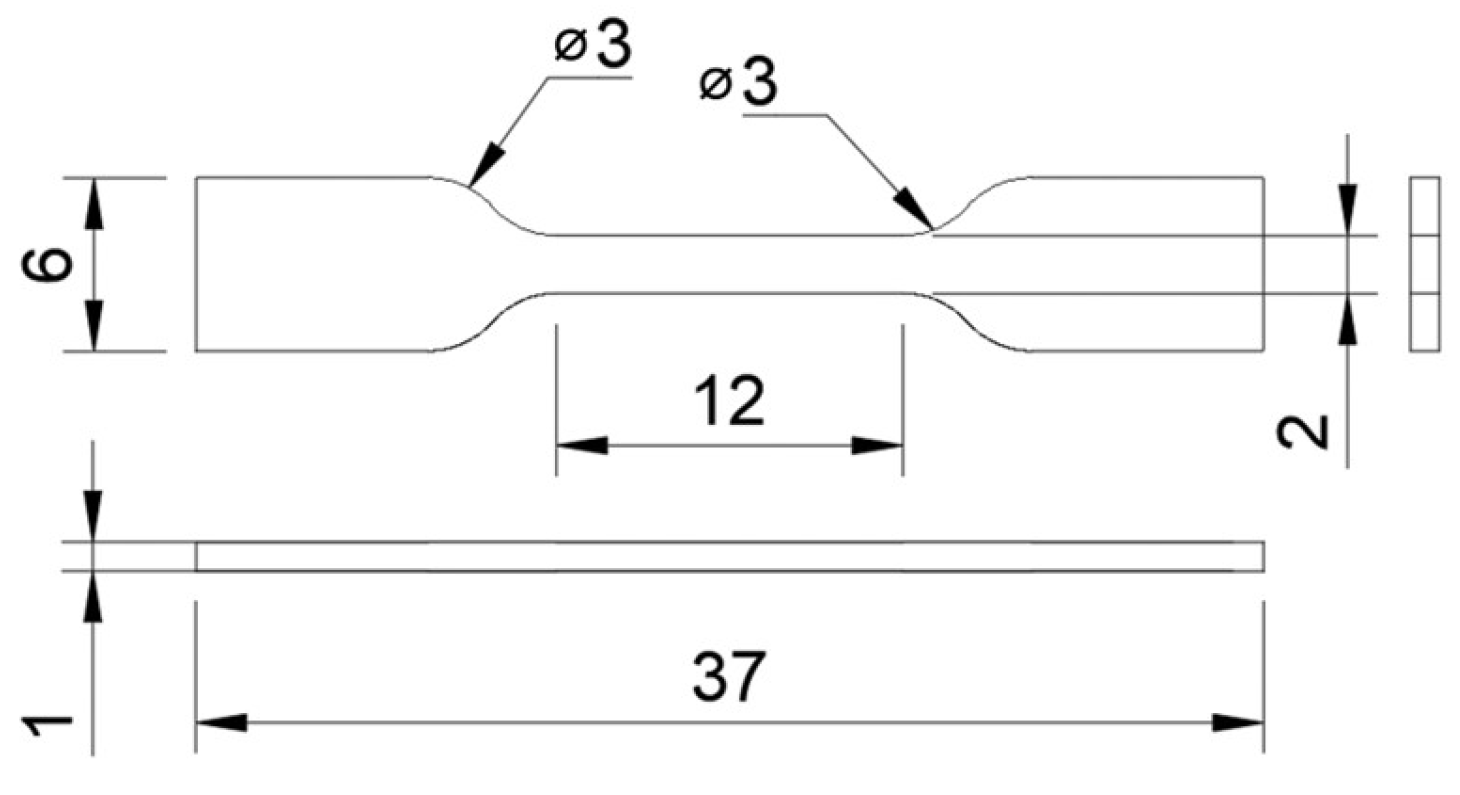
2.5. Mechanical Testing
2.6. Scanning Electron Microscopy (SEM)
3. Results and Discussion
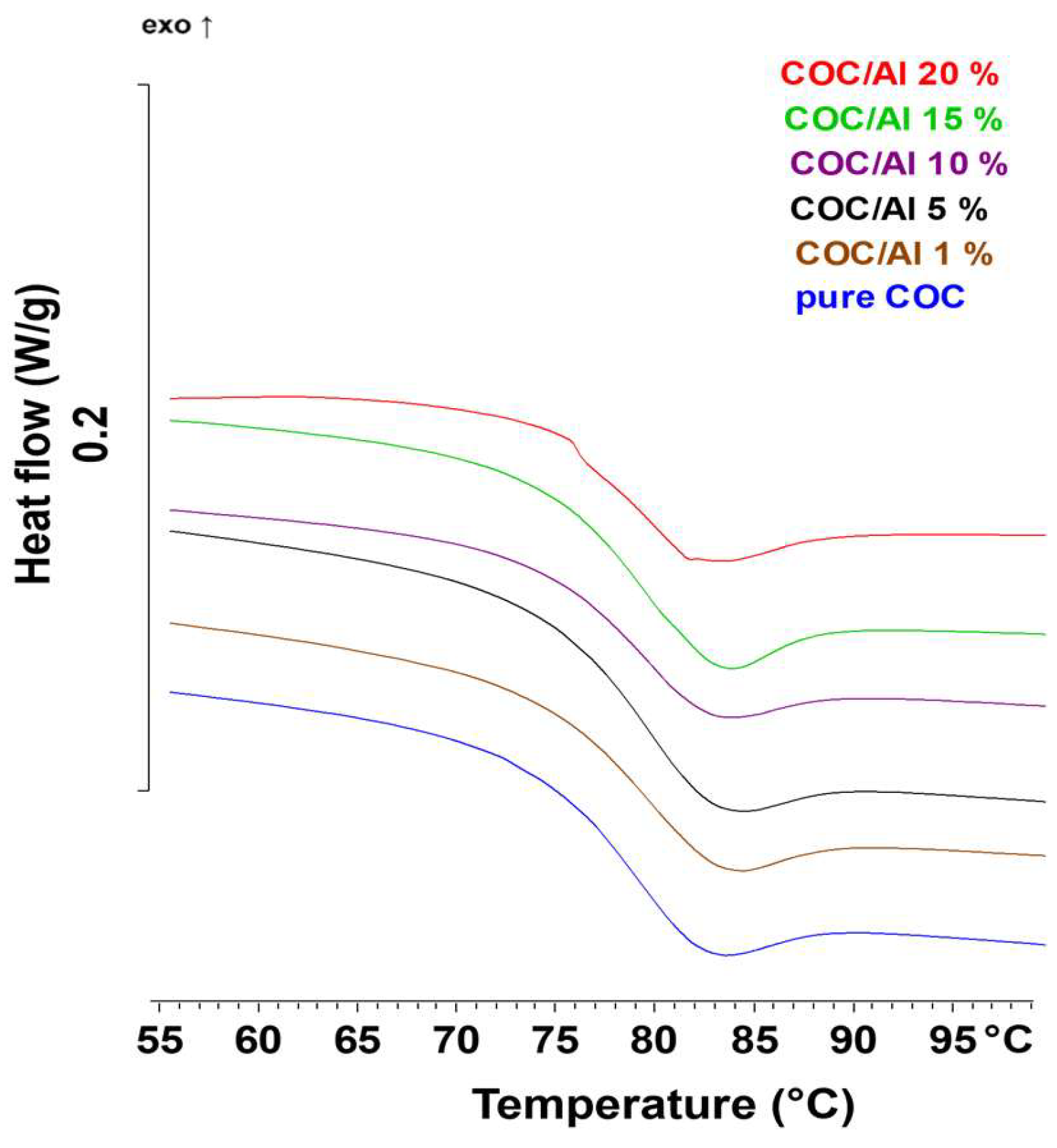
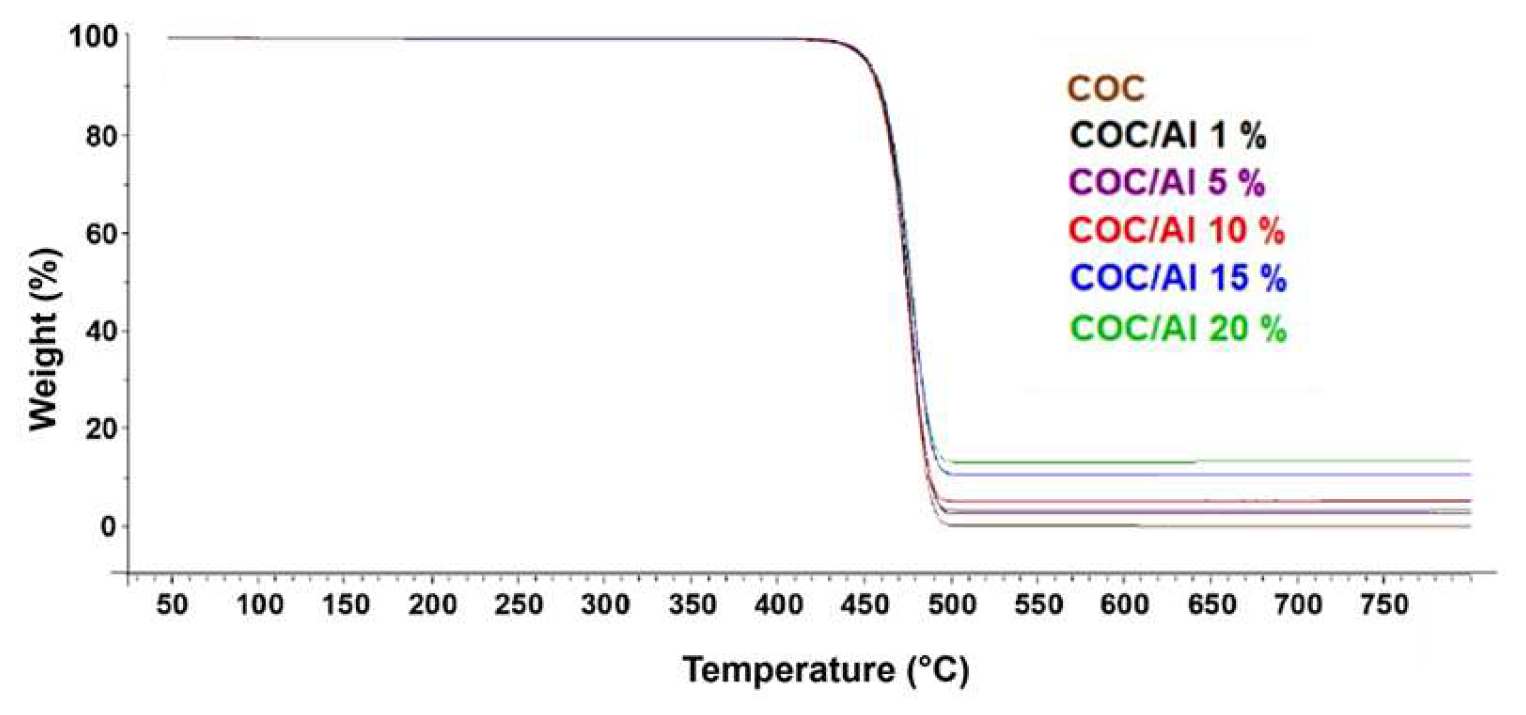
3.1. Thermal Properties
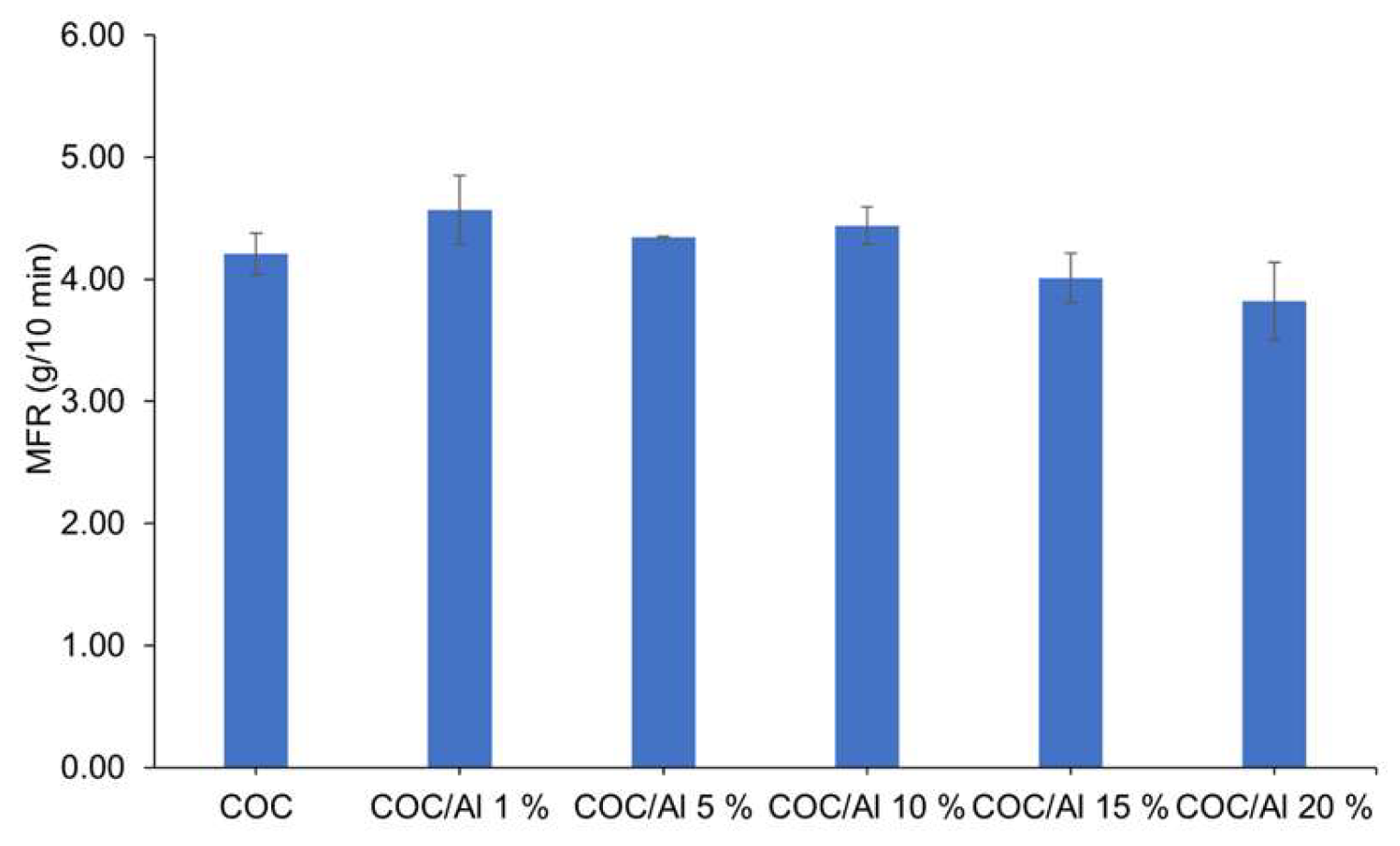
3.2. Melt Flow Rate of COC/Al Composites
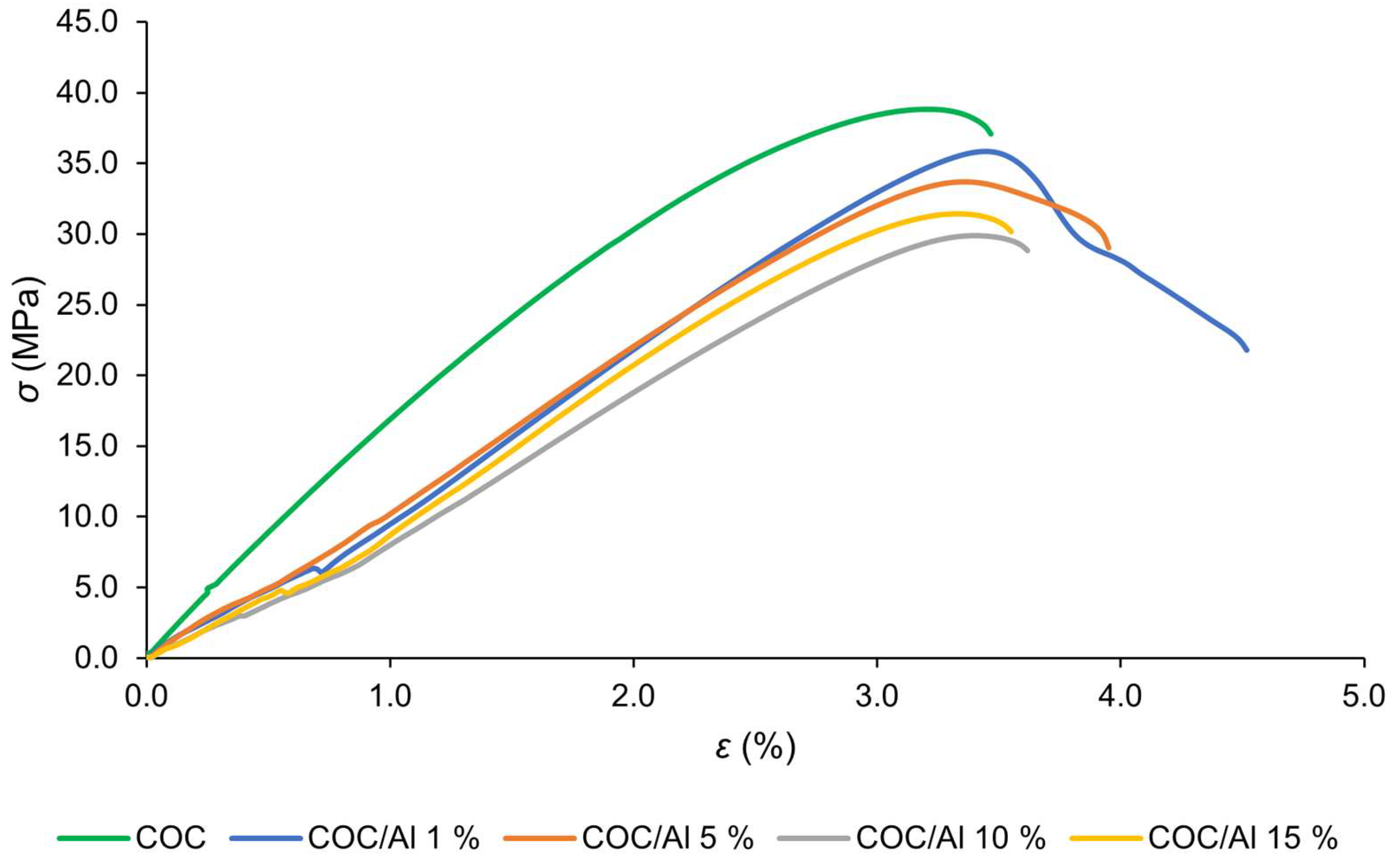
3.3. Mechanical Properties of 3D-Printed COC/Al Composites
4. Conclusions
Author Contributions
Funding
Institutional Review Board Statement
Informed Consent Statement
Data Availability Statement
Conflicts of Interest
References
- Tafete, G.A.; Habtu, N.G. Reactor Configuration, Operations and Structural Catalyst Design in Process Intensification of Catalytic Reactors: A Review. Chem. Eng. Process. 2023, 184, 109290. [Google Scholar] [CrossRef]
- Yu, Y.; Zhang, P.; Meng, H.; Sun, W.; Wang, D.; Yu, S.; Wang, F. Insights into Enhancement Performance of Mass Transfer Induced by Gas–Liquid Co-Current Static Mixing for Efficient CO2 Absorption. Chem. Eng. J. 2025, 521, 166660. [Google Scholar] [CrossRef]
- Lebl, R.; Zhu, Y.; Ng, D.; Hornung, C.H.; Cantillo, D.; Kappe, C.O. Scalable continuous flow hydrogenations using Pd/Al2O3-coated rectangular cross-section 3D-printed static mixers. Catal. Today 2022, 383, 55–63. [Google Scholar] [CrossRef]
- Martinuzzi, S.; Tranninger, M.; Sagmeister, P.; Horn, M.; Williams, J.D.; Kappe, C.O. Dynamic Experiments in Flow Accelerate Reaction Network Definition in a Complex Hydrogenation Using Catalytic Static Mixers. React. Chem. Eng. 2024, 9, 132–138. [Google Scholar] [CrossRef]
- Kundra, M.; Zhu, Y.; Nguyen, X.; Fraser, D.; Hornung, C.H.; Tsanaktsidis, J. 3D Printed Nickel Catalytic Static Mixers Made by Corrosive Chemical Treatment for Use in Continuous Flow Hydrogenation. React. Chem. Eng. 2022, 7, 284–296. [Google Scholar] [CrossRef]
- Mackiewicz, E.; Wejrzanowski, T.; Adamczyk-Cieślak, B.; Oliver, G.J. Polymer–Nickel Composite Filaments for 3D Printing of Open Porous Materials. Materials 2022, 15, 1360. [Google Scholar] [CrossRef]
- Benito Montaner, M.; Hilton, S.T. Recent Advances in 3D Printing for Continuous Flow Chemistry. Curr. Opin. Green Sustain. Chem. 2024, 47, 100923. [Google Scholar] [CrossRef]
- Valencia, L.M.; Herrera, M.; de la Mata, M.; de León, A.S.; Delgado, F.J.; Molina, S.I. Synthesis of Silver Nanocomposites for Stereolithography: In Situ Formation of Nanoparticles. Polymers 2022, 14, 1168. [Google Scholar] [CrossRef] [PubMed]
- Rodriguez-Padron, D.; Ahmad, A.; Romero-Carrillo, P.; Luque, R.; Esposito, R. 3D-Printing Design for Continuous Flow Catalysis. Trends Chem. 2022, 4, 739–753. [Google Scholar] [CrossRef]
- Mori, K.; Fujita, T.; Hata, H.; Kim, H.-J.; Nakano, T.; Yamashita, H. Surface Chemical Engineering of a Metal 3D-Printed Flow Reactor Using a Metal–Organic Framework for Liquid-Phase Catalytic H2 Production from Hydrogen Storage Materials. ACS Appl. Mater. Interfaces 2023, 15, 51079–51088. [Google Scholar] [CrossRef]
- Erokhin, K.S.; Gordeev, E.G.; Samoylenko, D.E.; Rodygin, K.S.; Ananikov, V.P. 3D Printing to Increase the Flexibility of the Chemical Synthesis of Biologically Active Molecules: Design of On-Demand Gas Generation Reactors. Int. J. Mol. Sci. 2021, 22, 9919. [Google Scholar] [CrossRef] [PubMed]
- Maier, M.C.; Valotta, A.; Hiebler, K.; Soritz, S.; Gavric, K.; Grabner, B.; Gruber-Woelfler, H. 3D Printed Reactors for Synthesis of Active Pharmaceutical Ingredients in Continuous Flow. Org. Process Res. Dev. 2020, 24, 2197–2207. [Google Scholar] [CrossRef]
- Martins, G.; Vicente, C.M.S.; Leite, M. Polymer–Metal Adhesion of Single-Lap Joints Using Fused Filament Fabrication Process: Aluminium with Carbon Fiber Reinforced Polyamide. Appl. Sci. 2023, 13, 4429. [Google Scholar] [CrossRef]
- Hasanzadeh, R.; Mihankhah, P.; Azdast, T.; Aghaiee, S.; Park, C.B. Optimization of process parameters of fused filament fabrication of polylactic acid composites reinforced by aluminum using Taguchi approach. Metals 2023, 13, 1013. [Google Scholar] [CrossRef]
- Ahmed, W.; Al-Marzouqi, A.H.; Nazir, M.H.; Rizvi, T.A.; Zaneldin, E.; Khan, M.; Aziz, M. Investigating the properties and characterization of a hybrid 3D printed antimicrobial composite material using FFF process: Innovative and swift. Int. J. Mol. Sci. 2023, 24, 8895. [Google Scholar] [CrossRef]
- Höving, S.; Akermann, M.; Schiller, A.; Franzke, J.; Schwendemann, D.; Brandt, S. Functionalization of Cyclic Olefin Copolymer for Enhanced Electrical Conductivity in Material Extrusion 3D-Printing: Potential Applications in Laboratory Environments and Small-Scale Experiments. 3D Print. Addit. Manuf. 2023, 12, 589–598. [Google Scholar] [CrossRef]
- Burtovyy, O.; Cushman, K.; Meyer, G.A.; Zhang, L.; Langsdorf, L.; Niemiec, A.; Gastaldo, D.; Skilskyj, D.; Skowerski, K.; Rhodes, L.F. Properties of Cyclic Olefin-Based Photo-ROMP Resins Suitable for DLP 3D Printing Applications. Mater. Adv. 2026, 7, 2097–2102. [Google Scholar] [CrossRef]
- Wasim, S.; Loeb, S.K. Aluminum Nanoparticle Enhanced TiO2 Photocatalysis of Organic Pollutants under Solar and UV-B Irradiation. npj Clean Water 2026, 9, 29. [Google Scholar] [CrossRef]
- Liu, J.; Xu, M.; Zhang, T.; Chu, X.; Shi, K.; Li, J. Al/TiO2 Composite as a Photocatalyst for the Degradation of Organic Pollutants. Environ. Sci. Pollut. Res. Int. 2023, 30, 9738–9748. [Google Scholar] [CrossRef]
- Chen, Y.; Xin, X.; Zhang, N.; Xu, Y.-J. 3D Printed Catalytic Structures: Advances in Particle and System Characterization. Part. Part. Syst. Charact. 2017, 34, 1600357. [Google Scholar] [CrossRef]
- Petousis, M.; Vidakis, N.; Mountakis, N.; Papadakis, V.; Tzounis, L. Three-Dimensional Printed Polyamide 12 (PA12) and Polylactic Acid (PLA) Alumina (Al2O3) Nanocomposites with Significantly Enhanced Tensile, Flexural, and Impact Properties. Nanomaterials 2022, 12, 4292. [Google Scholar] [CrossRef] [PubMed]
- ISO 527-1:2012; Plastics—Determination of Tensile Properties—Part 1: General Principles. International Organization for Standardization: Geneva, Switzerland, 2012. Available online: https://www.iso.org/standard/56045.html (accessed on 5 April 2025).
- Sharma, S.K.; Sharma, L.K.; Pradhan, R.; Sharma, Y.; Sharma, M.; Gajević, S.; Ivanović, L.; Stojanović, B. Interphase-centric and mechanism-driven advances in polymer composites reinforced with nano-, synthetic, and inorganic fillers. Polymers 2026, 18, 323. [Google Scholar] [CrossRef] [PubMed]
- Neuhaus, L.; Ioannou, O.; Overend, M. Bulk fillers from food waste for polymeric bio-composites: The influence of filler type, particle size and volume ratio on furan-matrix composites. Constr. Build. Mater. 2025, 502, 144303. [Google Scholar] [CrossRef]
- Köse, S. Investigation of the Mechanical and Tribological Properties of Aluminum Powder Filled with Cyclo-Olefin-Copolymer Composites. J. Radiat. Res. Appl. Sci. 2024, 17, 100848. [Google Scholar] [CrossRef]
- Mastroianni, L.; Agovino, G.; Sandri, F.; Aho, A.; Eränen, K.; Cassese, S.; Mungiguerra, S.; Di Serio, M.; Murzin, D.Y.; Russo, V.; et al. Digital Light Processing (DLP) 3D-Printed Pd/Al2O3 Catalysts for H2O2 Decomposition: Towards Efficient Green Thrusters. Appl. Catal. A 2025, 706, 120466. [Google Scholar] [CrossRef]



| Sample | m (COC) [g] | m (Al) [g] | Al Content [wt%] | Al Content [vol%] |
|---|---|---|---|---|
| COC | 200.0 | 0.0 | 0.0 | 0 |
| COC/Al 1% | 198.0 | 2.0 | 1.0 | 0.4 |
| COC/Al 5% | 190.0 | 10.0 | 5.0 | 1.9 |
| COC/Al 10% | 180.0 | 20.0 | 10.0 | 4.0 |
| COC/Al 15% | 170.0 | 30.0 | 15.0 | 6.3 |
| COC/Al 20% | 160.0 | 40.0 | 20.0 | 8.6 |
| Sample | Tg (°C) |
|---|---|
| COC | 77.2 |
| COC/Al 1% | 76.1 |
| COC/Al 5% | 76.6 |
| COC/Al 10% | 76.5 |
| COC/Al 15% | 76.3 |
| COC/Al 20% | 76.7 |
| Sample | Tonset (°C) | Residue (%) |
|---|---|---|
| COC | 448.4 | 0.2 |
| COC/Al 1% | 442.5 | 2.2 |
| COC/Al 5% | 445.0 | 2.9 |
| COC/Al 10% | 445.4 | 4.8 |
| COC/Al 15% | 445.6 | 10.4 |
| COC/Al 20% | 446.0 | 12.9 |
| Sample | MFR (g/10 min) |
|---|---|
| COC | 4.21 ± 0.17 |
| COC/Al 1% | 4.57 ± 0.28 |
| COC/Al 5% | 4.34 ± 0.01 |
| COC/Al 10% | 4.44 ± 0.15 |
| COC/Al 15% | 4.01 ± 0.20 |
| COC/Al 20% | 3.82 ± 0.32 |
| Sample | E (MPa) | σM (MPa) | εM (%) | σB (MPa) | εB (%) | W (J) |
|---|---|---|---|---|---|---|
| COC | 1783 ± 376 | 38.8 ± 6.2 | 2.95 ± 0.41 | 34.5 ± 0.4 | 3.21 ± 1.46 | 0.22 ± 0.07 |
| COC/Al 1% | 1277 ± 132 | 36.1 ± 2.4 | 3.10 ± 0.67 | 27.8 ± 8.1 | 5.33 ± 2.63 | 0.27 ± 0.21 |
| COC/Al 5% | 1169 ± 62 | 33.5 ± 2.2 | 3.29 ± 0.58 | 28.6 ± 2.7 | 4.81 ± 1.13 | 0.20 ± 0.11 |
| COC/Al 10% | 1086 ± 88 | 29.7 ± 3.3 | 3.27 ±0.49 | 28.4 ± 2.0 | 2.79 ± 0.38 | 0.11 ± 0.02 |
| COC/Al 15% | 1177 ± 97 | 27.4 ± 3.3 | 2.28 ± 0.90 | 25.6 ± 2.7 | 2.40 ± 1.00 | 0.08 ± 0.07 |
| Property | COC/Al Composites (Conventional Processing) | γ-Al2O3 3D-Printed Catalysts | This Study |
|---|---|---|---|
| Material type | polymer–metal (COC + Al) | ceramic (γ-Al2O3) | polymer–metal (COC + Al) |
| Fabrication method | conventional composite processing (molding and extrusion) | high-accuracy AM (ceramic) | fused filament fabrication |
| Processing temperature | moderate | high-temperature sintering | low-to-moderate (no high-temperature sintering required) |
| Particle distribution | can be homogeneous, but dependent on mixing | often uniform in printed pores, but DLP can suffer from particle sedimentation | can be homogeneous if filament preparation is done correctly; FFF avoids sedimentation issues |
| Structural complexity | limited to molded shapes | complex porous architectures | complex geometries |
| Mechanical robustness | moderate, improved by Al | brittle | high, mechanically stable for manipulation and flow applications |
| Scalability | readily scalable | limited by ceramic AM equipment | readily scalable using standard FFF printer |
| Novelty | demonstrates mechanical reinforcement in conventional composites | high-fidelity ceramic AM for catalysis | demonstration of melt-compounded polymer–metal filament enabling FFF fabrication of complex geometries relevant to structured flow applications |
Disclaimer/Publisher’s Note: The statements, opinions and data contained in all publications are solely those of the individual author(s) and contributor(s) and not of MDPI and/or the editor(s). MDPI and/or the editor(s) disclaim responsibility for any injury to people or property resulting from any ideas, methods, instructions or products referred to in the content. |
© 2026 by the authors. Licensee MDPI, Basel, Switzerland. This article is an open access article distributed under the terms and conditions of the Creative Commons Attribution (CC BY) license.
Share and Cite
Forjan, E.; Marković, M.-P.; Cvitkušić, K.; Vrsaljko, D. Fused Filament Fabrication of COC/Aluminum Composites for Structured Reactor Components. Appl. Sci. 2026, 16, 5717. https://doi.org/10.3390/app16115717
Forjan E, Marković M-P, Cvitkušić K, Vrsaljko D. Fused Filament Fabrication of COC/Aluminum Composites for Structured Reactor Components. Applied Sciences. 2026; 16(11):5717. https://doi.org/10.3390/app16115717
Chicago/Turabian StyleForjan, Elizabeta, Marijan-Pere Marković, Klara Cvitkušić, and Domagoj Vrsaljko. 2026. "Fused Filament Fabrication of COC/Aluminum Composites for Structured Reactor Components" Applied Sciences 16, no. 11: 5717. https://doi.org/10.3390/app16115717
APA StyleForjan, E., Marković, M.-P., Cvitkušić, K., & Vrsaljko, D. (2026). Fused Filament Fabrication of COC/Aluminum Composites for Structured Reactor Components. Applied Sciences, 16(11), 5717. https://doi.org/10.3390/app16115717