Article

Composition, Functional, and Technological Properties of Enzyme-Modified Carrot Pomace

by
Ugnė Gasiūnaitė
,
Jolita Jagelavičiūtė
,
Loreta Bašinskienė
and
Dalia Čižeikienė
*
Department of Food Science and Technology, Kaunas University of Technology, Radvilėnų Rd. 19, LT-50254 Kaunas, Lithuania
*
Author to whom correspondence should be addressed.
Appl. Sci. 2026, 16(11), 5552; https://doi.org/10.3390/app16115552
Submission received: 27 April 2026 / Revised: 21 May 2026 / Accepted: 23 May 2026 / Published: 2 June 2026
(This article belongs to the Section Food Science and Technology)

Abstract

Carrot pomace (CP) represents a promising source of dietary fiber with potential applications in functional food systems. This study investigated the effects of enzymatic hydrolysis (Pectinex® Ultra Tropical, Celluclast® 1.5 L, and Viscozyme® L) on the chemical composition, technological, and functional properties of CP. The untreated CP was characterized by a high total dietary fiber (TDF) content, predominated by insoluble dietary fiber (IDF), with a soluble dietary fiber (SDF)/IDF ratio of 1:1.6. Enzymatic treatment significantly reduced TDF and IDF (up to 54.1% and 58.5%, respectively) while increasing reducing sugars by 2.3–3.4-fold and changing the SDF/IDF ratio to 1:1.2–1.5. Technological properties were altered, with decreased oil-retention capacity and color intensity, whereas water-solubility index increased, and water-swelling capacity was enzyme-dependent. Emulsion stability was enhanced in enzymatically treated samples. Total phenolic content increased in the soluble fraction (up to 21.8%). Functional properties, including cholesterol-binding, sodium cholate-binding, and glucose-adsorption capacities, were significantly influenced by enzymatic modification and pH conditions (for cholesterol-binding capacity). Prebiotic activity varied depending on enzyme treatment, and Celluclast®-modified CP demonstrated the highest prebiotic index, exceeding that of inulin for selected strains. Overall, enzymatic hydrolysis effectively modulated the structural and functional properties of CP, highlighting its potential as a value-added ingredient for the formulation of functional and prebiotic food products.

1. Introduction

The increasing demand for nutritionally improved food products, along with the need to develop more sustainable food systems, has intensified interest in the use of agro-industrial residues. Consistent with the objectives of the European Commission’s Farm to Fork strategy, fruit and vegetable processing by-products are increasingly being explored as raw materials for the production of value-added ingredients, helping to reduce food waste and support more efficient resource use. In this context, pomace represents a promising by-product due to its bioactive and functional compounds that may be applied in food, feed, and nutraceutical products [1].
Carrot pomace (CP) is produced as a residue during carrot juice processing and represents a significant vegetable by-product, as up to half of the initial raw material may remain after juice extraction [2]. Despite its limited use, this material contains considerable amounts of dietary fiber (DF) and bioactive constituents. Compared with several other vegetable by-products, such as tomato, cauliflower, and potato residues, CP has been reported to provide notable levels of soluble dietary fiber (SDF), polyphenols, including phenolic acids and flavonoids, and carotenoids, particularly β-carotene [3]. These characteristics make CP a suitable ingredient for improving the nutritional and functional quality of food products [4,5]. Moreover, as a substantial fraction of carotene can still be retained in the pomace after juice extraction, its further use offers a more valuable alternative to disposal [6].
DF represents a key constituent contributing to the nutritional relevance and functional properties of pomace. Nevertheless, its physiological role and technological behavior are largely determined by the ratio of SDF to insoluble dietary fiber (IDF) [7]. While IDF is associated mainly with digestive health, SDF is more closely linked to cholesterol and glucose regulation, gut microbiota modulation, and improved textural properties in food systems [8]. Nevertheless, pomace materials often contain a predominance of IDF, which may limit their direct use in food applications [9,10,11]. Therefore, modification strategies aimed at increasing the proportion of SDF are of growing interest [9,10,11].
Among the available approaches, enzymatic hydrolysis is considered a promising method because it enables targeted modification of plant cell wall polysaccharides under relatively mild conditions. Cellulases, hemicellulases, and pectinases are capable of hydrolyzing complex polysaccharide structures, leading to changes in DF composition and modifying the functional characteristics of plant-based materials [12]. Although this approach has been investigated in several by-products [13], information on its effect on CP remains limited. Therefore, CP was selected in the present study as a fiber-rich vegetable by-product with high potential for sustainable valorization and for the development of functional food ingredients.
This study focused on the enzymatic modification of CP and its impact on chemical composition, technological performance, and functional characteristics. Particular attention was given to properties important for potential food applications, including water and oil-retention capacity, water-solubility index, bulk density, emulsion stability, and color, as well as the influence of enzymatic modification on functional characteristics such as prebiotic index, cholesterol-binding capacity, glucose-adsorption capacity, and antioxidant activities. The potential value of CP as a food ingredient was evaluated. Through this approach, the study aimed to provide further insight into the suitability of enzymatically treated CP for the development of value-added food products.

2. Materials and Methods

2.1. Carrot Pomace

Fresh carrots were obtained from a local supermarket and processed into juice using an electric vegetable juicer BETM-1 (Migiris, Mažeikiai, Lithuania). The remaining carrot pomace (CP) was collected and dried at 37 ± 2 °C for 48 h. After drying, the CP was milled with a high-speed centrifugal mill (Retsch ZM 200, Retsch GmbH, Haan, Germany) equipped with a sieve of 0.2 mm. The resulting powder was packed in plastic bags and stored at 4 °C until further analysis.

2.2. Enzymatic Hydrolysis Using Commercial Enzyme Preparations

Enzymatic modification of CP was conducted by applying three commercial enzyme preparations obtained from Novozymes A/S (Bagsværd, Denmark). The preparations were selected according to their predominant enzymatic activities: Viscozyme® L, with declared activity of 100 FBG/g and containing β-glucanases, pectinases, hemicellulases, and xylanases; Pectinex® Ultra Tropical, with activity of 5000 PECTU/g and including pectinases, cellulases, hemicellulases, and β-glucanases; and Celluclast® 1.5 L, with cellulase activity of 700 EGU/g.
For each enzymatic treatment, CP was dispersed in distilled water at a ratio of 2.5 g of material to 37.5 mL of water. Subsequently, 250 µL of the selected enzyme preparation was incorporated into the suspension, corresponding to an enzyme addition level of 100 µL/g of CP. This dosage was chosen based on the recommendations provided by the enzyme supplier and in accordance with previously reported enzymatic hydrolysis conditions [14,15]. Control samples were prepared under identical conditions, except that no enzyme was added and only distilled water was used. Enzymatic hydrolysis was carried out for 1 h at 50 °C, pH 3.7 in a water bath operating at 200 rpm, using the initial pH of the system without additional adjustment. Following hydrolysis, the heating to 95 °C for 20 min to inactivate the enzymes was performed, and then cooling to approx 20 °C.
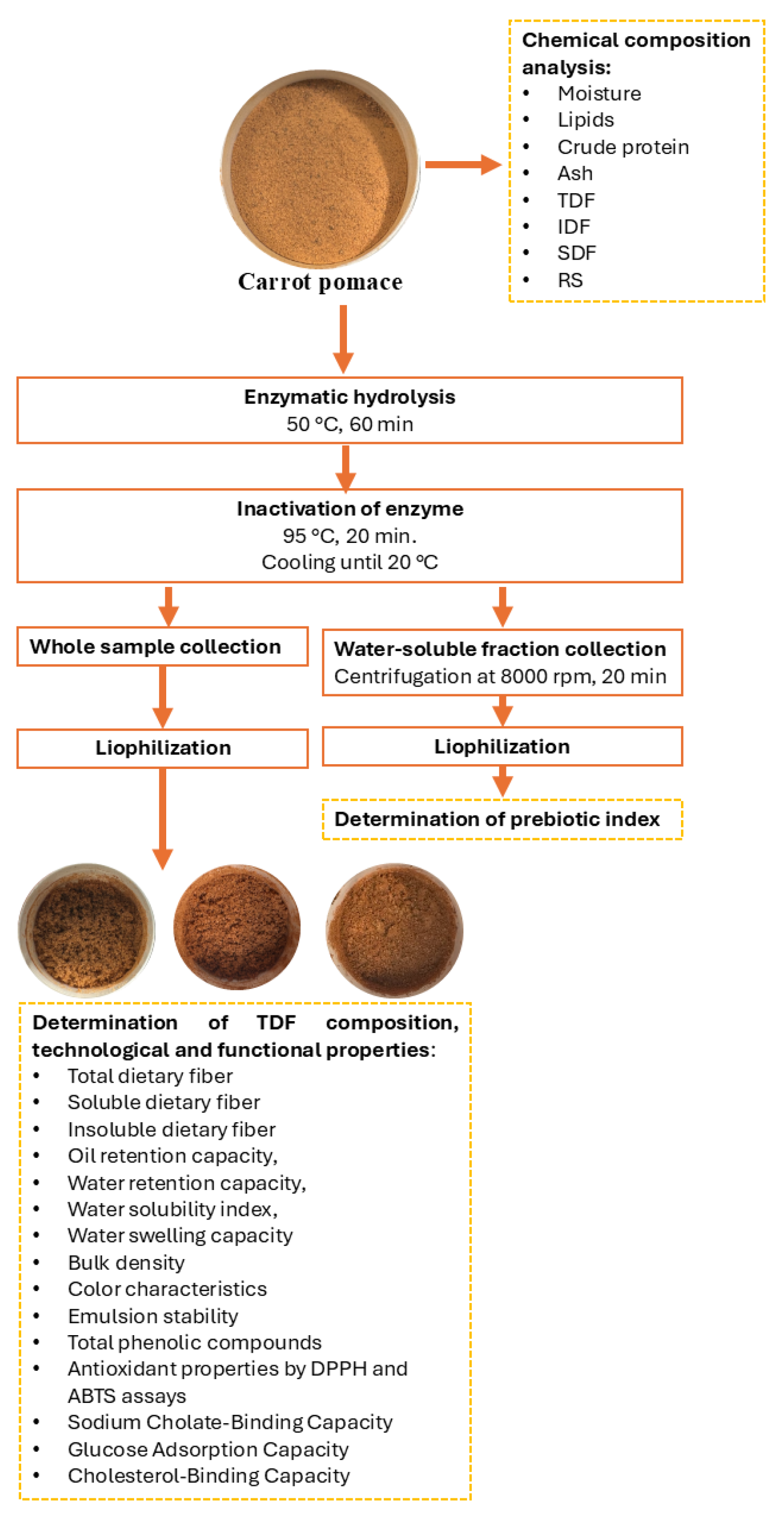
For soluble dietary fiber (SDF), insoluble dietary fiber (IDF), technological, and functional property analyses, the hydrolysates were processed as complete systems, without separating the soluble and insoluble fractions. The entire post-hydrolysis mixtures were therefore freeze-dried directly using a Harvest Right freeze dryer (North Salt Lake, UT, USA). In contrast, samples intended for the evaluation of prebiotic properties were first subjected to phase separation. For this purpose, the hydrolyzed suspensions were centrifuged at 8000 rpm for 20 min with a Hettich 320 centrifuge (Andreas Hettich GmbH, Tuttlingen, Germany). The liquid fractions obtained after centrifugation were collected, lyophilized, and subsequently used in the prebiotic assessment. All freeze-dried CP samples were stored in airtight containers at 4 °C to preserve sample stability. The experimental scheme is presented in Figure 1.

2.3. Determination of Chemical Composition

Proximate composition of CP samples was determined using standard analytical procedures. Moisture content was evaluated following AOAC Method 925.10-1925 [16]. For this analysis, 1 g of the sample was dried at 105 °C until a constant mass was obtained. Total lipids were quantified according to AOAC Method 948.22 [16] by Soxhlet extraction. Briefly, 3 g of the sample was extracted with hexane for 3 h. Crude protein content was assessed using the Kjeldahl procedure in accordance with AOAC Method 978 [16]. The analysis was performed with 1 g of sample, and the nitrogen content was converted to protein using a conversion factor of 6.25.
The ash was determined as ash content according to AOAC Method 930.05 [16]. For this purpose, 2 g of the sample was first subjected to pre-charring for 30 min and then placed in a muffle furnace, where incineration was carried out at 625 °C for 2 h.
Reducing sugars (RS) were analyzed using the 3,5-dinitrosalicylic acid assay based on the method of Miller [17], with slight adjustments. In brief, 0.5 g of CP was blended with 100 mL of distilled water and stirred for 10 min to obtain an aqueous extract. The resulting suspension was centrifuged at 5000 rpm for 15 min at room temperature using a Hettich 320 centrifuge (Andreas Hettich GmbH, Tuttlingen, Germany). Afterward, 1 mL of the supernatant was combined with 1 mL of 3,5-dinitrosalicylic acid reagent and heated in a water bath at 95 °C for 5 min, and absorbance was subsequently recorded at 540 nm using a Genesys 10 spectrophotometer (Thermo Electron LED GmbH, Langenselbold, Germany). The amount of RS was calculated from a glucose calibration curve prepared from serial dilutions of a 1 mg/mL glucose standard, covering a concentration range of 0–1 mg/mL.
SDF and IDF were determined using a commercial total dietary fiber assay kit from Megazyme International (Wicklow, Ireland). Analysis was performed according to the manufacturer’s instructions, according to AACC Method 32-07.01 and 991.43 [18]. In brief, 1 g of sample was dispersed in 40 mL of 0.05 M MES–Tris buffer (pH 8.2), and sequential enzymatic digestion with α-amylase, protease, and amyloglucosidase under the recommended assay conditions was conducted. The α-amylase treatment was conducted at 95 °C for 30 min, followed by protease digestion at 60 °C for 30 min. After pH adjustment to 4.1–4.8 with 1 N HCl, amyloglucosidase was loaded, and incubation was continued at 60 °C for another 30 min.
After digestion, the Fibertec 1023 E system was used for the filtration (Foss System, Hillerød, Denmark). The retained pellets were washed with hot distilled water, 95% ethanol, and acetone, and were dried at 103 °C overnight. Then it was used for IDF determination. For SDF analysis, the filtrate and liquids collected after washing were combined and used for SDF precipitation by pouring 4 volumes of 95% ethanol. After 1 h holding at 22 °C, the precipitates were filtered, rinsed with 95% ethanol solution and acetone, then dried, and weighed. Protein and ash corrections were applied to both fiber fractions, and the sum of SDF and IDF was calculated as total dietary fiber (TDF).

2.4. Evaluation of Technological Properties

Hydration properties, including water-swelling capacity (WSC), water retention capacity (WRC), and water-solubility index (WSI), were determined as described by Yu et al. [19], applying slight adjustments. Briefly, 0.2 g of the CP test sample was placed in a graduated centrifuge tube, then 6 mL of distilled water was added. The mixture was sealed and left to hydrate at 21 °C for 18 h. For WSC, the initial capacity of the dry material and the final capacity after hydration were recorded and used for calculation according to Equation (1). After hydration, the test CP sample was centrifuged at 5000 rpm for 20 min, and the liquid part was decanted, while the hydrated remains were weighed before and after drying to constant weight at 105 °C for WRC determination. The collected liquid part was dried until constant mass at 105 ± 2 °C and used to calculate WSI.
WSC was determined according to Equation (1):
WSC (mL/g) = (V1 − V0)/M
here V0 represents the initial capacity of the dry test sample (mL), V1 represents the capacity after hydration (mL), and M represents the dry content of the test sample (g).
WRC was determined according to Equation (2):
WRC (g/g) = (M1 − M2)/M2
here M1 represents the mass of the hydrated residue before drying (g), and M2 represents the mass of the residue after drying (g).
WSI was calculated according to Equation (3):
WSI (%) = (M/M0) × 100
here M represents the mass of the dried soluble fraction (g), and M0 represents the dry mass of the test sample applied for the dry content determination (g).
Oil-retention capacity (ORC) was calculated as described by Yu et al. [19], applying minor modifications. Briefly, 0.2 g of test CP sample, expressed on a dry matter basis, was mixed with 2 g of oil (Natura, San Lorenzo, Argentina) and left to allow oil absorption at 21 °C for 1 h. The mixture was then centrifuged at 3000 rpm for 10 min. The non-retained oil was carefully poured, while the residual pellets were weighed. ORC was calculated applying Equation (4):
ORC (g/g) = (M1 − M0)/M0
here M1 represents the mass of the pellets after centrifugation (g), and M0 represents the initial dry mass of the test sample expressed on a dry content basis (g).
Bulk density (BD) was determined as reported by Jagelavičiūtė et al. [20]. A 0.2 g portion of CP was transferred into a graduated centrifuge tube and gently tapped against a flat surface 20 times to determine the settled test sample volume. The occupied volume of the material was recorded, and BD was estimated using Equation (5):
BD (g/mL) = M/V
here M denotes the mass of the CP test sample on a dry matter basis (g), while V represents the volume occupied by the sample in the test tube (mL).

2.5. Evaluation of Emulsion Stability

Emulsion-forming properties of CP were assessed using the procedure adapted from Keršienė et al. [21]. Briefly, 0.16 g of CP was hydrated in 8 mL of distilled water in graduated test tubes, after which 8 g of sunflower oil was incorporated. The resulting water–oil mixtures were homogenized at 10,000 rpm for 5 min operating with an IKA® T-25 digital Ultra–Turrax homogenizer (Staufen, Germany).
Emulsion stability was characterized by comparing the volume of the stable emulsion phase with the total emulsion volume. Measurements were taken under three conditions: after 30 min at room temperature to evaluate short-term static stability, after heating at 80 °C for 30 min to assess thermal resistance, and during 21 days of refrigerated storage to determine longer-term stability. The stability percentage was calculated as follows (6):
Emulsion stability (%) = (SEV/TEV) × 100
here SEV represents the remaining capacity of the stable emulsion (mL), and TEV represents the total capacity of the emulsion (mL).

2.6. Color Analysis

Color parameters of CP samples were determined using a Konica Minolta colorimeter (Tokyo, Japan) and expressed in the CIE Lab* system. Samples were spread evenly on plates to obtain a uniform surface, then measured at 3 random chosen places. The L*, a*, and b* values indicated lightness, the green–red axis, and the blue–yellow axis, respectively. Chroma and total color difference (ΔE) were estimated according to Sivam et al. [22] using Equations (7) and (8):
Chroma = √(a2 + b2)
ΔE = √[(L0 − L)2 + (a0 − a)2 + (b0 − b)2]
here L0, a0, and b0 represent the color coordinates of the control sample.

2.7. Determination of Glucose-Adsorption Capacity

Glucose-adsorption capacity (GAC) was measured according to the modified procedure of Bhutkar et al. [23]. In brief, 1 g of the CP test sample was merged with 25 mL of glucose solution at concentrations of 0, 5, 10, 50, or 100 mmol/L. The mixtures were incubated at 37 °C for 6 h with intermittent shaking at 120 rpm using a GFL 1092 shaker (Thermolab, Ulm, Germany). After incubation, residual glucose in the liquid phase was quantified using a Sucrose/D-Fructose/D-Glucose assay kit (Megazyme, Wicklow, Ireland). GAC was calculated by correcting the decrease in glucose concentration for glucose released from CP in the blank sample, according to Equation (9):
GAC (mmol/L) = [C0 − (C1 − C2)] × V/m
here C0 represents the initial glucose concentration (mmol/L); C1 represents the glucose concentration after 6 h of incubation in samples containing CP and glucose solutions of 5, 10, 50, and 100 mmol/L; C2 represents the glucose concentration in the aqueous CP suspension after 6 h of incubation (mmol/L); m represents the dry matter mass of CP used in the assay (g); and V represents the sample volume (L).

2.8. Determination of Cholesterol-Binding Capacity

Cholesterol-binding capacity (CBC) was evaluated by applying a modified procedure based on Zhang et al. [24]. Diluted egg yolk was utilized as the cholesterol model medium and was formulated by mixing egg yolk with 9 volumes of deionized water. CP samples, 0.5 g, were incubated with 25 mL of the egg yolk dispersion at pH 2 or 7 for 2 h at 37 °C under intermittent shaking at 120 rpm. Control samples were prepared without CP.
To reduce matrix color interference, 10 mL of the incubated mixture was treated with 0.1 g of polyvinylpolypyrrolidone, mixed for 1 min, and filtered through filter paper. An aliquot of the clarified filtrate, 0.25 mL, was then combined with 1 mL of 96% ethanol and centrifuged at 4000× g for 20 min. Cholesterol content was determined spectrophotometrically according to Park [25], using cholesterol standards within the range of 0.01–0.3 mg/mL. CBC was calculated using Equation (10):
CBC (mg/g) = (C1 − C2) × V/m
here C1 represents the cholesterol concentration in the control sample, C2 represents the cholesterol concentration in the CP-containing sample, V represents the sample volume (mL), and m represents the dry mass of CP used in the assay (g).

2.9. Determination of Sodium Cholate-Binding Capacity

Sodium cholate-binding capacity (SCBC) was evaluated according to Xu et al. [26], with sodium cholate used as the bile salt model compound. Briefly, 0.2 g of CP and 0.2 g of sodium cholate were dispersed in 100 mL of 125 mmol/L NaCl solution at pH 7. The mixtures were incubated in 250 mL flasks at 37 °C for 2 h with intermittent shaking at 120 rpm using a GFL 1092 water bath shaker (Thermolab, Ulm, Germany). Samples prepared without CP were used as controls. After incubation, the mixtures were centrifuged at 4000× g for 20 min using a Hettich 320 centrifuge (Andreas Hettich GmbH, Tuttlingen, Germany).
Residual sodium cholate in the supernatant was quantified following the procedure of Shen et al. [27]. An aliquot of supernatant, 0.5 mL, was mixed with 4.5 mL of 42% sulfuric acid and heated at 70 °C for 20 min. Absorbance was then measured at 387 nm using a Genesys 10 spectrophotometer (Thermo Electron LED GmbH, Langenselbold, Germany). Sodium cholate concentration was calculated from a standard curve prepared in the range of 0.1–1 mg/mL. SCBC was calculated using Equation (11):
SCBC (mg/g) = (C1 − C2) × V/m
here C1 is the sodium cholate concentration in the control sample, C2 is the sodium cholate concentration in the CP-containing sample, V is the sample volume (mL), and m is the mass of CP used in the assay (g).

2.10. Determination of Antioxidant Activity and Total Phenolic Compounds

Aqueous extracts of CP were prepared using distilled water at a 1:25 ratio. The samples were centrifuged at 8000 rpm for 15 min, after which the supernatants were collected for antioxidant activity analysis. The antioxidant activity against DPPH radicals was measured according to Blois [28]. A DPPH reagent solution was prepared using 100 mM sodium acetate buffer (pH 5.5) and 0.1 mM DPPH dissolved in an acetonitrile:methanol mixture (1:1, v/v), followed by adjustment of the absorbance to 0.500. For antioxidant activity evaluation, 77 μL of CP extract was combined with 3000 μL of the prepared DPPH solution and incubated at room temperature in the absence of light for 15 min. The absorbance was then determined at 515 nm.
ABTS radical cation scavenging activity was determined following [29]. The ABTS·+ working solution was prepared by combining 7 mM ABTS with 2.45 mM potassium persulfate at a 1:1 (v/v) ratio and allowing the reaction to proceed for 16 h in the dark cabinet at 22 °C. Before measurement, the mixture was diluted with methanol until the absorbance reached 0.700 at 734 nm. Subsequently, 50 μL of CP extract was added to 3950 μL of the ABTS·+ solution and kept in the dark for 30 min. The absorbance was then recorded at 734 nm.
For both assays, gallic acid was used for calibration within the concentration range 0.001–0.005 mg, and the antioxidant activity was expressed as mg gallic acid equivalents (GAE) per 100 g of sample dry matter.
Total phenolic content (TPC) was measured based on the adopted Folin–Ciocalteu method [29]. Aqueous CP extracts were prepared by dispersing the samples in distilled water at a 1:25 ratio and centrifuging at 8000 rpm for 15 min using a Hettich 320 centrifuge (Andreas Hettich GmbH, Tuttlingen, Germany). For the reaction, 100 μL of extract was combined with 3000 μL of 3.3% Na2CO3 solution and 100 μL of Folin–Ciocalteu reagent. After 30 min of incubation at room temperature, absorbance was measured at 760 nm. TPC was determined from a gallic acid standard curve within the concentration range of 0.01–1.00 mg/mL and reported as mg GAE per 100 g of dry matter.

2.11. Determination of Prebiotic Index

Prebiotic index (PI) of the SDF fraction of CP samples was evaluated according to Przyborska et al. [30]. Bacterial starter inocula (100 μL) were transferred into bottles containing 10 mL of the appropriate growth medium, namely MRS broth for Lactobacillus acidophilus DSM 20079, Lactiplantibacillus plantarum DSM 24624 strains, and the Nutrient broth (Biolife, Italy) for E. coli. Each medium was supplemented with 1% (w/v) of the tested carbohydrate source, including the SDF fraction of CP and modified CP samples, inulin, or glucose. Control samples consisted of the same media inoculated with starter cultures but without any added sugar source. Bacteria strains were cultivated at 37 °C. The experiment was performed in triplicate. The growth of bacteria was monitored spectrophotometrically at 600 nm immediately after inoculation and after 24 and 48 h. PI for each probiotic strain in the presence of the different prebiotics was calculated using Equation (12):
PI = ( Δ OD LAB   with   prebiotic     Δ OD LAB   control ) / ( Δ OD LAB   with   glucose     Δ OD PRLAB   control ) ( Δ OD P   with   prebiotic     Δ OD P   control ) / ( Δ OD P   with   glucose     Δ OD P   control ) ;
here ∆ODLAB with prebiotic—the difference between optical density values measured at 24 h and 0 h, when probiotic lactic acid bacteria (LAB) were cultured in the sample using the tested prebiotic as a carbon source; ∆ODLAB control—the difference between optical density values measured at 24 h and 0 h, when LAB were cultured in the sample without glucose; ∆ODLAB with glucose—the difference between optical density values measured at 24 h and 0 h, when LAB were cultured in the sample with glucose; ∆ODP with prebiotic—the difference between optical density values measured at 24 h and 0 h, when pathogenic bacteria were cultured in the sample with the tested prebiotic; ∆ODP control—the difference between optical density values measured at 24 h and 0 h, when pathogenic bacteria were cultured in the sample without glucose; ∆ODP with glucose—the difference between optical density values measured at 24 h and 0 h, when pathogenic bacteria were cultured in the sample with glucose.

2.12. Statistical Analysis

Experiments were conducted in triplicate, and the obtained values are reported as mean ± standard deviation. Data processing and statistical testing were performed with GraphPad Prism software version 11 (GraphPad Software, Boston, MA, USA). Group differences were assessed using one-way ANOVA adjusted by Brown–Forsythe and Welch tests, while pairwise comparisons were carried out using the Games–Howell procedure. Results were considered significant when p < 0.05.

3. Results and Discussion

3.1. Chemical Composition of CP

The proximate composition of carrot pomace (CP) is presented in Table 1. The predominant component of CP was IDF, followed by soluble dietary fiber (SDF) and reducing sugars (RS). Protein and ash content were observed to be 6.91 and 6.81 g/100 g d.w., respectively. Luca et al. [5] reported similar protein and ash contents, ranging from 6.87 to 9.14% and from 5.29 to 5.89%, respectively, depending on carrot variety. However, the DF content reported in that study was lower, ranging from 28.69 to 33.34% [5]. In another study, the total dietary fiber (TDF) content of CP was reported to be within a similar range (63.5%), whereas the protein and ash contents were higher, reaching 8.44% and 7.67%, respectively [31]. Richards et al. [32] reported a lower IDF content (29.51%) and a lower TDF content (51.84%) in CP, while the SDF fraction (22.33%) was similar to that observed in the present study.
The TDF content of CP in the present study was higher than that previously reported for red beet pomace (50.8%) [33], tomato pomace (36.62 g/100 g DM) [34], and berry pomaces such as black currant (49.24 g/100 g d.w.) and apple pomace (35.92 g/100 g) [20,35]. However, it was lower than that reported for cranberry pomace (72.67 g/100 g) [12]. Similarly, the SDF content of CP was higher than that reported for red beet pomace (10.7%) [33], tomato pomace (4.62%) [34], and berry pomaces such as black currant, cranberry, and apple pomace [12,20,35]. Variations in pomace chemical composition reported across studies may be attributed to several factors, such as growing climate, cultivar-specific characteristics, storage conditions, and processing procedures [36].
These findings indicate that CP may serve as a valuable source of DF. Nevertheless, its relevance as a fiber-rich ingredient should be considered not only in terms of TDF concentration, but also with respect to the relationship between soluble and insoluble fractions. In the present study, the SDF/IDF ratio of CP was 1:1.7, indicating a higher proportion of insoluble than soluble fiber fractions. This ratio is particularly important because the relative amounts of SDF and IDF are closely associated with both the physicochemical behavior of fiber and its physiological effects. In particular, differences in hydration properties and oil-retention capacity between these fractions may substantially influence the technological performance of pomace and its suitability for incorporation into food systems [37]. At the same time, the balance between SDF and IDF fractions may affect physiological responses such as intestinal transit and microbiota modulation, thereby contributing to both the health-related value and the functional performance of fiber-rich ingredients in food applications [38].

3.2. DF Composition of Enzymatically Treated CP

The IDF fraction of CP is composed predominantly of pectic polysaccharides and hemicellulose, with cellulose present in lower amounts [31]. Enzymatic hydrolysis is frequently used to modify the fiber profile of pomace and to promote the formation of SDF and oligosaccharides. This treatment may be applied either before physical modification, in order to loosen the fiber network structure, or after such treatment, when enzyme accessibility to specific linkages within the fiber matrix becomes improved [39,40]. Due to their substrate specificity, enzymes can effectively depolymerize and solubilize fiber components by cleaving particular linkages within the polysaccharide structure. Because DF consists of different structural components, its hydrolysis generally requires several enzyme groups, mainly cellulases, hemicellulases/xylanases, and pectinases [41].
Therefore, this study assessed the effect of enzymatic treatment on the DF content and composition of CP, with the resulting changes after hydrolysis presented in Table 2. A significant decrease (p < 0.05) in both TDF and IDF was observed in all treated samples, with reductions ranging from 9.62 to 54.07% and from 12.03 to 58.52%, respectively. The greatest reduction in both TDF and IDF was found in the Viscozyme® L-treated sample, where these fractions were 54.07% and 58.52% lower than in the control, respectively. Hydrolysis with Celluclast® 1.5 L did not significantly affect SDF content, whereas treatment with the other enzymes resulted in a significant decrease in this fraction. In contrast, RS content increased significantly in all enzymatically treated samples, showing a 2.3- to 3.4-fold increase.
This trend agrees with the results reported by Mrabet et al. [42], who likewise observed a decrease in DF after treatment with Viscozyme® L. A comparable decline in SDF has also been described for berry pomace hydrolyzed with Viscozyme® L and Pectinex [12,35,43]. In contrast, other authors have reported enhanced solubilization of fiber after enzymatic treatment. For example, Yoon et al. [44] showed that enzymatic hydrolysis of CP increased the alcohol-SDF fraction when a cellulase-rich extract derived from edible snails was applied. Similar improvements in SDF have been reported for apple pomace following cellulolytic treatment, with increases of up to 20% [20] and the highest SDF value of 18.7% after cellulase hydrolysis in another study [45]. Moreover, Yu et al. [19] demonstrated that a complex enzyme preparation containing cellulase and xylanase significantly increased SDF content, whereas cellulase treatment in yuzu powder resulted in the opposite effect, leading to a decrease in SDF [46]. Similarly, treatment with Pectinex® Ultra SP-L, Viscozyme® L, and Celluclast® 1.5 L has been reported to enhance the SDF fraction in various plant by-products, such as carob, artichoke, apple, and broccoli residues [9].
These discrepancies among studies likely reflect differences in raw material composition, cell wall architecture, enzyme specificity, and processing conditions. CP IDF is composed mainly of pectic polysaccharides and hemicellulose, with cellulose representing a smaller fraction [31]. The lower reduction of SDF after Celluclast® 1.5 L treatment may be related to its more specific cellulolytic activity, which mainly targets cellulose-rich insoluble structures, whereas Viscozyme® L and Pectinex® Ultra Tropical are multi-enzyme preparations containing pectinolytic, hemicellulolytic, and β-glucanolytic activities.
Therefore, the response of this matrix to enzymatic hydrolysis depends on which structural components are preferentially degraded and whether depolymerization leads to the formation of soluble fiber fragments or to their further breakdown into low-molecular-weight compounds that are no longer quantified as DF. This is supported by studies on pectin recovery from CP. Laet et al. [47] reported successful pectin extraction using cellulase and suggested that degradation of cellulose within the three-dimensional primary cell wall network is a key step facilitating pectin release. The higher effectiveness of cellulase relative to hemicellulase may be related not only to cellulose hydrolysis, but also to its limited action on xyloglucan structures, which may further open the cell wall matrix [48,49]. Such mechanisms may explain why enzymatic treatment can improve the release of soluble polysaccharides in some studies, while in other cases, extensive hydrolysis may reduce the measurable SDF fraction. During hydrolysis, part of the SDF may be degraded into lower-molecular-weight compounds, such as oligosaccharides, monosaccharides, and disaccharides. Since these ethanol-soluble products are not quantified as SDF by the AACC 32-07.01 and AOAC 991.43 methods, the measured SDF content may not fully reflect all soluble hydrolysis products or their potential functional relevance. The increase in RS observed in the present study after all enzymatic treatments further indicates that fiber depolymerization was accompanied by the release of lower-molecular-weight carbohydrates. Similar shifts toward soluble sugars after hydrolysis have also been reported by Kitrytė et al. [14], who found that treatment of chokeberry pomace with Viscozyme® L increased glucose and fructose contents by 4–63% and 35–141%, respectively. Spadoni Andreani et al. [50] likewise demonstrated that enzymatic treatment with Viscozyme® L and Pectinex® Ultra SPL enhanced oligosaccharide yield in cranberry carbohydrate extracts.
Enzymatic hydrolysis decreased TDF and increased RS content, which may affect the nutritional value of CP; however, it also modified the SDF/IDF ratio of CP. Treatment with enzymes shifted this ratio from 1:1.6 (control sample) to 1:1.2–1.5, mainly as a result of the significant reduction in the IDF fraction. These findings suggest that Viscozyme and Pectinex® Ultra Tropical may be the most suitable enzyme preparations for reducing the IDF, while simultaneously increasing RS content. Celluclast® 1.5 L also reduced IDF, while it had the least detrimental impact on SDF content. The SDF/IDF ratio is considered an important parameter determining the nutritional and technological functionality of pomace, particularly properties related to water retention and viscosity. An SDF/IDF ratio of approximately 1:1 has been reported to provide favorable physiological effects, including improved gastric emptying, enhanced small intestinal propulsion, and increased production of total short-chain fatty acids [38].

3.3. Technological Properties of Modified CP

Enzymatic hydrolysis affected not only the DF content and the SDF/IDF ratio, but also the technological properties of CP. Cleavage of glycosidic bonds in high-molecular-weight carbohydrates may expose additional functional groups, thereby modifying the technological behavior of pomace [51]. The effect of hydrolysis on CP color attributes and selected technological characteristics is shown in Table 3, including oil-retention capacity, water retention capacity, water-solubility index, water-swelling capacity, and bulk density.
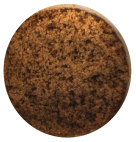
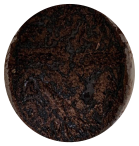
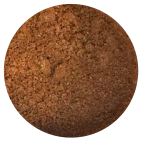
Enzymatic treatment significantly affected the color characteristics of CP. Compared with untreated CP, all hydrolyzed samples showed significantly lower (p < 0.05) L*, a*, and b* values, with reductions ranging from 9.1 to 26.0%, 2.2 to 21.5%, and 3.9 to 31.9%, respectively. The ΔE* values of hydrolyzed CP ranged from 4.70 to 15.45. These results indicate that hydrolysis produced visible color changes compared with untreated CP, as ΔE* values above 3.5 are considered perceptible according to the International Commission on Illumination (CIE) [52].
The L* values obtained in this study were lower than those reported in other studies, although they were closer to the L* value of fresh CP. Luca et al. [5] reported L* values of CP ranging from 66.02 to 73.30, a* values from 8.61 to 13.05, and b* values from 18.85 to 19.61, depending on carrot variety. Vega-Galvez et al. [53] reported L* values from 61.62 to 73.57, a* values from 19.57 to 33.79, and b* values from 28.66 to 40.51, depending on the drying method. The color values reported for fresh CP were L* = 49.10, a* = 37.68, and b* = 48.63.
The color of CP is largely associated with its carotenoid content, some of which may act as vitamin A precursors [54]. Carrot root color is cultivar-dependent and can vary from orange to purple according to the predominant phytochemical compounds present [55]. The observed decreases in a* and b* values indicate lower redness and yellowness, which may be associated with the degradation of carotenoids, flavanols, flavones, and isoflavones [56].
Changes in the TDF fraction during enzymatic hydrolysis were accompanied by decreased ORC in all CP samples. The lowest ORC was observed in CP hydrolyzed with Pectinex® Ultra Tropical, corresponding to a 21.3% decrease. Oil retention is mainly associated with surface properties, overall charge density, and the hydrophilic character of the material constituents [37]. The technological functionality of pomace is strongly affected by charge density, constituent hydrophilicity, and surface characteristics, which may also be reflected in bulk density. Generally, higher bulk density is associated with lower porosity and smaller particle size [37,57]. Enzymatic hydrolysis reduced the TDF content, which may have altered the surface characteristics of the treated pomace. Among the hydrolyzed samples, the Pectinex® Ultra Tropical-treated CP exhibited the greatest bulk density. A higher ORC is technologically relevant in fat- and emulsion-based food products, as it can contribute to improved system stability [58]. This was also observed by Choi et al. [59], who reported that low-fat chicken sausages containing apple pomace and reduced fat content from 30% to 20% showed decreased cooking, fat, and moisture losses, together with improved textural properties.
Hydration properties, such as WRC and WSC, are important indicators of the functional behavior of pomace. WRC describes the ability of the fiber matrix to retain water when external or gravitational forces are applied [60]. WSC reflects the increase in sample volume after immersion in excess water until equilibrium is reached, relative to its initial weight [60,61]. These properties are influenced by factors such as fiber particle size and the ratio of IDF to SDF [60,62]. In plant materials, the porous matrix formed by polysaccharide chains can retain considerable amounts of water through hydrogen bonding, thereby contributing to their functional properties [37]. High WSC may support gastrointestinal motility and defecation by increasing water retention in the intestinal contents, thereby contributing to improved bowel function.
In the present study, WRC did not change significantly after hydrolysis, whereas WSC varied significantly depending on the enzyme used. Hydrolysis with Celluclast® 1.5 L did not have a significant impact; Viscozyme® L increased WSC by 17.4%, while hydrolysis with Pectinex® Ultra Tropical decreased it by 18.9%. In addition, hydrolysis with enzymes significantly increased WSI. The WRC of CP observed in this study was higher than that reported in another study (4.76–7.64 g/g) [60]. In contrast, the WSC values were lower than those reported for other CP samples (25.95–27.22 mL/g; 29.23 mL/g) [60].
Changes in hydration properties after hydrolysis may be related to structural modifications of the polysaccharide matrix. The enzyme-dependent changes in hydration properties may be related to different degradation patterns of DF fractions, since cellulolytic, pectinolytic, and hemicellulolytic activities can differently modify SDF and IDF contents and the integrity of the polysaccharide matrix. Li et al. [45] reported improvements in WSC and WRC following hydrolysis, which may be attributed to partial polysaccharide depolymerization, especially in samples treated with cellulase-containing enzymes. Through the hydrolysis of β-(1 → 4) glycosidic linkages between glucose residues, cellulases can disrupt cellulose-rich cell wall structures, increase surface exposure, and facilitate water entrapment within the capillary spaces of CP fiber [45]. Destruction of polysaccharide linkages during enzymatic hydrolysis may reduce WSC by limiting the ability of the fiber network to retain water and expand. In this study, the decreased WSC observed in the sample with higher bulk density suggests that reduced matrix porosity may have restricted water uptake and swelling.
Schmid et al. [63] reported that increased solubility is commonly linked to the formation of higher amounts of water-soluble pectin and hemicellulose during pomace enzymatic hydrolysis. Similarly, Huang et al. [64] indicated that solubility can reflect degradation of fibrous material and the generation of low-molecular-weight compounds.
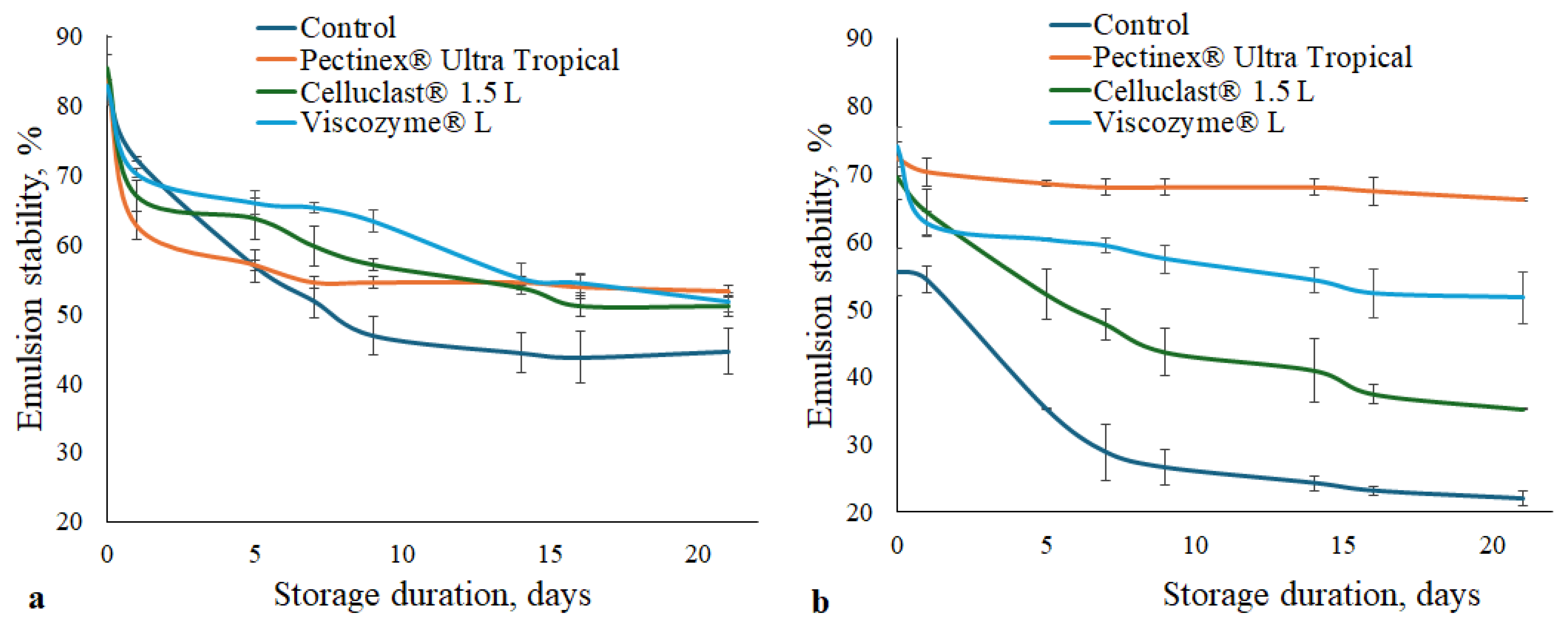
The effect of enzymatically treated CP on emulsion stability under static and thermal conditions is shown in Figure 2. Under static conditions, emulsion stability decreased from 81.5–85.3% to 44.5–53.2%. Emulsions stabilized with CP previously treated with the enzymes showed higher stability (decreased from 82.9–85.3 to 51.0–53.2%) than the control (decreased from 81.5 to 44.5%), which may be associated with the improved SDF/IDF ratio of these samples and increased WSC. The improved emulsion stability of treated CP may be technologically relevant, as emulsion stability reflects the ability of an emulsion to resist disruption and maintain its structure [65]. Moreover, emulsions enriched with SDF have been reported to form micelle-like networks, which may affect lipid digestion behavior, including the initial rate of fat digestion [66].
Because thermal processing, such as heating to 80 °C, is commonly applied during the manufacture of many food products, evaluation of emulsion stability under heat treatment is also important. Heating may impair emulsion stability, especially when the stabilizing system is weak or insufficient [67,68]. However, differences among samples were observed. Under thermal conditions, emulsion stability decreased from 55.4–73.9% to 22–66.1%. At the end of storage, the emulsion stabilized with untreated CP showed the lowest stability (decreased from 55.4 to 22%), whereas the emulsion containing CP hydrolyzed with Pectinex Ultra Tropical was the most stable (decreased from 73.9 to 66.1%).
Previous studies have shown that the emulsion-stabilizing capacity of plant by-products is influenced by several structural and hydration-related properties. Huc-Mathis et al. [69] in their work on Pickering emulsions based on food by-products, reported that bulk density, WRC, and IDF content were among the main factors affecting emulsion stability. In that study, apple pomace, which had the highest bulk density together with the lowest IDF content and WRC compared with oat bran processing by-products, showed the best emulsion-stabilizing properties [69]. Therefore, the improved emulsion stability of hydrolyzed CP may be related to the modified SDF/IDF ratio, increased WSI, and the combined contribution of soluble compounds and residual insoluble particles to droplet stabilization [34,69]. Hydrolysis converts high-molecular-weight compounds into smaller and more soluble molecules. In this context, Huang et al. [64] demonstrated that, in whey protein isolate-stabilized emulsions containing carboxymethyl cellulose, polymers with higher molecular weight provided better stabilization than lower-molecular-weight forms.
The technological effects of hydrolysis were enzyme-dependent: Viscozyme® L was the most effective in increasing WSC, Pectinex® Ultra Tropical resulted in the highest bulk density, and the best thermal emulsion stability. These differences indicate that enzyme selection should be based on the desired technological functionality of CP in the target food matrix.

3.4. Functional Properties of Modified CP

Phenolic compounds, such as phenolic acids, flavonoids, and proanthocyanidins, are linked to various bioactive effects, including antioxidant, anti-inflammatory, and anticancer activities. Nevertheless, in plant matrices, a substantial part of these compounds can occur in insoluble or bound forms, which may restrict their availability and functional use [70,71,72]. Free total phenolic compounds (TPC) increased in all CP samples after enzymatic hydrolysis, indicating that enzymatic treatment promoted the release of phenolic compounds from the pomace matrix (Table 4). The highest TPC was found in CP hydrolyzed with Celluclast® 1.5 L, showing an increase of 21.8%. This increase may be related to the degradation of fiber structures during hydrolysis, which can release phenolic compounds associated with plant cell wall components and make them more accessible for detection [73]. A similar trend of increased TPC after enzymatic hydrolysis has also been reported for berry pomace [12,43].
The antioxidant properties of enzymatically hydrolyzed CP were evaluated using DPPH and ABTS assays. The results showed that the effect of hydrolysis depended on the analytical method applied (Table 4). According to the DPPH assay, enzymatic treatment either reduced the antioxidant activity of CP or had no significant effect, with values ranging from 185.09 to 195.95 mg GAE/100 g. In contrast, the ABTS assay showed that hydrolysis with Viscozyme® L and Celluclast® 1.5 L significantly increased antioxidant activity. Depending on the enzyme preparation used, different DF fractions may have been degraded to different extents, as reflected by the observed changes in SDF, IDF, and RS contents. These enzyme-specific modifications of the CP matrix could promote the release of different groups of bound or entrapped compounds, including phenolics with varying polarity, molecular size, and radical-scavenging reactivity. As a result, the antioxidant response of hydrolyzed CP may differ between DPPH and ABTS assays, since these methods vary in their sensitivity to the chemical structure and accessibility of antioxidant compounds. A similar divergence between DPPH and ABTS results has also been reported in another study [74].
Differences between the two assays may be related to their distinct reaction mechanisms and sensitivity to antioxidant structure. Platzer et al. [75] showed that the antioxidant activity determined by different methods depends on several structural factors. The same authors also demonstrated that individual phenolic compounds differ in their reactivity depending on the assay used. In particular, hydroxycinnamic acids, which are among the predominant phenolic acids in carrot waste [76], showed higher activity in the ABTS assay than hydroxybenzoic acids, while such a distinction was not observed in the DPPH assay. In addition, the DPPH and ABTS methods differ in reaction medium and in their sensitivity to the chemical structure of antioxidants, meaning that hydrolysis-induced changes in compound profile may lead to lower radical-scavenging values in one assay without necessarily indicating the absence of released bioactive compounds [77].
Similar observations have been reported in studies on other plant by-products. Ayuso et al. [9] found that enzymatic hydrolysis could either increase or decrease antioxidant capacity in both DPPH and ABTS assays, depending on the by-product and the enzyme used, while hydrolysis of apple pomace with Viscozyme reduced both responses. Yu et al. [19] also reported that enzymatic modification of the CP IDF fraction did not significantly affect DPPH radical-scavenging capacity. Overall, the present results indicate that the antioxidant response of hydrolyzed CP is method-dependent and is strongly influenced by enzyme-induced changes in the profile and reactivity of released compounds.
CBC and SCBC are commonly used as in vitro indicators to evaluate the cholesterol- and bile salt-binding capacity of fiber-rich materials. In the present study, CBC ranged from 1.62 to 4.27 mg/g at pH 7 and from 1.87 to 3.38 mg/g at pH 2. In general, CBC was higher at pH 7 than at pH 2 of enzymatically modified CP. Enzymatic hydrolysis increased CBC at pH 7, whereas at pH 2, it decreased CBC in most cases, except in CP hydrolyzed with Pectinex® Ultra Tropical. The highest CBC values at both pH 7 and pH 2 were observed after hydrolysis with Pectinex® Ultra Tropical. The lower CBC observed at pH 2 is consistent with previous findings showing that cholesterol adsorption by DF occurs mainly in the intestinal environment rather than in the stomach [78]. The higher values of CBC at pH 7 were of pomace hydrolyzed with enzymes that contain pectinases. CBC of pomace DF may differ considerably, with reported values ranging from 0.03 to 37.10 mg/g [19]. This variability suggests that CBC is influenced not only by the composition and physicochemical properties of the fiber matrix, but also by the processing method applied. Therefore, differences in fiber composition, structural modifications induced by enzymatic treatment, and processing conditions may explain the variation in CBC observed among samples. Cholesterol adsorption by DF is generally attributed to two main mechanisms: physical and chemical interactions. Physical adsorption is mainly governed by structural characteristics of the fiber matrix, including particle size, porosity, and surface area, whereas chemical adsorption is associated with surface charge and the presence of hydrophobic groups [79,80].
The effect of enzymatic hydrolysis on SCBC depended on the enzyme applied. The highest SCBC was observed in CP hydrolyzed with Pectinex® Ultra Tropical, whereas the lowest value was found after treatment with Viscozyme® L. These differences may be related to enzyme-induced changes in fiber composition and hydration-related properties. According to Ma et al. [81], the ability of DF to bind sodium cholate is largely associated with high swelling capacity and elevated SDF content, both of which can increase the viscosity of the surrounding medium. In the present study, CP treated with Viscozyme® L showed the lowest WSC together with significantly reduced SDF and IDF contents, which may explain its lower SCBC.
Several mechanisms have been proposed to explain the interaction between DF and sodium cholate. These effects are mainly linked to the viscous and gel-forming behavior of SDF, as well as to the presence of phenolic compounds. Bile salt micelles contain different binding regions, which allow them to interact with both hydrophilic and hydrophobic bioactive compounds [82]. Zhou and Wang [83] suggested that the interaction between phenolics and sodium cholate occurs across several bile salt forms, from monomeric and dimeric species to primary and secondary micelles, and is largely driven by hydrophobic forces.
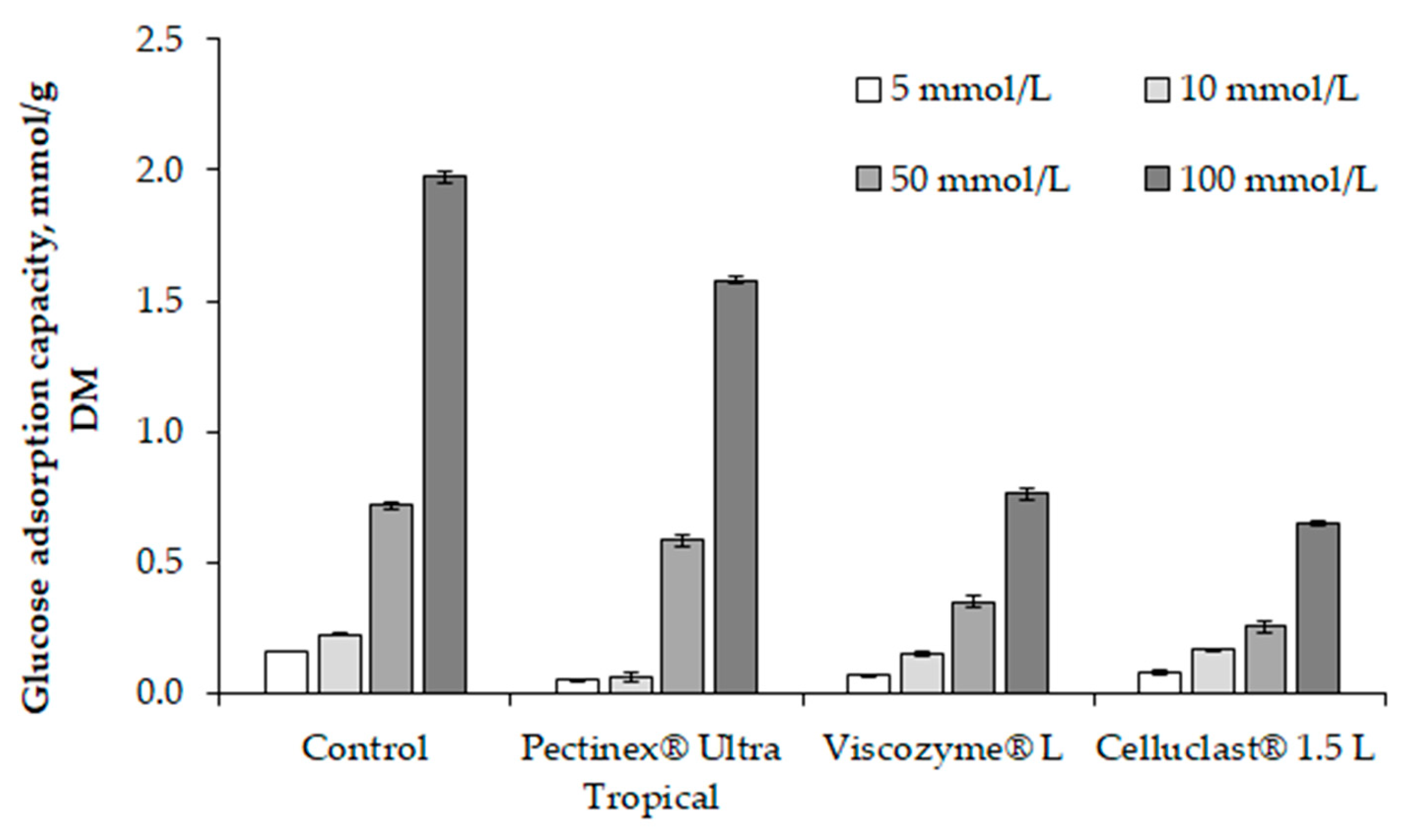
GAC reflects the ability of DF to bind glucose during simulated gastrointestinal transit in vitro [84]. This property is related to the structural characteristics of the fiber matrix, since the network formed by DF can retain or entrap small sugar molecules. Through this mechanism, DF may reduce glucose availability in vitro; however, this simplified assay does not directly reflect postprandial glycemic responses under physiological conditions [85]. The GAC values of hydrolyzed CP are presented in Figure 3. In the present study, glucose adsorption was dependent on glucose concentration. At lower concentrations (5 and 10 mmol/L), all CP samples showed relatively low and comparable GAC values, ranging from 0.048 to 1.975 mmol/g. When glucose concentration increased to 100 mmol/L, the adsorption capacity of CP also increased markedly.
Previous studies have likewise shown that GAC is influenced by both fiber structure and processing conditions. For example, DF isolated from carrot was reported to exhibit GAC values of 2.43–2.63 mmol/g after incubation in a 100 mmol/L glucose solution, with the observed differences depending on the extraction method used [19]. It has also been reported that glucose adsorption is closely associated with the structural organization of DF, as a more developed fiber network may enhance glucose entrapment and reduce its contact with the intestinal surface. Reported GAC values for DF vary from 0.17 to 4.65 mmol/g, and improvements observed after processing treatments, such as ultrasonication or high-pressure treatment, suggest enhanced glucose-binding functionality under in vitro conditions [86]. In the present study, enzymatic hydrolysis did not improve GAC, which may be related to the decrease in DF fractions and enzyme-dependent changes in the content and ratio of IDF and SDF. Previous studies have shown that SDF generally has a higher GAC than IDF, which may be attributed to its ability to increase system viscosity and consequently slow the diffusion of glucose molecules. In addition, structural modification of SDF can expose more polar and non-polar functional groups on the fiber surface, thereby strengthening interactions between the fiber matrix and glucose [87,88].
Overall, the effects of enzymatic hydrolysis on the functional properties of CP were enzyme- and assay-dependent. Celluclast® 1.5 L was the most effective in increasing free TPC, while Viscozyme® L and Celluclast® 1.5 L improved antioxidant activity according to the ABTS assay, but not according to DPPH, indicating that the antioxidant response depended on the released compound profile and the analytical method used. Pectinex® Ultra Tropical showed the most favorable effect on cholesterol-binding capacity at both pH 2 and pH 7 and resulted in the highest sodium cholate-binding capacity, whereas the GAC results indicated that enzymatic hydrolysis did not improve glucose adsorption under the tested conditions.

3.5. Prebiotic Properties of Modified CP

Soluble CP fractions were selected as a carbon source for PI evaluation instead of whole CP, as SDF and water-soluble oligosaccharides are generally more accessible for probiotic fermentation than insoluble carbohydrates; the results are shown in Table 5. The PI values differed between the tested strains, ranging from −1.58 to 0.73 for L. acidophilus DSM 20079 and from −2.29 to 1.51 for L. plantarum DSM 24624. The highest PI (p < 0.05) was observed for L. plantarum DSM 24624 grown with control CP, followed by CP hydrolyzed with Celluclast® 1.5 L. A high PI was also recorded for L. acidophilus DSM 20079 cultivated on CP previously hydrolyzed with Celluclast® 1.5 L. In contrast, the lowest values (p < 0.05) were obtained for L. plantarum DSM 24624 grown on CP hydrolyzed with Viscozyme®, followed by L. acidophilus DSM 20079 grown on the same substrate. Moreover, the PI of both L. plantarum DSM 24624 and L. acidophilus DSM 20079 was below zero when the strains were cultivated on CP hydrolyzed with Viscozyme® L and Pectinex® Ultra Tropical. Compared with inulin, the control CP and CP hydrolyzed with Celluclast® 1.5 L showed a higher PI, indicating that carbohydrates present in CP may possess considerable prebiotic potential. Similar observations were reported by Mall et al. [70], who showed that CP-derived carbohydrates promoted the growth of L. acidophilus and enhanced short-chain fatty acid production. In another study, Menon et al. reported that L. plantarum showed a negative PI with inulin but positive growth when grass-derived FOS or commercial FOS were used [89]. The PI reflects the potential prebiotic effect by comparing the growth of probiotic bacteria and enteric bacteria on the tested substrate with their growth on glucose, which is used as the reference substrate and assigned a PI value of 1. Negative PI values are obtained when probiotic bacteria grow less effectively on the tested substrate than on glucose and/or when their growth is lower relative to the enteric strain [89,90,91].
The observed prebiotic index may be related to the presence of pectic oligosaccharides and DF in CP, which can support probiotic growth and contribute to its high prebiotic capacity [92]. This may also be explained by the metabolic versatility of L. acidophilus, which is able to utilize a broad range of carbohydrates, including mono-, di-, and polysaccharides [93]. In addition, this strain can grow on oligosaccharides as a carbon source even in the absence of simple sugars [94]. The prebiotic activity of such carbohydrates is known to depend on their molecular weight, degree of polymerization, and the type of glycosidic linkage between the constituent units [95,96,97].

4. Conclusions

Carrot pomace (CP) are valuable source of DF and a promising raw material for valorization into functional food ingredients. Enzymatic hydrolysis significantly affected both the DF composition and the techno-functional properties of CP, although the extent of these changes depended on the enzyme used. Total dietary fiber (TDF) and insoluble dietary fiber (IDF) decreased significantly in all treated samples, with reductions ranging from 9.62 to 54.07% and from 12.03 to 58.52%, respectively. The greatest decrease was observed after hydrolysis with Viscozyme® L, while Celluclast® 1.5 L did not significantly affect soluble dietary fiber (SDF). At the same time, reducing sugars increased in all hydrolyzed samples by 2.3- to 3.4-fold, indicating degradation of structural polysaccharides.
Enzymatic treatment also significantly changed the technological properties of CP. Oil-retention capacity decreased in all samples, with the greatest reductions observed after treatment with Pectinex® Ultra Tropical (29.6%), whereas water retention capacity was not significantly affected. Water-swelling capacity was strongly enzyme-dependent: Viscozyme® L increased this parameter by 17.4%, while Pectinex® Ultra Tropical and Celluclast® 1.5 L reduced it by 18.9 and 7.1%, respectively. Enzymatic modification of CP increased the water-solubility index up to 33.4–66.2% and depended on the enzyme preparation used. Enzymatic hydrolysis also altered bulk density, color parameters, and emulsion stability, confirming that modification of the fiber matrix affected the technological performance of CP.
The bioactive and functional properties of CP were also influenced by enzymatic hydrolysis. Total phenolic content increased in water-soluble fraction of all the samples, with the highest increase observed after treatment with Celluclast® 1.5 L and Viscozyme® L (21.8 and 21.3%, respectively). Antioxidant properties evaluated by the ABTS assay increased after enzymatic modification, whereas DPPH values decreased or did not change significantly. The highest cholesterol-binding capacity and sodium cholate-binding capacity were observed in CP hydrolyzed with Pectinex® Ultra Tropical, while the highest prebiotic index values were obtained for L. plantarum DSM 24624 and L. acidophilus DSM 20079 grown on CP treated with Celluclast® 1.5 L and a control CP sample. Overall, the results demonstrate that enzymatic treatment can be used to improve the composition and properties of CP depending on its intended nutritional and technological application. Among the tested treatments, Viscozyme® L was more favorable for increasing water-swelling capacity and water-solubility index, while Pectinex® Ultra Tropical showed the most pronounced improvement in emulsion stability and cholesterol- and sodium cholate-binding capacities. Celluclast® 1.5 L did not significantly affect SDF content and was associated with the highest free total phenolic content and favorable values of prebiotic index. These findings indicate that enzyme selection should be guided by the target functionality of modified CP, as no single enzyme preparation improved all evaluated properties simultaneously.

Author Contributions

Conceptualization, L.B. and D.Č.; methodology, U.G. and D.Č.; software, J.J. and U.G.; validation, U.G. and D.Č.; formal analysis, J.J., U.G., D.Č., and L.B.; investigation, U.G.; resources, D.Č.; data curation, L.B. and D.Č.; writing—original draft preparation, J.J. and D.Č.; writing—review and editing, L.B., D.Č., J.J.; visualization, J.J. and D.Č.; supervision, D.Č. All authors have read and agreed to the published version of the manuscript.

Funding

This research was partly funded by the Research Council of Lithuania, project No. S-SV-25-283, under the program “Student Research and Internship Projects”, financed by the Lithuanian state budget.

Institutional Review Board Statement

Not applicable.

Informed Consent Statement

Not applicable.

Data Availability Statement

The original contributions presented in the study are included in the article, further inquiries can be directed to the corresponding author.

Acknowledgments

The authors acknowledge Novozymes A/S, Denmark, for kindly providing the enzymes used in this research.

Conflicts of Interest

The authors declare no conflicts of interest.

Abbreviations

The following abbreviations are used in this manuscript:
ABTS2,2′-azinobis-(3-ethylbenzothiazoline-6-sulfonic acid)
BDbulk density
CBCcholesterol-binding capacity
DFdietary fiber
DPPH2,2-diphenyl-1-picrylhydrazyl
CPcarrot pomace
GACglucose-adsorption capacity
IDFinsoluble dietary fiber
ORCoil-retention capacity
PIprebiotic index
RSreducing sugars
SDSsoluble dietary fiber
SCBCsodium cholate-binding capacity
TDFtotal dietary fiber
TPCtotal phenolic compounds
WRCwater retention capacity
WSIwater-solubility index
WSCwater-swelling capacity

References

  1. Yang, Y.Y.; Ma, S.; Wang, X.X.; Zheng, X.L. Modification and Application of Dietary Fiber in Foods. J. Chem. 2017, 2017, 9340427. [Google Scholar] [CrossRef]
  2. Sharma, K.D.; Karki, S.; Thakur, N.S.; Attri, S. Chemical Composition, Functional Properties and Processing of Carrot-A Review. J. Food Sci. Technol. 2012, 49, 22–32. [Google Scholar] [CrossRef]
  3. Sun, T.; Simon, P.W.; Tanumihardjo, S.A. Antioxidant Phytochemicals and Antioxidant Capacity of Biofortified Carrots (Daucus carota L.) of Various Colors. J. Agric. Food Chem. 2009, 57, 4142–4147. [Google Scholar] [CrossRef] [PubMed]
  4. Bellur Nagarajaiah, S.; Prakash, J. Nutritional Composition, Acceptability, and Shelf Stability of Carrot Pomace-Incorporated Cookies with Special Reference to Total and β-Carotene Retention. Cogent Food Agric. 2015, 1, 1039886. [Google Scholar] [CrossRef]
  5. Luca, M.I.; Ungureanu-Iuga, M.; Mironeasa, S. Carrot Pomace Characterization for Application in Cereal-Based Products. Appl. Sci. 2022, 12, 7989. [Google Scholar] [CrossRef]
  6. Kohajdová, Z.; Karovičová, J.; Jurasová, M. Influence of Carrot Pomace Powder on the Rheological Characteristics of Wheat Flour Dough and on Wheat Rolls Quality. Acta Sci. Pol. Technol. Aliment. 2012, 11, 381–387. [Google Scholar]
  7. Alba, K.; MacNaughtan, W.; Laws, A.P.; Foster, T.J.; Campbell, G.M.; Kontogiorgos, V. Fractionation and Characterisation of Dietary Fibre from Blackcurrant Pomace. Food Hydrocoll. 2018, 81, 398–408. [Google Scholar] [CrossRef]
  8. Diez-Sánchez, E.; Quiles, A.; Hernando, I. Use of Berry Pomace to Design Functional Foods. Food Rev. Int. 2023, 39, 3204–3224. [Google Scholar] [CrossRef]
  9. Ayuso, P.; Peñalver, R.; Quizhpe, J.; Rosell, M.d.l.Á.; Nieto, G. Broccoli, Artichoke, Carob and Apple By-Products as a Source of Soluble Fiber: How It Can Be Affected by Enzymatic Treatment with Pectinex® Ultra SP-L, Viscozyme® L and Celluclast® 1.5 L. Foods 2024, 14, 10. [Google Scholar] [CrossRef]
  10. Nguyen, T.T.A.; Nguyen, H.H.; Ton, N.M.N.; Tran, T.T.T.; Le, V.V.M. Enzymatic Treatment of Pineapple Pomace and Its Application into Fiber-Rich Biscuit Making. J. Agric. Food Res. 2024, 15, 100936. [Google Scholar] [CrossRef]
  11. Spadoni Andreani, E.; Karboune, S. Comparison of Enzymatic and Microwave-Assisted Alkaline Extraction Approaches for the Generation of Oligosaccharides from American Cranberry (Vaccinium macrocarpon) Pomace. J. Food Sci. 2020, 85, 2443–2451. [Google Scholar] [CrossRef]
  12. Jagelaviciute, J.; Basinskiene, L.; Cizeikiene, D.; Syrpas, M. Technological Properties and Composition of Enzymatically Modified Cranberry Pomace. Foods 2022, 11, 2321. [Google Scholar] [CrossRef] [PubMed]
  13. Iqbal, S.; Tirpanalan-Staben, Ö.; Franke, K. Modification of Dietary Fibers to Valorize the By-Products of Cereal, Fruit and Vegetable Industry—A Review on Treatment Methods. Plants 2022, 11, 3466. [Google Scholar] [CrossRef]
  14. Kitrytė, V.; Kraujalienė, V.; Šulniūtė, V.; Pukalskas, A.; Venskutonis, P.R. Chokeberry Pomace Valorization into Food Ingredients by Enzyme-Assisted Extraction: Process Optimization and Product Characterization. Food Bioprod. Process. 2017, 105, 36–50. [Google Scholar] [CrossRef]
  15. Yoshida, B.Y.; Prudencio, S.H. Physical, Chemical, and Technofunctional Properties of Okara Modified by a Carbohydrase Mixture. LWT 2020, 134, 110141. [Google Scholar] [CrossRef]
  16. AOAC. Official Methods of Analysis of the Association of Official Analytical Chemists, 15th ed.; Helrich, K., Ed.; Association of Official Analytical Chemist: Washington, DC, USA, 1990. [Google Scholar]
  17. Miller, G.L. Use of Dinitrosalicylic Acid Reagent for Determination of Reducing Sugar. Anal. Chem. 1959, 31, 426–428. [Google Scholar] [CrossRef]
  18. Megazyme. Total Dietary Fiber Assay Procedure; Megazyme: Wicklow, Ireland, 2017; pp. 1–19. [Google Scholar]
  19. Yu, G.; Bei, J.; Zhao, J.; Li, Q.; Cheng, C. Modification of Carrot (Daucus carota Linn. var. Sativa Hoffm.) Pomace Insoluble Dietary Fiber with Complex Enzyme Method, Ultrafine Comminution, and High Hydrostatic Pressure. Food Chem. 2018, 257, 333–340. [Google Scholar] [CrossRef]
  20. Jagelavičiutė, J.; Čižeikienė, D.; Bašinskienė, L. Enzymatic Modification of Apple Pomace and Its Application in Conjunction with Probiotics for Jelly Candy Production. Appl. Sci. 2025, 15, 599. [Google Scholar] [CrossRef]
  21. Keršiene, M.; Jasutiene, I.; Eisinaite, V.; Venskutonis, P.R.; Leskauskaite, D. Designing Multiple Bioactives Loaded Emulsions for the Formulations for Diets of Elderly. Food Funct. 2020, 11, 2195–2207. [Google Scholar] [CrossRef]
  22. Sivam, A.S.; Sun-Waterhouse, D.; Waterhouse, G.I.N.; Quek, S.; Perera, C.O. Physicochemical Properties of Bread Dough and Finished Bread with Added Pectin Fiber and Phenolic Antioxidants. J. Food Sci. 2011, 76, H97–H107. [Google Scholar] [CrossRef]
  23. Bhutkar, M.A.; Bhinge, S.D.; Randive, D.S.; Wadkar, G.H. Hypoglycemic Effects of Berberis aristata and Tamarindus indica Extracts in Vitro. Bull. Fac. Pharm. Cairo Univ. 2017, 55, 91–94. [Google Scholar] [CrossRef][Green Version]
  24. Zhang, N.; Huang, C.; Ou, S. In vitro binding capacities of three dietary fibers and their mixture for four toxic elements, cholesterol, and bile acid. J. Hazard. Mater. 2011, 186, 236–239. [Google Scholar] [CrossRef]
  25. Park, Y.W. Cholesterol Contents of U.S. and Imported Goat Milk Cheeses as Quantified by Different Colorimetric Methods. Small Rumin. Res. 1999, 32, 77–82. [Google Scholar] [CrossRef]
  26. Xu, H.; Jiao, Q.; Yuan, F.; Gao, Y. In Vitro Binding Capacities and Physicochemical Properties of Soluble Fiber Prepared by Microfluidization Pretreatment and Cellulase Hydrolysis of Peach Pomace. LWT-Food Sci. Technol. 2015, 63, 677–684. [Google Scholar] [CrossRef]
  27. Shen, J.; Yang, X.; Sun, X.; Gong, W.; Ma, Y.; Liu, L.; Yao, J. Amino-Functionalized Cellulose: A Novel and High-Efficiency Scavenger for Sodium Cholate Sorption. Cellulose 2020, 27, 4019–4028. [Google Scholar] [CrossRef]
  28. Blois, M.S. Antioxidant Determinations by the Use of a Stable Free Radical. Nature 1958, 181, 1199–1200. [Google Scholar] [CrossRef]
  29. Re, R.; Pellegrini, N.; Proteggente, A.; Pannala, A.; Yang, M.; Rice-Evans, C. Antioxidant Activity Applying an Improved ABTS Radical Cation Decolorization Assay. Free Radic. Biol. Med. 1999, 26, 1231–1237. [Google Scholar] [CrossRef]
  30. Przyborska, J.; Hall, M.C.; Concannon, M. In Vitro Determination of Prebiotic Potential of Aqueous Extract of Horse Chestnut By-Product. Bioact. Carbohydr. Diet. Fibre 2019, 19, 100190. [Google Scholar] [CrossRef]
  31. Chau, C.F.; Chen, C.H.; Lee, M.H. Comparison of the Characteristics, Functional Properties, and in Vitro Hypoglycemic Effects of Various Carrot Insoluble Fiber-Rich Fractions. LWT-Food Sci. Technol. 2004, 37, 155–160. [Google Scholar] [CrossRef]
  32. Richards, J.; Lammert, A.; Madden, J.; Kang, I.; Amin, S. Physical Treatments Modified the Functionality of Carrot Pomace. Foods 2024, 13, 2084. [Google Scholar] [CrossRef]
  33. Hotchkiss, A.T.; Chau, H.K.; Strahan, G.D.; Nuñez, A.; Simon, S.; White, A.K.; Dieng, S.; Heuberger, E.R.; Yadav, M.P.; Hirsch, J. Structural Characterization of Red Beet Fiber and Pectin. Food Hydrocoll. 2022, 129, 107549. [Google Scholar] [CrossRef]
  34. Nakov, G.; Brandolini, A.; Estivi, L.; Bertuglia, K.; Ivanova, N.; Jukić, M.; Komlenić, D.K.; Lukinac, J.; Hidalgo, A. Effect of Tomato Pomace Addition on Chemical, Technological, Nutritional, and Sensorial Properties of Cream Crackers. Antioxidants 2022, 11, 2087. [Google Scholar] [CrossRef]
  35. Kairė, A.; Jagelavičiūtė, J.; Bašinskienė, L.; Syrpas, M.; Čižeikienė, D. Influence of Enzymatic Hydrolysis on Composition and Technological Properties of Black Currant (Ribes nigrum) Pomace. Appl. Sci. 2025, 15, 6207. [Google Scholar] [CrossRef]
  36. Kuhkheil, A.; Badi, H.; Mehrafarin, A.; Abdossi, V. Chemical Constituents of Sea Buckthorn (Hippophae rhamnoides L.) Fruit in Populations of Central Alborz Mountains in Iran. Res. J. Pharmacogn. 2017, 4, 1–12. [Google Scholar]
  37. Elleuch, M.; Bedigian, D.; Roiseux, O.; Besbes, S.; Blecker, C.; Attia, H. Dietary Fibre and Fibre-Rich by-Products of Food Processing: Characterisation, Technological Functionality and Commercial Applications: A Review. Food Chem. 2011, 124, 411–421. [Google Scholar] [CrossRef]
  38. Wang, L.; Wang, J.; Wang, J.; Guo, Z.; Li, Z.; Qiu, J.; Wang, L. Soluble and Insoluble Dietary Fiber at Different Ratios: Hydration Characteristics, Rheological Properties, and Ameliorative Effects on Constipation. Food Chem. X 2024, 24, 101996. [Google Scholar] [CrossRef]
  39. Moczkowska, M.; Karp, S.; Niu, Y.; Kurek, M.A. Enzymatic, Enzymatic-Ultrasonic and Alkaline Extraction of Soluble Dietary Fibre from Flaxseed—A Physicochemical Approach. Food Hydrocoll. 2019, 90, 105–112. [Google Scholar] [CrossRef]
  40. Zhang, F.; Yi, W.; Cao, J.; He, K.; Liu, Y.; Bai, X. Microstructure Characteristics of Tea Seed Dietary Fibre and Its Effect on Cholesterol, Glucose and Nitrite Ion Adsorption Capacities in Vitro: A Comparison Study among Different Modifications. Int. J. Food Sci. Technol. 2020, 55, 1781–1791. [Google Scholar] [CrossRef]
  41. Manthei, A.; López-Gámez, G.; Martín-Belloso, O.; Elez-Martínez, P.; Soliva-Fortuny, R. Relationship between Physicochemical, Techno-Functional and Health-Promoting Properties of Fiber-Rich Fruit and Vegetable By-Products and Their Enhancement by Emerging Technologies. Foods 2023, 12, 3720. [Google Scholar] [CrossRef]
  42. Mrabet, A.; Rodríguez-Gutiérrez, G.; Rubio-Senent, F.; Hamza, H.; Rodríguez-Arcos, R.; Guillén-Bejarano, R.; Sindic, M.; Jiménez-Araujo, A. Enzymatic Conversion of Date Fruit Fiber Concentrates into a New Product Enriched in Antioxidant Soluble Fiber. LWT 2017, 75, 727–734. [Google Scholar] [CrossRef]
  43. Kaminskytė, G.; Jagelavičiūtė, J.; Bašinskienė, L.; Syrpas, M.; Čižeikienė, D. Effect of Modification Methods on Composition and Technological Properties of Sea Buckthorn (Hippophae rhamnoides L.) Pomace. Appl. Sci. 2025, 15, 8722. [Google Scholar] [CrossRef]
  44. Yoon, K.Y.; Cha, M.; Shin, S.R.; Kim, K.S. Enzymatic Production of a Soluble-Fibre Hydrolyzate from Carrot Pomace and Its Sugar Composition. Food Chem. 2005, 92, 151–157. [Google Scholar] [CrossRef]
  45. Li, X.; He, X.; Lv, Y.; He, Q. Extraction and Functional Properties of Water-Soluble Dietary Fiber from Apple Pomace. J. Food Process Eng. 2014, 37, 293–298. [Google Scholar] [CrossRef]
  46. Jeong, H.; Rani Das, P.; Kim, H.; Im, A.E.; Lee, B.B.; Yang, K.Y.; Nam, S.H. A Combination of Commercial and Traditional Food-Source-Derived Enzymatic Treatment Acts as a Potential Tool to Produce Functional Yuzu (Citrus junos) Powder. Food Chem. X 2023, 20, 100918. [Google Scholar] [CrossRef]
  47. De Laet, E.; Bernaerts, T.; Morren, L.; Vanmarcke, H.; Van Loey, A.M. The Use of Different Cell Wall Degrading Enzymes for Pectin Extraction from Carrot Pomace, in Comparison to and in Combination with an Acid Extraction. Foods 2025, 14, 435. [Google Scholar] [CrossRef]
  48. Zykwinska, A.; Boiffard, M.H.; Kontkanen, H.; Buchert, J.; Thibault, J.F.; Bonnin, E. Extraction of Green Labeled Pectins and Pectic Oligosaccharides from Plant Byproducts. J. Agric. Food Chem. 2008, 56, 8926–8935. [Google Scholar] [CrossRef]
  49. Encalada, A.M.I.; Pérez, C.D.; Flores, S.K.; Rossetti, L.; Fissore, E.N.; Rojas, A.M. Antioxidant Pectin Enriched Fractions Obtained from Discarded Carrots (Daucus carota L.) by Ultrasound-Enzyme Assisted Extraction. Food Chem. 2019, 289, 453–460. [Google Scholar] [CrossRef]
  50. Spadoni Andreani, E.; Karboune, S.; Liu, L. Extraction and Characterization of Cell Wall Polysaccharides from Cranberry (Vaccinium macrocarpon var. Stevens) Pomace. Carbohydr. Polym. 2021, 267, 118212. [Google Scholar] [CrossRef]
  51. He, Y.; Li, W.; Zhang, X.; Li, T.; Ren, D.; Lu, J. Physicochemical, Functional, and Microstructural Properties of Modified Insoluble Dietary Fiber Extracted from Rose Pomace. J. Food Sci. Technol. 2020, 57, 1421–1429. [Google Scholar] [CrossRef]
  52. Mokrzycki, W.S.; Tatol, M. Colour Difference ∆E—A Survey. Mach. Graph. Vis. 2011, 20, 383–411. [Google Scholar]
  53. Vega-Galvez, A.; Orellana-Palma, P.; Pasten, A.; Uribe, E.; Cortes, D.; Carvajal, M. Mild Temperature Conditions Applied to Carrot (Daucus carota L.) Waste Using Different Drying Methods: Effect on the Kinetics and Some Chemical Parameters. Processes 2025, 13, 90. [Google Scholar] [CrossRef]
  54. Bao, B.; Chang, K.C. Carrot Pulp Chemical Composition, Color, and Water-holding Capacity as Affected by Blanching. J. Food Sci. 1994, 59, 1159–1161. [Google Scholar] [CrossRef]
  55. Witrowa-Rajchert, D.; Bawoł, A.; Czapski, J.; Kidoń, M. Studies on Drying of Purple Carrot Roots. Dry. Technol. 2009, 27, 1325–1331. [Google Scholar] [CrossRef]
  56. Elik, A. Hot Air-Assisted Radio Frequency Drying of Black Carrot Pomace: Kinetics and Product Quality. Innov. Food Sci. Emerg. Technol. 2021, 73, 102800. [Google Scholar] [CrossRef]
  57. Caparino, O.A.; Tang, J.; Nindo, C.I.; Sablani, S.S.; Powers, J.R.; Fellman, J.K. Effect of Drying Methods on the Physical Properties and Microstructures of Mango (Philippine ‘Carabao’ Var.) Powder. J. Food Eng. 2012, 111, 135–148. [Google Scholar] [CrossRef]
  58. Baenas, N.; Nuñez-Gómez, V.; Navarro-González, I.; Sánchez-Martínez, L.; García-Alonso, J.; Periago, M.J.; González-Barrio, R. Raspberry Dietary Fibre: Chemical Properties, Functional Evaluation and Prebiotic in Vitro Effect. LWT 2020, 134, 110140. [Google Scholar] [CrossRef]
  59. Choi, Y.S.; Kim, Y.B.; Hwang, K.E.; Song, D.H.; Ham, Y.K.; Kim, H.W.; Sung, J.M.; Kim, C.J. Effect of Apple Pomace Fiber and Pork Fat Levels on Quality Characteristics of Uncured, Reduced-Fat Chicken Sausages. Poult. Sci. 2016, 95, 1465–1471. [Google Scholar] [CrossRef]
  60. Amin, S.; Jung, S.; Kang, I.; Duval, A. Valorization of Baby Carrot Processing Waste. J. Culin. Sci. Technol. 2023, 21, 1–17. [Google Scholar] [CrossRef]
  61. Raghavendra, S.N.; Rastogi, N.K.; Raghavarao, K.S.M.S.; Tharanathan, R.N. Dietary Fiber from Coconut Residue: Effects of Different Treatments and Particle Size on the Hydration Properties. Eur. Food Res. Technol. 2004, 218, 563–567. [Google Scholar] [CrossRef]
  62. Jaime, L.; Mollá, E.; Fernández, A.; Martín-Cabrejas, M.A.; López-Andréu, J.; Esteban, R.M. Structural Carbohydrate Differences and Potential Source of Dietary Fiber of Onion (Allium cepa L.) Tissues. J. Agric. Food Chem. 2001, 50, 122–128. [Google Scholar] [CrossRef]
  63. Schmid, V.; Steck, J.; Mayer-Miebach, E.; Behsnilian, D.; Briviba, K.; Bunzel, M.; Karbstein, H.P.; Emin, M.A. Impact of Defined Thermomechanical Treatment on the Structure and Content of Dietary Fiber and the Stability and Bioaccessibility of Polyphenols of Chokeberry (Aronia melanocarpa) Pomace. Food Res. Int. 2020, 134, 109232. [Google Scholar] [CrossRef]
  64. Huang, Y.L.; Ma, Y.S. The Effect of Extrusion Processing on the Physiochemical Properties of Extruded Orange Pomace. Food Chem. 2016, 192, 363–369. [Google Scholar] [CrossRef]
  65. Lan, G.; Chen, H.; Chen, S.; Tian, J. Chemical Composition and Physicochemical Properties of Dietary Fiber from Polygonatum odoratum as Affected by Different Processing Methods. Food Res. Int. 2012, 49, 406–410. [Google Scholar] [CrossRef]
  66. Kalla-Bertholdt, A.M.; Nguyen, P.V.; Baier, A.K.; Rauh, C. Influence of Dietary Fiber on In-Vitro Lipid Digestion of Emulsions Prepared with High-Intensity Ultrasound. Innov. Food Sci. Emerg. Technol. 2021, 73, 102799. [Google Scholar] [CrossRef]
  67. Zhai, J.; Wooster, T.J.; Hoffmann, S.V.; Lee, T.H.; Augustin, M.A.; Aguilar, M.I. Structural Rearrangement of β-Lactoglobulin at Different Oil-Water Interfaces and Its Effect on Emulsion Stability. Langmuir 2011, 27, 9227–9236. [Google Scholar] [CrossRef]
  68. Chen, J.; Mu, T.; Zhang, M.; Goffin, D. Effect of Heat Treatments on the Structure and Emulsifying Properties of Protein Isolates from Cumin Seeds (Cuminum cyminum). Food Sci. Technol. Int. 2018, 24, 673–687. [Google Scholar] [CrossRef]
  69. Huc-Mathis, D.; Almeida, G.; Michon, C. Pickering Emulsions Based on Food Byproducts: A Comprehensive Study of Soluble and Insoluble Contents. J. Colloid Interface Sci. 2021, 581, 226–237. [Google Scholar] [CrossRef]
  70. Mall, U.P.; Patel, V.H. Carrot Pomace Powder: A Promising Source of Polyphenols and Prebiotics for Improving Gut Health. Nutrire 2024, 49, 9. [Google Scholar] [CrossRef]
  71. De Camargo, A.C.; Regitano-D’Arce, M.A.B.; Biasoto, A.C.T.; Shahidi, F. Enzyme-Assisted Extraction of Phenolics from Winemaking by-Products: Antioxidant Potential and Inhibition of Alpha-Glucosidase and Lipase Activities. Food Chem. 2016, 212, 395–402. [Google Scholar] [CrossRef]
  72. Dinicola, S.; Cucina, A.; Pasqualato, A.; D’Anselmi, F.; Proietti, S.; Lisi, E.; Pasqua, G.; Antonacci, D.; Bizzarri, M. Antiproliferative and Apoptotic Effects Triggered by Grape Seed Extract (GSE) versus Epigallocatechin and Procyanidins on Colon Cancer Cell Lines. Int. J. Mol. Sci. 2012, 13, 651. [Google Scholar] [CrossRef]
  73. Khoddami, A.; Wilkes, M.A.; Roberts, T.H. Techniques for Analysis of Plant Phenolic Compounds. Molecules 2013, 18, 2328–2375. [Google Scholar] [CrossRef]
  74. Bas-Bellver, C.; Barrera, C.; Betoret, N.; Seguí, L. Effect of Processing and In Vitro Digestion on Bioactive Constituents of Powdered IV Range Carrot (Daucus carota, L.) Wastes. Foods 2023, 12, 731. [Google Scholar] [CrossRef] [PubMed]
  75. Platzer, M.; Kiese, S.; Herfellner, T.; Schweiggert-Weisz, U.; Miesbauer, O.; Eisner, P. Common Trends and Differences in Antioxidant Activity Analysis of Phenolic Substances Using Single Electron Transfer Based Assays. Molecules 2021, 26, 1244. [Google Scholar] [CrossRef]
  76. Panzella, L.; Moccia, F.; Nasti, R.; Marzorati, S.; Verotta, L.; Napolitano, A. Bioactive Phenolic Compounds From Agri-Food Wastes: An Update on Green and Sustainable Extraction Methodologies. Front. Nutr. 2020, 7, 538169. [Google Scholar] [CrossRef] [PubMed]
  77. Sadeer, N.B.; Montesano, D.; Albrizio, S.; Zengin, G.; Mahomoodally, M.F. The Versatility of Antioxidant Assays in Food Science and Safety—Chemistry, Applications, Strengths, and Limitations. Antioxidants 2020, 9, 709. [Google Scholar] [CrossRef]
  78. Zhu, Y.; He, C.; Fan, H.; Lu, Z.; Lu, F.; Zhao, H. Modification of Foxtail Millet (Setaria italica) Bran Dietary Fiber by Xylanase-Catalyzed Hydrolysis Improves Its Cholesterol-Binding Capacity. LWT 2019, 101, 463–468. [Google Scholar] [CrossRef]
  79. Nandi, I.; Sengupta, A.; Ghosh, M. Effects of Dietary Fibres Extracted from Defatted Sesame Husk, Rice Bran & Flaxseed on Hypercholesteromic Rats. Bioact. Carbohydr. Diet. Fibre 2019, 17, 100176. [Google Scholar] [CrossRef]
  80. Mirmiran, P.; Bahadoran, Z.; Moghadam, S.K.; Vakili, A.Z.; Azizi, F. A Prospective Study of Different Types of Dietary Fiber and Risk of Cardiovascular Disease: Tehran Lipid and Glucose Study. Nutrients 2016, 8, 686. [Google Scholar] [CrossRef]
  81. Ma, M.M.; Mu, T.H. Effects of Extraction Methods and Particle Size Distribution on the Structural, Physicochemical, and Functional Properties of Dietary Fiber from Deoiled Cumin. Food Chem. 2016, 194, 237–246. [Google Scholar] [CrossRef] [PubMed]
  82. O’Connor, C.J.; Wallace, R.G. Physico-Chemical Behavior of Bile Salts. Adv. Colloid Interface Sci. 1985, 22, 1–111. [Google Scholar] [CrossRef]
  83. Zhou, H.; Wang, X. Spectrometric Study on the Interaction of Sodium Cholate Aggregates with Quercetin. Colloids Surf. A Physicochem. Eng. Asp. 2015, 481, 31–37. [Google Scholar] [CrossRef]
  84. Peerajit, P.; Chiewchan, N.; Devahastin, S. Effects of Pretreatment Methods on Health-Related Functional Properties of High Dietary Fibre Powder from Lime Residues. Food Chem. 2012, 132, 1891–1898. [Google Scholar] [CrossRef]
  85. Wang, L.; Xu, H.; Yuan, F.; Pan, Q.; Fan, R.; Gao, Y. Physicochemical Characterization of Five Types of Citrus Dietary Fibers. Biocatal. Agric. Biotechnol. 2015, 4, 250–258. [Google Scholar] [CrossRef]
  86. He, Y.; Wang, B.; Wen, L.; Wang, F.; Yu, H.; Chen, D.; Su, X.; Zhang, C. Effects of Dietary Fiber on Human Health. Food Sci. Hum. Wellness 2022, 11, 1–10. [Google Scholar] [CrossRef]
  87. Liu, Y.; Ao, H.P.; Zheng, J.X.; Liang, Y.X.; Ren, D.F. Improved Functional Properties of Dietary Fiber from Rosa roxburghii Tratt Residue by Steam Explosion. J. Food Process. Preserv. 2022, 46, e16119. [Google Scholar] [CrossRef]
  88. Qiao, H.; Shao, H.; Zheng, X.; Liu, J.; Liu, J.; Huang, J.; Zhang, C.; Liu, Z.; Wang, J.; Guan, W. Modification of Sweet Potato (Ipomoea batatas Lam.) Residues Soluble Dietary Fiber Following Twin-Screw Extrusion. Food Chem. 2021, 335, 127522. [Google Scholar] [CrossRef]
  89. Menon, A.; Ravindran, R.; Koopmans, S.; Sanders, J.P.M.; Rai, D.K.; Gaffey, J.; Augustyniak, A.; McMahon, H. Purification, Characterisation, and Determination of Prebiotic Potential of Fructooligosaccharide from Perennial Rye Grass. Int. J. Biol. Macromol. 2024, 279, 135031. [Google Scholar] [CrossRef]
  90. Figueroa-González, I.; Rodríguez-Serrano, G.; Gómez-Ruiz, L.; García-Garibay, M.; Cruz-Guerrero, A. Prebiotic Effect of Commercial Saccharides on Probiotic Bacteria Isolated from Commercial Products. Food Sci. Technol. 2019, 39, 747–753. [Google Scholar] [CrossRef]
  91. Plamada, D.; Simon, E.; Nemes, S.A.; Teleky, B.E.; Odocheanu, R.; Szabo, K.; Ranga, F.; Dulf, F.V.; Vodnar, D.C. Exploring the in Vitro Prebiotic Potential of Two Different Freeze-Dried Apple Pomace Cultivars. Food Biosci. 2025, 64, 105892. [Google Scholar] [CrossRef]
  92. Hotchkiss, A.T.; Chau, H.K.; Strahan, G.D.; Nuñez, A.; Harron, A.; Simon, S.; White, A.K.; Yadav, M.P.; Yeom, H.W. Carrot Rhamnogalacturonan I Structure and Composition Changed during 2017 in California. Food Hydrocoll. 2023, 137, 108411. [Google Scholar] [CrossRef]
  93. Altermann, E.; Russell, W.M.; Azcarate-Peril, M.A.; Barrangou, R.; Buck, B.L.; McAuliffe, O.; Souther, N.; Dobson, A.; Duong, T.; Callanan, M.; et al. Complete Genome Sequence of the Probiotic Lactic Acid Bacterium Lactobacillus acidophilus NCFM. Proc. Natl. Acad. Sci. USA 2005, 102, 3906–3912. [Google Scholar] [CrossRef]
  94. Pan, X.; Wu, T.; Zhang, L.; Cai, L.; Song, Z. Influence of Oligosaccharides on the Growth and Tolerance Capacity of Lactobacilli to Simulated Stress Environment. Lett. Appl. Microbiol. 2009, 48, 362–367. [Google Scholar] [CrossRef]
  95. Wang, X.; Huang, M.; Yang, F.; Sun, H.; Zhou, X.; Guo, Y.; Wang, X.; Zhang, M. Rapeseed Polysaccharides as Prebiotics on Growth and Acidifying Activity of Probiotics in Vitro. Carbohydr. Polym. 2015, 125, 232–240. [Google Scholar] [CrossRef]
  96. Li, D.; Kim, J.M.; Jin, Z.; Zhou, J. Prebiotic Effectiveness of Inulin Extracted from Edible Burdock. Anaerobe 2008, 14, 29–34. [Google Scholar] [CrossRef]
  97. Stewart, M.L.; Timm, D.A.; Slavin, J.L. Fructooligosaccharides Exhibit More Rapid Fermentation than Long-Chain Inulin in an in Vitro Fermentation System. Nutr. Res. 2008, 28, 329–334. [Google Scholar] [CrossRef]
Figure 1. Experimental scheme.
Applsci 16 05552 g001
Figure 2. Stability behavior of emulsions containing enzymatically modified carrot pomace (CP) during static storage (a) and after heating at 80 °C for 30 min (b).
Applsci 16 05552 g002
Figure 3. GAC of enzymatically modified CP at different concentrations of glucose (5, 10, 50, and 100 mmol/L).
Applsci 16 05552 g003
Table 1. Chemical composition of carrot pomace (CP).
ParameterContent
Moisture, g/100 g9.63 ± 0.19
Crude protein, g/100 g d.w.6.91 ± 0.30
Lipids, g/100 g d.w.0.59 ±0.02
Ash, g/100 g d.w. 6.81 ± 0.06
TDF, g/100 g d.w.66.99 ± 1.25
IDF, g/100 g d.w. 41.48 ± 1.95
SDF, g/100 g d.w.25.52 ± 0.70
SDF/IDF ratio1:1.6
RS, g/100 g d.w.12.39 ± 0.04
Data values are expressed as means with the standard deviation (n = 3).
Table 2. Effect of enzymatic hydrolysis on dietary fiber (DF) and reducing sugars (RS) content and composition.
CompositionControl Viscozyme® L Pectinex® Ultra TropicalCelluclast® 1.5 L
TDF, g/100 g d.w.66.77 ± 0.73 c30.67 ± 0.17 a32.22 ± 0.85 a60.35 ± 2.00 b
SDF, g/100 g d.w.25.71 ± 1.33 b13.64 ± 0.11 a13.87 ± 0.12 a24.24 ± 1.45 b
IDF, g/100 g d.w.41.06 ± 0.59 c17.03 ± 0.28 a18.35 ± 0.97 a36.12 ± 0.55 b
SDF/IDF ratio1:1.61:1.21:1.3 1:1.5
RS, g/100 g d.w.12.14 ± 0.15 a41.45 ± 0.36 d37.32 ± 0.40 c27.42 ± 0.53 b
Different lowercase letters a–d in row show that values are significantly different (p < 0.05).
Table 3. Technological properties of enzymatically modified CP.
Color and Technological ParametersControl Viscozyme® L Pectinex® Ultra TropicalCelluclast® 1.5 L
Applsci 16 05552 i001Applsci 16 05552 i002Applsci 16 05552 i003Applsci 16 05552 i004
L*49.97 ± 0.15 d37.05 ± 0.81 a40.52 ± 0.05 b45.43 ± 0.13 c
a*11.25 ± 0.07 d9.34 ± 0.21 a9.87 ± 0.08 b11.00 ± 0.08 c
b*25.79 ± 0.14 d19.15 ± 0.37 a21.09 ± 0.09 b24.79 ± 0.10 c
∆E-14.57 ± 0.78 c10.57 ± 0.21 b4.70 ± 0.19 a
Chroma27.78 ± 0.14 c21.30 ± 0.41 a23.28 ± 0.10 b27.12 ± 0.10 c
ORC, g/g d.w.9.90 ± 0.15 b8.39 ± 0.40 ab7.79 ± 0.18 a8.83 ± 0.18 ab
WRC, g/g d.w.17.81 ± 0.78 a17.38 ± 1.24 a18.38 ± 0.27 a17.84 ± 0.55 a
WSC, mL/g d.w.4.77 ± 0.48 b5.60 ± 0.30 c3.87 ± 0.27 a4.43 ± 0.30 b
WSI, % 43.13 ± 0.17 a71.67 ± 0.99 c68.21 ± 0.71 c57.54 ± 0.71 b
Bulk density, g/mL 0.14 ± 0.01 b0.12 ± 0.01 a0.21 ± 0.02 c0.13 ± 0.01 ab
Mean ± standard deviation values in rows with different lowercase letters are significantly different (p < 0.05).
Table 4. Functional properties of enzymatically modified CP.
Parameters Control Viscozyme® L Pectinex® Ultra TropicalCelluclast® 1.5 L
TPC, mg GAE/100 g d.w.947.60 ± 19.25 a1149.01 ± 81.94 bc1044.55 ± 32.44 b1154.04 ± 42.43 c
DPPH, mg GAE/100 g195.95 ± 0.85 b194.47 ± 1.43 b185.09 ± 2.82 a189.54 ± 1.41 a
ABTS, mg GAE/100 g202.40 ± 2.14 a234.20 ± 3.03 bc216.93 ± 5.25 ab239.24 ± 2.62 c
CBC, mg/gpH 22.35 ± 0.17 c1.87 ± 0.13 b3.38 ± 0.12 d1.06 ± 0.12 a
pH 71.62 ± 0.07 a4.11 ± 0.18 c4.27 ± 0.11 c2.54 ± 0.09 b
SCBC, mg/g d.w.52.90 ± 2.57 c29.83 ± 3.33 a93.42 ± 2.64 d36.93 ± 3.48 b
Mean ± standard deviation values in rows with different lowercase letters are significantly different (p < 0.05).
Table 5. Prebiotic index of enzymatically modified CP water-soluble fraction.
PrebioticsPrebiotic Index (PI) with Test Microorganisms
L. acidophilus DSM 20079L. plantarum DSM 24624
Inulin 0.13 ± 0.02 a0.31 ± 0.04 a
Control0.62 ± 0.15 b1.51 ± 0.21 b
Pectinex® Ultra Tropical−0.74 ± 0.16 c−1.04 ± 0.15 c
Viscozyme® L−1.58 ± 0.22 d−2.29 ± 0.17 d
Celluclast® 1.5 L0.73 ± 0.06 b1.28 ± 0.18 b
Mean ± standard deviation values in columns with different lowercase letters are significantly different (p < 0.05).
Disclaimer/Publisher’s Note: The statements, opinions and data contained in all publications are solely those of the individual author(s) and contributor(s) and not of MDPI and/or the editor(s). MDPI and/or the editor(s) disclaim responsibility for any injury to people or property resulting from any ideas, methods, instructions or products referred to in the content.