1. Introduction
With the continuous growth of electricity demand and the uneven spatial distribution of energy resources, the development of safe and efficient long-distance bulk power transmission systems has become increasingly important [
1]. Ultra-high voltage (UHV) transmission technology has been widely adopted due to its advantages of large capacity and low transmission loss [
2]. On-site withstand voltage testing is essential for verifying insulation performance of UHV AC equipment prior to commissioning [
3]. Among various test parameters, the rational design of air-gap safety distance is critical for ensuring test reliability and the safety of personnel and equipment [
4,
5,
6]. Safety distance is jointly determined by multiple factors, including electrical clearance, personnel isolation, and electric field distortion margins [
7].
Current practices primarily follow national standard recommendations combined with voltage level, altitude, and environmental conditions, using correction factors and empirical margins [
8]. Existing standards are mainly based on normal atmospheric conditions below 1000 m altitude. However, under high-altitude conditions, reduced air density decreases breakdown field strength and alters discharge characteristics [
9,
10,
11,
12]. As altitude increases, the increased mean free path of electrons makes air gaps more susceptible to discharge, reducing insulation margins. Direct extrapolation of standard conditions thus leads to either overly conservative designs or insufficient safety margins. This issue becomes particularly prominent above 4000 m, affecting test accuracy and operational safety. Moreover, current standards provide no explicit correction factors for high-altitude AC withstand voltage testing, resulting in a lack of unified design guidance [
13].
In engineering practice, the typical workflow of altitude correction using empirical coefficients followed by field simulation exhibits notable limitations: empirical formulas cannot capture nonlinear discharge characteristics and safety margins lack standardized determination criteria [
8]. Consequently, the current standard system remains insufficient for guiding safety distance design at high altitudes [
14]. In practice, excessive reliance on empirical margins leads to larger spatial requirements and reduced site utilization efficiency, while overly conservative margins may even increase operational risk under constrained plateau conditions [
15]. Therefore, a minimum safety clearance model and an associated correction framework tailored for high-altitude UHV testing is necessary.
To address these challenges, this study develops a minimum safety distance model based on air-gap discharge characteristics for typical energized components relative to grounded structures and personnel. A correction framework considering meteorological conditions, proximity effects, and local electric field characteristics is proposed, together with an on-site zoning strategy. Distinct from existing standards that rely on single altitude correction factors or empirical margins, the core contribution is a quantifiable, multi-factor coupled framework. Specifically, three innovations are presented: first, the test amplification factor Ktest, taken as 2.4; second, the proximity effect is introduced as an independent correction factor Kprox, taken as 1.08, to quantify the influence of adjacent grounded structures; third, a four-step calculation strategy—“baseline distance–altitude correction–proximity correction–safety margin”—is established and validated using field data from Aba and Ganzi substations, yielding a recommended minimum safety distance of 16.4 m. Together, these contributions address the inadequacy of current standards for long air gaps at high altitudes and provide a quantitative design basis for on-site UHV AC testing.
3. Analysis of the Selection of Test Safety Distances
3.1. General Requirements for Test Distances
In high-voltage testing technology, the interaction of electric fields between the test specimen and surrounding live parts or earth electrodes (proximity effect) significantly influences its discharge characteristics. Therefore, the arrangement of the test specimen must comprehensively consider factors such as the distance between the specimen and other live or earthed devices, the height above ground (which should simulate actual operating conditions), and the routing and fixing methods of the high-voltage leads. These parameters are generally specified by the relevant technical committees based on the specific equipment type and test objectives.
To eliminate the interference of the proximity effect on test results, the clear distance between the test specimen and external components must be controlled to be no less than 1.5 times the shortest discharge path of the specimen itself; at this distance, the proximity effect can be considered negligible. However, under special test conditions—such as wet tests, artificial pollution tests, or other scenarios where the voltage distribution on the test specimen and the surrounding electric field are unaffected by external objects—this distance should be appropriately reduced, provided that no destructive discharge occurs to external components during the test. For tests at higher voltage levels, particularly where the peak value of the AC or positive-polarity impulse voltage exceeds 750 kV, stricter criteria must be applied to suppress the proximity effect. In such cases, provided that the distance between the live electrode and the adjacent object is not less than its distance to earth, the influence of the adjacent object may be considered negligible [
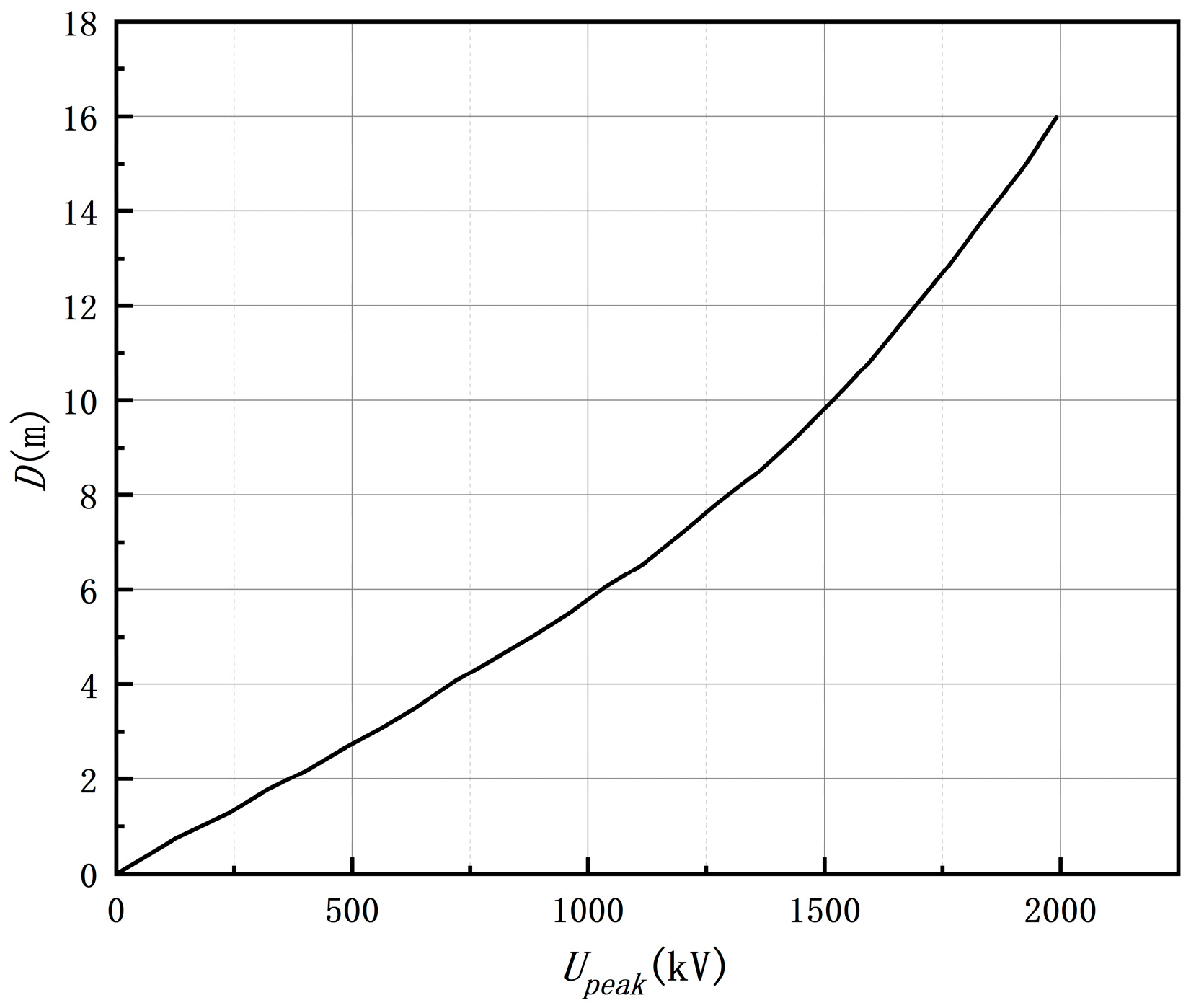
19]. For the convenience of engineering applications, reference may be made to the relationship curve between the maximum test voltage and the minimum permissible distance between the high-voltage electrode and the earth electrode or external live body, as shown in
Figure 4. This curve is derived from extensive test data and electric field analysis, and illustrates the non-linear growth trend of distance requirements at high voltages. For special structures or test requirements where a clear distance smaller than the values shown in the figure is required, verification must be carried out based on experimental results or through precise electric field calculations to ensure sufficient insulation margin. In
Figure 4 the fitted equation for AC in the range 1 m ≤ d ≤ 10 m is
Upeak = 560
d0.75.
Furthermore, during dry tests, the test specimen itself should be kept dry and clean, and the test should be conducted under the ambient atmospheric conditions of the test area to ensure the standardization and repeatability of the test.
3.2. Requirements for Safety Clearances in Impulse Withstand Voltage Tests
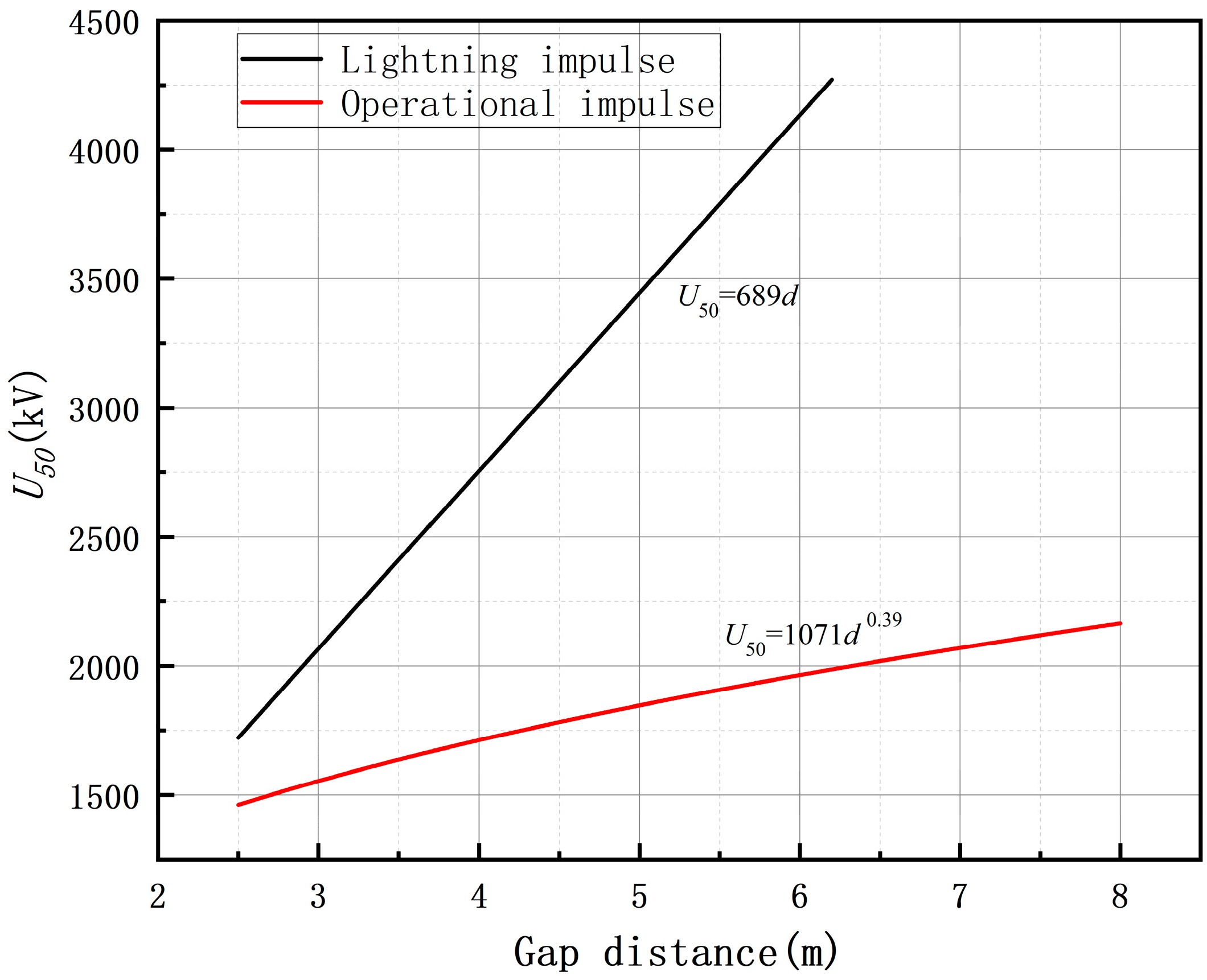
The rod-to-plate gap, as a typical physical model of a highly non-uniform electric field, determines the minimum clearances required within the test chamber based on the magnitude of the discharge voltage. The discharge curves for lightning impulse tests and operational impulse tests are shown in
Figure 5.
To ensure that power transformers do not experience external flashover when subjected to various types of overvoltage intrusion, the design of their external insulation air gaps must be strictly based on the characteristics of air discharge. In accordance with the provisions of the national standard GB/T 1094.3–2023 [
16], the test safety distance must take into account the discharge characteristics under both lightning impulse and switching impulse waveforms. For operating conditions where the rated lightning impulse level does not exceed 850 kV, the standard explicitly states that the straight-line distance clearance between the line terminal and ground should primarily refer to the rod-to-plate electrode clearance configuration model in IEC 60071–1:2023 [
22].
When the system voltage level increases and the lightning impulse withstand voltage reaches or exceeds 850 kV, the design basis for air gaps shifts from the basic rod-to-plate gap model to the conductor-to-support gap model to reflect the electric field distribution at the ends of high-voltage bushings and connection points in actual engineering applications [
3]. In operational impulse tests, however, due to the longer rise time of the wavefront, the insulation strength of the air gap exhibits a distinct saturation effect. The specific minimum air gap requirements for different equipment voltage levels and their corresponding impulse voltage ratings are detailed in the
Table 2.
The standard contains specific provisions regarding insulation requirements for neutral terminals, with the safety clearance adjusted according to the level of the neutral point’s lightning impulse withstand voltage.
Further tests on the discharge characteristics of long air gaps under low atmospheric pressure have shown that, when the operating altitude of main equipment such as transformers exceeds 1000 m, the reduction in air density causes a significant decline in insulation performance. For typical structures (such as rod-to-rod gaps and rod-to-plate gaps) at equivalent gap distances, the U50% discharge voltage exhibits a marked reduction; therefore, it is essential to introduce corresponding atmospheric parameter correction models to adjust the discharge voltage. Given that atmospheric pressure is a composite reflection of atmospheric parameters such as air density, ambient temperature and humidity, non-linear formulas incorporating atmospheric characteristic indices are currently the primary method used to model the discharge voltage correction process in high-altitude regions.
To establish the correction relationship for air-gap discharge voltage under high-altitude conditions, the altitude correction factor
Ka is introduced, defined as the ratio of the discharge voltage under test conditions to that under standard atmospheric conditions:
where
UH is the discharge voltage at altitude
H and
U0 is the discharge voltage under standard atmospheric conditions.
According to gas discharge theory and similarity laws, the discharge voltage of an air gap mainly depends on air density, and the two follow a power–law relationship:
n is the atmospheric characteristic exponent representing the influence of air pressure on external insulation discharge voltage and δ is the air density.
Within the troposphere (
H < 11 km), according to the International Standard Atmosphere (ISA) model, the variation in air density with altitude can be expressed as:
In summary, based on further derivation with respect to altitude, the atmospheric parameter correction factor can be further expressed as a function of altitude
H [
23]:
By calculating the average atmospheric characteristic index under different voltage waveforms, such as power frequency, lightning impulse and switching impulse, a fundamental theoretical correction factor can be provided for the verification of air gaps in on-site withstand voltage and partial discharge tests.
In engineering practice, there is a significant difference in magnitude between the design clearance of the equipment’s external insulation and the temporary safety operating distance required for on-site testing. Taking a 1000 kV ultra-high-voltage substation as an example, the comparison table of design air clearances and on-site testing safety distances is shown in the
Table 3.
As can be seen from the table above, when extrapolating this test scenario to ultra-high-altitude regions of 3700 m, simple theoretical atmospheric pressure corrections are insufficient to ensure test safety. Electric field distortions caused by adjacent grounding bodies in the on-site layout may result in a reduction of approximately 8% in the breakdown voltage.
Furthermore, when conducting on-site withstand voltage and partial discharge tests for UHV systems, corona discharge interference—which is highly prone to occurring at the high-voltage end—can be suppressed by installing appropriately sized corona-free rings or anti-corona hoods. The overall outer diameter of the 1000 kV side equalizing ring typically needs to be 2600 mm or greater. The massive equalizing hood reshapes the local electric field distribution and significantly affects the clearance factor within the insulation breakdown voltage correction system, thereby directly influencing the assessment of the overall external insulation clearance breakdown voltage and the final determination of the test safety distance.
3.3. Safety Distance Requirements for Power-Frequency and Partial Discharge Withstand Tests
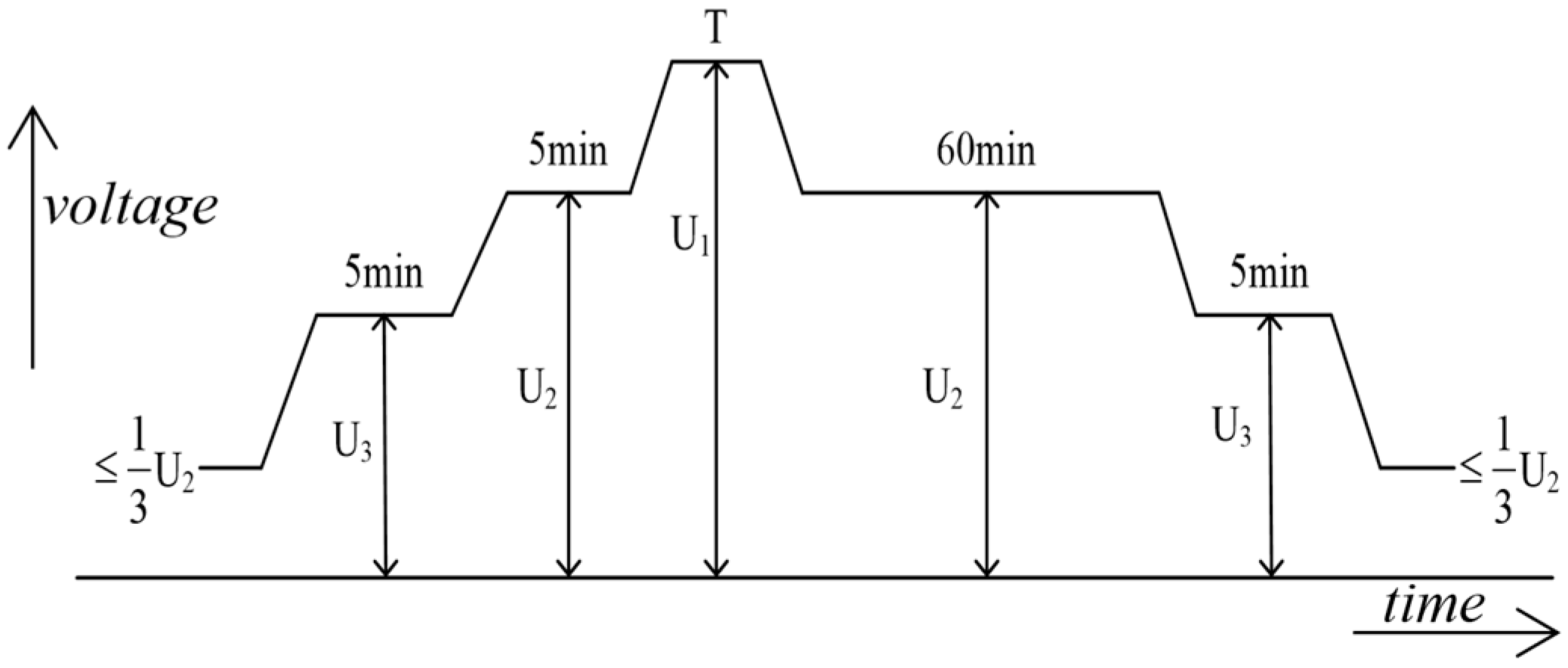
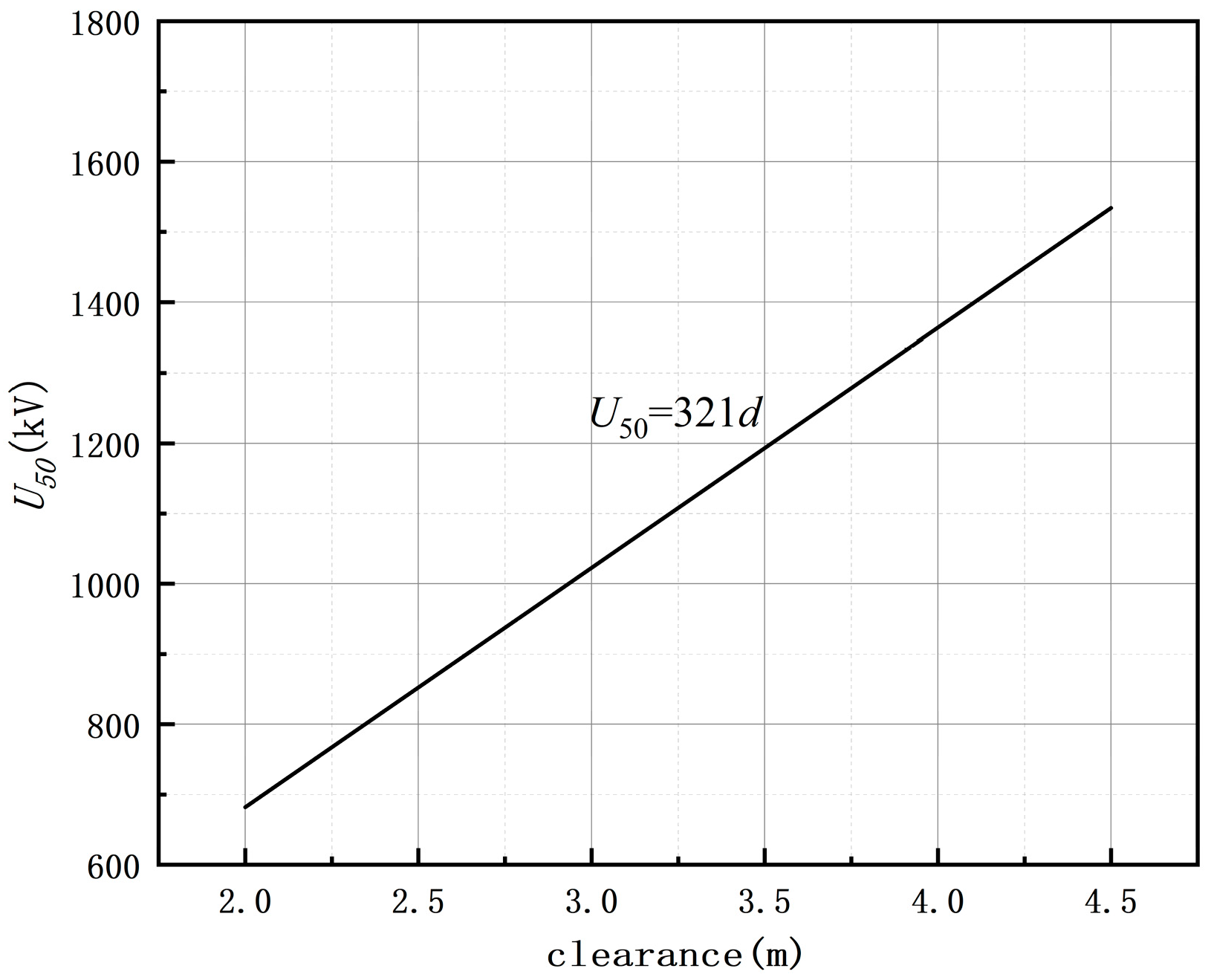
In UHV AC on-site withstand voltage tests, long-duration power-frequency withstand tests are typically conducted in conjunction with partial discharge tests, i.e., long-duration induced withstand tests combined with partial discharge tests, the discharge characteristic curve of which is shown in
Figure 6.
In order to accurately define the safe test distance for field tests under standard atmospheric conditions at low altitudes (≤1000 m), rigorous simulations must be conducted based on specific voltage application procedures. According to the voltage application standards for partial discharge testing of UHV main transformers, the maximum test voltage (rms)
Utest is typically set at 1.5 times the maximum operating phase voltage of the equipment, calculated as follows:
Since ionization and breakdown in air gaps primarily depend on the peak electric field strength of the applied voltage, this rms value must be converted to the peak test voltage
Upeak:
Referring to the power-frequency discharge characteristic curve for rod-to-plate gaps, long-duration alternating electric fields cause space charge to migrate and accumulate extensively within an extremely non-uniform electric field. Under standard atmospheric conditions (low altitude ≤ 1000 m), to withstand a power-frequency voltage with a peak of 1348 kV, the purely theoretical minimum electrical clearance (i.e., the critical distance for breakdown discharge) is approximately 4.2 m [
24].
However, in field tests for partial discharges in ultra-high-voltage equipment, the design threshold for safety distances is far higher than the simple “breakdown prevention” critical value. The core limiting factors lie in the suppression of corona discharge and the attenuation of proximity effects. Given the extremely stringent standards for partial discharge in 1000 kV transformers (with a requirement of ≤100 pC for partial discharge at the high-voltage end), if the air gap is maintained at only the theoretical clearance of 4.2 m, the surface of the high-voltage end and surrounding earth electrodes would very easily reach the threshold for air ionization, thereby triggering intense corona discharge. These high-frequency pulse currents generated by external air ionization will enter the measurement circuit via spatial electromagnetic coupling and conduction, completely masking the true, faint partial discharge signals within the transformer and causing the test to fail.
Therefore, in practical engineering applications, the on-site test safety distance
Dsafe must be calculated by applying a test amplification factor
Ktest—which incorporates margins for corona suppression and spatial electric field distortion—to the theoretical air clearance. Based on engineering statistics and electric field simulation experience, the test amplification factor for UHV testing at low altitudes is typically set at around 2.4. The value of 2.4 is not an empirical assumption, but an engineering-equivalent amplification factor derived from standard-based comparisons. According to GB/T 24842, under standard atmospheric conditions, the theoretical minimum air clearance corresponding to a 1000 kV power-frequency voltage is approximately 4.2 m. In contrast, based on DL/T 1275–2013 [
25], an air clearance of about 10 m is typically required in on-site testing to ensure operational reliability. The ratio of these values yields the coefficient (approximately 2.4). This coefficient characterizes the equivalent scaling between ideal discharge conditions and practical test configurations and has been widely adopted in the engineering design of clearances for UHV equipment during on-site testing.
Accordingly, the required test safety distance for low-altitude regions is calculated as follows:
It should be noted that the above safety distance calculation primarily addresses air-gap breakdown and corona suppression. However, surface discharge along insulating components, such as transformer bushings and grading rings, is another critical factor. Under high-altitude low-pressure conditions, the surface flashover voltage degrades more severely than the breakdown voltage of pure air gaps, due to enhanced surface charge accumulation and desorption of adsorbed gases, which further distort the local electric field. In the context of UHV AC on-site testing, surface discharge can introduce high-frequency interference that compromises partial discharge measurements. Therefore, in practical engineering, additional measures are taken, including optimizing the shape and surface finish of grading rings and increasing creepage distances. For the 1000 kV main transformer studied herein, field experience at low altitudes (≤1000 m) confirms that the 10 m safety distance, together with properly designed anti-corona rings, is adequate to suppress surface discharge as well.
In summary, to ensure that no destructive discharges occur during testing, whilst guaranteeing that the spatial electric field strength at the ends of high-voltage bushings relative to ground and surrounding structures remains well below the threshold field strength for air ionization and, to maintain an acceptable level of partial discharge background noise, when conducting 953 kV power frequency and partial discharge tests on 1000 kV main transformers in low-altitude areas (≤1000 m), the minimum required test safety distance shall be strictly defined as 10 m.
4. Special Requirements for High-Altitude Areas
In UHV AC on-site withstand voltage tests, the reduction in air gap insulation strength caused by high-altitude environments presents a core challenge for safety distance design. From a microscopic physical perspective, the reduced atmospheric pressure at high altitudes increases the mean free path between air molecules, thereby increasing the kinetic energy gained by electrons as they accelerate in an electric field. This makes them more prone to collision ionization, consequently lowering the breakdown voltage of the air [
26]. According to the provisions of GB/T 16927.1-2011 [
21], in atmospheric condition corrections, the effect of altitude is primarily reflected through the relative air density
δ, with the correction factor being:
which depends on the combined effect of atmospheric pressure p and temperature t.
For long air gaps at ultra-high voltage levels, the altitude correction is not a simple linear proportion; a dimensionless parameter g must be introduced to characterize the pre-discharge behavior during the discharge process, with g determining the range of values for the correction exponent m. The formula for calculating parameter
g is:
where
U50 is the peak voltage at which the probability of a destructive discharge occurring in the gap under actual atmospheric conditions is 50%; L is the shortest discharge path length of the test specimen (i.e., the air gap distance); and k is a correction parameter determined based on the voltage type (AC, DC, positive/negative polarity impulse) and the absolute atmospheric humidity.
Under UHV test conditions, due to the extremely high voltage levels and large gap distances, the rate at which breakdown voltage increases with distance slows down. This non-linear characteristic means that in regions above 3000 m altitude, traditional correction methods for altitudes below 1000 m often carry a risk of inaccuracy due to a lack of experimental support at extreme altitudes. Therefore, for high-altitude regions, this paper adopts the m-parameter method of IEC 60071-2:2023 [
27] and verifies
U50 through an iterative procedure. This method primarily considers the influence of altitude on breakdown voltage, assuming that the effects of temperature and humidity approximately cancel each other out.
Taking the Aba UHV substation at an altitude of 3620 m as an example, the controlled test conditions for on-site testing were long-duration induction withstand voltage tests with partial discharge monitoring on the 1000 kV main transformer, with a control voltage as high as 953 kV. In low-altitude regions (≤1000 m), the minimum safety distance required for this test voltage is 10 m. The m-parameter method stipulates that the breakdown voltage of air gaps must be corrected according to the following formula:
where
Ut is the voltage value under test conditions, in kV;
U0 is the voltage value under standard atmospheric conditions, in kV; and
Ka is the altitude correction factor. When the withstand voltage of external insulation is corrected from standard atmospheric conditions to altitudes below 2000 m, the formula for calculating the atmospheric correction factor
Ka is:
where
Ka is the altitude correction factor, used to reinforce the external insulation of electrical equipment in areas with an altitude exceeding 1000 m;
H is the altitude of the substation or line location, in meters; and
m is a correction factor related to the voltage type and gap structure. Under lightning impulse voltage and power-frequency voltage conditions, m = 1.
For power-frequency withstand voltage tests, the exponent m is typically taken as 1. When applying altitude correction for the Aba substation at an elevation of 3620 m, the altitude is conventionally rounded up to 3700 m for conservative design, resulting in an altitude correction factor Ka of 1.38.
By combining the baseline clearance at plain areas with the altitude correction factor, the minimum required air clearance for the high-altitude site can be expressed as:
Finally, using a baseline value of 10 m for plain areas, the minimum required air clearance under high-altitude conditions is calculated to be 13.8 m.
To further verify the applicability of the proposed altitude correction method in practical engineering, a field test at the Ganzi UHV substation located at an altitude of approximately 3500 m was selected as a representative case for analysis. Specifically, the Ganzi substation is situated at an elevation of about 3500 m, and the recorded atmospheric pressure during the transformer partial discharge test was approximately 65–66 kPa. During the test, the actual air gap between the busbar on the steel structure above the transformer and the grading shield of the 1000 kV bushing was approximately 13.2–13.9 m, with an average value of about 13.5 m. Under this gap condition, intermittent corona discharge was observed on the high-voltage-side grading shield. According to the standard altitude correction method, the calculated minimum air clearance is approximately 13.8 m. However, in preliminary voltage-raising tests, when the gap was increased to this calculated value, noticeable corona discharge and initial leader development were already observed, indicating that the theoretical calculation exhibits certain deviations under extreme low-pressure conditions.
Further analysis suggests that, under high-altitude environments, space charge effects become significantly enhanced, leading to distortion of the electric field distribution and consequently reducing corona inception and breakdown voltages. In addition, the influence of nearby grounded structures in the field layout cannot be neglected. According to experimental observations, the proximity effect can reduce the breakdown voltage by approximately 8%, which is consistent with reported results in the literature.
Based on this, the theoretical result is further corrected by introducing both the proximity effect correction and the engineering safety margin. The air clearance can be expressed as:
where
K1 is the proximity effect correction factor, taken as 0.08, and
K2 is the safety margin factor, taken as 0.10. The corrected air clearance is calculated as:
The corrected result is in good agreement with the safe clearance observed in field tests without obvious discharge, with the error within an acceptable range. The comparison indicates that the standard-based altitude correction method alone may underestimate the required clearance under complex high-altitude conditions. By incorporating proximity effects and safety margins, the calculated results are more consistent with engineering measurements, thereby validating the rationality and engineering applicability of the proposed correction approach.
5. Conclusions
This study addresses the difficulty in reasonably determining safety distances for on-site withstand voltage testing of UHV AC equipment under high-altitude conditions. A systematic investigation is conducted with respect to test circuit design, discharge interference control, and altitude-dependent safety distance correction, and the following conclusions are obtained:
(1) By introducing a test amplification scaling factor, a suppression mechanism for high-frequency corona interference induced by high-voltage bushing terminals and nearby grounded structures is established. A baseline safety operating distance of 10 m is identified for regions at altitudes of 1000 m and below.
(2) Considering the coupled effects of altitude-dependent atmospheric parameters such as air pressure and air density, a safety distance calculation model applicable to high-altitude conditions is developed. The applicability of the model is demonstrated for altitudes up to approximately 3700 m, based on field validation at the Aba and Ganzi substations.
(3) Based on actual pressurized observations at high-altitude sites, when determining the final safety distance for extreme high-altitude regions, it is essential to account for proximity effects and a safety margin of approximately 10% in addition to the altitude correction. Taking the Aba Ultra-High Voltage Substation as an example, calculations indicate that the minimum safe operating distance required for on-site testing should be 16.4 m to completely avoid the risk of discharge and ensure the authenticity and validity of the test data.