1. Introduction
With the continuous progress of production technology and control theory, the machining parameter optimization methods widely used at home and abroad are mainly divided into three categories: numerical simulation optimization, experimental design optimization, and intelligent algorithm optimization. Its core goal is to determine the optimal processing conditions, control the product processing tolerance within a reasonable range, avoid unnecessary repeated processing, and ensure reliable quality while meeting the needs of users to achieve the best performance of the processing process [
1].
Numerical simulation optimization mainly simulates physical phenomena in the processing process through computer simulation, establishes mathematical models, and adjusts processing parameters through optimization algorithms. For example, Wang Baolin [
2] uses ABAQUS software to simulate the hot tension straightening process of TC4 bars. Li Li [
3] optimizes the die forging process of the railway freight car coupler tongue through the rigid viscoplastic finite element method. Su Youhuang [
4] optimizes the drawing process of automobile inner panel parts by combining material mechanics tests and AutoForm. Gantar et al. [
5] optimized the sheet metal forming process to solve problems such as shape and springback. Kiran et al. [
6] optimized the 316L stainless steel DED welding process to improve efficiency. Miao [
7] optimized the 3Y-TZP ceramic process by laser-assisted heating and ABAQUS to improve surface quality. These studies show that numerical simulation can effectively optimize process parameters, improve product quality, and reduce energy consumption. However, this method has limitations such as long calculation time, high model accuracy requirements, and model simplification or parameter errors may lead to inaccurate results.
Experiment design optimization is mainly to systematically design and analyze experiments to find the optimal solution or an approximate optimal solution through statistical methods of experimental data. For example, Awale [
8] optimized the high-speed turning process by the gray correlation method, and found that higher cutting speed and lower feed speed are helpful to improve the surface quality of AISIS7 steel. Singh [
9] studied the influence of cutting parameters and tool geometry on the surface roughness of AISI52100 bearing, and considered that feed rate was the main factor, and established a mathematical model. Wang Jinfeng [
10] optimized cutting parameters through experiments and grey correlation analysis, and determined the best combination. Yadav [
11] combined the Taguchi method and the response surface method to optimize the surface roughness during double turning, and found that cutting speed had a greater influence. Gianni et al. [
12] optimized the cutting parameters in the milling process by the response surface method, reducing power consumption. Chu Xiaomeng [
13] optimized the process parameters of cylindrical turning based on an orthogonal test. Although the experimental design method has high reliability and stability, it has a high cost and a long cycle, which is suitable for accuracy and surface quality improvement in actual production.
Intelligent algorithm optimization is based on computer simulation and mathematical modeling, and finds the optimal solution or approximately the optimal solution by performing multiple iterative calculations and searches on the objective function. For example, Duan Xiaoming [
14] uses genetic algorithms to optimize the boring process of intersection holes of aircraft vertical tails. Chen Hongsong et al. [
15] optimized the milling process to improve efficiency and reduce deformation. Liu Haijiang et al. [
16] applied particle swarm optimization to optimize feed rates and cutting speeds to increase productivity and reduce costs. Han [
17] optimized milling power and material removal rate using particle swarm optimization. Mohamed et al. [
18] proposed a cuckoo algorithm to optimize production time. Jayabal [
19] combined with a genetic algorithm optimized tool wear and improved machining accuracy. Although intelligent algorithms perform well in dealing with complex problems and can effectively avoid local optimal solutions, their operability and reliability are low and still need further improvement.
The aforementioned three methods all exhibit certain limitations in the specific context of machining the bore system of marine diesel engines: numerical simulation methods rely on high-precision models and incur substantial computational costs, making them ill-suited for rapid response requirements involving diverse product varieties and small batch sizes; experimental design methods are costly and time-consuming, hindering dynamic adjustments required in production environments; while traditional intelligent algorithms possess the capability to optimize complex problems, their slow convergence speed and susceptibility to local optima often compromise optimization effectiveness in practical applications [
20].
Sparrow Search Algorithm (SSA) is a novel swarm intelligence optimization algorithm proposed in recent years. It features a few parameters, simple implementation, and fast convergence speed. However, the basic SSA tends to suffer from premature convergence in the later optimization stage. To address this defect, this paper introduces the disturbance search strategy of the Firefly Algorithm (FA). The attraction and brightness guidance mechanism among firefly individuals is adopted to perturb the position of the optimal sparrow in the population, which enhances the capability to escape from local optima. Consequently, an improved Sparrow Search Algorithm integrated with firefly disturbance (FASSA) is established [
21]. The proposed algorithm can guarantee global search accuracy and accelerate convergence simultaneously, making it more suitable for obtaining the optimal parameter combination within the stable domain of machining parameters. Faced with the multi-constraint physical model of engine block boring, the targeted hybrid mechanism of FASSA exhibits more robust convergence performance [
22,
23].
The primary innovations of this study lie in two aspects: First, the integration of the firefly interference mechanism into the SSA algorithm fundamentally improves the balance between exploration and exploitation. More importantly, the algorithm does not search in an unconstrained space; its constraints originate from the stability region derived by the Monte Carlo method. This coupling mechanism prevents the algorithm from selecting boundary parameters that are mathematically optimal but carry practical physical risks. Second, the stability limits obtained through static analysis are transformed into dynamic probabilistic reliability metrics, which directly guide the heuristic search process, thereby bridging the gap between stochastic workshop operation disturbances and deterministic optimization.
In the industrial manufacturing process of large marine diesel engine blocks, hole system machining is a core process that determines the overall assembly accuracy and operational reliability of the entire engine, and it is also one of the highest-risk machining links. Given the extremely large structural dimensions and high unit manufacturing cost of such workpieces, improper matching of cutting parameters can easily lead to failures such as machining chatter, tool failure, or dimensional deviation, which will not only cause huge economic losses but also result in serious delays in the entire production schedule [
24]. In addition, there are a large number of uncontrollable random interference factors in the actual production workshop (such as tool wear, material property fluctuations, machine tool vibrations, etc.), while traditional deterministic optimization models are difficult to effectively characterize and address these uncertainties. Therefore, systematically evaluating the operational robustness of optimized parameters under actual machining conditions is of irreplaceable practical significance for promoting the engineering application and implementation of this technology and realizing efficient and defect-free green manufacturing.
The hole system machining of marine diesel engine blocks features high precision, multi-process coupling, strong parameter sensitivity, small batch size, and high degree of customization, which imposes strict stability and reliability requirements on machining parameters. Therefore, machining parameters cannot be determined solely by empirical trial cutting. Instead, a quantitative model between machining quality and process parameters must be established, and the stable value range must be determined under the premise of meeting the qualification rate requirements. The hole machining of engine blocks is divided into three stages: rough boring, semi-finish boring, and finish boring, involving a total of nine parameters, including cutting speed, cutting depth, and feed rate. These parameters are mutually restrictive and highly coupled, presenting significant nonlinear relationships. In addition, diesel engine blocks are mostly made of high-strength cast iron or alloy materials, and the machining process is also affected by factors such as energy consumption and tool wear. Conventional linear models are difficult to accurately characterize these complex correlations. Therefore, it is necessary to construct a second-order regression model through Response Surface Methodology (RSM) to achieve high-precision fitting within a limited number of experiments, taking into account both modeling efficiency and prediction reliability.
Compared with traditional hole machining optimization problems, the machining of marine diesel engine cylinder blocks presents unique challenges. First, marine diesel engine cylinder blocks are massive and extremely expensive castings, and their machining must strictly adhere to the zero-scrap quality standard. In traditional machining, engineers can use the trial-and-error method to determine the optimal parameters; however, in the machining of marine engine cylinder blocks, any parameter testing that would cause severe vibration or workpiece damage is economically unacceptable. Second, the deep hole drilling process of these workpieces involves extremely complex and nonlinear dynamic behaviors. Even the most experienced senior engineers cannot mentally calculate or manually predict the precise boundary between maximum machining efficiency and dynamic failure. They typically adopt extremely conservative cutting parameters to ensure absolute safety. Although this cautious empirical approach can avoid workpiece scratches, it severely sacrifices machining efficiency and significantly prolongs the production cycle. Accordingly, this paper proposes an improved sparrow search algorithm (FASSA) integrated with a firefly perturbation mechanism. Leveraging its unique collaborative mechanism of global search and local perturbation, FASSA is capable of accurate optimization within the reliable safety domain defined by the engineering tolerances of marine diesel engine blocks. It achieves the global optimal arrangement of machining time while strictly satisfying dimensional constraints, thereby effectively solving the engineering problem of overly conservative and inefficient boring processes for high-value large castings.
The main objective of this paper is strictly focused on minimizing machining time while strictly ensuring dimensional accuracy. In the actual manufacturing process of high-value marine diesel engine blocks, cutting tools are subject to strict life cycle management and are proactively replaced preventively before significant wear occurs to completely avoid workpiece scrapping accidents. Therefore, under such controlled production conditions, the dynamic impact of tool wear on dimensional accuracy in a single machining cycle is negligible. Similarly, although energy consumption is of great economic significance, it is only an outcome indicator and does not directly affect the set stringent dimensional accuracy targets. For large machine tools, their fixed energy consumption is relatively high, so shortening machining time is the most effective method to reduce energy consumption per part [
25].
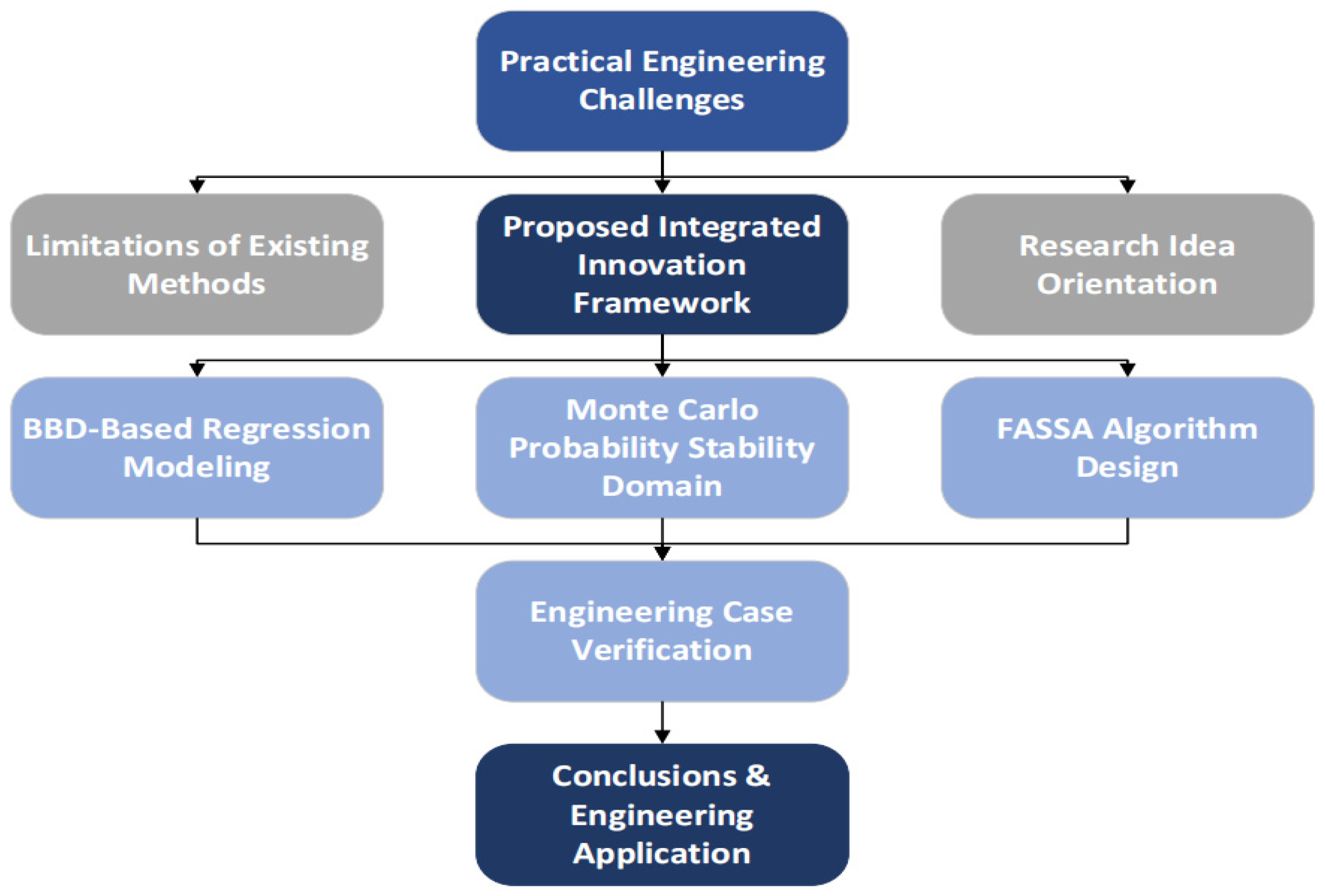
Based on the aforementioned analysis, to optimize the machining parameters of marine diesel engine processing characteristics more efficiently and stably, this paper employs an improved Sparrow Search algorithm integrated with Monte Carlo reliability analysis to minimize machining time under small-sample constraints. Considering the machining costs of marine diesel engine bodies and their processing characteristics—such as multi-product variety, small batch sizes, and multiple operations—the study first establishes a second-order response surface regression model linking key machining features of the hole system with machining parameters using the Surface Response Method, ensuring both accuracy and effective cost control while aligning with marine engine processing requirements. Subsequently, the Monte Carlo method is applied to determine the stable region of machining parameters, ensuring consistent quality and reliability in body machining. An enhanced Sparrow Search algorithm is then employed to identify the optimal parameter combination within this stable region, achieving dual objectives of maintaining stable machining quality and minimizing processing time. Finally, a case study using key camshaft hole machining features demonstrates the effectiveness of the proposed approach, with the entire workflow illustrated in
Figure 1. Results indicate that this optimization strategy significantly reduces machining time and shortens delivery cycles.
2. Solving the Stable Region of Key Quality Feature Machining Parameters
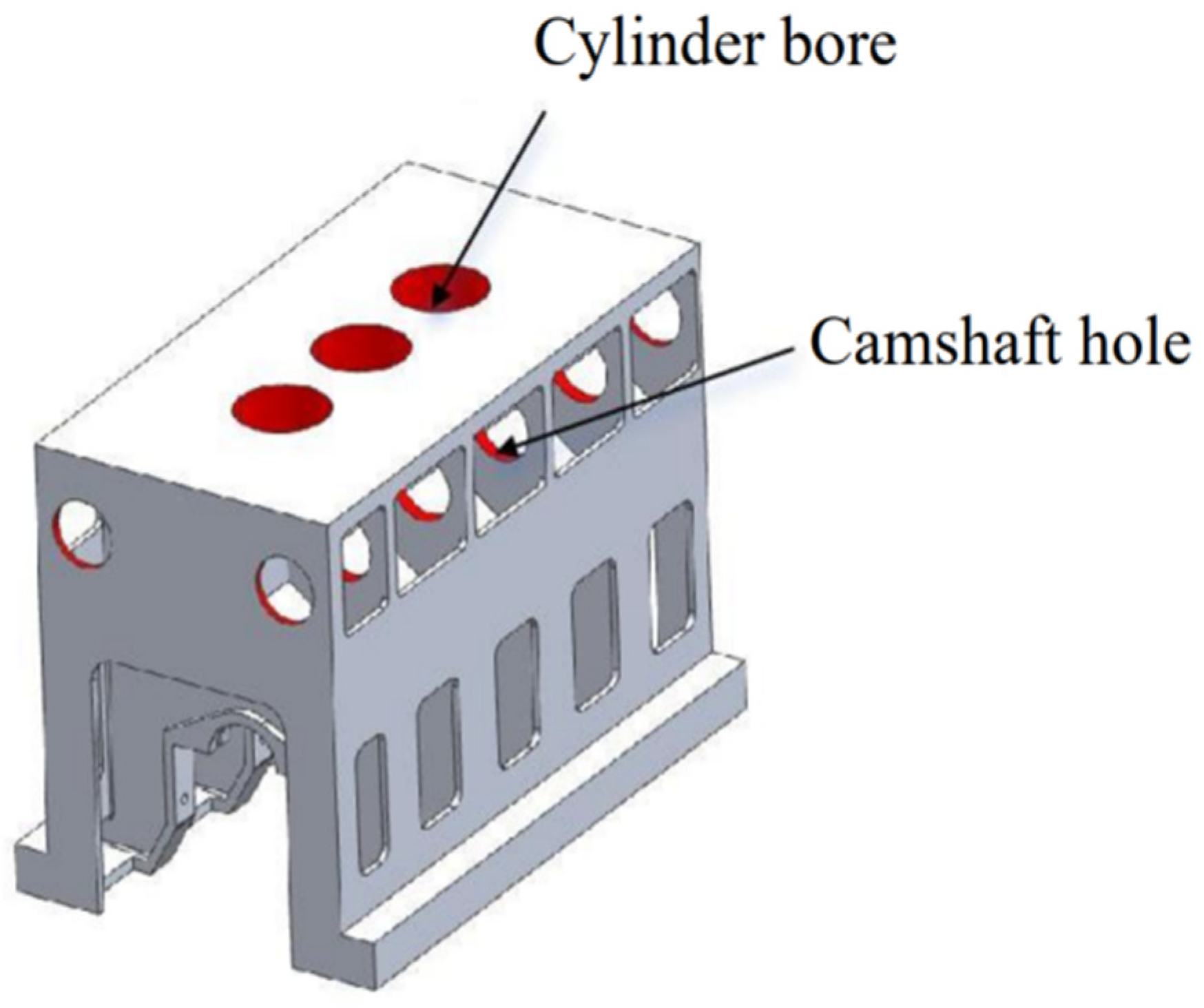
In order to ensure the final machining quality, the machining parameters are usually limited to a specific range in the machining process of the diesel engine body hole series. The experimental objects in this study are the camshaft bore and cylinder bore of marine diesel engines, and their structural schematic diagram is shown in
Figure 2. In order to control the machining quality more effectively, the value range of machining parameters must be restricted more accurately. Taking camshaft hole machining of key machining features as an example, this chapter studies the stable region of machining parameters in rough boring, semi-finish boring, and finish boring. The stability region refers to the reasonable range of machining parameters that meets the requirements of machining quality. In order to determine the stable region, the BBD surface response method is used to establish the second-order regression model between quality characteristics and machining parameters, and the stable region of each machining parameter is solved by the Monte Carlo method, which provides a powerful support for accurate control of the machining quality of the fuselage.
2.1. Construction of Second-Order Regression Model of Machining Quality Based on Surface Response Method
Surface Response Method consists of two common design types: Central Composite Design (CCD) and Box-Behnken Design (BBD) [
26]. BBD design of experiments not only ensures the accuracy of experimental results, but also effectively reduces the experimental time, thus significantly improving the efficiency of machining simulation. Compared with the CCD experimental design method, the BBD experimental design method is suitable for multi-factor and multi-level experiments, especially when the experimental cost is high, or the production equipment can not support many experiments. Because of its simplicity and high efficiency in fitting a response surface, it is widely welcomed by many researchers. It has the following characteristics [
27]:
- (1)
Marine diesel engine cylinder blocks are large-volume, high-value castings. Ideally, a three-level full factorial design can provide the most comprehensive evaluation. However, considering the practical conditions of marine diesel engine cylinder block projects, conducting 27 physical experiments on such large and high-value castings is economically unaffordable and poses an unacceptable risk of workpiece scrappage. Therefore, the number of physical trial-and-error experiments must be strictly limited to control experimental costs and prevent workpiece damage. In three-factor optimization, the Box-Behnken Design (BBD) requires only 17 experiments, while the standard Central Composite Design (CCD) requires 20 experiments. BBD provides an efficient “small-sample” solution that can generate sufficient degrees of freedom to fit a second-order quadratic model with fewer physical machining trials.
- (2)
The Central Composite Design (CCD) typically includes axial points extending beyond the defined cubic experimental region, which leads to a significant increase in prediction variance at these extreme positions. In contrast, the Box-Behnken Design (BBD) fundamentally avoids the existence of extreme vertices by placing all design points at the edge midpoints and the center point. This ensures that the prediction variance remains at a low and stable level and is strictly confined within the physically safe operating range, fully satisfying our requirements for reliability-constrained optimization.
- (3)
Although CCD achieves full rotatability, BBD inherently possesses only approximate rotatability, which means that the prediction variance remains essentially constant at the same distance from the design center. Since our FASSA optimization is strictly constrained by the established safety limits, the approximate rotatability provided by BBD is statistically fully sufficient to ensure that Monte Carlo simulations yield unbiased and robust surrogate prediction results.
Therefore, this paper chooses the BBD experimental design method, which is simpler, more commonly used, and can correctly reflect the relationship between machining parameters and machining quality.
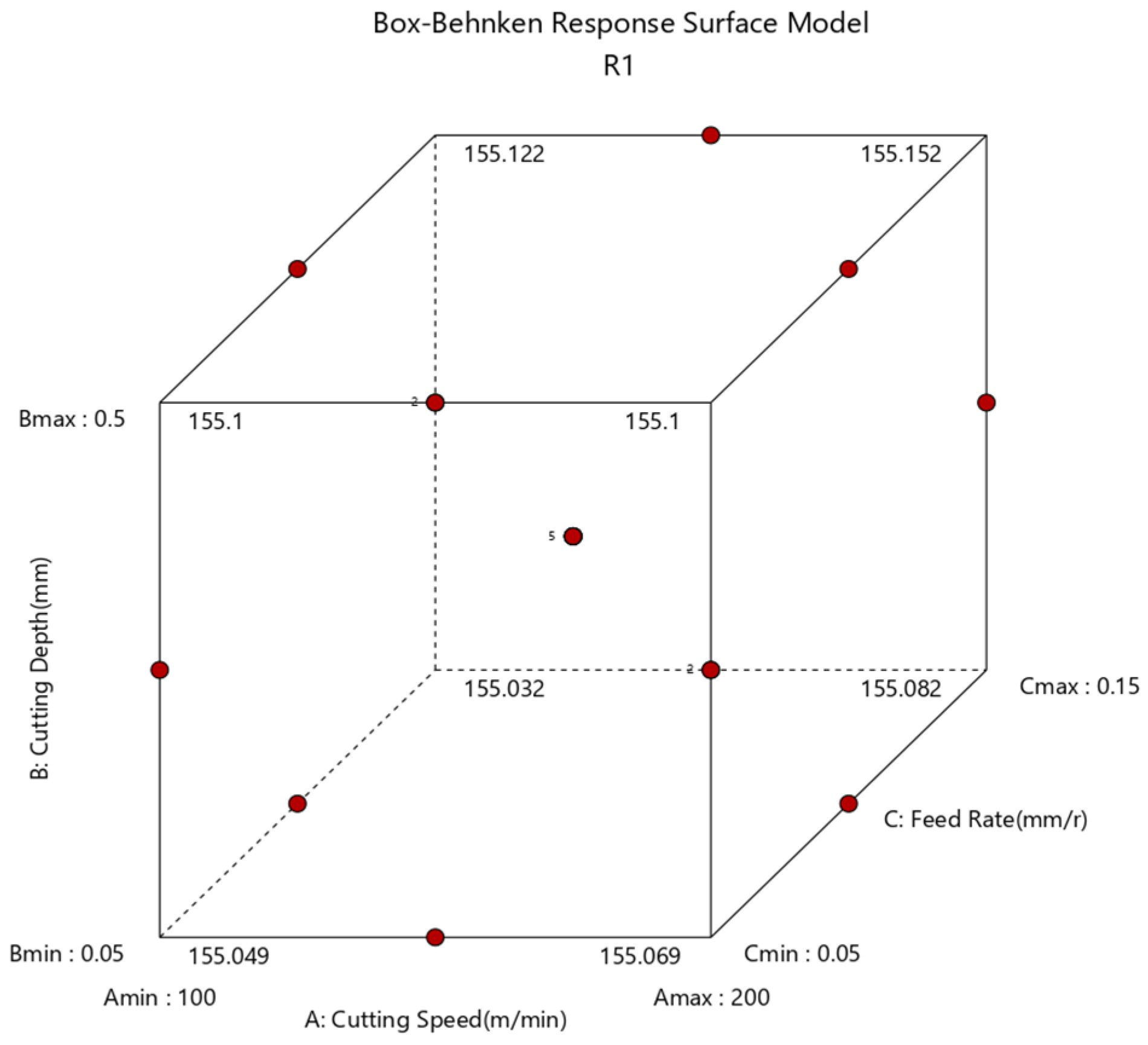
Figure 3 shows a schematic diagram of the BBD design of experiments.
In this paper, the surface response method is used to optimize the design of camshaft hole machining parameters. The design variables include three parameters: cutting speed (), cutting depth () and feed rate (). The response quantity is the camshaft hole diameter size quality characteristic value ().
All the data presented in this paper, including the actual cutting tests and aperture size measurement data corresponding to the marine diesel engine camshaft bore boring tests and Box-Behnken Design (BBD), were strictly completed in accordance with standard processes on the actual production line by the professional process team of the cooperative shipbuilding equipment manufacturing enterprise. Meanwhile, to ensure the reliability of modeling and analysis, abnormal samples caused by unexpected workshop disturbances have been eliminated during the data preprocessing stage.
The final geometric quality of the hole system is mainly determined by three process parameters: cutting speed, cutting depth, and feed rate. After removing these invalid outliers, the final 17 groups of experimental results represent strictly controlled, high-quality, and robust physical experimental data. In each experimental run, the machining test was repeated five times. After removing the maximum and minimum values, the remaining results were averaged to obtain the final response values. This processing method significantly reduced experimental errors.
In the measurement uncertainty evaluation, large diesel engine cylinder block castings are highly sensitive to environmental fluctuations such as temperature and humidity, and thermal expansion and structural stability are the main sources of error. Therefore, all dimensional inspections were carried out in a relatively stable workshop environment.
The aperture measurement was performed using the German DIATEST BMD-XQ (Darmstadt, Germany) high-precision electronic plug gauge matched with the Mitutoyo 543 series high-precision digital indicator (Kawasaki, Japan), which ensured the accuracy and credibility of the measured data and provided a reliable data foundation for subsequent analysis.
After determining the number and level of design variables, the experimental data collected by the enterprise are filled in the corresponding response target value to establish the test result coding table, as shown in
Table 1. In the table below, −1, 0, and 1 are used to indicate different levels of processing parameters that describe the value of each factor (or variable) in the experimental design. Specifically, −1 indicates the lower limit of the factor value range;0 indicates the middle value of the factor value range; and 1 indicates the upper limit of the factor value range.
The data in
Table 1 are calculated by the surface response method, and the variance analysis results of the response surface model are obtained. See
Table 2. According to statistical indicators such as
value indicating the degree of model fitting,
value indicating the degree of lack of fitting, and
value of multiple determination coefficient, the goodness of fit and significance of the second-order response surface regression model can be comprehensively evaluated.
Based on the quadratic polynomial regression model mentioned above, significance test and variance analysis are carried out on the surface response model between the quality characteristic value of the bore size of the finish boring camshaft and the machining parameters. The results are shown in
Table 2. The
value of the model is 72.7, indicating that the model has high significance and rationality. The
value of the model is less than 0.0001, which further confirms that the quadratic polynomial model constructed by the BBD experimental design method has extremely high statistical significance, indicating that the model parameters are statistically significant. The
p-value of the interaction term AB is 0.092, exceeding 0.05. Per standard statistical criteria, this result is not statistically significant. The
p-value of the quadratic term B
2 is 0.0516, which is slightly higher than 0.05 and also does not reach the conventional significance level. The research object of this study is the heavy castings of marine diesel engine cylinder blocks, whose process parameter responses exhibit interval heterogeneity. The AB interaction term and B
2 term only show obvious technical influences within local parameter ranges, but fail to reach the α = 0.05 threshold after averaging over the entire experimental domain.
The value of the mismatch term is 0.5234, significantly higher than 0.05, indicating that the impact of the mismatch term on the model is not significant and the model fitting effect is good. On the other hand, the value is 0.9894, and the adjusted value is 0.9758, which further indicates that the model has a good fitting effect and strong interpretation ability.
Combining the results of the significance test and the variance analysis of the above model, the quadratic polynomial regression equation between the quality characteristic value of the bore size of the finish boring camshaft and the machining parameters is finally obtained as follows:
Similarly, referring to the finish boring process flow, the quadratic polynomial regression equation fitting between the semi-finish boring camshaft aperture size and the machining parameters is:
Similarly, the fitting quadratic polynomial regression equation between the bore size quality characteristic value of the rough boring camshaft and the machining parameters is:
2.2. Solution of the Stable Region of Key Quality Feature Machining Parameters
The Monte Carlo method (MCM) is a numerical calculation technique based on random sampling. It is widely used in complex system analysis, risk assessment, financial modeling, and other fields by simulating a large number of random samples to estimate the statistical characteristics of the system [
28,
29,
30]. It can effectively deal with uncertain, high-dimensional, and nonlinear problems, providing a scientific basis for the decision-making process, especially in cases that traditional analytical methods are difficult to solve [
31]. In the machining process of the machine body, the selection of machining parameters is very important to the machining quality. Improper parameter setting will lead to high temperature and high pressure in the cutting area, causing plastic deformation of the material and affecting the machining accuracy. Even if the initial machining meets the standard, the effect of cutting force, temperature, and pressure may also lead to deformation. Therefore, a reasonable selection of machining parameters is very important. In this paper, the machining time is minimized by optimizing the machining parameters under the premise of ensuring the machining quality, and the Monte Carlo method is used to calculate the pass rate
of key quality characteristics, which is defined as the probability that the machining quality characteristics are lower than the allowable range after a certain process.
where, cutting speed
; cutting depth
; feed
is a random variable;
is a machining quality feature.
In order to accurately control the machining accuracy of key quality features, it is particularly important to study the relationship between cutting speed, cutting depth, and feed rate and yield
. Dimensional deviations and cutting parameter fluctuations in the machining process are not caused by a single error source, but are accumulated by a large number of mutually independent minor random errors. When the total variation of a manufacturing process consists of multiple independent random components without any dominant single error, the overall process parameters and machining errors asymptotically converge to follow a normal distribution [
32].
Assuming that these three process parameters obey a normal distribution, their mean value and standard deviation are represented by and respectively. By adjusting the mean value of each parameter, keeping the standard deviation unchanged, observing its influence on yield, and drawing the curve of yield change, the influence of different processing parameters on quality can be intuitively understood. Combining stability and reliability evaluation criteria, determine the optimal range of each parameter, thus establishing stability constraints for key quality features of the fuselage.
We strictly define both the upper and lower stability boundaries at the 95% confidence level. In the Monte Carlo simulation, a specific combination of machining parameters is classified into the stability region only when the probability that the predicted machining quality meets the strict industrial requirements exceeds the 95% acceptance threshold.
Mathematically, the stability boundary represents the geometric solution space that satisfies the above constraints; any parameter combination that results in an acceptance probability below this threshold is mathematically considered unstable and is eliminated.
The interval of cycle time is not based on arbitrary mathematical assumptions but is determined by actual industrial constraints. The upper limit corresponds to the extremely conservative empirical parameters commonly adopted by senior factory engineers; this benchmark not only ensures physical safety but also represents the maximum acceptable limit of low production efficiency. The lower limit is constrained by the absolute physical limitations of the machine tool.
Taking the boring camshaft holes as an example, calculate the mean and variance of machining parameters according to the enterprise test data. See
Table 3 for specific results.
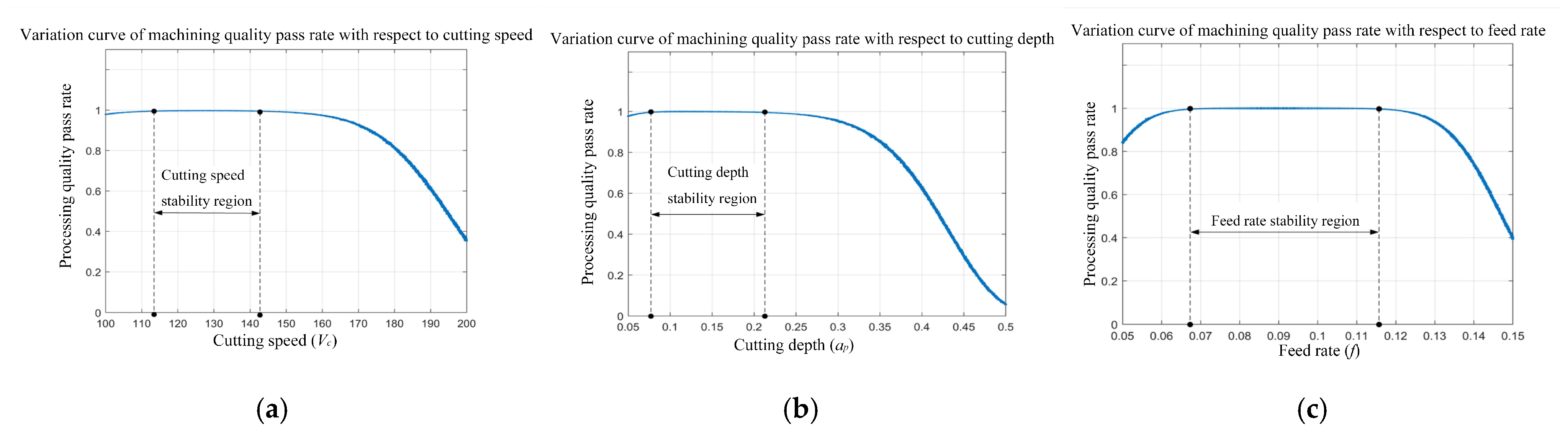
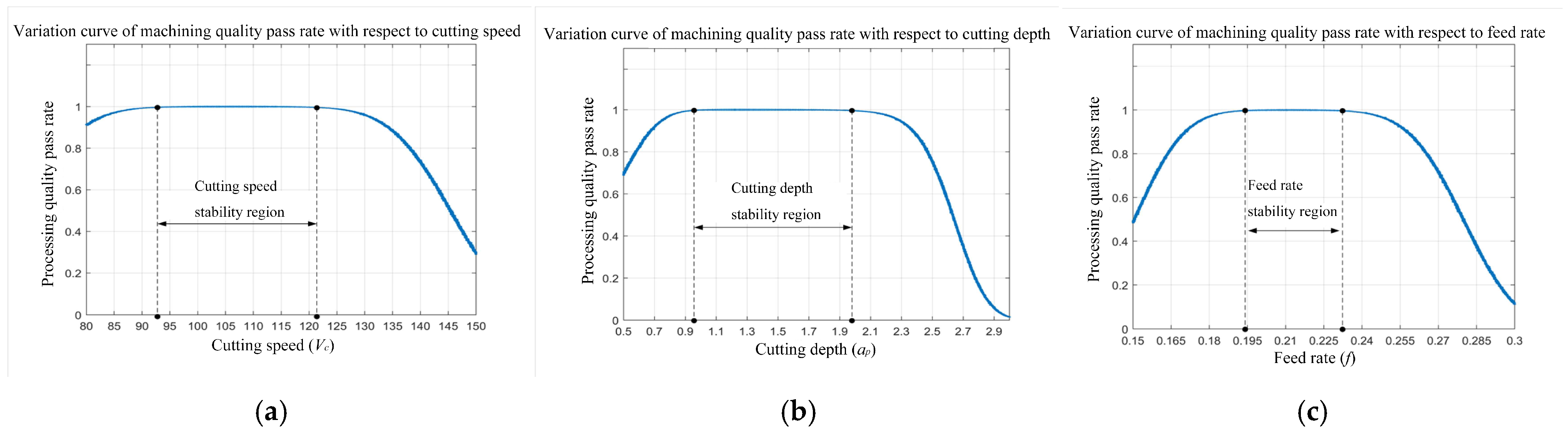
Based on the second-order regression model established above, the Monte Carlo method is used to simulate 10,000 times to calculate the times of meeting the machining accuracy of finish boring camshaft bore size, so as to obtain the qualified rate. Set the quality characteristic value as
mm, select cutting speed, cutting depth, and feed rate as influencing factors, keep the variance of other factors unchanged, and adjust the mean value of one factor to study its influence on the quality characteristic value. The Monte Carlo method is used to simulate the combination of different factors, calculate the qualified rate, and draw the curve of the machining quality qualified rate of finish boring camshaft bore, as shown in
Figure 4, to visually show the influence of machining parameters on quality.
According to the curve of machining parameters in
Figure 4, when the cutting speed is too low, the friction force between the tool and the workpiece increases, resulting in increased cutting force and cutting heat, which in turn intensifies tool wear and affects workpiece accuracy and surface quality. In addition, the cutting depth and feed speed are closely related to the cutting amount. Smaller cutting depth and feed speed are helpful to effectively remove heat, while increasing cutting speed and feed speed will aggravate heat accumulation, resulting in increased surface residual stress and affecting machining quality. Therefore, the machining parameter interval with small fluctuation of yield and high stability is selected as the stable region for finish boring camshaft bore machining. See
Table 4 for details. The lower limit and upper limit of the interval are represented by
and
, respectively.
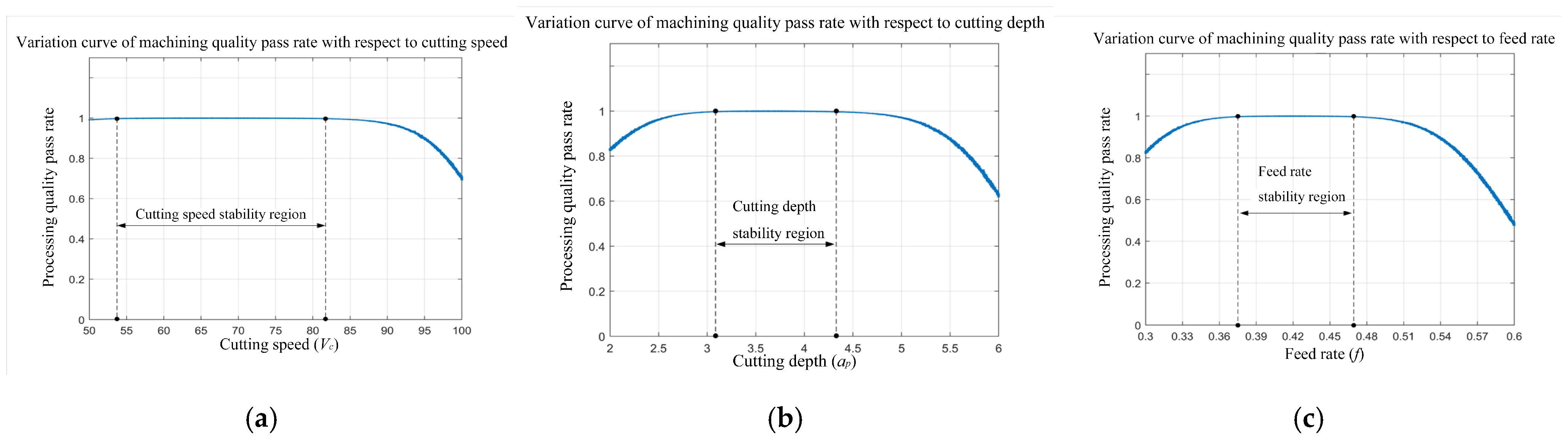
Similarly, based on the Monte Carlo method, by solving the machining quality characteristic qualification rate model of semi-finish boring camshaft aperture, the curve of machining quality qualification rate varying with cutting speed, cutting depth, and feed amount is obtained, as shown in
Figure 5.
For the stability range of semi-finish boring camshaft aperture processing parameters, see
Table 5 for details, where
and
represent the lower limit and upper limit of the stability range of processing parameters.
Similarly, based on the Monte Carlo method, by solving the qualification rate model of rough boring camshaft bore machining quality, the curve of rough boring camshaft bore machining quality qualification rate with respect to cutting speed, cutting depth, and feed amount can be obtained, as shown in
Figure 6.
For the stability region of machining parameters of the camshaft bore of rough boring fuselage, see
Table 6 for details. Among them,
and
represent the lower limit and upper limit of the stability region of machining parameter reliability.
3. Optimization Algorithm Based on FASSA
This section aims to optimize the key quality characteristic parameters in the machining process of the marine diesel engine fuselage, so as to shorten the machining time and improve the delivery period while meeting the machining accuracy requirements. Taking the machining of camshaft holes of fuselage series as an example, combined with the analysis of the stable region of machining parameters in part 1, an optimization model aiming at minimizing machining time is established. By improving the sparrow search algorithm, the optimal combination of machining parameters is found in a stable region, so as to realize the shortest machining time.
3.1. Establishment of Optimization Model for Machining Parameters
- (1)
Effect of processing parameters on processing time
Machining time is closely related to production efficiency. Long machining time not only increases equipment cost but also leads to higher energy consumption, tool wear, and labor cost. Part machining time consists of many links, including cutting time, tool change time, etc. [
33,
34]. For accurate analysis, this paper only focuses on the influence of machining parameters on cutting time. In boring machining, feed rate and cutting depth are key factors affecting machining time. Although increasing the feed rate can speed up the cutting, too much will aggravate the tool wear; increasing the cutting depth will increase the force and time required for cutting. A reasonable adjustment will help improve production efficiency and maintain processing quality.
In the boring process, the feed rate refers to the axial (or radial) movement distance of the tool per turn on the workpiece. A larger feed rate can improve production efficiency, shorten machining time, and reduce costs, but too high a feed rate may increase cutting force, accelerate tool wear, and affect workpiece surface quality. Therefore, it is necessary to find a balance between feed rate and machining quality to ensure quality and optimize machining time. The machining time calculated from the feed rate is
:
where
is the boring depth, mm, that is, the workpiece processing length or tool processing path length;
is the feed amount, mm/r, that is, the tool feed distance per revolution;
is the cutting speed m/min;
is the tool diameter, mm.
The depth of cut mainly affects the amount of material removed per cut in the boring process. Increasing the depth of cut can increase the amount of material removed per unit time, thus shortening the cutting time. However, excessive depth of cut increases cutting force, resulting in increased tool wear, increased cutting heat, and may affect workpiece surface quality or deformation. Therefore, the depth of cut indirectly affects the overall machining time by affecting the number of boring times. The number of boring times calculated according to the depth of cut is
.
where
is the machining allowance, mm, i.e., the difference between the predicted values of quality characteristics between two adjacent machining stages;
is the boring depth, mm. When the number of boring times
calculated is a decimal, it should be rounded up, i.e., keep an integer and add 1.
To sum up, according to the cutting speed, feed amount, and cutting depth, the total boring theoretical man-hour
for boring the camshaft hole diameter size value can be calculated.
- (2)
Design of optimization variables and objective functions
According to the above analysis, this paper takes the camshaft hole and cylinder hole as the research object, and constructs a machining parameter optimization model aiming at minimizing the machining time.
The optimization variables in the optimization model mainly include cutting speed
, cutting depth
and feed
in rough machining, semi-finish machining and finish machining stages, involving 9 variables in total. The reasonable configuration and adjustment of these variables in each machining stage play a crucial role in minimizing cutting time and ensuring machining accuracy. Therefore, in order to minimize the cutting time under the premise of ensuring the final machining accuracy, it is necessary to systematically optimize the relevant parameters. Taking the cutting time as the optimization objective, the objective function can be expressed as:
where
represents the total cutting time,
represents the camshaft hole diameter size of each machining stage,
represents rough boring,
represents semi-finish boring,
represents fine boring. By optimizing these parameters, the cutting time can be minimized on the basis of meeting the machining quality requirements.
- (3)
Establishment of constraint conditions and optimization model
Selecting the machining time of key quality features as the optimization objective, this paper establishes a machining parameter optimization model based on minimizing cutting time by taking the machining parameter stability domain of the camshaft hole diameter size obtained in Part 1 during rough boring, semi-fine boring, and finish boring processes as the optimization variable.
The optimization objective of this model is to minimize cutting time by adjusting machining parameters reasonably, while ensuring the stability of machining accuracy and quality.
The specific optimization model expression is shown as follows, in which the values of relevant processing parameters are shown in
Table 4,
Table 5 and
Table 6.
3.2. Improved Sparrow Search Optimization Algorithm
Sparrow Search Algorithm (SSA) is an optimization algorithm based on the sparrow’s foraging behavior and collective cooperation mechanism. It was first proposed in 2020. It is inspired by the collective behavior of sparrow populations when foraging and responding to predation threats. Sparrow populations improve foraging efficiency through cooperation and information transmission, and cooperate to protect population survival under threats. In SSA, individuals are divided into three roles: discoverer, follower, and warner. They are responsible for leading the group to find high-quality resources, following and improving predation efficiency, and warning of danger [
35]. In each iteration, the best individual becomes the “discoverer” and guides the group to move towards the optimal solution, while other individuals compete as “followers” to improve overall efficiency. The warner is responsible for issuing timely warnings to protect the group. The main steps of the SSA algorithm can be summarized as follows:
- (1)
Initialize the population position . The position of the nth sparrow in d-dimensional space can be represented by an matrix, with each row corresponding to the coordinates of a sparrow in d-dimensional space.
- (2)
The fitness value of initial sparrow population at foraging position is :
where
is the individual fitness value of sparrows.
- (3)
Position of Discoverer in Sparrow Population :
where
is the iteration number,
,
is the position information of sparrows in the solution space;
obeys (0, 1) uniformly distributed random number;
is the maximum threshold of iteration number;
is the warning threshold;
is the safety threshold;
obeys [0, 1] normally distributed random number;
unit matrix; when
, there is no danger at present and it can continue to forage; when
, the warner sends out danger signal and the population shifts.
- (4)
Position of followers in sparrow population :
where
is the worst position information of the discoverer;
is the best position information of the discoverer;
is a row of d-dimensional vectors with random values of 1 or −1,
; when
, the follower fitness value is low and needs to go elsewhere for food; when
, the follower fitness value is good and can continue to feed here.
- (5)
Position of the warner in the sparrow population :
where
is the global optimal position;
is a step size control parameter that obeys a normal distribution of [0, 1];
is a uniform random number within [−1, 1];
is the current individual fitness value,
and
are the local optimal and worst fitness values of the current population, respectively;
is a minimal constant with a prevention denominator of 0 and a value of
. When
, the sparrow’s foraging area is poor and vulnerable; when
, the sparrow finds danger and approaches its companion to reduce the risk of being arrested.
Firefly algorithm (FA) is a bionic swarm intelligence optimization algorithm that mimics firefly interaction during bioluminescence to form optimization strategies based on random search [
36]. Fireflies interact with their peers by emitting light signals of varying intensity that both attract mates and warn potential threats. Firefly attraction is proportional to light intensity, which varies with distance, with closer fireflies having stronger light intensity. Fireflies are attracted to other people’s flashes regardless of gender. The higher the light intensity, the stronger the attraction. The core principles of the FA algorithm include: all fireflies attract each other, attraction is proportional to brightness, and brightness is determined by the objective function value. The algorithm optimizes the search process through interaction and cooperation between individuals to help find better solutions.
FA algorithm steps are as follows:
Each firefly is considered a possible solution to the problem, and its relative fluorescence intensity
is used to quantify the quality or probability of the solution. The specific expression of relative fluorescence intensity
is as follows:
where,
represents the objective function value of fireflies, i.e., maximum fluorescence brightness, the higher the value, the stronger the firefly adaptability;
is the light intensity absorption coefficient, which decreases with the increase of distance and medium absorption;
represents the distance between fireflies.
Firefly Attraction
is:
where
is usually a constant representing the attractiveness of an individual light source.
The firefly disturbance location update formula is:
where
and
represent the spatial positions of fireflies
and
;
is a step factor;
is a random number in the range [0, 1], which helps to expand the search range and avoid falling into local optimal solutions at the initial stage.
The FASSA algorithm solves the problem of population diversity decreasing and easily falling into a local optimal solution in the iterative process of the original sparrow search algorithm by introducing a firefly disturbance search strategy. After the standard sparrow search, the strategy adjusts the sparrow position through the firefly disturbance mechanism to enhance population diversity. If the solution after disturbance is better, the position is updated to push the solution to converge to the global optimal solution. Firefly disturbance improves the global searching ability, accelerates the convergence speed, enhances the robustness and adaptability, and reduces the dependence on the initial solution.
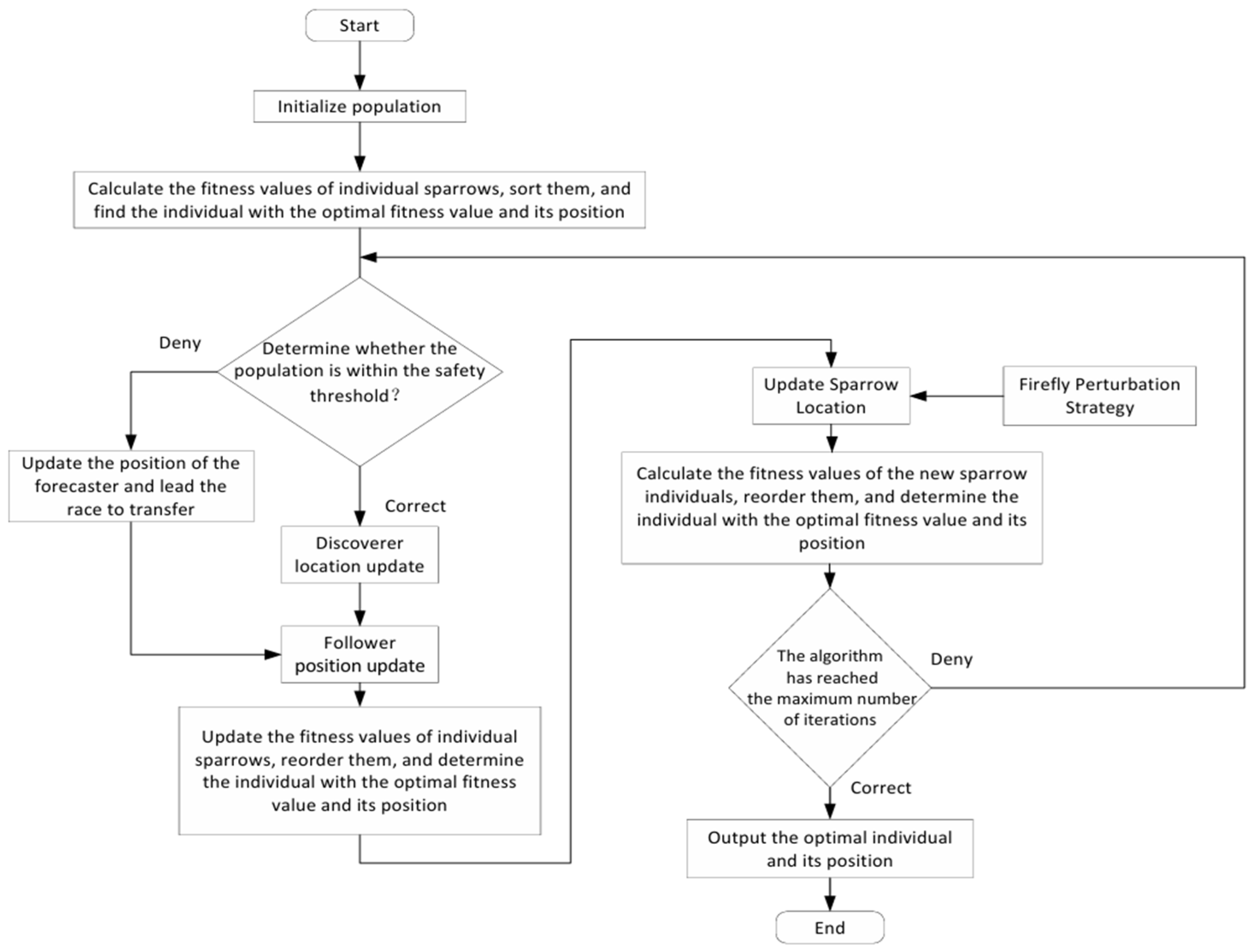
As shown in
Figure 7, the steps of FASSA are as follows:
Step 1: Initialize the sparrow population, the maximum iteration times, the ratio of discoverers to entrants, and the safety warning threshold of the population.
Step 2: Calculate the fitness value of each sparrow in the population, and sort them by value.
Step 3: Determine whether the population is within the safety threshold range. If not, update the position of the warner according to Formula (14), and lead the population to transfer. Otherwise, update the positions of the discoverer and follower according to Formulas (12) and (13).
Step 4: recalculate the sparrow population fitness value and update the individual sparrow position.
Step 5: update the sparrow position according to Formula (17) by using the firefly disturbance search strategy.
Step 6: recalculate the sparrow population fitness value and update the individual sparrow position.
Step 7: Check whether the stop condition is met. If so, output the optimal individual and position and terminate; otherwise, continue to execute Steps 3 and 4 for the next iteration.
4. Example Verification
In this paper, the camshaft hole diameter is taken as an example to optimize the machining parameters to verify the stability and applicability of the method. The hole machining includes three stages: rough boring, semi-finish boring, and fine boring, and the total machining time is the sum of the time lengths of each stage. In order to minimize the time, based on the optimization model mentioned above, the machining time is regarded as the fitness function, and the parameters of the three stages are optimized by using the improved sparrow search algorithm (FASSA). Cutting speed, cutting depth, and feed are selected as optimization variables, and their stability regions are taken as constraint conditions to ensure the reliability and stability of optimization results.
The performance of the FASSA algorithm is closely related to key parameters. Population size affects the search range and global ability. Larger scale enhances comprehensiveness but increases time complexity; the maximum iteration number needs to be dynamically adjusted to avoid resource waste or poor convergence; the ratio of predator to joiner directly affects convergence speed and performance. Parameter settings refer to the research of Fan Xu, Chen Kewei, and other scholars to ensure scientific rigor and rationality. See
Table 7 for specific parameter values.
In traditional metaheuristic algorithms, poor initial population distribution often leads to premature convergence. However, the introduced firefly perturbation mechanism effectively addresses this limitation. Even if the initial population is generated in suboptimal regions, the distance-based attraction coefficients can produce dynamic and powerful step perturbations. This mechanism endows the algorithm with strong global exploration capability in the early iterations and effectively reduces the dependence on favorable initial positions.
The initialization of FASSA in this study is not completely random. The initial population is strictly confined within the probabilistic safety domain predefined by Monte Carlo simulations. Since the search space is constrained both physically and statistically, the variance introduced by random initialization is inherently limited.
In order to verify the superiority of the FASSA algorithm in solving optimization problems, this paper compares it with the SSA algorithm without optimization. To ensure the accuracy and stability of model optimization results, the above two algorithms are independently run 100 times. This study uses the 95% confidence interval for statistical verification of repeated experimental results to reflect the validation accuracy and reliability of the data. The average and variance results of the optimized objective function are detailed in
Table 8.
According to the changes of mean and variance before and after optimization in
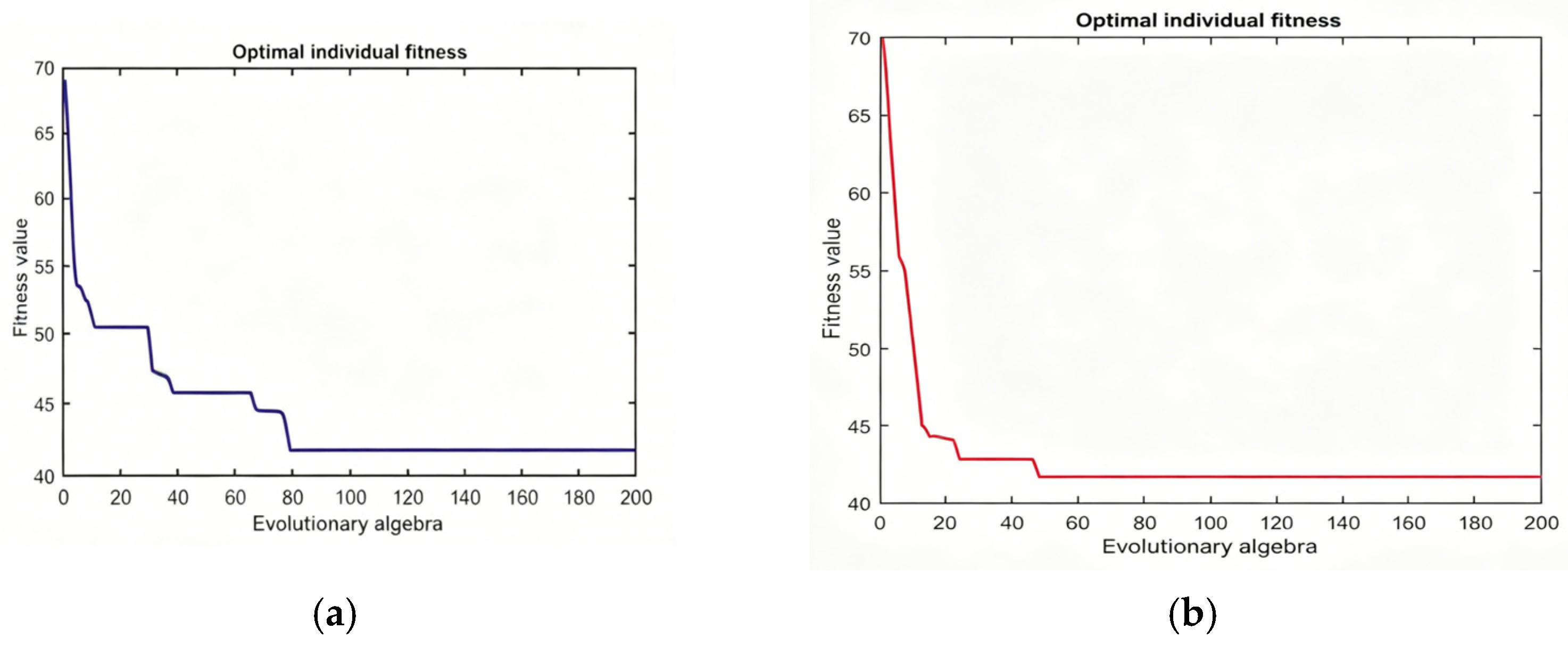
Table 8, the FASSA algorithm is significantly better than the SSA algorithm in global optimal solution search ability, and the result fluctuation in multiple iterations is small, showing higher stability, and can maintain a consistent optimization effect under different conditions. When the maximum iteration number is 200, the SSA algorithm and the FASSA algorithm are respectively applied to solve the machining time of boring the camshaft hole, see
Figure 8. When the SSA algorithm is used, the optimization results converge at the 80th generation, and the objective function value is about 41 min, while the FASSA algorithm converges at the 46th generation, and the convergence speed is faster. The results indicate that the FASSA algorithm has a faster convergence speed.
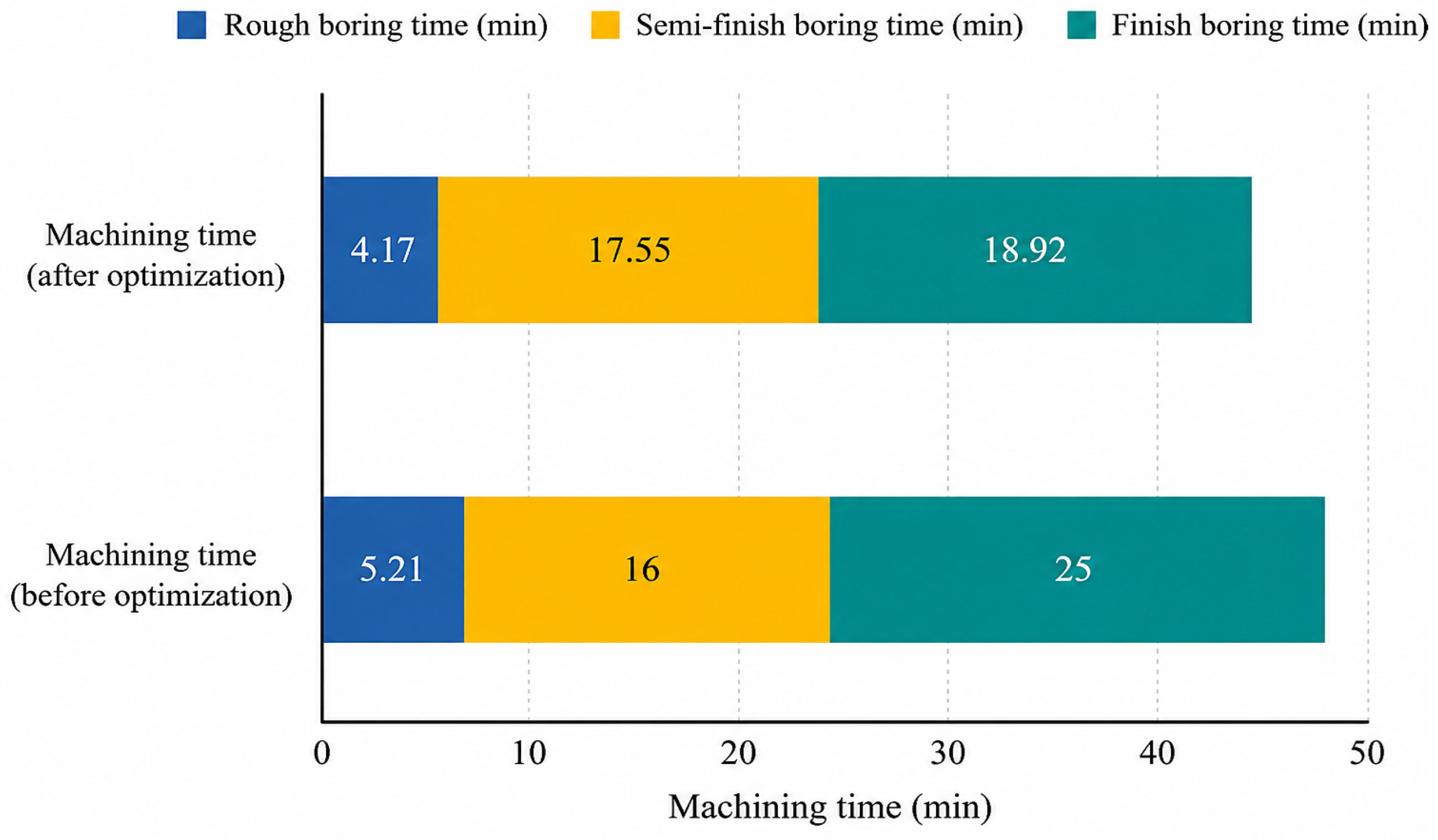
In order to show the difference in machining time before and after optimization more intuitively, this paper compares the machining time of the camshaft hole in rough boring, semi-finish boring, and finish boring stages. As shown in
Figure 9, the total machining time before optimization is about 46.21 min, and the total machining time after optimization of machining parameters is 40.64 min, which reduces the total machining time by about 12%.
In the original unoptimized process flow, overly aggressive parameter settings were adopted in the rough boring and semi-finish boring stages, resulting in poor and highly uneven surface quality prior to finish boring. Therefore, the final finish boring had to be performed at extremely conservative low rotational speeds to meet the strict dimensional tolerance requirements of marine diesel engine cylinder blocks.
The proposed FASSA algorithm successfully identified this process bottleneck and rationally redistributed the machining load. By fine-tuning the parameters of the semi-finish boring stage, its machining time was extended by 93 s. However, this modest time investment significantly improved the quality of the intermediate surface. Consequently, the subsequent finish boring operation can be safely carried out at higher cutting speeds and feed rates without the risk of machining chatter.
In the actual manufacturing process of marine engines, finish boring is the final and highest-risk process. Once chatter marks or dimensional deviations occur at this stage, the entire heavy casting will be directly scrapped. Therefore, engineers adopt extremely conservative dynamic parameters to ensure machining safety, which artificially creates an efficiency bottleneck. By constructing a probabilistic stability domain, our optimization model mathematically reveals this vast and previously underutilized potential optimization space.
The significant reduction in finish boring time is achieved through reasonable trade-off arrangements in the preceding semi-finish boring stage. Appropriate adjustment of machining parameters during the semi-finish boring process can obtain a highly uniform machining allowance and excellent intermediate surface quality.
Cutting force is extremely sensitive to fluctuations in material removal volume. Uneven removal volume will cause a sudden surge in cutting force, leading to deflection of the slender boring bar and further inducing regenerative chatter. The uniformly distributed removal volume obtained by optimizing the previous machining process can effectively suppress such random force fluctuations at the physical level. This dynamic stability mechanism enables the FASSA algorithm to safely and decisively increase the feed rate and spindle speed to the theoretical stability limit while avoiding exceeding the vibration threshold. This synergistic parameter optimization ultimately significantly shortens the finish boring time.
Table 9 lists the machining time and corresponding machining parameters of the camshaft in rough boring, semi-finish boring, and finish boring stages before and after optimization.
To sum up, the optimization model proposed in this paper, with the objective function of minimizing the machining time, can determine the shortest parameter combination under the premise of ensuring the machining accuracy of the product, and the FASSA algorithm exhibits higher search accuracy and convergence speed in the optimization process, effectively avoiding falling into local optimal solutions.
5. Conclusions
In this paper, aiming at the key features in machining holes of the marine diesel engine fuselage, a machining parameter scheme is proposed, which takes the minimum machining time as the optimization objective. This method establishes a second-order regression model between quality characteristics and machining parameters using the BBD surface response method, and determines the stable domain of machining parameters using the Monte Carlo method to ensure the stability and reliability of machining quality. Based on this, the FASSA algorithm is applied to optimize the machining parameters of key quality features, reduce machining time, and shorten the delivery cycle. The theoretical framework proposed in this paper demonstrates potential in a broader range of single-chain electromechanical systems, but the empirical validation of this study is strictly limited to the machining of engine hole-type components. Further research is required in the future to verify its transferability to other structural components.
The main conclusions are as follows:
- (1)
The stability region of machining parameters for key machining features is solved, which realizes a more reasonable range of machining parameters and ensures the stability and reliability of the machining quality of the fuselage.
- (2)
Based on the FASSA algorithm, the machining parameters of key machining features are optimized to reduce machining time and cycle time under the premise of ensuring final machining quality.
This study also has certain limitations. On the basis of the present research, future work can further expand the engineering practical significance and application boundary of the proposed method. The FASSA optimization framework can be extended to the machining scenarios of more complex marine diesel engine components. The generality and robustness of the algorithm can be further verified under actual workshop machining disturbances and equipment operating condition fluctuations, so as to improve its practical application value in production sites.
This paper mainly carries out parameter optimization, focusing on machining time and dimensional accuracy. Comprehensive analysis shows that energy efficiency and tool wear exert relatively limited influences on the optimization objectives of such hole system machining. In follow-up research, energy consumption and tool wear indicators can be further incorporated to conduct multi-objective optimization, improve the process evaluation system, and further enhance the integrity and engineering contribution of this study.