1. Introduction
Artificial Intelligence (AI) is profoundly transforming higher education. It enables the development of systems that personalize learning, automate processes, and improve the educational experience across different study modalities. Among the most relevant applications of AI are Intelligent Tutoring Systems (ITSs). They are designed to generate teaching materials, monitor student progress, and adapt instructional strategies to individual students’ needs (difficulty level, learning style, learning modality, and context) [
1]. Recent research has demonstrated the potential of ITSs to automate tasks for teachers such as grading, attendance tracking, and curriculum planning [
2,
3,
4]. Nonetheless, this poses multiple risks. Over-reliance on automation can reduce human oversight, introduce errors in complex decision-making, and depersonalize the teaching and learning process. Moreover, the extensive use of data to train AI models can lead to algorithmic bias, loss of privacy, intrusive surveillance, and a decline in empathy in teacher–student interactions [
5,
6].
It is precisely the incorporation of Multi-Agent Systems (MASs) that has enabled ITSs to evolve from rule-based approaches into more dynamic and modular architectures, capable of integrating student modeling, learning analytics, learning style detection, and adaptive content generation [
7,
8,
9]. As a result, MASs provide the architectural basis for the integration of diverse technological innovations into ITSs, supporting more flexible and student-centered educational processes. One example is the development of microservice-based architectures to process large volumes of data from Virtual Learning Environments (VLEs) [
10].
Furthermore, the integration of Deep Learning (DL) and Reinforcement Learning (RL) has further enhanced the adaptive capabilities of ITSs, enabling them to adjust the difficulty of activities more effectively and generate immediate, personalized feedback based on student behavior and individual learning needs. This has strengthened the ability of virtual tutors to adapt to the cognitive, emotional, and motivational characteristics of each student [
11].
Nevertheless, although ITSs have become more adaptive and technologically sophisticated, important limitations still constrain their effective use in practice. Among the most persistent challenges are the difficulty of scaling personalization, the complex integration of these systems with virtual learning platforms, immersive environments, and gamified settings, as well as limited transparency in decision-making and insufficient consideration of ethical issues and user experience. Together, these limitations highlight the need for more flexible and adaptive architectures capable of enabling truly personalized learning.
Yet, such architectures must go beyond technical functionality alone, as the effectiveness of ITS also depends on the quality of interaction with the student. Human–Computer Interaction (HCI) principles, such as usability, clarity of dialogue, and user experience (UX), are therefore fundamental to maximizing learning. Likewise, growing concerns about ethics in educational AI require systems to be transparent, explainable, secure, and respectful of data privacy [
12,
13].
In response to these technical and ethical demands, this paper proposes a Generative AI (GenAI)-based MAS architecture for the development of an adaptive ITS in higher education. Its novelty lies in combining a low-code platform to orchestrate specialized agents with pedagogical, practical, empathetic, and ethical functions, integrated with Large Language Models (LLMs) as the system’s conversational engine [
14]. This combination allows for the creation of conversational virtual tutors capable of maintaining Human–Agent Interaction (HAI) and HCI by considering rules, learning styles, regulations, educational theories, pedagogical strategies, and case studies [
15]. It incorporates an ethical agent to monitor the system’s behavior, ensuring transparency, explainability, and the responsible use of GenAI.
1.1. Current State of ITSs and MASs in Education
Traditionally, ITSs are structured around three fundamental components: the domain or teacher model, which represents expert knowledge; the student model, which describes their level of competence, preferences, and progress; and the tutor model, which manages teaching and feedback strategies [
16].
In recent years, various studies have been found to incorporate learning style theories such as VARK [
17], Kolb’s experiential learning cycle [
18], the Felder and Silverman Learning Style Model (FSLSM) [
19] and Gardner’s multiple intelligences [
20], among other proposals. These approaches aim to adapt content presentation and tutoring strategies to different student profiles, promoting active participation and improving academic performance in different learning environments.
At the same time, the development of ITSs has also progressed in a complementary direction, toward more distributed and interactive architectures that integrate advanced AI and MASs. Traditional models such as the Carter model [
21] introduced animated pedagogical agents, also known as guidebots, designed to guide students in virtual worlds and multimedia environments, combining the logic of ITSs with the interpersonal interaction capabilities of conversational characters.
Frasson and Chalfoun [
22] emphasized the importance of affective states, proposing emotionally intelligent systems capable of recognizing emotions through electroencephalography (EEG) devices and inducing emotional states conducive to learning and motivation. These works are recognized as having laid the foundations for tutoring architectures that not only transmit knowledge but also adjust their behavior, considering the emotional and social dimensions.
More recent research has delved deeper into personalization and student modeling, using tools such as the Agent Persona Instrument by Schroeder, Romine, and Craig, which has been applied in studies validating learners’ perceptions of pedagogical agents, examining the influence of virtual humans on motivation and learning, and in recent research evaluating educational chatbots, virtual-reality agents, and synthetic instructional voices [
23].
Adaptive models that combine learning analytics and AI techniques have been strengthened, such as the MASCARET tutoring system model [
24], a pedagogical MAS architecture for virtual training environments that integrates the domain, student, pedagogical, and interface models with an error model to personalize teaching. Within this framework, SECUREVI is highlighted as a training environment for firefighting officers that uses pedagogical agents to suggest, explain, and guide tactical decisions in emergency scenarios [
24].
The development of a collaborative agent based on microservices for virtual learning environments has been promoted. This agent manages and organizes large volumes of interaction data, facilitating decision-making and monitoring student engagement in distance education programs [
10].
Architecturally, there has been a transition toward student-centered systems based on educational data analysis. Current ITSs are known to integrate data mining and learning analytics to continuously monitor student interactions, detect difficulties, and predict performance [
25]. Using algorithms such as decision trees and machine learning techniques, learning paths are dynamically adjusted, resources are recommended, and proactive feedback is offered [
26].
The emergence of advanced AI and DL has opened new perspectives. Cui [
11] proposed an ITS that uses deep learning and reinforcement learning to generate dynamic study plans, adjust the difficulty of exercises and automatically evaluate tasks through computer vision. Applied in higher education, this approach aims to improve feedback and personalization. Other reviews have demonstrated the growth of voice-based virtual agents in teaching English as a foreign language, integrating NLP, speech synthesis, and machine learning to increase the naturalness and closeness of the tutor [
27].
Prospective studies have projected the integration of GenAI and advanced conversational agents such as ChatGPT-4.01 to achieve adaptive, empathetic, and scalable tutors. In higher education, these systems seek to improve motivation, reduce dropout rates, support self-regulation, and enable the efficient deployment of learning experiences [
28].
An emerging trend is the integration of autonomous agents within ITSs to distribute functions and improve scalability. This approach supports the implementation of MASs for distributing functions among autonomous agents with specific roles, such as providing feedback, evaluating progress, recommending content, or supporting motivation and collaborating in a coordinated manner in virtual environments, thus facilitating collaboration between different components.
Traditional frameworks such as Java Agent Development Framework (JADE) and Smart Python Multi-Agent Development Environment (SPADE) have been widely used to develop educational agents [
29,
30,
31,
32], but their integration with modern AI technologies and deployment on real platforms such as Moodle is still considered a challenge due to technical complexity and the lack of low-code tools [
33].
This widespread use is largely explained by the fact that platforms such as JADE are compatible with the Foundation for Intelligent Physical Agents (FIPA) standards and enable the development of distributed systems. Each agent specializes in specific functions, such as collecting behavioral data, analyzing student progress, and dynamically modifying learning materials according to their profile and preferences.
MASs have incorporated pedagogical models to improve personalization. The Felder–Silverman model and the VARK model are considered to be the most widely used models for the identification of different learning styles [
32], such as visual/verbal, active/reflective, sensory/intuitive, and global/sequential. These models are integrated into agents that analyze records of student interaction and automatically adjust content selection. Some studies have proposed reactive architectures based on the Event–Condition–Action model to respond in real time to events occurring on platforms such as Moodle [
34,
35].
Hybrid approaches that integrate MASs with emerging technologies, such as GenAI and LLMs, have been explored as a means of enhancing the capabilities of virtual tutors. Microservice-based architectures where collaborative agents manage large volumes of interaction data within VLEs have also been developed. These proposals are intended to increase the scalability and adaptability of ITSs, offering personalized experiences and advanced conversational support [
34,
35].
Recent research has presented models that combine Cognitive Computing, DL, and Natural Language Processing (NLP) with multimodal analytics to recognize emotions and self-regulated learning strategies, thereby adapting educational support. Examples of this approach are found in systems such as STUART for collaborative management [
36], KYPO SLE in cybersecurity training, and platforms such as SQL-Tutor and ProTuS [
37], that implement adaptive tutoring and individualized monitoring. Although conversational agents with natural dialogue capabilities are beginning to be explored, the integration of GenAI is still considered to be in its infancy, opening up opportunities to develop more empathetic and adaptive virtual tutors in higher education.
1.2. GenAI for Adaptive Learning and Tutoring Systems
The emergence of GenAI has transformed the concept of ITSs, offering new possibilities for personalization and automated support. Traditionally, ITSs were based on limited supervised learning, which was able to partially adapt content and feedback but was constrained by the need for manually designed scenarios and by the inability to generate contextualized explanations in real time [
38]. The emergence of LLMs, such as GPT-4, LLaMA, and PaLM, has enabled dynamic tutoring in which examples, activities, and assessments that are immediately tailored to individual needs.
Among the recent advances that improve the consistency of educational responses, Retrieval-Augmented Generation (RAG) and its extension through Knowledge Graphs (KGs) are particularly significant. When integrated into adaptive tutors, these approaches have been reported to increase learning scores by 35%, compared to traditional semantic search [
9]. The incorporation of specialized agents to perform diagnostic, recommendation, motivation, and metacognition tasks within MASs has been shown to allow for proactive student monitoring and multimodal feedback that combines text, graphics, video, and simulations [
39].
The adoption of GenAI has driven the creation of conversational tutoring platforms and assistants integrated into VLEs. Flagship cases such as Khanmigo and Duolingo Max, powered by GPT-4, have reported increases of 26 to 38% in student participation, 34% improvements in retention, and up to a 40% reduction in teaching workload for monitoring and feedback [
40].
In the field of programming, tools such as PyTutor provide progressive hints and personalized explanations to support code comprehension and debugging, with a positive impact on students with less prior preparation [
41]. There are reports of explainable assistants integrated into Moodle that grade code using BERT or CodeBERT models and justify feedback using interpretability techniques such as LIME and SHAP, achieving high accuracy and very short response times [
42].
Active, student-centered strategies find a key ally in GenAI. Studies in science and engineering courses have shown that guided inquiry prompts promote understanding of complex concepts such as thermodynamics and reduce misconceptions when chatbots are used in a structured way [
43]. Along the same line, adaptive gamification has been extensively explored, with GenAI-based Gamified Intelligent Tutoring and Instant Feedback Systems (G-ITIFSs) personalizing missions, challenges, and rewards to sustain motivation and support self-regulated learning [
40].
Teaching adoption frameworks based on Task-Technology Fit (TTF) and the Theory of Planned Behavior (TPB) have been proposed to explain the integration of GenAI in educational contexts. These frameworks highlight the importance of professional development and institutional support in overcoming adoption barriers, particularly in relation to gamified strategies supported by GenAI [
44]. In parallel, adaptive assessment has also been revitalized by GenAI. Models such as Cognitive Diagnosis Assessment (CDA) and Deterministic Input, Noisy “And” Gate Model (DINA) can be combined with the automatic generation of questions and personalized remedial materials, enabling a continuous and learning-oriented assessment process.
In this way, these models seek to generate specific study paths based on detected gaps [
45]. In adult education, the integration of AI tutoring into authentic assessments has also been shown to enhance critical thinking and problem-solving in real-world contexts, overcoming the limitations of standardized assessments [
46].
The expansion of generative tutors spans multiple disciplines. Although computer science and engineering lead their adoption, particularly in areas such as programming, data structures, and networking, successful applications have also been reported in health education, where these tutors simulate clinical cases and help develop diagnostic reasoning and decision-making [
47].
In languages and academic writing, the use of GenAI has moved from exploratory studies to empirical designs that demonstrate improvements in writing, revision, and textual feedback, although evidence on oral and listening skills is still limited [
48]. Significant improvements in performance and motivation have also been reported in basic education through environments such as ChatGPT-MPS for elementary mathematics, which personalize explanations and practice according to progress [
49].
Despite positive outcomes such as improvements in performance, motivation, and retention, state-of-the-art literature highlights critical challenges. Students value GenAI for its ability to save time, support with problem solving, and assist with written communication, but they also express concerns about accuracy, privacy, and fairness. Additionally, excessive reliance may affect critical thinking if adequate guidance is not provided in universities [
50].
From the perspective of Self-Determination Theory (SDT), the impact of GenAI on learning is considered ambivalent. When students interact with AI driven by epistemic curiosity and intrinsic motivation, the technology promotes the satisfaction of basic psychological needs, such as autonomy and competence [
51].
The integration of Explainable AI (XAI) approaches with automatic assessments and adaptive tutoring demonstrates that it is technically feasible to provide traceable feedback in the context of ITSs [
42]. Reviews point to the need for longitudinal studies, evidence at early school levels, and cultural and social impact assessments before widespread adoption. GenAI, powered by LLMs such as GPT, Claude, or LLaMA, has shown significant potential to enrich ITSs. These technologies enable the generation of personalized explanations, dynamic adaptation to different learning styles, and the creation of conversational agents that simulate human tutors. However, integrating GenAI into a MAS context requires overcoming barriers related to orchestration, communication, and response quality control [
39].
The literature reveals a study that uses n8n as an AI agent orchestration platform to automate the design of educational scenarios in clinical simulation. The proposal is still under development, validation, and exploration. The approach is oriented toward content generation and the teaching planning process rather than ITSs [
52].
1.3. Research Gap and Contribution
Although MASs and ITSs have been the subject of research for decades, their integration with GenAI remains limited from a pedagogical, student-centered, and adaptive perspective, especially within higher education contexts. Recent advances in LLMs such as ChatGPT-4.01 have opened new possibilities for improving the interaction and adaptability of virtual tutors. The adoption of these technologies faces technical, ethical, and methodological barriers that hinder their large-scale implementation in academic settings.
Low-code orchestration tools such as n8n have emerged [
53], allowing complex flows to be designed and agents to be connected to GenAI and NLP APIs in a visual, agile, and scalable way. These platforms reduce the complexity of MAS development, facilitate experimentation, and accelerate the construction of educational solutions that combine conversational capabilities with distributed decision-making processes. This technological gap raises the need for new architectures that combine the modularity and autonomy of MASs with the conversational and adaptive power of generative models.
This article presents ELA Tutor, a GenAI-based multi-agent architecture for the development of ITSs in higher education, implemented on the low-code n8n platform and connected to (OpenAI GPT-4.01, San Francisco, CA, USA; available at:
https://www.openai.com) as the main conversational engine. The proposal integrates agents with pedagogical, practical, empathetic, and ethical functions, equipped with NLP capabilities, advanced conversational interaction, and responsible HAI principles.
This work presents the first phase of ELA Tutor’s implementation and validation. Tests were conducted with university professors from different study modalities (face-to-face, blended, and online) in simulated and test environments. The aim was to evaluate the system’s functionality, usability, acceptance, and potential integration into the teaching process in higher education. This phase is crucial because it validates how each agent responds to user queries, refines the prompts embedded in each agent, and integrates the teaching strategies proposed by the professors.
This research is part of the International Chair on Trustworthy Artificial Intelligence and the Demographic Challenge, within the National Strategy for Artificial Intelligence (ENIA), under the European Recovery, Transformation and Resilience Plan (Ref. TSI-100933-2023-0001). ELA Tutor contributes to these broader objectives by providing a trustworthy AI solution for higher education, integrating specialized agents that operate under principles of cooperation and pedagogical alignment. This ITS reinforces the Chair’s objectives by promoting more effective, inclusive, and evidence-based tutoring processes, supported by advanced technologies and continuous teacher oversight.
2. Materials and Methods
2.1. System Design and Architecture
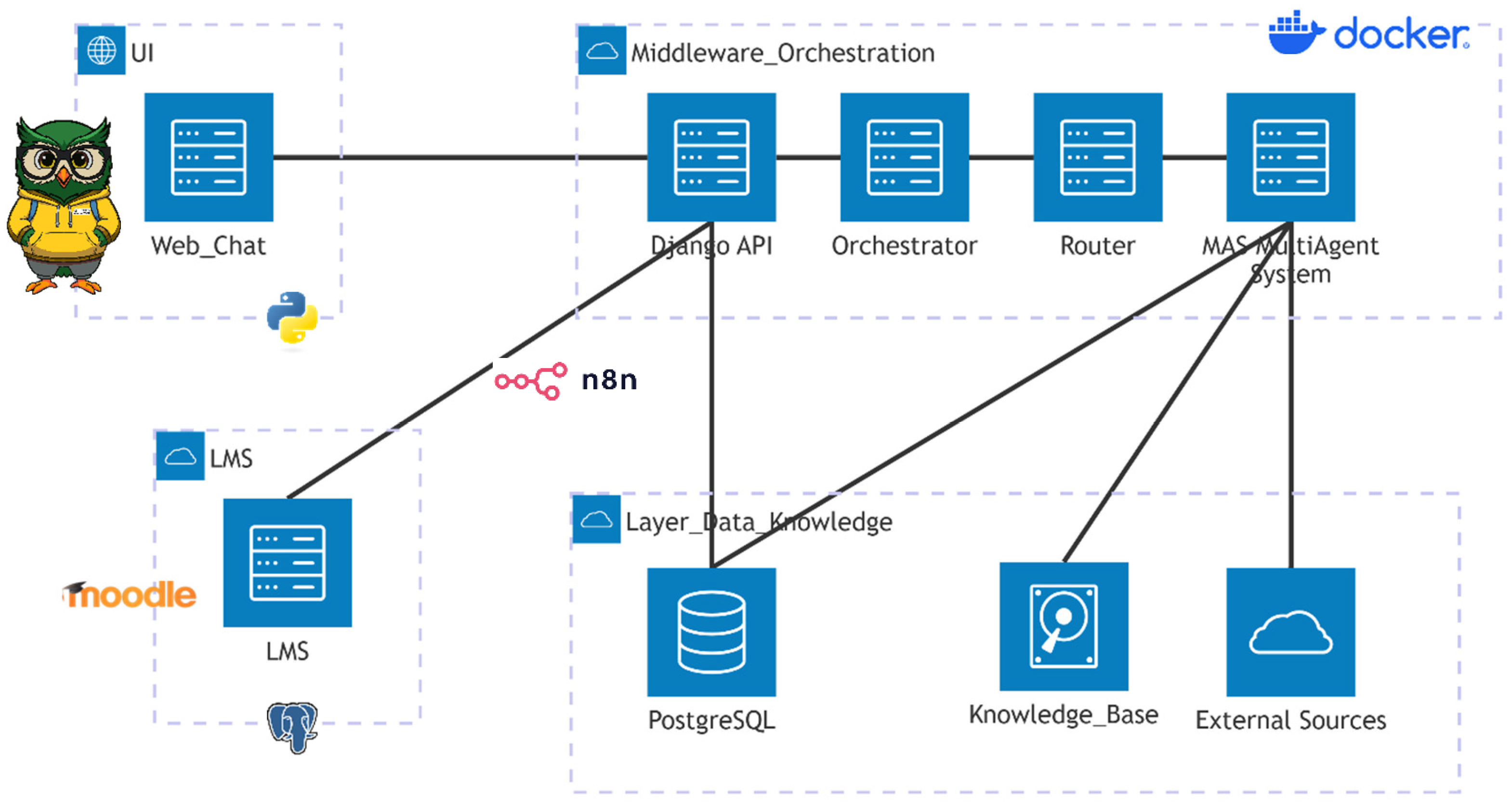
ELA Tutor is conceived as a scalable, modular, and pedagogically adaptive platform capable of supporting higher education teaching in both synchronous and asynchronous contexts. Its design followed a service-oriented and microservice-based architecture, enabling easy integration with institutional platforms and future extensibility.
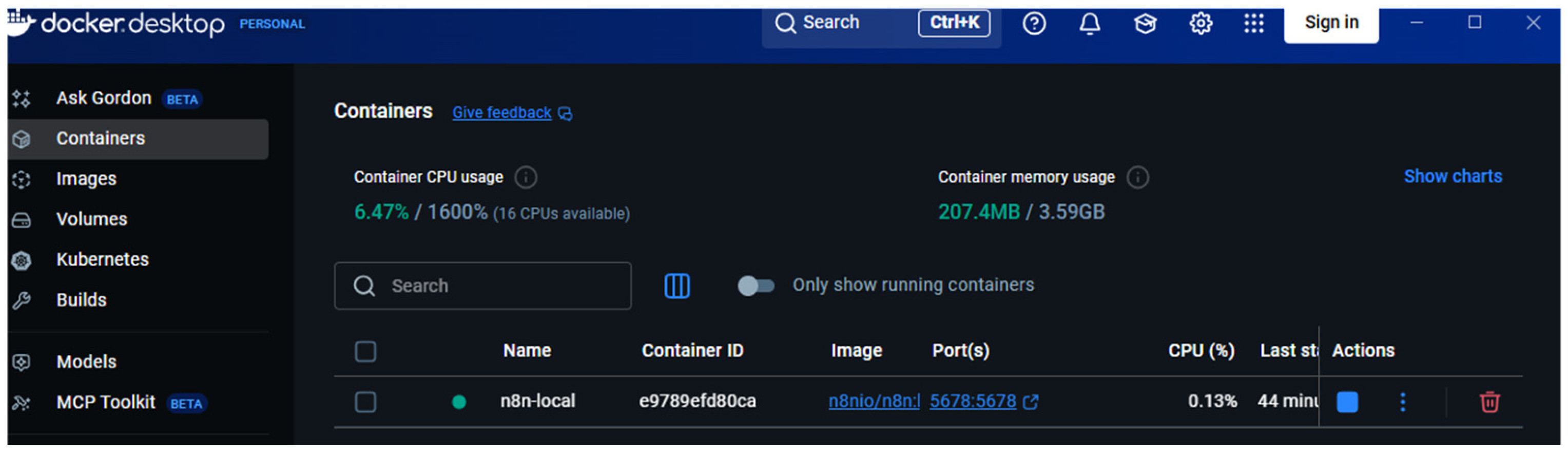
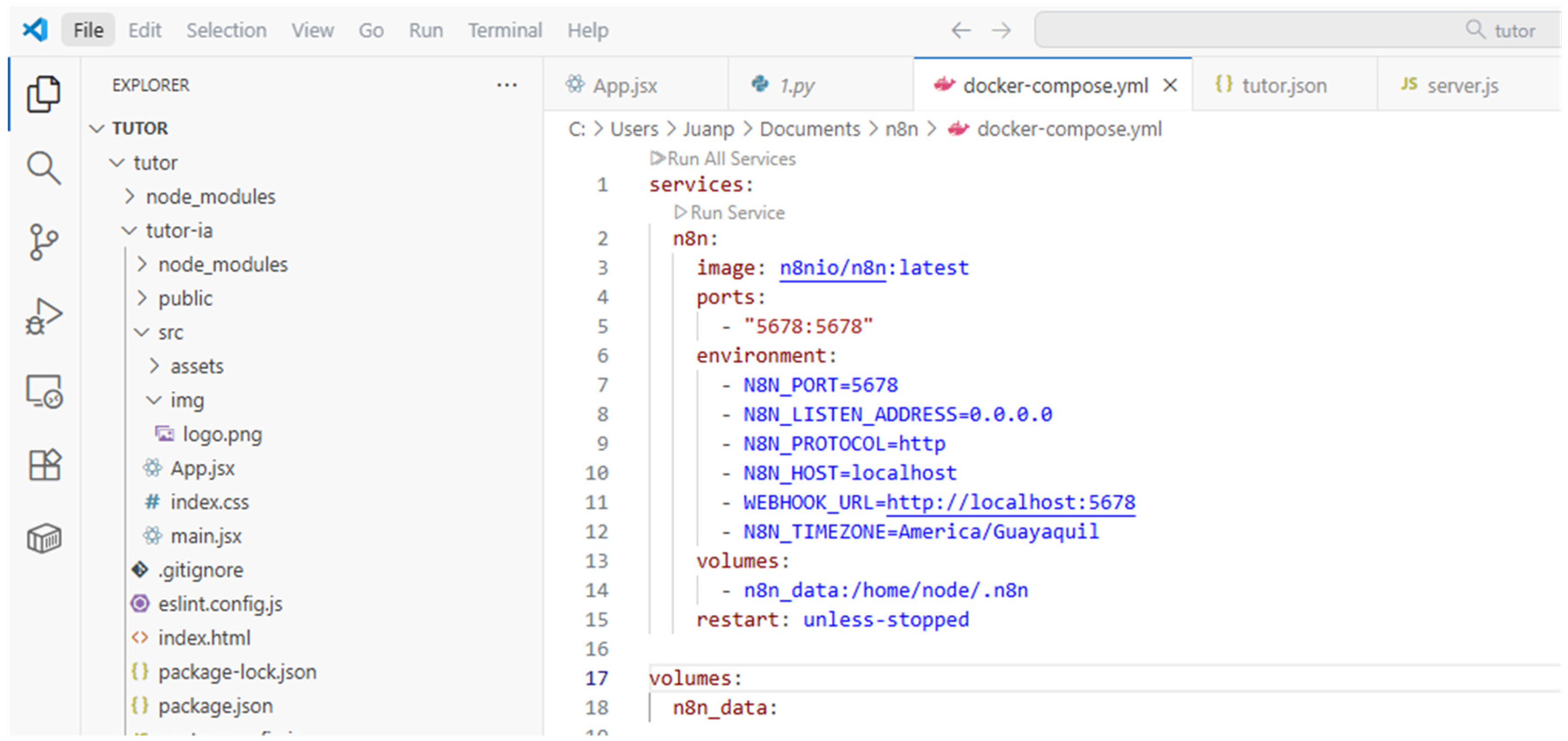
At the infrastructure level, the system is containerized using Docker Docker (Docker Inc., San Francisco, CA, USA) con la version 24.0.7 (
Figure 1), allowing each component (data storage, orchestration, interface, and learning analytics) to run independently while communicating through a secure internal network. This separation improves maintainability, simplifies deployment across different server environments, and supports incremental updates without affecting the overall system.
The architecture comprises four major layers:
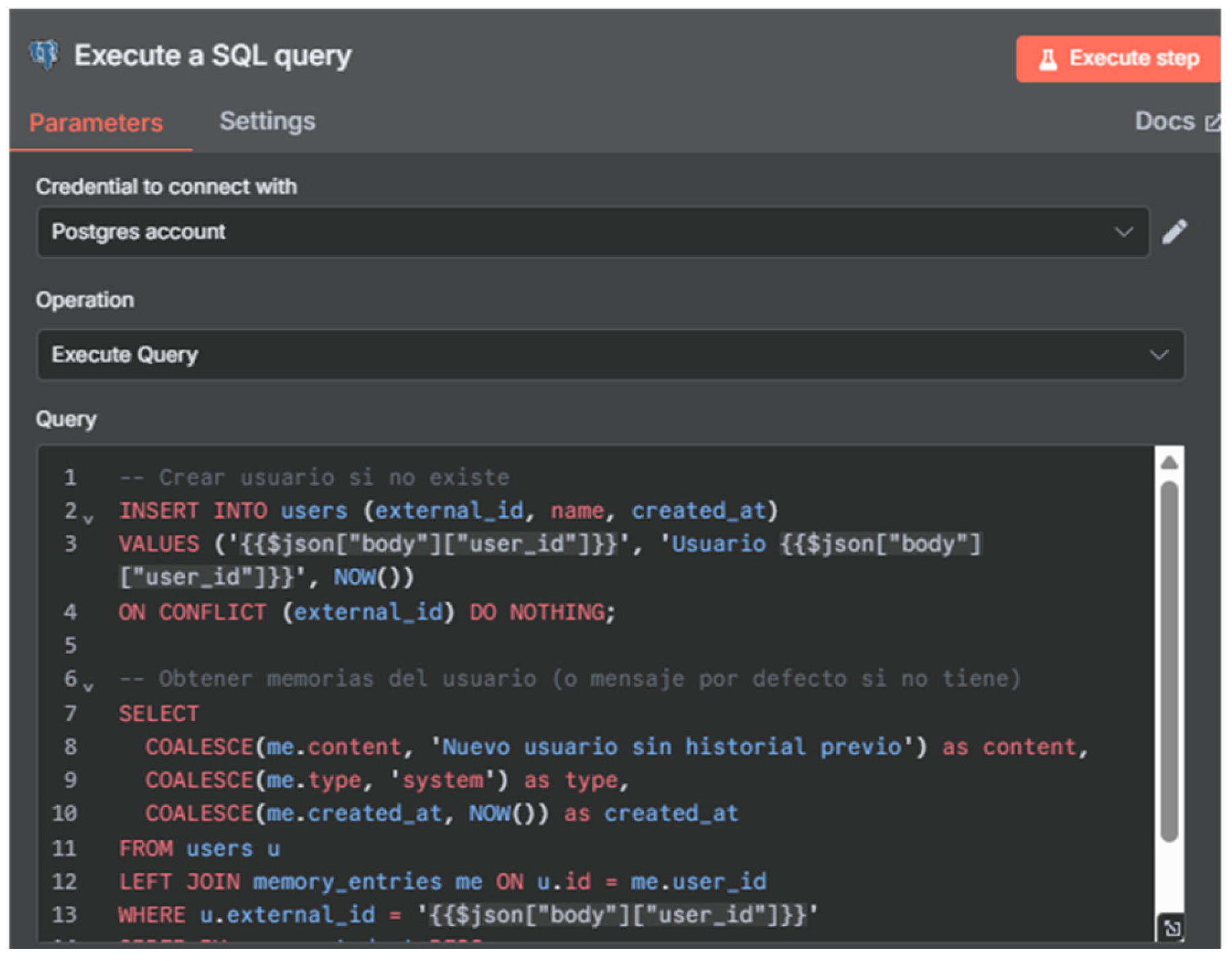
The system’s operational architecture is anchored by a robust PostgreSQL (PostgreSQL Global Development Group, available at:
https://www.postgresql.org) relational database (
Figure 2), which serves as the persistent layer for storing critical data, including user profiles, interactions, historical conversations, and learning performance indicators. The core intelligence relies on a dual-pronged knowledge base comprising curated institutional academic materials (textbooks, and teaching guides) and external general-purpose knowledge sources, including Wikipedia (Wikimedia Foundation, San Francisco, CA, USA; available at:
https://www.wikipedia.org), to support initial prototyping. However, the proposed architecture is inherently modular and supports integration through APIs and web services with indexed academic databases, institutional repositories, and curated digital libraries. This capability enables the incorporation of validated and domain-specific information sources, ensuring the robustness and reliability of the system’s responses.
The system incorporates a specialized content ingestion mechanism that empowers instructors to upload, process, and index their own materials, facilitating controlled knowledge expansion and ensuring rapid retrieval for customized educational support.
The system orchestration is managed byn8n (n8n GmbH, Berlin, Germany; available at:
https://n8n.io), an open-source workflow automation platform that serves as the central execution engine (
Figure 3). This platform is crucial for connecting the disparate components, including the user interface, various agents, and data storage through efficient use of API calls, webhook triggers, and task scheduling. Critically, n8n implements the complex decision-making logic for query routing; this is the switching mechanism, ensuring efficient task execution, and handling error recovery when any individual agent fails to produce a response.
The entire system is connected via a (Django Software Foundation, available at:
https://www.djangoproject.com)-based middleware that serves as the essential bridge between the (Moodle Pty Ltd., Perth, WA, Australia; available at:
https://moodle.org) learning management system and the ITS agents [
54]. This middleware provides robust RESTful APIs for managing user sessions, tracking detailed learning analytics, and ensuring the secure authentication of both virtual tutors and students.
ELA Tutor was designed for seamless integration with Moodle, which is widely adopted at the institutional level. This integration is facilitated through API protocols and single sign-on (SSO), allowing users to access it directly from their course pages without needing separate credentials. It also enables the synchronization of student progress, allowing the system to adapt its responses on the basis of relevant Moodle data, such as grades, completed activities, or learning paths defined within the LMS.
The layered, containerized design presented in
Figure 4 ensures high modularity, allowing for future enhancements such as analytics dashboards, recommendation engines, or advanced multimodal features such as video or image processing. It also ensures data security and compliance with institutional IT standards by isolating sensitive user information and enforcing controlled access.
2.2. MAS and Intelligent Switching Mechanism
ELA Tutor is powered by a MAS and was designed to reflect the complexity of tutoring in higher education, where students’ needs can vary between conceptual explanation, practical application, and motivational or metacognitive support. The core agents and their functionalities are defined as the Reception and Preprocessing Agent and the Intelligent Switching Router (Central Decision Node).
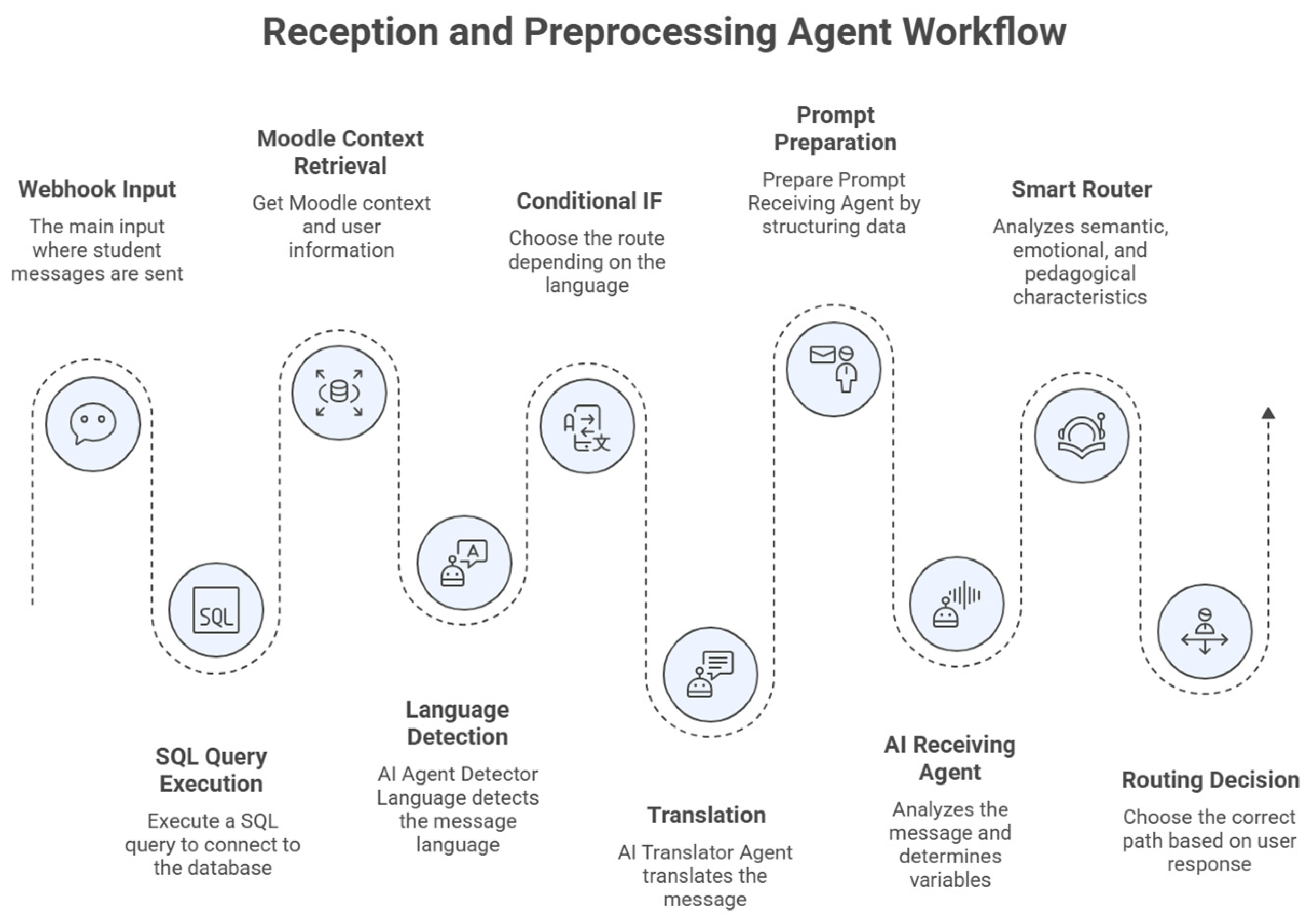
The Reception and Preprocessing request, as illustrated in
Figure 5, is managed through a webhook that serves as the system’s initial point of contact, and is responsible for cleansing and classifying the user queries. Its primary role is to perform text normalization, which involves removing noise, punctuation errors, and irrelevant tokens. Following this, it applies intent recognition using rule-based heuristics and lightweight NLP techniques. This process categorizes the queries into key types, such as conceptual questions, practical problems, performance feedback requests, or emotional support inquiries.
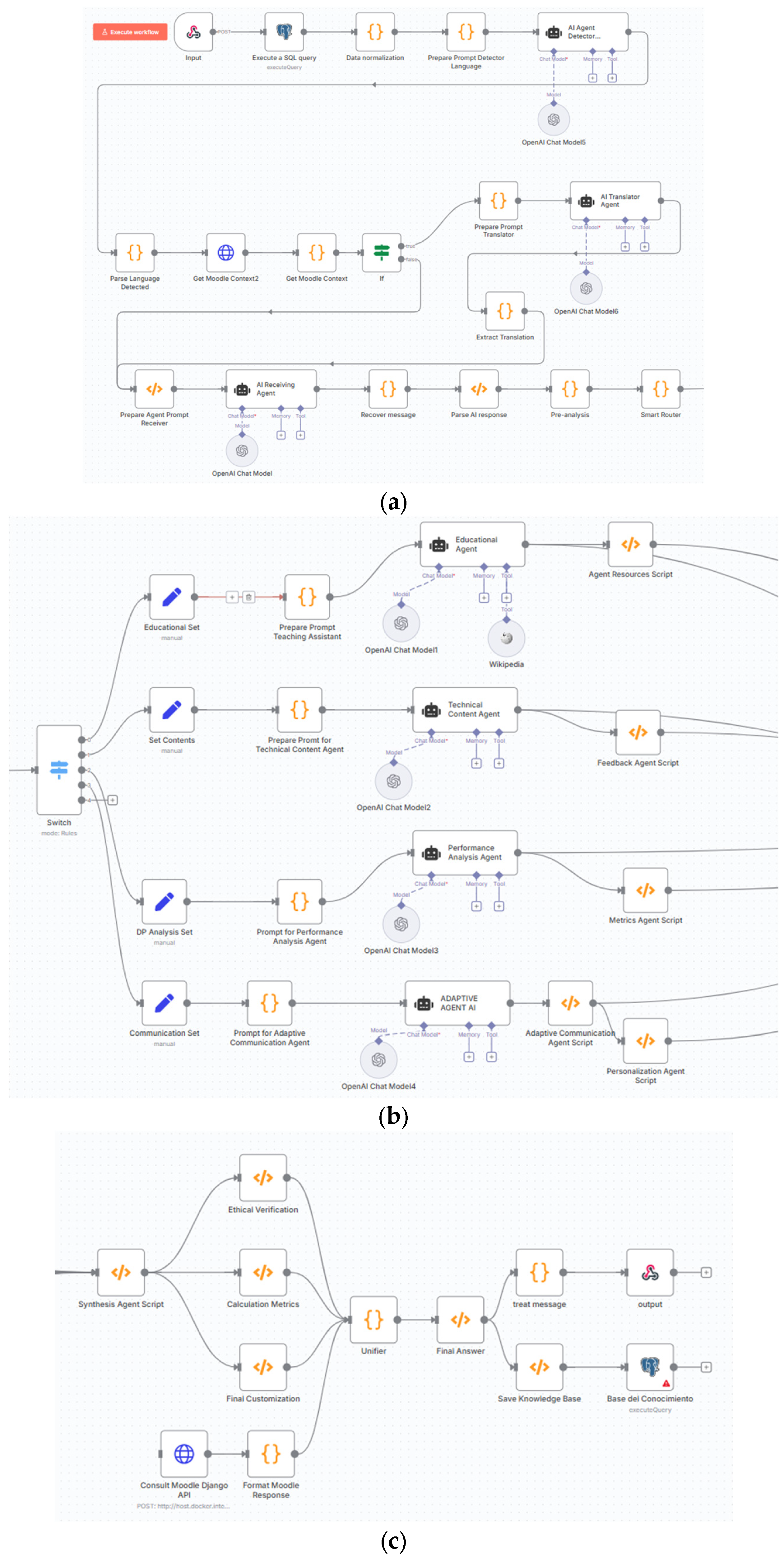
The process begins with data input from the educational environment or user interactions, managed through a webhook that triggers the sequence of intelligent agents. An SQL query retrieves relevant academic information about the student or course, which is then normalized and prepared for processing. Next, the AI Language Detection Agent identifies the language of interaction using an LLM model.
If translation is required, the flow continues to the AI Translator Agent, which adapts and generates responses in the appropriate language. Simultaneously, the system retrieves academic context from the LMS to ensure alignment with course content and learning activities. Once contextualized, the AI Prompt and Receiving Agent structures the prompt and interprets the user’s query. Before delivery, a semantic pre-analysis filters and routes the information through Intelligent Switching Router, which selects the most suitable flow based on the user’s intent and tutoring type.
This agent functions as the cognitive core of ELA Tutor, operating as a dynamic decision mechanism based on rule-based conditions and contextual metadata. Unlike static chatbots, it adaptively routes queries to the appropriate agent through real-time analysis of user input. The Router Agent evaluates three key parameters—query type, learner profile, and cognitive complexity—to determine the most suitable response pathway, enabling a coherent and context-aware tutoring experience.
ELA Tutor incorporates four supporting agents that operate collaboratively to enhance the system’s ability to respond to academic and tutoring queries from both instructors and students. These agents function as complementary components within the MAS architecture, each addressing a specific aspect of the tutoring process. The Pedagogical Agent ensures pedagogical consistency and relevance.
The Practical or Technical Agent manages domain-specific information and learning resources; the Analysis Agent evaluates learner interactions and progress; and the Adaptive Agent personalizes the instructional flow based on learner profiles and contextual variables. Together, they contribute to a cohesive and context-aware tutoring experience that aligns educational content with user needs.
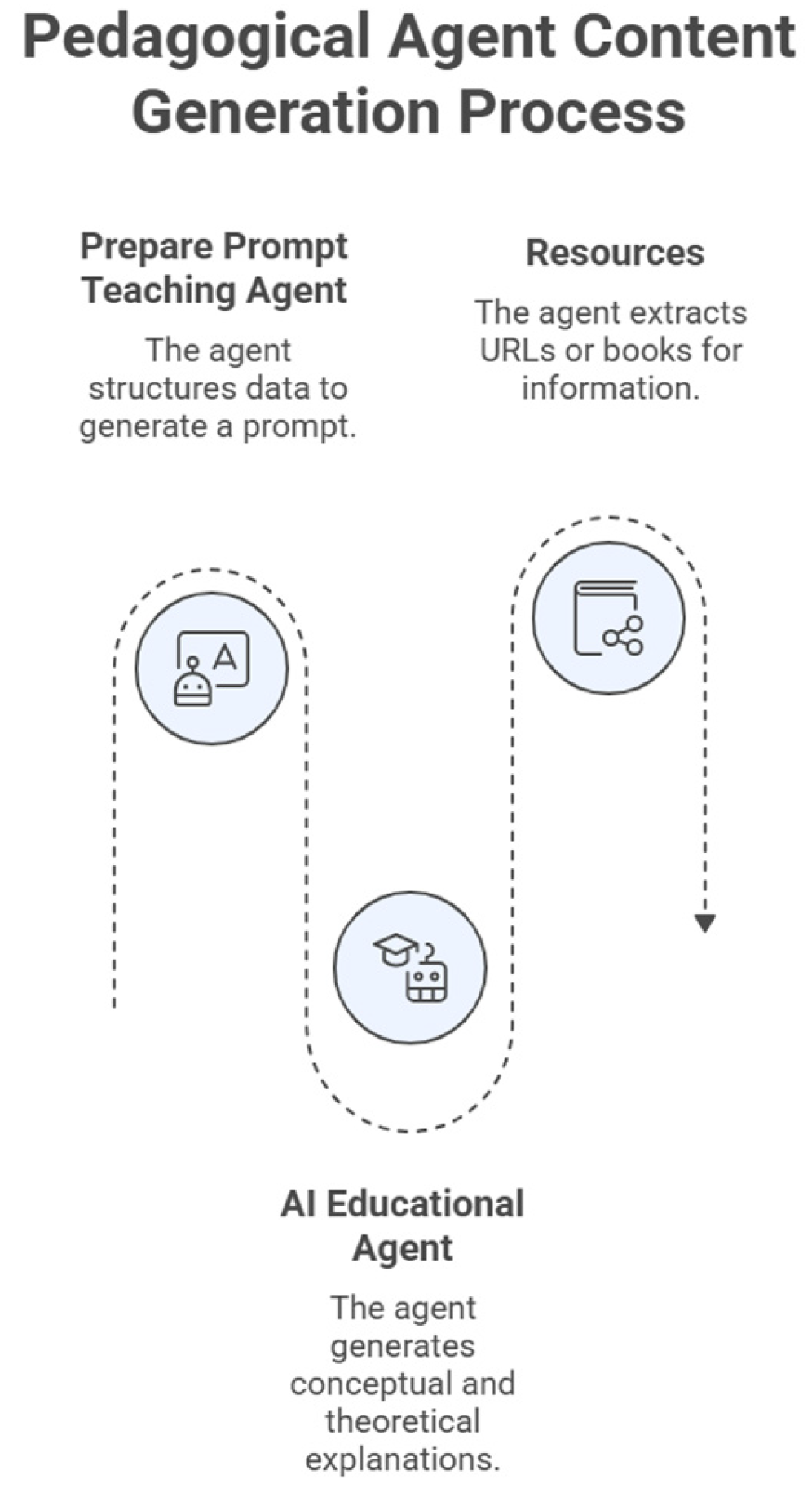
The Pedagogical Agent, as illustrated in
Figure 6, is responsible for generating structured theoretical content. It operates by combining the advanced capabilities of LLMs with a curated library of academic sources. These sources include institutional textbooks, instructor-uploaded guides, and Scopus-indexed material, ensuring the information is academically sound and relevant. The core function of this agent is to produce responses that are directly aligned with the official course syllabus and educational objectives, providing authoritative and targeted learning material.
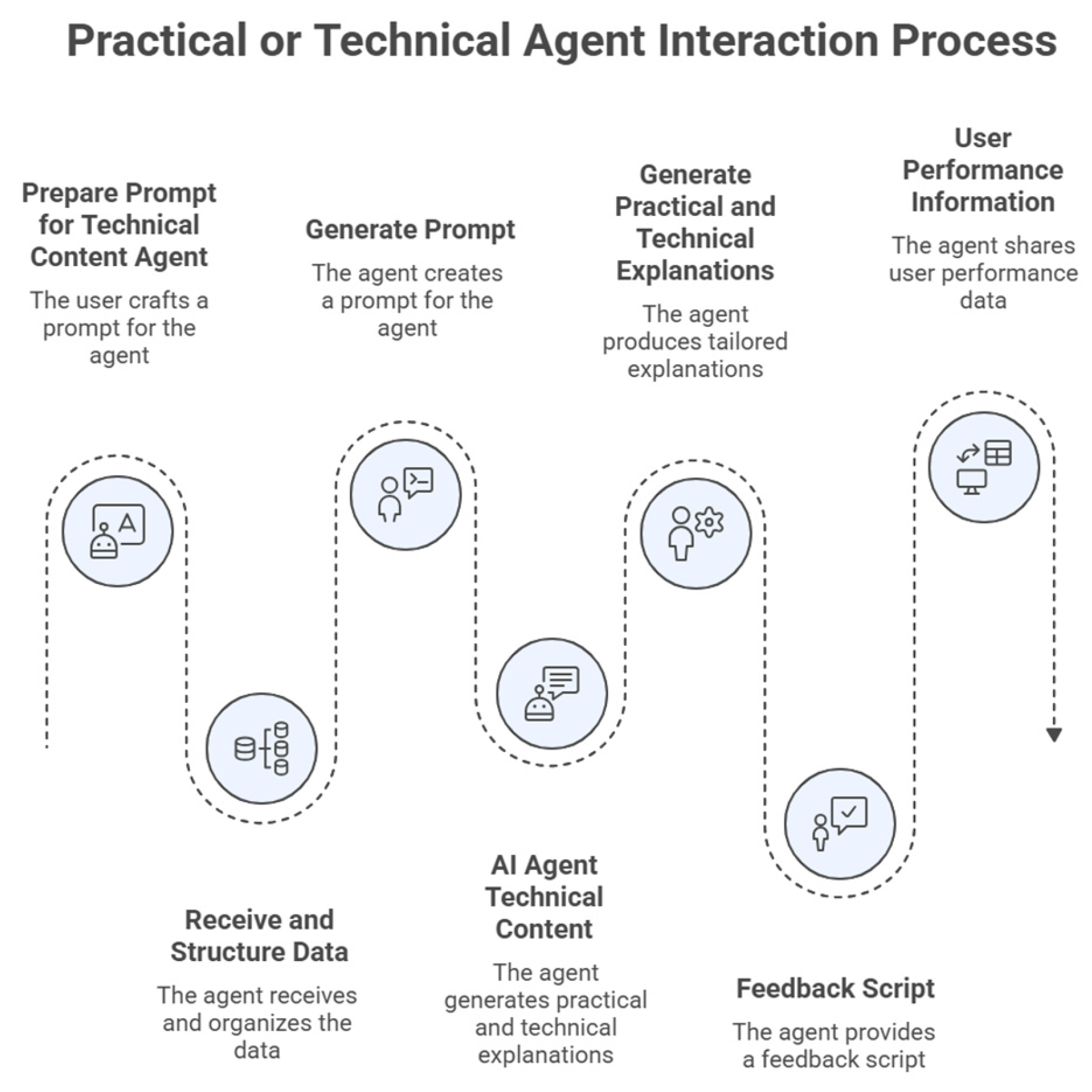
The Practical or Technical Agent (
Figure 7) focuses exclusively on applied learning, problem-solving, and coding tasks. This agent’s primary output is practical support, including providing examples, step-by-step instructions, or small exercises that are specifically tailored to address the user’s query. This functionality makes it particularly valuable and effective for subjects involving programming and STEM-related disciplines, where hands-on application is crucial for mastery.
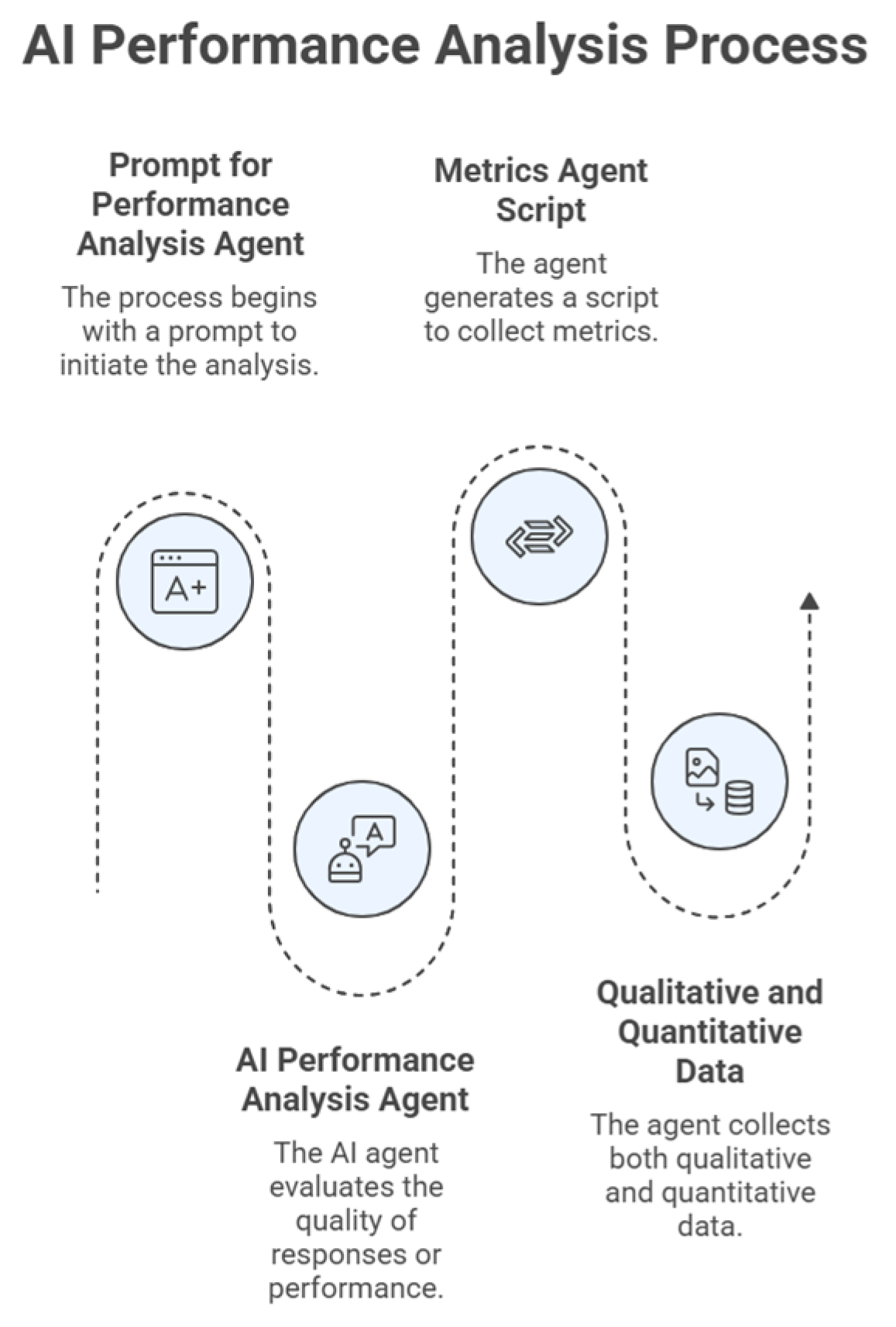
The Analysis Agent, as illustrated in
Figure 8, serves as the system’s evaluator, monitoring and assessing student progress and comprehension. It works by analyzing student interaction patterns and evaluating their current understanding based on prior responses and activity tracking. The goal of this analysis is to generate formative feedback that actively guides the student’s further learning. This feedback includes suggestions for additional resources or activities designed to address identified gaps in knowledge or performance.
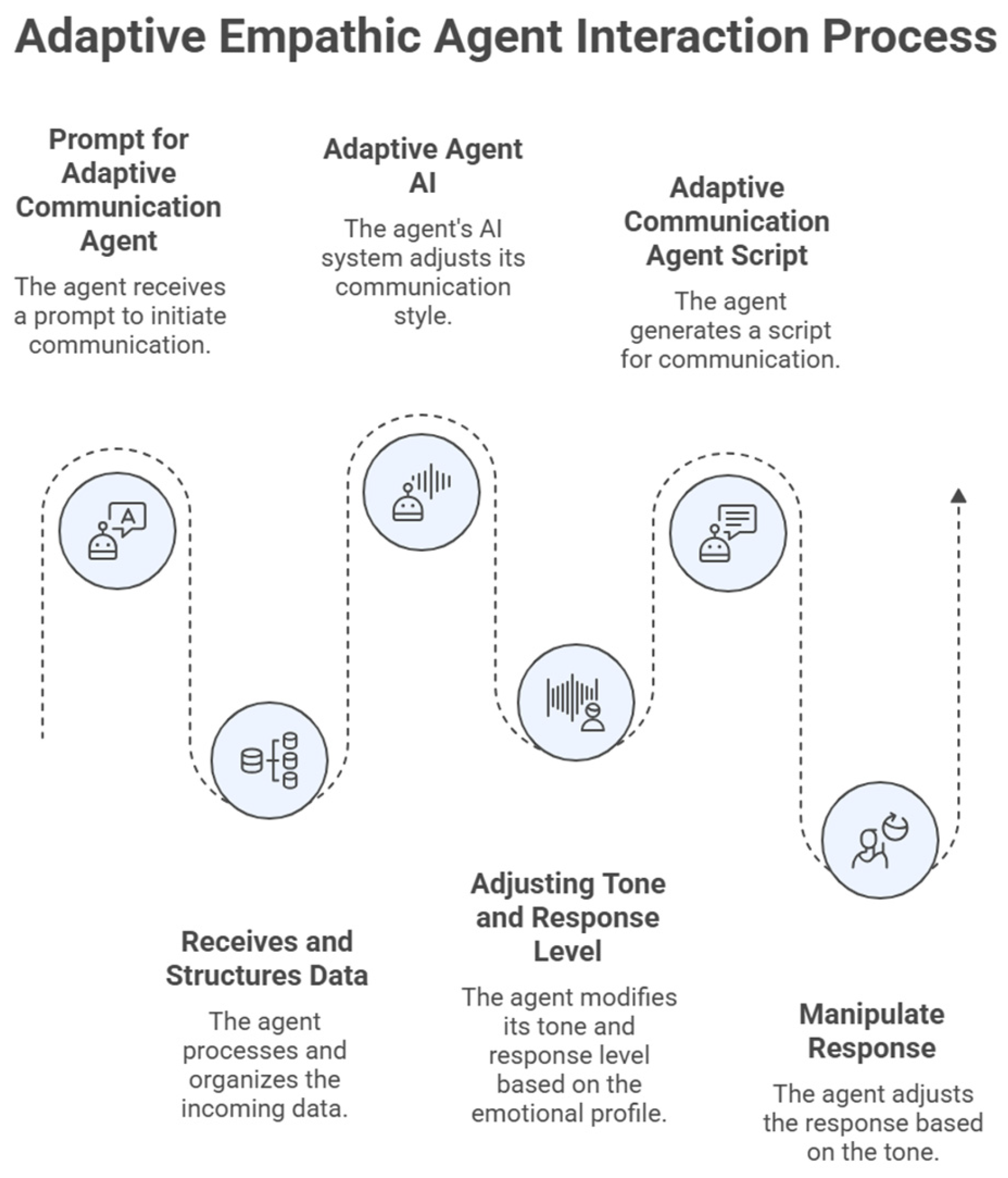
The Adaptive Empathic Agent (
Figure 9) is tasked with ensuring the interaction feels personalized and supportive. It achieves this by adjusting the tone and complexity of responses to emulate human-like empathy and scaffolding. Crucially, it encourages self-regulated learning by tailoring the conversational style based on the student’s perceived level of confidence and autonomy, fostering a supportive learning environment.
The Ethical–Pedagogical Filter acts as the final gatekeeper for all generated content. Its responsibility is to review all responses for accuracy, appropriateness, and educational integrity before they are presented to the user. This critical oversight function helps mitigate the risks of misinformation, especially when the system incorporates data from open repositories such as Wikipedia, ensuring the delivery of high-quality, trustworthy educational material.
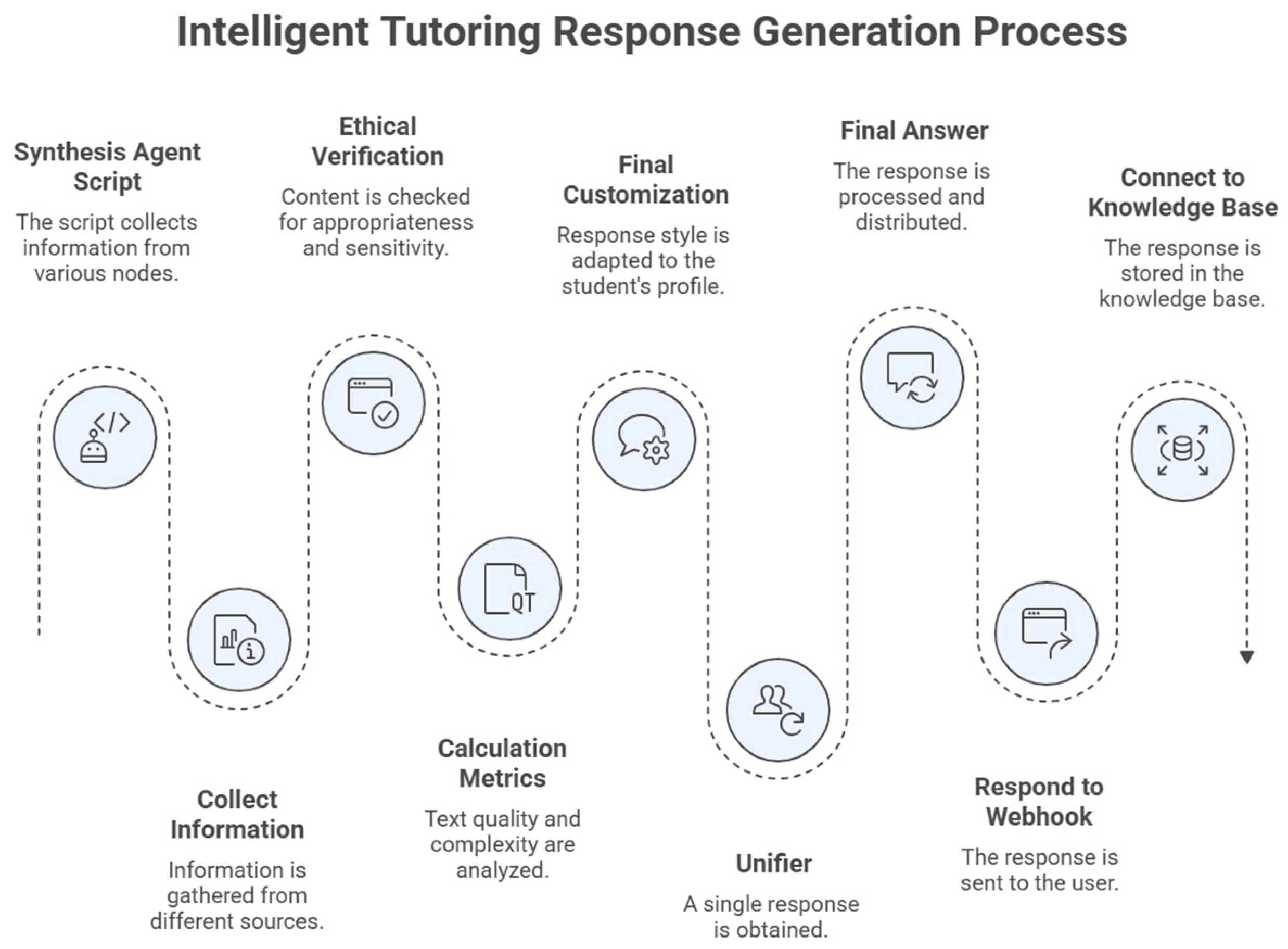
ELA Tutor integrates a response synthesis and validation agent (
Figure 10) that consolidates outputs from specialized agents to generate coherent and pedagogically aligned responses. The process includes ethical verification, quality evaluation (e.g., length and complexity), and final customization based on the learner’s profile. A unification module then merges all outputs into a single response for delivery. The final response is sent to the user via a webhook and stored in the knowledge base to support continuous improvement. This architecture ensures context-aware, ethically validated, and personalized tutoring.
2.3. User Interface and HAI
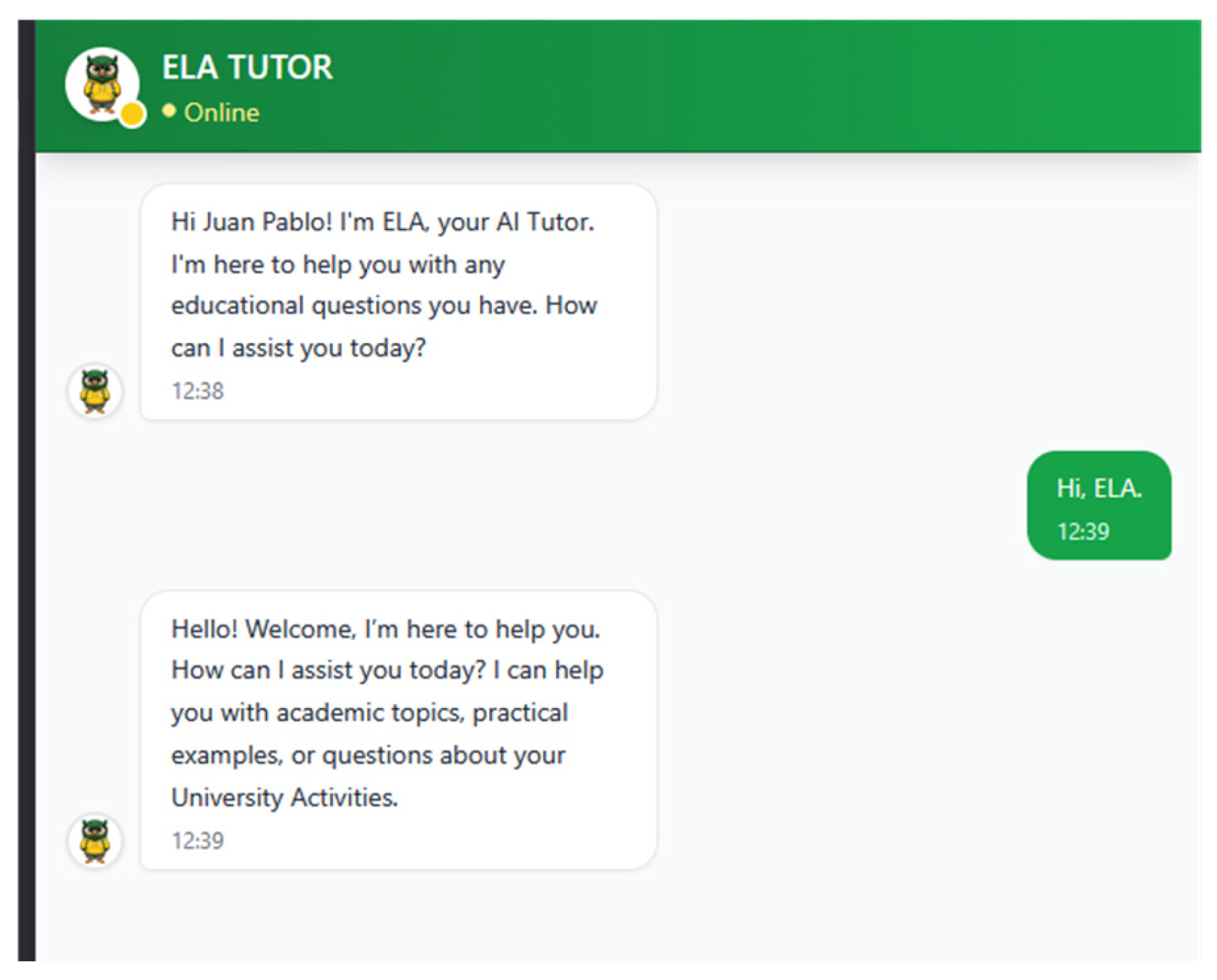
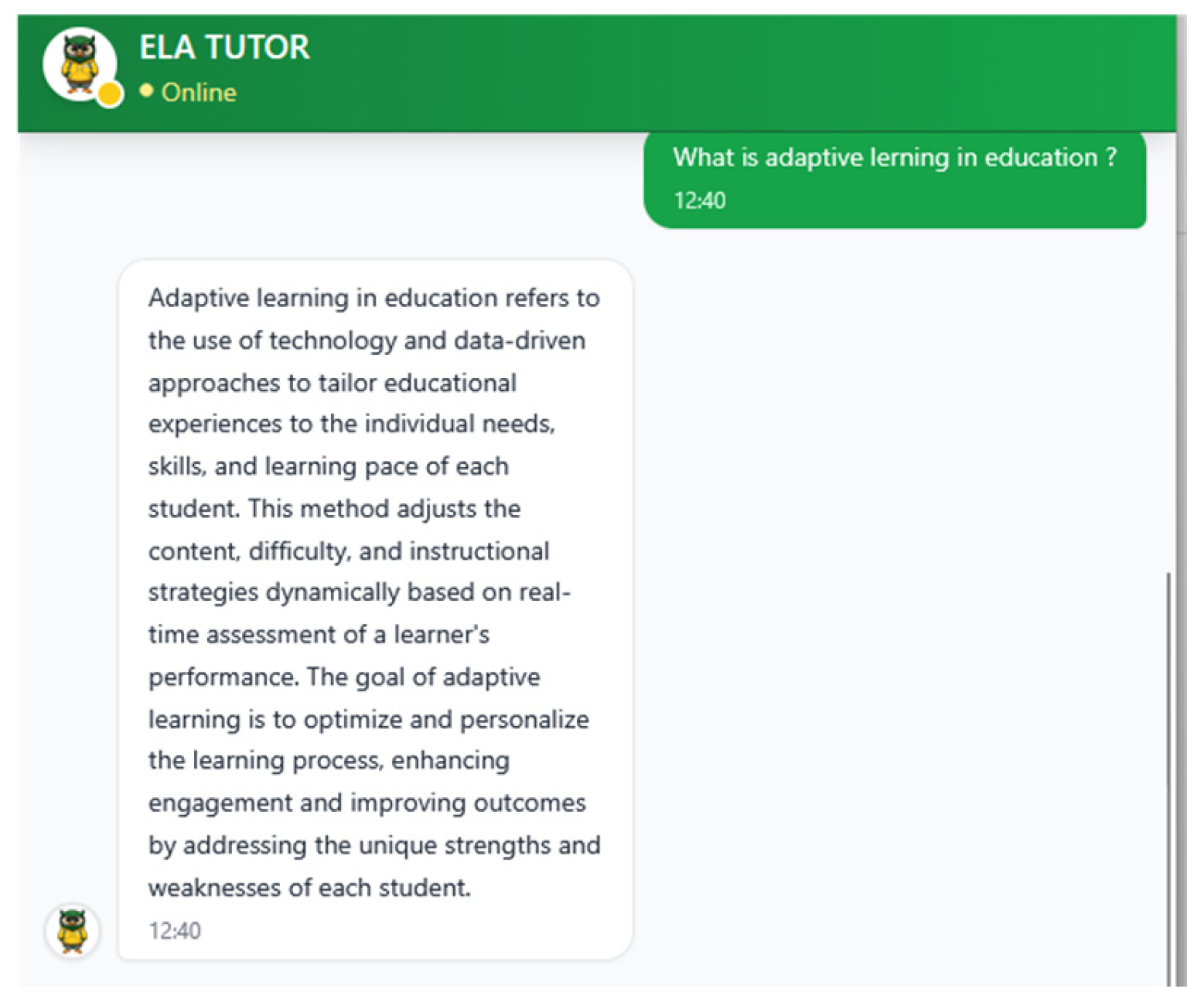
ELA Tutor includes a web-based conversational interface developed to support natural, fluid, and human-centered interaction between users (teachers and students) and the system. The design prioritizes ease of use, trust, and institutional branding to encourage adoption. The system is designed around a chat-based academic assistant, allowing users to interact naturally by typing questions or requests in a free-text format. This core feature enables a natural conversational flow, with responses appearing dynamically within the chat window to provide real-time tutoring support. The interface is shown in
Figure 11.
Figure 12 shows the moment of user interaction where the Pedagogical Agent takes over. Utilizing the input provided by the user’s prompt and drawing exclusively from the pre-defined knowledge base, this agent’s core function is to produce the necessary knowledge reinforcement material to support the students’ learning.
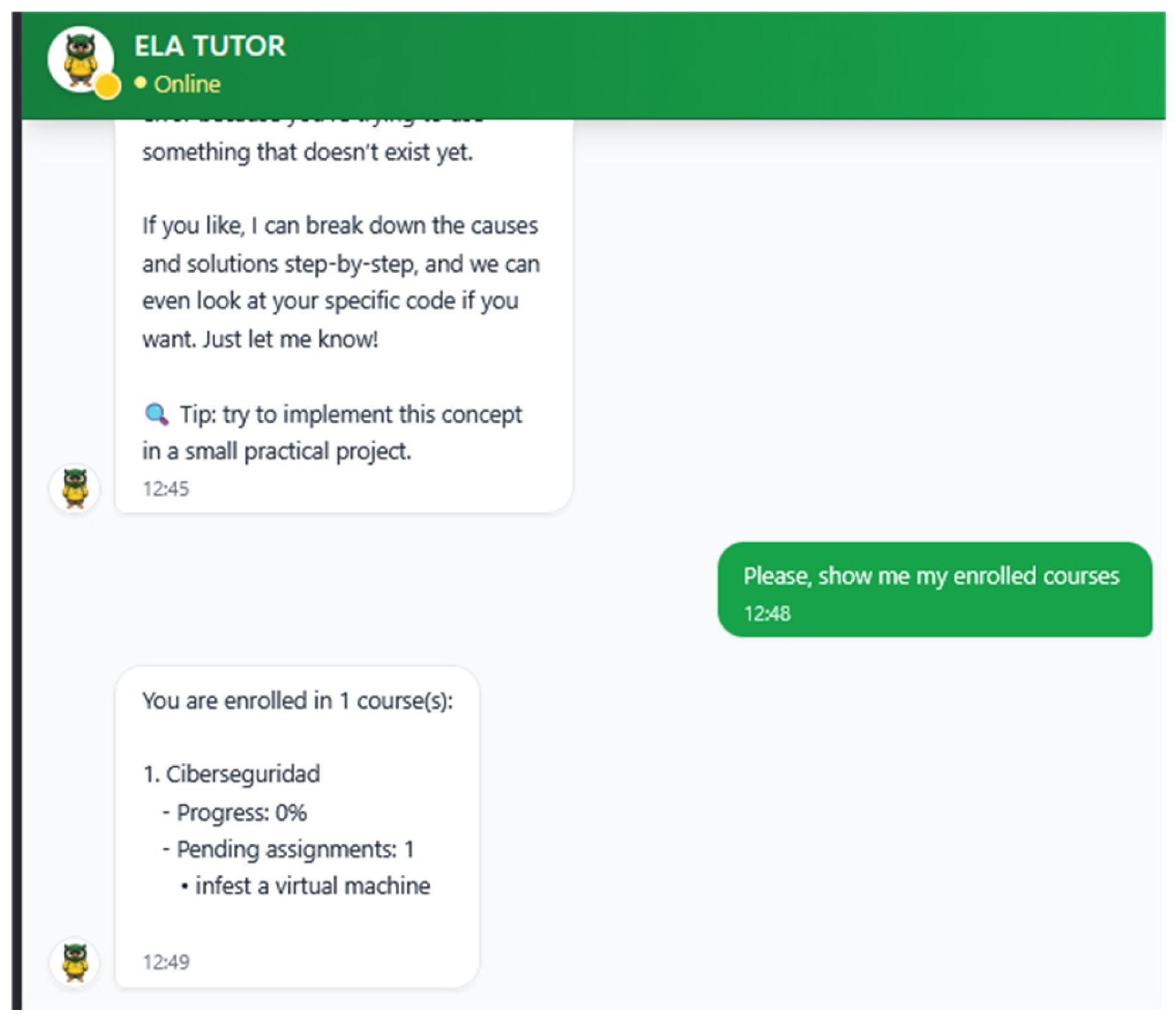
Figure 13 demonstrates the system’s operational exchange featuring the Practical Agent. In response to the user’s defined prompt, this agent leverages a repository of pre-trained practical scenarios validated by the State Polytechnic University of Carchi (UPEC) pedagogical team to produce technical output. A critical function of this agent is to ensure the response is contextually adapted to the local and regional specifics of the State Polytechnic University of Carchi’s Center for Entrepreneurship and University Well-being Office, thereby maximizing its practical relevance for the user.
This process is orchestrated through ELA Tutor, where the Intelligent Switching Router dynamically routes the user’s query to the appropriate agent based on intent, content complexity, and learner profile. Such orchestration allows the system to simulate real-time human–machine collaboration, reinforcing ELA Tutor’s role as an adaptive, context-aware learning assistant.
2.4. Diagram of the Architecture Implemented in n8n
The architecture implemented in n8n,
Figure 14a–c, represents the operational core of ELA Tutor, structuring an orchestration flow between the various specialized agents and the system’s processing layers. This environment enables task automation, intelligent query routing, and the modular integration of pedagogical, technical, and empathetic components. Each node within the flow performs a specific function in the tutoring process. The use of n8n as an orchestration platform facilitates transparent and extensible interaction among external systems such as academic databases, performance analysis modules, and LMS platforms. This configuration ensures that the ITS can adapt to different educational scenarios while maintaining a scalable and interoperable structure focused on automated decision-making.
2.5. Use Case Modeling of ELA Tutor
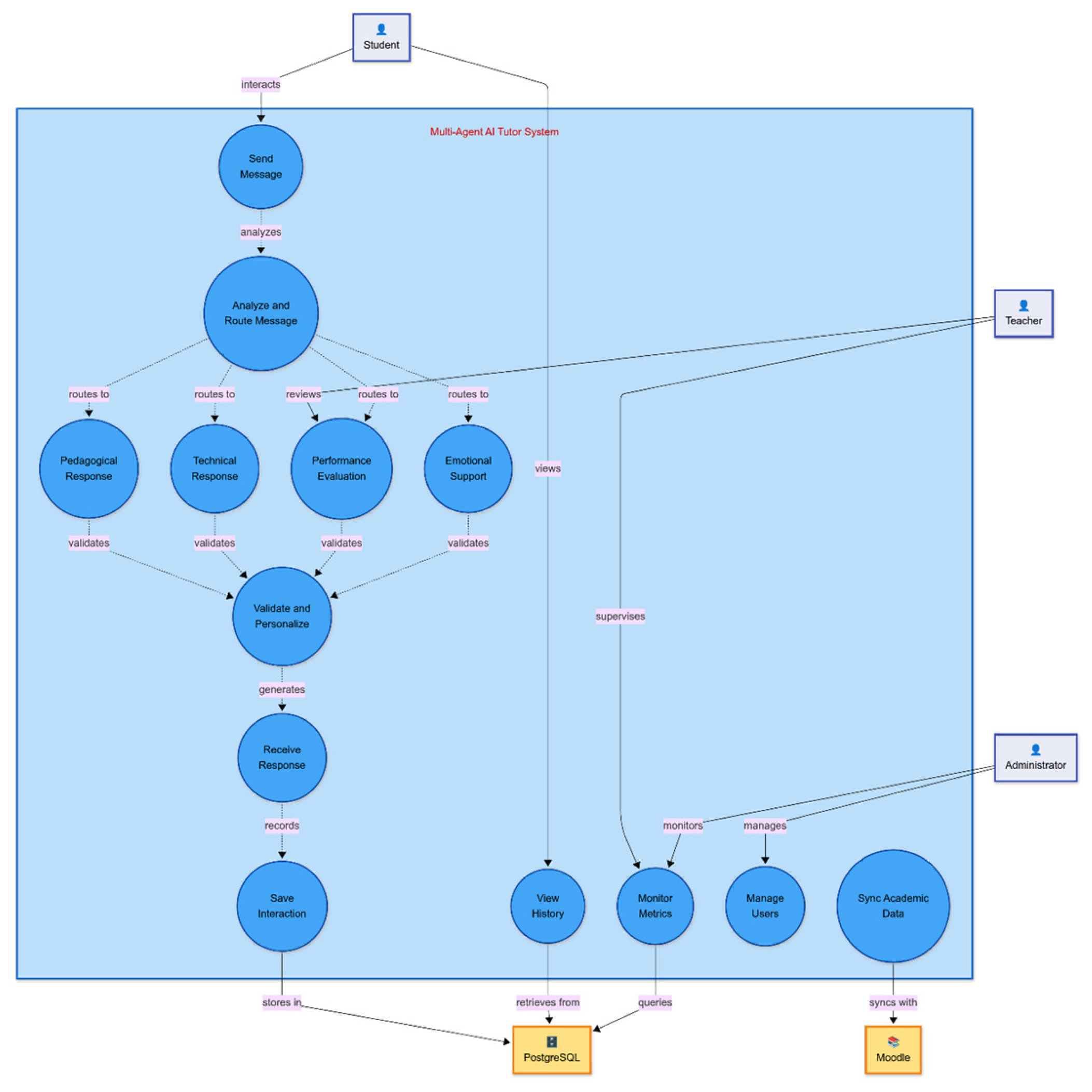
The use case diagram illustrates the functional structure of ELA Tutor developed under a MAS architecture (
Figure 15). The diagram shows how the student interacts with the system by sending queries, which are analyzed and classified by an intelligent routing module. Based on the detected intent, the system dynamically activates one of several specialized agents: a pedagogical agent, a technical agent, a performance analysis agent, or an empathic support agent. Each response is validated and personalized before being returned to the student and is simultaneously stored in a PostgreSQL knowledge repository to maintain a complete interaction history.
2.6. Case Study: Professors from the State Polytechnic University of Carchi
This study adopted a qualitative, exploratory, descriptive design to examine university teachers’ experiences with an ITS based on MAS architecture (ELA Tutor). The research aimed to evaluate the system’s adaptation to teaching practice, usability, learning personalization, information reliability, and institutional adoption potential across different teaching modalities.
A qualitative approach was chosen to gain an in-depth understanding of how teachers interact with the prototype and perceive its pedagogical relevance. Once the model was implemented, a rigorous case study was initiated in a controlled test environment to qualitatively validate ELA Tutor with a select group of faculty members. A total of 20 teachers from the State Polytechnic University of Carchi (UPEC) in Ecuador participated voluntarily. Purposeful sampling was used to ensure diversity regarding: (i) teaching modality (face-to-face, blended and online), (ii) academic fields (education, computing, health sciences, agribusiness, multimedia), and (iii) sociodemographic data, such as gender, age, current teaching modality, and academic program, which were collected to contextualize the analysis.
After the ELA Tutor prototype had been developed within an n8n-based architecture, it was validated with the participating lecturers. Validation followed three sequential stages: (i) system demonstration: teachers were introduced to the prototype through an explanation of its structure, agent-based workflow, and main features, answering theoretical and practical questions, and providing empathetic feedback; (ii) hands-on human–machine interaction: participants tested the system by submitting various types of questions (theoretical explanations, practical programming tasks) to explore its response accuracy, speed, and adaptability to different instructional contexts; and (iii) reflective feedback: teachers shared their impressions, evaluating ease of use, pedagogical relevance, and conditions for institutional adoption.
2.7. Data Collection Instrument
Data were gathered through a semi-structured interview protocol designed for this study. Open-ended questions allowed participants to elaborate freely on their experiences and expectations. Interviews were conducted individually in October 2025; each session lasted 30 to 45 min and included: viewing the system demonstration video, direct interaction with the ELA Tutor prototype and guided discussion using the semi-structured interview protocol. All interviews were audio-recorded with prior informed consent, transcribed verbatim, and organized into a qualitative analysis matrix. The study was conducted in accordance with institutional ethical guidelines and was approved by the corresponding ethics committee; supporting documentation is available upon request.
The interview comprised two sections: (i) sociodemographic profile: gender, age, modality, and academic program; (ii) pedagogical and technological dimensions:
Adaptation to teaching practice: fit to students’ learning needs and curriculum alignment.
Usability and user experience: ease of use, interface clarity, navigation, and learning curve.
Personalization of student learning: ability to tailor resources, activities, and assessment to individual progress.
Reliability and quality of information: perceived trustworthiness and academic rigor of the system’s responses.
Adoption and institutional recommendation: willingness to integrate the ITS institutionally and suggested improvements.
2.8. Data Analysis
A thematic content analysis combining deductive and inductive approaches was applied. Deductive coding was guided by five predefined evaluation dimensions: adaptation, usability, personalization, reliability, and adoption. Inductive coding enabled the identification of emerging subthemes, including asynchronous support, institutional platform integration, content curation, multimodal capabilities, and teacher training needs.
The coding process followed a structured procedure. First, interview responses were reviewed and segmented into meaningful units. Subsequently, open and axial coding were performed manually, supported by digital tools to organize, group, and visualize patterns. The categorization was conducted by the research team using a consistent coding framework applied across all responses. Each participant was anonymized using identifiers (Teacher 1–Teacher 20).
To enable systematic comparison and synthesis of qualitative data, responses were mapped into ordinal categories based on predefined criteria. These criteria considered: (i) the frequency of recurring responses across participants, (ii) the consistency of perspectives within each dimension, and (iii) the intensity or emphasis expressed in the discourse. The resulting categorization was reviewed collaboratively among the authors to ensure coherence and consistency in category assignments.
The ordinal scales were defined as follows:
Adaptation to Teaching Practice: high, medium, or low
Usability and User Experience: very easy, easy, or medium
Personalization of Student Learning: high, medium, or low
Reliability and Quality of Information: high, medium, or low
Adoption and Institutional Recommendation: full adoption, adoption with recommended improvements, or limited adoption
Comparative analyses were conducted considering gender, age group, and teaching modality, complemented by frequency counts and pattern mapping to identify convergences and divergences across subgroups.
The study adhered to standard ethical research practices in educational technology. Participation was voluntary, and all respondents provided informed consent prior to data collection. Responses were anonymized to ensure confidentiality, and the data were used exclusively for research purposes. Ethical approval documentation is available upon request.
3. Results
The following results summarize the main findings across the key evaluation criteria, which included adaptation to teaching practice, usability, personalization of learning, reliability of information, and institutional adoption potential.
The evaluation of teachers’ responses indicates a strong perception of high adaptability and ease of use of the proposed ELA Tutor. Most participants (85%) rated the system as highly adaptable to their instructional practice, highlighting its ability to support asynchronous assistance and extend learning beyond the classroom. Usability was consistently perceived as easy, with no participant reporting major barriers to interaction, indicating that the system requires minimal technical training. Regarding the personalization of student learning, 70% of teachers identified a strong capacity to adapt responses and activities to learners’ needs, while a smaller group (30%) considered personalization to be moderate, often linked to limited control over content configuration. In terms of reliability and quality of information, responses were more divided: 50% fully trusted the content generated—especially when fed with curated academic resources—while the remaining participants expressed moderate trust, requesting stronger integration with validated institutional databases.
Concerning institutional adoption, the majority (75%) explicitly recommended the system, either without reservations or with minor improvements, better content filtering, and deeper LMS integration, while only one participant (Teacher 17) expressed limited willingness to adopt ELA Tutor, citing concerns about information accuracy and technical complexity. These findings indicate that the system is well-positioned for large-scale deployment but would benefit from enhancements in content reliability and personalization flexibility to increase teacher confidence and adoption. These distributions are summarized in
Table 1, which presents the frequency and percentage of teacher evaluations across the five analyzed dimensions.
3.1. Featured Reviews and Limitations
Among the interviewed teachers, Teacher 15 demonstrated the most consistent and assertive evaluation of the proposed ELA Tutor based on a MAS architecture. Their assessment reflected full alignment between the system’s design and pedagogical practice, emphasizing adaptability, usability, and academic reliability. The teacher described the ITS as seamlessly integrated into their instructional workflow, particularly valuing its ability to provide asynchronous support and individualized feedback aligned with course objectives.
“The system feels like a real extension of my teaching. It understands the context of the course, provides accurate responses, and supports students even during outside class hours. It’s intuitive, fast, and genuinely useful for guiding learning.”
This response illustrates the ITS’s potential for effective adoption in higher education settings when supported by institutional validation of academic content and pedagogical supervision. It also demonstrates how the system’s human–AI interaction, mediated by adaptive agents and contextualized feedback, can enhance the perception of technological trust and pedagogical relevance among faculty members.
Teacher 17 exhibited the lowest level of confidence and engagement with the proposed MAS based ITS. While acknowledging the system’s conceptual potential, this participant reported significant reservations regarding its reliability, accuracy of information, and practical integration into classroom dynamics. The teacher characterized the experience as partially misaligned with their pedagogical needs, citing concerns about the transparency of automated reasoning and the trustworthiness of open-source data.
“Sometimes the answers seemed too general or not well-aligned with my class. I would prefer to verify the sources before showing them to students otherwise, I’m not fully confident using it in real teaching.”
This perspective highlights a critical dimension of institutional adoption: while most teachers perceived the ITS as pedagogically supportive, a minority expressed apprehension toward full automation in instructional contexts. Such feedback underscores the importance of integrating content validation protocols, teacher-controlled configuration panels, and academic database connections to enhance system credibility and teacher trust in future iterations.
3.2. Interview Results by Gender
The interview analysis revealed that both female and male teachers perceived ELA Tutor positively as a support tool for teaching practice. Among female teachers (n = 11), 82% reported that ELA Tutor adapts well to their instructional practice, primarily due to its ability to provide asynchronous support and resolve questions outside scheduled class hours, benefiting students with limited attendance or multiple responsibilities; 91% rated its usability as easy or very easy, highlighting the chat-style interface and low learning curve; and 73% reported that the system supports the personalization of activities and resources when teachers can control the content.
Regarding information reliability, 55% expressed full confidence when sources were teacher-defined, while 45% raised concerns about reliance on open sources such as Wikipedia and others. Moreover, 64% recommended institutional adoption without reservations, while 36% supported adoption on condition of certain improvements, such as integration with academic databases and multimodal capabilities.
Among male teachers (n = 9), acceptance was similarly high: 78% perceived ELA Tutor as well adapted to their teaching practice. All participants agreed that it is simple to use and requires no extensive training. In addition, 78% highlighted its capacity to support personalized learning by addressing different learning paces. Information reliability was considered high by 56%, although several respondents recommended enhancing the academic quality of sources. Finally, 78% recommended institutional adoption, while 22% requested technical refinements and more specialized content.
3.3. Results of the Interviews by Age
To deepen the interpretive analysis of faculty perceptions, the evaluation of ELA Tutor was stratified by age range, allowing for the identification of patterns associated with teaching experience and digital adaptability. Participants were classified into four ranges (20–30, 31–40, 41–50, and 51–60 years old), reflecting representative stages of academic professionalization in higher education.
This segmentation enabled a more controlled comparison across the five analytical dimensions: Adaptation to Teaching Practice, Usability and User Experience, Personalization of Student Learning, Reliability and Quality of Information, and Adoption and Institutional Recommendation.
Such differentiation supports an understanding of how generational and cognitive factors influence the acceptance and operational integration of the ITS within pedagogical workflows. The results, summarized in
Table 2, demonstrate consistent recognition of the system’s adaptability and usability across all groups, with younger faculty highlighting interactional affordances and automation efficiency, whereas senior educators emphasized pedagogical reliability, training requirements, and institutional scalability as determinants for large scale adoption.
3.4. Results of the Interviews by Study Modality and Pedagogical Criteria
Perceptions of ELA Tutor varied slightly by teaching modality but remained consistently positive. In the blended/semi-presential modality (n = 8), teachers expressed the highest acceptance, with 100% rating usability as easy and 88% emphasizing its value for supporting students with limited time and need for asynchronous guidance. Personalization was considered effective by 75%, and most recommended institutional adoption, though some requested learning analytics and multimodal features.
In the face-to-face modality (n = 8), 88% highlighted the system’s ease of use and 75% its usefulness for addressing immediate questions and complementing classroom activities. Information reliability was moderate (split between high and medium), and teachers advised stronger integration with in-class teaching. For the fully online modality (n = 4), 75% valued ELA Tutor’s adaptability to remote learning and found it easy to use but stressed the need for better handling of visual, mathematical, and technical content. Despite these concerns, all participants recommended its adoption, emphasizing the importance of teacher training and institutional content curation.
Table 3 provides a summary of teachers’ perceptions regarding the proposed ITS model.
3.5. Interview Results—Aspects for Improvement
Table 4 presents aspects of ELA Tutor that university teachers identified as requiring improvement. The most common suggestions concerned improving content reliability, personalization options, and technical integration, emphasizing the importance of institutional support and teacher agency in system refinement.
3.6. Quantitative Evaluation Results Across Pedagogical Dimensions
Although the present study is based on an exploratory qualitative evaluation, complementary quantitative evidence from prior implementations of the ELA Tutor system provides additional support. In a previous study conducted with 150 university students from the Multimedia and Audiovisual Production program in a real learning environment, the system was evaluated using Likert-scale metrics across three key dimensions: usability; satisfaction and usefulness; and accessibility and interaction [
55].
The results showed positive evaluations across all dimensions. Usability obtained a mean score of 3.77 (SD = 1.21), indicating that students perceived the system as relatively easy to use. Satisfaction and usefulness reached a mean value of 3.82 (SD = 1.02), reflecting a favorable perception of the system’s contribution to the learning process. Accessibility and interaction achieved the highest score, with a mean of 3.90 (SD = 1.15), suggesting effective communication and interaction within the learning environment.
These findings reinforce the robustness of the proposed architecture and provide quantitative support for the positive perceptions identified in the present study.
This study should be understood in relation to prior work on the ELA Tutor system. A previously published study [
55] provides quantitative evidence based on student interaction in a real learning environment, focusing on usability, satisfaction, and interaction quality. In contrast, the present study adopts an exploratory qualitative approach centered on university instructors, aiming to assess pedagogical integration, perceived usability, and potential for institutional adoption in a controlled setting.
Together, both studies represent complementary phases of system validation. The student-based evaluation offers quantitative insights into user experience and interaction performance, while the current instructor-based study provides qualitative evidence regarding pedagogical applicability and integration within teaching practices. This combined perspective contributes to a more comprehensive understanding of the system’s potential in higher education contexts.
4. Discussion
The results of this research show the high acceptance and positive evaluation of ELA Tutor. Most teachers considered that the system adapts effectively to teaching practice, facilitates the personalization of learning, and has an intuitive interface with a low learning curve. The general perception reflects that the proposed model manages to balance technological automation with pedagogical guidance, strengthening asynchronous support and learning continuity.
To contextualize the proposed system, a comparative analysis was conducted with traditional ITSs and recent GenAI-based tutoring approaches. Conventional ITSs typically rely on rule-based or static architectures [
34,
39,
42], which limit their capacity for dynamic adaptation and real-time personalization. In contrast, emerging GenAI-based systems provide greater flexibility in content generation but often lack structured orchestration and pedagogical coherence.
The proposed system addresses these limitations by combining a MAS architecture with workflow orchestration, enabling coordinated interaction between specialized agents responsible for pedagogical guidance, technical support, performance analysis, and adaptive responses. This design allows for more structured and context-aware decision-making compared to monolithic GenAI solutions.
Furthermore, the integration of pedagogical and adaptive components within a unified framework ensures that system responses are not only contextually relevant but also aligned with instructional objectives and learning processes. This combination positions the proposal as a hybrid approach that bridges the gap between traditional ITSs and purely generative AI-based systems.
This finding highlights the importance of a distributed, flexible, and ethical architecture capable of adapting tutoring based on the educational context and the behavior of the teacher and student, thus contributing to the personalization of the teaching and learning process. Compared to previous studies, the results confirm the pedagogical and technical advantages of MASs over traditional approaches based on rules or single agents. Research, such as that conducted by previous studies [
21,
23,
26], highlights that MAS environments significantly enhance system adaptability while reducing the structural rigidity characteristic of traditional frameworks such as JADE or SPADE.
Teachers’ perceptions coincide with the findings of [
8,
39,
45,
46,
50], which show that intelligent tutors with GenAI components promote student autonomy and motivation when accompanied by a layer of ethical control and pedagogical supervision. Unlike other models, the ELA Tutor developed in this study incorporates a centralized decision-making system with specialized agents, that work cooperatively, positioning it as a more comprehensive, adaptive, and verifiable model than solutions based solely on LLMs or generic conversational chatbots such as ChatGPT.
Analysis of the interviews suggests that teachers perceive ELA Tutor not as a substitute, but as a technological–pedagogical tool capable of extending teaching beyond the classroom. This interpretation consists of contemporary theories of self-regulated learning and intrinsic motivation [
11,
23,
37], according to which empathetic support and personalized feedback increase student engagement in the learning process.
Teachers in blended and virtual modalities were the ones who most highlighted the value of the system in asynchronous support and immediate feedback, which reinforces its applicability in hybrid learning environments. It is important to note that teachers in face-to-face modalities valued ITSs as an extension of the traditional classroom, reinforcing concepts, and maintaining student interest outside of class hours.
The existence of the switching module allowed the different agents of the system to be coordinated, offering differentiated responses according to the type of query, thus ensuring contextual, ethical, and cognitively diverse tutoring. This adaptive behavior marks a substantial difference from traditional tutors, who tend to follow linear sequences without the capacity for contextual inference.
The study has significant strengths. First, ELA Tutor’s architecture demonstrates a technical advance over previous models, enabling fluid communication between heterogeneous agents and ethical management of information flow. Second, the combination of pedagogical analysis, technical design, and qualitative evaluation offers a comprehensive understanding of the impact of ELA Tutor on university teaching. The incorporation of an adaptive empathic agent and an ethical–pedagogical filter reinforces the humanized approach of the system, consolidating its value as a model of intelligent tutoring focused on responsible interaction between humans and autonomous agents.
A controlled quasi-experimental phase is proposed to evaluate the pedagogical effectiveness of the multi-agent-based ITS from the students’ perspective. Similar to the pretest and posttest designs adopted in previous studies such as [
8,
36], this phase will assess learning outcomes across multiple university disciplines, focusing on knowledge retention, academic performance, and self-regulated learning. While traditional ITS evaluations have primarily focused on cognitive gains, this study expands the analysis by incorporating affective and autonomy-related metrics, thereby offering a broader understanding of the system’s educational impact.
The study will consider objective pedagogical metrics, such as normalized learning gain (N-gain), improvement in problem solving, reduction in conceptual errors, and the ability to transfer acquired knowledge. At the same time, affective and motivational indicators will be integrated, evaluating the perception of intelligent support, HAI, and the influence of ITSs on student self-confidence and self-regulation. The system demonstrates the potential of orchestrated AI-driven education.
From a comparative perspective, the proposed architecture introduces several elements that differentiate it from traditional ITSs and recent GenAI-based tutoring approaches. Conventional ITSs typically rely on predefined rules or static instructional flows, limiting their capacity to dynamically adapt to diverse learning contexts. In contrast, purely GenAI-based systems offer flexible content generation but often lack structured orchestration and pedagogical control.
The proposed system addresses these limitations by combining a multi-agent architecture with an intelligent routing mechanism, enabling coordinated interaction among specialized agents. This design supports context-aware decision-making, allowing the system to adapt responses based on query type, learner profile, and cognitive complexity. Furthermore, the integration of pedagogical and ethical components within the architecture contributes to maintaining instructional coherence and reducing the risks associated with uncontrolled content generation.
These characteristics position the proposed approach as a hybrid solution that balances flexibility and control, offering a structured yet adaptive framework for supporting tutoring processes in higher education environments.
5. Limitations
This study presents an exploratory validation of the proposed system and, therefore, has several limitations that should be acknowledged. First, the evaluation is primarily based on a qualitative analysis conducted with a limited sample of university instructors, which restricts the generalizability of the findings. Second, the study does not include objective performance metrics, such as learning outcomes or system efficiency indicators, nor a comparative evaluation against existing Intelligent Tutoring Systems or Generative AI-based solutions. Additionally, the quantitative evidence incorporated derives from prior implementations and should be interpreted as complementary rather than as a direct validation of the present study. Finally, the evaluation was conducted in a controlled environment prior to full deployment, which may not fully reflect real-world educational dynamics. Future work will address these limitations through large-scale experimental validation, integration with institutional data sources, and the inclusion of objective and comparative evaluation metrics.
6. Conclusions
The proposed framework for ELA Tutor represents a contribution to personalized adaptive learning and tutoring approaches in virtual learning environments by integrating AI-driven technologies within an n8n-based architecture. By combining LLMs with HAI techniques, the system is designed to adapt content and pedagogical strategies to the specific needs of each teacher, addressing some limitations of traditional ITSs, which are typically characterized by static flows and limited personalization capabilities.
Orchestration based on n8n enables fluid communication between specialized MASs, supporting pedagogical coherence and the traceability of cognitive processes within the educational environment. Compared to conventional MAS frameworks such as JADE or SPADE, the proposed system provides a modular and interoperable structure, facilitating integration with institutional LMS platforms in an agile and accessible manner.
The combination of multiple specialized agents within the ITS, coordinated through an intelligent switching module, constitutes a key architectural element of this proposal, as it allows for dynamic and contextual interaction across different dimensions of the tutoring process. The switch orchestrated in n8n operates as a central decision node, capable of analyzing query type, learner profile, and cognitive complexity to determine appropriate agent responses. This distributed architecture supports functional specialization while maintaining coherence in the generated responses.
Qualitative evaluation conducted with university instructors from the State Polytechnic University of Carchi (UPEC) indicates a positive perception of the system in terms of usability, adaptability, and potential for institutional adoption. Additionally, complementary quantitative evidence from prior student-based implementations suggests favorable results in usability, satisfaction, and interaction. However, these findings should be interpreted as part of an initial validation phase conducted in controlled environments.
From a pedagogical perspective, the intelligent switching mechanism supports non-linear tutoring processes, enabling adaptive responses aligned with the nature of the interaction and learner progression. While this design reflects characteristics associated with expert tutoring, its impact on learning outcomes has not yet been empirically validated.
The five criteria evaluated in the system by university teachers, namely, adaptation, usability, personalization, reliability, and institutional adoption, indicate a general trend toward acceptance and perceived usefulness of the system. Teachers emphasized that ELA Tutor has the potential to extend asynchronous support and tutoring beyond the classroom. Critical observations highlighted the need to improve content validation and integration with institutional learning platforms.
Despite the promising results, this study presents several limitations that should be acknowledged. First, the evaluation is primarily based on perception data collected from a limited sample of instructors, which may not fully reflect actual system performance in real educational contexts. Second, the study does not include objective performance metrics or benchmarking against existing ITSs or GenAI-based systems, limiting the ability to quantitatively assess its effectiveness.
However, the findings should be interpreted within the exploratory scope of the study, as the evaluation does not include objective performance metrics or comparative analysis with existing systems. In this sense, the contribution of this work lies in the design and initial validation of a coordinated multi-agent framework that enables context-aware and adaptive tutoring. Future research will focus on large-scale empirical validation, including student-centered evaluations, learning outcome measurements, and benchmarking against other ITSs and generative AI-based approaches.
Author Contributions
All authors contributed to the conception and design of the study. J.P.L.-G. was responsible for material preparation, data collection, and drafting both the initial and final versions of the manuscript. J.M.G.G. contributed to conceptualization, software development, data analysis, validation of results, and drafting of the initial manuscript. A.G.-B. contributed to methodology validation, provided conceptual guidance, and supervised the research process. Y.D. contributed to data curation, methodological supervision, and critical revision of the manuscript. All authors have read and agreed to the published version of the manuscript.
Funding
This research is part of the International Chair Project on Trustworthy Artificial Intelligence and Demographic Challenge within the National Strategy for Artificial Intelligence (ENIA), in the framework of the European Recovery, Transformation and Resilience Plan. Reference: TSI-100933-2023-0001. This project is funded by the Secretary of State for Digitalization and Artificial Intelligence and by the European Union (Next Generation).
Institutional Review Board Statement
The study was conducted in accordance with the Declaration of Helsinki and was reviewed by the Ethics Committee for Research in Human Beings of the Universidad Politécnica Estatal del Carchi (CEISH-UPEC). The committee determined that the study does not present any risk and is therefore exempt from further ethical review (3 June 2025).
Informed Consent Statement
Informed consent was obtained from all subjects involved in the study. Authorization and informed consent were requested prior to the application of the data collection instrument.
Data Availability Statement
Qualitative research data were collected through semi-structured interviews conducted with university faculty members as part of this study. The data consists of anonymized interview transcripts and thematic coding results used to support the analysis and findings reported in the manuscript. Due to ethical considerations and the need to protect participants’ confidentiality, the full interview transcripts are not publicly available. However, the anonymized data and supporting materials can be made available by the corresponding author upon reasonable request.
Acknowledgments
The authors would like to thank the Universidad Politécnica Estatal del Carchi and the Multimedia and Audiovisual Production program for their support in the development of this study.
Conflicts of Interest
The authors declare that there are no conflicts of interest, financial, personal, or academic, that could have influenced the results presented in this manuscript. All authors have contributed equally and transparently to the development of this research and approve its submission for review and potential publication.
Abbreviations
The following abbreviations are used in this manuscript:
| MAS | Multi-Agent System |
| ITS | Intelligent Tutoring System |
| AI | Artificial Intelligence |
References
- Memarian, B.; Doleck, T. A scoping review of reinforcement learning in education. Comput. Educ. Open 2024, 6, 100175. [Google Scholar] [CrossRef] [Scilit]
- Ertmer, P.A.; Newby, T.J. Behaviorism, Cognitivism, Constructivism: Comparing Critical Features from an Instructional Design Perspective. Perform. Improv. Q. 1993, 6, 50–72. [Google Scholar] [CrossRef] [Scilit]
- Iglesias, A.; Martínez, P.; Aler, R.; Fernández, F. Learning teaching strategies in an Adaptive and Intelligent Educational System through Reinforcement Learning. Appl. Intell. 2009, 31, 89–106. [Google Scholar] [CrossRef] [Scilit]
- Fahad Mon, B.; Wasfi, A.; Hayajneh, M.; Slim, A.; Abu Ali, N. Reinforcement Learning in Education: A Literature Review. Informatics 2023, 10, 74. [Google Scholar] [CrossRef] [Scilit]
- Hooda, M.; Rana, C.; Dahiya, O.; Rizwan, A.; Hossain, M.S. Artificial Intelligence for Assessment and Feedback to Enhance Student Success in Higher Education. Math. Probl. Eng. 2022, 2022, 5215722. [Google Scholar] [CrossRef] [Scilit]
- Sengar, S.S.; Hasan ABin Kumar, S.; Carroll, F. Generative artificial intelligence: A systematic review and applications. Multimed. Tools Appl. 2025, 84, 23661–23700. [Google Scholar] [CrossRef] [Scilit]
- Ba, S.; Yang, L.; Yan, Z.; Looi, C.K.; Gašević, D. Unraveling the mechanisms and effectiveness of AI-assisted feedback in education: A systematic literature review. Comput. Educ. Open 2025, 9, 100284. [Google Scholar] [CrossRef] [Scilit]
- Dawson, M.G.; Deer, R.; Boguslawski, S. Cognitive dissonance in programming education: A qualitative exploration of the impact of generative AI on application-directed learning. Comput. Hum. Behav. Rep. 2025, 19, 100724. [Google Scholar] [CrossRef] [Scilit]
- Dong, C.; Yuan, Y.; Chen, K.; Cheng, S.; Wen, C. How to Build an Adaptive AI Tutor for Any Course Using Knowledge Graph-Enhanced Retrieval-Augmented Generation (KG-RAG). In Proceedings of the 2025 14th International Conference on Educational and Information Technology (ICEIT); IEEE: Piscataway, NJ, USA, 2025; pp. 152–157. [Google Scholar] [CrossRef] [Scilit]
- Thalheimer, J.M.; Haendchen Filho, A.; Pereira Briks, F.J.; Ribeiro, R.C.; Concatto Fernando Viecelli, A.K. A Microservice-driven Collaborative Agent in Virtual Learning Environments: A Role Model for a Tracing Agent. In Proceedings of the 16th Brazilian Symposium on Information Systems on Digital Transformation and Innovation, SBSI 2020; Viana, D., e Silva, S.D., Magdaleno, A.M., Horita, F.E.A., Kamienski, C.A., Eds.; Association for Computing Machinery: New York, NY, USA, 2020. [Google Scholar] [CrossRef] [Scilit]
- Cui, L. Research of Intelligent Tutoring System Based on Deep Learning Computer Technology. In Proceedings of the International Conference on Applied Intelligence and Sustainable Computing, ICAISC 2023; Institute of Electrical and Electronics Engineers Inc.: Piscataway, NJ, USA, 2023. [Google Scholar] [CrossRef] [Scilit]
- Motlagh, N.Y.; Khajavi, M.; Sharifi, A.; Ahmadi, M. The Impact of Artificial Intelligence on the Evolution of Digital Education: A Comparative Study of OpenAI Text Generation Tools including ChatGPT, Bing Chat, Bard, and Ernie. 19 May 2025. Available online: http://arxiv.org/abs/2309.02029 (accessed on 27 September 2025).
- Agbo, F.J.; Olivia, C.; Oguibe, G.; Sanusi, I.T.; Sani, G. Computing education using generative artificial intelligence tools: A systematic literature review. Comput. Educ. Open 2025, 9, 100266. [Google Scholar] [CrossRef] [Scilit]
- Teng, D.; Wang, X.; Xia, Y.; Zhang, Y.; Tang, L.; Chen, Q.; Zhang, R.; Xie, S.; Yu, W. Investigating the utilization and impact of large language model-based intelligent teaching assistants in flipped classrooms. Educ. Inf. Technol. 2025, 30, 10777–10810. [Google Scholar] [CrossRef] [Scilit]
- Cambaz, D.; Zhang, X. Use of AI-driven Code Generation Models in Teaching and Learning Programming: A Systematic Literature Review. In Proceedings of the 55th ACM Technical Symposium on Computer Science Education, SIGCSE 2024; Association for Computing Machinery: New York, NY, USA, 2024; Volume 1, pp. 172–178. [Google Scholar] [CrossRef] [Scilit]
- López-Goyez, J.P.; González-Briones, A.; Chamorro, A.F. Models of Intelligent Tutoring Systems Based on Autonomous Agents for Virtual Learning Environments: A Systematic Literature Review. In Advances in Practical Applications of Agents, Multi-Agent Systems, and Digital Twins: The PAAMS Collection; Springer Nature: Cham, Switzerland, 2025; pp. 184–195. [Google Scholar] [CrossRef] [Scilit]
- Fleming, N.D.; Mills, C. Not Another Inventory, Rather a Catalyst for Reflection. Improv. Acad. 1992, 11, 137–155. [Google Scholar] [CrossRef] [Scilit]
- Kolb, D.A. Experiential Learning: Experience as the Source of Learning and Development; Prentice-Hall: Englewood Cliffs, NJ, USA, 1984; ISBN 978-0-13-295261-3. [Google Scholar]
- Felder, R. Learning and Teaching Styles in Engineering Education. 2002. Available online: http://www.ncsu.edu/felder-public/ILSpage.html (accessed on 10 September 2025).
- Gardner, H. Intelligence Reframed: Multiple Intelligences for the 21st Century; Basic Books: New York, NY, USA, 1999. [Google Scholar]
- Johnson, W.L. Pedagogical agent research at CARTE. AI Mag. 2001, 22, 85–94. [Google Scholar] [CrossRef]
- Frasson, C.; Chalfoun, P. Managing learner’s affective states in intelligent tutoring systems. Stud. Comput. Intell. 2010, 308, 339–358. [Google Scholar] [CrossRef] [Scilit]
- Schroeder, N.L.; Romine, W.L.; Craig, S.D. Measuring pedagogical agent persona and the influence of agent persona on learning. Comput. Educ. 2017, 109, 176–186. [Google Scholar] [CrossRef] [Scilit]
- Buche, C.; Querrec, R.; De Loor, P.; Chevaillier, P. MASCARET: Pedagogical Multi-Agents System for Virtual Environment for Training. In Proceedings. 2003 International Conference on Cyberworlds; IEEE: Singapore, 2003; pp. 423–430. [Google Scholar] [CrossRef] [Scilit]
- Xu, D.; Huang, W.W.; Wang, H.; Heales, J. Enhancing e-learning effectiveness using an intelligent agent-supported personalized virtual learning environment: An empirical investigation. Inf. Manag. 2014, 51, 430–440. [Google Scholar] [CrossRef] [Scilit]
- Hedi, T.; Nouzri, S.; Mualla, Y.; Abbas-Turki, A. Artificial Intelligence Agents for Personalized Adaptive Learning. Procedia Comput. Sci. 2025, 265, 252–259. [Google Scholar] [CrossRef] [Scilit]
- Katsarou, E.; Wild, F.; Sougari, A.M.; Chatzipanagiotou, P. A Systematic Review of Voice-based Intelligent Virtual Agents in EFL Education. Int. J. Emerg. Technol. Learn. 2023, 18, 65–85. [Google Scholar] [CrossRef] [Scilit]
- Lameras, P. A Vision of Teaching and Learning with AI. In Proceedings of the IEEE Global Engineering Education Conference, EDUCON; IEEE Computer Society: Washington, DC, USA, 2022; pp. 1796–1803. [Google Scholar] [CrossRef] [Scilit]
- Shen, V.R.L.; Yang, C.Y. Intelligent Multiagent Tutoring System in Artificial Intelligence. Int. J. Eng. Educ. 2011, 27, 248–256. Available online: https://www.ijee.ie/articles/Vol27-2/05_ijee2447ns.pdf (accessed on 10 September 2025).
- Palanca, J.; Terrasa, A.; Julián, V.; Carrascosa, C. SPADE 3: Supporting the New Generation of Multi-Agent Systems. IEEE Access 2020, 8, 182537–182549. [Google Scholar] [CrossRef] [Scilit]
- Yilmaz, R.; Yurdugül, H.; Karaoğlan Yilmaz, F.G.; Şahin, M.; Sulak, S.; Aydin, F.; Tepgeç, M.; Müftüoğlu, C.T.; ORAL, Ö. Smart MOOC integrated with intelligent tutoring: A system architecture and framework model proposal. Comput. Educ. Artif. Intell. 2022, 3, 100092. [Google Scholar] [CrossRef] [Scilit]
- Viswanathan, N.; Meacham, S.; Adedoyin, F.F. Enhancement of online education system by using a multi-agent approach. Comput. Educ. Artif. Intell. 2022, 3, 100057. [Google Scholar] [CrossRef] [Scilit]
- Apoki, U.C. The Design of WASPEC: A Fully Personalised Moodle System Using Semantic Web Technologies. Computers 2021, 10, 59. [Google Scholar] [CrossRef] [Scilit]
- Bednarik, R.; Joy, M.; Moreno, A.; Myller, N.; Sun, S.; Sutinen, E. Multi-agent educational system for program visualization. In Proceedings of the International Conference on Computational Intelligence for Modelling, Control and Automation, CIMCA 2005 and International Conference on Intelligent Agents, Web Technologies and Internet Commerce (CIMCA-IAWTIC’06); IEEE: Piscataway, NJ, USA, 2005; Volume 2, pp. 283–288. [Google Scholar] [CrossRef] [Scilit]
- Amane, M.; Aissaoui, K.; Berrada, M. A Multi-agent and Content-Based Course Recommender System for University E-learning Platforms. In Digital Technologies and Applications. ICDTA 2021; Lecture Notes in Networks and Systems; Springer: Cham, Switzerland, 2021; Volume 211, pp. 663–672. [Google Scholar] [CrossRef] [Scilit]
- Damasceno, A.R.P.; Martins, A.R.; Chagas, M.L.; Barros, E.M.; Maia, P.H.M.; Oliveira, F.C.M.B. STUART: An intelligent tutoring system for increasing scalability of distance education courses. In Proceedings of the IHC 2020—Proceedings of the 19th Brazilian Symposium on Human Factors in Computing Systems; Association for Computing Machinery: New York, NY, USA, 2020. [Google Scholar] [CrossRef] [Scilit]
- Vykopal, J.; Seda, P.; Svabensky, V.; Celeda, P. Smart Environment for Adaptive Learning of Cybersecurity Skills. IEEE Trans. Learn. Technol. 2023, 16, 443–456. [Google Scholar] [CrossRef] [Scilit]
- Borah, A.R.; Nischith, T.N.; Gupta, S. Improved Learning Based on GenAI. In Proceedings of the 2024 2nd International Conference on Intelligent Data Communication Technologies and Internet of Things (IDCIoT); IEEE: Piscataway, NJ, USA, 2024; pp. 1527–1532. [Google Scholar] [CrossRef] [Scilit]
- Almetnawy, H.; Orabi, A.; Alneyadi, A.R.; Ahmed, T.; Lakas, A. An Adaptive Intelligent Tutoring System Powered by Generative AI. In Proceedings of the 2025 IEEE Global Engineering Education Conference (EDUCON); IEEE: Piscataway, NJ, USA, 2025; pp. 1–10. [Google Scholar] [CrossRef] [Scilit]
- Gupta, S.; Dharamshi, R.R.; Kakde, V. An Impactful and Revolutionized Educational Ecosystem using Generative AI to Assist and Assess the Teaching and Learning benefits, Fostering the Post-Pandemic Requirements. In Proceedings of the 2024 Second International Conference on Emerging Trends in Information Technology and Engineering (ICETITE); IEEE: Piscataway, NJ, USA, 2024; pp. 1–4. [Google Scholar] [CrossRef] [Scilit]
- Yang, A.C.M.; Lin, J.Y.; Lin, C.Y.; Ogata, H. Enhancing python learning with PyTutor: Efficacy of a ChatGPT-Based intelligent tutoring system in programming education. Comput. Educ. Artif. Intell. 2024, 7, 100309. [Google Scholar] [CrossRef] [Scilit]
- Villegas-Ch, W.; Gutierrez, R.; García-Ortiz, J.; Guevara, V. Explainable educational assistant integrated in Moodle: Automated semantic assessment and adaptive tutoring based on NLP and XAI. Discov. Artif. Intell. 2025, 5, 191. [Google Scholar] [CrossRef] [Scilit]
- El Fathi, T.; Saad, A.; Larhzil, H.; Lamri, D.; Al Ibrahmi, E.M. Integrating generative AI into STEM education: Enhancing conceptual understanding, addressing misconceptions, and assessing student acceptance. Discip. Interdiscip. Sci. Educ. Res. 2025, 7, 6. [Google Scholar] [CrossRef] [Scilit]
- Polat, M. Gamification meets AI: Deciphering science teachers’ adoption of gamified intelligent tutoring systems through a Dual-Theoretical lens. Educ. Inf. Technol. 2025, 30, 24429–24461. [Google Scholar] [CrossRef] [Scilit]
- Gan, W.; Sun, Y.; Yu, X. Integrating Educational Assessment and Generative AI for Personalized Knowledge Building: An Exploratory Study. In Proceedings of the 2024 International Conference on Intelligent Education and Intelligent Research (IEIR); IEEE: Piscataway, NJ, USA, 2024; pp. 1–8. [Google Scholar] [CrossRef] [Scilit]
- Por, F.P.; Kanesin, T.; Law, L.F. Integration of AI Tutoring in Assessment Designs for Adult Learners. SN Comput. Sci. 2025, 6, 418. [Google Scholar] [CrossRef] [Scilit]
- Puvvadi, M.; Arava, S.K.; Santoria, A.; Chennupati, S.S.P.; Puvvadi, H.V. Generative AI for Personalized Learning and Education. In Proceedings of the 2025 7th International Conference on Intelligent Sustainable Systems (ICISS); IEEE: Piscataway, NJ, USA, 2025; pp. 1621–1627. [Google Scholar] [CrossRef] [Scilit]
- Li, B.; Tan, Y.L.; Wang, C.; Lowell, V. Two years of innovation: A systematic review of empirical generative AI research in language learning and teaching. Comput. Educ. Artif. Intell. 2025, 9, 100445. [Google Scholar] [CrossRef] [Scilit]
- Liu, J.; Sun, D.; Sun, J.; Wang, J.; Yu, P.L.H. Designing a generative AI enabled learning environment for mathematics word problem solving in primary schools: Learning performance, attitudes and interaction. Comput. Educ. Artif. Intell. 2025, 9, 100438. [Google Scholar] [CrossRef] [Scilit]
- Chugh, R.; Turnbull, D.; Kutty, S.; Sabrina, F.; Rashid, M.M.; Morshed, A.; Azad, S.; Kaisar, S.; Subramani, S. Generative AI as a learning assistant in ICT education: Student perspectives and educational implications. Educ. Inf. Technol. 2025, 30, 23693–23728. [Google Scholar] [CrossRef] [Scilit]
- Shahzad, M.F.; Xu, S.; An, X.; Asif, M.; Javed, I. Do generative AI technologies play a double-edged sword role in education? Findings from hybrid approach using PLS-SEM and fsQCA. Educ. Inf. Technol. 2025, 30, 19647–19676. [Google Scholar] [CrossRef] [Scilit]
- Barra, F.L.; Rodella, G.; Costa, A.; Scalogna, A.; Carenzo, L.; Monzani, A.; Corte, F.D. From prompt to platform: An agentic AI workflow for healthcare simulation scenario design. Adv. Simul. 2025, 10, 29. [Google Scholar] [CrossRef] [Scilit]
- Proser, Z. WorkOS. 2025. n8n: The Workflow Automation Tool for the AI Age. Available online: https://workos.com/blog/n8n-the-workflow-automation-tool-for-the-ai-age (accessed on 3 November 2025).
- Rathod, V. Bintellar. 2025. How n8n Can Supercharge Your LMS: Smarter Learning with Automation. Available online: https://www.binstellar.com/blog/how-n8n-can-supercharge-your-lms-smarter-learning-with-automation/ (accessed on 3 November 2025).
- López-Goyez, J.P.; González-Briones, A.; Demazeau, Y. An Adaptive Multi-Agent Architecture with Reinforcement Learning and Generative AI for Intelligent Tutoring Systems: A Moodle-Based Case Study. Appl. Sci. 2026, 16, 1323. [Google Scholar] [CrossRef] [Scilit]
Figure 1.
Docker container management panel showing the n8n-local service running, with a CPU usage of 6.47% (16 available cores) and a memory consumption of 207.4 MB out of 3.59 GB.
Figure 1.
Docker container management panel showing the n8n-local service running, with a CPU usage of 6.47% (16 available cores) and a memory consumption of 207.4 MB out of 3.59 GB.
Figure 2.
Execute a SQL query node in n8n, configured to create a user in PostgreSQL and retrieve their interaction history.
Figure 2.
Execute a SQL query node in n8n, configured to create a user in PostgreSQL and retrieve their interaction history.
Figure 3.
Configuration of the docker-compose.yml file for deploying the n8n service as the system’s central orchestrator, responsible for managing workflow automation, agent communication, and task execution through APIs, webhooks, and scheduled processes.
Figure 3.
Configuration of the docker-compose.yml file for deploying the n8n service as the system’s central orchestrator, responsible for managing workflow automation, agent communication, and task execution through APIs, webhooks, and scheduled processes.
Figure 4.
Architecture of the proposed GenAI-based multi-agent ITS.
Figure 4.
Architecture of the proposed GenAI-based multi-agent ITS.
Figure 5.
Reception and Preprocessing Agent: Initial query normalization and classification.
Figure 5.
Reception and Preprocessing Agent: Initial query normalization and classification.
Figure 6.
Pedagogical Agent: Generation of structured academic content using LLM.
Figure 6.
Pedagogical Agent: Generation of structured academic content using LLM.
Figure 7.
Practical or Technical Agent: Hands-on support for applied learning and problem-solving.
Figure 7.
Practical or Technical Agent: Hands-on support for applied learning and problem-solving.
Figure 8.
Analysis Agent: Formative evaluation and adaptive feedback generation.
Figure 8.
Analysis Agent: Formative evaluation and adaptive feedback generation.
Figure 9.
Adaptive Empathic Agent: Personalized interaction and emotional scaffolding.
Figure 9.
Adaptive Empathic Agent: Personalized interaction and emotional scaffolding.
Figure 10.
Ethical and pedagogical validation layer for intelligent tutoring response generation.
Figure 10.
Ethical and pedagogical validation layer for intelligent tutoring response generation.
Figure 11.
HAI through the ELA Tutor interface.
Figure 11.
HAI through the ELA Tutor interface.
Figure 12.
Test conducted with a teacher for the interaction of the Pedagogical Agent to provide assistance to the user.
Figure 12.
Test conducted with a teacher for the interaction of the Pedagogical Agent to provide assistance to the user.
Figure 13.
Teacher–system interaction sequence within ELA Tutor.
Figure 13.
Teacher–system interaction sequence within ELA Tutor.
Figure 14.
Workflow of the proposed ELA Tutor within the n8n environment. (a) Three specialized agents support adaptive communication: one in user language detection, the second in translation and the last in preparation and message management. (b) MAS implemented in n8n, composed of educational agents, technical content agents, performance analysis agents, and adaptive agents, coordinated through an intelligent switch. (c) User response: Synthesis and closing phase: ethical verification, metric calculation, result unification, and final personalization.
Figure 14.
Workflow of the proposed ELA Tutor within the n8n environment. (a) Three specialized agents support adaptive communication: one in user language detection, the second in translation and the last in preparation and message management. (b) MAS implemented in n8n, composed of educational agents, technical content agents, performance analysis agents, and adaptive agents, coordinated through an intelligent switch. (c) User response: Synthesis and closing phase: ethical verification, metric calculation, result unification, and final personalization.
Figure 15.
Use case representation of human–agent interaction within ELA Tutor.
Figure 15.
Use case representation of human–agent interaction within ELA Tutor.
Table 1.
Teachers’ evaluation of ELA Tutor across five pedagogical dimensions.
Table 1.
Teachers’ evaluation of ELA Tutor across five pedagogical dimensions.
| Participant | Adaptation to Teaching Practice | Usability and User Experience | Personalization of Student Learning | Reliability and Quality of Information | Adoption and Institutional Recommendation |
|---|
| Teacher 1 | High | Easy | High | High | Full Adoption |
| Teacher 2 | High | Easy | High | Medium | Full Adoption |
| Teacher 3 | Medium | Easy | High | High | Adoption with Recommended Improvements |
| Teacher 4 | High | Easy | Medium | High | Full Adoption |
| Teacher 5 | Medium | Easy | High | Medium | Adoption with Recommended Improvements |
| Teacher 6 | High | Easy | High | High | Full Adoption |
| Teacher 7 | Medium | Easy | Medium | Medium | Adoption with Recommended Improvements |
| Teacher 8 | High | Easy | High | Medium | Full Adoption |
| Teacher 9 | High | Easy | High | Medium | Full Adoption |
| Teacher 10 | High | Easy | High | Medium | Adoption with Recommended Improvements |
| Teacher 11 | Medium | Easy | Medium | Medium | Adoption with Recommended Improvements |
| Teacher 12 | High | Easy | High | High | Full Adoption |
| Teacher 13 | High | Easy | High | High | Full Adoption |
| Teacher 14 | High | Easy | Medium | Medium | Adoption with Recommended Improvements |
| Teacher 15 | High | Easy | High | High | Full Adoption |
| Teacher 16 | High | Easy | Medium | Medium | Adoption with Recommended Improvements |
| Teacher 17 | Low | Medium | Low | Low–Medium | Limited adoption |
| Teacher 18 | High | Easy | High | High | Full Adoption |
| Teacher 19 | High | Easy | Medium | Medium | Full Adoption |
| Teacher 20 | High | Easy | High | High | Full Adoption |
Table 2.
Distribution of teachers’ evaluations of ELA Tutor by age.
Table 2.
Distribution of teachers’ evaluations of ELA Tutor by age.
| Age Range | No. | Adaptation to Teaching Practice | Usability & User Experience | Personalization of Student Learning | Reliability & Quality of Information | Adoption & Institutional Recommendation |
|---|
| 20–30 | 5 | High (80%)
Teachers highlighted ITS’s flexibility and its ability to extend learning beyond class time through asynchronous tutoring. | Easy (100%)
Reported intuitive interface, low cognitive load, and quick adaptability to use. | High (60%)
Identified the system’s capacity for personalized feedback and dynamic exercises but requested richer multimedia integration. | Medium (40%)
Expressed caution about content reliability when not sourced from institutional repositories. | Full Adoption (80%)
Strongly recommended adoption with further content validation. |
| 31–40 | 7 | High (86%)
Recognized the ITS as an effective pedagogical complement for hybrid and online modalities. | Easy (86%)
Praised its user-centered design and minimal technical barriers. | High (71%)
Valued the adaptive guidance for diverse learning styles. | High (57%)
Trusted system responses when grounded in validated academic content. | Full Adoption (71%)
Supported institutional integration, emphasizing LMS connection. |
| 41–50 | 5 | High (80%)
Appreciated the system’s role in automating academic follow-up and reducing teacher workload. | Easy (80%)
Noted stability and efficiency in daily use. | High (80%)
Perceived effective customization based on student progress. | Medium (60%)
Suggested additional training to ensure pedagogical alignment and reliability. | Full Adoption (80%)
Recommended adoption supported by institutional technical and pedagogical assistance. |
| 51–60 | 3 | Medium (67%)
Acknowledged ITS’s potential but expressed the need for stronger technical support during integration. | Medium (67%)
Found it useful once familiarized but indicated initial adaptation challenges. | Medium (67%)
Identified personalization limits due to lack of multimodal feedback. | Medium (67%)
Requested clearer content traceability and citation mechanisms. | Adoption with Recommended Improvements (67%) Recommended gradual institutional deployment with guided training sessions. |
Table 3.
Comparison of teachers’ perceptions of ELA Tutor across teaching modalities.
Table 3.
Comparison of teachers’ perceptions of ELA Tutor across teaching modalities.
| Teaching Modality | Adaptation to Teaching Practice | Usability & User Experience | Personalization of Student Learning | Reliability & Quality of Information | Adoption & Institutional Recommendation |
|---|
face to face
(8 teachers) | High 75% | Easy 88% | High 75% | High 50% Medium 50% | Recommend 75%
Adoption with Recommended Improvements 25% |
Semi-presential
(8 teachers) | High 88% | Easy 100% | High 75% | High 63% Medium 37% |
Virtual/Online
(4 teachers) | High 75% | Easy 75% | High 75% | High 50% Medium 50% |
Table 4.
Comparison of teachers’ perceptions of the ITS across teaching modalities.
Table 4.
Comparison of teachers’ perceptions of the ITS across teaching modalities.
| Dimension | Teachers’ Improvement Suggestions | Key Observations | Frequency
(n = 20) |
|---|
| Content Reliability and Source Validation | Strengthening the accuracy of generated content by linking the ITS to institutional and academic databases (Scopus, Moodle, Google Scholar) and reducing dependency on open sources such as Wikipedia. | Teachers emphasized the need for verified and authoritative information to increase confidence and academic credibility. | 9 |
| Personalization and Content Control | Allow instructors to customize learning materials, upload guides, and adjust response depth and tone according to course objectives. | Educators requested greater control over how the system adapts to their pedagogical approach and curricular context. | 8 |
| Multimodal Interaction | Incorporate voice recognition, image analysis, and video response capabilities for richer, more inclusive learning experiences. | The absence of multimodal input limits usability in disciplines that require visual or technical interpretation. | 6 |
| Technical Optimization and LMS Integration | Improve synchronization with Moodle, enhance response stability, and increase processing efficiency and scalability. | Teachers noted occasional latency and the need for seamless integration with institutional academic systems. | 7 |
| Learning Analytics and Feedback Reports | Develop dashboards that visualize student engagement, response quality, and academic progress. | Teachers valued the potential of data analytics for formative assessment and adaptive guidance. | 5 |
| Disclaimer/Publisher’s Note: The statements, opinions and data contained in all publications are solely those of the individual author(s) and contributor(s) and not of MDPI and/or the editor(s). MDPI and/or the editor(s) disclaim responsibility for any injury to people or property resulting from any ideas, methods, instructions or products referred to in the content. |




 ,
,