Article

Wear and Friction Properties of Boronitrocarburized AISI 1018 Steel Using the Powder-Packing Method in a Single Stage


by
Iyari Alejandro Nava-Téllez
1,
Javier Arturo Jaime-Sánchez
1,
Milton Carlos Elias-Espinosa
1,* and
Aline Hernández-García
2
1
Tecnologico de Monterrey, School of Engineering and Sciences, Calle del Puente 222, Ejidos de Huipulco, Tlalpan, Mexico City 14380, Mexico
2
Faculty of Engineering, Universidad Anahuac México, Av. Universidad Anáhuac 46, Col. Lomas Anáhuac, Huixquilucan 52786, Mexico
*
Author to whom correspondence should be addressed.
Appl. Sci. 2026, 16(11), 5451; https://doi.org/10.3390/app16115451 (registering DOI)
Submission received: 21 April 2026 / Revised: 17 May 2026 / Accepted: 20 May 2026 / Published: 30 May 2026
(This article belongs to the Special Issue Advanced Surface Engineering for Tribological Applications)

Abstract

The thermochemical diffusion treatment of boronitrocarburizing in a single stage was conducted on AISI 1018 steel using the powder-packing method. The treatment was performed at temperatures of 1123 K, 1173 K, and 1223 K for 8 h. The specimens were characterized using Scanning Electron Microscopy (SEM), Energy-Dispersive Spectroscopy (EDS) and X-ray diffraction (XRD) enabling a superficial elemental analysis of B, N, and C diffusion into the substrate. The tribological effects of friction and wear under dry conditions were analyzed through a pin-on-disc test, employing an aluminum oxide (Al2O3) sphere and a profilometer to measure mass loss. The study concluded that the sample treated at 1173 K exhibited the best tribological performance, showing the lowest coefficient of friction ( μ 0.1216 ), while the samples treated at 1123 K and 1223 K exhibited coefficients of friction of μ 0.1611 and μ 0.1856 , respectively. All treated samples showed a reduction in the coefficient of friction compared to the control sample ( μ 0.558 ).

1. Introduction

Thermochemical treatments are processes in which B, N, or C atoms diffuse through steel surfaces. These treatments are used to enhance surface properties of steels, such as wear resistance, corrosion resistance, and hardness [1,2,3]. Thermochemical treatments can be carried out using different methods such as powder packing, paste, gas, plasma, and laser [4,5,6,7,8,9,10,11,12,13]. The powder-packing method is widely used due to its several advantages, such as simplicity, low cost, good surface finish, applicability to complex geometries, and the ability to perform localized treatments [14,15,16,17]. Nevertheless, its production capacity is relatively low [18].
Boriding, nitriding, and carburizing treatments increase the lifetime of tools and mechanical components used in various fields, such as the automotive, manufacturing, mining, oil and gas, agricultural, and biomedical industries [13,19,20].
In recent years, several thermochemical treatments and surface deposition methods have been developed using one or more stages to improve mechanical properties of steels, including wear resistance, hardness, and friction coefficient. Multiple-stage thermochemical treatments refer to those in which a treatment or deposition is performed and, after some time, an additional treatment is applied on top of the previous one; examples include carbo-boro-nitriding + PVD or boriding + nitriding [21,22,23,24]. Single-stage treatments are those in which diffusion or deposition of one or more elements occurs simultaneously in a single process; examples include carburizing, nitriding, boriding, borocarburizing, and nitrocarburization [12,25,26,27,28,29,30,31,32].
Boriding treatments significantly increase surface hardness (FeB ≈ 1890–2340 HV; Fe2B ≈ 1290–1680 HV) [23,32], increase wear resistance and improve corrosion resistance [33]; however, they can also increase material brittleness [25]. Carburizing (≈900 HV) [27] and nitriding (≈650–900 HV) [28] treatments also improve surface hardness, although typically to a lesser extent compared to boriding [21,31]; these treatments can also improve the mechanical wear resistance of the material [34,35]. Regarding specific treatments of gas nitriding, these usually can reach surface hardness levels of between ≈390–701 HV [36], which compared to the boriding packing method are much lower values.
Multiple-stage treatments such as borocarburizing (≈1500–1800 HV) [26] have shown reduced layer brittleness by lowering the boron diffusion rate, minimizing FeB phase formation, and improving mechanical properties such as toughness and ductility [26]. Boronitriding (≈1600–1800 HV) [37] has demonstrated reduced mass loss due to friction compared to single-stage boriding or nitriding treatments [23]; multiple stage boronitriding treatments using gas nitriding and pack boriding treatments (≈1000 HV) indicate higher wear resistance compared to single treatments [24]. Two-stage processes such as nitrocarburization + boriding (≈1300–1600 HV) show reduced hardness compared to boriding alone, due to the high carbon and nitrogen content during treatment, which slows down the growth of detrimental phases such as FeB within the boronitrocarburized layer [28].
Generally Boronitrocarburizing has shown the ability to produce high-performance surface layers with superior wear and corrosion resistance compared to individual treatments such as boriding, nitriding, or carburizing [21,28].
Single-stage boronitrocarburizing may offer important advantages compared to conventional multi-stage thermochemical treatments, including reduced processing time, lower energy consumption, simplified processing conditions, reduced costs and the possibility of simultaneously forming multiphase layers containing borides, nitrides, and carbides. However, the relationship between phase formation, elemental diffusion, microstructure evolution, and tribological performance in these systems has not been fully clarified.
Additionally, the simultaneous diffusion of boron, nitrogen, and carbon may promote the formation of more homogeneous multiphase surface layers with improved phase interaction and reduced brittleness compared to sequential or single-element thermochemical treatments, which typically produce more distinct layers with narrower interaction regions between phases as it can be seen in study [38]. This more homogeneous modified layer may enhance the tribological performance of low-carbon steels such as AISI 1018 by improving layer stability and reducing susceptibility to delamination and spalling during sliding conditions.
Although boriding, nitriding, carburizing, and duplex thermochemical treatments have been widely investigated, limited studies have focused on simultaneous boron, nitrogen, and carbon diffusion through a single-stage powder-pack boronitrocarburizing process, particularly for low-carbon steels such as AISI 1018. Most previous studies have concentrated on multi-stage treatments or on the diffusion of only one or two interstitial elements, while the combined tribological effects of boron, nitrogen, and carbon diffusion under a single-stage process remain insufficiently understood.
Low-carbon steels such as AISI 1018 are extensively used in industrial equipment and mechanical systems because of their low manufacturing cost and good machinability. Nevertheless, components operating under severe sliding or contact conditions are frequently exposed to friction- and wear-induced degradation, which can reduce service life and increase operational costs. As a result, considerable attention has been directed toward surface modification techniques capable of improving the tribological performance and durability of these steels [39].
This work aims to study the tribological behavior of AISI 1018 steel thermochemically treated using a single-stage powder-packing boronitrocarburizing process. The relationship between elemental diffusion, phase formation, microstructural evolution, and tribological performance was analyzed in this study to better understand the behavior of the treated layers. Tribological tests were carried out using a pin-on-disc configuration under dry conditions to evaluate the friction coefficient and wear behavior of the treated samples. These properties were compared with those reported for other thermochemical treatments in the literature.

2. Materials and Methods

2.1. Preparation of Boronitrocarburized Substrates

A round bar of AISI 1018 steel was used for this study with the following chemical composition (wt.%): 0.150 C, 0.760 Mn, 0.180 Si, 0.110 Cr, 0.120 Ni, 0.060 Mo, 0.009 P, 0.006 S, and 0.017 Al [40,41]. The material exhibited a hardness of 175 HBN (184 HV). The samples were machined into a cylindrical geometry (30 mm in diameter and 8 mm in thickness). The flat faces were ground and polished using silicon carbide sandpapers until a mirror-like finish was achieved, reaching a surface roughness of R a 0.2 μ m. Finally, the samples were cleaned using alcohol and acetone.
The boronitrocarburizing treatment was carried out using the powder-packing method inside a hermetically sealed cylindrical container made of AISI 1018 steel. The inner walls of the container were previously doped through three boriding cycles in order to saturate them and minimize the diffusion of chemical elements into the container walls. Inside the container, a 10 mm thick layer of powder mixture was first placed. The specific powder mixture used in this study is shown in Table 1 (H.E.F. Durferrit method, H.E.F. Durferrit GmbH, Mannheim, Germany) [32,42]. The sample was positioned on top of the 10 mm initial layer, and subsequently covered with additional powder mixture until a total powder height of 30 mm was reached inside the container ensuring a layer of at least 10 mm above the height of the sample.
The sealed container was introduced into a conventional furnace without an inert atmosphere at temperatures of 1123, 1173, and 1223 K for 8 h, ensuring consistent treatment conditions for all samples. After the thermochemical treatment, the specimens were cleaned in an ultrasonic bath (model DK-300PF, Shenzhen DeKang Electronic Cleaning Appliances, Shenzen, China) for 15 min at a frequency of 40 kHz and a temperature of 298 K, using a 95% ethanol solution to prevent surface contamination.

2.2. Characterization

The friction and wear parameters of the samples were characterized using a pin-on-disc tribometer (model TRB3, Anton Paar, Graz, Austria) [43,44]. The tests were conducted under dry conditions at ambient temperature (294.8–299.4 K) and relative humidity between 43 and 62%, using an aluminum oxide sphere (Al2O3, 99.8 wt.%) with a diameter of 6 mm. The sphere presented a hardness of 1650 HV, compressive strength of 2400 MPa, fracture toughness of 4 MPa·m1/2, and Young’s modulus of 380 GPa, and was supplied by Saphirwerk, Brügg, Switzerland [45,46].
The tribological test parameters included a total sliding distance of 500 m, a linear velocity of 0.1257 m·s−1, a track radius of 0.01 m, and a normal load of 4 N. A surface roughness tester (Surtronic Series S-100, Taylor Hobson, Liecester, UK) was used to evaluate the roughness of both untreated and treated substrates, as well as to obtain the wear track profiles after testing.
The surface morphology and elemental chemical composition of the specimens were analyzed using a scanning electron microscope (SEM, model EVO MA 10, Zeiss, Oberkochen, Germany) operated at an accelerating voltage of 15 kV, equipped with an energy dispersive spectroscopy (EDS) system (model XFlash 610M, Bruker, Billerica, MA, USA). The crystalline phases present in the samples were identified by X-ray diffraction (XRD) using a Bruker D8 Advance, Billerica, MA, USA diffractometer with Cu K α radiation ( λ = 1.5406 Å), operating in 2 θ (coupled 2 θ / θ ) scan mode, with a time per step of 38.662 s. The scanning range was from 10° to 90°.
Adhesion properties were evaluated using the Daimler–Benz Rockwell C indentation test. A Mitutoyo hardness tester (model Wizhard HR-522, Mitutoyo, Kawasaki, Japan) was used in accordance with the VDI 3198 standard [47], employing a conical diamond indenter with a radius of 200 μ m under a load of 150 kg. The indentation results were examined using an optical microscope (model GX71, Olympus, Tokyo, Japan).

3. Results and Discussion

3.1. Surface Elemental Diffusion and Composition

To better understand the diffusion behavior of boron, nitrogen, and carbon during the boronitrocarburizing treatment, EDS analyses were performed on both the surface and cross-sectional regions of the treated samples. These analyses provide information regarding the elemental distribution and the influence of treatment temperature on the chemical composition of the modified layers.
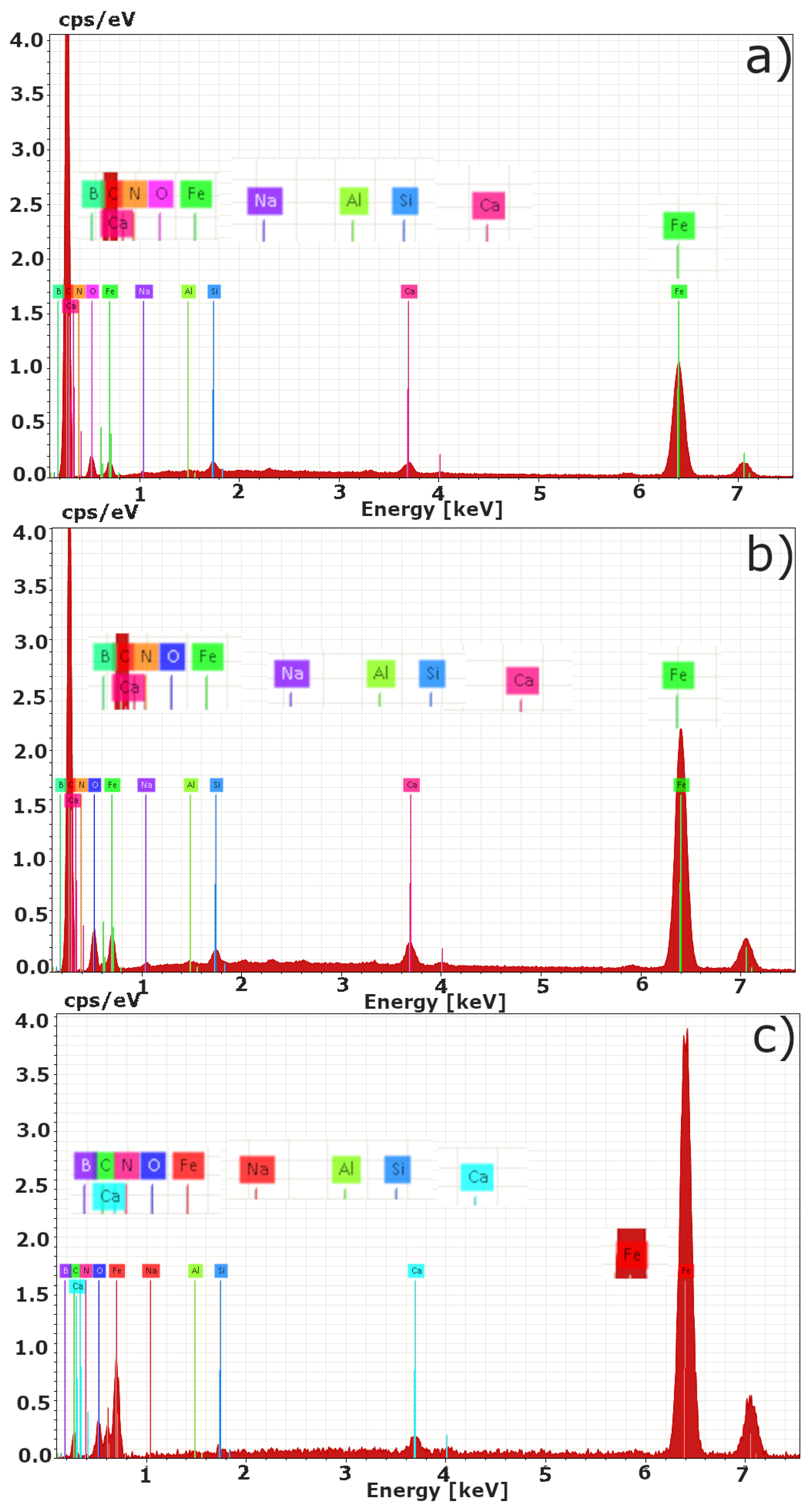
The EDS patterns of the analyzed samples, presented in Figure 1, suggest the presence of B, N, and C on the surface of the thermochemically treated substrates. Although EDS mapping was used to identify the elemental distribution within the treated layers, the quantification of light elements such as boron should be considered qualitative because of the limited sensitivity of the technique for low atomic number elements. Not all elements were detected at all treatment temperatures on this first EDS superficial analysis, according to Figure 1 and the results presented on Table 2, the only sample in which B, C, and N were detected was the 1223 K specimen, in the case of the 1123 K specimen only B and C were detected at the surface, while for the 1173 K specimen only C and N were detected. Additionally, the presence of some other elements can be observed in all the treatments, the most prominent being O, Ca, and Si. Ortiz-Domínguez et al. (2018) demonstrated in their studies the existence of a combination of γ -Fe4N1−x, ε -Fe2N, Fe2B and CaC2 phases that form by the diffusion of elements present in the boronitrocarburized treatment [32], suggesting that the presence of these elements could be related to the formation of these specific phases.
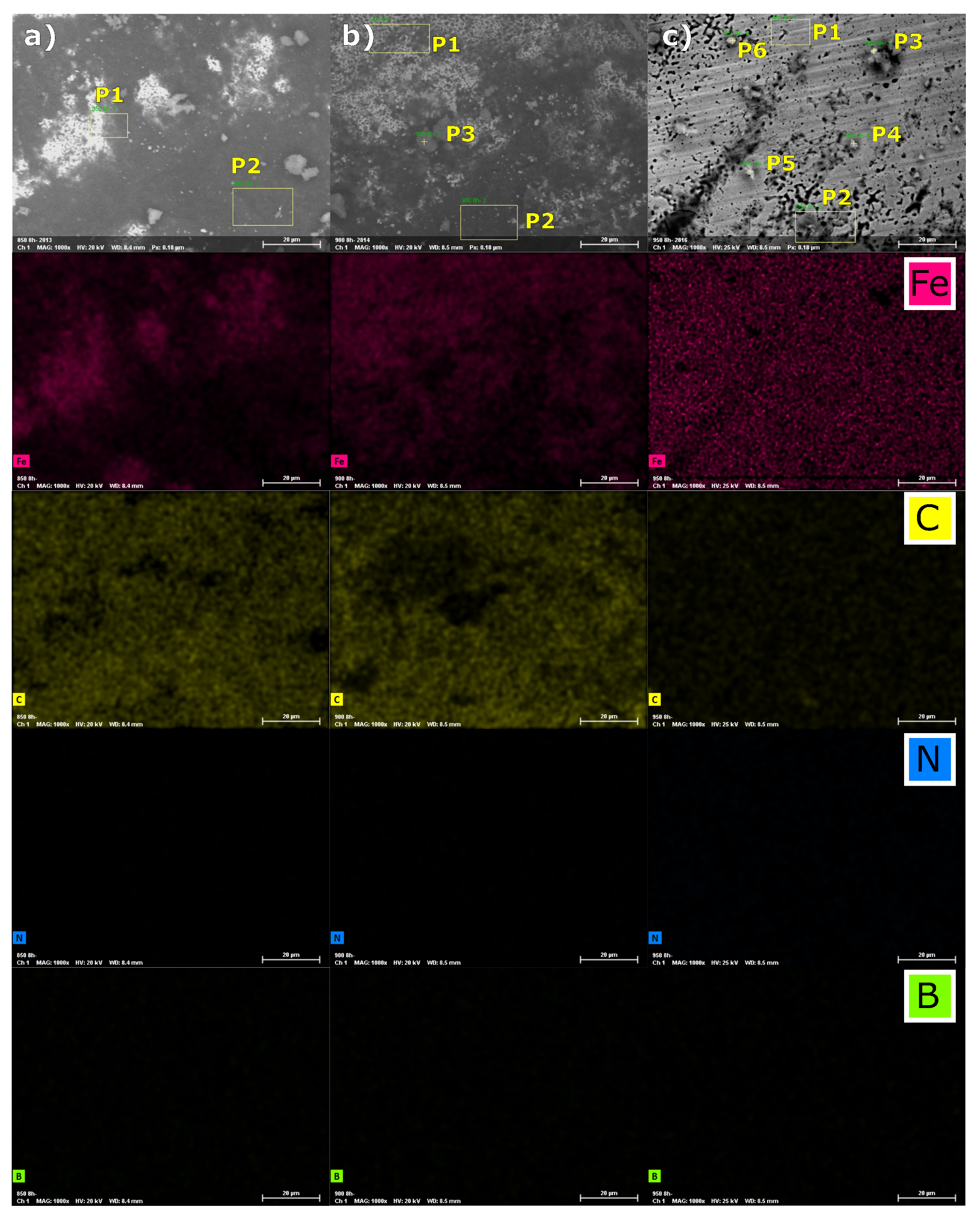
The EDS analysis in Table 2 indicates the normalized mass concentration percentages found over the wear tracks in the treated samples. Figure 2 shows the EDS mappings of the elements present at the surface of the wear track generated by the pin-on-disc test. From Figure 2, it can be concluded that the elements present in the boronitrocarburized thermochemical treatment are distributed throughout the analyzed region, which suggests the formation of of finely dispersed phases rather than a separate layer.
It can be observed from the data presented in Table 2 that the iron content increases with the treatment temperature. In contrast, the amount of carbon detected on the surface at the wear track decreases as the temperature increases. This trend is also confirmed in Figure 2, where the reduction in carbon content, shown in yellow, is clearly evident.
These results suggest that treatment temperature directly affects the elemental diffusion behavior and the distribution of boron-, carbon-, and nitrogen-rich phases within the treated layer. The relatively homogeneous elemental distribution suggested by the EDS mappings may contribute to the formation of a multiphase structure, which can later influence the microstructural evolution and tribological response of the material. It is important that this visual distribution from EDS test is not absolute and should be confirmed with more advanced tests such as EBSD.
Since the results in Figure 1 and Figure 2, and Table 2 were obtained by analyzing the entire wear track surface image—including areas where the surface remained undamaged—a more detailed analysis was conducted. This analysis aimed to determine the elemental distribution inside and outside the wear track in order to assess whether significant differences existed between the surface and wear-track compositions. The specific locations selected for this analysis are shown in Figure 2. Point 1 in Figure 2a, Point 2 in Figure 2b, and Point 1 in Figure 2c were used to analyze the elemental composition within the wear track area. In contrast, Point 2 in Figure 2a, Point 1 in Figure 2b, and Point 2 in Figure 2c were used to evaluate the composition of the undamaged surface.
The results of this point-specific analysis are presented in Table 3, providing a more localized evaluation of the elemental distribution. It can be observed that these results differ slightly from those shown in Table 2. When analyzing the data obtained from within the wear track, the presence of at least two elements of interest—B and C—can be identified, while nitrogen is found in negligible amounts in all three specimens.
The presence of B and C specifically within the wear track suggests that these elements have diffused deeper into the substrate and become detectable only after partial removal of the surface layer.
Differences between the elemental concentrations obtained from the surface, wear-track, and cross-sectional EDS analyses may be associated with the localized nature of the technique and the limited sensitivity of EDS for detecting light elements such as boron and, in some cases, nitrogen. Surface analyses represent average elemental concentrations over larger areas, while localized wear-track and cross-sectional analyses evaluate specific regions of the modified layer where elemental distribution may vary due to diffusion gradients and local phase formation. Consequently, the absence or negligible detection of boron or nitrogen in some surface analyses does not necessarily indicate the complete absence of these elements within the treated layer; therefore, all EDS results for boron and nitrogen should be interpreted carefully. This limitation of EDS analysis was, in fact, one of the main reasons why additional characterization was conducted using XRD, whose results suggest the formation of boride- and nitride-related phases.
From the data presented in Table 3, it can be observed that at higher treatment temperatures, the iron content within the substrate becomes more prominent. This suggests that the surface layer is less stable and that more severe wear occurs on the treated surface. Similarly, for both the wear track and the surface, the decrease in carbon content with increasing temperature is consistent with the results reported in Table 2.
Interestingly, the overall carbon content within the wear track is lower than that observed on the surface, indicating a higher concentration of carbon-rich phases near the top of the layer. This is particularly evident in the case of the 1123 K, 8 h treatment. Furthermore, a significant reduction (approximately 80%) in carbon content is observed in both the surface and the wear track when the treatment temperature increases from 1173 K to 1223 K.
In the case of boron, its content appears to remain relatively stable across most specimens, with the exception of the 1223 K condition at the surface. This may suggest a slightly higher concentration of boron within the intermediate region of the layer; however, overall, the diffusion of boron appears to be relatively uniform.
This behavior can be directly correlated with the mechanical response of the treated layers. Boronitrocarburizing offers several advantages over other thermochemical treatments, such as boriding. Although the surface hardness of boronitrocarburized steel is lower than that of borided steel, the reduced brittleness of the layer helps prevent delamination, thereby improving the abrasive wear and corrosion resistance of the treated surface [28,38].
This behavior indicates that the balance between boron, carbon, and nitrogen diffusion plays an important role in determining the mechanical stability of the treated layer. In particular, excessive treatment temperatures may promote compositional changes that negatively affect layer adhesion and structural integrity.
As shown in Figure 3, good layer adhesion was achieved for the specimens treated at 1123 K and 1173 K, as no noticeable microcracks or delamination were observed after the Daimler–Benz Rockwell C test [47]. In contrast, the specimen treated at 1223 K exhibited signs of delamination. This behavior is consistent with the element content trends observed in Table 2 and Table 3, which indicate that higher treatment temperatures lead to a less stable surface layer that is more prone to detachment from the substrate.

3.2. Cross-Sectional Diffusion and Microstructural Evolution

To further understand the origin of this behavior, it is necessary to analyze the distribution of elements along the depth of the treated layer. In particular, evaluating how elements such as B, C, and N diffuse into the substrate can provide insight into the formation and stability of the different phases that can later be identified by XRD, as well as their influence on the mechanical response of the material.
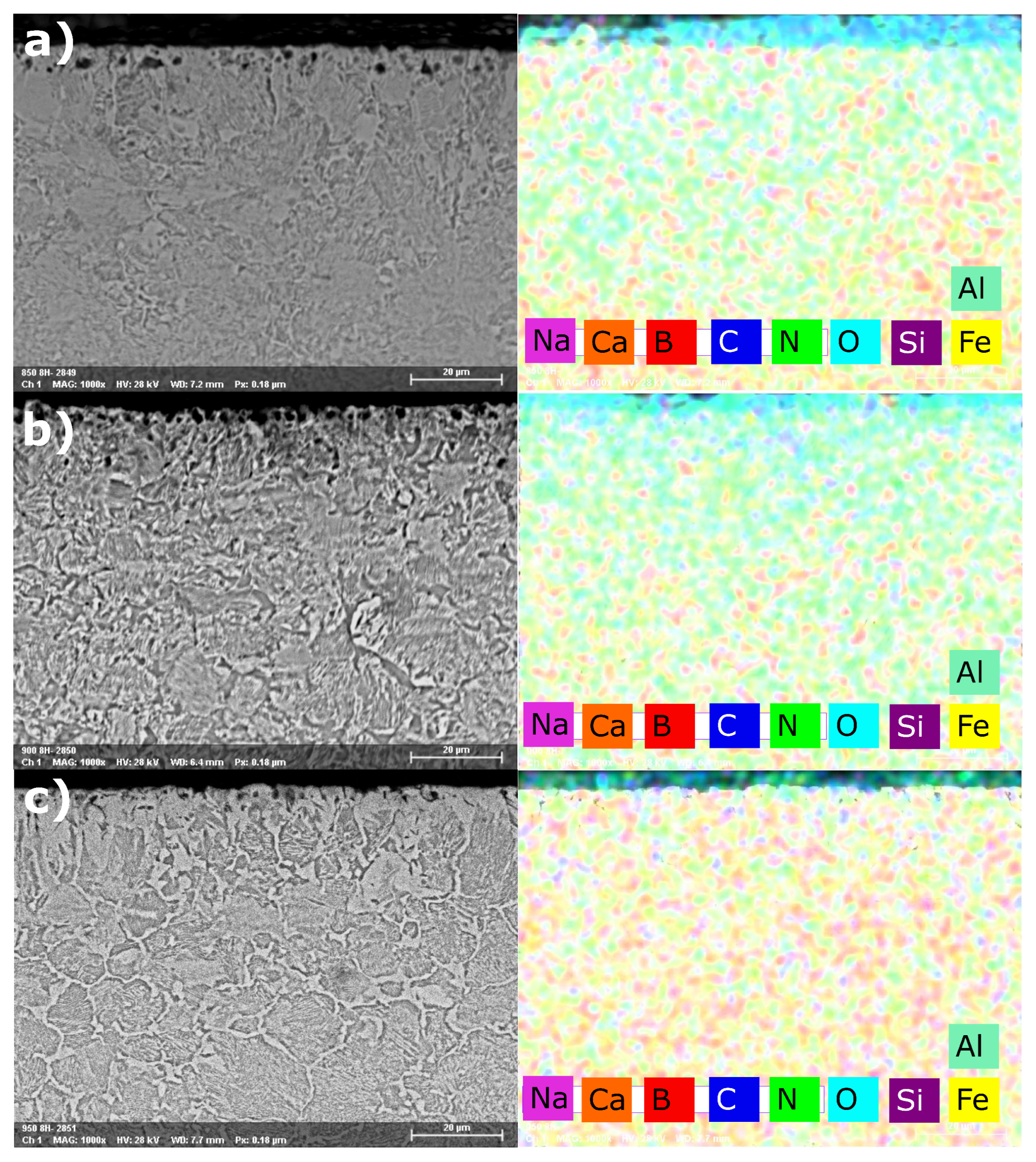
To characterize the components of the layer and evaluate diffusion along its depth, cross-sectional specimens were prepared to analyze the distribution of elements within the base material, AISI 1018 steel. Figure 4 shows the elemental mappings across the surface layer obtained by EDS analysis.
From these images, it can be observed that iron (Fe), shown in yellow, is the dominant element. Although carbon (C) is present throughout the entire layer, it is particularly evident in Figure 4a,b that there is a higher concentration of carbon in the upper region of the layer. This observation further indicates the trends previously identified in Table 2 and Table 3.
In this analysis, nitrogen is detected in relatively low concentrations; however, its content appears to increase with treatment temperature. This trend suggests enhanced diffusion of nitrogen into the substrate at higher temperatures, although its overall contribution remains limited compared to other elements. The presence of aluminum can also be observed; however, it is primarily concentrated near the top surface, which may be attributed to the mounting medium used during SEM/EDS sample preparation rather than to the material itself.
Although the elemental mappings in Figure 4 suggest a relatively uniform distribution of boron across the treated layer, the quantitative EDS results presented in Table 4 indicate that no boron was detected in the specimen treated at 1223 K for 8 h. This apparent discrepancy can be attributed to the inherent limitations of EDS for the detection and quantification of light elements such as boron. In particular, the low atomic number of boron results in weak X-ray emission and significant signal overlap with other elements, which reduces the accuracy and sensitivity of the technique [48].
Furthermore, it is possible that, at higher treatment temperatures, boron diffuses deeper into the substrate, leading to a concentration below the detection limit in the analyzed region.
For the specimen treated at 1173 K for 8 h, a relatively high concentration of boron can be observed. This may suggest the formation of a significant amount of FeB and Fe2B phases. The presence of these phases could be associated with improved tribological properties for this specimen [49].
Regarding the carbon content, it appears to remain relatively consistent across all treatments, with a slight decrease observed in the specimen treated at 1223 K for 8 h.
Compared to the results presented in Table 2 and Table 3, the amount of nitrogen detected is higher, particularly for the specimen treated at 1223 K. This suggests that nitrogen diffused further into the layer, resulting in an increased extent of diffusion as the treatment temperature increased.
It can also be observed from the results presented in Table 4 that significantly higher aluminum concentrations were detected compared to the previous EDS analyses. In particular, the aluminum content identified for the sample treated at 1173 K was considerably higher than expected.
These elevated aluminum values may originate from two possible sources. First, the mounting plate used during sample preparation was manufactured from an aluminum alloy. Since the cross-sectional EDS analyses required observation of the sample edge during SEM characterization, part of the mounting material may have been included during the area EDS analysis. A second possible source is associated with the aluminum oxide compounds used during the polishing procedure. Residual polishing compounds may have remained on the sample surface and contributed to the aluminum signal detected during the EDS measurements.
Therefore, the aluminum concentrations reported in the cross-sectional analyses should be interpreted cautiously, as they may be influenced by sample preparation and polishing procedures.
Overall, these results indicate that increasing the treatment temperature promotes the diffusion of interstitial elements such as nitrogen and boron into the substrate, leading to compositional gradients within the layer. However, excessive temperatures may result in the redistribution or dilution of these elements, particularly boron, which in turn affects the stability and effectiveness of the surface layer.
The diffusion gradients observed through the cross-sectional EDS analysis are also consistent with the microstructural variations identified in the SEM images. In particular, the increased boron concentration at intermediate temperatures may contribute to the formation of finer boride-rich regions, while excessive temperatures promote coarser microstructures and reduced layer stability.
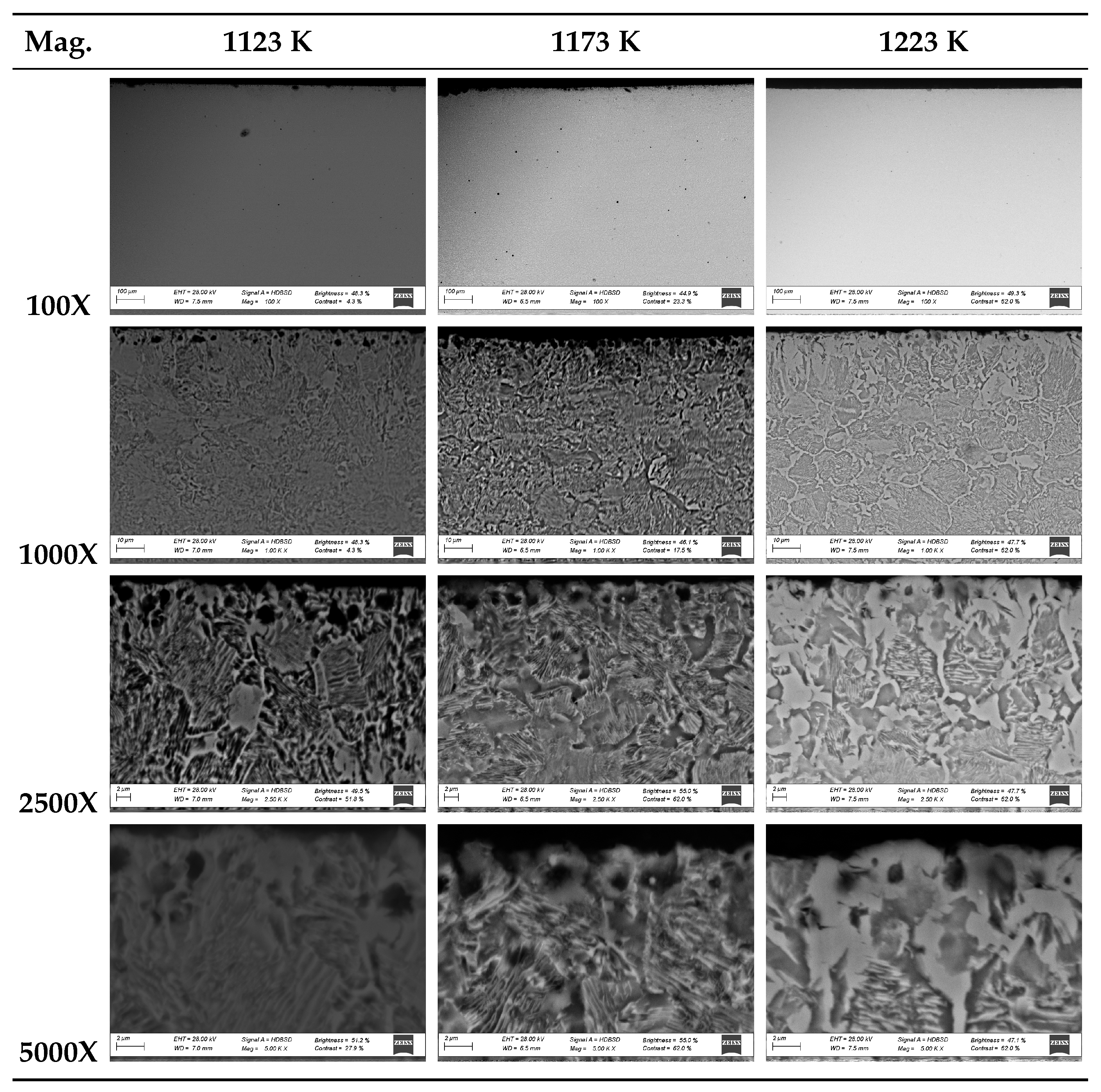
The element composition of the samples can be analyzed in relation to the observed microstructure in the cross-section micrographs that are shown in Figure 5. These series of images can be used to see the evolution of the microstructure of the layer with the different treatment temperatures.
For all the different treatments it can be seen at Figure 5 that there is some formation of pearlitic microstructures; nevertheless, in the case of the 1173 K 8 h sample, the pearlite is more compact than that shown in the other two treatments. The presence of this pearlitic microstructure is consistent with the findings of Table 4, in which a similar content of carbon is present in all the samples, suggesting the presence of rich carbon phases.
From Figure 5 it is also evident that, similar to the change of the size of the pearlitic microstructures, the treatment at 1173 K promoted a finer and more homogeneous microstructural morphology, which can be also explained by the Table 4 results, in which there is a particularly high content of boron for this specific sample. The morphology suggests the development of boride phases, such as Fe2B, which are known to form needle-like or columnar structures [50].
In contrast, the 1223 K 8 h sample shows a coarser microstructure, which is likely due to the low content of boron, and therefore the carbon and nitrogen phases are primarily contributing to the formation of this coarser microstructure. This increase in microstructural coarseness is primarily attributed to the higher treatment temperature, which promotes microstructural coarsening while the reduced boron content limits the formation of fine boride phases.
These microstructural differences suggest that treatment temperature strongly influences phase formation within the modified layer. Consequently, XRD analysis becomes essential to identify the specific boride-, carbide-, and nitride-related phases responsible for the observed mechanical and tribological behavior.
From the compositional and microstructural analysis discussed previously, it can be seen that the diffusion of boron, carbon, and nitrogen is strongly affected by the treatment temperature, producing noticeable changes in the stability and morphology of the treated layer. In particular, the presence of boron at intermediate temperatures and its apparent reduction at higher temperatures suggests that there are important changes in the phases that are being formed within the layer.

3.3. Phase Formation Analysis

Because of the limited sensitivity of EDS for detecting light elements such as boron, XRD analysis was used as a complementary technique to confirm the formation of boride and nitrogen-related phases in all treatment conditions.
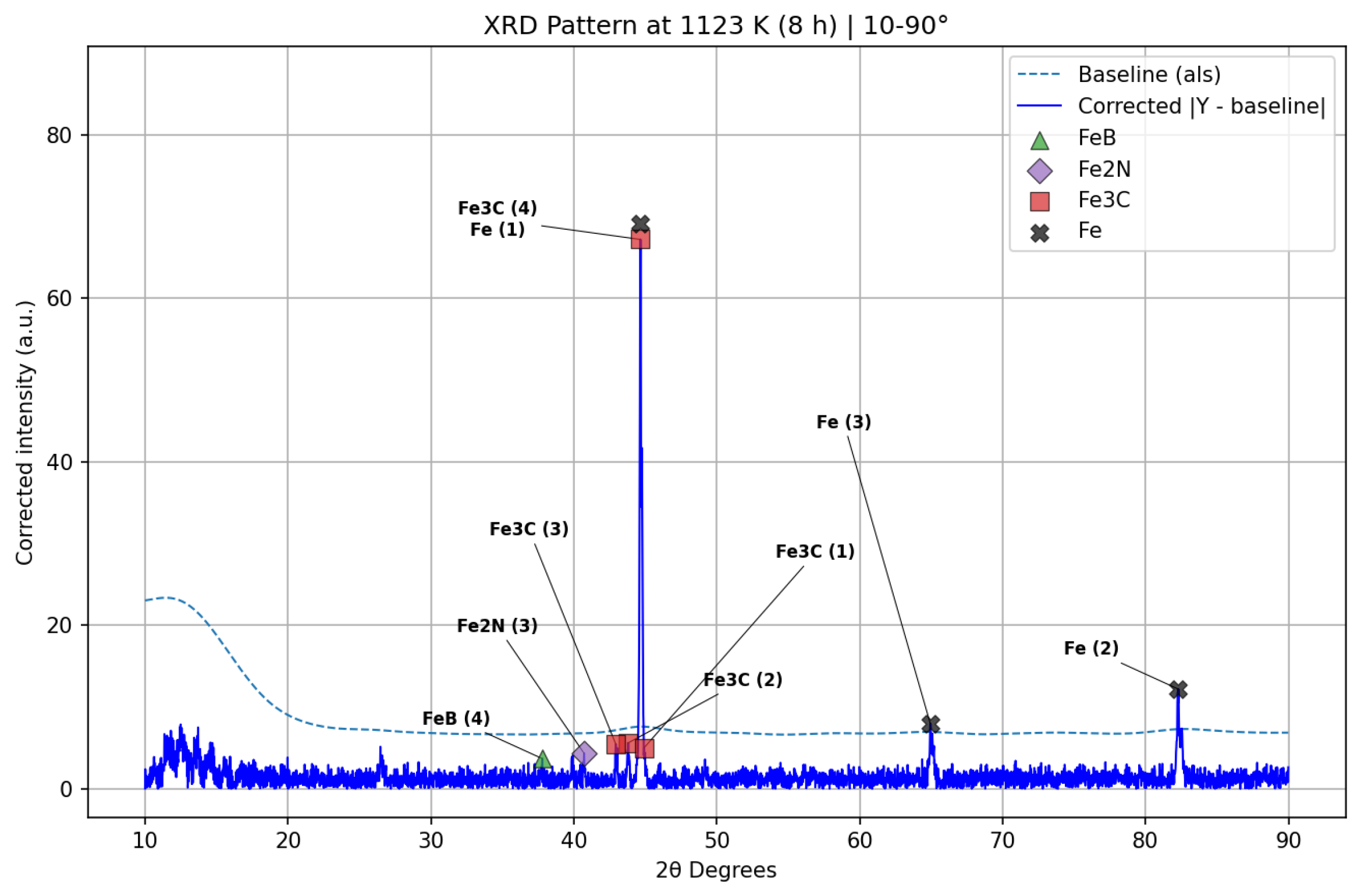
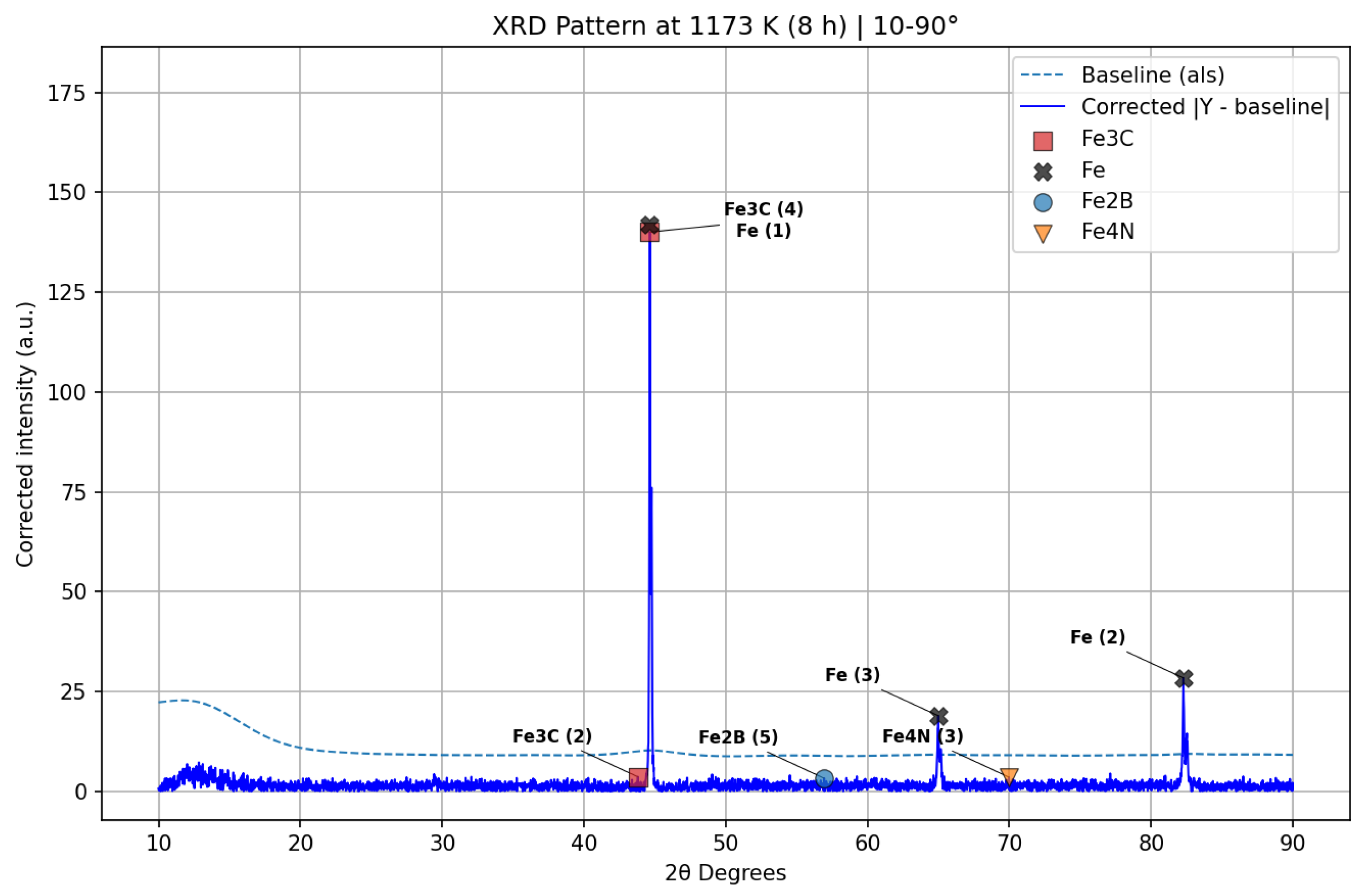
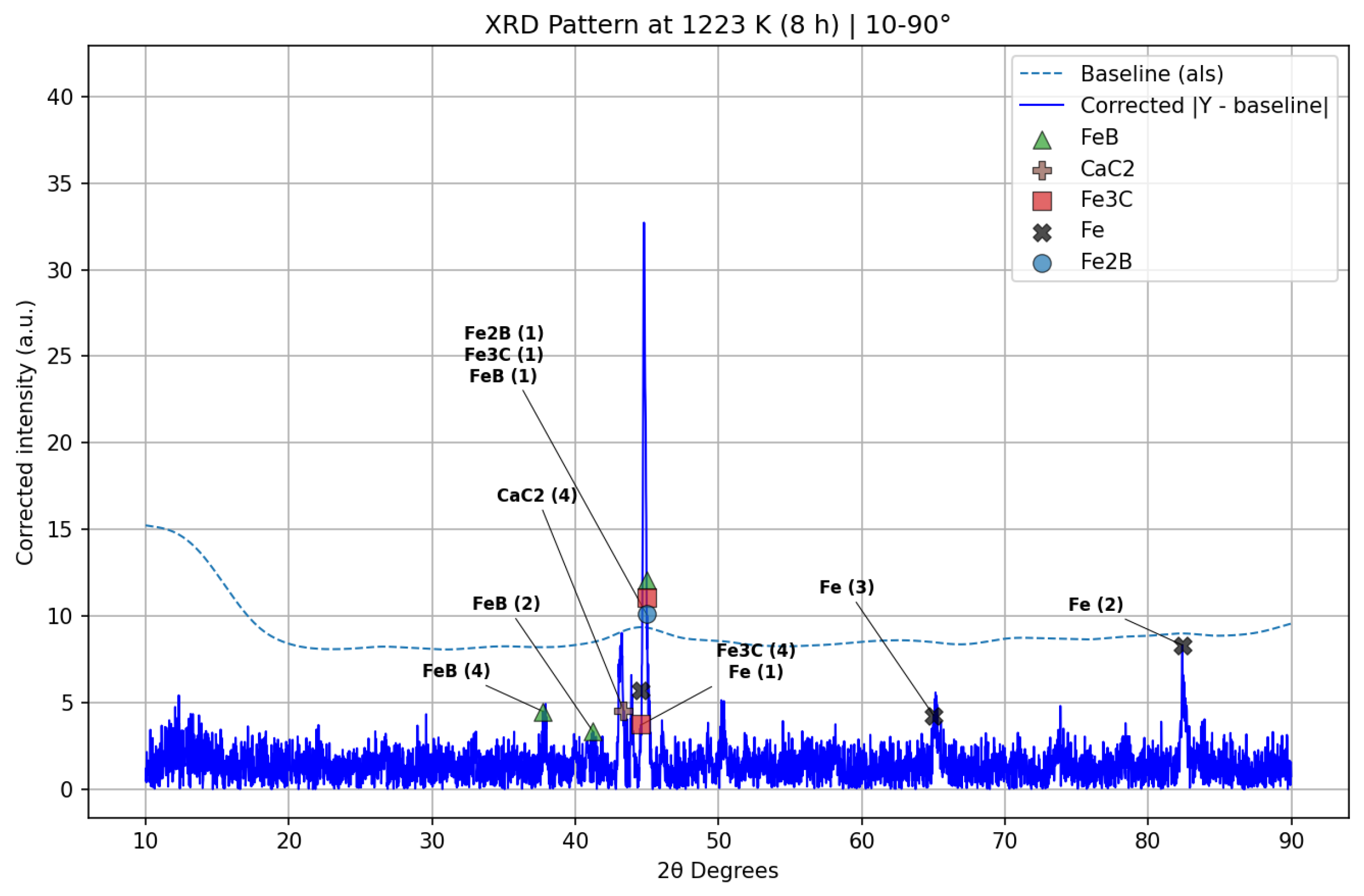
Aditionally, to further analyze these changes and to identify the phases present in each condition, XRD analysis was performed. This technique allows the identification of the crystalline phases formed during the treatment, complementing the information obtained from the EDS analysis. The XRD patterns for the specimens treated at 1123 K, 1173 K, and 1223 K for 8 h are shown in Figure 6, Figure 7, Figure 8, Figure 9 and Figure 10.
To support the phase identification obtained from the XRD analyses, the main diffraction peaks observed for each treatment condition were correlated with their corresponding crystallographic planes and PDF reference cards. Table 5 summarizes the principal peaks identified in the boronitrocarburized samples together with their associated phases, diffraction angles, and crystallographic indices.
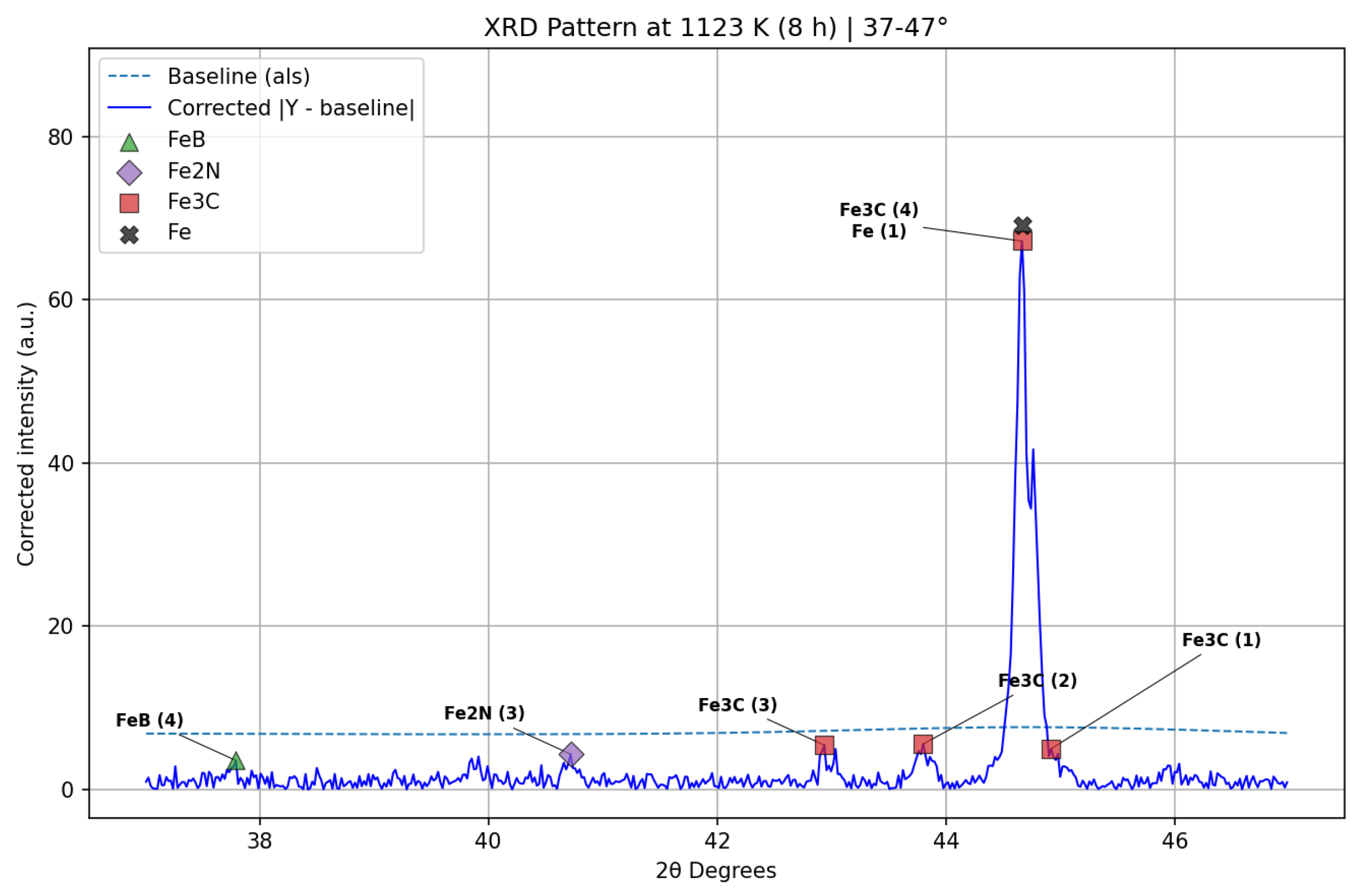
From the XRD pattern corresponding to the 1123 K (8 h) treatment shown in Figure 6 it can be seen that the dominant phases are Fe and Fe3C. The presence of Fe3C indicates that the surface layer is still rich in carbon, which is consistent with the results obtained from the EDS analysis in Table 2, Table 3 and Table 4. Additionally, small peaks associated with Fe2N can be observed, suggesting that nitrogen has diffused into the layer, although in limited amounts. The absence of strong boride peaks indicates that, at this temperature, the formation of boron-rich phases is still limited, which is consistent with the relatively low boron content measured. The specific boron phase that is being observed in this XRD analysis is FeB, which is harder than the Fe2B phase but also more brittle [38].
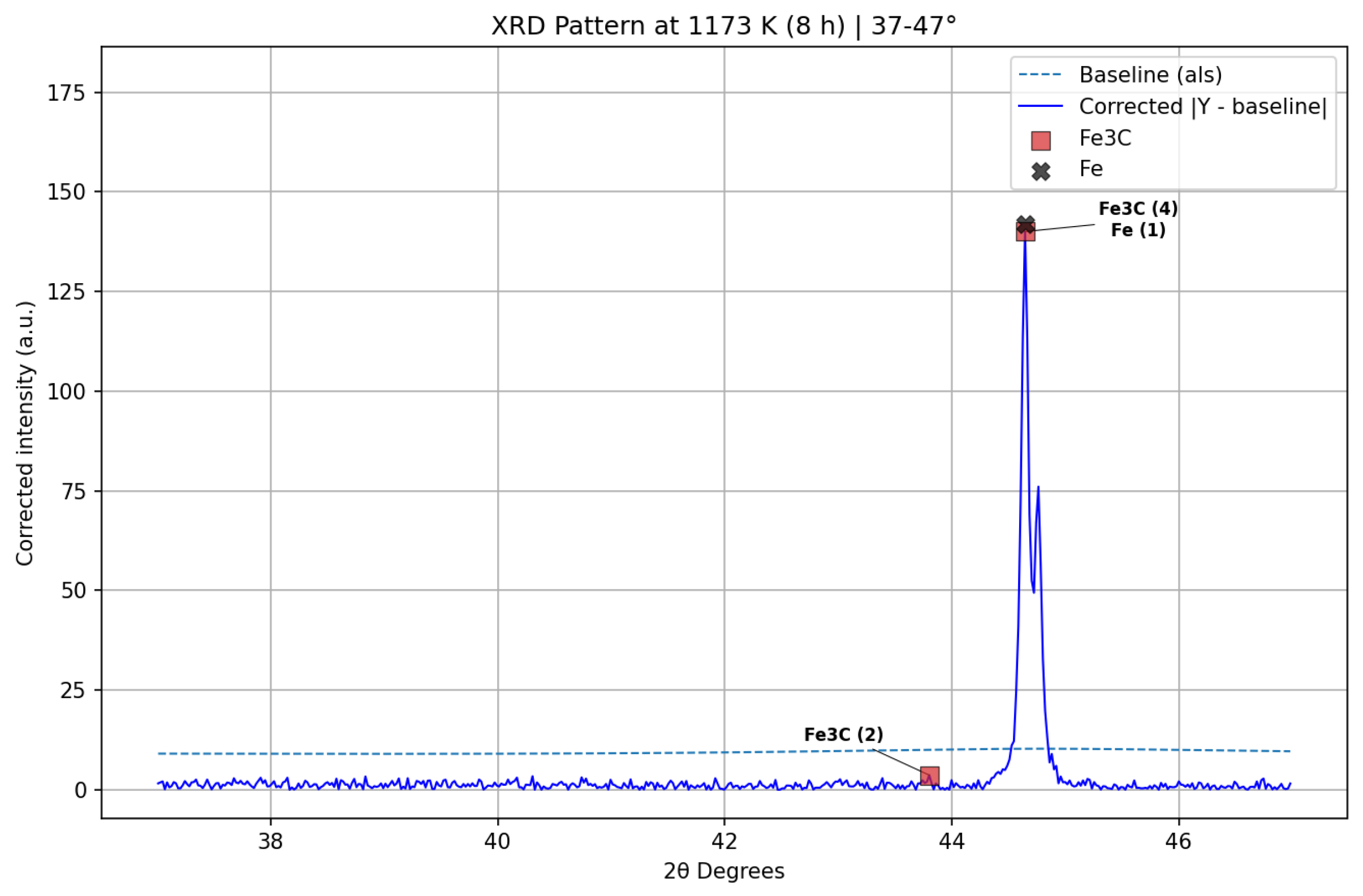
For the specimen treated at 1173 K (8 h) shown in Figure 7, it can be observed that new phases begin to appear, particularly Fe2B and Fe4N. The presence of Fe2B is especially important, as it suggests that boron is actively participating in the formation of boride phases at this temperature, and it is considered to exhibit better tribological properties compared to the FeB phase, since it is less brittle and therefore is harder to delaminate. At the same time, Fe3C is still present, indicating that carbon-rich phases have not completely disappeared. This combination of borides, carbides, and nitrides suggests the formation of a multiphase layer, which is consistent with the compositional analysis and may explain the improved mechanical and tribological properties observed for this condition.
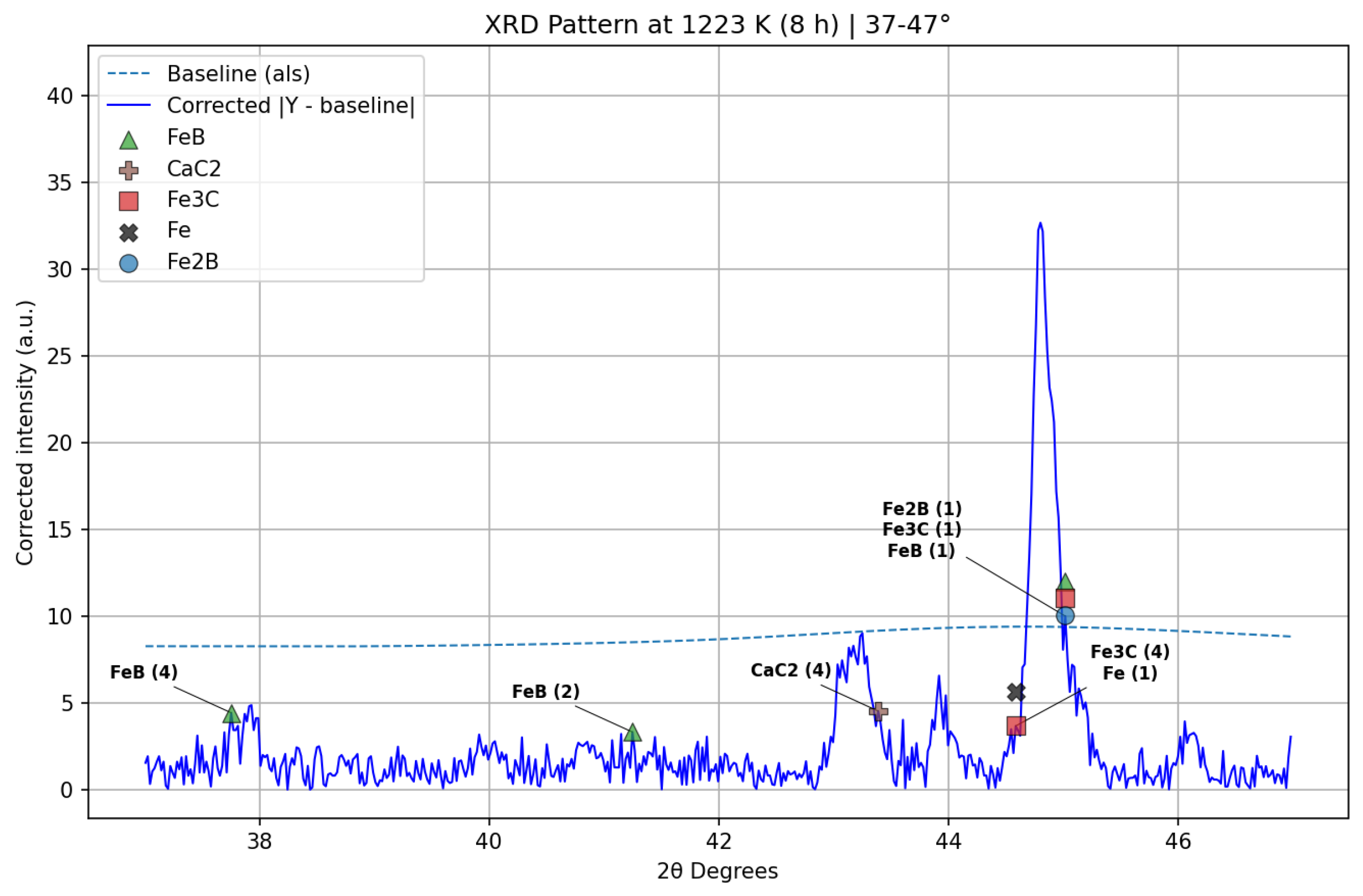
In contrast, the XRD pattern for the 1223 K (8 h) treatment shown in Figure 8 shows a more complex mixture of phases, including Fe, Fe3C, Fe2B, and FeB. Although boride phases are still present, their distribution appears less defined, and the intensity of the Fe peaks suggests a stronger contribution from the substrate. This behavior is consistent with the EDS results, where a higher iron content and a lower detectable boron concentration were observed. These results indicate that, at this temperature, excessive diffusion may occur, leading to a less stable surface layer and a reduction in the effectiveness of the boron-rich phases.
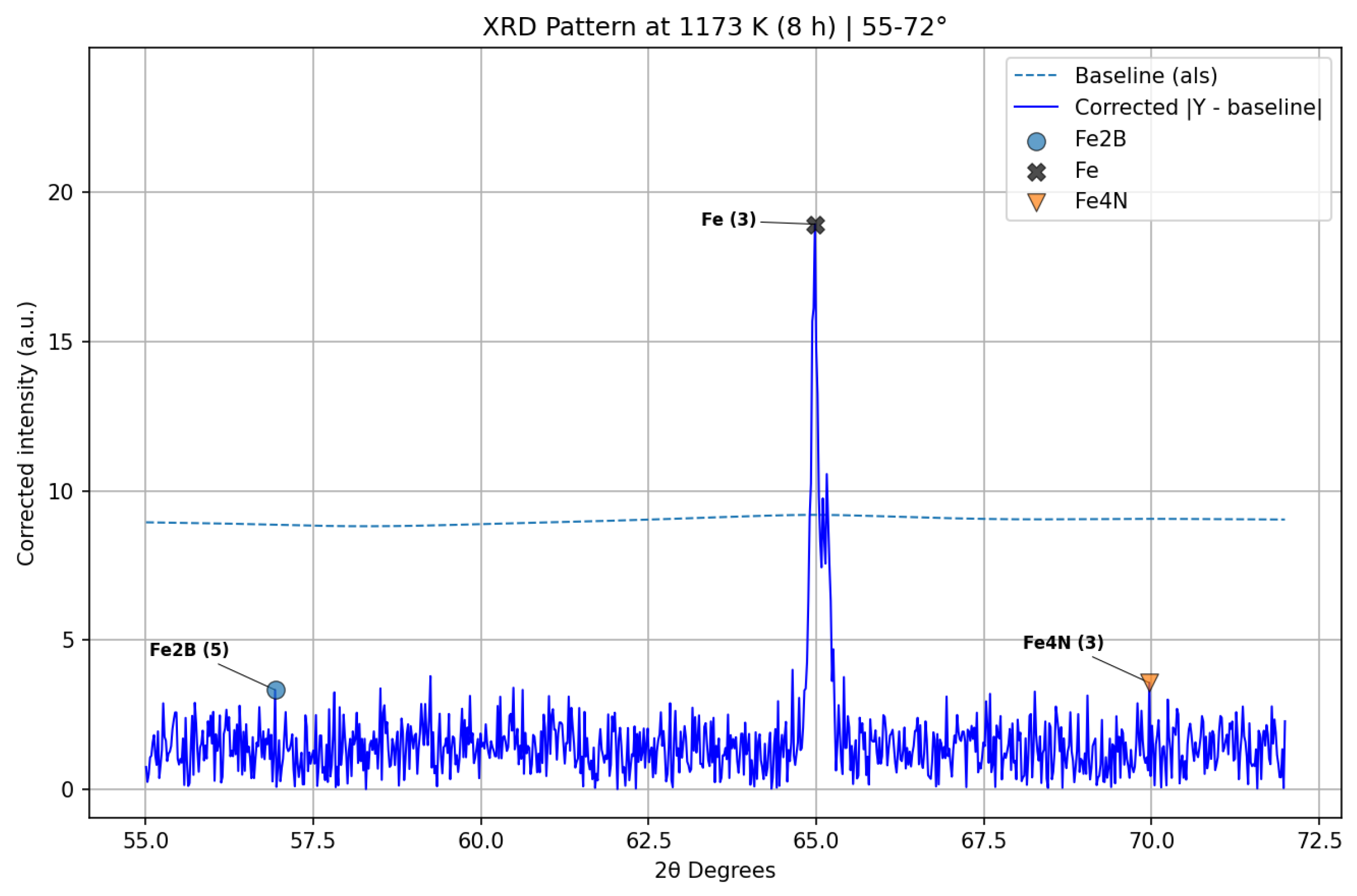
To better visualize the presence of the different phases identified in the XRD analysis, selected regions of the diffraction patterns were analyzed in more detail. Figure 9, Figure 10 and Figure 11 show the zoomed-in regions between 37–47° for all the temperature treatments while Figure 12 shows the angles 55–72° for the 1173 K sample. These regions correspond to the main diffraction peaks associated with Fe, Fe3C, Fe2B, FeB, and Fe4N.
Overall, the detailed XRD analysis suggests that the formation of boride and nitride-related phases becomes more evident at intermediate temperatures, particularly at 1173 K, where a well-defined multiphase structure is observed. The predominance of Fe2B-related phases under this condition may contribute to improved layer adhesion and reduced brittleness [38], which is consistent with the tribological behavior observed in the wear tests. In contrast, higher treatment temperatures promoted excessive elemental diffusion and a more heterogeneous phase distribution, leading to reduced microstructural stability and lower layer integrity.

3.4. Tribological Behavior

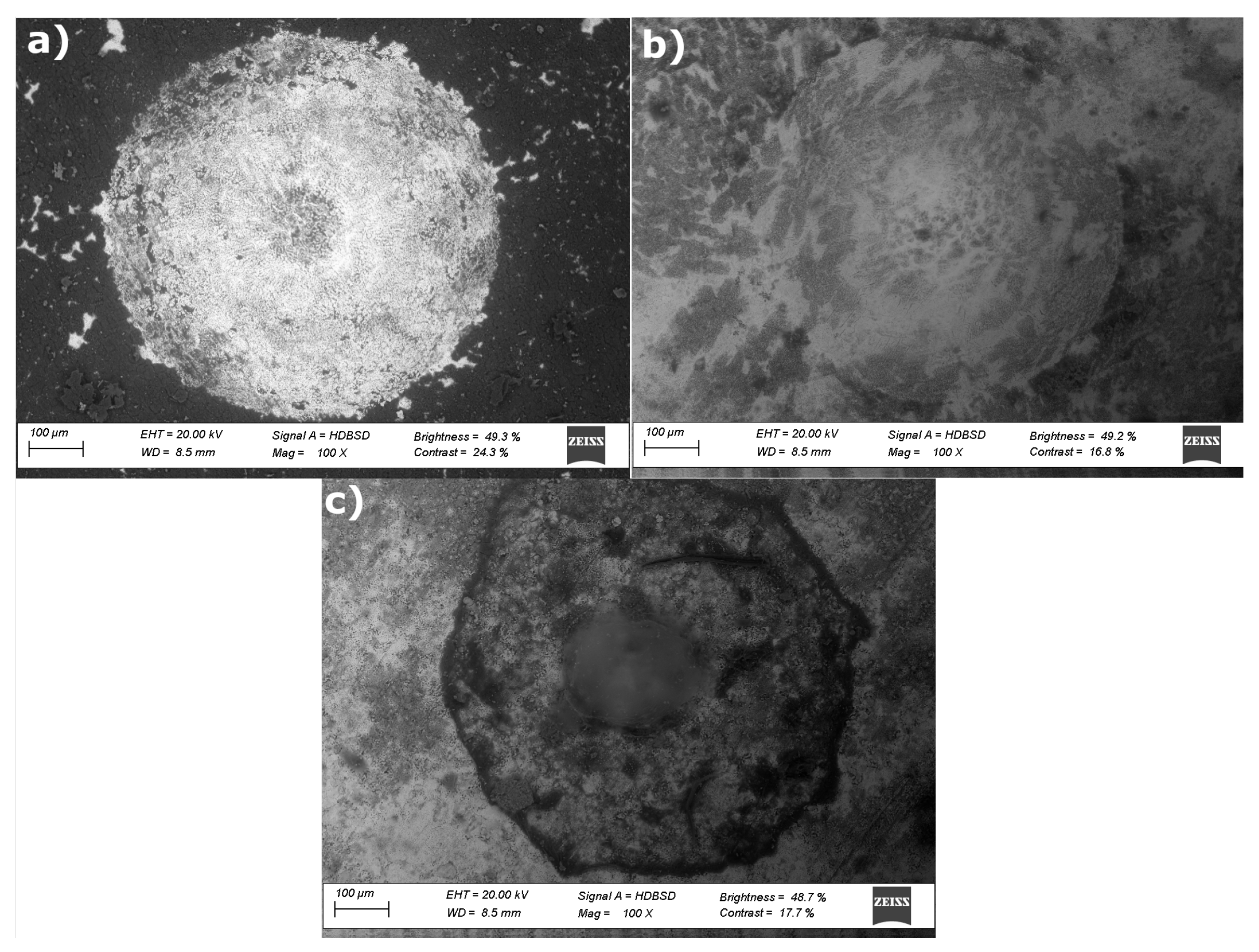
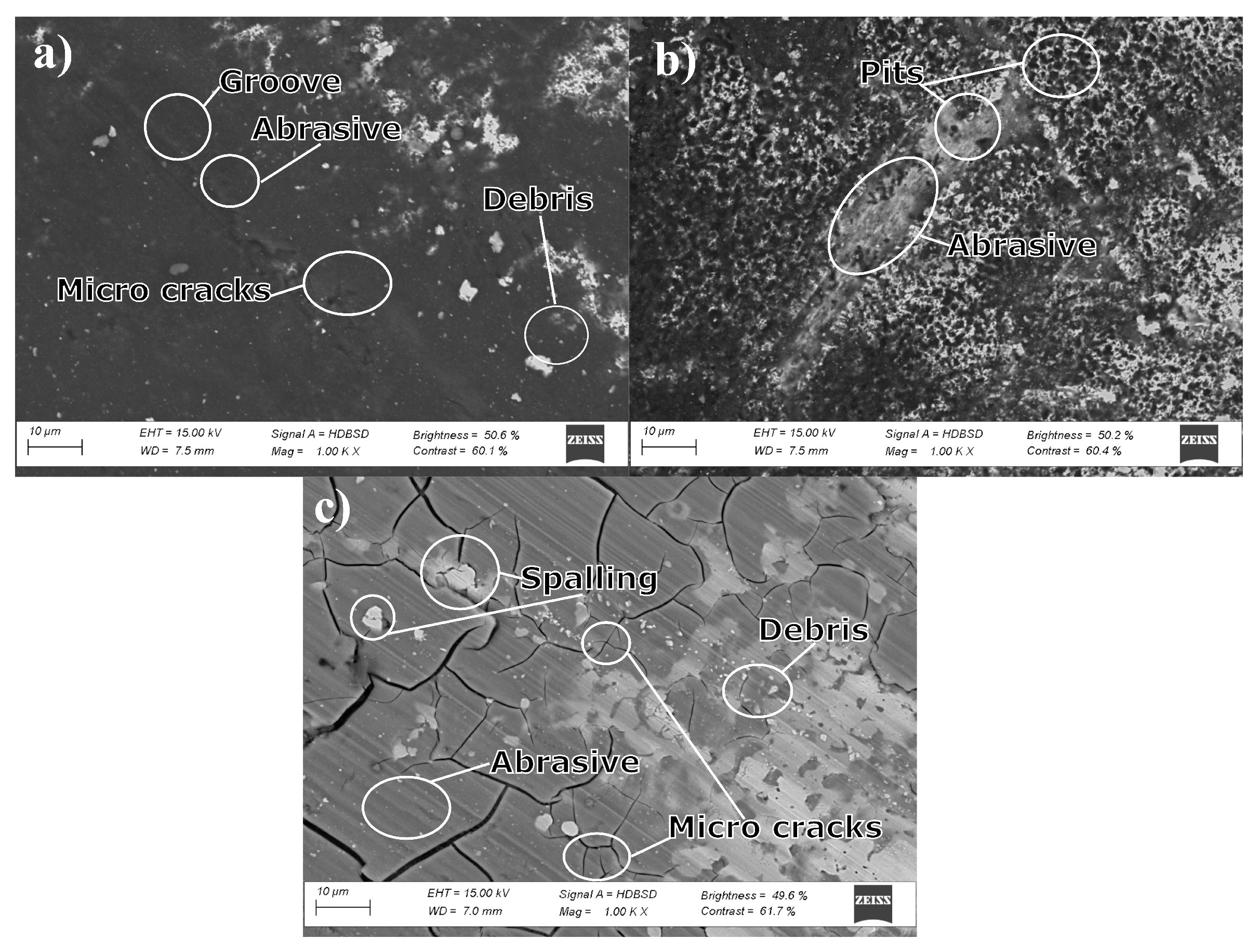
The phase evolution and diffusion behavior discussed in the previous sections can also be correlated with the surface morphologies observed after the wear tests. Figure 13 illustrates the wear track morphologies obtained from the pin-on-disc test using SEM. From these images, it can be seen that all specimens primarily exhibit abrasive wear. However, the specimen treated at 1173 K shows a higher presence of pores on the surface (Figure 13b).
This porosity can be related to the multiphase structure identified by XRD at this temperature, where the coexistence of borides, carbides, and nitrides may lead to local phase instability. According to a study conducted in 1996 [51], pore formation is associated with phase instability, considering factors such as elemental decomposition, treatment temperature, and the surrounding atmosphere pressure. As the system tends toward thermodynamic equilibrium, phase decomposition may promote the diffusion of elements in gaseous form, leading to pore formation.
Additionally, most of these pores are located beneath the top surface, where elemental supersaturation occurs [51]. Elemental supersaturation refers to a condition in which the concentration of diffused elements, particularly nitrogen, exceeds the solubility limit of the matrix within the subsurface region during the thermochemical treatment. This phenomenon occurs beneath the top surface because the outermost region is continuously exposed to the treatment atmosphere, where nitrides remain thermodynamically stable, while inward nitrogen diffusion into the substrate promotes local elemental accumulation below the surface. Under these conditions, partial nitride decomposition and localized gas accumulation may occur, contributing to pore formation within the treatment layer.
Although the presence of pores may indicate localized phase instability within the modified layer, the porosity observed for the specimen treated at 1173 K did not appear to negatively affect the overall tribological performance under the evaluated dry sliding conditions. This suggests that the beneficial effects associated with the formation of a stable multiphase structure, improved layer adhesion, and reduced brittleness were more significant than the localized effects produced by pore formation.
Figure 13. SEM micrographs of wear tracks surfaces generated by the pin-on-disc test on boronitrocarburized AISI 1018 steel treated for 8 h at (a) 1123 K, (b) 1173 K and (c) 1223 K [2,3,20,52].
Applsci 16 05451 g013
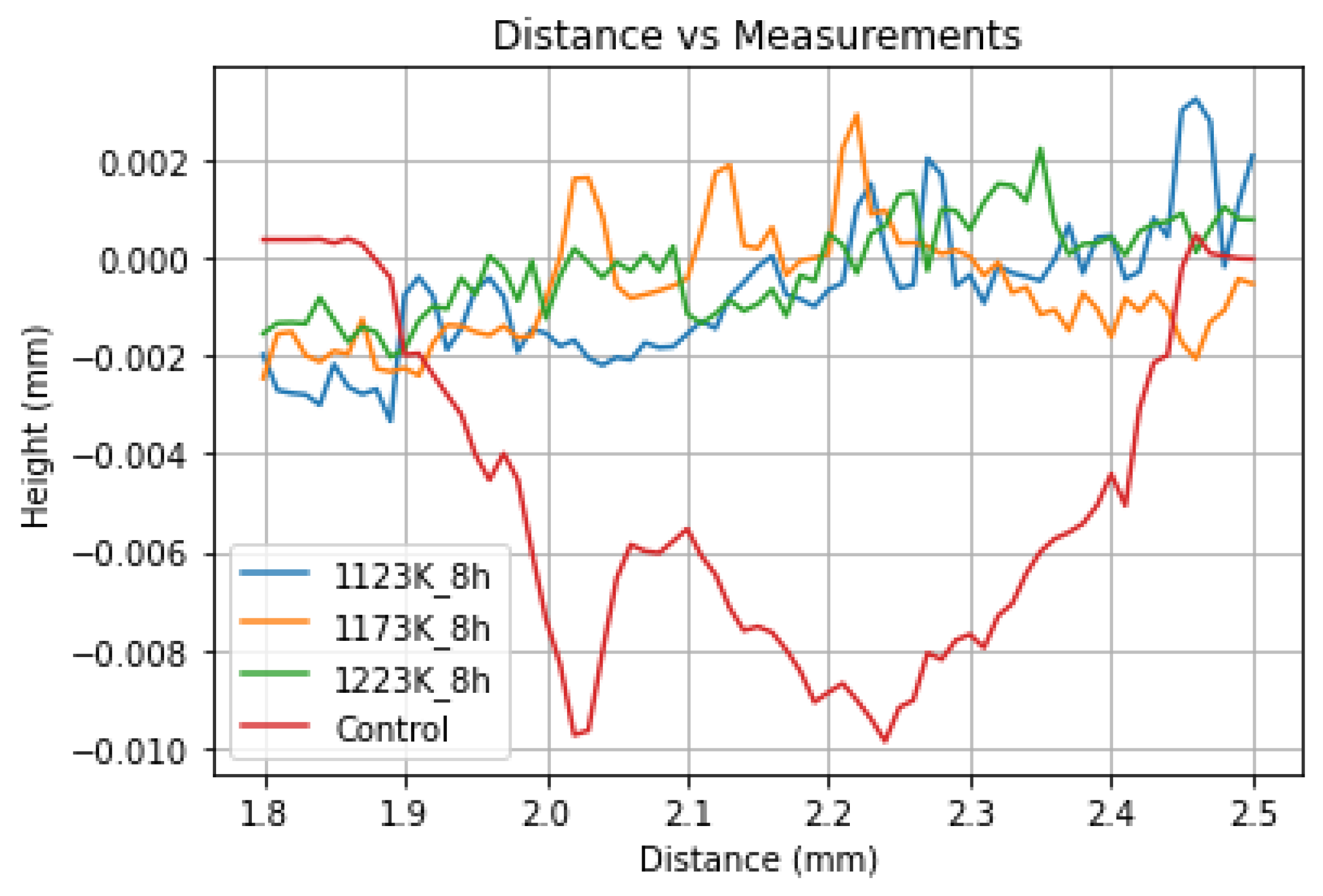
Figure 14 shows the wear track profiles obtained after the pin-on-disc test for the control sample (red curve) and the thermochemically treated specimens. From the figure, it can be seen that the control sample exhibits the deepest wear track, with a maximum depth close to 0.01 mm, indicating significantly higher material removal compared to the treated samples.
In contrast, all thermochemically treated specimens show much shallower wear tracks, with depths generally below 0.003 mm. Among them, the specimen treated at 1123 K for 8 h presents slightly deeper variations compared to the other treated conditions, while the specimens treated at 1173 K and 1223 K show more stable and uniform profiles with lower wear depth. The 1173 K specimen exhibited slightly better performance showing the highest peaks among all the samples.
Overall, these results indicate that the thermochemical treatments significantly improve the wear resistance of the material, reducing the depth of the wear track when compared to the untreated sample.
Table 6 presents the friction coefficient, wear rate, and roughness values obtained from the pin-on-disc tests. The samples treated at 1123 K, 1173 K, and 1223 K for 8 h showed an average reduction of approximately 75% in the coefficient of friction compared to the control sample.
Regarding the wear rate, wear-track cross-sectional profiles obtained with the roughness tester (Taylor Hobson) were used to calculate the wear volume and wear rate using the Anton Paar tribometer software. (Anton Paar, Graz, Austria) The software numerically integrates the wear-track profiles and calculates the wear parameters according to Equation (1) based on the experimental tribological conditions. A reduction in wear rate was observed for all boronitrocarburized samples compared to the untreated specimen.
W = V F d
where W is the wear rate, V is the wear volume loss, F is the applied normal load, and d is the sliding distance.
A comparison of the values for the friction coefficient and wear is made between the ones obtained for the AISI 1018 boronitrocarburized steel and the values reported in previous works that made different thermochemical treatments [30,52,53,54,55]. For the specific study made in [30], the tribological properties of Hardox 450 and HiTuff steels were analyzed when subjected to powder-pack boriding at 1073 K, 1173 K, and 1273 K for 5 h. It was found that the lowest coefficient of friction and wear was for HiTuff at 1073 K and for Hardox 450 at 1173 K. The properties of wear resistance do not necessarily improve with an increase in temperature or treatment time because of a hardness reduction in the formed layer as the treatment time or temperature increases caused by column-shaped boron crystal formations and an increase in the thermal expansion of the boron-related phases [30]. Although the specimen treated at 1223 K still exhibited a lower friction coefficient compared to the untreated substrate, the friction coefficient increased relative to the specimen treated at 1173 K. This nonmonotonic behavior may be associated with excessive elemental diffusion and the formation of a more heterogeneous and coarser multiphase structure at higher treatment temperatures. XRD and EDS analyses suggested an increased presence of FeB-related phases which may contribute to increased brittleness, localized delamination, spalling and therefore debris generation during sliding conditions. In contrast, the treatment performed at 1173 K promoted a more homogeneous and compact modified layer with a more stable phase distribution, which may explain the lower friction coefficient observed under this condition. Therefore, the improved tribological behavior observed at 1173 K is likely associated with the combined effect of Fe2B phase formation, a more homogeneous microstructure, and an improved layer adhesion due to the more balanced diffusion profile of boron, nitrogen, and carbon within the modified layer. These results indicate that the boronitrocarburizing thermochemical treatment effectively improves AISI 1018 steel’s tribological properties. Obtained surface rugosity values after boronitrocarburizing for specimens treated at 1123 K, 1173 K, 1223 K at 8 h ( R a = 0.67 μ m, 0.415 μ m, 0.42 μ m) are consistent with previous results in studies by [56,57]. These studies used boriding as a thermochemical treatment and found a tendency for a linear proportion between Ra and treatment temperature; in contrast, no linear relation was found between treatment time and R a [56,57]. Nevertheless, by the wear tracks’ rugosity values R a in this study, there is no indication of a relation between time, temperature, and Ra, as seen in Figure 15.
Table 6. Comparison of tribological properties for different thermochemical treatments.
Temp (K)BNC
AISI 1018
Boriding Hardox 450 [30]Boriding HiTuff [30]Nitriding [52]Nitriding [52]Boronitriding [54]Carbonitriding [53,55]
853 μ 0.125 , W 6.75 × 10 5 μ 0.575 , W 6.5 × 10 5
1073 μ 0.05 , W 1.00 × 10 5 μ 0.04 , W 2.50 × 10 6 μ 0.275 , W 2.81 × 10 3
1123 μ = 0.1611 , W = 5.33 × 10 6 , R a = 0.67 μ 0.15 , W 2.46 × 10 3
1173 μ = 0.1216 , W = 3.95 × 10 6 , R a = 0.415 μ 0.02 , W 5.00 × 10 6 μ 0.09 , W 2.00 × 10 5 μ 0.75 , W 0.88 × 10 6 μ 0.08 , W 2.66 × 10 3
1223 μ = 0.1856 , W = 4.74 × 10 6 , R a = 0.42
1273 μ 0.04 , W 5.00 × 10 5 μ 0.08 , W 1.00 × 10 5
Control μ = 0.558 , W = 8.67 × 10 5 , R a = 1.95
μ : coefficient of friction (COF); W: wear (mm3/Nm); R a : surface roughness ( μ m).
The tribological values reported in this work depend on several factors, including the type of thermochemical treatment, the nature of the diffusing agents, environmental conditions, and the chemical composition of the base material. However, the boronitrocarburized samples exhibited a clear improvement in both wear resistance and coefficient of friction compared to the untreated condition [30,52,53,54,55].
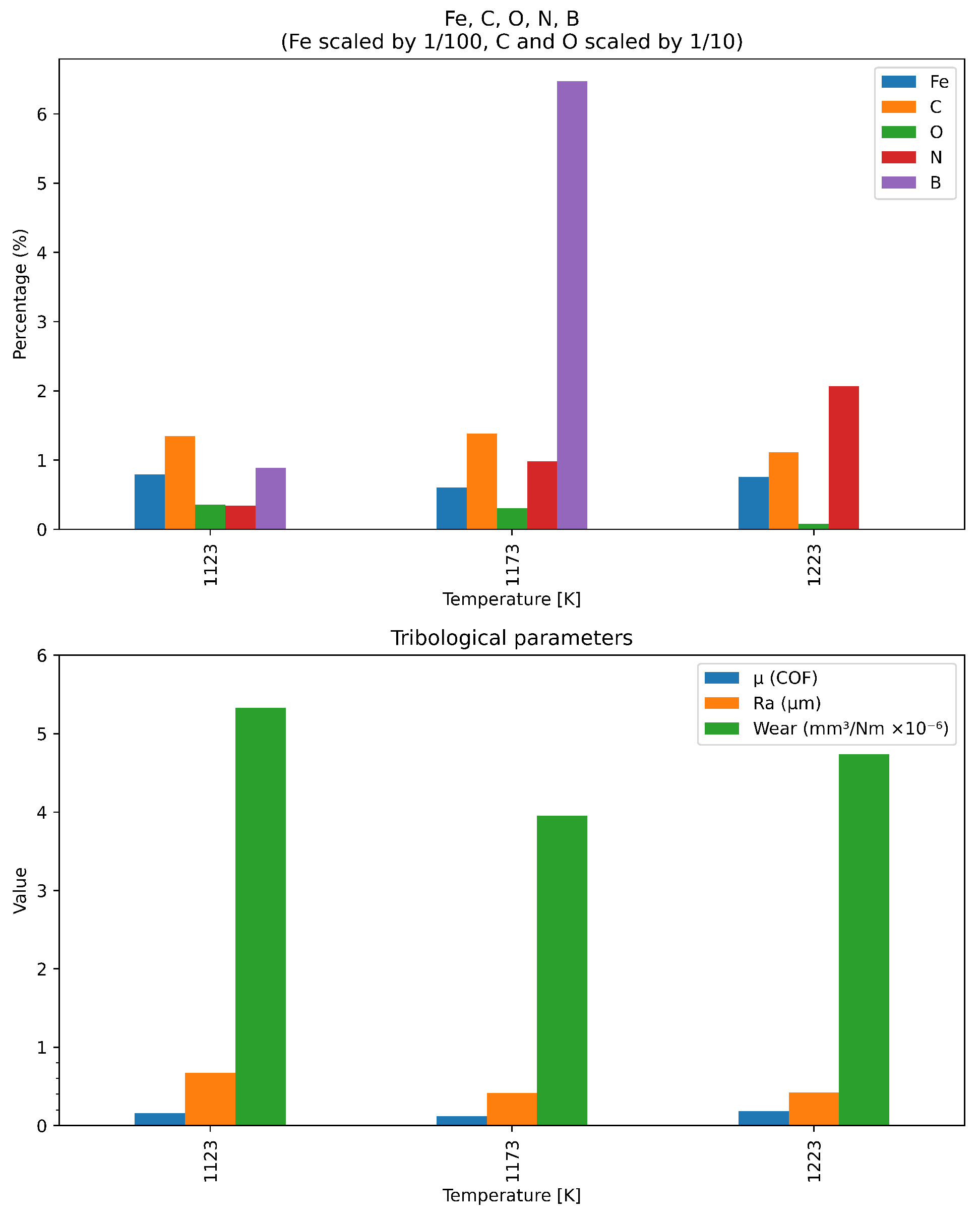
From Figure 15, it can be seen that the specimen treated at 1173 K shows the best overall tribological performance, with the lowest coefficient of friction and wear rate. In contrast, the specimens treated at 1123 K and 1223 K present higher values, indicating that the treatment temperature strongly influences the effectiveness of the surface layer. This behavior can be related to the phases identified by XRD. At 1123 K, the presence of FeB as the main boride phase suggests a harder but more brittle layer, which increases the susceptibility to cracking and material removal [38]. At 1173 K, the formation of Fe2B is observed, which is less brittle than FeB, indicating a more stable layer with a lower probability of delamination [58]. In contrast, at 1223 K, the coexistence of both FeB and Fe2B phases is observed, where the presence of the brittle FeB phase may negatively influence the mechanical integrity of the layer and contribute to the increase in wear and coefficient of friction; also, the large difference in the expansion coefficients of the two kinds of borides (FeB = 23 × 10 6  °C−1, Fe2B = 7.85 × 10 6  °C−1) contributes to easier delamination of combined FeB and Fe2B layers.
Although previous studies have reported a direct correlation between wear and coefficient of friction [59], in this work both parameters follow a similar but not identical trend, suggesting that additional mechanisms, such as phase composition and layer stability, may be influencing the wear behavior.
The reduction in wear depth observed for the treated specimens can be correlated with the formation of boride-, carbide-, and nitride-rich surface layers identified through EDS and XRD analyses. In particular, the more stable multiphase structure formed at 1173 K appears to contribute to improved resistance against material removal during sliding conditions.
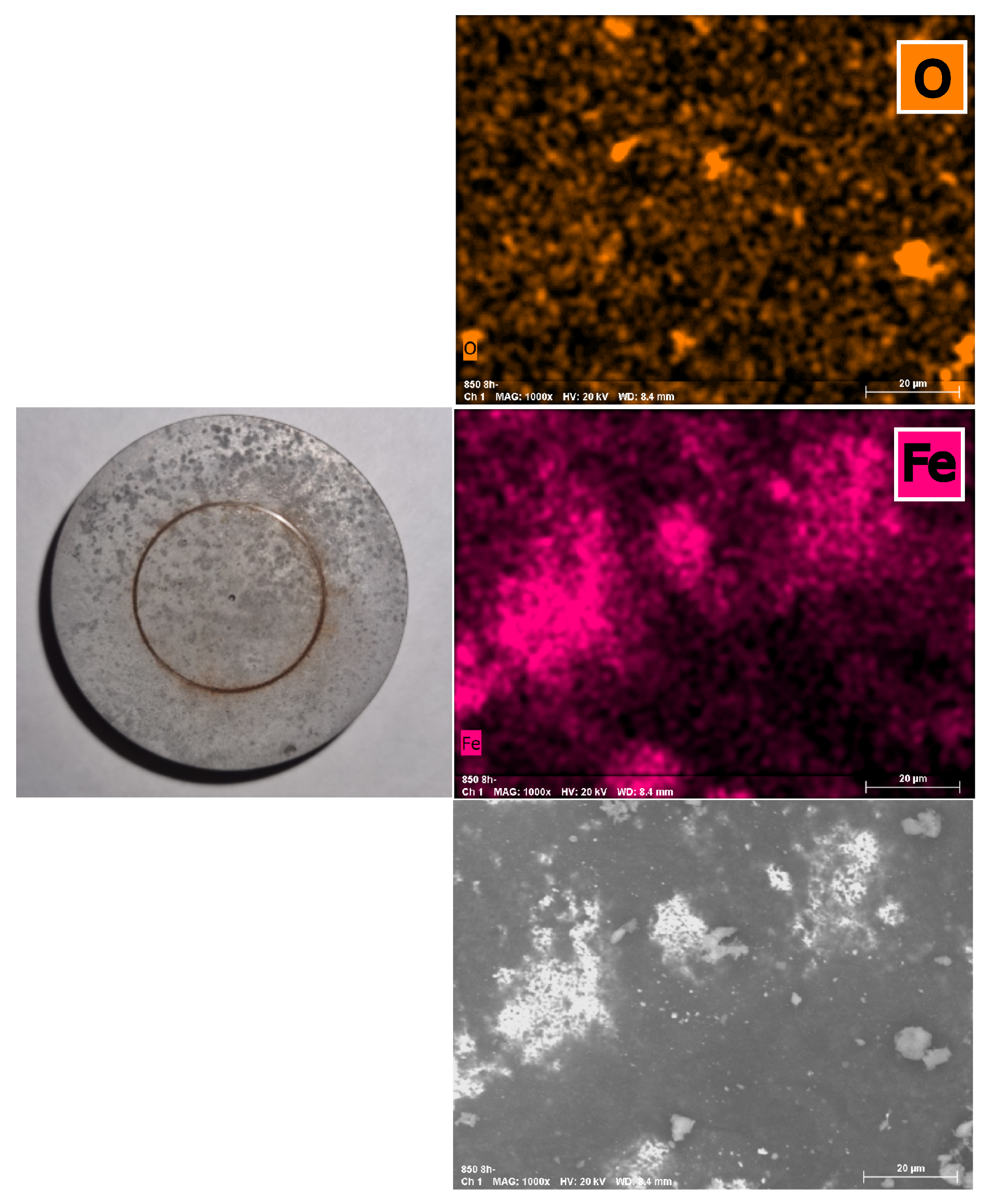
Regarding the oxygen content, Figure 15 shows that its normalized concentration varies with temperature, without a strictly monotonic increase. The presence of oxygen can be explained by the exposure of the substrate to the atmosphere during the wear process. As the surface layer undergoes partial degradation or delamination, the underlying material becomes exposed, promoting the formation of oxides after the pin-on-disc test [60]. These oxides are illustrated in Figure 16.
A study conducted in 2010 [61] reported that boron oxides can react with environmental humidity to form boric acid, which acts as a solid lubricant and reduces the coefficient of friction. However, in this study, an increase in the coefficient of friction is observed in conditions where higher oxygen concentrations were detected. This suggests that the dominant oxides formed on the wear track are likely iron oxides and not boron oxides. Iron oxides are known to act as abrasive particles, increasing friction and wear [62]. Furthermore, previous studies [63] have associated the presence of iron oxides with brown, reddish, or dark-colored surface features. Therefore, the brown coloration observed in and around the wear track in Figure 16 may be associated with the formation of iron oxides.
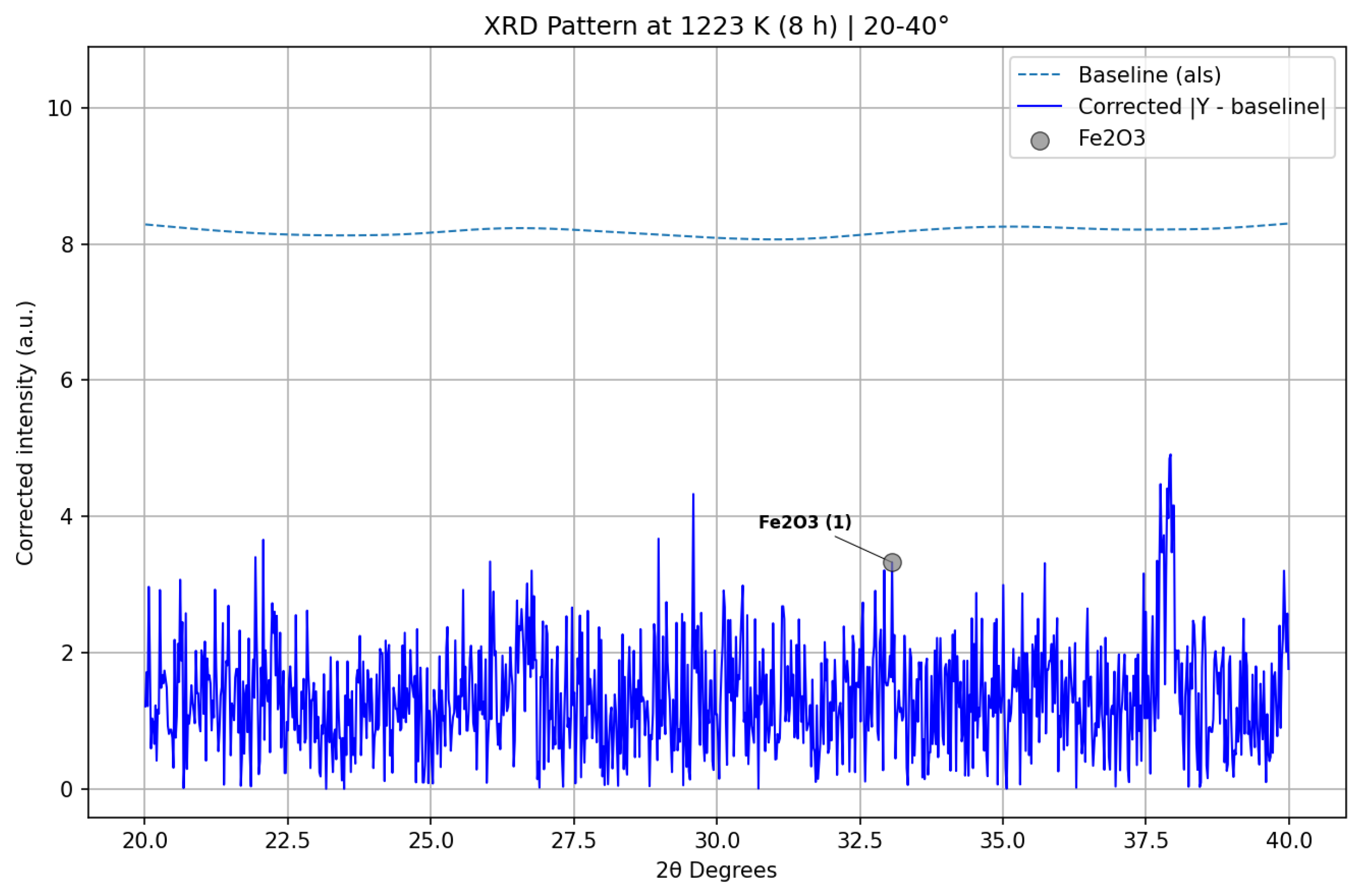
To confirm the presence of iron oxides an additional XRD analysis performed on the wear track region identified the presence of Fe2O3-related diffraction peaks, as shown in Figure 17. For this XRD analysis PDF card 00-006-0696 was used, and the peak shown corresponds to the 104 crystal plane with a peak detected at 33.152°. The detection of iron oxide phases suggests that oxidative wear mechanisms may occur during sliding conditions, particularly at higher treatment temperatures. Although the present results do not allow a definitive determination of the specific role of these oxides in the wear process, their presence may contribute to the observed increase in friction coefficient and wear behavior. On the other hand no boron oxide compounds were found during the XRD analysis.
Overall, the results obtained in this work demonstrate a strong interdependence between elemental diffusion, phase formation, microstructural evolution, and tribological performance during the boronitrocarburizing treatment of AISI 1018 steel. The treatment temperature significantly affected the diffusion behavior of boron, carbon, and nitrogen, promoting different phase compositions and layer morphologies that ultimately controlled the friction and wear response of the treated surfaces.

4. Conclusions

The diffusion of boron, nitrogen, and carbon during the boronitrocarburizing thermochemical treatment was confirmed in this work using both surface and cross-sectional EDS analysis, as well as XRD. From these results, it can be seen that the diffusion of these elements depends strongly on the treatment temperature, producing important changes in the phases formed, the microstructure, and the tribological behavior of the material.
The boronitrocarburizing treatment appeared to promote a combined diffusion behavior between boron, nitrogen, and carbon, leading to the formation of multiphase modified layers with improved tribological performance. Boron contributed primarily to wear resistance through the formation of FeB and Fe2B phases, which are associated with increased surface hardness. In contrast, nitrogen and carbon may contribute to layer stability by facilitating diffusion within the modified layer and promoting the formation of additional nitride and carbide related phases. Similar behavior has been reported in previous two-stage treatment studies [38]. Among the evaluated conditions, the treatment performed at 1173 K exhibited the best balance between phase stability, microstructural homogeneity, and tribological performance.
From the XRD analysis, it can be observed that at 1123 K the material is mainly dominated by Fe and Fe3C, with the presence of FeB as the primary boride phase. This phase is known to be hard but brittle [38], which can increase the susceptibility of the layer to cracking and detachment. At 1173 K, the formation of Fe2B is observed, while FeB is no longer clearly present. Since Fe2B is less brittle than FeB, this suggests that the layer becomes more stable, reducing the probability of delamination and improving the tribological behavior. In contrast, at 1223 K, both FeB and Fe2B phases are detected. The coexistence of these phases, particularly the presence of the more brittle FeB, may negatively affect the mechanical integrity of the layer, contributing to a reduction in tribological performance. This behavior may be associated with the formation of a more heterogeneous modified layer at 1223 K and 1123 K, where excessive elemental diffusion promotes phase coarsening and reduces the structural stability of the layer. Under sliding conditions, the presence of only FeB brittle regions or in coexistence with Fe2B phases may facilitate crack initiation and localized delamination, generating wear debris that contributes to increased friction and wear compared to the more homogeneous layer formed at 1173 K.
The study concluded that the sample treated at 1173 K exhibited the best tribological performance, showing the lowest coefficient of friction ( μ 0.1216 ). On the other hand the samples treated at 1123 K and 1223 K exhibited coefficients of friction of μ 0.1611 and μ 0.1856 , respectively. All treated samples showed a reduction in the coefficient of friction compared to the control sample ( μ 0.558 ).
From the cross-sectional EDS analysis, it can also be observed that the elements follow a diffusion-controlled behavior. Although the detection of boron and nitrogen by EDS should be interpreted cautiously due to the limited sensitivity of the technique for light elements, the results suggest that boron reaches its highest detectable concentration at 1173 K and then decreases at 1223 K, while nitrogen appears to increase with temperature, indicating deeper diffusion into the substrate. Carbon remains relatively stable, with a slight decrease at higher temperatures. These results suggest that the treatment produces compositional gradients within the modified layer.
These differences in composition and phase formation are reflected in the tribological results. All the treated specimens (1123 K, 1173 K, and 1223 K for 8 h) show better wear resistance and lower coefficient of friction compared to the control sample. Among them, the specimen treated at 1173 K shows the best overall tribological performance ( μ = 0.1216 , Wear = 3.95 × 10 6 mm3/Nm), which suggests that this condition produces a more stable layer. In contrast, the 1223 K sample shows a slight deterioration, which can be related to the coarser microstructure, the presence of brittle phases, and reduced layer stability.
The EDS, SEM, XRD, adhesion, and tribological analyses demonstrated a strong relationship between elemental diffusion, phase formation, microstructural stability, and the tribological behavior of the boronitrocarburized AISI 1018 steel. The EDS analyses indicated the diffusion of boron, carbon, and nitrogen into the treated layers, although the detection of boron and nitrogen should be interpreted carefully due to the limitations of EDS for light-element detection. The XRD results showed the formation of different boride-, nitride-, and carbide-related phases in the evaluated samples, which was especially useful for confirming the presence of boron- and nitrogen-related compounds that could not always be directly identified through EDS analysis. The SEM observations showed that the treatment performed at 1173 K promoted a more homogeneous and compact microstructural morphology with improved layer stability and lower susceptibility to delamination. These characteristics were consistent with the tribological results, where the specimen treated at 1173 K exhibited the lowest friction coefficient and one of the lowest wear rates among all the evaluated conditions.
AISI 1018 steel is widely used in the manufacturing of industrial equipment and mechanical systems that are frequently subjected to severe wear conditions. Consequently, these components may benefit significantly from thermochemical surface treatments aimed at improving their tribological properties and service life. Other surface modification methods have previously been applied to AISI 1018 steel to enhance the durability of industrial machinery components manufactured from this alloy [39], demonstrating the growing interest in surface engineering treatments for low-carbon steels so this types of studies are benefitial to these industries.

Author Contributions

Conceptualization, M.C.E.-E.; methodology, I.A.N.-T. and J.A.J.-S.; validation, I.A.N.-T. and M.C.E.-E.; formal analysis, I.A.N.-T. and M.C.E.-E.; investigation, I.A.N.-T., J.A.J.-S. and A.H.-G.; data curation, I.A.N.-T.; writing—original draft preparation, J.A.J.-S.; writing—review and editing, I.A.N.-T.; visualization, I.A.N.-T., M.C.E.-E. and A.H.-G.; supervision, M.C.E.-E.; project administration, M.C.E.-E., resources, M.C.E.-E. and A.H.-G. All authors have read and agreed to the published version of the manuscript.

Funding

This research received no external funding.

Institutional Review Board Statement

Not applicable.

Informed Consent Statement

Not applicable.

Data Availability Statement

The original contributions presented in this study are included in the article. Further inquiries can be directed to the corresponding author.

Conflicts of Interest

The authors declare no conflicts of interest.

References

  1. Zheng, Q.; Chen, H.s.; Zhou, J.; Wang, W.; Xi, S.x.; Yuan, Y. Effect of boron element on microstructure and mechanical properties of 316L stainless steel manufactured by selective laser melting. J. Mater. Res. Technol. 2023, 26, 3744–3755. [Google Scholar] [CrossRef]
  2. Hernández-Ramírez, E.J.; Guevara-Morales, A.; Figueroa-López, U.; Campos-Silva, I. Wear resistance of diffusion annealed borided AISI 1018 steel. Mater. Lett. 2020, 277, 128297. [Google Scholar] [CrossRef]
  3. Fernández-Valdés, D.; Meneses-Amador, A.; López-Liévano, A.; Ocampo-Ramírez, A. Sliding wear analysis in borided AISI 316L steels. Mater. Lett. 2021, 285, 129138. [Google Scholar] [CrossRef]
  4. Czerwinski, F. Heat Treatment: Conventional and Novel Applications; Intech: Rijeka, Croatia, 2012. [Google Scholar]
  5. Petrova, L. Progress in theory and practice of thermochemical treatment of steels. Int. Heat Treat. Surf. Eng. 2012, 6, 168–170. [Google Scholar] [CrossRef]
  6. Chaus, A.S.; Sahul, M.; Sitkevich, M.V.; Kusý, M. Optimisation of thermochemical treatment of M2 high-speed steel. Defect Diffus. Forum 2022, 420, 43–52. [Google Scholar] [CrossRef]
  7. Ortiz-Domínguez, M.; Morales-Robles, Á.; Gómez-Vargas, O.; Solis-Romero, J. Recycling of the powder-pack boriding mixture: Microstructural characterization of Fe2B layers on ASTM A36 steel. Microsc. Microanal. 2020, 26, 2220–2222. [Google Scholar] [CrossRef]
  8. Scheuer, C.J.; Cardoso, R.P.; Brunatto, S.F. Sequential low-temperature plasma-assisted thermochemical treatments of the AISI 420 martensitic stainless steel. Surf. Coat. Technol. 2021, 421, 127459. [Google Scholar] [CrossRef]
  9. López Perrusquia, N.; Doñu Ruiz, M.A.; García Bustos, E.D.; Lores Martínez, M.; Urriolagoitia Calderón, G.M.; Torres San Miguel, C.R. Duplex surface treatment on microalloy steels by dehydrated paste pack boriding and pack carburizing. Mater. Lett. 2020, 280, 128573. [Google Scholar] [CrossRef]
  10. Berns, H.; Edenhofer, B.; Bowman, J.W.; Juse, R.L. Solution nitriding of stainless steels: A new thermochemical heat treatment process. In Stainless Steel 2000, 1st ed.; CRC Press: Boca Raton, FL, USA, 2002; pp. 117–131. [Google Scholar]
  11. Kindrachuk, M.; Dukhota, O.; Tisov, O.; Korbut, E.; Yurchuk, A.; Kharchenko, V. Improving the wear resistance of heavy-duty elements in tribomechanical systems by a combined laser-thermochemical processing method. East.-Eur. J. Enterp. Technol. 2021, 3, 6–13. [Google Scholar] [CrossRef]
  12. Yildiz, U.T.; Varol, T.; Pürçek, G.; Akçay, S.B. A review on the surface treatments used to create wear and corrosion resistant steel surfaces. Politek. Derg. 2024, 27, 227–236. [Google Scholar] [CrossRef]
  13. Shi, M.; Li, J.; Mao, W.; Li, S.; Yang, Z.; Ma, X. Improving the wear and corrosion resistance of martensitic stainless steel by paste boriding treatment. Mater. Sci. Technol. 2023, 39, 300–309. [Google Scholar] [CrossRef]
  14. Fang, H.; Xu, F.; Zhang, G. Investigation of dry sliding wear behavior of pack boriding Fe-based powder metallurgy. Integr. Ferroelectr. 2020, 208, 67–82. [Google Scholar] [CrossRef]
  15. Ozdemir, O.; Omar, M.; Usta, M.; Zeytin, S.; Bindal, C.; Ucisik, A. An investigation on boriding kinetics of AISI 316 stainless steel. Vacuum 2008, 83, 175. [Google Scholar] [CrossRef]
  16. Kayali, Y. Investigation of diffusion kinetics of borided AISI P20 steel in micro-wave furnace. Vacuum 2015, 121, 129–134. [Google Scholar] [CrossRef]
  17. Fang, H.M.; Zhang, G.S.; Xia, L.S. Properties and growth kinetics of the boride layer of a boriding-strengthened Fe-based powder metallurgical material. Strength Mater. 2021, 53, 65–72. [Google Scholar] [CrossRef]
  18. Kayali, Y.; Yönetken, A. Investigation of wear behavior of borided materials produced by the powder metallurgy method in different compositions. Prot. Met. Phys. Chem. Surf. 2021, 57, 771–778. [Google Scholar] [CrossRef]
  19. García-León, R.A.; Martínez-Trinidad, J.; Campos-Silva, I. Historical review on the boriding process using bibliometric analysis. Trans. Indian Inst. Met. 2021, 74, 541–557. [Google Scholar] [CrossRef]
  20. Arteaga-Hernandez, L.A.; Cuao-Moreu, C.A.; Gonzalez-Rivera, C.E.; Alvarez-Vera, M.; Ortega-Saenz, J.A.; Hernandez-Rodriguez, M.A.L. Study of boriding surface treatment in the tribological behavior of an AISI 316L stainless steel. Wear 2021, 477, 203825. [Google Scholar] [CrossRef]
  21. Solis-Romero, J.; Ortiz-Domínguez, M.; Gómez-Vargas, O.; Escalona-Cambray, F.; Zuno-Silva, J. Characterization of PVD coating and carbo-boro-nitride layer on ARMCO® pure iron. Microsc. Microanal. 2020, 26, 2644–2646. [Google Scholar] [CrossRef]
  22. Ortiz-Dominguez, M.; Simon-Marmolejo, I.; Elias-Espinosa, M.; Flores-Renteria, M.A.; Martinez-Martinez, L.E.; Arenas-Flores, A. The powder-pack boriding and nitriding process: Microstructural characterization of boride and nitride layers on Armco pure iron. Microsc. Microanal. 2018, 24, 664–665. [Google Scholar] [CrossRef]
  23. Ruiz, M.D.; Perrusquia, N.L.; Miguel, C.R.; Saucedo, N.M.; Domínguez, V.O. Characterization of microstructure obtained by boronitriding of an AISI H13 steel. Microsc. Microanal. 2020, 26, 2452–2453. [Google Scholar] [CrossRef]
  24. Carrera Espinoza, R.; Alvarez Vera, M.; Wettlaufer, M.; Kerl, M.; Barth, S.; Moreno Garibaldi, P.; Díaz Guillen, J.C.; Hernández García, H.M.; Muñoz Arroyo, R.; Ortega, J.A. Study on the Tribological Properties of DIN 16MnCr5 Steel after Duplex Gas-Nitriding and Pack Boriding. Materials 2024, 17, 3057. [Google Scholar] [CrossRef]
  25. Bayça, S.U.; Bican, O.; Yamanel, B.; Hekimoğlu, A.P.; Çalış, M. The effect of solid boriding time on the structure, hardness and corrosion properties of AISI 5140 steel. Prot. Met. Phys. Chem. Surf. 2020, 56, 591–597. [Google Scholar] [CrossRef]
  26. Suryaraj, G.; Prince, M.; Maniraj, J. Diffusion borocarburizing of steels. Int. J. Adv. Sci. Technol. 2020, 29, 316–322. [Google Scholar]
  27. Pertek, A.; Kulka, M. Microstructure and properties of composite (B + C) diffusion layers on low-carbon steel. J. Mater. Sci. 2003, 38, 269–273. [Google Scholar] [CrossRef]
  28. Ramdane, N.; Touhami, Z.M.; Khettache, A.; Khelfaoui, Y.; Ourdjini, A.; Xin, J. Boriding and boronitrocarburising effects on hardness, wear and corrosion behavior of AISI 4130 steel. Matéria (Rio de Janeiro) 2019, 24, e-12327. [Google Scholar] [CrossRef]
  29. Kusmanov, S.A.; Silkin, S.A.; Smirnov, A.A.; Belkin, P.N. Possibilities of increasing wear resistance of steel surface by plasma electrolytic treatment. Wear 2017, 386–387, 239–246. [Google Scholar] [CrossRef]
  30. Aktaş, B.; Toprak, M.; Çalık, A.; Tekgüler, A. Effect of pack-boriding on the tribological behavior of Hardox 450 and Hituf steels. Rev. Adv. Mater. Sci. 2020, 59, 314–321. [Google Scholar] [CrossRef]
  31. Davis, J.R. Surface Hardening of Steels: Understanding the Basics; ASM International: Materials Park, OH, USA, 2002. [Google Scholar]
  32. Ortiz-Dominguez, M.; Martinez-Martinez, L.E.; Flores-Renteria, M.A.; Simon-Marmolejo, I.; Elias-Espinosa, M. A new powder-pack carbo-boro-nitriding process: Microstructural characterization of multicomponent layers on Armco® pure iron. Microsc. Microanal. 2018, 24, 2242–2243. [Google Scholar] [CrossRef]
  33. Belaid, M.; Fares, M.; Assalla, O.; Boukari, F. Surface characterization of a modified cold work tool steel treated by powder-pack boronizing. Mater. Werkst. 2022, 53, 15–38. [Google Scholar] [CrossRef]
  34. Kusmanov, S.; Mukhacheva, T.; Tambovskiy, I.; Naumov, A.; Belov, R.; Sokova, E.; Kusmanova, I. Increasing Hardness and Wear Resistance of Austenitic Stainless Steel Surface by Anodic Plasma Electrolytic Treatment. Metals 2023, 13, 872. [Google Scholar] [CrossRef]
  35. Baykara, C.; Atik, E. The effect of surface roughness and carburized depth on wear resistance in 16MnCr5 case hardening steel. Ind. Lubr. Tribol. 2024, 77, 81–92. [Google Scholar] [CrossRef]
  36. Panfil-Pryka, D.; Kulka, M.; Makuch, N.; Michalski, J.; Dziarski, P. The Effect of Temperature Distribution During Laser Heat Treatment of Gas-Nitrided 42CrMo4 Steel on the Microstructure and Mechanical Properties. Coatings 2020, 10, 824. [Google Scholar] [CrossRef]
  37. Wang, Y.; Liu, X. The performance study about the boronitriding layer in the low temperature. In Proceedings of the 2011 Second International Conference on Digital Manufacturing & Automation, Zhangjiajie, China, 5–7 August 2011; pp. 1309–1312. [Google Scholar] [CrossRef]
  38. Gómez-Vargas, O.A.; Solis-Romero, J.; Figueroa-López, U.; Ortiz-Domínguez, M.; Oseguera-Peña, J.; Neville, A. Boro-nitriding coating on pure iron by powder-pack boriding and nitriding processes. Mater. Lett. 2016, 176, 261–264. [Google Scholar] [CrossRef]
  39. Sánchez-Islas, A.; Martínez-Trinidad, J.; Campos-Silva, I.; Figueroa-López, U.; Martínez, J.C.; García-León, R.A. Dry Sliding Wear Test on Borided AISI 1018 Steel Under Pin-on-Disc Configuration. Metall. Mater. Trans. A 2021, 53, 179–199. [Google Scholar] [CrossRef]
  40. ASTM A108-24; Standard Specification for Steel Bar, Carbon and Alloy, Cold-Finished. ASTM International: West Conshohocken, PA, USA, 2024.
  41. ASTM A29/A29M-16; Standard Specification for General Requirements for Steel Bars, Carbon and Alloy, Hot-Wrought. ASTM International: West Conshohocken, PA, USA, 2020.
  42. Birk, P.; Wohlgemuth, K. Verfahren zum Nitrieren von Metallen, Insbesondere von Eisenlegierungen. DE Patent DE1771827A1, 9 March 1972. Available online: https://worldwide.espacenet.com/patent/search/family/005701008/publication/DE1771827A1?q=pn%3DDE1771827A1 (accessed on 27 January 2025).
  43. ASTM G99-17; Standard Test Method for Wear Testing with a Pin-on-Disk Apparatus. ASTM International: West Conshohocken, PA, USA, 2023.
  44. DIN 50324; Tribology Testing of Friction and Wear Model Test for Sliding Friction of Solids (Ball-on-Disc System). DIN: Berlin, Germany, 1992.
  45. Vanegas, L.G.; Espinosa, M.C.; Doñu Ruiz, M.A.; Perrusquia, N.L.; Hernández-García, A. Tribological evaluation of boride layers formed on an AISI M2 steel substrate by the powder packing method. Microsc. Microanal. 2023, 29, 98–101. [Google Scholar] [CrossRef]
  46. Saphirwerk. Precision Balls of the Highest Grade. 2014. Available online: https://saphirwerk.com/assets/Downloads/Saphirwerk-precision-balls.pdf (accessed on 17 January 2025).
  47. Vidakis, N.; Antoniadis, K.; Bilalis, S. The VDI 3198 indentation test: Evaluation of a reliable qualitative control for layered compounds. J. Mater. Process. Technol. 2003, 143, 481–485. [Google Scholar] [CrossRef]
  48. Thompson, K. Is energy resolution still an important specification in EDS? Microsc. Today 2013, 21, 30–34. [Google Scholar] [CrossRef]
  49. Krelling, A.P.; Milan, J.C.G.; Da Costa, C.E. Tribological behaviour of borided H13 steel with different boriding agents. Surf. Eng. 2015, 31, 581–587. [Google Scholar] [CrossRef]
  50. Guo, P.; Ma, S.; He, X.; Shah, I.; Lv, P.; Chen, H.; Zhang, J. Effect of silicon content on microstructures and properties of directionally solidified Fe-B alloy. Materials 2022, 15, 5937. [Google Scholar] [CrossRef] [PubMed]
  51. Somers, M.A.; Mittemeijer, E.J. Layer-growth kinetics on gaseous nitriding of pure iron: Evaluation of diffusion coefficients for nitrogen in iron nitrides. Metall. Mater. Trans. A 1995, 26, 57–74. [Google Scholar] [CrossRef]
  52. Castro, G.; Fernández-Vicente, A.; Cid, J. Influence of the nitriding time in the wear behaviour of an AISI H13 steel during a crankshaft forging process. Wear 2007, 263, 1375–1385. [Google Scholar] [CrossRef]
  53. Ampaw, E.K.; Arthur, E.K.; Adewoye, O.O.; Adetunji, A.R.; Olusunle, S.O.O.; Soboyejo, W.O. Carbonitriding “Pack Cyaniding” of ductile irons. Adv. Mater. Res. 2015, 1132, 330–348. [Google Scholar] [CrossRef]
  54. Mindivan, H. Effects of combined diffusion treatments on the wear behaviour of Hardox 400 steel. Procedia Eng. 2013, 68, 710–715. [Google Scholar] [CrossRef]
  55. Olanrewaju, Y.A. Effects of Cassava-Leaf-Enhanced Carbonitriding on Case-Hardening of Barite Mining Tools. Master’s Thesis, African University of Science and Technology, Abuja, Nigeria, 2017. [Google Scholar]
  56. Şahin, S. Effects of boronizing process on the surface roughness and dimensions of AISI 1020, AISI 1040 and AISI 2714. J. Mater. Process. Technol. 2009, 209, 1736–1741. [Google Scholar] [CrossRef]
  57. Türkmen, İ.; Yalamaç, E.; Keddam, M. Investigation of tribological behaviour and diffusion model of Fe2B layer formed by pack-boriding on SAE 1020 steel. Surf. Coat. Technol. 2019, 377, 124888. [Google Scholar] [CrossRef]
  58. Çelik, İ. Surface characterization of borided S220 rebar. J. Charact. 2021, 2, 66–70. [Google Scholar] [CrossRef]
  59. Kato, K. Wear in relation to friction: A review. Wear 2000, 241, 151–157. [Google Scholar] [CrossRef]
  60. Hayat, F.; Sezgin, C.T. Wear behavior of borided cold-rolled high manganese steel. Coatings 2021, 11, 1207. [Google Scholar] [CrossRef]
  61. Ulutan, M.; Yildirim, H. Tribological properties of borided AISI 4140 steel with the powder pack-boriding method. Tribol. Lett. 2010, 40, 269–278. [Google Scholar] [CrossRef]
  62. Noh, H.J.; Jang, H. Friction instability induced by iron and iron oxides on friction material surface. Wear 2018, 400–401, 93–100. [Google Scholar] [CrossRef]
  63. Scheinost, A.C.; Ford, R.G.; Sparks, D.L. Color identification of iron oxides and hydroxysulfates: Use and limitations. Soil Sci. Soc. Am. J. 1999, 63, 1463–1471. [Google Scholar] [CrossRef]
Figure 1. Energy-dispersive spectroscopy (EDS) spectrum on the surface of boronitrocarburized AISI 1018 steel for 8 h, (a) 1123 K, (b) 1173 K and (c) 1223 K.
Applsci 16 05451 g001
Figure 2. EDS mapping on wear tracks on the surface of boronitrocarburized AISI 1018 steel treated at (a) 1123 K, (b) 1173 K and (c) 1223 K for 8 h.
Applsci 16 05451 g002
Figure 3. Daimler–Benz Rockwell C coat adhesion test for treatments (a) 1123 K 8 h, (b) 1173 K 8 h and (c) 1223 K 8 h.
Applsci 16 05451 g003
Figure 4. EDS mapping on wear tracks on the surface of boronitrocarburized AISI 1018 steel treated at (a) 1123 K, (b) 1173 K and (c) 1223 K for 8 h.
Applsci 16 05451 g004
Figure 5. Cross-sectional microstructures of boronitrocarburized AISI 1018 steel at different magnifications (100×, 1000×, 2500×, and 5000×) for treatments at 1123 K, 1173 K, and 1223 K for 8 h.
Applsci 16 05451 g005
Figure 6. X–ray Diffraction (XRD) pattern for boronitrocarburized AISI 1018 Steel treated at 1123 K for 8 h.
Applsci 16 05451 g006
Figure 7. XRD–pattern for boronitrocarburized AISI 1018 Steel treated at 1173 K for 8 h.
Applsci 16 05451 g007
Figure 8. XRD–pattern for boronitrocarburized AISI 1018 Steel treated at 1223 K for 8 h.
Applsci 16 05451 g008
Figure 9. Detailed XRD–pattern for boronitrocarburized AISI 1018 Steel treated at 1123 K for 8 h showing the diffraction region between 37° and 47°.
Applsci 16 05451 g009
Figure 10. Detailed XRD–pattern for boronitrocarburized AISI 1018 Steel treated at 1173 K for 8 h showing the diffraction region between 37° and 47°.
Applsci 16 05451 g010
Figure 11. Detailed XRD–pattern for boronitrocarburized AISI 1018 Steel treated at 1223 K for 8 h showing the diffraction region between 37° and 47°.
Applsci 16 05451 g011
Figure 12. Detailed XRD–pattern for boronitrocarburized AISI 1018 Steel treated at 1173 K for 8 h showing the diffraction region between 55° and 72°.
Applsci 16 05451 g012
Figure 14. Cross-sectional profiles of wear scars made on the samples under a load of 4 N on boronitrocarburized AISI 1018 steel treated at 1123 K, 1173 K and 1223 K for 8 h.
Applsci 16 05451 g014
Figure 15. Relation between the coefficient of friction, wear, and roughness with the elements present in the thermochemical boronitrocarburizing treatment at different temperatures: 1123 K, 1173 K, 1223 K 8 h.
Applsci 16 05451 g015
Figure 16. Formation of oxides in the wear track for specimen 1173 K 8 h. Oxygen is represented in orange and iron in red color as shown in the EDS map.
Applsci 16 05451 g016
Figure 17. Detailed XRD–pattern obtained from the wear-track region of the sample treated at 1223 K for 8 h showing the identification of the main diffraction peak for Fe2O3 between 20° and 40°.
Applsci 16 05451 g017
Table 1. Composition of the powder mixture used for the boronitrocarburizing treatment.
ComponentDescriptionwt.%
Durborid G®Commercial boriding mixture containing CaSi, B4C, KBF4, and SiC50.0
CaCN2Nitrogen source42.5
Aktivator®Diffusion activator7.5
Table 2. EDS-normalized mass concentration (%) of elements over the wear tracks for different treatment temperatures.
Time (h)Temp (K)FeBCNOCaSiAlNa
8112321.081.4370.850.005.340.760.310.050.18
117335.090.0056.340.086.451.220.470.110.32
122379.550.1410.570.816.081.770.530.220.34
Table 3. Normalized mass concentration (%) measured at specific points on the wear track and surface regions.
RegionT (h)Temp (K)FeBCNOCaSiAlNa
Wear
track
8112330.191.5763.330.004.080.420.260.030.12
117339.441.9452.640.004.680.700.280.080.10
122382.311.699.880.403.791.110.260.000.03
Surface8112314.381.2876.990.006.200.710.270.080.10
117328.741.1662.380.006.051.030.310.080.23
122377.570.0011.840.208.261.590.330.140.02
Table 4. Normalized mass concentration (%) measured on the cross-sectional region of the treated samples.
Time (h)Temp (K)FeBCNOCaSiAlNa
8112379.340.8913.470.343.560.170.751.120.35
117360.156.4713.820.983.010.100.1815.290.32
122375.310.0011.142.070.800.250.459.570.41
Table 5. Main diffraction peaks identified in the boronitrocarburized samples together with their crystallographic plane indices and PDF reference cards.
PhaseIdentified 2 θ (°)Crystal PlanePDF CardTemperature (K)Time (h)
FeB37.701(101)00-032-046311238
Fe2N40.647(200)00-050-095811238
Fe3C42.879(211)00-035-077211238
Fe3C43.742(102)00-035-077211238
α -Fe44.667(110)00-006-069611238
Fe3C44.992(031)00-035-077211238
α -Fe64.940(200)00-006-069611238
α -Fe82.290(211)00-006-069611238
Fe3C43.742(102)00-035-077211738
α -Fe44.640(110)00-006-069611738
Fe2B56.912(130)00-036-133211738
α -Fe64.980(200)00-006-069611738
Fe4N69.949(220)00-064-013411738
α -Fe82.270(211)00-006-069611738
FeB37.701(101)00-032-046312238
FeB41.209(111)00-032-046312238
CaC243.390(200)01-072-111912238
Fe3C44.569(220)00-035-077212238
FeB45.029(021)00-032-046312238
Fe2B45.043(121)00-036-133212238
α -Fe65.020(200)00-006-069612238
α -Fe82.390(211)00-006-069612238
Disclaimer/Publisher’s Note: The statements, opinions and data contained in all publications are solely those of the individual author(s) and contributor(s) and not of MDPI and/or the editor(s). MDPI and/or the editor(s) disclaim responsibility for any injury to people or property resulting from any ideas, methods, instructions or products referred to in the content.