1. Introduction
Tyres are multifunctional engineering components that perform structural, tribological, thermal, and dynamic roles in road vehicles [
1,
2]. Beyond providing load support and road contact, they directly affect ride comfort, braking, handling stability, rolling resistance, noise generation, and wear particle formation. As elastic structures and rotating masses, tyres influence both local tyre behaviour and the broader vehicle response [
3,
4].
Among commonly discussed tyre parameters, attention is usually directed toward dimensions, inflation pressure, tread pattern, compound formulation, load index, speed category, and rolling resistance classification [
5,
6]. In contrast, the manufacturing mass of the tyre is comparatively less examined as an independent engineering variable, despite its practical relevance [
7,
8]. Tyre mass contributes to unsprung mass and rotational inertia, and both are associated with vehicle acceleration response, suspension behaviour, energy demand, and dynamic wheel control [
9,
10,
11]. In addition, tyre mass reflects the quantity and distribution of material incorporated during manufacturing and may therefore be indirectly linked to production consistency and resource efficiency [
12,
13,
14].
In contemporary automotive engineering, these issues are increasingly relevant. Electrified vehicles are sensitive to energy efficiency and rotating losses; advanced chassis control systems rely on predictable wheel behaviour, and growing attention is being paid to non-exhaust emissions originating from tyre and road wear. Under such conditions, secondary design and production parameters may gain increased practical relevance [
15,
16,
17].
Electrified vehicles often exhibit higher mass due to battery systems and are characterized by high instantaneous torque transmission [
18]. These characteristics can lead to increased tyre wear rates compared with conventional internal combustion engine vehicles [
19]. As a result, tyre properties and material characteristics are receiving increasing attention in studies focused on sustainable mobility and non-exhaust emissions [
20,
21].
Despite this relevance, publicly discussed tyre regulations and product labelling frameworks focus predominantly on safety, energy efficiency, wet grip, rolling resistance, noise, durability, and recycling-related requirements [
22,
23,
24,
25,
26]. Far less attention is devoted to the possible manufacturing dispersion of tyre mass within products of identical nominal specification [
27,
28]. From an engineering perspective, this raises a practical question: to what extent do nominally identical new tyres differ in mass when examined under controlled measurement conditions [
29,
30,
31,
32]?
Although tyre-related engineering research has expanded substantially in recent years, the majority of published studies focus on tyre–road interaction, rolling resistance, wear mechanisms, non-exhaust particle emissions, vehicle dynamics, and sustainability-related material aspects. Considerably less attention has been devoted to experimentally quantifying manufacturing mass variability among nominally identical passenger-car tyres under controlled and repeatable measurement conditions [
33,
34,
35,
36]. Existing manufacturing-oriented studies mainly address tyre production technologies, recycling processes, material composition, or broader performance characteristics, whereas direct experimental assessment of within-group tyre mass dispersion remains comparatively limited [
37,
38,
39,
40]. As a result, the possible engineering significance of measurable mass differences between nominally equivalent new tyres is still insufficiently clarified in the available literature [
41,
42].
The available literature therefore indicates that manufacturing tyre mass variability remains insufficiently documented experimentally, despite its potential relevance to material distribution, rotating inertia, unsprung mass, product consistency, and tolerance-oriented engineering assessment.
The aim of the present study is to experimentally quantify manufacturing mass variability in selected groups of new passenger-car tyres using a controlled repeated-weighing protocol. The study was not designed as a market-representative survey but as an engineering investigation focused on measurable mass dispersion within nominally identical tyre groups.
To achieve this aim, the following research tasks were defined:
To measure the mass of new tyres using a repeated high-precision weighing procedure with tyre repositioning before each measurement;
To quantify within-group mass dispersion using descriptive statistical indicators, including mean mass, standard deviation, range, and coefficient of variation;
To compare mass variability between selected tyre groups differing in size, season, production code, and intended application;
To examine potential batch-level variability in cases where multiple production codes were available within the same nominal tyre specification;
To discuss the engineering relevance of the measured variability in relation to manufacturing consistency, unsprung mass, rotating inertia, and future tolerance-oriented tyre assessment.
2. Materials and Methods
2.1. Study Design and Dataset Structure
The study was based on an experimental weighing campaign of selected new passenger-car tyres obtained from the commercial market. The primary analytical dataset comprised 68 new passenger-car tyres, grouped according to identical nominal size and available production-identification characteristics (brand/model group, dimensional code, and production batch or DOT information where available). The purpose of this grouping strategy was to evaluate mass dispersion among tyres that were nominally equivalent from the user perspective.
A secondary dataset consisting of six lightweight competition tyres was measured separately and treated only as an auxiliary reference case. These tyres were not used as a benchmark for conventional passenger-car tyres and were excluded from the primary comparative statistical interpretation.
The study was designed as a controlled measurement investigation rather than a market-representative survey. Therefore, the results should be interpreted as experimental evidence of measurable manufacturing mass variability in selected tyre groups not as a direct estimate of the entire tyre market.
No formal sample-size optimization or statistical power calculation was performed because the study was designed as an exploratory engineering investigation rather than as a market-representative population survey. Reliability of the measurement results was instead addressed through the repeatability-oriented protocol applied to each tyre and through cautious interpretation of group-level variability. Comparative conclusions were focused mainly on groups with sample size n ≥ 4, while groups with n = 2 were retained only as observational cases.
2.2. Weighing Equipment and Measurement Conditions
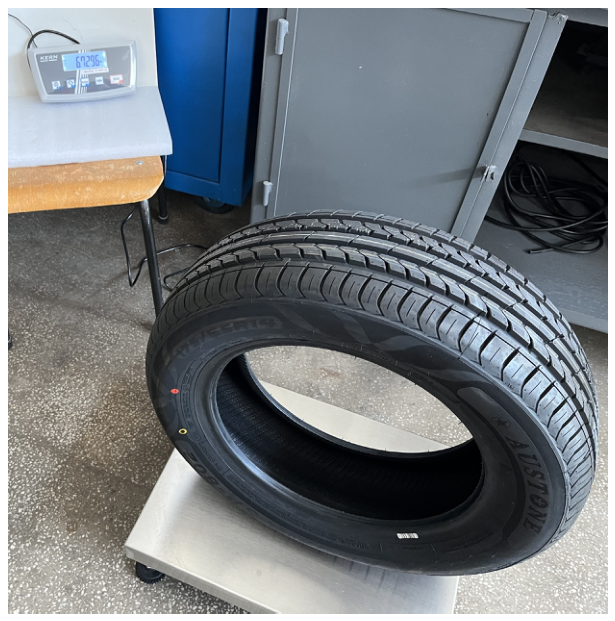
All measurements were performed using a KERN TDS 30K0.1L—Balingen, Germany (
Figure 1) [
43] precision scale (maximum capacity 30 kg; readability 0.1 g). Prior to the weighing campaign, the tyres and the weighing device were allowed to stabilize in an indoor environment with controlled temperature conditions of approximately 18–20 °C and low ambient humidity.
Before weighing, each tyre was inspected and cleaned to remove removable surface contaminants. Commercial labels attached to new tyres were removed prior to the final recorded measurements. Preliminary checks showed that label mass was non-negligible and varied between products; therefore, exclusion of labels was necessary to improve comparability between tyres.
All tyres were weighed individually without rims or additional accessories.
2.3. Repeatability and Measurement Uncertainty Control
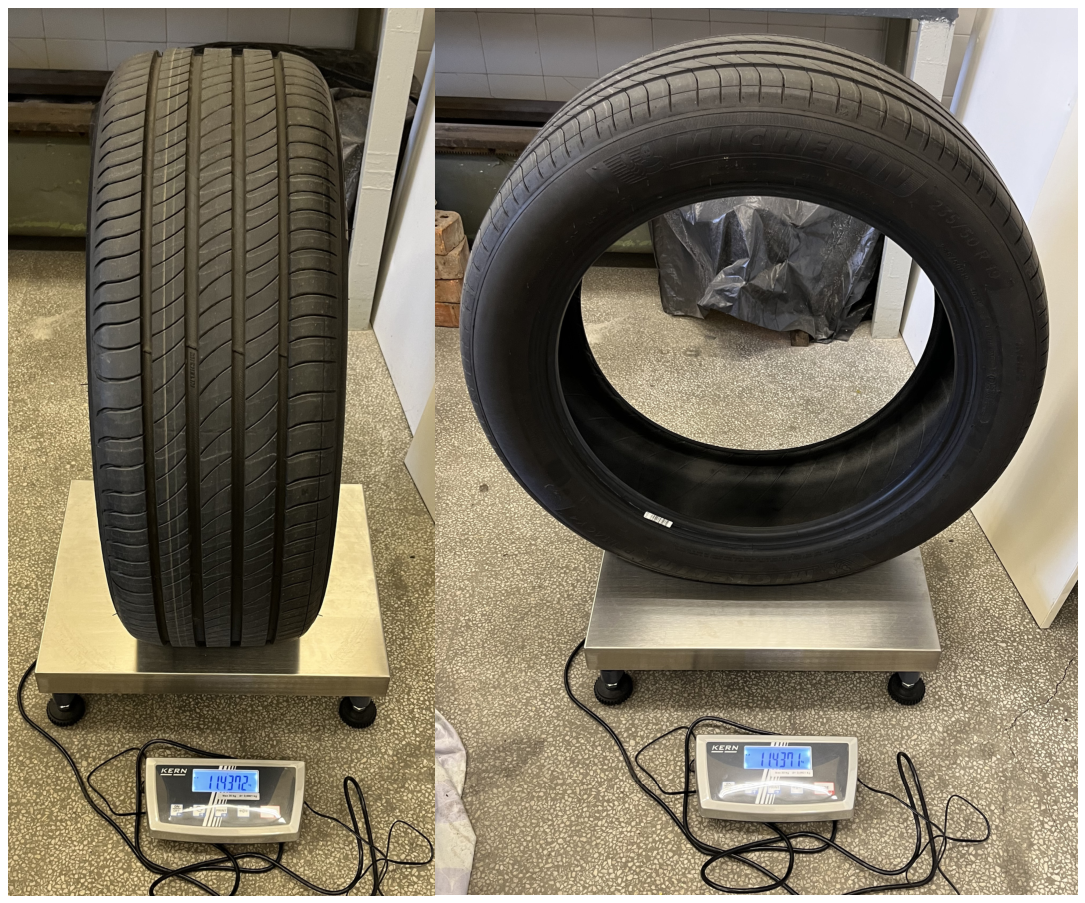
Although tyre weighing itself represents a comparatively straightforward measurement procedure, the reliability and repeatability of the obtained values remain important when evaluating small mass differences between nominally identical products. To improve repeatability control and reduce the influence of possible positioning-related effects, each tyre was weighed ten consecutive times, with complete removal and repositioning on the weighing platform before every individual measurement, as illustrated in
Figure 2.
The weighing instrument readability was 0.1 g, while the observed short-term repeatability during repeated tyre repositioning typically remained within approximately 0.1–0.3 g for individual tyres. In contrast, the between-tyre mass differences observed within several analysed groups reached substantially higher values, including differences on the order of several tens or hundreds of grams depending on the group considered. Under these conditions, the experimental variability associated with the weighing procedure itself remained significantly lower than the measured product-to-product dispersion.
The repeated repositioning procedure shown in
Figure 2 was intentionally implemented because passenger-car tyres represent relatively large and deformable objects compared with conventional laboratory specimens. Consequently, minor positioning effects on the weighing platform could not be excluded a priori. The adopted protocol therefore served as a practical repeatability-control measure aimed at distinguishing real manufacturing-related mass variability from random weighing fluctuations or positioning-related artefacts. The present study should be interpreted as an engineering-oriented repeatability-controlled measurement investigation rather than as a formal metrological certification procedure.
2.4. Statistical Treatment
The measured data were processed using descriptive statistical indicators appropriate for an exploratory engineering assessment of manufacturing tyre mass variability. Because the analysed tyre groups differed substantially in nominal dimensions, construction category, and mean mass, both absolute and relative indicators of dispersion were evaluated in order to ensure meaningful comparison between groups.
For each tyre group, the arithmetic mean mass was calculated as
where
is the mean tyre mass;
is the measured mass of the
i-th tyre; and
n is the number of tyres in the analysed group.
The sample standard deviation was used to quantify the spread of the measured values:
where
is represents the standard deviation of tyre mass within the group.
Because the analysed tyre groups covered substantially different nominal mass ranges, the coefficient of variation (
CV) was additionally calculated as a relative indicator of manufacturing dispersion:
where
CV is expressed in percent.
To complement the relative dispersion analysis, the absolute within-group spread was evaluated using the mass range:
where
and
are the maximum and minimum measured tyre masses in the respective group.
In addition to group-level variability indicators, repeated measurements were used to assess short-term repeatability of the weighing procedure. For each tyre, ten consecutive measurements were performed with complete removal and repositioning before every individual weighing. The repeatability span was evaluated as
where
represents the repeatability-related measurement span obtained from the repeated measurements of an individual tyre, while
and
correspond to the maximum and minimum repeated readings, respectively.
The observed repeatability-related variation remained substantially lower than the between-tyre mass differences identified within several analysed groups. This confirmed that the measured dispersion patterns could not be attributed solely to random weighing fluctuations or minor positioning effects.
In order to avoid overinterpretation of very small datasets, the principal comparative analysis was focused primarily on tyre groups with sample size n ≥ 4. Groups with n = 2 were retained in the dataset for completeness but were interpreted only as observational cases and were not used as the principal basis for comparative engineering conclusions. A separate batch-level comparison was additionally performed in cases where multiple production codes were available within the same nominal tyre specification. This approach enabled distinction between within-group variability and potential between-batch shifts in mean mass.
Additional statistical interpretation was performed through ranking and comparison of CV values among the groups with n ≥ 4, evaluation of absolute range relative to repeatability span, batch-level comparison of mean mass and dispersion for the largest subset, and a descriptive engineering trend analysis between nominal tyre width and mean group mass. These analyses were used to strengthen the engineering interpretation of variability patterns without claiming population-level statistical inference.
The statistical treatment was intentionally descriptive and engineering-oriented. Because the dataset was selected and non-random, no attempt was made to derive population-wide market estimates or universal manufacturing tolerance limits. The analysis was therefore focused on experimentally detectable variability patterns, repeatability-controlled evidence, and engineering interpretation of the observed mass dispersion.
3. Results
3.1. Dataset Characteristics and Overall Variability
The analysed dataset included 68 new passenger-car tyres grouped according to identical nominal specifications, seasonal category, and available production-identification characteristics. The investigated tyres covered a broad range of nominal dimensions and product categories, resulting in substantial variation in absolute tyre mass. In addition to the primary passenger-car dataset, six lightweight competition tyres were analysed separately as an auxiliary engineering reference case because of their substantially different design philosophy and mass-minimization-oriented construction.
Descriptive statistical results for the passenger-car tyre groups are summarized in
Table 1. For each group, the table reports the tyre group designation, production identification, sample size, arithmetic mean mass, minimum–maximum interval, absolute range, standard deviation, and coefficient of variation. These indicators were used to describe both absolute and relative mass dispersion within each nominal tyre group.
As expected, tyre groups with larger nominal dimensions generally exhibited higher absolute mass values than smaller passenger-car tyres. However, direct comparison of absolute mass between unrelated tyre categories has limited engineering value because tyre mass is influenced by several interacting factors, including section width, aspect ratio, rim diameter, reinforcement architecture, tread geometry, load category, and intended application. Therefore, the subsequent interpretation focuses primarily on mass variability within nominally identical tyre groups rather than on direct ranking of different tyre sizes.
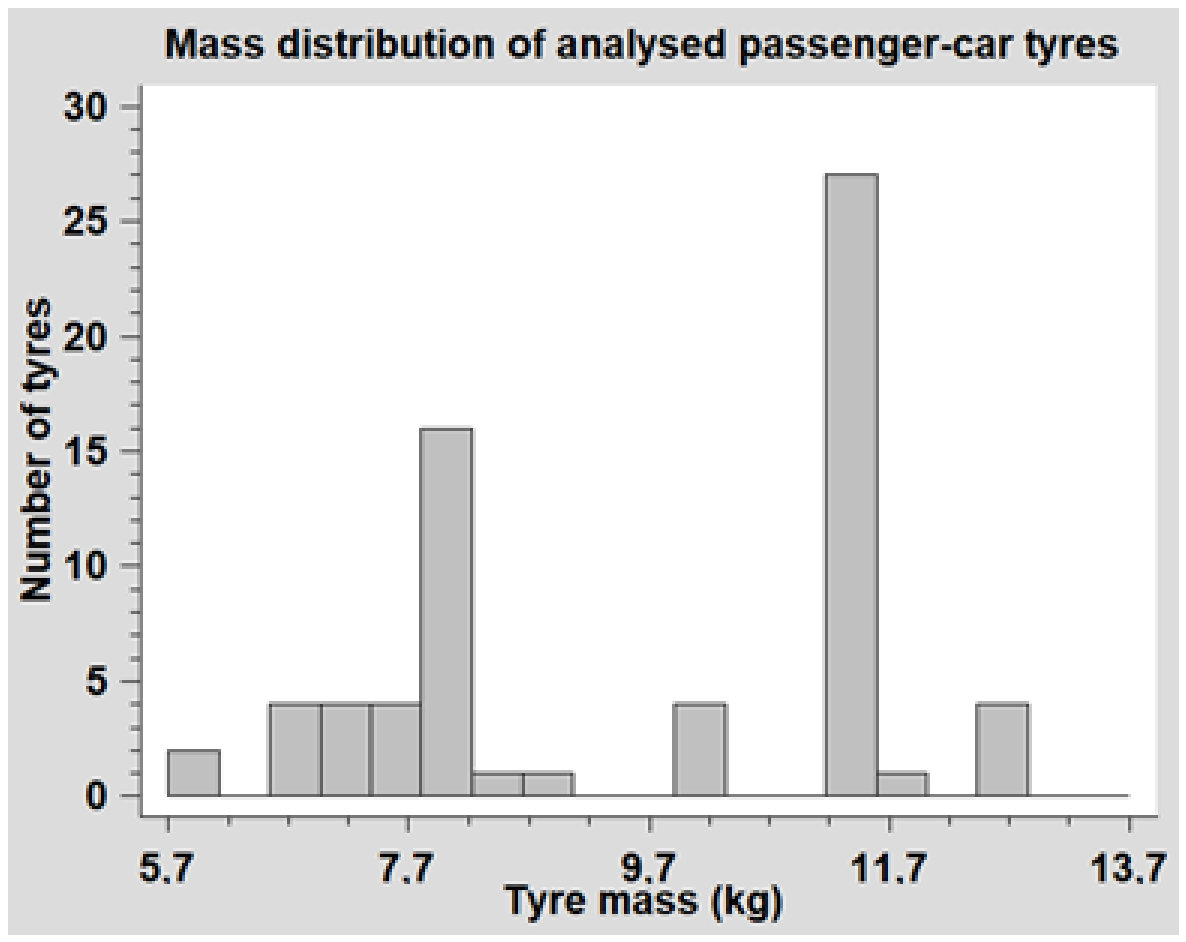
The overall mass distribution of the analysed passenger-car dataset is shown in
Figure 3. The multimodal distribution reflects the heterogeneous composition of the dataset and the presence of several tyre size categories with substantially different nominal masses. This supports the need to evaluate mass dispersion at group level, where tyres share identical or near-identical nominal specifications.
Groups with a very small sample size (
n = 2) were retained in
Table 1 for completeness and observational comparison. However, these groups were not used as the principal basis for comparative engineering conclusions because relative statistical indicators are sensitive to very small sample counts.
The auxiliary lightweight competition tyres had substantially lower absolute masses than the conventional passenger-car tyre groups, which is consistent with their reduced dimensions and specialized mass-oriented design purpose. Because these tyres differ substantially from the main passenger-car dataset in construction intent and application, they were excluded from the principal comparative statistical interpretation and were used only as an auxiliary reference case.
3.2. Within-Group Variability and Relative Dispersion
The comparative analysis demonstrated that measurable mass variability was present within several groups of tyres sharing identical nominal specifications. Because the measurements were performed under repeatability-controlled conditions and the short-term weighing variation remained low relative to the observed between-tyre differences, the detected dispersion patterns cannot be attributed solely to random measurement fluctuations.
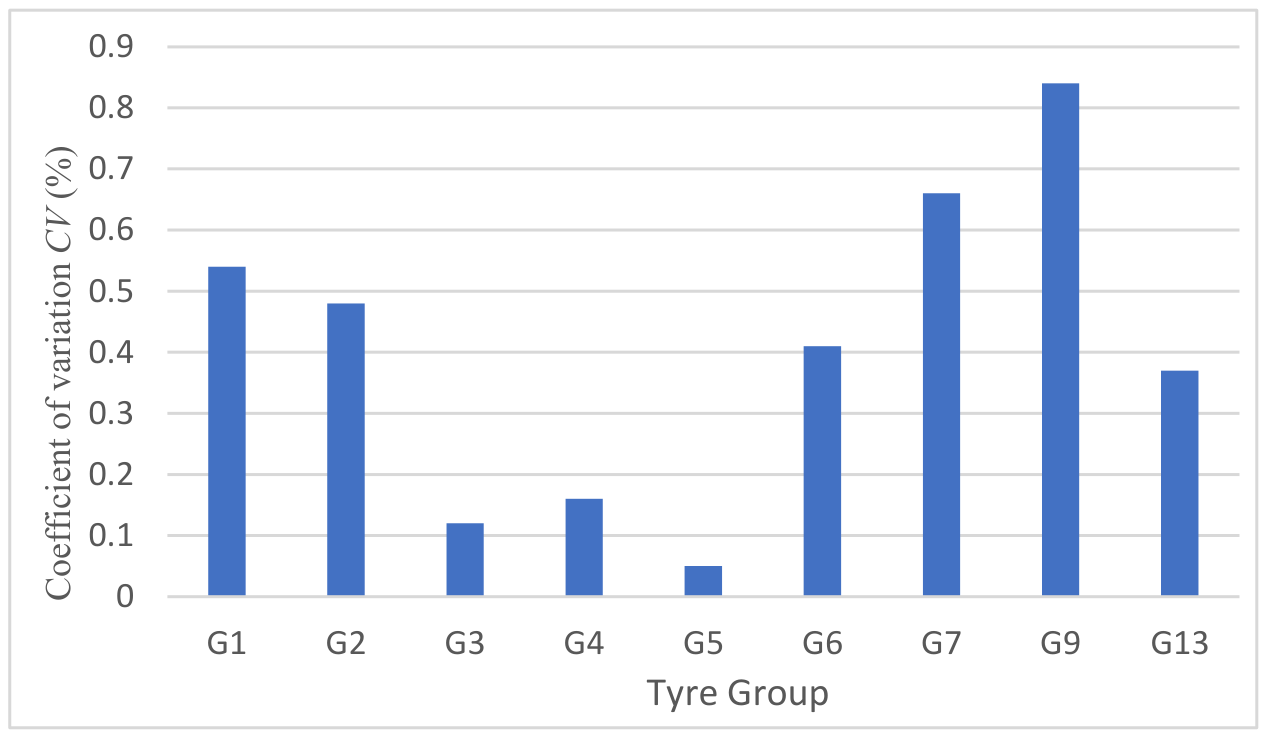
Relative variability between the analysed tyre groups was evaluated using the coefficient of variation (
CV), as presented in
Figure 4. The use of
CV enabled comparison between groups with substantially different nominal masses and dimensional categories by expressing dispersion relative to the corresponding mean group mass.
The results showed that relative mass consistency differed substantially between the analysed groups. Several tyre groups exhibited very low CV values, indicating comparatively high within-group consistency under the applied measurement conditions. In contrast, other groups demonstrated noticeably larger relative dispersion despite identical nominal specifications within the respective group.
This distinction is engineering-relevant because similar average tyre mass does not necessarily imply similar production consistency. Two tyre groups may exhibit comparable mean mass values while simultaneously differing substantially in internal mass dispersion. Consequently, evaluation of manufacturing consistency requires consideration of both central tendency and relative variability indicators rather than mean mass alone.
Among the tyre groups with sample size n ≥ 4, the lowest relative dispersion was observed for the Continental 275/35R21 tyres (CV = 0.05%), followed by the Michelin 215/65R17 and Bridgestone 195/55R16 groups. These results indicate comparatively high internal consistency within the analysed subsets. In contrast, the highest relative variability among the larger groups was identified for the summer Kleber 185/65R15 tyres (CV = 0.84%), followed by the Michelin 205/55R16 group (CV = 0.66%).
The variability patterns were not uniform across the dataset. Some groups exhibited low relative dispersion despite comparatively high absolute mass, whereas other groups demonstrated substantially larger internal spread even within smaller nominal size categories. This indicates that tyre mass variability cannot be interpreted solely as a function of absolute tyre size or mean mass. Instead, the observed dispersion is likely influenced by a combination of manufacturing, structural, and product-category-related factors.
The measured within-group mass differences frequently exceeded the repeatability-related variation in the weighing procedure by one or more orders of magnitude. From an experimental perspective, this indicates that the detected dispersion reflects real product-to-product variability rather than artefacts associated with short-term weighing instability or tyre repositioning effects.
Although the present study was not designed as a formal manufacturing-process investigation, the results demonstrate that manufacturing mass variability among nominally identical passenger-car tyres is experimentally detectable under controlled repeatable conditions and may therefore represent a relevant engineering descriptor of product consistency.
The observed variability patterns additionally motivated separate examination of a larger subset where multiple production batches were available within the same nominal tyre specification.
3.3. Example of Batch-Level Behaviour: Bridgestone 235/50R19
One of the most informative subsets within the analysed dataset consisted of the Bridgestone 235/50R19 tyres, for which two different production batches were available within the same nominal specification. This subset represented the largest analysed passenger-car group and enabled simultaneous evaluation of both within-batch and between-batch behaviour under identical measurement conditions.
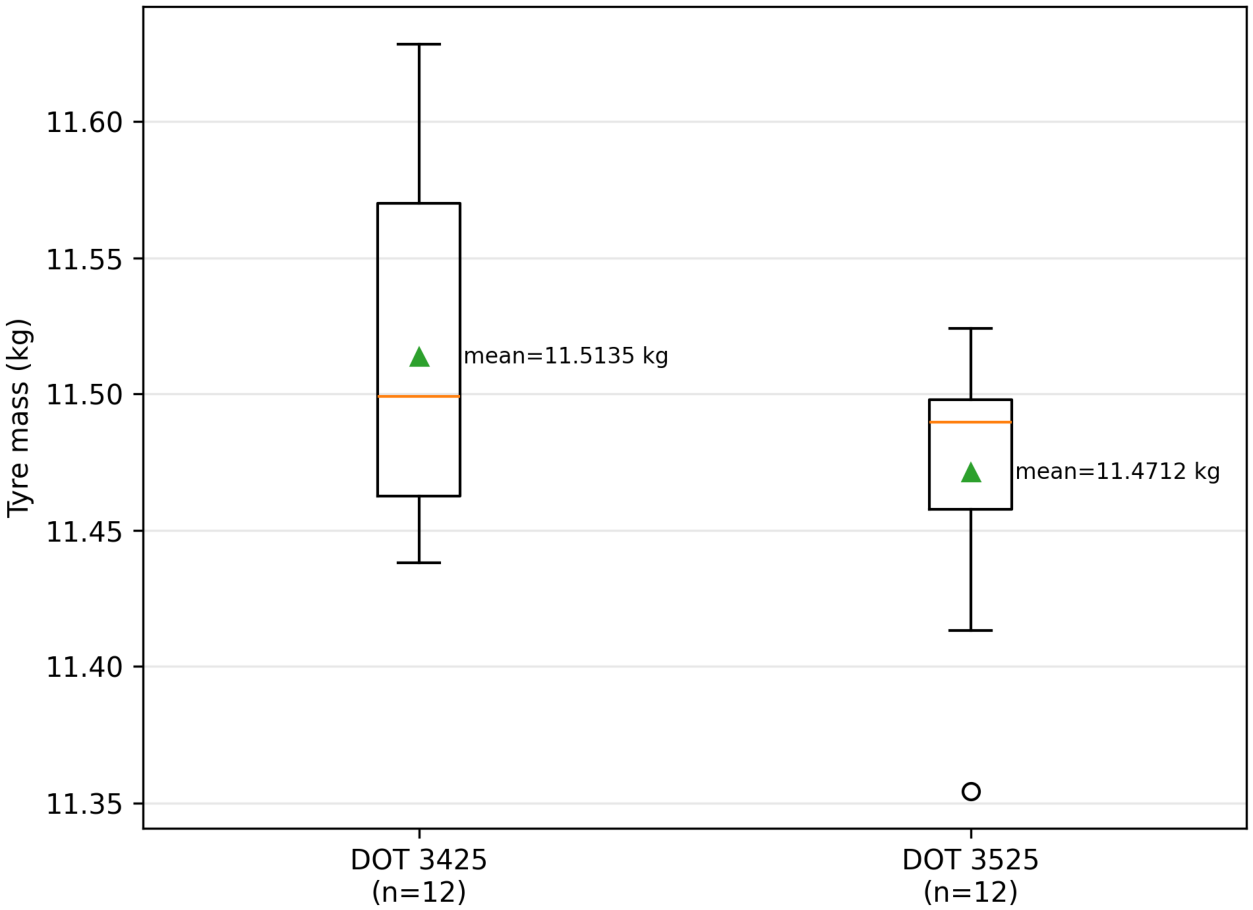
Batch DOT 3425 exhibited a mean measured mass of 11.5135 kg, whereas batch DOT 3525 showed a slightly lower mean value of 11.4712 kg, corresponding to a difference of 0.0423 kg between the two subsets (
Figure 5).
Both batches demonstrated relatively low internal dispersion, with calculated coefficients of variation of 0.55% and 0.43% for DOT 3425 and DOT 3525, respectively. These values indicate comparatively consistent production within each analysed batch under the applied repeatability-controlled measurement conditions.
At the same time, the experimentally detectable difference between the batch mean values demonstrates that measurable batch-level shifts may exist even when the nominal tyre specification remains unchanged. From an engineering perspective, this observation suggests that manufacturing mass variability should be considered both at the within-group level among nominally identical tyres and at the between-batch level among different production series of the same nominal product.
The observed batch-related differences remained substantially larger than the short-term repeatability-related variation in the weighing procedure, indicating that the detected behaviour cannot be explained solely by random weighing fluctuations.
Although the present dataset does not permit direct investigation of the underlying manufacturing causes, the results demonstrate that production-batch effects may represent a measurable component of tyre mass variability. This observation may be relevant for future manufacturing-consistency studies, quality-control investigations, and broader tolerance-oriented engineering assessment.
3.4. Engineering Relevance of the Observed Mass Variability
The present study did not directly investigate vehicle dynamics, rolling resistance, energy consumption, or tyre wear during service. Nevertheless, the experimentally detected mass variability remains engineering-relevant because tyres are simultaneously rotating and load-carrying components whose mass contributes to several aspects of vehicle operation. From a vehicle-dynamics perspective, tyre mass contributes to the unsprung portion of the suspension–wheel assembly. Consequently, measurable differences in tyre mass may influence wheel-system symmetry, suspension response, and the inertia characteristics of rotating assemblies. Although the present study does not quantify these effects experimentally, the measured variability demonstrates that nominally identical tyres cannot always be assumed to possess identical mass properties.
The largest within-group spread identified in the present dataset reached 0.2738 kg for the 235/50R19 tyre group. When extrapolated to a complete four-tyre vehicle set, this corresponds to a potential cumulative difference exceeding 1 kg between tyres of identical nominal specification. While such differences alone do not establish direct operational consequences, they illustrate that manufacturing mass variability may reach magnitudes that are not negligible from an engineering perspective. The observed variability may also be relevant to wheel balancing and paired tyre installation strategies because tyres operate as part of rotating wheel assemblies rather than as isolated components. In practical applications, improved consistency between nominally identical tyres may therefore contribute to more-uniform wheel-system behaviour and reduced correction requirements during balancing procedures.
In addition to operational considerations, tyre mass is also linked to material quantity and manufacturing distribution. Consequently, detectable variability in tyre mass may indirectly reflect broader differences in construction, reinforcement architecture, tread volume, or material allocation within nominally equivalent products. However, the present study did not include destructive structural analysis and therefore does not establish direct causal relationships between measured mass and specific construction parameters. From a broader engineering perspective, the results support the interpretation that tyre mass can be treated as a measurable descriptor of manufacturing consistency suitable for future tolerance-oriented investigations. At the same time, the present dataset should be interpreted cautiously because the analysed groups were selected and non-random rather than representative of the global tyre market.
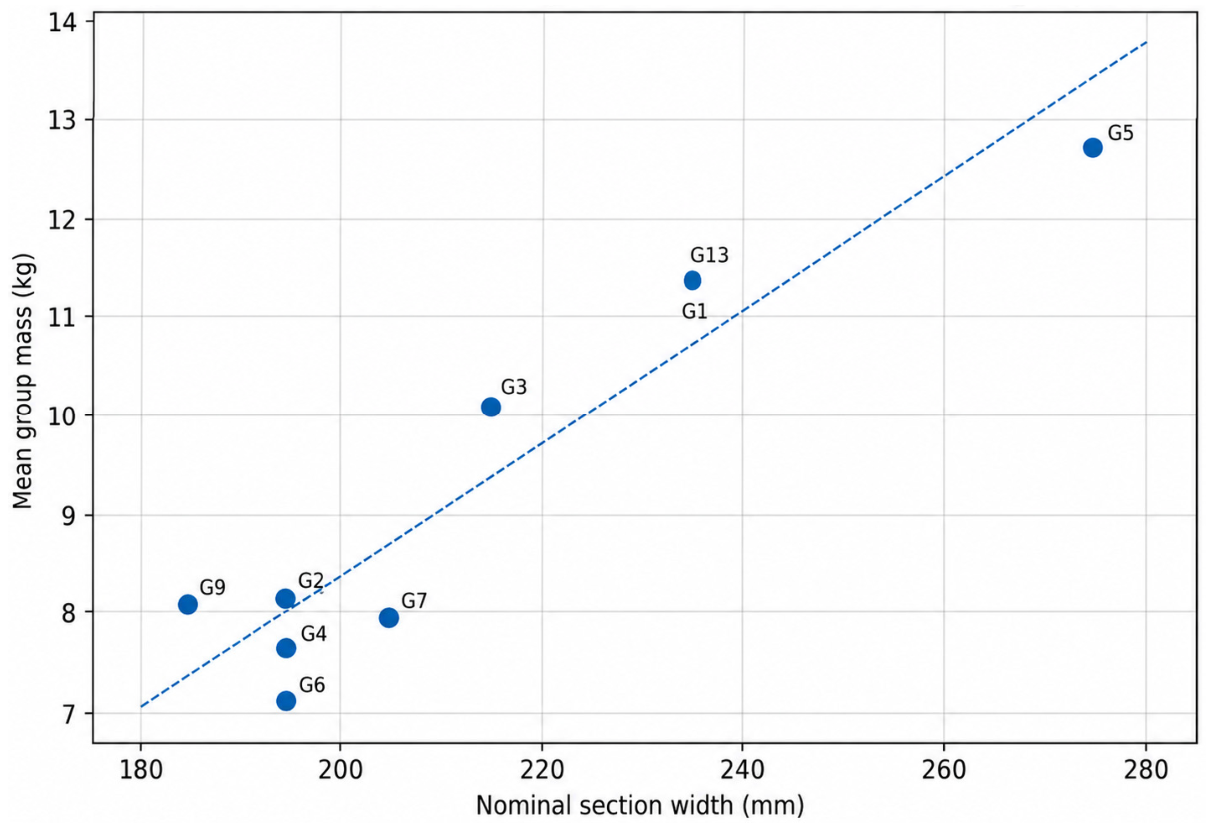
The newly introduced descriptive engineering comparison between nominal tyre width and mean group mass is presented in
Figure 6. As expected, larger nominal tyre widths generally corresponded to higher mean tyre masses. However, the observed scatter demonstrates that tyre mass cannot be explained solely by nominal dimensions because additional factors such as tread design, reinforcement structure, intended application, and product category also contribute to the final measured mass.
4. Discussion
The present results demonstrate that manufacturing mass variability among nominally identical passenger-car tyres is experimentally detectable under controlled repeatability-oriented measurement conditions. Although tyre mass is rarely discussed as an independent engineering parameter in the available literature, the obtained results indicate that measurable dispersion exists not only between different tyre categories but also within groups sharing identical nominal specifications and, in some cases, within the same production-batch framework.
One of the most important methodological observations is that the experimentally detected between-tyre differences substantially exceeded the short-term repeatability-related variation in the weighing procedure. Because each tyre was measured ten consecutive times with complete repositioning before every individual weighing, the observed variability cannot be explained solely by random instrument fluctuations or positioning-related artefacts. This distinction is important because the measured differences in several groups reached values one or more orders of magnitude larger than the repeatability-related measurement span.
The results additionally demonstrate that mean tyre mass alone is insufficient for evaluating manufacturing consistency. Some tyre groups exhibited comparatively low relative dispersion despite relatively high absolute mass, whereas others demonstrated noticeably larger internal variability even within smaller nominal size categories. This indicates that tyre mass variability is not governed exclusively by nominal dimensions and is likely influenced by multiple interacting manufacturing and structural factors, including reinforcement architecture, tread design, material distribution, and intended product application.
The Bridgestone 235/50R19 subset provided particularly important evidence because it enabled simultaneous observation of within-group and between-batch behaviour. Although both analysed production batches demonstrated comparatively low internal dispersion, measurable differences between the batch mean values remained experimentally detectable. From an engineering perspective, this suggests that tyre mass variability should not be interpreted solely at the individual-product level but also in relation to production-series behaviour and manufacturing consistency across batches.
The present results should nevertheless be interpreted within the limitations of the study design. The dataset was selected and non-random rather than market-representative, and the investigated groups differed in size, season, product category, and available sample count. Consequently, the study does not establish universal manufacturing tolerance limits and does not permit direct comparison between manufacturers or tyre categories at population level.
In addition, the present investigation did not include destructive structural analysis, wheel balancing measurements, rolling resistance testing, vehicle-dynamics experiments, or long-term wear evaluation. Therefore, no direct causal relationship is claimed between tyre mass variability and specific operational effects such as ride comfort, handling response, energy consumption, or wear rate. Instead, the results establish that manufacturing mass variability exists, is experimentally measurable, and may represent a relevant engineering descriptor worthy of further investigation.
Despite these limitations, the study contributes experimentally controlled evidence to an area that remains comparatively underrepresented in the publicly available tyre engineering literature. The obtained results support the broader methodological concept that tyre mass may be treated not only as a basic product characteristic but also as a measurable indicator related to manufacturing consistency, material distribution, and tolerance-oriented engineering assessment.
Future work should therefore focus on substantially larger datasets, controlled comparison between tyre categories and manufacturers, direct structural characterization, wheel-system balancing analysis, and integration with operational measurements such as tyre wear, rolling resistance, non-exhaust particle emissions, and vehicle-dynamics response. Such investigations would enable a more comprehensive evaluation of the engineering significance of manufacturing tyre mass variability under real operating conditions.
5. Conclusions
This study investigated manufacturing mass variability in selected groups of new passenger-car tyres using a controlled repeatability-oriented weighing protocol applied to a primary dataset of 68 passenger-car tyres. A secondary lightweight competition-tyre subset was analysed separately as an auxiliary engineering reference case.
Based on the obtained experimental results, the following conclusions can be drawn in accordance with the five research tasks defined in the Introduction:
The repeated high-precision weighing protocol confirmed that measurable manufacturing mass variability can be experimentally detected among new tyres with identical nominal specifications under controlled repeatability-oriented measurement conditions.
Within-group mass dispersion was quantified using mean mass, standard deviation, absolute range, coefficient of variation, and repeatability-related assessment. The short-term repeatability variation remained substantially lower than the observed between-tyre mass differences, supporting the reliability of the detected dispersion patterns.
The comparative analysis showed that relative variability was not uniform across the analysed tyre groups. Some groups exhibited comparatively high within-group consistency, whereas others demonstrated larger internal dispersion, indicating that nominal tyre size and mean mass alone are insufficient to describe manufacturing consistency.
The analysed Bridgestone 235/50R19 subset demonstrated that measurable variability may exist not only within nominally identical tyre groups but also between different production batches of the same nominal product.
The observed mass differences are engineering-relevant because tyre mass contributes to rotating inertia, unsprung mass, wheel-system symmetry, and broader material-distribution characteristics. Therefore, tyre mass can be treated as a measurable engineering descriptor suitable for future manufacturing-consistency and tolerance-oriented investigations.
At the same time, the present study should be interpreted within the limitations of a selected and non-random dataset rather than as a market-representative assessment of global tyre production. The results therefore do not justify universal tolerance limits or direct performance conclusions.
Future investigations should include substantially larger datasets, controlled inter-manufacturer comparison, structural characterization, wheel-balancing analysis, long-term wear measurements, and operational validation under real driving conditions.
In summary, the study provides experimentally controlled evidence that manufacturing tyre mass variability exists, can be measured reliably under repeatability-controlled conditions, and may merit broader investigation in future tyre engineering and manufacturing-consistency research.
Author Contributions
Conceptualization, I.D., D.S., V.H. and I.N.; methodology, I.D., D.S., V.H. and I.N.; software, I.D., D.S., V.H. and I.N.; validation, I.D., D.S., V.H. and I.N.; formal analysis, I.D., D.S., V.H. and I.N.; investigation, I.D., D.S., V.H. and I.N.; resources, I.D., D.S., V.H. and I.N.; data curation, I.D., D.S., V.H. and I.N.; writing—original draft preparation, I.D., D.S., V.H. and I.N.; writing—review and editing, I.D., D.S., V.H. and I.N.; visualization, I.D., D.S., V.H. and I.N.; funding acquisition, I.D., D.S., V.H. and I.N. All authors have read and agreed to the published version of the manuscript.
Funding
This research received no external funding.
Institutional Review Board Statement
Not applicable.
Informed Consent Statement
Not applicable.
Data Availability Statement
The data are contained within this article.
Acknowledgments
This work has been accomplished with financial support from the European Regional Development Fund within the Operational Programme “Bulgarian national recovery and resilience plan”, procedure for direct provision of grants “Establishing of a network of research higher education institutions in Bulgaria”, and under Project BG-RRP-2.004-0005 “Improving the research capacity anD quality to achieve intErnAtional recognition and reSilience of TU-Sofia (IDEAS)”.
Conflicts of Interest
The authors declare no conflicts of interest.
References
- Savant, S.; De Carvalho Pinheiro, H.; Sacchi, M.E.; Conti, C.; Carello, M. Tires and Vehicle Lateral Dynamic Performance: A Corrective Algorithm for the Influence of Temperature. Machines 2023, 11, 654. [Google Scholar] [CrossRef]
- Dechkova, S. Elastic properties of tyres affecting car comfort, driving and riding. Int. J. Appl. Mech. Eng. 2023, 28, 54–68. [Google Scholar] [CrossRef]
- Farfan-Cabrera, L. Tribology of electric vehicles: A review of critical components, current state and future improvement trends. Tribol. Int. 2019, 138, 473–486. [Google Scholar] [CrossRef]
- Zang, L.; Sun, J.; Peng, X.; Lin, F.; Deng, Y.; Bai, Y. A Comprehensive Review of Safety Tire Research. Lubricants 2025, 13, 357. [Google Scholar] [CrossRef]
- Soica, A.; Gheorghe, C. Tire–Road Interaction: A Comprehensive Review of Friction Mechanisms, Influencing Factors, and Future Challenges. Machines 2025, 13, 1005. [Google Scholar] [CrossRef]
- Ejsmont, J.; Taryma, S.; Ronowski, G.; Swieczko-Zurek, B. Influence of load and inflation pressure on the tyre rolling resistance. Int. J. Automot. Technol. 2016, 17, 237–244. [Google Scholar] [CrossRef]
- BMuresan, X.T.; Truong, T.; De Oliveira, L.; Lumière, V.; Cerezo, N.; Watanabe, M.T.; Do, M. A study of the direct emission of tire wear particles on different types of roads. Sci. Total Environ. 2025, 958, 178018. [Google Scholar] [CrossRef] [PubMed]
- Gorakifard, M.; Sierra, J.E.; Kian Far, E. Polymer extrusion processes in tire manufacturing: A systematic review and bibliometric analysis. Int. J. Adv. Manuf. Technol. 2026, 143. [Google Scholar] [CrossRef]
- Zhao, Y.; Du, F.; Wang, H.; Wang, X.; Yang, X.; Shi, D.; Bui, V.; Zhang, T. Research on Coordinated Control of Vehicle Inertial Suspension Using the Dynamic Surface Control Theory. Actuators 2024, 13, 389. [Google Scholar] [CrossRef]
- Ghazali, M. Path-following and tire loss investigation of a front in-wheel-drive electric vehicle with off-centre CG. Mech. Mach. Theory 2023, 189, 105422. [Google Scholar] [CrossRef]
- Sinapov, P.; Kralov, I.; Nedelchev, K. Mass moments of inertia effect on friction oscillations endurance in two-component mechanical system. AIP Conf. Proc. 2010, 1293, 21–29. [Google Scholar] [CrossRef]
- Di Bernardo, C.; Demichelis, F.; Dadkhah, M.; Fino, D.; Messori, M.; Noè, C. Driving the Green Transition: Innovative Tyre Formulation Using Agricultural and Pyrolysed Tyres Waste. Polymers 2025, 17, 2275. [Google Scholar] [CrossRef]
- Yousafzai, A.K.; Sutanto, M.H.; Khan, N.; Adedeji, J.A.; Mkhize, M.; Aliyu Yaro, N.S. An Experimental Study on the Influence of Waste Tyre Metal Fibre on Asphalt Mixture’s Performance Properties. Materials 2026, 19, 849. [Google Scholar] [CrossRef]
- Kreider, M.L.; Panko, J.M.; McAtee, B.L.; Sweet, L.I.; Finley, B.L. Physical and chemical characterization of tire-related particles: Comparison of particles generated using different methodologies. Sci. Total Environ. 2010, 408, 652–659. [Google Scholar] [CrossRef] [PubMed]
- Wei, H.; Li, G.; Lu, Y.; Zhang, H.; Wang, B. Integrated motion control and energy management of series hybrid electric vehicles: A multi-objective MPC approach. IFAC-PapersOnLine 2023, 56, 7134–7139. [Google Scholar] [CrossRef]
- Nguyen, A.T.; Nguyen, B.-M.; Trovão, J.P.F.; Ta, M.C. An Integrated Modeling Framework for Motion Control and Energy Management in Multi-Motor Electric Vehicles. IEEE Open J. Veh. Technol. 2025, 6, 2479–2493. [Google Scholar] [CrossRef]
- Wang, T.; Cassandras, C.G. Optimal motion control for energy-aware electric vehicles. In Proceedings of the 2013 IEEE International Conference on Control Applications (CCA), Hyderabad, India, 28–30 August 2013; pp. 388–393. [Google Scholar] [CrossRef]
- Timmers, V.R.; Achten, P.A. Non-exhaust PM emissions from electric vehicles. Atmos. Environ. 2016, 134, 10–17. [Google Scholar] [CrossRef]
- Giechaskiel, B.; Grigoratos, T.; Li, L.; Zang, S.; Lu, B.; Lopez, D.; García, J.J. Tyre Wear under Urban, Rural, and Motorway Driving Conditions at Two Locations in Spain and China. Lubricants 2024, 12, 338. [Google Scholar] [CrossRef]
- Müller, K.; Unice, K.; Panko, J.; Wagner, S. Tire emissions during the use phase of tires—Current and future trends. Environ. Sci. Adv. 2025, 4, 1344–1363. [Google Scholar] [CrossRef]
- Li, J.; Zhang, M.; Ge, Y.; Wen, Y.; Luo, J.; Yin, D.; Wang, C.; Wang, C. Emission Characteristics of Tyre Wear Particles from Light-Duty Vehicles. Atmosphere 2023, 14, 724. [Google Scholar] [CrossRef]
- O’Loughlin, D.P.; Haugen, M.J.; Day, J.; Brown, A.S.; Braysher, E.C.; Molden, N.; Willis, A.E.; MacFarlane, M.; Boies, A.M. Multi-element analysis of tyre rubber for metal tracers. Environ. Int. 2023, 178, 108047. [Google Scholar] [CrossRef] [PubMed]
- Deng, Y.; Wang, Z.; Shen, H.; Gong, J.; Xiao, Z. A comprehensive review on non-pneumatic tyre research. Mater. Des. 2023, 227, 111742. [Google Scholar] [CrossRef]
- ISO 4000-1:2024; Passenger Car Tyres and Rims. ISO: Geneva, Switzerland, 2024. Available online: https://www.iso.org/ (accessed on 1 March 2026).
- Regulation No 30 of the Economic Commission for Europe of the United Nations (UN/ECE)—Uniform Provisions Concerning the Approval of Pneumatic Tyres for Motor Vehicles and Their Trailers. Available online: https://data.europa.eu/eli/reg/2008/30(2)/oj (accessed on 5 March 2026).
- Regulation No 117 of the Economic Commission for Europe of the United Nations (UN/ECE)—Uniform Provisions Concerning the Approval of Tyres with Regard to Rolling Sound Emissions and to Adhesion on Wet Surfaces and/or to Rolling Resistance. Available online: https://data.europa.eu/eli/reg/2011/117(2)/oj (accessed on 5 March 2026).
- Bowles, A.J.; Fowler, G.D. Assessing the impacts of feedstock and process control on pyrolysis outputs for tyre recycling. Resour. Conserv. Recycl. 2022, 182, 106277. [Google Scholar] [CrossRef]
- Dalmau, M.E.; Augsburg, K.; Wenzel, F.; Ivanov, V. Tire Particle Emissions: Demand on Reliable Characterization. Tire Sci. Technol. 2020, 48, 107–122. [Google Scholar] [CrossRef]
- Landstrom, C.; Josefsson, L.; Walker, T.; Lofdahl, L. Aerodynamic Effects of Different Tire Models on a Sedan Type Passenger Car. SAE Int. J. Passeng. Cars-Mech. Syst. 2012, 5, 136–151. [Google Scholar] [CrossRef]
- Eckenberger, E.; Younes, M.; Mayer, T.; Loeber, M.; Bondorf, L.; Schripp, T.; Kernchen, S.; Laforsch, C.; Nölscher, A.C. About the Variability of Tire and Road Wear Marker Components in Air: From Emissions to Atmospheric Deposition. Environ. Sci. Technol. 2026, 60, 2023–2036. [Google Scholar] [CrossRef]
- UTAC ACEA Tyre Performance Study Report; Report AFFSAS1801813, GRBP-75-18; UTAC: Montlhéry, France, 2021; Available online: https://unece.org/sites/default/files/2022-02/GRBP-75-18e-Rev.1.pdf (accessed on 6 March 2026).
- Grigoriadis, K.; Mavros, G.; Knowles, J.; Pezouvanis, A. Experimental investigation of tyre–road friction considering topographical roughness variation and flash temperature. Tribol. Int. 2023, 181, 108294. [Google Scholar] [CrossRef]
- Dorfi, H.R. Tyre non-uniformities: Comparison of analytical and numerical tyre models and correlation to experimentally measured data. Veh. Syst. Dyn. 2005, 43, 223–240. [Google Scholar] [CrossRef]
- Giechaskiel, B.; Ferrarese, C.; Grigoratos, T.; Franco, V. Wear of Passenger Car C1 Tyres Under Regulatory On-Road Testing Conditions. Vehicles 2025, 7, 91. [Google Scholar] [CrossRef]
- Hyttinen, J.; Ussner, M.; Österlöf, R.; Jerrelind, J.; Drugge, L. Effect of Ambient and Tyre Temperature on Truck Tyre Rolling Resistance. Int. J. Automot. Technol. 2022, 23, 1651–1661. [Google Scholar] [CrossRef]
- Yoganandham, S.T.; Daeho, K.; Heewon, J.; Shen, K.; Jeon, J. Unveiling the environmental impact of tire wear particles and the associated contaminants: A comprehensive review of environmental and health risk. J. Hazard. Mater. 2024, 480, 136155. [Google Scholar] [CrossRef] [PubMed]
- Formela, K. Waste tire rubber-based materials: Processing, performance properties and development strategies. Adv. Ind. Eng. Polym. Res. 2022, 5, 234–247. [Google Scholar] [CrossRef]
- Karger-Kocsis, J.; Mészáros, L.; Bárány, T. Ground tyre rubber (GTR) in thermoplastics, thermosets, and rubbers. J. Mater. Sci. 2013, 48, 1–38. [Google Scholar] [CrossRef]
- Sampath, M.; Konikkara, N.; David, S.; Ramakrishnan, S.; Rath, J.; Amarnath, S.K.P. Advancements in sustainable materials for environmentally responsible tyre production: A comprehensive review. RSC Sustain. 2025, 3, 4336–4363. [Google Scholar] [CrossRef]
- Akhtar, A.; Tsang, H. A comparative life cycle assessment of recycled tire rubber applications in sustainable earthquake-resistant construction. Resour. Conserv. Recycl. 2024, 211, 107860. [Google Scholar] [CrossRef]
- Hassan, M.; Abdelkareem, M.; Moheyeldein, M.; Elagouz, A.; Tan, G. Advanced study of tire characteristics and their influence on vehicle lateral stability and untripped rollover threshold. Alex. Eng. J. 2020, 59, 1613–1628. [Google Scholar] [CrossRef]
- Mazzilli, V.; Ivone, D.; De Pinto, S.; Pascali, L.; Contrino, M.; Tarquinio, G.; Gruber, P.; Sorniotti, A. On the benefit of smart tyre technology on vehicle state estimation. Veh. Syst. Dyn. 2022, 60, 3694–3719. [Google Scholar] [CrossRef]
- Available online: https://igelmam.kern-sohn.com/media/drqfcpce/tds-30k01l-a-en.pdf (accessed on 5 March 2026).
| Disclaimer/Publisher’s Note: The statements, opinions and data contained in all publications are solely those of the individual author(s) and contributor(s) and not of MDPI and/or the editor(s). MDPI and/or the editor(s) disclaim responsibility for any injury to people or property resulting from any ideas, methods, instructions or products referred to in the content. |