Article

Validation and Verification of Novel Three-Dimensional Crack Growth Simulation Software GmshCrack3D


1
Applied Mechanics, Paderborn University, 33098 Paderborn, Germany
2
Engineering Mechanics, Paderborn University, 33098 Paderborn, Germany
*
Author to whom correspondence should be addressed.
Appl. Sci. 2026, 16(1), 384; https://doi.org/10.3390/app16010384
Submission received: 20 November 2025 / Revised: 24 December 2025 / Accepted: 27 December 2025 / Published: 30 December 2025
(This article belongs to the Special Issue Application of Fracture Mechanics in Structures)

Abstract

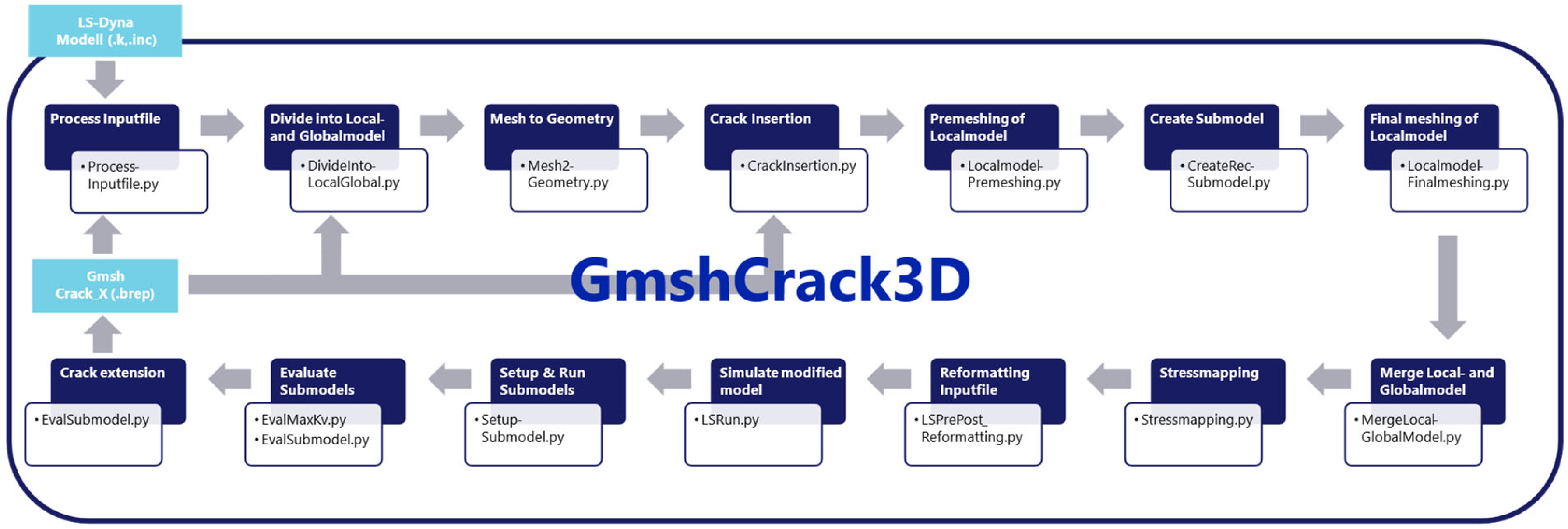
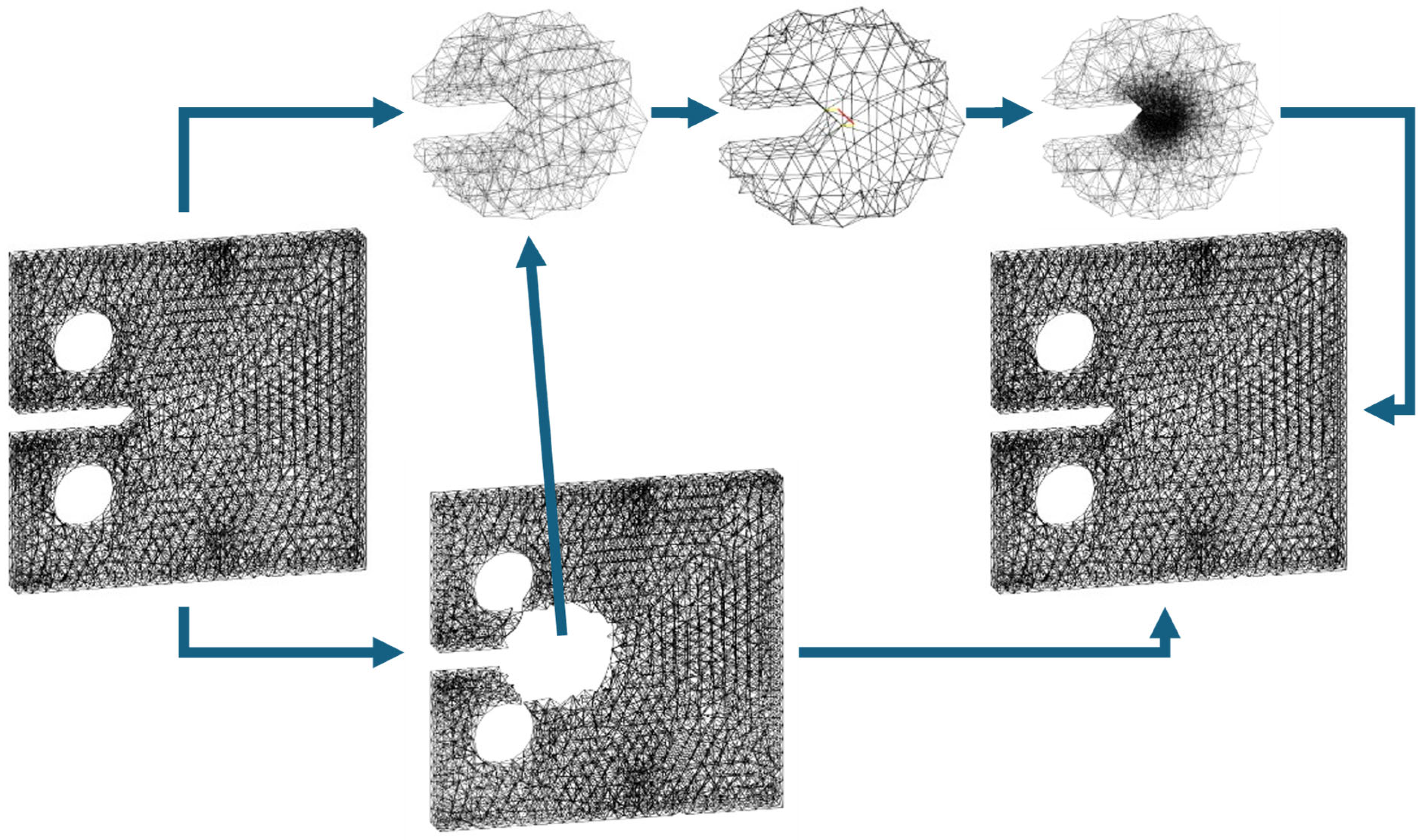
The accurate prediction of crack initiation and propagation is essential for assessing the structural integrity of mechanically joined components and other complex assemblies. To overcome the limitations of existing finite element tools, a modular Python framework has been developed to automate three-dimensional crack growth simulations. The program combines geometric reconstruction, adaptive remeshing, and the numerical evaluation of fracture mechanics parameters within a single, fully automated workflow. The framework builds on open-source components and remains solver-independent, enabling straightforward integration with commercial or research finite element codes. A dedicated sequence of modules performs all required steps, from mesh separation and crack insertion to local submodeling, stress and displacement mapping, and iterative crack-front update, without manual interaction. The methodology was verified using a mini-compact tension (Mini-CT) specimen as a benchmark case. The numerical results demonstrate the accurate reproduction of stress intensity factors and energy release rates while achieving high computational efficiency through localized refinement. The developed approach provides a robust basis for crack growth simulations of geometrically complex or residual stress-affected structures. Its high degree of automation and flexibility makes it particularly suited for analyzing cracks in clinched and riveted joints, supporting the predictive design and durability assessment of joined lightweight structures.
Keywords: fatigue crack growth; automated crack growth simulation; numerical methods; solver-independent framework fatigue crack growth; automated crack growth simulation; numerical methods; solver-independent framework