1. Introduction
In recent decades the widespread use of portable electronic devices has emerged as a major contributing factor to the prolonged maintenance of non-physiological postures [
1]. Among these, the anterior and downward flexion of the head represents one of the most prevalent and deleterious postural adaptations [
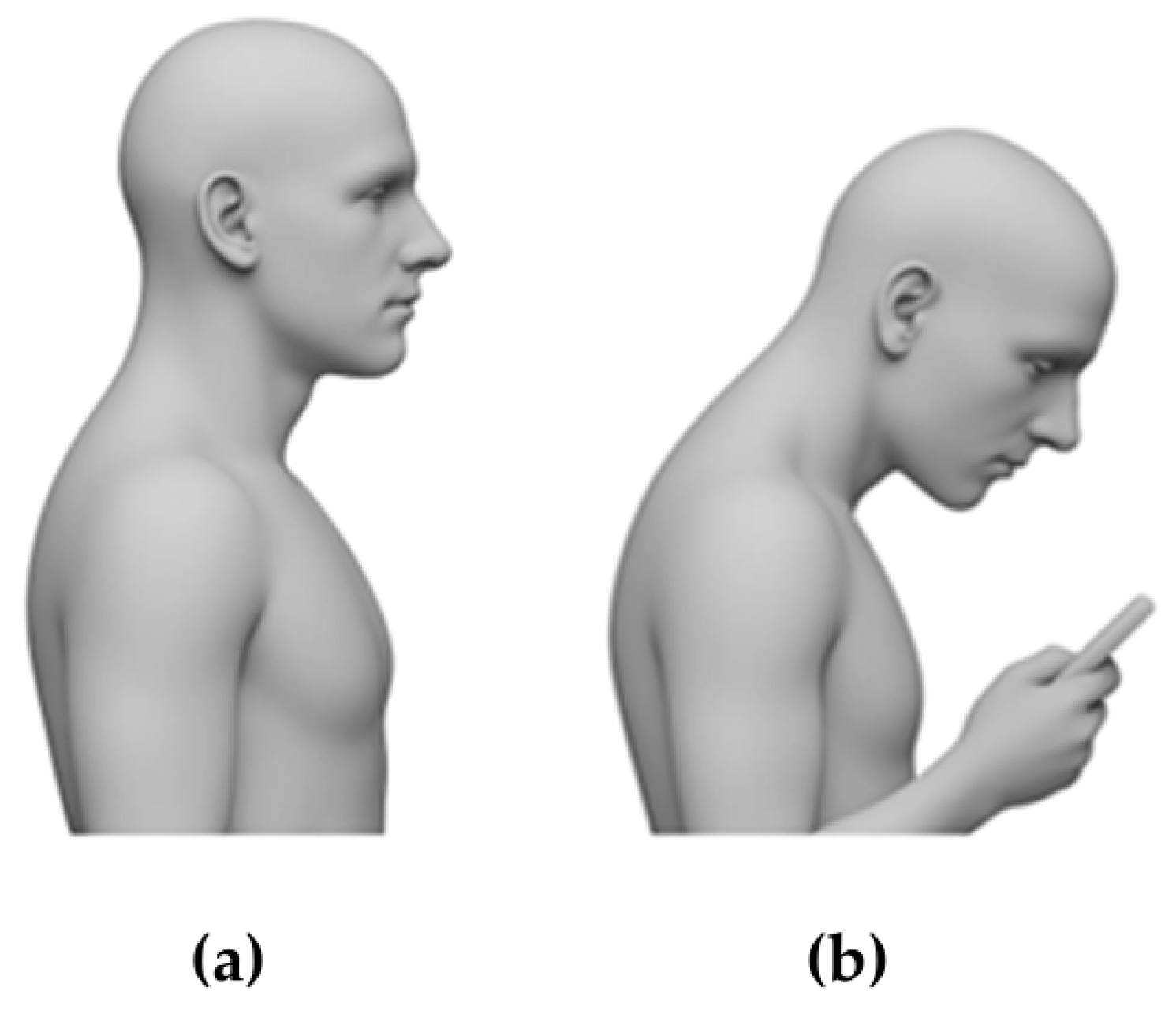
2]. This improper posture is defined by the anterior flexion of the cervical region, typically ranging from 40° to 60° and resulting in an anterior shift in the cranial center of gravity relative to the spinal axis [
3].
Several studies have demonstrated a close association between altered cervical posture and temporomandibular joint (TMJ) function. Tecco et al. reported that variations in the cranio-cervical angle are significantly correlated with the resting electromyographic activity of several masticatory muscles, including the masseter, anterior temporalis, and digastric muscles [
4]. These findings suggest a clear connection between the postural alignment of the cervical spine and the neuromuscular control of the stomatognathic system. Furthermore, Nota et al. demonstrated that patients suffering from temporomandibular disorders (TMDs) exhibit a significantly reduced cervical extension compared to controls, showing that cervical spine mobility constitutes a key biomechanical parameter with clinical relevance for TMDs evaluation [
5]. Ferreira et al. further observed reduced atlantoaxial flexion-rotation (C1–C2) and diminished performance of the deep cervical flexor muscles in women with TMDs, both correlated with mandibular pain and cervical disability [
6]. Additional clinical evidence has shown that therapeutic interventions involving mobilization and exercise of the upper cervical spine can enhance mandibular function, relieve pain, and increase maximum mouth opening, underscoring the functional interdependence between the cervical spine and the TMJ [
7]. Collectively, these findings support the hypothesis that cervical mobility, especially at the upper cervical segments, may serve as a meaningful clinical parameter for both the diagnosis and monitoring of TMDs.
In addition to these considerations, head posture has been consistently linked to changes in mandibular positioning [
8]. Evidence from earlier studies, including that of Ohmure et al., indicates that head posture exerts a significant effect on the condylar resting position, thereby suggesting a possible etiopathogenetic pathway in patients with cranio-cervico-mandibular disorders [
9].
Latest evidence has identified several predisposing factors for temporomandibular disorders, including psychosocial, sleep-related, and comorbid conditions, as summarized in a recent systematic review by Da-Cas et al. [
10]. However, current diagnostic frameworks such as the RDC/TMD and DC/TMD do not address posture-related mechanisms associated with prolonged digital device use [
11]. Notably, although this non-physiological posture is maintained daily for prolonged periods, its immediate biomechanical consequences on TMJ loading and condylar position remain unclear. In this context, the forward head flexion typically adopted during portable device interaction may represent an additional, yet unrecognized, predisposing factor. This conceptual gap supports the rationale for exploring a novel, device-related cranio-cervico-mandibular dysfunction, herein proposed as Electronic Device–Induced Temporomandibular Disorder (ED-TMD), and for investigating its potential biomechanical relevance.
Therefore, the aim of this cross-sectional study was to analyze the condylar and incisor relationship displacement induced by anterior head flexion typically associated with the use of portable electronic devices, ultimately to determine whether this posture represents a biomechanical condition capable of acting as an early biomechanical trigger for temporomandibular dysfunctions. To achieve this, a standardized protocol was employed to reproduce device-related head flexion under controlled conditions, ensuring the absence of voluntary mandibular muscle activation and isolating the immediate mechanical consequences of this posture.
2. Subjects and Methods
This cross-sectional study was approved by the Ethic Committee of IRCCS San Raffaele Hospital (Milan, Italy) with the document “parere09/int/2023” 25 January 2023. It was conducted in accordance with the principles laid down by the 18th World Medical Assembly (Helsinki, 1964) and all applicable amendments established by the World Medical Assemblies, and the ICH guidelines for Good Clinical Practice.
2.1. Participants
A total of 20 voluntary adult subjects (9 F, 11 M; mean age 27 ± 5 years) were enrolled at the Department of Dentistry, Vita-Salute San Raffaele University, Milan, Italy.
The patients enrolled in the study were required to meet the following inclusion criteria: age ≥ 18 years, functional natural dentition (≥28 present teeth), stable general health conditions (ASA classification I-II), ability to maintain the required standardized posture and to correctly perform the tasks specified in the protocol.
The following exclusion criteria were applied: systemic diseases or neurological conditions potentially affecting muscle or joint function, history of cranio-cervical or temporomandibular surgery or trauma, severe malocclusion or absence of a significant number of teeth impairing intercuspidal occlusion, active orthodontic treatment, ongoing pharmacological treatments that could alter neuromuscular function (e.g., muscle relaxants, psychotropic drugs), pregnancy, inability to understand the instructions or to cooperate with the experimental procedures.
2.2. Sample Size Justification
From a clinical standpoint, a difference of 1.0 mm in condylar displacement was considered the minimum clinically relevant threshold. Based on a preliminary analysis of the first 10 enrolled subjects, a standard deviation of 1.1 mm was observed. Given the observed standard deviation of 1.1 mm, the clinically relevant difference of 1.0 mm corresponded to an expected effect size of Cohen’s d = 0.91, which indicates a large effect and served as the basis for the sample size calculation. Using this estimate, a power analysis was performed, assuming a two-tailed α of 0.05 and 80% statistical power, which yielded a minimum required sample size of 12 subjects to detect the expected effect. Considering that previous investigations assessing condylar displacement within the glenoid fossa have commonly included samples of approximately 20 participants, a larger cohort was enrolled to improve the robustness and external validity of the findings [
12].
2.3. Recording System
All participants underwent an assessment that included mandibular kinematic recording. They were seated on a chair with a straight backrest, maintaining their feet flat on the floor to standardize posture.
For the recording of mandibular kinematic, the optoelectric jaw tracking system JMA-Optic AG (Zebris Medical GmbH, Isny, Germany) was employed. The system consisted of a facebow, a lower jaw sensor, which is activatable via a para-occlusal attachment, and a bitefork. It is based on stereoscopic technology (optical triangulation). This principle is realized through two cameras integrated into the facebow (receiving and control unit), which detect the infrared LED pattern emitted by the battery-powered lower jaw sensor (transmitting unit). As the sensor moves, the cameras capture a slightly distorted image of the LED pattern. These distortions are then processed to calculate the spatial coordinates of the lower jaw sensor in three dimensions with a maximum recording rate of 60 Hz and a measuring accuracy of ±0.05 mm. The coordinates are continuously transmitted to a connected computer via Wi-Fi interface. The lightweight facebow was positioned on the patient’s head and calibrated according to the manufacturer’s instructions. A corresponding mandibular sensor was attached to the lower arch using a para-occlusal attachment, fixed using a temporary composite material 3M™ Protemp™ 4 (3M ESPE, St. Paul, MN, USA). The material was applied to the attachment and placed on the lower row of teeth of the patients as centrally as possible and in a straight position. Patients were instructed to close the dentition to avoid interfering contacts. Bitefork was employed to determine the position of the upper jaw. To do that, silicone bite registration material was applied to the Bitefork and placed on the rows of teeth of the upper jaw. Therefore, the system was calibrated individually for each participant. The facebow adapts to the patient’s craniofacial morphology through an adjustable headband, and the anatomical reference points were recorded separately for each subject.
To ensure the relaxation of the muscles, surface electromyography (sEMG) was recorded using a surface electromyography system MyoWise (Via Gran Sasso, 18 20008, Bareggio, MI, Italy). Disposable pre-gelled Ag/AgCl bipolar surface electrodes (diameter 10 mm, interelectrode distance 20 mm) were placed on the skin overlying the target muscles, following the SENIAM (Surface Electromyography for the Non-Invasive Assessment of Muscles) guidelines. Before electrode placement, skin was carefully cleaned with 70% ethyl alcohol using sterile gauze pad to reduce impedance. Patients were asked to remove any hair in the electrode application area to guarantee optimal skin-electrode contact. Recordings were obtained bilaterally from the masseter and anterior temporalis muscles. Data normalization was not performed as the electromyography was solely employed as an aid to the mandibular rest position (RP) to verify that no unwanted contractions occurred during the test. Therefore, normalization was not required.
2.4. Experimental Tasks
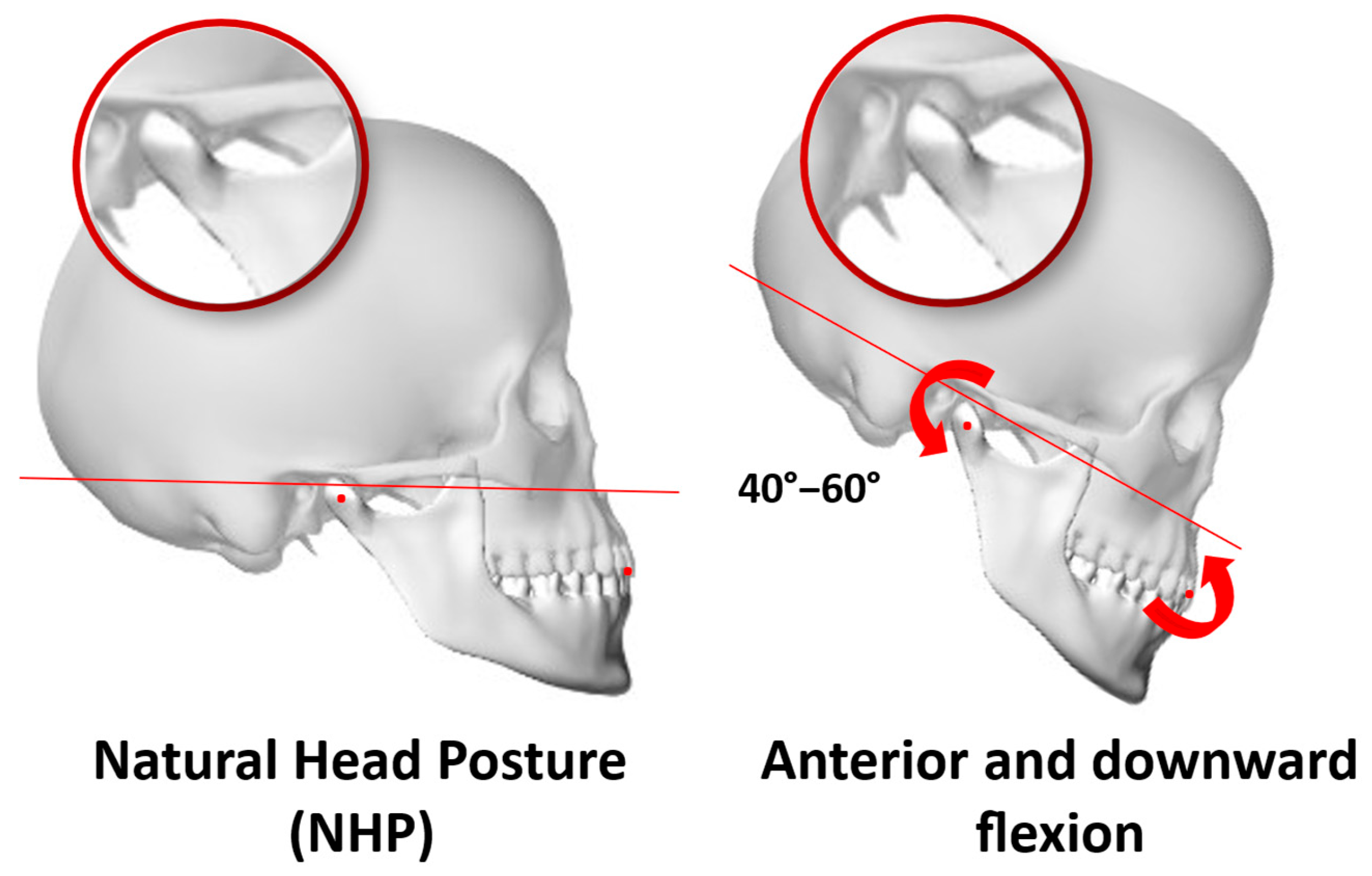
For data collection, a specific protocol was implemented to evaluate the effects of anterior head flexion (HF) typically adopted during the use of portable digital devices (e.g., smartphones, tablets) (
Figure 1).
The data acquisition process for each participant included the following steps:
Phase 1—Light clenching: In an upright position, each participant maintained their habitual occlusion with minimal muscular activation.
Phase 2—Mandibular Rest Position (RP): Participants were instructed to discontinue muscle contraction and to maintain the mandible in a neuromuscular rest position. sEMG was employed to exclude voluntary muscular activity.
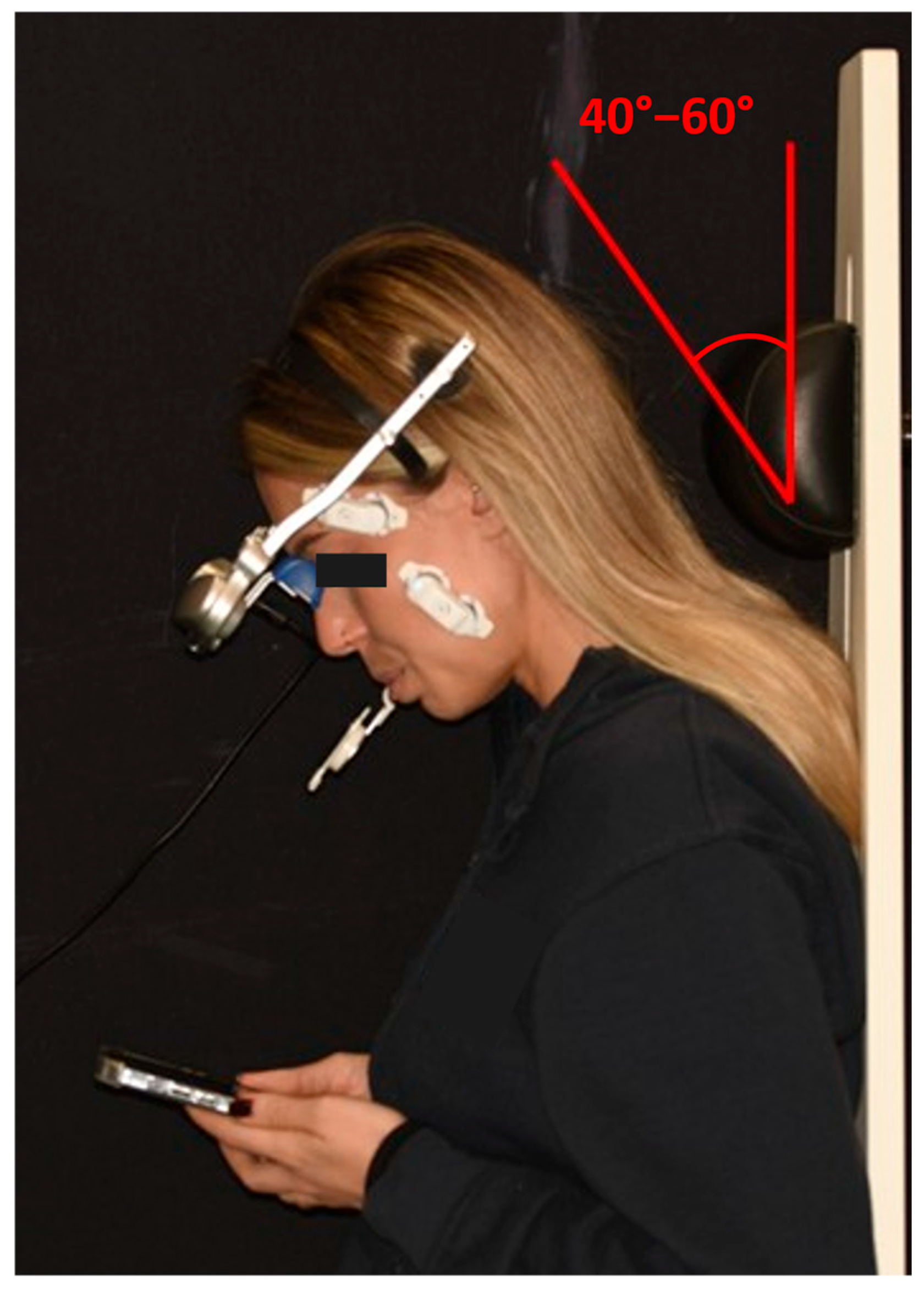
Phase 3—Head Flexion (HF): From the RP the head was inclined anteriorly by approximately 40–60°, simulating the posture typically observed during the use of portable digital devices, as reported in the literature [
13,
14]. The head-flexion position was standardized by defining an angle between 40° and 60°, which was subsequently verified through a visual assessment performed by multiple operators. The posture protocol was thoroughly explained to each participant prior to the examination (
Figure 2).
Three-dimensional kinematic recordings were performed to monitor condylar movements and incisal plane changes across all the three phases of the experimental protocol.
The light clenching phase was maintained for 5 s, followed by 10 s in the RP, and finally 10 s in the HF. These time intervals were established to allow the operator to clearly distinguish each phase and ensure accurate data recording. The light clenching phase was adopted as the reference position to evaluate the linear distance of RP and HF at both the condylar and incisal relationship. The test was repeated three times for each subject.
2.5. Data Handling and Statistical Analysis
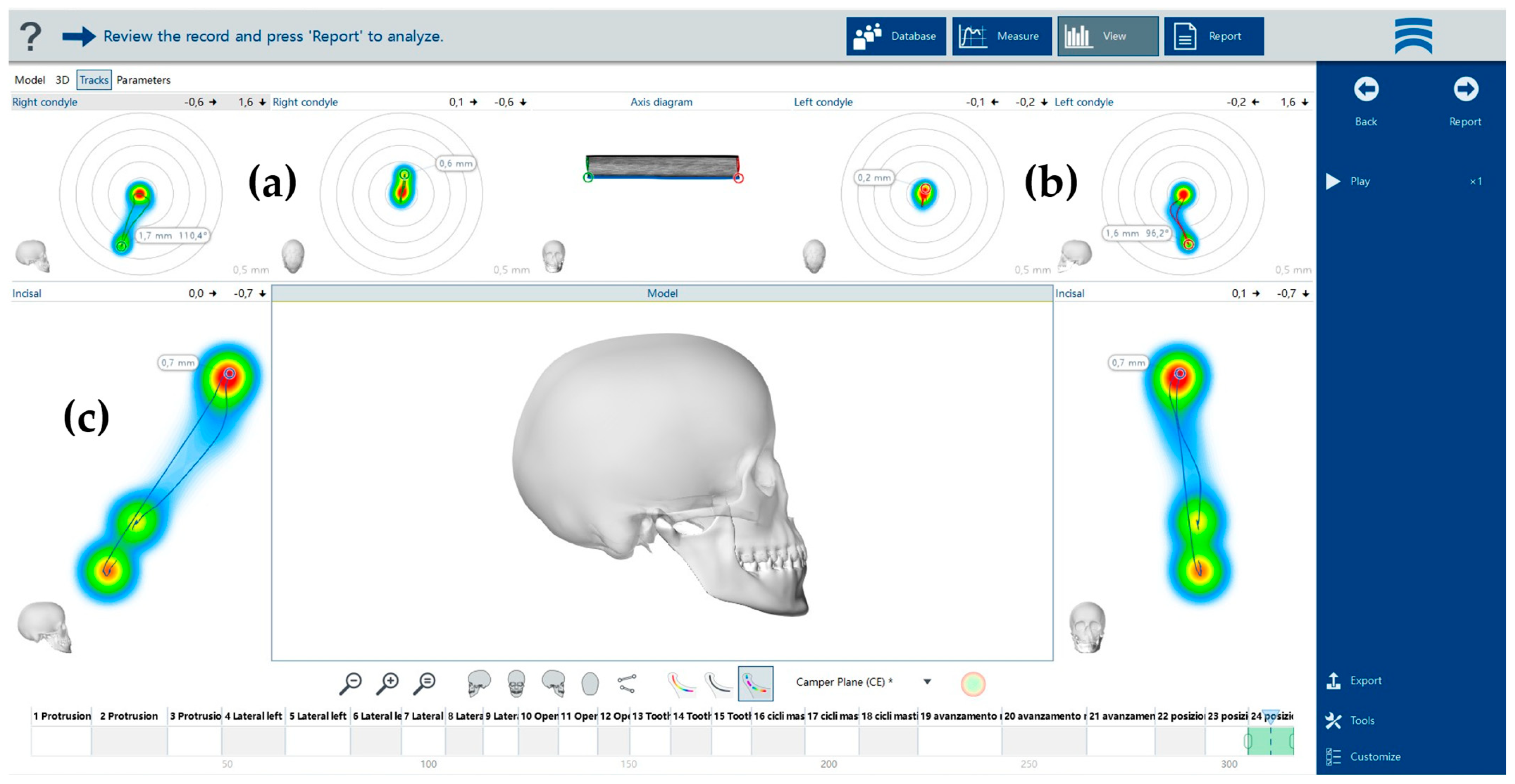
Objective measurements of right and left condylar displacements and incisal relationship changes were obtained using the software Zebris for Ceramill (version 4.0; Zebris Medical GmbH, Isny, Germany). For each subject, the condylar and incisal displacement between the HF and the RP was quantified relative to the light clenching position, which served as the reference position. The distance between HF and RP was measured in millimeters (mm) along two axes on the sagittal plane: on the vertical axis, downward displacements were recorded as positive values and upward movements as negative values, whereas on the anteroposterior axis, anterior displacements were assigned positive values and posterior displacements negative values (
Figure 3).
Data normality was preliminarily assessed using the Shapiro–Wilk test, which confirmed a normal distribution in all cases; accordingly, means, standard deviations, maximum and minimum values were calculated to describe the discrepancies observed in antero-posterior and vertical dimensions. Student’s t-test (two-tailed) was applied to assess statistically significant displacement of condyles from RP to HF, with the level of statistical significance set at p < 0.05. Confidence intervals were reported.
Data were processed using Microsoft Excel for descriptive statistical analysis, while inferential statistics was performed with StatPlus:mac Pro software (version 8; AnalystSoft Inc., Walnut, CA, USA).
3. Results
The descriptive and inferential statistical analysis for all the variables analyzed is reported in
Table 1 for the right and left condyle, and in
Table 2 for the interincisal point.
Inferential analysis demonstrated statistically significant displacement across all variables examined (p < 0.05), except for the anteroposterior movement of the left condyle, which did not reach statistical significance.
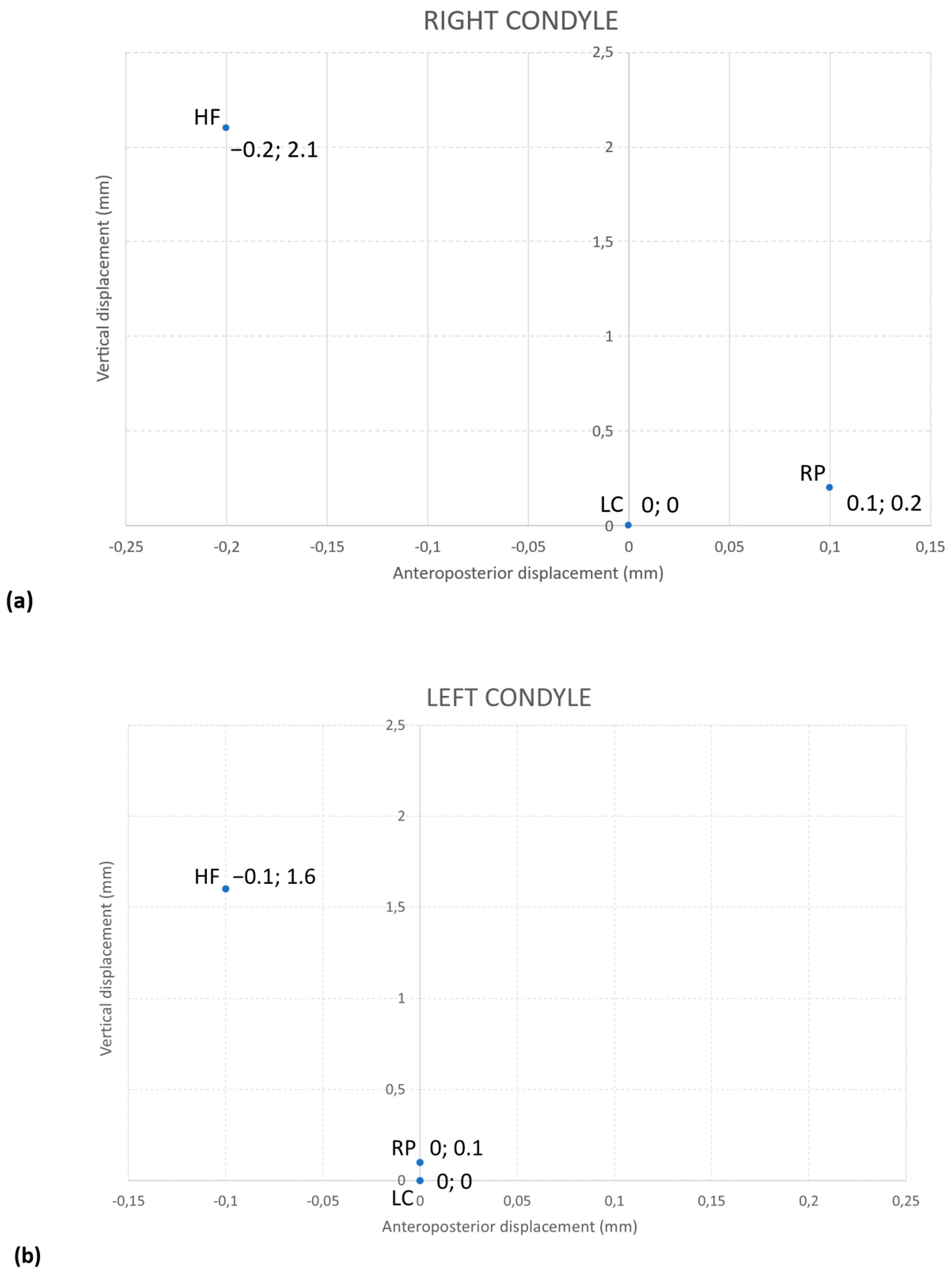
The right condyle exhibited a mean displacement of 1.9 mm in the downward direction (
p < 0.001), and the left condyle showed a downward displacement of 1.5 mm (
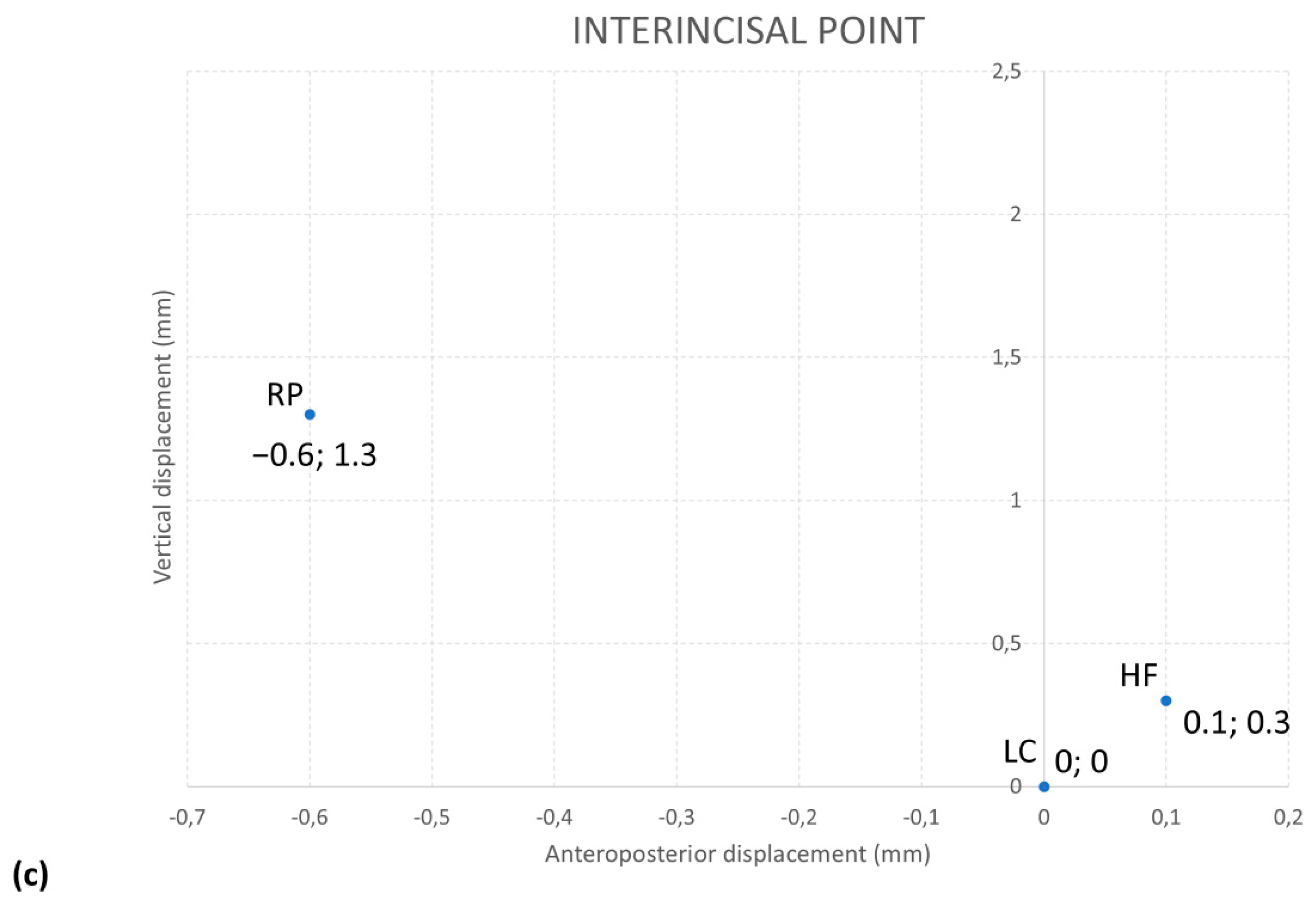
p < 0.001). An effect size of d = 0.91 indicates a large magnitude of displacement relative to measurement variability, supporting the clinical relevance of the observed condylar shift. No significant difference was observed between the two sides. At the dental level, the lower incisor revealed a mean shift of 1.0 mm superiorly (
p < 0.001) and 0.7 mm anteriorly (
p < 0.001). A graphical representation of these findings is provided in
Figure 4.
4. Discussion
The adoption of an improper habit characterized by head flexion, typically observed in individuals using portable electronic devices, is becoming increasingly common in daily life [
15]. The present study adds to the existing evidence in the literature by evaluating how this posture may influence condylar and incisal relationships.
In this investigation, carried out on a cohort of 20 adult participants, the two condyles exhibited a mean statistically significant downwards displacement: the right condyle exhibited a mean downwards displacement of 1.9 mm (p < 0.001) whereas the left condyle showed a downward displacement of 1.5 mm (p < 0.001). No significant difference was observed between mean downward displacement of the two sides. In addition, they also exhibited a mean backwards displacement of 0.3 mm (p < 0.001) on the right side, and 0.1 mm (p = 0.4) in the left side, whose clinical relevance appears negligible.
At the dental level, the incisal point revealed a mean shift of 1.0 mm upward (p < 0.001) and 0.7 mm forward (p < 0.001).
The inferior displacement of both condyles was found to be statistically significant and relevant from a clinical standpoint. Importantly, this downward condylar shift emerges as the most meaningful and potentially impactful finding, so it becomes crucial to establish whether such displacement could play a contributory role as a predisposing condition in the etiopathogenetic mechanisms underlying the development of TMDs.
Notably, the present results are consistent with those reported in previous studies. Ohmure et al. documented a mean posterior displacement of the condyle of approximately 1.1 mm, attributed to a postural condition named Forward Head Posture (FHP), which is biomechanically characterized by extension at the C1–C2 level combined with flexion of the lower cervical vertebrae (C3–C5) [
9]. In contrast, the posture evaluated in the current study—typically adopted during the use of electronic devices—consists of a pure flexion movement of the cervical spine, without the upper-cervical extension component that characterizes FHP. This distinction is biomechanically relevant, as the pure flexion pattern may exert different mechanical effects on the condyle compared with the combined extension–flexion configuration described by Ohmure et al., potentially explaining the differences observed in condylar displacement.
A proposed biomechanical hypothesis to explain these findings is the following: during the flexion of the cranio-cervical complex, mandible remains stable due to the basal muscular activity of the suprahyoid musculature. Specifically, the basal tone (myotatic reflex) not only counteracts the force of gravity but also resists the displacement potentially induced by cranio-cervical flexion. While mandible remains stable, cranial flexion is characterized by its rotation around a center located in the anterior maxillary region, approximately at the level of the incisors. Consequently, the observed changes in the inter-incisal relationship result minimal. By contrast, the displacement at the condylar level is much more pronounced, since the condyle represents the posterior extremity of the mandibular structure, where the movement is amplified through a lever effect. In summary, the condyles result significantly downward displaced within the glenoid fossa, plausibly as a result of a passive biomechanical mechanism occurring independently of any voluntary mandibular activity (
Figure 5).
As is known, condylar displacement could result in a sustained mechanical overload of the bilaminar retrodiskal zone, potentially resulting in micro-instability of the joint, leading to inflammation of the retrodiscal tissue and laxity of the ligaments. Over time, such alterations may contribute to a greater susceptibility to anterior disc displacement, which can manifest clinically through joint clicking, episodic locking, or reflex muscular tension [
16,
17,
18,
19].
Although this mechanism appears biologically plausible, it was not directly demonstrated by the present findings and should therefore be interpreted strictly as a theoretical hypothesis rather than an established causal pathway. Future research specifically designed to explore this hypothesis could provide deeper insights into the potential relationship between head flexion and TMJ function.
Literature reports that in individuals with Forward Head Posture (FHP) or other cervical postural dysfunctions, a chronic postero-inferior displacement of the mandibular condyle may occur potentially leading to disk displacement, joint sounds, retrocondylar pain, and functional limitations, ultimately constituting a true condyle–disk disorder [
20,
21,
22].
Although disk displacement may also occur in asymptomatic individuals, its concurrence with unfavorable postural conditions can shift a subclinical state toward a symptomatic, clinically relevant disorder. This hypothesis is consistent with epidemiological data indicating that, while the prevalence of disk displacement is high in the general population, progression to clinical dysfunction is modulated by a combination of biomechanical, inflammatory, and postural factors [
23,
24,
25].
This study provides a standardized experimental framework to measure condylar and inter-incisal shift during head flexion. However, these findings should be interpreted considering several limitations and delineate priorities for future research.
Firstly, the sample was single-center, relatively small, and demographically homogeneous, which may limit generalizability of the findings. Moreover, the design was cross-sectional, capturing only the immediate effects of the head flexion; therefore, neither causal inference nor conclusions regarding chronic exposures typical of prolonged digital device use can be drawn. Methodologically, it did not include a Magnetic Resonance Imaging (MRI) of disk/retro discal status nor clinical follow-up. Furthermore, although the JMA-Optic system is a validated three-dimensional jaw tracking device, a certain degree of measurement error inherent to optical tracking technologies cannot be completely excluded and may have contributed to variability in the recorded incisor relationship and condylar displacements. The study also lacked subgroup analyses—such as stratification by skeletal pattern, occlusal class, or sex—which could have revealed differential biomechanical responses to head flexion among specific subpopulations. Finally, unmeasured confounders, including parafunctional habits (e.g., bruxism), vertical skeletal pattern, pre-existing TMD symptoms, participants’ occupational profile or their average daily use of portable electronic devices may have influenced individual biomechanical responses and should be considered when interpreting the findings.





 ,
,