1. Introduction
Occlusion is the relationship between the masticatory surfaces of maxillary teeth and those of mandibular teeth in maximum intercuspation [
1,
2]. The masticatory system must be a multiple cutting tool. The lingual cusps of maxillary teeth and the lingual cusps of mandibular teeth are called “mold cusps” because they occlude in opposite pits.
Static occlusal contacts refer to the points of intercuspation between maxillary and mandibular teeth in maximum intercuspation, and their ideal distribution ensures stable load transfer and prevents excessive forces on individual teeth or the temporomandibular joint. Balanced posterior support, absence of interferences, and adequate tripodization of cusp–fossa relationships are considered fundamental principles for functional stability. Dynamic contacts, instead, occur during mandibular movements such as protrusion and laterality and contribute to guiding functions, although they are not the focus of static occlusal analysis. Together, these elements define the functional context within which static occlusal contact assessment—whether digital or traditional—must be interpreted [
3,
4,
5,
6].
The concept of occlusal balance is fundamental in dental health and patient comfort, directly influencing the alignment and function of the entire stomatognathic system. Occlusion refers to the spatial and forceful relationships between maxillary (upper) and mandibular (lower) teeth during static closure and dynamic movements. Properly balanced occlusion distributes masticatory forces evenly across the arches, thereby safeguarding against abnormal wear, fractures, and strain on the teeth and surrounding structures, such as the periodontal ligament, muscles, and temporomandibular joint (TMJ). Masticatory function impairments can lead to issues with speaking, swallowing, and chewing, which can negatively impact a person’s quality of life. Reduced masticatory function is frequently caused by TMJ (temporomandibular joint) problems, neurological abnormalities, dental problems, and muscular atrophy. Reduced masticatory function can be treated with surgery, dental work, or physical therapy, depending on the underlying cause [
2].
Malocclusion, or improper occlusal alignment, can result in a variety of dental issues, some of which may significantly affect quality of life. Malocclusion can cause excessive wear, dental fractures, TMJ disorders, and muscle pain. TMJ disorders, in particular, are often linked to occlusal imbalances, as unbalanced occlusal forces may lead to joint inflammation, pain, and restricted mandibular motion. Bruxism—a condition involving involuntary clenching and grinding of teeth—is commonly observed in patients with occlusal imbalances and may exacerbate conditions such as TMJ disorders by increasing the wear on dental surfaces and placing additional strain on the masticatory muscles and joint structures [
7].
Traditional methods for evaluating occlusal balance have primarily included the use of articulating paper, wax registration, and visual examination. Each has strengths but also inherent limitations. Articulating paper is widely used but provides only a static, two-dimensional indication of contact points and requires subjective interpretation. Similarly, wax registration captures occlusal relationships at a single moment in time but lacks dynamic information about how occlusal forces vary during mandibular movements, such as chewing [
8].
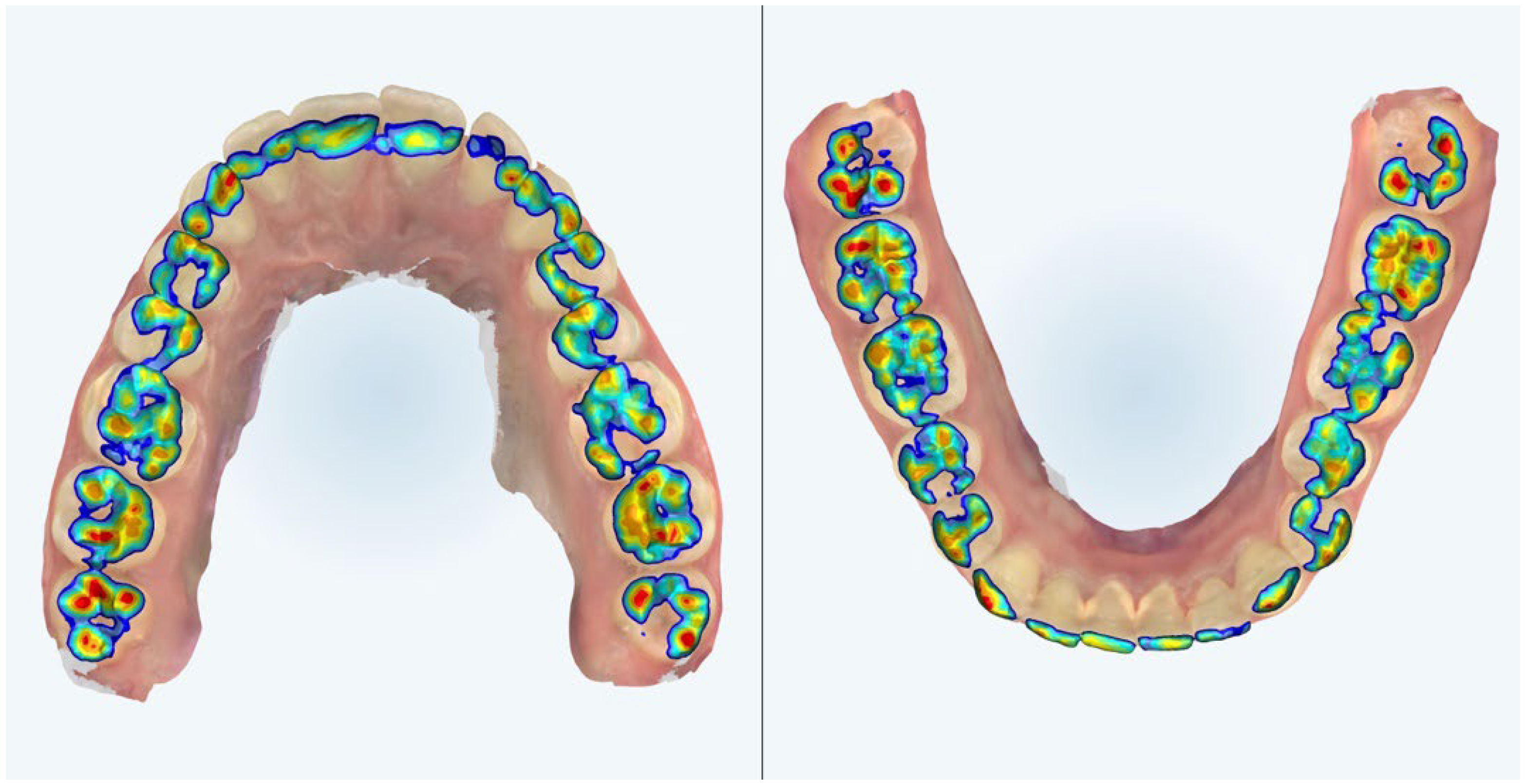
Digital techniques for occlusal assessment, which include intraoral scanning and specialized software, offer several advantages over traditional methods (
Figure 1). Digital tools capture three-dimensional images, enabling more precise visualization and quantification of occlusal contacts and pressure distribution. Intraoral scanners, for instance, can capture occlusal data with high-resolution accuracy, while dedicated software can map and analyze contact points and forces, producing color-coded images that visually rep-resent occlusal pressure zones. By allowing for a more thorough, dynamic analysis of occlusal balance, digital techniques provide detailed, objective information that can enhance diagnostic accuracy and guide more effective treatment planning [
9]. Recent literature has increasingly investigated the performance of digital occlusal analysis systems, reporting improvements in accuracy, reproducibility, and clinical interpretability when compared with conventional methods. Intraoral scanners and computerized occlusal devices, such as T-Scan, have demonstrated high reliability in identifying contact areas and quantifying force distribution, with several studies showing good reproducibility and reduced operator-dependent variability [
9,
10,
11,
12,
13,
14]. Nevertheless, digital systems are not without limitations: full-arch scans may accumulate stitching errors, force measurements can differ from true physiologic loads, and device sensitivity to small occlusal changes varies across platforms. Conversely, traditional tools such as articulating paper and wax registration, while inexpensive and widely accessible, may introduce subjectivity, lack quantitative force information, and are susceptible to thickness-related artifacts. Overall, the current evidence suggests that digital methods can provide more standardized and objective assessments, though they should be interpreted within the context of their technical constraints and ideally used in combination with traditional approaches for comprehensive occlusal evaluation [
15,
16,
17,
18].
In this study, we compared traditional and digital methods for occlusal balancing in a sample of patients to assess the relative accuracy and utility of each method. Specifically, we evaluated two digital methods: a Java-based software for analyzing intraoral scans and Z_TMJ software for analyzing data derived from wax registrations. By analyzing their performance, we aimed to determine whether digital tools could complement or replace traditional occlusal balancing methods in dental practices. The null hypothesis is therefore that the digital intraoral-scanner-based method and the wax-based method show no significant difference and no clinically relevant disagreement in the quantification of static occlusal contacts.
2. Materials and Methods
2.1. Study Design and Sample Selection
This cross-sectional experimental quantitative study was designed to compare occlusal contacts as assessed by two digital techniques and a traditional wax-based method. Participants were consecutively recruited among adults attending routine dental examinations at the University of Insubria, and a minimum sample of 20 subjects was deemed sufficient according to power analysis (α = 0.05, power = 0.80). A cohort of 20 adult participants was selected for this experiment, with each individual meeting strict inclusion criteria. Participants were required to have complete natural dentition up to the first molars and be free from orthodontic treatments, dental implants, and extensive prosthetic restorations to ensure a natural occlusal relationship. Exclusion criteria included known TMJ disorders or bruxism, which could introduce significant variability in occlusal contact data. This work has been performed in accordance with the ethical standards established in the Declaration of Helsinki of 1975. Ethical approval was obtained following institutional guidelines (C.E. Università degli Studi dell’Insubria. n. 0111335 23 December 2022), and informed consent was acquired from each participant. All experimental procedures took place in a controlled clinical environment to minimize external variability and ensure the accuracy of occlusal measurements.
2.2. Procedures for Occlusal Data Collection
Occlusal contact data were gathered using two different methodologies, one analog and the other digital, to allow for comparison.
2.3. Intraoral Scanning and Java-Based Software Analysis
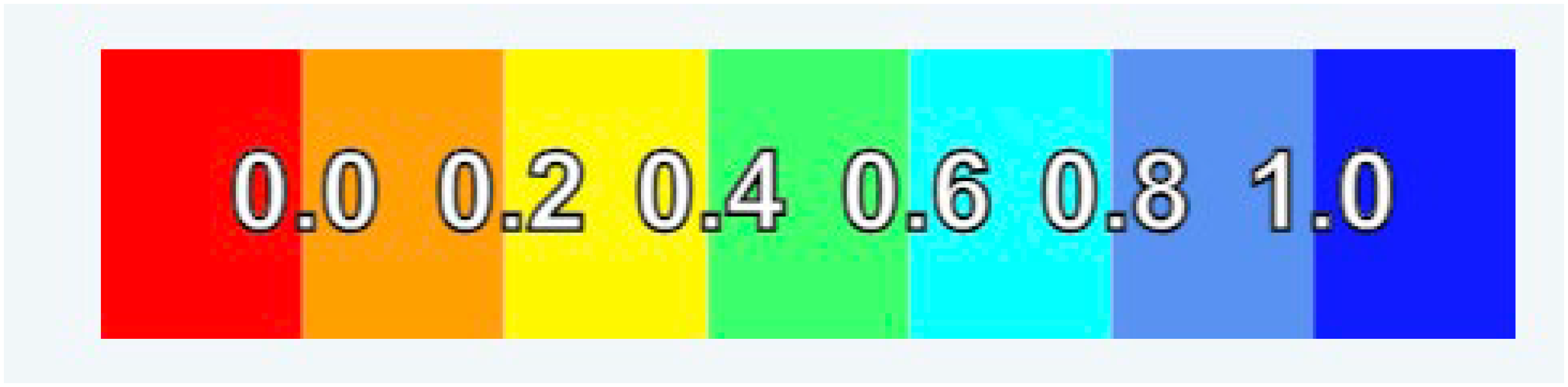
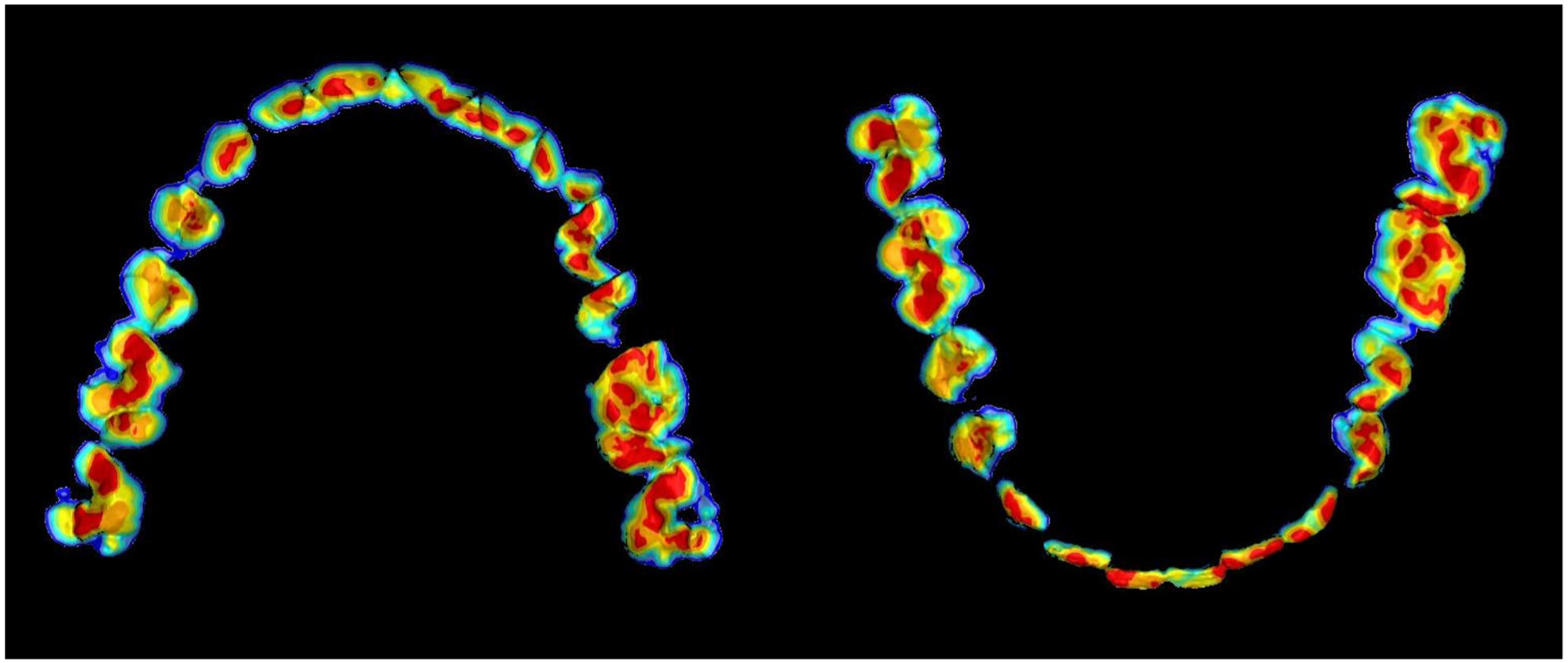
The digital technique involved the use of an intraoral scanner (iTero, Align Technology, Tempe, AZ, USA) capable of capturing three-dimensional images of each participant’s dentition. The scanner used a non-invasive, LED-based optical system that mapped occlusal surfaces by identifying contact points through variations in color intensity. The generated images were analyzed using Java-based software (PixCount.java, version 1.0, University of Insubria, Varese, Italy), which provided a pixel-based quantitative analysis of occlusal contacts. As shown in
Figure 2, different colors represented varying levels of occlusal pressure, with warm colors indicating higher pressure and cool colors lower pressure. Pixel density measurements quantified contact intensity and area, enabling a precise map of force distribution across the arches (
Figure 3). To obtain the results for both dental arches and assess the overall occlusal balance, the values from the first and fourth quadrants, as well as the second and third quadrants, were superimposed. These values were then converted into percentages, allowing for the evaluation of occlusal balance.
2.4. Wax Registration and Z_TMJ Software Analysis
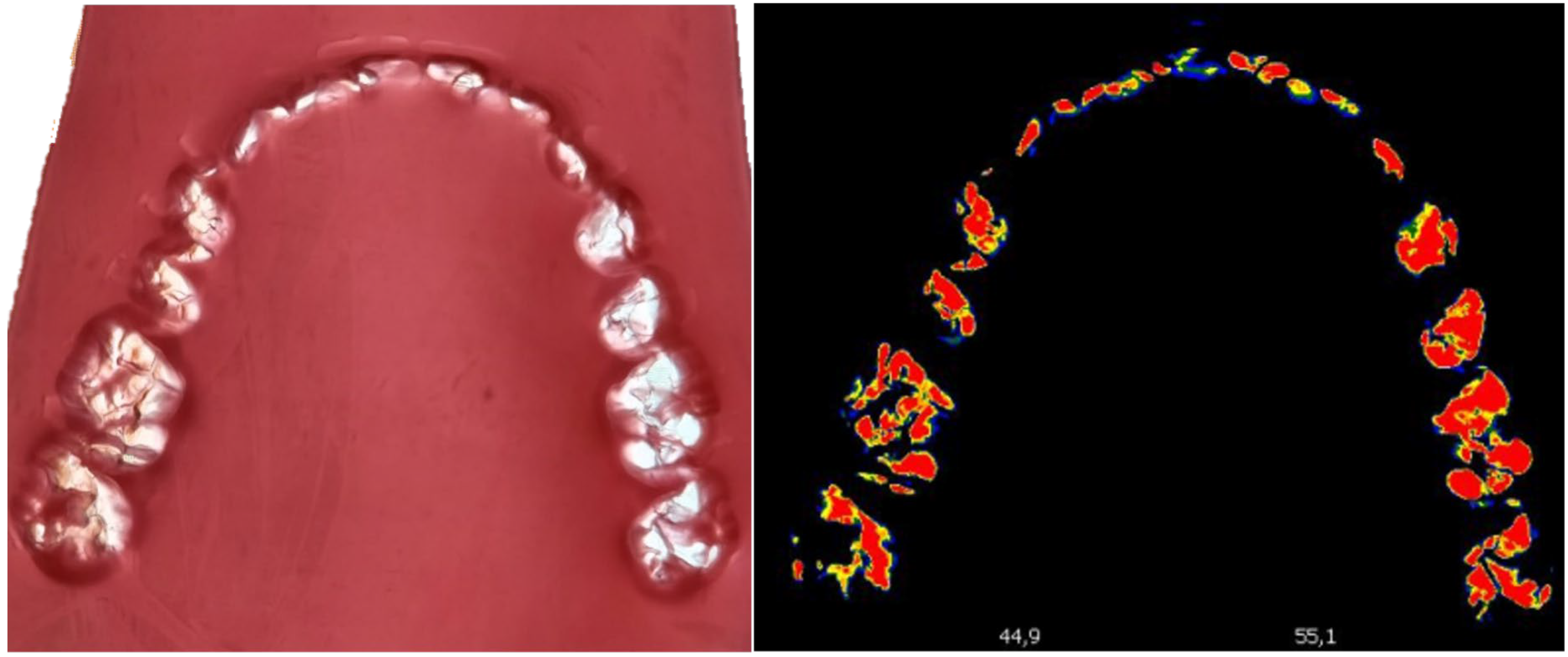
For the traditional wax-based method, each participant was instructed to bite into an occlusal wax registration heated to a standardized temperature of 40 °C, capturing occlusal contacts in maximum intercuspation. After cooling, the wax was examined using Z_TMJ software (version 1.0, University of Insubria, Varese, Italy). The software analyzed contact areas by measuring lacunae in the wax where the teeth had contacted (
Figure 4). This information was translated into digital data, providing values for contact distribution and force estimation. Values from the first and fourth quadrants, as well as the second and third quadrants, were converted into percentages and then compared.
2.5. Analytical Approach and Statistical Analysis
To minimize operator-related variability, all measurements were performed by a single calibrated operator who underwent a dedicated training session on both the intraoral-scanner-based workflow and the wax-registration protocol. Calibration included five pilot cases not included in the final dataset, during which the operator repeated each procedure until intra-operator consistency reached a variation below 5% between repeated measurements. In addition, to assess measurement reproducibility, 20% of the sample was randomly selected for duplicate analysis, and no statistically significant differences were observed between the first and second measurements (p > 0.05). This protocol ensured a standardized acquisition process and reduced the influence of operator-dependent variability across all occlusal recordings.
Both methods produced data in terms of occlusal contact areas and force distribution across the dental arches. The Java-based software analyzed intraoral scan data using pixel density calculations to generate precise maps of occlusal forces. Meanwhile, the Z_TMJ software quantified wax registration contacts based on indentations in the wax, translating these into measurable contact areas. Data from both methods were processed using SPSS software (v.29, SPSS Inc., Chicago, IL, USA). Means and standard deviations were calculated, and a paired t-test was used to compare the contact areas obtained from the two methodologies. A p-value of less than 0.05 was considered statistically significant. Additionally, correlation analysis was conducted to determine the consistency between methods in terms of contact distribution and force mapping. To assess interchangeability and method reliability, agreement was evaluated through the intraclass correlation coefficient. A normality check was performed using the Shapiro–Wilk test before applying parametric statistics.
3. Results
The study involved 20 patients, 6 males and 14 females, with an average age of 31.2 years. Results are summarized in
Table 1. The results revealed no statistically significant differences between the occlusal contacts measured by the Java software and the Z_TMJ software (
p > 0.05). This outcome suggests that wax registration remains a clinically viable option for occlusal assessment, while the digital method presents notable advantages in terms of speed, precision, and ease of data interpretation.
Analyzing a single hemiarcade, considering the other as complementary, we determined the values for mean, standard deviation, range, and median: the mean for Z_TMJ was 48.02, while for iTero it was 49.75. Z_TMJ exhibited a higher standard deviation (5.31) compared to iTero (3.44), suggesting greater data dispersion in Z_TMJ. The range for Z_TMJ was broader (42.2 to 60.7) than for iTero (42.0 to 58.1) while both systems showed similar median values (45.35 for Z_TMJ and 50.35 for iTero). From these values, the variance was calculated as 28.24 for Z_TMJ and 11.86 for iTero. The absolute median deviation was also evaluated (Z_TMJ: 1.9; iTero: 1.7), indicating comparable dispersion between the two methods, with Z_TMJ showing slightly higher variability.
To assess the shape of data distributions and potential deviations from normality, skewness and kurtosis tests were conducted. Skewness measures the asymmetry of a distribution relative to its mean: a skewness > 0 indicates positive asymmetry (right-skewed distribution), while a skewness < 0 indicates negative asymmetry (left-skewed).
Skewness:
- -
Z_TMJ: 1.13 (slight positive asymmetry, with values more concentrated on the left).
- -
iTero: 0.06 (almost no asymmetry, indicating a nearly symmetric distribution).
Kurtosis evaluates the “tailedness” of the distribution compared to a normal distribution: a kurtosis > 0 indicates heavier tails and a sharper peak, while a kurtosis < 0 suggests lighter tails and a flatter peak.
Kurtosis:
- -
Z_TMJ: 0.11 (close to zero, indicating a normal distribution).
- -
iTero: 0.84 (slightly higher, but still consistent with a normal distribution).
The higher skewness observed in Z_TMJ suggests a tendency toward higher values, whereas iTero displayed a more symmetric distribution. Both systems exhibited kurtosis values consistent with a normal distribution, with Z_TMJ slightly closer to a Gaussian profile. These findings highlight subtle but relevant differences in data distribution between the two methods. Comparing the data from both methods, we observed high levels of agreement in occlusal contact areas across participants. Both methods successfully mapped contact points and quantified force distribution, though the Java software pro-vided additional benefits by generating a more detailed color-coded visualization. This visual mapping highlighted high-pressure areas more distinctly, aiding in the identification of specific points where occlusal forces were concentrated. A paired-samples t-test confirmed that there were no significant differences between the methods regarding contact area measurements, with p-values exceeding the significance threshold of 0.05. By precisely comparing the two methods, it can be concluded that there is no significant linear correlation between the results. Agreement between the two methods was evaluated using the intraclass correlation coefficient. The analysis showed moderate agreement between the digital intraoral-scanner-based method and the wax-based method (ICC = 0.43), indicating that, while the two techniques yield comparable mean percentages of occlusal contacts, there is a non-negligible degree of variability at the individual level. These findings suggest that the methods cannot be considered fully interchangeable, but they provide overall consistent information on static occlusal contact distribution and may be used as complementary tools in clinical practice.
4. Discussion
The present study explored the measurement of static occlusal contacts using two commonly employed clinical approaches: a digital intraoral-scanner-based method and a traditional wax-based registration.
Recent studies underscore the importance of combining digital tools with traditional techniques to achieve optimal occlusal assessments. Digital intraoral scanners (IOS) have demonstrated higher accuracy in capturing dynamic occlusal forces and pressure distributions compared to conventional methods. However, for complete arch scans, cumulative errors can still occur due to misalignment during the scanning process. This suggests that while digital methods excel in precision and efficiency for localized treatments, traditional techniques such as articulating paper may provide complementary value in broader clinical applications [
11,
12].
Digital systems offer several practical and analytical advantages when assessing occlusal contacts. Intraoral scanners generate three-dimensional representations that can be viewed and manipulated from different angles, improving the interpretation of contact locations and their distribution across the arches. This multidimensional perspective contrasts with the single static imprint provided by wax registration and can support a more detailed understanding of occlusal relationships. Such visualization features may be particularly helpful in clinical contexts where subtle contact patterns influence treatment decisions, including restorative planning, orthodontic alignment, or the evaluation of mandibular function and TMJ-related conditions [
13]. Moreover, digital occlusal analysis tools are less susceptible to human error than traditional methods. By automating the analysis of contact points and force distribution, digital tools reduce subjectivity and minimize variability between assessments. This consistency can be invaluable for longitudinal studies where occlusal changes are monitored over time, such as in cases of progressive wear, orthodontic adjustments, or after occlusal adjustments in prosthodontics.
Hybrid approaches that integrate digital occlusion tools and traditional methods are gaining traction in clinical practice. For instance, studies have highlighted the effectiveness of digital tools such as T-Scan and OccluSense in mapping occlusal forces over time, offering enhanced visualization and quantification. However, traditional tools, particularly thin articulating papers (e.g., 40 µm), remain indispensable for detecting posterior occlusal contacts with high sensitivity. Combining these methods ensures a balance of cost-efficiency and diagnostic accuracy, particularly in resource-constrained settings [
14,
15].
Although digital technologies expand the possibilities for occlusal evaluation, wax registration continues to represent a practical and widely used option in clinical settings. The technique is straightforward, inexpensive, and requires minimal equipment, allowing clinicians to record static contacts efficiently during routine examinations. In contexts where access to digital systems is limited or where a rapid, low-cost assessment is sufficient, wax registration remains a reliable and familiar method for documenting occlusal contact patterns [
16]. Wax registration is particularly useful in cases where rapid analysis is sufficient, such as preliminary assessments or when occlusal balance needs to be evaluated for simple prosthetic procedures. The method’s simplicity and low cost make it feasible for routine use, even in resource-limited environments.
The integration of artificial intelligence (AI) and machine learning into digital occlusal analysis presents an exciting frontier. AI-driven systems can automate the detection and interpretation of occlusal contacts, reducing operator dependency and inter-observer variability. Additionally, advanced algorithms may enable predictive modeling of occlusal changes over time, further enhancing treatment planning in orthodontics and prosthodontics [
17,
18,
19].
The ability to conduct accurate occlusal analysis has significant implications for multidisciplinary treatment planning. In prosthodontics, occlusal balance is essential for the design of restorations that integrate harmoniously with the natural occlusal system. Similarly, orthodontists rely on precise occlusal data to plan interventions that will produce stable, long-lasting results. Digital occlusal tools can facilitate collaboration across disciplines, allowing multiple specialists to access and interpret the same data set for comprehensive treatment planning. The use of digital occlusal analysis also has potential applications in TMJ disorder management. By providing a detailed, objective view of occlusal contacts and force distribution, digital methods allow clinicians to diagnose and treat occlusal discrepancies that may contribute to TMJ disorders. Furthermore, digital records can be easily shared and stored, enhancing continuity of care for patients with complex, multi-phase treatments.
Digital technologies are also revolutionizing the customization of occlusal analysis. Tools such as patient-specific motion software allow clinicians to integrate dynamic mandibular movements into prosthetic designs. This ensures better functional integration and reduces the need for significant chairside adjustments. As highlighted in recent pilot studies, these approaches are particularly valuable in complex restorative treatments, providing clinically reliable results with fewer refinements [
15,
18].
While digital occlusal tools offer distinct advantages, they also come with limitations, primarily related to cost and accessibility. The initial investment required for intraoral scanners and software can be prohibitive for smaller clinics, and proper training is essential to ensure accurate data collection and analysis. Additionally, factors such as patient movement during scanning or variability in scan quality can affect the accuracy of the results. Future research should focus on refining digital occlusal tools to improve accessibility and affordability. Studies could explore the development of hybrid approaches that combine wax registration with digital analysis to offer a balance of cost-effectiveness and precision. Further studies are also warranted to assess the effectiveness of these tools in dynamic occlusal analysis, particularly for patients with parafunctional habits or complex occlusal disorders. This study also presents several limitations that should be acknowledged. First, repeatability testing was not performed on the full dataset, and measurements remained partly operator-dependent despite calibration procedures, which may have introduced minor variability. Additionally, the sample size was relatively small, limiting the generalizability of the findings and preventing more advanced subgroup analyses. Finally, the statistical framework was intentionally focused on essential agreement metrics, and a more extensive analytical approach could further refine the comparison between methods. These limitations highlight the need for future studies with larger cohorts, repeated measurements, and expanded statistical models to strengthen the evidence regarding the clinical performance of digital occlusal assessment tools.
5. Conclusions
This study compared a digital intraoral-scanner-based approach with a traditional wax-based method for assessing static occlusal contacts. While the two techniques produced similar mean values, agreement analysis indicated only moderate consistency, indicating that although the methods do not produce identical results at the individual level, they provide overall comparable quantitative outputs regarding static occlusal contact balance. The digital workflow demonstrated practical advantages—such as visualization and ease of data interpretation—while the wax method remained a simple and accessible option. Within the limits of this study, the findings suggest that both techniques provide clinically useful but not equivalent information, and they may be best viewed as complementary tools rather than alternatives capable of replacing one another. Future studies employing larger samples, repeated measurements, and expanded analytical frameworks are needed to clarify the conditions under which digital occlusal assessment may reliably match or surpass traditional methods.
Author Contributions
Conceptualization, L.L. and P.A.Z.; methodology, A.U. and A.M.; software, A.C.; validation, A.D. and S.S.; formal analysis, P.B.; investigation, A.M.; resources, S.B.; data curation, S.B. and S.S.; writing—original draft preparation, A.C. and A.U.; writing—review and editing, A.D.; visualization, P.A.Z.; supervision, L.L.; project administration, A.C. and N.G. All authors have read and agreed to the published version of the manuscript.
Funding
This research received no external funding.
Institutional Review Board Statement
This study was conducted in accordance with the Declaration of Helsinki and was approved by the Institutional Review Board of University of Insubria (protocol n.0111335 23 December 2022).
Informed Consent Statement
Informed consent was obtained from all subjects involved in the study.
Data Availability Statement
The raw data supporting the conclusions of this article will be made available by the authors on request.
Acknowledgments
A.C. is a Ph.D. student of the Life Sciences and Biotechnology course at the University of Insubria.
Conflicts of Interest
The authors declare no conflicts of interest.
References
- Davies, S.; Gray, R.M. What is occlusion? Br. Dent. J. 2001, 191, 235–238+241–235. [Google Scholar] [PubMed]
- Visscher, C.M.; Lobbezoo, F.; Naeije, M. Comparison of algometry and palpation in the recognition of temporomandibular disorder pain complaints. J. Orofac. Pain 2004, 18, 214–219. [Google Scholar] [PubMed]
- Wilson, K.S.; Hohmann, A. Dental anatomy and occlusion. Otolaryngol. Clin. N. Am. 1976, 9, 425–438. [Google Scholar] [CrossRef] [Scilit]
- Ishihara, S. Anatomy of dental occlusion. Nihon. Shika. Ishikai. Zasshi 1968, 21, 207–214. [Google Scholar] [PubMed]
- Curriculum guidelines for occlusion. Section on Dental Anatomy and Occlusion of the American Association of Dental Schools. J. Dent. Educ. 1993, 57, 384–387. [CrossRef] [Scilit]
- Curriculum guidelines for dental anatomy and occlusion for dental hygiene. Section on Dental Hygiene Education of the American Association of Dental Schools. J. Dent. Educ. 1993, 57, 378–381.
- Levrini, L.; Deppieri, A.; Carganico, A.; Rodigari, G.; Saran, S.; Zecca, P.A.; Cicciu, M.; Bocchieri, S. Chewing Function with Efficiency Tests in Subjects Wearing Clear Aligners. Dent. J. 2024, 12, 57. [Google Scholar] [CrossRef] [Scilit] [PubMed]
- Buser, R.; Ziltener, V.; Samietz, S.; Fontolliet, M.; Nef, T.; Schimmel, M. Validation of a purpose-built chewing gum and smartphone application to evaluate chewing efficiency. J. Oral Rehabil. 2018, 45, 845–853. [Google Scholar] [CrossRef] [Scilit] [PubMed]
- Botsford, K.P.; Frazier, M.C.; Ghoneima, A.A.M.; Utreja, A.; Bhamidipalli, S.S.; Stewart, K.T. Precision of the virtual occlusal record. Angle Orthod. 2019, 89, 751–757. [Google Scholar] [CrossRef] [Scilit] [PubMed]
- Lekaviciute, R.; Kriauciunas, A. Relationship Between Occlusal Factors and Temporomandibular Disorders: A Systematic Literature Review. Cureus 2024, 16, e54130. [Google Scholar] [CrossRef] [Scilit] [PubMed]
- Esposito, R.; Masedu, F.; Cicciu, M.; Tepedino, M.; Denaro, M.; Ciavarella, D. Reliabilty of recording occlusal contacts by using intraoral scanner and articulating paper—A prospective study. J. Dent. 2024, 142, 104872. [Google Scholar] [CrossRef] [Scilit] [PubMed]
- Rovira-Lastra, B.; Khoury-Ribas, L.; Flores-Orozco, E.I.; Ayuso-Montero, R.; Chaurasia, A.; Martinez-Gomis, J. Accuracy of digital and conventional systems in locating occlusal contacts: A clinical study. J. Prosthet. Dent. 2024, 132, 115–122. [Google Scholar] [CrossRef] [Scilit] [PubMed]
- Yuzbasioglu, E.; Kurt, H.; Turunc, R.; Bilir, H. Comparison of digital and conventional impression techniques: Evaluation of patients’ perception, treatment comfort, effectiveness and clinical outcomes. BMC Oral Health 2014, 14, 10. [Google Scholar] [CrossRef] [Scilit] [PubMed]
- Manziuc, M.M.; Savu, M.M.; Almasan, O.; Leucuta, D.C.; Taut, M.; Ifrim, C.; Berindean, D.; Kui, A.; Negucioiu, M.; Buduru, S. Insights into Occlusal Analysis: Articulating Paper versus Digital Devices. J. Clin. Med. 2024, 13, 4506. [Google Scholar] [CrossRef] [Scilit] [PubMed]
- Risciotti, E.; Squadrito, N.; Montanari, D.; Iannello, G.; Macca, U.; Tallarico, M.; Cervino, G.; Fiorillo, L. Digital Protocol to Record Occlusal Analysis in Prosthodontics: A Pilot Study. J. Clin. Med. 2024, 13, 1370. [Google Scholar] [CrossRef] [Scilit] [PubMed]
- Pagnano, V.O.; Bezzon, O.L.; de Mattos, M.G.; Ribeiro, R.F. A clinical evaluation of materials for interocclusal registration in centric relation. Braz. Dent. J. 2000, 11, 41–47. [Google Scholar] [PubMed]
- Sigvardsson, J.; Nilsson, S.; Ransjo, M.; Westerlund, A. Digital Quantification of Occlusal Contacts: A Methodological Study. Int. J. Environ. Res. Public Health 2021, 18, 5297. [Google Scholar] [CrossRef] [Scilit] [PubMed]
- Revilla-Leon, M.; Kois, D.E.; Zeitler, J.M.; Att, W.; Kois, J.C. An overview of the digital occlusion technologies: Intraoral scanners, jaw tracking systems, and computerized occlusal analysis devices. J. Esthet. Restor. Dent. 2023, 35, 735–744. [Google Scholar] [CrossRef] [Scilit] [PubMed]
- Zecca, P.A.; Borgese, M.; Raspanti, M.; Zara, F.; Fastuca, R.; Serafin, M.; Caprioglio, A. Comparative microscopic analysis of plastic dispersion from 3D-printed and thermoformed orthodontic aligners. Eur. J. Orthod. 2025, 47, 3. [Google Scholar] [CrossRef] [Scilit] [PubMed]
| Disclaimer/Publisher’s Note: The statements, opinions and data contained in all publications are solely those of the individual author(s) and contributor(s) and not of MDPI and/or the editor(s). MDPI and/or the editor(s) disclaim responsibility for any injury to people or property resulting from any ideas, methods, instructions or products referred to in the content. |




 ,
,