Effect of Electrochemical Hydrogen Degradation on the Bond Microstructure of Explosively Welded Joints

Abstract
1. Introduction
2. Materials and Methods
2.1. Material Preparation and Explosive Welding Process
2.2. Microstructural Characterization
2.3. Microhardness Measurements
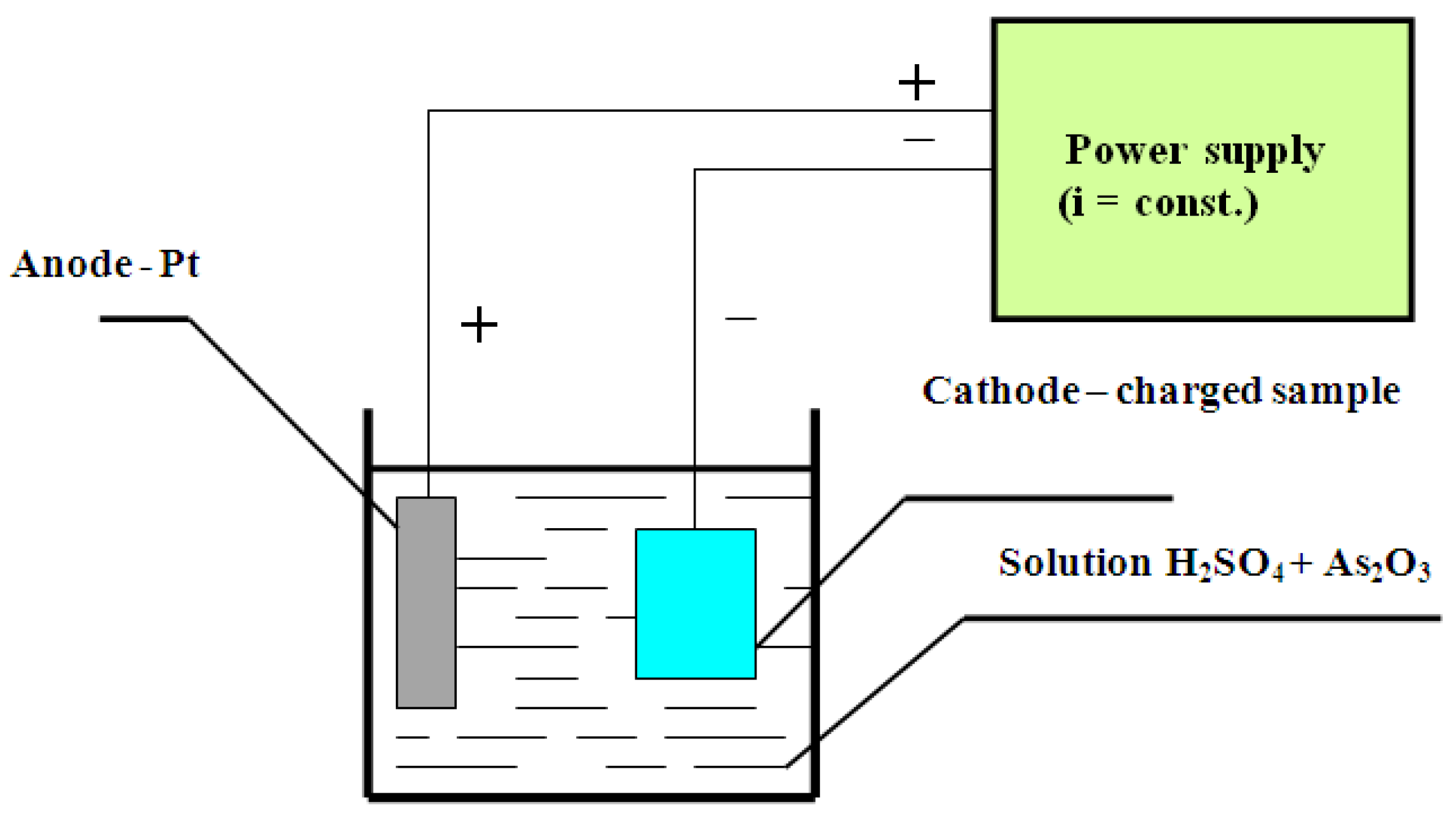
2.4. Hydrogen Charging and Thermal Desorption Analysis
3. Results
3.1. Interfacial Microstructure Characterization
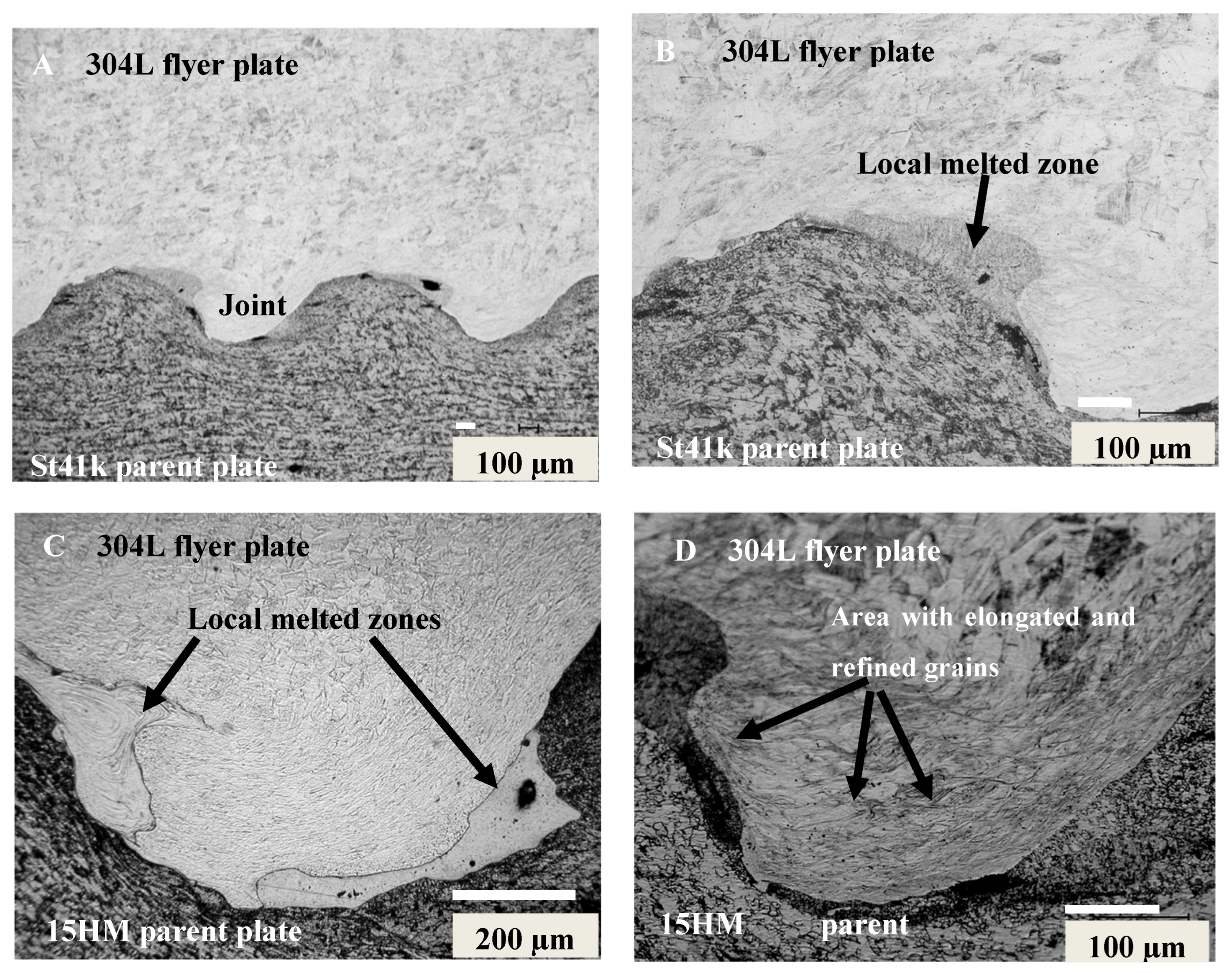
3.1.1. Macroscopic Interface Morphology
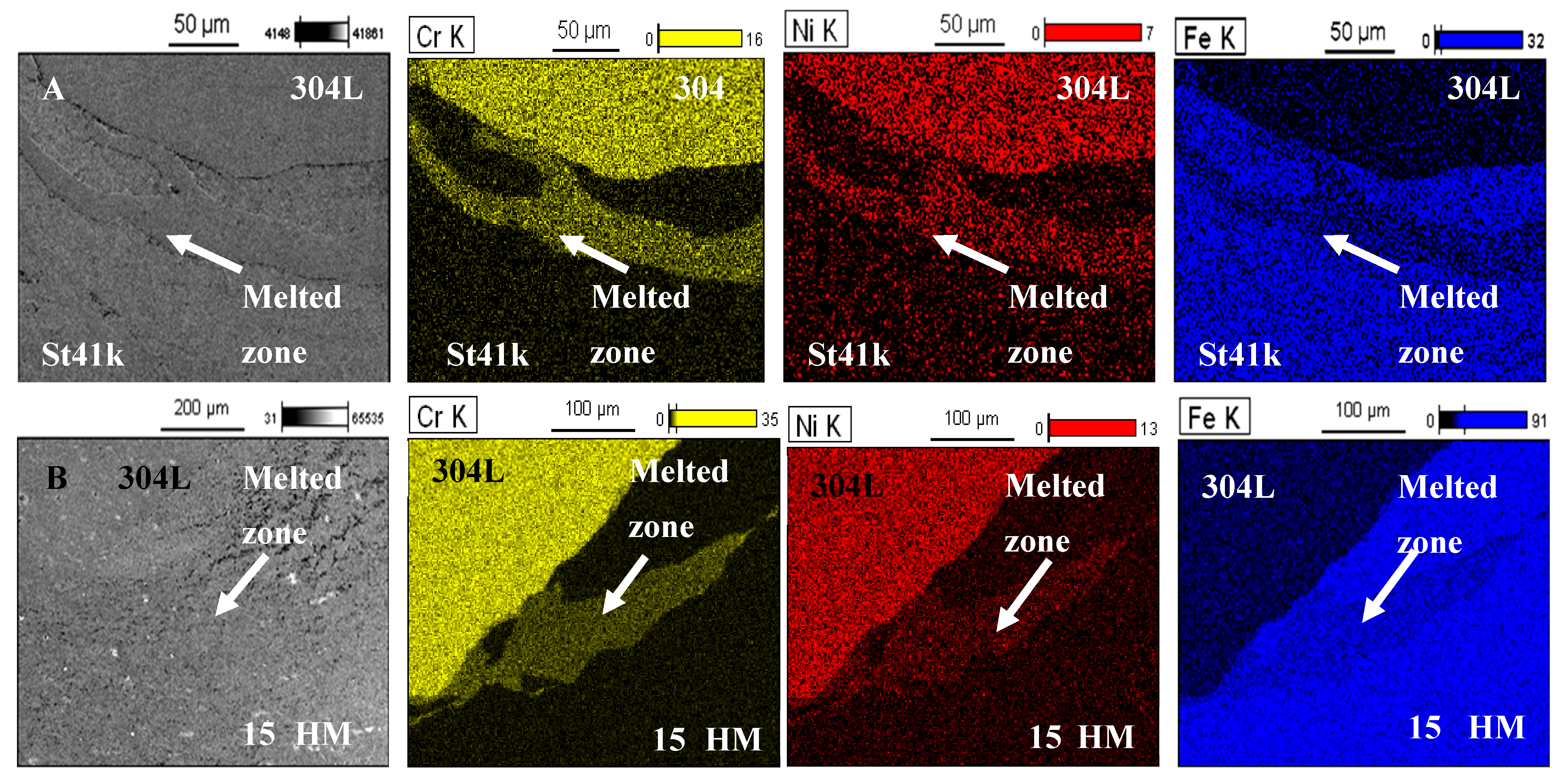
3.1.2. Compositional Analysis Across the Interface
4. Discussion
- (1)
- Mixed austenite–ferrite microstructures (duplex-type character), which combine austenite’s high hydrogen solubility with ferrite’s lower diffusivity,
- (2)
- Retained metastable austenite with high dislocation densities,
- (3)
- Potentially acicular ferrite or low-carbon martensite depending on precise cooling conditions and carbon redistribution.
5. Conclusions
- Explosive welding produced metallurgically bonded interfaces characterized by distinct wavy morphology and localized melting zones (LMZs) with dimensions ranging from 50 to 400 μm.
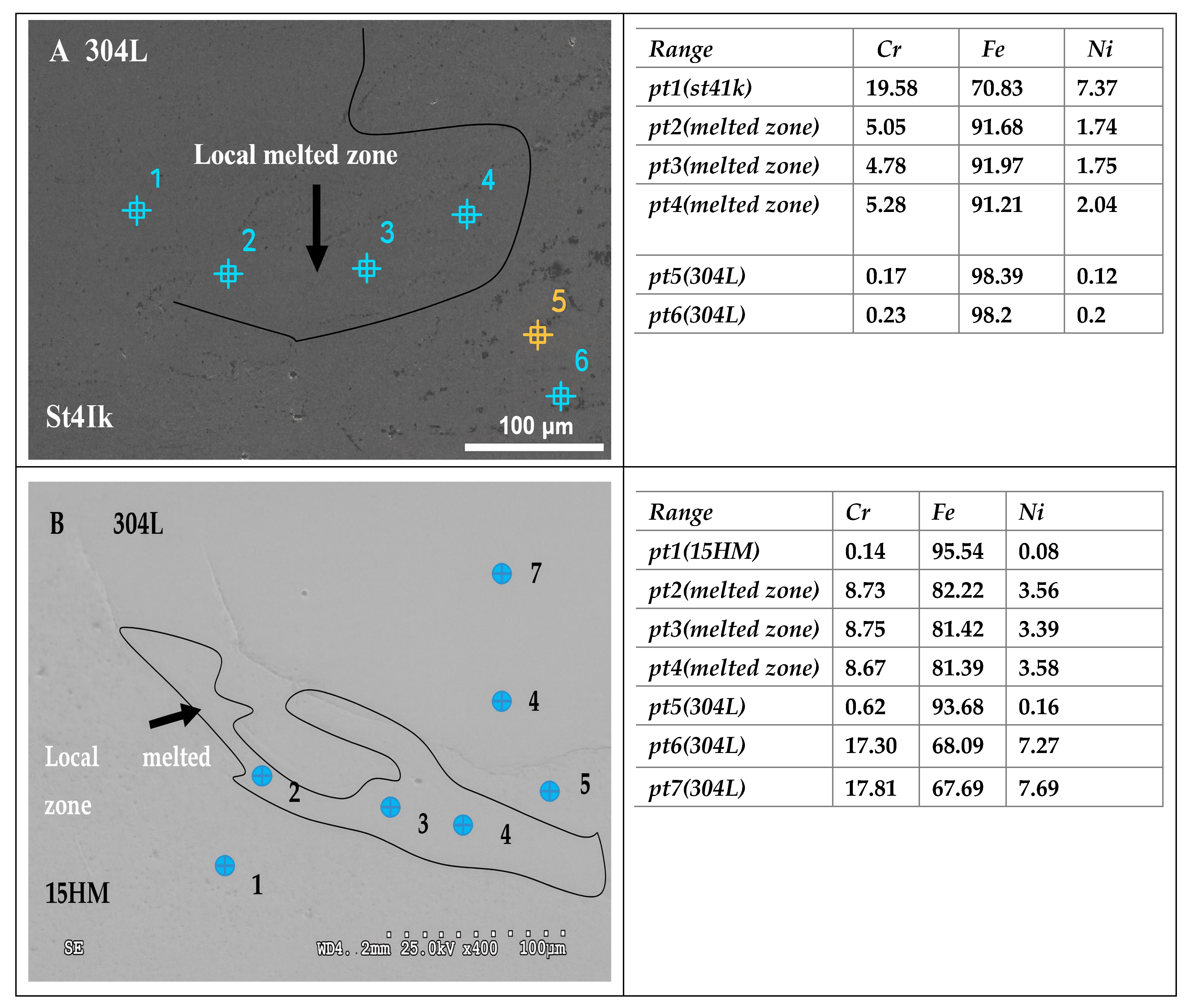
- Compositional analysis revealed that LMZs possess intermediate chromium (4.8–8.8 wt%) and nickel (1.7–3.6 wt%) contents, reflecting metallurgical mixing during rapid solidification.
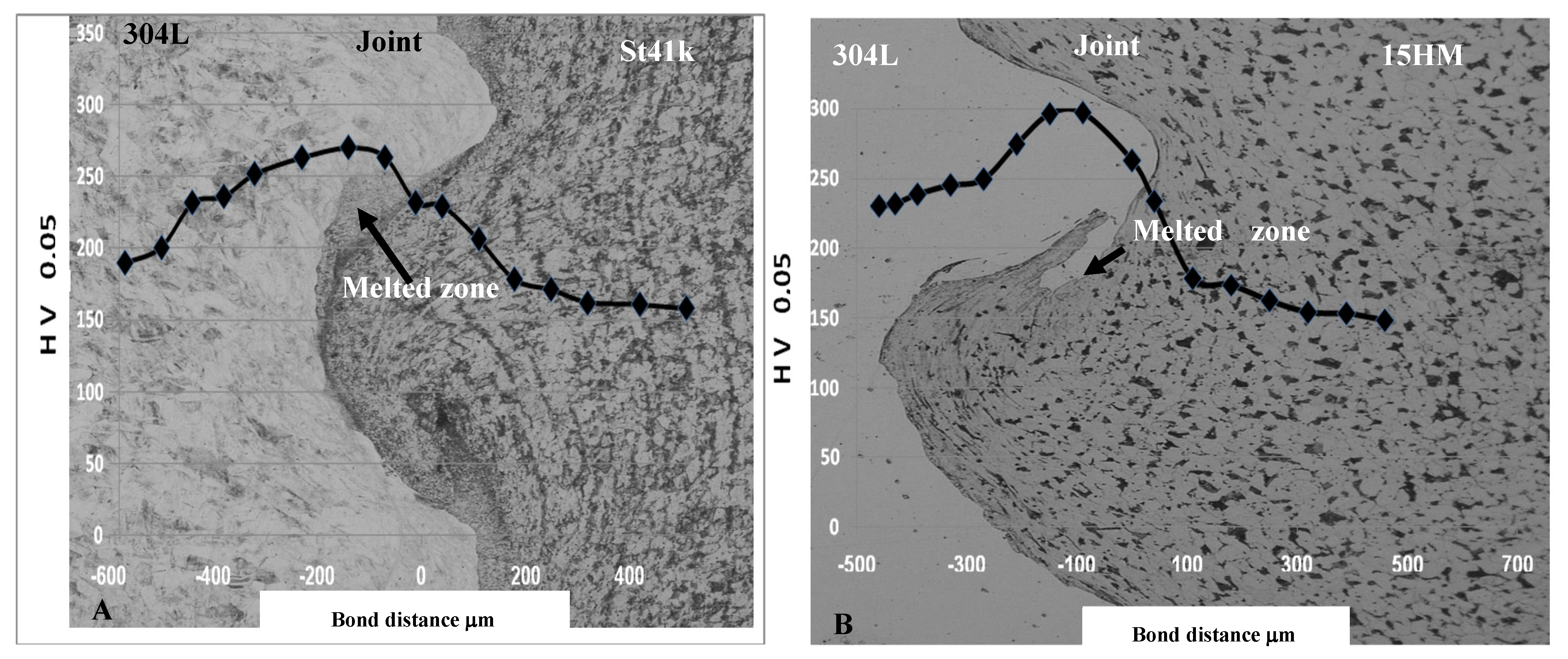
- Microhardness measurements indicate that LMZs exhibit significantly higher hardness than the parent materials, attributable to refined microstructure and plastic deformation.
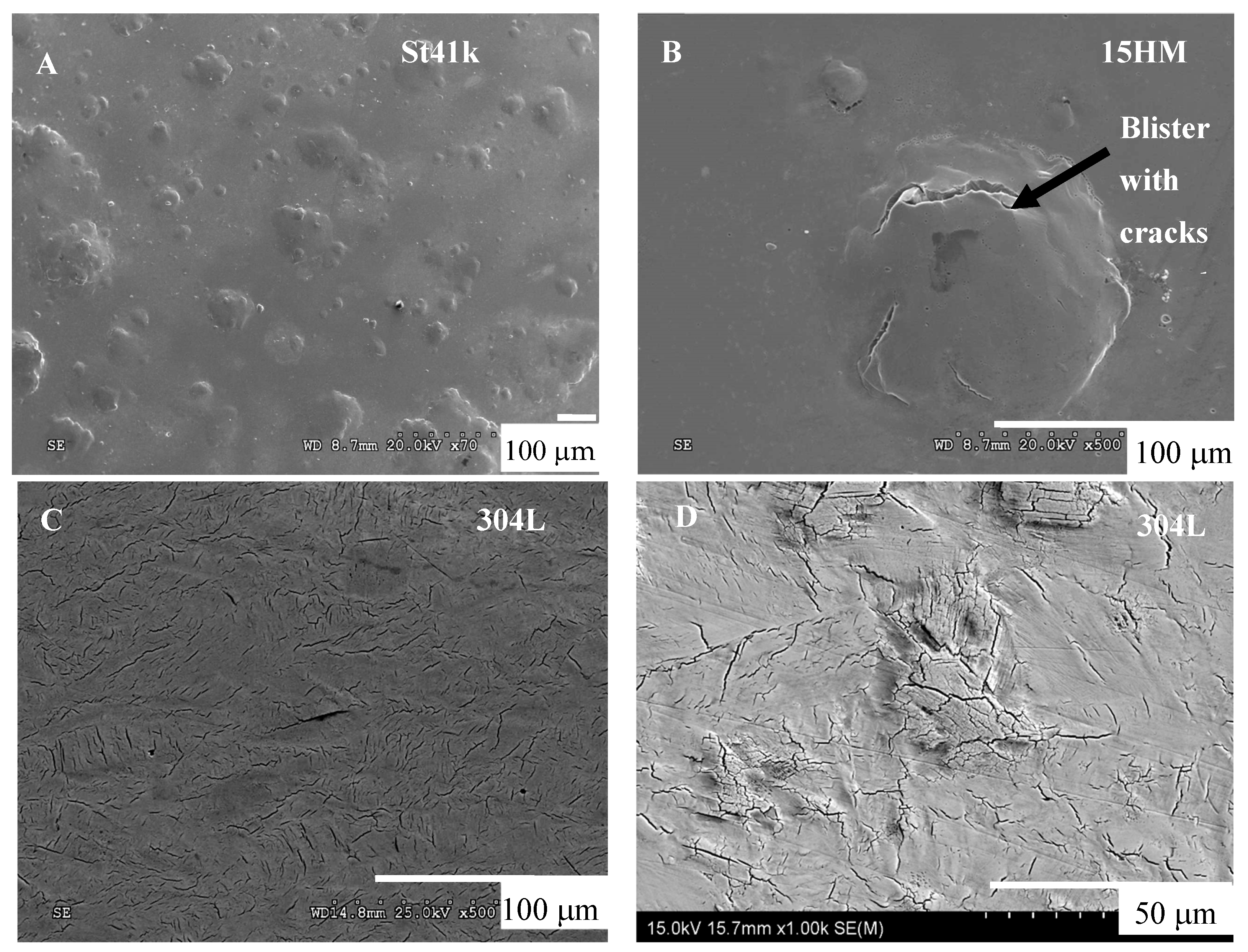
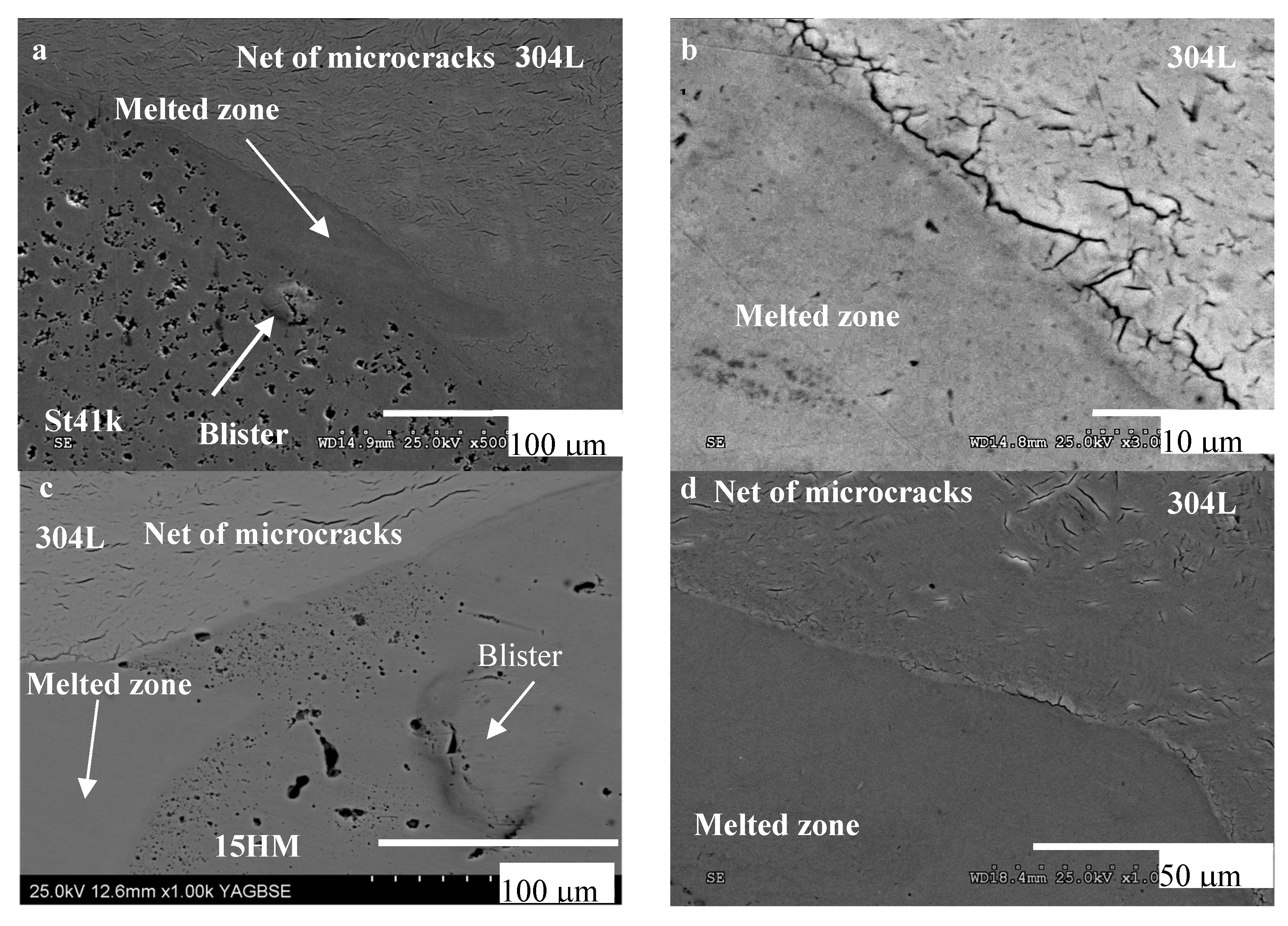
- Hydrogen charging at 0.05 A/cm2 for 24 h induced blisters with cracks in carbon steels and networks of microcracks in 304L stainless steel, whereas LMZs remained free of visible hydrogen-induced damage.
- The superior hydrogen embrittlement resistance of LMZs is attributed to their refined microstructure that provides a high density of hydrogen trapping sites, optimized chemical composition, and possibly beneficial compressive residual stresses from rapid solidification.
Author Contributions
Funding
Institutional Review Board Statement
Informed Consent Statement
Data Availability Statement
Conflicts of Interest
References
- Campari, A.; Ustolin, F.; Alvaro, A.; Paltrinieri, N. A Review on Hydrogen Embrittlement and Risk-Based Inspection of Hydrogen Technologies. Int. J. Hydrog. Energy 2023, 48, 35316–35346. [Google Scholar] [CrossRef]
- Krella, A. Hydrogen-Induced Degradation of Metallic Materials—A Short Review. Materials 2025, 18, 597. [Google Scholar] [CrossRef]
- Chen, B.; Qiu, F.; Xia, L.; Xu, L.; Jin, J.; Gou, G. In Situ Ultrasonic Characterization of Hydrogen Damage Evolution in X80 Pipeline Steel. Materials 2024, 17, 5891. [Google Scholar] [CrossRef]
- Ma, J.; Luo, H.; Hu, X.; Pan, Z.; Li, X. Electrochemical Study on the Effect of Hydrogen on the Passive Film of Selective Laser Melted 316L Stainless Steel in a Proton Exchange Membrane Water Electrolyzer Environment. Int. J. Hydrog. Energy 2023, 48, 19396–19410. [Google Scholar] [CrossRef]
- Islam, A.; Li, Q.; Storimans, E.; Ton, K.; Alam, T.; Farhat, Z.N. Effect of Microstructure on Hydrogen Permeation and Trapping in Natural Gas Pipeline Steels. npj Mater. Degrad. 2025, 9, 70. [Google Scholar] [CrossRef]
- Sun, Y.; Frank Cheng, Y. Hydrogen-Induced Degradation of High-Strength Steel Pipeline Welds: A Critical Review. Eng. Fail. Anal. 2022, 133, 105985. [Google Scholar] [CrossRef]
- Findik, F. Recent Developments in Explosive Welding. Mater. Des. 2011, 32, 1081–1093. [Google Scholar] [CrossRef]
- Wang, B.; Xie, F.; Luo, X.; Zhou, J. Experimental and Physical Model of the Melting Zone in the Interface of the Explosive Cladding Bar. J. Mater. Res. Technol. 2016, 5, 333–338. [Google Scholar] [CrossRef]
- Zafra, A.; Belzunce, J.; Rodríguez, C.; Fernández-Pariente, I. Hydrogen Embrittlement of the Coarse Grain Heat Affected Zone of a Quenched and Tempered 42CrMo4 Steel. Int. J. Hydrog. Energy 2020, 45, 16890–16908. [Google Scholar] [CrossRef]
- Katzarov, I.H. Multiscale Modeling and Analysis of Hydrogen-Enhanced Decohesion Across Block Boundaries in Low-Carbon Lath Martensite. Metals 2025, 15, 660. [Google Scholar] [CrossRef]
- Hasan, M.S.; Kapci, M.F.; Bal, B.; Koyama, M.; Bayat, H.; Xu, W. An Atomistic Study on the HELP Mechanism of Hydrogen Embrittlement in Pure Metal Fe. Int. J. Hydrog. Energy 2024, 57, 60–68. [Google Scholar] [CrossRef]
- Djukic, M.B.; Bakic, G.M.; Sijacki Zeravcic, V.; Sedmak, A.; Rajicic, B. The Synergistic Action and Interplay of Hydrogen Embrittlement Mechanisms in Steels and Iron: Localized Plasticity and Decohesion. Eng. Fract. Mech. 2019, 216, 106528. [Google Scholar] [CrossRef]
- Mazancová, E.; Ostroushko, D.; Saksl, K.; Niesłony, A. Joint Hydrogen Susceptibility of 304 SS Welded with Titanium/Podatność Połczenia Na Wodorowanie W Układzie Plateru Stal 304 Ss Zgrzewanym Wybuchowo Z Tytanem. Arch. Metall. Mater. 2014, 59, 1605–1610. [Google Scholar] [CrossRef][Green Version]
- Chen, Y.-S.; Huang, C.; Liu, P.-Y.; Yen, H.-W.; Niu, R.; Burr, P.; Moore, K.L.; Martínez-Pañeda, E.; Atrens, A.; Cairney, J.M. Hydrogen Trapping and Embrittlement in Metals—A Review. Int. J. Hydrog. Energy 2025, 136, 789–821. [Google Scholar] [CrossRef]
- Barros, A.; Konno, C.; De Paula, A.; Silva, C.; Garcia, A.; Cheung, N. The Role of Microstructural Length Scale in Hydrogen Generation Features of an Al-Sn-Fe Alloy. Metals 2024, 14, 187. [Google Scholar] [CrossRef]
- Silva, M.I.; Sorger, G.; Malitckii, E.; Vilaça, P. Hydrogen-as-a-Probe Applied to Investigate the Influence of Extraction and Preparation Methods on TDS Spectra of 13CrMo4-5 Samples. J. Mater. Sci. 2024, 59, 20735–20764. [Google Scholar] [CrossRef]
- Mojżeszko, M.; Setty, M. Numerical Investigation of the Influence of Explosive Welding Process Setup on the Ti/Cu Interlayer Morphology. Comput. Methods Mater. Sci. 2020, 20, 113–120. [Google Scholar] [CrossRef]
- Jandaghi, M.R.; Saboori, A.; Khalaj, G.; Khanzadeh Ghareh Shiran, M. Microstructural Evolutions and Its Impact on the Corrosion Behaviour of Explosively Welded Al/Cu Bimetal. Metals 2020, 10, 634. [Google Scholar] [CrossRef]
- Cui, Y.; Liu, D.; Zhang, Y.; Deng, G.; Fan, M.; Chen, D.; Sun, L.; Zhang, Z. The Microstructure and Mechanical Properties of TA1-Low Alloy Steel Composite Plate Manufactured by Explosive Welding. Metals 2020, 10, 663. [Google Scholar] [CrossRef]
- Zhao, H.; Zhao, C.; Yang, Y.; Wang, Y.; Sheng, L.; Li, Y.; Huo, M.; Zhang, K.; Xing, L.; Zhang, G. Study on the Microstructure and Mechanical Properties of a Ti/Mg Alloy Clad Plate Produced by Explosive Welding. Metals 2022, 12, 399. [Google Scholar] [CrossRef]
- Lousada, C.M.; Korzhavyi, P.A. Pathways of Hydrogen Atom Diffusion at Fcc Cu: Σ9 and Σ5 Grain Boundaries vs. Single Crystal. J. Mater. Sci. 2023, 58, 17004–17018. [Google Scholar] [CrossRef]
- Mine, Y.; Horita, N.; Horita, Z.; Takashima, K. Effect of Ultrafine Grain Refinement on Hydrogen Embrittlement of Metastable Austenitic Stainless Steel. Int. J. Hydrog. Energy 2017, 42, 15415–15425. [Google Scholar] [CrossRef]
- Li, M.; Zhang, H.; Henein, H.; Liu, J. Hydrogen Trapping in Precipitates of High-Strength Steel: Insights into Various Coherent and Stress Conditions. Int. J. Hydrog. Energy 2024, 92, 1356–1365. [Google Scholar] [CrossRef]
- Hong, Y.; Yin, G.; Zheng, Y.; Zhang, W.; Ma, L. Heat Treatment Effects on Hydrogen Embrittlement in 316L Stainless Steel Produced by Selective Laser Melting in High-Pressure Environment. Int. J. Hydrog. Energy 2025, 166, 150896. [Google Scholar] [CrossRef]
- Liu, H.; Ma, K.; Yu, S.; Deng, X.; Wang, Z. Optimization of composition for thick nm450 steel plates and elimination of delayed cracking phenomena. Mater. Res. Express 2025, 12, 106502. [Google Scholar] [CrossRef]
- Gesari, S.; Irigoyen, B.; Juan, A. Binding energy of hydrogen to mixed and screw dislocation. Surf. Rev. Lett. 2005, 12, 227–232. [Google Scholar] [CrossRef]
- Ju, J.; Fu, H.; FU, D.; Wei, S.; Sang, P.; Wu, Z.; Lei, Y. Effects of cr and v additions on the microstructure and properties of high-vanadium wear-resistant alloy steel. Ironmak. Steelmak. 2016, 45, 176–186. [Google Scholar] [CrossRef]
- Hussein, A.; Kim, B.; Verbeken, K.; Depover, T. The effect of grain boundary misorientation on hydrogen flux using a phase-field-based diffusion and trapping model. Adv. Eng. Mater. 2024, 26, 2401561. [Google Scholar] [CrossRef]
- Yao, G.; Liu, M.; Ye, W.; Xu, L.; Li, J.; Qiao, L.; Yan, Y. Effect of Microstructure on the Hydrogen Cracking Behavior of Bimetallic Metallurgical Clad Pipes: The Role of Precipitated Phases and Inclusions. Int. J. Hydrog. Energy 2025, 137, 13–25. [Google Scholar] [CrossRef]





| Material | Chemical Composition [% wt] | |||||||||
|---|---|---|---|---|---|---|---|---|---|---|
| C | Mn | Si | P | S | Cr | Ni | Cu | Fe | Ti | |
| Steel 304L | 0.023 | 1.979 | 0.313 | 0.039 | 0.0011 | 18.08 | 8.3 | ---- | R | --- |
| Steel St41k | 0.155 | 1.35 | 0.3 | 0.012 | 0.005 | 0.039 | 0.057 | 0.007 | R | 0.02 |
| Steel 15HM | 0.15 | 0.59 | 0.25 | --- | 0.0015 | 0.83 | 0.093 | --- | R | --- |
Disclaimer/Publisher’s Note: The statements, opinions and data contained in all publications are solely those of the individual author(s) and contributor(s) and not of MDPI and/or the editor(s). MDPI and/or the editor(s) disclaim responsibility for any injury to people or property resulting from any ideas, methods, instructions or products referred to in the content. |
© 2025 by the authors. Licensee MDPI, Basel, Switzerland. This article is an open access article distributed under the terms and conditions of the Creative Commons Attribution (CC BY) license (https://creativecommons.org/licenses/by/4.0/).
Share and Cite
Gloc, M.; Maj, P.; Przybysz-Gloc, S. Effect of Electrochemical Hydrogen Degradation on the Bond Microstructure of Explosively Welded Joints. Appl. Sci. 2025, 15, 13139. https://doi.org/10.3390/app152413139
Gloc M, Maj P, Przybysz-Gloc S. Effect of Electrochemical Hydrogen Degradation on the Bond Microstructure of Explosively Welded Joints. Applied Sciences. 2025; 15(24):13139. https://doi.org/10.3390/app152413139
Chicago/Turabian StyleGloc, Michał, Piotr Maj, and Sylwia Przybysz-Gloc. 2025. "Effect of Electrochemical Hydrogen Degradation on the Bond Microstructure of Explosively Welded Joints" Applied Sciences 15, no. 24: 13139. https://doi.org/10.3390/app152413139
APA StyleGloc, M., Maj, P., & Przybysz-Gloc, S. (2025). Effect of Electrochemical Hydrogen Degradation on the Bond Microstructure of Explosively Welded Joints. Applied Sciences, 15(24), 13139. https://doi.org/10.3390/app152413139