Research on MaaS Usage Intention and Influence Mechanism


Abstract
1. Introduction
- Constructing an integrated model to systematically examine both the direct effects and interaction effects among these variables;
- Conducting in-depth analysis of the mediating roles between perceived usefulness/perceived ease of use and usage intention;
- Investigating the moderating effects of demographic variables on core pathways.
2. Research Models and Hypothesis
2.1. Base Variables
2.2. Extended Variables
3. Questionnaire Design and Data Collection
3.1. Descriptive Statistical Analysis
3.2. Reliability and Validity Analysis
4. Results
4.1. Variance Analysis
4.1.1. MaaS Travel Service Usage Intention Variance Analysis
4.1.2. Environmental Awareness Variance Analysis
4.1.3. Social Influence Variance Analysis
4.1.4. Privacy Concerns Variance Analysis
4.1.5. Service Similarity Variance Analysis
4.2. Structural Equation Model Calculation Results
4.3. Mediation Effect Analysis Results
4.3.1. Mediating Effect Test of Service Similarity
4.3.2. Mediating Effect Test of Social Influence
- Social influence affects the intention to use through privacy concerns and environmental awareness, with effects in the same direction. This indicates that social influence has a significant positive impact on usage intention (by reducing privacy concerns and enhancing environmental awareness).
- Social influence forms a chain mediation through the cognitive variables of the Technology Acceptance Model: social influence → perceived usefulness → perceived ease of use → usage intention. This pathway shows that social influence first strengthens perceived usefulness, which then enhances perceived ease of use, ultimately promoting the intention to use MaaS travel services. This finding confirms the applicability of the Technology Acceptance Model in the MaaS context and reveals the role of social norms in shaping technology perceptions.
- A complex pathway involving service similarity was identified: social influence → service similarity → privacy concerns → usage intention. This chain mediation indicates that social influence increases the perception of service similarity, which in turn heightens privacy concerns, thereby inhibiting the intention to use MaaS travel services.

| Item | Effect | Boot SE | BootLLCI | BootULCI | z | p |
|---|---|---|---|---|---|---|
| SI ⇒ EA ⇒ BI | 0.081 | 0.024 | 0.041 | 0.136 | 3.362 | 0.001 |
| SI ⇒ PC ⇒ BI | 0.031 | 0.013 | 0.010 | 0.063 | 2.297 | 0.022 |
| SI ⇒ SS ⇒ PC ⇒ BI | −0.006 | 0.004 | −0.015 | −0.001 | −1.693 | 0.090 |
| SI ⇒ PU ⇒ PEU ⇒ BI | 0.047 | 0.014 | 0.025 | 0.080 | 3.362 | 0.001 |
4.3.3. Mediating Effect Test of Perceived Usefulness
4.4. Results of Moderating Effect Analysis
4.4.1. Moderating Effect of Occupation on Perceived Ease of Use and Willingness to Use
4.4.2. Moderating Effects of Occupation on Perceived Usefulness and Intention to Use
4.4.3. Moderating Effect of Occupation on Social Influence and Willingness to Use
4.5. Results of Multigroup Analysis
4.5.1. Multigroup Analysis of Perceived Usefulness and Perceived Ease of Use
4.5.2. Multigroup Analysis of Service Similarity
5. Discussion and Suggestion
5.1. Key Findings and Theoretical Contributions
5.2. Theoretical Insights and Practical Implications from a Cross-City Comparative Perspective
5.3. Research on User Group Differences Based on Market Segmentation Theory
5.4. Optimization Strategies and Managerial Implications Based on Influence Mechanisms
- (1)
- Mitigating Privacy Concerns to Build a Foundation of Trust. Privacy concerns are a key barrier directly inhibiting user adoption. Thus, data security and privacy protection should not merely be backend technical issues but must become core frontend product selling points. Operators should adopt “data sandbox technologies” to ensure sensitive information (e.g., home addresses) is stored locally. Provide users with a “Privacy Protection Mode” feature, allowing them to enable blurred location sharing (e.g., within a 500 m radius). Enhance in-app “Data Usage Transparency” explanations to clearly demonstrate how personal information is protected and utilized.
- (2)
- Leveraging Social Influence to Activate Network Effects. Social influence is the strongest driving factor, indicating that MaaS promotion possesses strong social attributes. Launch “real user experience” short videos on platforms like Douyin and Xiaohongshu to enhance credibility. Introduce “refer-a-friend rewards” mechanisms to encourage social sharing. For enterprise users, establish “departmental green travel rankings” to leverage workplace social influence.
- (3)
- Balancing the Double-Edged Sword of “Similarity” to Optimize User Experience. The study finds that service similarity indirectly negatively impacts intention through privacy concerns. This suggests that while interface familiarity reduces learning costs, it may also trigger associations with data misuse. Adopt interaction logic from mature apps (e.g., ordering and payment processes) to ensure usability. Establish unique visual and brand identity to differentiate from data-abusive platforms. At critical user touchpoints (e.g., first registration), use clear privacy statements and data-friendly designs to proactively distinguish MaaS as a privacy-conscious service, making “privacy protection” a core brand asset.
- (4)
- Strengthening Environmental Awareness to Shape Brand Value. Environmental awareness directly positively influences usage intention, but motivations vary across groups. For highly educated, high-stress commuters, avoid simplistic environmental messaging. Instead, translate environmental values into convenient actions (e.g., optimizing commute reliability and transfer efficiency) to make green travel the “smartest and most reliable” choice, not just the “greenest.” For less educated groups, implement instant reward mechanisms (e.g., red envelopes for bike-sharing usage). For enterprises, incorporate employee MaaS usage into ESG (Environmental, Social, and Governance) scoring systems and offer tax incentives to promote participation.
6. Conclusions
Supplementary Materials
Author Contributions
Funding
Institutional Review Board Statement
Informed Consent Statement
Data Availability Statement
Conflicts of Interest
Appendix A
| Latent Variable | Symbol | Measurement Items | Reference |
|---|---|---|---|
| Perceived Ease of Use (PEU) | PEU1 | I think it’s very simple to learn to use MaaS software | Schikofsky et al. |
| PEU2 | I think the operation steps of MaaS software are clear and easy to understand, and it’s not difficult to comprehend and use | ||
| PEU3 | I don’t think using MaaS is difficult | ||
| Perceived Usefulness (PU) | PU1 | I think MaaS can enrich my travel options | Schikofsky et al. |
| PU2 | I think using MaaS can improve my travel efficiency | ||
| PU3 | I think using MaaS can make travel more convenient | ||
| Behavior intention (BI) | BI1 | If there is a chance, I will consider choosing MaaS as my mode of transportation | Schikofsky et al. |
| BI2 | If I have the chance to use MaaS, I will try to use it | ||
| BI3 | If a mature MaaS software emerges, I will use it | ||
| Social Influence (SI) | SI1 | If the social media reviews are good, I am willing to use MaaS | Wen et al. |
| SI2 | If everyone around me uses MaaS, then I will use it too | ||
| SI3 | If my relatives and friends support and praise MaaS, I am willing to use it | ||
| Environmental Awareness (EA) | EA1 | I am very concerned about the environmental situation and think that environmental problems have become increasingly serious in recent years | Lopez-Carreiro et al. |
| EA1 | Considering environmental pollution, I usually try to choose green means of transportation such as buses, subways and bicycles | ||
| EA1 | If it is beneficial to the environment, I am willing to change my mode of transportation or my travel pattern | ||
| Privacy Concerns (PC) | PC1 | I’m worried that MaaS will collect too much personal information | Zhang et al. |
| PC2 | I’m worried that MaaS might use my personal information for other purposes without my authorization | ||
| PC3 | I’m worried that MaaS might share my personal information with other applications without my authorization | ||
| Service Similarity (SS) | SS1 | MaaS reminds me of other products or services I have used | Schikofsky et al. |
| SS2 | I find that MaaS has similarities in usage with other products or services | ||
| SS3 | MaaS is similar to the travel services I am accustomed to using |
References
- Big Data Development Department, State Information Center. 2021 Annual Traffic Analysis Report of Major Chinese Cities; Big Data Development Department, State Information Center: Beijing, China, 2021. [Google Scholar]
- Labee, P.; Rasouli, S.; Liao, F. The implications of Mobility as a Service for urban emissions. Transp. Res. Part D 2022, 102, 103128. [Google Scholar] [CrossRef]
- Nie, Z.Q. Challenges and opportunities of the sharing economy model to traditional industries. Mark. Wkly. 2025, 38, 83–86. [Google Scholar]
- Liu, X.; Feng, Y.Y. The impact of sharing economy on traditional industrial markets and coping strategies. Ind. Innov. Res. 2024, 3, 112–114. [Google Scholar]
- Hietanen, S. Mobility as a Service—The new transport model? Eurotransport 2014, 12, 2–4. [Google Scholar]
- Schikofsky, J.; Dannewald, T.; Kowald, M. Exploring motivational mechanisms-behind the intention to adopt mobility as a service (MaaS): Insights from Germany. Transp. Res. Part A Policy Pract. 2020, 131, 296–312. [Google Scholar] [CrossRef]
- Lopez-Carreiro, I.; Monzon, A.; Lopez, E. Assessing the intention to uptake MaaS: The case of Randstad. Eur. Transp. Res. Rev. 2021, 152, 275–294. [Google Scholar] [CrossRef]
- Lopez-Carreiro, I.; Monzon, A.; Lopez, E. MaaS Implications in the Smart City: A Multi-Stakeholder Approach. Sustainability 2023, 15, 10832. [Google Scholar] [CrossRef]
- Matowicki, M.; Amorim, M.; Kern, M.; Pecherkova, P.; Motzer, N.; Pribyl, O. Understanding the potential of MaaS—An European survey on attitudes. Travel Behav. Soc. 2022, 27, 204–215. [Google Scholar] [CrossRef]
- Kriswardhana, W.; Esztergár-Kiss, D. Cluster Analysis of User Preferences related to MaaS Aspects. In Proceedings of the 2023 8th International Conference on Models and Technologies for Intelligent Transportation Systems (MT-ITS), Nice, France, 14–16 June 2023; pp. 1–6. [Google Scholar]
- Nikiforiadis, A.; Tsavdari, D.; Mizaras, V.; Ayfantopoulou, G. Identifying Barriers and Expectations in MaaS: Users’ and Stakeholders’ Perspective. Future Transp. 2023, 3, 1240–1252. [Google Scholar] [CrossRef]
- Shah, S.A.H.; Hisashi, K. Users’ adoption intentions of ridesharingservices in Lahore, Pakistan: An empirical examination with an extended technology acceptance model. Res. Transp. Bus. Manag. 2025, 60, 101335. [Google Scholar]
- Ajzen, I. The Theory of Planned Behavior. Organ. Behav. Hum. Decis. Process. 1991, 50, 179–217. [Google Scholar] [CrossRef]
- Peng, W.; Robinson-Tay, K. Assessing the characteristics and outcomes of perceived usefulness and ease of use for autonomous vehicle adoption. Transp. Res. Part F Traffic Psychol. Behav. 2025, 111, 391–408. [Google Scholar] [CrossRef]
- Alqarni, T.M.; Hamadneh, B.M.; Jdaitawi, M.T. Perceived usefulness of Internet of Things (IOT) in the quality of life of special needs and elderly individuals in Saudi Arabia. Heliyon 2024, 10, e25122. [Google Scholar] [CrossRef] [PubMed]
- Venkatesh, V.; Morris, M.G.; Davis, G.B.; Davis, F.D. User acceptance of information technology: Toward a unified view. MIS Q. 2003, 27, 425–478. [Google Scholar] [CrossRef]
- Rejali, S.; Aghabayk, K.; Shiwakoti, N. Assessing public a priori acceptance of fully automated vehicles using an extended technology acceptance model and importance-performance analysis. IATSS Res. 2024, 48, 537–549. [Google Scholar] [CrossRef]
- Shi, J.; Yuan, R.; Yan, X.; Wang, M.; Qiu, J.; Ji, X.; Yu, G. Factors Influencing the Sharing of Personal Health Data Based on the Integrated Theory of Privacy Calculus and Theory of Planned Behaviors Framework: Results of a Cross-Sectional Study of Chinese Patients in the Yangtze River Delta. J. Med. Internet Res. 2023, 25, e46562. [Google Scholar] [CrossRef]
- Koh, L.Y.; Lee, J.Y.; Wang, X.; Yuen, K.F. Urban drone adoption: Addressing technological, privacy and task-technology fit concerns. Technol. Soc. 2023, 72, 102203. [Google Scholar] [CrossRef]
- Dang, Y.; Guo, S.; Guo, X.; Wang, M.; Xie, K. Privacy Concerns About Health Information Disclosure in Mobile Health: Questionnaire Study Investigating the Moderation Effect of Social Support. JMIR Mhealth Uhealth 2021, 9, e19594. [Google Scholar] [CrossRef]
- Mousavizadeh, M.; Kim, D.J.; Chen, R. Effects of assurance mechanisms and consumer concerns on online purchase decisions: An empirical study. Decis. Support Syst. 2016, 92, 79–90. [Google Scholar] [CrossRef]
- Chen, Y.; Khan, S.K.; Shiwakoti, N.; Stasinopoulos, P.; Aghabayk, K. Analysis of Australian public acceptance of fully automated vehicles by extending technology acceptance model. Case Stud. Transp. Policy 2023, 14, 101072. [Google Scholar] [CrossRef]
- Wang, Y.; Witlox, F. Global trends in electric vehicle adoption and the imp- act of environmental awareness, user attributes, and barriers. Energy Rep. 2025, 13, 1125–1137. [Google Scholar] [CrossRef]
- Vázquez-Paja, B.; Feo-Valero, M.; del Saz-Salazar, S. Environmental awareness and transportation choices: A case study in Valencia, Spain. Transp. Res. Part D Transp. Environ. 2024, 137, 104487. [Google Scholar] [CrossRef]
- Li, Y.F.; Zhu, X.M. A review of three cognitive transfer theories. Psychol. Dev. Educ. 2001, 17, 58–62. [Google Scholar] [CrossRef]
- Li, S.H.; Bai, X.R. Introduction to structural equation modeling. Coast. Enterp. Sci. Technol. 2009, 40–42. [Google Scholar]
- Liu, Y.R.; An, F.J. A comparative study of canonical correlation analysis and structural equation modeling. Stat. Decis. 2004, 40, 40–45. [Google Scholar]
- Chen, Q.; Liang, W.N.; Meng, Q. Structural equation modeling and its applications. Chin. J. Health Stat. 2004, 21, 70–74. [Google Scholar] [CrossRef]
- Guo, J.; Nazri, M.; Fernandez, K. Psychological factors and retirement planning behavior among Chinese university faculty members: The mediating effects of retirement planning intention. Educ. Gerontol. 2025, 51, 875–890. [Google Scholar] [CrossRef]
- Cho, M.; Cho, E. The hidden signals of luxury: Investigating inconspicuous consumption and the mediating role of social connectedness. J. Retail. Consum. Serv. 2025, 87, 104398. [Google Scholar] [CrossRef]
- Elbaz, A.M.; Sayed, B.S.; Amjed, S.; Salem, I.E.; Shamas, G. Entrepreneurship Education, mindset and entrepreneurial intentions: The moderating effects of creativity and role models. Int. J. Manag. Educ. 2025, 23, 101240. [Google Scholar] [CrossRef]
- Polushkina-Merchanskaya, O.; Armstrong, M.D.S.; Gómez-Llorente, C.; Ferrer, P.; Fernandez-Gonzalez, S.; Perez-Cruz, M.; Gómez-Roig, M.D.; Camacho, J. Considerations for missing data, outliers and transformations in permutation testing for ANOVA with multivariate responses. Chemom. Intell. Lab. Syst. 2025, 258, 105320. [Google Scholar] [CrossRef]

| Hypothesis | Path |
|---|---|
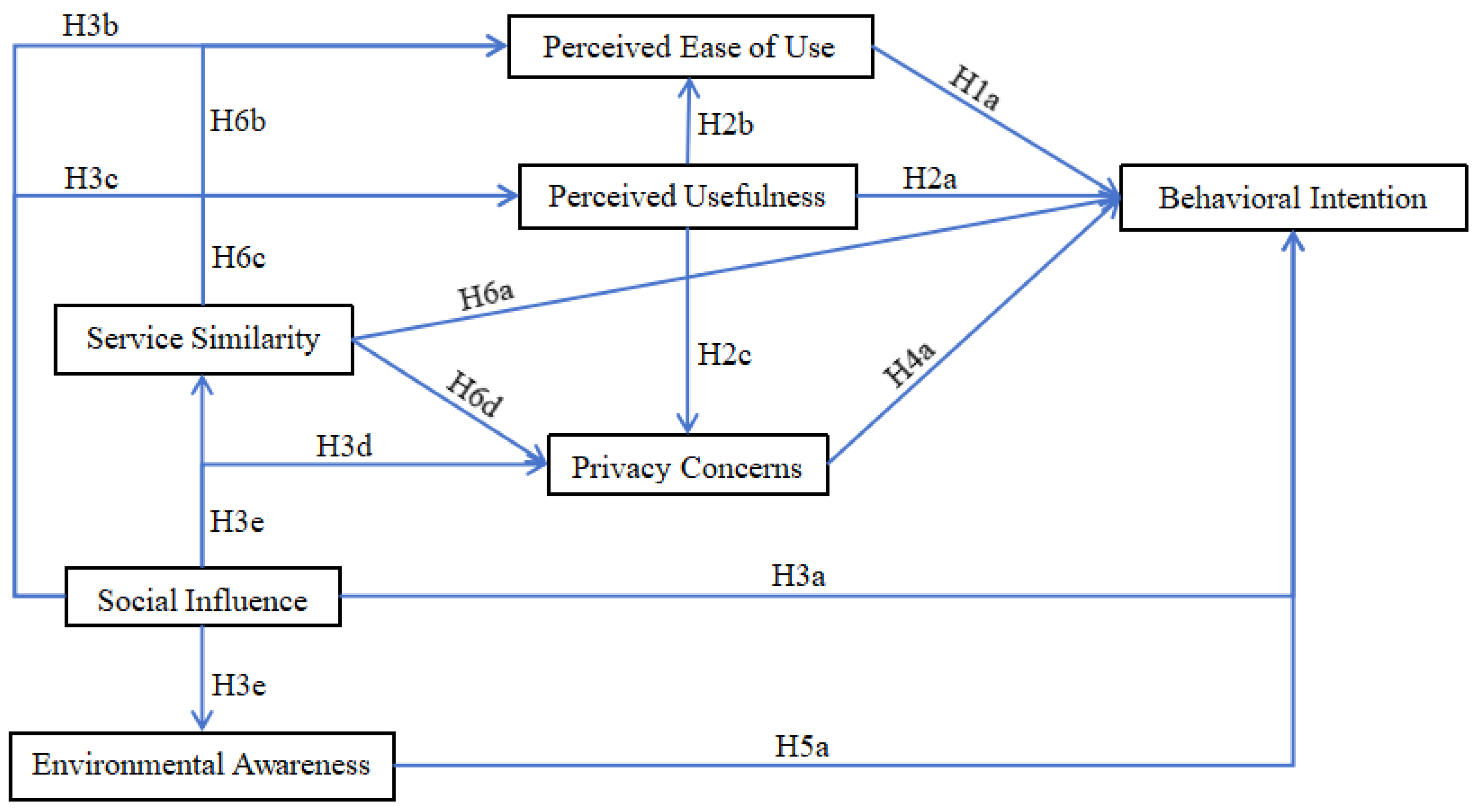
| H1a | Perceived Ease of Use → Behavioral Intention (+) |
| H2a | Perceived Usefulness → Behavioral Intention (+) |
| H2b | Perceived Usefulness → Perceived Ease of Use (+) |
| H3a | Social Influence → Behavioral Intention (+) |
| H3b | Social Influence → Perceived Ease of Use (+) |
| H3c | Social Influence → Perceived Usefulness (+) |
| H2c | Perceived Usefulness → Privacy Concerns (+) |
| H3d | Social Influence → Privacy Concerns (−) |
| H4a | Privacy Concerns → Behavioral Intention (−) |
| H3e | Social Influence → Environmental Awareness (+) |
| H5a | Environmental Awareness → Behavioral Intention (+) |
| H6a | Service Similarity → Behavioral Intention (+) |
| H6b | Service Similarity → Perceived Ease of Use (+) |
| H6c | Service Similarity → Perceived Usefulness (+) |
| H6d | Service Similarity → Privacy Concerns (+) |
| H6e | Social Influence → Service Similarity (+) |
| Variable | Measurement Items | Factor Loading | AVE | CR | Cronbach’s α |
|---|---|---|---|---|---|
| PEU | PEU1 | 0.716 | 0.501 | 0.751 | 0.747 |
| PEU2 | 0.676 | ||||
| PEU3 | 0.731 | ||||
| PU | PU1 | 0.741 | 0.503 | 0.752 | 0.751 |
| PU2 | 0.723 | ||||
| PU3 | 0.663 | ||||
| BI | BI1 | 0.646 | 0.502 | 0.750 | 0.749 |
| BI2 | 0.688 | ||||
| BI3 | 0.785 | ||||
| SI | SI1 | 0.698 | 0.506 | 0.754 | 0.754 |
| SI2 | 0.704 | ||||
| SI3 | 0.731 | ||||
| PC | PC1 | 0.886 | 0.832 | 0.937 | 0.936 |
| PC2 | 0.930 | ||||
| PC3 | 0.920 | ||||
| EA | EA1 | 0.653 | 0.504 | 0.751 | 0.746 |
| EA2 | 0.673 | ||||
| EA3 | 0.795 | ||||
| SS | SS1 | 0.825 | 0.670 | 0.859 | 0.858 |
| SS2 | 0.854 | ||||
| SS3 | 0.776 |
| PEU | PU | BI | SI | PC | EA | SS | |
|---|---|---|---|---|---|---|---|
| PEU | 0.708 | ||||||
| PU | 0.459 | 0.709 | |||||
| BI | 0.487 | 0.482 | 0.709 | ||||
| SI | 0.353 | 0.476 | 0.561 | 0.711 | |||
| PC | −0.238 | −0.247 | −0.348 | −0.254 | 0.912 | ||
| EA | 0.367 | 0.288 | 0.478 | 0.391 | −0.179 | 0.710 | |
| SS | 0.073 | 0.078 | 0.117 | 0.171 | 0.115 | 0.004 | 0.819 |
| Variable | Item | Mean ± Standard Deviation | F Test | One-Way Analysis of Variance |
|---|---|---|---|---|
| Education | High school (including secondary school) and below | 3.78 ± 0.50 | 0.832 | 0.009 ** |
| Bachelor’s degree or junior degree | 4.30 ± 0.50 | |||
| Master or above | 4.11 ± 0.46 | |||
| Occupation | Enterprise staff | 4.29 ± 0.49 | 0.600 | 0.031 * |
| Public institution | 4.06 ± 0.63 | |||
| Administrative body | 3.44 ± 0.51 | |||
| Student | 4.22 ± 0.50 | |||
| Freelancers/self-employed individuals | 4.28 ± 0.71 | |||
| Driver’s license | Yes | 4.24 ± 0.51 | 0.107 | 0.034 * |
| No | 4.43 ± 0.44 |
| Variable | Item | Mean ± Standard Deviation | F Test | One-Way Analysis of Variance |
|---|---|---|---|---|
| Travel purpose | Commuting | 4.30 ± 0.50 | 0.354 | 0.000 ** |
| Entertainment | 3.67 ± 0.37 | |||
| Shopping | 4.27 ± 0.43 | |||
| Travel distance | <3 km | 4.16 ± 0.52 | 0.632 | 0.000 ** |
| 3–5 km | 4.08 ± 0.46 | |||
| 5–10 km | 4.24 ± 0.49 | |||
| >10 km | 4.45 ± 0.50 | |||
| Common traffic tools | Public transportation | 4.32 ± 0.48 | 0.394 | 0.012 * |
| Taxi/ride-hailing | 3.94 ± 0.59 | |||
| Private car | 4.29 ± 0.55 | |||
| Bikes/shared bikes | 3.86 ± 0.38 | |||
| Walk | 4.00 ± 0.54 | |||
| Shared electric bike | 4.33 ± 0.47 | |||
| Others | 3.83 ± 0.71 | |||
| Commuting Time | <15 min | 3.95 ± 0.47 | 0.218 | 0.024 * |
| 15–30 min | 4.21 ± 0.54 | |||
| 30–60 min | 4.31 ± 0.47 | |||
| >60 min | 4.42 ± 0.53 |
| Variable | Item | Mean ± Standard Deviation | F Test | One-Way Analysis of Variance |
|---|---|---|---|---|
| Education | High school (including secondary school) and below | 4.33 ± 0.70 | 0.140 | 0.040 * |
| Bachelor’s degree or junior degree | 4.26 ± 0.50 | |||
| Master or above | 4.00 ± 0.63 | |||
| Driver’s license | Yes | 4.20 ± 0.53 | 0.174 | 0.004 ** |
| No | 4.46 ± 0.45 | |||
| Travel purpose | Commuting | 4.25 ± 0.51 | 0.264 | 0.043 * |
| Entertainment | 3.90 ± 0.68 | |||
| Shopping | 4.40 ± 0.43 | |||
| Commuting mode | Single mode | 4.11 ± 0.57 | 0.071 | 0.004 ** |
| Multimode combination | 4.30 ± 0.49 |
| Variable | Item | Mean ± Standard Deviation | F Test | One-Way Analysis of Variance |
|---|---|---|---|---|
| Occupation | Enterprise staff | 4.28 ± 0.51 | 0.147 | 0.013 * |
| Public institution | 3.94 ± 0.74 | |||
| Administrative body | 3.56 ± 0.51 | |||
| Student | 4.33 ± 0.63 | |||
| Freelancers/self-employed individuals | 3.89 ± 0.50 | |||
| Travel cost | CNY >1000 | 4.27 ± 0.60 | 0.078 | 0.021 * |
| CNY 300–1000 | 4.31 ± 0.49 | |||
| CNY <300 | 4.11 ± 0.58 |
| Variable | Item | Mean ± Standard Deviation | F Test | One-Way Analysis of Variance |
|---|---|---|---|---|
| Number of private cars | 0 | 2.95 ± 1.17 | 0.383 | 0.004 ** |
| 1 | 2.78 ± 1.24 | |||
| ≥2 | 3.57 ± 1.11 | |||
| Travel distance | <3 km | 3.58 ± 0.99 | 0.240 | 0.000 ** |
| 3–5 km | 3.36 ± 1.17 | |||
| 5–10 km | 2.71 ± 1.23 | |||
| >10 km | 2.58 ± 1.19 | |||
| Common traffic tools | Public transportation | 2.66 ± 1.22 | 0.597 | 0.001 ** |
| Taxi/ride-hailing | 3.12 ± 1.01 | |||
| Private car | 3.40 ± 1.21 | |||
| Bikes/shared bikes | 3.71 ± 1.04 | |||
| Walk | 3.50 ± 1.00 | |||
| Shared electric bike | 3.42 ± 1.20 | |||
| Travel cost | CNY >1000 | 2.45 ± 1.40 | 0.148 | 0.001 ** |
| CNY 300–1000 | 2.77 ± 1.21 | |||
| CNY <300 | 3.28 ± 1.14 | |||
| Commuting mode | Single mode | 3.22 ± 1.20 | 0.782 | 0.002 ** |
| Multimode combination | 2.72 ± 1.22 | |||
| Commuting Time | <15 min | 3.15 ± 1.17 | 0.576 | 0.002 ** |
| 15–30 min | 3.26 ± 1.18 | |||
| 30–60 min | 2.63 ± 1.20 | |||
| >60 min | 2.80 ± 1.33 | |||
| Private Car Usage Frequency | Almost every day | 3.45 ± 1.25 | 0.631 | 0.018 * |
| 2 times per week or less | 2.73 ± 1.24 | |||
| 3–6 times a week | 3.00 ± 1.19 |
| Variable | Item | Mean ± Standard Deviation | F Test | One-Way Analysis of Variance |
|---|---|---|---|---|
| Driver’s license | Yes | 3.69 ± 0.78 | 0.071 | 0.000 ** |
| No | 3.09 ± 0.91 | |||
| Travel frequency | >6 | 3.40 ± 0.92 | 0.163 | 0.000 ** |
| 4–6 | 3.73 ± 0.97 | |||
| 2–3 | 3.66 ± 0.79 | |||
| ≤1 | 2.83 ± 0.83 | |||
| Commuting Time | <15 min | 3.90 ± 0.58 | 0.094 | 0.044 * |
| 15–30 min | 3.76 ± 0.78 | |||
| 30–60 min | 3.48 ± 0.87 | |||
| >60 min | 3.58 ± 0.79 | |||
| Private Car Usage Frequency | Almost every day | 3.45 ± 0.75 | 0.640 | 0.009 ** |
| 2 times per week or less | 3.49 ± 0.80 | |||
| 3–6 times a week | 3.80 ± 0.85 |
| Path | Nonstandard Coefficient | SE | Z (CR Value) | p | Standardization Coefficient | Result | |
|---|---|---|---|---|---|---|---|
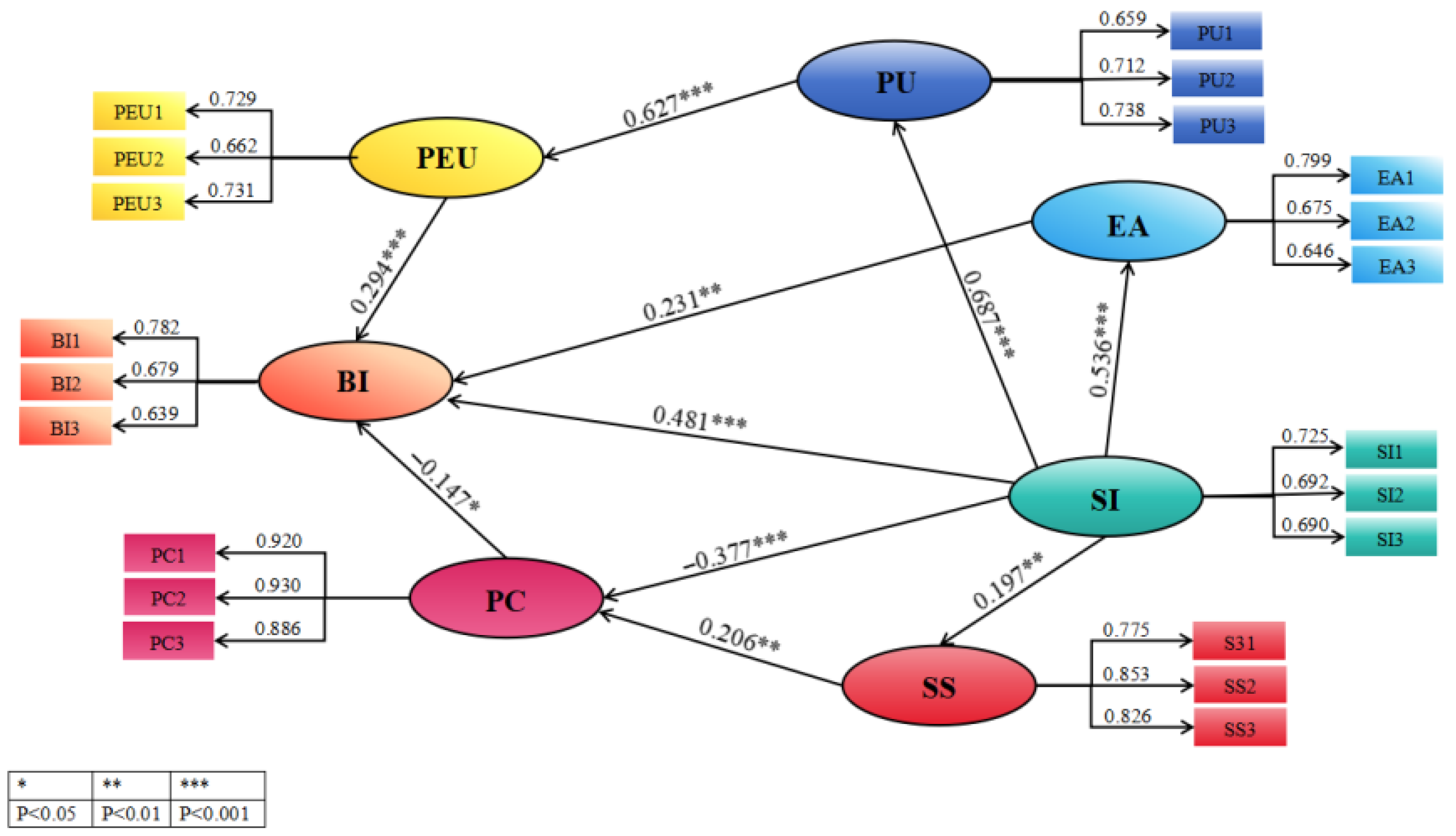
| H1a | PEU → BI | 0.269 | 0.069 | 3.920 | 0.000 | 0.294 | Yes |
| H2a | PU → BI | - | - | - | - | - | No |
| H2b | PU → PEU | 0.594 | 0.084 | 7.047 | 0.000 | 0.627 | Yes |
| H3a | SI → BI | 0.463 | 0.098 | 4.719 | 0.000 | 0.481 | Yes |
| H3b | SI → PEU | - | - | - | - | - | No |
| H3c | SI → PU | 0.761 | 0.101 | 7.551 | 0.000 | 0.687 | Yes |
| H2c | PU → PC | - | - | - | - | - | No |
| H3d | SI → PC | −0.987 | 0.196 | −5.040 | 0.000 | −0.377 | Yes |
| H4a | PC → BI | −0.054 | 0.021 | −2.516 | 0.012 | −0.147 | Yes |
| H3e | SI → EA | 0.509 | 0.087 | 5.830 | 0.000 | 0.536 | Yes |
| H5a | EA → BI | 0.234 | 0.080 | 2.921 | 0.003 | 0.231 | Yes |
| H6a | SS → BI | - | - | - | - | - | No |
| H6b | SS → PEU | - | - | - | - | - | No |
| H6c | SS → PU | - | - | - | - | - | No |
| H6d | SS → PC | 0.304 | 0.099 | 3.076 | 0.002 | 0.206 | Yes |
| H6e | SI → SS | 0.351 | 0.132 | 2.658 | 0.008 | 0.197 | Yes |
| Common Index | χ2/df | GFI | RMSEA | RMR | CFI | NFI | NNFI |
|---|---|---|---|---|---|---|---|
| Judgment criteria | <3 | >0.9 | <0.10 | <0.05 | >0.9 | >0.9 | >0.9 |
| Value | 1.080 | 0.936 | 0.017 | 0.030 | 0.994 | 0.926 | 0.993 |
| Item | c | a | b | a*b | a*b (Boot SE) | a*b (z Value) | a*b (p Value) | a*b (95% BootCI) | c’ | Result |
|---|---|---|---|---|---|---|---|---|---|---|
| SS ⇒ PC ⇒ BI | 0.018 | 0.271 ** | −0.052 ** | −0.014 | 0.012 | −1.140 | 0.254 | −0.054–−0.006 | 0.032 | Full mediation |
| Item | c | a | b | a*b | a*b (Boot SE) | a*b (z Value) | a*b (p Value) | a*b (95% BootCI) | c’ | Result |
|---|---|---|---|---|---|---|---|---|---|---|
| PU ⇒ PEU⇒ BI | 0.233 ** | 0.348 ** | 0.206 ** | 0.072 | 0.031 | 2.342 | 0.019 | 0.014–0.134 | 0.162 * | Partial mediation |
| Model 1 | Model 3 | |||||||||
|---|---|---|---|---|---|---|---|---|---|---|
| B | se | t | p | β | B | se | t | p | β | |
| Constant | 3.508 | 0.643 | 5.454 | 0.000 *** | - | 3.639 | 0.714 | 5.097 | 0.000 *** | - |
| PC | −0.052 | 0.015 | −3.450 | 0.001 *** | −0.162 | −0.050 | 0.015 | −3.421 | 0.001 *** | −0.158 |
| PU | 0.140 | 0.052 | 2.692 | 0.008 ** | 0.145 | 0.152 | 0.051 | 2.969 | 0.003 ** | 0.157 |
| SI | 0.271 | 0.051 | 5.318 | 0.000 *** | 0.287 | 0.269 | 0.050 | 5.429 | 0.000 *** | 0.285 |
| EA | 0.214 | 0.048 | 4.489 | 0.000 *** | 0.223 | 0.202 | 0.047 | 4.279 | 0.000 *** | 0.211 |
| SS | 0.032 | 0.024 | 1.324 | 0.187 | 0.060 | 0.023 | 0.023 | 0.973 | 0.332 | 0.043 |
| PEU | 0.192 | 0.051 | 3.808 | 0.000 *** | 0.198 | 0.141 | 0.150 | 0.945 | 0.346 | 0.145 |
| Occupation—Public institution [reference item] | - | - | - | - | - | - | - | - | - | - |
| PEU * Occupation—Freelancer/self-employed | −0.774 | 0.246 | −3.144 | 0.002 ** | −0.174 | |||||
| R2 | 0.500 | 0.550 | ||||||||
| Adjust R2 | 0.488 | 0.525 | ||||||||
| F | F (6259) = 43.158, p = 0.000 | F (14,251) = 21.919, p = 0.000 | ||||||||
| △R2 | 0.500 | 0.038 | ||||||||
| △F | F (6259) = 43.158, p = 0.000 | F (4251) = 5.281, p = 0.000 | ||||||||
| Model 1 | Model 3 | |||||||||
|---|---|---|---|---|---|---|---|---|---|---|
| B | se | t | p | β | B | se | t | p | β | |
| Constant | 3.032 | 0.657 | 4.611 | 0.000 *** | - | 2.775 | 0.674 | 4.120 | 0.000 *** | - |
| PEU | 0.192 | 0.051 | 3.808 | 0.000 *** | 0.198 | 0.247 | 0.051 | 4.817 | 0.000 *** | 0.254 |
| EA | 0.214 | 0.048 | 4.489 | 0.000 *** | 0.223 | 0.207 | 0.047 | 4.416 | 0.000 *** | 0.216 |
| PC | −0.052 | 0.015 | −3.450 | 0.001 *** | −0.162 | −0.050 | 0.015 | −3.400 | 0.001 *** | −0.157 |
| SI | 0.271 | 0.051 | 5.318 | 0.000 *** | 0.287 | 0.274 | 0.049 | 5.575 | 0.000 *** | 0.290 |
| SS | 0.032 | 0.024 | 1.324 | 0.187 | 0.060 | 0.023 | 0.023 | 0.998 | 0.319 | 0.043 |
| PU | 0.140 | 0.052 | 2.692 | 0.008 ** | 0.145 | 0.075 | 0.174 | 0.432 | 0.666 | 0.078 |
| Occupation—Public institution [reference item] | - | - | - | - | - | - | - | - | - | - |
| PU * Occupation—Freelancer/self-employed | −1.895 | 0.433 | −4.374 | 0.000 *** | −0.281 | |||||
| R2 | 0.500 | 0.557 | ||||||||
| Adjust R2 | 0.488 | 0.532 | ||||||||
| F | F (6259) = 43.158, p = 0.000 | F (14,251) = 22.532, p = 0.000 | ||||||||
| △R2 | 0.500 | 0.045 | ||||||||
| △F | F (6259) = 43.158, p = 0.000 | F (4251) = 6.328, p = 0.000 | ||||||||
| Model 1 | Model 3 | |||||||||
|---|---|---|---|---|---|---|---|---|---|---|
| B | se | t | p | β | B | se | t | p | β | |
| Constant | 4.211 | 0.673 | 6.254 | 0.000 *** | - | 4.410 | 0.700 | 6.301 | 0.000 *** | - |
| PEU | 0.192 | 0.051 | 3.808 | 0.000 *** | 0.198 | 0.186 | 0.051 | 3.655 | 0.000 *** | 0.191 |
| PU | 0.140 | 0.052 | 2.692 | 0.008 ** | 0.145 | 0.137 | 0.052 | 2.654 | 0.008 ** | 0.141 |
| PC | −0.052 | 0.015 | −3.450 | 0.001 *** | −0.162 | −0.053 | 0.015 | −3.567 | 0.000 *** | −0.167 |
| EA | 0.214 | 0.048 | 4.489 | 0.000 *** | 0.223 | 0.226 | 0.047 | 4.796 | 0.000 *** | 0.235 |
| SS | 0.032 | 0.024 | 1.324 | 0.187 | 0.060 | 0.027 | 0.024 | 1.159 | 0.248 | 0.052 |
| SI | 0.271 | 0.051 | 5.318 | 0.000 *** | 0.287 | 0.369 | 0.151 | 2.454 | 0.015 * | 0.391 |
| Occupation—Public institution [reference item] | - | - | - | - | - | - | - | - | - | - |
| SI * Occupation—Freelancer/self-employed | −1.174 | 0.346 | −3.392 | 0.001 *** | −0.203 | |||||
| R2 | 0.500 | 0.539 | ||||||||
| Adjust R2 | 0.488 | 0.513 | ||||||||
| F | F (6259) = 43.158, p = 0.000 | F (14,251) = 20.975, p = 0.000 | ||||||||
| △R2 | 0.500 | 0.027 | ||||||||
| △F | F (6259) = 43.158, p = 0.000 | F (4251) = 3.671, p = 0.006 | ||||||||
| Item | c | a | b | a*b | a*b (Boot SE) | a*b (z Value) | a*b (p Value) | a*b (95% BootCI) | c’ | Result |
|---|---|---|---|---|---|---|---|---|---|---|
| PU ⇒ PEU ⇒ BI | 0.294 ** | 0.379 *** | 0.335 *** | 0.127 | 0.054 | 2.359 | 0.018 | 0.035–0.246 | 0.167 | Full mediation |
| Item | c | a | b | a*b | a*b (Boot SE) | a*b (z Value) | a*b (p Value) | a*b (95% BootCI) | c’ | Result |
|---|---|---|---|---|---|---|---|---|---|---|
| PU ⇒ PEU ⇒ BI | 0.185 ** | 0.311 *** | 0.138 * | 0.043 | 0.025 | 1.696 | 0.090 | −0.004–0.097 | 0.142 * | Partial mediation |
| X | → | Y | Nonstandard Coefficient | SE | z (CR Value) | p | Standardization Coefficient |
|---|---|---|---|---|---|---|---|
| SS (Low level) | → | BI | 0.226 | 0.075 | 3.035 | 0.002 | 0.417 |
| SS (High level) | → | BI | −0.016 | 0.053 | −0.299 | 0.765 | −0.028 |
Disclaimer/Publisher’s Note: The statements, opinions and data contained in all publications are solely those of the individual author(s) and contributor(s) and not of MDPI and/or the editor(s). MDPI and/or the editor(s) disclaim responsibility for any injury to people or property resulting from any ideas, methods, instructions or products referred to in the content. |
© 2025 by the authors. Licensee MDPI, Basel, Switzerland. This article is an open access article distributed under the terms and conditions of the Creative Commons Attribution (CC BY) license (https://creativecommons.org/licenses/by/4.0/).
Share and Cite
Guo, F.; Gao, L.; Ni, A.; Zhao, X.; Zhang, Y. Research on MaaS Usage Intention and Influence Mechanism. Appl. Sci. 2025, 15, 9453. https://doi.org/10.3390/app15179453
Guo F, Gao L, Ni A, Zhao X, Zhang Y. Research on MaaS Usage Intention and Influence Mechanism. Applied Sciences. 2025; 15(17):9453. https://doi.org/10.3390/app15179453
Chicago/Turabian StyleGuo, Fengyu, Linjie Gao, Anning Ni, Xu Zhao, and Yunxi Zhang. 2025. "Research on MaaS Usage Intention and Influence Mechanism" Applied Sciences 15, no. 17: 9453. https://doi.org/10.3390/app15179453
APA StyleGuo, F., Gao, L., Ni, A., Zhao, X., & Zhang, Y. (2025). Research on MaaS Usage Intention and Influence Mechanism. Applied Sciences, 15(17), 9453. https://doi.org/10.3390/app15179453