Abstract
A connected vehicle (CV) enables vehicles to communicate not only with other vehicles but also the road infrastructure based on wireless communication technologies. A road system with CVs, which is often referred to as a cooperative intelligent transportation system (C-ITS), provides drivers with road and traffic condition information using an in-vehicle warning system. Road environments with CVs induce drivers to reduce their speed while increasing the spacing or changing lanes to avoid potential risks downstream. Such avoidance maneuvers can be considered to improve driving behavior from a traffic safety point of view. This study seeks to quantitatively evaluate the effect of in-vehicle warning information using per-vehicle data (PVD) collected from freeway C-ITSs. The PVD are reproduced to extract the speed–spacing relationship and are evaluated to determine whether the warning information induces drivers to drive in a conservative way. This study reveals that the in-vehicle warning prompts drivers to increase the spacing while decreasing their speed in the majority of samples. The rate of conservative driving behavior tends to increase during the initial operation period, but no significant changes were observed after this period; that is, the reliability of in-vehicle warning information is not constant in the CV environment.
1. Introduction
The term connected vehicle (CV) denotes a technology and system that utilizes wireless communication technology to provide information about traffic conditions downstream. This communication occurs between vehicles as well as between vehicles and infrastructure. The driver receiving the information is expected to quickly and safely respond to unexpected situations to prevent accidents from risk factors [1,2]. Since the early 2000s, various studies using real-time in-vehicle data have been conducted in the United States and Europe as communication technologies and services advance [3,4,5,6]. In South Korea, the first pilot study of the cooperative intelligent transportation system (C-ITS) started in 2014 in Sejong and gradually expanded to other cities, including Seoul, Jeju, and Gwangju. In each study, the C-ITS infrastructures, including in-vehicle warning systems, roadside units (RSU), and other wireless communication units, were installed, tested, and operated. Apart from the study in urban areas, the Korea Expressway Corporation (KEC) installed C-ITSs in some sections of expressways in the metropolitan area in 2018. This installation encompassed the development and implementation of over 700 in-vehicle warning systems, a digital tachograph (DTG), and an advanced driving assistance system (ADAS). From the system, one can easily obtain various in-vehicle data, including speed, acceleration rate, latitude, longitude, time to collision (TTC), and spacing (often referred to as PVD).
In the C-ITS environment, we anticipate that drivers who receive vehicle-to-everything (V2X)-based warning information will likely adjust their behavior by either reducing their speed, increasing spacing, or changing lanes to avoid potentially hazardous traffic conditions downstream. Thus, assessing the quantitative impact of the warning information provided on driver behavior would play a crucial role for traffic operators.
This study suggests a method to quantitatively evaluate the effect of in-vehicle warning information using per-vehicle data (PVD) collected from freeway C-ITSs. Based on findings from a previous study [7], aggressive drivers (“Aggressive driver” means a driver who maintain shorter spacing at a given speed than ordinary drivers) typically maintained speeds ranging from 75 kph to 140 kph while keeping a spacing of 32.4 m (i.e., standard deviation: 27.4 m), whereas conservative drivers (“Conservative driver” means a driver who maintain longer spacing at a given speed than ordinary drivers) speeds were distributed between 74 kph and 105 kph with a spacing of 62.2 m (i.e., standard deviation: 32.9 m). Leveraging insights from this earlier research, this study aims to quantitatively evaluate the impact of warning information from the C-ITS. To achieve this, two experiments were designed within the same C-ITS environment: one experiment where the in-vehicle warning information is provided to drivers and the other where it is not. We examined the PVD collected at second intervals from the two experiments to investigate the relative changes in speed and spacing within the speed–spacing plane and see if driving behavior tends to become more conservative when the warning information is actually provided versus when it is not. Furthermore, this study quantitatively assessed the number of vehicles responding to the warning information and a comparative analysis was conducted between the two experiments.
The remainder of this paper is organized as follows. Section 2 presents previous studies related to the evaluation of in-vehicle warning information. Section 3 presents the methodology to evaluate the in-vehicle warning information. Section 4 introduces the analysis area and empirical data used in this study. Section 5 shows the results of the evaluation and finally this paper closes in Section 6 with the conclusions of the study.
2. Literature Review
After reviewing the literature that evaluated the effect of V2V-based in-vehicle warning information, we can categorize the research into three groups based on the type of data.
The first group of studies used simulated data from microscopic simulation, where in-vehicle warning information was evaluated based on average speed, acceleration, volume of traffic, etc. For example, some studies examined simulated data to optimize mobility, safety, and the environmental benefits in a CV environment [8,9]. Another study simulated automated driving vehicles in CV environments. The researchers calculated the traffic volume, travel times, and speeds to evaluate the CVs based on the in-vehicle information [10,11]. Guglielmi et al. (2017) evaluated the CV environments with heavy vehicles based on intersection movement assistance (IMA), forward collision warning (FCW), and blind spot warning/lane change warning (BSW/LCW) via VISSIM simulation [12]. Rahman et al. (2019) evaluated automated braking and lane-keeping assistance scenarios using time exposed time to collision (TET), time integrated time to collision (TIT), time exposed rear-end crash risk index (TERCRI), lane-changing conflicts (LCC), number of critical jerks (NCJ), and the number of conflicts that are reproduced by simulations [13]. These simulation-based studies concluded that CV environments can simultaneously provide positive effects on mobility and safety. Traffic simulation has been utilized to evaluate the effectiveness of warning information not only for driving safety, but also traffic flow performance [14,15,16]. Sharma et al. (2021) showed that in mixed traffic conditions, CVs improve the efficiency and safety of traffic flow [17]. Hu et al. (2021) analyzed the performance of mobility according to the market penetration rate (MPR) of CVs. The results showed that as the MPR increases in mixed traffic, the average travel time of all traffic decreases and the average speed increases [18].
The second group of studies included those using driving simulators, where in-vehicle warning information was provided using various types of display methods. Li et al. (2021) analyzed the impact of the CV environment on the tunnel entrance zone. They calculated the speed, standard deviation of the speed, and acceleration and evaluated drivers’ speed control in the warning zone [19]. Adomah et al. (2022) combined a driving simulator and VISSIM to evaluate the impact of weather conditions (i.e., foggy conditions) [20]. They used TTC, TET, TIT, and a speed-related index as the measure of effectiveness (MOE). Ali et al. (2020) evaluated CV environments using a driver simulator based on spacing and TTC [21]. Yue et al. (2018) simulated the relationship between various types of traffic accidents and TTC in CV environments [22]. Chang et al. (2019) evaluated the safety effectiveness of providing warning information. The analysis used speed standard deviation, TET, and TIT to evaluate the longitudinal safety effect of warning information in the event of fog. The results showed that fog warning systems are beneficial in reducing speed and improving driver behavior [23]. Bakhshi et al. (2021) evaluated the effectiveness of warning information for curved road sections with slippery road conditions for truck drivers in a driving simulation environment. The results showed that warning information decreased off-road crashes by utilizing a kinematic-based surrogate measure of safety (K-SMos) [24]. Duan et al. (2023) analyzed the effectiveness of an audible warning system based on a driving simulator environment to improve bottlenecks in highway construction areas. The analysis showed that warning information can effectively reduce the risk of bottlenecks, but the effectiveness decreases with the delay in providing warning information [25]. In addition, several studies have evaluated the effectiveness of variable speed limit systems (VSLSs) in CV environments. The results show that the average speed and volatility of speed are reduced in severe weather conditions such as fog, increasing safety [26,27].
The third group of studies included studies that employed PVD. These studies compared various MOEs between situations with in-vehicle information and situations without in-vehicle information. Zhang et al. (2022) evaluated truck drivers’ driving behavior using GPS data and an in-vehicle driver monitoring system [28]. Hsu et al. (2022) evaluated the impact of a motorcycle safety warning system (MSWS) using RFID data [29]. MohamMad et al. (2021) examined PVD collected from the safety pilot model deployment (SPMD) program to analyze vehicle maneuvers, such as differences in speed and lateral/longitudinal differences in acceleration in CV environments [30]. Jang et al. (2020) evaluated the impact of in-vehicle warning information based on TTC, TET, standard deviation in acceleration, jerk, and rate exceeding the speed limit, which were reproduced from the PVD [31]. Xie et al. (2019) compared time to collision with disturbance (TTCD) with TTC, which were calculated from the PVD in CV environments to determine which surrogate safety measure (SSM) was better for explaining rear-collision crash potentials [32]. Arvin et al. (2019) analyzed CV-based in-vehicle data to evaluate intersection crash risk using the semiparametric geographically weighted Poisson regression (S-GWPR) model and random parameter (RP) Poisson model [33].
The proposed study herein differs from previous ones in several respects. Most previous studies used either simulated data with warning information or investigated PVD to compare situations with and without in-vehicle warning information. On the other hand, the research seeks to evaluate the effect of improving driving behavior before and after warning information is provided using PVD. Unlike previous studies, we employed the speed–spacing relationship to evaluate in-vehicle warning information. The speed–spacing relationship is one of the fundamental relationships that enables the visualization of traffic state progression. One can differentiate aggressive or conservative drivers from ordinary drivers. However, there were limitations to constructing a speed–spacing relationship even using PVD, due to the difficulty of extracting two consecutive vehicle trajectories. Given that the CV systems employed in this study are equipped with ADASs, we could obtain spacing information to establish the speed–spacing relationship.
3. Methodology
To empirically measure the effectiveness of in-vehicle warning information, we undertook a microscopic analysis utilizing PVD collected at second intervals. Leveraging the big data allowed the identification of individual vehicle dynamics, enabling an investigation into the relative changes in speed and spacing before and after the provision of warning information within the speed–spacing plane.
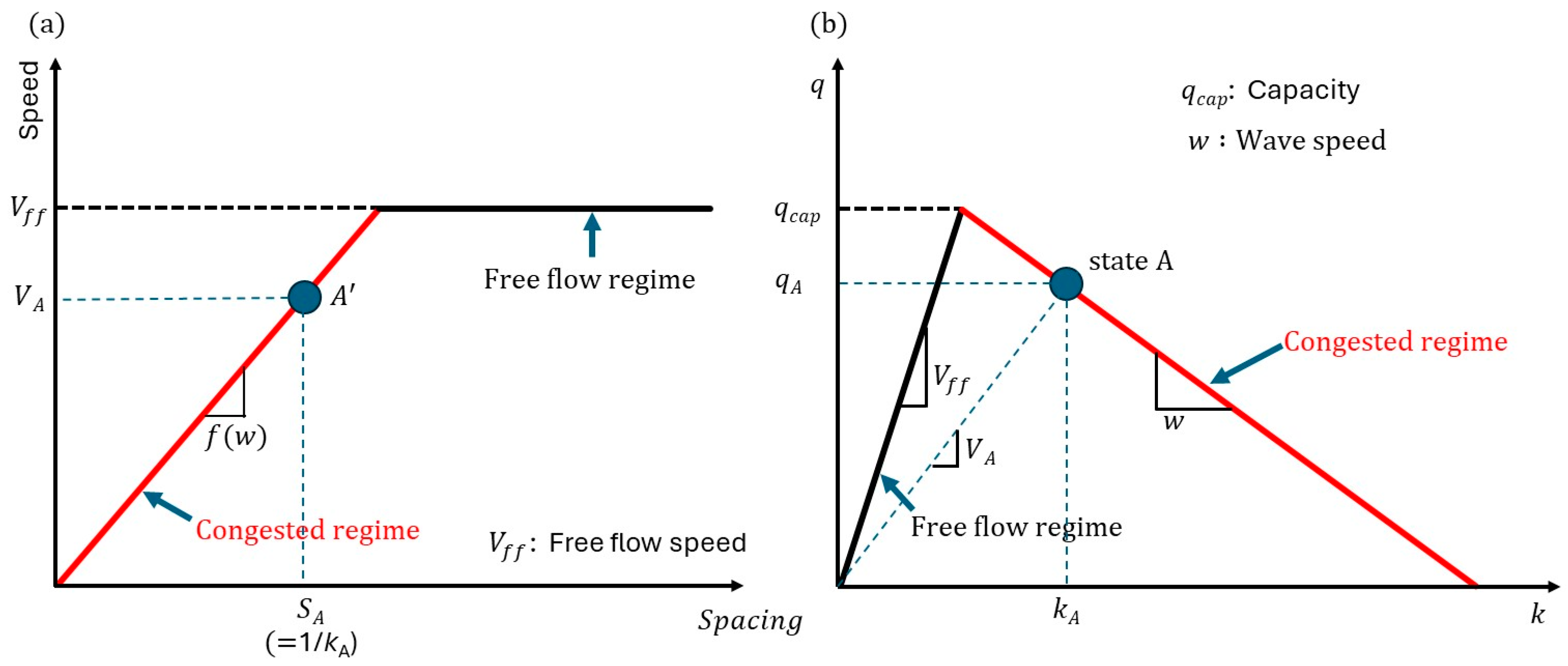
Conventionally, the relationship between speed and vehicle distance is illustrated in Figure 1a [34]. In fact, the relationship can be derived from the fundamental relationship in Figure 1b frequently employed in macroscopic traffic flow analysis [35]. For instance, traffic state A in Figure 1b is characterized by dA, qA, and VA (the slope of a straight line from origin to state A as per the fundamental equation). Given that spacing is the reciprocal of density, point A’ in Figure 1a corresponds to state A in Figure 1b.
Figure 1.
(a) Conventional speed–spacing relationship and (b) fundamental relationship between flow (q) and density (k).
In both relationships, delineated by black and red solid lines in Figure 1, there are two distinct regimes: free flow and congestion. As depicted in Figure 1a, the relationship between spacing and speed is directly proportional in the congested regime. Conversely, density is inversely proportional to flow in fundamental relationships. However, density and flow are aggregated measurements in traffic flow theory, and it is not possible to reproduce them directly from the PVD. On the other hand, as both spacing and speed are extractable from the data, our focus lies in examining the speed–spacing relationship to accomplish the objective in this study.
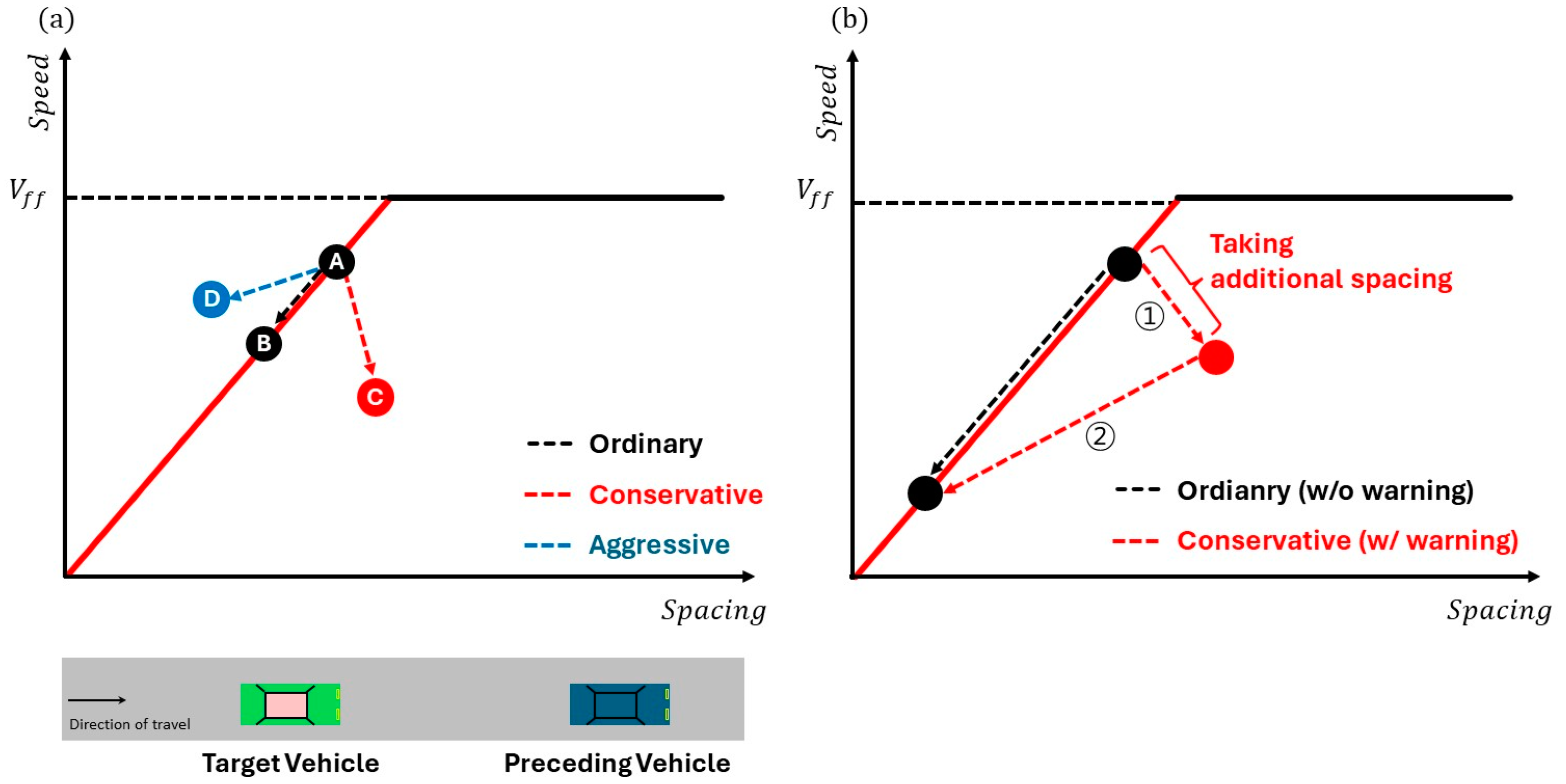
The speed–spacing relationship provides insight into how ordinary drivers establish spacing corresponding to a given speed, and conversely, how they determine speed based on spacing. Suppose that a target vehicle is at point A in Figure 2a and its preceding vehicle decelerates in a traffic jam. If the driver of the target vehicle is an ordinary driver, the driver slows down while decreasing its spacing and that driver theoretically follows the trajectory in speed–spacing plane moving from point A to point B in Figure 2a. However, if the driver is a conservative driver, it tends to maintain additional spacing while decelerating harder than the ordinary driver. As a result, the trajectory of the driver’s speed–spacing relationship moves from point A to point C. In contrast, an aggressive driver is anticipated to maintain a relatively short spacing at a given speed and its trajectory moves from point A to point D in Figure 2a. That is, the internal area of a given speed–spacing relationship signifies the speed–spacing behavior of conservative drivers, whereas the external area represents that of aggressive drivers.
Figure 2.
(a) Speed–spacing trajectories from aggressive, conservative, and ordinary drivers, (b) comparison of speed–spacing trajectories between an ordinary and a conservative driver.
The objective of the in-vehicle warning information provided by the C-ITS is to prevent accidents by inducing drivers to take proactive actions against potential hazards downstream. In other words, the warning information is a service that advises the average driver to be more conservative in response to the situation ahead. Such conservative driving behavior can be distinguished from the speed–spading trajectory of ordinary drivers. Figure 2b shows the hypothetical trajectories on the speed–spacing plane between an ordinary driver who has not been alerted and a conservative driver who has.
If the driver responds to the in-vehicle warning, it is expected to slow down and create additional spacing as the conservative driver shown in Figure 2b. Therefore, the average speed decreases, while the spacing increases right after the warning. Conversely, for an ordinary driver who does not receive warning information, the speed–spacing dynamics continue to adhere to the usual pattern, resulting in spacing decreasing concurrently with deceleration, as per the black dotted line in Figure 2b. Even for aggressive drivers, there are two possible scenarios: either maintaining a constant speed with a tendency to decrease spacing or increasing speed while decreasing spacing. Either way, it is distinguished from the conservative driver’s trajectory, as spacing decreases. Hence, this study aims to investigate the relative differences in speed to identify conservative driving behavior when drivers receive the in-vehicle warning in the following way.
First, two experiments were conducted within the same C-ITS environment. In the first experiment, the in-vehicle warning information is actually provided to the driver and the log is recorded in the PVD. In the second experiment, the driver does not receive the warning information, but a log of pertinent timestamps is recorded. Thus, the experimenter can see from the data when the warning information is provided but the driver cannot. Second, we extracted speed and spacing measurements immediately before and after the in-vehicle warning log in each PVD dataset collected from the two experiments. Third, for each experiment, we compared the distribution of speed and spacing before and after the provision of the in-vehicle warning information. Furthermore, upon careful examination of the differences between the two experiments, we ascertained whether driving behavior tends to become more conservative when the warning information is actually provided versus when it is not. Fourth, following the calculation of an index to quantitatively assess the number of vehicles responding to the warning information (see Equation (1)), a comparative analysis was conducted between the two experiments.
where the number of effective vehicles is those vehicles where speed decreases while spacing increases.
4. Analysis Area and Data
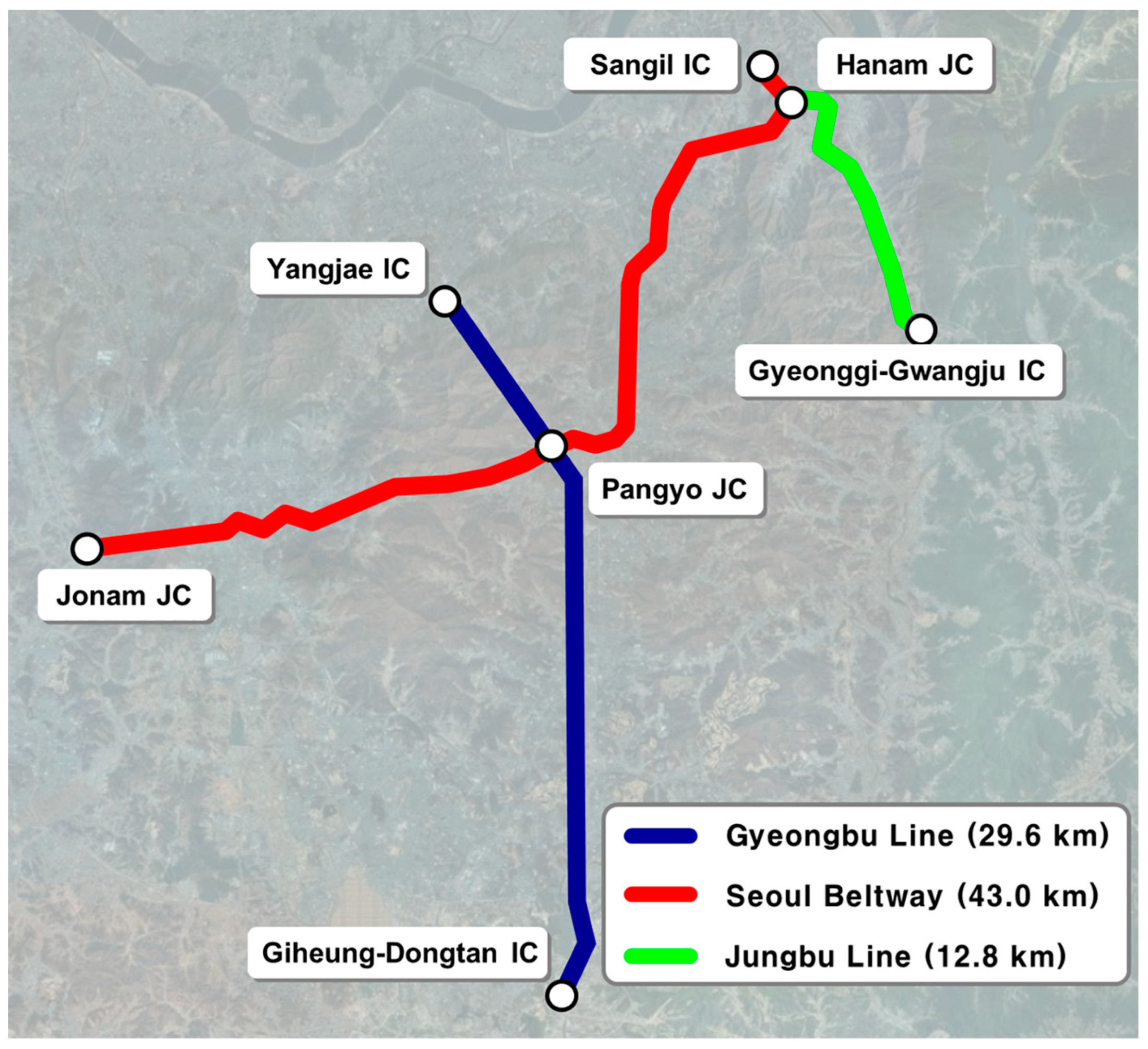
The PVD employed in this study were collected from 400 buses, 250 trucks, and 50 SUVs on freeways. KEC installed C-ITS infrastructures on the road and in-vehicle units were installed in these 700 vehicles. The data were collected from three freeway sections, as illustrated in Figure 3. The total section length is 85.4 km, and the longest section is a part of the Gyeongbu Line that connects the capital of South Korea and Busan. The PVD were collected over 16 months in 2019 and 2020. Over the two years, the two experiments were performed, the first of which was from July 2019 to July 2020; vehicles equipped with C-ITS in-vehicle units received in-vehicle warning information (we call this period the “with” period in this study). However, from August 2020 to October 2020, the drivers did not receive the warning information because the in-vehicle unit was turned off over this period (we call this the “without” period in this study). However, there was a log in the data at the time when the warning information should have been provided. This data over the “without” period was used as a control group against the data during the “with” period to analyze the drivers’ driving behavior when no warning information was provided.
Figure 3.
Analysis area.
Table 1 shows vehicle records included in the PVD. The PVD originate from two subsystems, DTG, including general vehicle travel records (e.g., speed, acceleration, location, etc.), and ADAS, with records of FCWS (forward collision warning system), LDWS (lane departure warning system), TTC, and spacing. In total, 108 types of vehicle records are logged every second in the PVD. Of those records, this study analyzed timestamp, speed, spacing, and in-vehicle warning logs.
Table 1.
Type of records in PVD.
In this study, the effect of FCWS to prevent direct or secondary accidents caused by other vehicle breakdowns or accidents downstream was evaluated in terms of driving behavior. The FCWS was activated whenever the forward collision risk increases due to the slowing or sudden stop of the preceding vehicle downstream, which results in short spacing in contrast to relative speed.
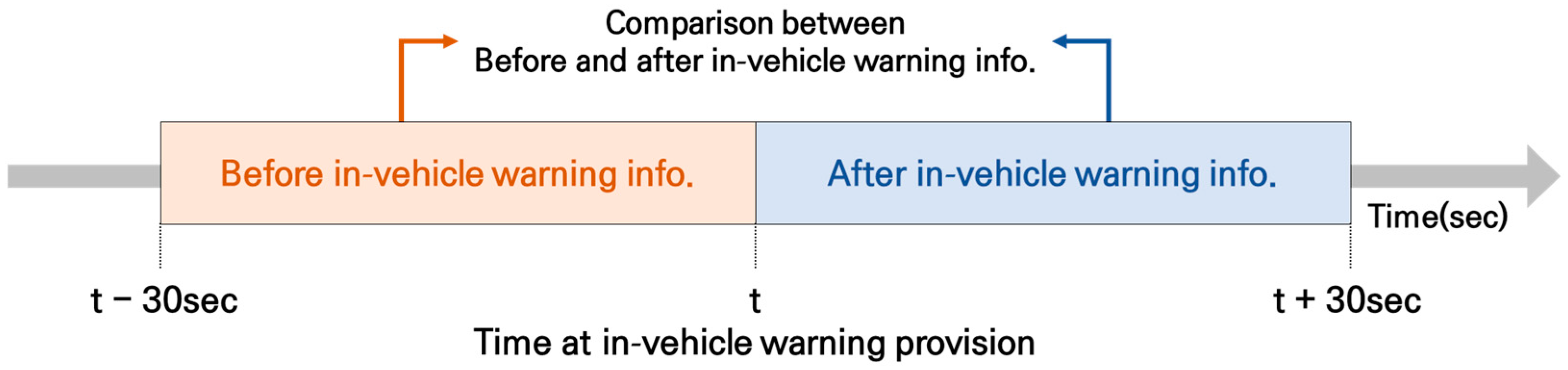
To analyze driving behavior following the provision of warning information, this study took a 30 s record before and after FCWS was provided (refer to Figure 4). The reason why the time unit chosen was 30 s was to obtain a sufficient sample of the two variables (speed and vehicle spacing) and at the same time, it was short enough to fully analyze the impact of providing warning information. Since in-vehicle records are logged every second, in theory, two groups of 30 s data are analyzed. However, some samples were obtained where a few records were missed due to certain technical issues. Thus, this study considered a sample that had at least 15 s consecutive records both before and after the in-vehicle warning to be valid.
Figure 4.
Analysis sample extraction.
Table 2 summarizes the total number of valid samples extracted in the analysis by each analysis period.
Table 2.
Data collection summary.
5. Results
5.1. Speed–Spacing Relationship
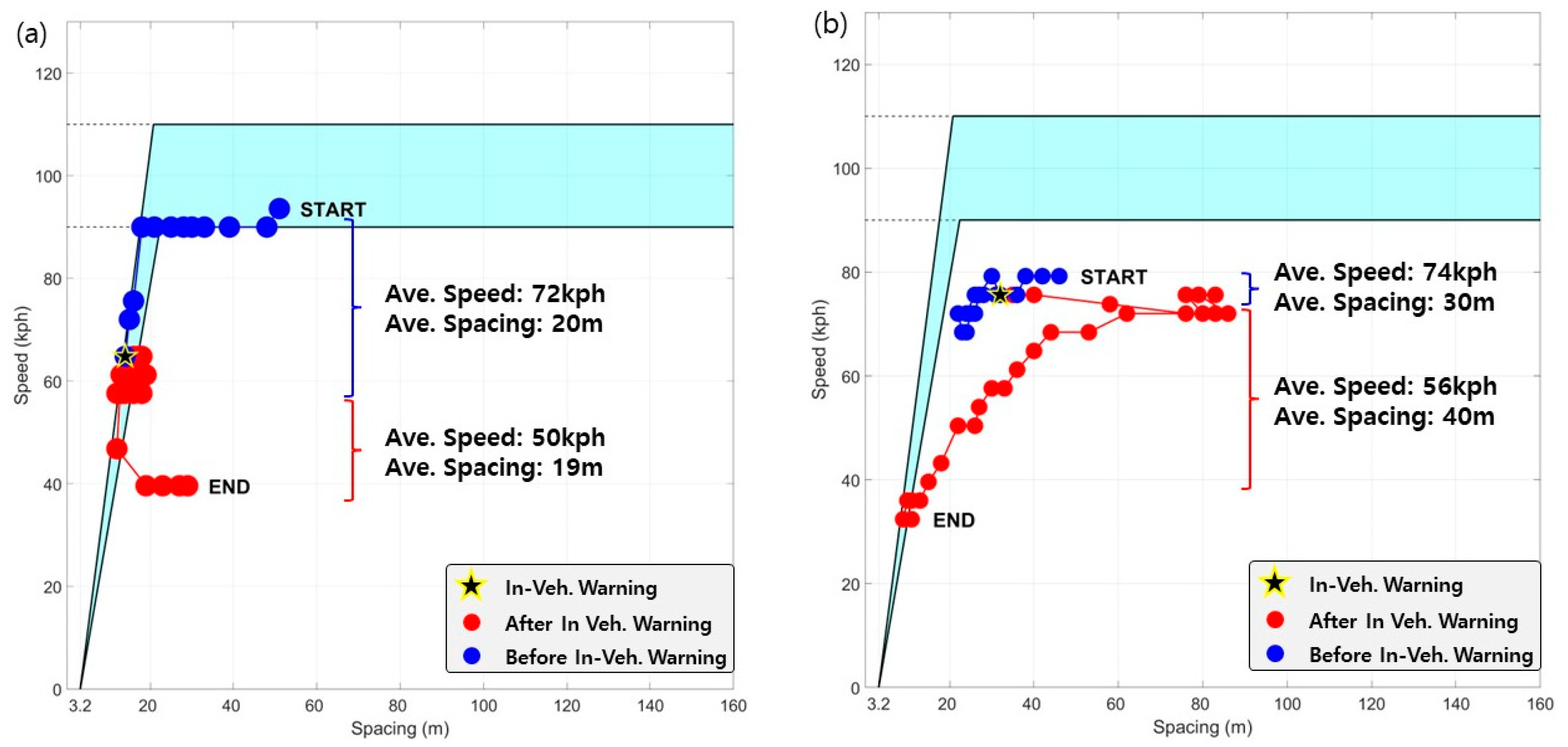
First of all, this study scrutinized speed and spacing measurements over time in speed–space plane by sample. Figure 5 shows typical examples of speed–spacing trajectories from “without” and “with” periods, which were extracted from some of the samples mentioned in Table 2. In each figure, a star represents the speed and spacing at the time of the in-vehicle warning. An in-vehicle warning is activated based on relative speed and spacing between vehicles. Thus, the warnings in Figure 5 do not occur at the same spacing. Blue dots are speed and spacing measurements before the warning and red dots after. The sold black line is a theoretical speed–spacing relationship for convenience. Figure 5a shows the time series changes of speed and spacing from one of the samples collected over the “without” period. On the other hand, Figure 5b represents the case extracted from the “with” period.
Figure 5.
Example of determining whether driving behavior is improved: (a) ordinary driver; (b) conservative driver (72 kph/50 kph/20 m/19 m vs. 74 kph/56 kph/30 m/40 m).
In Figure 5a, speed and spacing are generally located along the theoretical speed–spacing relationship. In addition, one can easily recognize that speed decreases as spacing decreases after the in-vehicle warning. Thus, this case would represent a case from an “ordinary driver” as mentioned in Section 3. In Figure 5b, on the other hand, most of speed and spacing are located inside the theoretical relationship. In fact, it appears that some of them are much further to the right in the theoretical relationship right after the time of the warning. It is suspected that the driver reacted to the warning and took additional spacing at a given speed. Therefore, this can be classified as a case of “conservative driver” as mentioned in Section 3. Focusing on average speed and spacing before and after warning, both speed and spacing decrease after the warning in Figure 5a. However, the average speed decreases, and the spacing increases in Figure 5b.
5.2. Relative Difference in Speed and Spacing between “without” and “with” Periods
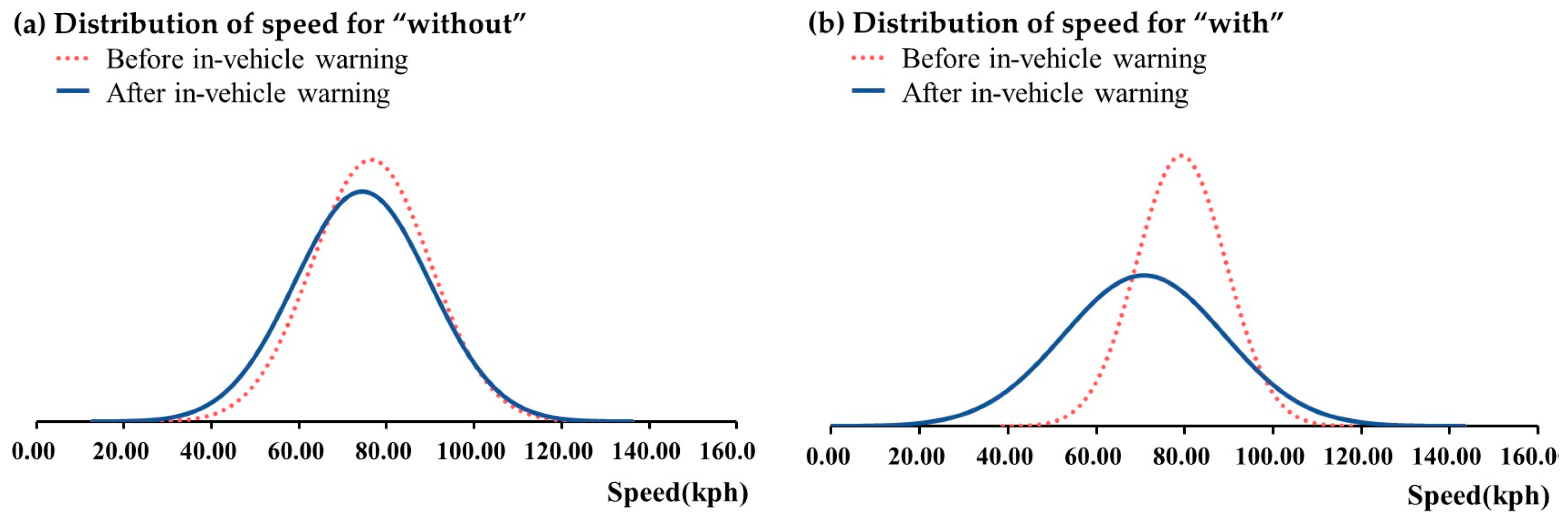
To evaluate the effectiveness of the in-vehicle warning information, this study investigates the distributions of speed and spacing between the “without” and “with” periods. Figure 6 and Table 3 summarize the distributions and basic statistics of speed from the “without” and “with” periods, respectively.
Figure 6.
Speed distribution of (a) “without” and (b) “with”.
Table 3.
Statistics of “without” and “with” for speed.
As shown in Figure 6 and Table 3, the average speed after the in-vehicle warning is lower than before in both periods. Such differences are expected according to Figure 5. Interestingly, we observed that the standard deviation of speed after the warning was larger than that before in both cases but the differences in “with” was much higher than in “without”. It is suspected to be the result of driver deceleration to obtain additional spacing when the warning information is actually provided, which can also be confirmed in Figure 5.
In addition, this study conducted t-tests of speed distribution, as illustrated in Figure 6, to confirm the statistical significance. Table 4 shows the one-tailed two sample t-test result in speed for “without” and “with” periods, which was conducted with a significance level of α = 0.05. The results in Table 4 reveal that a significant difference in speed between before and after the in-vehicle warning indicated that average speed before the warning was faster than after in both periods.
Table 4.
T-test result in speed.
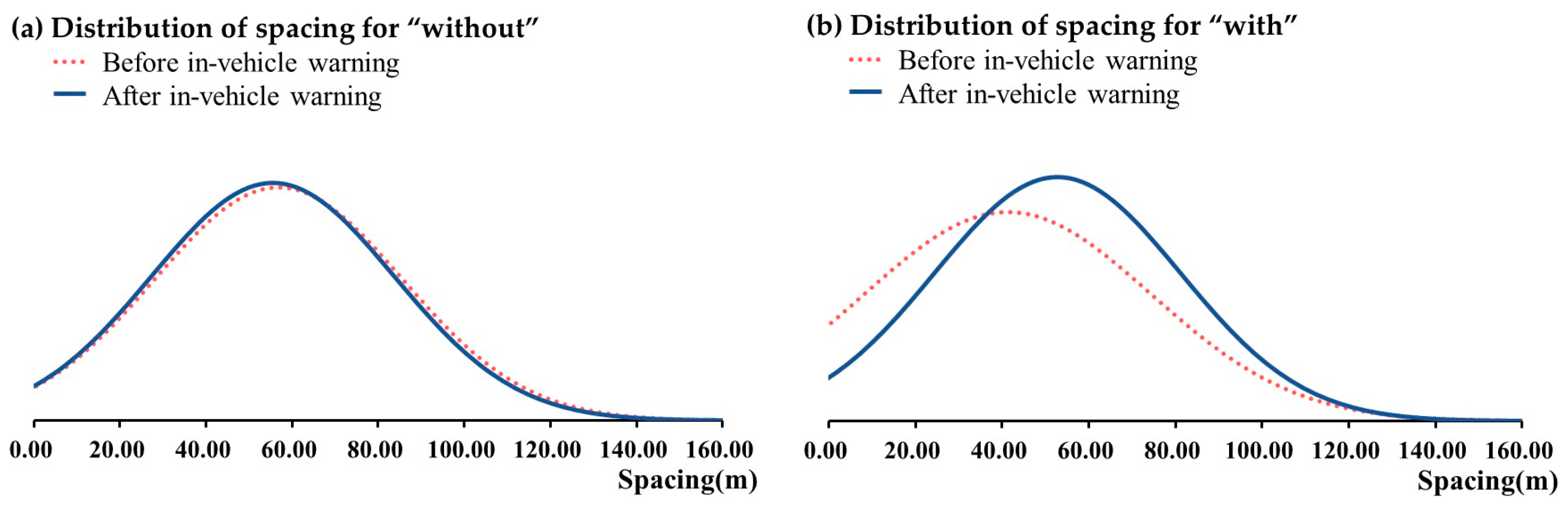
This study repeats the investigation in Figure 6, Table 3 and Table 4 for spacing and the results are summarized in Figure 7, Table 5 and Table 6.
Figure 7.
Spacing distribution of (a) “without” and (b) “with”.
Table 5.
Statistics of “without” and “with” for spacing.
Table 6.
T-test result in spacing.
As shown in Figure 7 and Table 5 for “without”, the average spacing after the warning was similar to before the warning. In Table 5 for “with”, on the other hand, the difference between the two seems clear: the average spacing after the warning was lower than before. The contrast between the “without” and “with” periods in spacing supports the premise that the in-vehicle warning induces drivers to take additional spacing at a given speed. Table 6 summarizes the one-tailed two sample t-test result in spacing for both periods.
According to the p-value during the “without” period, we cannot reject the null hypothesis that spacing before the in-vehicle warning is the same as after while we accept the alternative hypothesis during the “with” period.
Summarizing the investigation in speed and spacing between the “with” and “without” periods, we saw that average speed after the in-vehicle warning was lower than before during both periods. However, average spacing after the warning was greater than before only during the “with” period. The findings support our suspicion that when drivers receive actual in-vehicle warning in the C-ITS environment, they are more likely to decelerate while taking additional spacing to prepare for situations downstream.
5.3. Comparison between “with” and “without” Periods in BMI (Behavior Monitoring Indicator)
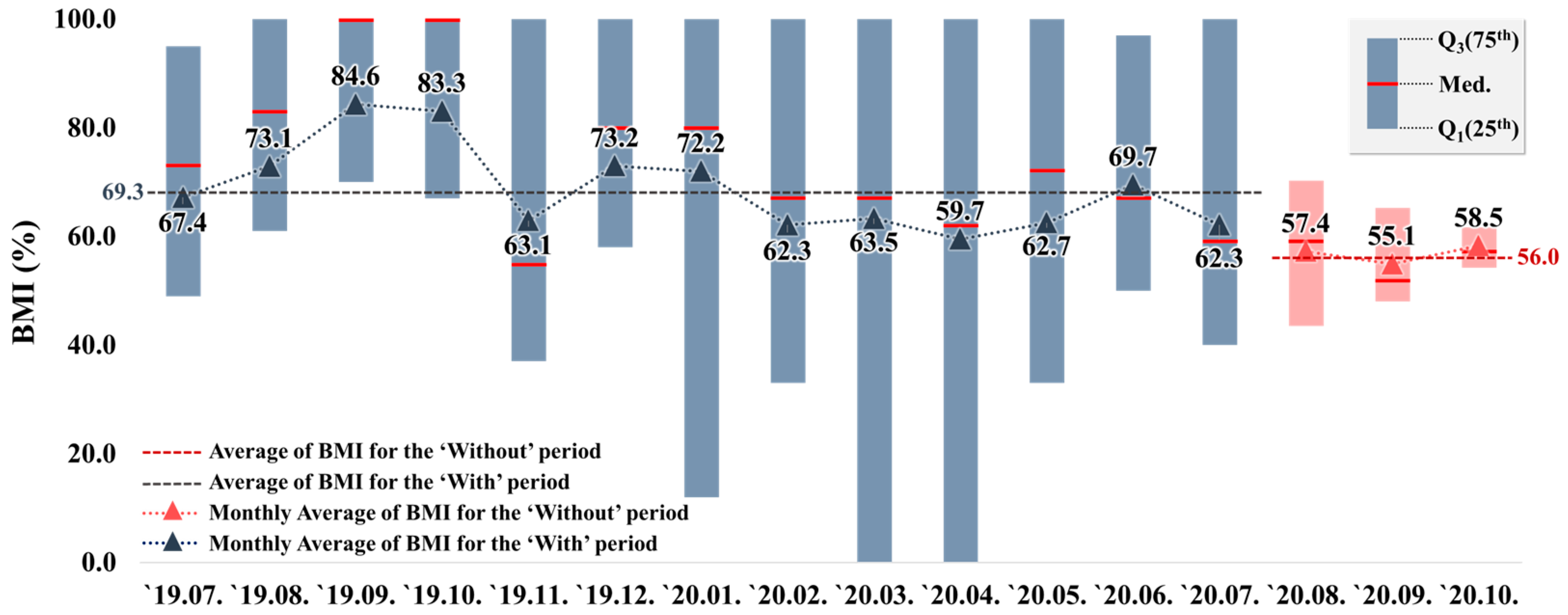
This study also compared the “with” period with the “without” period based on the BMI calculated from Equation (1) to see if the driving behavioral difference due to the in-vehicle warning information is consistent over time. Figure 8 shows monthly box plots of BMI between July 2019 and October 2020 where both “without” and “with” periods are included. In each box plot, the top and bottom edges of a box show the first and third quartiles, and the horizontal line within the box shows the median value of the observations. A monthly average BMI is highlighted as a triangle shape, and the average BMI by period is represented as a dotted line.
Figure 8.
Timeseries of monthly BMI over 13 months.
In Figure 8, we can see that the median BMI was between 55% and 59% during the “without” period and between 62% and 85% during the “with” period. Without exception, all median BMI during the “with” period was higher than “without”. It appears that the variation in the height of the boxplot is larger in the “with” period. The difference in average BMI values between the two periods is about 13%. Figure 8 shows that more drivers responded to the warning when it was actually provided. Focusing on the trend of the monthly BMI over the “with” periods, the BMI tended to increase from July 2019 to September 2019, which was the initial period of providing FCWS warnings. Since that time, the median BMI tended to decrease a little and then it stabilized at the average value, which was 69.3%. We suspect that some drivers selectively react to the in-vehicle warning after going through an adaptation phase. Perhaps the relatively high variation in BMI during the “with” period may also be explained by that reason.
6. Discussion and Conclusions
In the C-ITS environment, various in-vehicle warning information is implemented. Thus, it is essential to evaluate the warning services using appropriate quantitative indicators and to monitor whether the effect continues during the operation period. The evaluation process is also important because the results of the evaluation can be applied to calibrate the service parameters (e.g., activation conditions and exposure duration).
This study aims to quantitatively assess the impact of in-vehicle warning information using PVD collected from freeway C-ITSs. Leveraging the background of traffic flow theory and individual vehicle data collected in every second, we evaluated whether the warning information induces drivers to drive in a conservative way. For the evaluation, this study employed PVD collected from 700 vehicles on freeways over two different time periods: one period when the in-vehicle warning information was provided to drivers and the other when it was not.
After identifying the driving characteristics of conservative drivers in a speed–spacing plane, we compared various statistics related to speed and spacing between the two data collection periods. Our analysis revealed several significant findings regarding the effectiveness of in-vehicle warning information as follows.
- During the “with” period, drivers tend to decelerate and increase spacing when they receive an in-vehicle warning.
- Compared with the “without” period, we found empirical evidence that the in-vehicle warning information was effective in encouraging drivers to drive more conservatively.
- Since the “with” period was followed by the “without” period, some drivers selectively react to the in-vehicle warning after going through an adaptation phase (i.e., “with” period).
- Drivers’ reliability and compliance rate to the warning information could be time sensitive.
These findings provide an insight that it is imperative for the C-ITS operators to devise an MOE to evaluate the reliability of warning information and continually monitor these measures.
Despite the C-ITS operation period in this study extending over a year, it was difficult to obtain a sufficient number of valid samples. Especially, we collected the “without” data for 3 months and a relatively smaller number of samples were collected as compared with the “with” period. Expanding the data collection would enhance the comprehensiveness of this study. Of the many different types of warning information, this study only considers the FCWS warning. In future research, we intend to investigate whether other warning information has a different impact on the driver in terms of conservative driving behaviors. We emphasize that the speed–spacing relationship was applied to evaluate the effectiveness of the in-vehicle warning information. However, lateral movement, including lane-changing maneuvers, represents another potential driving behavior to be expected after receiving an in-vehicle warning. Analyzing lateral movement can be accomplished using the PVD by collecting additional in-vehicle records such as steering angle, angular velocity, and lane information.
Author Contributions
Study conception and design, H.K. and S.K.; data collection, J.K. and A.J.; analysis and interpretation of results, H.K., J.K. and S.K.; draft manuscript preparation, H.K. and S.K. All authors have read and agreed to the published version of the manuscript.
Funding
This work is supported in part by the Korea Agency for Infrastructure Technology Advancement (KAIA) grant funded by the Ministry of Land, Infrastructure and Transport (Grant RS-2022-00143579).
Institutional Review Board Statement
Not applicable.
Informed Consent Statement
Not applicable.
Data Availability Statement
The original contributions presented in the study are included in the article, further inquiries can be directed to the corresponding author.
Conflicts of Interest
The authors declare no conflicts of interest.
Abbreviation
| Abbreviation | Meaning |
| ADAS | advanced driving assistance system |
| BSW | blind spot warning |
| C-ITS | cooperative intelligent transportation system |
| CV | connected vehicle |
| DTG | digital tachograph |
| FCW | forward collision warning |
| FCWS | forward collision-warning system |
| IMA | intersection movement assistance |
| KEC | Korea Expressway Corporation |
| K-SMos | kinematic-based surrogate measure of safety |
| LCC | lane changing conflicts |
| LCW | lane change warning |
| LDWS | lane departure warning system |
| MOE | measure of effectiveness |
| MPR | market penetration rate |
| MSWS | motorcycle safety warning system |
| NCJ | number of critical jerk |
| PVD | per-vehicle data |
| RP | random parameter |
| RSU | roadside units |
| S-GWPR | semiparametric geographically weighted Poisson regression |
| SPMD | safety pilot model deployment |
| SSM | surrogate safety measure |
| TERCRI | time exposed rear-end crash risk index |
| TET | time exposed time to collision |
| TIT | time integrated time to collision |
| TTC | time to collision |
| TTCD | time to collision with disturbance |
| VSLSs | variable speed limit systems |
References
- Guériau, M.; Billot, R.; El Faouzi, N.E.; Monteil, J.; Armetta, F.; Hassas, S. How to Assess the Benefits of Connected Vehicles? A Simulation Framework for the Design of Cooperative Traffic Management Strategies. Transp. Res. Part C Emerg. Technol. 2016, 67, 266–279. [Google Scholar] [CrossRef]
- Uhlemann, E. Introducing connected vehicles [connected vehicles]. IEEE Veh. Technol. Mag. 2015, 10, 23–31. [Google Scholar] [CrossRef]
- Zumpf, S.; Gopalakrishna, D.; Garcia, V.; Ragan, A.; English, T.; Young, R.; Ahmed, M.; Kitchener, F.; Serulle, N.U.; Hsu, E. Connected Vehicle Pilot Deployment Program Phase 1, Application Deployment Plan-ICF/Wyoming. 2016. Available online: https://rosap.ntl.bts.gov/view/dot/40121 (accessed on 18 March 2024).
- Talas, M.; Bradley, M.; Rausch, R.; Benevelli, D.; Sim, S.; Opie, K.; Stanley, C.; Whyte, W. Connected Vehicle Pilot Deployment Program Phase 1: Comprehensive Deployment Plan: New York City: Volume 1: Technical Application: Part I: Technical and Management Approach. 2020. Available online: https://rosap.ntl.bts.gov/view/dot/31730 (accessed on 18 March 2024).
- Cordahi, G.; Kamalanathsharma, R.; Kolleda, J.; Miller, D.; Novosad, S.; Poling, T.; Sundararajan, S. Connected Vehicle Pilot Deployment Program Phase 1: Application Deployment: Tampa (THEA): Final Report. 2016. Available online: https://rosap.ntl.bts.gov/view/dot/31734 (accessed on 18 March 2024).
- Kotsi, A.; Mitsakis, E.; Tzanis, D. Overview of C-ITS Deployment Projects in Europe and USA. In Proceedings of the 23rd IEEE International Conference on Intelligent Transportation Systems, Rhodes, Greece, 20–23 September 2020. [Google Scholar] [CrossRef]
- Park, S.; Oh, C.; Kim, Y.; Choi, S.; Park, S. Understanding impacts of aggressive driving on freeway safety and mobility: A multi-agent driving simulation approach. Transp. Res. Part F Traffic Psychol. Behav. 2019, 64, 377–387. [Google Scholar] [CrossRef]
- Khondaker, B.; Kattan, L. Variable speed limit: A microscopic analysis in a connected vehicle environment. Transp. Res. Part C Emerg. Technol. 2015, 58, 146–159. [Google Scholar] [CrossRef]
- Ahmed, H.U.; Ahmad, S.; Yang, X.; Lu, P.; Huang, Y. Safety and Mobility Evaluation of Cumulative-Anticipative Car-Following Model for Connected Autonomous Vehicles. Smart Cities 2024, 7, 518–540. [Google Scholar] [CrossRef]
- Talebpour, A.; Mahmassani, H.S. Influence of connected and autonomous vehicles on traffic flow stability and throughput. Transp. Res. Part C Emerg. Technol. 2016, 71, 143–163. [Google Scholar] [CrossRef]
- Letter, C.; Elefteriadou, L. Efficient control of fully automated connected vehicles at freeway merge segments. Transp. Res. Part C Emerg. Technol. 2017, 80, 190–205. [Google Scholar] [CrossRef]
- Guglielmi, J.; Yanagisawa, M.; Swanson, E.; Stevens, S.; Najm, W. Estimation of Safety Benefits for Heavy-Vehicle Crash Warning Applications Based on Vehicle-to-Vehicle Communications; No. DOT HS 812 429; U.S. Department of Transportation, National Highway Traffic Safety Administration: Washington, DC, USA, 2017. Available online: https://rosap.ntl.bts.gov/view/dot/37005 (accessed on 1 March 2024).
- Rahman, M.S.; Abdel-Aty, M.; Lee, J.; Rahman, M.H. Safety benefits of arterials’ crash risk under connected and automated vehicles. Transp. Res. Part C Emerg. Technol. 2019, 100, 354–371. [Google Scholar] [CrossRef]
- Arafat, M.; Hadi, M.; Hunsanon, T.; Amine, K. Stop sign gap assist application in a connected vehicle simulation environment. Transp. Res. Rec. 2021, 2675, 1127–1135. [Google Scholar] [CrossRef]
- Miqdady, T.; de Oña, R.; de Oña, J. Traffic Safety Sensitivity Analysis of Parameters Used for Connected and Autonomous Vehicle Calibration. Sustainability 2023, 15, 9990. [Google Scholar] [CrossRef]
- Atkins, W.S. Research on the Impacts of Connected and Autonomous Vehicles (CAVs) on Traffic Flow. Stage 2: Traffic Modelling and Analysis Technical Report. 2016. Available online: https://www.gov.uk/government/publications/driverless-vehicles-impacts-on-traffic-flow (accessed on 1 March 2024).
- Sharma, A.; Zheng, Z.; Kim, J.; Bhaskar, A.; Haque, M.M. Assessing traffic disturbance, efficiency, and safety of the mixed traffic flow of connected vehicles and traditional vehicles by considering human factors. Transp. Res. Part C Emerg. Technol. 2021, 124, 102934. [Google Scholar] [CrossRef]
- Hu, M.; Zhang, Z.; Chen, X. Research on benefits of mixed traffic flow of intelligent connected vehicles. J. Syst. Simul. 2021, 33, 2270. [Google Scholar] [CrossRef]
- Li, Z.; Xing, G.; Zhao, X.; Li, H. Impact of the connected vehicle environment on tunnel entrance zone. Accid. Anal. Prev. 2021, 157, 106145. [Google Scholar] [CrossRef] [PubMed]
- Adomah, E.; Khoda Bakhshi, A.; Ahmed, M.M. Safety impact of connected vehicles on driver behavior in rural work zones under foggy weather conditions. Transp. Res. Rec. 2022, 2676, 88–107. [Google Scholar] [CrossRef]
- Ali, Y.; Sharma, A.; Haque, M.M.; Zheng, Z.; Saifuzzaman, M. The impact of the connected environment on driving behavior and safety: A driving simulator study. Accid. Anal. Prev. 2020, 144, 105643. [Google Scholar] [CrossRef] [PubMed]
- Yue, L.; Abdel-Aty, M.; Wu, Y.; Wang, L. Assessment of the safety benefits of vehicles’ advanced driver assistance, connectivity and low level automation systems. Accid. Anal. Prev. 2018, 117, 55–64. [Google Scholar] [CrossRef] [PubMed]
- Chang, X.; Li, H.; Qin, L.; Rong, J.; Lu, Y.; Chen, X. Evaluation of cooperative systems on driver behavior in heavy fog condition based on a driving simulator. Accid. Anal. Prev. 2019, 128, 197–205. [Google Scholar] [CrossRef]
- Bakhshi, A.K.; Gaweesh, S.M.; Ahmed, M.M. The safety performance of connected vehicles on slippery horizontal curves through enhancing truck drivers’ situational awareness: A driving simulator experiment. Transp. Res. Part F Traffic Psychol. Behav. 2021, 79, 118–138. [Google Scholar] [CrossRef]
- Duan, K.; Yan, X.; Li, X.; Hang, J. Improving drivers’ merging performance in work zone using an in-vehicle audio warning. Transp. Res. Part F Traffic Psychol. Behav. 2023, 95, 297–321. [Google Scholar] [CrossRef]
- Yang, G.; Ahmed, M.M.; Gaweesh, S. Impact of variable speed limit in a connected vehicle environment on truck driver behavior under adverse weather conditions: Driving simulator study. Transp. Res. Rec. 2019, 2673, 132–142. [Google Scholar] [CrossRef]
- Zhao, X.; Xu, W.; Ma, J.; Li, H.; Chen, Y.; Rong, J. Effects of connected vehicle-based variable speed limit under different foggy conditions based on simulated driving. Accid. Anal. Prev. 2019, 128, 206–216. [Google Scholar] [CrossRef] [PubMed]
- Zhang, X.; Wang, X.; Bao, Y.; Zhu, X. Safety assessment of trucks based on GPS and in-vehicle monitoring data. Accid. Anal. Prev. 2022, 168, 106619. [Google Scholar] [CrossRef] [PubMed]
- Hsu, T.P.; Wen, K.L.; Liu, C.H. Safety effect analysis of motorcycle V2I collision warning system. IET Intell. Transp. Syst. 2022, 16, 13–23. [Google Scholar] [CrossRef]
- Mohammadnazar, A.; Arvin, R.; Khattak, A.J. Classifying travelers’ driving style using basic safety messages generated by connected vehicles: Application of unsupervised machine learning. Transp. Res. Part C Emerg. Technol. 2021, 122, 102917. [Google Scholar] [CrossRef]
- Jang, J.; Ko, J.; Park, J.; Oh, C.; Kim, S. Identification of safety benefits by inter-vehicle crash risk analysis using connected vehicle systems data on Korean freeways. Accid. Anal. Prev. 2020, 144, 105675. [Google Scholar] [CrossRef] [PubMed]
- Xie, K.; Yang, D.; Ozbay, K.; Yang, H. Use of real-world connected vehicle data in identifying high-risk locations based on a new surrogate safety measure. Accid. Anal. Prev. 2019, 125, 311–319. [Google Scholar] [CrossRef]
- Arvin, R.; Kamrani, M.; Khattak, A.J. How instantaneous driving behavior contributes to crashes at intersections: Extracting useful information from connected vehicle message data. Accid. Anal. Prev. 2019, 127, 118–133. [Google Scholar] [CrossRef]
- Newell, G.F. A simplified car-following theory: A lower order model. Transp. Res. Part B Methodol. 2002, 36, 195–205. [Google Scholar] [CrossRef]
- Treiber, M.; Kesting, A. Elementary Car-Following Models; Springer: Berlin Heidelberg, Germany, 2013; pp. 157–180. [Google Scholar] [CrossRef]
Disclaimer/Publisher’s Note: The statements, opinions and data contained in all publications are solely those of the individual author(s) and contributor(s) and not of MDPI and/or the editor(s). MDPI and/or the editor(s) disclaim responsibility for any injury to people or property resulting from any ideas, methods, instructions or products referred to in the content. |
© 2024 by the authors. Licensee MDPI, Basel, Switzerland. This article is an open access article distributed under the terms and conditions of the Creative Commons Attribution (CC BY) license (https://creativecommons.org/licenses/by/4.0/).