Can Complex Training Improve Acute and Long-Lasting Performance in Basketball Players? A Systematic Review
 , , , and
Abstract
1. Introduction
2. Materials and Methods
2.1. Elegibility Criteria
2.2. Data Extraction
2.3. Methodological Quality Assessment
3. Results
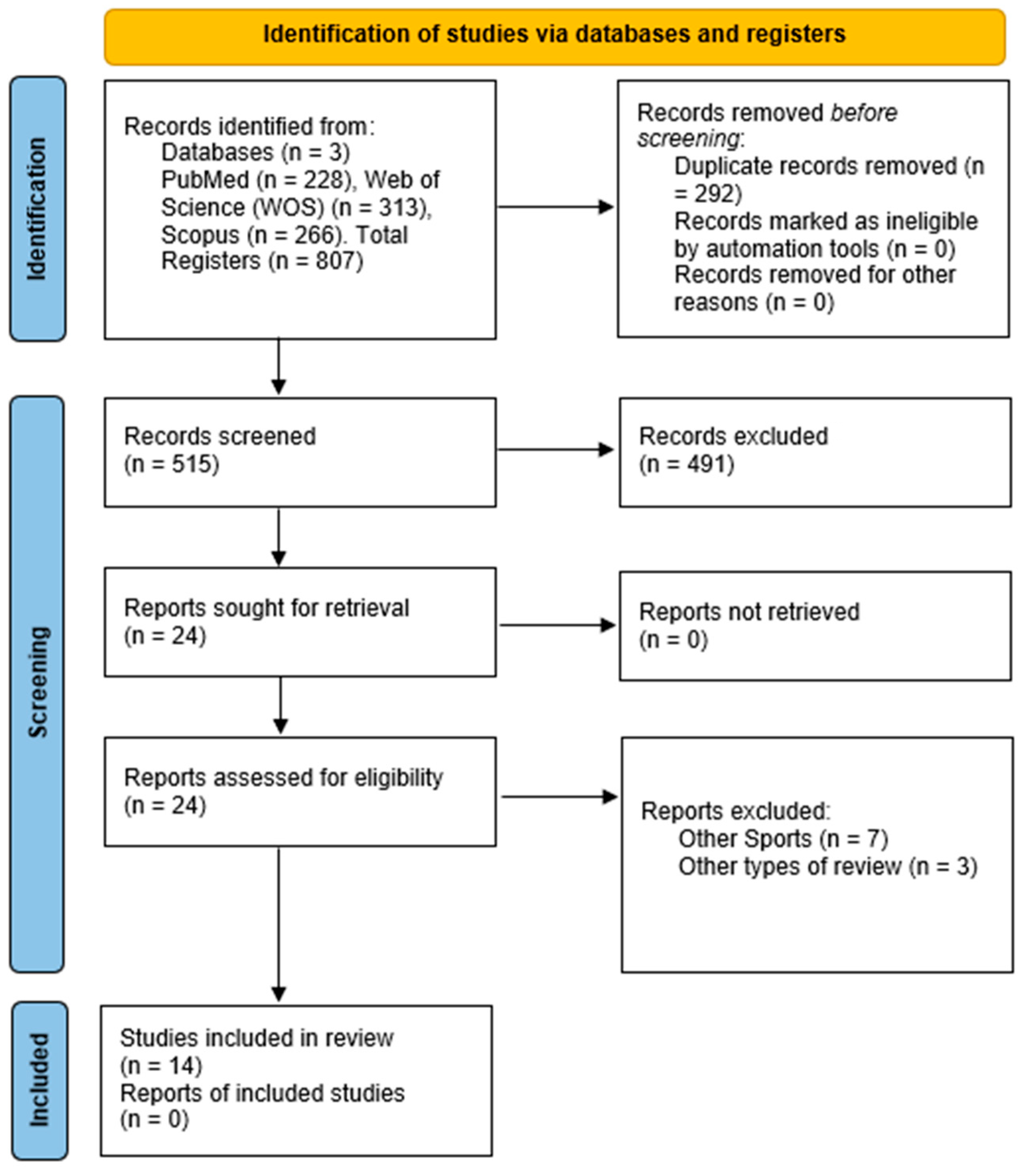
3.1. Study Selection and Identification
3.2. Methodological Quality
3.3. Acute Effects of Complex Training
3.4. Chronic Effects of Complex Training
4. Discussion
5. Conclusions
Author Contributions
Funding
Institutional Review Board Statement
Informed Consent Statement
Data Availability Statement
Conflicts of Interest
References
- Russell, J.L.; McLean, B.D.; Impellizzeri, F.M.; Strack, D.S.; Coutts, A.J. Measuring Physical Demands in Basketball: An Explorative Systematic Review of Practices. Sport. Med. 2021, 51, 81–112. [Google Scholar] [CrossRef] [PubMed]
- Stojanović, E.; Stojiljković, N.; Scanlan, A.T.; Dalbo, V.J.; Berkelmans, D.M.; Milanović, Z. The Activity Demands and Physiological Responses Encountered during Basketball Match-Play: A Systematic Review. Sport. Med. 2018, 48, 111–135. [Google Scholar] [CrossRef] [PubMed]
- Pernigoni, M.; Ferioli, D.; Butautas, R.; La Torre, A.; Conte, D. Assessing the External Load Associated With High-Intensity Activities Recorded During Official Basketball Games. Front. Psychol. 2021, 12, 668194. [Google Scholar] [CrossRef] [PubMed]
- García, F.; Castellano, J.; Reche, X.; Vázquez-Guerrero, J. Average Game Physical Demands and the Most Demanding Scenarios of Basketball Competition in Various Age Groups. J. Hum. Kinet. 2021, 79, 165–174. [Google Scholar] [CrossRef] [PubMed]
- Sánchez-Sánchez, J.; Carretero, M.; Ramírez-Campillo, R.; Petisco, C.; Diego, M.; Gonzalo-Skok, O.; Nakamura, F.Y. Effects of High-Intensity Training with One versus Three Changes of Direction on Youth Female Basketball Players’ Performance. Kinesiology 2018, 50, 117–125. [Google Scholar]
- Alemdaroǧlu, U. The Relationship between Muscle Strength, Anaerobic Performance, Agility, Sprint Ability and Vertical Jump Performance in Professional Basketball Players. J. Hum. Kinet. 2012, 31, 149–158. [Google Scholar] [CrossRef] [PubMed]
- Latorre Román, P.Á.; Villar Macias, F.J.; García Pinillos, F. Effects of a Contrast Training Programme on Jumping, Sprinting and Agility Performance of Prepubertal Basketball Players. J. Sports Sci. 2018, 36, 802–808. [Google Scholar] [CrossRef] [PubMed]
- Sperlich, P.; Behringer, M.; Mester, J. The Effects of Resistance Training Interventions on Vertical Jump Performance in Basketball Players: A Meta-Analysis. J. Sport. Med. Phys. Fitness 2016, 56, 874–883. [Google Scholar]
- Santos, E.J.A.M.; Janeira, M.A.A.S. The Effects of Resistance Training on Explosive Strength Indicators in Adolescent Basketball Players. J. Strength Cond. Res. 2012, 26, 2641–2647. [Google Scholar] [CrossRef]
- Benis, R.; Bonato, M.; La Torre, A. Elite Female Basketball Players’ Body-Weight Neuromuscular Training and Performance on the Y-Balance Test. J. Athl. Train. 2016, 51, 688–695. [Google Scholar] [CrossRef]
- Ciacci, S.; Bartolomei, S. The Effects of Two Different Explosive Strength Training Programs on Vertical Jump Performance in Basketball. J. Sports Med. Phys. Fitness 2018, 58, 1375–1382. [Google Scholar] [CrossRef] [PubMed]
- Alemdaroǧlu, U.; Dündar, U.; Köklü, Y.; Aşci, A.; Findikoǧlu, G. The Effect of Exercise Order Incorporating Plyometric and Resistance Training on Isokinetic Leg Strength and Vertical Jump Performance: A Comparative Study. Isokinet. Exerc. Sci. 2013, 21, 211–217. [Google Scholar] [CrossRef]
- Brien, J.; Browne, D.; Earls, D. The Effects of Different Types of Eccentric Overload Training on Strength, Speed, Power and Change of Direction in Female Basketball Players. J. Funct. Morphol. Kinesiol. 2020, 5, 50. [Google Scholar] [CrossRef] [PubMed]
- Ramirez-Campillo, R.; García-Hermoso, A.; Moran, J.; Chaabene, H.; Negra, Y.; Scanlan, A.T. The Effects of Plyometric Jump Training on Physical Fitness Attributes in Basketball Players: A Meta-Analysis. J. Sport Health Sci. 2022, 11, 656–670. [Google Scholar] [CrossRef] [PubMed]
- Uysal, H.Ş.; Dalkiran, O.; Korkmaz, S.; Akyildiz, Z.; Nobari, H.; Clemente, F.M. The Effect of Combined Strength Training on Vertical Jump Performance in Young Basketball Players: A Systematic Review and Meta-Analysis. Strength Cond. J. 2023, 45, 554–567. [Google Scholar] [CrossRef]
- Docherty, D.; Robbins, D.; Hodgson, M. Complex Training Revisited: A Review of Its Current Status as a Viable Training Approach. Strength Cond. J. 2004, 26, 52–57. [Google Scholar] [CrossRef]
- Thapa, R.K.; Lum, D.; Moran, J.; Ramirez-Campillo, R. Effects of Complex Training on Sprint, Jump, and Change of Direction Ability of Soccer Players: A Systematic Review and Meta-Analysis. Front. Psychol. 2021, 11, 627869. [Google Scholar] [CrossRef] [PubMed]
- Prieske, O.; Behrens, M.; Chaabene, H.; Granacher, U.; Maffiuletti, N.A. Time to Differentiate Postactivation “Potentiation” from “Performance Enhancement” in the Strength and Conditioning Community. Sport. Med. 2020, 50, 1559–1565. [Google Scholar] [CrossRef] [PubMed]
- Healy, R.; Comyns, T.M. The Application of Postactivation Potentiation Methods to Improve Sprint Speed. Strength Cond. J. 2017, 39, 1–9. [Google Scholar] [CrossRef]
- Freitas, T.T.; Calleja-González, J.; Carlos-Vivas, J.; Marín-Cascales, E.; Alcaraz, P.E. Short-Term Optimal Load Training vs a Modified Complex Training in Semi-Professional Basketball Players. J. Sports Sci. 2019, 37, 434–442. [Google Scholar] [CrossRef]
- Tsimahidis, K.; Galazoulas, C.; Skoufas, D.; Papaiakovou, G.; Bassa, E.; Patikas, D.; Kotzamanidis, C. The Effect of Sprinting after Each Set of Heavy Resistance Training on the Running Speed and Jumping Performance of Young Basketball Players. J. Strength Cond. Res. 2010, 24, 2102–2108. [Google Scholar] [CrossRef] [PubMed]
- Santos, E.J.A.M.; Janeira, M.A.A.S. Effects of Complex Training on Explosive Strength in Adolescent Male Basketball Players. J. Strength Cond. Res. 2008, 22, 903–909. [Google Scholar] [CrossRef] [PubMed]
- Seitz, L.B.; Haff, G.G. Factors Modulating Post-Activation Potentiation of Jump, Sprint, Throw, and Upper-Body Ballistic Performances: A Systematic Review with Meta-Analysis. Sport. Med. 2016, 46, 231–240. [Google Scholar] [CrossRef] [PubMed]
- Gołaś, A.; Maszczyk, A.; Zajac, A.; Mikołajec, K.; Stastny, P. Optimizing Post Activation Potentiation for Explosive Activities in Competitive Sports. J. Hum. Kinet. 2016, 52, 95–106. [Google Scholar] [CrossRef] [PubMed]
- Matthews, M.; O’Conchuir, C.; Comfort, P. The Acute Effects of Heavy and Light Resistances on the Flight Time of a Basketball Push-Pass during Upper Body Complex Training. J. Strength Cond. Res. 2009, 23, 1988–1995. [Google Scholar] [CrossRef]
- Hasan, N.; Nuhmani, S.; Kachanathu, S.J.; Muaidi, Q.I. Efficacy of Complex Training on Angular Velocity of Shoulder in Collegiate Basketball Players. J. Back Musculoskelet. Rehabil. 2018, 31, 859–865. [Google Scholar] [CrossRef] [PubMed]
- Thapa, R.K.; Narvariya, P.; Weldon, A.; Talukdar, K.; Ramirez-Campillo, R. Can Complex Contrast Training Interventions Improve Aerobic Endurance, Maximal Strength, and Repeated Sprint Ability in Soccer Players? A Systematic Review and Meta-Analysis. Montenegrin J. Sport. Sci. Med. 2022, 11, 3–13. [Google Scholar] [CrossRef]
- Page, M.J.; McKenzie, J.E.; Bossuyt, P.M.; Boutron, I.; Hoffmann, T.C.; Mulrow, C.D.; Shamseer, L.; Tetzlaff, J.M.; Akl, E.A.; Brennan, S.E.; et al. The PRISMA 2020 Statement: An Updated Guideline for Reporting Systematic Reviews. BMJ 2021, 372, 71. [Google Scholar] [CrossRef] [PubMed]
- Tsimachidis, C.; Patikas, D.; Galazoulas, C.; Bassa, E.; Kotzamanidis, C. The Post-Activation Potentiation Effect on Sprint Performance after Combined Resistance/Sprint Training in Junior Basketball Players. J. Sports Sci. 2013, 31, 1117–1124. [Google Scholar] [CrossRef]
- Papla, M.; Ewertowska, P.; Krzysztofik, M. Acute Effects of Complex Conditioning Activities on Athletic Performance and Achilles Tendon Stiffness in Male Basketball Players. J. Sport. Sci. Med. 2023, 22, 281–287. [Google Scholar] [CrossRef]
- Drevon, D.; Fursa, S.R.; Malcolm, A.L. Intercoder Reliability and Validity of WebPlotDigitizer in Extracting Graphed Data. Behav. Modif. 2017, 41, 323–339. [Google Scholar] [CrossRef] [PubMed]
- Smart, N.A.; Waldron, M.; Ismail, H.; Giallauria, F.; Vigorito, C.; Cornelissen, V.; Dieberg, G. Validation of a New Tool for the Assessment of Study Quality and Reporting in Exercise Training Studies: TESTEX. Int. J. Evid. Based Healthc. 2015, 13, 9–18. [Google Scholar] [CrossRef] [PubMed]
- Biel, P.; Ewertowska, P.; Stastny, P.; Krzysztofik, M. Effects of Complex Training on Jumping and Change of Direction Performance, and Post-Activation Performance Enhancement Response in Basketball Players. Sports 2023, 11, 181. [Google Scholar] [CrossRef] [PubMed]
- Hassan, A.K.; Bursais, A.K.; Alibrahim, M.S.; Selim, H.S.; Abdelwahab, A.M.; Hammad, B.E. The Impact of Core Complex Training on Some Basketball-Related Aspects of Physical Strength and Shooting Performance. Eur. J. Investig. Health Psychol. Educ. 2023, 13, 1624–1644. [Google Scholar] [CrossRef] [PubMed]
- Rodríguez-Cayetano, A.; López Ramos, S.; Ollero, D.E.; Pérez-Muñoz, S. Effect of a Specific Physical Preparation Program on Physical Fitness in U18 Basketball Players|Efecto de Un Programa de Preparación Física Específica Sobre La Condición Física En Jugadores Sub18 de Baloncesto. Retos 2023, 50, 152–161. [Google Scholar] [CrossRef]
- Sánchez-Sixto, A.; Harrison, A.J.; Floriá, P. Effects of Plyometric vs. Combined Plyometric Training on Vertical Jump Biomechanics in Female Basketball Players. J. Hum. Kinet. 2021, 77, 25–35. [Google Scholar] [CrossRef] [PubMed]
- Shi, L.; Lyons, M.; Duncan, M.; Chen, S.; Chen, Z.; Guo, W.; Han, D. Effects of Variable Resistance Training within Complex Training on Neuromuscular Adaptations in Collegiate Basketball Players. J. Hum. Kinet. 2022, 84, 174–183. [Google Scholar] [CrossRef]
- Yáñez-García, J.M.; Rodríguez-Rosell, D.; Mora-Custodio, R.; González-Badillo, J.J. Changes in Muscle Strength, Jump, and Sprint Performance in Young Elite Basketball Players: The Impact of Combined High-Speed Resistance Training and Plyometrics. J. Strength Cond. Res. 2022, 36, 478–485. [Google Scholar] [CrossRef]
- Santos, E.J.A.M.; Janeira, M.A.A.S. The Effects of Plyometric Training Followed by Detraining and Reduced Training Periods on Explosive Strength in Adolescent Male Basketball Players. J. Strength Cond. Res. 2011, 25, 441–452. [Google Scholar] [CrossRef]
- Xie, Y.; Zhou, H. Effects of Compound Training on Motricity Among Basketball Players. Rev. Bras. Med. Esporte 2023, 29, e2022_0599. [Google Scholar] [CrossRef]
- Latorre-Román, P.A.; Mora-López, D.; García-Pinillos, F. Effects of a Physical Activity Programme in the School Setting on Physical Fitness in Preschool Children. Child. Care. Health Dev. 2018, 44, 427–432. [Google Scholar] [CrossRef]
- Ebben, W.P. Complex Training: A Brief Review. J. Sport. Sci. Med. 2002, 1, 42–46. [Google Scholar]
- Ebben, W.P.; Watts, P.B. A Review of Combined Weight Training and Plyometric Training Modes: Complex Training. Strength Cond. J. 1998, 20, 18–27. [Google Scholar] [CrossRef]
- Koźlenia, D.; Domaradzki, J. Effects of Post-Activation Protocols Based on Slow Tempo Bodyweight Squat and Isometric Activity on Vertical Jump Height Enhancement in Trained Males: A Randomized Controlled Trial. PeerJ 2023, 11, e15753. [Google Scholar] [CrossRef] [PubMed]
- Bogdanis, G.C.; Tsoukos, A.; Veligekas, P.; Tsolakis, C.; Terzis, G. Effects of Muscle Action Type with Equal Impulse of Conditioning Activity on Postactivation Potentiation. J. Strength Cond. Res. 2014, 28, 2521–2528. [Google Scholar] [CrossRef] [PubMed]
- Krzysztofik, M.; Spieszny, M.; Trybulski, R.; Wilk, M.; Pisz, A.; Kolinger, D.; Filip-Stachnik, A.; Stastny, P. Acute Effects of Isometric Conditioning Activity on the Viscoelastic Properties of Muscles and Sprint and Jumping Performance in Handball Players. J. Strength Cond. Res. 2023, 37, 1486–1494. [Google Scholar] [CrossRef]
- Chiu, L.; Fry, A.; Weiss, L.; Schilling, B.; Brown, L.E.; Smith, S. Postactivation Potentiation Response in Athletic and Recreationally Trained Individuals. J. Strength Cond. Res. 2003, 17, 671–677. [Google Scholar] [PubMed]
- Pagaduan, J.; Pojskic, H. A Meta-Analysis on the Effect of Complex Training on Vertical Jump Performance. J. Hum. Kinet. 2020, 71, 255–265. [Google Scholar] [CrossRef] [PubMed]
- Gutiérrez-Flores, D.; Alcaraz, P.E.; Cormier, P.; Martínez-Serrano, A.; Freitas, T.T. Do Activities Performed within the Intra-Contrast Rest Interval Affect Neuromuscular Performance during Complex-Contrast Training Protocols? J. Hum. Kinet. 2024, 91, 33–46. [Google Scholar] [CrossRef]


| PICOS Category | Inclusion Criteria | Exclusion Criteria |
|---|---|---|
| P (Population) | Basketball players from any sex (female/male) or competitive level without age restrictions (amateur to professional level). | Sports other than basketball (e.g., soccer, football, volleyball) or with injuries. |
| I (Intervention) | Studies analyzing acute (effect of CT implemented how warm-up) or chronic (effect of CT implemented how training strategy) effects of CT with a specified applied load | Interventions testing the effects of other types of strength training (i.e., Bodyweight Training) or including alternative methods in addition to strength training |
| C (Comparators) | Studies where groups are compared (i.e., CT vs. control group or vs. other type or training or different load) | Single-group studies |
| O (Outcomes) | The studies must analyze the effects in physical fitness tests (jump, speed, strength…) | Interventions that analyze other variables (i.e., cognition-related, nutrition) |
| S (Study designs) | Randomized and non-randomized controlled studies | Single group studies; Case studies (e.g., <5 participants per group). |
| Items | Total Points (from a Maximum of 15) | ||||||||||||
|---|---|---|---|---|---|---|---|---|---|---|---|---|---|
| 1 | 2 | 3 | 4 | 5 | 6 | 7 | 8 | 9 | 10 | 11 | 12 | ||
| Biel et al. (2023) [33] | 1 | 1 | 1 | 1 | 0 | 3 | 0 | 2 | 1 | 1 | 1 | 1 | 13 |
| Freitas et al. (2019) [20] | 0 | 1 | 0 | 1 | 0 | 2 | 0 | 1 | 1 | 1 | 1 | 1 | 9 |
| Hasan et al. (2018) [28] | 0 | 1 | 0 | 1 | 0 | 1 | 0 | 1 | 1 | 1 | 1 | 1 | 8 |
| Hassan et al. (2023) [34] | 1 | 1 | 0 | 0 | 0 | 2 | 0 | 1 | 1 | 1 | 1 | 1 | 9 |
| Latorre Roman et al. (2018) [41] | 0 | 1 | 0 | 1 | 0 | 2 | 0 | 2 | 1 | 0 | 1 | 1 | 9 |
| Papla et al. (2023) [30] | 1 | 1 | 0 | 1 | 0 | 0 | 0 | 2 | 1 | 1 | 1 | 1 | 9 |
| Rodríguez-Cayetano et al. (2023) [35] | 0 | 0 | 0 | 0 | 0 | 0 | 0 | 2 | 1 | 0 | 1 | 1 | 5 |
| Sánchez-Sixto et al. (2021) [36] | 0 | 1 | 0 | 1 | 0 | 0 | 0 | 2 | 1 | 0 | 1 | 1 | 7 |
| Santos et al. (2008) [9] | 0 | 1 | 0 | 1 | 0 | 1 | 0 | 2 | 1 | 0 | 1 | 1 | 8 |
| Shi et al. (2022) [37] | 1 | 1 | 0 | 1 | 0 | 2 | 0 | 2 | 1 | 1 | 1 | 1 | 11 |
| Tsimachidis et al. (2013) [29] | 0 | 1 | 0 | 1 | 0 | 1 | 0 | 2 | 1 | 1 | 1 | 1 | 9 |
| Tsimahidis et al. (2010) [21] | 0 | 1 | 0 | 1 | 0 | 1 | 0 | 2 | 1 | 0 | 1 | 1 | 8 |
| Xie et al. (2023) [40] | 0 | 1 | 0 | 1 | 0 | 1 | 0 | 2 | 1 | 0 | 1 | 1 | 8 |
| Yañez-García et al. (2022) [38] | 1 | 0 | 0 | 1 | 0 | 1 | 0 | 2 | 1 | 0 | 1 | 1 | 8 |
| Study | Groups | n | Body Mass (kg) | Age (yrs) | Experimental Design | Exercise Intervention Prescription | Group Specific Pre-Post Change |
|---|---|---|---|---|---|---|---|
| Biel et al. (2023) [33] | CPX | 13 | 85.9 ± 10.9 | 24 ± 6 | After a standardized warm-up, both groups performed a pre-test (CMJ, SLJ, and shuttle run test). 5 min later, participants performed each group performance conditioning activity and after 6 min performed the post test. | CPX training: 2–4 sets of 5–12 reps at 85% 1 RM with 90–120 rest (resistance exercise/active rest engaging different body regions/explosive exercise involving similar muscle groups as the first exercise) perform 3 sets of 5 DJ with a 60 s rest in-between. | Pre-training CMJ Height (cm): ↑ 5.5 ± 6.7% DOM SLJ Height (cm): ↑ 2.3 ± 5.6% N-DOM SLJ Height (cm): ↑ 2.3 ± 6.3% Shuttle RunTest Time (s): %↓ 0.7 ± 1.3% Post-training CMJ Height (cm): ↑ 4.5 ± 5% DOM SLJ Height (cm): ↑ 7.6 ± 14.8% N-DOM SLJ Height (cm): ↑ 2 ± 7.7% Shuttle RunTest Time (s): ↓ 1 ± 0.9% |
| CMP | 11 | 89.9 ± 8.5 | 21 ± 4 | CPX training: 2–4 sets of 5–12 reps at 85% 1 RM with 90–120 rest (explosive exercise/active rest engaging different body regions/resistance exercise involving similar muscle groups as the first exercise) perform 3 sets of 5 DJ with a 60 s rest in-between. | Post-training CMJ Height (cm): ↑ 2.6 ± 5.3% DOM SLJ Height (cm): ↑ 5.4 ± 14.6 N-DOM SLJ Height (cm): ↑ 3.7 ± 6.2% Shuttle RunTest Time (s): ↓ 0.7 ± 1.4% Pre-training CMJ Height (cm): ↑ 4.6 ± 3.8% DOM SLJ Height (cm): ↑ 1.7 ± 6.4% N-DOM SLJ Height (cm): ↑ 1.9 ± 6.7% Shuttle RunTest Time (s): ↓ 0.8 ± 1.4 | ||
| Papla et al. (2023) [30] | Bilateral activity group | 13 | 87 ± 11 | 24 ± 6 | After a standardized warm-up, both groups perform a pre-test (Achilles’ tendon stiffness, CMJ and MAT time). After 5 min each group performed conditioning activity and after 6 min performed the post test. | Bilateral: 2 sets of 4 repetitions of back squats at 80% 1 RM and 10 drop jumps. 3-min rest interval between sets, while there was no rest within the conditioning activity complex. | CMJ Height (cm): ↑ 1.3 ± 4.4% CMJ Peak Velocity (m/s): ↑ 1.3 ± 4.1% CMJ Contraction time (ms): ↓ 4.9 ± 14.3% CMJ RSI: ↑ 9.2 ± 16.4% |
| Unilateral activity group | 13 | 89 ± 13 | 25 ± 7 | Unilateral: 2 sets of 2 repetitions of split squats on each leg at 80% 1 RM, followed by 5 depth jumps to lateral hop on each leg. 3-min rest interval between sets, while there was no rest within the conditioning activity complex. | CMJ Height (cm): ↓ 0.9 ± 3.6% CMJ Peak Velocity (m/s): ↑ 0.4 ± 2.1% CMJ Contraction time (ms): ↓ 3.5 ± 11.5% CMJ RSI: ↑ 1.3 ± 12.6% | ||
| Tsimachidis et al. (2013) [29] | Combined training group | 13 | 80.9 ± 10.2 | 18.0 ± 1.2 | After 10-week Combined training (2 times/week 5 sets at 8 RM half-squats during 5 weeks and 5 sets at 5 RΜ during the next 5 weeks. A maximal 30 m sprint was performed in the middle of the 3-min interval between the resistance sets). | Pre-training 10-m running speed (m/s): ↑ 0.95% 30-m running speed (m/s): 0% After 5 min: 10-m running speed (m/s): ↑ 1.65% 30-m running speed (m/s): ↑ 0.52% Post-training 10-m running speed (m/s): ↑ 1.1% 30-m running speed (m/s): ↑ 1.14% After 5 min: 10-m running speed (m/s): ↑ 48.3% 30-m running speed (m/s): ↑ 3.74% | |
| Control group | 13 | 18.0 ± 0.7 | 82.0 ± 5.3 | After 10-week habitual training (technical and tactical preparation). | Pre-training 10-m running speed (m/s): ↑ 0.72% 30-m running speed (m/s): 0.18% After 5 min: 10-m running speed (m/s): ↑ 0.96% 30-m running speed (m/s): ↑ 0.53 Post-training 10-m running speed (m/s): ↑ 1.8% 30-m running speed (m/s): ↑ 0.71% After 5 min: 10-m running speed (m/s): ↑ 1.42% 30-m running speed (m/s): ↑ 0.88% |
| Biel et al. (2023) [33] | Complex training (resistance/active rest/explosive exercise) (n = 19) | Compound training (explosive exercise/active rest/resistance) (n = 13) | |||||
| Pre-training | Pre | Post | ES/p | Pre | Post | ES/p | |
| CMJ Height (cm) | 35.8 ± 2.5 | 37.8 ± 3.5 | 0.66/- | 37.7 ± 2.6 | 39.5 ± 3 | 0.64/- | |
| SLJ DOM Height (cm) | 16.7 ± 2.9 | 17.1 ± 3 | 0.14/- | 17.1 ± 3.3 | 17.4 ± 3.1 | 0.09/- | |
| SLJ N-DOM Height (cm) | 16.6 ± 2.6 | 17.0 ± 3.1 | 0.14/- | 16.2 ± 1.4 | 16.4 ± 0.9 | 0.17/- | |
| Shuttle run test time (s) | 5.09 ± 0.16 | 5.06 ± 0.09 | 0.23/- | 5.12 ± 0.11 | 5.07 ± 0.09 | 0.5/- | |
| Post-training | Pre | Post | ES/p | Pre | Post | ES/p | |
| CMJ Height (cm) | 36.7 ± 3.5 | 38.2 ± 2.9 | 0.47/- | 37.9 ± 2.9 | 38.9 ± 3 | 0.34/- | |
| SLJ DOM Height (cm) | 17.5 ± 3.2 | 18.5 ± 2.6 | 0.34/- | 17.9 ± 3.5 | 18.7 ± 3.3 | 0.24/- | |
| SLJ N-DOM Height (cm) | 17.4 ± 2.8 | 17.8 ± 3.2 | 0.13/- | 16.6 ± 1.5 | 17.1 ± 1.5 | 0.33/- | |
| Shuttle run test time (s) | 5.02 ± 0.17 | 4.96 ± 0.15 | 0.37/- | 5.08 ± 0.16 | 5.03 ± 0.11 | 0.36/- | |
| Papla et al. (2023) [30] | Bilateral conditioning activity complex (n = 13) | Unilateral conditioning activity complex (n = 13) | |||||
| Pre | Post | ES/p | Pre | Post | ES/p | ||
| CMJ Height (cm) | 39.3 ± 5.1 | 39.8 ± 5.1 | 0.10/>0.05 | 38.7 ± 4.7 | 38.4 ± 4.8 | −0.06/>0.05 | |
| CMJ Peak velocity (m/s) | 2.87 ± 0.19 | 2.89 ± 0.16 | 0.11/>0.05 | 2.84 ± 0.19 | 2.86 ± 0.18 | 0.10/>0.05 | |
| CMJ Contraction Time (m/s) | 868 ± 167 | 821 ± 165 | −0.27/>0.05 | 808 ± 113 | 796 ± 103 | −0.11/>0.05 | |
| CMJ RSI mod | 0.47 ± 0.12 | 0.51 ± 0.14 | 0.30/>0.05 | 0.48 ± 0.06 | 0.49 ± 0.13 | 0.13/>0.05 | |
| MAT DOM (s) | 3.23 | 2.58 | -/>0.05 | 2.43 | 2.36 | -/>0.05 | |
| MAT N-DOM (s) | 2.56 | 3.22 | -/>0.05 | 2.56 | 3.22 | -/>0.05 | |
| Tsimachidis et al. (2013) [29] | Combined training group (n = 13) | Control group (n = 13) | |||||
| Pre training | Pre | Post | ES/p | Pre | Post | ES/p | |
| 10-m running speed (m/s) | 4.23 | 4.27 | -/>0.05 | 4.17 | 4.20 | -/>0.05 | |
| 10-m running speed (m/s) post 5 min | 4.23 | 4.30 | -/>0.05 | 4.17 | 4.21 | -/>0.05 | |
| 30-m running speed (m/s) | 5.79 | 5.79 | -/>0.05 | 5.64 | 5.65 | -/>0.05 | |
| 30-m running speed (m/s) post 5 min | 5.79 | 5.82 | -/>0.05 | 5.64 | 5.67 | -/>0.05 | |
| Post training | Pre | Post | ES/p | Pre | Post | ES/p | |
| 10-m running speed (m/s) | 4.56 | 4.61 | -/>0.05 | 4.22 | 4.27 | -/>0.05 | |
| 10-m running speed (m/s) post 5 min | 4.56 | 6.75 | -/<0.05 | 4.22 | 4.28 | -/>0.05 | |
| 30-m running speed (m/s) | 6.15 | 6.22 | -/>0.05 | 5.65 | 5.69 | -/>0.05 | |
| 30-m running speed (m/s) post 5 min | 6.15 | 6.38 | -/<0.05 | 5.65 | 5.70 | -/>0.05 | |
| Study | Groups | n | Body Mass (kg) | Age (yrs) | Experimental Design | Exercise Intervention Prescription | Group Specific Pre-Post Change |
|---|---|---|---|---|---|---|---|
| Biel et al. (2023) [33] | CPX | 13 | 85.9 ± 10.9 | 24 ± 6 | After a standardized warm-up, both groups perform a pre-test (CMJ, SLJ and Shuttle Run Test). After 8 weeks, each group retested. | CPX training: 2–4 seta of 5–12 repa at 85% 1 RM with 90–120 rest (resistance exercise/active rest engaging different body regions/explosive exercise involving similar muscle groups as the first exercise) perform 3 sets of 5 DJ with a 60 s rest in-between. 2 times per week. | CMJ Height (cm): ↑ 2.3 ± 5% CMJ Relative Peak Power (W/kg): ↑ 0.8 ± 9.1% CMJ Contraction Time (ms): ↑ 7.3 ± 37% SLJ DOM Height (cm): ↑ 5.4 ± 16.2% SLJ DOM Relative Peak Power [W/kg]: ↑ 4.1 ± 6.6% SLJ N-DOM Height (cm): ↑ 4.7 ± 4.5% SLJ N-DOM Relative Peak Power [W/kg]: ↑ 2.2 ± 4.6% Shuttle Run Test Time (s): ↓ 0.7 ± 1.3% |
| CMP | 11 | 89.9 ± 8.5 | 21 ± 4 | CMP training: 2–4 seta of 5–12 repa at 85% 1 RM with 90–120 rest (explosive exercise/active rest engaging different body regions/resistance exercise involving similar muscle groups as the first exercise) perform 3 sets of 5 DJ with a 60 s rest in-between. 2 times per week. | CMJ Height (cm): ↑ 0.5 ± 3% CMJ Relative Peak Power (W/kg): ↑ 1.1 ± 3.3% CMJ Contraction Time (ms): ↓ 0.5 ± 12.3% SLJ DOM Height (cm): ↑ 5.1 ± 9.9% SLJ DOM Relative Peak Power [W/kg]: ↑ 4.7 ± 3.4% SLJ N-DOM Height (cm): ↑ 2.7 ± 9.2% SLJ N-DOM Relative Peak Power [W/kg]: ↑ 3.4 ± 6.4% Shuttle Run Test Time (s): ↓ 0.8 ± 1.4% | ||
| Freitas et al. (2019) [20] | MCT | 9 | 21.3 ± 4.3 | 90.9 ± 14.8 | After a standardized warm-up, both groups perform a pre-test (CMJ, SLJ, 10 m sprint and t-test). After 6 weeks, each group retested. | MCT training: 3–4 sets of 3–5 reps at 80% 1 RM + Optimal Load, with 180 rest (Half Squat, Bench Press and Hip Thrust). 2 times per week. | Half Squat 1 RM (kg): ↑ 17.2 ± 11.6% Bench Press 1R (kg): ↑ 4.3 ± 4.6% Hip Thrust 1R (kg): ↑ 28.2 ± 19% CMJ Height (cm): ↑ 2.2 ± 4.3% CMJ Peak Power (W): ↑ 3.0 ± 4.4% SLJ Distance (m): ↑ 2.5 ± 4.6% 10-m Sprint Time (s): ↓ 2.3 ± 4.6% t-Test Time (s): ↓ 3.0 ± 2.1% |
| OLT | 9 | OLT training: 3–4 sets of 7–8 reps at optimal load. 2 times per week. | Half Squat 1 RM (kg): ↑ 10.8 ± 5.3% Bench Press 1R (kg): ↑ 2.2 ± 3.7% Hip Thrust 1R (kg): ↑ 23.4 ± 17.7% CMJ Height (cm): ↑ 4.0 ± 3.8% CMJ Peak Power (W): ↑ 2.9 ± 3.5% SLJ Distance (m): ↓ 0.72 ± 9.0% 10-m Sprint Time (s): ↓ 1.63 ± 1.6% t-Test Time (s): ↓ 3.03 ± 3.2% | ||||
| Hasan et al. (2018) [28] | CT | 10 | 23.3 ± 1.41 | 56.6 ± 2.5 | After a standardized warm-up, both groups perform a pre-test (TAAV). Before and after 6 weeks, each group was tested. | CT training: This group underwent both the training pattern given to groups A and B with intensity reduced by 25%. An intra-complex rest interval of eight minutes was given between weight training and plyometric training. | TAAV (s): ↑ 21.1% |
| PT | 10 | 22.7 ± 1.41 | 59 ± 6.4 | PT training: 3–4 sets of 6–8 reps at jumps with medicine ball. The plyometric exercises given to the subjects were double arm over-head throw, double arm chest pass, double arm side-to-side throw, double arm through leg throw, with 30 sec of rest between each. 2 times per week. | TAAV (s): ↑ 14.6% | ||
| RT | 10 | 22.3 ± 1.63 | 58.8 ± 6 | RT training: 4 sets of 6–10 reps at 40–100% 1 RM. The resistance training group performed the following exercises: Frontal raise, prone extension, shoulder abduction, external rotation, internal rotation, biceps curl, triceps curl, forearm supination, forearm pronation, wrist flexion and extension. | TAAV (s): ↑ 13.6% | ||
| Hassan et al. (2023) [34] | CCT | 12 | 18.58 ± 0.67 | 76.42 ± 1.38 | During 10 weeks, each of the three groups underwent 30 training units, with each week consisting of 3 training units. Before and after 10 weeks, each group was tested. | 3 groups of 9–10 repetitions or 30 s of 10 core exercises with 2–30 s of rest intergroup and 1–5 inter-rest. | Core muscle strength stability (min): ↑ 14.58% Sit-up abdomen test (n°): ↑ 42.49% Sit-up back test (n°): ↑ 31.51% Standing long jump test (cm): ↑ 12.80% Sargent jump test (cm): ↑ 30.45% Medicine ball javelin quadrathlon test (m): ↑ 57.63% Shooting test (n°): ↑ 76.26% |
| CT | 12 | 18.50 ± 0.52 | 76.67 ± 1.78 | 3 groups of 9–12 groups replications with 2 s rest between groups and 4–5 min rest between weight training and barometric. | Core muscle strength stability (min): ↑ 12.57% Sit-up abdomen test (n°): ↑ 34.59% Sit-up back test (n°): ↑ 21.49% Standing long jump test (cm): ↑ 12.92% Sargent jump test (cm): ↑ 25.32% Medicine ball javelin quadrathlon test (m): ↑ 41.23% Shooting test (n°): ↑ 45.93% | ||
| CE | 12 | 18.42 ± 0.51 | 76.58 ± 0.67 | 1–3 × 10–15 repetitions of 10 core exercises with rest of 30–90 s. | Core muscle strength stability (min): ↑ 11.58% Sit-up abdomen test (n°): ↑ 33.44% Sit-up back test (n°): ↑ 19.86% Standing long jump test (cm): ↑ 12.92% Sargent jump test (cm): ↑ 24.99% Medicine ball javelin quadrathlon test (m): ↑ 41.65% Shooting test (n°): ↑ 45.33% | ||
| Latorre Román et al. (2018) [41] | CPX | 30 | 17.22 ± 2.48 kg/m2 (BMI) | 8.72 ± 0.97 | After a standardized warm-up, both groups perform a pre-test (SJ, DJ, CMJ, CCS, SLJ, 25 m Sprint and t-test). After 10 weeks, each group retested. | 5–13 sets of 10 reps alternating isometric (90° isometric Half Squat exercise or 90° isometric Half Squat exercise with partner sitting on top of the thighs) and plyometric exercises (depth jumps from the seated position or vertical jumps from the seated position), in this order (CT) with 90 s of passive rest. 2 times per week. | SJ Height (cm): ↑ 1.95 ± 1.60% CMJ Height (cm): ↑ 2.51 ± 1.37% SSC Height (cm): ↑ 0.55 ± 1.71% DJ20-cm Height (cm): ↑ 2.02 ± 1.18% DJ40-cm Height (cm): ↑ 2.03 ± 1.65% Standing long jump (cm): ↑ 4.76 ± 5.17% 25-m Sprint Time (s): ↓ 0.37 ± 0.34% t-Test Time (s): ↓ 1.08 ± 1.63% |
| CG | 28 | This group only did normal basketball training. | SJ Height (cm): ↑ 1.23 ± 0.85% CMJ Height (cm): ↑ 1.03 ± 0.96% SSC Height (cm): ↓ 0.20 ± 0.91% DJ20-cm Height (cm): ↑ 1.07 ± 1.01% DJ40-cm Height (cm): ↑ 1.11 ± 0.99% Standing long jump (cm): ↑ 3.85 ± 7.14% 25-m Sprint Time (s): ↓ 0.16 ± 0.23% t-Test Time (s): ↓ 0.11 ± 0.45% | ||||
| Rodríguez-Cayetano et al. (2023) [35] | EG | 12 | 16.3 ± 0.5 | After a standardized warm-up, both groups perform a pre-test (CMJ, SJ, IAT with and without ball and 20 m Sprint). After 8 weeks, each group retested. | 24 sessions of 40 min (16 gym sessions and 8 court practices). The gym sessions were a mixture of plyometric exercises, exercises with resistance exercises. 3 times per week. | CMJ Height (cm): ↓ 3.23% SJ Height (cm): ↑ 1.11% Illinois-Ball (s): ↑ 3.05% Illinois-No-Ball (s): ↑ 2.32% 20-m Sprint Time (s): ↓ 0.26% Left ankle dorsiflexion test (°): ↑ 3.87% Right ankle dorsiflexion test (°): ↑ 4.57% Medicine ball throw (cm): ↑ 5.14% | |
| CG | 11 | 16.4 ± 0.5 | This group only did normal basketball training. | CMJ Height (cm): ↑ 1.11% SJ Height (cm): ↑ 5.35% Illinois-Ball (s): ↑ 0.54% Illinois-No-Ball (s): ↑ 4.24% 20-m Sprint Time (s): ↓ 1.85% Left ankle dorsiflexion test (°): ↑ 2.18% Right ankle dorsiflexion test (°): ↓ 1.01% Medicine ball throw (cm): ↓ 9.8% | |||
| Sánchez-Sixto et al. (2021) [36] | PWG | 13 | 60.14 ± 12.44 | 23.00 ± 2.94 | After a standardized warm-up, both groups perform a pre-test (CMJ, and Isoinertial progressive resistance test). After 6 weeks, each group retested. | PWG: 3–4 sets of 3–6 reps at Full Squats in Smith machine with relative resistance of 0.8–1.0 m/s and 4–7 sets of 5 reps of jumps, with 180 s of rest. 2 times per week. | CMJ Height (cm): ↑ 11.8% PPowerECC (W·BW−1): ↑ 15.6% PPowerCON (W·BW−1): ↑ 9.4% |
| PG | 11 | 64.05 ± 11.15 | 22.55 ± 3.17 | PG: 3–4 sets of 3–6 reps at DJ of 20,30 and 40 cm and 4–7 sets of 5 reps of jumps. 2 times per week. | CMJ Height (cm): ↑ 6.1% PPowerECC (W·BW−1): ↑ 12.4% PPowerCON (W·BW−1): ↑ 3.4% | ||
| CG | 12 | 65.77 ± 8.29 | 22.58 ± 7.28 | This group only did normal basketball training. | CMJ Height (cm): ↑ 3.0% PPowerECC (W·BW−1): ↓ 4.6% PPowerCON (W·BW−1): ↓ 1.5% | ||
| Santos et al. (2008) [9] | EG | 15 | 72.7 ± 16.9 | 14.7 ± 0.5 | After a standardized warm-up, both groups perform a pre-test (SJ, CMJ, ABA, DJ, MP and MBT). After 10 weeks, each group retested. | EG: 2–4 sets of 6–15 RM reps at resistance exercises (Leg extension, Pullover, Leg curl, Leg press…) plyometric exercise with 60–240 s of passive rest between sets and 15–60 s of passive rest between exercises. 2 times per week. | CMJ Height (cm): ↑ 10.5% SJ Height (cm): ↑ 13% ABA Height (cm): ↑ 10.5% DJ Height (cm): ↑ 5.6% MP (W/Kg): ↑ 3.4% Medicine ball throw (m): ↑ 19.6% |
| CG | 10 | 61.1 ± 11.4 | 14.2 ± 0.4 | This group only did normal basketball training. | CMJ Height (cm): ↓ 7.7% SJ Height (cm): ↓ 8.1% ABA Height (cm): ↓ 5.2% DJ height (cm): ↓ 1.2% MP (W/Kg): ↓ 10.9% Medicine ball throw (m): ↑ 5.5% | ||
| Shi et al. (2022) [37] | CRT | 10 | 82.8 ± 12.8 | 20.8 ± 1.4 | After a standardized warm-up, both groups perform a pre-test (1 RM, CMJ, SJ, SBJ, 10 m and 20 m Sprint). After 8 weeks, each group retested. | CRT: 1 set of 3–4 reps at Back Squat 85% 1 RM followed by plyometric exercises with 3 min of passive rest within complex training. 2 times per week. | 1 RM (Kg): ↑ 32.3% CMJ Height (cm): ↑ 5.6% SJ (cm): ↑ 12.9% SBJ (cm): ↑ 2% 10-m Sprint Time (s): ↓ 0.6% 20-m Sprint Time (s): ↑ 0.3% |
| VRT | 11 | VRT Group: combined elastic bands with 1 set of 3–4 reps at Back Squat 85% IRM Back Squat followed by plyometric exercises with 3 min of passive rest within complex training. 2 times per week. | 1 RM (Kg): ↑ 36.5% CMJ Height (cm): ↑ 12.9% SJ (cm): ↑ 21.4% SBJ (cm): ↑ 2.9% 10-m Sprint Time (s): ↓ 0.6% 20-m Sprint Time (s): ↓ 0.3% | ||||
| Tsimachidis et al. (2013) [29] | PWG | 13 | 80.9 ± 10.2 | 18.0 ± 1.2 | After a standardized warm-up, both groups perform a pre-test (1 RM, SJ, CMJ and DJ, 0–10 m Sprint and 10–30 m Sprint). After 10 weeks, each group retested. | After 10-week Combined training 5 sets at 8 RM Half Squat during 5 weeks and 5 sets at 5 RΜ during the next 5 weeks. A maximal 30 m sprint was performed in the middle of the 3-min interval between the resistance sets). 2 times per week. | 1 RM (Kg): ↑ 30.3 ± 1.5% 0–10-m Sprint Time (s): - 0–30-m Sprint Time (s): - |
| CG | 13 | 82.0 ± 5.3 | 18.0 ± 0.7 | After 10-week habitual training (technical and tactical preparation). | 1 RM (Kg): - 0–10-m Sprint Time (s): - 0–30-m Sprint Time (s): - | ||
| Tsimahidis et al. (2010) [21] | PWG | 13 | 80.9 ± 10.2 | 18.0 ± 1.2 | After a standardized warm-up, both groups perform a pre-test (1 RM, SJ, CMJ and DJ, 0–10 m Sprint and 10–30 m Sprint). After 10 weeks, each group retested. | After 5- and 10-week Combined training 5 sets at 8 RM half-squats during 5 weeks and 5 sets at 5 RΜ during the next 5 weeks. A maximal 30 m sprint was performed in the middle of the 3-min interval between the resistance sets). 2 times per week. | After 5-weeks 1 RM (Kg): ↑ 18.8% CMJ Height (cm): ↑ 8.64% SJ Height (cm): ↑ 9.12% DJ Height (cm): ↑ 10.32% 0–10-m Sprint Time (s): ↓ 5.48% 10–30-m Sprint Time (s): ↓ 3.23% After 10-weeks 1 RM (Kg): ↑ 29.0% CMJ Height (cm): ↑ 22.84% SJ Height (cm): ↑ 12.76% DJ Height (cm): ↑ 14.19% 0–10 m Sprint Time (s): ↓ 7.60% 10–30 m Sprint Time (s): ↓ 5.33% |
| CG | 13 | 18.0 ± 0.7 | 82.0 ± 5.3 | After 5- and 10-week habitual training (technical and tactical preparation). | After 5-weeks 1 RM (Kg): ↑ 0.70% CMJ Height (cm): ↑ 0.96% SJ Height (cm): ↑ 1.54% DJ Height (cm): ↑ 0.95% 0–10-m Sprint Time (s): ↑ 0.41% 10–30-m Sprint Time (s): ↓ 0.37% After 10-weeks 1 RM (Kg): ↑ 1.30% CMJ Height (cm): ↑ 1.28% SJ Height (cm): ↑ 2.16% DJ Height (cm): ↑ 1.91% 0–10-m Sprint Time (s): ↑ 0.41% 10–30-m Sprint Time (s): ↓ 0.56% | ||
| Xie et al. (2023) [40] | EG | 15 | 19.7 ± 1.6 | 80.8 ± 2.6 | After a standardized warm-up, both groups perform a pre-test (IAT, Pro Test, TWT, DRT and Z-test). After 8 weeks, each group retested. | The experimental group did complex exercises with rope ladder training. | IAT (s): ↓ 4.3% Pro-test (s): ↓ 9.0% TWT (s): ↓ 5.0% DRT (s): ↓ 4.5% Z-test (s): ↓ 6.1% |
| CG | 15 | 20.3 ± 1.1 | 81.1 ± 2.3 | This group only did normal basketball training. | IAT (s): ↓ 1.0% Pro-test (s): ↓ 2.1% TWT (s): ↓ 1.1% DRT (s): ↓ 2.4% Z-test (s): ↓ 1.9% | ||
| Yáñez-García et al. (2022) [38] | U-13 | 11 | 13.1 ± 0.5 | 64.2 ± 13.7 | After a standardized warm-up, both groups perform a pre-test (CMJ, 20 m Sprint and PILT in full Squat “RM”). After 6 weeks, each group retested. | All made it 2–3 sets of 4–8 reps at 45–60% 1 RM of resistance exercises and different exercises of plyometric, sprint and COD. 2 times per week. | CMJ Height (cm): ↑ 11.6% 10-m Sprint Time (s): ↓ 3.9% 20-m Sprint Time (s): ↓ 3.5% 10–20-m Sprint Time (s): ↓ 3.1% 1 RM Full Squat (kg): ↑ 27.3% |
| U-15 | 11 | 14.8 ± 0.4 | 77.1 ± 12.5 | CMJ Height (cm): ↑ 10.3% 10-m Sprint Time (s): ↓ 0.9% 20-m Sprint Time (s): ↓ 1.4% 10–20-m Sprint Time (s): ↓ 1.9% 1 RM Full Squat (kg): ↑ 17.5% | |||
| U-17 | 11 | 16.5 ± 0.5 | 84.0 ± 10.6 | CMJ Height (cm): ↑ 6.6% 10-m Sprint Time (s): ↓ 0.3% 20-m Sprint Time (s): ↓ 0.7% 10–20-m Sprint Time (s): ↓ 1.2% 1 RM Full Squat (kg): ↑ 9.2% |
| Biel et al. (2023) [33] | Complex training (resistance/active rest/explosive exercise) (n = 19) | Compound training (explosive exercise/active rest/resistance) (n = 13) | ||||||||
| Pre | Post | ES/p | Pre | Post | ES/p | |||||
| CMJ Height (cm) | 35.8 ± 2.5 | 36.7 ± 3.5 | 0.3/>0.05 | 37.7 ± 2.6 | 37.9 ± 2.9 | 0.07/>0.05 | ||||
| CMJ Relative Peak Power (W/kg) | 57.2 ± 4.1 | 57.7 ± 6.7 | 0.09/>0.05 | 57.7 ± 6.7 | 59.6 ± 3.7 | 0.35/>0.05 | ||||
| CMJ Contraction Time (ms) | 755 ± 188 | 758 ± 145 | 0.02/>0.05 | 833 ± 111 | 823 ± 109 | 0.09/>0.05 | ||||
| SLJ DOM Height (cm) | 16.7 ± 2.9 | 17.4 ± 3.2 | 0.23/>0.05 | 17.1 ± 3.3 | 17.9 ± 3.5 | 0.24/>0.05 | ||||
| SLJ DOM Relative Peak Power [W/kg] | 33.2 ± 4.6 | 34.6 ± 5.1 | 0.29/<0.05 | 34.3 ± 4.4 | 35.9 ± 4.7 | 0.35/<0.05 | ||||
| SLJ N-DOM Height (cm) | 16.6 ± 2.6 | 17.4 ± 2.8 | 0.30/<0.05 | 16.2 ± 1.4 | 16.6 ± 1.5 | 0.28/<0.05 | ||||
| SLJ N-DOM Relative Peak Power [W/kg] | 33.7 ± 3.9 | 34.5 ± 4.6 | 0.19/<0.05 | 33.6 ± 2.4 | 34.7 ± 2.7 | 0.43/<0.05 | ||||
| Shuttle run test time (s) | 5.09 ± 0.16 | 5.02 ± 0.17 | -/>0.05 | 5.12 ± 0.11 | 5.08 ± 0.16 | -/>0.05 | ||||
| Freitas et al. (2019) [20] | Modified Complex Training (n = 9) | Optimal Load Training (n = 9) | ||||||||
| Pre | Post | ES/p | Pre | Post | ES/p | |||||
| Half Squat 1 RM (kg) | 154.8 ± 33.3 | 178.2 ± 14.5 | 0.64/- | 149.1 ± 23.0 | 165.4 ± 27.9 | 0.64/- | ||||
| Bench Press 1R (kg) | 66.6 ± 14.8 | 69.2 ± 13.2 | 0.15/- | 76.4 ± 14.2 | 78.2 ± 15.0 | 0.11/- | ||||
| Hip Thrust 1R (kg) | 145.7 ± 29.9 | 186.6 ± 39.6 | 1.23/- | 144.2 ± 32.2 | 179.0 ± 46.4 | 0.98/- | ||||
| CMJ Height (cm) | 36.4 ± 4.2 | 37.2 ± 3.6 | 0.15/- | 36.5 ± 7.2 | 37.9 ± 7.5 | 0.17/- | ||||
| CMJ Peak Power (W) | 4594.2 ± 730.0 | 4775.3 ± 712.4 | 0.22/- | 4699.1 ± 780.5 | 4833.1 ± 762.2 | 0.16/- | ||||
| SLJ Distance (m) | 2.39 ± 0.23 | 2.46 ± 0.24 | 0.27/- | 2.27 ± 0.22 | 2.27 ± 0.24 | 0.01/- | ||||
| 10-m Sprint time (s) | 1.89 ± 0.10 | 1.86 ± 0.13 | 0.27/- | 1.91 ± 0.09 | 1.87 ± 0.09 | 0.29/- | ||||
| T-Test (s) | 9.45 ± 0.35 | 9.16 ± 0.50 | 0.75/- | 9.71 ± 0.67 | 9.46 ± 0.30 | 0.42/- | ||||
| Hasan et al. (2018) [28] | Complex training (n = 10) | Plyometric training (n = 10) | Weight training (n = 10) | |||||||
| Pre | Post | ES/p | Pre | Post | ES/p | Pre | Post | ES/p | ||
| Angular velocity (rad/sec) | 10.32 ± 1.46 | 12.50 ± 1.71 | -/0.000 | 9.64 ± 1.14 | 11.05 ± 1.27 | -/0.000 | 9.86 ± 1.63 | 11.20 ± 1.81 | -/0.000 | |
| Hassan et al. (2023) [34] | Complex training (n = 12) | Core complex training (n = 12) | Core training (n = 12) | |||||||
| Pre | Post | ES/p | Pre | Post | ES/p | Pre | Post | ES/p | ||
| Core muscle strength stability (min) | 1.91 ± 0.06 | 2.15 ± 0.06 | 2.60/0.001 | 1.92 ± 0.08 | 2.20 ± 0.05 | 3.34/0.001 | 1.90 ± 0.05 | 2.12 ± 0.05 | 3.12/0.001 | |
| Sit-up abdomen test (n°) | 18.33 ± 0.78 | 24.67 ± 0.89 | 4.86/0.001 | 18.83 ± 0.72 | 26.83 ± 0.94 | 6.25/0.001 | 18.42 ± 0.52 | 24.58 ± 0.79 | 5.17/0.001 | |
| Sit-up back test (n°) | 17.08 ± 0.52 | 20.75 ± 0.75 | 3.18/0.001 | 17.17 ± 0.72 | 22.58 ± 1.51 | 3.46/0.001 | 17.17 ± 0.72 | 20.58 ± 0.52 | 3.43/0.001 | |
| Standing long jump test (cm) | 194.83 ± 3.54 | 220.00 ± 1.71 | 6.73/0.001 | 196.58 ± 3.58 | 221.75 ± 2.26 | 7.83/0.001 | 194.83 ± 3.54 | 220.00 ± 1.71 | 6.96/0.001 | |
| Sargent jump test (cm) | 37.01 ± 0.14 | 46.38 ± 0.80 | 11.50/0.001 | 37.04 ± 0.19 | 48.32 ± 0.36 | 25.32/0.001 | 37.01 ± 0.13 | 46.26 ± 0.89 | 10.90/0.001 | |
| Medicine ball javelin quadrathlon test (m) | 5.19 ± 0.06 | 7.33 ± 0.25 | 8.92/0.001 | 5.24 ± 0.07 | 8.26 ± 0.06 | 34.80/0.001 | 5.21 ± 0.05 | 7.38 ± 0.32 | 6.96/0.001 | |
| Shooting test (n°) | 7.25 ± 0.62 | 10.58 ± 0.52 | 4.28/0.001 | 7.33 ± 0.49 | 12.92 ± 1.00 | 5.61/0.001 | 7.17 ± 0.72 | 10.42 ± 0.52 | 4.31/0.001 | |
| Latorre Román et al. (2018) [41] | Contrast training (n = 30) | Control group (n = 28) | ||||||||
| Pre | Post | ES/p | Pre | Post | ES/p | |||||
| SJ Height (cm) | 17.53 ± 4.08 | 19.48 ± 4.82 | -/>0.05 | 17.15 ± 3.75 | 18.39 ± 3.98 | -/>0.05 | ||||
| CMJ Height (cm) | 17.85 ± 4.08 | 20.36 ± 4.34 | -/<0.001 | 17.47 ± 4.27 | 18.51 ± 4.24 | -/<0.001 | ||||
| Stretch shortening cycle (cm) | 0.32 ± 1.61 | 0.87 ± 1.55 | -/<0.05 | 0.31 ± 0.99 | 0.11 ± 1.09 | -/>0.05 | ||||
| DJ Height 20 cm (cm) | 15.76 ± 4.11 | 17.78 ± 4.02 | -/<0.001 | 16.41 ± 3.68 | 17.48 ± 4.06 | -/<0.001 | ||||
| DJ Height 40 cm (cm) | 14.96 ± 4.42 | 16.99 ± 3.95 | -/<0.001 | 16.25 ± 3.93 | 17.36 ± 4.29 | -/<0.001 | ||||
| Standing long jump (cm) | 131.03 ± 16.86 | 135.80 ± 19.20 | -/<0.001 | 132.00 ± 19.11 | 135.86 ± 19.95 | -/<0.01 | ||||
| 25-m sprint time (s) | 5.53 ± 0.41 | 5.15 ± 0.45 | -/<0.001 | 5.91 ± 0.84 | 5.75 ± 0.81 | -/<0.01 | ||||
| t-test (s) | 15.66 ± 1.44 | 14.57 ± 1.29 | -/<0.001 | 15.98 ± 1.04 | 15.86 ± 1.44 | -/>0.05 | ||||
| Rodríguez-Cayetano et al. (2023) [35] | Contrast training (n = 12) | Control group (n = 11) | ||||||||
| Pre | Post | ES/p | Pre | Post | ES/p | |||||
| CMJ Height (cm) | 48.89 | 47.31 | -/0.218 | 39.65 | 40.09 | -/0.546 | ||||
| SJ Height (cm) | 36.06 | 36.46 | -/0.695 | 31.75 | 33.45 | -/0.229 | ||||
| Illinois without ball (s) | 16.05 | 16.54 | -/0.054 | 16.73 | 16.82 | -/0.565 | ||||
| Illinois with ball (s) | 17.24 | 17.64 | -/0.075 | 17.45 | 18.19 | -/0.035 | ||||
| 20-m sprint time (s) | 3.78 | 3.77 | -/0.873 | 3.79 | 3.72 | -/0.185 | ||||
| Left ankle dorsiflexion test (°) | 43.24 | 44.91 | -/0.074 | 43.93 | 44.89 | -/0.736 | ||||
| Right ankle dorsiflexion test (°) | 44.19 | 46.21 | -/0.236 | 43.49 | 43.05 | -/0.672 | ||||
| Medicine ball throw (cm) | 713.33 | 750.00 | -/0.008 | 640.00 | 633.64 | -/0.663 | ||||
| Sánchez-Sixto et al. (2021) [36] | Combined training (full squats and repeated jumps) (n = 13) | Control group (n = 12) | ||||||||
| Pre | Post | ES/p | Pre | Post | ES/p | |||||
| CMJ Height (m) | 0.34 ± 0.03 | 0.38 ± 0.05 | 1.08/- | 0.33 ± 0.03 | 0.34 ± 0.03 | 0.10/- | ||||
| CMJ minimum Force (BW) | 0.43 ± 0.20 | 0.37 ± 0.18 | −0.50/- | 0.59 ± 0.12 | 0.60 ± 0.10 | 0.05/- | ||||
| CMJ average force (BW) | 1.80 ± 0.15 | 1.83 ± 0.14 | 0.20/- | 1.81 ± 0.16 | 1.77 ± 0.14 | −0.26/- | ||||
| CMJ crouch position force (BW) | 2.13 ± 0.27 | 2.16 ± 0.20 | 0.12/- | 2.07 ± 0.23 | 1.97 ± 0.21 | −0.4/- | ||||
| CMJ peak force (BW) | 2.21 ± 0.24 | 2.23 ± 0.19 | 0.10/- | 2.21 ± 0.23 | 2.12 ± 0.20 | −0.35/- | ||||
| CMJ maximum negative velocity during the downward Phase (m·s−1) | −1.01 ± 0.14 | −1.15 ± 0.19 | −0.81/- | −0.88 ± 0.14 | −0.86 ± 0.13 | 0.13/- | ||||
| CMJ maximum velocity upward phase (m·s−1) | 2.26 ± 0.14 | 2.41 ± 0.20 | 0.95/- | 2.25 ± 0.10 | 2.24 ± 0.11 | −0.15/- | ||||
| Crouch (m) | −0.26 ± 0.03 | −0.28 ± 0.06 | −0.6/- | −0.25 ± 0.04 | −0.25 ± 0.05 | 0.04/- | ||||
| Eccentric time (s) | 0.64 ± 0.13 | 0.69 ± 0.15 | 0.32/- | 0.81 ± 0.10 | 0.81 ± 0.13 | 0.04/- | ||||
| Concentric time (s) | 0.28 ± 0.04 | 0.28 ± 0.04 | 0.21/- | 0.27 ± 0.04 | 0.28 ± 0.04 | 0.23/- | ||||
| Eccentric peak power (W · BW−1) | −1.35 ± 0.37 | −1.56 ± 0.39 | −0.55/- | −1.08 ± 0.24 | −1.03 ± 0.22 | 0.17/- | ||||
| Concentric peak power (W · BW−1) | 3.94 ± 0.48 | 4.31 ± 0.60 | 0.68/- | 3.96 ± 0.36 | 3.90 ± 0.35 | −0.16/- | ||||
| Santos et al. (2008) [9] | Complex training (n = 15) | Control group (n = 10) | ||||||||
| Pre | Post | ES/p | Pre | Post | ES/p | |||||
| CMJ Height (cm) | 29.88 ± 5.9 | 33.02 ± 6.2 | -/0.000 | 30.76 ± 5.1 | 28.40 ± 4.0 | -/0.004 | ||||
| SJ Height (cm) | 24.79 ± 4.2 | 28.01 ± 4.6 | -/0.000 | 22.70 ± 4.3 | 20.74 ± 3.9 | -/0.091 | ||||
| ABK Height (cm) | 34.77 ± 6.3 | 38.43 ± 7.1 | -/0.000 | 36.12 ± 4.8 | 34.32 ± 4.8 | -/0.030 | ||||
| DJ Height (cm) | 34.71 ± 7.4 | 36.64 ± 8.1 | -/0.053 | 31.11 ± 4.8 | 30.75 ± 4.1 | -/0.785 | ||||
| Mechanical power (W·kg−1) | 23.69 ± 4.0 | 24.48 ± 3.9 | -/0.200 | 25.98 ± 6.0 | 23.14 ± 5.7 | -/0.045 | ||||
| Medicine ball throw (m) | 3.47 ± 0.6 | 4.15 ± 0.5 | -/0.000 | 3.10 ± 0.4 | 3.27 ± 0.4 | -/0.005 | ||||
| Shi et al. (2022) [37] | Complex variable resistance training (n = 8) | Complex constant resistance training (n = 8) | ||||||||
| Pre | Post | ES/p | Pre | Post | ES/p | |||||
| 1 RM Back Squat (kg) | 123.18 ± 27.67 | 168.09 ± 27.12 | 1.58/<0.001 | 130.67 ± 14.84 | 172.89 ± 16.08 | 2.60/<0.001 | ||||
| CMJ Height (cm) | 48.96 ± 6.33 | 55.29 ± 8.34 | 0.82/0.002 | 46.03 ± 5.29 | 48.60 ± 6.10 | 0.43/0.02 | ||||
| SJ Height (cm) | 41.81 ± 4.13 | 50.76 ± 6.06 | 1.66/<0.001 | 39.40 ± 3.96 | 44.47 ± 3.68 | 1.26/<0.001 | ||||
| SBJ Height (cm) | 268.36 ± 16.42 | 276.27 ± 20.91 | 0.40/0.029 | 256.22 ± 19.01 | 261.44 ± 16.99 | 0.28/0.094 | ||||
| 10-m sprint time (s) | 1.73 ± 0.08 | 1.72 ± 0.07 | −0.13/0.466 | 1.78 ± 0.09 | 1.77 ± 0.07 | −0.12/0.689 | ||||
| 20-m sprint time (s) | 3.01 ± 0.13 | 3.00 ± 0.12 | −0.08/0.709 | 3.10 ± 0.13 | 3.11 ± 0.14 | 0.07/0.729 | ||||
| Tsimachidis et al. (2013) [29] | Combined training group (n = 13) | Control group (n = 13) | ||||||||
| Pre | Post | ES/p | Pre | Post | ES/p | |||||
| Half Squat 1 RM (kg) | - | - | -/<0.05 | - | - | -/>0.05 | ||||
| 10-m running speed (m/s) | - | - | -/<0.05 | - | - | -/>0.05 | ||||
| 30-m running speed (m/s) | - | - | -/<0.05 | - | - | -/>0.05 | ||||
| Tsimahidis et al. (2010) [21] | Combined training group (n = 13) | Control group (n = 13) | ||||||||
| Pre | Post | ES/p | Pre | Post | ES/p | |||||
| Pre-Post 5-week | ||||||||||
| Half Squat 1 RM (kg) | 101.3 | 120.4 | -/<0.05 | 100.1 | 100.8 | -/>0.05 | ||||
| 10-m sprint time (s) | 2.37 | 2.24 | -/<0.05 | 2.41 | 2.42 | -/>0.05 | ||||
| 30-m sprint time (s) | 5.25 | 5.08 | -/<0.05 | 5.35 | 5.33 | -/>0.05 | ||||
| CMJ Height (cm) | 32.4 | 35.2 | -/<0.05 | 31.2 | 31.5 | -/>0.05 | ||||
| SJ Height (cm) | 32.9 | 35.9 | -/<0.05 | 32.4 | 32.9 | -/>0.05 | ||||
| DJ Height (cm) | 31.0 | 34.2 | -/<0.05 | 31.4 | 31.7 | -/>0.05 | ||||
| Pre-Post 10-week | ||||||||||
| Half Squat 1 RM (kg) | 101.3 | 130.7 | -/<0.05 | 100.1 | 101.4 | -/>0.05 | ||||
| 10-m sprint time (s) | 2.37 | 2.19 | -/<0.05 | 2.41 | 2.42 | -/>0.05 | ||||
| 30-m sprint time (s) | 5.25 | 4.97 | -/<0.05 | 5.35 | 5.32 | -/>0.05 | ||||
| CMJ Height (cm) | 32.4 | 39.8 | -/<0.05 | 31.2 | 31.6 | -/>0.05 | ||||
| SJ Height (cm) | 32.9 | 37.1 | -/<0.05 | 32.4 | 33.1 | -/>0.05 | ||||
| DJ Height (cm) | 31.0 | 35.4 | -/<0.05 | 31.4 | 32.0 | -/>0.05 | ||||
| Xie et al. (2023) [40] | Compound training (n = 15) | Control group (n = 15) | ||||||||
| Pre | Post | ES/p | Pre | Post | ES/p | |||||
| Illinois Test (s) | 16.38 ± 0.39 | 15.68 ± 0.31 | -/- | 16.37 ± 0.42 | 16.21 ± 0.34 | -/- | ||||
| Pro Test (s) | 5.34 ± 0.44 | 4.86 ± 0.51 | -/- | 5.31 ± 0.56 | 5.20 ± 0.53 | -/- | ||||
| T-word test (s) | 9.19 ± 0.59 | 8.73 ± 0.32 | -/- | 9.21 ± 0.64 | 9.11 ± 0.47 | -/- | ||||
| Dribble round test (s) | 11.88 ± 0.71 | 11.34 ± 0.52 | -/- | 11.87 ± 0.68 | 11.59 ± 0.53 | -/- | ||||
| Z test (s) | 7.74 ± 0.54 | 7.27 ± 0.47 | -/- | 7.76 ± 0.47 | 7.61 ± 0.58 | -/- | ||||
| Yañez-García et al. (2022) [38] | Contrast training U13 (n = 15) | Contrast training U15 (n = 15) | Contrast training U17 (n = 14) | |||||||
| Pre | Post | ES/p | Pre | Post | ES/p | Pre | Post | ES/p | ||
| CMJ Height (cm) | 27.0 ± 6.2 | 30.2 ± 6.2 | 0.51/<0.001 | 32.5 ± 3.7 | 35.9 ± 3.4 | 0.95/<0.001 | 33.9 ± 6.1 | 36.2 ± 6.1 | 0.37/<0.01 | |
| Half Squat 1 RM (kg) | 52.9 ± 13.8 | 66.8 ± 14.2 | 0.82/<0.001 | 72.9 ± 18.8 | 85.6 ± 21.8 | 0.66/<0.001 | 95.8 ± 20.9 | 104.2 ± 19.8 | 0.38/<0.01 | |
| 10-m sprint time (s) | 1.96 ± 0.12 | 1.88 ± 0.09 | 0.69/<0.05 | 1.83 ± 0.06 | 1.82 ± 0.06 | 0.28/<0.05 | 1.78 ± 0.07 | 1.78 ± 0.05 | 0.09/<0.05 | |
| 20-m sprint time (s) | 3.46 ± 0.19 | 3.34 ± 0.18 | 0.66/<0.001 | 3.18 ± 0.11 | 3.14 ± 0.10 | 0.40/<0.01 | 3.11 ± 0.12 | 3.09 ± 0.11 | 0.18/<0.01 | |
| 10–20-m sprint time (s) | 1.50 ± 0.08 | 1.46 ± 0.09 | 0.55/<0.001 | 1.35 ± 0.07 | 1.32 ± 0.07 | 0.37/>0.05 | 1.32 ± 0.07 | 1.31 ± 0.06 | 0.23/>0.05 | |
Disclaimer/Publisher’s Note: The statements, opinions and data contained in all publications are solely those of the individual author(s) and contributor(s) and not of MDPI and/or the editor(s). MDPI and/or the editor(s) disclaim responsibility for any injury to people or property resulting from any ideas, methods, instructions or products referred to in the content. |
© 2024 by the authors. Licensee MDPI, Basel, Switzerland. This article is an open access article distributed under the terms and conditions of the Creative Commons Attribution (CC BY) license (https://creativecommons.org/licenses/by/4.0/).
Share and Cite
Flórez Gil, E.; Vaquera, A.; Ramírez-Campillo, R.; Sanchez-Sanchez, J.; Rodríguez Fernández, A. Can Complex Training Improve Acute and Long-Lasting Performance in Basketball Players? A Systematic Review. Appl. Sci. 2024, 14, 6839. https://doi.org/10.3390/app14156839
Flórez Gil E, Vaquera A, Ramírez-Campillo R, Sanchez-Sanchez J, Rodríguez Fernández A. Can Complex Training Improve Acute and Long-Lasting Performance in Basketball Players? A Systematic Review. Applied Sciences. 2024; 14(15):6839. https://doi.org/10.3390/app14156839
Chicago/Turabian StyleFlórez Gil, Enrique, Alejandro Vaquera, Rodrigo Ramírez-Campillo, Javier Sanchez-Sanchez, and Alejandro Rodríguez Fernández. 2024. "Can Complex Training Improve Acute and Long-Lasting Performance in Basketball Players? A Systematic Review" Applied Sciences 14, no. 15: 6839. https://doi.org/10.3390/app14156839
APA StyleFlórez Gil, E., Vaquera, A., Ramírez-Campillo, R., Sanchez-Sanchez, J., & Rodríguez Fernández, A. (2024). Can Complex Training Improve Acute and Long-Lasting Performance in Basketball Players? A Systematic Review. Applied Sciences, 14(15), 6839. https://doi.org/10.3390/app14156839