Performance and Usability of Smartglasses for Augmented Reality in Precision Livestock Farming Operations



Abstract
1. Introduction
2. Materials and Methods
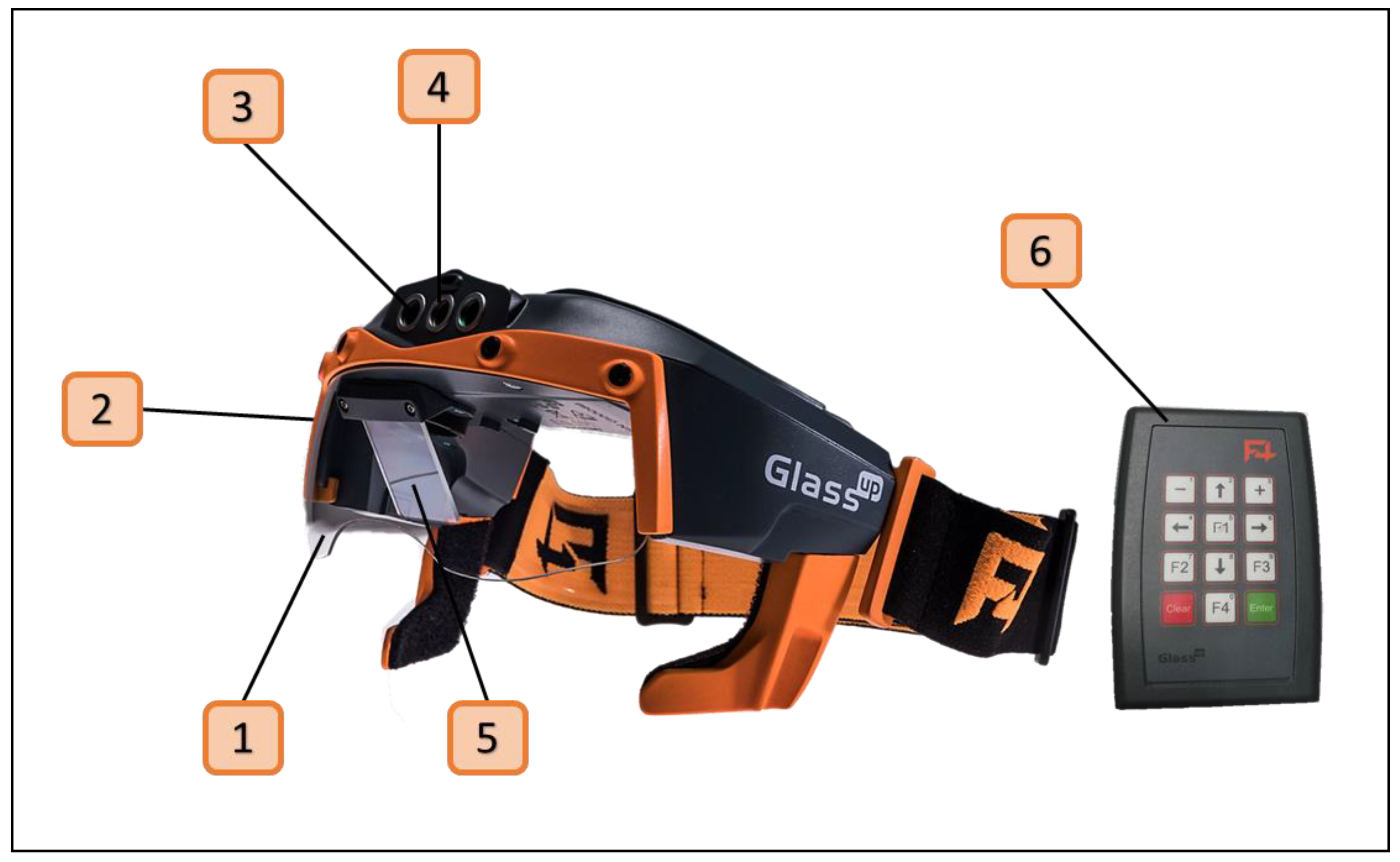
2.1. Task Equipment and Participants
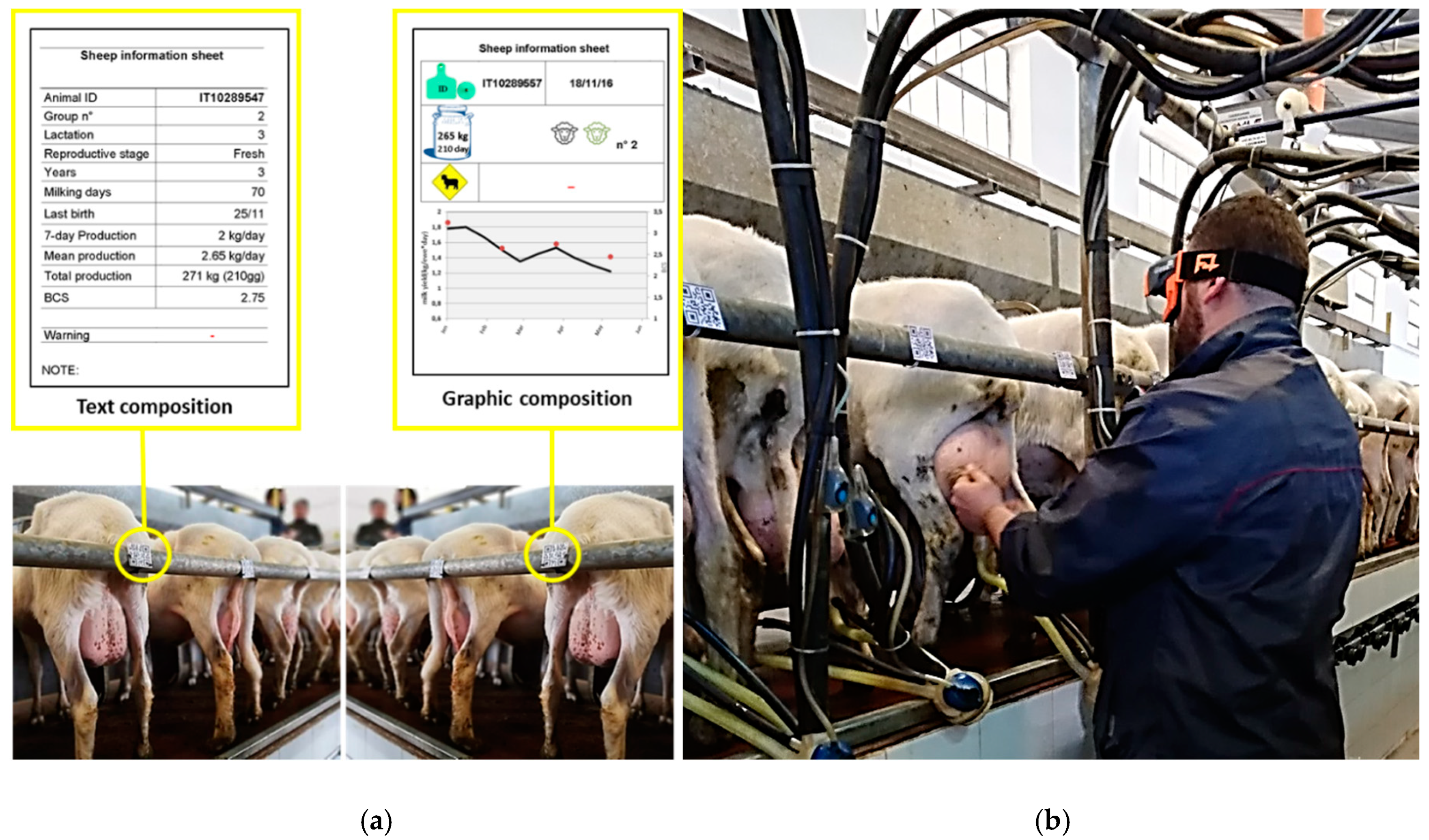
2.2. Sheep Information Sheet and QR Code
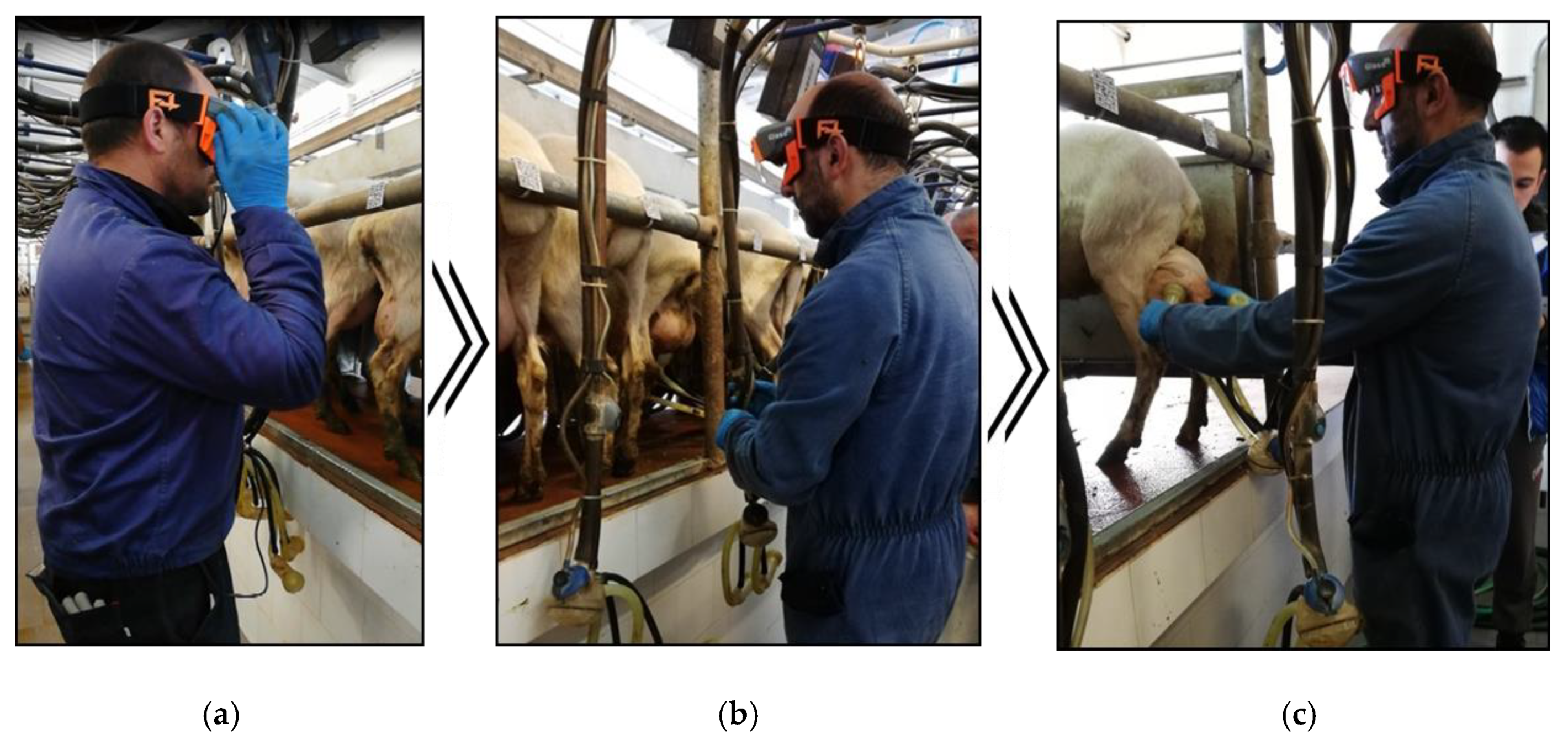
2.3. Experiment and Evaluation Procedure
2.4. Statistical Analysis
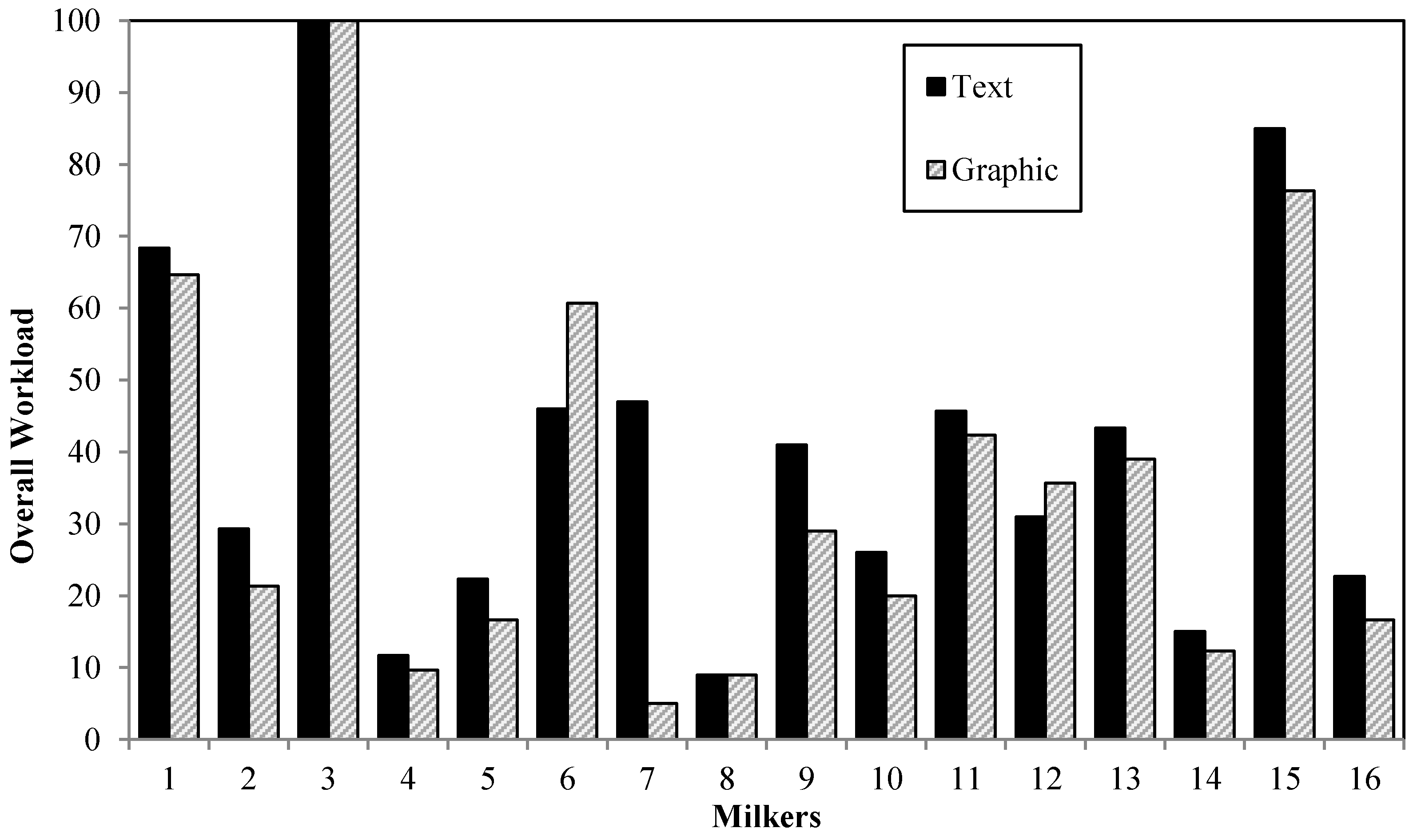
3. Results and Discussion
4. Conclusions
Author Contributions
Funding
Acknowledgments
Conflicts of Interest
References
- Caudell, T.P.; Mizell, D.W. Augmented reality: An application of heads-up display technology to manual manufacturing processes. In Proceedings of the IEEE 25th Hawaii International Conference on System Sciences, Kauai, HI, USA, 7–10 January 1992; Volume 2, pp. 659–669. [Google Scholar]
- Milgram, P.; Kishino, F. A Taxonomy of Mixed Reality Visual Displays. IEICE Trans. Inf. Syst. 1994, 77, 1321–1329. [Google Scholar]
- Azuma, R.; Baillot, Y.; Behringer, R.; Feiner, S.; Julier, S.; MacIntyre, B. Recent advances in augmented reality. IEEE Comput. Graph. Appl. 2001, 21, 34–47. [Google Scholar] [CrossRef] [Scilit]
- Azuma, R. A Survey of Augmented Reality. Presence Teleoperators Virtual Environ. 1997, 6, 355–385. [Google Scholar] [CrossRef] [Scilit]
- Chatzopoulos, D.; Bermejo, C.; Huang, Z.; Hui, P. Mobile augmented reality survey: From where we are to where we go. IEEE Access 2017, 5, 6917–6950. [Google Scholar] [CrossRef] [Scilit]
- Höllerer, T.H.; Feiner, S. Mobile augmented reality. In Telegeoinformatics: Location-Based Computing and Services; Taylor & Francis: London, UK, 2004; pp. 221–260. [Google Scholar]
- Tractica. Smart Augmented Reality Glasses. 2019. Available online: https://www.tractica.com/research/smart-augmented-reality-glasses/ (accessed on 14 October 2019).
- Bellini, H.; Chen, W.; Sugiyama, M.; Shin, M.; Alam, S.; Takayama, D. Goldman Sachs Global Investment Research Technical Report: Virtual and Augmented Reality—Understanding the Race for the Next Computing Platform. 2016. Available online: http://www.goldmansachs.com/our-thinking/pages/technology-drivinginnovation-folder/virtual-and-augmented-reality/report.pdf (accessed on 15 October 2019).
- Feiner, S. A Touring Machine: Prototyping 3D Mobile Augmented Reality Systems for Exploring the Urban Environment. In Proceedings of the IEEE First International Symposium on Wearable Computers, Cambridge, MA, USA, 13–14 October 1997; pp. 74–81. [Google Scholar]
- Lee, L.H.; Hui, P. Interaction Methods for Smart Glasses: A Survey. IEEE Access 2018, 6, 28712–28732. [Google Scholar] [CrossRef] [Scilit]
- Syberfeldt, A.; Danielsson, O.; Gustavsson, P. Augmented Reality Smart Glasses in the Smart Factory: Product Evaluation Guidelines and Review of Available Products. IEEE Access 2017, 5, 9118–9130. [Google Scholar] [CrossRef] [Scilit]
- Fraga-Lamas, P.; Fernández-Caramés, T.M.; Blanco-Novoa, Ó.; Vilar-Montesinos, M.A. A review on industrial augmented reality systems for the industry 4.0 shipyard. IEEE Access 2018, 6, 13358–13375. [Google Scholar] [CrossRef] [Scilit]
- De Pace, F.; Manuri, F.; Sanna, A. Augmented Reality in Industry 4.0. Am. J. Compt. Sci. Inform. Technol. 2018, 6, 1–17. [Google Scholar] [CrossRef] [Scilit]
- Eckert, M.; Volmerg, J.S.; Friedrich, C.M. Augmented Reality in Medicine: Systematic and Bibliographic Review. JMIR Mhealth Uhealth 2019, 7. [Google Scholar] [CrossRef] [Scilit]
- Huuskonen, J.; Oksanen, T. Soil sampling with drones and augmented reality in precision agriculture. Comput. Electron. Agric. 2018, 154, 25–35. [Google Scholar] [CrossRef] [Scilit]
- Kumar, N.M.; Singh, N.K.; Peddiny, V.K. Wearable Smart Glass: Features, Applications, Current Progress and Challenges. In Proceedings of the IEEE ICGCIoT, Bangalore, India, 16–18 August 2018; pp. 577–582. [Google Scholar]
- Cupial, M. Augmented reality in agriculture. In Proceedings of the 5th International Scientific Symposium: Farm Machinery and Process Management in Sustainable Agriculture, Lublin, Poland, 23–24 November 2011; pp. 23–24. [Google Scholar]
- Vuzix M400 Smart-Glasses. Available online: https://www.vuzix.eu/Products/M400-Smart-Glasses (accessed on 10 September 2019).
- Epson. Available online: https://www.epson.co.uk/products/see-through-mobile-viewer (accessed on 10 September 2019).
- GlassUp F4 Smart Glasses. Available online: https://www.glassup.com/en/ (accessed on 11 September 2019).
- Shea, R.; Fu, D.; Sun, A.; Cai, C.; Ma, X.; Fam, X.; Gong, W.; Liu, J. Location-based augmented reality with pervasive smartphone sensors: Inside and beyond Pokemon Go! IEEE Access 2017, 5, 9619–9631. [Google Scholar] [CrossRef] [Scilit]
- Kim, M.; Choi, S.H.; Park, K.-B.; Lee, J.Y. User Interactions for Augmented Reality Smart Glasses: A Comparative Evaluation of Visual Contexts and Interaction Gestures. Appl. Sci. 2019, 9, 3171. [Google Scholar] [CrossRef] [Scilit]
- Halachmi, I.; Guarino, M.; Bewley, J.; Pastell, M. Smart Animal Agriculture: Application of Real-Time Sensors to Improve Animal Well-Being and Production. Annu. Rev. Anim. Biosci. 2019, 7, 403–425. [Google Scholar] [CrossRef] [Scilit] [PubMed]
- Todde, G.; Murgia, L.; Caria, M.; Pazzona, A. A multivariate statistical analysis to characterize mechanization, structural and energy profile in Italian dairy farms. Energy Rep. 2016, 2, 129–134. [Google Scholar] [CrossRef] [Scilit]
- Caria, M.; Todde, G.; Pazzona, A. An Evaluation of automated in-line precision dairy farming technology implementation in three dairy farms in Italy. Front. Agric. Sci. Eng. 2019, 6, 181–187. [Google Scholar] [CrossRef] [Scilit]
- Todde, G.; Caria, M.; Gambella, F.; Pazzona, A. Energy and carbon impact of precision livestock farming technologies implementation in the milk chain: From dairy farm to cheese factory. Agriculture 2017, 7, 79. [Google Scholar] [CrossRef] [Scilit]
- Valergakis, G.E.; Arsenos, G.; Basdagianni, Z.; Banos, G. Grouping strategies and lead factors for ration formulation in milking ewes of the Chios breed. Livest. Sci. 2008, 115, 211–218. [Google Scholar] [CrossRef] [Scilit]
- Wu, Y.; Liang, D.; Shaver, R.D.; Cabrera, V.E. An income over feed cost nutritional grouping strategy. J. Dairy Sci. 2019, 102, 4682–4693. [Google Scholar] [CrossRef] [Scilit]
- Lobeck-Luchterhand, K.M.; Silva, P.R.B.; Chebel, R.C.; Endres, M.I. Effect of prepartum grouping strategy on displacements from the feed bunk and feeding behavior of dairy cows. J. Dairy Sci. 2014, 97, 2800–2807. [Google Scholar] [CrossRef] [Scilit]
- Kariuki, C.M.; van Arendonk, J.A.M.; Kahi, A.K.; Komen, H. Multiple criteria decision-making process to derive consensus desired genetic gains for a dairy cattle breeding objective for diverse production systems. J. Dairy Sci. 2017, 100, 4671–4682. [Google Scholar] [CrossRef] [Scilit]
- Leroy, G.; Baumung, R.; Notter, D.; Verrier, E.; Wurzinger, M.; Scherf, B. Stakeholder involvement and the management of animal genetic resources across the world. Livest. Sci. 2017, 198, 120–128. [Google Scholar] [CrossRef] [Scilit]
- Camara, Y.; Sow, F.; Govoeyi, B.; Moula, N.; Sissokho, M.M.; Antoine-Moussiaux, N. Stakeholder involvement in cattle-breeding program in developing countries: A Delphi survey. Livest. Sci. 2019, 228, 127–135. [Google Scholar] [CrossRef] [Scilit]
- Okayama, T.; Miyawaki, K. The “Smart Garden” using Augmented Reality. IFAC Proc. Vol. 2013, 46, 307–310. [Google Scholar] [CrossRef] [Scilit]
- Baumann, H.; Starner, T.; Iben, H.; Lewandowski, A.; Zschaler, P. Evaluation of graphical user-interfaces for order picking using head-mounted displays. In Proceedings of the ICMI’11 13th International Conference on Multimodal Interfaces, ACM Request Permissions, Alicante, Spain, 14–18 November 2011; pp. 377–384. [Google Scholar] [CrossRef] [Scilit]
- Kim, S.; Nussbaum, M.A.; Gabbard, J.L. Influence of augmented reality head-worn display type and user interface design on performance and usability in simulated warehouse order picking. Appl. Ergon. 2019, 74, 186–193. [Google Scholar] [CrossRef] [Scilit] [PubMed]
- Liu, D.; Jenkins, S.A.; Sanderson, P.M.; Watson, M.O.; Leane, T.; Kruys, A.; Russell, W.J. Monitoring with head-mounted displays: Performance and safety in a full-scale simulator and part-task trainer. Anesth. Analg. 2009, 109, 1135–1146. [Google Scholar] [CrossRef] [Scilit] [PubMed]
- Patterson, R.; Winterbottom, M.D.; Pierce, B.J. Perceptual issues in the use of headmounted visual displays. Hum. Factors 2006, 48, 555–573. [Google Scholar] [CrossRef] [Scilit]
- Kim, S.; Nussbaum, M.A.; Ulman, S. Impacts of using a head-worn display on gait performance during level walking and obstacle crossing. J. Electromyogr. Kinesiol. 2018, 39, 142–148. [Google Scholar] [CrossRef] [Scilit]
- Rzayev, R.; Woźniak, P.W.; Dingler, T.; Henze, N. Reading on Smart Glasses: The Effect of Text Position, Presentation Type and Walking. In Proceedings of the CHI Conference on Human Factors in Computing Systems, Montreal, QC, Canada, 21–26 April 2018. [Google Scholar]
- Caria, M.; Sara, G.; Todde, G.; Polese, M.; Pazzona, A. Exploring smart glasses for augmented reality: A valuable and integrative tool in the precision livestock farming. Animals 2019, 9, 903. [Google Scholar] [CrossRef] [Scilit]
- Bracco, F.; Chiorri, C. Italian validation of the NASA-TLX in a sample of bikers. In Proceedings of the National Congress of the Italian Psychological Association, Rovereto, Italy, 13–15 September 2006; Volume 47. [Google Scholar]
- Hart, S.G. NASA-Task Load Index (NASA-TLX); 20 years later. In Proceedings of the Human Factors and Ergonomics Society 50th Annual Meeting, Santa Monica, CA, USA, 16–20 October 2006; pp. 904–908. [Google Scholar]
- Wang, C.-H.; Tsai, N.-H.; Lu, J.-M.; Wang, M.-J. Usability evaluation of an instructional application based on Google Glass for mobile phone disassembly task. Appl. Ergon. 2019, 77, 58–69. [Google Scholar] [CrossRef] [Scilit]
- Assila, A.; de Oliveira, K.M.; Ezzedine, H. Standardized Usability Questionnaires: Features and Quality Focus. Electron. J. Comput. Sci. Inf. Technol. 2016, 6, 15–31. [Google Scholar]
- Lewis, J.R. IBM computer usability satisfaction questionnaires: Psychometric evaluation and instructions for use. Int. J. Hum. Comput. Interact. 1995, 7, 57–78. [Google Scholar] [CrossRef] [Scilit]
- Caria, M.; Boselli, C.; Murgia, L.; Rosati, R.; Pazzona, A. Influence of low vacuum levels on milking characteristics of sheep, goat and buffalo. J. Agric. Eng. 2013, 44, 217–220. [Google Scholar] [CrossRef]
- Posner, M.I.; Nissen, M.J.; Klein, R.M. Visual dominance: An information-processing account of its origins and significance. Psychol. Rev. 1976, 83, 157–171. [Google Scholar] [CrossRef] [PubMed]


| Work Completion Time (min) | Number of Errors | |
|---|---|---|
| Total (N = 32) † | 11.1 ± 3.70 | 0.8 ± 1.44 |
| Information Composition Type | ||
|---|---|---|
| Text | Graphic | |
| Mental Demand | 47.50 ± 28.75 | 37.50 ± 29.21 |
| Physical Demand | 39.06 ± 32.10 | 36.56 ± 29.31 |
| Temporal Demand | 47.50 ± 28.93 | 38.13 ± 28.51 |
| Performance | 35.00 ± 29.94 | 33.13 ± 28.63 |
| Effort | 32.50 ± 30.39 | 30.63 ± 31.30 |
| Frustration | 24.38 ± 28.45 | 22.50 ± 27.99 |
| Category | N † | Statement | Mean | SD | Category Mean |
|---|---|---|---|---|---|
| SYSUSE | 1 | Overall, I am satisfied with how easy it is to use this device | 4.19 | 0.98 | |
| 2 | It was simple to use the device | 4.19 | 1.17 | ||
| 3 | I could effectively complete my work using this device | 4.00 | 1.26 | ||
| 4 | I was able to complete my work quickly using this device | 3.69 | 1.14 | ||
| 5 | I was able to efficiently complete my work using this device | 3.63 | 0.96 | ||
| 6 | I felt comfortable using this device | 4.06 | 1.18 | ||
| 7 | It was easy to learn to use this device | 4.69 | 0.48 | ||
| 8 | I believe I could become productive quickly using this device | 3.44 | 1.26 | 3.98 | |
| INFOQUAL | 9 | It was easy to find the information on mastitis I needed | 4.69 | 0.48 | |
| 10 | It was easy to find the information on milk production I needed | 4.56 | 0.63 | ||
| 11 | The information was effective in helping me complete the task and scenarios | 4.50 | 0.63 | ||
| 12 | The organization of text-format information on the device display was clear | 3.56 | 1.15 | ||
| 13 | The organization of graphic-format information on the device display was clear | 4.06 | 1.00 | 4.28 | |
| INTER QUAL | 14 | This device has all the functions and capabilities I expect it to have | 3.75 | 1.06 | 3.75 |
| OVERALL | 15 | Overall, I am satisfied with this device | 4.38 | 0.81 | 4.38 |
© 2020 by the authors. Licensee MDPI, Basel, Switzerland. This article is an open access article distributed under the terms and conditions of the Creative Commons Attribution (CC BY) license (http://creativecommons.org/licenses/by/4.0/).
Share and Cite
Caria, M.; Todde, G.; Sara, G.; Piras, M.; Pazzona, A. Performance and Usability of Smartglasses for Augmented Reality in Precision Livestock Farming Operations. Appl. Sci. 2020, 10, 2318. https://doi.org/10.3390/app10072318
Caria M, Todde G, Sara G, Piras M, Pazzona A. Performance and Usability of Smartglasses for Augmented Reality in Precision Livestock Farming Operations. Applied Sciences. 2020; 10(7):2318. https://doi.org/10.3390/app10072318
Chicago/Turabian StyleCaria, Maria, Giuseppe Todde, Gabriele Sara, Marco Piras, and Antonio Pazzona. 2020. "Performance and Usability of Smartglasses for Augmented Reality in Precision Livestock Farming Operations" Applied Sciences 10, no. 7: 2318. https://doi.org/10.3390/app10072318
APA StyleCaria, M., Todde, G., Sara, G., Piras, M., & Pazzona, A. (2020). Performance and Usability of Smartglasses for Augmented Reality in Precision Livestock Farming Operations. Applied Sciences, 10(7), 2318. https://doi.org/10.3390/app10072318