1. Introduction
Open-source software (OSS) has become a central infrastructure of the digital economy. Sponsors of OSS projects coordinate development communities, maintain shared code bases and increasingly offer commercial service on top of them. A longstanding challenge for such sponsors is how to capture value without undermining the openness and community participation that make OSS attractive in the first place (
Chesbrough & Appleyard, 2007;
Morgan et al., 2013;
Osterloh & Rota, 2007;
West, 2003). Commercial open-source and open-core models address this tension by combining free, open components with proprietary features, hosted variants or services (
Riehle, 2012), yet we still know relatively little about how these configurations evolve over time as sponsors seek more sophisticated revenue portfolios.
At the same time, multi-sided platform research shows that digital platforms often monetise through multiple roles (e.g., marketplace operator, transaction intermediary, infrastructure provider) within a single ecosystem (
Cusumano et al., 2019;
Trabucchi & Buganza, 2021;
Trabucchi et al., 2022). Freemium and tiered pricing models further complicate the picture by decoupling adoption from direct revenues: free tiers fuel growth, while premium tiers, commissions or other mechanisms monetise only subsets of users or transactions (
Anderson, 2009;
Kumar, 2014). For open, ecosystem-based platforms, monetization thus becomes a configuration problem: platforms must decide who pays, for what, and at which point in the value-creation process, while maintaining the participation of developers, partners and users.
A third strand of research points to the growing role of data and artificial intelligence (AI) in business model innovation. Data- and AI-enabled business models rely on rich data assets and analytics capabilities to create and capture value through, for instance, prediction, optimisation and personalisation (
Gregory et al., 2021;
Hartmann et al., 2016;
Lanteri, 2021;
Åström et al., 2022). However, most accounts implicitly assume that platform sponsors have centralised access to high-quality data and strong control over digital infrastructure. In open-source, self-hosted contexts, this assumption does not hold: software is deployed on merchants’ own infrastructure, code is decentralised, and key usage and transaction data remain under the control of ecosystem participants. Under such conditions, the role of data and AI in monetization is both more constrained and potentially more consequential.
This paper investigates these issues through an in-depth case study of PrestaShop, a large open-source e-commerce platform whose sponsor has progressively layered new monetization mechanisms: an Addons marketplace, a payment solution (PrestaShop Checkout), managed infrastructure (PrestaShop Hosting) and a curated subscription tier (PrestaShop Enterprise). These sit on top of a free, community-based core. PrestaShop operates in a self-hosted, decentralised environment: merchants install and run the software on their own infrastructure, and a global network of agencies and technology partners provides services around the platform. During the period we study, the sponsor embarked on a shift from a diffuse, complement-based revenue logic to a more structured hybrid monetization portfolio, while simultaneously building a data strategy and AI capabilities to overcome an initially recognised “data blindness” and to support more intentional value capture. In this paper, we use hybrid monetization to denote configurations where several distinct revenue logics, such as marketplace commissions, transaction fees, infrastructure services and subscription tiers, coexist and are deliberately combined by the platform sponsor within a single ecosystem.
Existing studies illuminate important aspects of this trajectory but only partially address the situation we observe. Research on commercial OSS and open-core models explains why firms combine open and proprietary layers, but typically treats business models as relatively static types (e.g., “service-based” vs. “open-core”) and says less about how mature OSS sponsors sequentially assemble and reconfigure multiple revenue streams over time. Freemium research focuses on tiering within a single, often centrally hosted SaaS product and rarely considers multi-actor ecosystems where code and data are decentralised. Platform and multi-sided market studies detail a variety of monetization logics (commissions, subscriptions, transaction fees), yet often assume strong infrastructural and data control on the part of the platform. We know much less about how these logics are configured and governed in a self-hosted OSS platform that must work with fragmented data, strong community norms and heterogeneous partners.
We know comparatively little about how these elements come together in an open-source, data-constrained platform: how a sponsor of a self-hosted OSS platform sequentially reconfigures its business model to implement a hybrid monetization architecture, and how it manages the resulting tensions between openness, ecosystem health and value capture. To address this gap, we ask:
RQ1: How does the sponsor of a self-hosted open-source platform reconfigure its business model to implement hybrid monetization?
RQ2: How are tensions between openness, ecosystem participation, and value capture governed as hybrid monetization emerges over time?
In this study, hybrid monetization refers to the layered combination of an open-source core, freemium-like participation structures, and data-enabled services operating under conditions of decentralized data and limited platform control.
We address the two research questions through a qualitative, abductive single-case study of PrestaShop, based on semi-structured interviews with management, analysis of internal dashboards and strategy documents, and participant observation of key meetings between January and July 2024. The study builds on and extends prior work on AI-enabled transformation in PrestaShop (
De Ruosi et al., 2026), which analysed the role of AI as trigger, driver and enabler of organisational change. Here, we reorient the analysis to foreground hybrid monetization and governance, focusing on how the sponsor assembles and governs a layered monetization architecture and how data and AI function as monetization infrastructure in this process.
The paper makes four main contributions. First, it contributes to research on open-source and open-core business models by providing a processual account of how hybrid monetization is assembled in a mature open-source platform, showing how a sponsor moves from a diffuse, complement-based revenue logic toward a layered portfolio of marketplace, transactional, infrastructural and subscription-based streams while preserving an open core. Second, it enriches platform and hybrid multi-sided platform studies by framing hybrid monetization as a configuration problem and showing how a single sponsor can simultaneously occupy multiple monetization roles within one ecosystem. Third, it adds a monetization lens to AI-enabled transformation research by demonstrating how data and AI capabilities in a self-hosted, decentralised ecosystem function as monetization infrastructure that makes targeted, scalable value capture designable, monitorable and adjustable over time. Finally, it contributes to platform governance research by showing how monetization design itself constitutes boundary work: hybrid monetization architectures are made workable through selective centralisation, partner-inclusive designs and configurable data-sharing arrangements that preserve multiple participation modes for community members, partners and merchants.
The paper is structured as follows.
Section 2 develops the theoretical background;
Section 3 presents the research design and methodology;
Section 4 narrates the evolution of PrestaShop’s business model and data/AI capabilities and develops the three dynamics identified in our analysis;
Section 5 discusses the implications and
Section 6 concludes.
2. Theoretical Background
2.1. Business Model Dynamics in Commercial Open-Source Platforms
Business models explain how organisations configure activities to create, deliver and capture value (
Teece, 2010;
Zott et al., 2011). In digital contexts, business model change is typically treated as a dynamic, path-dependent process in which new value propositions and revenue models are refined through cycles of experimentation, scaling and adjustment (
Achtenhagen et al., 2013;
Foss & Saebi, 2018;
Kohtamäki et al., 2024;
Trischler & Li-Ying, 2023). Rather than relying on a single dominant revenue stream, firms often assemble revenue portfolios, intentionally combined sets of different monetization logics, to support growth and resilience over time.
Within this broader stream, open innovation and open business model research highlight that firms may deliberately open parts of their value creation system to external contributors while retaining control over key assets and revenue streams (
Chesbrough, 2006;
Chesbrough & Appleyard, 2007;
Chesbrough & Bogers, 2014). Open-source software (OSS) is a central empirical setting: firms sponsor shared code bases, mobilise communities of contributors, and monetise through services, complementary products or proprietary extensions rather than the sale of the core software alone (
Morgan et al., 2013;
Osterloh & Rota, 2007).
Commercial open source and open-core models formalise these ideas.
West (
2003) frames the core strategic dilemma as “how open is open enough?”, arguing that many firms combine open layers that encourage adoption and complements with proprietary layers that support differentiation and value capture.
Riehle (
2012) describes the single-vendor commercial OSS model, in which a focal firm controls an OSS project and earns revenues via dual licensing, subscriptions and complementary services. In open-core variants, a feature-complete or nearly complete core is released under an open-source licence, while enterprise-grade features, tooling or hosted variants remain proprietary.
These studies increasingly recognise that commercial OSS business models evolve over time, but they often classify models in relatively static terms (e.g., “service-based” vs. “open-core”) and say less about how sponsors of mature OSS projects reconfigure their models to assemble more complex monetization portfolios. PrestaShop exemplifies this dynamic setting. It is a French open-source e-commerce platform used by more than 250,000 merchants and thousands of expert partners worldwide. In its early years, the business model centred on free distribution of the core software and indirect value capture via complementary services and the Addons marketplace. More recently, the sponsor has layered proprietary services and curated distributions, tightly specified bundles of modules and services that are selected, quality-controlled and updated by the sponsor, on top of the open core, raising questions about how commercial OSS platforms gradually re-architect their business models while preserving openness and community participation.
2.2. Hybrid Monetization in Multi-Sided Platform Ecosystems
Multi-sided platform theory provides a second lens for understanding how such re-architecting occurs. Multi-sided platforms create value by enabling interactions among distinct user groups and harnessing cross-side network effects (
Eisenmann et al., 2006;
Rochet & Tirole, 2003;
Cusumano et al., 2019). Their monetization choices cannot be reduced to simple price levels: platforms must decide which sides to subsidise, which to monetise, and how to combine revenue logics such as commissions, listing fees, subscriptions or advertising (
Täuscher & Laudien, 2018). Recent work on hybrid multi-sided platforms shows that platform sponsors often combine multiple monetization roles (e.g., marketplace operator, transaction intermediary, infrastructure provider) within the same ecosystem, configuring them in different ways over time (
Trabucchi & Buganza, 2021;
Trabucchi et al., 2022).
The freemium literature adds an important pricing and tiering dimension.
Anderson (
2009) popularised the idea that digital products with low or zero marginal costs can be offered free to most users while monetizing a paying minority or alternative revenue streams.
Kumar (
2014) defines freemium as a combination of free and premium offerings and highlights three core design issues: what to include in the free tier, how to structure premium tiers, and how to manage conversion and cost to serve. Empirical studies show that conversion depends on how value is partitioned across tiers, perceived fairness, and the interaction with network effects: free tiers can fuel user growth and ecosystem participation, while premium tiers monetise a subset of users who value additional functionality, assurances or support.
For open e-commerce platforms, these insights translate into a specific configuration problem. Platforms such as PrestaShop orchestrate interactions across merchants, module developers, agencies and technology partners, and can monetise at multiple points: commissions on marketplace sales, partner programmes, transactional fees on payments, infrastructure services such as hosting, and curated subscription bundles. Historically, PrestaShop relied on a free open-source core and monetized indirectly via Addons commissions and partner relationships. In practice, this free core functions as a freemium “base tier”: merchants can run fully functional shops without paying the sponsor directly, while the platform captures value from complements. More recent initiatives add explicit transactional, infrastructural and subscription layers on top of this base tier. From a hybrid multi-sided perspective, the sponsor is re-drawing who pays, for what, and at which point in the value creation process, assembling a portfolio of revenue logics that target different sides of the ecosystem.
2.3. Data- and AI-Enabled Monetization Under Decentralised Data Constraints
A third strand of literature concerns data-driven and AI-enabled business models.
Hartmann et al. (
2016) conceptualise data-driven business models as those in which data are central to value propositions and revenue mechanisms—for instance, analytics, prediction or optimisation services sold on a subscription or usage basis.
Gupta and George (
2016) describe big data analytics capability as a bundle of tangible, human and organisational resources that allow firms to transform data into performance improvements. Building on these foundations, research on AI-enabled business models and data ecosystems shows that intensive use of data and AI is often associated with new monetization mechanisms such as analytics subscriptions, outcome-based pricing and performance-linked fees, and with data network effects that can reinforce competitive advantage (
Lanteri, 2021;
Mehmood et al., 2025).
Much of this work, however, implicitly assumes that firms or platform sponsors enjoy centralised access to rich, high-quality data and strong control over their digital infrastructure. In many platform settings—particularly consumer-facing or cloud-based services—this assumption is reasonable: interactions occur on centrally managed infrastructure, and data streams can be instrumented and analysed in near real time. For open-source, self-hosted platforms, the picture is different. Code is decentralised, installations are distributed across merchants’ own infrastructure, and key usage and transaction data remain under the control of ecosystem participants. This decentralisation constrains the sponsor’s visibility and limits the scope for designing data-driven monetization ex ante.
The PrestaShop case illustrates these constraints. Recent strategic moves—such as the creation of a Data Strategy Team, the deployment of tools like Looker and HubSpot, and the development of AI-based segmentation and forecasting—were explicitly aimed at overcoming an initial “data blindness” and making the ecosystem legible enough to support more intentional monetization. Yet, because many merchants self-host and control their own data, the platform’s data strategy depends on opt-in mechanisms, selective data-sharing arrangements and proprietary analytics layers that sit on top of, rather than replace, the decentralised infrastructure. In this context, data and AI capabilities function as monetization infrastructure: they enable the sponsor to identify high-potential segments, design differentiated offerings such as Checkout, Hosting and Enterprise, and monitor their performance, but they must be built under persistent structural constraints on data access.
2.4. Synthesis and Research Gap: Hybrid Monetization in an Open, Data-Constrained Platform
Bringing these lenses together, PrestaShop sits at the intersection of three conversations: commercial open-source and open-core business models, hybrid multi-sided platform monetization (including freemium tiering), and data- and AI-enabled business models. Existing research shows that commercial OSS sponsors can mix open and proprietary layers, that platforms can combine multiple monetization roles within one ecosystem, and that data and AI can underpin increasingly fine-grained monetization. Yet most accounts treat these elements separately and typically assume either relatively static open-core configurations or centrally controlled, data-rich platforms.
We know less about how a mature, self-hosted open-source platform sequentially reconfigures its business model to assemble a hybrid monetization architecture that spans complements, transactions, infrastructure and curated subscriptions, when its legitimacy depends on openness and its visibility is limited by decentralised data. This tension motivates our empirical inquiry. The following sections use this integrated theoretical framing to interpret PrestaShop’s trajectory and to derive implications for business model and platform research.
3. Research Design and Methodology
3.1. Overall Research Approach
This study adopts a qualitative single case-study design to investigate how an open-source platform sponsor reconfigures its business model toward hybrid monetization under decentralised data constraints. A single-case design is appropriate when the aim is to develop rich, processual explanations of how and why particular organisational configurations emerge over time rather than to test predefined hypotheses (
Eisenhardt & Graebner, 2007;
Siggelkow, 2007;
Yin, 2014).
The empirical setting is PrestaShop, a major open-source e-commerce platform whose sponsor has progressively layered monetization mechanisms (Addons, Checkout, Hosting, Enterprise) on top of a free, community-based core. The case combines commercial open source, multi-sided platform dynamics and data/AI-enabled transformation, while operating under structural constraints on data centralisation and direct control over merchant relationships.
Our research design follows a systematic combining and abductive logic (
Dubois & Gadde, 2002;
Welch et al., 2011). Rather than moving linearly from theory to data, we iterated between emerging insights from the field and evolving theoretical framings around business model dynamics, hybrid monetization and data/AI capabilities. This paper builds on and extends a prior case study of PrestaShop’s AI adoption and data strategy (
De Ruosi et al., 2026), which analysed the role of AI as trigger, driver and enabler of organisational change. While we draw on the same core empirical setting and partially overlapping data, the present study reorients the analysis toward hybrid monetization and governance: it foregrounds how the platform sponsor assembles and governs a layered monetization architecture, and how data and AI function as monetization infrastructure in this process.
Methodologically, we combine multiple qualitative sources—semi-structured interviews, internal documents and dashboards, and participant observation—to reconstruct key episodes in the evolution of PrestaShop’s business model and the development of data and AI capabilities that supported monetization choices.
3.2. Case Selection and Context
PrestaShop was selected as a revelatory and information-rich case for four reasons. First, it is a mature open-source e-commerce platform with a large installed base of self-hosted merchants and a global network of agencies and technology partners. This configuration makes it an archetypal commercial OSS platform that must balance openness, community expectations and value capture.
Second, during the period studied, PrestaShop shifted from a diffuse, complement-based revenue logic centred on the Addons marketplace and partner programmes toward a more structured hybrid monetization portfolio. The introduction and scaling of PrestaShop Checkout (transaction fees), PrestaShop Hosting (infrastructure revenues) and PrestaShop Enterprise (a curated subscription tier) each altered the sponsor’s role and control points within the ecosystem.
Third, this strategic reorientation was intertwined with the construction of a data strategy and AI capabilities. Recognised limitations in data visibility prompted the creation of a Data Strategy Team, investments in tools such as Looker and HubSpot, and experiments with AI-based segmentation and forecasting, making PrestaShop an informative context for examining how data and AI support monetization under decentralised data constraints.
Finally, one of the authors had privileged access to the organisation through ongoing collaboration with senior managers. This embedded position provided access to internal dashboards, board presentations and strategy documents, and enabled participation in internal meetings where monetization and data/AI initiatives were discussed. While such proximity raises issues of positionality and potential bias, it also enhances the depth of insight and the potential for theory-building from a single case (
Chughtai & Myers, 2017;
Welch et al., 2011). We return to these issues in
Section 3.5.
3.3. Data Collection
Data were collected between January and July 2024 using three complementary sources: semi-structured interviews, internal documents and dashboards, and participant observation.
Table 1 summarises the dataset.
Semi-structured interviews. We conducted ten in-depth interviews with senior and intermediate managers involved in strategy, product, data and commercial roles. Informants included members of the executive team, the Head of Data & AI and Data Strategy Lead, senior sales and partnership managers, and regional leaders responsible for key markets. Interviewees were selected purposively to capture diverse perspectives on monetization, data and AI, and ecosystem governance.
The interview protocol explored four broad themes: (1) the evolution of PrestaShop’s business model and revenue logics since its foundation in 2007; (2) the role of data strategy and AI capabilities in informing and enabling monetization decisions; (3) the design and performance of specific revenue mechanisms and their implications for different ecosystem actors; and (4) organisational capabilities and cultural shifts associated with a move from a community-centric posture to a more sales- and performance-driven model over time. Interviews lasted between 35 and 50 min, were conducted online, recorded with consent and transcribed verbatim. We encouraged informants to reconstruct concrete episodes and decision processes and probed for contradictions or alternative interpretations.
Document and dashboard analysis. To complement interview accounts and mitigate retrospective bias, we analysed a corpus of internal documents and dashboards, including performance dashboards for Addons and Checkout, weekly revenue and profitability reports, product and strategy presentations for Hosting and Enterprise, ecosystem mapping and segmentation documents, and board-level slides on data strategy and AI initiatives. These materials provided evidence on the timing and scope of monetization initiatives, revenue trends and performance indicators (e.g., Addons commission revenues, Checkout adoption and volumes, Hosting and Enterprise sales, cost structure and EBITDA evolution), ecosystem segmentation logic, and internal framings of data, AI and monetization.
Participant observation. One author engaged in participant observation through regular interactions with PrestaShop managers and participation in selected internal meetings and workshops, including strategy sessions on monetization, discussions about the role of partners and agencies, and meetings of the Data Strategy Team and product teams and public events with merchants and agencies. Fieldnotes focused on how managers framed monetization problems, articulated trade-offs between openness and value capture, and discussed the role of data and AI in supporting decisions.
Across all three data sources, we paid particular attention to temporal ordering and to episodes where monetization initiatives, data/AI capabilities and governance arrangements interacted. This allowed us to reconstruct how PrestaShop moved from a community-centric, diffuse monetization logic toward a more structured hybrid monetization architecture, and how debates about community, partners and data governance shaped these moves.
Although primary data collection for this study was conducted between January and July 2024, the case narrative spans the period from PrestaShop’s founding in 2007 to the emergence of its hybrid monetization portfolio in 2024. Earlier phases of the trajectory were reconstructed through triangulation of archival internal documents, historical strategy presentations, publicly available records, and retrospective accounts from long-tenured informants. This temporal triangulation enabled the study to develop a processual explanation of business model reconfiguration while mitigating risks of retrospective bias and over-reliance on recent observations.
3.4. Data Analysis
Data analysis proceeded in several iterative steps, informed by the Gioia methodology for inductive concept development and by established approaches to qualitative data reduction and display (
Gioia et al., 2013;
Magnani & Gioia, 2023). Our aim was to develop a processual explanation of hybrid monetization and governance in PrestaShop while remaining grounded in informants’ language and the empirical particularities of the case.
First, we conducted open coding of interview transcripts, observation notes and key documents, attaching first-order codes to passages that described changes in monetization practices, data and AI initiatives, ecosystem relationships and governance arrangements.
Next, we grouped first-order codes into second-order themes that captured recurring patterns across sources, such as layering of monetization logics, data and AI as monetization infrastructure, rebalancing roles between platform and partners, and boundary work around community versus commercial orientation. We then connected these themes into three aggregate dimensions that structure our process narrative: (1) the shift from community-led freeness to intentional monetization, (2) the construction of data and AI as monetization infrastructure, and (3) the assembly and governance of a hybrid monetization portfolio. These dimensions provide the backbone for the Findings (
Section 4).
Because this study builds on the empirical setting analysed in
De Ruosi et al. (
2026), we also reflected explicitly on how our analytical focus differs. The previous study organised the data structure around the roles of AI as trigger, driver and enabler of transformation. For the present paper, we revisited the corpus with a different theoretical and coding lens, foregrounding hybrid monetization, the configuration of revenue logics across platform layers, and governance of openness–capture tensions. This entailed re-coding portions of the material and re-assembling the aggregate dimensions to align with the business model and platform monetization studies mobilised here.
Throughout analysis, we used temporal bracketing to structure the case into analytically meaningful periods (foundation, Addons-driven monetization, ecosystem rebalancing, data/AI build-up, Checkout/Hosting/Enterprise) and iterated between within-period coding and cross-period comparison. These temporal brackets correspond to historically distinct phases in the platform’s evolution—foundation, Addons-driven monetization, ecosystem rebalancing, data and AI capability build-up, and the emergence of a hybrid monetization portfolio—allowing us to connect observed mechanisms to longitudinal shifts in governance, data visibility, and value-capture architecture. We also engaged in theory matching (
Dubois & Gadde, 2002), moving back and forth between emerging patterns and the studies on commercial OSS, hybrid multi-sided platforms and data-driven business models.
3.5. Ensuring Trustworthiness and Validity
We adopted several strategies to enhance the trustworthiness and validity of our findings (
Lincoln & Guba, 1985;
Welch et al., 2011). First, we sought triangulation across data sources by comparing narratives from interviews with internal dashboards, strategy documents and fieldnotes; divergences were treated as analytically interesting and probed in follow-up conversations. Second, we conducted member checks with key informants by sharing preliminary process maps and emerging interpretations and inviting feedback on factual accuracy and plausibility. These discussions helped refine temporal sequencing and clarify the motivations behind monetization initiatives.
Third, we maintained an audit trail of coding decisions, theme development and theoretical moves. Interim data structures, memos and revised coding schemes were stored and annotated, allowing us to track how our interpretation evolved over time and how it differed from the AI-centric analysis reported in
De Ruosi et al. (
2026). Fourth, we reflected on positionality and access. The embedded author’s dual role as collaborator and researcher provided deep insight but also potential bias; to mitigate this, coding was discussed among co-authors, who challenged interpretations that appeared too aligned with managerial narratives, and we systematically sought disconfirming evidence in the data (
Chughtai & Myers, 2017). While embedded access provided privileged visibility into strategic discussions and internal data, it also required deliberate reflexivity. In several instances, managerial narratives emphasizing successful monetization outcomes were contrasted with operational tensions observed during meetings and workshops, particularly regarding partner concerns about cannibalization and uneven adoption of new revenue streams across regions. These divergences were treated as analytically significant rather than reconciled prematurely, and they informed the interpretation of hybrid monetization as a negotiated and politically contingent process rather than a linear success trajectory.
Finally, following
Tsang (
2014), we do not claim statistical generalisability from a single case. Instead, we aim for analytic generalisation by specifying the conditions under which our explanation is likely to travel—namely, open-source or open-core platforms that rely on self-hosted deployments, face decentralised data and limited direct control over ecosystem participants, yet seek to implement hybrid monetization architectures supported by data and AI capabilities.
4. Findings
Our analysis shows how PrestaShop gradually assembled a hybrid monetization architecture on top of its open-source core. Rather than a single pivot, this architecture emerged through a sequence of adjustments in value capture, governance and data strategy. We trace three interrelated dynamics: a move from community-led freeness to intentional monetization, the construction of data and AI as monetization infrastructure, and the assembly and governance of a portfolio of monetization logics (Addons, Checkout, Hosting, Enterprise).
To make the longitudinal structure of this evolution explicit, the findings are organized around temporally bracketed phases spanning from the platform’s founding in 2007 to the consolidation of a hybrid monetization portfolio in 2024 (see
Table 2 for a summary of key periods, triggers, and governance implications).
4.1. From Community-Led Freeness to Intentional Monetization
In its first years (2007–2014), PrestaShop operated as a classic open-source project: the core software was free, development was community-led, and the business model relied on support services and ancillary activities rather than the software itself. Value creation was substantial—the platform attracted a large base of merchants and developers—but value capture remained diffuse, indirect and weakly instrumented.
A first deliberate move toward monetization came with the Addons marketplace (2015–2018), which centralised the distribution of modules and themes and allowed PrestaShop to capture commissions on third-party sales. This introduced a first hybrid configuration: the core remained open-source and free, while a proprietary marketplace created platform-centric revenues. At the same time, the marketplace revealed limits: revenues were volatile, dependent on complementors and difficult to manage strategically, and quality and pricing governance had to be recentralised, creating tensions with developers.
Between 2019 and 2020, management entered what insiders described as an “ecosystem rebalancing” phase. PrestaShop’s role was reframed “from project to orchestrator”, with renewed dialogue with merchants, agencies and module developers to clarify expectations and redistribute responsibilities. The realisation that PrestaShop lacked basic visibility on its ecosystem—the “data blindness” repeatedly mentioned by executives—crystallised the sense that the open-source plus marketplace configuration under-monetised the platform’s position and left the sponsor dependent on others’ commercial choices. As one senior executive explained, “for years we had growth in installations and ecosystem activity, but very limited visibility on who was really creating value or where monetization could realistically happen. We were managing a community more than a business.” This perceived disconnect between ecosystem expansion and value capture reinforced internal recognition that a more orchestrated and data-informed monetization logic was required.
Mechanism. A configuration that combined a free, community-led core with a loosely governed marketplace created structural under-monetization and dependency on complementors. As managers confronted the limits of this model and its associated data blindness, they reframed PrestaShop’s role from project to orchestrator, generating the problem pressure that triggered subsequent investments in data strategy and AI capabilities as enablers of more deliberate monetization.
4.2. Data and AI as Monetization Infrastructure
From 2021 onwards, discussions about AI exposed the absence of systematic data governance and catalysed the construction of a data strategy. Early explorations of potential AI use cases in recommendation, forecasting or support made visible that the company lacked robust, centralised data on merchants, partners and usage. This prompted the creation of a Data Strategy Team, the consolidation of internal and external data sources into unified merchant and partner profiles, and the deployment of analytics and AI-enabled segmentation tools.
The CFO explicitly framed these moves in monetization terms, wanting to “know everything about the ecosystem and progressively monetise it and shift to automated ways to do it.” Practically, the data team integrated information from product usage, support, billing and ecosystem intelligence tools to support AI-enabled segmentation and prioritisation. The Go-To-Market team used these profiles to identify profitable clusters—notably medium-sized merchants in EU and LATAM—and to target outreach and offer design accordingly.
For example, internal segmentation dashboards were used to re-prioritize commercial outreach toward mid-sized merchants showing sustained transaction growth but low historical attachment to paid services. As one data team member noted, “once we could clearly see which merchants combined scale, stability, and growth potential, the discussion shifted from generic ecosystem support to very concrete monetization opportunities.” This operational use of analytics illustrates how data visibility translated into actionable targeting rather than remaining a purely descriptive capability.
AI and analytics also influenced operational areas, such as customer support, where models reduced ticket volumes and resolution times through dynamic content and automated responses. Across 2022–2024, managers linked improvements in key indicators (e.g., live sites, EBITDA, operating costs) to the data-driven reorientation of the business. Rather than asking “how can we monetise modules?”, the emerging logic was “how can we monetise our position and knowledge of the ecosystem?”, with data and AI providing the instrumentation needed to evaluate and steer monetization choices.
Mechanism. Perceived data blindness led to the creation of a central Data Strategy Team and unified profiles and dashboards. Coupled with AI tools, this infrastructure enabled PrestaShop to segment the ecosystem, prioritise medium-sized EU/LATAM merchants and discipline monetization experiments with performance indicators. Data and AI thus shifted from being potential feature enablers to a backbone that makes intentional, evidence-based monetization feasible.
4.3. Assembling a Hybrid Monetization Portfolio
On top of this data and AI infrastructure, PrestaShop progressively assembled a portfolio of monetization logics that coexist with—and partially reconfigure—the open-source model. Three offerings are particularly central: PrestaShop Checkout, PrestaShop Hosting and PrestaShop Enterprise.
4.3.1. Transactional Monetization: PrestaShop Checkout
PrestaShop Checkout, co-developed with PayPal, introduced transactional monetization. Instead of capturing value only when merchants purchase modules or support, PrestaShop now participates in the stream of payment transactions occurring on stores powered by its software. From a merchant perspective, Checkout offers an integrated payment solution; from the platform’s perspective, it provides a scalable revenue source indexed to merchant activity rather than to one-off sales.
In practical terms, managers monitored weekly adoption and transaction-volume indicators to evaluate whether Checkout was becoming embedded in merchants’ operational routines rather than remaining an optional add-on. One commercial leader described this shift as the moment when “payments stopped being an ecosystem feature and started becoming a [structural] revenue stream for the platform.” This transition illustrates how transactional monetization moved from experimental deployment to a scalable and continuously measured component of the hybrid revenue architecture.
Conceptually, Checkout marks a shift from monetising complements (third-party modules) to monetising core interactions (transactions between merchants and end customers). To make this possible, PrestaShop had to insert itself technically into the payment flow, secure sufficient trust for adoption and instrument the solution with data pipelines feeding back into the analytics infrastructure. Each payment event becomes both a revenue opportunity and a new observation that refines the understanding of merchant performance and behaviour.
4.3.2. Infrastructure Monetization: PrestaShop Hosting
PrestaShop Hosting represents a second monetization logic focused on infrastructure. Instead of leaving hosting entirely to third parties, PrestaShop offers managed hosting that bundles performance, security and support. Hosting creates a recurring revenue stream decoupled from Addons sales, concentrates installations on controlled infrastructure and facilitates more consistent data collection on usage patterns and technical configurations.
In monetization terms, Hosting sits between the pure open-source logic and full SaaS: it does not close the code, but it recentres economic and technical control around the platform sponsor. This provides a more predictable basis for cross-selling other services, such as Checkout and Enterprise, to merchants already anchored in PrestaShop’s infrastructure.
4.3.3. Subscription Monetization: PrestaShop Enterprise
The most far-reaching move in the hybrid architecture is PrestaShop Enterprise, introduced from 2024 onwards. While the traditional Addons marketplace offered a wide and relatively uncurated range of extensions, Enterprise is positioned as a curated distribution of the core platform, combined with a selected set of high-quality modules and services.
Enterprise introduces a subscription fee structure, aligning revenue with ongoing value provision rather than one-time sales. Built in collaboration with expert partners and governed by strict coding and integration standards, it makes the experience more similar to SaaS for merchants while preserving the openness and extensibility of the underlying codebase. For monetization, Enterprise plays three roles: it creates a premium tier targeting the medium-sized, higher-potential merchants identified through data and AI-enabled segmentation; it provides a structured channel through which selected partners can distribute their modules, with clearer revenue sharing and quality guarantees compared to the open marketplace; and it offers a platform for future AI-enabled personalization, as region- or sector-specific bundles can be generated and maintained based on observed performance and preferences.
In contrast to the earlier, diffuse monetization through Addons, Enterprise is deliberately designed as a monetization layer on top of the open-source core. It codifies a more orchestrated role for PrestaShop, aligning value capture with the governance mechanisms required to coordinate partners and maintain product coherence.
The performance implications of this layered monetization strategy became increasingly differentiated across revenue streams between 2023 and 2025. PrestaShop Checkout evolved into the company’s dominant and most structurally embedded revenue stream, supported by sustained growth in active and stable customers and increasing routinization of transactional monetization within the ecosystem. Hosting, while representing a smaller share, demonstrated steady penetration and recurring growth, contributing to greater predictability of infrastructure-based income. Enterprise, by contrast, remains in an early ramp-up phase: although its revenue contribution is still emerging, its contractual structure and higher value positioning suggest significant long-term impact potential. Taken together, these differentiated trajectories illustrate not a uniform shift but a progressive rebalancing toward recurring and more controllable revenue foundations, consistent with the hybrid monetization architecture described above.
Mechanism. Taken together, Checkout, Hosting and Enterprise illustrate a layering mechanism: once data and AI infrastructure and an orchestrator role are in place, the sponsor can progressively add monetization layers tied to different control points (transactions, infrastructure, curated bundles). Each new layer both exploits and reinforces centralised knowledge about the ecosystem, diversifying revenue beyond Addons while keeping the open core intact and preserving multiple participation modes for merchants and partners.
4.4. Managing Tensions in Hybrid Monetization
Constructing this hybrid monetization architecture generated tensions inside the organisation and across the ecosystem around three boundaries: community versus commercial orientation, platform–partner roles and data ownership and governance.
Moving from “taking care of a community” to “knowing the ecosystem and having specific sales targets” implied a redefinition of purpose for many employees. Senior executives emphasised ecosystem monetization as a strategic priority, whereas some regional managers experienced the shift as abrupt, pointing to the lack of existing sales culture and tools. Technical teams also had to adjust to more commercially oriented roadmapping, where product decisions were increasingly guided by segment profitability and cross-selling potential.
Hybrid monetization also required renegotiating the platform–partner boundary. Marketplace complementors and agencies had historically contributed to the platform’s success under relatively loose governance. The introduction of Checkout, Hosting and especially Enterprise meant that PrestaShop now competed in some service domains (e.g., hosting, payments) and selectively privileged certain modules and partners in curated bundles. Management sought to mitigate these tensions by involving expert agencies in co-developing and distributing Enterprise, framing it as a joint monetization opportunity. This reinforced PrestaShop’s orchestrator role while maintaining partner participation.
Finally, there were tensions around data ownership and governance. Building monetization infrastructure required merchants and partners to share more data with the platform. Proprietary analytics layers, opt-in mechanisms and AI-enabled segmentation introduced new dependencies and raised questions about how insights would be used. Executives recognised that over-centralisation risked undermining the trust-based foundations of the open-source community, so they stressed transparency and mutual benefit (e.g., better matchmaking, targeted support, improved products).
Mechanism. Tensions around purpose, partner roles and data governance operate as a continuous test of which monetization moves are organisationally and politically sustainable. Boundary work—adjusting participation rules, revenue-sharing arrangements and data-access mechanisms—functions as the corrective process that keeps the hybrid architecture workable, preventing it from sliding either into a purely community logic or into forms of closure that would undermine the open-source foundations of the ecosystem.
4.5. Summary of Dynamics and Mechanisms
In sum, PrestaShop’s move toward hybrid monetization was not a simple switch from “free” to “paid”. It was a multi-stage process in which the platform sponsor recognised the monetization limits of community-led freeness and marketplace-only revenue, built data and AI capabilities as monetization infrastructure, and assembled and governed a portfolio of transactional, infrastructural and subscription-based revenue models. This process unfolded under the structural constraints of an open-source ecosystem, making hybrid monetization inseparable from changes in governance, culture and data strategy.
Table 2 summarises the main episodes in this trajectory, highlighting for each the initial condition, organisational response, monetization move and associated governance implications.
5. Discussion
This study examined how an open-source e-commerce platform sponsor assembles a hybrid monetization architecture on top of a free, community-based core under conditions of decentralised data and limited structural control. By tracing PrestaShop’s evolution from a community-led, low-monetization model to a portfolio of revenue logics supported by data and AI capabilities, we deepen understanding of how open-source platforms can redesign their business models to capture value without abandoning openness.
Section 4 highlighted three intertwined dynamics: a shift from community-led freeness to intentional monetization, the construction of data and AI as monetization infrastructure, and the governance of a portfolio of monetization logics within an open ecosystem. In this section, we interpret these dynamics and discuss their implications for business model dynamics, platform and open-source research, AI-enabled transformation, and platform governance, before turning to implications for practice.
5.1. Hybrid Monetization as a Staged Business Model Reconfiguration
Classic freemium models treat monetization as a simple free/premium split within a single product, while typical SaaS models concentrate value capture in a recurring subscription attached to centrally hosted software. In contrast, PrestaShop’s hybrid monetization is multi-layered and selectively applied. What is at stake in our case is therefore not whether to shift from free to paid, but how to assemble and govern a configuration of coexisting revenue logics around an open-source core without undermining ecosystem participation.
A first implication concerns how we conceptualise business model change in open-source platforms. Research on business model dynamics emphasises that digital business models evolve through iterative cycles of innovation, validation, scaling and pivoting rather than through discrete, one-off redesigns (
Achtenhagen et al., 2013;
Foss & Saebi, 2018;
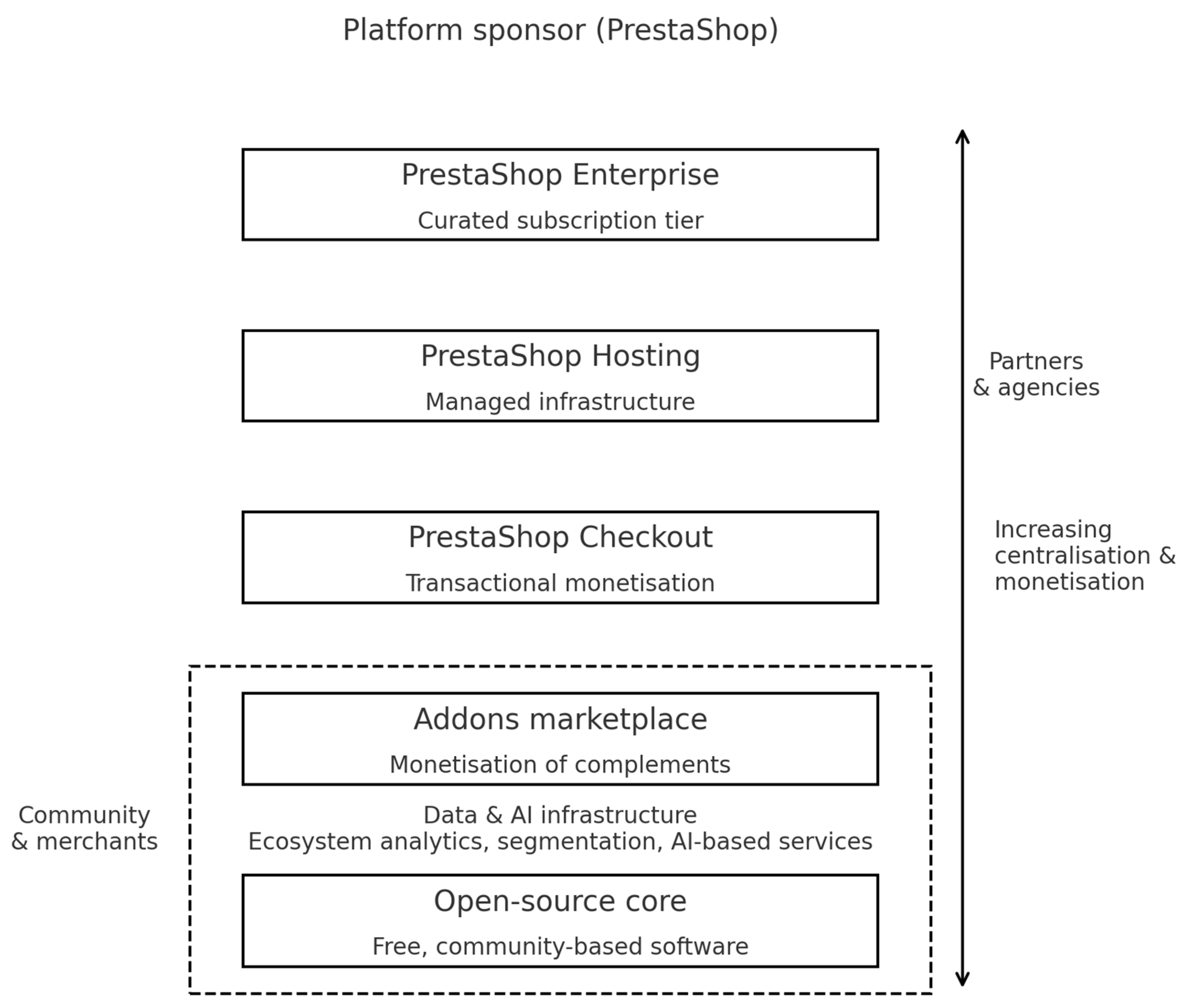
Zott et al., 2011). Our case reinforces this view and specifies how such dynamics unfold when monetization is structurally constrained by the freeness and decentralisation of the core. Instead of a single monetization pivot, PrestaShop’s trajectory reveals a sequence of layered and partially overlapping moves that gradually produce a hybrid architecture (summarised in
Figure 1).
Seen through this lens, value capture in open-source platforms is not simply “added” ex post to an unchanged value-creation architecture. Monetization and architecture co-evolve: each new revenue mechanism requires corresponding changes in control points, standards and partner relationships. This extends work on platform lifecycles and multi-sided platform evolution (e.g.,
Hagiu & Wright, 2015;
Muzellec et al., 2015;
Cusumano et al., 2019) by showing that, in open-source contexts, hybrid monetization is best understood as a configuration problem. Rather than choosing a single monetization model, the sponsor curates a portfolio of revenue logics that can be selectively targeted at specific segments (for example, medium-sized merchants in EU/LATAM) while preserving an open core. In doing so, freemium and open-core models appear less as static types and more as evolving configurations in which new layers are introduced, recalibrated and sometimes pruned over time.
These dynamics also extend open innovation scholarship by illustrating how selective openness can be reconfigured over time through monetization design. Rather than treating openness and value capture as a fixed trade-off, the PrestaShop case shows how platform sponsors progressively reorganize the boundary between shared and proprietary elements across architectural layers of the business model. Hybrid monetization thus operates as a mechanism of dynamic boundary calibration, enabling continued ecosystem participation while gradually strengthening appropriability and revenue stability.
5.2. Data and AI as Infrastructure for Hybrid Monetization
The staged reconfiguration described above is tightly intertwined with the evolution of data and AI capabilities. Existing models of AI-enabled business model innovation typically assume that organisations already possess centralised, high-quality data and strong control over their digital infrastructure (
Åström et al., 2022;
Gregory et al., 2021). In such settings, AI can be deployed directly to optimise interactions or personalise services, and monetization is often treated as a downstream design choice. By contrast, as
Section 4.2 shows, PrestaShop operates in a self-hosted, decentralised ecosystem in which the sponsor initially experienced “data blindness”: merchants retained control over installations and data, and the company lacked basic visibility on which merchants, partners or modules were most valuable or receptive to premium offers.
In this context, AI first acted as a trigger for business model change. Early discussions about potential AI use cases exposed the absence of systematic data governance and highlighted the need to build data-ready monetization mechanisms. The data initiatives described in
Section 4.2—including the creation of a dedicated data function, the integration of internal and external data sources and the deployment of segmentation tools—were therefore not merely technical projects but preconditions for hybrid monetization. Once basic data foundations were in place, AI became a driver of monetization choices: merchant and partner profiling informed the focus on medium-sized merchants in EU and LATAM and supported the design of offerings such as Checkout, Hosting and Enterprise that match the needs and willingness to pay of these segments. AI-supported dashboards and KPIs then helped reorient resources and evaluate the performance of new revenue streams, reinforcing the shift from diffuse marketplace monetization to an intentional hybrid portfolio.
Finally, AI acts as an enabler of scalable hybrid monetization. It supports modular, configurable offerings such as Enterprise bundles, helps identify region- and industry-specific configurations, and can automate aspects of personalisation and cross-selling across the portfolio. Building on the AI-as-trigger/driver/enabler framework developed in
De Ruosi et al. (
2026), we show that in an open-source, self-hosted context these roles are tightly intertwined with the design and sequencing of revenue mechanisms. Data and AI are not simply tools or products to be monetised; they constitute monetization infrastructure that makes the ecosystem knowable, segmentable and governable enough for hybrid value capture to be feasible.
Beyond segmentation and performance monitoring, the case also highlights a broader orchestration role for AI in hybrid platform monetization. AI-enabled analytics contributed to predictive identification of high-potential merchants, prioritization of partner engagement, and continuous adjustment of revenue mechanisms across transactional, infrastructural, and subscription layers. In this sense, AI functions not only as an efficiency-enhancing capability but as a coordination and governance infrastructure that stabilizes hybrid monetization over time. This perspective extends prior research by positioning AI as an organizing mechanism in platform evolution rather than solely as a source of product-level intelligence.
5.3. Governing Openness–Capture Tensions
The reconfiguration of monetization and data infrastructure, in turn, brings governance questions to the foreground. As hybrid revenue layers accumulate on top of an open-source core, tensions emerge not only around what is monetised but also around who controls key assets, how participation is organised, and how far the sponsor can recentralise without undermining its community base.
Our second research question surfaced the three tensions discussed in
Section 4.4: community versus commercial orientation, platform–partner roles and data ownership and governance. Hybrid monetization thus necessarily involves rebalancing these boundaries, not only redesigning pricing structures.
Conceptually, these observations contribute to work on platform governance and platform boundaries (
Gawer, 2021;
Jacobides et al., 2024) by showing that monetization design is itself a form of boundary setting. Decisions such as keeping the core open-source while adding optional hosting, analytics and curated tiers are examples of partial recentralisation that preserve multiple participation modes. Hybrid monetization is not a binary switch from “open” to “closed”, but an ongoing process of boundary work in which participation rules, revenue sharing and data-access mechanisms are adjusted to keep openness and value capture in a workable balance.
5.4. Implications for Theory
Synthesising the above, the study offers four main theoretical implications. First, we extend research on open-source and open-core business models by conceptualising hybrid monetization in an open-source platform as a sequential, layered reconfiguration rather than an instantaneous strategic choice. Constraints such as decentralised data and community expectations mean that some revenue models become feasible only after appropriate data and governance foundations are built, and monetization portfolios must therefore be actively assembled and recombined over time.
Second, we enrich work on platform business models and hybrid multi-sided platforms (
Rohn et al., 2021;
Trabucchi & Buganza, 2021;
Trabucchi et al., 2022) by detailing how a single sponsor can simultaneously occupy multiple monetization roles within one ecosystem. Our case illustrates these not as alternative archetypes but as elements of a deliberately orchestrated configuration, each tied to specific sides, incentives and governance mechanisms.
Third, we add a monetization lens to AI-enabled transformation research. Relative to prior work that focuses on AI’s impact on capabilities and routines, including
De Ruosi et al. (
2026), we show how AI-as-trigger/driver/enabler is intertwined with the design and sequencing of hybrid revenue mechanisms. AI does not merely optimise an existing monetization model; it exposes structural gaps in a decentralised, self-hosted ecosystem, informs which segments and revenue logics to prioritise, and underpins scalable offerings such as Enterprise. In this sense, data and AI function as monetization infrastructure rather than only as sources of new features.
Fourth, we contribute to research on platform governance and ecosystem boundaries by demonstrating how hybrid monetization architectures are made workable through boundary work. As PrestaShop layers proprietary revenue models on top of an open-source core, it must continuously redraw community, partner and data boundaries. Governance and monetization thus appear as jointly determined design problems rather than separate domains.
A central dimension of this boundary work concerns data governance. As hybrid monetization expands, control over data access, visibility, and analytical interpretation becomes a key source of both value creation and ecosystem tension. The PrestaShop case shows that platform sponsors do not resolve this tension through full recentralization, but through selective governance mechanisms such as opt-in data sharing, proprietary analytics layers, and partner-inclusive value propositions built around shared performance improvement. These arrangements mitigate risks of dependency and opportunism while preserving the distributed autonomy characteristic of open-source ecosystems. Data governance therefore emerges as a constitutive element of hybrid monetization rather than a secondary operational concern.
5.5. Implications for Practice
For practitioners, particularly managers of open-source or data-constrained platforms, our findings suggest several actionable lessons. First, the case underlines the importance of treating data governance and monetization as a joint design problem and sequencing hybrid monetization in “learning layers” rather than as a big-bang shift. Open-source platforms cannot assume that relevant data will be centrally available. Before launching advanced AI services or complex premium tiers, platform leaders need to invest in basic data infrastructure—opt-in mechanisms, harmonised identifiers and analytics layers that make ecosystem behaviour visible. These foundations are prerequisites both for deploying AI and for designing targeted hybrid monetization, because they enable the sponsor to understand who is doing what in the ecosystem and where value-capture opportunities actually lie. At the same time, PrestaShop’s trajectory shows the value of moving from low-risk, complementary monetization (marketplace commissions) to more embedded forms (Checkout, Hosting) and finally to curated subscription models (Enterprise). Each layer generates revenue and learning about partner reactions, merchant willingness to pay and operational implications. Managers of similar platforms can explicitly frame such initiatives as experiments in value capture, with clear metrics, feedback loops and a willingness to recalibrate or retire elements that prove politically or economically fragile.
Second, the introduction of curated subscription offerings such as PrestaShop Enterprise illustrates the risk that premium tiers may be perceived by complementors as bypassing or displacing them. Designing partner-inclusive premium tiers is therefore critical. In practice, this means involving key partners in the design and distribution of premium bundles, clarifying roles and revenue sharing ex ante, and maintaining parallel “open” channels (for example, a general marketplace) to preserve diversity and innovation. Such designs help ensure that hybrid monetization strengthens rather than undermines the broader ecosystem.
Finally, the case highlights the value of using AI not only to deliver features but also to support monetization decisions. While AI-enabled functionality such as recommendations or automation can enhance products, our analysis shows that AI-enabled analytics and segmentation can be equally important in informing which segments to prioritise, which combinations of services to offer and how to allocate scarce commercial and technical resources. For small and medium platforms in particular, focusing AI efforts on understanding and steering the monetization portfolio may improve the odds of building a sustainable hybrid architecture that aligns data, governance and value capture while maintaining the legitimacy and participation that make open-source ecosystems attractive in the first place.
6. Conclusions
Against a backdrop of rising expectations that digital infrastructures should be both open and financially sustainable, the PrestaShop case shows that hybrid monetization is a gradual re-architecting of value creation, value capture and data governance, in which open-source principles, ecosystem relationships and AI-enabled capabilities must be carefully balanced. By detailing how one platform sponsor navigated this balancing act, we provide both scholars and practitioners with a more nuanced understanding of what it means to make open-source platforms economically viable in a data-driven era, and to encourage further research on the diverse hybrid paths that such platforms can take.
This paper set out to understand how an open-source platform sponsor can reconfigure its business model to implement a hybrid monetization architecture under conditions of decentralised data and community-based governance, and what tensions this reconfiguration generates. Drawing on a qualitative single-case study of PrestaShop, we traced how the firm moved from a community-led, low-monetization model toward a more orchestrated portfolio of revenue logics while preserving an open-source core.
From this trajectory, we answer our first research question by conceptualising hybrid monetization as an evolving, layered business model configuration. As discussed in
Section 5.1, PrestaShop progressively assembled a five-layer architecture in which the open-source core remains free and community-based, while Addons, Checkout, Hosting and Enterprise monetise complements, transactions, infrastructure and curated subscriptions, respectively. Hybrid monetization thus appears not as a one-off “pivot” from free to paid, but as a staged reconfiguration in which monetization and architecture co-evolve over time.
Our second research question focused on the tensions and trade-offs that arise when an open-source platform sponsor moves toward such a hybrid architecture. The case highlights interrelated tensions around community versus commercial orientation, platform–partner boundaries, and data ownership and governance. As elaborated in
Section 5.3, PrestaShop addressed these tensions through ongoing “boundary work” that selectively recentralises monetization, standards and data while maintaining multiple participation modes. Hybrid monetization, in this sense, is inseparable from the political and organisational work required to keep openness and value capture in a workable balance.
Like all single-case studies, this research is subject to limits of scope and generalisability. Our analysis focuses on one open-source e-commerce platform, operating primarily in European and Latin American markets and at a specific stage in its transformation. Other platforms, particularly those in more regulated sectors or with different ownership structures, may face different constraints and opportunities when pursuing hybrid monetization. Comparative studies across multiple open-source and proprietary platforms would help validate and refine the hybrid monetization patterns identified here. Second, our data privilege the perspective of the platform sponsor and its closest partners. Although we draw on interviews, documents and some ecosystem-level indicators, merchant and developer perspectives are necessarily more limited. Future research could incorporate multi-sided data, including surveys or usage analytics at merchant and partner level, to examine how different actors perceive and respond to hybrid monetization moves. Finally, the monetization architecture we describe is still evolving. Enterprise, in particular, represents an early-stage attempt to create a subscription-based curated tier, and its long-term adoption and impact remain to be seen. Longitudinal follow-up studies could explore how hybrid monetization stabilises (or is re-opened) as markets, regulation and AI capabilities evolve. These limitations open several avenues for future work. First, comparative research could examine how different hybrid monetization configurations (e.g., stronger emphasis on SaaS, services, or data products) unfold across open-source platforms operating under distinct structural constraints. Second, the empirical material in this study privileges the perspective of the platform sponsor and its managerial actors. Although ecosystem tensions are analyzed, independent developers, agencies, and merchants were not directly interviewed. Future research could incorporate multi-actor data to explore how hybrid monetization is perceived, negotiated, or resisted from the standpoint of external ecosystem participants. Third, future studies could investigate how hybrid monetization interacts with regulatory developments around data governance and digital markets, and develop design principles or heuristics to guide platform sponsors in sequencing monetization, data, and governance changes under varying institutional environments.