Article

Valorization of Aged Opuntia-Derived Digestate as a Sustainable Nutrient Source for Photosynthetic Microbial Consortia


by
Juan Andrés Aguilar-Huesca
1,
Carlos Alexander Lucho-Constantino
1,*,
Rosa Icela Beltrán-Hernández
1,
Mónica Ivette Sánchez-Contreras
1 and
Pablo Antonio López-Pérez
2
1
Centro de Investigaciones Químicas, Instituto de Ciencias Básicas e Ingeniería, Universidad Autónoma del Estado de Hidalgo, Pachuca C.P. 42184, Hidalgo, Mexico
2
Escuela Superior de Apan, Universidad Autónoma del Estado de Hidalgo, Apan C.P. 43920, Hidalgo, Mexico
*
Author to whom correspondence should be addressed.
Environments 2026, 13(6), 288; https://doi.org/10.3390/environments13060288 (registering DOI)

Submission received: 19 April 2026 / Revised: 16 May 2026 / Accepted: 20 May 2026 / Published: 23 May 2026

Abstract

The objective of this study was to evaluate the potential of age Opuntia-derivated digestate (OpDcm) as a nutrient source for photosynthetic microbial consortia (PMC), aiming to reduce dependence on mineral media and promote the valorization of locally available biomass in arid and semi-arid regions. Batch cultures were performed in bubble column photobioreactors (BCPBR) and open raceway (ORPBR) photobioreactors using different proportions of OpDcm and BG110 to assess biomass production, chlorophyll a dynamics, and physicochemical responses of a PMC dominated by Nostoc sp. Chemical characterization showed that OpDcm contained higher levels of K, Ca, Mg, and Mn than BG110, providing a robust ionic matrix for initial growth; however, potential limitations in P, Mg, and Fe were identified. In both BCPBR and ORPBR systems, OpDcm demonstrated nutrient compositions that stimulated biomass production in the PMC at levels comparable to those achieved with BG110 medium. Statistical analyses showed that specific treatments, particularly T1 (10% OpDcm in BCPBR) and T3 (10% OpDcm + 2.5% BG110 in ORPBR), produced biomass yields similar to or higher than those obtained with the conventional BG110 medium. However, chlorophyll a concentration was lower in OpDcm treatments due to limited light transmission and micronutrient constraints. The N–NH4+ dynamics in BCPBR and ORPBR exhibited pronounced variability among the evaluated culture media, spanning from negligible changes (<1 mg L−1) over the entire cultivation period to sustained ammonium production rates of 2–3 mg L−1 day−1. Morphological analysis confirmed a consortium dominated by Nostoc sp., supported by pH values within the optimal range (8–9). Overall, the use of age-Opuntia-derived digestates demonstrated it can serve as a partial or total substitute for a low-cost nutrient source for cyanobacterial cultivation, underscoring their relevance to circular bioeconomy strategies for producing photosynthetic biomass.

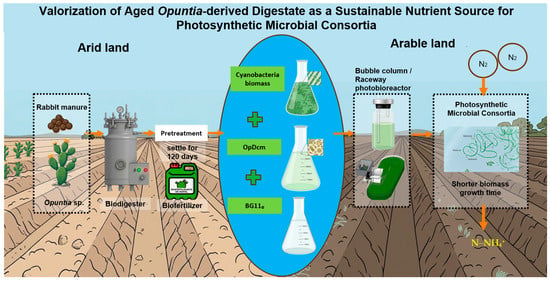
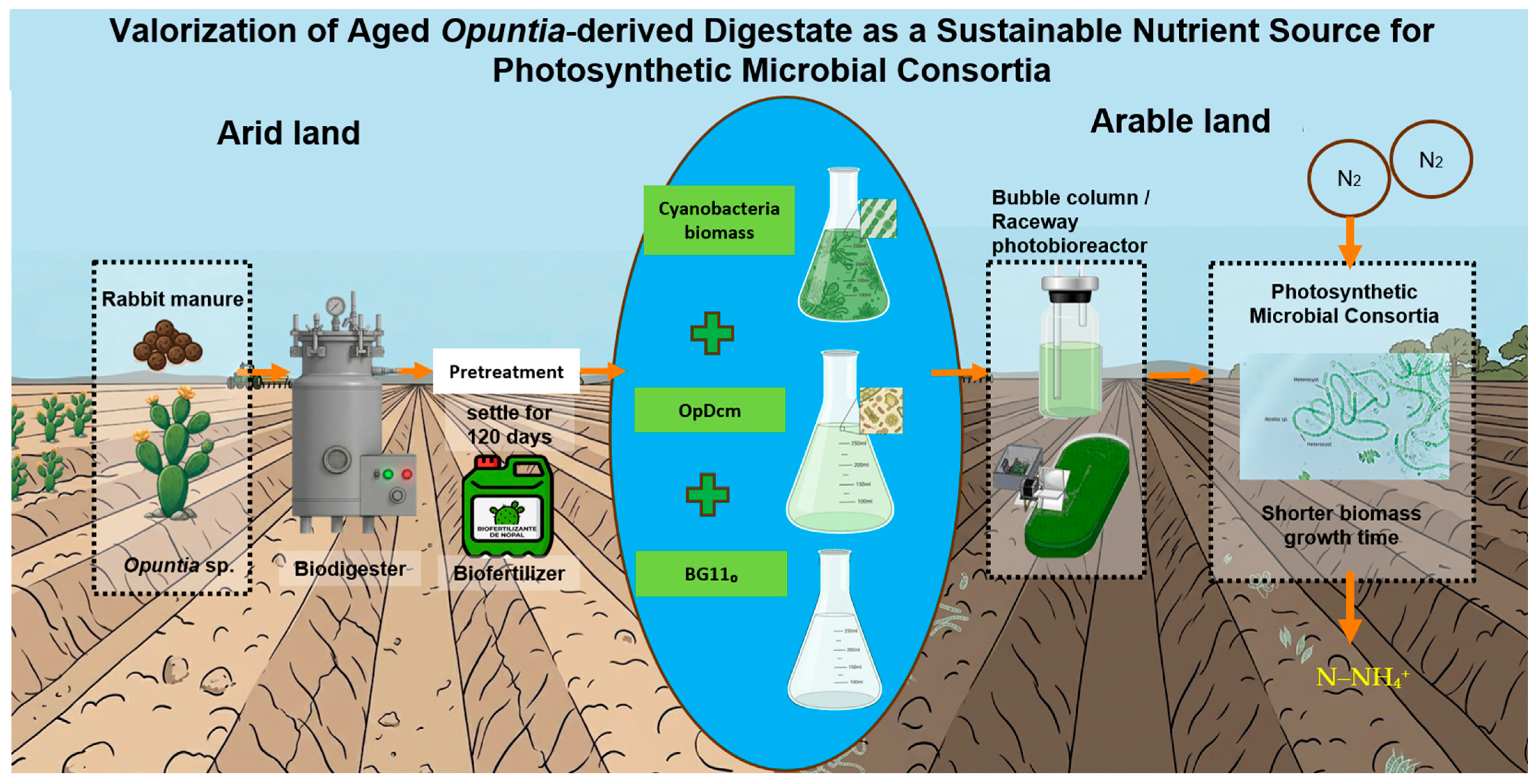
Graphical Abstract

1. Introduction

Conventional intensive agriculture contributes significantly to global environmental impacts, driven by the steady increase in food demand [1]. As a result, there is a strong dependence on and overuse of mineral fertilizers, which are vulnerable to fluctuations arising from global crises. The historically high prices of mineral fertilizers in 2022 highlight the fragility of this model and the urgent need to explore alternatives to current production methods [2]. In parallel, to meet global agri-food demands by 2050, some authors estimate that worldwide food production will need to increase by 60–70% [3], whereas others suggest that an increase of up to 110% may be required [4], with fertilizer availability emerging as a critical limiting factor.
Specifically, this limitation in nitrogen-fertilizers is intrinsically constrained by its physicochemical form. Although nitrogen is the most abundant element in the atmosphere and a key nutrient in agriculture, it predominantly exists as inert molecular nitrogen (N2), which is not directly accessible to plants. Only a restricted group of microorganisms can convert N2 into bioavailable species such as nitrate (NO3) and ammonium (NH4+), which are the primary forms assimilated by plants. To overcome this natural limitation, modern agriculture has relied heavily on synthetic nitrogen fertilizers produced via Haber-Bosh process. However, this technology is highly energy-intensive, dependent on fossil fuels, and emits greenhouse gases such as CO2, CO, and NOx [5]. Therefore, it is essential to develop methods capable of obtaining and managing nitrogen in an environmentally and economically sustainable manner [6].
In this context, nitrogen-fixing cyanobacteria are a promising alternative for enhancing agricultural productivity through biological nitrogen fixation in soils [7,8,9,10]. However, despite their potential, the large-scale cultivation of microalgae and cyanobacteria remains constrained by the high cost of nutrient inputs required to sustain biomass production [11]. Consequently, recent research has focused on the use of alternative nutrient sources derived from waste valorization processes, particularly agro-industrial residues, anaerobic digestates, livestock effluents, and nutrient-rich wastewaters [12,13]. Among these, anaerobic digestion (AD) has emerged as a promising platform for converting organic residues into biogas and nutrient-rich digestate [14,15,16]. These digestates contain significant amounts of nitrogen, phosphorus, organic matter, and micronutrients, making them attractive candidates for partially or fully replacing synthetic culture media. However, their use is often limited by factors like free ammonia, phenolic compounds, nutrient imbalances, turbidity, color, suspended solids, salinity, and microbial contamination, which affect culture performance [11]. Consequently, although digestates have been successfully used to partially or fully replace synthetic media in cultures of Spirulina/Arthrospira, Chlorella, Scenedesmus/Desmodesmus, and consortia, their performance remains highly dependent on digestate composition and strain tolerance [17].
On the other hand, due to its organic origin, the functionality of digestates decay along the time, which can be reinterpreted as an opportunity rather than a limitation. Aged biofertilizers and digestates, despite their reduced direct agronomic efficiency, retain residual nutrients that can be repurposed as culture media for photosynthetic microorganisms. For this reason, we hypothesized that OpDcm, despite its decline in direct agronomic functionality during storage, can serve as an alternative nutrient source for PMC, thereby enabling microbial growth and partial recovery of its fertilizing capacity through biological nitrogen fixation. In particular, cyanobacterial-based consortia can use these substrates while simultaneously enriching them through biological nitrogen fixation, thereby restoring part of their fertilizing capacity and closing nutrient loops within a circular bioeconomy approach. Therefore, developing tailored nutrient sources from anaerobic digestates is essential, particularly for water-scarce or semi-arid regions, where reducing cultivation costs is critical.
In Mexico, about 233,000 hectares of Opuntia spp. are cultivated, along with nearly 3 million hectares of wild species [18], highlighting the widespread availability of this biomass as a renewable resource. This abundance positions Opuntia spp. as a promising feedstock for AD and nutrient recovery. Several studies [16,19,20] have demonstrated its potential for producing mucilage, pectin, biogas, and digestate, with the latter suitability as a nutrient-rich biofertilizer. Therefore, the objective of this study was to assess the potential of OpDcm to cultivate photosynthetic microbial consortia, aiming to reduce dependence on conventional mineral media and contribute to the development of sustainable strategies in arid and semi-arid regions.

2. Materials and Methods

2.1. Opuntia Digestate as a Culture Medium for Photosynthetic Microbial Consortia

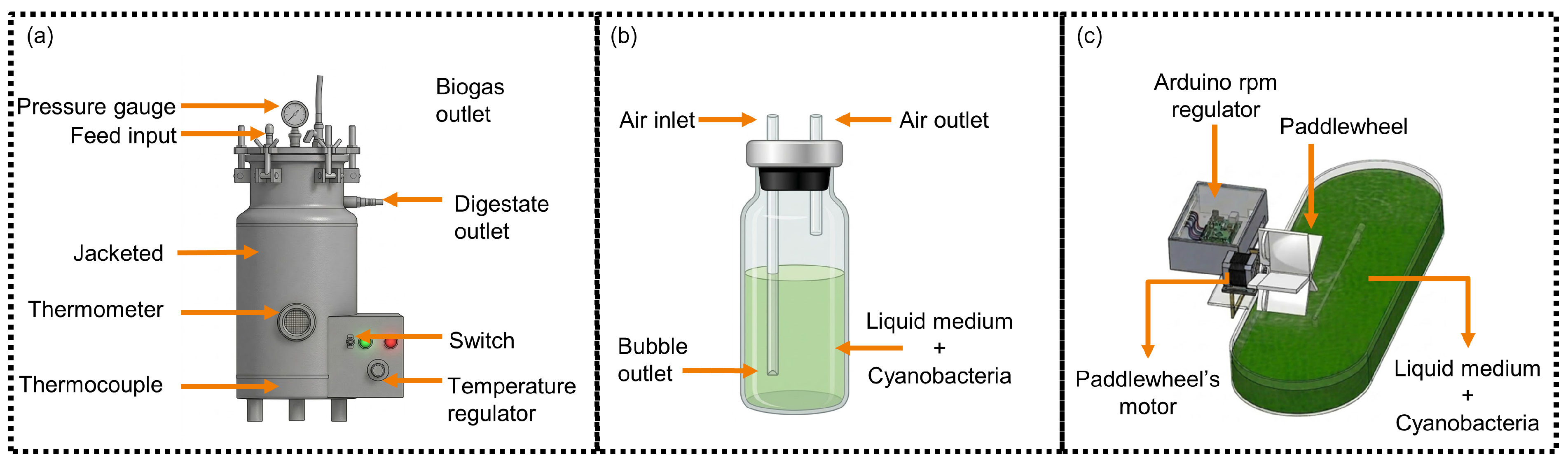
An anaerobic fed-batch bioreactor with a total volume of 13 L (working volume of 10.3 L) was used to produce the OpD (Figure 1a). The inoculum in the bioreactor was prepared from a 50:50 (v/v) co-substrate mixture of rabbit manure and water, stabilized for 50 days. The bioreactor was operated using only Opuntia residues at an organic loading rate (OLR) of 0.95 kg VS m−3, maintained at 35 °C, with a hydraulic retention time (HRT) of 60 days, and fed on a semi-continuous (daily) basis.
The OpD obtained was aged for 120 days in a plastic container at room temperature (20 ± 2 °C), stored under a roof and protected from direct sunlight. Passive aeration was permitted by the container, which stayed closed, and it also prevented contamination by insects or other microorganisms. The duration of this process was defined by the nitrogen content, specific N–NH4+ concentrations (>100 mg/L), because they may be inhibitory concentrations for the microbial photosynthetic consortium, according to Li et al. [21], and once finished, the OpDcm was used as a culture medium for the microbial photosynthetic consortium. Finally, the OpD with low N–NH4+ content was filtered using filter paper No. 1 (diameter 150 mm, Whatman, Maidstone, UK) in a vacuum filtration unit (47 mm, Wheaton, Millville, NJ, USA).
To evaluate the aging effect on the digestate and support its valorization, OpD and OpDcm were characterized for total nitrogen (TN), ammonia (N–NH4+), and total phosphorus (TP). TN and ammonia were determined using the micro-Kjeldahl method and the phenate method No. 132 C, respectively, following standard procedures described by APHA, AWWA, and WEF [22], while TP was quantified according to established colorimetric methods [23].
All samples and blanks were analyzed in triplicate.
Sample collection, preservation, and handling were conducted in strict accordance with internationally recognized protocols [22]. All samples were collected in clean containers and stored at −18 °C prior to analysis to minimize physicochemical alterations.
For metal determination, samples were subjected to microwave-assisted acid digestion in accordance with EPA Method 3015 [24]. Briefly, 45 mL of the homogenized sample was mixed with 5.0 ± 0.1 mL of HNO3 in sealed digestion vessels. The samples were then digested under controlled temperature, pressure, and time conditions, according to the method specifications, to ensure complete solubilization of the target elements prior to quantification.
Concentrations of potassium (K), calcium (Ca), manganese (Mn), magnesium (Mg), iron (Fe), sodium (Na), boron (B), and copper (Cu) were quantified using inductively coupled plasma optical emission spectroscopy (ICP-OES; Optima 3000XL, PerkinElmer, Shelton, CT, USA). All samples and blanks were analyzed in triplicate. The analytical sensitivity was assessed by calculating the limits of detection (LOD) and quantification (LOQ). The resulting LODs and LOQs were 0.03 ppm and 0.12 ppm for K, 0.01 ppm and 0.04 ppm for Ca, 0.02 ppm and 0.087 ppm for Mn, 0.003 ppm and 0.011 ppm for Mg, 0.06 ppm and 0.20 ppm for Fe, 0.01 ppm and 0.035 ppm for Na, 0.50 ppm and 1.67 ppm for B, and 0.03 ppm and 0.013 ppm for Cu, respectively. Instrumental calibration was performed prior to each analysis using external calibration curves. The equipment was calibrated prior to metal quantification.

2.2. PMC Growth in Photobioreactors

PMC (Nostoc sp. and Scenedesmus sp.) were isolated from water used for irrigation of Zea mays crops by Sánchez-Contreras et al. [10]. The PMC were propagated in BG11 and BG110 media [25] to support the growth of microalgae and cyanobacteria, respectively.
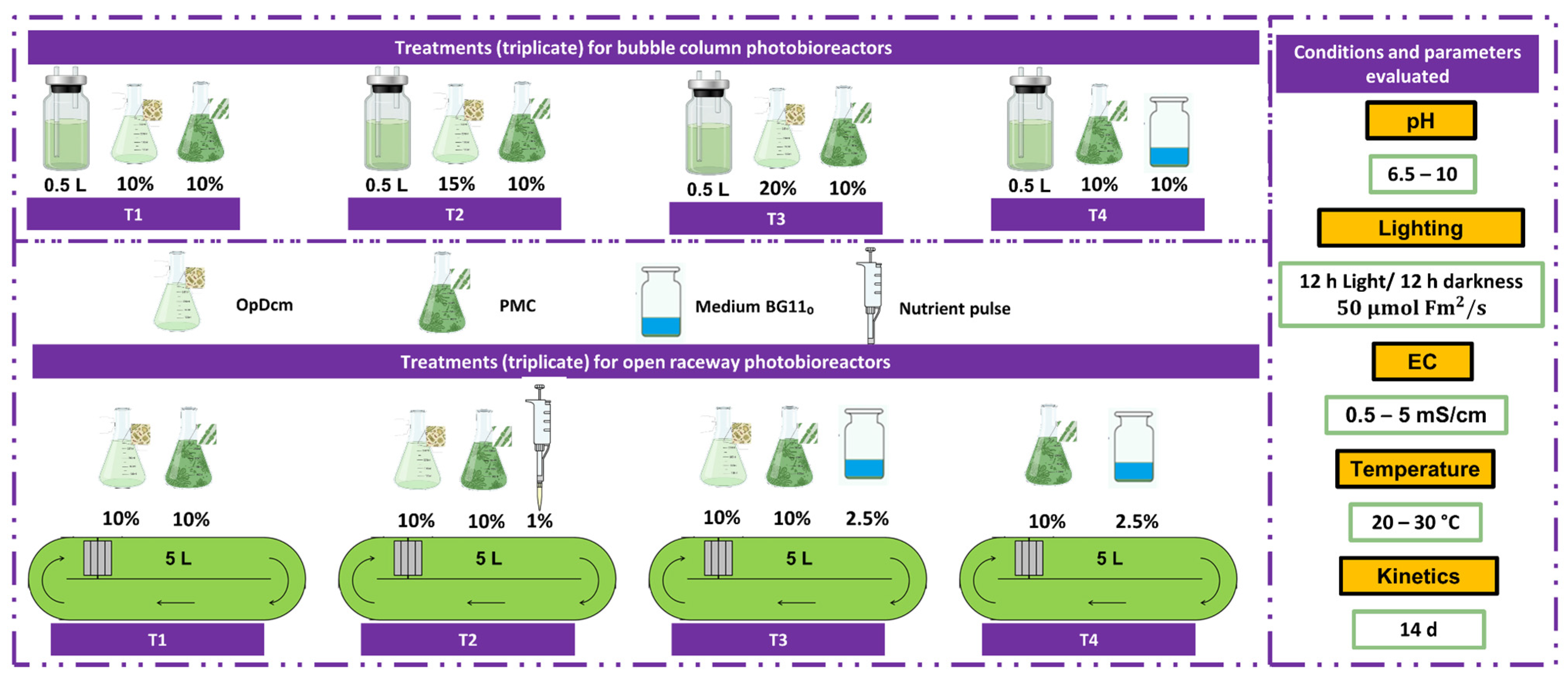
To evaluate the effect of OpDcm on PMC growth, it was tested at 10% (Treatment 1), 15% (Treatment 2), and 20% (Treatment 3) (v/v in distilled water) and compared with 10% BG110 medium as the control (Treatment 4). Cultivations were conducted in closed (BCPBR) and open (ORPBR) bioreactors as follows:
BCPBRs of 1 L (Figure 1b), with an operational volume of 500 mL, were used and operated under continuous aeration and mixing for 24 h at an airflow rate of 0.5–0.6 L min−1. At 12:12 h, a light-dark photoperiod was applied; illumination was provided by SMD-type LED lamps (Illux, model TL-1818.B65, 18 W, Illux de México S.A. de C.V., Tlalnepantla, Mexico), delivering a photon flux density of 50 μmol m−2 s−1 [26], with an irradiation angle of 90° and a fixed distance of 30 cm between the light source and the photobioreactor [10]. All experimental treatments were conducted in triplicate.
An acrylic ORPBR of 5 L was employed (Figure 1c). The ORPBR showed a total illuminated area of approximately 0.1 m2. The system was operated continuously with aeration and agitation for 24 h, following a 12:12 h light-dark photoperiod. Illumination was supplied by SMD LED lamps (Illux, model TL-1818.B65, 18 W), providing a photon flux of 50 μmol m−2 s−1, with an irradiance angle of 90° and a distance of 30 cm from the RP surface.
Among the treatments assessed in the BCPBR, the condition that yielded the highest biomass at the lowest OpDcm dose was selected for further evaluation. Subsequently, three culture media were tested in the ORPBR, with all treatments conducted in triplicate. Three culture medium conditions were evaluated in the ORPBR in triplicate for each treatment. In Treatment 1 (T1), the system was inoculated with 10% (v/v) PMC and fed with 10% (v/v) OpDcm, following the dilution factor reported by Chong et al. [11] for anaerobic digestates, to minimize potential inhibitory effects from high concentrations of organic or ionic compounds. In Treatment 2 (T2), the feeding conditions resembled those of T1, with the addition of a daily nutrient pulse of 1% (v/v) OpDcm throughout the kinetic period to assess the system’s response to a gradual feed. Finally, in Treatment 3 (T3), the same initial feeding strategy as T1 was used, with the addition of 2.5% (v/v) synthetic BG110 medium at the start of the experiment to address potential nutritional deficiencies in OpDcm. The control treatment (T4) was with 10% BG110 medium. In Figure 2, are shown all treatments with OpDcm and BG110 in BCPBR and ORPBR, along with the parameters evaluated in these experiments.
During each experiment, pH, temperature, total dissolved solids (TDS), salinity (S), and electrical conductivity (EC) were monitored using a previously calibrated multiparameter meter (pH-W3988, Juanjuan Electronic Technology Co., Guangzhou, China). The initial concentration of biomass in PMC (predominantly Nostoc sp.) was 0.5 ± 0.15 g L−1 (10% PMC). Biomass concentration was measured by dry weight [22]. Chlorophyll a content was determined using the trichromatic method described by Wellburn [27], enabling quantification. Briefly, 5 mL of each sample was collected in triplicate and centrifuged at 2500 rpm for 10 min using a HERMLE Z 200 A centrifuge (Hermle Labortechnik GmbH, Wehingen, Germany). The supernatant was carefully discarded, and the pellet was resuspended in 5 mL of 90% (v/v) acetone. The samples were then incubated in a water bath at 70 °C for 10 min to enhance pigment extraction, followed by storage in the dark at room temperature for 24 h to ensure complete extraction. Chlorophyll a concentration was quantified spectrophotometrically by measuring absorbance at 664, 630, and 647 nm using a Thermo Scientific GENESYS 10 Vis spectrophotometer (Thermo Fisher Scientific Inc., Waltham, MA, USA). The chlorophyll a content was calculated according to Equation (1).
Chl a (µg/mL) = (A664)−04(A630)−3.73(A647)
Microscopic observations of the mixed culture were conducted with a B3 Professional Series microscope at 100× magnification Motic B3 Professional Series microscope (Motic Instruments Inc., Xiamen, China) to evaluate cellular growth and morphological integrity.

2.3. Statistics Analysis

Statistical analysis of biomass, chlorophyll a, and ammonia was performed on at least three replicates per sample in each treatment, in triplicate. Calculations of means, standard deviations, error bars, and statistical comparisons (ANOVA at a significance level of 0.05) and Dunnett’s C post hoc comparisons were performed using SPSS version 23.0.

3. Results and Discussions

3.1. Characterization of Culture Media

Elemental characterization of Opuntia sp. digestate (OpD) and the culture media employed (OpDcm and BG110) for photosynthetic microbial consortia was conducted (Table 1). For the OpD medium, a clear influence of the aerobic post-treatment duration on the anaerobic digestate is observed. OpDcm showed significantly higher levels of K, Ca, Mg, and Mn than the BG110 medium (see Table 1), confirming its potential as an alternative source of macro-and micronutrients for PMC growth. However, several authors [14,28,29] have noted that culture media derived from organic residues may have specific limitations, especially in Fe and P, elements whose availability critically affects pigment synthesis and photosynthetic efficiency, largely as a consequence of the dilution regimes applied in each treatment.
Furthermore, the increased K and Na levels observed in OpDcm align with findings from References [7,28], who emphasized the importance of these elements in osmoregulation and in maintaining cellular membrane potential in PMC. Together, these traits demonstrate OpDcm provides a robust elemental composition that supports initial biomass growth; however, adding P or Fe might be necessary to maintain optimal performance during longer cultivation periods. Table 1 summarizes the elemental composition of OpD and compares it with that of the BG110 medium, highlighting the key differences that account for the nutrient dynamics observed throughout the experiments.

3.2. Kinetics in a Bubble Column Photobioreactor

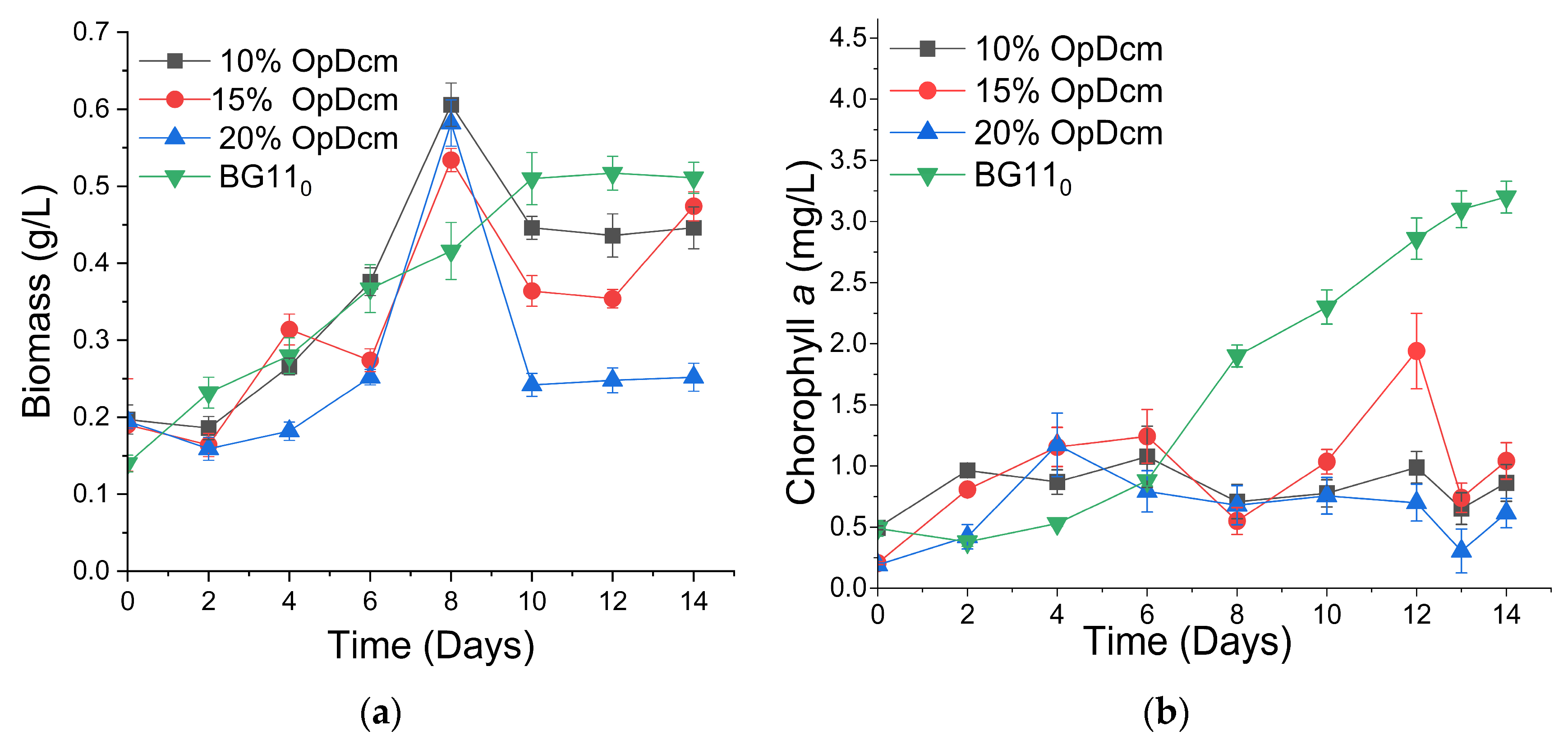
The BCPBR experiment was performed between September and December 2023. The biomass and chlorophyll a kinetics of PMC cultivated BCPBR under different OpDcm treatments (T1: 10%, T2: 15%, T3: 20%, and T4: 10% BG110 as control) are shown in Figure 3a,b.
Figure 3a shows a positive effect of using OpDcm as culture medium in PMC production; the maximum biomass was reached on day 8, approximately 20% earlier than in the BG110 medium (T4), where the peak occurred around day 10. The shorter time to biomass production suggests a potential biostimulatory effect of OpDmc. Anaerobic digestates have been proposed as alternative culture media for microalgae due to their bioavailable nutrients, which are essential for the metabolism of microalgae and cyanobacteria [30]. Besides their nutritional contribution, Tarakhovskaya et al. [31] report that algae and cyanobacteria respond to plant phytohormones such as auxins and gibberellins, which regulate cell division, elongation, and morphogenesis, thereby influencing growth dynamics. In this context, nutrients and biostimulants in OpDcm could enhance metabolic activity and promote quicker biomass production, consistent with the growth time observed in the evaluated PBR systems.
For biomass on day 8, the three dilutions were slightly higher; on day 14, the 10% (T1) and 15% (T2) dilutions were similar to the BG110 treatment, and differences among the treatments became clear, suggesting that the synthetic medium supported biomass growth for a longer period. This pattern has been consistently reported [10,32,33] in mineral media such as BG110, where the stationary phase typically occurs around day 14.
Biomass production of a photosynthetic microbial consortium was evaluated under four experimental treatments (T1–T4) using descriptive statistical analysis, one-way ANOVA, and Dunnett’s C multiple comparison tests to determine the temporal effect and stability of microbial growth. The results revealed substantial differences in biomass accumulation dynamics among treatments and throughout the experimental period. Treatments T1 (10% of OpDcm) and T4 (BG110) exhibited the highest mean biomass values (0.343 and 0.340 g L−1, respectively), indicating a high productive capacity of the consortium under these cultivation conditions. In contrast, T3 (20% of OpDcm) showed the lowest mean biomass (0.226 g L−1) but also exhibited the lowest experimental variability, suggesting more metabolically stable behavior. On the other hand, Levene’s test confirmed significant heterogeneity of variances across all treatments (p < 0.001), justifying the use of robust post hoc analyses. ANOVA revealed significant temporal effects on biomass production in T1 (F = 10.145; p < 0.001), T2 (F = 3.485; p = 0.018), and T4 (F = 12.567; p < 0.001), whereas T3 did not show statistically significant differences over time (p = 0.235). Multiple comparison analyses demonstrated that T4 exhibited the most dynamic temporal response, with significant increases in biomass during the exponential growth phase.
Overall, the results demonstrate that cultivation conditions significantly influenced the productivity and stability of the photosynthetic consortium, highlighting T1 and T4 as treatments with strong potential for biotechnological applications focused on the sustainable production of microbial biomass. Also, Markou et al. [28] and Barzee et al. [29] reported that anaerobic digestates derived from agro-industrial residues and food waste can serve as alternative culture media due to their high concentrations of soluble nutrients, thereby speeding up the exponential growth phase.
In the case of chlorophyll a (Figure 3b), the concentrations did not increase comparably to those observed in BG110 (T4) when OpDcm dilutions were used. This response can be attributed to the digestate’s turbidity, which limits light transmission through the culture, in contrast to BG110’s transparency. Such internal light attenuation may constrain the synthesis of photosynthetic pigments, even when biomass accumulation is favored during the early growth phases. Sinetova et al. [34] identified light intensity and spectral quality as direct limiting factors for cyanobacterial growth, whereas Wang et al. [35] and Huesemann et al. [36] demonstrated that opaque media or systems with high optical density promote internal photolimitation and reduced photosynthetic rates due to self-shading and light scattering.
Additionally, the decreased chlorophyll a concentration observed in OpDcm treatments may be linked to specific limitations in Fe availability. Iron, in turn, acts as an essential cofactor in enzymes involved in nitrogen assimilation and chlorophyll synthesis; limited Fe availability may thus hinder both pigment production and photosynthetic efficiency [28]. In the BCPBR, the kinetics shown in Figure 3b show more pronounced increases in chlorophyll a at the intermediate dilution (T3; 15% OpDmc), reaching maximum values of 1.9 ± 0.31 mg L−1 on day 12. This pattern indicates improved light-use efficiency and mixing performance within the column system, with aeration and bubbling promoting a homogeneous cell suspension and more uniform light exposure. Furthermore, the previously discussed biostimulant effect of the digestate may have sped up the initial phase of photosynthetic growth.
However, the effect of four experimental treatments on chlorophyll a accumulation demonstrated that chlorophyll dynamics were significantly influenced by time across all evaluated treatments. The highest overall mean values were observed in T4 and T1, with values of 0.3716 and 0.3699 mg L−1, respectively, suggesting a greater capacity to sustain photosynthetic activity under these experimental conditions. T2 exhibited an intermediate mean value, whereas T3 showed the lowest average chlorophyll concentration, despite displaying the most pronounced temporal response according to the ANOVA F-value.
The homogeneity analysis revealed that T1, T3, and T4 satisfied the assumption of equal variances, whereas T2 exhibited significant heteroscedasticity, indicating greater internal variability. This condition justified the use of Dunnett’s C post hoc test, which is particularly suitable for scenarios involving unequal variances. ANOVA confirmed highly significant differences in all treatments (p < 0.001), demonstrating that chlorophyll a accumulation was not constant throughout the experimental period.
Multiple comparisons revealed that T1 and T4 differed significantly (p < 0.05) between the initial days and the intermediate or final sampling times, indicating a progressive accumulation of chlorophyll a. In T2, the observed differences were more variable, likely associated with its experimental heterogeneity. T3 showed significant contrasts primarily concentrated on day 8, suggesting a transient increase rather than a sustained physiological response. Overall, the results indicate that T1 and T4 were the most favorable treatments for promoting stable photosynthetic performance, whereas T3 induced an intense but temporally limited response.
Ammonium nitrogen (N-NH4+) concentrations were quantified at the experiment’s outset in BCPBR: 16.09 ± 0.51 mg L−1 (10% OpDmc), 24.14 ± 0.6 mg L−1 (15% OpDmc), 32.19 ± 0.5 mg L−1 (20% OpDmc), and 1.2 ± 0.1 mg L−1 (BG110). These levels remained stable throughout cultivation, with minor increases (<1 mg L−1), yielding final values of 17.19 ± 0.71 mg L−1, 24.72 ± 0.17 mg L−1, 32.71 ± 0.21 mg L−1, and 1.82 ± 0.2 mg L−1 respectively. Li et al. [21] reported that elevated ammonium (100–200 mg/L) significantly affected microalgal growth, but microalgae in mixotrophic cultivation exhibited better growth and greater tolerance to higher ammonium levels. Our treatments achieved peak biomass production on day 8 across all conditions, revealing no detectable inhibition. Mechanistically, cyanobacteria preferentially assimilate NH4+ over NO3 via the energy-efficient GS-GOGAT pathway, enabling direct amino acid synthesis and minimizing ATP costs [37]. Furthermore, bioavailable micronutrients (e.g., Fe, Mg, Mn) in OpDcm likely enhanced enzymatic and photosynthetic efficiency, while organic compounds in the digestate exerted biostimulant effects, thereby enhancing metabolic flexibility and biomass production.

3.3. Raceway Photobioreactor Kinetics

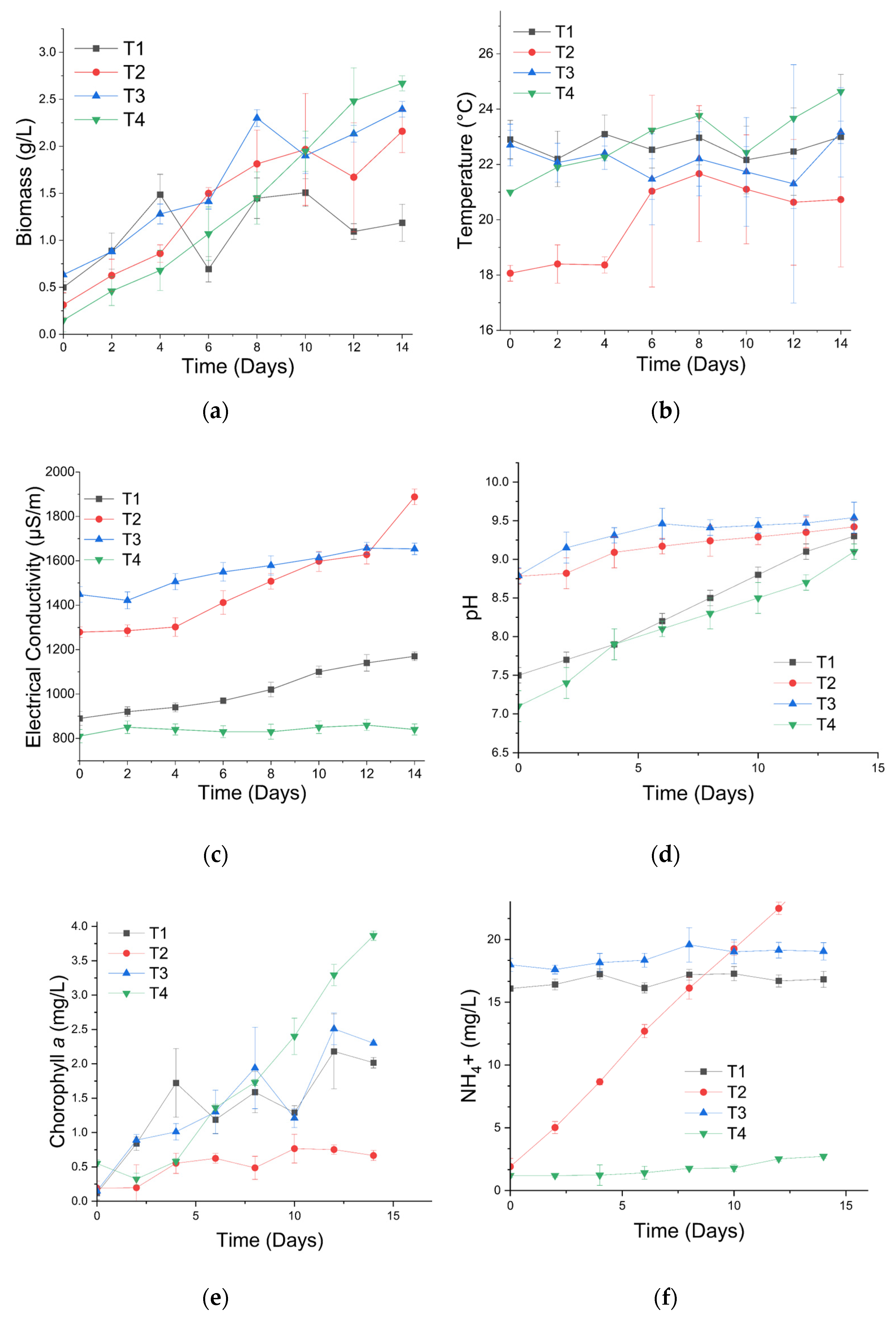
The ORPBR experiment was carried out between March and August 2024, with a total cultivation period of 14 days across all treatments (T1: 10% OpDcm; T2: 10% OpDcm + 1% nutrient pulse; T3: 10% OpDcm + 2.5% BG110; and T4: 10% BG110 as control). The initial operating conditions showed slight variability among replicates. Initial biomass concentrations were 0.6 ± 0.14 g L−1, 0.3 ± 0.06 g L−1, and 0.5 ± 0.12 g L−1 for treatments 1, 2, and 3, respectively. The corresponding initial pH values were 8.7 ± 0.1, 8.7 ± 0.1, and 7.5 ± 0.03. Electrical conductivity (EC) values were 1448 ± 10, 1279 ± 10, and 890 ± 10 µS cm−1, while temperatures measured 22.3 ± 0.1, 22.9 ± 0.1, and 23 ± 0.1 °C for replicates 1, 2, and 3, respectively. In the ORPBR, all four treatments showed sustained growth over the 14-day cultivation period (Figure 4a). The statistical analysis showed temporal effects and the stability of microbial growth in four experimental treatments (T1–T4). The results revealed significant differences (p < 0.05) in biomass accumulation dynamics among treatments and throughout the experimental period. Treatment T3 exhibited the highest mean biomass production (1.6167 g L−1), followed by T2 (1.3639 g L−1) and T4 (1.3634 g L−1), whereas T1 showed the lowest performance (1.1000 g L−1). Additionally, T4 exhibited the highest experimental variability (SD = 0.89601), indicating that the physiological response depends strongly on cultivation conditions. The ANOVA demonstrated a significant effect of time on biomass production across all treatments (p < 0.001). Treatment T4 exhibited the highest F value (1479.255), indicating extremely dynamic growth kinetics, whereas T2, T1, and T3 displayed significant (p < 0.05) but less abrupt temporal responses. Post hoc comparisons revealed T1 maintained relatively stable, slow growth, with no significant differences (p < 0.05) at most evaluated time points. This behavior aligns with the findings of Chong et al. [11], who noted that dilutions designed to reduce inhibitory effects can also limit the availability of essential nutrients such as phosphorus. In contrast, T2 and T3 exhibited significant increases in biomass (p < 0.05) during the later stages of cultivation, suggesting a sustained exponential phase and enhanced metabolic efficiency of the consortium. Particularly, T3 combined high productivity with moderate physiological stability, representing the most favorable experimental condition. This analysis confirms the T3 (2.5% BG110–10% OpDmc) feasibility of OpDcm as a partial replacement for the synthetic medium. Conversely, T4 showed significant differences (p < 0.05) at nearly all experimental time points, reflecting high physiological sensitivity and possible metabolic stress.
Overall, the results demonstrate that cultivation conditions significantly influence the growth kinetics and stability of the photosynthetic microbial consortium, highlighting the potential of treatment T3 for biotechnological applications aimed at sustainable biomass production. However, given that nutrient deficiencies were identified in the evaluated treatments, future scale-up strategies should prioritize standardizing the OpDcm production process and assessing its application as a biostimulant in field crops to validate its agronomic potential under real-world cultivation conditions.
Moreover, the dynamics of chlorophyll a accumulation across four experimental treatments showed they exerted differential effects on the photosynthetic response throughout the experimental period. Treatment T4 exhibited the highest mean chlorophyll a concentration (1.76 ± 1.27 g L−1), followed by T3 (1.42 ± 0.78 g L−1), T1 (1.37 ± 0.69 g L−1), and T2 (0.53 ± 0.26 g L−1), indicating that T4 promoted the greatest pigment accumulation. However, this treatment also displayed the highest variability, suggesting an intense but heterogeneous physiological response. Also, Levene’s test confirmed significant heterogeneity of variances across all treatments, with p-values below 0.05. These findings indicated that the data did not satisfy the assumption of homoscedasticity; therefore, the use of Dunnett’s C post hoc test was statistically appropriate for multiple comparisons. ANOVA revealed a significant effect of time on chlorophyll a concentration in T1, T2, T3, and T4. The highest F-value was observed in T4, evidencing a highly pronounced temporal kinetic response, whereas T2 exhibited the weakest response.
However, Dunnett’s C comparisons confirmed T4 showed the greatest number of significant differences among evaluation times, particularly between the initial and final stages of the experiment, reflecting sustained chlorophyll a accumulation. T3 also exhibited significant increases, although less pronounced, while T1 displayed an intermediate response pattern. In contrast, T2 showed limited temporal differentiation. Overall, the results indicate T4 was the most effective treatment for stimulating chlorophyll accumulation, followed by T3 and T1, whereas T2 exhibited the lowest capacity to sustain photosynthetic activity.
The observed differences in biomass growth and chlorophyll a production between the two reactors are pronounced and can be primarily attributed to the closed configuration of the BCPBR versus the open design of the ORPBR, the latter being inherently more susceptible to contamination during the experimental period [10]. This trend aligns with the observations of Wang et al. [38], who identified optimal digestate dilutions ranging from 10% to 25%, and with Prajapati et al. [39], who proposed 30% as an appropriate concentration to support growth without causing toxic effects. These authors further emphasized that anaerobic digestates enable the production of biomass suitable for a wider range of applications than traditional wastewater-based systems, which are often limited to biofuel production due to contamination risks.
The temperature recorded during the ORPBR kinetic assays ranged from 18 to 25 °C (Figure 4b), values that fall within the mesophilic range suitable for cyanobacterial growth. Singh and Singh [40] reported that many algal species, including cyanobacteria, exhibit enhanced metabolic and photosynthetic activity between 20 and 30 °C, whereas temperatures outside this range decrease cultivation efficiency. Consistently, Abdel-Raouf et al. [41] highlighted that cyanobacteria used in aquatic systems demonstrate high environmental tolerance and maintain stable physiological performance within this thermal range; thus, temperature rarely acts as a limiting factor under mesophilic conditions. In the present study, the sustained growth of MC, the main Nostoc sp. across all treatments, indicates that the observed temperature fluctuations did not significantly affect inter-treatment differences, and that nutrient availability and light quality likely played a more decisive role in cultivation kinetics.
EC showed a steady increase across all treatments (Figure 4c), reflecting the accumulation of dissolved ions as cultivation progressed. This pattern aligns with previous reports for digestate-based media, where mineralization of organic compounds and the release of salts (notably reduced nitrogen and phosphorus species) raise the system’s ionic load [36,42]. Despite this rise, PMC growth remained stable, indicating tolerance to moderate EC fluctuations, consistent with cyanobacteria’s ability to maintain osmotic balance in nutrient-rich inorganic media [43].
The pH values recorded (Figure 4d) further confirm cyanobacterial dominance in the culture, as the observed range (8–9) matches the optimum reported by Unrein et al. [44] for cyanobacterial growth. This range supports both metabolic activity and the bioavailability of essential nutrients. Furthermore, since Scenedesmus sp. typically proliferates under more alkaline conditions (pH ≥ 10), as noted by Arias et al. [45], the pH values observed in this study indicate that the culture conditions favored the predominance of Nostoc sp. within the consortium.
Light availability was identified as a limiting factor for chlorophyll a synthesis (Figure 4e). Sinetova et al. [34] and Chong et al. [11] demonstrated that irradiance directly influences growth rates in photosynthetic cultures. In this study, a photon flux density of 50 µmol m−2 s−1 was used, significantly below the optimal range of 200–400 µmol m−2 s−1 recommended by several authors [7,35,36,45]. Additionally, the turbidity of OpDcm further decreased light penetration, as reflected in the low chlorophyll a concentration observed in the ORPBR (Figure 4e), with maximum values of 0.66–1.18 mg L−1 in T1–T3, compared to 2.67 ± 0.1 mg L−1 in T4 with BG110. These values align with those reported by Arias et al. [45] in transparent synthetic media, confirming that light limitation was the primary factor restricting chlorophyll a production in digestate-based treatments.
The N–NH4+ dynamics in ORPBR exhibited marked differences among the evaluated culture media (Figure 4f). The effect of four experimental treatments on N–NH4+ concentration in a photosynthetic microbial consortium was evaluated through descriptive statistics, homogeneity of variance analysis, one-way ANOVA, and robust multiple comparison tests. A differential response of the consortium was revealed by the results under the experimental conditions evaluated. Treatment T3 exhibited the highest average ammonium concentration (18.63 ± 1.02), followed by T1 (16.74 ± 0.60) and T2 (14.16 ± 8.11), whereas T4 showed the lowest concentration (1.73 ± 0.58). This pattern indicates T3 promoted the greatest ammonium accumulation or persistence within the culture medium, while T4 induced a marked reduction of this nitrogenous compound.
The dispersion analysis revealed strong heterogeneity among treatments, primarily due to the high variability observed in T2. This condition suggests that the assumption of homoscedasticity was not fully satisfied and justifies the application of robust statistical tests for treatment comparisons. The ANOVA, based on the descriptive statistics, indicated a highly significant treatment effect on ammonium concentration (F = 82.43, p < reconstructed from the descriptive statistics) indicated a highly significant treatment effect on ammonium concentration (F = 82.43, p < 0.001), with a large effect size (η2 = 0.729), demonstrating that the treatments accounted for a substantial proportion of the total observed variability. Robust multiple comparisons revealed significant differences among most treatments, particularly between T4 and the remaining groups, confirming that this experimental condition strongly altered ammonium dynamics.
Also, the observed differences in N–NH4+ kinetics among culture media can be primarily attributed to variations in initial nutrient composition, turbidity, pH, and nitrogen sources. These factors regulate key processes such as ammonium assimilation, microbial transformation pathways, and physicochemical losses. In particular, pH plays a critical role in determining the equilibrium between NH4+ and free ammonia (NH3), with increasing pH shifting the balance toward NH3, the volatile form. Under alkaline conditions, this shift may enhance ammonia stripping and lead to nitrogen losses from the system, whereas at lower pH values, nitrogen remains predominantly in the NH4+ form, favoring biological uptake.
Additionally, turbidity and light attenuation may influence photosynthetic activity and thus nitrogen assimilation rates, while the presence of organic matter in OpDcm can stimulate heterotrophic and mixotrophic microbial activity, further modulating nitrogen transformations. Collectively, these interacting factors govern the balance between ammonium production, assimilation, and loss, ultimately defining nitrogen availability and biomass productivity in the system.
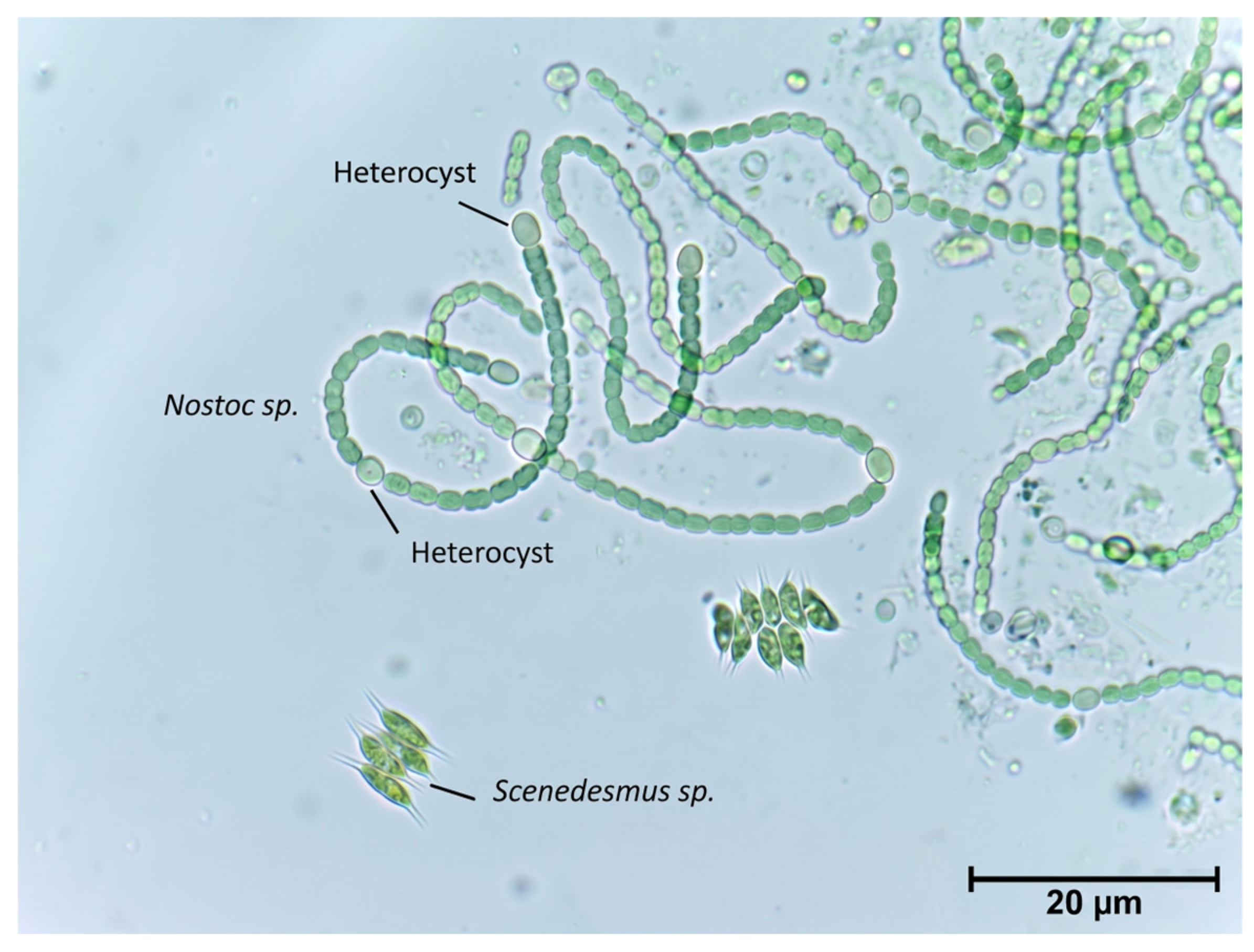
Overall, the results suggest that ammonium availability, accumulation, or transformation in photosynthetic consortia is strongly influenced by the applied treatment. These findings are relevant to optimizing culture conditions for nitrogen management, improving consortium metabolic efficiency, and enhancing its potential applications in biotechnological or biofertilizer systems. Additionally, due to the ammonium concentrations detected in the PMC from BCPBR and ORPBR systems, its application as a biofertilizer is not justified; rather, its potential lies in its use as a biostimulant. Padilla-Valle et al. [46] reported the use of microalgae such as Chlorella sorokiniana in Solanum lycopersicum L. under reduced fertilization regimes, demonstrating increases in yield, SPAD units, and nutrient uptake efficiency. Similarly, González Céspedes et al. [47] evaluated the effect of Scenedesmus sp. and Chlorella sp. on Cucumis sativus cultivation and observed positive effects on both root and shoot development, including increases in plant height and leaf number. In addition, Belica & Suárez [48] applied Chlorella sp. and Nostoc sp. to maize (Zea mays) cultivation, reporting enhanced plant height, greater leaf number, and improved root development in treatments that used cyanobacteria and microalgae as biostimulants. To morphologically characterize the photosynthetic consortium, the harvested biomass was examined with a B3 Professional Series microscope at ×40 magnification Motic B3 Professional Series microscope (Motic Instruments Inc., Xiamen, China) (Figure 5). The micrograph shows a characteristic multicellular structure with clearly distinguishable cyanobacterial trichomes of Nostoc and the complementary presence of green microalgae from the genus Scenedesmus, indicating a mixed consortium.
As shown in Figure 5, Scenedesmus sp. was detected at a lower relative abundance, indicating the formation of a mixed consortium where the cyanobacterium dominates. Morphological comparison based on the taxonomic descriptions reported by Muro-Pastor & Hess [49] further supported this identification. Figure 5 shows a strong morphological resemblance between the structures described for Nostoc sp. in the literature and those observed using a Motic B3 Professional Series microscope (Motic Instruments Inc., Xiamen, China) at ×40 magnification. The photosynthetic microbial consortia exhibited heterocyst-like cells under nitrogen-limited conditions, a feature commonly associated with the capacity for diazotrophic differentiation. However, it is essential to distinguish explicitly between morphological indicators of diazotrophic potential and the functional confirmation of nitrogen fixation. While heterocysts represent a structural adaptation that protects nitrogenase from oxygen inactivation, their presence alone does not substantiate active N2 fixation. Functional validation requires direct biochemical or molecular evidence, including acetylene reduction assays, 15N isotopic incorporation, nifH gene expression, and measurements of nitrogenase activity. Because these analyses were beyond the scope of the present study, the heterocysts observed here should be interpreted strictly as markers of putative diazotrophic capability, rather than as proof of functional nitrogen fixation. This distinction is critical to avoid overestimating the biological nitrogen contribution in the valorization process and to ensure a conservative interpretation of the ecological and biotechnological roles of the consortium [50,51,52].

4. Conclusions

OpDcm demonstrated consistent performance as an alternative nutrient source for stimulating the growth of the photosynthetic microbial consortium, supporting its development in both BCPBR and ORPBR systems. Although growth dynamics differed between the two photobioreactors, likely because of variations in operational conditions—particularly mixing efficiency—the comparison between closed and open systems revealed a significant effect on the observed biological performance. Furthermore, its elemental composition, characterized by elevated concentrations of K, Ca, Mg, and Mn, promoted the initial establishment of the culture. However, certain nutrient deficiencies were identified and could be corrected through targeted supplementation to enhance overall productivity. These findings demonstrate OpDcm represents a technically viable alternative to conventional mineral media. Importantly, the OpDcm dilutions evaluated in this study may serve as a reference framework for the valorization of aged or expired digestates, which can be re-used for low-cost photosynthetic biomass production under a circular economy approach.
Also, chlorophyll a synthesis was influenced by digestate turbidity, the applied light regime, and potential Fe limitations; nevertheless, both cultivation systems maintained sufficient photosynthetic activity to sustain growth and promote early biomass accumulation. Morphological analysis confirmed the dominance of Nostoc sp., with a lower abundance of Scenedesmus sp., highlighting the biological stability of the consortium. In bubble column photobioreactors, ammonium dynamics revealed an efficient balance between nitrogen release and assimilation, preventing net NH4+ accumulation even under potentially inhibitory concentrations. In contrast, raceway systems exhibited ammonium accumulation because nitrogen mineralization rates exceeded the culture uptake capacity, likely intensified by light limitation and alkaline pH conditions. These findings emphasize the importance of synchronizing nitrogen supply with the metabolic capacity of the consortium to optimize process productivity and sustainability. Collectively, these results show that aged Opuntia-derived digestate is a viable, low-cost, and environmentally sustainable substrate for producing nitrogen-fixing cyanobacteria, holding strong potential for agricultural use as a biostimulant to improve crop performance. Priority in future research should be given to process optimization, including turbidity control, irradiance management, and micronutrient supplementation, alongside evaluating scalability and integration into extensive agricultural and biotechnological applications.

5. Patents

This process was protected under the Mexican Institute of Industrial Property (IMPI) under registration MX/a/2025/015687: “Medio de cultivo elaborado a partir del digestado de Opuntia para la producción de cianobacterias”.

Author Contributions

Formal analysis, investigation, data curation, writing—original draft preparation, J.A.A.-H.; writing—original draft preparation, editing, and supervision, C.A.L.-C.; supervision, R.I.B.-H.; supervision and investigation, M.I.S.-C.; supervision, P.A.L.-P. All authors have read and agreed to the published version of the manuscript.

Funding

This research was funded by SECIHTI for a PhD scholarship, CV 1234429, and our laboratory’s own resources.

Institutional Review Board Statement

Not applicable.

Data Availability Statement

The datasets generated and/or analyzed in the current study are available from the corresponding author upon request.

Conflicts of Interest

The authors declare no conflicts of interest. The funders had no role in the design of the study; in the collection, analysis, or interpretation of data; in the writing of the manuscript; or in the decision to publish the results.

References

  1. Springmann, M.; Clark, M.; Mason-D’Croz, D.; Wiebe, K.; Bodirsky, B.L.; Lassaletta, L.; de Vries, W.; Vermeulen, S.J.; Herrero, M.; Carlson, K.M. Options for Keeping the Food System within Environmental Limits. Nature 2018, 562, 519–525. [Google Scholar] [CrossRef]
  2. Szekely, I.; Jijakli, M.H. Bioponics as a Promising Approach to Sustainable Agriculture: A Review of the Main Methods for Producing Organic Nutrient Solution for Hydroponics. Water 2022, 14, 3975. [Google Scholar] [CrossRef]
  3. Araújo, S.O.; Peres, R.S.; Barata, J.; Lidon, F.; Ramalho, J.C. Characterising the Agriculture 4.0 landscape—Emerging trends, challenges and opportunities. Agronomy 2021, 11, 667. [Google Scholar] [CrossRef]
  4. Rockström, J.; Williams, J.; Daily, G.; Noble, A.; Matthews, N.; Gordon, L.; Wetterstrand, H.; DeClerck, F.; Shah, M.; Steduto, P. Sustainable intensification of agriculture for human prosperity and global sustainability. Ambio 2017, 46, 4–17. [Google Scholar] [CrossRef]
  5. Silva, R.E.; Quesada, B. El Proceso Haber-Bosch en la Sociedad Agroindustrial: Peligros y Alternativas. El Otro Derecho 2015, 42, 75–96. (In Spanish) [Google Scholar]
  6. Peñuelas, J.; Coello, F.; Sardans, J. A Better Use of Fertilizers Is Needed for Global Food Security and Environmental Sustainability. Agric. Food Secur. 2023, 12, 5. [Google Scholar] [CrossRef]
  7. Do Nascimento, M.; Battaglia, M.E.; Sanchez Rizza, L.; Ambrosio, R.; Arruebarrena Di Palma, A.; Curatti, L. Prospects of using biomass of N2-fixing cyanobacteria as an organic fertilizer and soil conditioner. Algal Res. 2019, 43, 101652. [Google Scholar] [CrossRef]
  8. Roncero-Ramos, B.; Román, J.R.; Gómez-Serrano, C.; Cantón, Y.; Acién, F.G. Production of a biocrust-cyanobacteria strain (Nostoc commune) for large-scale restoration of dryland soils. J. Appl. Phycol. 2019, 31, 2303–2314. [Google Scholar] [CrossRef]
  9. Wissemeier, A.H.; Haehndel, R.; Zerulla, W.; Carrasco, I. 100 Años del Proceso Haber-Bosch: Rendimientos en Cultivos Hortícolas con y sin Fertilizantes Nitrogenados Inorgánicos. Actas Hortic. 2019, 61, 69–76. [Google Scholar]
  10. Sánchez-Contreras, M.I.; Beltran-Hernandez, R.I.; Lucho-Constantino, C.A.; Lopez-Perez, P.A. A Kinetic Dynamic Model of a Photobioreactor in Batch Operation for Production as Biofertilizer. Rev. Mex. Ing. Quím. 2025, 24, 1–15. [Google Scholar] [CrossRef]
  11. Chong, C.C.; Cheng, Y.W.; Ishak, S.; Lam, M.K.; Lim, J.W.; Tan, I.S.; Show, L.S.; Lee, K.T. Anaerobic digestate as a low-cost nutrient source for sustainable microalgae cultivation: A way forward through waste valorization approach. Sci. Total Environ. 2022, 803, 150070. [Google Scholar] [CrossRef]
  12. Xia, A.; Murphy, J.D. Microalgal cultivation in treating liquid digestate from biogas systems. Trends Biotechnol. 2016, 34, 264–275. [Google Scholar] [CrossRef]
  13. Zuliani, L.; Frison, N.; Jelic, A.; Fatone, F.; Bolzonella, D.; Ballottari, M. Microalgae cultivation on anaerobic digestate of municipal wastewater, sewage sludge and agrowaste. Int. J. Mol. Sci. 2016, 17, 1692. [Google Scholar] [CrossRef]
  14. Johnson, T.J.; Katuwal, S.; Anderson, G.A.; Gu, L.; Zhou, R.; Gibbons, W.R. Photobioreactor cultivation strategies for microalgae and cyanobacteria. Biotechnol. Prog. 2018, 34, 811–827. [Google Scholar] [CrossRef] [PubMed]
  15. Mupambwa, H.A.; Namwoonde, A.S.; Liswaniso, G.M.; Hausiku, M.K.; Ravindran, B. Biogas digestates are not an effective nutrient solution for hydroponic tomato (Lycopersicon esculentum L.) production under a deep water culture system. Heliyon 2019, 5, e02736. [Google Scholar] [CrossRef] [PubMed]
  16. Quintanar-Orozco, E.T.; Vázquez-Rodríguez, G.A.; Beltrán-Hernández, R.I.; Lucho-Constantino, C.A.; Coronel-Olivares, C.; Montiel, S.G.; Islas-Valdez, S. Enhancement of the biogas and biofertilizer production from Opuntia heliabravoana Scheinvar. Environ. Sci. Pollut. Res. 2018, 25, 28403–28412. [Google Scholar] [CrossRef]
  17. Fernandes, F.; Silkina, A.; Gayo-Peláez, J.I.; Kapoore, R.V.; de la Broise, D.; Llewellyn, C.A. Microalgae Cultivation on Nutrient Rich Digestate: The Importance of Strain and Digestate Tailoring under PH Control. Appl. Sci. 2022, 12, 5429. [Google Scholar] [CrossRef]
  18. Torres-Ponce, R.L.; Morales-Corral, D.; Ballinas-Casarrubias, M.L.; Nevárez-Moorillón, G.V. El nopal: Planta del semidesierto con aplicaciones en farmacia, alimentos y nutrición animal. Rev. Mex. Cienc. Agríc. 2015, 6, 1129–1142. (In Spanish) [Google Scholar] [CrossRef]
  19. Cruz-Méndez, A.S.; Ortega-Ramírez, E.; Lucho-Constantino, C.A.; Arce-Cervantes, O.; Vázquez-Rodríguez, G.A.; Coronel-Olivares, C.; Beltrán-Hernández, R.I. Bamboo Biochar and a Nopal-Based Biofertilizer as Improvers of Alkaline Soils with Low Buffer Capacity. Appl. Sci. 2021, 11, 6502. [Google Scholar] [CrossRef]
  20. Lucho Constantino, C.A.; Beltrán Hernández, R.I.; Ortega Ramírez, E.; Cruz-Méndez, A.S. Proceso para la Producción de Biofertilizante de Opuntia spp. Patent MX/a/2019/014242, 416410, 16 August 2024. [Google Scholar]
  21. Li, X.; Li, W.; Zhai, J.; Wei, H.; Wang, Q. Effect of ammonium nitrogen on microalgal growth, biochemical composition and photosynthetic performance in mixotrophic cultivation. Bioresour. Technol. 2019, 273, 368–376. [Google Scholar] [CrossRef]
  22. APHA; AWWA; WEF. Standard Methods for the Examination of Water and Wastewater, 22nd ed.; American Public Health Association: Washington, DC, USA, 2012; pp. 2-55–2-56. [Google Scholar]
  23. Boraste, A.; Vamsi, K.; Jhadav, A.; Khairnar, Y.; Gupta, N.; Trivedi, S.; Patil, P.; Gupta, G.; Gupta, M.; Mujapara, A.K. Biofertilizers: A novel tool for agriculture. Int. J. Microbiol. Res. 2009, 1, 23–31. [Google Scholar] [CrossRef]
  24. EPA. Method 3051A microwave assisted acid digestion of sediments, sludges, soils, and oils. Anal. Chem. 2007, 111, 362–366. [Google Scholar]
  25. Rippka, R.; Deruelles, J.; Waterbury, J.B.; Herdman, M.; Stanier, R.Y. Generic Assignments, Strain Histories and Properties of Pure Cultures of Cyanobacteria. J. Gen. Microbiol. 1979, 111, 1–61. [Google Scholar] [CrossRef]
  26. Andersen, R.A.; Kawachi, M. Traditional Microalgae Isolation Techniques. In Algal Culture Techniques; Andersen, R.A., Ed.; Elsevier Academic Press: Burlington, MA, USA, 2005; pp. 88–100. [Google Scholar]
  27. Wellburn, A.R. The Spectral Determination of Chlorophylls a and b, as Well as Total Carotenoids, Using Various Solvents with Spectrophotometers of Different Resolution. J. Plant Physiol. 1994, 144, 307–313. [Google Scholar] [CrossRef]
  28. Markou, G.; Vandamme, D.; Muylaert, K. Microalgal and cyanobacterial cultivation: The supply of nutrients. Water Res. 2014, 65, 186–202. [Google Scholar] [CrossRef]
  29. Barzee, T.J.; Yothers, C.; Edalati, A.; Rude, K.; Chio, A.; El Mashad, H.M.; Zhang, R. Pilot microalgae cultivation using food waste digestate with minimal resource inputs. Bioresour. Technol. Rep. 2022, 19, 101200. [Google Scholar] [CrossRef]
  30. Al-Mallahi, J.; Ishii, K. Attempts to alleviate inhibitory factors of anaerobic digestate for enhanced microalgae cultivation and nutrients removal: A review. J. Environ. Manag. 2022, 304, 114266. [Google Scholar] [CrossRef]
  31. Tarakhovskaya, E.R.; Maslov, Y.I.; Shishova, M.F. Phytohormones in algae. Russ. J. Plant Physiol. 2007, 54, 163–170. [Google Scholar] [CrossRef]
  32. Hernández-Melchor, D.J.; Cristiani-Urbina, E.; Ferrera-Cerrato, R.; Esparza-García, J.F.; Cañizares-Villanueva, R.O. Producción a la Intemperie de un Consorcio Microbiano Fotosintético Fijador de Nitrógeno en Cultivo por Lote y Semicontinuo en un Fotobiorreactor de Puente Aéreo de Cara Plana. Rev. Int. Contam. Ambient. 2017, 33, 73–81. [Google Scholar] [CrossRef]
  33. Dineshkumar, R.; Kumaravel, R.; Gopalsamy, J.; Sikder, M.N.A.; Sampathkumar, P. Microalgae as Bio-Fertilizers for Rice Growth and Seed Yield Productivity. Waste Biomass Valorization 2018, 9, 793–800. [Google Scholar] [CrossRef]
  34. Sinetova, M.A.; Cerveny, J.; Zavrel, T.; Nedbal, L. On the dynamics and constraints of batch culture growth of the cyanobacterium Cyanothece sp. ATCC 51142. J. Biotechnol. 2012, 162, 148–155. [Google Scholar] [CrossRef]
  35. Wang, M.; Yang, H.; Ergas, S.J.; van der Steen, P. A novel shortcut nitrogen removal process using an algal-bacterial consortium in a photo-sequencing batch reactor (PSBR). Water Res. 2015, 87, 38–48. [Google Scholar] [CrossRef]
  36. Huesemann, M.; Crowe, B.; Waller, P.; Chavis, A.; Hobbs, S.; Edmundson, S.; Wigmosta, M. A validated model to predict microalgae growth in outdoor pond cultures subjected to fluctuating light intensities and water temperatures. Algal Res. 2016, 13, 195–206. [Google Scholar] [CrossRef]
  37. Muro-Pastor, M.I.; Reyes, J.C.; Florencio, F.J. Ammonium assimilation in cyanobacteria. Photosynth. Res. 2005, 83, 135–150. [Google Scholar] [CrossRef]
  38. Wang, L.; Li, Y.; Chen, P.; Min, M.; Chen, Y.; Zhu, J.; Ruan, R.R. Anaerobic Digested Dairy Manure as a Nutrient Supplement for Cultivation of Oil-Rich Green Microalgae Chlorella sp. Bioresour. Technol. 2010, 101, 2623–2628. [Google Scholar]
  39. Prajapati, S.K.; Kumar, P.; Malik, A.; Vijay, V.K. Bioconversion of algae to methane and subsequent utilization of digestate for algae cultivation: A closed loop bioenergy generation process. Bioresour. Technol. 2014, 158, 174–180. [Google Scholar] [CrossRef] [PubMed]
  40. Singh, S.P.; Singh, P. Effect of Temperature and Light on the Growth of Algae Species: A Review. Renew. Sustain. Energy Rev. 2015, 50, 431–444. [Google Scholar] [CrossRef]
  41. Abdel-Raouf, N.; Al-Homaidan, A.A.; Ibraheem, I.B.M. Microalgae and Wastewater Treatment. Saudi J. Biol. Sci. 2012, 19, 257–275. [Google Scholar] [CrossRef]
  42. Mollo, L.; Petrucciani, A.; Norici, A. Selection of Microalgae in Artificial Digestate: Strategies towards an Effective Phycoremediation. Plant Physiol. Biochem. 2024, 210, 108588. [Google Scholar] [CrossRef] [PubMed]
  43. Pade, N.; Hagemann, M. Salt Acclimation of Cyanobacteria and Their Application in Biotechnology. Life 2015, 5, 25–49. [Google Scholar] [CrossRef]
  44. Unrein, F.; O’Farrell, I.; Izaguirre, I.; Sinistro, R.; Dos Santos Afonso, M.; Tell, G. Phytoplankton response to pH rise in a N-limited floodplain lake: Relevance of N2-fixing heterocystous cyanobacteria. Aquat. Sci. 2010, 72, 179–190. [Google Scholar] [CrossRef]
  45. Arias, D.M.; Uggetti, E.; García-Galán, M.J.; García, J. Cultivation and selection of cyanobacteria in a closed photobioreactor used for secondary effluent and digestate treatment. Sci. Total Environ. 2017, 587–588, 157–167. [Google Scholar] [CrossRef]
  46. Padilla-Valle, Y.K.; Ulloa-Mercado, G.; Gutiérrez-Coronado, M.A.; Rentería-Mexía, A.; Gortáres-Moroyoqui, P.; Díaz-Quiroz, C.A. Biostimulant effect of microalgae Chlorella sorokiniana on growth of tomato (Solanum lycopersicum L.). Rev. Bio Cienc. 2025, 13, e1922. [Google Scholar]
  47. González Céspedes, A.M.; Ayala Doñas, A.; Alcoser Bonifaz, J.A.; Pozo Dengra, J.; Carreño Amate, C. Evaluación del efecto bioestimulante sobre plantas con extractos de microalgas obtenidos a partir de un proceso de economía circular. C3-Bioecon. 2025, 6, 49–67. [Google Scholar] [CrossRef]
  48. Belica Salazar, J.A.; Suárez Gaibor, M.A. Evaluación de un Biofertilizante a Base de Chlorella sp. y Nostoc sp. en Zea mays L. en Condiciones de Laboratorio. Bachelor’s Thesis, Universidad Politécnica Salesiana, Quito, Ecuador, 2025. Available online: http://dspace.ups.edu.ec/handle/123456789/29959 (accessed on 1 April 2026).
  49. Muro-Pastor, A.M.; Hess, W.R. Heterocyst differentiation: From single mutants to global approaches. Trends Microbiol. 2012, 20, 548–557. [Google Scholar] [CrossRef] [PubMed]
  50. BermanFrank, I.; Lundgren, P.; Falkowski, P. Nitrogen fixation and photosynthetic oxygen evolution in cyanobacteria. Res. Microbiol. 2003, 154, 157–164. [Google Scholar] [CrossRef]
  51. Flores, E.; Herrero, A. Compartmentalized function through cell differentiation in filamentous cyanobacteria. Nat. Rev. Microbiol. 2010, 8, 39–50. [Google Scholar] [CrossRef] [PubMed]
  52. Kumar, K.; Mella-Herrera, R.; Golden, J. Cyanobacterial heterocysts. Cold Spring Harb. Perspect. Biol. 2010, 2, A000315. [Google Scholar] [CrossRef] [PubMed]
Figure 1. Bioreactors employed: (a) Anaerobic digester for Opuntia biomass digestion; (b) bubble column photobioreactor (BCPBR) system used for PMC growth experiments. (c) raceway photobioreactor (ORPBR) used for photosynthetic microbial consortium (PMC) cultivation.
Environments 13 00288 g001
Figure 2. Treatments with Opuntia Digestate as a Culture Medium for Photosynthetic Microbial Consortia in both the bubble-column and raceway photobioreactors.
Environments 13 00288 g002
Figure 3. Growth dynamics of PMC in a bubble column photobioreactor: (a) biomass concentration and (b) chlorophyll a content.
Environments 13 00288 g003
Figure 4. Variables monitored during the kinetic experiments of PMC cultivated in different treatments: (a) MC biomass; (b) temperature; (c) electrical conductivity; (d) pH; (e) chlorophyll a; and (f) Ammonium.
Environments 13 00288 g004
Figure 5. Morphological identification of the cyanobacterium Nostoc sp. and microalgae Scenedesmus sp., micrographs taken at ×40 magnification in the raceway photobioreactor.
Environments 13 00288 g005
Table 1. Elemental characterization of Opuntia sp. digestate (OpD) and of the culture media employed (OpDcm and BG110) for photosynthetic microbial consortia.
Parameter and ElementsOpDOpDcmBG110 1
TN415 ± 2.1 mg/L16 ± 2.4 mg/L-
TP47 ± 3.2 mg/L33 ± 2.1 mg/L16 mg/L
K555 ± 4.12 mg/L451 ± 5.7 mg/L12.76 mg/L
Ca404 ± 1.4 mg/L362 ± 1.4 mg/L7.84 mg/L
Mg170 ± 1.9 mg/L153 ± 1.90 mg/L7.52 mg/L
Sn.e.n.e.21 mg/L
Fe6 ± 0.05 mg/L5 ± 0.05 mg/L0.87 mg/L
Mn143 ± 0.04 mg/L131 ± 0.04 mg/L-
Na88 ± 28.82 mg/L81 ± 20.1 mg/L9.66 mg/L
B6 ± 0.07 mg/L5.88 ± 0.07 mg/L-
Cu0.28 ± 0.03 mg/L0.22 ± 0.02 mg/L-
Zn0.98 ± 0.22 mg/L0.97 ± 0.22 mg/L-
N-NH4+310 ± 1.7 mg/L161 ± 0.9 mg/L1.2 mg/L
pH7.2 ± 17.5 ± 18.3 ± 0.75
Auxins1158 ± 12.7 mg/L50 ± 4.3 mg/L-
Gibberellins23 ± 1.76 mg/L2.6 ± 0.7 mg/L-
1: [25]; n.e.: Not evaluate; OpD: Opuntia sp. digestate; OpDcm: Opuntia sp. digestate used as a culture medium for cyanobacteria, - No present.
Disclaimer/Publisher’s Note: The statements, opinions and data contained in all publications are solely those of the individual author(s) and contributor(s) and not of MDPI and/or the editor(s). MDPI and/or the editor(s) disclaim responsibility for any injury to people or property resulting from any ideas, methods, instructions or products referred to in the content.