

Why Marginal Gains Matter: Reducing Construction Waste to Cut Costs and Carbon in UK Housebuilding

Abstract
1. Introduction
2. Materials and Methods
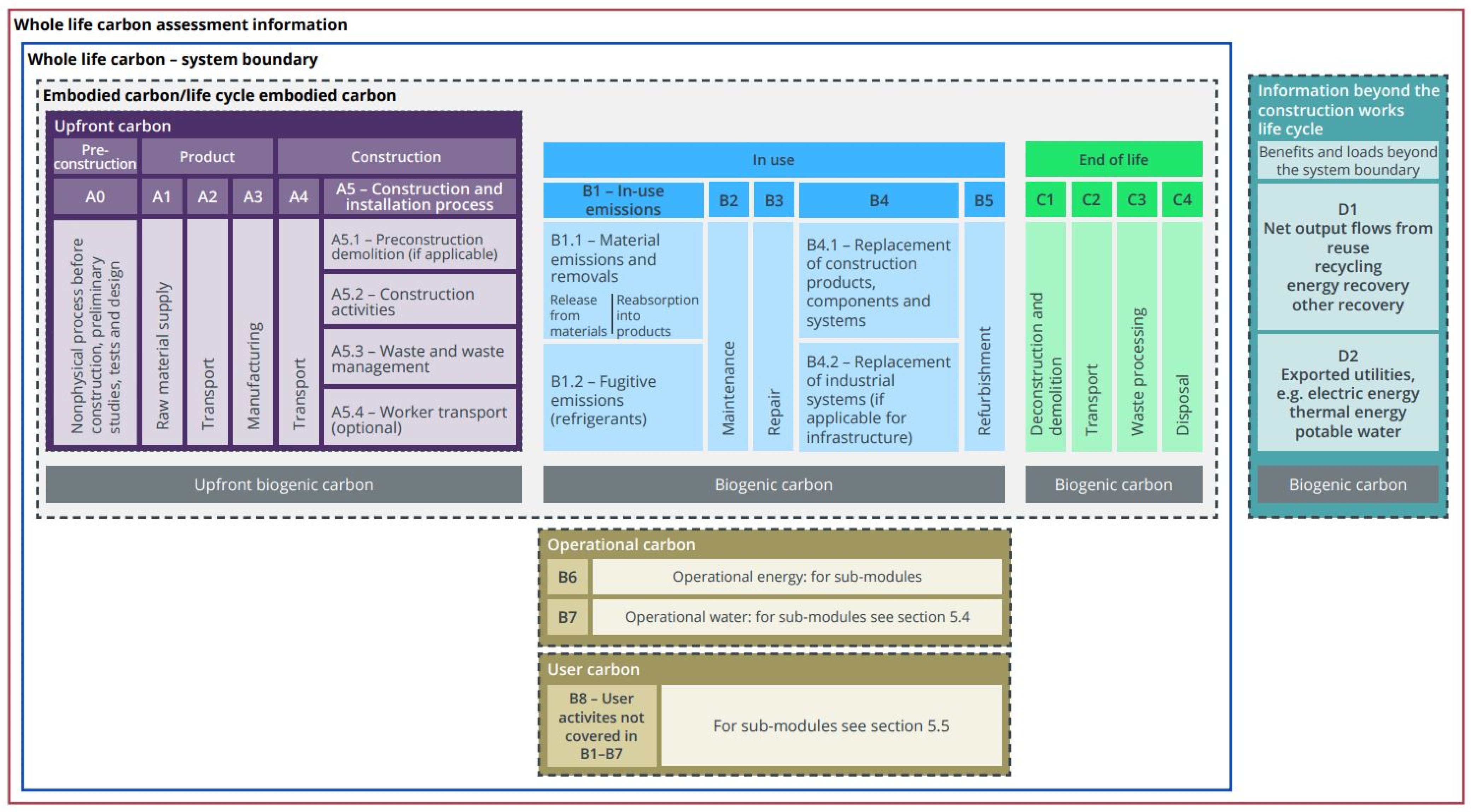
- Scope of waste examined
2.1. Literature Review
- The waste impact of housebuilding
- Considering waste rates used in estimating

| Material | Wastage Rates | Source of Reference |
|---|---|---|
| Facing Bricks | 5% | The Brick Development Association (2024) [27] |
| 6% | RICS (2024) [26] and Future Homes Hub (2024) [28] | |
| 10% | Brickhunter (2024) [29] | |
| 7.5–12.5% | Estimator’s Pocket Book (2019) [30] | |
| Blocks | 3% | Adams K and Hobbs G (2023) [31] |
| 3% | Future Homes Hub (2024) [28] | |
| 5% | Estimator’s Pocket Book (2019) [30] | |
| 5–10% | RICS (2024) [26] | |
| Plasterboard | 4% | RICS (2024) [26] and Future Homes Hub (2024) [28] |
| 10% | British Gypsum (2024) [32], Knauf (2022) [33] and Estimator’s Pocket Book (2019) [30] | |
| 35% | WRAP (2015) [34] | |
| Insulation Board | 2% | Isover (2022) [35] and Recticel (2023) [36] |
| 7% | RICS (2024) [26] and Future Homes Hub (2024) [28] | |
| Timber Joists | 2% | RICS (2024) [26] and Future Homes Hub (2024) [28] |
| 7.5% | Estimator’s Pocket Book (2019) [30] |
2.2. Theoretical Framework: Resource Efficiency, Lean Construction and Circular Economy Principles
- Resource efficiency
- Lean construction theory
- Circular economy principles
- Positioning marginal gains within these frameworks
2.3. Exploring Waste Rates Through Spend Data
- Selection of material streams
- Case study selection and data availability
- Data quality and contract model considerations
- Assessing variability in spend data
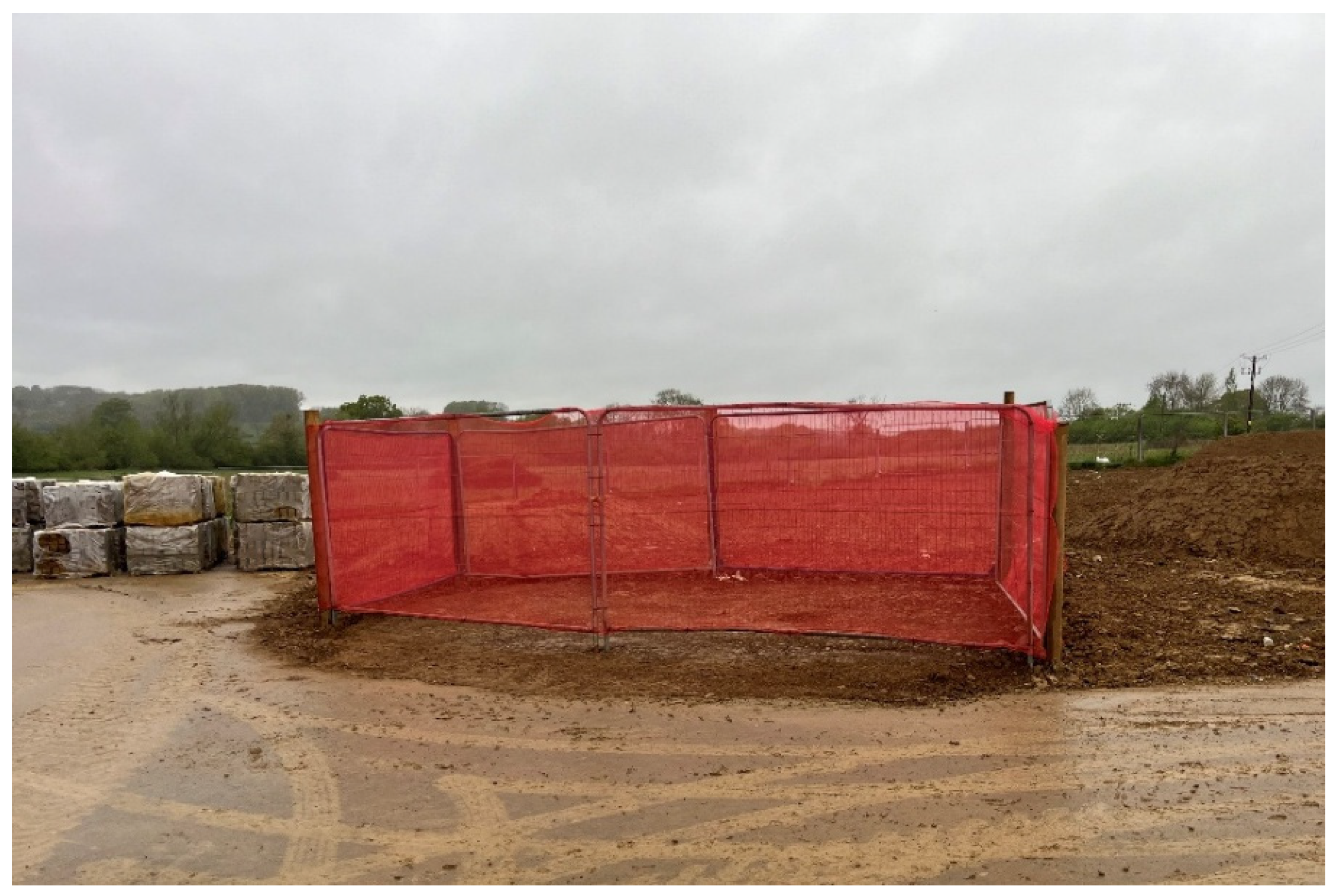
2.4. Measuring Waste Rates Through Controlled Site Study
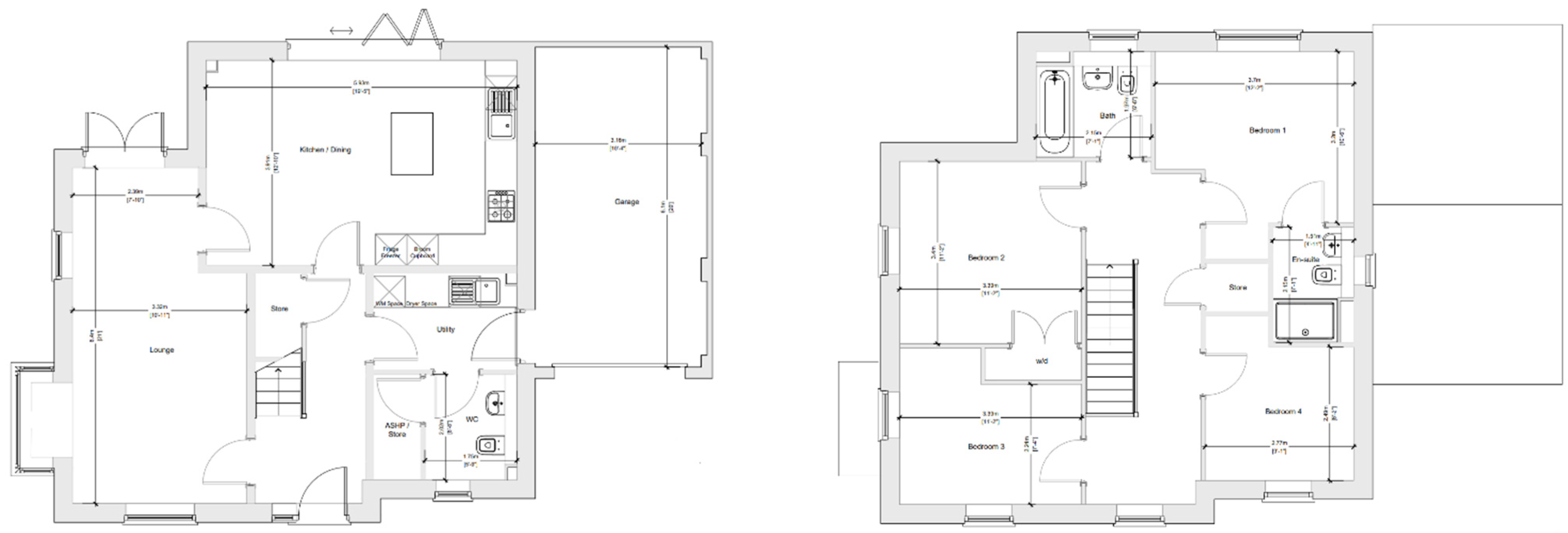
- Rationale for single-unit focus
3. Results
3.1. Analysis of Initial Estimates Versus Final Spend
3.2. Analysis of Controlled On-Site Waste Study
- Material-Specific Observations from the monitored site
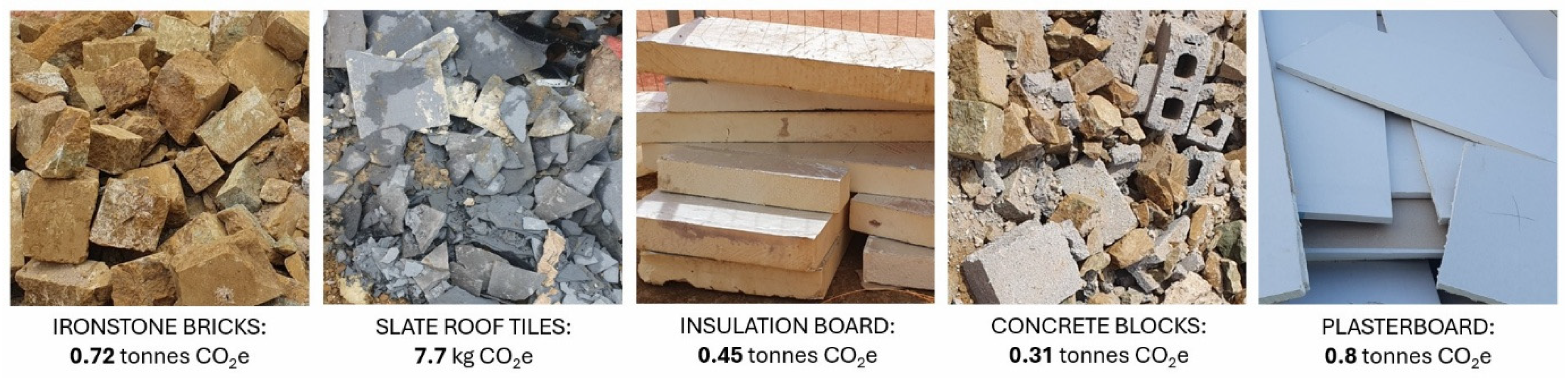
- Carbon Impact
4. Discussion
- Significance for UK housebuilding
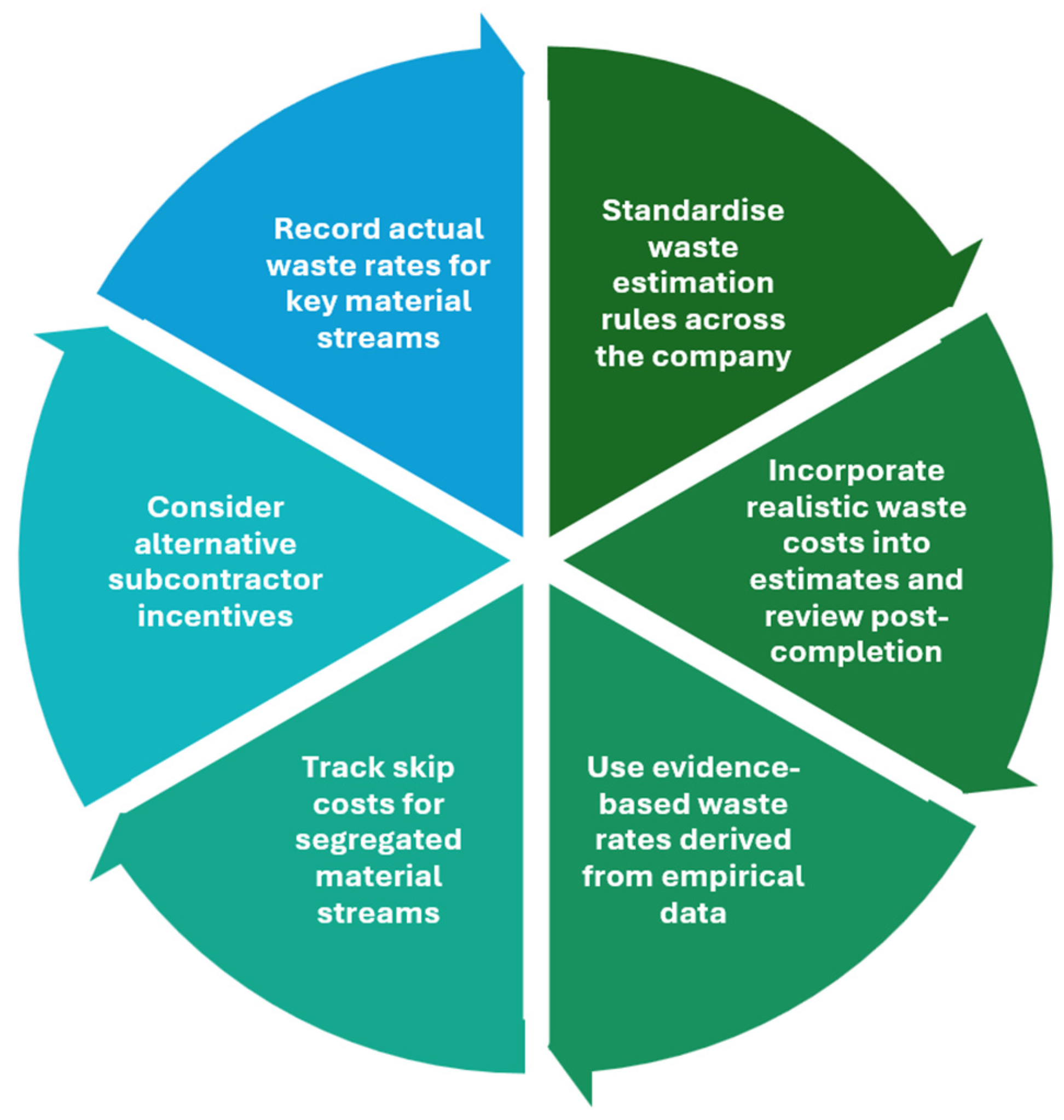
- Recommendation for Best-Practice Estimating to Reduce Waste
- Standardising waste estimation methodologies to ensure consistency and comparability across projects.
- Incorporating realistic costs for key waste streams into initial estimates and validating them against actual outcomes at project completion.
- Basing waste rate assumptions on empirical data collected through the feedback loop to improve forecasting accuracy.
- Monitoring disposal costs for segregated material streams (e.g., plasterboard, timber) and developing targeted reduction strategies.
- Exploring alternative subcontractor incentives, such as counter-charging for skip use, to encourage more efficient material handling.
- Capturing detailed data on waste generation by material type to inform future planning and performance benchmarking.
5. Conclusions
- Further research
- Limitations of the study
Author Contributions
Funding
Data Availability Statement
Conflicts of Interest
References
- HM Government. Construction 2025. Industrial Strategy: Government and Industry in Partnership; GOV.UK; HM Government: London, UK, 2013. Available online: https://assets.publishing.service.gov.uk/media/5a7b7ea140f0b62826a03f2c/bis-13-955-construction-2025-industrial-strategy.pdf (accessed on 11 September 2025).
- Dziekonski, D.; Mascarenhas, F.; Mahamadu, A.M.; Manu, P. Investigation into the key barriers to achieving UK “Construction 2025” Strategy targets. Eng. Manag. Prod. Serv. 2023, 15, 116–127. [Google Scholar] [CrossRef] [Scilit]
- Thomas, D.R. A General Inductive Approach for Analyzing Qualitative Evaluation Data. Am. J. Eval. 2006, 27, 237–246. [Google Scholar] [CrossRef] [Scilit]
- Pratt, M.G.; Sonenshein, S.; Feldman, M.S. Moving beyond templates: A bricolage approach to conducting trustworthy qualitative research. Organ. Res. Methods 2022, 25, 211–238. [Google Scholar] [CrossRef] [Scilit]
- Osmani, M. Construction Waste. In Waste: A Handbook for Management; Letcher, T., Vallero, D., Eds.; Academic Press: Cambridge, MA, USA, 2011; pp. 207–218. [Google Scholar]
- DEFRA. UK Statistics on Waste 2025 Dataset; GOV.UK; DEFRA: London, UK, 2025. Available online: https://www.gov.uk/government/statistics/uk-waste-data (accessed on 24 September 2025).
- The Waste (England and Wales) Regulations 2011. Available online: https://www.legislation.gov.uk/uksi/2011/988/contents (accessed on 24 September 2025).
- The Controlled Waste (England and Wales) Regulations 2012. Available online: https://www.legislation.gov.uk/uksi/2012/811/contents (accessed on 24 September 2025).
- Adams, K.; Thornback, J. How Much Waste is Produced by the Construction Sector? CPA: London, UK, 2022. [Google Scholar]
- Chen, K.; Wang, J.; Yu, B.; Wu, H.; Zhang, J. Critical Evaluation of Construction and Demolition Waste and Associated Environmental Impacts: A Scientometric Analysis. J. Clean. Prod. 2020, 287, 125071. [Google Scholar] [CrossRef] [Scilit]
- Kiesnere, G.; Atstaja, D.; Cudecka-Purina, N.; Susniene, R. The Potential of Wood Construction Waste Circularity. Environments 2024, 11, 231. [Google Scholar] [CrossRef] [Scilit]
- Ratnasabapathy, S.; Perera, S.; Alashwal, A.; Lord, O. Assessment of Waste Generation and Diversion Rates in Residential Construction Projects in Australia. In Proceedings of the CIB World Building Congress, Hong Kong, China, 17–21 June 2019. [Google Scholar]
- Martins, F.P.; Soldal, O.B.; Stefanelli, N.O.; Botelho, A.B. A Scoping Review of Construction and Demolition Waste Management and the Sustainable Development Goals: Evidence from Brazil. Sustain. Dev. 2025, 34, 544–555. [Google Scholar] [CrossRef] [Scilit]
- Agha, A.; Shibani, A.; Hassan, D.; Zalans, B. Modular Construction in the United Kingdom Housing Sector: Barriers and Implications. J. Archit. Eng. Technol. 2021, 10, 236. [Google Scholar]
- Loizou, L.; Barati, K.; Shen, X.; Li, B. Quantifying Advantages of Modular Construction: Waste Generation. Buildings 2021, 11, 622. [Google Scholar] [CrossRef] [Scilit]
- Chen, C. Advantages and barriers of modular construction method in constructing buildings. Proc. Inst. Civ. Eng. Smart Infrastruct. Constr. 2023, 176, 75–84. [Google Scholar] [CrossRef] [Scilit]
- QFlow. The UK Construction Industry; Annual Waste Report 2023; QFlow: London, UK, 2023; Available online: https://qualisflow.com/uk-construction-waste-report-2023/ (accessed on 17 October 2025).
- HM Treasury. Public Expenditure Statistical Analyses 2024; GOV.UK; HM Treasury: London, UK, 2024. Available online: https://www.gov.uk/government/statistics/public-expenditure-statistical-analyses-2024 (accessed on 22 October 2025).
- RIBA. Foundations for the Future: A New Delivery Model for Social Housing; RIBA: London, UK, 2024; Available online: https://www.riba.org/campaigns/policies/social-housing-report/ (accessed on 22 October 2025).
- Redrow. Reduce the Rubble; Redrow: Wales, UK, 2020. [Google Scholar]
- New Economics Foundation. Good, Green Homes for All; NEF: London, UK, 2025; Available online: https://neweconomics.org/2025/10/good-green-homes-for-all (accessed on 11 November 2025).
- Department for Levelling Up, Housing & Communities. Energy Performance of Buildings Data: England and Wales; GOV.UK; Department for Levelling Up, Housing & Communities: London, UK, 2024. Available online: https://epc.opendatacommunities.org/login (accessed on 24 October 2025).
- UKGBC. Building the Case for Net Zero: Closing the Gap Towards Net Zero Carbon New-Build Homes; UK Green Building Council: London, UK, 2022. [Google Scholar]
- RIBA. 2030 Climate Challenge, 2nd ed.; RIBA: London, UK, 2021. [Google Scholar]
- Greater London Authority. London Plan Guidance: Whole Life-Cycle Carbon Assessments; Greater London Authority: London, UK, 2022.
- RICS. Professional Standard. Whole Life Carbon Assessment for the Built Environment, 2nd ed.; RICS: London, UK, 2024. [Google Scholar]
- The Brick Development Association. Environmental Product Declaration: UK Clay Brick [Issue 4]; BRE: Watford, UK, 2024. [Google Scholar]
- Future Homes Hub. Whole Life Carbon Conventions and Simple Tool; FHH WLC Conventions V1.0 APPENDIX A—Default Material and Carbon Data; Future Homes Hub: London, UK, 2024; Available online: https://futurehomes.org.uk/wlc-tool (accessed on 9 April 2025).
- Brickhunter. How to Calculate the Number of Bricks You Need. UK. 2024. Available online: https://brickhunter.com/blog/how-to-calculate-the-number-of-bricks-you-need?srsltid=AfmBOoqNEvgx1PqFWyRtmo2MBkhT85OQZgz1EL3q2CZj2jeuoamuduvy (accessed on 9 April 2025).
- Cartlidge, D. Estimator’s Pocket Book, 2nd ed.; Routledge: London, UK, 2019. [Google Scholar]
- Adams, K.; Hobbs, G. Final Report: Wastage Rates for Blocks and Ready Mixed Concrete; Reusefully: Bedford, UK, 2023. [Google Scholar]
- British Gypsum Saint Gobain. Environmental Product Declaration: Gyproc WallBoard 12.5 mm [Version 3]; The International EPD System; British Gypsum Saint Gobain: Loughborough, UK, 2024. [Google Scholar]
- Knauf. Environmental Product Declaration: Knauf Wallboard, Baseboard and Plank Plasterboard 9.5, 12.5, 15 and 19 mm; The International EPD System; Knauf: Camellia, Australia, 2022. [Google Scholar]
- WRAP. Plasterboard Case Study: Reducing and Recycling Plasterboard Waste on a Site Where Space Is a Constraint; WRAP: Banbury, UK, 2015. [Google Scholar]
- Isover Saint Gobain. Environmental Product Declaration: Cavity Wall Slab (CWS) 32.65 mm–100 mm; The International EPD System; Isover Saint Gobain: Courbevoie, France, 2022. [Google Scholar]
- EPD Hub. Environmental Product Declaration: IP PIR 022; One Click LCA; EPD Hub: Amsterdam, The Netherlands, 2023. [Google Scholar]
- The RICS. Life Cycle Costing Standard, 1st ed.; RICS: London, UK, 2025. [Google Scholar]
- BRE. SmartWaste. Available online: https://bregroup.com/products/smartwaste (accessed on 20 November 2025).
- Allwood, J.M.; Cullen, J.M.; Carruth, M.A.; Cooper, D.R.; McBrien, M.; Milford, R.L.; Moynihan, M.C.; Patel, A.C.H. Material efficiency: A white paper. Resour. Conserv. Recycl. 2011, 55, 362–381. [Google Scholar] [CrossRef] [Scilit]
- Koskela, L. Application of the New Production Philosophy to Construction; Technical Report No. 72; Center for Integrated Facility Engineering (CIFE), Stanford University: Stanford, CA, USA, 1992. [Google Scholar]
- Ballard, G.; Howell, G. Implementing Lean Construction: Understanding and Action. In Proceedings of the 6th Annual Conference of the International Group for Lean Construction (IGLC-6), Guarujá, Brazil, 13–15 August 1998. [Google Scholar]
- Ballard, G.; Howell, G. What Kind of Production Is Construction? In Proceedings of the 6th Annual Conference of the International Group for Lean Construction (IGLC-6), Guarujá, Brazil, 13–15 August 1998. [Google Scholar]
- Koskela, L. An Exploration Towards a Production Theory and Its Application to Construction; VTT Technical Research Centre of Finland: Espoo, Finland, 2000. [Google Scholar]
- Koskela, L.; Ballard, G.; Howell, G.; Tommelein, I. The Foundations of Lean Construction. In Proceedings of the 15th Annual Conference of the International Group for Lean Construction (IGLC-15); Koskela, L., Bertelsen, P., Eds.; Michigan State University: East Lansing, MI, USA, 2007; pp. 213–226. [Google Scholar]
- Kirchherr, J.; Reike, D.; Hekkert, M. Conceptualizing the circular economy: An analysis of 114 definitions. Resour. Conserv. Recycl. 2017, 127, 221–232. [Google Scholar] [CrossRef] [Scilit]
- Wastesure: The Consequences of Plasterboard Contamination: Compliance and Cost Implications. UK. 2024. Available online: https://www.wastesure.com/skip-hire-guides/the-consequences-of-plasterboard-contamination-compliance-and-cost-implication (accessed on 13 October 2025).
- Housing Today. Rayner Announces New Target of 370,000 Homes as She Reveals Plan for NPPF Changes. 2024. Available online: https://www.housingtoday.co.uk/news/rayner-announces-new-target-of-370000-homes-as-she-reveals-plan-for-nppf-changes/5130731.article (accessed on 24 October 2025).


| Sources of Waste | Causes |
|---|---|
| Design | Frequent design changes, detailed design specifications |
| Offcuts | Cutting materials to sizes |
| Procurement | Supplier’s error, over-ordering |
| Packaging | Excess material product packaging |
| Material handling | Transportation, off-loading, inappropriate handling |
| Operations | Tradesperson’s error (quality, repairs), material efficiency |
| Material protection | Bad weather (rain and wind) |
| Scheme | No. of Houses | Average Cost of Construction | Material | Initial % of Waste Allowed for | Total % of Product Wasted | Total Value of Product Wasted | Cost Added (£/Home) | Amount of Carbon Added Due to Waste (kgCO2e) |
|---|---|---|---|---|---|---|---|---|
| Site A | 15 | £179,079 | Blocks | 10% | 15% | £7780.03 | £518.67 | 12,997.8 |
| Traditional brick & block build | Facing Bricks | 10% | 9% | £6771.60 | £451.44 | 3493.5 | ||
| Insulation | 10% | 17% | £5523.34 | £368.22 | 876.8 | |||
| Plasterboard | * not identified | 35% | £7240.03 | £482.67 | 1109.43 | |||
| Joists | 0% | 0.5% | £65.58 | £4.37 | 0.16 | |||
| Site B | 110 | £176,721 | Blocks | 5% | 8.41% | £3540.35 | £32.19 | 1258.3 |
| Pre-manufactured timber frame | Facing Bricks | 5% | 5% | £28,044 | £254.95 | 34.5 | ||
| Insulation | 0% | 3% | £5822 | £52.93 | 8.5 | |||
| Plasterboard | * not identified | 13% | £20,531.79 | £186.65 | 3145.0 | |||
| Joists | 0% | 2% | £25,338.54 | £230.35 | 4 | |||
| Site C | 34 | £173,117 | Blocks | 5% | 9.20% | £7880.11 | £231.77 | 17,874.4 |
| Traditional brick & block build | Facing Bricks | 5% | 20% | £37,168.28 | £1093.18 | 36,683.5 | ||
| Insulation | 5% | 5% | £876.00 | £25.76 | 1336.8 | |||
| Plasterboard | * not identified | 4% | £1713.72 | £50.40 | 262.71 | |||
| Joists | 0% | 0% | £0.00 | £0.00 | 0 |
| Scheme | Total Cost of Excess Material Added per House | Cost of Excess Material as a % of Build Cost | Total Carbon Added Due to Waste (kgCO2e) | Carbon Added per House (tCO2e) |
|---|---|---|---|---|
| Site A | £1825.37 | 1% | 18,477.57 | 1.23 |
| Site B | £757.06 | 0.4% | 4441.8 | 0.04 |
| Site C | £1401.12 | 0.8% | 56,157.3 | 1.7 |
| Material | Reference Wastage Rates | Developer Estimated Rates | Actual Rates Measured |
|---|---|---|---|
| Bricks | 5–12.5% | 5–10% | 5–20% |
| Blocks | 3–7.5% | 5–10% | 8.4–15% |
| Insulation | 2–7% | 5–10% | 3–17% |
| Plasterboard | 4–35% | * not identified | 4–35% |
| Timber joists | 2–7.5% | 0% | 0.5–2% |
Disclaimer/Publisher’s Note: The statements, opinions and data contained in all publications are solely those of the individual author(s) and contributor(s) and not of MDPI and/or the editor(s). MDPI and/or the editor(s) disclaim responsibility for any injury to people or property resulting from any ideas, methods, instructions or products referred to in the content. |
© 2026 by the authors. Licensee MDPI, Basel, Switzerland. This article is an open access article distributed under the terms and conditions of the Creative Commons Attribution (CC BY) license.
Share and Cite
Sage, E.; Fieldson, R. Why Marginal Gains Matter: Reducing Construction Waste to Cut Costs and Carbon in UK Housebuilding. Environments 2026, 13, 290. https://doi.org/10.3390/environments13060290
Sage E, Fieldson R. Why Marginal Gains Matter: Reducing Construction Waste to Cut Costs and Carbon in UK Housebuilding. Environments. 2026; 13(6):290. https://doi.org/10.3390/environments13060290
Chicago/Turabian StyleSage, Emilia, and Rosi Fieldson. 2026. "Why Marginal Gains Matter: Reducing Construction Waste to Cut Costs and Carbon in UK Housebuilding" Environments 13, no. 6: 290. https://doi.org/10.3390/environments13060290
APA StyleSage, E., & Fieldson, R. (2026). Why Marginal Gains Matter: Reducing Construction Waste to Cut Costs and Carbon in UK Housebuilding. Environments, 13(6), 290. https://doi.org/10.3390/environments13060290