1. Introduction
There is no standard ‘recipe’ for water treatment. Even when restricting attention to specific drinking water treatment (DWT) plants, a series of variables strongly participate in the resulting quality of the treated water. These variables include the following:
- -
seasonal changes in water composition, such as the distribution of natural organic matter (NOM), algal organic matter (AOM), or dry period effects;
- -
abrupt changes in the quality of input raw water caused by events like flash floods or emergencies (e.g., chemical leakage);
- -
gradual year-by-year deterioration of raw water quality reflecting societal development, including continuing urbanisation, increasing tourism, and industrialisation contributing to acid rain.
This wide array of factors necessitates the permanent modification of DWT procedures. A majority of DWT plants use the classical coagulation/flocculation procedure followed by the separation of the formed suspension via sedimentation/flotation and/or filtration. This process requires selecting and modifying appropriate coagulants and additive flocculants, optimising their dosage, and setting the pH value, typically carried out using a jar test method.
Another factor strongly influencing water treatment efficiency is temperature. Its range varies across climatic zones; in middle latitudes, it typically spans 8 to 20 °C. However, in northern territories, it can drop 2 °C approximately or even below. This dispersion significantly impacts water treatment from various aspects (Kang [
1], Xiao et al. [
2], Xiao et al. [
3]), as detailed below.
Coagulation/flocculation in the water treatment process is fundamentally composed of two phases: perikinetic and orthokinetic. The main difference between these two mixing/agglomeration types lies in their origin. The perikinetic phase is physical, while the orthokinetic phase is chemically driven. The perikinetic phase is predominantly governed by Brownian motion, which is highly sensitive to temperature. The orthokinetic phase (orthokinetic agglomeration) is connected with the efficiency of the chosen coagulant/flocculant agents. For instance, the efficiency of frequently used aluminium-containing classical agents (such as aluminium sulphate) remarkably reduces its efficiency with decreasing temperature (Morris and Knocke [
4]). This is often compensated for by increased dosing, which unfortunately results in a higher volume of sludge and adverse environmental and health impacts. Not all coagulants/flocculants exhibit such a pronounced decrease in efficiency; pre-hydrolysed products, for example, are more resistant to low temperatures (Duan and Gregory [
5]). Nevertheless, a general decrease in chemical efficiency with dropping temperature is easily detectable for most chemicals. As an alternative to increasing the dosing of classical chemical agents, biodegradable bioflocculants exist, and while their efficiency is also reduced with a temperature drop, they are environmentally acceptable (Li et al. [
6]).
Another temperature-related aspect is the bulkiness and strength of the created flocs (aggregates). Much smaller aggregates are formed at lower temperatures (Morris and Knocke [
4], Hanson and Cleasby [
7]), and these aggregates simultaneously exhibit lower floc strength (Hanson and Cleasby [
7], Kang and Cleasby [
8]). The sedimentation of aggregates is heavily influenced by temperature-dependent water density
ρw and dynamic viscosity
η. These values, along with their ratio—the kinematic viscosity
ν—are presented in
Table 1. As a decrease in density is very mild, the changes in resistance against flow—viscosity—are significant, which means that lower temperatures do not contribute to aggregate sedimentation. Measuring floc compactness is non-trivial. Classical photographic methods can be unreliable because the measure of compactness is influenced by the mutual angle between the floc and the camera lens. It seems that the only parameter directly interlaced with the notion of ‘compactness’ is the fractal dimension.
A significant challenge is the adequate choice of the pH value as a function of temperature; a value optimised for one temperature usually fails at others. In this regard, analysing the pOH value appears to be much more beneficial for properly setting the appropriate values at different temperatures (Hanson and Cleasby [
7], Van Benschoten and Edzwald [
9]).
Generally, the literature concerning the temperature effect on the coagulation/flocculation process is rather scarce. The study is divided into three parts: physical aspects of coagulation (perikinetic phase), chemical aspects of coagulation/flocculation (orthokinetic phase), and fractal analysis (aggregate compactness). This study aims to provide a detailed description of the dependence of Brownian motion (perikinetic phase) on temperature, including a relatively simple and accurate ratio of particle displacements at various temperatures. The crucial role is an adequate pH value choice in the orthokinetic phase, presenting its dependence on temperature. The differing responses of metal-based coagulants (as documented for aluminium- and iron-based agents) to lower temperatures are presented, including the time-dependent rate of hydrolysis. It is followed—using published results—by floc (aggregate) characterisation based on fractal dimension in dependence on temperature (orthokinetic phase), including corresponding visualisation estimates.
2. Perikinetic Phase (Brownian Motion)
Brownian motion is the phenomenon where small particles undergo permanent, random, moderate fluctuations. Colloidal particles exhibit this continuous chaotic motion, which results from accumulated kinetic energy in the molecules of the carrier liquid (water) constantly imparting kinetic energy to the particles. Over a period of time, if no direction of the random oscillations is preferred, the process of diffusion balances the particle distribution throughout the medium.
Brownian motion represents the primary initiation of particle clustering. A higher intensity of particle displacement increases the probability of particle clustering because particle collisions are more frequent. Higher intensity is enhanced by higher temperature and increased time. Conversely, intensity is reduced by increasing the particle diameter (assuming spherical particles), as the particle’s projected cross-section offers higher resistance to motion.
The concentration of Brownian particles
φ at point
x at time
t satisfies the diffusion equation
where the diffusion coefficient
D relates the diffusive flux with the changes in concentration gradient (Fick’s second law).
Denoting N as the number of particles at the initial time
t = 0, the diffusion equation has the analytical solution
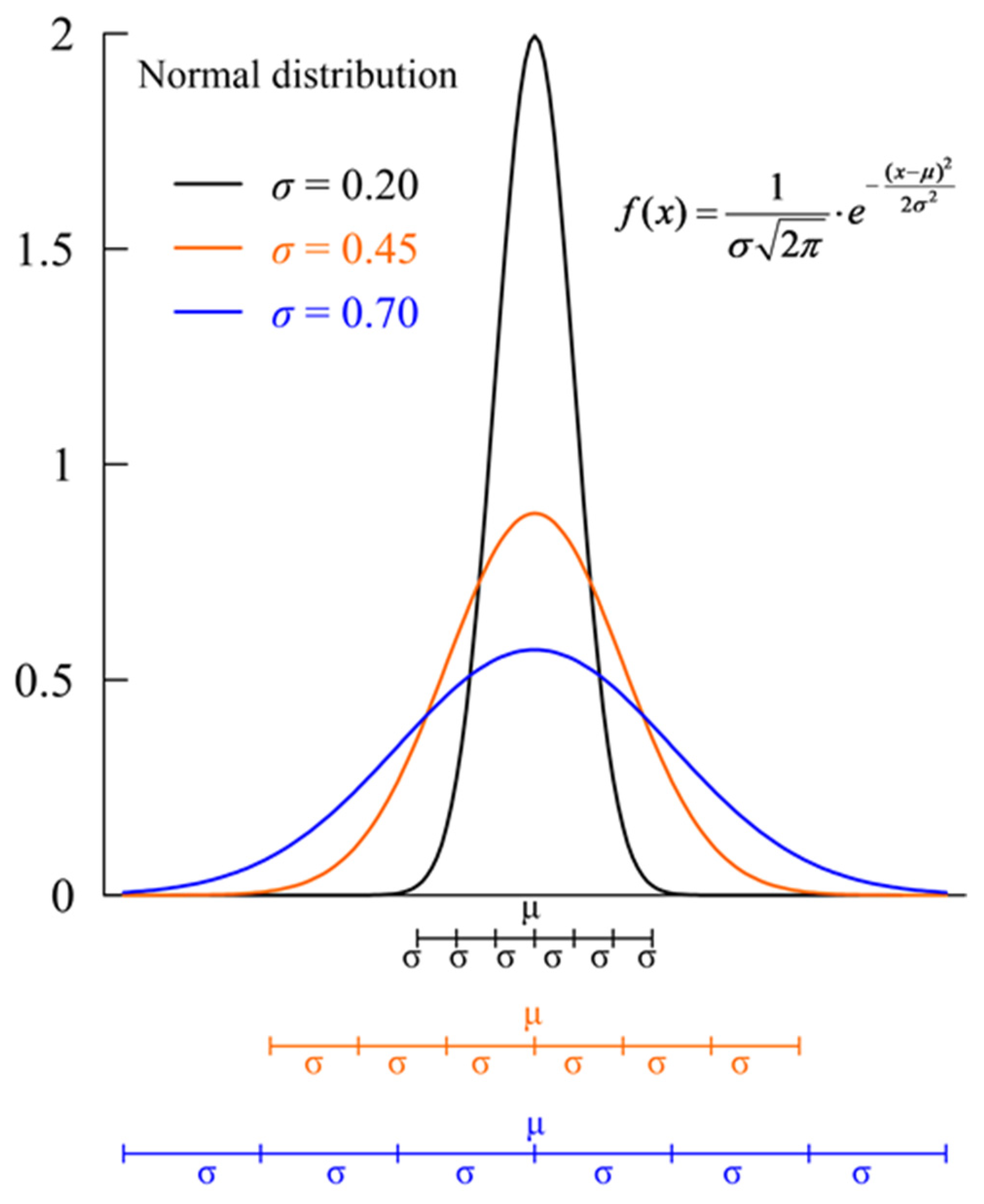
This form is identical to a normal distribution in its standard form
with the mean
μ = 0 and variance
σ2 = 2
Dt (
σ is the standard deviation); see
Figure 1.
Hence, the first central moment of this distribution is 0, which implies the same probability for a particle whether it will move to the left or to the right. The non-vanishing second central moment (equal to variance
σ2)
provides the first approximation for an estimate of the mean displacement
of the particle within the time interval [0,
t]
For spherical particles with a fixed diameter
d and low non-dimensional Reynolds number Re (relating the inertial and viscous forces), the Stokes–Einstein–Sutherland equation expresses the diffusion coefficient
D in the form relating thermal energy of the particle (the numerator) with the drag experienced by the particle (the denominator)
where
kB is the Boltzmann constant (=1.380649 × 10
−23 J⋅K
−1),
T is the absolute temperature in K, and
η is the dynamic viscosity in Pa⋅s.
Hence, the final relation for evaluating the mean displacement of the spherical particle is of the form
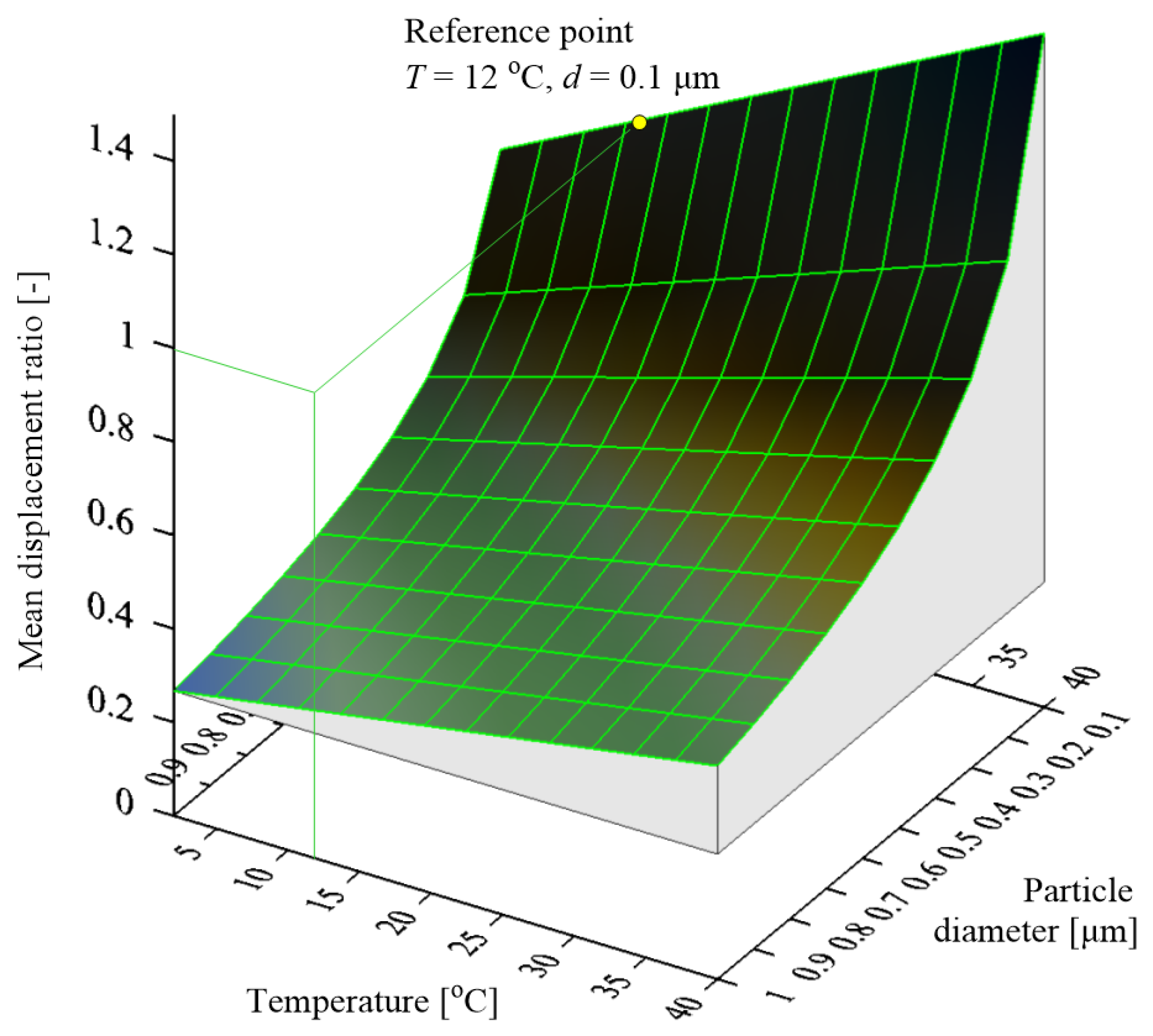
If we take as a reference point the value of particle displacement for a frequent temperature as 12 °C (= 285.15 K and the corresponding viscosity of water 0.001234 Pa s) and the diameter 0.1 μm, and compare this value with other combinations of temperature and diameter assuming the same time, we obtain the mean displacement ratio expressed as
which is graphically depicted in
Figure 2, documenting a course of mean particle displacement. As expected, the minimum is attained for the lowest value of temperature and the highest value of a particle diameter, and the maximal value corresponds to the opposite entry values.
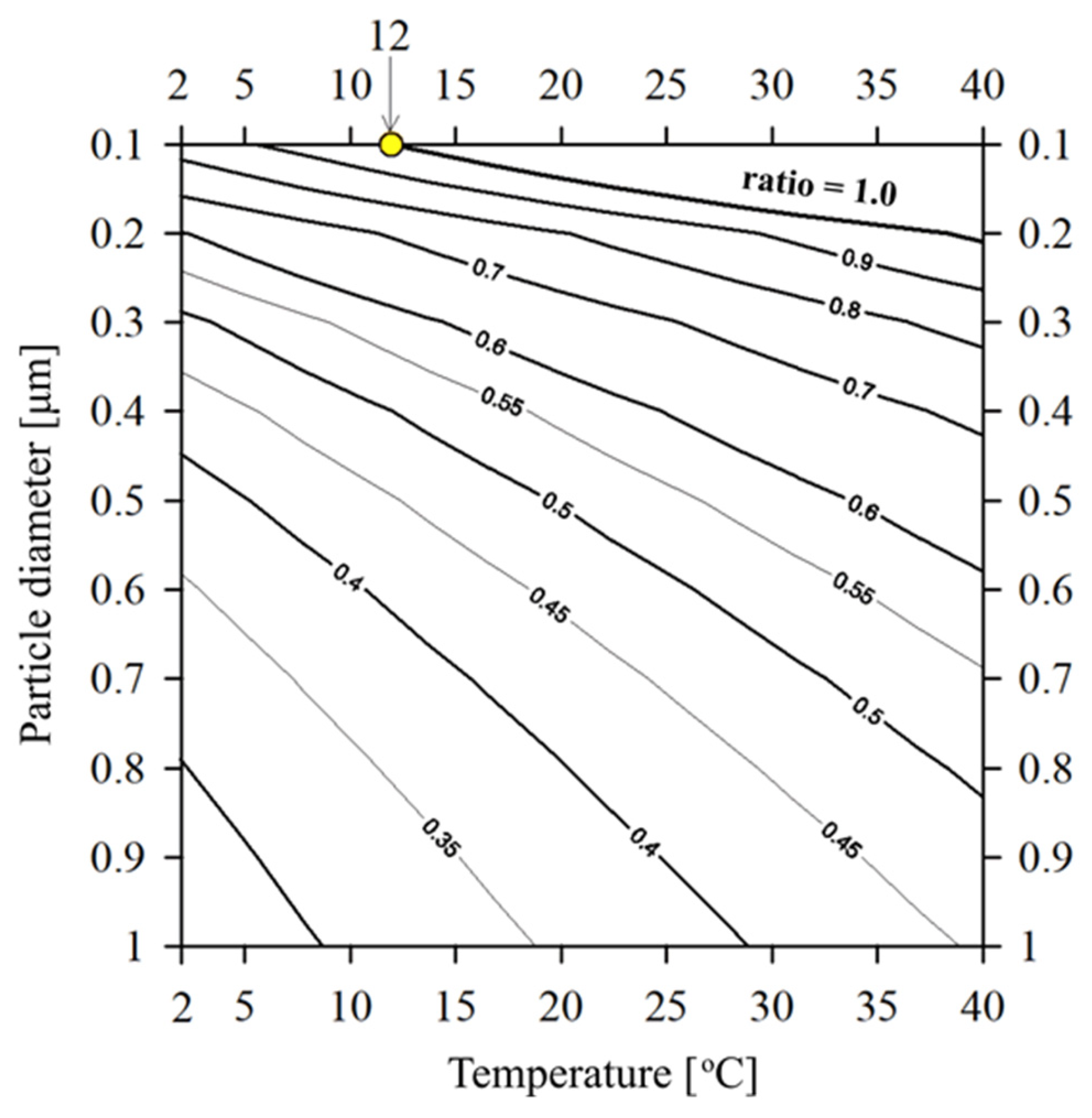
The pairs (temperature, diameter) with the same mean displacement ratios are shown in the contour plot, see
Figure 3.
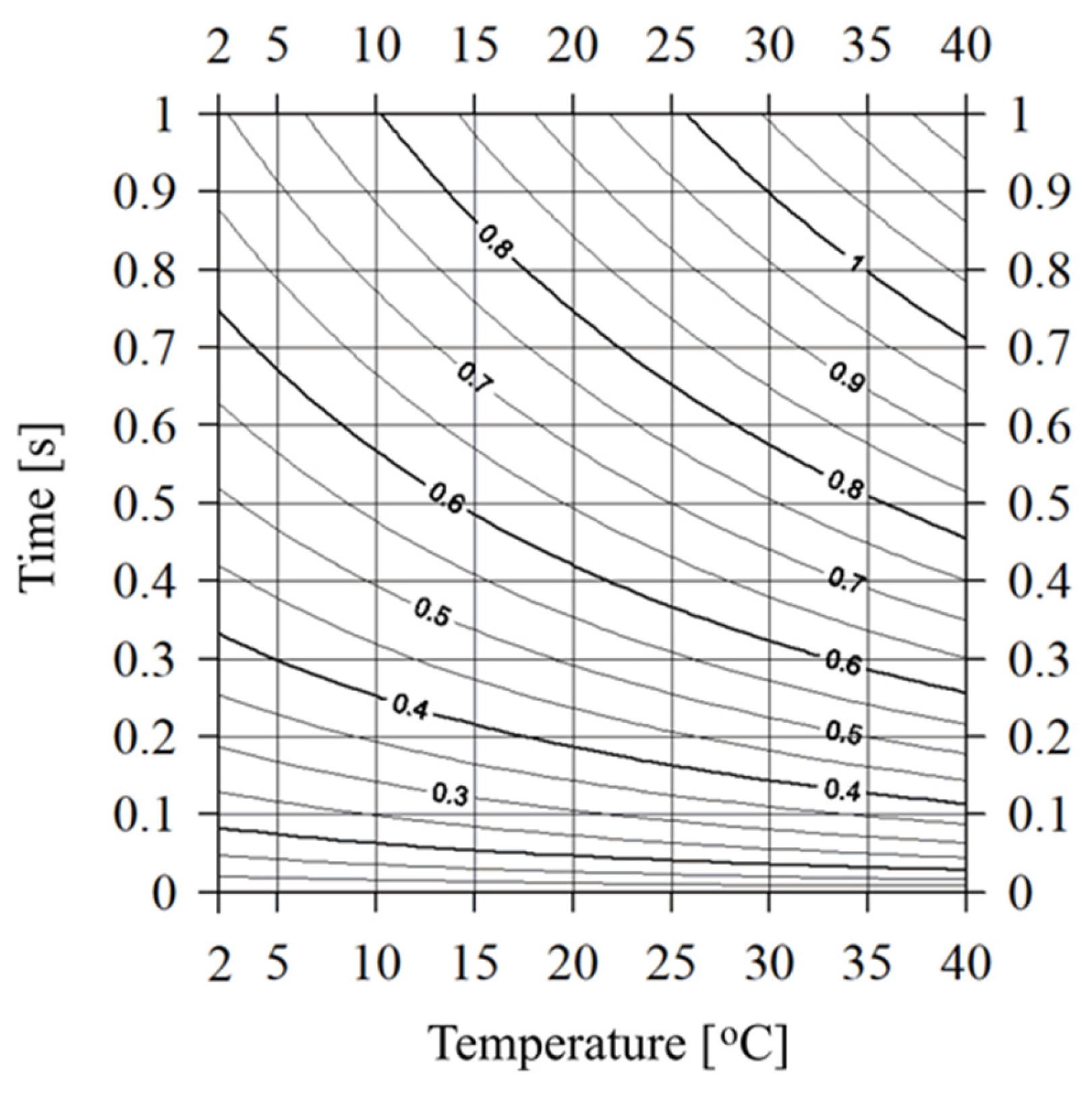
A dramatic change in the mean particle displacement with temperature changes is illustrated in
Figure 4, where the data corresponding to the individual curves are equal to
(
d is arbitrary). For a fixed value of the particle diameter the changes in displacements are apparent. This is also documented in
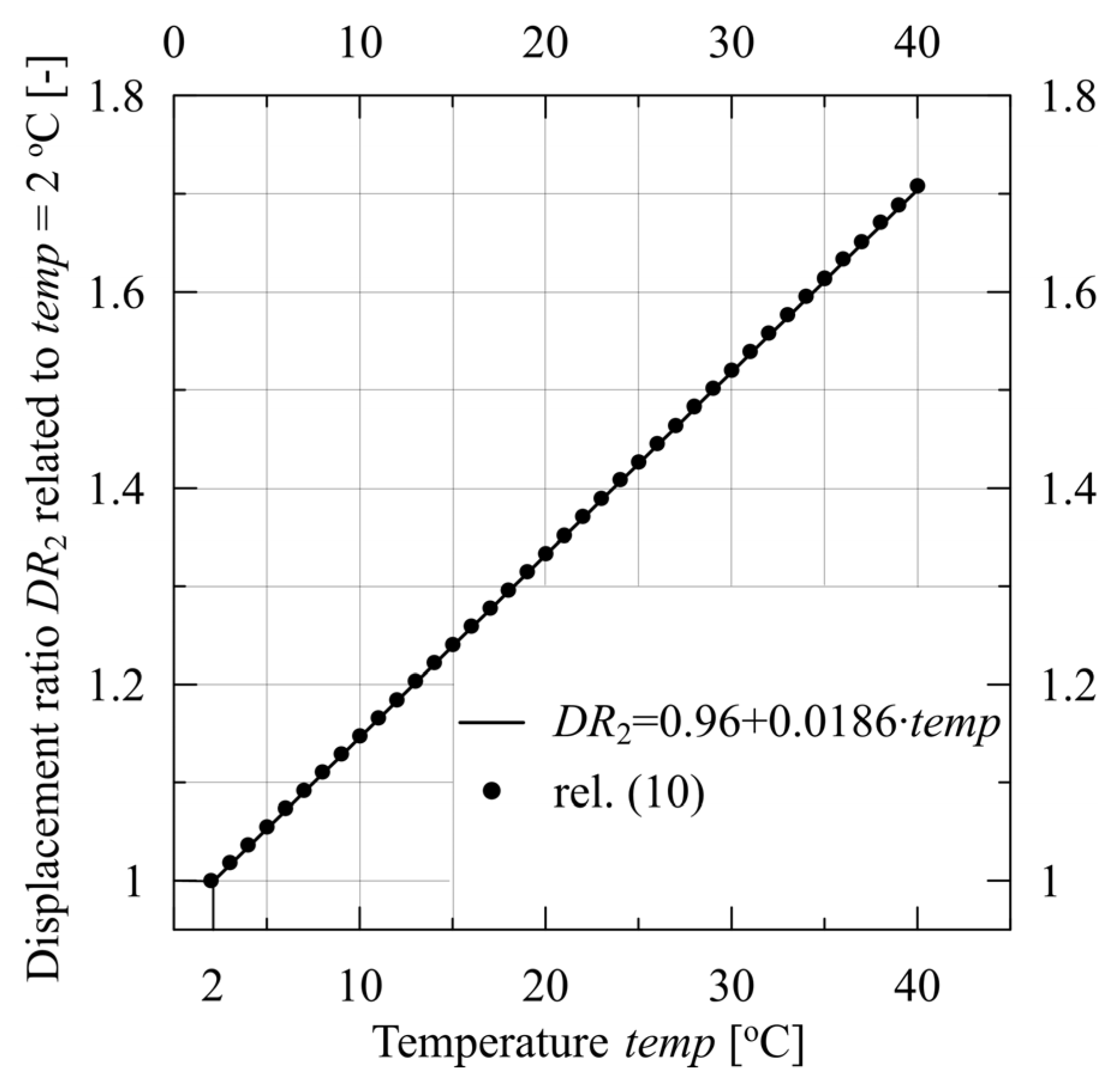
Figure 5, providing the explicit approximate relation
where
DR2 is the displacement ratio between
for the given diameter
d and elapsed time
t, and the temperature
temp is given in °C. The approximate rel. (9) evaluates (practically interpolates) the exact relation
obtained from rel. (7) and the reference temperature 2 °C (=275.15 K) for a specific particle (i.e., the same diameter and elapsed time, a difference only in temperature).
Figure 3.
A contour plot of equivalent pairs (particle diameter, temperature) with respect to the mean displacement ratio (a projection of the surface plot in
Figure 2).
Figure 3.
A contour plot of equivalent pairs (particle diameter, temperature) with respect to the mean displacement ratio (a projection of the surface plot in
Figure 2).
Figure 4.
The courses of curves in dependence on temperature and time.
Figure 4.
The courses of curves in dependence on temperature and time.
The preceding figures clearly document a significant dependence of particle displacement on temperature. The values for 12 °C and 22 °C show increases of 18% and 37%, respectively, in a comparison with water temperature 2 °C. This implies a relatively low probability of particle collisions at low temperatures compared to higher temperatures. Consequently, the initial step in water treatment—perikinetic mixing—is substantially less efficient at low temperatures.
Figure 5.
The time-invariant relative mean displacements of identical particles at various temperatures related to the reference displacement at 2 °C.
Figure 5.
The time-invariant relative mean displacements of identical particles at various temperatures related to the reference displacement at 2 °C.
The preceding numerical values should be interpreted with caution. The derived relations rely on the assumption
see rels. (4) and (5). Relation (11) is fully justified only in the laminar regime. Any imbalance in this relation may affect the numerical exactness of the quantification. However, the qualitative conclusions and the functional trends of the introduced magnitudes in dependence on temperature remain valid. The entire process is also influenced by the eXtended DLVO inputs (electrical double-layer repulsive forces, attractive van der Waals forces, Lewis acid–base interaction). Overcoming the repulsive force and forming flocs from primary particles is strongly related to the intensity of Brownian motion, as documented by Yu et al. [
10] for aluminium hydroxide precipitates with humic acid. Conversely, Brownian motion enhanced by temperature can contribute to the breakage of larger aggregates (Tan et al. [
11]).
3. Orthokinetic Phase—Formation of Aggregates
3.1. A Dependence of Water Characteristics on Temperature
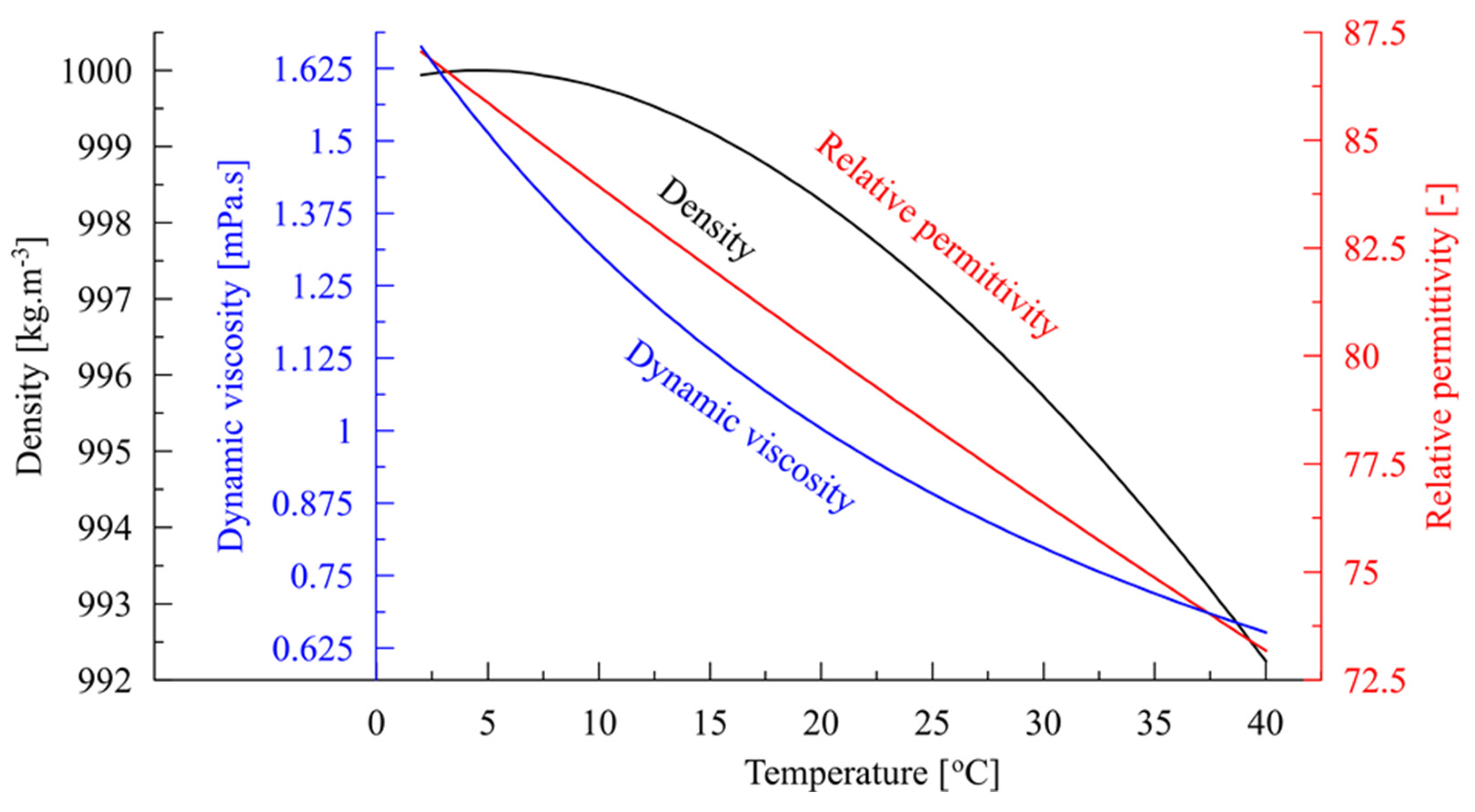
The significance of temperature, as seen in the perikinetic phase (Brownian motion), is equally critical in the orthokinetic phase (coagulation/flocculation process). Most physical quantities of water—such as density, viscosity, permittivity, diffusivity, and electric conductivity—are temperature-dependent, as documented for the first three properties in
Figure 6.
The seemingly smaller increases in water density when moving from 12 °C to 2 °C (0.35‰) and from 22 °C to 2 °C (2.1‰) are accompanied by the non-negligible increases in relative permittivity (4.7 and 9.6%, respectively) and the dramatic ones in viscosity (34.6% and 73.9%, respectively). Higher viscosity, which represents a resistance to flow, substantially reduces the frequency of particle collisions. This immediately impacts the chemical aspects of the coagulation process, specifically its rate and floc morphology (aggregate compactness) (Morris and Knocke [
4], Haarhoff and Cleasby [
12], Hanson and Cleasby [
7]).
The overall reduction in the coagulation process with decreasing temperature is attributed to low collision frequency, primarily caused by the lower intensity of Brownian motion (Yu et al. [
13]). This can be partially balanced by adjusting coagulant/flocculant dosage. The adverse effects of a temperature drop can sometimes be compensated by increasing the pH value (Camp et al. [
14], Mohtadi and Rao [
15], Hanson and Cleasby [
7]). The dependence of turbidity removal efficiency on temperature is another obvious challenge (Dayarathne et al. [
16]).
Flocculation, the chemically based orthokinetic phase, largely dominates the physically based perikinetic phase in drinking water treatment. However, it must be considered that water in many reservoirs is deposited for weeks or months. During this ‘pre-processing’, Brownian motion is often the sole factor contributing to water treatment. Nevertheless, for particles characterised by effective diameters exceeding 1 μm, the orthokinetic collision rate greatly surpasses the rate due to Brownian diffusion (Kang and Cleasby [
8] and references therein).
3.2. Efficiency of Al-Based Coagulants at Low Temperatures
Aluminium- and iron-based coagulants are the most frequently used agents worldwide in DWT due to their effectiveness across a wide range of water types, their performance under normal temperatures, and their relatively low cost (Edzwald [
17]). However, their usage is strongly influenced by the raw water temperature. It is generally known that the efficiency of aluminium-based coagulants progressively reduces with a decrease in temperature (Morris and Knocke [
4], Van Benschoten and Edzwald [
9], Tari et al. [
18], Fitzpatrick et al. [
19], McCurdy et al. [
20]). This reduction is far more pronounced when compared to iron-based coagulants.
In addition to its well-known dependence on pH, the hydrolysis process is also subject to temperature fluctuations. The following notation (simplified by not introducing the water molecules in the primary hydration shell)
describes a successive development of hydrolysis equilibria (see
Table 2) for the case of Al
3+, where each stage is characterised by its equilibrium constant given (the Guldberg and Waage’s law of mass action), for example
where the square brackets represent the equilibrium molar concentrations of the individual species.
Table 2 (based on the data from Xiao et al. [
21]) illustrates the apparent changes in hydrolysis rates as a function of temperature. Determining K-values is nontrivial, which is reflected in the variations reported by different authors; however, these discrepancies do not alter the overall temperature-dependent trends in the equilibrium constants. Analogous trends are also valid for other coagulants.
The efficiency of coagulation using traditional aluminium sulphate (alum, Al2(SO4)3∙18H2O) at low temperature can be elevated in more ways:
Increasing alum dosage: Higher alum dosage reduces the time required for particle destabilisation due to increased collision-attachment efficiency, and it increases the rate at which the number of primary particles decreases (Matsui et al. [
22]). However, this approach leads to a higher volume of residual Al, representing potential health risks (Bondy [
23], Krupinska [
24], García-Avila et al. [
25]).
Substituting alum with preformed polymerized forms of Al, such as polyaluminium chloride (PACl) and polyaluminium sulphate (PAS): These pre-polymerized agents are more effective at lower temperatures and also exhibit a broader pH range than alum (Matsui et al. [
22]. Another positive factor is the higher charge density of PACl species, which allows for decreased coagulant dosage and a consequent reduction in residual production (McCurdy et al. [
20]).
Application of dual-coagulants: The adverse impact of high Al dosage can be attenuated by applying dual coagulants. Huang et al. [
26] used a polyaluminium chloride–compound bioflocculant (PACl–CBF) and a compound bioflocculant–polyaluminium chloride (CBF–PACl), which improved dissolved organic carbon (DOC) removal efficiency. CBF was primarily composed of polysaccharide (90.6%) and protein (9.3%). By reducing Al content, the compound bioflocculant helps lower the health risks of the residual and offers partial biodegradability.
As evident above, the crucial factor in temperature-dependent DWT is the collision frequency of particles,
N [cm
−3∙s
−1]. Zhou et al. [
27] introduced a relation for collision frequency
where β (counts/cm
3) is the constant;
cp is the concentration of particles;
d is the mean diameter of particles;
ξ is the dissipation rate of water energy, and
μ is the dynamic viscosity of water. The energy dissipation rate quantifies the amount of energy lost due to viscous forces in turbulent flow, which consists of eddies of different sizes. Going down to very small eddies, the energy dissipates into heat due to viscous forces.
As expected, the collision frequency decreases with both a reduced particle concentration and an increase in dynamic viscosity at lower temperatures (see
Figure 6), and it is intrinsically linked to the intensity of Brownian motion (Yu et al. [
13]). Coupled with the insufficient hydrolysis rate of coagulants at low temperatures (Van Benschoten and Edzwald [
9], Xiao et al. [
2]), this leads to direct consequences:
Reduced aggregation rate (Yu et al. [
10])
Xiao et al. [
3] showed that the decrease in raw water temperature by 1 °C within the range from 22 °C to 2 °C was accompanied by 1–8% decrease in the aggregation rate.
Reduced floc size (Fitzpatrick et al. [
19], Yu et al. [
10])
It has an impact on residual turbidity, which is dominantly caused by the presence of small particles and flocs. Xiao et al. [
2] found that—in their case—the flocs at 2 °C were on average half the size of those at 22 °C.
3.3. Three Possibilities of Recalculating (pH, pOH) Couples at Different Temperatures
Beyond the type and dosing of coagulation/flocculation agents, the pH value is a crucial parameter for optimising DWT efficiency. The self-dissociation of water
into hydronium (H
3O
+) and hydroxide (OH
−) ions is an equilibrium process preserving the constant ionic product of water K
w = [H
3O
+][OH
−] at a given temperature (square brackets denote a molar concentration of the respective component). In the case of
temp = 25 °C (more exactly 24.87 °C), the product of molar concentrations (mol/litre) of both ions K
w attains the value 10
−14 [mol
2/L
2], inducing a neutral value 10
−7 [mol/L] for which both concentrations are balanced. Disbalance from the neutral value indicates basicity or acidity. The neutral value (pH = 7 for
temp = 25 °C) is not fixed but is subject to temperature as K
w decreases with temperature (water dissociation decreases with temperature).
There are three basic possibilities for primary evaluation of pH and pOH values (pH + pOH = −log (Kw) ≡ pKw) at temperatures differing from the temperature for which the pH (pOH) value was optimised:
to preserve a constant ratio of concentrations [H3O+]/[OH−] (pH/pOH = Const);
to preserve a constant concentration of hydroxide ions [OH−] (pOH = Const);
to preserve a constant concentration of hydronium ions [H3O+] (pH = Const).
Each possibility generates significantly different chemical outcomes for the water treatment process, as discussed in detail below.
3.3.1. Fixed Ratio of Concentrations [H3O+]/[OH−] (pH/pOH = Const)
A neutral pH (pOH) value expresses the situation where the concentrations of both ion groups are balanced. At 25 °C, this means that the neutral value is approximately 7 as pK
w ≈ 14 (more exactly 13.997). The dilution of ions in each group is documented by a very large mean distance of about 0.255 μm (
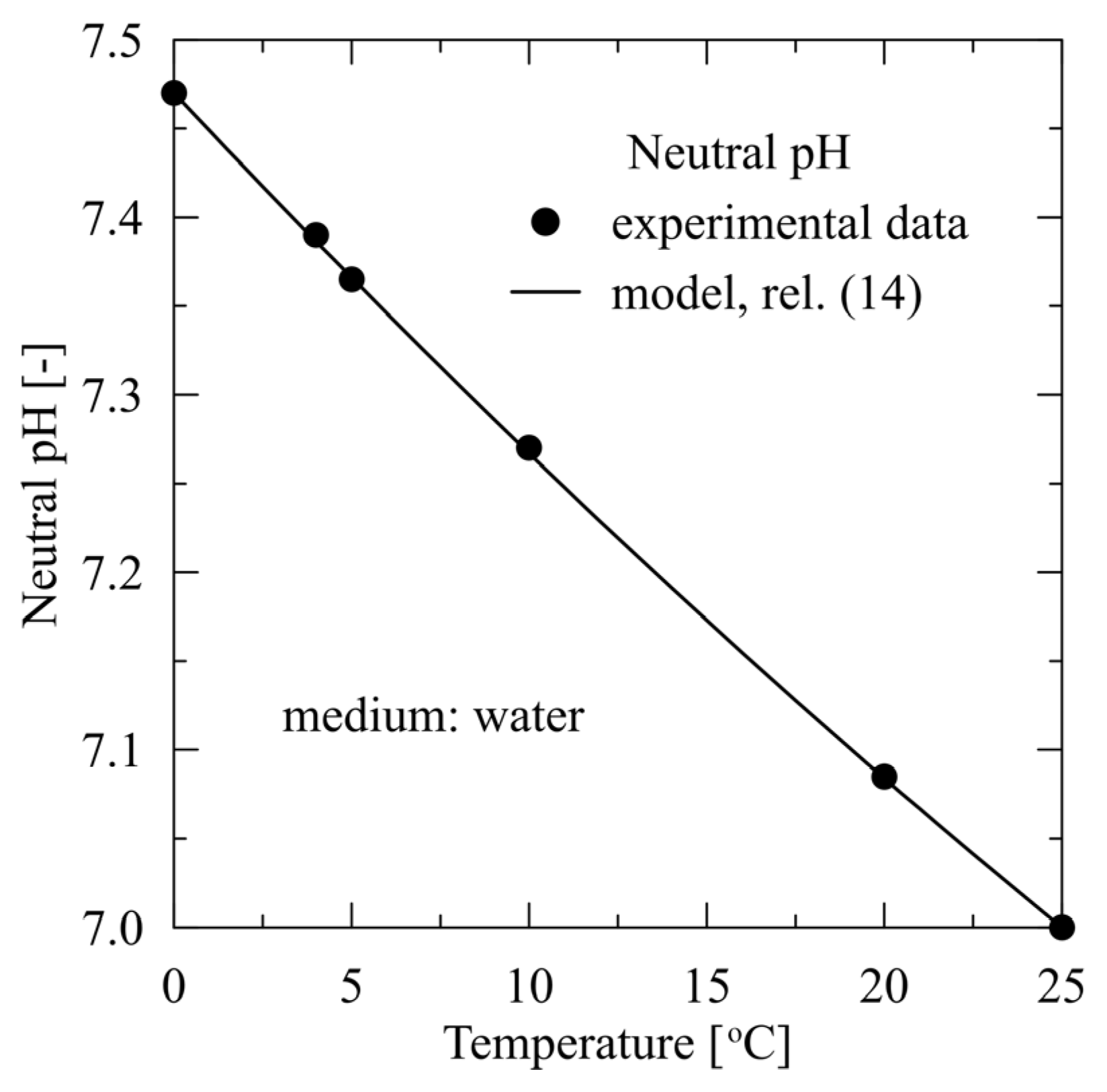
https://www.idc-online.com/technical_references/pdfs/chemical_engineering/Water_dissociation_and_pH.pdf (accessed on 4 January 2026)). The mean distance increases with decreasing temperature (concentration decreases) as the rate of water dissociation reduces with decreasing temperature as documented in
Figure 7. With the temperature approaching zero, the neutral pH value attains 7.47 (pK
w ≈ 14.94). This implies that, for instance, the value pH = 7.35 represents basicity at 25 °C, while it represents acidity at temperatures above 0 °C. The neutral pH (pOH) values, depending on temperature, can be approximated in the range (0 °C, 25 °C) by the relation
The course of neutral pH (pOH) values is depicted in
Figure 8. The changes in the concentration of similar ions with temperature are not negligible; for instance, the concentration of ions in each group is lowered to approximately one-third (10
−7.47/10
−7 ≈ 0.339) when passing from 25 °C to 0 °C. For a common treated water temperature of 10 °C, the decrease is about one-half (10
−7.27/10
−7 ≈ 0.537).
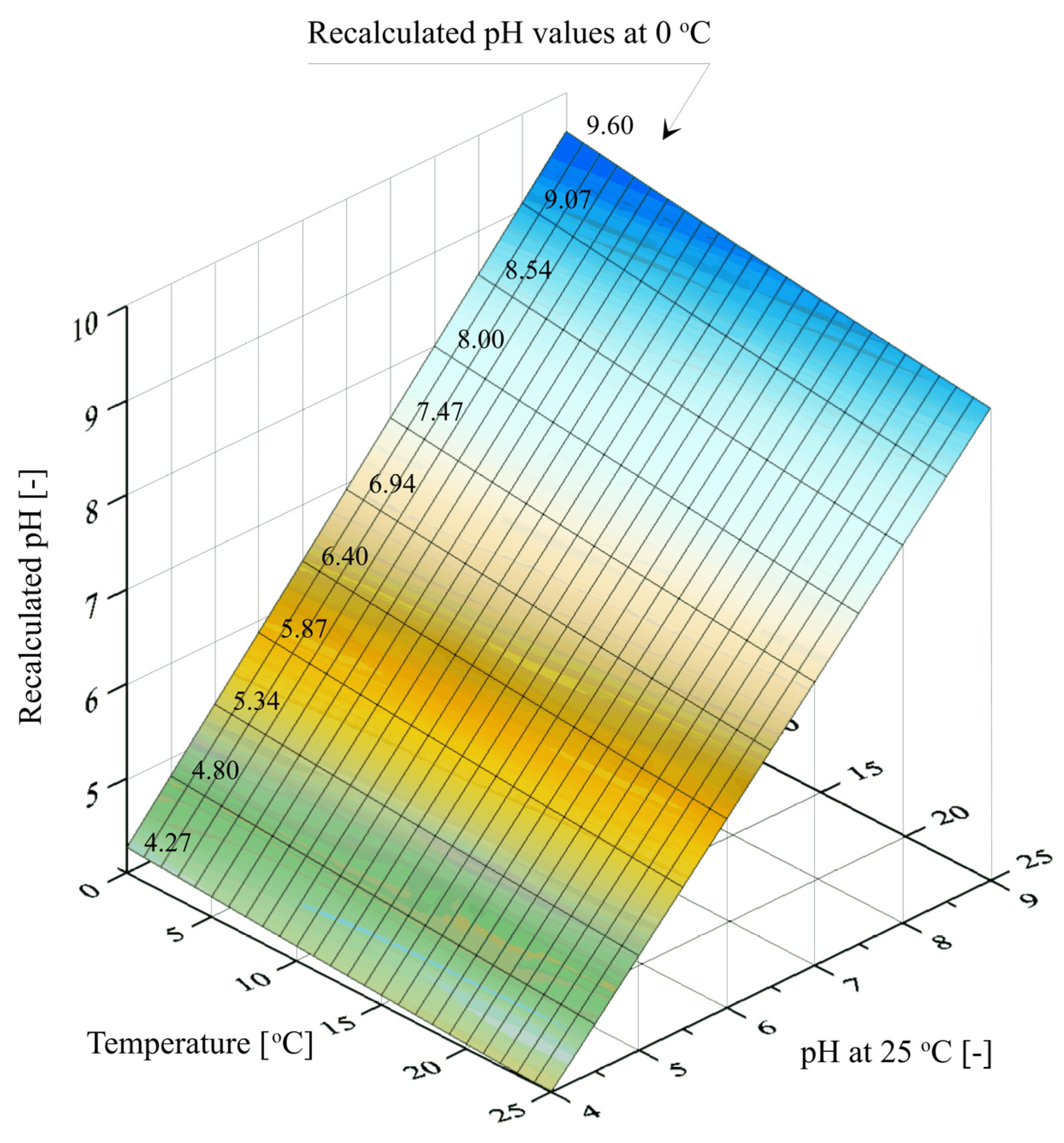
If drinking water treatment experiments determine an optimised pH value at 25 °C, one might consider preserving the ratio pH/pOH for other temperatures
From here, it follows that
and by rearranging, we obtain
Graphical interpretation of this relation is shown in
Figure 8.
The problem is that both concentrations (of hydronium (H3O+) and hydroxide (OH−) ions) are reduced with a decreasing temperature. Hence, the chemical conditions at temperatures differing from 25 °C are fundamentally different, and there is no direct correspondence between the original optimised pH value at 25 °C and the recalculated one for a different temperature.
3.3.2. Fixed Concentration of Hydroxide Ions [OH−] (pOH = Const)
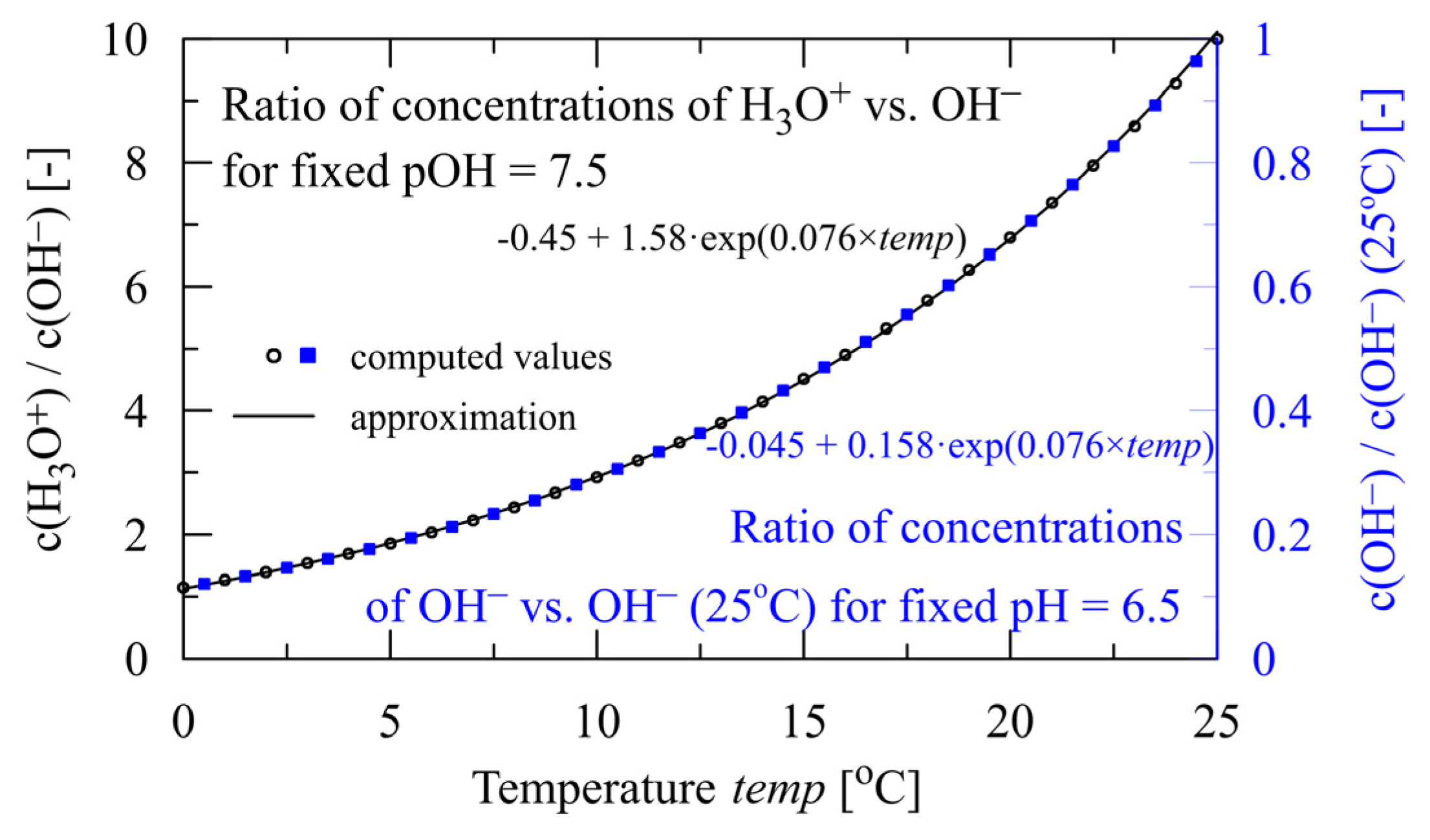
Fixing the concentration of hydroxide ions results in a more intense drop in hydronium ions with decreasing temperature. In other words, the entire increase of pK
w with decreasing temperature projects into an increase in pH and, consequently, a higher dilution of hydronium ions. As illustrated in
Figure 9 (left ordinate), fixing a concentration of hydroxide ions to 7.5 implies a reduction in hydronium ions to one-ninth when passing from 25 °C to 0 °C.
Fixing pOH prevents the reduction in hydroxide ions and ensures their supply for the hydrolysis reaction, as metal hydroxides cause particle destabilisation. This is why the use of constant pOH is recommended for correcting system chemistry for temperature effects (Hanson and Cleasby [
7], Van Benschoten and Edzwald [
9]).
3.3.3. Fixed Concentration of Hydronium Ions [H3O+] (pH = Const)
A fixed concentration of hydronium ions leads to a decreasing concentration of hydroxide ions with decreasing temperature. This is shown in
Figure 9. A decrease in temperature from 25 °C to 0 °C is accompanied by a decrease in hydroxide ions OH
− to one-ninth, which substantially influences the chemical aspects of the whole water treatment process. This explains a failure in water treatment efficiency when the same values of pH are applied for different temperatures (e.g., Hanson and Cleasby [
7]).
Based on this and preceding sub-sections, it raises a question whether the commonly used pH value optimising efficiency of drinking water treatment should not be substituted by a corresponding pOH value at temperature
t(exp) under which the experiments are carried out
and with the changes in temperature to fix the pOH value. Then, the corresponding pH value at temperature
temp in practical conditions can be calculated (using Relation (14)) from the relation
where the first term (product) determines an approximate value of (pK
w)
temp.
3.4. Compactness (Fractal Dimension) of Aggregates at Low Temperatures
The term compactness is rather fuzzy as its interpretation is not well-established. This term can be quantified using the term fractal dimension. This term—coined by Mandelbrot [
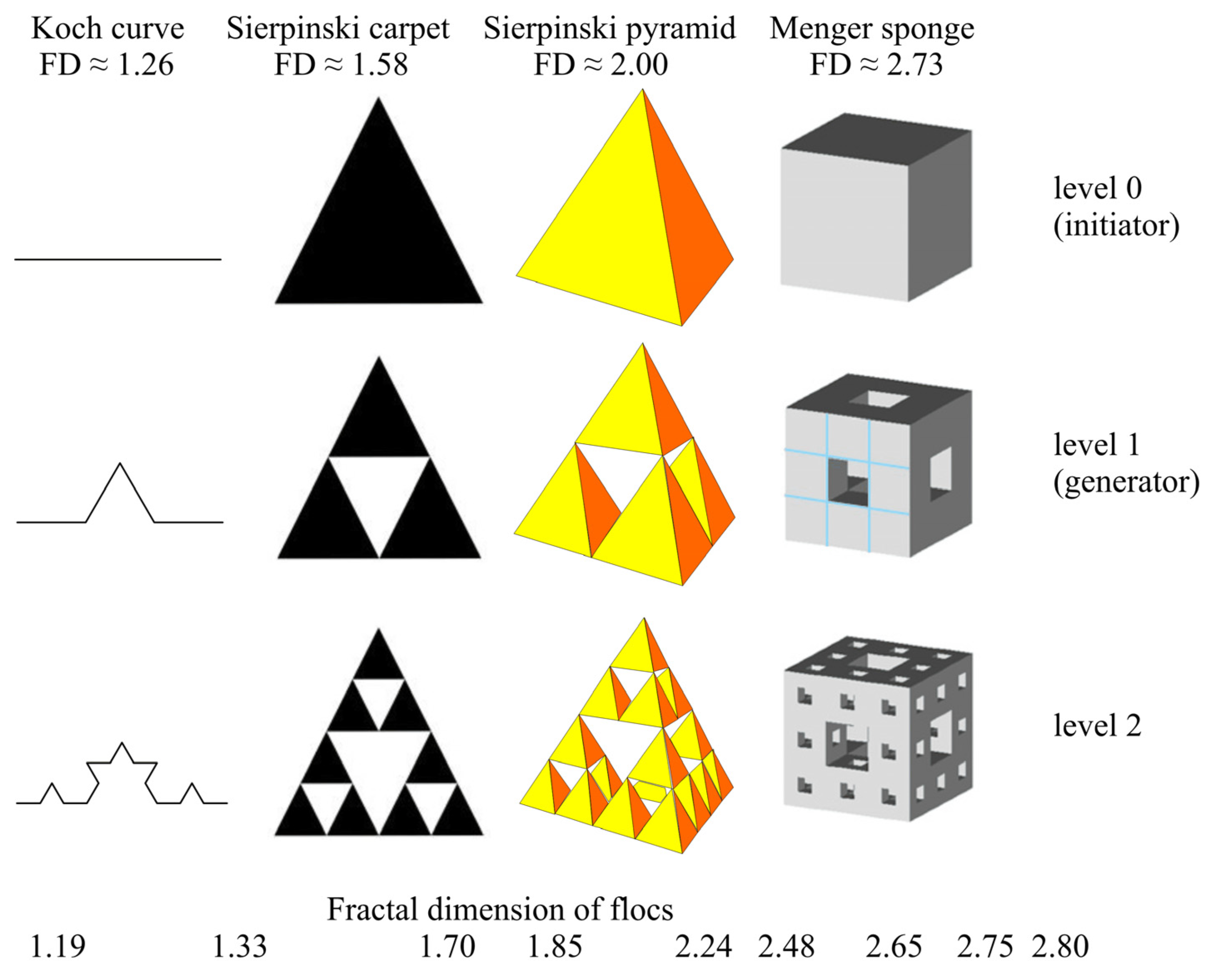
28]—was originally in its strict notation based on the process of self-similarity. Loosely said, an observer inserted into this process cannot determine at which level they appear. Theoretically, the similarity procedure could be repeated (starting with the so-called initiator (level 0) and repeatedly proceeding with a generator (level 1) (see
Figure 10) infinitely many times. In practice, this process is stopped after a couple of steps due to, for instance, the finite (further non-divisible) sizes of particles. The self-similarity is also violated. However, even under these circumstances, an application of the fractal approach has proven to be very efficient in many industrial branches, including water drinking treatment (Hiemenz and Rajagopalan [
29], Hunter [
30], Gregory [
31], Bache and Gregory [
32]).
From a drinking water treatment perspective, two fractal regions are important: a fractal dimension value from 1 to 2 when the studied aggregate is projected to the two-dimensional (2D) plane, or a value from 2 to 3, which characterises a spatial object. An approach to lower Euclidean limits (1 or 2) represents very loose aggregates; an increase in fractal values in the direction to the upper Euclidean limits (2 or 3) describes a more compact aggregate with a limited number of short ’sprouts’ and a condensed inner core.
At low temperatures, the looseness/compactness of aggregates, expressed by fractal dimension, is highly sensitive to the coagulation characteristics introduced earlier, primarily collision frequency. Collision frequency is non-negligibly influenced by the particle frequency (turbidity) in the processed raw water. This explains the differences among the results obtained by various authors. This turbidity imbalance is often smoothed out over a relatively long time period compared to treatment under moderate temperatures, as newly forming flocs are of a reduced size.
Xiao et al. [
3] showed that—using alum as a coagulant agent—the perimeter-based 2D fractal dimension
Dpf (area ∝ (perimeter)
2/Dpf) increased from 1.19 to 1.33 as the temperature dropped from 22 °C to 2 °C.
Yu et al. [
10] presented a gradual increase in fractal dimension with coagulation time for raw water at a temperature of approximately 4 °C, in contrast to the same water containing humic acids, where initially the fractal dimension decreased and then increased with a dosage of alum as the coagulant agent. The variation in 2D fractal dimension was within the interval (1.7, 1.85); see
Figure 10. The same course—initial decrease in fractal dimension with time followed by an increase—was found by Liu et al. [
33] for three coagulants (alum, PACl, PAFC (polyaluminium ferric chloride)) at temperatures within 2.1–8.7 °C. The fractal dimensions started at 2.52, dropped to 2.45, and moderately increased.
Huang et al. [
26] used the method of laser light scattering for fractal characterisation with three different coagulants: PACl, PACl-CBF and CBF-PACl. The raw water temperature was approximately 6 °C, and in jar tests about 10 °C. The fractal dimension approximately attained the values 2.65, 2.8, and 2.75 in the formation, breakage, and recovery stages, respectively (for PACl-CBF systematically lower by 0.1). This means that compactness in these cases roughly corresponds to the Menger sponge; see
Figure 10.
4. Discussion
The classical “rule of three”, in drinking water treatment, coagulant–dosage–pH value, becomes significantly more complicated when the processed raw water exhibits low temperatures:
Coagulant:
The classical metal-based coagulants (containing Al, Fe) exhibit completely different behaviour, not only in comparison between, e.g., Al (worse efficiency and health risks) and Fe, but also between the coagulants based on the same metal component (worse performance of aluminium sulphate in comparison with polyaluminium chloride).
Dosage:
Lower temperatures decrease solubility, and the rate of hydrolysis. An increased dosage results in an increase in sludge and, hence, poses the possible health risks (Al).
pH value:
Based on literature sources, fixing an optimised value achieved at a specific value of temperature fails in reaching optimised efficiency at a different temperature. A first approximation of the corresponding pH value should be recalculated from the self-ionisation constant of water Kw (its negative common logarithm), and by fixing the value of pOH.
The fractal dimension appears to be the most appropriate parameter for characterising the looseness or compactness of formed flocs. Its determination has a direct connection to the object’s complexity, regardless of any interpretation based on porosity or irregularity (the highest FD values, 2 for 2D and 3 for 3D, are attained by the simplest geometrical objects: a circle and a sphere, respectively).
The measure of compactness has different implications at higher and lower temperatures, which is linked to floc size. Higher compactness at higher temperatures usually indicates good settlement, as the formed flocs are relatively voluminous, and even a phase of breakage does not violate this tendency. The situation at lower temperatures is different; a relatively high floc compactness can still be accompanied by a relatively small size of formed aggregates. Combined with floc breakage, this scenario can suppress or delay the tendency toward sedimentation.
Enhancing the coagulation rate by increasing the coagulant dosage creates problems concerning the amount of deposited sludge. When Al-based coagulants are used, they also amplify health risks.
On the other hand, DWT at low temperatures is usually free of the seasonal phenomena seen at common temperatures, such as the occurrence of algal organic matter (AOM). However, the occurrence of other unwanted components, such as diatoms, is gradually increasing even at low temperatures in recent times.
5. Conclusions
The literature devoted to drinking water treatment at low temperatures is relatively scarce. The choice of coagulants applied at these temperatures is also limited, as the transportation of a series of newly tested biodegradable agents based on natural sources is expensive, and their efficiency under these conditions is rather unclear. Naturally, the focus on the coagulant–dosage–pH relationship should be significantly concentrated on a proper determination of the pH value to ensure an optimal DWT process. However, the quality of the processed water is not the only parameter; the amount and potential harmfulness of the produced sludge must also be considered. A decrease in coagulant or flocculant efficiency that is compensated for by increased dosages leads to greater sludge volumes, which can have adverse environmental and health impacts.
All of these factors contribute to the comprehensive financial analysis, as the net prices of coagulants and flocculants represent only one component of the final calculations. Health risks, environmental quality, transport distances, increased dosages necessitated by low temperatures, and other site-specific factors related to individual drinking water treatment (DWT) plants must also be taken into account. This context explains the increased attention given to the application of aluminium-based coagulants
The simple algebraic Relation (17), which adjusts the experimental pH value to its corresponding value at a specified temperature, represents an effective primary step for establishing the input parameters.
More accurate determination of floc looseness/compactness through the fractal dimension is influenced by the capabilities of the individual fractal determination methods (e.g., issues with 2D projections versus the challenge of undisturbed floc morphology in 3D).