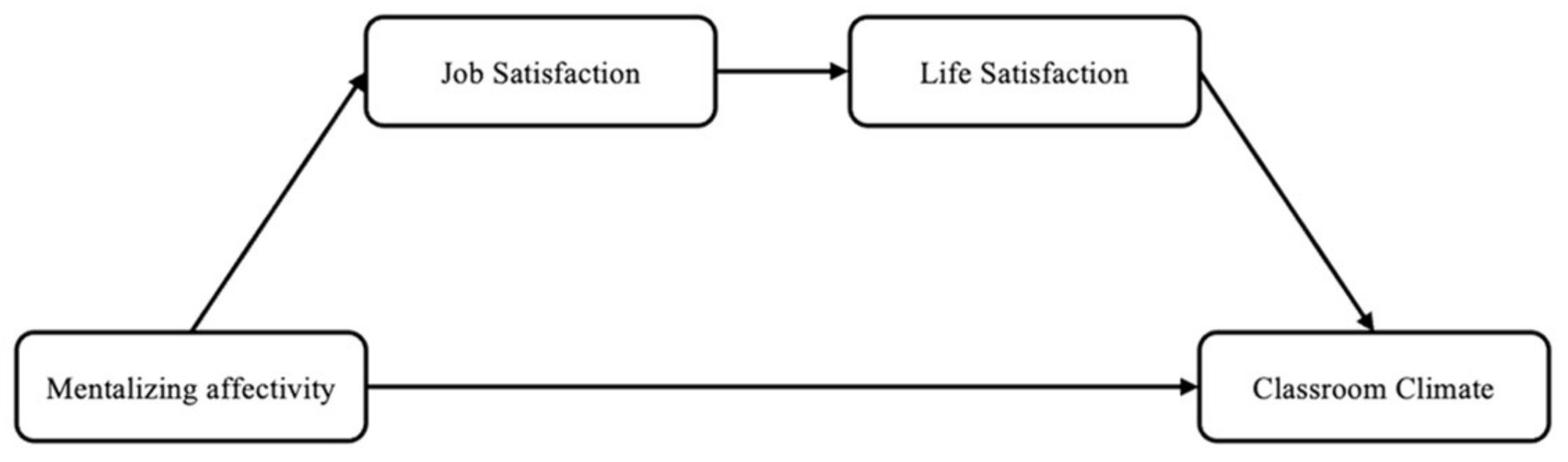
The Classroom Climate and the Role of Teachers’ Mentalized Affectivity: Mediation Through Job and Life Satisfaction



Abstract
1. Introduction
1.1. Mentalized Affectivity and Classroom Climate
1.2. Job/Life Satisfaction and Classroom Climate
1.3. Mentalized Affectivity, Job/Life Satisfaction, and Classroom Climate
1.4. Teacher-Level Factors Affecting the Classroom Climate
2. Materials and Methods
2.1. Aims and Research Questions
2.2. Procedure
2.3. Participants
2.4. Measures
2.4.1. Mentalized Affectivity
2.4.2. Classroom Climate
2.4.3. Life and Job Satisfaction
2.5. Statistical Plan
3. Results
3.1. Group Comparisons
3.2. Associations Between Study Variables in Teachers of Primary and Lower Secondary Education
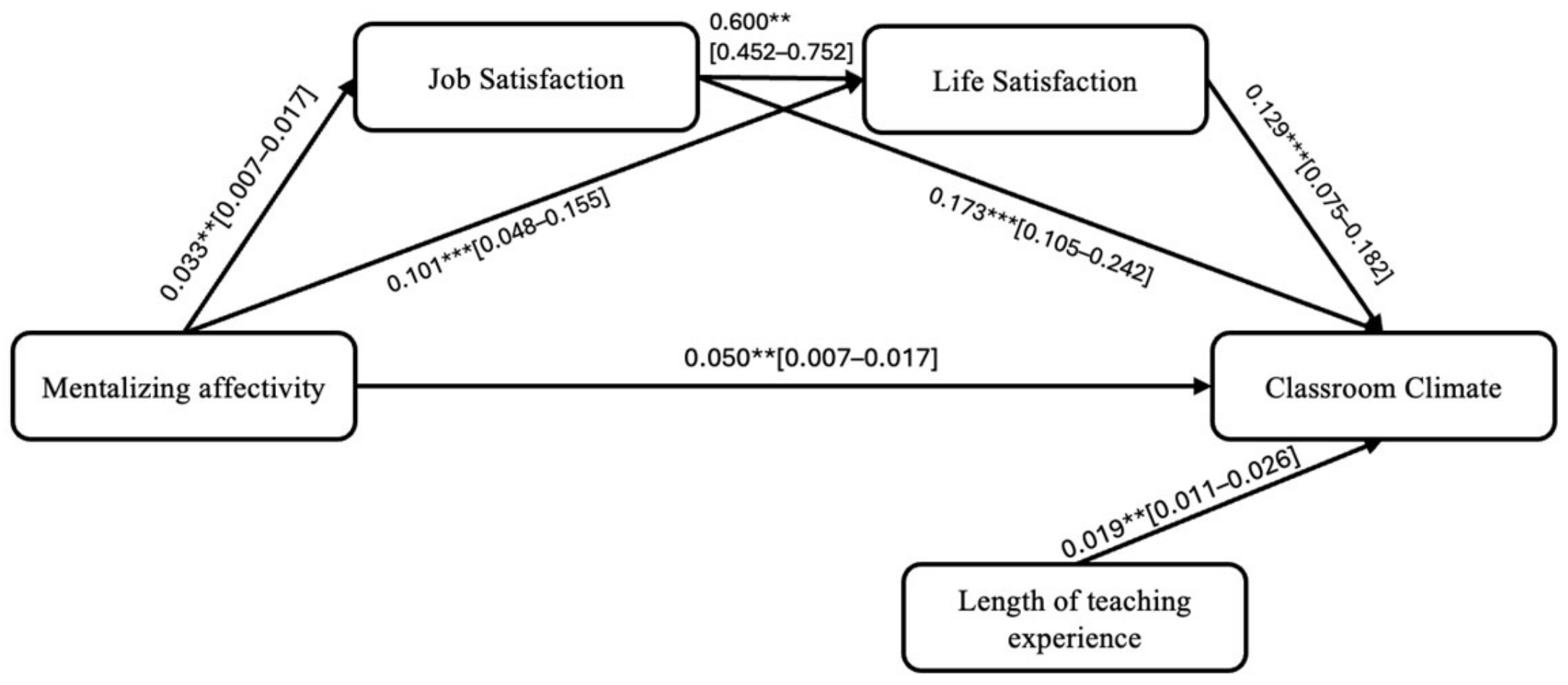
3.3. Parallel Mediation Model
4. Discussion
5. Study’s Strengths and Limitations
6. Research and Educational Implications
7. Conclusions
Author Contributions
Funding
Institutional Review Board Statement
Informed Consent Statement
Data Availability Statement
Conflicts of Interest
References
- Alghamdi, M. H., & Sideridis, G. (2024). Identifying subgroups of teacher burnout in elementary and secondary schools: The effects of teacher experience, age and gender. Frontiers in Psychology, 15, 1406562. [Google Scholar]
- Allen, J. G., Fonagy, P., & Bateman, A. W. (2008). Mentalizing in clinical practice. American Psychiatric Publishing. [Google Scholar]
- Bak, P. L. (2012). “Thoughts in mind”: Promoting mentalizing communities for children. In I. Vrouva, & N. Midgley (Eds.), Minding the child: Mentalization-based interventions with children, young people and their families (pp. 202–218). Routldedge. [Google Scholar]
- Bak, P. L., Midgley, N., Zhu, J. L., Wistoft, K., & Obel, C. (2015). The resilience program: Preliminary evaluation of a mentalization-based education program. Frontiers in Psychology, 6, 753. [Google Scholar] [CrossRef] [Scilit] [PubMed]
- Ballespí, S., Vives, J., Alonso, N., Sharp, C., Ramírez, M. S., Fonagy, P., & Barrantes-Vidal, N. (2019). To know or not to know? Mentalization as protection from somatic complaints. PLoS ONE, 14(5), e0215308. [Google Scholar] [CrossRef] [Scilit] [PubMed]
- Bianco, F., & Castelli, I. (2023). The promotion of mature theory of mind skills in educational settings: A mini-review. Frontiers in Psychology, 14, 1197328. [Google Scholar] [CrossRef] [Scilit] [PubMed]
- Bianco, F., & Lecce, S. (2016). Translating child development research into practice: Can teachers foster children’s theory of mind in primary school? British Journal of Educational Psychology, 86(4), 592–605. [Google Scholar] [CrossRef] [Scilit] [PubMed]
- Bianco, F., Levante, A., Petrocchi, S., Lecciso, F., & Castelli, I. (2021). Maternal psychological distress and children’s internalizing/externalizing problems during the COVID-19 pandemic: The moderating role played by hypermentalization. International Journal of Environmental Research and Public Health, 18(19), 10450. [Google Scholar] [CrossRef] [Scilit] [PubMed]
- Bortolami, M., Deidda, L., & Suglia, F. (2017). Power analysis for exploratory research: Considerations and guidelines. Giornale Italiano di Psicologia, 44(2), 123–132. [Google Scholar]
- Bronfenbrenner, U. (1979). The ecology of human development: Experiments by nature and design. Harvard University Press. [Google Scholar]
- Brown, T., & Beran, M. (2007). Developmental stages of children. In Ergonomics for children (pp. 29–54). CRC Press. [Google Scholar]
- Buyse, E., Verschueren, K., Verachtert, P., & Van Damme, J. (2009). Predicting school adjustment in early elementary school: Impact of teacher–child relationship quality and relational classroom climate. The Elementary School Journal, 110(2), 119–141. [Google Scholar] [CrossRef] [Scilit] [PubMed]
- Byrne, G., Murphy, S., & Connon, G. (2020). Mentalization-based treatments with children and families: A systematic review of the literature. Clinical Child Psychology and Psychiatry, 25(4), 1022–1048. [Google Scholar] [CrossRef] [Scilit] [PubMed]
- Cabello-Sanz, S., Muñoz-Parreño, J. A., & González-Benito, A. (2025). Impact of an emotional education program on children with attention deficit and hyperactivity disorder in primary education: Improvements in academic performance. Espiral Cuadernos del Profesorado, 18(37), 75–88. [Google Scholar] [CrossRef] [Scilit]
- Carroll, A., Forrest, K., Sanders-O’Connor, E., Flynn, L., Bower, J. M., Fynes-Clinton, S., York, A., & Ziaei, M. (2022). Teacher stress and burnout in Australia: Examining the role of intrapersonal and environmental factors. Social Psychology of Education, 25(2), 441–469. [Google Scholar] [CrossRef] [Scilit] [PubMed]
- Cavioni, V., Grazzani, I., Ornaghi, V., Agliati, A., Gandellini, S., Cefai, C., Camilleri, L., Bartolo, P., Vorkapić, S. T., Golob, L., Poulou, M., Martinsone, B., Supe, I., Simões, C., Lebre, P., Colomeischi, A., Rusu, P., Acostoaie, L., Vintur, T., & Conte, E. (2023). A multi-component curriculum to promote teachers’ mental health: Findings from the PROMEHS program. International Journal of Emotional Education, 15(1), 34–52. [Google Scholar] [CrossRef] [Scilit]
- Cavioni, V., Grazzani, I., Ornaghi, V., Agliati, A., & Pepe, A. (2021). Adolescents’ mental health at school: The mediating role of life satisfaction. Frontiers in Psychology, 12, 720628. [Google Scholar] [CrossRef] [Scilit] [PubMed]
- Chelouche-Dwek, G., Petrick, O., McHugh, B., Dawson, N., Hillman, M., & Fonagy, P. (2026). Bridging clinical and educational contexts: Mentalization-based techniques in educational settings. Frontiers in Psychology, 17, 1797274. [Google Scholar] [CrossRef] [Scilit] [PubMed]
- Cheon, S. H., Reeve, J., Marsh, H. W., & Song, Y. G. (2022). Intervention-enabled autonomy-supportive teaching improves the PE classroom climate to reduce antisocial behavior. Psychology of Sport and Exercise, 60, 102174. [Google Scholar] [CrossRef] [Scilit]
- Cieślak, M., Kozaka, J., Golińska, P. B., & Bidzan, M. (2022). Mentalization and its relation to life satisfaction and the level of mental adjustment to illness in women with breast cancer: A pilot study. International Journal of Environmental Research and Public Health, 19(16), 10323. [Google Scholar] [CrossRef] [Scilit] [PubMed]
- Cohen, J., McCabe, E. M., Michelli, N. M., & Pickeral, T. (2009). School climate: Research, policy, practice, and teacher education. Teachers College Record, 111(1), 180–213. [Google Scholar] [CrossRef] [Scilit]
- Collie, R. J., Shapka, J. D., Perry, N. E., & Martin, A. J. (2015). Teachers’ psychological functioning in the workplace: Exploring the roles of contextual beliefs, need satisfaction, and personal characteristics. Journal of Educational Psychology, 108(6), 788–799. [Google Scholar] [CrossRef] [Scilit]
- Daily, S. M., Mann, M. J., Kristjansson, A. L., Smith, M. L., & Zullig, K. J. (2019). School climate and academic achievement in middle and high school students. Journal of School Health, 89(3), 173–180. [Google Scholar] [CrossRef] [Scilit] [PubMed]
- De Carlo, E., Martis, C., Lecciso, F., Levante, A., Signore, F., & Ingusci, E. (2024). Acceptance of disability as a protective factor for emotional exhaustion: An empirical study on employed and unemployed persons with disabilities. Psicologia Sociale, 18(2), 235–260. [Google Scholar]
- Demirel, H. (2014). An investigation of the relationship between job and life satisfaction among teachers. Procedia-Social and Behavioral Sciences, 116, 4925–4931. [Google Scholar] [CrossRef] [Scilit]
- DeWitt, P., & Slade, S. (2014). School climate change: How do I build a positive environment for learning?(ASCD Arias). ASCD. [Google Scholar]
- Diener, E. (1984). Subjective well-being. Psychological Bulletin, 95(3), 542–575. [Google Scholar] [CrossRef]
- Diener, E., Lucas, R. E., & Oishi, S. (2018). Advances and open questions in the science of subjective well-being. Collabra: Psychology, 4(1), 15. [Google Scholar] [CrossRef] [Scilit] [PubMed]
- Dreer, B. (2023). On the outcomes of teacher wellbeing: A systematic review of research. Frontiers in Psychology, 14, 1205179. [Google Scholar] [CrossRef] [Scilit] [PubMed]
- Ensink, K., Bégin, M., Normandin, L., Godbout, N., & Fonagy, P. (2017). Mentalization and dissociation in the context of trauma: Implications for child psychopathology. Journal of Trauma & Dissociation, 18(1), 11–30. [Google Scholar] [CrossRef] [Scilit] [PubMed]
- European Union. (2013). European joint action on mental health and well-being (2013–2016). European Union. [Google Scholar]
- Graham, L. J., White, S. L. J., Cologon, K., & Pianta, R. C. (2020). Do teachers’ years of experience make a difference in the quality of teaching? Teaching and Teacher Education, 96, 103190. [Google Scholar] [CrossRef] [Scilit]
- Gray, C., Wilcox, G., & Nordstokke, D. (2017). Teacher mental health, school climate, inclusive education and student learning: A review. Canadian Psychology, 58(3), 203. [Google Scholar] [CrossRef] [Scilit]
- Grazia, V., & Molinari, L. (2021). School climate research: Italian adaptation and validation of a multidimensional school climate questionnaire. Journal of Psychoeducational Assessment, 39(3), 286–300. [Google Scholar] [CrossRef] [Scilit]
- Greenberg, D. M., Kolasi, J., Hegsted, C. P., Berkowitz, Y., & Jurist, E. L. (2017). Mentalized affectivity: A new model and assessment of emotion regulation. PLoS ONE, 12(10), e0185264. [Google Scholar] [CrossRef] [Scilit] [PubMed]
- Greenberg, J., & Baron, R. A. (2000). Behaviour in organizations (7th ed.). Prentice Hall. [Google Scholar]
- Gyurak, A., Gross, J. J., & Etkin, A. (2011). Explicit and implicit emotion regulation: A dual-process framework. Cognition and Emotion, 25(3), 400–412. [Google Scholar] [CrossRef] [Scilit] [PubMed]
- Hamm, J. V., Farmer, T. W., Dadisman, K., Gravelle, M., & Murray, A. R. (2011). Teachers’ attunement to students’ peer group affiliations as a source of improved student experiences of the school social–affective context following the middle school transition. Journal of Applied Developmental Psychology, 32(5), 267–277. [Google Scholar] [CrossRef] [Scilit]
- Hayes, A. F. (2017). Introduction to mediation, moderation, and conditional process analysis: A regression-based approach. Guilford Publications. [Google Scholar]
- Huta, V., & Waterman, A. S. (2014). Eudaimonia and its distinction from hedonia: Developing a classification and terminology for understanding conceptual and operational definitions. Journal of Happiness Studies, 15(6), 1425–1456. [Google Scholar]
- Jennings, P. A., & Greenberg, M. T. (2009). The prosocial classroom: Teacher social and emotional competence in relation to student and classroom outcomes. Review of Educational Research, 79(1), 491–525. [Google Scholar] [CrossRef] [Scilit]
- Jurist, E. L. (2005). Mentalized affectivity. Psychoanalytic Psychology, 22(3), 426–444. [Google Scholar] [CrossRef] [Scilit]
- Jurist, E. L. (2018). Tenere a mente le emozioni: La mentalizzazione in psicoterapia. Raffaello Cortina Editore. [Google Scholar]
- Karasova, J., & Nehyba, J. (2025). Novice teachers’ classroom behaviour management: Situations, responses and impact on student behaviour. British Educational Research Journal, 51(5), 2116–2141. [Google Scholar] [CrossRef] [Scilit]
- Kebritchi, M., Lipschuetz, A., & Santiague, L. (2017). Issues and challenges for teaching successful online courses in higher education: A literature review. Journal of Educational Technology Systems, 46(1), 4–29. [Google Scholar] [CrossRef] [Scilit]
- Kingsford-Smith, A. A., Collie, R. J., Loughland, T., & Nguyen, H. T. (2023). Teacher wellbeing in rural, regional, and metropolitan schools: Examining resources and demands across locations. Teaching and Teacher Education, 132, 104229. [Google Scholar] [CrossRef] [Scilit]
- Koth, C. W., Bradshaw, C. P., & Leaf, P. J. (2008). A multilevel study of predictors of student perceptions of school climate: The effect of classroom-level factors. Journal of Educational Psychology, 100(1), 96. [Google Scholar] [CrossRef] [Scilit]
- Kunter, M., Klusmann, U., Baumert, J., Richter, D., Voss, T., & Hachfeld, A. (2013). Professional competence of teachers: Effects on instructional quality and student development. Journal of Educational Psychology, 105(3), 805. [Google Scholar] [CrossRef] [Scilit]
- Lakens, D. (2013). Calculating and reporting effect sizes to facilitate cumulative science: A practical primer for t-tests and ANOVAs. Frontiers in Psychology, 4, 62627. [Google Scholar] [CrossRef] [Scilit] [PubMed]
- la Velle, L. (2020). The challenges for teacher education in the 21st century: Urgency, complexity and timeliness. Journal of Education for Teaching, 46(1), 1–3. [Google Scholar] [CrossRef] [Scilit]
- Lecce, S., Ronchi, L., & Devine, R. T. (2022). Mind what teacher says: Teachers’ propensity for mental-state language and children’s theory of mind in middle childhood. Social Development, 31(2), 303–318. [Google Scholar] [CrossRef] [Scilit]
- Lecciso, F., Levante, A., Baruffaldi, F., & Petrocchi, S. (2016). Theory of mind in deaf adults. Cogent Psychology, 3(1), 1264127. [Google Scholar] [CrossRef] [Scilit]
- Levante, A., Petrocchi, S., Bianco, F., Castelli, I., & Lecciso, F. (2023). Teachers during the COVID-19 era: The mediation role played by mentalizing ability on the relationship between depressive symptoms, anxious trait, and job burnout. International Journal of Environmental Research and Public Health, 20(1), 859. [Google Scholar] [CrossRef] [Scilit] [PubMed]
- Levante, A., Petrocchi, S., Bianco, F., Castelli, I., & Lecciso, F. (2025). Emotional exhaustion faced by Italian female teaching staff during COVID-19 pandemic: A sequential mediation model applying coping strategies, self-efficacy for online teaching, and technostress. International Journal of Educational Research Open, 8, 100403. [Google Scholar] [CrossRef] [Scilit]
- Macovei, C. M., Bumbuc, Ș., & Martinescu-Bădălan, F. (2023). Personality traits, role ambiguity, and relational competence as predictors for teacher subjective wellbeing. Frontiers in Psychology, 13, 1106892. [Google Scholar] [CrossRef] [Scilit] [PubMed]
- Malone, M., Cornell, D., & Shukla, K. (2017). Association of grade configuration with school climate for 7th and 8th grade students. School Psychology Quarterly, 32(3), 350–366. [Google Scholar] [CrossRef] [Scilit] [PubMed]
- Marchetti, A., Castelli, I., Cavalli, G., Cavalli, G., Di Terlizzi, E., Lecciso, F., Lucchini, B., Massaro, D., Petrocchi, S., & Valle, A. (2013). Theory of mind in typical and atypical developmental settings: Some considerations from a contextual perspective. In A. Antonietti, E. M. Confalonieri, & A. Marchetti (Eds.), Reflective thinking in educational settings: A cultural framework (pp. 102–137). Cambridge University Press. [Google Scholar]
- McClave, E., & Sander, J. (2018). Planning transparent research: Sample size and power considerations in exploratory studies. Journal of Methods and Measurement in the Social Sciences, 9(1), 45–60. [Google Scholar]
- Mitchell, M. M., Bradshaw, C. P., & Leaf, P. J. (2010). Student and teacher perceptions of school climate: A multilevel exploration of patterns of discrepancy. Journal of School Health, 80(6), 271–279. [Google Scholar] [CrossRef] [Scilit] [PubMed]
- Muñoz-Troncoso, F., & Riquelme, E. H. (2025). Teachers’ perceptions of classroom climate and wellbeing: The role of physical classroom conditions in Chile. Frontiers in Psychology, 16, 1567464. [Google Scholar] [CrossRef] [Scilit] [PubMed]
- Nišponská, M. (2022). Mentalization and its use in schools. Pedagogika, 72(4), 535–552. [Google Scholar] [CrossRef] [Scilit]
- Nwoko, J. C., Emeto, T. I., Malau-Aduli, A. E., & Malau-Aduli, B. S. (2023). A systematic review of the factors that influence teachers’ occupational wellbeing. International Journal of Environmental Research and Public Health, 20(12), 6070. [Google Scholar] [CrossRef] [Scilit] [PubMed]
- Patalay, P., & Fitzsimons, E. (2018). Development and predictors of mental ill-health and wellbeing from childhood to adolescence. Social Psychiatry and Psychiatric Epidemiology, 53(12), 1311–1323. [Google Scholar] [CrossRef] [Scilit] [PubMed]
- Pedditzi, M. L., Nonnis, M., & Nicotra, E. F. (2021). Teacher satisfaction in relationships with students and parents, and burnout. Frontiers in Psychology, 12, 703130. [Google Scholar] [CrossRef] [Scilit] [PubMed]
- Pianta, R. C. (2001). Enhancing relationships between children and teachers. Raffaello Cortina Editore. [Google Scholar]
- Pianta, R. C., & Hamre, B. K. (2009). Conceptualization, measurement, and improvement of classroom processes: Standardized observation can leverage capacity. Educational Researcher, 38(2), 109–119. [Google Scholar] [CrossRef] [Scilit]
- Pietarinen, J. (2000). Transfer to and study at secondary school in Finnish school culture: Developing schools on the basis of pupils’ experiences. International Journal of Educational Research, 33, 383–400. [Google Scholar] [CrossRef] [Scilit]
- Podsakoff, P. M., MacKenzie, S. B., Lee, J.-Y., & Podsakoff, N. P. (2003). Common method biases in behavioral research: A critical review of the literature and recommended remedies. Journal of Applied Psychology, 88(5), 879–903. [Google Scholar] [CrossRef] [Scilit] [PubMed]
- Rinaldi, T., Castelli, I., Greco, A., Greenberg, D. M., Jurist, E. L., Valle, A., & Marchetti, A. (2021). The mentalized affectivity scale (MAS): Development and validation of the Italian version. PLoS ONE, 16(4), e0249272. [Google Scholar] [CrossRef] [Scilit] [PubMed]
- Roeser, R. W., Skinner, E., Beers, J., & Jennings, P. A. (2012). Mindfulness training and teachers’ professional development: An emerging area of research and practice. Child Development Perspectives, 6(2), 167–173. [Google Scholar] [CrossRef] [Scilit]
- Rozenblatt-Perkal, Y., Gueron-Sela, N., & Atzaba-Poria, N. (2025). Enhancing classroom emotional support: The positive impact of improved mentalizing abilities in early childhood teachers following a group-based intervention. Attachment & Human Development, 27(6), 833–848. [Google Scholar] [CrossRef] [Scilit] [PubMed]
- Ryan, R. M., & Deci, E. L. (2001). On happiness and human potentials: A review of research on hedonic and eudaimonic well-being. Annual Review of Psychology, 52, 141–166. [Google Scholar] [CrossRef] [Scilit] [PubMed]
- Ryff, C. D. (1989). Happiness is everything, or is it? Explorations on the meaning of psychological well-being. Journal of Personality and Social Psychology, 57(6), 1069–1081. [Google Scholar] [CrossRef] [Scilit]
- Safiye, T., Vukčević, B., Milidrag, A., Dubljanin, J., Cikotić, A. G., Dubljanin, D., Lačković, M., Rodić, I., Nikolić, M., Čolaković, G., Mladenović, T., & Gutić, M. (2023). Relationship between mentalizing and teacher burnout: A cross-sectional study. PLoS ONE, 18(1), e0279535. [Google Scholar] [CrossRef] [Scilit] [PubMed]
- Santelices, M. P., Duarte, J., Fischerworring, M., Sieverson, C., Montoya, F., & Araneda, M. E. (2023). Keeping children in mind: Mentalizing capacities of caregivers and educators and the development of theory of mind in preschool children. Trends in Psychology, 31(4), 845–864. [Google Scholar] [CrossRef] [Scilit]
- Schwarzer, N. H., Nolte, T., Fonagy, P., Griem, J., Kieschke, U., & Gingelmaier, S. (2023). The relationship between global distress, mentalizing and well-being in a German teacher sample. Current Psychology, 42(2), 1239–1248. [Google Scholar] [CrossRef] [Scilit]
- Somersalo, H., Solantaus, T., & Almqvist, F. (2002). Classroom climate and the mental health of primary school children. Nordic Journal of Psychiatry, 56(4), 285–290. [Google Scholar] [CrossRef] [Scilit] [PubMed]
- Valle, A., Massaro, D., Castelli, I., Sangiuliano Intra, F., Lombardi, E., Bracaglia, E., & Marchetti, A. (2016). Promoting mentalizing in pupils by acting on teachers: Preliminary Italian evidence of the “Thought in Mind” project. Frontiers in Psychology, 7, 1213. [Google Scholar] [CrossRef] [Scilit] [PubMed]
- Valle, A., Massaro, D., Rinaldi, T., Castelli, I., Lombardi, E., Bracaglia, E., Intra, F. S., & Marchetti, A. (2019). Attachment representation, mentalization, and cognitive emotion regulation strategies at school. Ricerche di Psicologia, 42(1), 83–102. [Google Scholar] [CrossRef] [Scilit]
- Valle, A., Rinaldi, T., Greco, A., Pianta, R., Castelli, I., & Marchetti, A. (2022). Mentalization and attachment in educational relationships at primary school. Ricerche di Psicologia, 1, 1–23. [Google Scholar] [CrossRef] [Scilit]
- Wang, M. T., & Dishion, T. J. (2012). The trajectories of adolescents’ perceptions of school climate, deviant peer affiliation, and behavioral problems during the middle school years. Journal of Research on Adolescence, 22(1), 40–53. [Google Scholar] [CrossRef] [Scilit] [PubMed]
- Way, N., Reddy, R., & Rhodes, J. (2007). Students’ perceptions of school climate during the middle school years: Associations with trajectories of psychological and behavioral adjustment. American Journal of Community Psychology, 40(3–4), 194–213. [Google Scholar] [CrossRef] [Scilit] [PubMed]
- Weiss, H. M. (2002). Deconstructing job satisfaction: Separating evaluations, beliefs and affective experiences. Human Resource Management Review, 12(2), 173–194. [Google Scholar] [CrossRef] [Scilit]
- Wenglinsky, H. (2002). The link between teacher classroom practices and student academic performance. Education Policy Analysis Archives, 10, 12. [Google Scholar] [CrossRef] [Scilit]


| Primary School Teachers M (SD) | Lower Secondary Education Teachers M (SD) | U-Test; p-Value | |
|---|---|---|---|
| Mentalized Affectivity | 4.79 (0.61) | 4.75 (0.60) | U = 15.272; p = 0.410 |
| Classroom Climate | 4.68 (0.60) | 4.36 (0.55) | U = 11.526; p < 0.001 |
| Job Satisfaction | 7.91 (1.17) | 7.67 (1.49) | U = 15.393; p = 0.463 |
| Life Satisfaction | 8.02 (1.47) | 7.99 (1.39) | U = 15.055; p = 0.282 |
| Length of Teaching Experience | (1) | (2) | (3) | (4) | (5) | |
|---|---|---|---|---|---|---|
| Length of teaching experience | - | 0.743 *** | −0.314 *** | 0.377 *** | −0.158 * | −0.265 *** |
| Teachers’ age (1) | - | −0.094 | 0.129 | −0.045 | −0.098 | |
| Mentalized affectivity (2) | −0.147 | 0.119 | - | 0.539 *** | 0.210 ** | 0.454 *** |
| Classroom climate (3) | 0.238 ** | 0.193 | 0.237 ** | - | 0.026 *** | 0.421 *** |
| Job satisfaction (4) | −0.048 | 0.007 | 0.439 *** | 0.238 *** | - | 0.433 *** |
| Life satisfaction (5) | −0.027 | 0.108 | 0.477 *** | 0.025 *** | 0.738 ** | - |
| 95% Bootstrap CI | ||||
|---|---|---|---|---|
| Beta | BootSE | BootLLCI | BootULCI | |
| Total effect | 0.060 | 0.007 | 0.047 | 0.074 |
| Direct path | ||||
| Mentalized affectivity → classroom climate | 0.050 | 0.007 | 0.036 | 0.065 |
| Indirect path | ||||
| Mentalized affectivity → job satisfaction → classroom climate | 0.041 | 0.018 | 0.007 | 0.076 |
| Mentalized affectivity → life satisfaction → classroom climate | 0.093 | 0.042 | 0.001 | 0.165 |
| Mentalized affectivity → job satisfaction → life satisfaction → classroom climate | 0.018 | 0.011 | 0.001 | 0.044 |
Disclaimer/Publisher’s Note: The statements, opinions and data contained in all publications are solely those of the individual author(s) and contributor(s) and not of MDPI and/or the editor(s). MDPI and/or the editor(s) disclaim responsibility for any injury to people or property resulting from any ideas, methods, instructions or products referred to in the content. |
© 2026 by the authors. Licensee MDPI, Basel, Switzerland. This article is an open access article distributed under the terms and conditions of the Creative Commons Attribution (CC BY) license.
Share and Cite
Levante, A.; Lecciso, F.; Castelli, I. The Classroom Climate and the Role of Teachers’ Mentalized Affectivity: Mediation Through Job and Life Satisfaction. Behav. Sci. 2026, 16, 1305. https://doi.org/10.3390/bs16081305
Levante A, Lecciso F, Castelli I. The Classroom Climate and the Role of Teachers’ Mentalized Affectivity: Mediation Through Job and Life Satisfaction. Behavioral Sciences. 2026; 16(8):1305. https://doi.org/10.3390/bs16081305
Chicago/Turabian StyleLevante, Annalisa, Flavia Lecciso, and Ilaria Castelli. 2026. "The Classroom Climate and the Role of Teachers’ Mentalized Affectivity: Mediation Through Job and Life Satisfaction" Behavioral Sciences 16, no. 8: 1305. https://doi.org/10.3390/bs16081305
APA StyleLevante, A., Lecciso, F., & Castelli, I. (2026). The Classroom Climate and the Role of Teachers’ Mentalized Affectivity: Mediation Through Job and Life Satisfaction. Behavioral Sciences, 16(8), 1305. https://doi.org/10.3390/bs16081305