Digital Compensation? Investigating the Moderating Role of the Home Learning Environment in the Effectiveness of Learning Apps
 , , , and
Abstract
1. Introduction
1.1. Early Literacy and Numeracy Skills
1.2. Home Literacy and Home Numeracy Environment
1.3. Associations Between Child and Family Characteristics with the Home Learning Environment and Literacy and Numeracy Skills
1.4. The Potential of Learning Apps Within the Home Learning Environment
1.5. The Current Study
2. Materials and Methods
2.1. Literacy and Numeracy Apps
2.2. Home Learning Environment Measurements
2.3. Child Measurements
2.4. Child and Family Characteristics
2.5. Analytical Approach
3. Results
3.1. Descriptive Analyses
3.2. Pre-Analysis: Differences in Baseline Literacy/Numeracy Skills Based on Home Literacy/Numeracy Environment
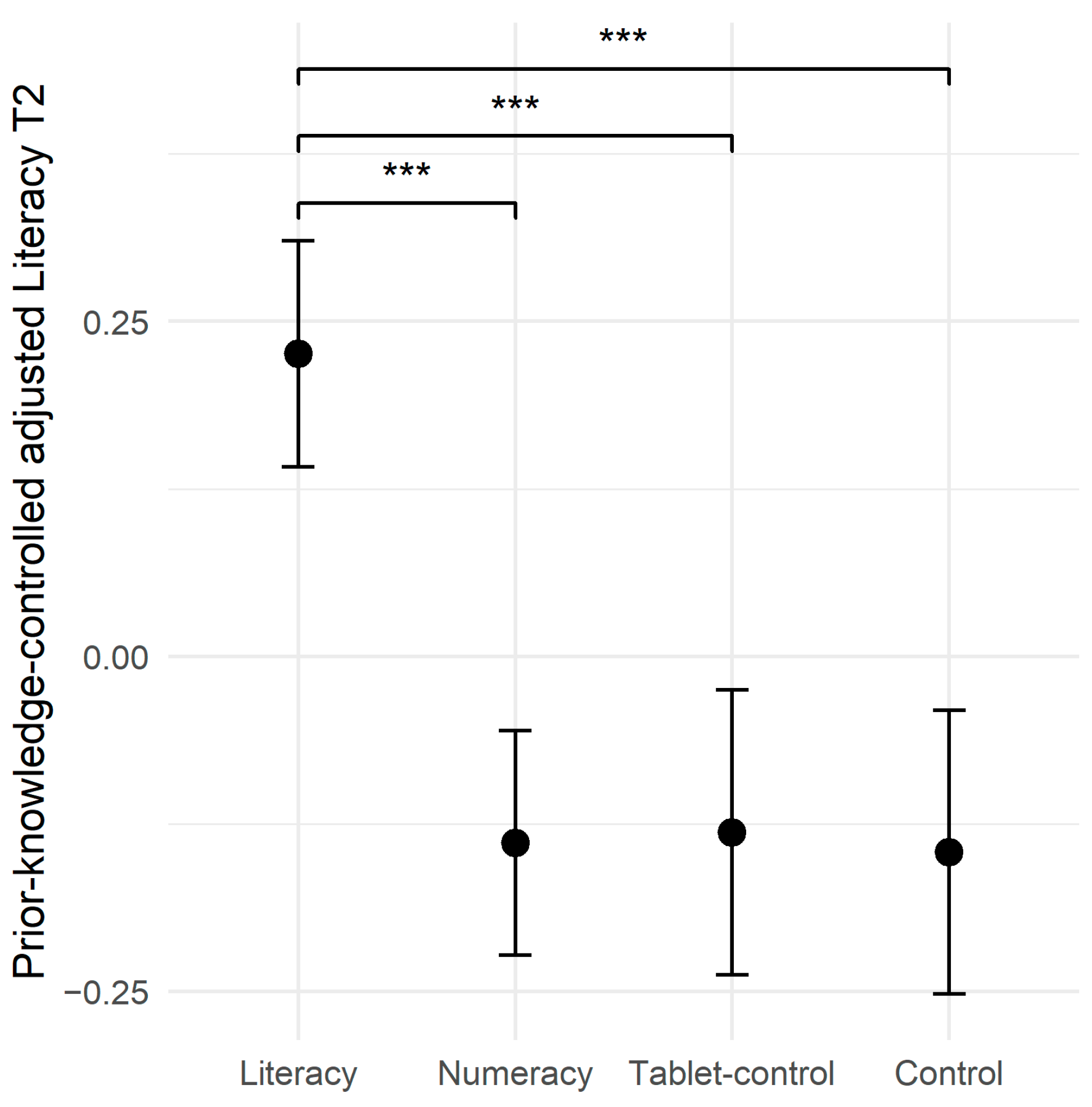
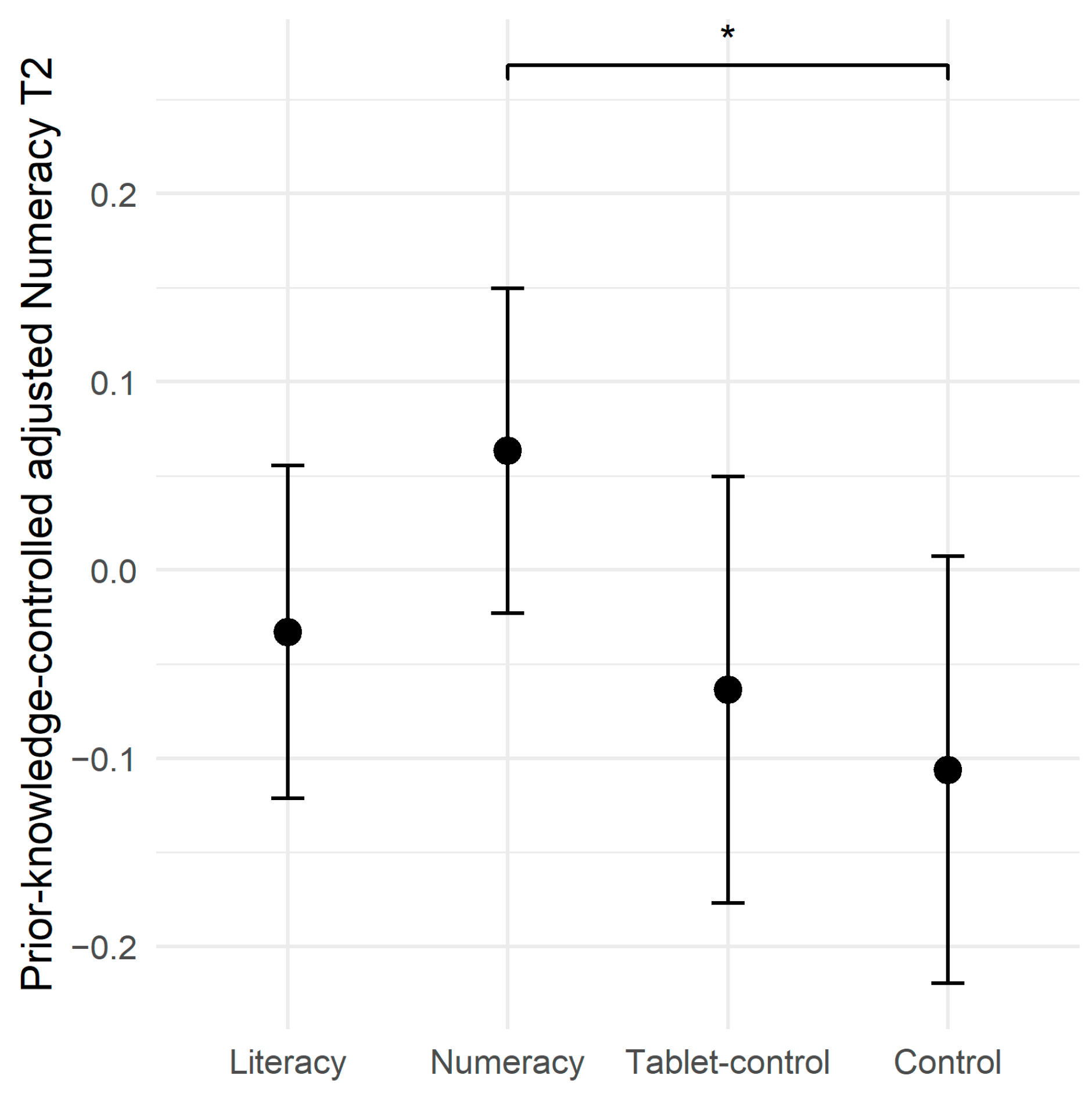
3.3. Differences in Literacy/Numeracy Skill Gains Depending on Intervention Group Membership
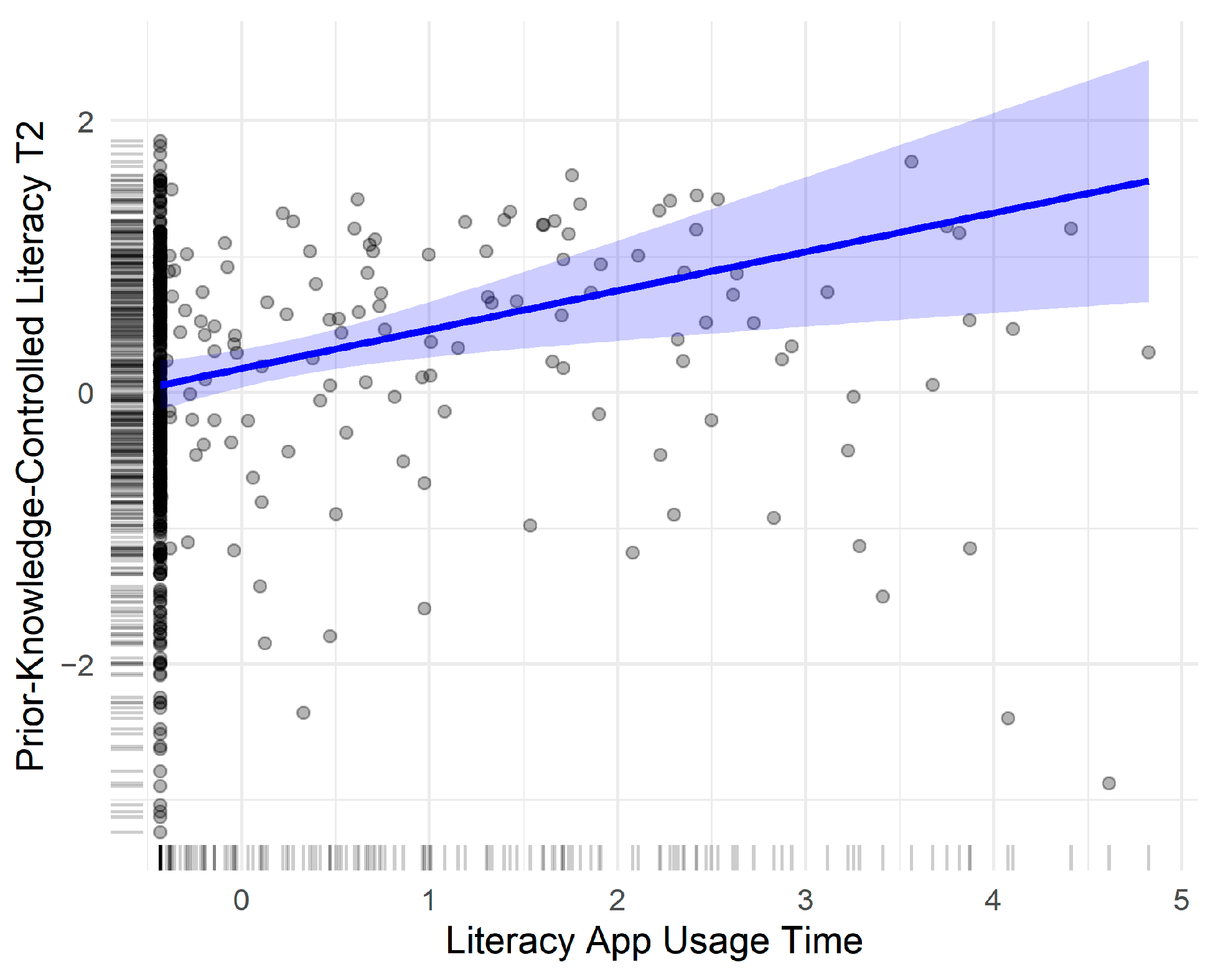
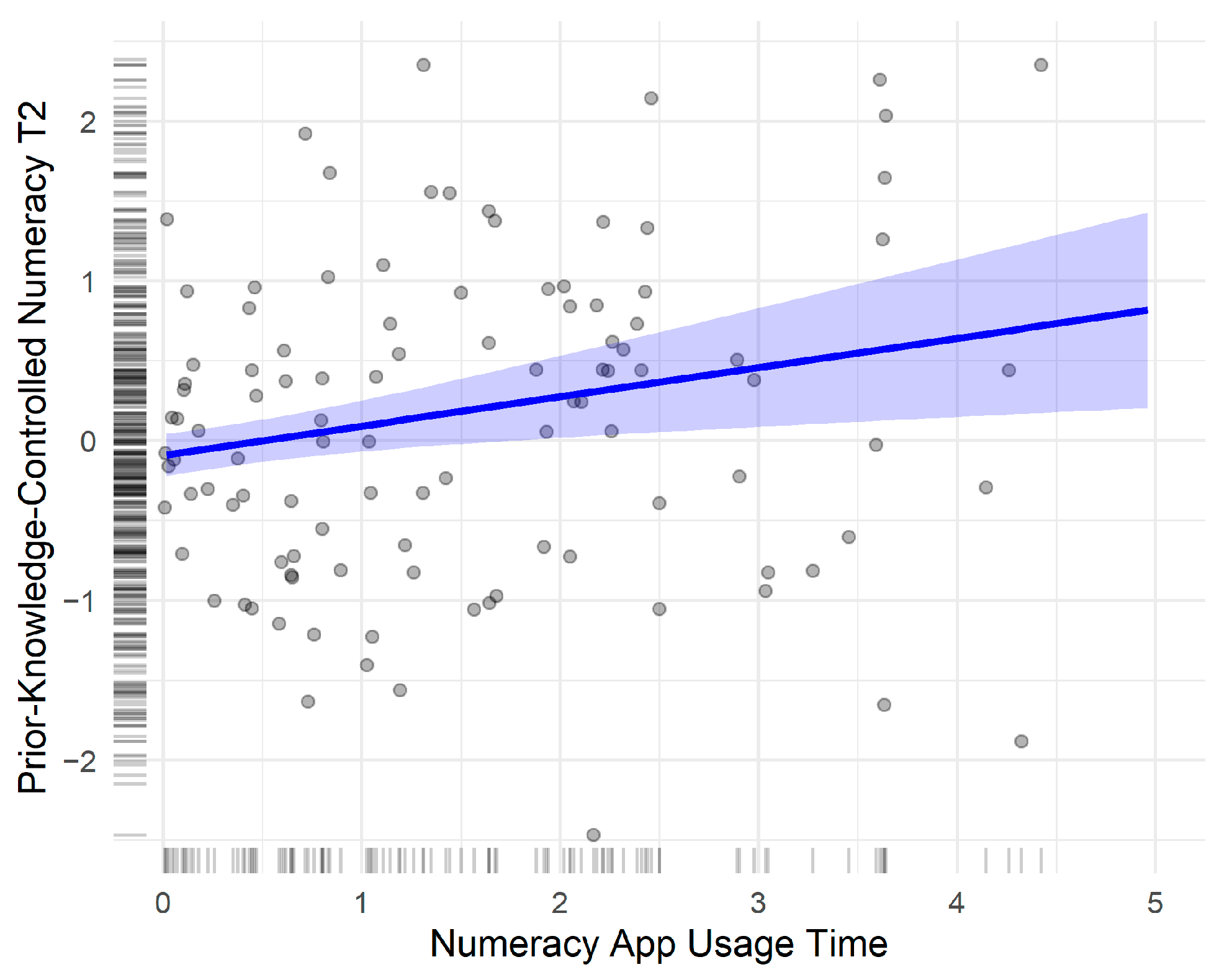
3.4. Predictiveness of Longer App Usage for Literacy/Numeracy Skill Gains
3.5. Interaction Terms Between HLE/HNE and App Usage to Predict Literacy/Numeracy Gains
4. Discussion
4.1. Children in the Intervention Groups Show Significantly Greater Literacy/Numeracy Gains than Children in the Control Groups
4.2. Longer App Usage Time Predicts Literacy and Numeracy Skill Gains
4.3. Absence of Moderation Effects Indicate Limited Digital Compensation for Lower-Quality Home Learning Environments
4.4. Limitations
5. Conclusions
Supplementary Materials
Author Contributions
Funding
Institutional Review Board Statement
Informed Consent Statement
Data Availability Statement
Acknowledgments
Conflicts of Interest
Abbreviations
| HLE | Home Literacy Environment |
| HNE | Home Numeracy Environment |
| LAUT | Literacy app usage time |
| LAUT_sq | Squared literacy app usage time |
| NAUT | Numeracy app usage time |
| NAUT_sq | Squared numeracy app usage time |
| SES | Socioeconomic status |
| PST | Passive screen time |
| MB | Migration background |
References
- Adam, P., Kleemans, T., Droop, M., Amorim, A. N., & Segers, E. (2025). A digital boost of the home literacy environment positively impacts early reading and vocabulary development of Indonesian 1st graders at-risk. The Journal of Educational Research, 118(5), 425–436. [Google Scholar] [CrossRef] [Scilit]
- Adelantado-Renau, M., Moliner-Urdiales, D., Cavero-Redondo, I., Beltran-Valls, M. R., Martínez-Vizcaíno, V., & Álvarez-Bueno, C. (2019). Association between screen media use and academic performance among children and adolescents: A systematic review and meta-analysis. JAMA Pediatrics, 173(11), 1058–1067. [Google Scholar] [CrossRef] [Scilit] [PubMed]
- Aiken, L. S., & West, S. G. (1991). Multiple regression: Testing and interpreting interactions. Sage Publications, Inc. [Google Scholar]
- Amaefule, C. O., Breitwieser, J., Biedermann, D., Nobbe, L., Drachsler, H., & Brod, G. (2023). Fostering children’s acceptance of educational apps: The importance of designing enjoyable learning activities. British Journal of Educational Technology, 54, 1351–1372. [Google Scholar] [CrossRef] [Scilit]
- Anders, Y., Rossbach, H. G., Weinert, S., Ebert, S., Kuger, S., Lehrl, S., & Von Maurice, J. (2012). Home and preschool learning environments and their relations to the development of early numeracy skills. Early Childhood Research Quarterly, 27(2), 231–244. [Google Scholar] [CrossRef] [Scilit]
- Arnold, D. H., Chary, M., Gair, S. L., Helm, A. F., Herman, R., Kang, S., & Lokhandwala, S. (2021). A randomized controlled trial of an educational app to improve preschoolers’ emergent literacy skills. Journal of Children and Media, 15(4), 457–475. [Google Scholar] [CrossRef] [Scilit]
- Aunio, P., & Mononen, R. (2018). The effects of educational computer game on low-performing children’s early numeracy skills–an intervention study in a preschool setting. European Journal of Special Needs Education, 33(5), 677–691. [Google Scholar] [CrossRef] [Scilit]
- Autor:innengruppe Bildungsberichterstattung. (2024). Bildung in Deutschland 2024: Ein indikatorengestützter bericht mit einer analyse zu beruflicher bildung [Education in Germany 2024: An indicator-based report with an analysis of vocational education and training]. wbv Publikation. [Google Scholar]
- Bai, S., Hew, K. F., & Huang, B. (2020). Does gamification improve student learning outcome? Evidence from a meta-analysis and synthesis of qualitative data in educational contexts. Educational Research Review, 30(7521), 100322. [Google Scholar] [CrossRef] [Scilit]
- Bakker, M., Torbeyns, J., Wijns, N., Verschaffel, L., & De Smedt, B. (2019). Gender equality in 4- to 5-year-old preschoolers’ early numerical competencies. Developmental Science, 22(1), e12718. [Google Scholar] [CrossRef] [Scilit] [PubMed]
- Baroody, A. E., & Diamond, K. E. (2013). Measures of preschool children’s interest and engagement in literacy activities: Examining gender differences and construct dimensions. Early Childhood Research Quarterly, 28(2), 291–301. [Google Scholar] [CrossRef] [Scilit]
- Barros, C., Carvalho, A. A., & Salgueiro, A. (2020). The effect of the serious game Tempoly on learning arithmetic polynomial operations. Education and Information Technologies, 25(3), 1497–1509. [Google Scholar] [CrossRef] [Scilit]
- Baumert, J., & Maaz, K. (2006). Das theoretische und methodische konzept von PISA zur erfassung sozialer und kultureller ressourcen der herkunftsfamilie: Internationale und nationale rahmenkonzeption [The PISA theoretical and methodological framework for assessing the social and cultural resources of the family of origin: International and national conceptual frameworks]. In J. Baumert, P. Stanat, & R. Watermann (Eds.), Herkunftsbedingte disparitäten im bildungswesen: Vertiefende analysen im rahmen von PISA 2000 (pp. 11–29). VS Verlag für Sozialwissenschaften. [Google Scholar]
- Berkowitz, T., Schaeffer, M. W., Maloney, E. A., Peterson, L., Gregor, C., Levine, S. C., & Beilock, S. L. (2015). Math at home adds up to achievement in school. Science, 350(6257), 196–198. [Google Scholar] [CrossRef] [Scilit] [PubMed]
- Birtwistle, E., Schoedel, R., Bemmann, F., Wirth, A., Sürig, C., Stachl, C., Bühner, M., & Niklas, F. (2022). Mobile sensing in psychological and educational research: Examples from two application fields. International Journal of Testing, 22(3–4), 264–288. [Google Scholar] [CrossRef] [Scilit]
- Bosire, J. P. O., Palermo, F., & Napoli, A. R. (2025). Early home literacy and math environment: Cross-domain associations between parental literacy and math beliefs. Frontiers in Psychology, 16, 1649713. [Google Scholar] [CrossRef] [Scilit] [PubMed]
- Bradley, R. H., & Corwyn, R. F. (2002). Socioeconomic status and child development. Annual Review of Psychology, 53(2002), 371–399. [Google Scholar] [CrossRef] [Scilit] [PubMed]
- Bronfenbrenner, U. (1979). The ecology of human development: Experiments by nature and design. Harvard University Press. [Google Scholar]
- Burgemeister, B., Blum, L., & Lorge, J. (1972). Columbia mental maturity scale. Harcourt Brace Jovanovich. [Google Scholar]
- Burghardt, L., Linberg, A., Lehrl, S., & Konrad-Ristau, K. (2020). The relevance of the early years 59 home and institutional learning environments for early mathematical competencies. Journal for Educational Research Online, 12(3), 103–125. [Google Scholar] [CrossRef] [PubMed]
- Cabell, S. Q., Gerde, H. K., Hwang, H., Bowles, R., Skibbe, L., Piasta, S. B., & Justice, L. M. (2022). Rate of growth of preschool-age children’s oral language and decoding skills predicts beginning writing ability. Early Education and Development, 33(7), 1198–1221. [Google Scholar] [CrossRef] [Scilit]
- Callaghan, M. N., & Reich, S. M. (2020). Mobile app features that scaffold pre-school learning: Verbal feedback and leveling designs. British Journal of Educational Technology, 52(2), 785–806. [Google Scholar] [CrossRef] [Scilit]
- Cannon, J., & Ginsburg, H. P. (2008). “Doing the math”: Maternal beliefs about early mathematics versus language learning. Early Education and Development, 19(2), 238–260. [Google Scholar] [CrossRef] [Scilit]
- Chang, I. (2023). Early numeracy and literacy skills and their influences on fourth-grade mathematics achievement: A moderated mediation model. Large-Scale Assessments in Education, 11, 18. [Google Scholar] [CrossRef] [Scilit]
- Clemente-Suárez, V. J., Beltrán-Velasco, A. I., Herrero-Roldán, S., Rodriguez-Besteiro, S., Martínez-Guardado, I., Martín-Rodríguez, A., & Tornero-Aguilera, J. F. (2024). Digital device usage and childhood cognitive development: Exploring effects on cognitive abilities. Children, 11(11), 1299. [Google Scholar] [CrossRef] [Scilit] [PubMed]
- Coddington, C. H., Mistry, R. S., & Bailey, A. L. (2014). Socioeconomic status and receptive vocabulary development: Replication of the parental investment model with Chilean preschoolers and their families. Early Childhood Research Quarterly, 29(4), 538–549. [Google Scholar] [CrossRef] [Scilit]
- Coolen, I., Merkley, R., Ansari, D., Dove, E., Dowker, A., Mills, Murphy, V., von Spreckelsen, M., & Scerif, G. (2021). Domain-general and domain-specific influences on emerging numerical cognition: Contrasting uni- and bidirectional prediction models. Cognition, 215, 104816. [Google Scholar] [CrossRef] [Scilit] [PubMed]
- Daucourt, M. C., Napoli, A. R., Quinn, J. M., Wood, S. G., & Hart, S. A. (2021). The home math environment and math achievement: A meta-analysis. Psychological Bulletin, 147(6), 565–596. [Google Scholar] [CrossRef] [Scilit] [PubMed]
- Dearing, E., Casey, B. M., Ganley, C. M., Tillinger, M., Laski, E., & Montecillo, C. (2012). Young girls’ arithmetic and spatial skills: The distal and proximal roles of family socioeconomics and home learning experiences. Early Childhood Research Quarterly, 27(3), 458–470. [Google Scholar] [CrossRef] [Scilit]
- de Bondt, M., Willenberg, I. A., & Bus, A. G. (2020). Do book giveaway programs promote the home literacy environment and children’s literacy-related behavior and skills? Review of Educational Research, 90(3), 349–375. [Google Scholar] [CrossRef] [Scilit]
- DeFlorio, L., & Beliakoff, A. (2015). Socioeconomic status and preschoolers’ mathematical knowledge: The contribution of home activities and parent beliefs. Early Education and Development, 26(3), 319–341. [Google Scholar] [CrossRef] [Scilit]
- De Smedt, B. (2022). Individual differences in mathematical cognition: A Bert’s eye view. Current Opinion in Behavioral Sciences, 46, 101175. [Google Scholar] [CrossRef] [Scilit]
- Dierkx, V., Van De Rijt, B., Hessen, D., Van Luit, H., & van Viersen, S. (2025). Early numeracy development as a foundation of mathematics achievement in primary education. Learning and Individual Differences, 121, 102706. [Google Scholar] [CrossRef] [Scilit]
- Dong, Y., Wu, S. X.-Y., Dong, W.-Y., & Tang, Y. (2020). The effects of home literacy environment on children’s reading comprehension development: A meta-analysis. Educational Sciences: Theory & Practice, 20(2), 63–82. [Google Scholar] [CrossRef] [Scilit]
- Dore, R. A., Shirilla, M., Hopkins, E., Collins, M., Scott, M., Schatz, J., & Hirsh-Pasek, K. (2019). Education in the app store: Using a mobile game to support US preschoolers’ vocabulary learning. Journal of Children and Media, 13(4), 452–471. [Google Scholar] [CrossRef] [Scilit]
- Dowdall, N., Melendez-Torres, G. J., Murray, L., Gardner, F., Hartford, L., & Cooper, P. J. (2020). Shared picture book reading interventions for child language development: A systematic review and meta-analysis. Child Development, 91(2), e383–e399. [Google Scholar] [CrossRef] [Scilit] [PubMed]
- Dubé, A. K., Alam, S. S., Xu, C., Wen, R., & Kacmaz, G. (2019). Tablets as elementary mathematics education tools: Are they effective and why. In K. Robinson, H. Osana, & D. Kotsopoulos (Eds.), Mathematical learning and cognition in early childhood (pp. 223–248). Springer. [Google Scholar] [CrossRef] [Scilit]
- Dubowy, M., Ebert, S., Von Maurice, J., & Weinert, S. (2008). Sprachlich-kognitive kompetenzen beim eintritt in den kindergarten: Ein vergleich von kindern mit und ohne migrationshintergrund [Language and cognitive skills upon entering preschool: A comparison of children with and without migration background]. Zeitschrift für Entwicklungspsychologie und Pädagogische Psychologie, 40(3), 124–134. [Google Scholar] [CrossRef] [Scilit]
- Ehlert, A., Ricken, G., & Fritz, A. (2020). MARKO-screening—Mathematik- und rechenkonzepte im vorschulalter: Screening [Mathematical and numeracy concepts in preschool-aged children: Screening]. Hogrefe. [Google Scholar]
- Elliott, L., & Bachman, H. J. (2018). SES disparities in early math abilities: The contributions of parents’ math cognitions, practices to support math, and math talk. Developmental Review, 49, 1–15. [Google Scholar] [CrossRef] [Scilit]
- Elliott, L., Braham, E. J., & Libertus, M. E. (2017). Understanding sources of individual variability in parents’ number talk with young children. Journal of Experimental Child Psychology, 159, 1–15. [Google Scholar] [CrossRef] [Scilit] [PubMed]
- Endlich, D., Berger, N., Küspert, P., Lenhard, W., Marx, P., Weber, J., & Schneider, W. (2017). WVT: Würzburger Vorschultest: Erfassung schriftsprachlicher und mathematischer (Vorläufer-) Fertigkeiten und sprachlicher Kompetenzen im letzten Kindergartenjahr [Würzburger preschool test: Assessment of literacy and mathematical (precursor) skills and language competencies in the final year of kindergarten]. Hogrefe. [Google Scholar]
- Esser, G. (2002). BUEVA-II: Basisdiagnostik für umschriebene entwicklungsstörungen im vorschulalter [Basic assessment for specific developmental disorders in preschool-aged children]. Hogrefe. [Google Scholar]
- Falikman, M. (2021). There and back again: A (reversed) Vygotskian perspective on digital socialization. Frontiers in Psychology, 12, 501233. [Google Scholar] [CrossRef] [Scilit] [PubMed]
- Federal Statistical Office. (2025). Bevölkerung und erwerbstätigkeit: Bevölkerung mit migrationshintergrund—Ergebnisse des Mikrozensus 2024 [Population and employment: Population with a migration background—Results of the Microcensus 2024]. Available online: https://www.destatis.de/DE/Themen/Gesellschaft-Umwelt/Bevoelkerung/Migration-Integration/Publikationen/_publikationen-innen-migrationshintergrund.html (accessed on 13 April 2026).
- Georgiou, G. K., Inoue, T., & Parrila, R. (2021). Developmental relations between home literacy environment, reading interest, and reading skills: Evidence from a 3-year longitudinal study. Child Development, 92(5), 2053–2068. [Google Scholar] [CrossRef] [Scilit] [PubMed]
- Gibson, J. L., Newbury, D. F., Durkin, K., Pickles, A., Conti-Ramsden, G., & Toseeb, U. (2021). Pathways from the early language and communication environment to literacy outcomes at the end of primary school; the roles of language development and social development. Oxford Review of Education, 47(2), 260–283. [Google Scholar] [CrossRef] [Scilit]
- Goodrich, J. M., Fitton, L., Chow, J., & Peng, P. (2025). Reconceptualizing the home literacy environment in multilingual contexts. In G. Georgiou, & T. Inoue (Eds.), Home literacy environment and literacy acquisition: Evidence from different languages and contexts (pp. 257–273). Springer Nature. [Google Scholar] [CrossRef] [Scilit]
- Graham, J. W., Olchowski, A. E., & Gilreath, T. D. (2007). How many imputations are really needed? Some practical clarifications of multiple imputation theory. Prevention Science, 8(3), 206–213. [Google Scholar] [CrossRef] [Scilit] [PubMed]
- Gustafsson, J. E., Hansen, K. Y., & Rosén, M. (2011). Effects of home background on student achievement in reading, mathematics, and science at the fourth grade. Timss and Pirls, 4, 181–287. [Google Scholar]
- Hadd, A. R., & Rodgers, J. L. (2017). Intelligence, income, and education as potential influences on a child’s home environment: A (maternal) sibling-comparison design. Developmental Psychology, 53(7), 1286. [Google Scholar] [CrossRef] [Scilit] [PubMed]
- Hawes, Z., Moss, J., Caswell, B., Seo, J., & Ansari, D. (2019). Relations between numerical, spatial, and executive function skills and mathematics achievement: A latent-variable approach. Cognitive Psychology, 109, 68–90. [Google Scholar] [CrossRef] [Scilit] [PubMed]
- Herodotou, C. (2018). Young children and tablets: A systematic review of effects on learning and development. Journal of Computer Assisted Learning, 34(1), 1–9. [Google Scholar] [CrossRef] [Scilit]
- Hirsh-Pasek, K., Zosh, J. M., Golinkoff, R. M., Gray, J. H., Robb, M. B., & Kaufman, J. (2015). Putting education in “educational” apps: Lessons from the science of learning. Psychological Science in the Public Interest, 16(1), 3–34. [Google Scholar] [CrossRef] [Scilit] [PubMed]
- Hornung, C., Schiltz, C., Brunner, M., & Martin, R. (2014). Predicting first-grade mathematics achievement: The contributions of domain-general cognitive abilities, nonverbal number sense, and early number competence. Frontiers in Psychology, 5, 272. [Google Scholar] [CrossRef] [Scilit] [PubMed]
- Højen, A., Schmidt, A. S. M., Møller, I. S., & Flansmose, L. (2022). Unequal home literacy environments between preschool-age boys and girls predict unequal language and preliteracy outcomes. Acta Psychologica, 230, 103716. [Google Scholar] [CrossRef] [Scilit] [PubMed]
- Inoue, T., Manolitsis, G., de Jong, P. F., Landerl, K., Parrila, R., & Georgiou, G. K. (2020). Home literacy environment and early literacy development across languages varying in orthographic consistency. Frontiers in Psychology, 11, 1923. [Google Scholar] [CrossRef] [Scilit] [PubMed]
- Jiang, Y., Lau, C., & Tan, C. Y. (2024). Socioeconomic status and children’s English language and literacy outcomes: The mediating role of home literacy environment. Early Education and Development, 35(3), 588–614. [Google Scholar] [CrossRef] [Scilit]
- Johnson, G. M., & Puplampu, K. P. (2008). Internet use during childhood and the ecological techno-subsystem. Canadian Journal of Learning and Technology, 34(1), n1. [Google Scholar]
- Jordan, N. C., Kaplan, D., Locuniak, M. N., & Ramineni, C. (2007). Predicting first-grade math achievement from developmental number sense trajectories. Learning Disabilities Research & Practice, 22(1), 36–46. [Google Scholar] [CrossRef] [Scilit]
- Kapteijns, B., van de Ven, M., van Hoogmoed, A. H., & Kroesbergen, E. H. (2025). Cognitive and home predictors of precocious reading and math before formal education. Journal of Experimental child Psychology, 252, 106159. [Google Scholar] [CrossRef] [Scilit] [PubMed]
- Kebritchi, M., & Hirumi, A. (2008). Examining the pedagogical foundations of modern educational computer games. Computers & Education, 51(4), 1729–1743. [Google Scholar] [CrossRef] [Scilit]
- Kersey, A. J., Braham, E. J., Csumitta, K. D., Libertus, M. E., & Cantlon, J. F. (2018). No intrinsic gender differences in children’s earliest numerical abilities. npj Science of Learning, 3, 12. [Google Scholar] [CrossRef] [Scilit] [PubMed]
- Kim, J., Gilbert, J., Yu, Q., & Gale, C. (2021). Measures matter: A meta-analysis of the effects of educational apps on preschool to grade 3 children’s literacy and math skills. Aera Open, 7, 23328584211004183. [Google Scholar] [CrossRef] [Scilit]
- Kleemans, T., Peeters, M., Segers, E., & Verhoeven, L. (2012). Child and home predictors of early numeracy skills in kindergarten. Early Childhood Research Quarterly, 27(3), 471–477. [Google Scholar] [CrossRef] [Scilit]
- Krajewski, K. (2018). MBK 0: Test mathematischer basiskompetenzen im kindergartenalter [Assessment of basic mathematical skills in preschool-aged children]. Hogrefe. [Google Scholar]
- Krajewski, K., & Schneider, W. (2009). Early development of quantity to number-word linkage as a precursor of mathematical school achievement and mathematical difficulties: Findings from a four-year longitudinal study. Learning and Instruction, 19(6), 513–526. [Google Scholar] [CrossRef] [Scilit]
- Krijnen, E., van Steensel, R., Meeuwisse, M., Jongerling, J., & Severiens, S. (2020). Exploring a refined model of home literacy activities and associations with children’s emergent literacy skills. Reading and Writing, 33(1), 207–238. [Google Scholar] [CrossRef] [Scilit]
- Lange, B. P., Euler, H. A., & Zaretsky, E. (2016). Sex differences in language competence of 3- to 6-year-old children. Applied Psycholinguistics, 37(6), 1417–1438. [Google Scholar] [CrossRef] [Scilit]
- Lee, J., Moon, S., & Hegar, R. L. (2011). Mathematics skills in early childhood: Exploring gender and ethnic patterns. Child Indicators Research, 4(3), 353–368. [Google Scholar] [CrossRef] [Scilit]
- Lehrl, S., Ebert, S., Blaurock, S., Rossbach, H.-G., & Weinert, S. (2020). Long-term and domain-specific relations between the early years home learning environment and students’ academic outcomes in secondary school. School Effectiveness and School Improvement, 31(1), 102–124. [Google Scholar] [CrossRef] [Scilit]
- Lehrl, S., Linberg, A., Niklas, F., & Kuger, S. (2021). The home learning environment in the digital age: Associations between self-reported “analog” and “digital” home learning environment and Children’s socio-emotional and academic outcomes. Frontiers in Psychology, 12, 592513. [Google Scholar] [CrossRef] [Scilit] [PubMed]
- Lenhard, A., Lenhard, W., Segerer, R., & Suggate, S. (2015). PPVT-peabody picture vocabulary test (4th ed., German version). Pearson. [Google Scholar]
- Lenhart, J., Suggate, S. P., & Lenhard, W. (2022). Shared-reading onset and emergent literacy development. Early Education and Development, 33(4), 589–607. [Google Scholar] [CrossRef] [Scilit]
- Lewicki, K., Franze, M., Gottschling-Lang, A., & Hoffmann, W. (2018). Developmental differences between preschool boys and girls in Northeastern Germany. European Early Childhood Education Research Journal, 26(3), 316–333. [Google Scholar] [CrossRef] [Scilit]
- Leyva, D. (2019). How do low-income Chilean parents support their preschoolers’ writing and math skills in a grocery game? Early Education and Development, 30(1), 114–130. [Google Scholar] [CrossRef] [Scilit]
- Martinot, P., Colnet, B., Breda, T., Sultan, J., Touitou, L., Huguet, P., Spelke, E., Dehaene-Lambertz, G., Bressoux, P., & Dehaene, S. (2025). Rapid emergence of a maths gender gap in first grade. Nature, 643, 1020–1029. [Google Scholar] [CrossRef] [Scilit] [PubMed]
- Mayer, R. E. (2014). Cognitive theory of multimedia learning. In R. E. Mayer (Ed.), The Cambridge handbook of multimedia learning (2nd ed., pp. 43–71). Cambridge University Press. [Google Scholar] [CrossRef] [Scilit]
- McElvany, N., Lorenz, R., Frey, A., Goldhammer, F., Schilcher, A., & Stubbe, T. C. (2023). IGLU 2021. Lesekompetenz von grundschulkindern im internationalen vergleich und im trend über 20 jahre [Reading proficiency among elementary school children: An international comparison and trends over 20 years]. Advanced online publication. [Google Scholar] [CrossRef] [Scilit]
- Medienpädagogischer Forschungsverbund Südwest (mpfs). (2024). KIM-studie 2024. Kindheit, internet, medien. Basisuntersuchung zum medienumgang 6- bis 13-jähriger [KIM study 2024. Childhood, internet, media. A baseline study on media use among 6- to 13-years-olds]. Available online: https://mpfs.de/studie/kim-studie-2024/ (accessed on 29 July 2026).
- Meindl, M., & Jungmann, T. (2019). EuLe 4–5. Erzähl- und Lesekompetenzen erfassen bei 4- bis 5-jährigen Kindern [Assessing storytelling and reading skills in 4- to 5-year-old children]. Hogrefe. [Google Scholar]
- Mejía-Rodríguez, A. M., Luyten, H., & Meelissen, M. R. M. (2021). Gender differences in mathematics self-concept across the world: An exploration of student and parent data of TIMSS 2015. International Journal of Science and Mathematics Education, 19(6), 1229–1250. [Google Scholar] [CrossRef] [Scilit]
- Melhuish, E. C., Phan, M. B., Sylva, K., Sammons, P., Siraj-Blatchford, I., & Taggart, B. (2008). Effects of the home learning environment and preschool center experience upon literacy and numeracy development in early primary school. Journal of Social Issues, 64(1), 95–114. [Google Scholar] [CrossRef] [Scilit]
- Mol, S. E., Bus, A. G., De Jong, M. T., & Smeets, D. J. (2008). Added value of dialogic parent–child book readings: A meta-analysis. Early Education and Development, 19(1), 7–26. [Google Scholar] [CrossRef] [Scilit]
- Mues, A., Birtwistle, E., Wirth, A., & Niklas, F. (2021). Parental (STEM) occupations, the home numeracy environment, and kindergarten children’s numerical competencies. Education Sciences, 11(12), 819. [Google Scholar] [CrossRef] [Scilit]
- Mues, A., Schiele, T., Berner, V. D., Ufer, S., Birtwistle, E., Wirth, A., & Niklas, F. (2024). Der zusammenhang mathematischer lernerfahrungen in der familie mit strukturellen hintergrundmerkmalen und mathematischen vorläuferfähigkeiten im vorschulalter [The relation between mathematical learning experiences in the family and structural background characteristics and mathematical precursor skills in preschool children]. Frühe Bildung, 13(4), 201–210. [Google Scholar] [CrossRef] [Scilit]
- Mues, A., Wirth, A., Birtwistle, E., & Niklas, F. (2022). Associations between children’s numeracy competencies, mothers’ and fathers’ mathematical beliefs, and numeracy activities at home. Frontiers in Psychology, 3, 835433. [Google Scholar] [CrossRef] [Scilit] [PubMed]
- Mutaf-Yıldız, B., Sasanguie, D., De Smedt, B., & Reynvoet, B. (2020). Probing the relationship between home numeracy and children’s mathematical skills: A systematic review. Frontiers in Psychology, 11, 2074. [Google Scholar] [CrossRef] [Scilit] [PubMed]
- Napoli, A. R., & Purpura, D. J. (2018). The home literacy and numeracy environment in preschool: Cross-domain relations of parent-child practices and child outcomes. Journal of Experimental Child Psychology, 166, 581–603. [Google Scholar] [CrossRef] [Scilit] [PubMed]
- Neumann, M. M. (2018). Using tablets and apps to enhance emergent literacy skills in young children. Early Childhood Research Quarterly, 42, 239–246. [Google Scholar] [CrossRef] [Scilit]
- Neumann, M. M., & Neumann, D. L. (2017). The use of touch-screen tablets at home and pre-school to foster emergent literacy. Journal of Early Childhood Literacy, 17(2), 203–220. [Google Scholar] [CrossRef] [Scilit]
- Nguyen, T., Watts, T. W., Duncan, G. J., Clements, D. H., Sarama, J. S., Wolfe, C., & Spitler, M. E. (2016). Which preschool mathematics competencies are most predictive of fifth grade achievement? Early Childhood Research Quarterly, 36, 550–560. [Google Scholar] [CrossRef] [Scilit] [PubMed]
- Niklas, F. (2015). Die familiäre lernumwelt und ihre bedeutung für die kindliche kompetenzentwicklung [The home learning environment and its importance for children’s skill development]. Psychologie in Erziehung und Unterricht, 62(2), 106–120. [Google Scholar] [CrossRef] [Scilit]
- Niklas, F., Annac, E., & Wirth, A. (2020). App-based learning for kindergarten children at home (Learning4Kids): Study protocol for cohort 1 and the kindergarten assessments. BMC Pediatrics, 20(1), 554. [Google Scholar] [CrossRef] [Scilit] [PubMed]
- Niklas, F., Birtwistle, E., Mues, A., & Wirth, A. (2025). Learning apps at home prepare children for school. Child Development, 96(2), 577–590. [Google Scholar] [CrossRef] [Scilit] [PubMed]
- Niklas, F., Birtwistle, E., Wirth, A., Schiele, T., & Mues, A. (2022). App-based learning for kindergarten children at home (Learning4Kids): Study protocol for cohort 2 and the school assessments. BMC Pediatrics, 22, 705. [Google Scholar] [CrossRef] [Scilit] [PubMed]
- Niklas, F., & Lehrl, S. (2025). Die familie als lernumwelt: Definition, konzeption und zusammenhänge mit der kindlichen kompetenzentwicklung [The family as learning environment: Definition, concept, and links to children’s skill development]. Kohlhammer Verlag. [Google Scholar]
- Niklas, F., & Schneider, W. (2010). Der Zusammenhang von familiärer lernumwelt mit schulrelevanten kompetenzen im vorschulalter [The relation between the home learning environment and school-related skills in preschool-aged children]. Zeitschrift für Soziologie der Erziehung und Sozialisation, 30(2), 149–165. [Google Scholar]
- Niklas, F., & Schneider, W. (2017a). Home learning environment and development of child competencies from kindergarten until the end of elementary school. Contemporary Educational Psychology, 49, 263–274. [Google Scholar] [CrossRef] [Scilit]
- Niklas, F., & Schneider, W. (2017b). Intervention in the home literacy environment and kindergarten children’s vocabulary and phonological awareness. First Language, 37(5), 433–452. [Google Scholar] [CrossRef] [Scilit]
- Niklas, F., Tayler, C., & Schneider, W. (2015). Home-based literacy activities and children’s cognitive outcomes: A comparison between Australia and Germany. International Journal of Educational Research, 71, 75–85. [Google Scholar] [CrossRef] [Scilit]
- Novita, S., & Kluczniok, K. (2022). Receptive vocabulary of preschool children with migration backgrounds: The effect of home literacy activities. Early Child Development and Care, 192(11), 1728–1743. [Google Scholar] [CrossRef] [Scilit]
- Nur, I. R. D., Herman, T., & Dahlan, T. H. (2022). Numeracy literacy in early childhood: An investigation in arithmetic, geometry and patterns in early stage. Jurnal Teori Dan Aplikasi Matematika, 6(2), 308–320. [Google Scholar] [CrossRef] [Scilit]
- Papadakis, S., Kalogiannakis, M., & Zaranis, N. (2018). The effectiveness of computer and tablet assisted intervention in early childhood students’ understanding of numbers. An empirical study conducted in Greece. Education and Information Technologies, 23(5), 1849–1871. [Google Scholar] [CrossRef] [Scilit]
- Peng, P., Wang, T., Wang, C., & Lin, X. (2019). A meta-analysis on the relation between fluid intelligence and reading/mathematics: Effects of tasks, age, and social economics status. Psychological Bulletin, 145(2), 189–236. [Google Scholar] [CrossRef] [Scilit] [PubMed]
- Piasta, S. B., Justice, L. M., McGinty, A. S., & Kaderavek, J. N. (2012). Increasing young children’s contact with print during shared reading: Longitudinal effects on literacy achievement. Child Development, 83(3), 810–820. [Google Scholar] [CrossRef] [Scilit] [PubMed]
- Rachels, J. R., & Rockinson-Szapkiw, A. J. (2017). The effects of a mobile gamification app on elementary students’ Spanish achievement and self-efficacy. Computer Assisted Language Learning, 31(1–2), 72–89. [Google Scholar] [CrossRef] [Scilit]
- Raghubar, K. P., & Barnes, M. A. (2017). Early numeracy skills in preschool-aged children: A review of neurocognitive findings and implications for assessment and intervention. The Clinical Neuropsychologist, 31(2), 329–351. [Google Scholar] [CrossRef] [Scilit] [PubMed]
- R Core Team. (2025). R: A language and environment for statistical computing. R Foundation for Statistical Computing. Available online: https://www.R-project.org/ (accessed on 29 July 2026).
- Rogowsky, B. A., Terwilliger, C. C., Young, C. A., & Kribbs, E. E. (2017). Playful learning with technology: The effect of computer-assisted instruction on literacy and numeracy skills of preschoolers. International Journal of Play, 7(1), 60–80. [Google Scholar] [CrossRef] [Scilit]
- Rowe, M. L., Guzman Turco, R., & Blatt, J. H. (2021). Can interactive apps promote parent-child conversations? Journal of Applied Developmental Psychology, 76, 101326. [Google Scholar] [CrossRef] [Scilit]
- Schafer, J. L., & Olsen, M. K. (1998). Multiple imputation for multivariate missing-data problems: A data analyst’s perspective. Multivariate Behavioral Research, 33(4), 545–571. [Google Scholar] [CrossRef] [Scilit] [PubMed]
- Schiele, T., Edelsbrunner, P., Mues, A., Birtwistle, E., Wirth, A., & Niklas, F. (2025). The effectiveness of game-based literacy app learning in preschool children from diverse backgrounds. Learning and Individual Differences, 117, 102579. [Google Scholar] [CrossRef] [Scilit]
- Schwippert, K., Kasper, D., Eickelmann, B., Goldhammer, F., Köller, O., Selter, C., & Steffensky, M. (Eds.). (2024). TIMSS 2023: Mathematische und naturwissenschaftliche Kompetenzen von Grundschulkindern in Deutschland im internationalen Vergleich [An international comparison of mathematical and science skills of primary school children in Germany]. Waxmann. [Google Scholar]
- Sénéchal, M., & LeFevre, J.-A. (2002). Parental involvement in the development of children’s reading skill: A five-year longitudinal study. Child Development, 73(2), 445–460. [Google Scholar] [CrossRef] [Scilit] [PubMed]
- Sénéchal, M., Ouellette, G., & Young, L. (2004). Testing the concurrent and predictive relations among articulation accuracy, speech perception, and phoneme awareness. Journal of Experimental Child Psychology, 89(3), 242–269. [Google Scholar] [CrossRef] [Scilit] [PubMed]
- Silinskas, G., Di Lonardo, S., Douglas, H., Xu, C., LeFevre, J.-A., Garckija, R., Gabrialaviciute, I., & Raiziene, S. (2020). Responsive home numeracy as children progress from kindergarten through Grade 1. Early Childhood Research Quarterly, 53, 484–495. [Google Scholar] [CrossRef] [Scilit]
- Sirin, S. R. (2005). Socioeconomic status and academic achievement: A meta-analytic review of research. Review of Educational Research, 75(3), 417–453. [Google Scholar] [CrossRef] [Scilit]
- Skwarchuk, S. L., Sowinski, C., & LeFevre, J. A. (2014). Formal and informal home learning activities in relation to children’s early numeracy and literacy skills: The development of a home numeracy model. Journal of Experimental Child Psychology, 121, 63–84. [Google Scholar] [CrossRef] [Scilit] [PubMed]
- Sonnenschein, S., & Sun, S. (2017). Racial/ethnic differences in kindergartners’ reading and math skills: Parents’ knowledge of children’s development and home-based activities as mediators. Infant and Child Development, 26(5), e2010. [Google Scholar] [CrossRef] [Scilit]
- Stock, P., Desoete, A., & Roeyers, H. (2009). Predicting arithmetic abilities: The role of preparatory arithmetic markers and intelligence: The role of preparatory arithmetic markers and intelligence. Journal of Psychoeducational Assessment, 27(3), 237–251. [Google Scholar]
- Susperreguy, M. I., & Davis-Kean, P. E. (2016). Maternal math talk in the home and math skills in preschool children. Early Education and Development, 27(6), 841–857. [Google Scholar] [CrossRef] [Scilit]
- Susperreguy, M. I., Di Lonardo Burr, S., Xu, C., Douglas, H., & LeFevre, J.-A. (2020). Children’s home numeracy environment predicts growth of their early mathematical skills in kindergarten. Child Development, 91(5), 1663–1680. [Google Scholar] [CrossRef] [Scilit] [PubMed]
- Thompson, R. J., Napoli, A. R., & Purpura, D. J. (2017). Age-related differences in the relation between the home numeracy environment and numeracy skills. Infant and Child Development, 26(5), e2019. [Google Scholar] [CrossRef] [Scilit]
- Torppa, M., Vasalampi, K., Eklund, K., & Niemi, P. (2022). Long-term effects of the home literacy environment on reading development: Familial risk for dyslexia as a moderator. Journal of Experimental Child Psychology, 215, 105314. [Google Scholar] [CrossRef] [Scilit] [PubMed]
- Uscianowski, C., Almeda, M. V., & Ginsburg, H. P. (2020). Differences in the complexity of math and literacy questions parents pose during storybook reading. Early Childhood Research Quarterly, 50, 40–50. [Google Scholar] [CrossRef] [Scilit]
- Valcárcel Jiménez, M., Heine, J.-H., Schiele, T., Mues, A., & Niklas, F. (2025). The role of parental attitudes, home literacy environment, and migration background in preschool children’s emergent literacy skills. Journal of Applied Developmental Psychology, 99, 101830. [Google Scholar] [CrossRef] [Scilit]
- Valcárcel Jiménez, M., Yumus, M., Schiele, T., Mues, A., & Niklas, F. (2024). Preschool emergent literacy skills as predictors of reading and spelling in Grade 2 and the role of migration background in Germany. Journal of Experimental Child Psychology, 244, 105927. [Google Scholar] [CrossRef] [Scilit] [PubMed]
- Vanbecelaere, S., Van den Berghe, K., Cornillie, F., Sasanguie, D., Reynvoet, B., & Depaepe, F. (2020). The effects of two digital educational games on cognitive and non-cognitive math and reading outcomes. Computers & Education, 143, 103680. [Google Scholar] [CrossRef] [Scilit]
- Van Buuren, S., & Groothuis-Oudshoorn, K. (2011). Mice: Multivariate imputation by chained equations in R. Journal of Statistical Software, 45(3), 1–67. [Google Scholar] [CrossRef] [Scilit]
- Varnell, S., Ehrman, P., Kumar, S. C., Sandel, J., Ellis, A., & Purpura, D. J. (2025). What I say is not what I do: Gender differences in the home mathematics environment. Developmental Psychology, 61(3), 482–494. [Google Scholar] [CrossRef] [Scilit] [PubMed]
- Vasilyeva, M., Rey-Guerra, C., Lu, L., & Dearing, E. (2025). Parental input as a mediating pathway for gender differences in early academic skills. Early Childhood Research Quarterly, 72, 35–43. [Google Scholar] [CrossRef] [Scilit]
- Vink, G., & van Buuren, S. (2013). Multiple imputation of squared terms. Sociological Methods & Research, 42(4), 598–607. [Google Scholar] [CrossRef] [Scilit]
- Vygotsky, L. S. (1978). Mind in society: The development of higher psychological processes (M. Cole, V. John-Steiner, S. Scribner, & E. Souberman, Eds.). Harvard University Press. [Google Scholar]
- Wegener, B. (1988). Kritik des prestiges [Criticism of prestige]. Westdeutscher Verlag. [Google Scholar]
- Whitehurst, G. J., & Lonigan, C. J. (1998). Child development and emergent literacy. Child Development, 69(3), 848–872. [Google Scholar] [CrossRef] [Scilit]
- Wirth, A., Mues, A., Birtwistle, E., & Niklas, F. (2024). Evaluating educational apps for preschoolers: Differences and agreements between the assessments of experts, parents, and their children. Computers in Human Behavior, 160, 108361. [Google Scholar] [CrossRef] [Scilit]
- Wirth, A., Stadler, M., Birtwistle, E., & Niklas, F. (2023). New directions in the conceptualization and operationalization of the home learning environment. Journal of Educational Psychology, 115(1), 160–172. [Google Scholar] [CrossRef] [Scilit]
- Xie, H., Peng, J., Qin, M., Huang, X., Tian, F., & Zhou, Z. (2018). Can touchscreen devices be used to facilitate young children’s learning? A meta-analysis of touchscreen learning effect. Frontiers in Psychology, 9, 2580. [Google Scholar] [CrossRef] [Scilit] [PubMed]



| Variable | N | M | SD | min | max | Cronbach’s α/McDonald’s Ω |
|---|---|---|---|---|---|---|
| Literacy skills T1 | 482 | 0.00 | 0.47 | −1.29 | 1.14 | 0.93/0.93 |
| Numeracy skillsT1 | 472 | 0.01 | 0.50 | −0.93 | 2.00 | 0.94/0.94 |
| Literacy skills T2 | 486 | 0.01 | 0.46 | −1.50 | 0.87 | 0.91/0.92 |
| Numeracy skills T2 | 474 | 0.01 | 0.52 | −1.26 | 1.25 | 0.94/0.95 |
| HLE | 437 | 2.46 | 0.49 | 0.08 | 3.74 | 0.83/0.83 |
| HNE | 485 | 2.61 | 0.68 | 0.25 | 4.00 | 0.81/0.81 |
| LAUT | 499 | 162.01 | 374.57 | 0.00 | 1969.18 | 0.95/0.95 |
| LAUT_sq | 499 | 166,266.06 | 517,549.58 | 0.00 | 3,877,669.87 | |
| NAUT | 496 | 219.07 | 495.92 | 0.00 | 2908.52 | 0.98/0.98 |
| NAUT_sq | 497 | 322,998.84 | 1,124,907.58 | 0.00 | 14,990,525.50 | |
| Sex | 500 | 0.5 | ||||
| Age | 500 | 60.96 | 4.61 | 51.00 | 75.00 | |
| Intelligence | 492 | 52.2 | 5.2 | 12 | 57 | |
| SES | 500 | −0.01 | 0.82 | −2.89 | 1.24 | 0.75/0.75 |
| MB | 486 | 0.4 | ||||
| PST | 492 | 2.9 | 0.9 | 0.00 | 4.00 |
| 1 | 2 | 3 | 4 | 5 | 6 | 7 | 8 | 9 | 10 | 11 | 12 | 13 | 14 | 15 | ||
|---|---|---|---|---|---|---|---|---|---|---|---|---|---|---|---|---|
| 1 | Literacy skills T1 | − | ||||||||||||||
| 2 | Numeracy skills T1 | 0.68 *** | − | |||||||||||||
| 3 | Literacy skills T2 | 0.84 *** | 0.66 *** | − | ||||||||||||
| 4 | Numeracy skills T2 | 0.62 *** | 0.84 *** | 0.67 *** | − | |||||||||||
| 5 | HLE | 0.29 *** | 0.15 ** | 0.29 *** | 0.13 ** | − | ||||||||||
| 6 | HNE | 0.24 *** | 0.20 *** | 0.21 *** | 0.21 *** | 0.65 *** | − | |||||||||
| 7 | LAUT | −0.01 | 0.00 | 0.12 ** | 0.00 | 0.04 | 0.08 | − | ||||||||
| 8 | LAUT_sq | −0.03 | −0.01 | 0.05 | −0.01 | 0.01 | 0.06 | 0.94 *** | − | |||||||
| 9 | NAUT | −0.04 | −0.01 | −0.10 * | 0.05 | −0.05 | −0.02 | −0.18 *** | −0.14 ** | − | ||||||
| 10 | NAUT_sq | −0.07 | −0.02 | −0.11 * | 0.01 | −0.06 | −0.03 | −0.12 ** | −0.09 * | 0.89 *** | − | |||||
| 11 | Sex | 0.09 | −0.09 * | 0.09 | −0.11 * | 0.05 | −0.03 | −0.06 | −0.08 | −0.01 | −0.01 | − | ||||
| 12 | Age | 0.13 * | 0.25 *** | 0.15 *** | 0.26 *** | −0.16 *** | −0.06 | 0.02 | 0.00 | 0.02 | 0.02 | −0.05 | − | |||
| 13 | Intelligence | 0.40 *** | 0.35 *** | 0.42 *** | 0.38 *** | 0.25 *** | 0.22 ** | −0.03 | −0.03 | −0.03 | −0.06 | 0.10 * | 0.09 | − | ||
| 14 | SES | 0.42 *** | 0.27 *** | 0.41 *** | 0.27 *** | 0.29 *** | 0.10 * | −0.07 | −0.12 ** | −0.04 | −0.09 | −0.01 | −0.21 *** | 0.24 *** | − | |
| 15 | MB | −0.39 *** | −0.22 *** | −0.38 *** | −0.17 *** | −0.16 *** | 0.00 | 0.03 | 0.06 | 0.03 | 0.06 | −0.02 | 0.01 | −0.18 *** | −0.30 *** | − |
| 16 | PST | 0.09 * | 0.01 | 0.09 | −0.03 | 0.09* | 0.01 | 0.00 | −0.01 | −0.01 | 0.03 | −0.08 | −0.06 | −0.05 | 0.12 ** | −0.09 |
Disclaimer/Publisher’s Note: The statements, opinions and data contained in all publications are solely those of the individual author(s) and contributor(s) and not of MDPI and/or the editor(s). MDPI and/or the editor(s) disclaim responsibility for any injury to people or property resulting from any ideas, methods, instructions or products referred to in the content. |
© 2026 by the authors. Licensee MDPI, Basel, Switzerland. This article is an open access article distributed under the terms and conditions of the Creative Commons Attribution (CC BY) license.
Share and Cite
Schiele, T.; Valcárcel Jiménez, M.; Camligüney, Ö.; Wirth, A.; Niklas, F. Digital Compensation? Investigating the Moderating Role of the Home Learning Environment in the Effectiveness of Learning Apps. Behav. Sci. 2026, 16, 1304. https://doi.org/10.3390/bs16081304
Schiele T, Valcárcel Jiménez M, Camligüney Ö, Wirth A, Niklas F. Digital Compensation? Investigating the Moderating Role of the Home Learning Environment in the Effectiveness of Learning Apps. Behavioral Sciences. 2026; 16(8):1304. https://doi.org/10.3390/bs16081304
Chicago/Turabian StyleSchiele, Tina, María Valcárcel Jiménez, Öykü Camligüney, Astrid Wirth, and Frank Niklas. 2026. "Digital Compensation? Investigating the Moderating Role of the Home Learning Environment in the Effectiveness of Learning Apps" Behavioral Sciences 16, no. 8: 1304. https://doi.org/10.3390/bs16081304
APA StyleSchiele, T., Valcárcel Jiménez, M., Camligüney, Ö., Wirth, A., & Niklas, F. (2026). Digital Compensation? Investigating the Moderating Role of the Home Learning Environment in the Effectiveness of Learning Apps. Behavioral Sciences, 16(8), 1304. https://doi.org/10.3390/bs16081304