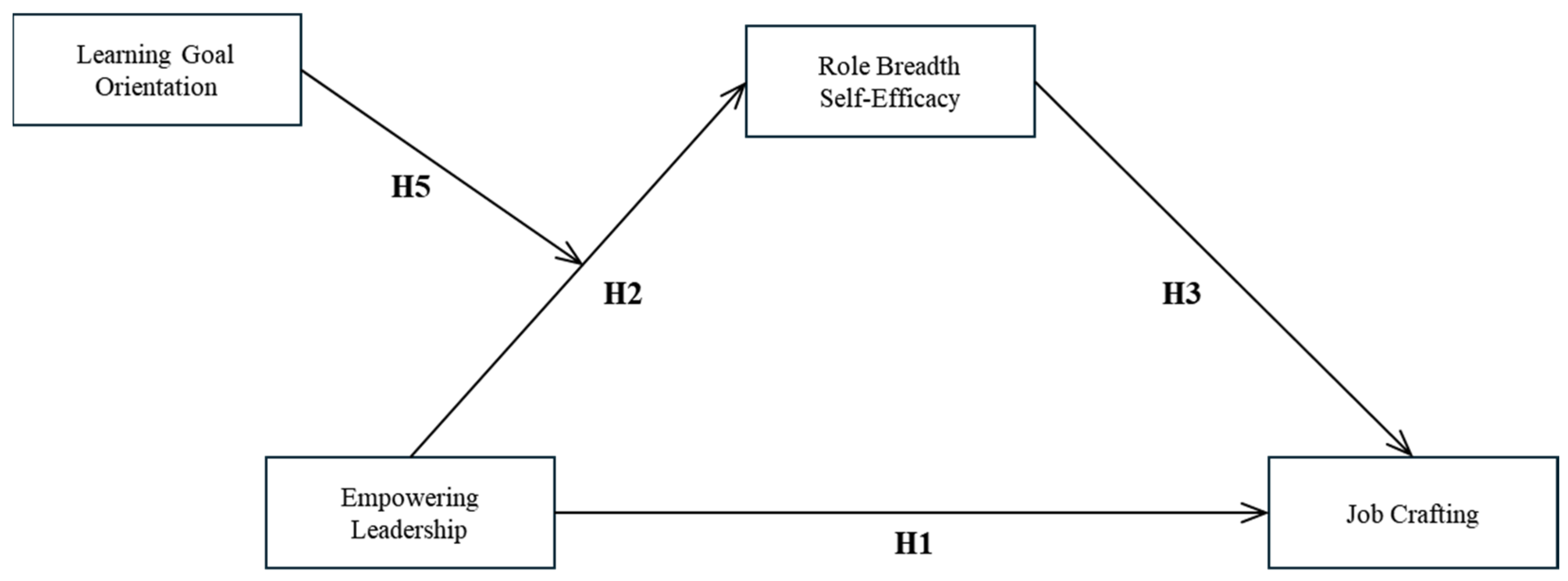
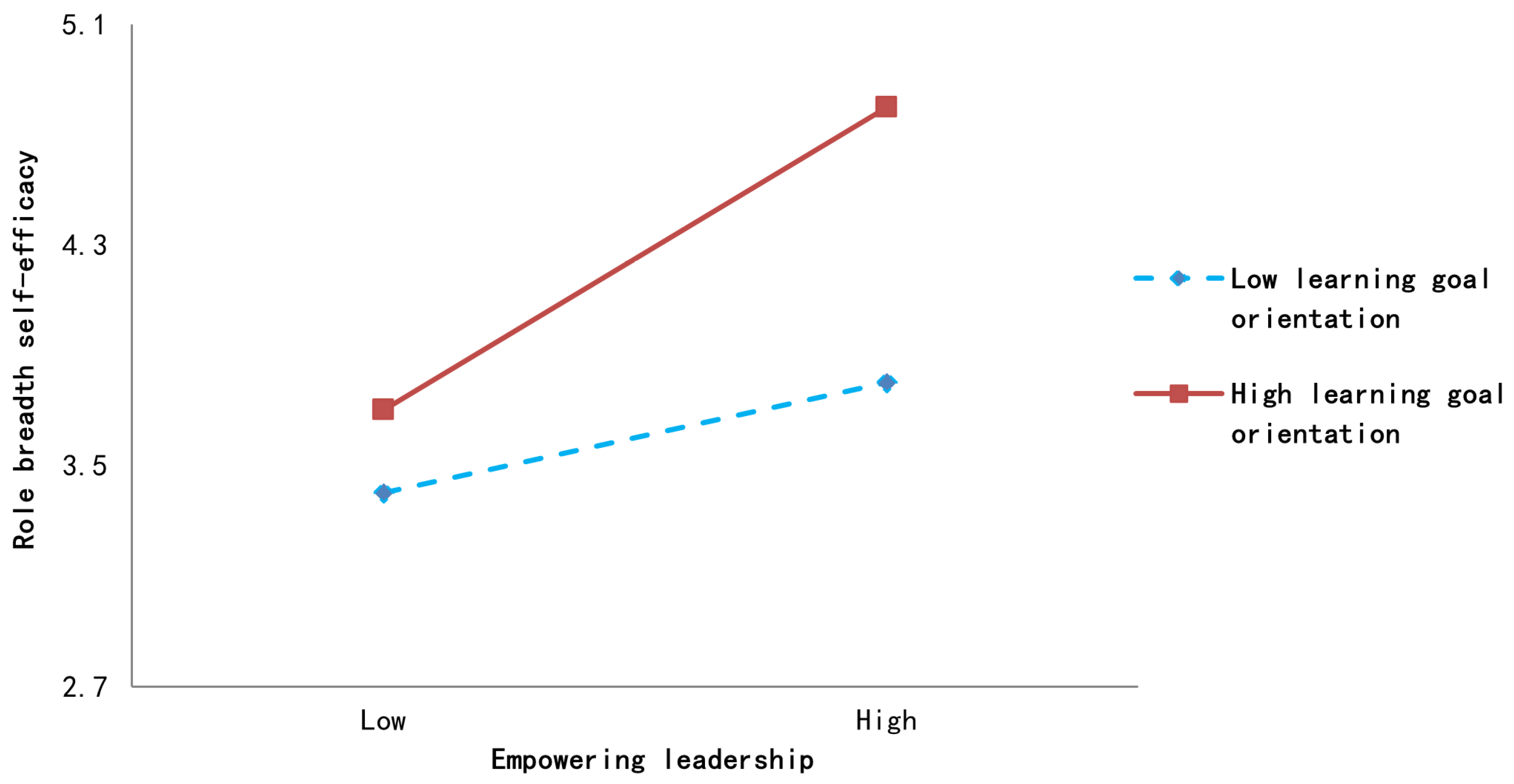
The Impact of Empowering Leadership on the Job Crafting of Knowledge Employees: A Moderated Mediating Effect Model
Abstract
1. Introduction
2. Literature Review
2.1. Organizational Behavior of Empowering Leadership
2.2. Influence of Leadership Styles on Job Crafting
2.3. Research Hypotheses
2.3.1. Direct Effects
2.3.2. Moderating Effect
3. Methodology
3.1. Data Collection Procedure
3.2. Participants
3.3. Instruments
3.4. Data Analysis Procedure
4. Results
4.1. Common Variance Test
4.2. Descriptive Statistics and Correlation Analysis
4.3. Hypothesis Testing
5. Discussion
5.1. Limitations
5.2. Theoretical Implications
5.3. Practical Implications
6. Conclusions
Author Contributions
Funding
Institutional Review Board Statement
Informed Consent Statement
Data Availability Statement
Conflicts of Interest
References
- Ahearne, M., Mathieu, J., & Rapp, A. (2005). To empower or not to empower your sales force? An empirical examination of the influence of leadership empowerment behavior on customer satisfaction and performance. Journal of Applied Psychology, 90(5), 945–955. [Google Scholar] [CrossRef] [PubMed]
- Arnold, J. A., Arad, S., Rhoades, J. A., & Drasgow, F. (2000). The empowering leadership questionnaire: The construction and validation of a new scale for measuring leader behaviors. Journal of Organizational Behavior, 21(3), 249–269. [Google Scholar] [CrossRef]
- Auh, S., Menguc, B., & Jung, Y. S. (2014). Unpacking the relationship between empowering leadership and service-oriented citizenship behaviors: A multilevel approach. Journal of the Academy of Marketing Science, 42(5), 558–579. [Google Scholar] [CrossRef]
- Bakker, A. B., Hakanen, J. J., Demerouti, E., & Xanthopoulou, D. (2007). Job resources boost work engagement, particularly when job demands are high. Journal of Educational Psychology, 99(2), 274–284. [Google Scholar] [CrossRef]
- Bakker, A. B., Tims, M., & Derks, D. (2012). Proactive personality and job performance: The role of job crafting and work engagement. Human Relations, 65(10), 1359–1378. [Google Scholar] [CrossRef]
- Bandura, A. (2001). Social cognitive theory: An agentic perspective. Annual Review of Psychology, 52(1), 1–26. [Google Scholar] [CrossRef]
- Baron, R. M., & Kenny, D. A. (1986). The moderator–mediator variable distinction in social psychological research: Conceptual, strategic, and statistical considerations. Journal of Personality and Social Psychology, 51(6), 1173–1182. [Google Scholar] [CrossRef]
- Bateman, T. S., & Crant, J. M. (1993). The proactive component of organizational behavior: A measure and correlates. Journal of Organizational Behavior, 14(2), 103–118. [Google Scholar] [CrossRef]
- Bharadwaja, M., & Tripathi, N. (2020). Linking empowering leadership and job attitudes: The role of psychological empowerment. Journal of Asia Business Studies, 15(1), 110–127. [Google Scholar] [CrossRef]
- Bruning, P. F., & Campion, M. A. (2018). A role–resource approach–avoidance model of job crafting: A multimethod integration and extension of job crafting theory. The Academy of Management Journal, 61(2), 499–522. [Google Scholar] [CrossRef]
- Cenciotti, R., Alessandri, G., & Borgogni, L. (2017). Psychological capital and career success over time: The mediating role of job crafting. Journal of Leadership & Organizational Studies, 24(3), 372–384. [Google Scholar] [CrossRef]
- Cohen, G. L. (2003). Party over policy: The dominating impact of group influence on political beliefs. Journal of Personality and Social Psychology, 85(5), 808–822. [Google Scholar] [CrossRef] [PubMed]
- Conger, J. A., & Kanungo, R. N. (1988). The empowerment process: Integrating theory and practice. Academy of Management Review, 13(3), 471–482. [Google Scholar] [CrossRef]
- DeChurch, L. A., & Mesmer-Magnus, J. R. (2010). The cognitive underpinnings of effective teamwork: A meta-analysis. Journal of Applied Psychology, 95(1), 32–53. [Google Scholar] [CrossRef]
- Den Hartog, D. N., & Belschak, F. D. (2012). When does transformational leadership enhance employee proactive behavior? The role of autonomy and role breadth self-efficacy. Journal of Applied Psychology, 97(1), 194–202. [Google Scholar] [CrossRef]
- Dirks, K. T., & de Jong, B. (2022). Trust within the workplace: A review of two waves of research and a glimpse of the third. Annual Review of Organizational Psychology and Organizational Behavior, 9(1), 247–276. [Google Scholar] [CrossRef]
- Drucker, P. F. (1999). Management challenges for the 21st century. HarperBusiness. ISBN 978-0-88730-998-4. [Google Scholar]
- Dweck, C. S. (1986). Motivational processes affecting learning. American Psychologist, 41(10), 1040–1048. [Google Scholar] [CrossRef]
- Edmondson, A. (1999). Psychological safety and learning behavior in work teams. Administrative Science Quarterly, 44(2), 350–383. [Google Scholar] [CrossRef]
- Fischer, T., & Sitkin, S. B. (2023). Leadership styles: A comprehensive assessment and way forward. Academy of Management Annals, 17(1), 331–372. [Google Scholar] [CrossRef]
- Füllemann, D., Jenny, G. J., Brauchli, R., & Bauer, G. F. (2015). The key role of shared participation in changing occupational self-efficacy through stress management courses. Journal of Occupational and Organizational Psychology, 88(3), 490–510. [Google Scholar] [CrossRef]
- Guo, Y., Jin, J., & Yim, S. (2023). Impact of inclusive leadership on innovative work behavior: The mediating role of job crafting. Administrative Sciences, 13(1), 4. [Google Scholar] [CrossRef]
- Hao, P., He, W., & Long, L. (2018). Why and when empowering leadership has different effects on employee work performance: The pivotal roles of passion for work and role breadth self-efficacy. Journal of Leadership & Organizational Studies, 25(1), 85–100. [Google Scholar] [CrossRef]
- Hayes, A. F. (2017). Introduction to mediation, moderation, and conditional process analysis: A regression-based approach (2nd ed.). Guilford Press. ISBN 978-1-4625-3466-1. [Google Scholar]
- Hofstede, G. (2001). Culture’s consequences: Comparing values, behaviors, institutions and organizations across nations (2nd ed.). Sage Publications. ISBN 978-1-4522-0793-3. [Google Scholar]
- Kim, M., & Beehr, T. A. (2018). Organization-based self-esteem and meaningful work mediate effects of empowering leadership on employee behaviors and well-being. Journal of Leadership & Organizational Studies, 25(4), 385–398. [Google Scholar] [CrossRef]
- Kim, M., & Beehr, T. A. (2021). The power of empowering leadership: Allowing and encouraging followers to take charge of their own jobs. The International Journal of Human Resource Management, 32(9), 1865–1898. [Google Scholar] [CrossRef]
- Lee, A., Willis, S., & Tian, A. W. (2018). Empowering leadership: A meta-analytic examination of incremental contribution, mediation, and moderation. Journal of Organizational Behavior, 39(3), 306–325. [Google Scholar] [CrossRef]
- Lord, R. G., & Emrich, C. G. (2000). Thinking outside the box by looking inside the box: Extending the cognitive revolution in leadership research. The Leadership Quarterly, 11(4), 551–579. [Google Scholar] [CrossRef]
- Messmann, G. (2023). Fostering proactive behaviour: The role of work-related reflection, psychological empowerment, and participative safety for innovative behaviour and job crafting. International Journal of Training and Development, 27(1), 99–116. [Google Scholar] [CrossRef]
- Meyer, R. D., Dalal, R. S., José, I. J., Hermida, R., Chen, T. R., Vega, R. P., Brooks, C. K., & Khare, V. P. (2014). Measuring job-related situational strength and assessing its interactive effects with personality on voluntary work behavior. Journal of Management, 40(4), 1010–1041. [Google Scholar] [CrossRef]
- Mumford, M. D., Connelly, S., & Gaddis, B. (2003). How creative leaders think: Experimental findings and cases. The Leadership Quarterly, 14(4–5), 411–432. [Google Scholar] [CrossRef]
- Nguyen, M., Pontes, N., Malik, A., Gupta, J., & Gugnani, R. (2024). Impact of high involvement work systems in shaping power, knowledge sharing, rewards and knowledge perception of employees. Journal of Knowledge Management, 28(6), 1771–1792. [Google Scholar] [CrossRef]
- Parker, S. K. (1998). Enhancing role breadth self-efficacy: The roles of job enrichment and other organizational interventions. Journal of Applied Psychology, 83(6), 835–852. [Google Scholar] [CrossRef]
- Parker, S. K., Williams, H. M., & Turner, N. (2006). Modeling the antecedents of proactive behavior at work. Journal of Applied Psychology, 91(3), 636–652. [Google Scholar] [CrossRef]
- Podsakoff, P. M., MacKenzie, S. B., Lee, J., & Podsakoff, N. P. (2003). Common method biases in behavioral research: A critical review of the literature and recommended remedies. Journal of Applied Psychology, 88(5), 879–903. [Google Scholar] [CrossRef]
- Rodrigues, N., & Rebelo, T. (2023). Can employees capitalize upon their role breadth self-efficacy and innovative work behaviour to enhance their prospects of promotion? European Journal of Work and Organizational Psychology, 32(4), 562–574. [Google Scholar] [CrossRef]
- Saks, A. M., & Gruman, J. A. (2014). Making organizations more effective through organizational socialization. Journal of Organizational Effectiveness: People and Performance, 1(3), 261–280. [Google Scholar] [CrossRef]
- Schaufeli, W. B., & Bakker, A. B. (2004). Job demands, job resources, and their relationship with burnout and engagement: A multi-sample study. Journal of Organizational Behavior, 25(3), 293–315. [Google Scholar] [CrossRef]
- Seo, J. J. (2023). Why does the impact of psychological empowerment increase employees’ knowledge-sharing intention? A moderated mediation model of belonging and perceived organizational support. Behavioral Sciences, 13(5), 387. [Google Scholar] [CrossRef] [PubMed]
- Tho, N. D. (2022). Employees’ psychological capital and innovation outputs: The roles of job crafting and proactive personality. Innovation, 24(2), 333–353. [Google Scholar] [CrossRef]
- VandeWalle, D. (1997). Development and validation of a work domain goal orientation instrument. Educational and Psychological Measurement, 57(6), 995–1015. [Google Scholar] [CrossRef]
- van Wingerden, J., Bakker, A. B., & Derks, D. (2017). Fostering employee well-being via a job crafting intervention. Journal of Vocational Behavior, 100, 164–174. [Google Scholar] [CrossRef]
- Van Yperen, N. W., & Hagedoorn, M. (2003). Do high job demands increase intrinsic motivation or fatigue or both? The role of job control and job social support. The Academy of Management Journal, 46(3), 339–348. [Google Scholar] [CrossRef]
- Wang, H., Wu, C., Zhang, Y., & Chen, C. C. (2008). The dimensionality and measure of empowering leadership behavior in the Chinese organizations. Acta Psychologica Sinica, 40(12), 1297–1305. [Google Scholar] [CrossRef]
- Wang, Z., Chen, H., & Huang, Q. (2019). A study on job crafting scale development for knowledge workers. Science & Technology Progress and Policy, 36(2), 118–125. [Google Scholar] [CrossRef]
- Wrzesniewski, A., & Dutton, J. E. (2001). Crafting a job: Revisioning employees as active crafters of their work. Academy of Management Review, 26(2), 179–201. [Google Scholar] [CrossRef]
- Zhang, X., & Bartol, K. M. (2010). Linking empowering leadership and employee creativity: The influence of psychological empowerment, intrinsic motivation, and creative process engagement. The Academy of Management Journal, 53(1), 107–128. [Google Scholar] [CrossRef]
- Zhang, X., Ma, C., Zhao, S., & Lu, J. (2025). Unlocking potential: How flexibility i-deals promote job crafting through social interaction among persons with disabilities. Journal of Occupational and Organizational Psychology, 98(4), e70060. [Google Scholar] [CrossRef]



| Variable | Mean | SD | 1 | 2 | 3 |
|---|---|---|---|---|---|
| 1. Empowering leadership | 3.60 | 1.05 | |||
| 2. Job crafting | 3.48 | 1.16 | 0.51 *** | ||
| 3. Role breadth self-efficacy | 3.68 | 1.05 | 0.43 *** | 0.34 ** | |
| 4. Learning goal orientation | 3.78 | 0.98 | 0.45 *** | 0.46 *** | 0.47 *** |
| M1 | M2 | M3 | M4 | |
|---|---|---|---|---|
| Gender | −0.20 | −0.13 | −0.21 | −0.18 |
| Age | −0.03 | −0.03 | −0.02 | −0.02 |
| Educational background | −0.05 | 0.02 | −0.05 | −0.05 |
| Working years | 0.11 | −0.01 | 0.12 | 0.11 |
| Position level | 0.07 | −0.04 | 0.10 | 0.07 |
| Empowering leadership | 0.56 *** | 0.42 *** | 0.49 *** | |
| Role breadth self-efficacy | 0.38 *** | 0.16 ** | ||
| R2 | 0.28 | 0.19 | 0.14 | 0.30 |
| ΔR2 | 0.27 | 0.19 | 0.14 | 0.30 |
| F | 21.54 | 13.00 | 8.85 | 20.05 |
| Variable | M5 |
|---|---|
| Gender | −0.107 |
| Age | −0.027 |
| Educational background | 0.008 |
| Working years | −0.017 |
| Position level | −0.039 |
| Empowering leadership | 0.322 *** |
| Learning goal orientation | 0.303 *** |
| Empowering leadership × Learning goal orientation | 0.176 *** |
| R2 | 0.323 |
| ΔR2 | 0.323 |
| F | 19.634 |
| The Level of Learning Goal Orientation | Conditional Mediating Effect | BootSE | Boot LLCI | Boot ULCI |
|---|---|---|---|---|
| eff1(M − 1SD) | 0.1221 | 0.0614 | 0.0014 | 0.2428 |
| eff2(M) | 0.3226 | 0.0518 | 0.2207 | 0.4244 |
| eff3(M + 1SD) | 0.5230 | 0.0776 | 0.3705 | 0.6756 |
Disclaimer/Publisher’s Note: The statements, opinions and data contained in all publications are solely those of the individual author(s) and contributor(s) and not of MDPI and/or the editor(s). MDPI and/or the editor(s) disclaim responsibility for any injury to people or property resulting from any ideas, methods, instructions or products referred to in the content. |
© 2026 by the authors. Licensee MDPI, Basel, Switzerland. This article is an open access article distributed under the terms and conditions of the Creative Commons Attribution (CC BY) license.
Share and Cite
Mao, Y.; Fang, Q.; Jiang, C.; Wu, H. The Impact of Empowering Leadership on the Job Crafting of Knowledge Employees: A Moderated Mediating Effect Model. Behav. Sci. 2026, 16, 117. https://doi.org/10.3390/bs16010117
Mao Y, Fang Q, Jiang C, Wu H. The Impact of Empowering Leadership on the Job Crafting of Knowledge Employees: A Moderated Mediating Effect Model. Behavioral Sciences. 2026; 16(1):117. https://doi.org/10.3390/bs16010117
Chicago/Turabian StyleMao, Yu, Quan Fang, Chunyan Jiang, and Huabin Wu. 2026. "The Impact of Empowering Leadership on the Job Crafting of Knowledge Employees: A Moderated Mediating Effect Model" Behavioral Sciences 16, no. 1: 117. https://doi.org/10.3390/bs16010117
APA StyleMao, Y., Fang, Q., Jiang, C., & Wu, H. (2026). The Impact of Empowering Leadership on the Job Crafting of Knowledge Employees: A Moderated Mediating Effect Model. Behavioral Sciences, 16(1), 117. https://doi.org/10.3390/bs16010117