


Secondary School Teachers’ Disorder-Specific Mental Health Literacy About Depression, Anxiety, Early Psychosis and Suicide Risk: A Scoping Review

Abstract
1. Introduction
1.1. Adolescent Anxiety and Depression
1.2. Adolescent Early Psychosis
1.3. Adolescent Suicide Risk
1.4. Teachers’ Disorder-Specific Mental Health Literacy
1.5. Aims
2. Methods
2.1. Study Selection
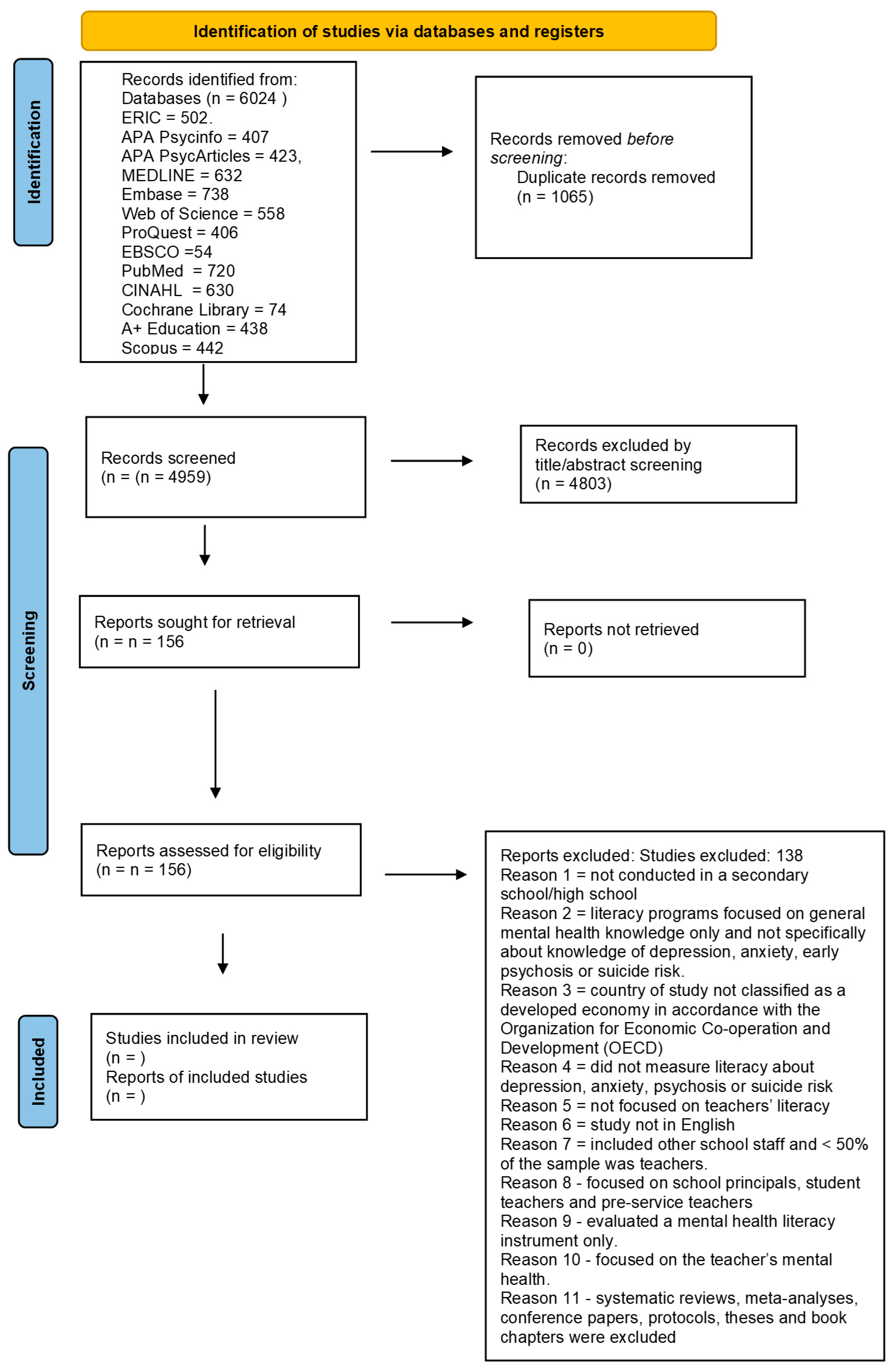
2.2. Appraisal of Evidence
2.3. Charting the Data and Results
3. Results
3.1. Methodological Quality
3.2. Study Characteristics
3.2.1. Country of Study
3.2.2. Study Designs
3.2.3. Participants
3.2.4. Training
3.2.5. Studies Measuring Knowledge of Depression, Anxiety, Psychosis or Suicide Risk
3.2.6. Urban or Rural Schools
3.3. Teachers’ Mental Health Literacy
3.3.1. Depression Literacy
3.3.2. Anxiety Literacy
3.3.3. Early Psychosis Literacy
3.3.4. Suicide Risk Literacy
4. Discussion
4.1. Depression
4.2. Anxiety
4.3. Early Psychosis
4.4. Suicide Risk
4.5. Limitations
5. Conclusions
Supplementary Materials
Author Contributions
Funding
Institutional Review Board Statement
Data Availability Statement
Acknowledgments
Conflicts of Interest
References
- AIHW (Australian Institute of Health and Welfare). (2024). Health of young people Australian institute of health and welfare. Available online: https://www.aihw.gov.au/reports/children-youth/health-of-young-people (accessed on 10 January 2024).
- AIHW (Australian Institute of Health and Welfare). (2025). Suicide and self-harm monitoring. Available online: https://www.aihw.gov.au/suicide-self-harm-monitoring/population-groups/young-people/suicide-self-harm-young-people (accessed on 4 January 2025).
- Alemayehu, C., Mitchell, G., & Nikles, J. (2018). Barriers for conducting clinical trials in developing countries—A systematic review. International Journal for Equity in Health, 17, 37. [Google Scholar] [CrossRef] [PubMed]
- American Psychiatric Association. (2013). Diagnostic and statistical manual of mental disorders (5th ed.). American Psychiatric Association. [Google Scholar] [CrossRef]
- Anderson, M., Werner-Seidler, A., King, C., Gayed, A., Harvey, S. B., & O’Dea, B. (2019). Mental health training programs for secondary school teachers: A systematic review. School Mental Health, 11(3), 489–508. [Google Scholar] [CrossRef]
- Appleby, L., Morriss, R., Gask, L., Roland, M., Lewis, B., Perry, A., Battersby, L., Colbert, N., Green, G., Amos, T., Davies, L., & Faragher, B. (2000). An educational intervention for front-line health professionals in the assessment and management of suicide patients (The STORM Project). Psychological Medicine, 30(4), 805–812. [Google Scholar] [CrossRef] [PubMed]
- Arksey, H., & O’Malley, L. (2005). Scoping studies: Towards a methodological framework. International Journal of Social Research Methodology, 8(1), 19–32. [Google Scholar] [CrossRef]
- Arslan, S., & Karabey, S. (2023). High school students’ and teachers’ mental health literacy levels in Istanbul, Turkey: A comprehensive analysis. The Journal of School Health, 93(8), 698–706. [Google Scholar] [CrossRef]
- Bandura, A. (1977). Self-efficacy: Toward a unifying theory of behavioral change. Psychological Review, 84(2), 191–215. [Google Scholar] [CrossRef]
- Bandura, A. (2006). Toward a psychology of human agency. Perspect Psychol Sci., 1(2), 164–180. [Google Scholar] [CrossRef] [PubMed]
- Bernal-Morales, B., Rodríguez-Landa, J. F., & Pulido-Criollo, F. (2015). Impact of anxiety and depression symptoms on scholar performance in high school and university students. In A fresh look at anxiety disorders. IntechOpen. [Google Scholar]
- Bockhoff, K., Ellermeier, W., & Bruder, S. (2022). Evaluation of a suicide prevention program encompassing both student and teacher training components. Crisis, 44(4), 276–284. [Google Scholar] [CrossRef]
- Bowman, S., Alvarez-Jimenez, M., Wade, D., McGorry, P., & Howie, L. (2014). Forgotten family members: The importance of siblings in early psychosis. Early Intervention in Psychiatry, 8(3), 269–275. [Google Scholar] [CrossRef] [PubMed]
- Bowman, S., McKinstry, C., Howie, L., & McGorry, P. (2020). Expanding the search for emerging mental ill health to safeguard student potential and vocational success in high school: A narrative review. Early Intervention in Psychiatry, 14(6), 655–676. [Google Scholar] [CrossRef] [PubMed]
- Campbell, F., Tricco, A. C., Munn, Z., Pollock, D., Saran, A., Sutton, A., & White, H. (2023). Mapping reviews, scoping reviews, and evidence and gap maps (EGMs): The same but different—The “Big Picture” review family. Systematic Reviews, 12, 45. [Google Scholar] [CrossRef] [PubMed]
- Cordingley, P. (2015). The contribution of research to teachers’ professional learning and development. Oxford Review of Education, 41(2), 234–252. [Google Scholar] [CrossRef]
- Daraganova, G. (2017). The Longitudinal Study of Australian Children (LSAC) annual statistical report 2016: Chapter 6-Self-harm and suicidal behaviour of young people aged 14–15 years old. Australian Institute of Family Studies. [Google Scholar]
- Dunst, C. J., Bruder, M. B., & Hamby, D. W. (2015). Metasynthesis of in-service professional development research: Features associated with positive educator and student outcomes. Educational Research and Reviews, 10(12), 1731–1744. [Google Scholar] [CrossRef]
- Early Psychosis Guidelines Writing Group. (2016). Australian clinical guidelines for early psychosis (2nd ed. update). Orygen, The National Centre of Excellence in Youth Mental Health. [Google Scholar]
- Eaton, S., Harrap, B., Downey, L., Thien, K., Bowtell, M., Bardell-Williams, M., Ratheesh, A., McGorry, P., & O’Donoghue, B. (2019). Incidence of treated first episode psychosis from an Australian early intervention service and its association with neighbourhood characteristics. Schizophrenia Research, 209, 206–211. [Google Scholar] [CrossRef] [PubMed]
- Elmelid, A., Stickley, A., Lindblad, F., Schwab-Stone, M., Henrich, C. C., & Ruchkin, V. (2015). Depressive symptoms, anxiety and academic motivation in youth: Do schools and families make a difference? Journal of Adolescence 45, 174–182. [Google Scholar] [CrossRef]
- Esch, P., Bocquet, V., Pull, C., Couffignal, S., Lehnert, T., Graas, M., Fond-Harmant, L., & Ansseau, M. (2014). The downward spiral of mental disorders and educational attainment: A systematic review on early school leaving. BMC Psychiatry, 14, 237–350. [Google Scholar] [CrossRef]
- Exner-Cortens, D., Baker, E., Fernandez Conde, C., Van Bavel, M., Roy, M., & Pawluk, C. (2022). School-based suicide prevention through gatekeeper training: The role of natural leaders. Canadian Journal of Community Mental Health, 41(3), 176–195. [Google Scholar] [CrossRef]
- Foulkes, L., & Andrews, J. L. (2023). Are mental health awareness efforts contributing to the rise in reported mental health problems? A call to test the prevalence inflation hypothesis. New Ideas in Psychology, 69, 101010. [Google Scholar] [CrossRef]
- Frauenholtz, S., Mendenhall, A., & Moon, J. (2017). Role of School Employees’ Mental Health Knowledge in Interdisciplinary Collaborations to Support the Academic Success of Students Experiencing Mental Health Distress. Children & Schools, 39(2), 71–79. [Google Scholar] [CrossRef]
- Frojd, S., Nissiene, E., Pelkonen, M., Marttunen, M., Marttunen, M. J., Koivisto, A.-M., & Kaltiala-Heino, R. (2008). Depression and school performance in middle adolescent boys and girls. Journal of Adolescence, 31(4), 485–498. [Google Scholar] [CrossRef]
- Garvik, M., Idsoe, T., & Bru, E. (2014). Effectiveness study of a CBT-based adolescent coping with depression course. Emotional and Behavioural Difficulties, 19(2), 195–209. [Google Scholar] [CrossRef]
- Goulding, S., Chien, V., & Compton, M. (2010). Prevalence and correlates of school drop-out prior to initial treatment of nonaffective psychosis: Further evidence suggesting a need for supported education. Schizophrenia Research, 116(2–3), 228–233. [Google Scholar] [CrossRef] [PubMed]
- Hart, S. R., Kastelic, E. A., Wilcox, H. C., Beaudry, M. B., Musci, R. J., Heley, K. M., Ruble, A. E., & Swartz, K. L. (2014). Achieving depression literacy: The Adolescent Depression Knowledge Questionnaire (ADKQ). School Mental Health: A Multidisciplinary Research and Practice Journal, 6(3), 213–223. [Google Scholar] [CrossRef]
- Heng, Q., & Chu, L. (2023). Self-efficacy, reflection, and resilience as predictors of work engagement among English teachers. Front Psychology, 14, 1160681. [Google Scholar] [CrossRef] [PubMed]
- Higgins, J. P. T., Thomas, J., Chandler, J., Cumpston, M., Li, T., Page, M. J., & Welch, V. (2024). Cochrane handbook for systematic reviews of interventions (version 6.5). Cochrane. Available online: www.cochrane.org/handbook (accessed on 2 April 2025).
- Hong, Q. N., Fàbregues, S., Bartlett, G., Boardman, F., Cargo, M., Dagenais, P., Gagnon, M.-P., Griffiths, F., Nicolau, B., O’Cathain, A., Rousseau, M.-C., Vedel, I., & Pluye, P. (2018). The mixed methods appraisal tool (MMAT), version 2018. Education for Information, 34(4), 285–291. [Google Scholar] [CrossRef]
- Hugh-Jones, S., Janardhana, N., Al-Janabi, H., Bhola, P., Cooke, P., Fazel, M., Hudson, K., Khandeparkar, P., Mirzoev, T., Venkataraman, S., West, R. M., & Mallikarjun, P. (2022). Safeguarding adolescent mental health in India (SAMA): Study protocol for codesign and feasibility study of a school systems intervention targeting adolescent anxiety and depression in India. BMJ Open, 12(4), e054897. [Google Scholar] [CrossRef]
- Johnson, L. A., & Parsons, M. E. (2012). Adolescent suicide prevention in a school setting: Use of a gatekeeper program. NASN School Nurse, 27(6), 312–317. [Google Scholar] [CrossRef]
- Jorm, A. F. (2012). Mental health literacy: Empowering the community to take action for better mental health. The American Psychologist, 67(3), 231–243. [Google Scholar] [CrossRef]
- Jorm, A. F., Kitchener, B. A., Sawyer, M. G., Scales, H., & Cvetkovski, S. (2010). Mental health first aid training for high school teachers: A cluster randomized trial. BMC Psychiatry, 10, 51. [Google Scholar] [CrossRef]
- Jorm, A. F., Korten, A. E., Jacomb, P. A., Christensen, H., Rodgers, B., & Pollitt, P. (1997). “Mental health literacy”: A survey of the public’s ability to recognise mental disorders and their beliefs about the effectiveness of treatment. The Medical Journal of Australia, 166(4), 182–186. [Google Scholar] [CrossRef]
- Kelleher, I. (2025). Annual Research Review: Psychosis in children and adolescents: Key updates from the past 2 decades on psychotic disorders, psychotic experiences, and psychosis risk. Journal of Child Psychology And Psychiatry, 66(4), 460–476. [Google Scholar] [CrossRef]
- Kelly, M. S. (2011). Data-driven decision making in school-based mental health:(HOW) is it possible? Advances in School Mental Health Promotion, 4(4), 2–4. [Google Scholar] [CrossRef]
- Kessler, R. C., Angermeyer, M., Anthony, J. C., De Graaf, R. O. N., Demyttenaere, K., Gasquet, I., Girolamo, G. D., Gluzman, S., Gureje, O., Haro, J. M., Kawakami, N., Karam, A., Levinson, D., Mora, M. E. M., Browne, M. O., Posada-Villa, J., Stein, D. J., Tsang, C. H. A., Aguilar-Gaxiola, S., … Üstün, T. B. (2007). Lifetime prevalence and age-of-onset distributions of mental disorders in the World Health Organization’s World Mental Health Survey Initiative. World Psychiatry, 6(3), 168. [Google Scholar] [PubMed]
- Lally, J., Ajnakina, O., Stubbs, B., Cullinane, M., Murphy, K. C., Gaughran, F., & Murray, R. M. (2017). Remission and recovery from first-episode psychosis in adults: Systematic review and meta-analysis of long-term outcome studies. The British Journal of Psychiatry, 211(6), 350–358. [Google Scholar] [CrossRef] [PubMed]
- Lamis, D. A., Underwood, M., & D’Amore, N. (2017). Outcomes of a suicide prevention gatekeeper training program among school personnel. Crisis, 38(2), 89–99. [Google Scholar] [CrossRef]
- Law, M., & MacDermid, J. (1998). Evidence-based rehabilitation (2nd ed.). Slack. [Google Scholar]
- Law, M., Stewart, D., Pollock, M., Letts, L., Bosch, J., & Westmorland, M. (1998). Guidelines for critical review form: Quantitative studies. McMaster University Occupational Therapy Evidence-Based Practice Research Group. [Google Scholar]
- Lawrence, D., Johnson, S., Hafekost, J., Boterhoven De Haan, K., Sawyer, M., Ainley, J., & Zubrick, S. (2015). The mental health of children and adolescents: Report on the second Australian child and adolescent survey of mental health and wellbeing. Department of Health. [Google Scholar]
- Leach, L., & Butterworth, P. (2012). The effect of early onset common mental disorders on educational attainment in Australia. Psychiatric Research, 199(1), 51–57. [Google Scholar] [CrossRef]
- Letts, L., Wilkins, S., Law, M., Stewart, D., Bosch, J., & Westmorland, M. (2007). Guidelines for critical review form: Qualitative studies. McMaster University Occupational Therapy Evidence-Based Practice Research Group. [Google Scholar]
- Levac, D., Colquhoun, H., & O’Brien, K. K. (2010). Scoping studies: Advancing the methodology. Implementation Science, 5, 69. [Google Scholar] [CrossRef]
- McGorry, P. D., Mei, C., Chanen, A., Hodges, C., Alvarez-Jimenez, M., & Killackey, E. (2022). Designing and scaling up integrated youth mental health care. World Psychiatry: Official Journal of the World Psychiatric Association (WPA), 21(1), 61–76. [Google Scholar] [CrossRef]
- Mei, C., Fitzsimons, J., Allen, N., Alvarez-Jimenez, M., Amminger, G. P., Browne, V., Cannon, M., Davis, M., Dooley, B., Hickie, I. B., Iyer, S., Killackey, E., Malla, A., Manion, I., Mathias, S., Pennell, K., Purcell, R., Rickwood, D., Singh, S. P., … McGorry, P. D. (2020). Global research priorities for youth mental health. Early Intervention in Psychiatry, 14(1), 3–13. [Google Scholar] [CrossRef]
- Methley, A. M., Campbell, S., Chew-Graham, C., McNally, R., & Cheraghi-Sohi, S. (2014). PICO, PICOS and SPIDER: A comparison study of specificity and sensitivity in three search tools for qualitative systematic reviews. BMC Health Services Research, 14(1), 579. [Google Scholar] [CrossRef]
- Miller, L., Musci, R., D’Agati, D., Alfes, C., Beaudry, M. B., Swartz, K., & Wilcox, H. (2019). Teacher mental health literacy is associated with student literacy in the adolescent depression awareness program. School Mental Health, 11(2), 357–363. [Google Scholar] [CrossRef]
- Moon, J., Williford, A., & Mendenhall, A. (2017). Educators’ perceptions of youth mental health: Implications for training and the promotion of mental health services in schools. Children and Youth Services Review, 73, 384–391. [Google Scholar] [CrossRef]
- Moor, S., Ann, M., Hester, M., Elisabeth, W. J., Robert, E., Robert, W., & Caroline, B. (2007). Improving the recognition of depression in adolescence: Can we teach the teachers? Journal of Adolescence, 30(1), 81–95. [Google Scholar] [CrossRef] [PubMed]
- Nalipay, M. J. N., & Simon, P. D. (2023). Teachers are frontliners too: Promoting mental health literacy among teachers in low-and middle-income countries. Asian Journal of Psychiatry, 81, 103407. [Google Scholar] [CrossRef] [PubMed]
- O’Dea, B., Parker, B., Batterham, P. J., Chakouch, C., Mackinnon, A. J., Whitton, A. E., Newby, J. M., Subotic-Kerry, M., Gayed, A., & Harvey, S. B. (2023). A cluster randomized controlled trial on the effectiveness of the building educators’ skills in adolescent mental health (BEAM) program for improving secondary school educators’ confidence, behavior, knowledge, and attitudes toward student mental health. Journal of Teacher Education, 76(2), 178–194. [Google Scholar] [CrossRef]
- OECD (Organisation for Economic Co-operation and Development). (2012). Sick on the job?: Myths and realities about mental health and work. Mental Health and Work, OECD Publishing. [Google Scholar] [CrossRef]
- Ohrt, J. H., Deaton, J. D., Linich, K., Guest, J. D., Wymer, B., & Sandonato, B. (2020). Teacher training in K-12 student mental health: A systematic review. Psychology in the Schools. [Google Scholar] [CrossRef]
- Papandrea, K., & Winefield, H. (2011). It’s not just the squeaky wheels that need the oil: Examining teachers’ views on the disparity between referral rates for students with internalizing versus externalizing problems. School Mental Health, 3, 222–235. [Google Scholar] [CrossRef]
- Parker, B. L., Anderson, M., Batterham, P. J., Gayed, A., Subotic-Kerry, M., Achilles, M. R., Chakouch, C., Werner-Seidler, A., Whitton, A. E., & Dea, B. O. (2021). Examining the preliminary effectiveness and acceptability of a web-based training program for Australian secondary school teachers: Pilot study of the BEAM (Building Educators’ skills in Adolescent Mental Health) program. JMIR Mental Health, 8(10), e29989. [Google Scholar] [CrossRef]
- Peters, M. D., Marnie, C., Colquhoun, H., Garritty, C. M., Hempel, S., Horsley, T., Langlois, E. V., Lillie, E., O’Brien, K. K., Tunçalp, Ö., Wilson, M. G., Zarin, W., & Tricco, A. C. (2021). Scoping reviews: Reinforcing and advancing the methodology and application. Systematic Reviews, 10, 263. [Google Scholar] [CrossRef]
- Prabhu, S. G., Mallikarjun, P. K., Palmer, A., Nag, R., Khadeparkar, P., Arelingaiah, M., Lakshman, K. A., Podiya, J. K., Navaneetham, J., & Hugh-Jones, S. (2024). Mental health literacy in secondary school teachers and interventions to improve it—A systematic review and narrative synthesis. Journal of Mental Health, 33(5), 1156–1171. [Google Scholar] [CrossRef]
- Productivity Commission. (2020). Inquiry report on mental health, report No. 95. Canberra Australia. [Google Scholar]
- Quinnett, P. (1995). QPR: Ask a question, save a life. The QPR Institute and Suicide Awareness/Voices of Education. [Google Scholar]
- Quinnett, P. (1999). QPR institute. Available online: http://www.qprinstitute.com (accessed on 9 February 2025).
- Radez, J., Reardon, T., Creswell, C., Lawrence, P. J., Evdoka-Burton, G., & Waite, P. (2021). Why do children and adolescents (not) seek and access professional help for their mental health problems? A systematic review of quantitative and qualitative studies. European Child & Adolescent Psychiatry, 30(2), 183–211. [Google Scholar] [CrossRef]
- Reis, C., & Cornell, D. (2018). An evaluation of suicide gatekeeper training for school counselors and teachers. Professional School Counseling, 11(6), 2156759X0801100605. [Google Scholar] [CrossRef]
- Robinson, J., Green, G., Spittal, M. J., Templer, K., & Bailey, E. (2016). Impact and acceptability of delivering skills-based training on risk management (STORM) in Australian secondary schools. Health Behavior and Policy Review, 3(3), 259–268. [Google Scholar] [CrossRef]
- Robson, E. M., Husin, H. M., Dashti, S. G., Vijayakumar, N., Moreno-Betancur, M., Moran, P., Patton, G. C., & Sawyer, S. M. (2024). Tracking the course of depressive and anxiety symptoms across adolescence (the CATS study): A population-based cohort study in Australia. Lancet Psychiatry, 12(1), 44–53, Erratum in: Lancet Psychiatry, 12(2), e2. https://doi.org/10.1016/S2215-0366(25)00004-5. PMID: 39644904. [Google Scholar] [CrossRef] [PubMed]
- Rossetto, A., Jorm, A. F., & Reavley, N. J. (2016). Predictors of adults’ helping intentions and behaviours towards a person with a mental illness: A six-month follow-up study. Psychiatry Research, 240, 170–176. [Google Scholar] [CrossRef] [PubMed]
- Shilubane, H. N., Bos, A. E., Ruiter, R. A., van den Borne, B., & Reddy, P. S. (2015). High school suicide in South Africa: Teachers’ knowledge, views and training needs. BMC Public Health, 15, 245. [Google Scholar] [CrossRef]
- Sims, S., & Fletcher-Wood, H. (2021). Identifying the characteristics of effective teacher professional development: A critical review. School Effectiveness and School Improvement, 32(1), 47–63. [Google Scholar] [CrossRef]
- Sims, S., Fletcher-Wood, H., O’Mara-Eves, A., Cottingham, S., Stansfield, C., Goodrich, J., Van Herwegen, J., & Anders, J. (2023). Effective teacher professional development: New theory and a meta-analytic test. Review of Educational Research, 95(2), 213–254. [Google Scholar] [CrossRef]
- Siskind, D., Orr, S., Sinha, S., Yu, O., Brijball, B., Warren, N., MacCabe, J. H., Smart, S. E., & Kisely, S. (2022). Rates of treatment-resistant schizophrenia from first-episode cohorts: Systematic review and meta-analysis. The British Journal of Psychiatry, 220(3), 115–120. [Google Scholar] [CrossRef]
- Staines, L., Healy, C., Murphy, F., Byrne, J., Murphy, J., Kelleher, I., Cotter, D., & Cannon, M. (2023). Incidence and persistence of psychotic experiences in the general population: Systematic review and meta-analysis. Schizophrenia Bulletin, 49, 1007–1021. [Google Scholar] [CrossRef]
- Tricco, A. C., Lillie, E., Zarin, W., O’Brien, K. K., Colquhoun, H., Levac, D., Moher, D., Peters, M. D. J., Horsley, T., Weeks, L., Hempel, S., Akl, E. A., Chang, C., McGowan, J., Stewart, L., Hartling, L., Aldcroft, A., Wilson, M. G., Garritty, C., … Straus, S. E. (2018). PRISMA extension for scoping reviews (PRISMAScR): Checklist and explanation. Annals of Internal Medicine 169, 467–473. [Google Scholar] [CrossRef]
- Tschannen-Moran, M., Hoy, A. W., & Hoy, W. K. (1998). Teacher Efficacy: Its Meaning and Measure. Review of Educational Research, 68(2), 202–248. [Google Scholar] [CrossRef]
- Van Ameringen, M., Mancini, C., & Farvolden, P. (2003). The impact of anxiety disorders on educational achievement. Journal of Anxiety Disorder, 17(5), 561–571. [Google Scholar] [CrossRef] [PubMed]
- Vieira, M. A., Gadelha, A. A., Moriyama, T. S., Bressan, R. A., & Bordin, I. A. (2014). Evaluating the effectiveness of a training program that builds teachers’ capability to identify and appropriately refer middle and high school students with mental health problems in Brazil: An exploratory study. BMC Public Health, 14, 210. [Google Scholar] [CrossRef] [PubMed]
- Viera, A. J., & Garrett, J. M. (2005). Understanding inter-observer agreement: The kappa statistic. Family Medicine, 37, 360–363. [Google Scholar] [PubMed]
- Waghorn, G., Saha, S., Harvey, C., Morgan, V., Waterreus, A., Bush, R., Castle, D., Galletly, C., Stain, H. J., Neil, A. L., McGorry, P., & McGrath, J. J. (2012). ‘Earning and learning’ in those with psychotic disorders: The second Australian national survey of psychosis. Australian and New Zealand Journal of Psychiatry, 46(8), 774–785. [Google Scholar] [CrossRef]
- Watson, K. J. (2024). Secondary teachers’ perceived ability to support student mental health. Educational Research: Theory and Practice, 35(1), 233–247. [Google Scholar]
- Wei, Y., & Kutcher, S. (2014). Innovations in Practice: ‘Go-to’ Educator Training on the mental health competencies of educators in the secondary school setting: A program evaluation. Child and Adolescent Mental Health, 19(3), 219–222. [Google Scholar] [CrossRef] [PubMed]
- Wei, Y., Kutcher, S., Baxter, A., & Heffernan, A. (2021). The program evaluation of ‘Go-To Educator Training’ on educators’ knowledge about and stigma toward mental illness in six Canadian provinces. Early Intervention in Psychiatry, 15(4), 922–931. [Google Scholar] [CrossRef] [PubMed]
- Weldman, A., Augustine, A., Murayama, K., & Elliot, A. (2015). Internalizing symptomatology and academic achievement: Bi-directional prospective relations in adolescence. Journal of Research in Personality, 58, 106–114. [Google Scholar] [CrossRef]
- WHO (World Health Organization). (2020). Adolescent mental health World Health Organization. Available online: https://www.who.int/news-room/fact-sheets/detail/adolescent-mental-health (accessed on 2 April 2024).
- WHO (World Health Organization). (2023). Adolescent and young adult health. Available online: https://www.who.int/news-room/fact-sheets/detail/adolescents-health-risks-and-solutions (accessed on 2 April 2024).
- Williams, R., Ostinelli, E. G., Agorinya, J., Minichino, A., De Crescenzo, F., Maughan, D., Puntis, S., Cliffe, C., Kurtulmus, A., Lennox, B. R., & Cipriani, A. (2024). Comparing interventions for early psychosis: A systematic review and component network meta-analysis. E Clinical Medicine, 70, 102537. [Google Scholar] [CrossRef] [PubMed] [PubMed Central]
- Worley, J. T., Sullivan, L., Ferguson, E., Anderson-Butcher, D., Mack, S., Houle, J., & Ault-Baker, K. (2025). Coach mental health literacy: A scoping review. International Review of Sport and Exercise Psychology, 1–27, Advance online publication. [Google Scholar] [CrossRef]
- Wyman, P. A., Brown, C. H., Inman, J., Cross, W., Schmeelk-Cone, K., Guo, J., & Pena, J. B. (2008). Randomized trial of a gatekeeper program for suicide prevention: 1-year impact on secondary school staff. Journal of Consulting and Clinical Psychology, 76(1), 104. [Google Scholar] [CrossRef]
- Yamaguchi, S., Foo, J. C., Nishida, A., Ogawa, S., Togo, F., & Sasaki, T. (2020). Mental health literacy programs for school teachers: A systematic review and narrative synthesis. Early Intervention in Psychiatry, 14(1), 14–25. [Google Scholar] [CrossRef]
- Yamaguchi, S., Foo, J. C., & Sasaki, T. (2023). A survey of suicide literacy in Japanese school teachers. Scientific Reports, 13(1), 23047. [Google Scholar] [CrossRef]

| Item | Essential Criteria |
|---|---|
| 1. Purpose | Do the authors clearly state the aim of the study, which is to investigate the mental health literacy of secondary school teachers about adolescent depression, anxiety, early psychosis or suicide risk? |
| 2. Literature review | Do the authors justify the need for the study, namely the need to undertake further research into the mental health literacy of secondary school teachers about adolescent depression, anxiety, early psychosis or suicide risk? |
| 3. Study design | Have the authors described the study design to address the study aims, that is, to evaluate the mental health literacy of teachers? |
| 4. Blinding | Have the authors used assessor blinding to minimize bias? |
| 5. Sample description | Do the authors describe the sample in terms of age, gender and number of participants? |
| 6. Sample set | Have the authors justified their sample size through a power calculation or post hoc analysis and recruited sufficient numbers? |
| 7. Ethics and consent | Have the authors documented ethical approval for the research and gained informed consent from participants? |
| 8. Validity of outcomes | Did the authors use valid outcome measures to measure the mental health literacy of secondary school teachers specifically about adolescent depression, anxiety, early psychosis or suicide risk? |
| 9. Reliability of outcomes | Did the authors use reliable outcome measures to measure the mental health literacy of secondary school teachers specifically about adolescent depression, anxiety, early psychosis or suicide risk? |
| 10. Intervention description | Did the authors provide sufficient information to enable reproduction of the intervention? |
| 11. Statistical significance | Did the authors report on at least one outcome measure in line with the study aim and in terms of statistical significance? |
| 12. Statistical analysis | Did the authors use appropriate statistical analyses in evaluating results according to their aim? |
| 13. Clinical importance | Did the authors reflect on the clinical importance of the results for secondary school teachers? |
| 14. Conclusions | Did the authors provide appropriate conclusions considering the study method and result? |
| 15. Clinical implications | Did the authors discuss the implications of the results in terms of secondary school teachers’ mental health literacy about adolescent depression, anxiety, early psychosis or suicide risk? |
| 16. Study limitations | Did the authors identify limitations of the study methodology and results? |
| Item | Essential Criteria |
|---|---|
| 1. Purpose | Do the authors clearly state the aim of the study and/or research question, which is to investigate the mental health literacy of secondary school teachers about adolescent depression, anxiety, early psychosis or suicide risk? |
| 2. Literature review | Do the authors justify the need for the study? Was it clear and compelling—the need to undertake further research into the mental health literacy of secondary school teachers about adolescent depression, anxiety, early psychosis or suicide risk? Was relevant background literature reviewed? |
| 3. Study design | Was the study design appropriate for the research question, that is, to investigate the mental health literacy of secondary school teachers about adolescent depression, anxiety, early psychosis or suicide risk? |
| 4. Theoretical perspective | Was a theoretical perspective described? Are the methods congruent with the philosophical underpinnings and purpose? |
| 5. Sample description | Have the authors described the sampling method used? Was the process of purposeful section described? Was sampling performed until redundancy in data was reached? |
| 6. Sample set | Have the authors described the sample in adequate detail, in terms of demographic data and number of participants? |
| 7. Ethics and consent | Have the authors documented ethical approval for the research and gained informed consent from participants? |
| 8. Data collection | Were clear and complete descriptions of data collection provided? Were the role of researcher and the relationship with participants described? Were the assumptions and biases of researchers identified? |
| 9. Procedural rigor | Do the authors provide adequate information about data collection procedures, e.g., gaining access to the site, field notes and training data gatherers? |
| 10. Data analyses | Were the data analysis methods inductive? Were the findings consistent and reflective of the data? Was a decision trail developed and outlined? Was the process of analyzing the data described? |
| 11. Theoretical connections | Were the concepts under study clarified and refined and relationships made clear? Did a meaningful picture of the phenomenon under study emerge? |
| 12. Overall rigor | Was there evidence of the four components of trustworthiness—credibility, transferability, dependability and confirmability? |
| 13. Conclusions and implications | Were the conclusions appropriate given the study findings? Were the clinical implications outlined? Were the limitations of the study discussed? |
| Study | Individual Item | Total/16 | Quality Descriptor | |||||||||||||||
|---|---|---|---|---|---|---|---|---|---|---|---|---|---|---|---|---|---|---|
| 1 | 2 | 3 | 4 | 5 | 6 | 7 | 8 | 9 | 10 | 11 | 12 | 13 | 14 | 15 | 16 | |||
| (Arslan and Karabey, 2023) | 1 | 1 | 1 | 0 | 1 | 0 | 0 | 1 | 1 | 0 | 0 | 1 | 1 | 0 | 1 | 1 | 10 | Fair |
| (Bockhoff et al., 2022) | 1 | 1 | 1 | 0 | 0 | 0 | 0 | 1 | 1 | 0 | 1 | 1 | 1 | 1 | 1 | 1 | 11 | Fair |
| (Johnson & Parsons, 2012) | 1 | 1 | 1 | 0 | 0 | 0 | 0 | 1 | 0 | 1 | 0 | 0 | 1 | 1 | 1 | 0 | 8 | Fair |
| (Jorm et al., 2010) | 1 | 1 | 1 | 0 | 1 | 1 | 1 | 1 | 0 | 1 | 1 | 1 | 1 | 1 | 1 | 1 | 14 | High |
| (Lamis et al., 2017) | 1 | 1 | 1 | 0 | 1 | 1 | 0 | 1 | 1 | 1 | 1 | 1 | 1 | 0 | 1 | 1 | 13 | High |
| (Miller et al., 2019) | 1 | 1 | 1 | 0 | 0 | 0 | 1 | 1 | 1 | 1 | 1 | 1 | 1 | 1 | 1 | 1 | 13 | High |
| (Moor et al., 2007) | 1 | 1 | 1 | 0 | 0 | 0 | 1 | 1 | 1 | 1 | 1 | 1 | 1 | 0 | 1 | 1 | 12 | Moderate |
| (O’Dea et al., 2023) | 1 | 1 | 1 | 0 | 1 | 1 | 1 | 1 | 1 | 1 | 1 | 1 | 1 | 1 | 1 | 1 | 15 | High |
| (Parker et al., 2021) | 1 | 1 | 1 | 0 | 1 | 0 | 1 | 1 | 1 | 1 | 1 | 1 | 0 | 1 | 1 | 1 | 13 | High |
| (Reis & Cornell, 2018) | 1 | 1 | 1 | 0 | 0 | 0 | 0 | 1 | 0 | 1 | 1 | 1 | 1 | 1 | 1 | 1 | 11 | Fair |
| (Robinson et al., 2016) | 1 | 1 | 1 | 0 | 1 | 0 | 1 | 1 | 1 | 1 | 1 | 1 | 1 | 1 | 1 | 1 | 14 | High |
| (Vieira et al., 2014) | 1 | 1 | 1 | 0 | 1 | 0 | 1 | 1 | 0 | 0 | 1 | 1 | 1 | 1 | 1 | 1 | 12 | Moderate |
| (Wei et al., 2021) | 1 | 1 | 1 | 0 | 1 | 1 | 0 | 1 | 1 | 1 | 1 | 1 | 0 | 1 | 1 | 1 | 12 | Moderate |
| (Wei and Kutcher, 2014) | 1 | 1 | 1 | 0 | 0 | 0 | 1 | 1 | 0 | 1 | 1 | 1 | 1 | 0 | 1 | 1 | 11 | Fair |
| (Wyman et al., 2008) | 1 | 1 | 1 | 0 | 1 | 0 | 1 | 1 | 0 | 1 | 1 | 1 | 1 | 0 | 1 | 1 | 12 | Moderate |
| (Yamaguchi et al., 2023) | 1 | 1 | 0 | 0 | 1 | 0 | 1 | 1 | 1 | 0 | 1 | 1 | 1 | 1 | 1 | 1 | 12 | Moderate |
| Study | Individual Item | Total/13 | Quality Descriptor | ||||||||||||
|---|---|---|---|---|---|---|---|---|---|---|---|---|---|---|---|
| 1 | 2 | 3 | 4 | 5 | 6 | 7 | 8 | 9 | 10 | 11 | 12 | 13 | |||
| (Shilubane et al., 2015) | 1 | 1 | 1 | 0 | 1 | 0 | 1 | 0 | 0 | 0 | 0 | 1 | 1 | 7 | Fair |
| Category of Study Methodological Quality Criteria | Yes | No | Can’t Tell |
|---|---|---|---|
| Study: (Exner-Cortens et al., 2022) | |||
| S1. Are there clear research questions? | * | ||
| S2. Do the collected data allow the research questions to be addressed? | * | ||
| 1. Qualitative Component of Study | |||
| 1.1. Is the qualitative approach appropriate to answer the research questions? | * | ||
| 1.2. Are the qualitative data collection methods adequate to address the research question? | * | ||
| 1.3. Are the findings adequately derived from the data? | * | ||
| 1.4. Is the interpretation of results sufficiently substantiated by data? | * | ||
| 1.5. Is there coherence between qualitative data sources, collection, analysis and interpretation? | * | ||
| 4. Quantitative Component of Study | |||
| 4.1 Is the sampling strategy relevant to address the question? | * | ||
| 4.2 Is the sample representative of the target population? | * | ||
| 4.3 Are the measurements appropriate? | * | ||
| 4.4 Is the statistical analysis appropriate to answer the research question? | * | ||
| 5. Mixed Method Integration | |||
| 5.1 Is there an adequate rationale for using a mixed-method design to address the research question? | * | ||
| 5.2 Are the different components of the study effectively integrated to answer the research questions? | * | ||
| 5.3 Are the outputs of the integration of qualitative and quantitative components adequately interpreted? | * | ||
| 5.4 Are divergencies and inconsistencies between quantitative and qualitative results adequately addressed? | * | ||
| 5.5 Do the different components of the study adhere to the quality criteria of each tradition of the methods involved? | * |
| Study | Instrument Used to Measure Knowledge of Depression | Literacy Training Content |
|---|---|---|
| 1. Arslan and Karabey (2023) | Mental Health Literacy Questionnaire (Jorm et al., 1997). Vignette presented of depression (Arslan & Karabey, 2023) | No training |
| 2. Jorm et al. (2010) | Knowledge about mental health problems (Jorm et al., 2010) Recognition of depression in a vignette (Jorm et al., 2010) Stigma towards depressed students (Jorm et al., 2010) Beliefs about treatment of depression (Jorm et al., 2010) Intentions to help a depressed student (Jorm et al., 2010) | Mental Health First Aid |
| 3. Miller et al. (2019) | The Adolescent Depression Knowledge Questionnaire (ADKQ) (Hart et al., 2014) | Adolescent Depression Awareness Program (ADAP) |
| 4. Moor et al. (2007) | Teachers given class lists to indicate which students they believed were depressed (Moor et al., 2007) | Training package on adolescent depression developed by researchers |
| 5. O’Dea et al. (2023) | Confidence in Recognizing and Responding to Students’ Mental Health Needs (O’Dea et al., 2023) | Building Educators Skills in Adolescent Mental Health Program (BEAM) |
| 6. Parker et al. (2021) | Depression Stigma Scale (Parker et al., 2021) | Building Educators Skills in Adolescent Mental Health Program (BEAM) |
| 7. Vieira et al. (2014) | Questionnaire with vignettes, one indicating high risk for depression (Vieira et al., 2014) | Training package on adolescent depression developed by researchers |
| 8. Wei et al. (2021) | Mental Health Knowledge and Stigma Survey (measures knowledge about depression) (Wei and Kutcher, 2014) | ‘Go-To’ Educator Training |
| 9. Wei and Kutcher (2014) | Mental Health Knowledge and Stigma Survey (measures knowledge about depression) (Wei and Kutcher, 2014) | ‘Go-To’ Educator Training |
| Study | Instrument Used to Measure Knowledge of Anxiety | Literacy Training Content |
|---|---|---|
| 1. Arslan and Karabey (2023) | Mental Health Literacy Questionnaire (Jorm et al., 1997) —vignette presented of an anxiety disorder (Arslan & Karabey, 2023) | No training |
| 2. Jorm et al. (2010) | Knowledge about mental health problems (Jorm et al., 2010) | Mental Health First Aid |
| 3. O’Dea et al. (2023) | Confidence in Recognizing and Responding to Students’ Mental Health Needs (O’Dea et al., 2023) | Adolescent Depression Awareness Program (ADAP) |
| 4. Wei et al. (2021) | Mental Health Knowledge and Stigma Survey (measures knowledge about anxiety) (Wei and Kutcher, 2014) | ‘Go-To’ Educator Training |
| 5. Wei and Kutcher (2014) | Mental Health Knowledge and Stigma Survey (measures knowledge about anxiety) (Wei and Kutcher, 2014) | ‘Go-To’ Educator Training |
| Study | Instrument Used to Measure Knowledge of Psychosis | Literacy Training Content |
|---|---|---|
| 1. Arslan and Karabey (2023) | Mental Health Literacy Questionnaire (Jorm et al., 1997). Vignette of psychosis (Arslan & Karabey, 2023) | No training provided |
| 2. Jorm et al. (2010) | Knowledge about mental health problems (Jorm et al., 2010) | Mental Health First Aid |
| 3. Vieira et al. (2014) | Questionnaire with vignettes, one highlighting behavior indicating high risk for psychosis (Vieira et al., 2014) | Training package on early psychosis developed by researchers |
| 4. Wei et al. (2021) | Mental Health Knowledge and Stigma Survey (measures knowledge about schizophrenia) (Wei and Kutcher, 2014) | ‘Go-To’ Educator Training |
| 5. Wei and Kutcher (2014) | Mental Health Knowledge and Stigma Survey (measures knowledge about schizophrenia) (Wei and Kutcher, 2014) | ‘Go-To’ Educator Training |
| Study | Instrument Used to Measure Knowledge of Suicide Risk | Literacy Training Content |
|---|---|---|
| 1. Bockhoff et al. (2022) | Training evaluation survey (Bockhoff et al., 2022) Students help-seeker behavior survey (Bockhoff et al., 2022) Vignette representing a student in crisis, plus 12-item survey (Bockhoff et al., 2022) School staff’s self-efficacy in counseling suicidal students survey (Bockhoff et al., 2022) | QPR |
| 2. Exner-Cortens et al. (2022) | Survey of Knowledge Attitudes (Exner-Cortens et al., 2022) Gatekeeper Behaviors for Suicide Prevention in School Training (Exner-Cortens et al., 2022) | QPR |
| 3. Johnson and Parsons (2012) | Survey designed by researchers | QPR |
| 4. Lamis et al. (2017) | Knowledge Attitudes and Self-efficacy (Lamis et al., 2017) | Making Educators Partners in Suicide Prevention |
| 5. Reis and Cornell (2018) | Student suicide prevention survey (Reis & Cornell, 2018) | QPR |
| 6. Robinson et al. (2016) | Knowledge of Deliberate Self-Harm Questionnaire (Robinson et al., 2016) Attitudes to Children who Self-Harm Scale (Robinson et al., 2016) Attitudes to Suicide Prevention Scale (Appleby et al., 2000) Filmed role play | STORM |
| 7. Shilubane et al. (2015) | 5 Focus groups | No training |
| 8. Wyman et al. (2008) | Staff suicide prevention survey (Wyman et al., 2008) Knowledge of QPR (Quinnett, 1999) Appraisals (gatekeeper preparedness, self-evaluation of knowledge, gatekeeper efficacy, gatekeeper reluctance, access to services, gatekeeper behaviors, training) (Wyman et al., 2008) Communication with students (Wyman et al., 2008) | QPR |
| 9. Yamaguchi et al. (2023) | Survey assessing (a) knowledge about suicide, (b) intention to ask about students’ suicidal thoughts/plans and (c) attitudes towards talking to suicidal students (Yamaguchi et al., 2023) | No training |
Disclaimer/Publisher’s Note: The statements, opinions and data contained in all publications are solely those of the individual author(s) and contributor(s) and not of MDPI and/or the editor(s). MDPI and/or the editor(s) disclaim responsibility for any injury to people or property resulting from any ideas, methods, instructions or products referred to in the content. |
© 2026 by the authors. Licensee MDPI, Basel, Switzerland. This article is an open access article distributed under the terms and conditions of the Creative Commons Attribution (CC BY) license.
Share and Cite
Bowman, S.; McKinstry, C.; Howie, L. Secondary School Teachers’ Disorder-Specific Mental Health Literacy About Depression, Anxiety, Early Psychosis and Suicide Risk: A Scoping Review. Behav. Sci. 2026, 16, 115. https://doi.org/10.3390/bs16010115
Bowman S, McKinstry C, Howie L. Secondary School Teachers’ Disorder-Specific Mental Health Literacy About Depression, Anxiety, Early Psychosis and Suicide Risk: A Scoping Review. Behavioral Sciences. 2026; 16(1):115. https://doi.org/10.3390/bs16010115
Chicago/Turabian StyleBowman, Siann, Carol McKinstry, and Linsey Howie. 2026. "Secondary School Teachers’ Disorder-Specific Mental Health Literacy About Depression, Anxiety, Early Psychosis and Suicide Risk: A Scoping Review" Behavioral Sciences 16, no. 1: 115. https://doi.org/10.3390/bs16010115
APA StyleBowman, S., McKinstry, C., & Howie, L. (2026). Secondary School Teachers’ Disorder-Specific Mental Health Literacy About Depression, Anxiety, Early Psychosis and Suicide Risk: A Scoping Review. Behavioral Sciences, 16(1), 115. https://doi.org/10.3390/bs16010115

