


Abstract
(1) Background: As digital technology continues to reshape visual landscapes, understanding how design elements influence customer experience has become essential. Eye-tracking technology offers a powerful, quantitative approach to assessing visibility, aesthetics, and design components, providing unique insights into visual engagement. (2) Methods: This paper presents a systematic review of eye-tracking methodologies applied in design research. Thirty studies were selected for analysis from recognized academic databases using the Preferred Reporting Items for Systematic Reviews and Meta-Analyses (PRISMA) method. Employing the Population, Intervention, Comparison, and Outcomes (PICO) framework, this review focused on experimental studies in visual communication and new media design that utilized visual symbols for communication and leveraged new media technologies. (3) Results: The findings corroborated that eye-tracking technology offers in-depth insights into gaze patterns, visual perception, and attention, which can inform design strategies. This review shows that assessing visual designs based on eye-tracking data can enhance consumer-centered interfaces, better align with user preferences, and foster more engaged behaviors in both digital and physical environments. (4) Conclusions: This review deepens our understanding of the cognitive and emotional processes underlying visual engagement. It also suggests new avenues for integrating diverse eye-tracking metrics into design evaluation, offering practical applications for improving design strategies and advancing the field of design research.
1. Introduction
The utilization of eye-tracking technology in design evaluation research has garnered significant attention due to its capability to capture visual responses and attentional processes. In design studies, capturing visual attention is crucial for understanding consumer behavior and subsequently optimizing consumer interactions and design effects [1]. As customer experience plays a significant role in shaping consumer behavior [2,3], good or bad consumer experience has a direct effect on product usage and sales [4]. Moreover, consumer behavior shapes customer preferences, perceptions, and decision-making processes [5].
Eye-tracking technology is an innovative, non-invasive cognitive neuroscience technology that can capture and record the process of consumers’ eye movements when browsing product interfaces to form objective data [6]. It has become an effective method for analyzing consumer information processing and revealing consumer behavior.
Cognitive psychology research has found that visual attention can reflect the cognitive processing in the brain [7]. The cognitive processing theory explains that individuals’ cognitive processing affects their response to information [8]. Consumers who devote more visual attention to a product have more positive product preferences that affect their consumption decisions [9]. Thus, as technology advances, it is important to quantitatively evaluate the influence of design elements on customer experience.
While traditional design evaluation methods such as surveys and self-reports are subject to inherent limitations in capturing the unconscious aspects of consumer behavior, eye-tracking technology offers an objective and non-intrusive approach to investigating customer attention and visual perception [4]. By precisely tracking eye movements, fixations, and gaze patterns, eye-tracking allows researchers to gain profound insights into the cognitive processes involved in design evaluation [10]. Eye movements provide evidence of engagement in cognitive processes [11]. Specifically, increased fixation duration has been associated with increased cognitive effort, and a longer gaze indicates interest or confusion [12].
Despite the growing interest in eye-tracking technology, there are still significant gaps in research reviews related to design, particularly systematic reviews in the fields of visual communication design, new media design, and recent innovations, such as AI-driven eye-tracking or real-time design adjustments. Furthermore, most eye-tracking experiments related to design research focus heavily on gaze and fixation metrics, often overlooking other key eye-tracking measures, such as saccades, pupil dilation, and blinks, which could offer deeper insights into emotional responses and cognitive processing. A saccade is defined as the rapid, involuntary movement of the eyes when shifting gaze from one point to another. It can reveal visual search strategies and attention allocation [13]. Pupil dilation is the dilation of the pupil, which can reflect psychological excitement [14]. Blinks refer to the rapid closing and opening of the eyes. By recording the frequency and duration of blinking, researchers can infer the attention state and fatigue level of a subject [15].
Furthermore, the broader application of eye tracking across different design domains remains underexplored. The eye movement and pupillary response in relation to emotional or cognitive processing provide valuable information for one’s higher cognitive function and state of affect [16] and provide a more objective understanding of cognitive feedback for design practice [12]. In the realm of design practice, the underlying interests of consumers should be understood, and a positive relationship between the product and the consumer should be maintained to help companies make informed decisions before finalizing the design.
The application of eye-tracking technology in design research makes it possible for researchers to uncover the cognitive mechanisms that influence consumers’ perception and evaluation of design, which also enables the identification of visual elements that capture attention and elicit emotional responses through precise tracking of consumers’ eye movements, fixations, and gaze patterns [14]. However, comprehensive reviews that consolidate eye-tracking applications in design are lacking, particularly in areas like visual communication and new media design, creating a need for a systematic overview of current research.
Eye-tracking technology significantly enhances the applicability in design, providing researchers with the means to analyze consumers’ visual exploration of both physical and digital displays. By tracking eye movements, designers can evaluate the visibility and effectiveness of display elements, optimize visual merchandising strategies, and direct consumers’ attention toward essential product information. A previous eye-tracking study by Chiu et al. (2023) confirmed that reusable packaging and monotone logos attract consumers’ attention more quickly than original packaging [17].
Despite advancements in design technology, comprehensive reviews that bridge the gap between traditional design evaluations and modern tools like eye tracking, particularly in areas like visual communication and new media, are lacking. This systematic review addresses this gap by providing a consolidated view of eye tracking’s application in these design domains, identifying trends, and suggesting future research avenues. Specifically, this study investigated the application of eye-tracking technology in design research to gain insights into the interaction between consumer behaviors and design elements.
The focus was on the potential benefits of integrating eye-tracking data into visual communication design, including designs that use visual symbols for communication and new media designs that rely on emerging media technologies. The primary research scopes were to (i) analyze research papers using the Population, Intervention, Comparison, and Outcomes (PICO) framework commonly employed in evidence-based practice; (ii) review the various types of eye-tracking technology utilized in design research; (iii) explore how design evaluation is carried out using eye-tracking technology; and (iv) discuss the limitations and considerations of using eye-tracking technology in design research, as well as potential future directions for integrating this technology with other interdisciplinary approaches.
Ultimately, this review explores the potential applications of eye-tracking technology in design evaluation, addresses the methodological challenges associated with its use in design research, and outlines future research directions to advance the field. By identifying gaps in the literature and promoting interdisciplinary and integrative approaches, this review aims to consolidate existing knowledge while enhancing both the theoretical understanding and practical applications of eye tracking across diverse design disciplines.
2. Eye-Tracking Technology
The inception of eye-tracking technology dates back to the early 20th century, with the first devices consisting of specialized contact lenses affixed to a pointer [18]. Early research into eye-tracking technology, which sought to understand the most basic assumptions about how the brain and visual system work together, was often solely academic, too complex, and expensive to apply commercially [4]. In the 1940s, a system for tracking eye movements with film recordings was developed with the goal of systematically studying user interface interaction to improve system design [19]. In the 1960s and 1970s, video-based eye trackers appeared—a change that ushered in a new era of eye tracking and facilitated the development of other aspects of eye-tracking technology [4]. Since the 1970s, eye-tracking technology has been employed in diverse domains, including medicine, education, and marketing [18,20]. By the end of the 1990s, breakthroughs in the design of hardware and software for eye tracking broadened its applicability beyond academia, enabling its use in various commercial customer experience laboratories [4].
Improvements in eye-tracking technology have made eye-tracking more affordable and user-friendly for both participants and researchers. Video-based eye trackers can determine the direction of gaze with a high degree of accuracy by measuring the position of the corneal reflection of infrared light relative to the pupil. These can be found in both table and head-mounted configurations and allow for eye tracking in real-time, enabling a much wider range of experimentation than was previously possible [21]. As a result, the use of eye tracking in research across a wide range of disciplines has exploded [21].
In design research, three primary categories of eye-tracking systems exist: screen-based, wearable, and VR-integrated systems. Screen-based eye trackers come in three types—desktop, stationary, and remote. While the basic concepts of each type are the same, the processes and interpretations involved can be varied and complex. Screen-based eye-tracking devices, which are more commonly used for non-invasive eye tracking, must be calibrated before each use and mounted on a computer or screen. Stationary eye trackers are ideal for use in the laboratory [21]. While evaluating the design, the subject must be seated in front of a screen-mounted device that can record observations of any screen stimulus or offline stimuli. Some trackers require a chin rest to stabilize the head, as the chin rest can improve the accuracy of the measurement [21].
Next, a wearable eye tracker is mounted on the lightweight eyewear, which allows the evaluator to move freely while continuously monitoring their eye movements and capturing their visual experience. Unlike screen-based eye-tracking devices, wearable eye trackers do not require head positioning or pre-calibration. These devices use wireless connections to transfer data to a computer or cloud storage. Eye-tracking glasses, much like traditional eyeglasses, are suitable for use in dynamic environmental settings such as driving studies and visual perception investigations in indoor/outdoor environments.
Finally, the convergence of eye-tracking technology and recent research has facilitated the integration of eye tracking with virtual reality (VR) [22], making it possible to detect and analyze the user’s eye movements in a VR environment. VR eye tracking has several benefits. It allows customers to experience immersive sensations in highly controlled environments, provides more in-depth information about the assessor’s behavior, and helps define the area observed by the assessor more easily. With eye-tracking technology, designers can monitor the user’s focus in a VR environment in real-time, thereby optimizing the spatial design layout and material selection. This technology can help designers quickly identify and solve potential problems, avoiding unnecessary waste and delays during actual construction. Eye-tracking technology can also simulate the effects of different materials and present them to designers in real-time. Through virtual reality environments, designers can intuitively perceive the texture, color, and gloss of different materials to better select and match materials and enhance the beauty and quality of the building. Therefore, the use of VR eye-tracking technology offers considerable potential for conducting effective architectural and spatial design assessments and establishing a platform to study various environments beyond a single geographic location [23].
3. Methods
3.1. Paper Selection Criteria
A literature review, coupled with the Preferred Reporting Items for Systematic Reviews and Meta-Analyses (PRISMA) framework, served as the foundation for identifying pertinent studies in this research, with the goal of assessing the potential of employing eye-tracking techniques in design evaluation.
The search strings employed were limited to papers presented in written English and published between 2010 and 2023 in international journals. This timeframe aligns with the contemporary classification of design domains and recent advancements in eye-tracking technology. We included only studies from articles in peer-reviewed journals and excluded conference proceedings and dissertations, as the latter typically represent initial experiments and have smaller sample sizes, leading to a potentially weaker data analysis. The inclusion criteria were limited to experimental studies involving eye tracking in the context of design. The selected papers were deliberately employed to guarantee the incorporation of eye-tracking technology within the framework of experimental design studies and rigorous data analysis.
We excluded review papers and case studies related to eye-tracking technology. The keywords utilized for this purpose were eye tracking, design evaluation, visual communication design, new media design, customer experience, and visual attention (Table 1). Search queries were conducted across reputable databases, including Web of Science, Scopus, and Science Direct, using the terms “eye tracking” AND “design evaluation” AND “visual communication design” AND “new media design” AND “customer experience” AND “consumer behavior” AND “visual attention.” The Boolean operator “AND” was utilized to explore broader categories, while “OR” was employed for the investigation of subcategories. We excluded non-experimental papers that were not related to design and eye tracking, had no comparators, and did not respond to the PICO criteria. Additional papers were identified through subjective inspection of the reference lists of relevant publications.

Table 1.
Classification of Search Terms.
These criteria ensured the reliability and relevance of the summary results, focusing on the evaluation and application of eye-tracking technology in visual communication design and new media design, and providing a valuable reference for future design research. According to Yi (2021), visual communication design utilizes visual symbols to convey information, encompassing typography, logo, illustration, advertising, packaging, display, and film and television design. New media design, on the other hand, refers to interactive media characterized by two-way communication, relying on computer technology to enhance interactivity and performance [24].
A total of 432 studies were identified through these database searches, of which 96 were initially excluded because they did not meet our paper selection criteria. Of the remaining articles, 118 duplicates were excluded. In the next phase, the inclusion and exclusion criteria were applied to the titles and abstracts (Table 2).
Table 2.
Inclusion and Exclusion Criteria.
A detailed full-text review of 122 articles was then conducted to confirm the eligibility criteria. Ultimately, 30 eligible studies were included in the final analysis (Figure 1).
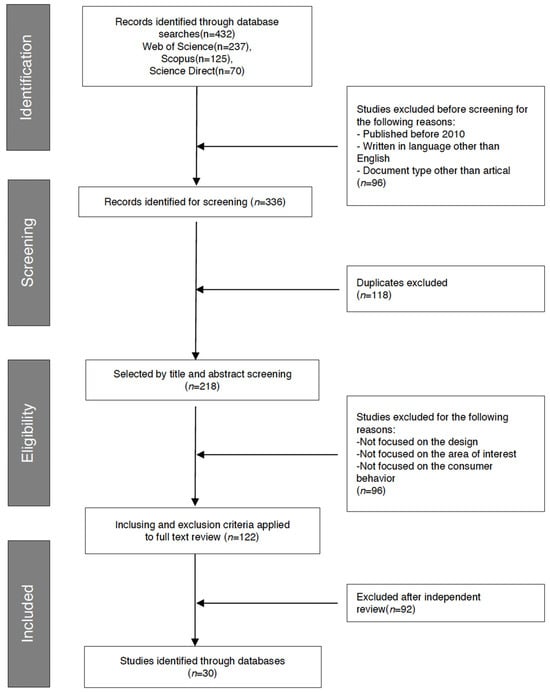
Figure 1.
PRISMA Flow Diagram.
3.2. Analysis Methods
This review utilized the analysis methods suggested by the Cochrane Handbook for Systematic Reviews of Interventions and psychometric tools for assessing communication styles (CSI-B/I) [25]. Papers were categorized and analyzed according to the PICO framework of Higgins et al. (2019) [26]. The PICO criteria in the selected papers were reviewed. Population (P) refers to participant characteristics such as sample size, age, gender, and condition; Intervention (I) refers to tested variables; Comparison (C) denotes conditions of comparison within each group of independent variables; and Outcome (O) refers to the results of consumer psychological measurement data, such as consumer behavior, psychological perception, and attention, obtained using eye-tracking technology. The 30 studies selected for this study are shown in Table 3.
Table 3.
Design discipline and type classification.
4. Results
4.1. Results of Analysis Using PICO Framework
4.1.1. Population
The participant sample sizes in the analyzed studies ranged from a minimum of 20 to a maximum of 255 individuals, as shown in Table 4. The subjects involved in the studies were aged between 18 and 65 years. Regarding gender, five studies did not specify the gender of the participants and were thus excluded from this analysis. Among those included, 37.8% of participants were identified as male, while 62.2% were identified as female.
Table 4.
Participants.
A sizable proportion of evaluators involved in the 30 studies were college students and faculty members, indicating that they had relatively high levels of education. All participants were normal-sighted. Some evaluators were local town residents and design students. Local urban residents have a deeper understanding of the local culture and environment, which enables them to provide feedback that is more relevant to the research objectives. Design students usually have a certain theoretical knowledge of aesthetics and design, which enables them to provide more professional and in-depth feedback. Other participants were recruited based on specific skills, such as those with experience in marketing activities, MBA programs, or extensive work experience.
4.1.2. Intervention and Comparators
The selected studies employed a range of interventions in visual communication and new media design, focusing specifically on visual stimuli and web-based interfaces. Interventions in visual communication design include elements such as product packaging, advertisement type, and layout configuration. For example, some studies have examined variations in product packaging by comparing label illustration styles, packaging materials, and layout features, such as the arrangement of logos and product images. These interventions aimed to uncover how specific visual features attract and sustain consumer attention. Comparators typically involve alternative designs highlighting key variations (e.g., additive-free vs. standard yogurt types and gender-specific vs. neutral advertisements), enabling a clearer assessment of consumer preferences and attention patterns relative to each design variation.
In new media design, interventions are centered on the interface layout, navigation, and page complexity. Studies have frequently assessed consumer reactions to different web page layouts (e.g., list vs. matrix display modes, simple vs. complex designs) and specific interface features, such as primary navigation novelty, to evaluate their effects on user engagement and cognitive load. Comparators in these cases involved alternative configurations that allowed for the direct observation of differences in user attention and engagement, particularly when navigating complex multimedia environments or interactive platforms. Stimuli for these comparisons typically included screenshots or interactive interfaces closely resembling real-world web layouts, providing ecological validity to the findings and supporting practical applications in digital marketing and user interface design. Table 5 summarizes the interventions and comparators used in the selected studies.
Table 5.
Intervention and Comparator.
4.1.3. Outcome
Table 6 illustrates the tools and measurement metrics used in the eye-tracking experiments. SMI and Tobii are the most widely used eye-tracking instruments for measuring the number of gazes and gaze duration. Because it is generally considered that gaze is a good indicator of attention, gaze and gaze duration are the basic units of visual information processing [56]. Gaze duration reflects the length of time spent processing information, which is important for understanding the information processing process. More advanced assessments of parameters, such as pupil shape, corneal boundaries, and pupil dilation, were also included in this analysis.
Table 6.
Outcome.
Understanding consumer behavior through visual attention has been an important focus of studies. In Ballco’s research [27], different types of yogurt were compared using eye-tracking technology metrics, such as gaze duration and gaze count. The study found that the likelihood that a product will be purchased increases with greater consumers’ visual attention to a product. Based on these data, the study further revealed a positive relationship between visual attention and consumer choice behavior. Boscolo [30] further explored the influence of gender on differences in visual attention and attitudes toward advertising. By setting the average total duration of gaze as an indicator, the study compared the responses of different genders to visual elements. The results showed that the production of gender-specific or gender-neutral advertising can affect the audience’s visual attention and emotional response, which can subsequently affect products and brands. Modi [1] compared and analyzed web design, search options, and page layout by fixing eye-tracking metrics, counts, and first focus times. The results show that the interface layout of e-commerce portals has a significant effect on customer decision-making behavior during online shopping. Sophie Lacoste-Badie [39] used eye-tracking technology to assess attention by measuring fixation duration, fixation counts, and eye movements to investigate the influence of front-of-pack (FOP) variations on consumer attention. The findings showed that FOP can attract the attention of respondents. Visual saliency is usually defined as the physical attributes of an object, such as color, shape, and movement, that catch respondents’ attention. This study provided a simple and cost-effective packaging design solution that uses eye tracking to eliminate cluttered information, attract the attention of consumers, and thus take a critical step toward the purchase decision [39]. Wu’s [53] research used the recording of fixed count and fixed time to study how the primary navigation (novel versus ordinary) of the apparel e-commerce influenced consumer attention, novelty perception, arousal, and approach behavior. The results showed that novel primary navigation leads to increased attention, novelty perception, arousal, and an increased willingness to approach the online store. Novelty perception and arousal serially mediated the effect of primary navigation on approach behavior. Atmospheric responsiveness plays a moderating role in the relationship between primary navigation and consumer approach behavior. The study provided online store owners with management insights into the design of major navigation and targeted optimization for webpage design [53].
García-Madariag et al. (2019) employed multimodal biosensors and multiple software tools combining eye tracking and electroencephalography (EEG) to measure attention. Declarative testing was utilized to assess preferences, and the findings suggested that implicit monitoring based on EEG and gaze data could predict the perception of package design colors [34].
Furthermore, ten studies supplemented their eye-tracking experiments with questionnaires and in-depth interviews, integrating eye-tracking data with subjective assessments. The dimensions measured included consumers’ preferences for multiple product types when choosing a product and the perceived importance of product attributes, such as price, flavor, brand, healthfulness, convenience, and ingredients. Examination of gender differences in visual attention and attitudes toward different types of advertisements revealed differences between men’s and women’s visual attention to images and their attitudes toward the loudness of the advertisements. Evaluating full-body versus partial-body graphic labels on plastic beverage bottles yielded the conclusion that consumers chose partial-body labels more frequently than full-body labels, regardless of the flavor of the beverage.
Overall, the reviewed investigations delved into consumers’ gaze behaviors, choice patterns, and design preferences, often with a focus on specific product variations. The insights garnered from such studies serve as valuable inputs for crafting designs that effectively capture the visual attention of consumers.
4.2. Application of Eye-Tracking System for Design Evaluation
In the application of eye-tracking technology in visual communication and new media design evaluation, two primary categories of eye-tracking systems were observed: screen-based and wearable eye trackers.
Table 7 presents a description of the two types of systems, including their strengths, limitations, and applications in the design evaluation in the selected studies.
Table 7.
Overview of Eye-tracking System for Design Evaluation.
Screen-based or wearable eye trackers are mostly used in label and package design studies, where they are instrumental in evaluating the intricate relationship between various labeling elements (e.g., organic and origin labels, pricing information, nutritional content) and package attributes (e.g., packaging materials, illustrations, and color schemes). In the field of advertising design, the primary focus is on evaluating the attention-grabbing elements of advertisements that resonate with consumers. Researchers in this domain explore disruptive elements within sustainable marketing practices and examine various aspects of advertising elements, including ad formats, celebrity endorsements, advertising logos, and slogans [30,43,47]. These studies offer insights into the elements that effectively attract consumer attention and contribute to the effectiveness of advertising campaigns.
Furthermore, eye-tracking studies examine the characteristics of websites and interfaces, exploring factors such as list versus matrix layouts, novelty versus familiarity, simplicity versus complexity, and consumers’ novelty perception, arousal, and proximity behaviors. These investigations shed light on the design features that significantly affect consumer attention, guiding the creation of more effective and engaging digital interfaces. Compared to traditional media, interface design is an interactive medium that relies heavily on the role of computers and focuses on customer experience.
Overall, eye-tracking technology plays an important role as an evaluation tool in the field of design research. It enables researchers to deeply analyze the association between design elements and consumers’ reflections, which in turn provides a more informed and effective basis for design strategy development.
4.3. Applications in the Design Domain
This literature review categorized the applications of eye-tracking technology into two design domains: visual communication design and new media design. By incorporating eye-tracking technology into design evaluation studies, one can proactively identify the elements that attract consumers’ attention and distinguish them from those that do not. These insights can enhance all aspects of design, including packaging design, advertising design, interface layout planning, and point-of-sale displays. To this end, this study delved into the utilization of eye-tracking technology in design and explored its innovative potential across diverse domains, including visual communication design and new media design.
Visual communication design mainly uses visual symbols to convey information, such as text, logos, and illustrations. Its subdivisions include packaging design, display design, advertising design, illustration design, and logo and font design. This integrated study reviewed the subdivisions of visual communication design, as shown in Table 8. In the field of visual communication design, the 30 papers in this study included 24 items in packaging design, advertising design, display, logo, and illustration design.
Table 8.
Application in Visual Communication Design and New Media Design.
Packaging design is a systematic endeavor, with labels playing an integral role in the process. Eye-tracking research in the realm of advertising encompasses a multifaceted exploration of celebrity endorsements, slogans, and advertising texts, among others. In the realm of display design research, Drexler and Souček (2016) evaluated the cognitive processing of Generation Y consumers by examining the effect of dessert shelf positioning through eye-tracking experiments [33]. Conversely, Gomes et al. (2014) probed the influence of mannequin heads in physical store windows on consumer shopping behavior [35].
In the field of visual communication design, eye-tracking technology plays a vital role in assessing the effects of various design elements on consumer behavior. Specifically, it is often used to verify the influence of various design elements on factors such as attention allocation, product perception, purchase intention, and choice.
The new media design studies employ eye-tracking technology to investigate the effect of design components of multimedia web services and interface design on consumers’ visual behaviors. The incorporation of eye-tracking technology facilitates an examination of how different webpage elements, including navigation, visual complexity, and product listing page design, influence customer attention and reactions to products and advertisements while browsing websites. In evaluating the interface design components, analyzing the customer’s eye movements using eye-tracking technology can help identify design flaws that increase the objectivity of these evaluations. Table 8 illustrates the application of eye-tracking technology in new media design.
5. Discussion
5.1. Implications
Eye tracking is a well-established research tool for better understanding the eye movements and gaze of individual participants and sample populations [57]. A well-designed experiment yields coherent data, enables statistical analysis, and makes it possible to draw conclusions that are relevant to the examined context [56]. Eye-tracking technology can obtain a more objective evaluation of design elements than traditional questionnaires and interviews. In addition, eye tracking can capture the user’s gaze point and eye movement trajectory in real-time, which is particularly important for real-time user testing. This proves the versatility, real-time nature, and effectiveness of eye-tracking instruments in a wide range of design fields.
However, different eye trackers are tailored to specific research objectives. Screen-based eye trackers, frequently used in controlled laboratory settings, offer high precision and are ideal for testing multiple experimental stimuli in stable environments. In contrast, wearable eye trackers, such as Tobii glasses, more closely approximate natural behavior, allowing for the assessment of dynamic stimuli and participant movement, which is essential for real-world applications in physical environments. The naturalistic assessment provided by wearable systems adds ecological validity, making these findings more applicable to real-life design scenarios. Researchers need to carefully consider these distinctions when selecting the most appropriate eye-tracking system for their study objectives.
In design evaluations, screen-based eye trackers are often favored for visual communication and new media design because they can be easily utilized in controlled laboratory conditions. These conditions enable researchers to focus on specific eye movement measures, such as gaze direction and gaze point, which have been the primary variables in many studies. This level of precision is particularly useful in assessing user interactions with digital and physical interfaces, helping to optimize design elements for an enhanced customer experience.
Advanced eye-tracking technology offers additional metrics, including pupil diameter and dilation, eye position and identification, and saccades, which are often overlooked. For example, studies by Mikhailenko et al. (2022) and Kim and Lee (2021) highlighted the potential of pupil diameter as an indicator of emotional recognition, with observable correlations between emotional states and changes in pupil size. Despite this potential, few studies have actively incorporated pupil dilation data into their analysis, suggesting that focusing on this underexplored area could deepen our understanding of emotional responses and cognitive processing in design research [14,18].
This emphasis on gaze and fixation measures, while valuable, can provide only limited insights into eye-tracking technology in design evaluation. Broadening the metrics used in eye-tracking research by including saccades, pupil dilation, and blink rates could provide a more comprehensive understanding of both cognitive load and emotional engagement with design elements. Expanding the use of pupil-related metrics, saccades, and blinks alongside traditional measures could enhance our understanding of how consumers emotionally engage with design elements, providing a more holistic view of their interactions with visual stimuli. Therefore, future studies could benefit from integrating more diverse eye-tracking metrics to capture nuanced emotional and cognitive responses, contributing richer multidimensional insights into design research.
Furthermore, this study contributes to the theoretical understanding of design evaluation by positioning eye tracking as a critical tool for bridging the gap between cognition and the visual design effect. These insights can help refine existing models of consumer behavior and decision-making in response to visual stimuli, leading to the development of more accurate predictive models in both academic and applied research settings.
For practitioners, including designers, marketers, and user experience (UX) professionals, this study provides actionable insights into the application of eye-tracking technology in design evaluation. Eye-tracking data can inform the design process directly by identifying which elements capture user attention and which are overlooked, enabling the optimization of product packaging, advertising layouts, and user interfaces for better engagement. This technology allows practitioners to make evidence-based decisions that enhance user experience, drive consumer behavior, and increase brand impact.
5.2. Limitations and Suggestions for Future Research
This review identified several limitations and areas of improvement in the selected studies. First, the predominant reliance on university students and staff as samples limits the generalizability of the findings. Future research should expand participant diversity by including various age groups and occupational backgrounds to ensure broader applicability. Second, as technology and methodologies evolve rapidly, studies based on data from a specific period may not fully reflect current advancements. Longitudinal research that tracks trends and incorporates technological developments is essential for maintaining relevance. Moreover, excluding conference papers that often present innovative findings may result in biased conclusions. Future reviews should integrate conference papers to enhance their comprehensiveness and relevance.
A significant limitation is the inconsistency in the metrics used across studies, which affects the comparability of the findings. For example, key indicators such as pupil dilation, which is crucial for understanding cognitive and emotional effects, were often omitted. Future research should adopt standardized and diverse indicators to enable a holistic assessment of design impacts. Furthermore, the reviewed studies primarily relied on screen-based eye-tracking devices, with limited adoption of wearable devices and VR-based technologies. Wearable and VR eye-tracking tools offer significant advantages, such as capturing gaze behavior in naturalistic or immersive settings and enabling a more accurate analysis of attention, navigation patterns, and emotional responses [58]. This capability is particularly relevant for evaluating user experience in dynamic or virtual environments. Future studies should prioritize these technologies to enhance their ecological validity and deepen insights into user interactions.
The integration of multimodal biometric methods holds promise for advancing design research. Combining eye tracking with tools such as EEG, fNIRS, HRV, EMG, and ECG can provide richer insights into neurocognitive and emotional processes. This multidisciplinary approach enables a deeper understanding of how design elements influence behavior, perceptions, and emotions, thus supporting the development of sustainable user-centered designs. By analyzing emotional and physiological responses, researchers can bridge the gap between aesthetics, usability, and user satisfaction [59].
Lastly, the scope of this review focused on visual communication and new media design, yet eye-tracking applications extend to other domains, such as spatial and product design. Future studies should explore these areas to broaden the impact of eye-tracking research and uncover its potential in multidisciplinary contexts. Emerging technologies, including remote and online eye tracking, also warrant attention for their ability to expand research accessibility and flexibility, particularly in diverse real-world settings. In addition, wearable devices designed to track the eye movements of mobile observers have enabled the study of gaze behavior in more realistic naturalistic settings [60].
This review underscores the importance of integrating subjective methods, such as interviews and questionnaires, with objective eye-tracking data. This combined approach offers a robust framework for studying decision-making processes, many of which occur subconsciously while accounting for demographic and cultural diversity. Future research that builds on these recommendations can provide more comprehensive insights into the relationship between design and human behavior, advancing both theoretical understanding and practical applications.
6. Conclusions
In the field of behavioral sciences, understanding how visual design and media interaction influence consumer engagement is essential for companies aiming to expand their market reach. Research has increasingly focused on how consumers respond to visual and media elements with the aim of enhancing recognition and support through strategic design [61]. Eye-tracking technology has become a powerful tool in this field, offering precise insights into eye movements and gaze patterns across both individual and group samples. Well-constructed eye-tracking studies yield robust data, enable in-depth statistical analysis, and provide contextually rich insights that deepen our understanding of consumer behavior in real-world settings [56].
This review systematically explored the evolving role of eye-tracking technology in design assessment, with a particular focus on its growing relevance in visual communication and new media research over the past decade. While current applications have predominantly focused on identifying design elements that capture visual attention, this narrow emphasis on surface-level metrics limits our ability to understand the broader implications of design. To fully leverage the potential of eye-tracking technology, its application should be expanded beyond optimizing visual engagement to include multiple stages of the design process, such as conceptualization, prototyping, and comprehensive evaluation. This broader application can reveal how design decisions shape customer experiences in more intricate and meaningful ways, particularly in fostering sustainable and customer-centered behaviors.
Expanding design evaluation methods to incorporate a broader range of biometric measures will enhance the precision of design research and contribute to a deeper understanding of consumer-oriented behavioral experiences. By broadening the tools and methodologies used in design evaluation, we can better meet diverse customer needs and support more informed decision-making processes. By adopting such advanced methodologies, future research could transform the evaluation of visual and media designs, highlighting the critical role of evidence-based practices in creating engaging, sustainable, and customer-centric environments.
Author Contributions
Conceptualization, R.G. and N.K.; methodology, R.G. and N.K.; software, R.G.; validation, N.K. and J.L.; formal analysis, R.G.; investigation, R.G., N.K. and J.L.; resources, R.G. and N.K.; data curation, R.G. and N.K.; writing—original draft preparation, R.G.; writing—review and editing, N.K. and J.L.; visualization, R.G.; supervision, N.K.; project administration, N.K.; funding acquisition, N.K. All authors have read and agreed to the published version of the manuscript.
Funding
This work was supported by the Research Fund, 2024 of the Catholic University of Korea and by the Basic Science Research Program through the National Research Foundation of Korea (NRF) funded by the Ministry of Education (NRF-2020R1I1A1A01073447).
Institutional Review Board Statement
Not applicable.
Informed Consent Statement
Not applicable.
Data Availability Statement
Available upon request.
Conflicts of Interest
The authors declare no conflicts of interest. The funders had no role in the design of the study, in the collection, analyses, or interpretation of data, in the writing of the manuscript, or in the decision to publish the results.
References
- Modi, N.; Singh, J. Understanding online consumer behavior at e-commerce portals using eye-gaze tracking. Int. J. Hum. Comput. Interact. 2023, 39, 721–742. [Google Scholar] [CrossRef]
- Hadiantini, R.; Hendrayati, H. The Importance of Consumer Satisfaction for E-Commerce Users: How That Affects Consumer Behavior on Consumer Satisfaction? In Proceedings of the First International Conference on Science, Technology, Engineering and Industrial Revolution 2021, (ICSTEIR 2020), Bandung, Indonesia, 14–15 November 2020; pp. 96–104. [Google Scholar]
- Saura, J.R.; Palos-Sanchez, P.; Rodríguez Herráez, B. Digital marketing for sustainable growth: Business models and online campaigns using sustainable strategies. Sustainability 2020, 12, 1003. [Google Scholar] [CrossRef]
- Bergstrom, J.R.; Schall, A.J. Eye Tracking in Customer Experience Design; Elsevier: Waltham, MA, USA, 2014; pp. 3–6. [Google Scholar]
- Kararia, S. Sustainable Packaging: A Consumer’s Perspective. Master’s Thesis, Jyvaskyla University, Jyvaskyla, Finland, 2023. [Google Scholar]
- Shi, R.; Wang, M.; Qiao, T.; Shang, J. The Effects of Live Streamer’s Facial Attractiveness and Product Type on Consumer Purchase Intention: An Exploratory Study with Eye Tracking Technology. Behav. Sci. 2024, 14, 375. [Google Scholar] [CrossRef] [PubMed]
- Just, M.A.; Carpenter, P.A. Eye fixations and cognitive processes. Cogn. Psychol. 1976, 8, 441–480. [Google Scholar] [CrossRef]
- Greenwald, A.G.; Leavitt, C. Audience involvement in advertising: Four levels. J. Consum. Res. 1984, 11, 581–592. [Google Scholar] [CrossRef]
- Van Loo, E.J.; Caputo, V.; Nayga, R.M., Jr.; Seo, H.S.; Zhang, B.; Verbeke, W. Sustainability labels on coffee: Consumer preferences, willingness-to-pay and visual attention to attributes. Ecol. Econ. 2015, 118, 215–225. [Google Scholar] [CrossRef]
- Joseph, A.W.; Murugesh, R. Potential eye tracking metrics and indicators to measure cognitive load in human-computer interaction research. J. Sci. Res. 2020, 64, 168–175. [Google Scholar] [CrossRef]
- Rayner, K. Visual attention in reading: Eye movements reflect cognitive processes. Mem. Cogn. 1977, 5, 443–448. [Google Scholar] [CrossRef] [PubMed]
- Rappa, N.A.; Ledger, S.; Teo, T.; Wai Wong, K.; Power, B.; Hilliard, B. The use of eye tracking technology to explore learning and performance within virtual reality and mixed reality settings: A scoping review. Interact. Learn. Environ. 2022, 30, 1338–1350. [Google Scholar] [CrossRef]
- Jonikaitis, D.; Szinte, M.; Rolfs, M.; Cavanagh, P. Allocation of attention across saccades. J. Neurophysiol. 2013, 109, 1425–1434. [Google Scholar] [CrossRef] [PubMed]
- Kim, N.; Lee, H. Assessing consumer attention and arousal using eye-tracking technology in virtual retail environment. Front. Psychol. 2021, 12, 665658. [Google Scholar] [CrossRef]
- Stern, J.A.; Boyer, D.; Schroeder, D. Blink rate: A possible measure of fatigue. Hum. Factors 1994, 36, 285–297. [Google Scholar] [CrossRef] [PubMed]
- Skaramagkas, V.; Giannakakis, G.; Ktistakis, E.; Manousos, D.; Karatzanis, I.; Tachos, N.S.; Tsiknakis, M. Review of eye tracking metrics involved in emotional and cognitive processes. IEEE Rev. Biomed. Eng. 2021, 16, 260–277. [Google Scholar] [CrossRef]
- Chiu, T.P.; Yang, D.J.; Ma, M.Y. The Intertwining Effect of Visual Perception of the Reusable Packaging and Type of Logo Simplification on Consumers’ Sustainable Awareness. Sustainability 2023, 15, 13115. [Google Scholar] [CrossRef]
- Mikhailenko, M.; Maksimenko, N.; Kurushkin, M. Eye-tracking in immersive virtual reality for education: A review of the current progress and applications. Front. Educ. 2022, 7, 697032. [Google Scholar] [CrossRef]
- Jacob, R.J.; Karn, K.S. Eye tracking in human-computer interaction and usability research: Ready to deliver the promises. In The Mind’s Eye; Elsevier: Amsterdam, The Netherlands, 2003; pp. 573–605. [Google Scholar]
- Kang, Y.; Kim, E.J. Differences of restorative effects while viewing urban landscapes and green landscapes. Sustainability 2019, 11, 2129. [Google Scholar] [CrossRef]
- Carter, B.T.; Luke, S.G. Best practices in eye tracking research. Int. J. Psychophysiol. 2020, 155, 49–62. [Google Scholar] [CrossRef]
- McNamara, A.; Jain, E. Eye tracking and virtual reality. In Proceedings of the SIGGRAPH Asia 2019 Courses, Brisbane, Australia, 17–20 November 2019; pp. 1–33. [Google Scholar]
- Zhang, Y.; Liu, H.; Kang, S.C.; Al-Hussein, M. Virtual reality applications for the built environment: Research trends and opportunities. Autom. Constr. 2020, 118, 103311. [Google Scholar] [CrossRef]
- Yi, D.B. Introduction to Design; People’s Fine Arts Publishing House: Beijing, China, 2021; pp. 157–171. [Google Scholar]
- Diotaiuti, P.; Valente, G.; Mancone, S.; Grambone, A. Psychometric properties and a preliminary validation study of the Italian brief version of the communication styles inventory (CSI-B/I). Front. Psychol. 2020, 11, 1421. [Google Scholar] [CrossRef] [PubMed]
- Higgins, J.P.T.; Thomas, J.; Chandler, J.; Cumpston, M.; Li, T.; Page, M.J.; Welch, V.A. (Eds.) Cochrane Handbook for Systematic Reviews of Interventions, 2nd ed.; John Wiley & Sons: Hoboken, NJ, USA, 2019. [Google Scholar] [CrossRef]
- Ballco, P.; De Magistris, T.; Caputo, V. Consumer preferences for nutritional claims: An exploration of attention and choice based on an eye-tracking choice experiment. Food Res. Int. 2019, 116, 37–48. [Google Scholar] [CrossRef]
- Barbierato, E.; Berti, D.; Ranfagni, S.; Hernández-Álvarez, L.; Bernetti, I. Wine label design proposals: An eye-tracking study to analyze consumers’ visual attention and preferences. Int. J. Wine Bus. Res. 2023, 35, 365–389. [Google Scholar] [CrossRef]
- Barbosa, A.A.L.; De Moura, J.A.; De Medeiros, D.D. Positioning of design elements on the packaging of frozen convenience food and consumers’ levels of attention: An experiment using pizza boxes. Food Qual. Prefer. 2021, 87, 104044. [Google Scholar] [CrossRef]
- Boscolo, J.C.; Oliveira, J.H.C.; Maheshwari, V.; Giraldi, J.D.M.E. Gender differences: Visual attention and attitude toward advertisements. Mark. Intell. Plan. 2021, 39, 300–314. [Google Scholar] [CrossRef]
- Centurión, M.; Machín, L.; Ares, G. Relative impact of nutritional warnings and other label features on cereal bar healthfulness evaluations. J. Nutr. Educ. Behav. 2019, 51, 850–856. [Google Scholar] [CrossRef]
- De Keyzer, F.; Dens, N.; De Pelsmacker, P. The processing of native advertising compared to banner advertising: An eye-tracking experiment. Electron. Commer. Res. 2021, 23, 1–20. [Google Scholar] [CrossRef]
- Drexler, D.; Souček, M. The influence of sweet positioning on shelves on consumer perception. Food Packag. Shelf Life 2016, 10, 34–45. [Google Scholar] [CrossRef]
- García-Madariaga, J.; López, M.F.B.; Burgos, I.M.; Virto, N.R. Do isolated packaging variables influence consumers’ attention and preferences. Physiol. Behav. 2019, 200, 96–103. [Google Scholar] [CrossRef] [PubMed]
- Gomes, T.; Hurley, R.A.; Duchowski, A.; Darby, D.; Ouzts, A. The effect of full body versus partial body graphic labelling on beverage packaging. Packag. Technol. Sci. 2014, 27, 933–943. [Google Scholar] [CrossRef]
- Hazuchová, N.; Nagyová, Ľ.; Stávková, J.; Chytil, O.; Košičiarová, I. Attention analysis of honey jar labels using eye-tracking techniques. Potravinarstvo 2018, 12, 815. [Google Scholar] [CrossRef]
- Im, H.; Ju, H.W.; Johnson, K.K. Beyond visual clutter: The interplay among products, advertisements, and the overall webpage. J. Res. Interact. Mark. 2021, 15, 804–821. [Google Scholar] [CrossRef]
- Katz, M.; Campbell, B.; Liu, Y. Local and organic preference: Logo versus text. J. Agric. Appl. Econ. 2019, 51, 328–347. [Google Scholar] [CrossRef]
- Lacoste-Badie, S.; Yu, J.; Droulers, O. Small change, big change–Increasing attention with product package variations. Food Qual. Prefer. 2020, 86, 104007. [Google Scholar] [CrossRef]
- Lindström, A.; Berg, H.; Nordfält, J.; Roggeveen, A.L.; Grewal, D. Does the presence of a mannequin head change shopping behavior? J. Bus. Res. 2016, 69, 517–524. [Google Scholar] [CrossRef]
- Liu, C.W.; Lo, S.K.; Hsieh, A.Y.; Hwang, Y. Effects of banner Ad shape and the schema creating process on consumer internet browsing behavior. Comput. Hum. Behav. 2018, 86, 9–17. [Google Scholar] [CrossRef]
- Liu, S.; Gui, D.Y.; Zuo, Y.; Dai, Y. Good slang or bad slang? Embedding internet slang in persuasive advertising. Front. Psychol. 2019, 10, 1251. [Google Scholar] [CrossRef] [PubMed]
- Lourenção, M.; Giraldi, J.D.M.E.; de Oliveira, J.H.C. Destination advertisement semiotic signs: Analysing tourists’ visual attention and perceived ad effectiveness. Ann. Tour. Res. 2020, 84, 103001. [Google Scholar] [CrossRef]
- Merdian, P.; Piroth, P.; Rueger-Muck, E.; Raab, G. Looking behind eye-catching design: An eye-tracking study on wine bottle design preference. Int. J. Wine Bus. Res. 2021, 33, 134–151. [Google Scholar] [CrossRef]
- Meyerding, S.G.; Merz, N. Consumer preferences for organic labels in Germany using the example of apples–Combining choice-based conjoint analysis and eye-tracking measurements. J. Clean. Prod. 2018, 181, 772–783. [Google Scholar] [CrossRef]
- Nemergut, J.; Mokrý, S. Influence of packaging attributes on perception of juice: Eye-tracking study. Potravinárstvo 2020, 14, 371–378. [Google Scholar] [CrossRef]
- Pelau, C.; Nistoreanu, P.; Lazar, L.; Badescu, R. Celebrity vs. Product: A Neuroscientific Approach to the Distractors in Food Advertising for Sustainable Marketing. Sustainability 2022, 14, 12768. [Google Scholar] [CrossRef]
- Peschel, A.O.; Orquin, J.L.; Loose, S.M. Increasing consumers’ attention capture and food choice through bottom-up effects. Appetite 2019, 132, 1–7. [Google Scholar] [CrossRef]
- Schmutz, P.; Roth, S.P.; Seckler, M.; Opwis, K. Designing product listing pages—Effects on sales and users’ cognitive workload. Int. J. Hum. Comput. Stud. 2010, 68, 423–431. [Google Scholar] [CrossRef]
- Vu, T.M.H.; Tu, V.P.; Duerrschmid, K. Design factors influence consumers’ gazing behaviour and decision time in an eye-tracking test: A study on food images. Food Qual. Prefer. 2016, 47, 130–138. [Google Scholar] [CrossRef]
- Wang, Q.; Xu, Z.; Cui, X.; Wang, L.; Ouyang, C. Does a big Duchenne smile really matter on e-commerce websites? An eye-tracking study in China. Electron. Commer. Res. 2017, 17, 609–626. [Google Scholar] [CrossRef]
- Wook, C.S.; Chang, L.K. Exploring the effect of the human brand on consumers’ decision quality in online shopping: An eye-tracking approach. Online Inf. Rev. 2013, 37, 83–100. [Google Scholar] [CrossRef]
- Wu, R.; Li, Y.; Hu, Y. Navigating in online stores: The effect of the primary navigation on consumers’ response—A study based on the apparel e-retailer. Electron. Commer. Res. Appl. 2022, 53, 101134. [Google Scholar] [CrossRef]
- Xiao, L.; Wang, S. Mobile marketing interface layout attributes that affect user aesthetic preference: An eye-tracking study. Asia Pac. J. Mark. Logist. 2023, 35, 472–492. [Google Scholar] [CrossRef]
- Yu, J.; Droulers, O.; Lacoste-Badie, S. Why display motion on packaging? The effect of implied motion on consumer behavior. J. Retail. Consum. Serv. 2022, 64, 102840. [Google Scholar] [CrossRef]
- Holmqvist, K.; Nyström, M.; Andersson, R.; Dewhurst, R.; Jarodzka, H.; Van de Weijer, J. Eye Tracking: A Comprehensive Guide to Methods and Measures; Oxford University: New York, NY, USA, 2011. [Google Scholar]
- Aalto, P.; Steinert, M. Emergence of eye-tracking in architectural research: A review of studies 1976–2021. Archit. Sci. Rev. 2024, 1, 1–11. [Google Scholar] [CrossRef]
- Lemon, K.N.; Verhoef, P.C. Understanding customer experience throughout the customer journey. J. Mark. 2016, 80, 69–96. [Google Scholar] [CrossRef]
- Kim, J.; Kim, N. Quantifying emotions in architectural environments using biometrics. Appl. Sci. 2022, 12, 9998. [Google Scholar] [CrossRef]
- Franchak, J.M.; Yu, C. Beyond screen time: Using head-mounted eye tracking to study natural behavior. Adv. Child Dev. Behav. 2022, 62, 61–91. [Google Scholar]
- Li, H.; Xu, J.; Fang, M.; Tang, L.; Pan, Y. A study and analysis of the relationship between visual—Auditory logos and consumer behavior. Behav. Sci. 2023, 13, 613. [Google Scholar] [CrossRef]
Disclaimer/Publisher’s Note: The statements, opinions and data contained in all publications are solely those of the individual author(s) and contributor(s) and not of MDPI and/or the editor(s). MDPI and/or the editor(s) disclaim responsibility for any injury to people or property resulting from any ideas, methods, instructions or products referred to in the content. |
© 2024 by the authors. Licensee MDPI, Basel, Switzerland. This article is an open access article distributed under the terms and conditions of the Creative Commons Attribution (CC BY) license (https://creativecommons.org/licenses/by/4.0/).