
Thermal and Fluid Evolution of Paleozoic Rocks in the Sakmara Zone and Eastern Pre-Caspian Basin, Western Kazakhstan

 , and
, and
Abstract
1. Introduction
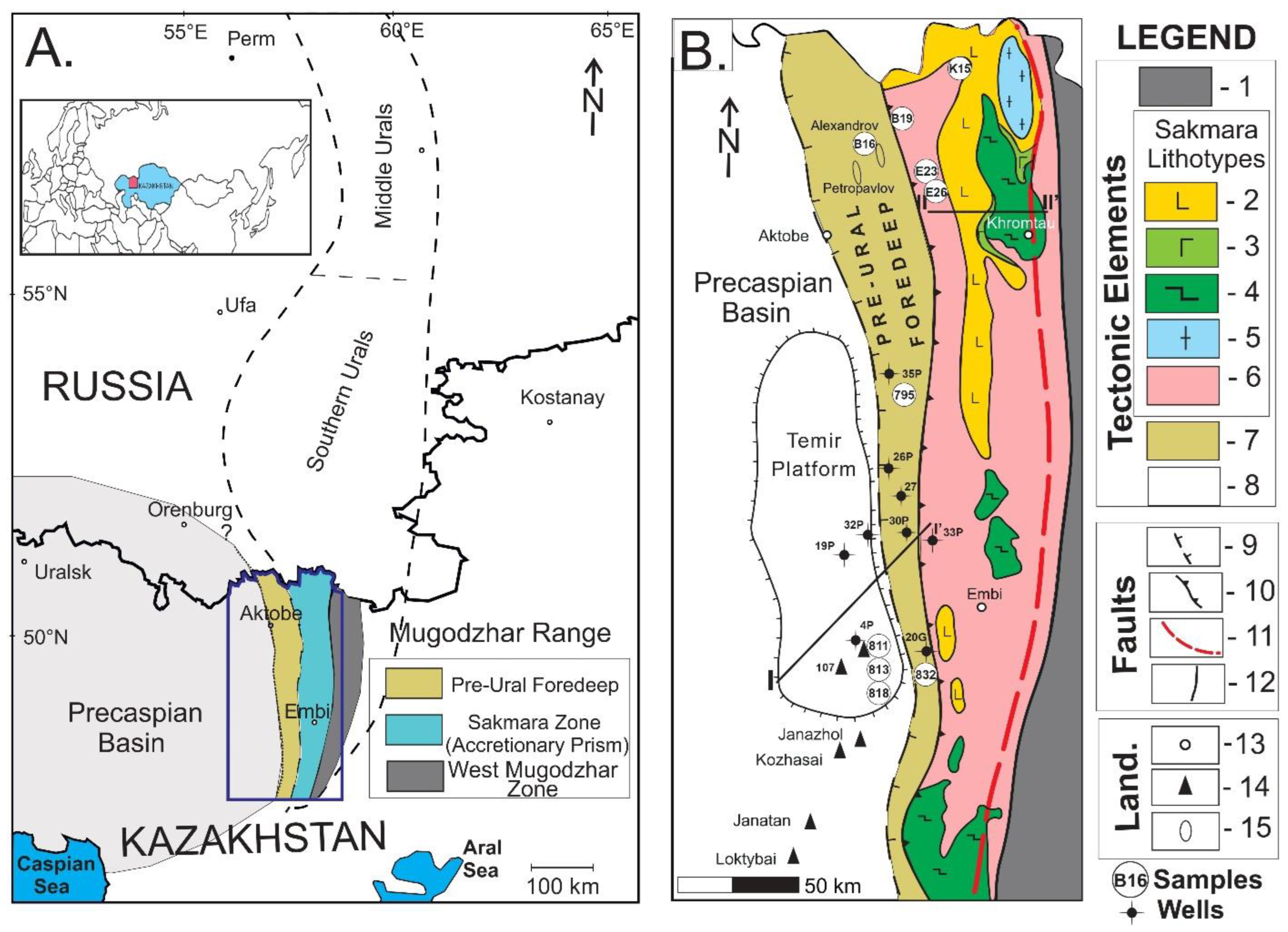
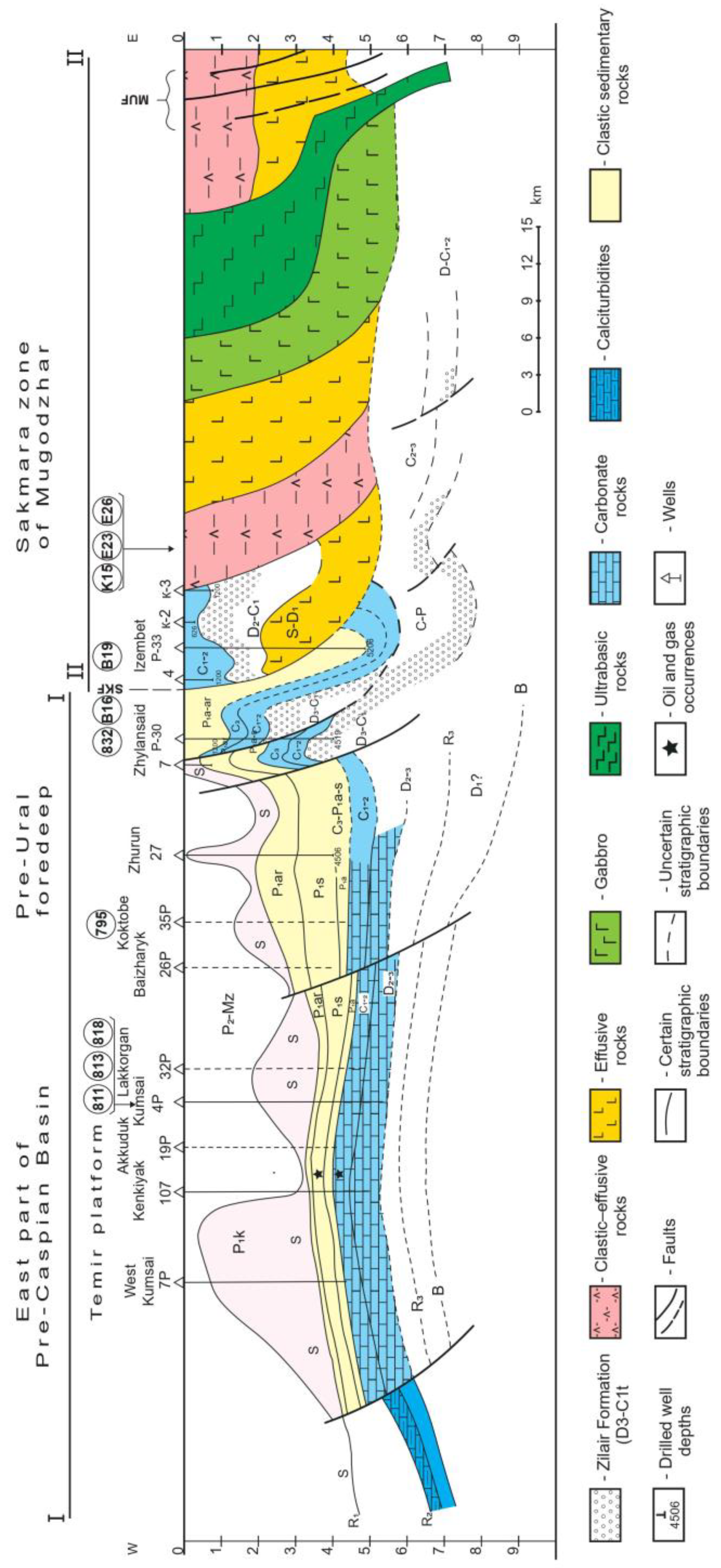
2. Geological Setting
2.1. Tectonic Evolution


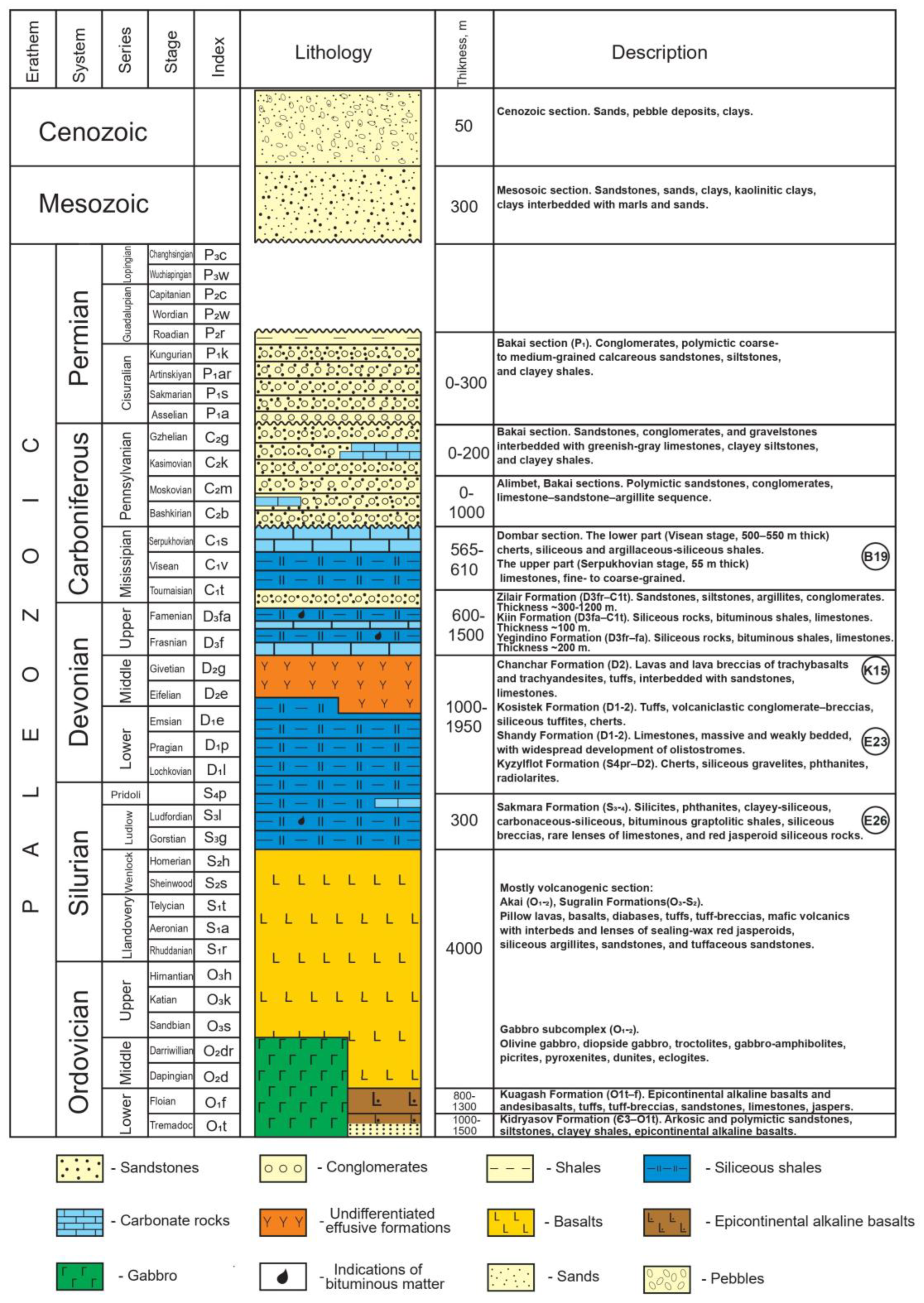
2.2. Stratigraphy and Petroleum System Context
2.3. Geodynamic Controls on Thermal Regime and Fluid Circulation
3. Materials and Methods
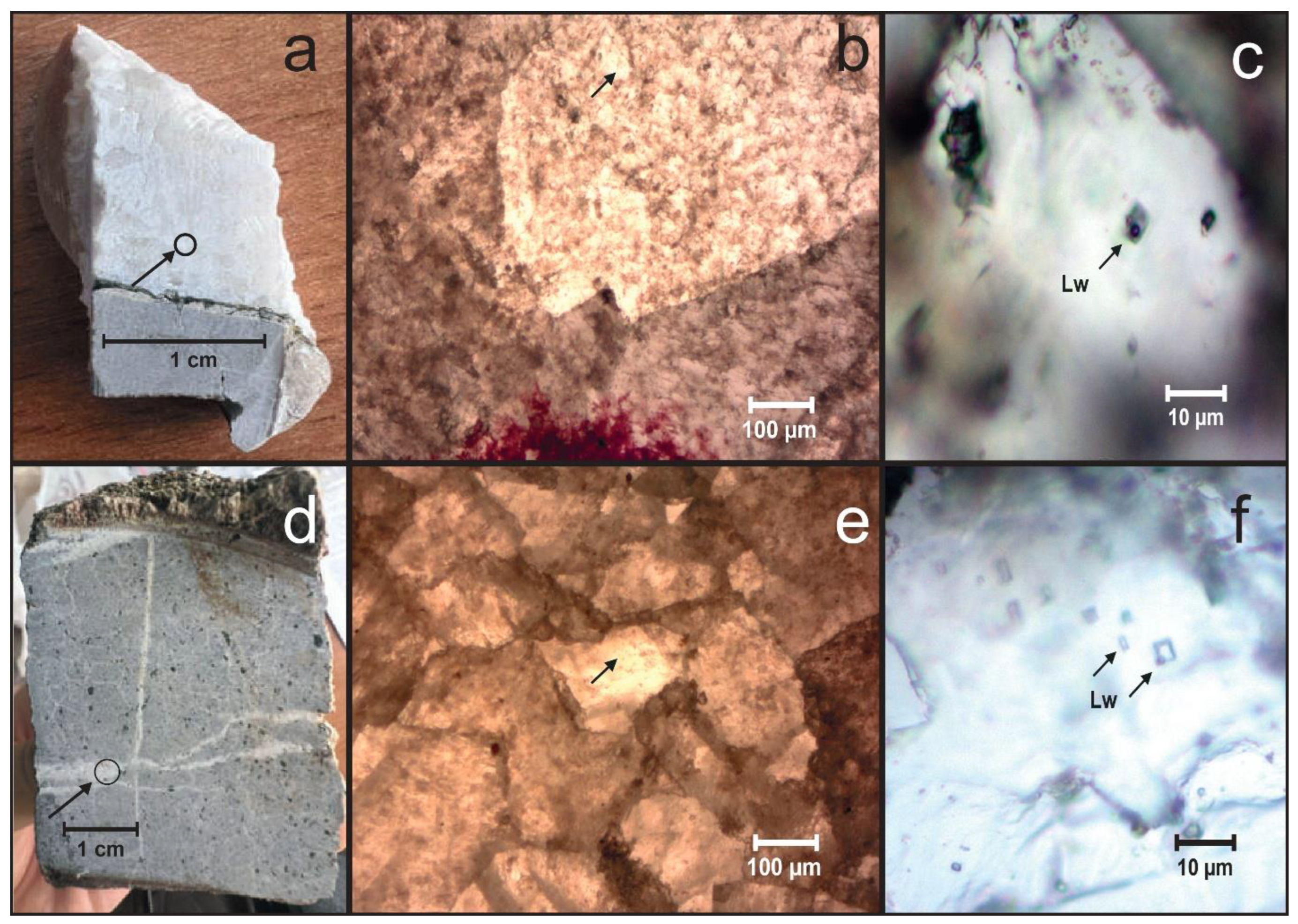
3.1. Sampling and Petrography
3.2. Fluid Inclusion Microthermometry
3.3. Salinity and Isochore Calculations
3.4. Analytical Procedure and Data Quality

| No. | Location Age | Sample No. | Population | Th (°C) | Depth 2 (km) | Tm (°C) | Salinity 3 (wt.% eq) | |||
|---|---|---|---|---|---|---|---|---|---|---|
| min/ max | Mean (n) | Mean | min/ max | Mean (n) | NaCl | CaCl2 | ||||
| 1 | Kumsai C2b | 818 | 1 | 52.3/61.5 | 56.9 (2) | 1.2 | −32.8/−10 | −21.4 (2) | 24.0 | |
| 2 | 102/111 | 107.6 (3) | 2.9 | −38/−7 | −22.5 (2) | 24.4 | ||||
| 2 | Kumsai D2g–D3fr | 813 | 1 | 68 | 68 (1) | 1.6 | - | - | ||
| 2 | 85/146 | 113 (1) | 3.1 | −23/−6 | −14.24 (9) | 18 | 19.8 | |||
| 3 | 164 | 164 (1) | 4.8 | - | - | |||||
| 4 | 185 | 185 (1) | 5.5 | −2 | −2 (1) | 3.4 | 3.8 | |||
| 3 | Kumsai D2–D3 | 811 | 1 | 56.5/78 | 66.08 (13) | 1.5 | −20/−4 | −13 (13) | 16.9 | 18.8 |
| 2 | 98.5/146 | 115 (9) | 3.2 | −8/−4 | −5.57 (7) | 8.6 | 9.9 | |||
| 3 | 155/165 | 160 (2) | 4.7 | −2 | −2 (1) | 3.4 | 3.8 | |||
| 4 | 190 | 190 (1) | 5.7 | −10 | −10 (1) | 13.9 | 15.8 | |||
| 4 | Alexandrov Fold P1 | B16 | 2 | 87/106 | 98 (4) | 2.5 | −0.7/−0.4 | −0.5 (4) | 0.9 | 0.8 |
| 4 | 180/238 | 220 (9) | 6.7 | −3.5/−0.7 | −1.38 (9) | 2.4 | 2.6 | |||
| 5 | Koktobe P1s | 795 | 1 | 74 | 74 (1) | 1.8 | −6 | −6 (1) | ||
| 2 | 92.5 | 92.5 (1) | 2.4 | - | - | |||||
| 6 | Karnak P1as | 832 | 2 | 92.5 | 92.5 (1) | 2.4 | 0 | 0 (1) | 0 | 0 |
| 7 | Dombar area C1v-s | B19 | 2 | 97/139 | 100 (17) | 2.5 | −7.7/−3 | −5.6 (18) | 8.7 | 10.0 |
| 8 | Shandy Fm D1–2 | E23 | 3 | 153/166 | 159 (6) | 4.6 | −4/−2 | −3.08 (6) | 5.1 | 5.8 |
| 9 | Sakmara Fm S3–4 | E26 | 1 | 54/70 | 62 (6) | 1.3 | −4.3/−0.2 | −1.7 (6) | 2.9 | 3.2 |
| 2 | 91/130 | 104 (12) | 2.7 | −5.3/−4.7 | −4.8 (10) | 7.6 | 8.7 | |||
| 4 | 183/219 | 204 (12) | 6.2 | −4.3/−0.6 | −1.04 (13) | 1.8 | 1.9 | |||
| 10 | Chanchar Fm D2 | K15 | 2 | 116/133 | 125 (8) | 3.5 | −3.3/−1.1 | −2.2 (8) | 3.7 | 4.1 |
| 3 | 157/168 | 162 (5) | 5.2 | −3.3/−0.9 | −2.1 (5) | 3.6 | 4.0 | |||
| 4 | 188/229 | 211 (5) | 7.0 | −4/−1.2 | −2.4 (5) | 4. | 4.5 | |||
| 5 | 268/284 | 277 (7) | 8.8 | −4/−1.1 | −2.8 (7) | 4.7 | 5.3 | |||


4. Results
4.1. Fluid Inclusion Types
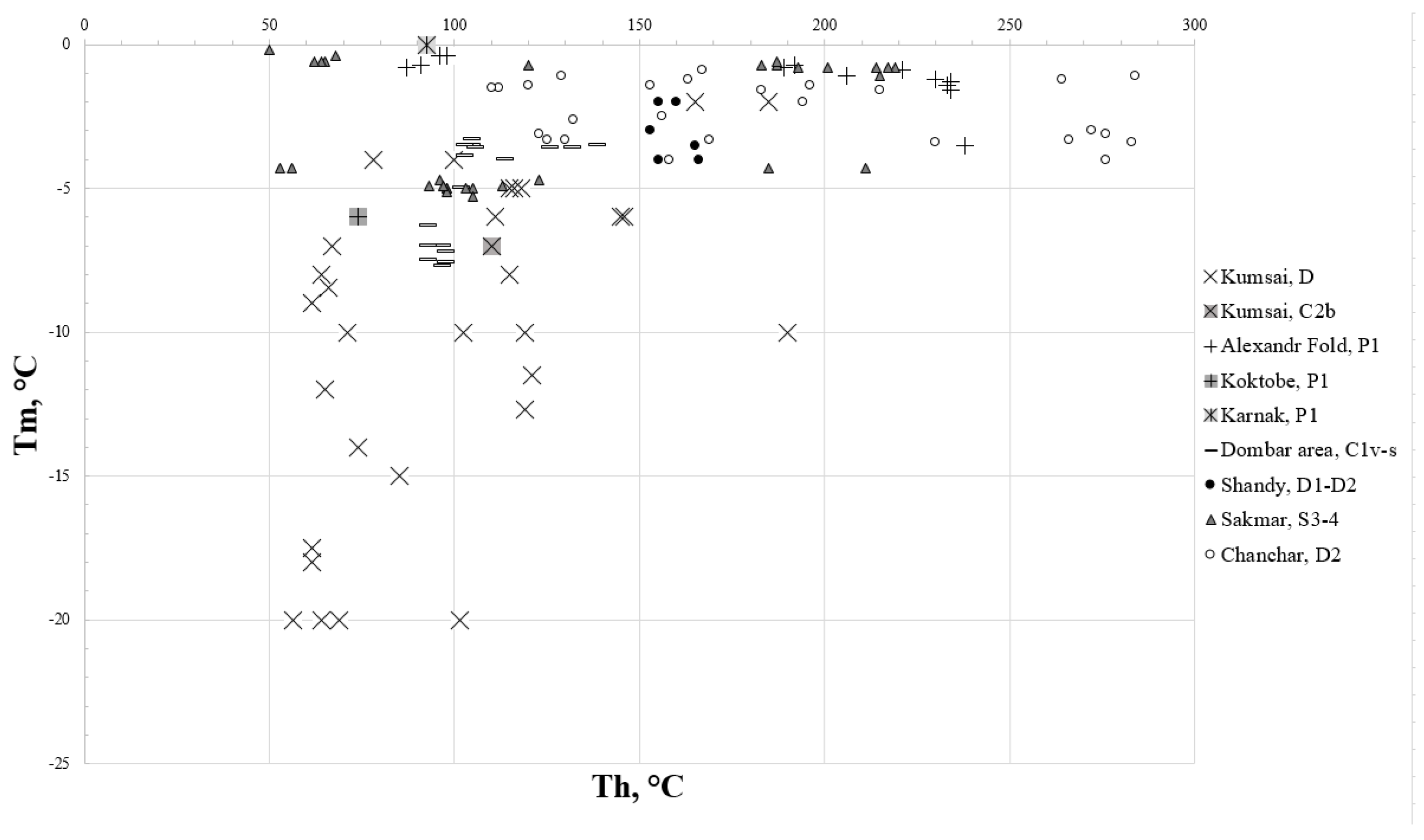
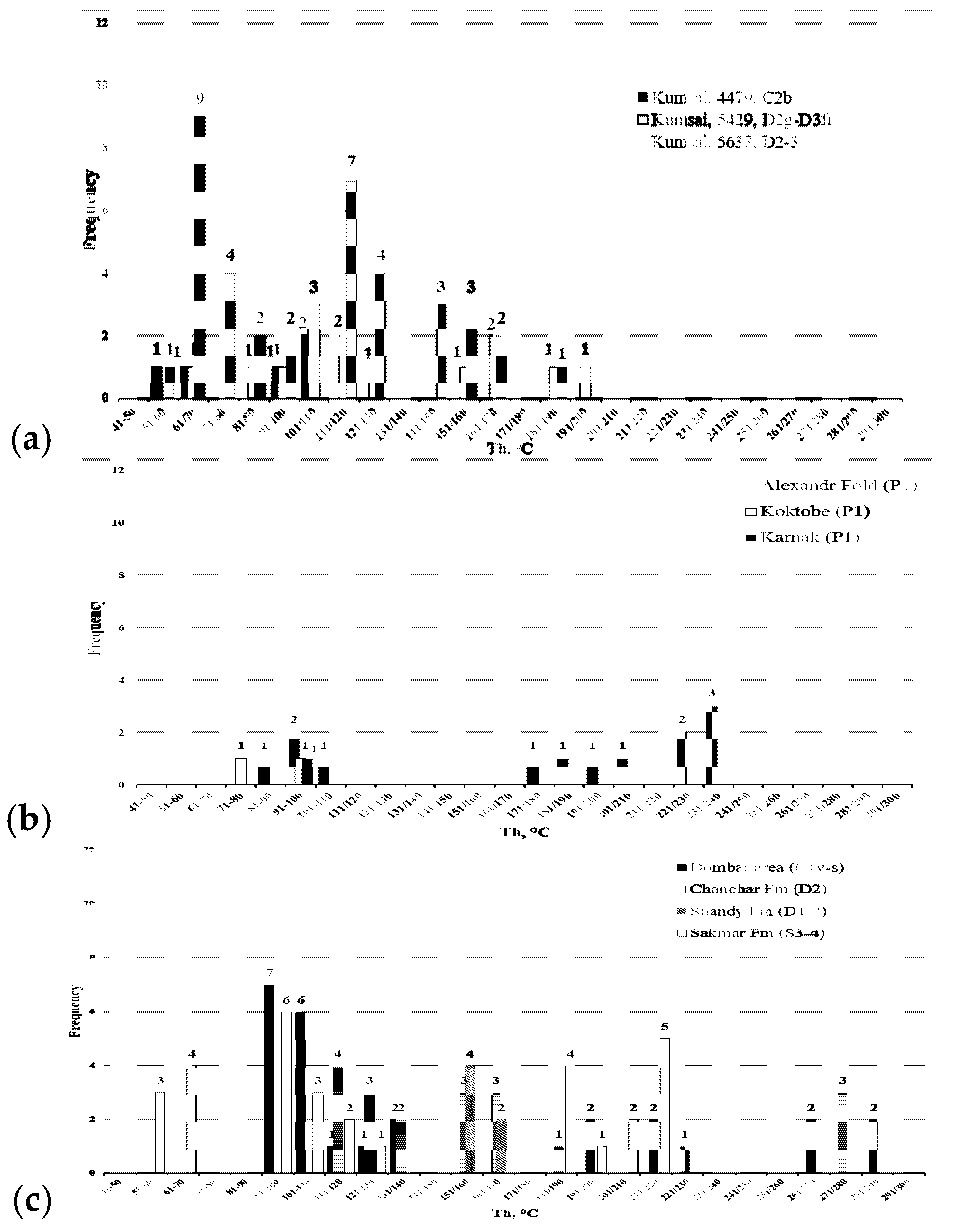
4.2. Homogenization Temperatures (Th)
- Low-temperature: 50–78 °C;
- Intermediate: 87–146 °C, buried related;
- Moderately high: 155–166 °C (Devonian limestones, Shandy Formation):
- High: >180 °C, locally reaching ~275–284 °C occurring in fracture- and vein-filling calcite.

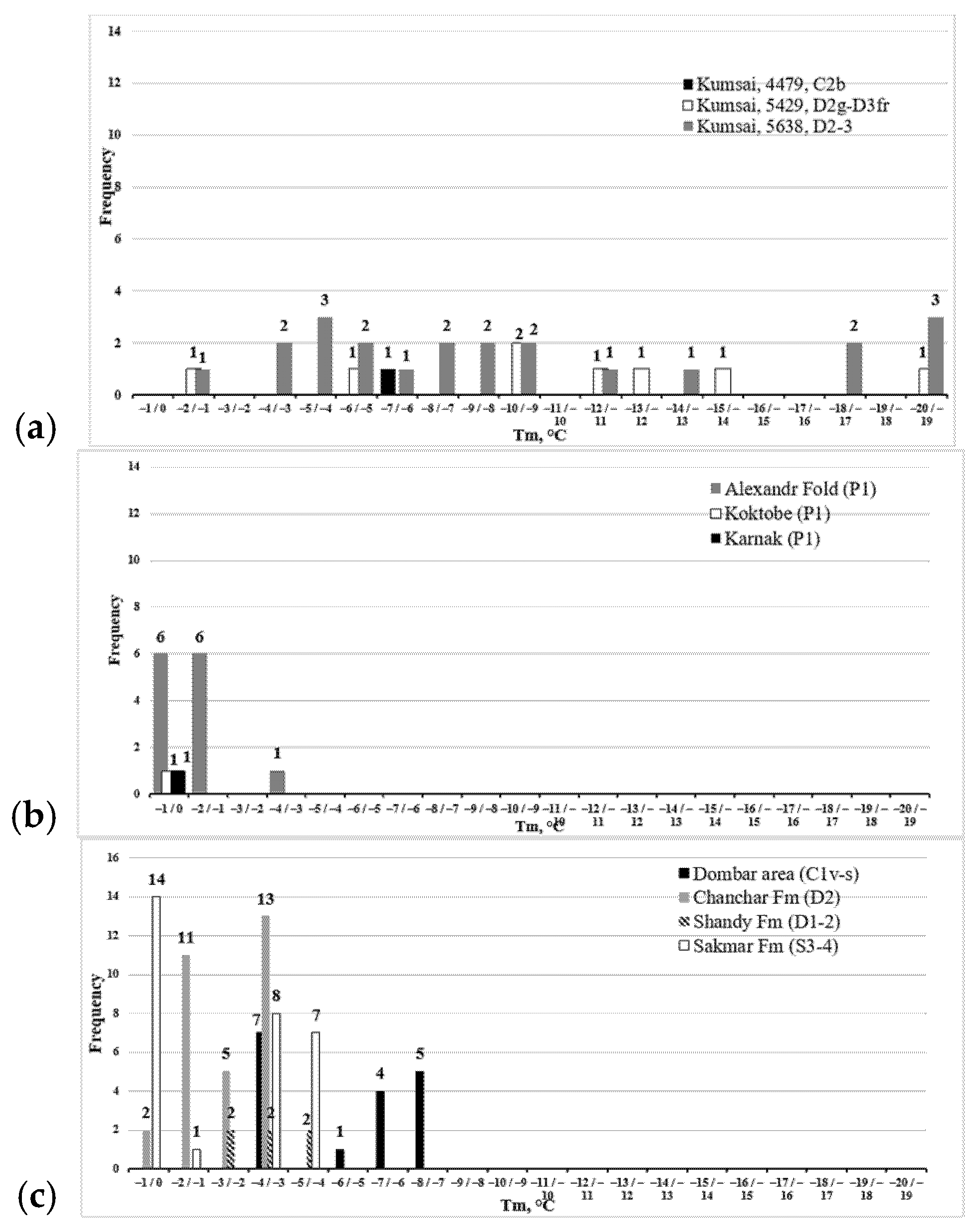
4.3. Ice-Melting Temperatures (Tm) and Salinity
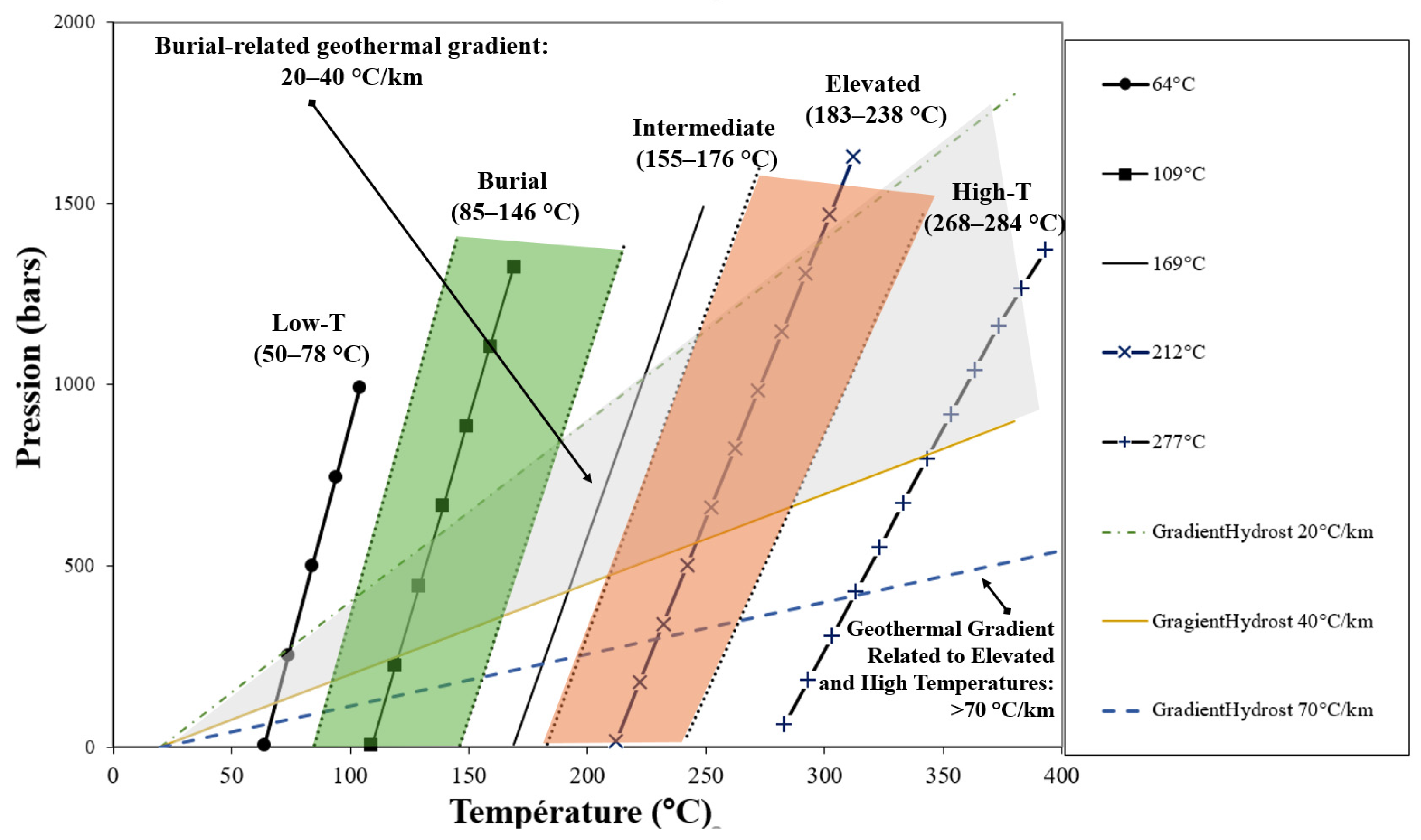
4.4. Pressure–Temperature Constraints
5. Discussion
5.1. Overview: A Polyphase, Predominantly Fracture-Controlled Record
5.2. Burial Temperatures Versus Fluid Inclusion Record
5.3. Low-Temperature Inclusions and Early-to Late-Stage Fluid Circulation
5.4. Evidence for a Suppressed Geothermal Gradient
5.5. Implications for Hydrocarbon Generation
5.6. Hydrocarbon Origin: Migration Versus Local Generation
5.7. Transient Hydrothermal Events and Their Limited Thermal Significance
5.8. Progressive Localization of Permeability: A Continuum Rather than Discrete “Events”
5.9. Pressure–Temperature Constraints and Trapping Depths
6. Conclusions
- The studied fluid inclusions record a polyphase, predominantly fracture-controlled fluid system comprising several thermal populations distinguished by homogenization temperature, salinity, and host microstructural setting. Because direct dating of vein minerals and systematic structural constraints on distinct fracture generations are unavailable, the proposed early-, intermediate-, and high-temperature stages should be interpreted as a relative sequence of thermal-fluid regimes within the regional tectonic framework rather than as a fully resolved chronological evolution.
- Fluid inclusion microthermometry reveals a complex, multistage thermal history. The dominant population (Th ≈ 87–146 °C) records burial-related fluids at depths of approximately 2–4.5 km. Higher-temperature inclusions (Th > 180 °C) indicate short-lived fault-controlled hydrothermal pulses and advective heat transfer, whereas lower-temperature inclusions (Th ≈ 50–78 °C) reflect early burial diagenesis and/or late-stage fluid circulation during uplift and exhumation.
- The thermal evolution of the Pre-Uralian Foredeep and Sakmara accretionary zone reflects the combined effects of burial heating and episodic hydrothermal circulation. The available fluid-inclusion, structural, and maturity data suggest that hydrocarbons were likely generated in deeper, more thermally mature source intervals and subsequently migrated into the studied formations along fault-controlled pathways.
- This study highlights the value of integrating fluid-inclusion microthermometry with structural and burial-history analyses to reconstruct basin-scale thermal and fluid-flow evolution. The resulting conceptual model is applicable to other collisional belts and foreland basins where transient hydrothermal circulation along major tectonic structures influences diagenesis, thermal evolution, and petroleum-system development.
- The principal limitation of this study is the absence of direct geochronological constraints on vein formation and fluid entrapment. Additional uncertainty arises from the limited number of studied localities and the incomplete characterization of fracture generations and paleostress histories. Consequently, the proposed thermal-fluid evolution should be regarded as a first-order conceptual framework rather than a fully constrained P–T–t reconstruction.
- Future research should integrate fluid-inclusion studies with vein-mineral geochronology (e.g., U–Pb and Ar–Ar methods), low-temperature thermochronology, stable-isotope geochemistry, basin modeling, and detailed structural analysis. Such multidisciplinary approaches would better constrain the timing of fluid-flow events, quantify the relative contributions of conductive and advective heat transfer, and refine petroleum-system models for the Uralian foreland system and analogous basins worldwide.
Author Contributions
Funding
Data Availability Statement
Acknowledgments
Conflicts of Interest
Abbreviations
| FI | Fluid inclusion |
| Fm | Formation |
| Tm | Final ice-melting temperature |
| Th | Homogenization temperature |
| P-T | Pressure–temperature |
| wt.% | Weight per cent |
References
- Moretto, V.; Berio, L.R.; Dallai, L.; Viola, G.; Balsamo, F.; Pizzati, M.; Grathoff, G.; Warr, L.N.; Xie, R.; Aldega, L. Unmixing fluid histories in polymineralic fault rocks using isotopic evolution and the PolyFrac tool: A case study from Lemnos Island, Greece. Chem. Geol. 2026, 708, 123345. [Google Scholar] [CrossRef] [Scilit]
- Spagnolo, G.S.; Bernasconi, S.M.; Aldega, L.; Castorina, F.; Billi, A.; Smeraglia, L.; Agosta, F.; Prosser, G.; Tavani, S.; Carminati, E. Interplay and feedback between tectonic regime, faulting, sealing horizons, and fluid flow in a hydrocarbon-hosting extensional basin: The Val d’Agri Basin case, Southern Italy. Earth Planet. Sci. Lett. 2024, 646, 118982. [Google Scholar] [CrossRef] [Scilit]
- Rauch, C.; Barrie, K.; Collins, S.C.; Hornbach, M.J.; Brokaw, C. Heat flow and thermal conductivity measurements in the northeastern Pennsylvania Appalachian Basin depocenter. AAPG Bull. 2018, 102, 2155–2170. [Google Scholar] [CrossRef] [Scilit]
- Kingston, A.; Ardakani, O.H.; Watt, E.; Samson, I.M. Evidence of Hydrocarbon Generation and Overpressure Development in an Unconventional Reservoir Using Fluid Inclusion and Stable Isotope Analysis From the Early Triassic, Western Canadian Sedimentary Basin. Front. Earth Sci. 2022, 10, 918898. [Google Scholar] [CrossRef] [Scilit]
- Delpomdor, F.; Bonneville, S.; Baert, K.; Préat, A. An introduction to the Precambrian petroleum system in the Sankuru-Mbuji-Mayi-Lomami-Lovoy Basin, South-Central Democratic Republic of Congo. J. Pet. Geol. 2017, 41, 5–27. [Google Scholar] [CrossRef] [Scilit]
- Opera, A.; Alizadeh, B.; Sarafdokht, H.; Janbaz, M.; Fouladvand, R.; Heidarifard, M.H. Burial history reconstruction and thermal maturity modeling for the Middle Cretaceous–Early Miocene Petroleum System, southern Dezful Embayment, SW Iran. Int. J. Coal Geol. 2013, 120, 1–14. [Google Scholar] [CrossRef] [Scilit]
- Barnolas, A.; Larrasoaña, J.C.; Pujalte, V.; Schmitz, B.; Sierro, F.J.; Mata, M.P.; van den Berg, B.C.J.; Pérez-Asensio, J.N.; Salazar, Á.; Salvany, J.M.; et al. Alpine Foreland Basins. In The Geology of Iberia: A Geodynamic Approach. Regional Geology Reviews; Quesada, C., Oliveira, J., Eds.; Springer: Cham, Switzerland, 2019. [Google Scholar] [CrossRef] [Scilit]
- Mukhtarova, K.Z.; Nasibova, G.J. Geodynamic regime and prospects for oil and gas potential in the South Caspian Basin. J. Geol. Geogr. Geoecology 2023, 32, 550–559. [Google Scholar] [CrossRef] [Scilit] [PubMed]
- Ullah, I.; Jamil, M.; Rahim, H.U.; Khan, I.; Ali, A.; Muzammil, M.; Abbas, W.; Umar, M.; Shah, F.; Usman, M. Impact of Diagenesis on Microbial Carbonate Reservoirs in the Upper Indus Basin, NW Himalayas. Minerals 2026, 16, 111. [Google Scholar] [CrossRef] [Scilit]
- González-Acebrón, L.; Goldstein, R.H.; Mas, R.; Arribas, J. Criteria for recognition of localization and timing of multiple events of hydrothermal alteration in sandstones illustrated by petrographic, fluid inclusion, and isotopic analysis of the Tera Group, Northern Spain. Int. J. Earth Sci. 2011, 100, 1811–1826. [Google Scholar] [CrossRef] [Scilit]
- Bahnan, A.E.; Carpentier, C.; Pironon, J.; Ford, M.; Ducoux, M.; Barré, G.; Mangenot, X.; Gaucher, E.C. Impact of geodynamics on fluid circulation and diagenesis of carbonate reservoirs in a foreland basin: Example of the Upper Lacq reservoir (Aquitaine basin, SW France). Mar. Pet. Geol. 2020, 111, 676–694. [Google Scholar] [CrossRef] [Scilit]
- de Graaf, S.; Nooitgedacht, C.W.; Le Goff, J.; van der Lubbe, J.H.J.L.; Vonhof, H.B.; Reijmer, J.J.G. Fluid-flow evolution in the Albanide fold-thrust belt; insights from hydrogen and oxygen isotope ratios of fluid inclusions. AAPG Bull. 2019, 103, 2421–2445. [Google Scholar] [CrossRef] [Scilit]
- Zhemchuzhnikov, V.; Akhmetzhanov, A.; Ibrashev, K.; Akhmetzhanova, G. The Geotectonic Peculiarities of the North Caspian Permian Salt-Bearing Basins (Kazakhstan). Geosciences 2024, 14, 23. [Google Scholar] [CrossRef] [Scilit]
- Abdulin, A.A.; Avdeev, A.V.; Seitov, N.S. Tectonics of the Sakmara and Or-Ilek Zones of the Mugodzhar; Nauka: Alma-Ata, Kazakhstan, 1977; 238p. (In Russian) [Google Scholar]
- Abdulin, A.A.; Zaravnyaeva, V.K.; Korinevsky, V.G. New Data on the Stratigraphy of the Greenstone Volcanogenic Zone of the Southern Mugodzhar. In Problems of Geology and Copper Mineralization of the Mugodzhar; Nauka: Alma-Ata, Kazakhstan, 1963; pp. 26–39. [Google Scholar]
- Peive, A.V.; Ivanov, S.N.; Necheukhin, V.M.; Perfil’ev, A.S.; Puchkov, V.N. Tectonics of the Urals: Explanatory Note to the Tectonic Map of the Urals at 1:1,000,000 Scale; Nauka: Moscow, Russia, 1977; 120p. (In Russian) [Google Scholar]
- Ruzhentsev, S.V. Geology of the Southern Part of the Sakmara Zone of the Urals. In Problems of Theoretical and Regional Tectonics; Nauka: Moscow, Russia, 1971; pp. 25–40. (In Russian) [Google Scholar]
- Ruzhentsev, S.V. Marginal Ophiolitic Allochthons; Nauka: Moscow, Russia, 1976; 170p. (In Russian) [Google Scholar]
- Ivanov, S.N.; Puchkov, V.N.; Ivanov, K.S.; Samarkin, G.I.; Semenov, I.V.; Pumpyansky, A.I.; Dymkin, A.M.; Poltavets, Y.A.; Rusin, A.I.; Krasnobaev, A.A. Formation of the Earth’s Crust of the Urals; Nauka: Moscow, Russia, 1986; 248p. [Google Scholar]
- Montenat, C.; Barrier, P.; Francou, C. Oural = Ural = Urali. In Documents et Travaux de L’IGAL; Mémoire Hors-Série 1; Institut Géologique Albert-de-Lapparent: Cergy-Pontoise, France, 1995; 189p. [Google Scholar]
- Puchkov, V.N. Paleo Geodynamics of the Southern and Middle Urals; Gilem Publishing House: Ufa, Russia, 2000; 146p. (In Russian) [Google Scholar]
- Puchkov, V.N. Geology of the Urals and Cis-Urals: Actual Problems of Stratigraphy, Tectonics, Geodynamics and Metallogeny; DesignPoligraphService: Ufa, Russia, 2010; 280p. (In Russian) [Google Scholar]
- Yurish, V.V.; Ulukpanov, K.T. Geodynamics of the Paleozoic of the Kazakh Urals; Aktobe Regional University Press: Aktobe, Kazakhstan, 2020. (In Russian) [Google Scholar]
- Yensepbayev, T.A.; Izart, A.; Joltaev, G.; Hautevelle, Y.; Suarez-Ruiz, I. Geochemical characterization of source rocks and oils from the eastern part of the Precaspian basin and Pre-Uralian basin (Kazakhstan): Paleoenvironmental and paleothermal interpretation. Org. Geochem. 2010, 41, 242–262. [Google Scholar] [CrossRef] [Scilit]
- Khvorova, I.V.; Voznesenskaya, T.A.; Zolotarev, B.P.; Il’inskaya, M.N.; Ruzhentsev, S.V. Formations of the Sakmara Allochthon; Nauka: Moscow, Russia, 1978; 232p, Available online: https://www.geokniga.org/labels/55166 (accessed on 22 June 2026). (In Russian)
- Leonenok, N.I. Silurian Deposits of the Kos-Istek Area, Northern Mugodzhar. Tr. Lab. Geol. Uglya 1955, 3, 116–225. (In Russian) [Google Scholar]
- Varganov, V.G.; Antsygin, N.Y.; Nasedkina, V.A.; Militsina, V.S.; Shurygina, M.V. Stratigraphy and Fauna of the Ordovician of the Middle Urals; Nedra: Moscow, Russia, 1973; 227p, Available online: https://www.dissercat.com/content/stratigrafiya-i-khitinozoi-ordovika-zilairskogo-sinklinoriya-yuzhnogo-urala (accessed on 22 June 2026). (In Russian)
- Nasedkina, V.A. Ordovician Conodonts of the Western Slope of the Urals. In New Miospores, Foraminifers, Ostracods and Conodonts of the Paleozoic and Mesozoic of the Urals; Malakhova, N.P., Chuvashov, B.I., Eds.; Ural Scientific Center, USSR Academy of Sciences: Sverdlovsk, USSR, 1975; pp. 110–136. (In Russian) [Google Scholar]
- Korinevsky, V.G. Volcanogenic Rocks of the Lower Silurian of the Sakmara Zone of the Mugodzhar. In Problems of Petrology of Volcanic Rocks of the Urals; Ural Scientific Center, USSR Academy of Sciences: Sverdlovsk, USSR, 1975; pp. 58–71. (In Russian) [Google Scholar]
- Korobkov, V.F.; Baimagambetov, B.K.; Sapozhnikov, P.K.; Ulukpanov, K.T. Guidebook of Geological Excursions in the Mugodzhar Mountains; Aktobe State University Press: Aktobe, Kazakhstan, 2012. (In Russian) [Google Scholar]
- Kazantseva, T.T. On the Stratigraphy of the Zilair Series of the Western Slope of the Southern Urals. Dokl. Akad. Nauk. SSSR 1970, 194, 649–652. (In Russian) [Google Scholar]
- Kazantseva, T.T. On the Stratigraphy and Geodynamics of the Zilair Deposits in the Southern Urals. Izv. Ufim. Nauchnogo Tsentra RAN 2021, 3, 77–88. (In Russian) [Google Scholar] [CrossRef] [Scilit]
- Yanshin, A.L. Tectonics of the Kargaly Mountains. Byulleten MOIP Geol. Ser. 1932, 10, 308–345. [Google Scholar]
- Edwards, R.L.; Wasserburg, G.J. The age and emplacement of obducted oceanic crust in the Urals from Sm–Nd and Rb–Sr systematics. Earth Planet. Sci. Lett. 1985, 72, 389–404. [Google Scholar] [CrossRef] [Scilit]
- Downey, M.W.; Morgan, W.A.; Threet, J.C. Petroleum Provinces of the Twenty-First Century; American Association of Petroleum Geologists: Tulsa, OK, USA, 2001; 573p. [Google Scholar]
- Ingebritsen, S.E.; Manning, C.E. Permeability of the continental crust: Dynamic variations inferred from hydrothermal systems and metamorphism. Geofluids 2010, 10, 193–205. [Google Scholar] [CrossRef] [Scilit]
- Sibson, R.H. Crustal stress, faulting and fluid flow. Geol. Soc. Lond. Spec. Publ. 1994, 78, 69–84. [Google Scholar] [CrossRef] [Scilit]
- Sibson, R.H. Structural permeability of fluid-driven fault-fracture. J. Struct. Geol. 1996, 18, 1031–1042. [Google Scholar] [CrossRef] [Scilit]
- Sibson, R.H. Fluid involvement in normal faulting. J. Geodyn. 2000, 29, 469–499. [Google Scholar] [CrossRef] [Scilit]
- Bense, V.F.; Gleeson, T.; Loveless, S.E.; Bour, O.; Scibek, J. Fault zone hydrogeology: Modeling fluid flow in heterogeneous, fault-controlled hydrothermal systems. Earth-Sci. Rev. 2013, 127, 171–192. [Google Scholar] [CrossRef] [Scilit]
- Siler, D.L.; Pepin, J. 3-D geologic controls of hydrothermal fluid flow at Brady geothermal field, Nevada, USA. Geothermics 2021, 94, 102112. [Google Scholar] [CrossRef] [Scilit]
- Zhang, Y.-G.; Frantz, J.D. Determination of the homogenization temperatures and densities of supercritical fluids in the system NaClKClCaCl2H2O using synthetic fluid inclusions. Chem. Geol. 1987, 64, 335–350. [Google Scholar] [CrossRef] [Scilit]
- Nardin, E.; Godderis, Y.; Donnadieu, Y.; Le Hir, G.; Blakey, R.C.; Puceat, E.; Aretz, M. Modeling the early Paleozoic long-term climatic trend. Geol. Soc. Am. Bull. 2011, 123, 1181–1192. [Google Scholar] [CrossRef] [Scilit]
- Joachimski, M.M.; Breisig, S.; Buggisch, W.F.; Talent, J.A.; Mawson, R.; Gereke, M.; Morrow, J.R.; Day, J.; Weddige, K. Devonian climate and reef evolution: Insights from oxygen isotopes in apatite. Earth Planet. Sci. Lett. 2009, 284, 599–609. [Google Scholar] [CrossRef] [Scilit]
- Bodnar, R.J. Revised equation for calculating freezing-point depression of H2O–NaCl solutions. Geochim. Cosmochim. Acta 1993, 57, 683–684. [Google Scholar] [CrossRef] [Scilit]
- Bodnar, R.J. Introduction to fluid inclusions. In Fluid Inclusions: Analysis and Interpretation; Samson, I., Anderson, A., Marshall, D., Eds.; Mineralogical Association of Canada Short Course Series; Mineralogical Association of Canada: Québec City, QC, Canada, 2003; Volume 32, pp. 1–8. [Google Scholar]
- Potter, R.W.; Clynne, M.A.; Brown, D.L. Freezing point depression of aqueous sodium chloride solutions. Econ. Geol. 1978, 73, 284–285. [Google Scholar] [CrossRef] [Scilit]
- Steele-MacInnis, M.; Bodnar, R.J.; Naden, J. Numerical model to determine the composition of H2O–NaCl–CaCl2 fluid inclusions based on microthermometric and microanalytical data. Geochim. Cosmochim. Acta 2011, 75, 21–40. [Google Scholar] [CrossRef] [Scilit]
- Drebushchak, V.A.; Ogienko, A.G.; Yunoshev, A.S. Metastable eutectic melting in the NaCl-H2O system. Thermochim. Acta 2017, 647, 94–100. [Google Scholar] [CrossRef] [Scilit]
- Roedder, E. Fluid Inclusions. In Reviews in Mineralogy; Mineralogical Society of America: Washington, DC, USA, 1984; Volume 12, 644p. [Google Scholar]
- Dubois, M.; Ayt Ougougdal, M.; Meere, P.; Royer, J.J.; Boiron, M.C.; Cathelineau, M. Temperature of paleo- to modern self-sealing within a continental rift basin; the fluid inclusion data (Soultz-sous-Forêts, Rhine Graben, France). Eur. J. Mineral. 1996, 8, 1065–1080. [Google Scholar]
- Smith, M.P.; Savary, V.; Yardley, B.W.D.; Valley, J.W.; Royer, J.J.; Dubois, M. The evolution of the deep flow regime at Soultz-sous-Forêts, Rhine Graben, eastern France: Evidence from a composite quartz vein. J. Geophys. Res.-Part B-Solid Earth 1998, 103, 27223–27237. [Google Scholar] [CrossRef] [Scilit]
- Cathelineau, M.; Boiron, M.C. Downward penetration and mixing of sedimentary brines and dilute hot waters at 5 km depth in the granite basement at Soultz-sous-Forêts (Rhine graben, France). Comptes Rendus Geosci. 2010, 342, 560–565. [Google Scholar] [CrossRef] [Scilit]
- Le Carlier, C.; Royer, J.J.; Flores, E.L. Convective heat transfer at the Soultz-sous-Forêts Geothermal Site: Implications for oil potential. First Break 1994, 12, 553–560. [Google Scholar] [CrossRef] [Scilit]
- Dumitru, T.A. Effects of subduction parameters on geothermal gradients in forearcs, with an application to Franciscan Subduction in California. J. Geophys. Res. Solid Earth 1991, 96, 621–641. [Google Scholar] [CrossRef] [Scilit]
- Ernst, W.G. Do mineral parageneses reflect unusually high- pressure conditions of Franciscan metamorphism? Am. J. Sci. 1971, 270, 81–108. [Google Scholar] [CrossRef] [Scilit]
- Ernst, W.G. Tectonic history of subduction zones inferred from retrograde blueschist P-T paths. Geology 1988, 16, 1081–1084. [Google Scholar] [CrossRef] [Scilit]
- Springer, M.; Förster, A. Heat-flow density across the Central Andean subduction zone. Tectonophysics 1998, 291, 123–139. [Google Scholar] [CrossRef] [Scilit]
- Jaupart, C.; Mareschal, J.C. 6.05—Heat Flow and Thermal Structure of the Lithosphere. Treatise Geophys. 2007, 6, 217–251. [Google Scholar] [CrossRef] [Scilit]
- Zhanserkeyeva, A.A.; Kassenov, A.K. Prospect evaluation based on integrated petroleum system analysis: Block E case study, south-eastern edge of Precaspian Basin (Kazakhstan). J. Pet. Explor. Prod. Technol. 2022, 12, 2625–2642. [Google Scholar] [CrossRef] [Scilit]
- Lepezin, G.G.; Travin, A.V.; Yudin, D.S.; Volkova, N.I.; Korsakov, A.V. Age and thermal history of the Maksyutov metamorphic complex: 40Ar/39Ar evidence. Petrology 2006, 14, 98–114. [Google Scholar] [CrossRef] [Scilit]
- Leech, M.L.; Stockli, D.F. The late exhumation history of the ultrahigh-pressure Maksyutov Complex, south Ural Mountains, from new apatite fission track data. Tectonics 2000, 19, 153–167. [Google Scholar] [CrossRef] [Scilit]
- Kukkonen, I.T.; Golovanova, I.V.; Khachay, Y.V.; Druzhinin, V.S.; Kosarev, A.M.; Schapov, V.A. Low geothermal heat flow of the Urals fold belt. Tectonophysics 1997, 276, 63–85. [Google Scholar] [CrossRef] [Scilit]
- Rakhimov, I.R.; Ankusheva, N.N.; Samigullin, A.A.; Shanina, S.N. Origin and Evolution of Ore-Forming Fluids at the Small-Sized Gold Deposits in the Khudolaz Area, Southern Urals. Minerals 2023, 13, 781. [Google Scholar] [CrossRef] [Scilit]
- Korekina, M.A.; Savichev, A.N. Conditions of Formation and Sources of Fluids of Barren Vein Quartz Deposits of Hydrothermal–Metamorphogenic–Metasomatic and Hydrothermal–Metamorphogenic Genesis, Middle and Southern Urals. Vestn. St. Petersburg Univ. Earth Sci. 2023, 68, 201–216. [Google Scholar] [CrossRef] [Scilit]
- Sharipova, A.A.; Michurin, S.V.; Krupenin, M.T.; Garaeva, A.A.; Kanipova, Z.A. Vein Quartz from Gold Occurrences in Riphean Deposits of the Avzyan Ore District, Southern Urals: Mineralogical and Thermocryometric Features. Bull. Perm Univ. Geol. 2017, 16, 216–230. [Google Scholar] [CrossRef] [Scilit]

| No. | Locality/Well | Depth (m) | Formation Age | Paléo- Environment | Facies |
|---|---|---|---|---|---|
| 818 | Kumsai 4P | 4479–4494 | C2b | Middle platform | Biomicrite packstone |
| 813 | Kumsai 4P | 5429–5442 | D2g–D3fr | Core reef/back-reef transition | Biomicrite–wackestone with stromatoporoids |
| 811 | Kumsai 4P | 5638–5648 | D2–D3 | Inner platform | Biomicrosparite–packstone |
| 832 | Karnak 20G | 2195–2200 | P1as | Slope with turbidites | Litharenite |
| 795 | Koktobe 35P | 3993–3998 | P1s | Slope with turbidites | Litharenite |
| B16 | Alexandrov Fold | Quarry | P1 | Sabkha–lagoon system | Halite-bearing limestone |
| B19 | Dombar area | Outcrop | C1v-s | Middle platform | Biomicrite-packstone |
| K15 | Chanchar Fm | Outcrop | D2 | Platform | Recrystallized limestone |
| E23 | Shandy Fm | Outcrop | D1–2 | Platform | Recrystallized limestone |
| E26 | Sakmara Fm | Outcrop | S3–4 | External platform | Biomicrite-packstone |
| Geodynamic Stage | Age | Main Domain | Formations | FI Populations | Interpreted Fluid Regime |
|---|---|---|---|---|---|
| Oceanic/rift- to early marginal-basin | Ordovician–Silurian | Sakmara zone | Sakmara Fm | Low-T to burial-related | Early background thermal regime, later partly overprinted by burial and accretional/collisional processes |
| Subduction–accretion and early collision | Devonian–Tournaisian | Sakmara accretionary zone | Sakmara, Shandy, Chanchar | Burial-related, intermediate, elevated, locally high-T | Fault- and fracture-controlled advective/hydrothermal pulses |
| Collision and foreland loading | Late Carboniferous–Permian | Pre-Uralian Foredeep, Sakmara thrust front, eastern Pre-Caspian Basin | Dombar, Alexandrov, Sakmara, Kumsai | Burial-related, to locally high-T | Burial fluids combined with structurally focused flow during thrusting |
| Post-collisional uplift/reactivation | Permian and younger | Thrust front, foredeep margin, eastern Pre-Caspian Basin | Calcite-filled fractures and veins in outcrops and wells | Low-T and mixed | Low-T meteoric/formational circulation, local reactivation, and late fracture-controlled flow |
Disclaimer/Publisher’s Note: The statements, opinions and data contained in all publications are solely those of the individual author(s) and contributor(s) and not of MDPI and/or the editor(s). MDPI and/or the editor(s) disclaim responsibility for any injury to people or property resulting from any ideas, methods, instructions or products referred to in the content. |
© 2026 by the authors. Licensee MDPI, Basel, Switzerland. This article is an open access article distributed under the terms and conditions of the Creative Commons Attribution (CC BY) license.
Share and Cite
Yensepbayev, T.; Kuandykov, I.; Abdrassil, A.; Royer, J.-J.; Cathelineau, M.; Nurmaganbetova, L. Thermal and Fluid Evolution of Paleozoic Rocks in the Sakmara Zone and Eastern Pre-Caspian Basin, Western Kazakhstan. Geosciences 2026, 16, 260. https://doi.org/10.3390/geosciences16070260
Yensepbayev T, Kuandykov I, Abdrassil A, Royer J-J, Cathelineau M, Nurmaganbetova L. Thermal and Fluid Evolution of Paleozoic Rocks in the Sakmara Zone and Eastern Pre-Caspian Basin, Western Kazakhstan. Geosciences. 2026; 16(7):260. https://doi.org/10.3390/geosciences16070260
Chicago/Turabian StyleYensepbayev, Talgat, Ismail Kuandykov, Alina Abdrassil, Jean-Jacques Royer, Michel Cathelineau, and Lyaila Nurmaganbetova. 2026. "Thermal and Fluid Evolution of Paleozoic Rocks in the Sakmara Zone and Eastern Pre-Caspian Basin, Western Kazakhstan" Geosciences 16, no. 7: 260. https://doi.org/10.3390/geosciences16070260
APA StyleYensepbayev, T., Kuandykov, I., Abdrassil, A., Royer, J.-J., Cathelineau, M., & Nurmaganbetova, L. (2026). Thermal and Fluid Evolution of Paleozoic Rocks in the Sakmara Zone and Eastern Pre-Caspian Basin, Western Kazakhstan. Geosciences, 16(7), 260. https://doi.org/10.3390/geosciences16070260