Epidemiology and Genetic Diversity of Spirometra Tapeworm Isolates from Snakes in Hunan Province, China

 ,
, 

Abstract
:Simple Summary
Abstract
1. Introduction
2. Materials and Methods
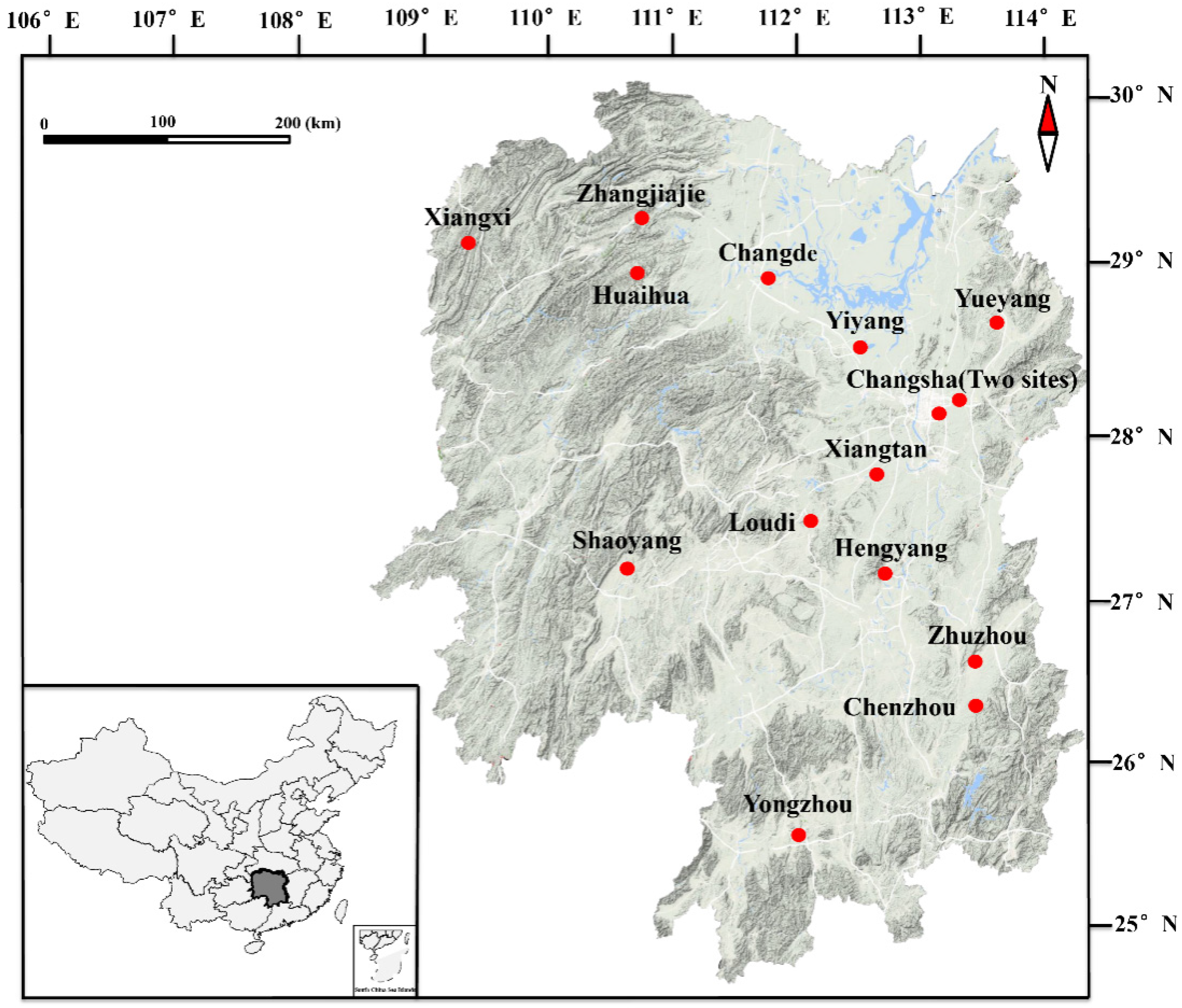
2.1. Collection of Sparganum Isolates from Snakes
2.2. Sequencing of Target Genes
2.3. Genetic Diversity Analysis of Isolates from Snakes
2.4. Phylogenetic Analysis
3. Results
3.1. Prevalence of Sparganum Infection in Snakes
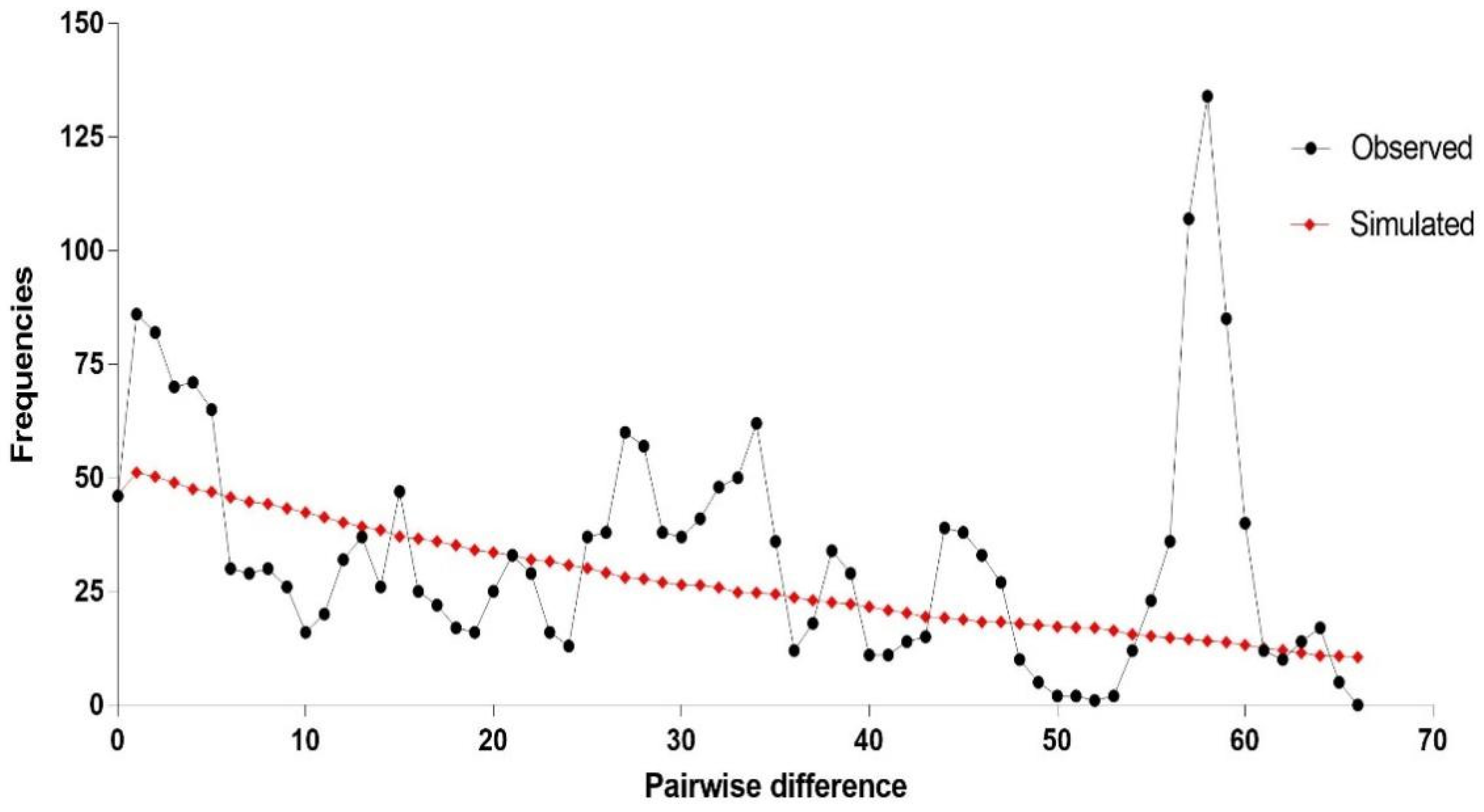
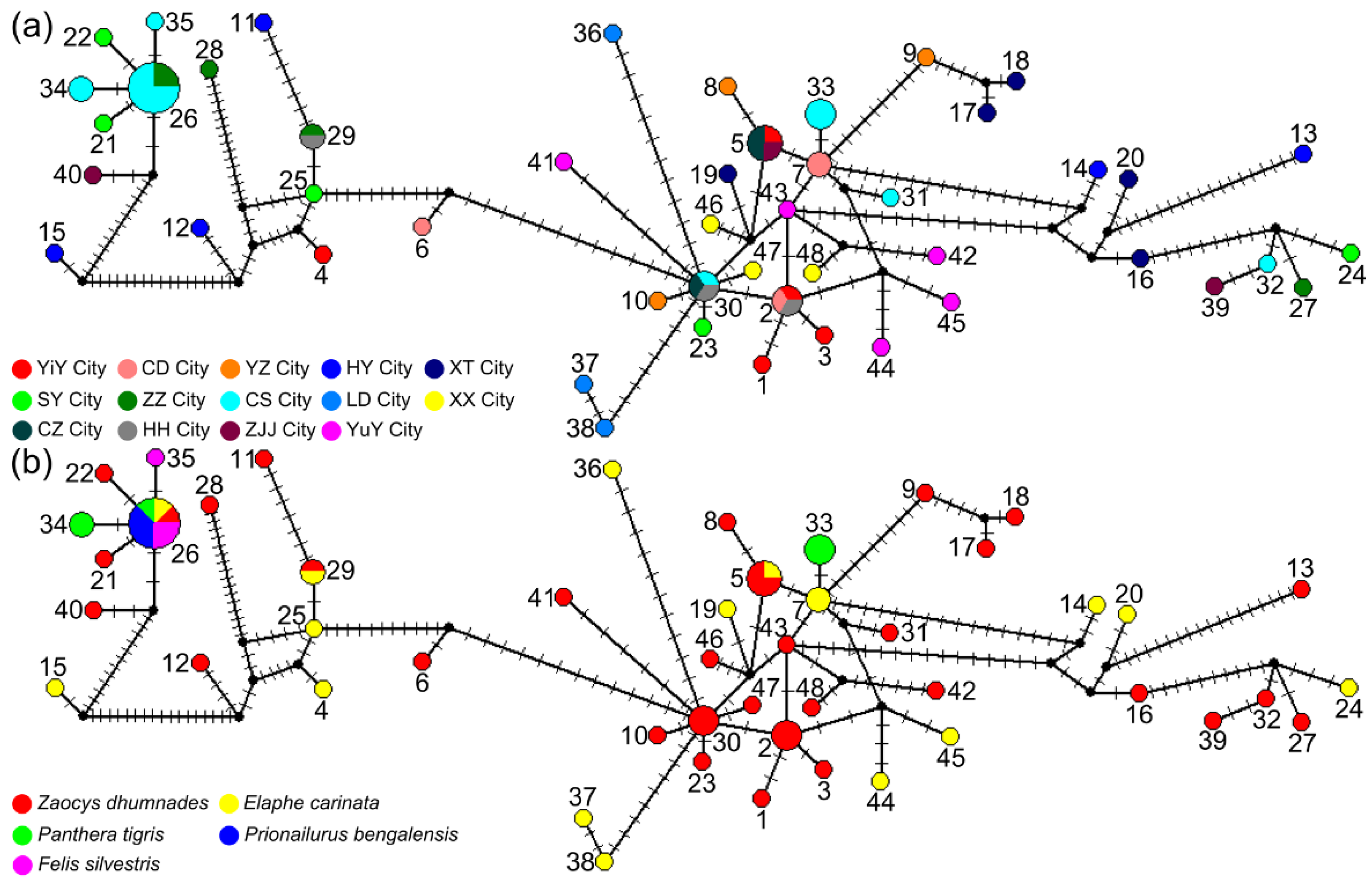
3.2. Genetic Diversity and Phylogenetic Pattern
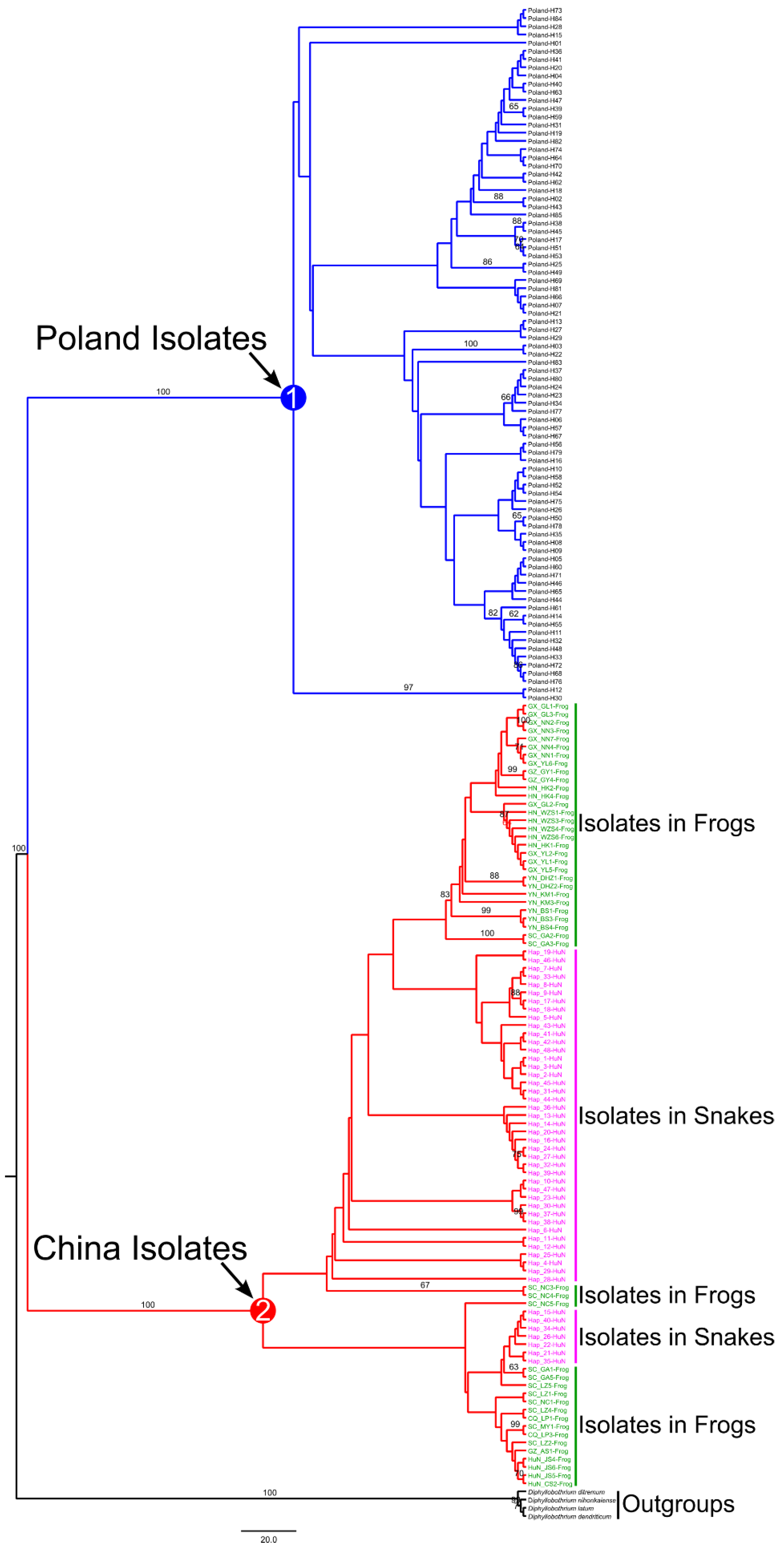
3.3. Phylogenetic Pattern
4. Discussion
- S. mansoni lineage (corresponding to most of the isolates from Asia, Australia, Romania, and a single sequence from Tanzania);
- Spirometra sp. 1 lineage (corresponding to a few specimens from Korea and Japan);
- Spirometra folium lineage (corresponding to most specimens from Africa, such as Sudan and Ethiopia and the remaining specimens from Tanzania);
- S. erinaceieuropaei lineage (corresponding to the majority of European specimens);
- S. decipiens complex 1 lineage; and
- S. decipiens complex 2 lineages.
5. Conclusions
Supplementary Materials
Author Contributions
Funding
Institutional Review Board Statement
Informed Consent Statement
Data Availability Statement
Conflicts of Interest
References
- Scholz, T.; Kuchta, R.; Brabec, J. Broad tapeworms (Diphyllobothriidae), parasites of wildlife and humans: Recent progress and future challenges. Int. J. Parasitol. Parasites Wildl. 2019, 9, 359–369. [Google Scholar] [CrossRef] [PubMed]
- Liu, S.N.; Su, X.Y.; Chen, W.Q.; Yu, J.W.; Li, J.R.; Jiang, P.; Cui, J.; Wang, Z.Q.; Zhang, X. Transcriptome profiling of plerocercoid and adult developmental stages of the neglected medical tapeworm Spirometra erinaceieuropaei. Acta Trop. 2022, 232, 106483. [Google Scholar] [CrossRef] [PubMed]
- Liu, Q.; Li, M.W.; Wang, Z.D.; Zhao, G.H.; Zhu, X.Q. Human sparganosis, a neglected food borne zoonosis. Lancet Infect. Dis. 2015, 15, 1226–1235. [Google Scholar] [CrossRef]
- Cui, J.; Wang, Y.; Zhang, X.; Lin, X.M.; Zhang, H.W.; Wang, Z.Q.; Chen, J.X. A neglected risk for sparganosis: Eating live tadpoles in central China. Infect. Dis. Poverty. 2017, 6, 58. [Google Scholar] [CrossRef]
- Liu, W.; Tan, L.; Huang, Y.; Li, W.C.; Liu, Y.S.; Yang, L.C. Prevalence and molecular characterization of Spirometra erinaceieuropaei spargana in snakes in Hunan Province, China. J. Helminthol. 2020, 94, e131. [Google Scholar] [CrossRef]
- Zhang, X.; Hong, X.; Liu, S.N.; Jiang, P.; Zhao, S.C.; Sun, C.X.; Wang, Z.Q.; Cui, J. Large-scale survey of a neglected agent of sparganosis Spirometra erinaceieuropaei (Cestoda: Diphyllobothriidae) in wild frogs in China. PLoS Negl. Trop. Dis. 2020, 14, e0008019. [Google Scholar] [CrossRef] [Green Version]
- Jeon, H.K.; Park, H.; Lee, D.; Choe, S.; Kim, K.H.; Sohn, W.M. Genetic Identification of Spirometra decipiens Plerocercoids in Terrestrial Snakes from Korea and China. Korean J. Parasitol. 2016, 54, 181–185. [Google Scholar] [CrossRef] [PubMed] [Green Version]
- Xiao, X.; Qi, R.; Han, H.J.; Liu, J.W.; Qin, X.R.; Fang, L.Z. Molecular identification and phylogenetic analysis of Cryptosporidium, Hepatozoon and Spirometra in snakes from central China. Int. J. Parasitol. Parasites Wildl. 2019, 10, 274–280. [Google Scholar] [CrossRef] [PubMed]
- Yudhana, A.; Praja, R.N.; Supriyanto, A. The medical relevance of Spirometra tapeworm infection in Indonesian Bronzeback snakes (Dendrelaphis pictus): A neglected zoonotic disease. Vet. World. 2019, 12, 844–848. [Google Scholar] [CrossRef]
- Dai, R.S.; Liu, G.H.; Song, H.Q.; Lin, R.Q.; Yuan, Z.G.; Li, M.W. Sequence variability in two mitochondrial DNA regions and internal transcribed spacer among three cestodes infecting animals and humans from China. J. Helminthol. 2012, 86, 245–251. [Google Scholar] [CrossRef]
- Hong, X.; Liu, S.N.; Xu, F.F.; Han, L.L.; Jiang, P.; Wang, Z.Q. Global genetic diversity of Spirometra tapeworms. Trop. Biomed. 2020, 37, 237–250. [Google Scholar]
- Liu, W.; Zhao, G.H.; Tan, M.Y.; Zeng, D.L.; Wang, K.Z.; Yuan, Z.G. Survey of Spirometra erinaceieuropaei spargana infection in the frog Rana nigromaculata of the Hunan Province of China. Vet. Parasitol. 2010, 173, 152–156. [Google Scholar] [CrossRef]
- Zhang, X.; Wang, H.; Cui, J.; Jiang, P.; Fu, G.M.; Zhong, K. Characterisation of the relationship between Spirometra erinaceieuropaei and Diphyllobothrium species using complete cytb and cox1 genes. Infect. Genet. Evol. 2015, 35, 1–8. [Google Scholar] [CrossRef]
- Kuchta, R.; Kołodziej-Sobocińska, M.; Brabec, J.; Młocicki, D.; Sałamatin, R.; Scholz, T. Sparganosis (Spirometra) in Europe in the Molecular Era. Clin. Infect. Dis. 2021, 72, 882–890. [Google Scholar] [CrossRef]
- Kolodziej-Sobocinska, M.; Stojak, J.; Kondzior, E.; Ruczynska, I.; Wojcik, J.M. Genetic diversity of two mitochondrial DNA genes in Spirometra erinaceieuropaei (Cestoda: Diphyllobothridae) from Poland. J. Zool. Syst. Evol. Res. 2019, 57, 764–777. [Google Scholar] [CrossRef]
- Larkin, M.A.; Blackshields, G.; Brown, N.P.; Chenna, R.; McGettigan, P.A.; McWilliam, H. Clustal W and Clustal X version 2.0. Bioinformatics 2007, 23, 2947–2948. [Google Scholar] [CrossRef] [Green Version]
- Kumar, S.; Stecher, G.; Tamura, K. MEGA7: Molecular Evolutionary Genetics Analysis Version 7.0 for Bigger Datasets. Mol. Biol. Evol. 2016, 33, 1870–1874. [Google Scholar] [CrossRef] [Green Version]
- Rozas, J.; Ferrer-Mata, A.; Sánchez-DelBarrio, J.C.; Guirao-Rico, S.; Librado, P.; Ramos-Onsins, S.E. DnaSP 6: DNA Sequence Polymorphism Analysis of Large Data Sets. Mol. Biol. Evol. 2017, 34, 3299–3302. [Google Scholar] [CrossRef]
- Leigh, J.W.; Bryant, D. POPART: Full-feature software for haplotype network construction. Methods Ecol. Evol. 2015, 6, 1110–1116. [Google Scholar] [CrossRef]
- Excoffier, L.; Lischer, H.E. Arlequin suite ver 3.5: A new series of programs to perform population genetics analyses under Linux and Windows. Mol. Ecol. Resour. 2010, 10, 564–567. [Google Scholar] [CrossRef]
- Fu, Y.X. Statistical tests of neutrality of mutations against population growth, hitchhiking and background selection. Genetics 1997, 147, 915–925. [Google Scholar] [CrossRef]
- Tajima, F. Statistical method for testing the neutral mutation hypothesis by DNA polymorphism. Genetics 1989, 123, 585–595. [Google Scholar] [CrossRef]
- Guindon, S.; Gascuel, O.A. simple, fast, and accurate algorithm to estimate large phylogenies by maximum likelihood. Syst. Biol. 2003, 52, 696–704. [Google Scholar] [CrossRef] [Green Version]
- Darriba, D.; Taboada, G.L.; Doallo, R.; Posada, D. jModelTest 2: More models, new heuristics and parallel computing. Nat. Methods 2012, 9, 772. [Google Scholar] [CrossRef] [Green Version]
- Wang, F.; Zhou, L.; Gong, S.; Deng, Y.; Zou, J.; Wu, J.; Liu, W.; Hou, F. Severe infection of wild-caught snakes with Spirometra erinaceieuropaei from food markets in Guangzhou, China involves a risk for zoonotic sparganosis. J. Parasitol. 2011, 97, 170–171. [Google Scholar] [CrossRef]
- Wang, F.M.; Li, W.Y.; Gong, S.P.; Wei, Y.F.; Ge, Y.; Yang, G.D.; Xiao, J.J. Spirometra erinaceieuropaei severely infect frogs and snakes from food markets in Guangdong, China: Implications a highly risk for zoonotic sparganosis. Trop. Biomed. 2018, 35, 408–412. [Google Scholar]
- Wang, F.; Li, W.; Hua, L.; Gong, S.; Xiao, J.; Hou, F.; Ge, Y.; Yang, G. Spirometra (Pseudophyllidea, Diphyllobothriidae) severely infecting wild-caught snakes from food markets in Guangzhou and Shenzhen, Guangdong, China: Implications for public health. Sci. World 2014, 2014, 874014. [Google Scholar] [CrossRef] [Green Version]
- Chen, D.R.; Xie, P.D. A preliminary investigation of Spirometra mansoni infected by snakes in Meilie Farmers market, Sanming City, Fujian Province. Chin. J. Zoonoses 1988, 2, 55–56. [Google Scholar]
- Zhou, Q.A.; Quan, C.Y.; Zeng, Y.; Shi, Y.L.; Li, J.; Zhang, H.M.; Huang, W.Y. Investigation on plerocercoid infection in frogs and snakes in Nanning Guangxi. Progress Vet. Med. 2013, 34, 126–128. [Google Scholar]
- Zhang, X.; Cui, J.; Wei, T.; Li, L.Y.; Jiang, J.; Lu, J.C.; Jiang, P.; Liu, L.N.; Wang, Z.Q. Survey and genetic variation of Spirometra erinaceieuropaei sparganum in frogs and snakes from Guangxi of southern China. Trop. Biomed. 2014, 31, 862–870. [Google Scholar]
- Chen, Y.; Wu, Z.J.; Qiu, M.L. Infective investigation of frog and snake plerocercoids in some areas of Guizhou. J. Guizhou Normal Univ. 2008, 1, 5–6. [Google Scholar]
- Chen, J.L.; Liu, X.J.; Zhang, S.S. Harm and control of sparganum to Pit viper. Spec. Wild Econ. Anim. Plant Res. 1990, 4, 29–30. [Google Scholar]
- Xu, W.M.; Tang, Y.; Wang, J.; Yang, Y.; Fang, S.Y.; Zhu, S.J.; Jin, X.Y.; Wang, H. Survey of Sparganum mansoni infection in frogs and snakes in Hangzhou. Dis. Surveill. 2009, 24, 612–613. [Google Scholar]
- Lu, Y.; Chen, J.X.; Li, H.; Cai, Y.C.; Ai, L.; Chun, Y.H.; Song, P.; Chen, S.H. Infection of Spirometra mansoni plerocercoid in snakes from Shanghai Zoo. Chin. J. Parasitol. Parasit. Dis. 2018, 36, 593–596. [Google Scholar]
- Yamasaki, H.; Sanpool, O.; Rodpai, R.; Sadaow, L.; Laummaunwai, P.; Un, M. Spirometra species from Asia: Genetic diversity and taxonomic challenges. Parasitol. Int. 2021, 80, 102181. [Google Scholar] [CrossRef]
- Zhang, X.; Wang, H.; Cui, J.; Jiang, P.; Lin, M.L.; Zhang, Y.L. The phylogenetic diversity of Spirometra erinaceieuropaei isolates from southwest China revealed by multi genes. Acta Trop. 2016, 156, 108–114. [Google Scholar] [CrossRef]
- Yanagida, T.; Matsuoka, H.; Kanai, T.; Nakao, M.; Ito, A. Anomalous segmentation of Diphyllobothrium nihonkaiense. Parasitol. Int. 2010, 59, 268–270. [Google Scholar] [CrossRef] [Green Version]




| Country | Geographical Origin | No. Infected/No. Examined (%) | Infection Intensity (Spargana/Snake) | References |
|---|---|---|---|---|
| China | ||||
| Hunan | HN-YiY | 43/49 (87.76) | 5-56 | This study |
| HN-CD | 18/20 (90.00) | 5-25 | This study | |
| HN-YZ | 28/33 (84.85) | 1-18 | This study | |
| HN-HY | 13/20 (65.00) | 4-22 | This study | |
| HN-XT | 68/71 (95.77) | 5-70 | This study | |
| HN-SY | 20/20 (100.00) | 5-60 | This study | |
| HN-ZZ | 22/23 (95.65) | 2-32 | This study | |
| HN-CS | 60/71 (84.51) | 3-60 | This study | |
| HN-LD | 22/24 (91.67) | 5-49 | This study | |
| HN-CZ | 18/20 (90.00) | 7-25 | This study | |
| HN-HH | 18/20 (90.00) | 6-35 | This study | |
| HN-ZJJ | 29/30 (96.67) | 8-38 | This study | |
| HN-YuY | 24/28 (85.71) | 2-22 | This study | |
| HN-XX | 19/20 (95.00) | 8-43 | This study | |
| Total | 402/449 (89.53) | 1-70 | ||
| Guangdong | 353/757 (44.51) | 1-213 | [25,26,27] | |
| Fujian | 25/32 (78.79) | 1-28 | [28] | |
| Guangxi | 38/160 (23.17) | 1-208 | [29,30] | |
| Guizhou | 85/172 (42.16) | 1-121 | [31] | |
| Jilin | 134/435 (30.80) | N/a | [32] | |
| Zhejiang | 5/5 (100.00) | 2-99 | [33] | |
| Shanghai | 55/59 (93.22) | 1-294 | [34] | |
| Hubei | 55/149 (36.90) | 1-23 | [8] | |
| Total | 1152/2218 (51.93) | 1-294 | ||
| Korea | 235/283 (83.04) | N/a | [7] | |
| Indonesia | 192/378 (50.85) | 1-111 | [9] | |
| Poland | 2/55 (3.64) | 1-3 | [15] | |
| Total | 1581/2934 (53.89) | 1-294 |
| Species | No. Infected/No. Examined | Prevalence (%) | Infection Intensity (Spargana/Snake) |
|---|---|---|---|
| Deinagkistrodon acutus | 5/11 | 45.45 | 1-34 |
| Bungarus multicinctus | 6/49 | 12.24 | 1-26 |
| Bungarus fasciatus | 1/10 | 10.00 | 1-1 |
| Naja atra | 46/184 | 25.00 | 1-208 |
| Naja naja | 9/16 | 56.25 | 1-28 |
| Naja kaouthia | 0/7 | 0 | N/a |
| Dinodon rufozonatum | 126/145 | 86.89 | 1-291 |
| Elaphe carinata | 170/216 | 78.70 | 1-172 |
| Elaphe taeniura | 70/150 | 46.67 | 1-121 |
| Coelognathus radiatus | 3/15 | 20.00 | 1-4 |
| Enhydris bocourti | 0/9 | 0 | N/a |
| Enhydris chinensis | 3/35 | 8.57 | N/a |
| Enhydris plumbea | 11/95 | 11.58 | 1-28 |
| Ptyas korros | 47/127 | 37.01 | 1-65 |
| Ptyas mucosus | 67/150 | 44.67 | 1-208 |
| Xenochrophis flavipunctatus | 86/132 | 65.15 | 1-133 |
| Zaocys dhumnades | 393/417 | 94.24 | 1-294 |
| Sinonatrix annularis | 11/38 | 28.95 | 1-14 |
| Cryptelytrops albolabris | 3/5 | 60.00 | 1-8 |
| Natrix natrixLinnaeus | 5/65 | 7.69 | 1-14 |
| Elaphe mandarinus | 0/2 | 0 | 1-26 |
| Gloydius brevicaudus | 10/12 | 83.33 | 1-26 |
| Rhabdophis tigrinus | 132/162 | 81.48 | 1-28 |
| Elaphe schrenkii | 0/7 | 0 | N/a |
| Elaphe davidi | 0/2 | 0 | N/a |
| Agkistrodon saxatilis | 51/60 | 85.00 | N/a |
| Dendrelaphis pictus | 192/378 | 50.79 | 1-111 |
| Gloydius blomhoffi siniticus | 134/435 | 30.80 | 1-100 |
| Total | 1581/2934 | 53.89 | 1-294 |
| mtDNA Gene | SS | n Haplotypes | Hd | Pi |
|---|---|---|---|---|
| cox1 | 67 | 30 | 0.899 | 0.0105 |
| cytb | 67 | 26 | 0.888 | 0.0117 |
| cox1 + cytb | 67 | 48 | 0.979 | 0.0110 |
| Source of Variation | d.f | Sum of Squares | Variance Components | Percentage of Variation | Fixation Index (FST) | p-Value |
|---|---|---|---|---|---|---|
| Among populations | 13 | 373.415 | 3.755210 | 24.96 | 0.24961 | 0.0000 |
| Within populations | 53 | 598.317 | 11.28899 | 75.04 | ||
| Total | 66 | 971.731 | 15.04420 | 100 |
| Sample | 1 | 2 | 3 | 4 | 5 | 6 | 7 | 8 | 9 | 10 | 11 | 12 | 13 | 14 |
|---|---|---|---|---|---|---|---|---|---|---|---|---|---|---|
| 1 YiY | 0.00 | |||||||||||||
| 2 CD | −0.19 | 0.00 | ||||||||||||
| 3 YZ | −0.04 | −0.03 | 0.00 | |||||||||||
| 4 HY | 0.24 | 0.27 * | 0.29 * | 0.00 | ||||||||||
| 5 XT | 0.17 * | 0.17 | −0.03 | 0.20 | 0.00 | |||||||||
| 6 SY | 0.32 | 0.35 | 0.28 | −0.00 | 0.14 | 0.00 | ||||||||
| 7 ZZ | 0.43 * | 0.47 * | 0.43 * | 0.07 | 0.32 * | −0.17 | 0.00 | |||||||
| 8 CS | 0.37 * | 0.39 | 0.35 | 0.11 | 0.21 | −0.13 | −0.07 * | 0.00 | ||||||
| 9 LD | 0.16 * | 0.27 | 0.22 | 0.24 | 0.23 | 0.32 | 0.43 * | 0.40 * | 0.00 | |||||
| 10 CZ | −0.10 | −0.04 | −0.08 | 0.31 | 0.11 | 0.38 | 0.51 | 0.41 * | 0.31 | 0.00 | ||||
| 11 HH | −0.24 | −0.13 | 0.03 | 0.09 | 0.16 | 0.17 | 0.29 | 0.29 * | 0.07 | 0.17 | 0.00 | |||
| 12 ZJJ | 0.30 * | 0.33 | 0.17 | −0.01 | −0.08 | −0.21 | −0.05 | −0.11 | 0.28 | 0.33 | 0.17 | 0.00 | ||
| 13 YuY | 0.04 | 0.05 | 0.09 | 0.36 * | 0.18 | 0.42 * | 0.54 * | 0.44 * | 0.26 * | 0.11 | 0.10 | 0.40 | 0.00 | |
| 14 XX | −0.04 | 0.02 | 0.00 | 0.30 | 0.12 | 0.36 | 0.49 * | 0.41 * | 0.27 | 0.12 | 0.04 | 0.31 | 0.03 | 0.00 |
Publisher’s Note: MDPI stays neutral with regard to jurisdictional claims in published maps and institutional affiliations. |
© 2022 by the authors. Licensee MDPI, Basel, Switzerland. This article is an open access article distributed under the terms and conditions of the Creative Commons Attribution (CC BY) license (https://creativecommons.org/licenses/by/4.0/).
Share and Cite
Gong, T.; Su, X.; Li, F.; He, J.; Chen, S.; Li, W.; Xie, X.; Liu, Y.; Zhang, X.; Liu, W. Epidemiology and Genetic Diversity of Spirometra Tapeworm Isolates from Snakes in Hunan Province, China. Animals 2022, 12, 1216. https://doi.org/10.3390/ani12091216
Gong T, Su X, Li F, He J, Chen S, Li W, Xie X, Liu Y, Zhang X, Liu W. Epidemiology and Genetic Diversity of Spirometra Tapeworm Isolates from Snakes in Hunan Province, China. Animals. 2022; 12(9):1216. https://doi.org/10.3390/ani12091216
Chicago/Turabian StyleGong, Tengfang, Xiaoyi Su, Fen Li, Junlin He, Shuyu Chen, Wenchao Li, Xinrui Xie, Yisong Liu, Xi Zhang, and Wei Liu. 2022. "Epidemiology and Genetic Diversity of Spirometra Tapeworm Isolates from Snakes in Hunan Province, China" Animals 12, no. 9: 1216. https://doi.org/10.3390/ani12091216
APA StyleGong, T., Su, X., Li, F., He, J., Chen, S., Li, W., Xie, X., Liu, Y., Zhang, X., & Liu, W. (2022). Epidemiology and Genetic Diversity of Spirometra Tapeworm Isolates from Snakes in Hunan Province, China. Animals, 12(9), 1216. https://doi.org/10.3390/ani12091216