Gram-Negative Endogenous Endophthalmitis: A Systematic Review

 , , ,
, , , 
Abstract
1. Introduction
2. Methods
2.1. Eligibility Criteria
2.2. Information Sources and Search Strategy
2.3. Selection and Data Collection Process
2.4. Data Items
2.5. Synthesis Methods
2.6. Bias and Certainty Assessment
3. Results
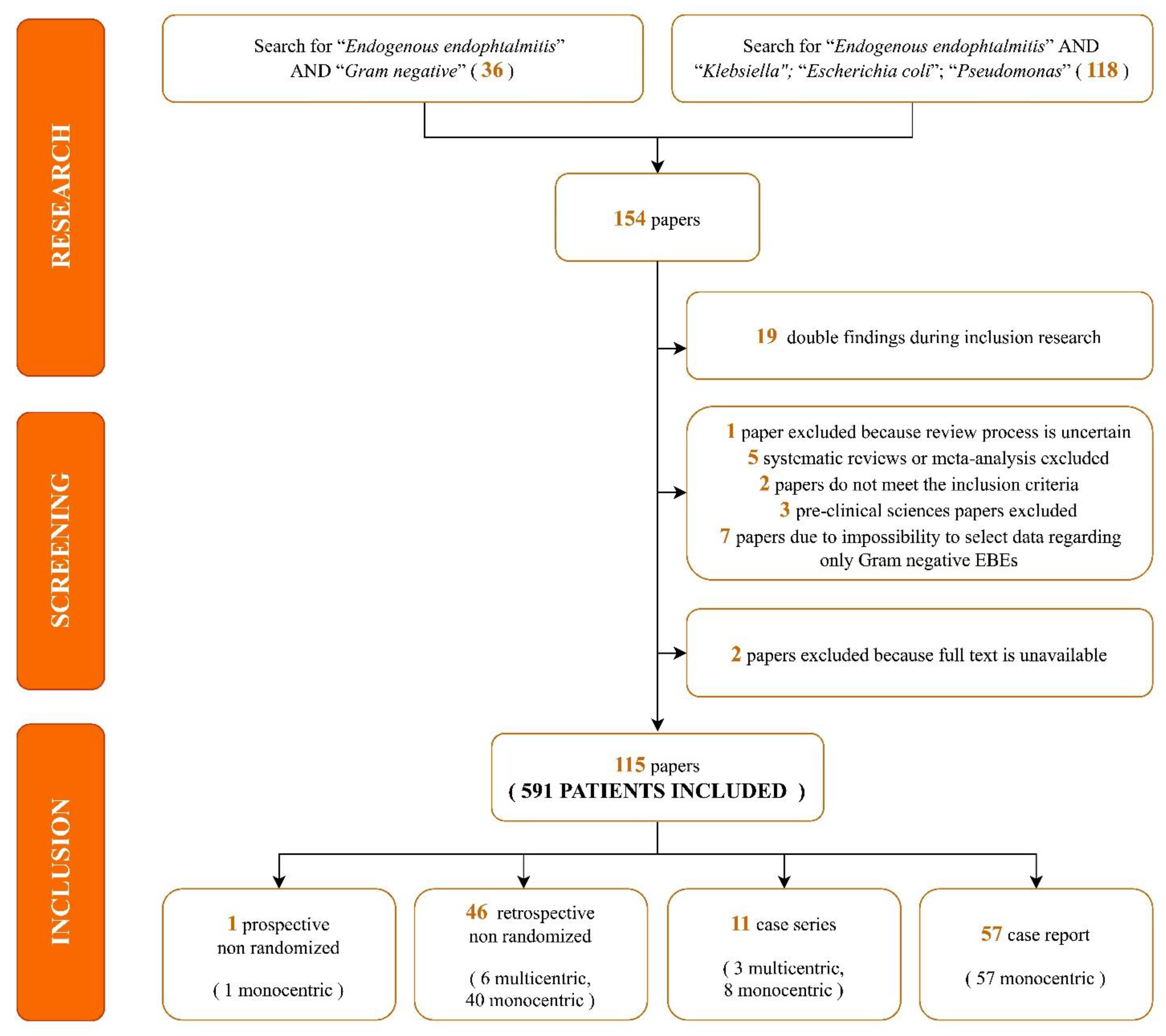
3.1. Study Selection and Search Results
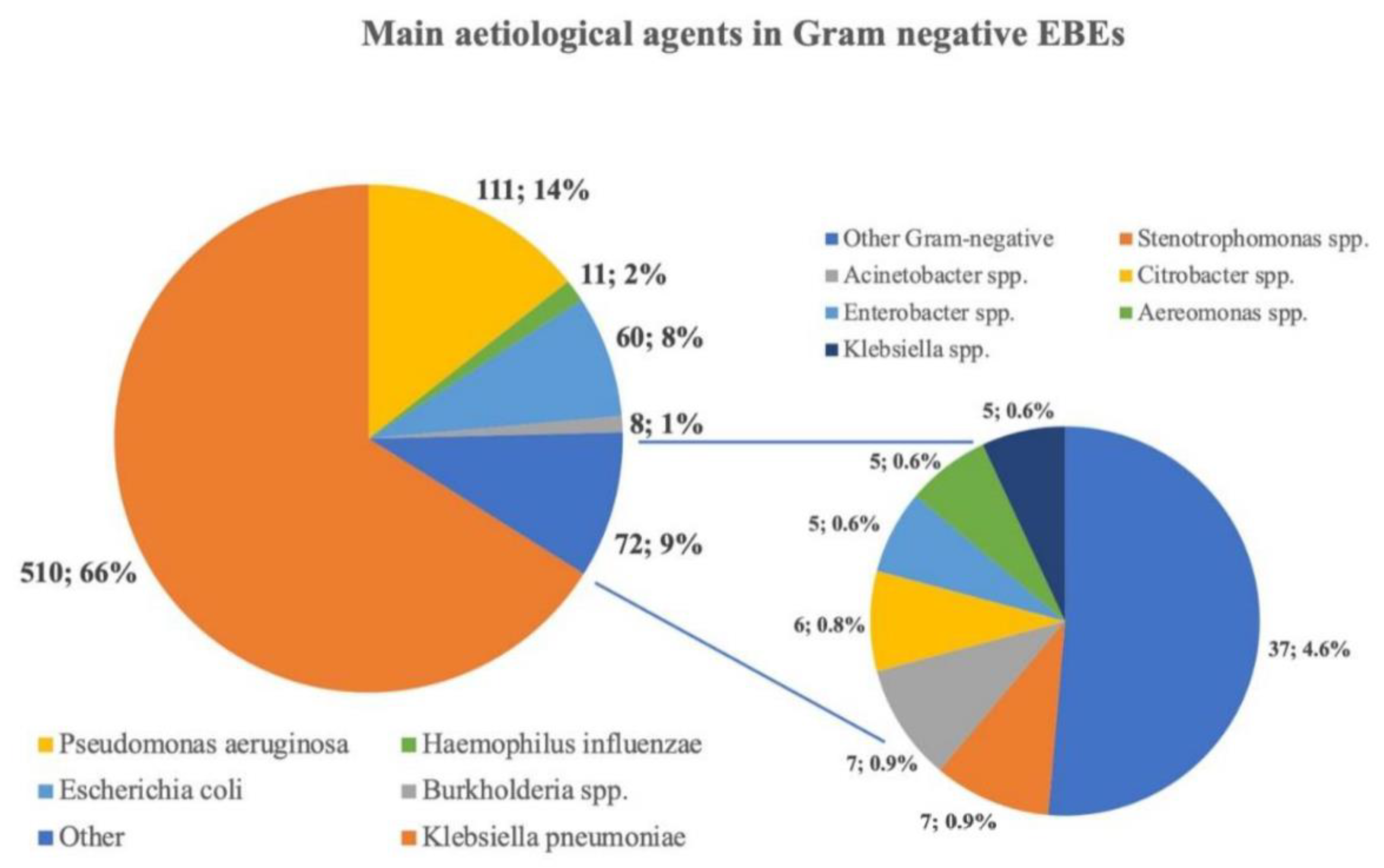
3.2. Results of Synthesis
4. Discussion
5. Conclusions
Author Contributions
Funding
Institutional Review Board Statement
Informed Consent Statement
Data Availability Statement
Conflicts of Interest
References
- Durand, M.L. Bacterial and Fungal Endophthalmitis. Clin. Microbiol. Rev. 2017, 30, 597–613. [Google Scholar] [CrossRef] [PubMed]
- Regan, K.A.; Radhakrishnan, N.S.; Hammer, J.D.; Wilson, B.D.; Gadkowski, L.B.; Iyer, S.S.R. Endogenous Endophthalmitis: Yield of the Diagnostic Evaluation. BMC Ophthalmol. 2020, 20, 138. [Google Scholar] [CrossRef] [PubMed]
- Durand, M.L. Endophthalmitis. Clin. Microbiol. Infect. 2013, 19, 227–234. [Google Scholar] [CrossRef] [PubMed]
- Coburn, P.S.; Wiskur, B.J.; Miller, F.C.; LaGrow, A.L.; Astley, R.A.; Elliott, M.H.; Callegan, M.C. Bloodstream-To-Eye Infections Are Facilitated by Outer Blood-Retinal Barrier Dysfunction. PLoS ONE 2016, 11, e0154560. [Google Scholar] [CrossRef]
- Wilson, B.D.; Relhan, N.; Miller, D.; Flynn, H.W. Gram-Negative Bacteria from Patients with Endophthalmitis: Distribution of Isolates and Antimicrobial Susceptibilities. Retin. Cases Brief Rep. 2019, 13, 54–56. [Google Scholar] [CrossRef]
- de Francesco, M.A.; Tiecco, G.; Scaltriti, E.; Piccinelli, G.; Corbellini, S.; Gurrieri, F.; Crosato, V.; Moioli, G.; Marchese, V.; Focà, E.; et al. First Italian Report of a Liver Abscess and Metastatic Endogenous Endophthalmitis Caused by ST-23 Hypervirulent Klebsiella pneumoniae in an Immunocompetent Individual. Infection 2022. [Google Scholar] [CrossRef]
- Gajdzis, M.; Figuła, K.; Kamińska, J.; Kaczmarek, R. Endogenous Endophthalmitis—The Clinical Significance of the Primary Source of Infection. J. Clin. Med. 2022, 11, 1183. [Google Scholar] [CrossRef]
- Cunningham, C.; Widder, J.; Raiji, V. Endophthalmitis. Dis.-A-Mon. 2017, 63, 45–48. [Google Scholar] [CrossRef]
- Simakurthy, S.; Tripathy, K. Endophthalmitis. In StatPearls [Internet]; StatPearls Publishing: Treasure Island, FL, USA, 2022. [Google Scholar]
- Page, M.J.; McKenzie, J.E.; Bossuyt, P.M.; Boutron, I.; Hoffmann, T.C.; Mulrow, C.D.; Shamseer, L.; Tetzlaff, J.M.; Akl, E.A.; Brennan, S.E.; et al. The PRISMA 2020 Statement: An Updated Guideline for Reporting Systematic Reviews. BMJ 2021, 372, n71. [Google Scholar] [CrossRef]
- Danielescu, C.; Anton, N.; Stanca, H.T.; Munteanu, M. Endogenous Endophthalmitis: A Review of Case Series Published between 2011 and 2020. J. Ophthalmol. 2020, 2020, 1–13. [Google Scholar] [CrossRef]
- Samalia, P.D.; Welch, S.; Polkinghorne, P.J.; Niederer, R.L. Endogenous Endophthalmitis: A 21-Year Review of Cases at a Tertiary Eye Care Centre. Ocul. Immunol. Inflamm. 2022, 30, 1414–1419. [Google Scholar] [CrossRef] [PubMed]
- Kittisupamongkol, W. Correspondence: Fastidious Gram-Negative Bacilli Such as HACEK and Haemophilus as Causes of Bilateral Endogenous Endophthalmitis. Retina 2010, 30, 187. [Google Scholar] [CrossRef] [PubMed]
- Chew, K.L.; Lin, R.T.P.; Teo, J.W.P. Klebsiella pneumoniae in Singapore: Hypervirulent Infections and the Carbapenemase Threat. Front. Cell. Infect. Microbiol. 2017, 7, 515. [Google Scholar] [CrossRef] [PubMed]
- Hussain, I.; Ishrat, S.; Ho, D.C.W.; Khan, S.R.; Veeraraghavan, M.A.; Palraj, B.R.; Molton, J.S.; Abid, M.B. Endogenous Endophthalmitis in Klebsiella pneumoniae Pyogenic Liver Abscess: Systematic Review and Meta-Analysis. Int. J. Infect. Dis. 2020, 101, 259–268. [Google Scholar] [CrossRef] [PubMed]
- Teweldemedhin, M.; Gebreyesus, H.; Atsbaha, A.H.; Asgedom, S.W.; Saravanan, M. Bacterial Profile of Ocular Infections: A Systematic Review. BMC Ophthalmol. 2017, 17, 212. [Google Scholar] [CrossRef]
- Pollreisz, A.; Rafferty, B.; Kozarov, E.; Lalla, E. Klebsiella pneumoniae Induces an Inflammatory Response in Human Retinal-Pigmented Epithelial Cells. Biochem. Biophys. Res. Commun. 2012, 418, 33–37. [Google Scholar] [CrossRef]
- Motta, C.; Salmeri, M.; Anfuso, C.D.; Amodeo, A.; Scalia, M.; Toscano, M.A.; Giurdanella, G.; Alberghina, M.; Lupo, G. Klebsiella pneumoniae Induces an Inflammatory Response in an in Vitro Model of Blood-Retinal Barrier. Infect. Immun. 2014, 82, 851–863. [Google Scholar] [CrossRef]
- Selva Pandiyan, A.; Siva Ganesa Karthikeyan, R.; Rameshkumar, G.; Sen, S.; Lalitha, P. Identification of Bacterial and Fungal Pathogens by RDNA Gene Barcoding in Vitreous Fluids of Endophthalmitis Patients. Semin. Ophthalmol. 2020, 35, 358–364. [Google Scholar] [CrossRef]
- Cheng, H.-P.; Chang, F.-Y.; Fung, C.-P.; Siu, L.-K. Klebsiella pneumoniae Liver Abscess in Taiwan Is Not Caused by a Clonal Spread Strain. J. Microbiol. Immunol. Infect. 2002, 35, 85–88. [Google Scholar]
- Kashani, A.H.; Eliott, D. Bilateral Klebsiella pneumoniae (K1 Serotype) Endogenous Endophthalmitis as the Presenting Sign of Disseminated Infection. Ophthalmic Surg. Lasers Imaging Retin. 2011, 42, e12–e14. [Google Scholar] [CrossRef]
- Sheu, S.-J.; Chou, L.-C.; Hong, M.-C.; Hsiao, Y.-C.; Liu, Y.-C. Risk Factors for Endogenous Endophthalmitis Secondary to Klebsiella pneumoniae Liver Abscess. Zhonghua Yi Xue Za Zhi (Taipei) 2002, 65, 534–539. [Google Scholar] [CrossRef] [PubMed]
- Connell, P.P.; O’Neill, E.C.; Fabinyi, D.; Islam, F.M.A.; Buttery, R.; McCombe, M.; Essex, R.W.; Roufail, E.; Clark, B.; Chiu, D.; et al. Endogenous Endophthalmitis: 10-Year Experience at a Tertiary Referral Centre. Eye 2011, 25, 66–72. [Google Scholar] [CrossRef] [PubMed]
- Ramakrishnan, R.; Bharathi, M.J.; Shivkumar, C.; Mittal, S.; Meenakshi, R.; Khadeer, M.A.; Avasthi, A. Microbiological Profile of Culture-Proven Cases of Exogenous and Endogenous Endophthalmitis: A 10-Year Retrospective Study. Eye 2009, 23, 945–956. [Google Scholar] [CrossRef] [PubMed]
- Zhang, M.; Xu, G.-Z.; Jiang, R.; Ni, Y.-Q.; Wang, K.-Y.; Gu, R.-P.; Ding, X.-Y. Pediatric Infectious Endophthalmitis: A 271-Case Retrospective Study at a Single Center in China. Chin. Med. J. 2016, 129, 2936–2943. [Google Scholar] [CrossRef] [PubMed]
- Kim, C.H.; Chen, M.F.; Coleman, A.L. Adjunctive Steroid Therapy versus Antibiotics Alone for Acute Endophthalmitis after Intraocular Procedure. Cochrane Database Syst. Rev. 2017, 2017, CD012131. [Google Scholar] [CrossRef]
- Varghese, B.; Rodrigues, C.; Deshmukh, M.; Natarajan, S.; Kamdar, P.; Mehta, A. Broad-Range Bacterial and Fungal DNA Amplification on Vitreous Humor from Suspected Endophthalmitis Patients. Mol. Diagn. Ther. 2006, 10, 319–326. [Google Scholar] [CrossRef]
- Kaburaki, T.; Takamoto, M.; Araki, F.; Fujino, Y.; Nagahara, M.; Kawashima, H.; Numaga, J. Endogenous Candida albicans Infection Causing Subretinal Abscess. Int. Ophthalmol. 2010, 30, 203–206. [Google Scholar] [CrossRef]
- Hu, C.-C.; Ho, J.-D.; Lou, H.-Y.; Keller, J.J.; Lin, H.-C. A One-Year Follow-up Study on the Incidence and Risk of Endophthalmitis after Pyogenic Liver Abscess. Ophthalmology 2012, 119, 2358–2363. [Google Scholar] [CrossRef]
- Wong, C.-H.; Kurup, A.; Wang, Y.-S.; Heng, K.-S.; Tan, K.-C. Four Cases of Necrotizing Fasciitis Caused by Klebsiella species. Eur. J. Clin. Microbiol. Infect. Dis. 2004, 23, 403–407. [Google Scholar] [CrossRef]
- Deepa, M.J.; Megharaj, C.; Patil, S.; Rani, P.K. Cryptococcus laurentii Endogenous Endophthalmitis Post COVID-19 Infection. BMJ Case Rep. 2022, 15, e246637. [Google Scholar] [CrossRef]
- Kuo, G.; Yen, C.-L.; Lu, Y.-A.; Chen, C.-Y.; Sun, M.-H.; Lin, Y.; Tian, Y.-C.; Hsu, H.-H. Clinical and Visual Outcomes Following Endogenous Endophthalmitis: 175 Consecutive Cases from a Tertiary Referral Center in Taiwan. J. Microbiol. Immunol. Infect. 2022, 55, 114–122. [Google Scholar] [CrossRef] [PubMed]
- Sanchez, J.M.; Elinav, H.; Tiosano, L.; Amer, R. Endophthalmitis Panorama in the Jerusalem Area. Int. Ophthalmol. 2022, 42, 1523–1535. [Google Scholar] [CrossRef] [PubMed]
- Qi, M.; He, L.; Zheng, P.; Shi, X. Clinical Features and Mortality of Endogenous Panophthalmitis in China: A Six-Year Study. Semin. Ophthalmol. 2022, 37, 208–214. [Google Scholar] [CrossRef] [PubMed]
- Zhu, J.; Xia, H.; Tang, R.; Ng, T.K.; Yao, F.; Liao, X.; Zhang, Q.; Ke, X.; Shi, T.; Chen, H. Metagenomic Next-Generation Sequencing Detects Pathogens in Endophthalmitis Patients. Retina 2022, 42, 992–1000. [Google Scholar] [CrossRef] [PubMed]
- Lourthai, P.; Choopong, P.; Dhirachaikulpanich, D.; Soraprajum, K.; Pinitpuwadol, W.; Punyayingyong, N.; Ngathaweesuk, Y.; Tesavibul, N.; Boonsopon, S. Visual Outcome of Endogenous Endophthalmitis in Thailand. Sci. Rep. 2021, 11, 14313. [Google Scholar] [CrossRef] [PubMed]
- Pillai, G.; Remadevi, K.; Anilkumar, V.; Radhakrishnan, N.; Rasheed, R.; Ravindran, G. Clinical Profile and Outcome of Endogenous Endophthalmitis at a Quaternary Referral Centre in South India. Indian J. Ophthalmol. 2020, 68, 827. [Google Scholar] [CrossRef]
- Tabatabaei, S.A.; Soleimani, M.; Mirshahi, R.; Bohrani, B.; Aminizade, M. Culture-Proven Endogenous Endophthalmitis: Microbiological and Clinical Survey. Int. Ophthalmol. 2020, 40, 3521–3528. [Google Scholar] [CrossRef]
- Gounder, P.A.; Hille, D.M.; Khoo, Y.J.; Phagura, R.S.; Chen, F.K. Endogenous Endophthalmitis In Western Australia. Retina 2020, 40, 908–918. [Google Scholar] [CrossRef]
- Dave, V.; Pathengay, A.; Panchal, B.; Jindal, A.; Datta, A.; Sharma, S.; Pappuru, R.; Joseph, J.; Jalali, S.; Das, T. Clinical Presentations, Microbiology and Management Outcomes of Culture-Proven Endogenous Endophthalmitis in India. Indian J. Ophthalmol. 2020, 68, 834. [Google Scholar] [CrossRef]
- Yang, G.; Huang, X.; Jiang, S.; Xu, Z. Endogenous Endophthalmitis Caused by Klebsiella pneumoniae: A Ten-Year Retrospective Study in Western China. Ophthalmic Res. 2020, 63, 507–516. [Google Scholar] [CrossRef]
- Shrestha, S.; Manandhar, A. Microbiological Patterns of Endophthalmitis in a Tertiary Level Hospital of Kathmandu, Nepal. Nepal. J. Ophthalmol. 2020, 12, 262–269. [Google Scholar] [CrossRef] [PubMed]
- Wang, Y.; Wang, X.; Di, Y. Surgery Combined with Antibiotics for the Treatment of Endogenous Endophthalmitis Caused by Liver Abscess. BMC Infect. Dis. 2020, 20, 661. [Google Scholar] [CrossRef] [PubMed]
- Hsieh, M.-C.; Chen, S.-N.; Cheng, C.-Y.; Li, K.-H.; Chuang, C.-C.; Wu, J.-S.; Lee, S.-T.; Chiu, S.-L. Clinicomicrobiological Profile, Visual Outcome and Mortality of Culture-Proven Endogenous Endophthalmitis in Taiwan. Sci. Rep. 2020, 10, 12481. [Google Scholar] [CrossRef] [PubMed]
- Silpa-archa, S.; Ponwong, A.; Preble, J.M.; Foster, C.S. Culture-Positive Endogenous Endophthalmitis: An Eleven-Year Retrospective Study in the Central Region of Thailand. Ocul. Immunol. Inflamm. 2017, 26, 1–10. [Google Scholar] [CrossRef]
- Celiker, H.; Kazokoglu, H. Ocular Culture-Proven Endogenous Endophthalmitis: A 5-Year Retrospective Study of the Microorganism Spectrum at a Tertiary Referral Center in Turkey. Int. Ophthalmol. 2019, 39, 1743–1751. [Google Scholar] [CrossRef]
- Chung, C.Y.; Wong, E.S.; Liu, C.C.H.; Wong, M.O.M.; Li, K.K.W. Clinical Features and Prognostic Factors of Klebsiella Endophthalmitis—10-Year Experience in an Endemic Region. Eye 2017, 31, 1569–1575. [Google Scholar] [CrossRef]
- Chen, S.-C.; Lee, Y.-Y.; Chen, Y.-H.; Lin, H.-S.; Wu, T.-T.; Sheu, S.-J. Klebsiella pneumoniae Infection Leads to a Poor Visual Outcome in Endogenous Endophthalmitis: A 12-Year Experience in Southern Taiwan. Ocul. Immunol. Inflamm. 2017, 25, 870–877. [Google Scholar] [CrossRef]
- Kuo, G.; Lu, Y.-A.; Sun, W.-C.; Chen, C.-Y.; Kao, H.-K.; Lin, Y.; Lee, C.-H.; Hung, C.-C.; Tian, Y.-C.; Hsu, H.-H. Epidemiology and Outcomes of Endophthalmitis in Chronic Dialysis Patients: A 13-Year Experience in a Tertiary Referral Center in Taiwan. BMC Nephrol. 2017, 18, 270. [Google Scholar] [CrossRef]
- Chen, K.-J.; Chen, Y.-P.; Chao, A.-N.; Wang, N.-K.; Wu, W.-C.; Lai, C.-C.; Chen, T.-L. Prevention of Evisceration or Enucleation in Endogenous Bacterial Panophthalmitis with No Light Perception and Scleral Abscess. PLoS ONE 2017, 12, e0169603. [Google Scholar] [CrossRef]
- Satpathy, G.; Nayak, N.; Wadhwani, M.; Venkwatesh, P.; Kumar, A.; Sharma, Y.; Sreenivas, V. Clinicomicrobiological Profile of Endophthalmitis: A 10 Year Experience in a Tertiary Care Center in North India. Indian J. Pathol. Microbiol. 2017, 60, 214. [Google Scholar] [CrossRef]
- Cho, H.; Shin, Y.U.; Siegel, N.H.; Yu, H.G.; Sobrin, L.; Patel, A.; Durand, M.L.; Miller, J.W.; Husain, D. Endogenous Endophthalmitis in the American and Korean Population: An 8-Year Retrospective Study. Ocul. Immunol. Inflamm. 2016, 26, 1–8. [Google Scholar] [CrossRef] [PubMed]
- Ben Artsi, E.; Katz, G.; Kinori, M.; Moisseiev, J. Endophthalmitis Today: A Multispecialty Ophthalmology Department Perspective. Eur. J. Ophthalmol. 2016, 26, 71–77. [Google Scholar] [CrossRef] [PubMed]
- Falavarjani, K.G.; Alemzadeh, S.A.; Habibi, A.; Hadavandkhani, A.; Askari, S.; Pourhabibi, A. Pseudomonas aeruginosa Endophthalmitis: Clinical Outcomes and Antibiotic Susceptibilities. Ocul. Immunol. Inflamm. 2017, 25, 377–381. [Google Scholar] [CrossRef] [PubMed]
- Park, I.H.; Jun, C.H.; Wi, J.W.; Park, S.Y.; Lee, W.S.; Jung, S.I.; Park, C.H.; Joo, Y.E.; Kim, H.S.; Choi, S.K.; et al. Prevalence of and Risk Factors for Endogenous Endophthalmitis in Patients with Pyogenic Liver Abscesses. Korean J. Intern. Med. 2015, 30, 453. [Google Scholar] [CrossRef] [PubMed]
- Ratra, D.; Saurabh, K.; Das, D.; Nachiappan, K.; Nagpal, A.; Rishi, E.; Bhende, P.; Sharma, T.; Gopal, L. Endogenous Endophthalmitis: A 10-Year Retrospective Study at a Tertiary Hospital in South India. Asia Pac. J. Ophthalmol. (Phila) 2015, 4, 286–292. [Google Scholar] [CrossRef]
- Sridhar, J.; Kuriyan, A.E.; Flynn, H.W.; Miller, D. Endophthalmitis Caused by Pseudomonas aeruginosa. Retina 2015, 35, 1101–1106. [Google Scholar] [CrossRef]
- Lim, H.W.; Shin, J.W.; Cho, H.Y.; Kim, H.K.; Kang, S.W.; Song, S.J.; Yu, H.G.; Oh, J.R.; Kim, J.S.; Moon, S.W.; et al. Endogenous Endophthalmitis in the Korean Population. Retina 2014, 34, 592–602. [Google Scholar] [CrossRef]
- Jayasudha, R.; Narendran, V.; Manikandan, P.; Prabagaran, S.R. Identification of Polybacterial Communities in Patients with Postoperative, Posttraumatic, and Endogenous Endophthalmitis through 16S RRNA Gene Libraries. J. Clin. Microbiol. 2014, 52, 1459–1466. [Google Scholar] [CrossRef]
- Lee, J.Y.; Kim, K.H. Endogenous Endophthalmitis Complicated by Pyogenic Liver Abscess: A Review of 17 Years’ Experience at a Single Center. Digestion 2014, 90, 116–121. [Google Scholar] [CrossRef]
- Jalali, S.; Pehere, N.; Rani, P.K.; Bobbili, R.B.; Nalamada, S.; Motukupally, S.R.; Sharma, S. Treatment Outcomes and Clinicomicrobiological Characteristics of a Protocol-Based Approach for Neonatal Endogenous Endophthalmitis. Eur. J. Ophthalmol. 2014, 24, 424–436. [Google Scholar] [CrossRef]
- Kim, H.W.; Kim, S.Y.; Chung, I.Y.; Lee, J.E.; Lee, J.E.; Park, J.M.; Park, J.M.; Han, Y.S.; Oum, B.S.; Byon, I.S.; et al. Emergence of Enterococcus species in the Infectious Microorganisms Cultured from Patients with Endophthalmitis in South Korea. Infection 2014, 42, 113–118. [Google Scholar] [CrossRef] [PubMed]
- Lee, S.; Um, T.; Joe, S.G.; Hwang, J.-U.; Kim, J.-G.; Yoon, Y.H.; Lee, J.Y. Changes in the Clinical Features and Prognostic Factors Of Endogenous Endophthalmitis. Retina 2012, 32, 977–984. [Google Scholar] [CrossRef] [PubMed]
- Sheu, S.-J.; Kung, Y.-H.; Wu, T.-T.; Chang, F.-P.; Horng, Y.-H. Risk Factors for Endogenous Endophthalmitis Secondary to Klebsiella pneumoniae Liver Abscess: 20-Year Experience in Southern Taiwan. Retina 2011, 31, 2026–2031. [Google Scholar] [CrossRef] [PubMed]
- Chen, K.-J.; Sun, M.-H.; Lai, C.-C.; Wu, W.-C.; Chen, T.-L.; Kuo, Y.-H.; Chao, A.-N.; Hwang, Y.-S.; Chen, Y.-P.; Wang, N.-K.; et al. Endophthalmitis Caused by Pseudomonas aeruginosa In Taiwan. Retina 2011, 31, 1193–1198. [Google Scholar] [CrossRef]
- Chung, K.S.; Kim, Y.K.; Song, Y.G.; Kim, C.O.; Han, S.H.; Chin, B.S.; Gu, N.S.; Jeong, S.J.; Baek, J.-H.; Choi, J.Y.; et al. Clinical Review of Endogenous Endophthalmitis in Korea: A 14-Year Review of Culture Positive Cases of Two Large Hospitals. Yonsei Med. J. 2011, 52, 630. [Google Scholar] [CrossRef]
- Zhang, H.; Liu, Z. Endogenous Endophthalmitis: A 10-Year Review of Culture-Positive Cases in Northern China. Ocul. Immunol. Inflamm. 2010, 18, 133–138. [Google Scholar] [CrossRef]
- Chen, L.; Pai, V.; Levinson, R.; Sharpe, A.H.; Freeman, G.J.; Braun, J.; Gordon, L.K. Constitutive Neuronal Expression of the Immune Regulator, Programmed Death 1 (PD-1), Identified During Experimental Autoimmune Uveitis. Ocul. Immunol. Inflamm. 2009, 17, 47–55. [Google Scholar] [CrossRef]
- Sng, C.C.A.; Jap, A.; Chan, Y.H.; Chee, S.-P. Risk Factors for Endogenous Klebsiella Endophthalmitis in Patients with Klebsiella Bacteraemia: A Case-Control Study. Br. J. Ophthalmol. 2008, 92, 673–677. [Google Scholar] [CrossRef]
- Fan, J.C.; Niederer, R.L.; von Lany, H.; Polkinghorne, P.J. Infectious Endophthalmitis: Clinical Features, Management and Visual Outcomes. Clin. Exp. Ophthalmol. 2008, 36, 631–636. [Google Scholar] [CrossRef]
- Ness, T.; Pelz, K.; Hansen, L.L. Endogenous Endophthalmitis: Microorganisms, Disposition and Prognosis. Acta Ophthalmol. Scand. 2007, 85, 852–856. [Google Scholar] [CrossRef]
- Keswani, T.; Ahuja, V.; Changulani, M. Evaluation of Outcome of Various Treatment Methods for Endogenous Endophthalmitis. Indian J. Med. Sci. 2006, 60, 454–460. [Google Scholar] [CrossRef][Green Version]
- Leibovitch, I.; Lai, T.; Raymond, G.; Zadeh, R.; Nathan, F.; Selva, D. Endogenous Endophthalmitis: A 13-Year Review at a Tertiary Hospital in South Australia. Scand. J. Infect. Dis. 2005, 37, 184–189. [Google Scholar] [CrossRef]
- Chen, Y.-J.; Kuo, H.-K.; Wu, P.-C.; Kuo, M.-L.; Tsai, H.-H.; Liu, C.-C.; Chen, C.-H. A 10-Year Comparison of Endogenous Endophthalmitis Outcomes: An East Asian Experience with Klebsiella pneumoniae Infection. Retina 2004, 24, 383–390. [Google Scholar] [CrossRef]
- Schiedler, V.; Scott, I.U.; Flynn, H.W.; Davis, J.L.; Benz, M.S.; Miller, D. Culture-Proven Endogenous Endophthalmitis: Clinical Features and Visual Acuity Outcomes. Am. J. Ophthalmol. 2004, 137, 725–731. [Google Scholar] [CrossRef]
- Tan, Y.-M.; Chee, S.-P.; Soo, K.-C.; Chow, P. Ocular Manifestations and Complications of Pyogenic Liver Abscess. World J. Surg. 2004, 28, 38–42. [Google Scholar] [CrossRef]
- Jackson, T.L.; Eykyn, S.J.; Graham, E.M.; Stanford, M.R. Endogenous Bacterial Endophthalmitis: A 17-Year Prospective Series and Review of 267 Reported Cases. Surv. Ophthalmol. 2003, 48, 403–423. [Google Scholar] [CrossRef]
- Yoon, Y.H.; Lee, S.U.; Sohn, J.-H.; Lee, S.E. Result of Early Vitrectomy for Endogenous Klebsiella pneumoniae Endophthalmitis. Retina 2003, 23, 366–370. [Google Scholar] [CrossRef]
- Zhu, J.; Chen, F.; Xie, Z. Report of Four Cases of Endogenous Klebsiella pneumoniae Endophthalmitis Originated from Liver Abscess with Eye Complaints as the Initial Presentations. Ocul. Immunol. Inflamm. 2022, 30, 5–10. [Google Scholar] [CrossRef]
- Díaz, S.V.; González, J.A.P.; Galindo-Ferreiro, A.; Monar, P.S.C.; Tarancón, A.M.A.; Frutos, M.P.G.D. Liver Abscess and Endogenous Endophthalmitis Secondary to Klebsiella variicola in a Patient with Diabetes: First Reported Case. Arq. Bras. Oftalmol. 2022, 85, 324–326. [Google Scholar] [CrossRef]
- Aguilar-González, M.; Marín-Payá, E.; Pérez-López, M.; Bort-Martínez, M.Á.; Aviñó-Martínez, J.; España-Gregori, E. Posterior Scleral Perforation Due to Endogenous Endophthalmitis in a Pregnant with Selective IgA Deficiency. Rom. J. Ophthalmol. 2022, 66, 97–100. [Google Scholar] [CrossRef]
- Chen, H.C.; Schlenker, A.C.; Dolman, P.J.; Wong, V.A. Two Cases of Bilateral Blindness from Klebsiella pneumoniae Endogenous Endophthalmitis. Can. J. Ophthalmol. 2021, 56, e155–e157. [Google Scholar] [CrossRef]
- Bilgic, A.; Sudhalkar, A.; Gonzalez-Cortes, J.H.; March de Ribot, F.; Yogi, R.; Kodjikian, L.; Mathis, T. Endogenous Endophthalmitis in the Setting of COVID-19 Infection. Retina 2021, 41, 1709–1714. [Google Scholar] [CrossRef]
- Sinha, P.; Sinha, U.; Raj, A.; Pati, B.K. Bilateral Endogenous Endophthalmitis Complicated by Scleral Perforation: An Unusual Presentation. BMJ Case Rep. 2021, 14, e244547. [Google Scholar] [CrossRef]
- Zhang, N.; Xia, J.; Zhang, F.; Huang, R.; Chen, Z.; Liu, J. Case Report of Catheter-Related Klebsiella pneumoniae Endophthalmitis. Clin. Lab. 2021, 67. [Google Scholar] [CrossRef]
- Correia, C.; Lopes, S.; Mendes, S.; Almeida, N.; Figueiredo, P. Endogenous Endophthalmitis and Liver Abscess: A Metastatic Infection or a Coincidence? GE Port. J. Gastroenterol. 2021, 29, 426–431. [Google Scholar] [CrossRef]
- Kamau, E.; Allyn, P.R.; Beaird, O.E.; Ward, K.W.; Kwan, N.; Garner, O.B.; Yang, S. Endogenous Endophthalmitis Caused by ST66-K2 Hypervirulent Klebsiella pneumoniae, United States. Emerg. Infect. Dis. 2021, 27, 2215–2218. [Google Scholar] [CrossRef]
- Pentecost, G.S.; Kesterson, J. Pyogenic Liver Abscess and Endogenous Endophthalmitis Secondary to Klebsiella pneumoniae. Am. J. Emerg. Med. 2021, 41, 264.e1–264.e3. [Google Scholar] [CrossRef]
- Kurumkattil, R.; Trehan, H.; Tandel, K.; Sharma, V.; Dhar, S.; Mahapatra, T. Endogenous Endophthalmitis Secondary to Burkholderia cepacia: A Rare Presentation. Indian J. Ophthalmol. 2020, 68, 2283. [Google Scholar] [CrossRef]
- Rocha-de-Lossada, C.; Díaz Antonio, T.; Rachwani Anil, R.; Cuartero Jiménez, E. Meningoencephalitis Due to Endogenous Endophthalmitis by Klebsiella pneumoniae in a Diabetic Patient. Indian J. Ophthalmol. 2020, 68, 1456. [Google Scholar] [CrossRef]
- Fujita, M.; Takahashi, A.; Imaizumi, H.; Hayashi, M.; Okai, K.; Abe, K.; Ohira, H. Endogenous Endophthalmitis Associated with Pyogenic Liver Abscess Caused by Klebsiella pneumoniae. Intern. Med. 2019, 58, 2507–2514. [Google Scholar] [CrossRef]
- Blandford, A.D.; Wiggins, N.B.; Ansari, W.; Hwang, C.J.; Wilkoff, B.L.; Perry, J.D. Cautery Selection for Oculofacial Plastic Surgery in Patients with Implantable Electronic Devices. Eur. J. Ophthalmol. 2019, 29, 315–322. [Google Scholar] [CrossRef]
- Zhou, Y.; Wang, X.; Shen, J.; Lu, Z.; Liu, Y. Endogenous Endophthalmitis Caused by Carbapenem-Resistant Hypervirulent Klebsiella pneumoniae: A Case Report and Literature Review. Ocul. Immunol. Inflamm. 2019, 27, 1099–1104. [Google Scholar] [CrossRef]
- Dogra, M.; Singh, S.R.; Thattaruthody, F. Klebsiella pneumoniae Endogenous Endophthalmitis Mimicking a Choroidal Neovascular Membrane with Subretinal Hemorrhage. Ocul. Immunol. Inflamm. 2020, 28, 468–470. [Google Scholar] [CrossRef]
- Pillsbury, M.M.; Geha, R.M.; Edson, R.S. Sticky Business: A Syndrome of Mucoid Bacterial Spread. BMJ Case Rep. 2019, 12, e226956. [Google Scholar] [CrossRef]
- Xu, M.; Li, A.; Kong, H.; Zhang, W.; Chen, H.; Fu, Y.; Fu, Y. Endogenous Endophthalmitis Caused by a Multidrug-Resistant Hypervirulent Klebsiella pneumoniae Strain Belonging to a Novel Single Locus Variant of ST23: First Case Report in China. BMC Infect. Dis. 2018, 18, 669. [Google Scholar] [CrossRef]
- Rubin, U.; Benson, M.D.; Kulkarni, S.; Greve, M.D.J. Endogenous Endophthalmitis Due to Klebsiella pneumoniae from an Infected Gallbladder. Can. J. Ophthalmol. 2018, 53, e258–e260. [Google Scholar] [CrossRef]
- Mak, C.Y.; Sin, H.P.; Chan, V.C.; Young, A. Klebsiella Endophthalmitis as the Herald of Occult Colorectal Cancer. BMJ Case Rep. 2018, 2018, bcr-2017-223400. [Google Scholar] [CrossRef]
- Dogra, M.; Sharma, M.; Katoch, D.; Dogra, M. Management of Multi Drug Resistant Endogenous Klebsiella pneumoniae Endophthalmitis with Intravitreal and Systemic Colistin. Indian J. Ophthalmol. 2018, 66, 596. [Google Scholar] [CrossRef]
- Kim, S.-J.; Chu, S.T.; Lee, K.S.; Nam, S.W.; Choi, J.K.; Chung, J.W.; Kwon, H.C. Metastatic Endophthalmitis and Thyroid Abscess Complicating Klebsiella pneumoniae Liver Abscess. Clin. Mol. Hepatol. 2018, 24, 88–91. [Google Scholar] [CrossRef]
- Dadia, S.D.; Modi, R.R.; Shirwadkar, S.; Potdar, N.A.; Shinde, C.A.; Nair, A.G. Salmonella typhi Associated Endogenous Endophthalmitis: A Case Report and a Review of Literature. Ocul. Immunol. Inflamm. 2017, 26, 1–6. [Google Scholar] [CrossRef]
- Xu, H.; Fu, B.; Lu, C.; Xu, L.; Sun, J. Successful Treatment of Endogenous Endophthalmitis with Extensive Subretinal Abscess: A Case Report. BMC Ophthalmol. 2018, 18, 238. [Google Scholar] [CrossRef] [PubMed]
- Odouard, C.; Ong, D.; Shah, P.R.; Gin, T.; Allen, P.J.; Downie, J.; Lim, L.L.; McCluskey, P. Rising Trends of Endogenous Klebsiella pneumoniae Endophthalmitis in Australia. Clin. Exp. Ophthalmol. 2017, 45, 135–142. [Google Scholar] [CrossRef]
- Martel, A.; Butet, B.; Ramel, J.C.; Martiano, D.; Baillif, S. Medical Management of a Subretinal Klebsiella pneumoniae Abscess with Excellent Visual Outcome without Performing Vitrectomy. J. Fr. Ophtalmol. 2017, 40, 876–881. [Google Scholar] [CrossRef] [PubMed]
- Wood, E.H.; Powers, M.A.; Moshfeghi, D.M. Spontaneous Globe Rupture Due to Rapidly Evolving Endogenous Hypermucoid Klebsiella pneumoniae Endophthalmitis. Ophthalmic Surg. Lasers Imaging Retin. 2017, 48, 600–601. [Google Scholar] [CrossRef] [PubMed]
- Cheng, N.M.; Chandra, A.; Roufail, E.; Moodie, J.J.; Yeoh, J.; Allen, P.J.; Salinas-La Rosa, C.M.; Matthews, B.J. Chorioretinal Biopsy for the Diagnosis of Endogenous Endophthalmitis Due to Escherichia coli. Retin. Cases Brief Rep. 2017, 11, 30–33. [Google Scholar] [CrossRef]
- Al-Kharashi, A.S. Endogenous Endophthalmitis Caused by Brucella melitensis. Retin. Cases Brief Rep. 2016, 10, 165–167. [Google Scholar] [CrossRef]
- Memon, M.; Raman, V. Serratia marcescens Endogenous Endophthalmitis in an Immunocompetent Host. BMJ Case Rep. 2016. [Google Scholar] [CrossRef]
- Guber, J.; Saeed, M. Presentation and Outcome of a Cluster of Patients with Endogenous Endophthalmitis: A Case Series. Klin. Mon. Augenheilkd. 2015, 232, 595–598. [Google Scholar] [CrossRef]
- Siu, G.D.J.-Y.; Lo, E.C.-F.; Young, A. Endogenous Endophthalmitis with a Visual Acuity of 6/6. Case Rep. 2015. [Google Scholar] [CrossRef]
- Moore, P.P.; McGowan, G.F.; Sandhu, S.S.; Allen, P.J. Klebsiella pneumoniae Liver Abscess Complicated by Endogenous Endophthalmitis: The Importance of Early Diagnosis and Intervention. Med. J. Aust. 2015, 203, 300–301. [Google Scholar] [CrossRef]
- Shum, J.W.H.; Tsang, F.C.W.; Fung, K.S.C.; Li, K.K.W. Presumed Aggregatibacter aphrophilus Endogenous Endophthalmitis. Int. Ophthalmol. 2015, 35, 269–273. [Google Scholar] [CrossRef]
- Yin, W.; Zhou, H.; Li, C. Endogenous Klebsiella pneumoniae Endophthalmitis. Am. J. Emerg. Med. 2014, 32, 1300.e3–1300.e5. [Google Scholar] [CrossRef] [PubMed]
- Sahu, C.; Kumar, K.; Sinha, M.K.; Venkata, A.; Majji, A.B.; Jalali, S. Review of Endogenous Endophthalmitis during Pregnancy Including Case Series. Int. Ophthalmol. 2013, 33, 611–618. [Google Scholar] [CrossRef] [PubMed]
- Basu, S.; Kumar, A.; Kapoor, K.; Bagri, N.K.; Chandra, A. Neonatal Endogenous Endophthalmitis: A Report of Six Cases. Pediatrics 2013, 131, e1292–e1297. [Google Scholar] [CrossRef] [PubMed]
- Maruno, T.; Ooiwa, Y.; Takahashi, K.; Kodama, Y.; Takakura, S.; Ichiyama, S.; Chiba, T. A Liver Abscess Deprived a Healthy Adult of Eyesight: Endogenous Endophthalmitis Associated with a Pyogenic Liver Abscess Caused by Serotype K1 Klebsiella pneumonia. Intern Med. 2013, 52, 919–922. [Google Scholar] [CrossRef] [PubMed][Green Version]
- Sawada, A.; Komori, S.; Udo, K.; Suemori, S.; Mochizuki, K.; Yasuda, M.; Ohkusu, K. Case of Endogenous Endophthalmitis Caused by Klebsiella pneumoniae with MagA and RmpA Genes in an Immunocompetent Patient. J. Infect. Chemother. 2013, 19, 326–329. [Google Scholar] [CrossRef]
- Yusuf, I.H.; Sipkova, Z.; Patel, S.; Benjamin, L. Neisseria meningitidis Endogenous Endophthalmitis with Meningitis in an Immunocompetent Child. Ocul. Immunol. Inflamm. 2014, 22, 398–402. [Google Scholar] [CrossRef]
- Enani, M.A.; El-Khizzi, N.A. Community Acquired Klebsiella pneumoniae, K1 Serotype. Invasive Liver Abscess with Bacteremia and Endophthalmitis. Saudi Med. J. 2012, 33, 782–786. [Google Scholar]
- Suwan, Y.; Preechawai, P. Endogenous Klebsiella Panophthalmitis: Atypical Presentation. J. Med. Assoc. Thai. 2012, 95, 830–833. [Google Scholar]
- Al-Mahmood, A.M.; Al-Binali, G.Y.; AlKatan, H.; Abboud, E.B.; Abu El-Asrar, A.M. Endogenous Endophthalmitis Associated with Liver Abscess Caused by Klebsiella pneumoniae. Int. Ophthalmol. 2011, 31, 145–148. [Google Scholar] [CrossRef]
- Degoricija, V.; Skerk, V.; Vatavuk, Z.; Knezević, T.; Sefer, S.; Vućicević, Z. Bilateral Pseudomonas aeruginosa Endogenous Endophthalmitis in an Immune-Competent Patient with Nosocomial Urosepsis Following Abdominal Surgery. Acta Clin. Croat. 2011, 50, 261–266. [Google Scholar] [PubMed]
- Habeeb, S.Y.; Varma, D.K.; Ahmed, I.I.K. Oblique Illumination and Trypan Blue to Enhance Visualization through Corneal Scars in Cataract Surgery. Can. J. Ophthalmol. 2011, 46, 555–556. [Google Scholar] [CrossRef] [PubMed]
- Chen, K.-J.; Hwang, Y.-S.; Wang, N.-K.; Chao, A.-N. Endogenous Klebsiella pneumoniae Endophthalmitis with Renal Abscess: Report of Two Cases. Int. J. Infect. Dis. 2010, 14, e429–e432. [Google Scholar] [CrossRef] [PubMed]
- Shankar, K.; Gyanendra, L.; Hari, S.; Dev Narayan, S. Culture Proven Endogenous Bacterial Endophthalmitis in Apparently Healthy Individuals. Ocul. Immunol. Inflamm. 2009, 17, 396–399. [Google Scholar] [CrossRef] [PubMed]
- Chiu, C.-H.; Peng, M.-Y.; Chang, F.-Y.; Wang, Y.-C. Endogenous Endophthalmitis Caused by Citrobacter koseri. Am. J. Med. Sci. 2009, 338, 509–510. [Google Scholar] [CrossRef] [PubMed]
- Dodson, D.; Stewart, R.; Karcioglu, Z.; Conway, M.D.; Mushatt, D.; Ayyala, R.S. Klebsiella pneumoniae Endophthalmitis Secondary to Liver Abscess Presenting as Acute Iridocyclitis. Ophthalmic Surg. Lasers Imaging Retin. 2009, 40, 522–523. [Google Scholar] [CrossRef]
- Argelich, R.; Ibáñez-Flores, N.; Bardavio, J.; Burés-Jelstrup, A.; García-Segarra, G.; Coll-Colell, R.; Cuadrado, V.; Fernández-Monrás, F. Orbital Cellulitis and Endogenous Endophthalmitis Secondary to Proteus mirabilis Cholecystitis. Diagn. Microbiol. Infect. Dis. 2009, 64, 442–444. [Google Scholar] [CrossRef]
- Karama, E.M.; Willermain, F.; Janssens, X.; Claus, M.; van den Wijngaert, S.; Wang, J.-T.; Verougstraete, C.; Caspers, L. Endogenous Endophthalmitis Complicating Klebsiella pneumoniae Liver Abscess in Europe: Case Report. Int. Ophthalmol. 2008, 28, 111–113. [Google Scholar] [CrossRef]
- Luemsamran, P.; Pornpanich, K.; Vangveeravong, S.; Mekanandha, P. Orbital Cellulitis and Endophthalmitis in Pseudomonas Septicemia. Orbit 2008, 27, 455–457. [Google Scholar] [CrossRef]
- Li, K.K.W.; Tang, E.W.H.; Lai, J.S.M.; Wong, D. Pseudomonas aeruginosa Choroidal Abscess in a Patient with Bronchiectasis. Int. Ophthalmol. 2008, 28, 287–290. [Google Scholar] [CrossRef]
- Hu, V.; Zaidi, F.; Larkin, G.; Muir, G.; Stanford, M. Bilateral Endogenous Endophthalmitis after Holmium Laser Lithotripsy. Urology 2007, 70, 590.e13–590.e14. [Google Scholar] [CrossRef] [PubMed]
- Chen, K.-J.; Sun, M.-H.; Hou, C.-H.; Sun, C.-C.; Chen, T.-L. Burkholderia pseudomallei Endophthalmitis. J. Clin. Microbiol. 2007, 45, 4073–4074. [Google Scholar] [CrossRef] [PubMed][Green Version]
- Yodprom, R.; Pathanapitoon, K.; Kunavisarut, P.; Ausayakhun, S.; Wattananikorn, S.; Rothova, A. Endogenous Endophthalmitis Due to Salmonella choleraesuis in an HIV-Positive Patient. Ocul. Immunol. Inflamm. 2007, 15, 135–138. [Google Scholar] [CrossRef] [PubMed]
- DÍaz-Valle, D.; del Castillo, J.M.B.; Aceñero, M.J.F.; Santos-Bueso, E.; de La Casa, J.M.M.; Garcia-Sanchez, J. Endogenous Pseudomonas Endophthalmitis in an Immunocompetent Patient. Eur. J. Ophthalmol. 2007, 17, 461–463. [Google Scholar] [CrossRef] [PubMed]
- Seale, M.; Lee, W.-K.; Daffy, J.; Tan, Y.; Trost, N. Fulminant Endogenous Klebsiella pneumoniae Endophthalmitis: Imaging Findings. Emerg. Radiol. 2007, 13, 209–212. [Google Scholar] [CrossRef] [PubMed]
- Tan, V.E.S.; Jeevanan, J.; Lee, B.R. Parapharyngeal Abscess Complicated by Endophthalmitis: A Rare Presentation of Nasopharyngeal Carcinoma. J. Laryngol. Otol. 2008, 122, 867–870. [Google Scholar] [CrossRef]
- Dua, S.; Chalermskulrat, W.; Miller, M.B.; Landers, M.; Aris, R.M. Bilateral Hematogenous Pseudomonas aeruginosa Endophthalmitis after Lung Transplantation. Am. J. Transplant. 2006, 6, 219–224. [Google Scholar] [CrossRef]
- Takebayashi, K.; Matsumoto, S.; Nakagawa, Y.; Wakabayashi, S.; Aso, Y.; Inukai, T. Endogenous Endophthalmitis and Disseminated Intravascular Coagulation Complicating a Klebsiella pneumoniae Perirenal Abscess in a Patient with Type 2 Diabetes. Am. J. Med. Sci. 2005, 329, 157–160. [Google Scholar] [CrossRef]
- Motley, W.W.; Augsburger, J.J.; Hutchins, R.K.; Schneider, S.; Boat, T.F. Pseudomonas aeruginosa Endogenous Endophthalmitis With Choroidal Abscess in a Patient with Cystic Fibrosis. Retina 2005, 25, 202–207. [Google Scholar] [CrossRef]
- O’Keefe, M.; Nolan, L.; Lanigan, B.; Murphy, J. Pseudomonas aeruginosa Endophthalmitis in a Preterm Infant. J. AAPOS 2005, 9, 288–289. [Google Scholar] [CrossRef]
- Chan, W.-M.; Liu, D.T.L.; Fan, D.S.P.; Lau, T.T.Y.; Lam, D.S.C. Failure of Systemic Antibiotic in Preventing Sequential Endogenous Endophthalmitis of a Bronchiectasis Patient. Am. J. Ophthalmol. 2005, 139, 549–550. [Google Scholar] [CrossRef] [PubMed]
- Matasova, K.; Hudecova, J.; Zibolen, M. Bilateral Endogenous Endophthalmitis as a Complication of Late-Onset Sepsis in a Premature Infant. Eur. J. Pediatr. 2003, 162, 346–347. [Google Scholar] [CrossRef] [PubMed]
- Dohmen, K.; Okubo, H.; Okabe, H.; Ishibashi, H. Endophthalmitis with Klebsiella pneumoniae Liver Abscess. Fukuoka Igaku Zasshi 2003, 94, 31–36. [Google Scholar] [PubMed]
- Sullivan, P.; Clark, W.L.; Kaiser, P.K. Bilateral Endogenous Endophthalmitis Caused by HACEK Microorganism. Am. J. Ophthalmol. 2002, 133, 144–145. [Google Scholar] [CrossRef]
- Lin, H.-H.; Chien, C.-C.; Fang, J.-T.; Lai, R.-H.; Huang, C.-C. Unusual Clinical Presentation of Klebsiella pneumoniae Induced Endogenous Endophthalmitis and Xanthogranulomatous Pyelonephritis in A Non-Nephrolithiasis and Non-Obstructive Urinary Tract. Ren. Fail. 2002, 24, 659–665. [Google Scholar] [CrossRef]
- Xie, C.A.; Singh, J.; Tyagi, M.; Androudi, S.; Dave, V.P.; Arora, A.; Gupta, V.; Agrawal, R.; Mi, H.; Sen, A. Endogenous Endophthalmitis—A Major Review. Ocul. Immunol. Inflamm. 2022, 1–24. [Google Scholar] [CrossRef]
- ECDC. European Centre for Disease Prevention and Control. Risk Assessment: Emergence of Hypervirulent Klebsiella pneumoniae ST23 Carrying Carbapenemase Genes in EU/EEA Coun-tries. Available online: https://www.ecdc.europa.eu/en/publications-data/risk-assessment-emergence-hypervirulent-klebsiella-pneumoniae-eu-eea (accessed on 18 November 2022).
- Franchini, M.; Glingani, C.; de Donno, G.; Lucchini, G.; Beccaria, M.; Amato, M.; Castelli, G.P.; Bianciardi, L.; Pagani, M.; Ghirardini, M.; et al. Convalescent Plasma for Hospitalized COVID-19 Patients: A Single-Center Experience. Life 2022, 12, 420. [Google Scholar] [CrossRef]
- Modjtahedi, B.S.; Finn, A.V.; Papakostas, T.D.; Durand, M.; Husain, D.; Eliott, D. Intravenous Drug Use–Associated Endophthalmitis. Ophthalmol. Retin. 2017, 1, 192–199. [Google Scholar] [CrossRef]
- Kabbara, S.; Kelkar, N.; Conway, M.D.; Peyman, G.A. Endogenous Endophthalmitis: Etiology and Treatment. In Infectious Eye Diseases—Recent Advances in Diagnosis and Treatment; IntechOpen: London, UK, 2021. [Google Scholar] [CrossRef]
- Relhan, N.; Forster, R.K.; Flynn, H.W. Endophthalmitis: Then and Now. Am. J. Ophthalmol. 2018, 187, xx–xxvii. [Google Scholar] [CrossRef]
- Emami, S.; Kitayama, K.; Coleman, A.L. Adjunctive Steroid Therapy versus Antibiotics Alone for Acute Endophthalmitis after Intraocular Procedure. Cochrane Database Syst. Rev. 2022, 6, CD012131. [Google Scholar] [CrossRef]



| Country | Patients | Aetiology | Source of Infection | Comorbidities | N° of Eyes (n° RE, n° LE) | Monocular/Binocular | Surgery | Reference |
|---|---|---|---|---|---|---|---|---|
| Taiwan | 48 | Klebsiella pneumoniae 31 Pseudomonas aeruginosa 11 Escherichia coli 2 | Pneumonia 2 Other 20 | Diabetes mellitus 32 Hypertension 21 Renal disease 7 Cirrhosis 6 HIV 2 Malignancy 1 | 48 (RE 24 LE 24) | Monocular 48 | Vitrectomy 6 Enucleation 18 | [32] |
| Palestine | 2 | Klebsiella pneumoniae 2 | NA | Diabetes mellitus 2 Malignancy 1 | 2 (RE 1 LE 1) | Monocular 2 | NA | [33] |
| China | 15 | Klebsiella pneumoniae 13 Escherichia coli 1 | Liver abscess 8 Other 6 Pneumonia 4 | Diabetes mellitus 14 | 16 (RE 9 LE 7) | Monocular 14 Binocular 1 | Evisceration 8 | [34] |
| China | 4 | Klebsiella pneumoniae 4 | NA | NA | 4 (RE 2 LE 2) | Monocular 4 | NA | [35] |
| Thailand | 13 | Klebsiella pneumoniae 7 Other 4 Escherichia coli 1 Pseudomonas aeruginosa 1 | NA | NA | NA | NA | NA | [36] |
| India | 3 | Klebsiella pneumoniae 1 Pseudomonas aeruginosa 1 Haemophilus influenzae 1 | NA | NA | NA | NA | NA | [37] |
| Iran | NA | Klebsiella pneumoniae 14 Escherichia coli 9 Pseudomonas aeruginosa 6 | NA | NA | NA | NA | NA | [38] |
| Australia | NA | Klebsiella pneumoniae 9 Escherichia coli 1 Pseudomonas aeruginosa 1 | NA | NA | NA | NA | NA | [39] |
| India | NA | Other 28 Pseudomonas aeruginosa 15 Escherichia coli 8 Haemophilus influenzae 7 Klebsiella pneumoniae 6 | NA | NA | NA | NA | NA | [40] |
| China | 10 | Klebsiella pneumoniae 10 | Liver abscess 4 Pneumonia 2 BSI/Sepsis 5 Other 1 | Diabetes mellitus 5 Malignancy 2 Cardiovascular disease 1 Other 2 Chronic hepatitis 2 | 10 (RE 7 LE 3) | Monocular 10 | Vitrectomy 3 Evisceration 2 Exenteration 1 | [41] |
| Nepal | 2 | Pseudomonas aeruginosa 2 | NA | NA | NA | NA | NA | [42] |
| China | 9 | Klebsiella pneumoniae 8 Other 1 | Liver abscess 16 | NA | NA | NA | NA | [43] |
| Taiwan | NA | Klebsiella pneumoniae 44 Escherichia coli 9 Other 4 Pseudomonas aeruginosa 6 Haemophilus influenzae 1 | NA | NA | NA | NA | NA | [44] |
| Thailand | 14 | Klebsiella pneumoniae 9 Escherichia coli 3 Pseudomonas aeruginosa 2 | Pneumonia 1 Other 7 | Diabetes mellitus 7 Cirrhosis 2 Hypertension 1 Renal disease 1 | 14 (RE 9 LE 5) | Monocular 14 | Vitrectomy 7 Enucleation 1 | [45] |
| Turkey | 2 | Pseudomonas aeruginosa 1 Other 1 | NA | NA | NA | NA | NA | [46] |
| Hong Kong | 19 | Klebsiella pneumoniae 12 | Liver abscess 18 BSI/Sepsis 18 Pneumonia 3 Other 4 | Diabetes mellitus 10 Chronic hepatitis 3 | 24 (RE 10 LE 14) | Monocular 14 Binocular 5 | Vitrectomy 3 Evisceration 9 | [47] |
| Taiwan | 48 | Klebsiella pneumoniae 48 | Liver abscess 33 Pneumonia 2 Other 6 | Diabetes mellitus 34 Hypertension 17 Malignancy 7 Chronic hepatitis 4 | 10 (RE 2 LE 8) | Monocular 8 Binocular 1 | Vitrectomy 2 Enucleation 1 Evisceration 1 | [48] |
| Taiwan | 9 | Escherichia coli 3 Other 3 Pseudomonas aeruginosa 2 | NA | Diabetes mellitus 4 Hypertension 4 Malignancy 2 Drug abuse 1 | 58 (RE 27 LE 31) | Monocular 38 Binocular 10 | Vitrectomy 18 Enucleation 1 Evisceration 11 | [48] |
| Taiwan | 7 | Klebsiella pneumoniae 3 Pseudomonas aeruginosa 3 Other 1 | Pneumonia 1 Other 1 | Diabetes mellitus 5 Cirrhosis 1 | 8 (RE 5 LE 3) | Monocular 6 Binocular 1 | Vitrectomy 1 Enucleation 1 | [49] |
| Taiwan | 14 | Klebsiella pneumoniae 12 Escherichia coli 1 Pseudomonas aeruginosa 1 | Liver abscess 8 Pneumonia 1 Other 2 | Drug abuse 1 | 14 (RE 10 LE 4) | Monocular 14 | NA | [50] |
| India | 8 | Pseudomonas aeruginosa 6 Other 2 | NA | NA | 8 | Monocular 8 | NA | [51] |
| USA, South Korea | NA | Klebsiella pneumoniae 24 Escherichia coli 1 Haemophilus influenzae 1 Other 1 | NA | NA | 29 | NA | Evisceration 2 | [52] |
| Israel | 1 | Escherichia coli 1 | Other 1 | NA | NA | NA | NA | [53] |
| Iran | 1 | Pseudomonas aeruginosa 1 | NA | Diabetes mellitus 1 | NA | NA | Evisceration 1 | [54] |
| South Korea | 8 | Klebsiella pneumoniae 8 | Liver abscess 8 | NA | NA | NA | NA | [55] |
| India | 9 | Klebsiella pneumoniae 1 Pseudomonas aeruginosa 3 Other 4 | BSI/Sepsis 1 | NA | NA | NA | Vitrectomy 3 Evisceration 1 | [56] |
| India | 11 | Pseudomonas aeruginosa 5 Other 3 Escherichia coli 2 | NA | Diabetes mellitus 4 Gastrointestinal disorders 1 Cirrhosis 1 Chronic hepatitis 1 | 9 (RE 7 LE 2) | Monocular 9 | No surgery | [56] |
| USA | 2 | Pseudomonas aeruginosa 2 | BSI/Sepsis 1 | Other 1 Immunosuppression 1 Malignancy 1 | 2 | Monocular 2 | Enucleation 2 | [57] |
| South Korea | 23 | Klebsiella pneumoniae 20 Escherichia coli 1 Pseudomonas aeruginosa 1 | Liver abscess 17 Pneumonia 2 Other 1 | NA | 23 (RE 14 LE 9) | Monocular 23 | Vitrectomy 9 Enucleation 1 | [58] |
| India | 3 | Pseudomonas aeruginosa 1 Haemophilus influenzae 1 Other 2 | NA | NA | NA | NA | NA | [59] |
| Korea | 8 | Klebsiella pneumoniae 8 Escherichia coli 1 | Liver abscess 5 | Diabetes mellitus 4 Hypertension 3 Renal disease 3 None 2 Cardiovascular disease 1 Gastrointestinal disorders 1 Lung diseases 1 Other 1 | 8 (RE 5 LE 3) | Monocular 8 | Vitrectomy 2 Enucleation 1 | [60] |
| India | 14 | Pseudomonas aeruginosa 8 Other 4 Klebsiella pneumoniae 2 | BSI/Sepsis 11 | Pregnancy complications 3 Gastrointestinal disorders 1 | 17 (RE 11 LE 6) | Monocular 11 Binocular 3 | Vitrectomy 5 | [61] |
| South Korea | 8 | Klebsiella pneumoniae 6 Escherichia coli 1 Other 1 | NA | NA | 8 | Monocular 8 | NA | [62] |
| South Korea | 30 | Klebsiella pneumoniae 30 | Liver abscess 18 Pneumonia 5 Other 6 | Renal disease 2 Diabetes mellitus 12 Cirrhosis 6 Malignancy 3 Alcohol abuse 1 | NA | NA | NA | [63] |
| Taiwan | 42 | Klebsiella pneumoniae 42 | Liver abscess 42 | Diabetes mellitus 33 Hypertension 18 Gastrointestinal disorders 8 Other 3 | 53 (RE 24 LE 29) | Monocular 31 Binocular 11 | Vitrectomy 9 | [64] |
| Taiwan | 8 | Pseudomonas aeruginosa 8 | NA | NA | 9 (RE 5 LE 4) | Monocular 7Binocular 1 | Evisceration 7 | [65] |
| South Korea | 15 | Klebsiella pneumoniae 7 Pseudomonas aeruginosa 7 Escherichia coli 1 | Liver abscess 3 Pneumonia 2 Other 3 | Diabetes mellitus 6 Lung diseases 2 Hypertension 1 Renal disease 1 Chronic Hepatitis 3 Malignancy 1 None 1 | 15 | Monocular 15 | Vitrectomy 8 Evisceration 2 | [66] |
| China | 1 | Klebsiella pneumoniae 1 | Liver abscess 1 | Diabetes mellitus 1 | 1 (RE 1) | Monocular 1 | No surgery | [67] |
| Taiwan | 9 | Klebsiella pneumoniae 8 | BSI/Sepsis 8 Pneumonia 2 | Diabetes mellitus 5 Chronic hepatitis 1 Other 3 | 10 (RE 5 LE 5) | Monocular 8 Binocular 1 | Vitrectomy 1 | [68] |
| Singapore | 5 | Klebsiella pneumoniae 5 | Liver abscess 5 BSI/Sepsis 5 | Diabetes mellitus 4 Hypertension 1 | 7 (RE 4 LE 3) | Monocular 3 Binocular 2 | Vitrectomy 1 | [69] |
| New Zealand | NA | Other 3 | NA | NA | NA | NA | NA | [70] |
| Germany | 1 | Other 1 | NA | NA | 1 | Monocular 1 | NA | [71] |
| India | 2 | Klebsiella pneumoniae 1 Pseudomonas aeruginosa 1 | BSI/Sepsis 1 | Diabetes mellitus 1 Renal disease 1 Chronic hepatitis 1 | 2 (RE 1 LE 1) | Monocular 2 | Evisceration 1 | [72] |
| Australia | 1 | Pseudomonas aeruginosa 1 | Other 1 | Diabetes mellitus 1 | 1 (LE 1) | Monocular 1 | Evisceration 1 | [73] |
| Taiwan | 45 | Klebsiella pneumoniae 45 | Liver abscess 39 Pneumonia 5 Other 4 | NA | NA | NA | NA | [74] |
| Taiwan | 6 | Escherichia coli 2 Other 2 Pseudomonas aeruginosa 1 | NA | NA | 56 (RE 33 LE 23) | Monocular 34 Binocular 11 | Vitrectomy 6 | [74] |
| USA | 1 | Klebsiella pneumoniae 1 | BSI/Sepsis 1 | Diabetes mellitus 1 Hemopathy 1 | 1 (RE 1) | Monocular 10 | Evisceration 1 | [75] |
| Singapore | 10 | Klebsiella pneumoniae 10 | Liver abscess 10 | Diabetes mellitus 7 Cardiovascular disease 1 | 10 (RE 7 LE 3) | Monocular 10 | Vitrectomy 3 Evisceration 2 | [76] |
| United Kingdom | 7 | Klebsiella pneumoniae 1 Escherichia coli 4 Other 2 | Liver abscess 1 Other 5 | Diabetes mellitus 4 Other 1 Renal disease 2 Alcohol abuse 1 | 7 (RE 4 LE 3) | Monocular 7 | NA | [77] |
| South Korea | 7 | Klebsiella pneumoniae 7 | Liver abscess 4 BSI/Sepsis 2 | Diabetes mellitus 5 Cirrhosis 1 | 10 | NA | Vitrectomy 7 | [78] |
| China | 4 | Klebsiella pneumoniae 4 | Liver abscess 4 | Diabetes mellitus 2 | 4 (RE 2 LE 2) | Monocular 4 | Evisceration 4 | [79] |
| Spain | 1 | Other 1 | NA | Diabetes mellitus 1 | 1 (RE 1) | Monocular 1 | No surgery | [80] |
| Spain | 1 | Pseudomonas aeruginosa 1 | BSI/Sepsis 1 | Immunosuppression 1 Lung diseases 1 | 1 (RE 1) | Monocular 1 | No surgery | [81] |
| Canada | 2 | Klebsiella pneumoniae 2 | BSI/Sepsis 2 Liver abscess 1 Other 1 | Diabetes mellitus 1 Gastrointestinal disorders 1 | 4 (RE 2 LE 2) | Binocular 2 | Enucleation 2 | [82] |
| Germany, India, Mexico, France | 2 | Klebsiella pneumoniae 1 Other 1 | Other 1 | Lung diseases 1 Immunosuppression 1 Other 2 | 2 (RE 1 LE 1) | Monocular 2 | Vitrectomy 2 | [83] |
| India | 1 | Escherichia coli 1 | Other 1 | Diabetes mellitus 1 | 2 (RE 1 LE 1) | Binocular 1 | No surgery | [84] |
| China | 1 | Klebsiella pneumoniae 1 | BSI/Sepsis 1 | Diabetes mellitus 1 Other 1 | 1 (LE 1) | Monocular 1 | Vitrectomy 1 | [85] |
| Portugal | 1 | Klebsiella pneumoniae 1 | Liver abscess 1 | NA | 1 (RE 1) | Monocular 1 | Vitrectomy 1 | [86] |
| USA | 1 | Klebsiella pneumoniae 1 | NA | Diabetes mellitus 1 Drug abuse 1 | 1 (RE 1) | Monocular 1 | No surgery | [87] |
| USA | 1 | Klebsiella pneumoniae 1 | Liver abscess 1 | Chronic hepatitis 1 | 1 (LE 1) | Monocular 1 | No surgery | [88] |
| India | 1 | Other 1 | Other 1 | NA | 1 (RE 1) | Monocular 1 | Vitrectomy 1 | [89] |
| India | 1 | Klebsiella pneumoniae 1 | Other 1 | NA | 1 (LE 1) | Monocular 1 | Enucleation 1 | [90] |
| Japan | 2 | Klebsiella pneumoniae 1 | Liver abscess 2 | Diabetes mellitus 1 Other 1 | 2 (RE 2) | Monocular 2 | Vitrectomy 3 Enucleation 1 | [91] |
| United Kingdom | 1 | Escherichia coli 1 | Other 1 | Gastrointestinal disorders 1 Hypertension 1 | 1 (LE 1) | Monocular 1 | NA | [92] |
| China | 1 | Klebsiella pneumoniae 1 | NA | Diabetes mellitus 1 Lung disease 1 | 1 (RE 1) | Monocular 1 | Vitrectomy 1 Enucleation 1 | [93] |
| India | 1 | Klebsiella pneumoniae 1 | NA | Chronic hepatitis 1 | 1 (LE 1) | Monocular 1 | NA | [94] |
| USA | 1 | Klebsiella pneumoniae 1 | Liver abscess 1 | Diabetes mellitus 1 | 1 (LE 1) | Monocular 1 | No surgery | [95] |
| China | 1 | Klebsiella pneumoniae 1 | Liver abscess 1 | Diabetes mellitus 1 | 1 (RE 1) | Monocular 1 | Vitrectomy 1 | [96] |
| Canada | 1 | Klebsiella pneumoniae 1 | Other 1 | Diabetes mellitus 1 Renal disease 1 | 1 (LE 1) | Monocular 1 | Vitrectomy 1 | [97] |
| China | 1 | Klebsiella pneumoniae 1 | Other 1 | Diabetes mellitus 1 Hypertension 1 | 1 (LE 1) | Monocular 1 | Vitrectomy 1 | [98] |
| India | 1 | Klebsiella pneumoniae 1 | Other 1 | None 1 | 1 (LE 1) | Monocular 1 | No surgery | [99] |
| South Korea | 1 | Klebsiella pneumoniae 1 | Liver abscess 1 | None 1 | 1 (RE 1) | Monocular 1 | Vitrectomy 1 | [100] |
| South Korea | 1 | Klebsiella pneumoniae 1 | Liver abscess 1 | None 1 | 1 (RE 1) | Monocular 1 | Vitrectomy 1 | [100] |
| India | 1 | Other 1 | BSI/Sepsis 1 | None 1 | 1 (LE 1) | Monocular 1 | Vitrectomy 1 Evisceration 1 | [101] |
| China | 1 | Klebsiella pneumoniae 1 | NA | Alcohol abuse 1 Gastrointestinal disorders 1 | 1 (RE 1) | Monocular 1 | Vitrectomy 1 | [102] |
| Australia | 4 | Klebsiella pneumoniae 4 | Liver abscess 4 Pneumonia 1 BSI/Sepsis 3 Other 1 | Dyslipidaemia 3 Diabetes mellitus 2 Hypertension 1 None 1 | 6 (RE 3 LE 3) | Monocular 2 Binocular 2 | Vitrectomy 4 Enucleation 1 | [103] |
| France | 1 | Klebsiella pneumoniae 1 | Liver abscess 1 | None 1 | 1 (LE 1) | Monocular 1 | No surgery | [104] |
| USA | 1 | Klebsiella pneumoniae 1 | BSI/Sepsis 1 | Diabetes mellitus 1 | 1 (RE 1) | Monocular 1 | Enucleation 1 | [105] |
| Australia | 1 | Escherichia coli 1 | NA | Diabetes mellitus 1 | 1 (LE 1) | Monocular 1 | Vitrectomy 1 | [106] |
| Saudi Arabia | 1 | Other 1 | Other 1 | NA | 1 (LE 1) | Monocular 1 | Vitrectomy 3 | [107] |
| United Kingdom | 1 | Other 1 | NA | Renal diseases 1 | 1 (LE 1) | Monocular 1 | No surgery | [108] |
| United Kingdom | 2 | Klebsiella pneumoniae 2 Pseudomonas aeruginosa 1 | Pneumonia 1 Other 1 | Diabetes mellitus 1 Renal diseases 1 | 3 | Monocular 1 Binocular 1 | NA | [109] |
| China | 1 | Klebsiella pneumoniae 1 | Liver abscess 1 | Diabetes mellitus 1 | 1 (LE 1) | Monocular 1 | Vitrectomy 1 | [110] |
| Australia | 1 | Klebsiella pneumoniae 1 | Liver abscess 1 | Dyslipidaemia 1 | 2 (RE 1 LE 1) | Binocular 1 | Vitrectomy 1 | [111] |
| China | 1 | Other 1 | NA | NA | 1 (LE 1) | Monocular 1 | Vitrectomy 1 | [112] |
| China | 1 | Klebsiella pneumoniae 1 | Pneumonia 1 BSI/Sepsis 1 | Other 1 Chronic hepatitis 1 | 2 (RE 1 LE 1) | Binocular 1 | No surgery | [113] |
| India | 1 | Klebsiella pneumoniae 1 | Other 1 | Pregnancy complications 1 | 1 (LE 1) | Monocular 1 | No surgery | [114] |
| India | 6 | Klebsiella pneumoniae 2 Pseudomonas aeruginosa 2 | NA | NA | NA | NA | NA | [115] |
| Japan | 1 | Klebsiella pneumoniae 1 | BSI/Sepsis 1 | None 1 | 2 (RE 1 LE 1) | Binocular 1 | No surgery | [116] |
| Japan | 1 | Klebsiella pneumoniae 1 | Other 1 | Other 2 | 1 (LE 1) | Monocular 1 | Vitrectomy 1 Enucleation 1 | [117] |
| United Kingdom | 1 | Other 1 | Other 1 | None 1 | 1 (RE 1) | Monocular 1 | No surgery | [118] |
| Saudi Arabia | 1 | Klebsiella pneumoniae 1 | Liver abscess 1 | Diabetes mellitus 1 | 1 (RE 1) | Monocular 1 | Vitrectomy 1 Evisceration 1 | [119] |
| Thailand | 1 | Klebsiella pneumoniae 1 | BSI/Sepsis 1 | Diabetes mellitus 1 | 1 (LE 1) | Monocular 1 | Vitrectomy 1 | [120] |
| Saudi Arabia | 2 | Klebsiella pneumoniae 2 | Liver abscess 2 | Diabetes mellitus 2 Cardiovascular disease 1 Hypertension 1 Lung diseases 1 | 3 (RE 1 LE 2) | Monocular 1 Binocular 1 | Vitrectomy 1 | [121] |
| Croatia | 1 | Pseudomonas aeruginosa 1 | BSI/Sepsis 1 | Hypertension 1 Cardiovascular disease 1 | 2 (RE 1 LE 1) | Binocular 1 | No surgery | [122] |
| Canada | 1 | Escherichia coli 1 | NA | Hypertension 1 | 1 (RE 1) | Monocular 1 | Vitrectomy 1 | [123] |
| Taiwan | 2 | Klebsiella pneumoniae 1 | Other 2 | Diabetes mellitus 2 | 3 (RE 2 LE 1) | Monocular 1 Binocular 1 | No surgery | [124] |
| Nepal | 2 | Escherichia coli 2 | NA | NA | 2 (RE 2) | Monocular 2 | NA | [125] |
| Taiwan | 1 | Citrobacter spp. 1 | Other 1 | NA | 1 (RE 1) | Monocular 1 | NA | [126] |
| USA | 1 | Klebsiella pneumoniae 1 | Liver abscess 1 | None 1 | 1 (RE 1) | Monocular 1 | Enucleation 1 | [127] |
| Spain | 1 | Other 1 | Other 1 | Diabetes mellitus 1 Other 1 | 1 (LE 1) | Monocular 1 | Evisceration 1 | [128] |
| Belgium | 1 | Klebsiella pneumoniae 1 | Liver abscess 1 | Diabetes mellitus 1 | 1 (RE 1) | Monocular 1 | No surgery | [129] |
| Thailand | 1 | Pseudomonas aeruginosa 1 | Other 1 | None 1 | 1 (LE 1) | Monocular 1 | No surgery | [130] |
| Hong Kong | 1 | Pseudomonas aeruginosa 1 | NA | Lung diseases 1 | 1 (RE 1) | Monocular 1 | Enucleation 1 | [131] |
| United Kingdom | 1 | Pseudomonas aeruginosa 1 | Other 1 | NA | 2 (RE 1 LE 1) | Binocular 1 | No surgery | [132] |
| Taiwan | 1 | Other 1 | NA | Diabetes mellitus 1 | 1 (RE 1) | Monocular 1 | No surgery | [133] |
| Thailand | 1 | Other 1 | BSI/Sepsis 1 | Other 1 | 1 (LE 1) | Monocular 1 | No surgery | [134] |
| Spain | 1 | Pseudomonas aeruginosa 1 | Pneumonia 1 | None 1 | 1 (RE 1) | Monocular 1 | Enucleation 1 | [135] |
| Australia | 1 | Klebsiella pneumoniae 1 | Liver abscess 1 | None 1 | 1 (RE 1) | Monocular 1 | Enucleation 1 Evisceration 1 | [136] |
| Malaysia | 1 | Klebsiella pneumoniae 1 | Other 1 | Diabetes mellitus 1 Malignancy 1 | 1 (LE 1) | Monocular 1 | Evisceration 1 | [137] |
| USA | 1 | Pseudomonas aeruginosa 1 | Other 1 | Lung diseases 1 Immunosuppression 1 | 2 (RE 1 LE 1) | Binocular 1 | Vitrectomy 1 | [138] |
| Japan | 1 | Klebsiella pneumoniae 1 | Other 1 | Diabetes mellitus 1 | 1 (RE 1) | Monocular 1 | No surgery | [139] |
| USA | 1 | Pseudomonas aeruginosa 1 | Pneumonia 1 | Lung diseases 1 | 1 (LE 1) | Monocular 1 | Vitrectomy 1 | [140] |
| Ireland | 1 | Pseudomonas aeruginosa 1 | BSI/Sepsis 1 | Pregnancy complications 1 | 1 (RE 1) | Monocular 1 | Evisceration 1 | [141] |
| China | 1 | Pseudomonas aeruginosa 1 | NA | Lung diseases 1 | 1 (RE 1) | Monocular 1 | Vitrectomy 1 | [142] |
| Slovakia | 1 | Pseudomonas aeruginosa 1 | BSI/Sepsis 1 | Pregnancy complications 1 | 2 (RE 1 LE 1) | Binocular 1 | No surgery | [143] |
| Japan | 1 | Klebsiella pneumoniae 1 | Liver abscess 1 | None 1 | 2 (RE 1 LE 1) | Binocular 2 | Enucleation 2 | [144] |
| USA | 1 | Other 1 | Other 1 | Other 1 | 2 (RE 1 LE 1) | Binocular 1 | Vitrectomy 2 | [145] |
| Taiwan | 1 | Klebsiella pneumoniae 1 | NA | Renal disease 1 | 1 (RE 1) | Monocular 1 | No surgery | [146] |
| Comorbidities | |
|---|---|
| Number of studies with available data | 84 |
| Number of patients included | 420 |
| Diabetes mellitus (n, %) | 231 (55.0%) |
| Hypertension (n, %) | 72 (17.1%) |
| Renal disease (n, %) | 21 (5.0%) |
| Malignancy (n, %) | 19 (4.5%) |
| Chronic hepatitis (n, %) | 18 (4.3%) |
| Cirrhosis (n, %) | 17 (4.0%) |
| Gastrointestinal disorders (n, %) | 14 (3.3%) |
| Lung diseases (n, %) | 11 (2.6%) |
| Other Cardiovascular diseases (n, %) | 7 (1.7%) |
| Immunosuppression (n, %) | 5 (1.2%) |
| Alcohol abuse (n, %) | 5 (1.2%) |
| Pregnancy complications (n, %) | 4 (0.9%) |
| People who inject drugs (n, %) | 3 (0.7%) |
| Other (n, %) | 29 (6.9%) |
| Source of Infection | |
|---|---|
| Number of studies with available data | 81 |
| Number of patients included | 488 |
| Liver abscess (n, %) | 266 (54.5%) |
| Bloodstream infections/sepsis (n, %) | 116 (23.8%) |
| Pneumonia (n, %) | 37 (7.6%) |
| Abdominal infections (n, %) | 37 (7.6%) |
| Urinary tract infections (n, %) | 26 (5.3%) |
| Acute bacterial skin and skin structures infections (n, %) | 8 (1.6%) |
| Post-surgery or medical procedures (n, %) | 8 (1.6%) |
| Other source of infection (n, %) | 19 (3.9%) |
| Initial Ocular Lesions | |
|---|---|
| Number of studies with available data | 70 |
| Number of eyes included | 270 |
| Vitreous opacity (n, %) | 134 (49.6%) |
| Hypopyon (n, %) | 95 (35.2%) |
| Redness (n, %) | 91 (33.7%) |
| Corneal involvement (n, %) | 66 (24.4%) |
| Anterior chamber reaction (n, %) | 46 (16.7%) |
| Swelling lid (n, %) | 37 (13.7%) |
| Retinal lesions (n, %) | 27 (10.0%) |
Disclaimer/Publisher’s Note: The statements, opinions and data contained in all publications are solely those of the individual author(s) and contributor(s) and not of MDPI and/or the editor(s). MDPI and/or the editor(s) disclaim responsibility for any injury to people or property resulting from any ideas, methods, instructions or products referred to in the content. |
© 2022 by the authors. Licensee MDPI, Basel, Switzerland. This article is an open access article distributed under the terms and conditions of the Creative Commons Attribution (CC BY) license (https://creativecommons.org/licenses/by/4.0/).
Share and Cite
Tiecco, G.; Laurenda, D.; Mulè, A.; Arsuffi, S.; Storti, S.; Migliorati, M.; Boldini, A.; Signorini, L.; Castelli, F.; Quiros-Roldan, E. Gram-Negative Endogenous Endophthalmitis: A Systematic Review. Microorganisms 2023, 11, 80. https://doi.org/10.3390/microorganisms11010080
Tiecco G, Laurenda D, Mulè A, Arsuffi S, Storti S, Migliorati M, Boldini A, Signorini L, Castelli F, Quiros-Roldan E. Gram-Negative Endogenous Endophthalmitis: A Systematic Review. Microorganisms. 2023; 11(1):80. https://doi.org/10.3390/microorganisms11010080
Chicago/Turabian StyleTiecco, Giorgio, Davide Laurenda, Alice Mulè, Stefania Arsuffi, Samuele Storti, Manuela Migliorati, Alessandro Boldini, Liana Signorini, Francesco Castelli, and Eugenia Quiros-Roldan. 2023. "Gram-Negative Endogenous Endophthalmitis: A Systematic Review" Microorganisms 11, no. 1: 80. https://doi.org/10.3390/microorganisms11010080
APA StyleTiecco, G., Laurenda, D., Mulè, A., Arsuffi, S., Storti, S., Migliorati, M., Boldini, A., Signorini, L., Castelli, F., & Quiros-Roldan, E. (2023). Gram-Negative Endogenous Endophthalmitis: A Systematic Review. Microorganisms, 11(1), 80. https://doi.org/10.3390/microorganisms11010080