


Fosfomycin Resistance: An Update on the Anthropogenic Impact Through Agriculture
 , , , , and
Abstract
1. Introduction
2. Fosfomycin—History and Application
3. Chemical Structure of Fosfomycin and Its Implications for Environmental Persistence
4. Mechanisms of Resistance to Fosfomycin
5. Agriculture’s Contribution to the Spread of Fosfomycin Resistance
5.1. Fosfomycinuse in Veterinary Medicine
5.2. Impact of Agricultural Practices on the Development of Resistance to Fosfomycin
5.2.1. Fertilisation
5.2.2. Plastics
5.2.3. Pesticides
5.2.4. Heavy Metals
5.2.5. Global Warming
6. Methodological Advancements in the Study of Fosfomycin Resistance
6.1. Classical and PCR-Based Methods
6.2. Meta-Omics Approaches
6.3. Functional Metagenomics
6.4. Quantitative and High-Throughput Detection Methods
6.5. Single-Cell Genomics and Flow Cytometry-Based Approaches
6.6. Emerging CRISPR-Based Detection
7. Attempts to Prevent the Spread of Fosfomycin Resistance
7.1. Global Frameworks
7.2. Regional (European Union) Initiatives
7.3. National Action Plans and Stewardship Guidelines
8. Conclusions
Author Contributions
Funding
Data Availability Statement
Acknowledgments
Conflicts of Interest
Abbreviations
| AMR | antimicrobial resistance |
| ANSM | The French National Agency for Medicines and Health Products Safety |
| BfArM | Federal Institute for Drugs and Medical Devices |
| ddPCR | digital droplet PCR |
| EC | European Comission |
| ECDC | European Centre for Disease Prevention and Control |
| EFSA | European Food Safety Agency |
| EMA | European Medicines Agency |
| EU | European Union |
| FACS | Fluorescence-activated cell sorting |
| FAO | Food and Agriculture Organization |
| FDA | Food and Drug Administration |
| GLASS | WHO Global Antimicrobial Resistance and Use Surveillance System |
| HPCIA | Highest Priority Critically Important Antimicrobials |
| MHRA | Medicines and Healthcare products Regulatory Agency |
| OPs | organophosphonates |
| PMDA | Pharmaceuticals and Medical Devices Agency |
| SLIPTA | Stepwise Laboratory Improvement Process Towards Accreditation |
| UNEP | The United Nations Environment Programme |
| WHO | World Health Organization |
| WOAH | World Organisation for Animal Health |
References
- WHO. WHO Bacterial Priority Pathogens List, 2024: Bacterial Pathogens of Public Health Importance to Guide Research, Development and Strategies to Prevent and Control Antimicrobial Resistance; WHO: Geneva, Switzerland, 2024. [Google Scholar]
- Naghavi, M.; Vollset, S.E.; Ikuta, K.S.; Swetschinski, L.R.; Gray, A.P.; Wool, E.E.; Robles Aguilar, G.; Mestrovic, T.; Smith, G.; Han, C.; et al. Global Burden of Bacterial Antimicrobial Resistance 1990–2021: A Systematic Analysis with Forecasts to 2050. Lancet 2024, 404, 1199–1226. [Google Scholar] [CrossRef]
- WHO. Analysis of Antibacterial Agents in Clinical and Preclinical Development: Overview and Analysis 2025; WHO: Geneva, Switzerland, 2025. [Google Scholar]
- Hashemian, S.M.R.; Farhadi, Z.; Farhadi, T. Fosfomycin: The Characteristics, Activity, and Use in Critical Care. Ther. Clin. Risk Manag. 2019, 15, 525–530. [Google Scholar] [CrossRef] [PubMed]
- WHO. WHO List of Medically Important Antimicrobials A Risk Management Tool for Mitigating Antimicrobial Resistance Due to Non-Human Use; WHO: Geneva, Switzerland, 2024. [Google Scholar]
- Pérez, D.; Tapia, M.; Soraci, A. Fosfomycin: Uses and Potentialities in Veterinary Medicine. Open Vet. J. 2014, 4, 2226–4485. [Google Scholar]
- WOAH List of Antimicrobial Agents of Veterinary Importance. Available online: https://www.woah.org/app/uploads/2021/06/amended-91gs-tech-03-amr-working-group-report-en.pdf (accessed on 30 November 2025).
- Campanile, F.; Wootton, M.; Davies, L.; Aprile, A.; Mirabile, A.; Pomponio, S.; Demetrio, F.; Bongiorno, D.; Walsh, T.R.; Stefani, S.; et al. Gold Standard Susceptibility Testing of Fosfomycin in Staphylococcus Aureus and Enterobacterales Using a New Agar Dilution Panel®. J. Glob. Antimicrob. Resist. 2020, 23, 334–337. [Google Scholar] [CrossRef]
- Nollkaemper, A. Building Alliances between the WHO, the FAO, WOAH and UNEP in: Unity in Diversity: Perspectives on the Law of International Organizations. In Unity in Diversity: Perspectives on the Law of International Organizations; Brill|Nijhoff: Leiden, The Netherlands, 2025; pp. 157–175. [Google Scholar]
- Lobermeyer, K. Cooperation Across International Organizations: Effects of Regime Complexity on the Quadripartite of One Health. Glob. Policy 2025, 16, 454–464. [Google Scholar] [CrossRef]
- WHO. One Health Initiative. Available online: https://www.who.int/teams/one-health-initiative/quadripartite-secretariat-for-one-health (accessed on 16 December 2025).
- Schmerold, I.; van Geijlswijk, I.; Gehring, R. European Regulations on the Use of Antibiotics in Veterinary Medicine. Eur. J. Pharm. Sci. 2023, 189, 106473. [Google Scholar] [CrossRef]
- Mattioni Marchetti, V.; Hrabak, J.; Bitar, I. Fosfomycin Resistance Mechanisms in Enterobacterales: An Increasing Threat. Front. Cell Infect. Microbiol. 2023, 13, 1178547. [Google Scholar] [CrossRef] [PubMed]
- Hendlin, D.; Stapley, E.O.; Jackson, M.; Wallick, H.; Miller, A.K.; Wolf, F.J.; Miller, T.W.; Chaiet, L.; Kahan, F.M.; Foltz, E.L.; et al. Phosphonomycin, a New Antibiotic Produced by Strains of Streptomyces. Science 1969, 166, 122–123. [Google Scholar] [CrossRef]
- Katayama, N.; Tsubotani, S.; Nozaki, Y.; Harada, S.; Ono, H. Fosfadecin and Fosfocytocin, New Nucleotide Antibiotics Produced by Bacteria. J. Antibiot. 1990, 43, 238–246. [Google Scholar] [CrossRef]
- Shoji, J.; Kato, T.; Hinoo, H.; Hattori, T.; Hirooka, K.; Matsumoto, K.; Tanimoto, T.; Kondo, E. Production of Fosfomycin (Phosphonomycin) by Pseudomonas Syringae. J. Antibiot. 1986, 39, 1011–1012. [Google Scholar] [CrossRef]
- Glamkowski, E.J.; Gal, G.; Purick, R.; Davidson, A.J.; Sletzinger, M. New Synthesis of the Antibiotic Phosphonomycin. J. Org. Chem. 2002, 35, 3510–3512. [Google Scholar] [CrossRef]
- Falagas, M.E.; Vouloumanou, E.K.; Samonis, G.; Vardakasa, K.Z. Fosfomycin. Clin. Microbiol. Rev. 2016, 29, 321–347. [Google Scholar] [CrossRef] [PubMed]
- Raz, R. Fosfomycin: An Old-New Antibiotic. Clin. Microbiol. Infect. 2012, 18, 4–7. [Google Scholar] [CrossRef]
- Cao, Y.; Peng, Q.; Li, S.; Deng, Z.; Gao, J. The Intriguing Biology and Chemistry of Fosfomycin: The Only Marketed Phosphonate Antibiotic. RSC Adv. 2019, 9, 42204. [Google Scholar] [CrossRef]
- Dijkmans, A.C.; Zacarías, N.V.O.; Burggraaf, J.; Mouton, J.W.; Wilms, E.B.; van Nieuwkoop, C.; Touw, D.J.; Stevens, J.; Kamerling, I.M.C. Fosfomycin: Pharmacological, Clinical and Future Perspectives. Antibiotics 2017, 6, 24. [Google Scholar] [CrossRef]
- Neuner, E.A.; Sekeres, J.; Hall, G.S.; Van Duin, D. Experience with Fosfomycin for Treatment of Urinary Tract Infections Due to Multidrug-Resistant Organisms. Antimicrob. Agents Chemother. 2012, 56, 5744–5748. [Google Scholar] [CrossRef] [PubMed]
- Furtak, A.; Szafranek-Nakonieczna, A.; Furtak, K.; Pytlak, A. A Review of Organophosphonates, Their Natural and An-thropogenic Sources, Environmental Fate and Impact on Microbial Greenhouse Gases Emissions—Identifying Knowledge Gaps. J. Environ. Manag. 2024, 355, 120453. [Google Scholar] [CrossRef]
- Li, S.; Liu, Z.; Süring, C.; Chen, L.; Müller, S.; Zeng, P. The Impact of the Antibiotic Fosfomycin on Wastewater Communities Measured by Flow Cytometry. Front. Microbiol. 2022, 12, 737831. [Google Scholar] [CrossRef]
- Rott, E.; Steinmetz, H.; Metzger, J.W. Organophosphonates: A Review on Environmental Relevance, Biodegradability and Removal in Wastewater Treatment Plants. Sci. Total Environ. 2018, 615, 1176–1191. [Google Scholar] [CrossRef]
- Kobayashi, S.; Kuzuyama, T.; Seto, H. Characterization of the FomA and FomB Gene Products from Streptomyces Wed-morensis, Which Confer Fosfomycin Resistance on Escherichia coli. Antimicrob. Agents Chemother. 2000, 44, 647–650. [Google Scholar] [CrossRef] [PubMed]
- Mendoza, C.; Garcia, J.M.; Llaneza, J.; Mendez, F.J.; Hardisson, C.; Ortiz, J.M. Plasmid-Determined Resistance to Fosfomycin in Serratia Marcescens. Antimicrob. Agents Chemother. 1980, 18, 215–219. [Google Scholar] [CrossRef] [PubMed]
- Huang, Y.; Lin, Q.; Zhou, Q.; Lv, L.; Wan, M.; Gao, X.; Wang, C.; Liu, J.H. Identification of FosA10, a Novel Plasmid-Mediated Fosfomycin Resistance Gene of Klebsiella Pneumoniae Origin, in Escherichia coli. Infect. Drug Resist. 2020, 13, 1273–1279. [Google Scholar] [CrossRef]
- Ye, Z.; Wang, L.; Liu, T.; Li, F.; Liu, Y.; Li, Z.; Zhu, Z.; Huang, J.; Wang, L.; Wang, X. The Prevalence, Antimicrobial Resistance and Molecular Genetic Characteristics of Fosfomycin-Resistant Klebsiella Pneumoniae Isolated from Raw Milk. Int. Dairy. J. 2024, 159, 106068. [Google Scholar] [CrossRef]
- Grilo, T.; Freire, S.; Miguel, B.; Martins, L.N.; Menezes, M.F.; Nordmann, P.; Poirel, L.; Sousa, M.J.R.; Aires-de-Sousa, M. Occurrence of Plasmid-Mediated Fosfomycin Resistance (Fos Genes) among Escherichia coli Isolates, Portugal. J. Glob. Antimicrob. Resist. 2023, 35, 342–346. [Google Scholar] [CrossRef]
- Zhang, Y.; Yang, C.; Yao, J.; Zhou, L.; Zhang, X.; Wang, H.; Liu, L.; Tu, Y.; Li, X. Spread of the Fosfomycin Resistance FosA3 Gene via the IS26 Mobile Element between Plasmids and the Chromosome of Carbapenem-Resistant Escherichia coli in China. J. Glob. Antimicrob. Resist. 2025, 42, 80–87. [Google Scholar] [CrossRef]
- Benzerara, Y.; Gallah, S.; Hommeril, B.; Genel, N.; Decré, D.; Rottman, M.; Arlet, G. Emergence of Plasmid-Mediated Fosfomycin-Resistance Genes among Escherichia coli Isolates, France. Emerg. Infect. Dis. 2017, 23, 1564–1567. [Google Scholar] [CrossRef] [PubMed]
- Abdelraheem, W.M.; Mahdi, W.K.M.; Abuelela, I.S.; Hassuna, N.A. High Incidence of Fosfomycin-Resistant Uropathogenic E. Coli among Children. BMC Infect. Dis. 2023, 23, 475. [Google Scholar] [CrossRef]
- Ríos, E.; del Carmen López Diaz, M.; Culebras, E.; Rodríguez-Avial, I.; Rodríguez-Avial, C. Resistance to Fosfomycin Is Increasing and Is Significantly Associated with Extended-Spectrum β-Lactamase-Production in Urinary Isolates of Escherichia coli. Med. Microbiol. Immunol. 2022, 211, 269–272. [Google Scholar] [CrossRef]
- Tartor, Y.H.; Abd El-Aziz, N.K.; Gharieb, R.M.A.; El Damaty, H.M.; Enany, S.; Soliman, E.A.; Abdellatif, S.S.; Attia, A.S.A.; Bahnass, M.M.; El-Shazly, Y.A.; et al. Whole-Genome Sequencing of Gram-Negative Bacteria Isolated From Bovine Mastitis and Raw Milk: The First Emergence of Colistin Mcr-10 and Fosfomycin FosA5 Resistance Genes in Klebsiella Pneumoniae in Middle East. Front. Microbiol. 2021, 12, 770813. [Google Scholar] [CrossRef]
- Xin, L.; Xu, X.; Shi, Q.; Han, R.; Wang, J.; Guo, Y.; Hu, F. High Prevalence and Overexpression of Fosfomycin-Resistant Gene FosX in Enterococcus Faecium From China. Front. Microbiol. 2022, 13, 900185. [Google Scholar] [CrossRef] [PubMed]
- Wiltsie, V.; Travis, S.; Shay, M.R.; Simmons, Z.; Frantom, P.; Thompson, M.K. Structural and Functional Characterization of Fosfomycin Resistance Conferred by FosB from Enterococcus faecium. Protein Sci. 2022, 31, 580–590. [Google Scholar] [CrossRef] [PubMed]
- Silver, L.L. Fosfomycin: Mechanism and Resistance. Cold Spring Harb. Perspect. Med. 2017, 7, a025262. [Google Scholar] [CrossRef] [PubMed]
- Lu, J.; Zhang, R.; Yu, Y.; Lou, H.; Li, D.; Bao, Q.; Feng, C. Identification of a Novel Chromosome-Encoded Fosfomycin Resistance Gene FosC3 in Aeromonas Caviae. Front. Microbiol. 2025, 16, 1577167. [Google Scholar] [CrossRef]
- Sun, L.; Wang, H.; Liu, Y.; Hong, Y.; Zhu, F.; Zhuang, H.; Wang, Z.; Yu, Y.; Chen, Y.; Chen, Y. Transmission of FosD-Carrying Methicillin-Resistant Staphylococcus Aureus ST764 in East Asia: Evidence of Human and Livestock Transmission. J. Glob. Antimicrob. Resist. 2025, 44, 379–385. [Google Scholar] [CrossRef] [PubMed]
- Kitanaka, H.; Wachino, J.I.; Jin, W.; Yokoyama, S.; Sasano, M.A.; Hori, M.; Yamada, K.; Kimura, K.; Arakawa, Y. Novel Integron-Mediated Fosfomycin Resistance Gene FosK. Antimicrob. Agents Chemother. 2014, 58, 4978–4979. [Google Scholar] [CrossRef] [PubMed]
- Khabthani, S.; Hamel, M.; Baron, S.A.; Diene, S.M.; Rolain, J.M.; Merhej, V. FosM, a New Family of Fosfomycin Resistance Genes Identified in Bacterial Species Isolated from Human Microbiota. Antimicrob. Agents Chemother. 2021, 65, e01712-20. [Google Scholar] [CrossRef]
- Zhang, R.; Yu, Y.; Huang, L.; Chen, S.; Hu, R.; Wang, X.; Huang, D.; Song, C.; Lu, J.; Bao, Q.; et al. Characterization of FosA13, a Novel Fosfomycin Glutathione Transferase Identified in a Morganella Morganii Isolate from Poultry. Front. Cell Infect. Microbiol. 2025, 15, 1534084. [Google Scholar] [CrossRef]
- Jiang, Y.; Shen, P.; Wei, Z.; Liu, L.; He, F.; Shi, K.; Wang, Y.; Wang, H.; Yu, Y. Dissemination of a Clone Carrying a FosA3-Harbouring Plasmid Mediates High Fosfomycin Resistance Rate of KPC-Producing Klebsiella Pneumoniae in China. Int. J. Antimicrob. Agents 2015, 45, 66–70. [Google Scholar] [CrossRef]
- Rehman, M.A.; Yin, X.; Persaud-Lachhman, M.G.; Diarra, M.S. First Detection of a Fosfomycin Resistance Gene, FosA7, in Salmonella Enterica Serovar Heidelberg Isolated from Broiler Chickens. Antimicrob. Agents Chemother. 2017, 61, e00410-17. [Google Scholar] [CrossRef]
- Ma, Y.; Xu, X.; Guo, Q.; Wang, P.; Wang, W.; Wang, M. Characterization of FosA5, a New Plasmid-mediated Fosfomycin Resistance Gene in Escherichia coli. Lett. Appl. Microbiol. 2015, 60, 259–264. [Google Scholar] [CrossRef]
- Poirel, L.; Vuillemin, X.; Kieffer, N.; Mueller, L.; Descombes, M.C.; Nordmann, P. Identification of FosA8, a Plas-mid-Encoded Fosfomycin Resistance Determinant from Escherichia coli, and Its Origin in Leclercia adecarboxylata. Antimicrob. Agents Chemother. 2019, 63, e01403-19. [Google Scholar] [CrossRef]
- Shehab, S.K.; Mohammed, R.K. Role of MurA and FosB Genes in Fosfomycin Resistance in Staphylococcus Aureus Isolated from Urinary Tract Infection Patients. Cuest. Fisioter. 2025, 54, 1126–1137. [Google Scholar] [CrossRef]
- Chen, Y.; Hong, Y.; Sun, L.; Yu, Y.; Chen, Y. Mining Staphylococcus Aureus Genomic Data for Identifying Fosfomycin Resistance Genes. Lancet Microbe 2024, 5, 626. [Google Scholar] [CrossRef]
- Yag, F.; Sezgin, F.M.; Sevim, E. Molecular Characterisation of Fosfomycin Resistance Genes in Escherichia coli Isolates. Folia Microbiol. 2025, 2025, 1–9. [Google Scholar] [CrossRef]
- Xu, W.; Chen, T.; Wang, H.; Zeng, W.; Wu, Q.; Yu, K.; Xu, Y.; Zhang, X.; Zhou, T. Molecular Mechanisms and Epidemiology of Fosfomycin Resistance in Staphylococcus Aureus Isolated From Patients at a Teaching Hospital in China. Front. Microbiol. 2020, 11, 1290. [Google Scholar] [CrossRef]
- Kieffer, N.; Poirel, L.; Descombes, M.C.; Nordmann, P. Characterization of FosL1, a Plasmid-Encoded Fosfomycin Re-sistance Protein Identified in Escherichia coli. Antimicrob. Agents Chemother. 2020, 64, e02042-19. [Google Scholar] [CrossRef] [PubMed]
- Chen, Y.; Ji, S.; Sun, L.; Wang, H.; Zhu, F.; Chen, M.; Zhuang, H.; Wang, Z.; Jiang, S.; Yu, Y.; et al. The Novel Fosfomycin Resistance Gene FosY Is Present on a Genomic Island in CC1 Methicillin-Resistant Staphylococcus Aureus. Emerg. Microbes Infect. 2022, 11, 1166–1173. [Google Scholar] [CrossRef]
- Hong, Y.; Chen, Y.; Zhang, J.; Zhang, H.; Wang, Z.; Zhao, F.; Sun, L.; Chen, M.; Zhu, F.; Zhuang, H.; et al. Identification of the Novel Fosfomycin Resistance Gene FosSC in Staphylococcus Capitis. Int. J. Antimicrob. Agents 2024, 63, 107162. [Google Scholar] [CrossRef]
- Xin, L.; Hu, Z.; Han, R.; Xu, X.; Wang, C.; Li, D.; Guo, Y.; Hu, F. Asp50Glu Mutation in MurA Results in Fosfomycin Resistance in Enterococcus Faecium. J. Glob. Antimicrob. Resist. 2022, 30, 50–55. [Google Scholar] [CrossRef] [PubMed]
- Raina, D.; Tiwari, H.; Sharma, S.; Deepika; Chinthakindi, P.K.; Nargotra, A.; Sangwan, P.L.; Eniyan, K.; Bajpai, U.; Vish-wakarma, R.A.; et al. Screening of Compound Library Identifies Novel Inhibitors against the MurA Enzyme of Escherichia coli. Appl. Microbiol. Biotechnol. 2021, 105, 3611–3623. [Google Scholar] [CrossRef] [PubMed]
- Takahata, S.; Ida, T.; Hiraishi, T.; Sakakibara, S.; Maebashi, K.; Terada, S.; Muratani, T.; Matsumoto, T.; Nakahama, C.; Tomono, K. Molecular Mechanisms of Fosfomycin Resistance in Clinical Isolates of Escherichia coli. Int. J. Antimicrob. Agents 2010, 35, 333–337. [Google Scholar] [CrossRef] [PubMed]
- Xu, S.; Fu, Z.; Zhou, Y.; Liu, Y.; Xu, X.; Wang, M. Mutations of the Transporter Proteins Glpt and Uhpt Confer Fosfomycin Resistance in Staphylococcus Aureus. Front. Microbiol. 2017, 8, 914. [Google Scholar] [CrossRef]
- Ma, Y.; Pirolo, M.; Giarratana, L.; Nielsen, K.L.; Häussler, S.; Guardabassi, L. Chromosomal Genes Modulating Fosfomycin Susceptibility in Uropathogenic Escherichia coli: A Genome-Wide Analysis. Antimicrob. Agents Chemother. 2025, 69, e01417-24. [Google Scholar] [CrossRef] [PubMed]
- Gil-Gil, T.; Martínez, J.L. Role of the Phosphotransferase System in the Transport of Fosfomycin in Escherichia coli. Int. J. Antimicrob. Agents 2024, 63, 107027. [Google Scholar] [CrossRef]
- Kurabayashi, K.; Hirakawa, Y.; Tanimoto, K.; Tomita, H.; Hirakawa, H. Role of the CpxAR Two-Component Signal Transduction System in Control of Fosfomycin Resistance and Carbon Substrate Uptake. J. Bacteriol. 2014, 196, 248–256. [Google Scholar] [CrossRef] [PubMed]
- Truong-Bolduc, Q.C.; Wang, Y.; Hooper, D.C. Tet38 Efflux Pump Contributes to Fosfomycin Resistance in Staphylococcus Aureus. Antimicrob. Agents Chemother. 2018, 62, e00927-18. [Google Scholar] [CrossRef]
- Food Safety Commission of Japan. Fosfomycin (Veterinary Medicinal Products): Summary. Food Saf. 2019, 7, 96. [Google Scholar] [CrossRef]
- Decree 39/2017/ND-CP. Available online: https://english.luatvietnam.vn/decree-no-39-2017-nd-cp-dated-april-4-2017-of-the-government-on-providing-the-regulatory-framework-for-animal-feeds-and-aqua-feeds-113523-doc1.html (accessed on 30 November 2025).
- Servicio Nacional De Sanidad y Calidad Agroalimentaria Resolution 445/2024. Available online: https://www.boletinoficial.gob.ar/detalleAviso/primera/306555/20240429 (accessed on 30 November 2025).
- Resolution 80/2025. Available online: https://www.boletinoficial.gob.ar/detalleAviso/primera/321082/20250213 (accessed on 30 November 2025).
- Portaria SDA Nr 798 DE 10/05/2023. Available online: https://www.legisweb.com.br/legislacao/?id=445358 (accessed on 30 November 2025).
- Biggel, M.; Zurfluh, K.; Treier, A.; Nüesch-Inderbinen, M.; Stephan, R. Characteristics of FosA-Carrying Plasmids in E. coli and Klebsiella Spp. Isolates Originating from Food and Environmental Samples. J. Antimicrob. Chemother. 2021, 76, 2004–2011. [Google Scholar] [CrossRef]
- Menck-Costa, M.F.; Baptista, A.A.S.; Gazal, L.E.S.; Justino, L.; Sanches, M.S.; de Souza, M.; Nishio, E.K.; Queiroz Dos Santos, B.; Cruz, V.D.; Berbert, J.V.M.; et al. High-Frequency Detection of FosA3 and BlaCTX–M–55 Genes in Escherichia coli From Longitudinal Monitoring in Broiler Chicken Farms. Front. Microbiol. 2022, 13, 846116. [Google Scholar] [CrossRef]
- Zhang, X.; Ma, M.; Cheng, Y.; Huang, Y.; Tan, Y.; Yang, Y.; Qian, Y.; Zhong, X.; Lu, Y.; Si, H. Spread and Molecular Char-acteristics of Enterobacteriaceae Carrying FosA-Like Genes from Farms in China. Microbiol. Spectr. 2022, 10, e00545-22. [Google Scholar] [CrossRef] [PubMed]
- Wang, X.M.; Dong, Z.; Schwarz, S.; Zhu, Y.; Hua, X.; Zhang, Y.; Liu, S.; Zhang, W.J. Plasmids of Diverse Inc Groups Dis-seminate the Fosfomycin Resistance Gene FosA3 among Escherichia coli Isolates from Pigs, Chickens, and Dairy Cows in Northeast China. Antimicrob. Agents Chemother. 2017, 61, e00859-17. [Google Scholar] [CrossRef]
- Lv, L.; Huang, X.; Wang, J.; Huang, Y.; Gao, X.; Liu, Y.; Zhou, Q.; Zhang, Q.; Yang, J.; Guo, J.-Y.; et al. Multiple Plasmid Vectors Mediate the Spread of FosA3 in Extended-Spectrum-β-Lactamase-Producing Enterobacterales Isolates from Retail Vege-tables in China. mSphere 2020, 5, e00507-20. [Google Scholar] [CrossRef]
- Ramadan, H.; Soliman, A.M.; Hiott, L.M.; Elbediwi, M.; Woodley, T.A.; Chattaway, M.A.; Jenkins, C.; Frye, J.G.; Jackson, C.R. Emergence of Multidrug-Resistant Escherichia coli Producing CTX-M, MCR-1, and FosA in Retail Food From Egypt. Front. Cell Infect. Microbiol. 2021, 11, 681588. [Google Scholar] [CrossRef] [PubMed]
- Juscele, F.; Saidenberg, A.B.S.; Christoffersen, L.E.B.; Edslev, S.M.; Hallstrøm, S.; Nacarato, J.R.; Barbosa, F.B.; Cunha, M.P.; Esposito, F.; Lincopan, N.H.; et al. Escherichia coli in Brazilian Poultry Fecal Samples: Co-Carriage of Fosfomycin and ESBL Resistance. Antibiotics 2025, 14, 269. [Google Scholar] [CrossRef]
- Munir, A.; Lu, X.; Humak, F.; Kürekci, C.; Mahmood, M.S.; Gul, S.; Wang, Z.; Mohsin, M.; Li, R. Emergence of Plas-mid-Mediated Fosfomycin Resistance among Escherichia coli Harboring FosA4, Tet (X4), and Mcr-1 Genes in Wild Birds. mSystems 2025, 10, e0167324. [Google Scholar] [CrossRef] [PubMed]
- Wang, J.; Wang, Y.; Wang, Z.Y.; Wu, H.; Mei, C.Y.; Shen, P.C.; Pan, Z.M.; Jiao, X. Chromosomally Located FosA7 in Sal-monella Isolates From China. Front. Microbiol. 2021, 12, 781306. [Google Scholar] [CrossRef] [PubMed]
- Haley, B.J.; Kim, S.W.; Van Kessel, J.A. Escherichia coli Isolated from Bovine Sources Encoding the Fosfomycin Resistance Gene FosA7.5. Foodborne Pathog. Dis. 2025, 22, 230–235. [Google Scholar] [CrossRef]
- Hu, J.; Chen, L.; Li, G.; Pan, Y.; Lu, Y.; Chen, J.; Xiong, W.; Zeng, Z. Prevalence and Genetic Characteristics of FosB-Positive Staphylococcus Aureus in Duck Farms in Guangdong, China in 2020. J. Antimicrob. Chemother. 2023, 78, 802–809. [Google Scholar] [CrossRef]
- Karki, A.B.; Neyaz, L.; Fakhr, M.K. Comparative Genomics of Plasmid-Bearing Staphylococcus Aureus Strains Isolated From Various Retail Meats. Front. Microbiol. 2020, 11, 574923. [Google Scholar] [CrossRef]
- Bello Gonzalez, T.D.J.; Van Gelderen, B.; Harders, F.; Bossers, A.; Brouwer, M.S.M.; Haenen, O.L.M. An Insight into the Presence of Antimicrobial Resistance Genes in Opportunistic Pathogenic Bacteria Isolated from Farm-Reared Crickets. Microorganisms 2025, 13, 391. [Google Scholar] [CrossRef]
- Liu, B.H.; Lei, C.W.; Zhang, A.Y.; Pan, Y.; Kong, L.H.; Xiang, R.; Wang, Y.X.; Yang, Y.X.; Wang, H.N. Colocation of the Multiresistance Gene Cfr and the Fosfomycin Resistance Gene FosD on a Novel Plasmid in Staphylococcus Arlettae from a Chicken Farm. Antimicrob. Agents Chemother. 2017, 61, e01388-17. [Google Scholar] [CrossRef]
- Huang, H.; Chen, H.; Zhao, R.; Chen, Y.; Hu, J.; Wan, P.; Zhang, L.; Xiong, W.; Chen, Y.; Li, Y.; et al. Characterization of fosS, a Novel Fosfomycin-Modifying Enzyme Gene Identified in Staphylococcus haemolyticus. One Health Adv. 2025, 3, 28. [Google Scholar] [CrossRef]
- Hölzel, C.S.; Schwaiger, K.; Harms, K.; Küchenhoff, H.; Kunz, A.; Meyer, K.; Müller, C.; Bauer, J. Sewage Sludge and Liquid Pig Manure as Possible Sources of Antibiotic Resistant Bacteria. Environ. Res. 2010, 110, 318–326. [Google Scholar] [CrossRef]
- Wang, H.; Qi, J.F.; Qin, R.; Ding, K.; Graham, D.W.; Zhu, Y.G. Intensified Livestock Farming Increases Antibiotic Resistance Genotypes and Phenotypes in Animal Feces. Commun. Earth Environ. 2023, 4, 123. [Google Scholar] [CrossRef]
- Chen, C.; Pankow, C.A.; Oh, M.; Heath, L.S.; Zhang, L.; Du, P.; Xia, K.; Pruden, A. Effect of Antibiotic Use and Composting on Antibiotic Resistance Gene Abundance and Resistome Risks of Soils Receiving Manure-Derived Amendments. Environ. Int. 2019, 128, 233–243. [Google Scholar] [CrossRef]
- Kelbrick, M.; Hesse, E.; O’ Brien, S. Cultivating Antimicrobial Resistance: How Intensive Agriculture Ploughs the Way for Antibiotic Resistance. Microbiology 2023, 169, 001384. [Google Scholar] [CrossRef]
- Tang, B.; Wang, J.; Zheng, X.; Chang, J.; Ma, J.; Wang, J.; Ji, X.; Yang, H.; Ding, B. Antimicrobial Resistance Surveillance of Escherichia coli from Chickens in the Qinghai Plateau of China. Front. Microbiol. 2022, 13, 885132. [Google Scholar] [CrossRef]
- Marutescu, L.G.; Jaga, M.; Postolache, C.; Barbuceanu, F.; Milita, N.M.; Romascu, L.M.; Schmitt, H.; de Roda Husman, A.M.; Sefeedpari, P.; Glaeser, S.; et al. Insights into the Impact of Manure on the Environmental Antibiotic Residues and Resistance Pool. Front. Microbiol. 2022, 13, 965132. [Google Scholar] [CrossRef]
- Marti, R.; Scott, A.; Tien, Y.C.; Murray, R.; Sabourin, L.; Zhang, Y.; Topp, E. Impact of Manure Fertilization on the Abundance of Antibiotic-Resistant Bacteria and Frequency of Detection of Antibiotic Resistance Genes in Soil and on Vegetables at Harvest. Appl. Environ. Microbiol. 2013, 79, 5701–5709. [Google Scholar] [CrossRef] [PubMed]
- Sun, S.; Lu, C.; Liu, J.; Williams, M.A.; Yang, Z.; Gao, Y.; Hu, X. Antibiotic Resistance Gene Abundance and Bacterial Community Structure in Soils Altered by Ammonium and Nitrate Concentrations. Soil. Biol. Biochem. 2020, 149, 107965. [Google Scholar] [CrossRef]
- Wang, Y.; Cai, J.; Chen, X.; Guo, B.; Liu, J.; Qiu, G.; Li, H. The Connection between the Antibiotic Resistome and Nitro-gen-Cycling Microorganisms in Paddy Soil Is Enhanced by Application of Chemical and Plant-Derived Organic Fertilizers. Environ. Res. 2024, 243, 117880. [Google Scholar] [CrossRef] [PubMed]
- Zhang, J.; Chen, J.; Wang, C.; Wang, P.; Feng, B.; Gao, H.; Chen, D. Nitrate Input Enriched the Antibiotic Resistance Genes in Lake Sediments by Shaping Co-Host Community and Promoting Horizontal Gene Transfer. J. Hazard. Mater. 2025, 497, 139580. [Google Scholar] [CrossRef] [PubMed]
- Iqbal, S.; Xu, J.; Allen, S.D.; Khan, S.; Nadir, S.; Arif, M.S.; Yasmeen, T. Unraveling Consequences of Soil Micro- and Nano-Plastic Pollution on Soil-Plant System: Implications for Nitrogen (N) Cycling and Soil Microbial Activity. Chemosphere 2020, 260, 127578. [Google Scholar] [CrossRef]
- Sa’adu, I.; Farsang, A. Plastic Contamination in Agricultural Soils: A Review. Environ. Sci. Eur. 2023, 35, 13. [Google Scholar] [CrossRef]
- Ramage, S.J.F.F.; Coull, M.; Cooper, P.; Campbell, C.D.; Prabhu, R.; Yates, K.; Dawson, L.A.; Devalla, S.; Pagaling, E. Mi-croplastics in Agricultural Soils Following Sewage Sludge Applications: Evidence from a 25-Year Study. Chemosphere 2025, 376, 144277. [Google Scholar] [CrossRef]
- Rillig, M.C.; Kim, S.W.; Zhu, Y.G. The Soil Plastisphere. Nat. Rev. Microbiol. 2023, 22, 64–74. [Google Scholar] [CrossRef]
- Zhou, Q.; Zhang, J.; Zhang, M.; Wang, X.; Zhang, D.; Pan, X. Persistent versus Transient, and Conventional Plastic versus Biodegradable Plastic?—Two Key Questions about Microplastic-Water Exchange of Antibiotic Resistance Genes. Water Res. 2022, 222, 118899. [Google Scholar] [CrossRef]
- Wang, X.; Li, J.; Pan, X. How Micro-/Nano-Plastics Influence the Horizontal Transfer of Antibiotic Resistance Genes—A Review. Sci. Total Environ. 2024, 944, 173881. [Google Scholar] [CrossRef]
- Meng, J.; Zhang, Q.; Zheng, Y.; He, G.; Shi, H. Plastic Waste as the Potential Carriers of Pathogens. Curr. Opin. Food Sci. 2021, 41, 224–230. [Google Scholar] [CrossRef]
- Xu, Y.; Li, H.; Ding, Y.; Zhang, D.; Liu, W. How Nanoscale Plastics Facilitate the Evolution of Antibiotic Resistance? J. Hazard. Mater. 2024, 480, 136157. [Google Scholar] [CrossRef] [PubMed]
- Liu, L.; Sun, Y.; Du, S.; Li, Y.; Wang, J. Nanoplastics Promote the Dissemination of Antibiotic Resistance Genes and Diversify Their Bacterial Hosts in Soil. Eco-Environ. Health 2024, 3, 1–10. [Google Scholar] [CrossRef]
- Huang, G.; Wang, H.; Li, Z.; He, X.; Shan, G.; Wang, P.; Ding, M.; Feng, C. Selective Enrichment of Potential Pathogens and Antibiotic Resistance Genes Derived from Farmland Residual Microplastic Films. Appl. Soil. Ecol. 2025, 213, 106294. [Google Scholar] [CrossRef]
- Xiao, B.; Pu, Q.; Ding, G.; Wang, Z.; Li, Y.; Hou, J. Synergistic Effect of Horizontal Transfer of Antibiotic Resistance Genes between Bacteria Exposed to Microplastics and per/Polyfluoroalkyl Substances: An Explanation from Theoretical Methods. J. Hazard. Mater. 2025, 492, 138208. [Google Scholar] [CrossRef]
- Rafa, N.; Ahmed, B.; Zohora, F.; Bakya, J.; Ahmed, S.; Ahmed, S.F.; Mofijur, M.; Chowdhury, A.A.; Almomani, F. Micro-plastics as Carriers of Toxic Pollutants: Source, Transport, and Toxicological Effects. Environ. Pollut. 2024, 343, 123190. [Google Scholar] [CrossRef] [PubMed]
- Qiu, D.; Ke, M.; Zhang, Q.; Zhang, F.; Lu, T.; Sun, L.; Qian, H. Response of Microbial Antibiotic Resistance to Pesticides: An Emerging Health Threat. Sci. Total Environ. 2022, 850, 158057. [Google Scholar] [CrossRef] [PubMed]
- Liao, H.; Li, X.; Yang, Q.; Bai, Y.; Cui, P.; Wen, C.; Liu, C.; Chen, Z.; Tang, J.; Che, J.; et al. Herbicide Selection Promotes Antibiotic Resistance in Soil Microbiomes. Mol. Biol. Evol. 2021, 38, 2337. [Google Scholar] [CrossRef]
- Lloyd, A.W.; Percival, D.; Yurgel, S.N. Effect of Fungicide Application on Lowbush Blueberries Soil Microbiome. Microorganisms 2021, 9, 1366. [Google Scholar] [CrossRef]
- Maggi, F.; la Cecilia, D.; Tang, F.H.M.; McBratney, A. The Global Environmental Hazard of Glyphosate Use. Sci. Total Environ. 2020, 717, 137167. [Google Scholar] [CrossRef]
- Benbrook, C.M. Trends in Glyphosate Herbicide Use in the United States and Globally. Environ. Sci. Eur. 2016, 28, 3. [Google Scholar] [CrossRef]
- Mandl, K.; Cantelmo, C.; Gruber, E.; Faber, F.; Friedrich, B.; Zaller, J.G. Effects of Glyphosate-, Glufosinate- and Flazasul-furon-Based Herbicides on Soil Microorganisms in a Vineyard. Bull. Environ. Contam. Toxicol. 2018, 101, 562–569. [Google Scholar] [CrossRef]
- Yazdankhah, S.; Rudi, K.; Bernhoft, A. Zinc and Copper in Animal Feed—Development of Resistance and Co-Resistance to Antimicrobial Agents in Bacteria of Animal Origin. Microb. Ecol. Health Dis. 2014, 25, 25862. [Google Scholar] [CrossRef] [PubMed]
- Peters, A.; Merrington, G.; Stapleton, K.; Lofts, S. Environmental Risk Assessment of the Use of Zinc Oxide Medicated Feeds for Weaning Piglets in the UK. Environ. Sci. Adv. 2024, 3, 706–716. [Google Scholar] [CrossRef]
- Liu, P.; Wu, Q.; Hu, W.; Tian, K.; Huang, B.; Zhao, Y. Effects of Atmospheric Deposition on Heavy Metals Accumulation in Agricultural Soils: Evidence from Field Monitoring and Pb Isotope Analysis. Environ. Pollut. 2023, 330, 121740. [Google Scholar] [CrossRef]
- Gillieatt, B.F.; Coleman, N.V. Unravelling the Mechanisms of Antibiotic and Heavy Metal Resistance Co-Selection in Environmental Bacteria. FEMS Microbiol. Rev. 2024, 48, fuae017. [Google Scholar] [CrossRef] [PubMed]
- Wang, R.; Chen, H.; Liu, Y. Metagenomic Insights into the Characteristics and Co-Migration of Antibiotic Resistome and Metal(Loid) Resistance Genes in Urban Landfill Soil and Groundwater. Environ. Res. 2025, 285, 122285. [Google Scholar] [CrossRef]
- Thomas, J.C.; Oladeinde, A.; Kieran, T.J.; Finger, J.W.; Bayona-Vásquez, N.J.; Cartee, J.C.; Beasley, J.C.; Seaman, J.C.; McArthur, J.V.; Rhodes, O.E.; et al. Co-occurrence of Antibiotic, Biocide, and Heavy Metal Resistance Genes in Bacteria from Metal and Radionuclide Contaminated Soils at the Savannah River Site. Microb. Biotechnol. 2020, 13, 1179. [Google Scholar] [CrossRef]
- Song, J.; Chen, Y.; Mi, H.; Xu, R.; Zhang, W.; Wang, C.; Rensing, C.; Wang, Y. Prevalence of Antibiotic and Metal Resistance Genes in Phytoremediated Cadmium and Zinc Contaminated Soil Assisted by Chitosan and Trichoderma Harzianum. Environ. Int. 2024, 183, 108394. [Google Scholar] [CrossRef]
- Goryluk-Salmonowicz, A.; Myczka, A.W.; Popowska, M. Antibiotic- and Metal-Resistant Endophytes Inhabit Armeria Maritima Hyperaccumulator. Plant Soil. 2023, 495, 57–76. [Google Scholar] [CrossRef]
- Liu, C.; Li, G.; Qin, X.; Xu, Y.; Wang, J.; Wu, G.; Feng, H.; Ye, J.; Zhu, C.; Li, X.; et al. Profiles of Antibiotic- and Heavy Metal-Related Resistance Genes in Animal Manure Revealed Using a Metagenomic Analysis. Ecotoxicol. Environ. Saf. 2022, 239, 113655. [Google Scholar] [CrossRef]
- Nabuurs, G.-J.; Mrabet, R.; Abu Hatab, A.; Bustamante, M.; Clark, H.; Havlík, P.; House, J.; Mbow, C.; Ninan, K.; Popp, A. Chapter 7: Agriculture, Forestry and Other Land Uses. In IPCC Sixth Assessment Report. Mitigation of Climate Change; Cambridge University Press: Cambridge, UK; New York, NY, USA, 2022; pp. 747–860. ISBN 9781009157926. [Google Scholar]
- Rodríguez-Verdugo, A.; Lozano-Huntelman, N.; Cruz-Loya, M.; Savage, V.; Yeh, P. Compounding Effects of Climate Warming and Antibiotic Resistance. iScience 2020, 23, 101024. [Google Scholar] [CrossRef]
- Hacopian, M.T.; Barrón-Sandoval, A.; Romero-Olivares, A.L.; Berlemont, R.; Treseder, K.K. Warming Is Associated With More Encoded Antimicrobial Resistance Genes and Transcriptions Within Five Drug Classes in Soil Bacteria: A Case Study and Synthesis. Environ. Microbiol. 2025, 27, e70097. [Google Scholar] [CrossRef]
- Depta, J.; Niedźwiedzka-Rystwej, P. The Phenomenon of Antibiotic Resistance in the Polar Regions: An Overview of the Global Problem. Infect. Drug Resist. 2023, 16, 1979. [Google Scholar] [CrossRef]
- Oishy, M.N.; Shemonty, N.A.; Fatema, S.I.; Mahbub, S.; Mim, E.L.; Hasan Raisa, M.B.; Anik, A.H. Unravelling the Effects of Climate Change on the Soil-Plant-Atmosphere Interactions: A Critical Review. Soil. Environ. Health 2025, 3, 100130. [Google Scholar] [CrossRef]
- Szadziul, M.; Goryluk-Salmonowicz, A.; Popowska, M. The Link between Antibiotic Resistance Level and Soil Physi-co-Chemical Properties. Front. Microbiol. 2025, 16, 1584660. [Google Scholar] [CrossRef]
- Nordmann, P.; Sadek, M.; Ortiz de la Rosa, J.M.; Pfister, S.; Fournier, C.; Poirel, L. Selective Culture Medium for Screening of Fosfomycin Resistance in Enterobacterales. J. Clin. Microbiol. 2022, 60, e02063-21. [Google Scholar] [CrossRef]
- Chaudhary, D.K.; Khulan, A.; Kim, J. Development of a Novel Cultivation Technique for Uncultured Soil Bacteria. Sci. Rep. 2019, 9, 6666. [Google Scholar] [CrossRef] [PubMed]
- Perez-Bou, L.; Gonzalez-Martinez, A.; Cabrera, J.J.; Juarez-Jimenez, B.; Rodelas, B.; Gonzalez-Lopez, J.; Correa-Galeote, D. Design and Validation of Primer Sets for the Detection and Quantification of Antibiotic Resistance Genes in Environmental Samples by Quantitative PCR. Microb. Ecol. 2024, 87, 71. [Google Scholar] [CrossRef] [PubMed]
- Waseem, H.; Jameel, S.; Ali, J.; Ur Rehman, H.S.; Tauseef, I.; Farooq, U.; Jamal, A.; Ali, M.I. Contributions and Challenges of High Throughput QPCR for Determining Antimicrobial Resistance in the Environment: A Critical Review. Molecules 2019, 24, 163. [Google Scholar] [CrossRef] [PubMed]
- Taylor, W.; Bohm, K.; Dyet, K.; Weaver, L.; Pattis, I. Comparative Analysis of QPCR and Metagenomics for Detecting Antimicrobial Resistance in Wastewater: A Case Study. BMC Res. Notes 2025, 18, 5. [Google Scholar] [CrossRef]
- Knight, M.E.; Webster, G.; Perry, W.B.; Baldwin, A.; Rushton, L.; Pass, D.A.; Cross, G.; Durance, I.; Muziasari, W.; Kille, P.; et al. National-Scale Antimicrobial Resistance Surveillance in Wastewater: A Comparative Analysis of HT QPCR and Met-agenomic Approaches. Water Res. 2024, 262, 121989. [Google Scholar] [CrossRef]
- Elbait, G.D.; Daou, M.; Abuoudah, M.; Elmekawy, A.; Hasan, S.W.; Everett, D.B.; Alsafar, H.; Henschel, A.; Yousef, A.F. Comparison of QPCR and Metagenomic Sequencing Methods for Quantifying Antibiotic Resistance Genes in Wastewater. PLoS ONE 2024, 19, e0298325. [Google Scholar] [CrossRef]
- Berendonk, T.U.; Manaia, C.M.; Merlin, C.; Fatta-Kassinos, D.; Cytryn, E.; Walsh, F.; Bürgmann, H.; Sørum, H.; Norström, M.; Pons, M.N.; et al. Tackling Antibiotic Resistance: The Environmental Framework. Nat. Rev. Microbiol. 2015, 13, 310–317. [Google Scholar] [CrossRef]
- Peng, J.; Zhou, X.; Rensing, C.; Liesack, W.; Zhu, Y.G. Soil Microbial Ecology through the Lens of Metatranscriptomics. Soil. Ecol. Lett. 2023, 6, 230217. [Google Scholar] [CrossRef]
- Wu, X.; Liu, Z.; Li, M.; Bartlam, M.; Wang, Y. Integrated Metagenomic and Metatranscriptomic Analysis Reveals Actively Expressed Antibiotic Resistomes in the Plastisphere. J. Hazard. Mater. 2022, 430, 128418. [Google Scholar] [CrossRef]
- Versluis, D.; D’Andrea, M.M.; Ramiro Garcia, J.; Leimena, M.M.; Hugenholtz, F.; Zhang, J.; Ozturk, B.; Nylund, L.; Sipkema, D.; van Schaik, W.; et al. Mining Microbial Metatranscriptomes for Expression of Antibiotic Resistance Genes under Natural Conditions. Sci. Rep. 2015, 5, 11981. [Google Scholar] [CrossRef]
- Davis, B.C.; Vikesland, P.J.; Pruden, A. Evaluating Quantitative Metagenomics for Environmental Monitoring of Antibiotic Resistance and Establishing Detection Limits. Environ. Sci. Technol. 2025, 59, 6192–6202. [Google Scholar] [CrossRef] [PubMed]
- Brown, C.L.; Keenum, I.M.; Dai, D.; Zhang, L.; Vikesland, P.J.; Pruden, A. Critical Evaluation of Short, Long, and Hybrid Assembly for Contextual Analysis of Antibiotic Resistance Genes in Complex Environmental Metagenomes. Sci. Rep. 2021, 11, 3753. [Google Scholar] [CrossRef] [PubMed]
- dos Santos, D.F.K.; Istvan, P.; Quirino, B.F.; Kruger, R.H. Functional Metagenomics as a Tool for Identification of New Antibiotic Resistance Genes from Natural Environments. Microb. Ecol. 2016, 73, 479–491. [Google Scholar] [CrossRef]
- Gschwind, R.; Ugarcina Perovic, S.; Weiss, M.; Petitjean, M.; Lao, J.; Coelho, L.P.; Ruppé, E. ResFinderFG v2.0: A Database of Antibiotic Resistance Genes Obtained by Functional Metagenomics. Nucleic Acids Res. 2023, 51, W493–W500. [Google Scholar] [CrossRef] [PubMed]
- Kieffer, N.; Böhm, M.E.; Berglund, F.; Marathe, N.P.; Gillings, M.R.; Larsson, D.G.J. Identification of Novel FosX Family Determinants from Diverse Environmental Samples. J. Glob. Antimicrob. Resist. 2025, 41, 8–14. [Google Scholar] [CrossRef]
- Mullany, P. Functional Metagenomics for the Investigation of Antibiotic Resistance. Virulence 2014, 5, 443–447. [Google Scholar] [CrossRef] [PubMed]
- Apjok, G.; Számel, M.; Christodoulou, C.; Seregi, V.; Vásárhelyi, B.M.; Stirling, T.; Eszenyi, B.; Sári, T.; Vidovics, F.; Nagrand, E.; et al. Characterization of Antibiotic Resistomes by Reprogrammed Bacteriophage-Enabled Functional Metagenomics in Clinical Strains. Nat. Microbiol. 2023, 8, 410–423. [Google Scholar] [CrossRef] [PubMed]
- Silvester, R.; Woodhall, N.; Nurmi, W.; Muziasari, W.; Farkas, K.; Cross, G.; Malham, S.K.; Jones, D.L. High-Throughput QPCR Profiling of Antimicrobial Resistance Genes and Bacterial Loads in Wastewater and Receiving Environments. Environ. Pollut. 2025, 373, 126096. [Google Scholar] [CrossRef]
- Li, X.D.; Xin, L.; Rong, W.T.; Liu, X.Y.; Deng, W.A.; Qin, Y.C.; Li, X.L. Effect of Heavy Metals Pollution on the Composition and Diversity of the Intestinal Microbial Community of a Pygmy Grasshopper (Eucriotettix oculatus). Ecotoxicol. Environ. Saf. 2021, 223, 112582. [Google Scholar] [CrossRef]
- Lin, W.; Li, R.; Cao, S.; Li, H.; Yang, K.; Yang, Z.; Su, J.; Zhu, Y.G.; Cui, L. High-Throughput Single-Cell Metabolic Labeling, Sorting, and Sequencing of Active Antibiotic-Resistant Bacteria in the Environment. Environ. Sci. Technol. 2024, 58, 17838–17849. [Google Scholar] [CrossRef]
- Zhong, J.; Chen, Y.; Dong, Y.; Guo, C.; Liu, Y. SPARC: An Orthogonal Cas12a/Cas13a Dual-Channel CRISPR Platform for Reliable SNV Identification and Mutation Confirmation. Anal. Chem. 2025, 97, 14629–14636. [Google Scholar] [CrossRef]
- Walflor, H.S.M.; Lucena, A.R.C.; Tuon, F.F.; Medeiros, L.C.S.; Faoro, H. Resensitization of Fosfomycin-Resistant Escherichia coli Using the CRISPR System. Int. J. Mol. Sci. 2022, 23, 9175. [Google Scholar] [CrossRef]
- WHO. Global Action Plan on Antimicrobial Resistance. Available online: https://www.who.int/publications/i/item/9789241509763 (accessed on 30 November 2025).
- WHO. Global Antimicrobial Resistance and Use Surveillance System (GLASS). Available online: https://dataindonesia.id/sektor-riil/detail/angka-konsumsi-ikan-ri-naik-jadi-5648-kgkapita-pada-2022 (accessed on 30 November 2025).
- WHO. Antimicrobial Resistance Diagnostic Initiative. Available online: https://www.who.int/publications/i/item/9789240072015 (accessed on 30 November 2025).
- Odhiambo, C.O.; van der Puije, B.; Maina, M.; Mekonen, T.; Diallo, S.; Datema, T.; Loembe, M.M.; Kebede, Y.; Ndlovu, N.; Ondoa, P. Examining 7 Years of Implementing Quality Management Systems in Medical Laboratories in Sub-Saharan Africa. Trop. Med. Int. Health 2023, 28, 126–135. [Google Scholar] [CrossRef]
- Mao, S.; Soputhy, C.; Lay, S.; Jacobs, J.; Ku, G.M.; Chau, D.; Chhea, C.; Ir, P. The Barriers and Facilitators of Implementing a National Laboratory-Based AMR Surveillance System in Cambodia: Key Informants’ Perspectives and Assessments of Microbiology Laboratories. Front. Public Health 2023, 11, 1332423. [Google Scholar] [CrossRef]
- Trollip, A.; Gadde, R.; Datema, T.; Gatwechi, K.; Oskam, L.; Katz, Z.; Whitelaw, A.; Kinyanjui, P.; Njukeng, P.; Wendifraw, D.A.; et al. Implementation of a Customised Antimicrobial Resistance Laboratory Scorecard in Cameroon, Ethiopia and Kenya. Afr. J. Lab. Med. 2022, 11, 9. [Google Scholar] [CrossRef] [PubMed]
- WOAH. Terrestrial Animal Health Code. Available online: https://rr-europe.woah.org/app/uploads/2020/08/oie-terrestrial-code-1_2019_en.pdf (accessed on 30 November 2025).
- WOAH. Annual Report on Antimicrobial Agents Intended for Use in Animals 8 Th Report Contents. Available online: https://www.woah.org/app/uploads/2024/05/woah-amu-report-2024-final.pdf (accessed on 30 November 2025).
- McEwen, S.A.; Fedorka-Cray, P.J. Antimicrobial Use and Resistance in Animals. Clin. Infect. Dis. 2002, 34, S93–S106. [Google Scholar] [CrossRef]
- EC. A European One Health Action Plan Against Antimicrobial Resistance. Available online: https://health.ec.europa.eu/system/files/2020-01/amr_2017_action-plan_0.pdf (accessed on 30 November 2025).
- Murphy, D.; Ricci, A.; Auce, Z.; Beechinor, J.G.; Bergendahl, H.; Breathnach, R.; Bure, J.; Ao, J.; Duarte, P.; Silva, D.; et al. EMA and EFSA Joint Scientific Opinion on Measures to Reduce the Need to Use Antimicrobial Agents in Animal Husbandry in the European Union, and the Resulting Impacts on Food Safety (RONAFA). EFSA J. 2017, 15, e04666. [Google Scholar] [CrossRef] [PubMed]
- Regulation-2019/6-EN-EUR-Lex. Available online: https://eur-lex.europa.eu/eli/reg/2019/6/oj/eng (accessed on 30 November 2025).
- Ajulo, S.; Awosile, B. Global Antimicrobial Resistance and Use Surveillance System (GLASS 2022): Investigating the Rela-tionship between Antimicrobial Resistance and Antimicrobial Consumption Data across the Participating Countries. PLoS ONE 2024, 19, e0297921. [Google Scholar] [CrossRef] [PubMed]
- EC. EU Steps up the Fight against Antimicrobial Resistance. Available online: https://ec.europa.eu/commission/presscorner/detail/en/ip_23_3187 (accessed on 30 November 2025).
- EFSA. The European Union Summary Report on Antimicrobial Resistance in Zoonotic and Indicator Bacteria from Humans, Animals and Food in 2022–2023. EFSA J. 2025, 23, e9237. [Google Scholar] [CrossRef] [PubMed]
- EMA. Categorisation of Antibiotics Used in Animals Promotes Responsible Use to Protect Public and Animal Health. Available online: https://www.ema.europa.eu/en/news/categorisation-antibiotics-used-animals-promotes-responsible-use-protect-public-and-animal-health (accessed on 30 November 2025).
- WHO. Evaluation of Certain Veterinary Drug Residues in Food. Available online: https://www.who.int/publications/i/item/9789240095533 (accessed on 30 November 2025).
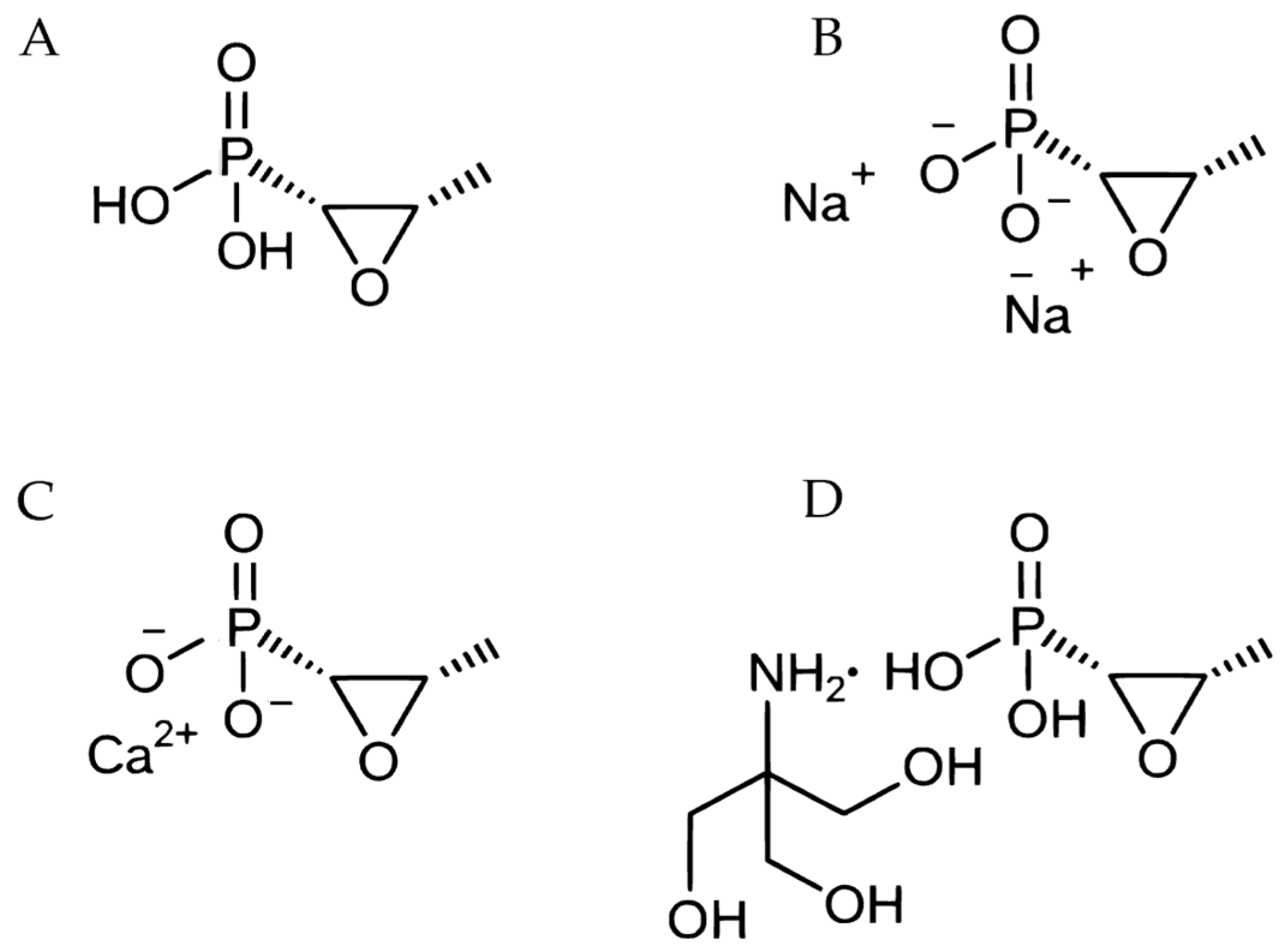
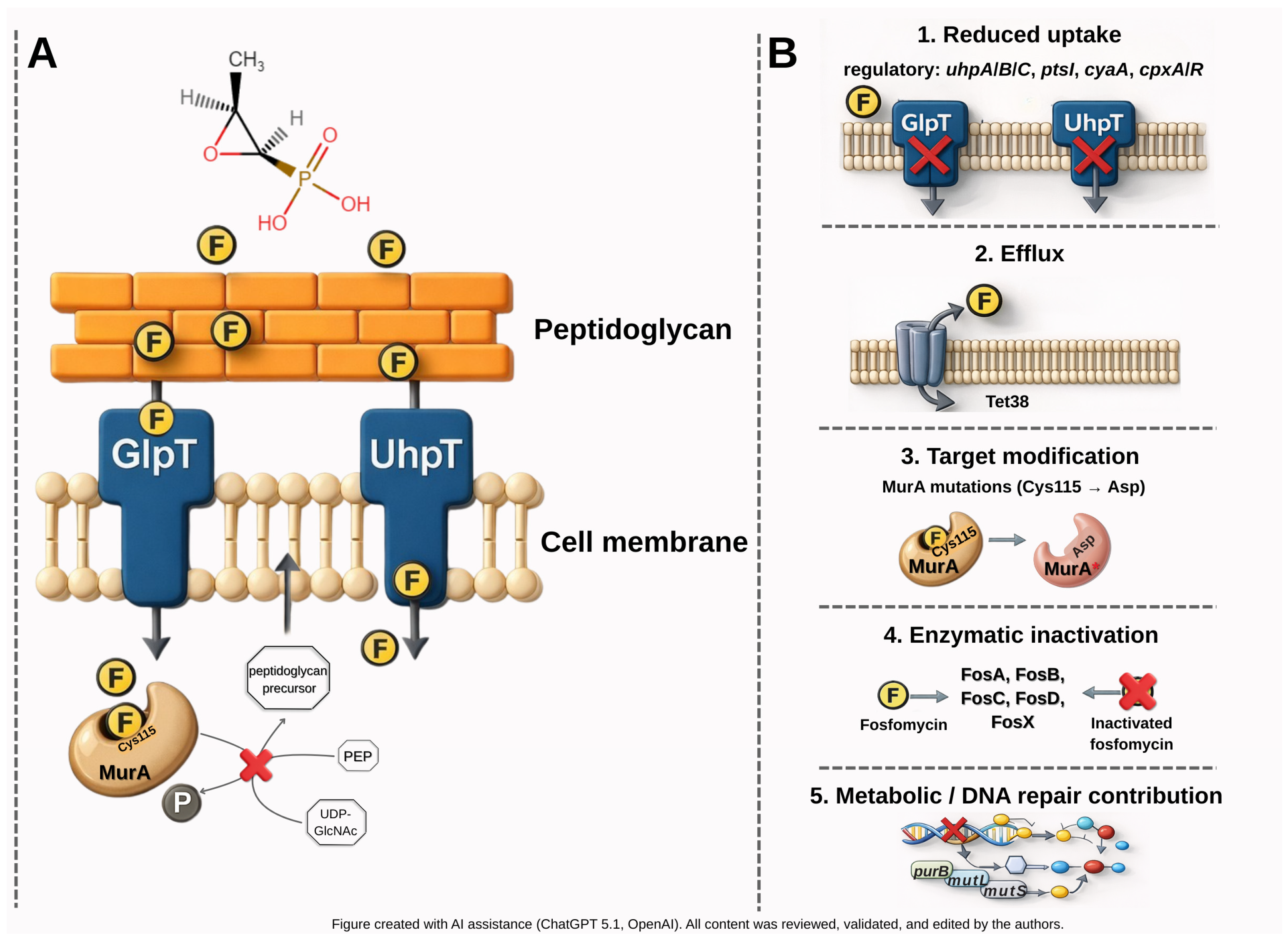

| Gene/Mutation | Localisation | Encoded Protein/Function | Mechanism | Host (Example) | Ref. |
|---|---|---|---|---|---|
| Enzymatic Inactivation | |||||
| fomA, fomB | chromosome, within fosfomycin biosynthetic gene cluster | FomA, FomB (kinases) | Phosphorylates fosfomycin (FomA) and fosfomycin-phosphate (FomB) | S. wedmorensis | [26] |
| fosA (fosA1–fosA13) | plasmid/chromosome | FosA (glutathione S-transferase) | Mn2+- and K+-dependent; adds glutathione to open fosfomycin epoxide ring | Gram-negative bacteria (e.g., Klebsiella, Enterobacter, Serratia, Pseudomonas) | [43,44,45,46,47] |
| fosB, fosSA | plasmid/chromosome | FosB (bacillithiol or L-cysteine transferase) | Mn2+/Mg2+-dependent; adds thiol (bacillithiol or L-Cys) to open fosfomycinepoxide ring | Gram-positive bacteria (e.g., Staphylococcus) | [48,49] |
| fosC, fosC2, fosC3 | plasmid/chromosome | FosC (phosphotransferase/kinase) | Uses ATP to phosphorylate fosfomycin | E. coli, S. aureus | [39,50] |
| fosX | chromosome | FosX (epoxide hydrolase) | Mn2+-dependent; adds water to open fosfomycin epoxide ring | L. monocytogenes, C. botulinum, E. faecium. | [13,50,51] |
| fosL1, fosL2 | plasmid | FosL1, FosL2 (glutathione S-transferases) | FosA-like enzymatic activity | Enterobacteriaceae | [52] |
| fosD | chromosome | FosD (bacillithiol transferase) | Adds bacillithiol to open fosfomycin epoxide ring | S. aureus | [51] |
| fosY | chromosome | FosY (putative bacillithiol transferase) | FosB-like enzymatic activity | S. aureus (CC1 MRSA) | [53] |
| fosSC | chromosome | FosSC (putative bacillithiol transferase) | FosB-like enzymatic activity | S. capitis | [54] |
| fosK | chromosome | FosK (glutathione S-transferase) | FosA-like enzymatic activity | Acinetobacter soli | [41] |
| fosM | chromosome | FosM (bacillithiol transferase) | FosB-like enzymatic activity | Bacillus | [42] |
| murA | chromosome | MurA (UDP-N-acetylglucosamine enolpyruvyl transferase) | Makes MurA active site inaccessible through a cysteine-to-aspartate mutation | E. coli, S. aureus | [48,55,56,57] |
| Transportation | |||||
| glpT | chromosome | GlpT (glycerol-3-phosphate transporter) | Mutation in the gene leads to inactivation of the transporter | [20,58,59] | |
| uhpT | chromosome | UhpT (Hexose-6-phosphate:phosphate antiporter | Mutation in the gene leads to inactivation of the transporter | ||
| uhpA, uhpB, uhpC | chromosome | uhpT regulatory genes | Mutation in the gene reduces the expression of uhpT | E. coli, S. aureus | [20,58,59] |
| ptsI | chromosome | responsible for cAMP synthesis, uhpT and glpT regulatory gene | Mutation in the gene reduces intracellular levels of cAMP and subsequently expression of glpT and uhpT | E. coli | [60] |
| cyaA | chromosome | responsible for cAMP synthesis, uhpT and glpT regulatory gene | Mutation in the gene reduces intracellular levels of cAMP and subsequently expression of glpT and uhpT | E. coli | [60] |
| cpxA, cpxR | chromosome | uhpT and glpT regulatory gene | Deletions in the cpxA gene result in constitutive expression of its regulator cpxR. CpxR directly represses glpT and uhpT expression | E. coli | [61] |
| tet38 | chromosome | Tet38 efflux transporter | Facilitates fosfomycin removal from cytoplasm | S. aureus | [62] |
| Related with central metabolism | |||||
| mutL, mutS | chromosome | DNA mismatch repair system | Mutation in these genes impair DNA repair mechanisms leading to the accumulation of mutations that confer fosfomycin resistance | E. coli | [59] |
| purB | chromosome | Adenylosuccinate lyase/de novo purine nucleotide biosynthesis | Requires further investigation, putative role in cAMP synthesis | E. coli | [59] |
| hflD | chromosome | lysogenisation regulator (upstream of purB) | Requires further investigation | E. coli | [59] |
| Host Microorganism | Source | Resistance Gene | Ref. |
|---|---|---|---|
| K. pneumoniae and K. variicola | food | fosA | [13] |
| E. coli | chicken, farms in China | fosA3 | [30] |
| E. coli ABW A19 (ST1266), ESBL DR28 (ST167); SBF22 (ST354) | wastewater, food and surface water | fosA3 | [68] |
| E. coli | broiler chickens and poultry farm environmental samples | fosA3 | [69] |
| E. coli | food animals (pigs, chickens, pigeons) and their environments (China) | fosA3 | [70] |
| E. coli | isolates obtained from pigs, chickens, dairy cows, and staff (China) | fosA3 | [71] |
| Raoultella ornithinolytica, E. coli, K. pneumoniae, Citrobacter freundii | vegetables: lettuce, cucumber, tomato, bean sprouts, | fosA3 | [72] |
| E. coli | retail food: in beef | fosA3 | [73] |
| E. coli | faecal samples collected at Brazilian broiler farms | fosA3 | [74] |
| E. coli | faecal droppings of wild birds in the urban parks in Faisalabad, Pakistan | fosA4 | [75] |
| E. coli | retail food: chicken meet | fosA4 | [73] |
| K. pneumoniae | unpasteurised raw milk samples | fosA5 | [29] |
| K. pneumoniae | raw milk (Egypt) | fosA5 | |
| S. enterica | food animals and retail meat products in China | fosA7 | [76] |
| S. enterica serovar Heidelberg | broiler chicken | fosA7 | [45] |
| E. coli | bovine from USA | fosA7,5 (variant of fosA7 gene) | [77] |
| E. coli | isolates from pig, chicken and pigeon in China | fosA7,5 (variant of fosA7 gene) | [70] |
| K. pneumoniae ESBL DR09 (ST307) | food | fosA8 | [68] |
| E. coli isolate PK9 | recovered from a chicken meat (China) | fosA10 | [28] |
| waterfowl (China) | fosA10 | [31] | |
| M. morganii isolate DW0548 | poultry on a farm in Wenzhou, China | fosA13 | [31] |
| Aeromonas caviae DW0021 | soil sample from an animal farm in Wenzhou, China | fosC3, fosSC, fosG, fosL1, FosL2, Orf1 | [39] |
| S. aureus. | duck farms (China) | fosB | [78] |
| E. faecalis | from pigs | fosB | |
| S. aureus | chicken and pork isolates (United States) | fosB | [79] |
| Bacillus cereus | house crickets | fosB1–B3 | [80] |
| S. arlettae strain SA-01 | chicken farm in China | fosD | [81] |
| S. haemolyticus | swine slaughterhouse | fosS | [82] |
| Framework/Policy/Initiative | Main Recommendations and Actions | Relevance to Fosfomycin Use | Key Limitations/Challenges | Ref. |
|---|---|---|---|---|
| Global | ||||
| WHO Global Action Plan on Antimicrobial Resistance | Strengthen AMR surveillance, optimise antimicrobial use, support innovation, and improve awareness under the One Health framework. | Provides a strategic One Health framework for reducing antimicrobial misuse and preserving critically important antimicrobials, which indirectly includes fosfomycin despite not being mentioned by name. | Does not address fosfomycin explicitly; recommendations remain broad and require national-level translation to affect specific antimicrobials. | [149] |
| WHO GLASS Global Antimicrobial Resistance and Use Surveillance System | Establishes standardised global surveillance of AMR and antimicrobial use; supports laboratory capacity, harmonised methodologies, and data reporting; integrates human, animal and (pilot) environmental surveillance modules. | Indirect relevance: GLASS establishes harmonised surveillance of priority pathogens and critically important antimicrobials; but fosfomycin is not part of its standard reporting panels. Data generated by GLASS can support broader assessments of AMR trends in bacterial reservoirs that may also harbour fos genes. | Fosfomycin is not monitored; environmental sampling remains limited; uneven diagnostic capacity across countries restricts comparability. | [150,161] |
| WHO Antimicrobial Resistance Diagnostic Initiative | Expand diagnostic capacity, standardise laboratory systems, and ensure access to reliable AMR testing. | Supports improved laboratory capacity and diagnostic accuracy for AMR detection, which enhances the ability to identify fosfomycin-resistant isolates even though the drug is not targeted specifically. | Does not include drug-specific recommendations; focuses on system capacity rather than antimicrobial classes; implementation is constrained in low-resource settings. | [151] |
| WOAH Terrestrial Animal Health Code | Promote prudent and responsible antimicrobial use in animals; ban antibiotics as growth promoters; reinforce veterinary oversight. | Provides global principles for prudent antimicrobial use in animals, which apply equally to fosfomycin as a critically important antimicrobial for human medicine. | Does not mention fosfomycin by name; focuses on general stewardship principles rather than substance-specific restrictions. | [155] |
| WOAH List of Antimicrobial Agents of Veterinary Importance | Provide classification of antimicrobials for veterinary use, including a recommendation that fosfomycin use should be kept at absolute minimum. | Explicitly lists fosfomycin (cyclic esters) and recommends minimal use in veterinary medicine due to high resistance risk. | Implementation varies across member states; document focuses on classification rather than enforcement; environmental compartments not addressed. | [7] |
| Regional (EU) | ||||
| European One Health Action Plan against Antimicrobial Resistance | Reduce antimicrobial use in livestock by 50%; strengthen AMR surveillance; support R&D and stewardship programmes. | Includes monitoring of fosfomycin use in livestock, aquaculture, and zoonotic pathogens. | Variable national implementation; data gaps in environmental compartments. | [158] |
| EU Council Recommendation on stepping up EU actions to combat AMR | Strengthen One Health national action plans, reinforce surveillance/monitoring of AMR and antimicrobial consumption, set targets for AMU, improve awareness and training. | Supports the reduction in antimicrobial use in the animal and human farming sectors; indirectly supports better management of important antibiotics, including fosfomycin. | Diverse implementation across Member States; surveillance gaps especially in environmental sector. | [162] |
| EFSA/ECDC European Union Summary Report on Antimicrobial Resistance in zoonotic and indicator bacteria | Provides comprehensive surveillance data on AMR in zoonotic (e.g., Salmonella, Campylobacter) and indicator bacteria (e.g., E. coli) from animals, food, and the environment; identifies emerging resistance trends; supports risk assessment and evidence-based policy decisions across the EU. | May be indirectly relevant for fosfomycin resistance, as it monitors key bacterial reservoirs (e.g., commensal E. coli, ESBL/AmpC producers) that commonly harbour plasmid-mediated fos genes, supporting broader risk assessment of potential transmission along the food chain. | Fosfomycin is not included in the harmonised EU AMR monitoring panel; environmental compartments (soil and water) remain largely unmonitored, and methodological variability across Member States limits comparability. | [163] |
| EMA/EFSA Categorisation of Antimicrobials (2017) | Provides scientific advice on antimicrobial classes and categorisation by risk to human health; includes Appendix I listing CIAs authorised in human medicine only. | Includes Appendix I specifying that cyclic esters such as fosfomycin are CIAs authorised for human medicine only, and their use in veterinary practice should be kept at an absolute minimum due to the high risk of resistance dissemination. | Based on data available up to 2017; categorisation not updated recently. | [159] |
| EU Regulation (EU) 2019/6 on Veterinary Medicinal Products | Regulation lays down general rules to restrict the use of antimicrobials of critical importance for human medicine in animals, including the possibility of reserving such substances for human use only. | Although fosfomycin is not specified by name, the regulation’s provisions on reserving critical antimicrobials for humans provide a legal basis for restricting veterinary use of fosfomycin. | No specific mention of fosfomycin; implementation relies on national legislation and monitoring of veterinary antimicrobials sales; environmental compartments not explicitly addressed. | [160] |
| Veterinary Guidelines/International and Regional | ||||
| Good Veterinary Practice (FAO, EMA) | Promotes targeted therapy, diagnostics, and reduction in CIAs | Indirectly restricts veterinary fosfomycin use. | Does not name fosfomycin explicitly; adoption varies. | [12,164,165] |
Disclaimer/Publisher’s Note: The statements, opinions and data contained in all publications are solely those of the individual author(s) and contributor(s) and not of MDPI and/or the editor(s). MDPI and/or the editor(s) disclaim responsibility for any injury to people or property resulting from any ideas, methods, instructions or products referred to in the content. |
© 2025 by the authors. Licensee MDPI, Basel, Switzerland. This article is an open access article distributed under the terms and conditions of the Creative Commons Attribution (CC BY) license.
Share and Cite
Goraj, W.; Kowalczyk, P.; Bełżecki, G.; Furtak, A.; Pytlak, A.; Szafranek-Nakonieczna, A. Fosfomycin Resistance: An Update on the Anthropogenic Impact Through Agriculture. Pathogens 2026, 15, 29. https://doi.org/10.3390/pathogens15010029
Goraj W, Kowalczyk P, Bełżecki G, Furtak A, Pytlak A, Szafranek-Nakonieczna A. Fosfomycin Resistance: An Update on the Anthropogenic Impact Through Agriculture. Pathogens. 2026; 15(1):29. https://doi.org/10.3390/pathogens15010029
Chicago/Turabian StyleGoraj, Weronika, Paweł Kowalczyk, Grzegorz Bełżecki, Adam Furtak, Anna Pytlak, and Anna Szafranek-Nakonieczna. 2026. "Fosfomycin Resistance: An Update on the Anthropogenic Impact Through Agriculture" Pathogens 15, no. 1: 29. https://doi.org/10.3390/pathogens15010029
APA StyleGoraj, W., Kowalczyk, P., Bełżecki, G., Furtak, A., Pytlak, A., & Szafranek-Nakonieczna, A. (2026). Fosfomycin Resistance: An Update on the Anthropogenic Impact Through Agriculture. Pathogens, 15(1), 29. https://doi.org/10.3390/pathogens15010029

