Article

The Challenges of Dual Education and the Role of Resilience in the Balance Between Learning and Work


1
Apáczai Csere János Faculty of Humanities, Education and Social Sciences, Széchenyi István University, 9026 Győr, Hungary
2
Doctoral School of Law and Political Sciences, Széchenyi István University, 9026 Győr, Hungary
*
Author to whom correspondence should be addressed.
Soc. Sci. 2026, 15(1), 15; https://doi.org/10.3390/socsci15010015
Submission received: 16 November 2025 / Revised: 13 December 2025 / Accepted: 26 December 2025 / Published: 28 December 2025

Abstract

The rapid transformation of the 21st-century labour market requires students to be highly psychologically adaptable, especially in dual education systems where academic and work-based learning occur simultaneously. This study examines resilience as a psychological and pedagogical protective factor among students in dual vocational education and dual higher education programmes. Using a quantitative research design with validated scales measuring resilience, motivation, satisfaction, and stress, the research investigates how individual and contextual factors influence students’ adaptability. The results showed that vocational education and training students exhibited greater resilience, greater learning satisfaction, and lower levels of stress than those in higher education. Regression analysis confirmed that resilience positively contributes to academic success, while supportive mentoring and a structured learning environment enhance emotional stability and motivation. The analysis highlights that autonomy and pressure to perform are associated with higher levels of stress in higher education, underscoring the critical role of mentorship and peer support in improving adaptability. These findings emphasise that resilience is not only an individual capacity, but also a pedagogical and organisational construct; its systematic development should be integrated into the dual education framework to support student well-being, learning effectiveness, and long-term professional adaptation.

1. Introduction

1.1. The Importance of Dual Training and Psychological Flexibility

The rapidly evolving social and economic landscape of the 21st century presents education systems with new and increasingly complex challenges (Organisation for Economic Co-Operation and Development (OECD) 2023). Preparing learners today requires more than the development of professional and cognitive skills; it must also involve enhancing psychological and emotional adaptability (Duckworth and Gross 2014). In a world defined by continuous technological, economic and social transformation, students need new forms of adaptation, where psychological flexibility, emotional intelligence, and self-regulation play a crucial role.
Resilience has emerged as a key psychological construct that influences students’ problem-solving abilities, motivation, and long-term success in both academic and workplace settings (Masten 2014; Luthar 2015; Ungar 2019). Dual learning environments—where formal (school-based) and informal (workplace-based) learning intersect—create a particularly dynamic context in which learning outcomes are shaped by the interaction of personal, contextual and organisational factors, as conceptualised in the 3P model (Presage–Process–Product) (Tynjälä 2013).
The distinctive feature of dual training is that students simultaneously engage in school-based instruction and workplace practice. Managing these parallel roles places considerable psychological and emotional demands on learners, who must constantly reconcile theoretical knowledge with practical experience. At the same time, this duality creates valuable opportunities to develop independence, responsibility, and perseverance (Organisation for Economic Co-Operation and Development (OECD) 2018).

1.2. Resilience in Vocational Education and Training and Higher Education

For young vocational education and training (VET) learners—typically between 15 and 16, specifically in the Hungarian VET context—resilience is a crucial protective factor that supports early socialisation into the world of work (Smith et al. 2010). In the context of dual training, students face real-life challenges that require them to manage stress, increase responsibility, and make consequential decisions. Supportive feedback, structured mentoring, and a psychologically safe learning environment significantly enhance their ability to adapt and thrive (Turner et al. 2017).
In dual training programmes in higher education, sources of stress often vary. Students typically face increased expectations regarding time management, academic performance, and the development of professional autonomy. For these students, resilience is demonstrated primarily through self-regulation, reflective learning, and the deliberate use of coping strategies. Individuals with higher levels of resilience generally exhibit more balanced emotional states, stronger academic performance, and a lower risk of dropping out (Gu and Day 2013; Masten 2021).

1.3. Research Problem and Objective

The starting point of this study is the recognition that the success of dual training extends far beyond the acquisition of professional competencies. The psychological resilience of the students and their ability to manage the combined demands of study and work play a central role in their persistence in education, integration into the labour market, and long-term mental well-being.
The purpose of this research is to investigate how the balance between academic and workplace responsibilities, along with the supportive characteristics of learning and work environments, influences the resilience and adaptability of students engaged in dual education. Our empirical analysis examines the relationship between psychological flexibility and organisational support, thereby contributing to a deeper understanding of learning processes within dual training systems. Preliminary findings suggest that resilience is closely related to academic performance, time management skills, and the availability of social support (Cassidy 2015; Hartley 2011).
A further objective of the study is to determine whether there are measurable differences between the resilience levels of VET and higher education students and to analyse how their motivation, satisfaction, and stress profiles evolve in various forms of dual training.

2. Theoretical Background and Review of the Literature

2.1. The Psychological and Pedagogical Role of Resilience

Developing students’ resilience is essential for effectively managing stressful situations, maintaining self-confidence, and cultivating a strong professional identity (Templeton and Pritchard 2020). Resilience, when considered solely as an individual capacity, is inadequate to account for adaptation; it must be interpreted as a social-ecological construct. It is seen to be one of the defining primary psychological and pedagogical factors in dual, practice-oriented training programmes (Connor and Davidson 2003).
Resilience is not a static personality capacity, but a dynamic, evolving process that develops through the interaction of individual and environmental factors (Luthar et al. 2000). The unique aspect of dual training is that students continuously alternate between learning environments at school and in the workplace. This dual structure introduces real, often unpredictable stressors, increased responsibilities, and interpersonal challenges.
Students with high levels of resilience have been shown to respond more effectively to academic and workplace challenges. They possess more advanced problem-solving and emotion regulation skills, exhibit a lower risk of dropping out, and are better able to maintain motivation to learn (Martin and Marsh 2009; Tugade and Fredrickson 2004). Resilience fosters adaptive coping, enhances perseverance, improves learning efficiency, and promotes professional self-reflection (Bakker and de Vries 2021; Rutter 2012).
Empirical research demonstrates that resilient students learn more effectively in hands-on environments: they constructively process mistakes, recover more quickly from failures, and integrate their experiences more deeply (Tugade and Fredrickson 2004; Martin and Marsh 2006). In contrast, a lack of resilience increases the risk of academic exhaustion and psychological burnout (Salmela-Aro and Tynkkynen 2012). Low resilience reduces learning efficiency, raises stress levels, reduces motivation, and can lead to the avoidance of practical tasks, ultimately hindering long-term competence development.

2.2. The Role of Learning Motivation and Stress in the Dual Education Context

In the dual education system, students face the challenge of balancing academic demands with workplace responsibilities, creating a unique stress environment. According to the Transactional Model of Stress and Coping (Denson 2023), stress occurs when environmental demands exceed an individual’s available resources (Lazarus and Folkman 1984). In the context of dual training, this “double burden” can result in role conflicts, time pressure, and performance anxiety. However, moderate stress levels can serve as a positive challenge (eustress), encouraging professional growth. In contrast, chronic stress combined with insufficient social support can adversely affect academic performance and increase the risk of burnout (Salmela-Aro and Upadyaya 2014; Bakker and de Vries 2021). Therefore, assessing stress levels is crucial to understanding the protective role of resilience.
Motivation for learning is a critical factor in the success of both vocational and higher education. According to Self-Determination Theory, motivation is most effective when it is intrinsic, driven by the satisfaction of three basic psychological needs: autonomy, competence, and relatedness (Ryan and Deci 2017). Dual training environments are uniquely positioned to support these needs by providing real-world contexts in which students can develop professional competence and social integration. Research indicates that students with higher intrinsic motivation demonstrate greater persistence and employ more effective deep-learning strategies (Kyndt et al. 2014). Understanding the interplay among resilience, stress, and motivation offers a more comprehensive understanding of how students adapt to the complex demands of the dual training model.

2.3. The Relationship Between Resilience and Occupational Safety in Dual Training

The lack of resilience poses a risk not only for learning psychology but also for occupational safety. Individuals with less resilience are more prone to making mistakes in stressful situations, are less consistent in following safety protocols, and demonstrate a reduced willingness to solve problems proactively. Empirical research suggests that resilience can mediate the relationship between workplace stress and unsafe behaviour, thereby directly influencing the risk of accidents. This underscores the paramount importance of building resilience not only to improve learning outcomes but also to improve workplace safety.
At the same time, resilience can be understood not only as an individual attribute but also as an organisational characteristic that extends to both organisational and community levels, where supportive relationships play a crucial role in adaptive functioning (Ungar 2012). Organisational resilience refers to the ability of workplace communities to anticipate, prevent, and effectively respond to unexpected events.
This is especially important in the case of dual training sites, as the integration and safe working of learners depend largely on the safety culture of the host organisation. Based on the Safety-II approach, resilient organisations not only strive to prevent violations but also focus on studying successful adaptations and recoveries (Hollnagel 2014). This approach facilitates the incorporation of lessons learnt from mistakes into organisational operations, thereby enhancing safety performance and work stability.
A positive safety culture—an organisational approach to safety—has a direct correlation with the level of resilience and both contribute to reducing the number of workplace accidents (Clarke 2006; Mutonyi et al. 2025). Previous research shows that resilience development acts as a risk reduction factor at both the individual and organisational levels (Hollnagel 2014; Raetze et al. 2022).
At the same time, it is important to emphasise that resilience alone cannot replace appropriate technical and security measures, regulations, or structured training programmes. The best outcomes are achieved when psychological preparation and operational safety education are implemented in an integrated and mutually strengthening body.

2.4. Pedagogical and Organisational Strategies for the Development of Resilience in Dual Training

The development of resilience in dual training requires a multi-level approach, as it is not a fixed personality capacity, but a skill that can be cultivated through learning and targeted interventions. Effective tools for individual development include stress inoculation and simulation exercises, which help in developing coping strategies and strengthen the sense of control within a safe environment of gradually increasing difficulty (Meichenbaum 2007; McGaghie et al. 2010). Cognitive behavioural techniques and mindfulness-based methods have been shown to reduce anxiety, enhance concentration, and promote greater flexibility in problem-solving (Hofmann et al. 2012; Zenner and Walach 2014).
Regular self-reflection, journaling, and structured mentoring feedback all contribute to improving self-efficacy and learning resilience. In addition, group processing and peer support systems that support social support help reduce feelings of isolation and facilitate the transformation of individual experiences into collective learning.
The role of practical trainers and mentors is crucial in strengthening resilience. A supportive, empathetic, and reflective mentoring approach enhances students’ sense of security and tolerance for stress, while structured feedback and crisis management practices foster the development of a positive professional identity. Therefore, mentor training should place special emphasis on developing emotional intelligence, conflict management skills, and constructive communication. Institutional and organisational support, such as regular mentoring consultations, psychological counselling, and collaboration among learners, mentors, and leadership, significantly increases the retention and development potential of learners.
Resilience building can be especially effective when integrated into occupational safety and health (OSH) education and practical training programmes. Formal, practice-oriented occupational health and safety training has been shown to reduce workplace injuries, particularly when it incorporates real-life scenarios and site-specific exercises. The combination of resilience development programmes and OSH education has a multifaceted preventive effect: it enhances risk recognition, increases safety awareness, and decreases the frequency of unsafe behaviours.
In general, the level of resilience is a key determinant of success in dual practical training. Resilient learners are more effective at acquiring and applying professional knowledge, performing their tasks with greater confidence, and adapting more easily to changing challenges in the workplace.

2.5. Theoretical Framework: Bronfenbrenner’s Ecological Systems Theory

The theoretical framework of the research was provided by Bronfenbrenner’s ecological systems theory (Bronfenbrenner 1979), which interprets the resilience of students not only as an individual capacity but as a dynamic process in the interaction between the person and their environment (Masten and Reed 2002). Resilience, interpreted from an ecological perspective, is therefore a complex, context-dependent process in which an individual’s adaptability develops through the supportive or inhibiting effects of the environment (Luthar et al. 2000).
Current scholarship increasingly moves away from defining resilience merely as an individual personality capacity. Instead, it is understood as a dynamic, social-ecological process. According to Ungar (2012), resilience is defined as the ability of individuals to navigate their way to the psychological, social, cultural, and physical resources that sustain their well-being, and their ability individually and collectively to negotiate for these resources to be provided in culturally meaningful ways. In the context of dual education, this means that student resilience is not solely an internal capacity but is highly dependent on the quality of the ‘facilitating environment’—specifically, the availability of supportive mentors, the inclusiveness of the workplace community and the pedagogical structure of the vocational school (Masten 2014; Ungar 2019). Therefore, resilience is co-constructed through the interactions between the student and their educational and professional environments.
According to this approach, students’ emotional stability, self-efficacy, and coping capacity depend to a large extent on the support mechanisms of the learning community, educational institution, and work environment. The modern interpretation of the ecological approach is represented by Ungar’s (Ungar 2012) model of social-ecological resilience, which emphasises that individual coping capacity is shaped by the dynamic interaction of the supportive social environment and the cultural context.
Ungar’s social-ecological model (Ungar 2012) is particularly relevant in the context of dual training in the 21st century, where students play the role of student and employee at the same time. In such an environment, the development of resilience is not only relevant for academic success but also a prerequisite for long-term professional success and mental health. In the dual training structure, the different levels of systems—the school, the workplace, the mentor, and the students’ personal living space—are in continuous interaction, so resilience and motivation measurements play a key role in revealing the quality of educational processes.
The present research direction is particularly timely, as the rapid transformation of the labour market, automation, and the spread of competence-based education require an increased examination of students’ adaptability, psychological flexibility, and motivation to learn. Ecologically based empirical measurements and longitudinal follow-ups of resilience are able to reveal the factors that support or hinder the successful professional socialisation of students in dual vocational training.
Bronfenbrenner’s theory offers practical guidance for educators and mentoring professionals to innovate educational practice. The ecological approach helps to recognise that student development is influenced by several factors that interact with each other: individual psychological characteristics, the quality of social relationships, and institutional and organisational culture (Bronfenbrenner and Morris 2007; Luthar et al. 2000).
The application of the model allows learning environments that support the acquisition of professional competencies and the development of adaptive coping strategies at the same time. Practical tools for this can be reflective exercises, sharing of group experience, supportive mentoring, and creating a learning environment that promotes psychological safety. In this way, an ecological approach not only strengthens student well-being but also contributes to the formation of a more flexible, adaptable, and resilient workforce generation. Based on the above, the empirical study of resilience, motivation and satisfaction in dual vocational education is not only a theoretical, but also a strategic research priority, which helps the adaptive renewal of education systems and preparation for the challenges of the future labour market.

3. Methodology

3.1. Research Objective and Methodology

The purpose of the research is to explore the personal and environmental factors of resilience among students and their participation in dual vocational education and dual higher education. The research used a quantitative methodology approach, using standardised questionnaires to analyse statistical patterns of resilience and psychological factors (Creswell and Plano Clark 2018).

3.2. Model and Ethical Aspects

The study sample consisted of 150 people, of whom 75 participated in vocational training and 75 in dual training in higher education. The age of the vocational training group ranged from 16 to 18 years, while the age of the higher education group ranged from 19 to 21 years. The gender ratios and demographic variables in the sample were balanced, allowing comparisons between groups without gender and age bias.
The sample participating in the research was selected from the dual training institutions of the Western Hungarian region. Vocational training students were enrolled from five institutions belonging to vocational training centres, while higher education participants came from the dual training programme of the Széchenyi István University.
All students conducted their practical activities with dual partners operating in the industrial sector, mainly in companies with a machinery, automotive, and technology profile. The data collection thus focused on the industrial part of dual training, allowing a deeper examination of the factors of resilience in the workplace.
The ethical approval of the research was given by the competent organisation units of the Győr Vocational Training Centre and the Széchenyi István University. Study participants joined the study on a voluntary basis after signing a prior informed consent form. Data processing complied with the applicable data protection and research ethics regulations in all respects (European Parliament and Council of the European Union 2016; Hungary National Assembly 2011).
Personal data and institutional identifiers have been processed in anonymised form for the sole purpose of scientific processing. The sampling was targeted, but voluntary, and the data collection was carried out with ethical permission while ensuring the anonymity of the participants. The sample size meets the statistical requirements of smaller-scale empirical studies, allowing fundamental differences and trends to be detected.

3.3. Measuring Tools

Resilience in this study can be understood as a multidimensional construct that includes emotional stability, self-efficacy, coping strategies, and social support (Connor and Davidson 2003; Windle 2011). Measures used included the Brief Resilience Scale (BRS) (Smith et al. 2008). To assess academic performance, participants were asked to report their Grade Point Average (GPA) from the last closed semester. In addition, the survey included self-assessment items on self-efficacy and social competence.
The questionnaire used in the study consisted of 25 items, which were evaluated on a five-point Likert scale (1 = not at all typical, 5 = fully characteristic). The questionnaire measured several internationally validated constructs that covered the dimensions of psychological resilience, learning motivation, satisfaction, and stress. Items were compiled taking into account the Brief Resilience Scale (BRS) (Smith et al. 2008) and previous research on learning motivation and psychological well-being (Ryan and Deci 2017; Bakker and de Vries 2021).
The questionnaire was made up of four main sub-dimensions:
  • Resilience (Q1–Q6)—the degree of coping with stress, perseverance and emotional restoration (with two inverse items: Q3, Q5; inverse score = 6—response),
  • Learning motivation (Q7–Q13)—explore internal and external motivational factors,
  • Satisfaction (Q14–Q19)—measure subjective well-being, learning experiences and satisfaction of students,
  • Stress (Q20–Q25)—to assess psychological stress and coping difficulties (with two inverse items: Q22, Q24).
Scale scores were derived from the average of the items in the given dimension, with a higher value indicating a more positive psychological state or a stronger protective factor. The internal reliability of the questionnaire was checked with a Cronbach-alpha indicator, which exceeded 0.7 for all dimensions, so the measuring device showed adequate reliability.
Before the application of the questionnaire, a pilot sample of 10 people was also pre-tested, based on which the linguistic and content clarity of the items was validated. This step ensured that the measurement tool measured the desired psychological variables in a way that was understandable and consistent for the target group.
The multidimensional structure of the instrument made it possible to examine resilience and related psychological factors in a complex way, as well as to analyse their correlations with academic performance and learning satisfaction.

3.4. Data Processing and Statistical Procedures

In the course of data analysis, we examined the correlations between resilience, academic performance, and peer support using descriptive statistics, Cronbach-alpha reliability indicators, Pearson correlation, and linear regression.
Python 3 software (pandas, scipy, statsmodels) was used for the analyses. The statistical procedures were as follows:
  • Descriptive statistics (mean, standard deviation, number of items) for the main variables.
  • Cronbach’s α to investigate the internal reliability of scales.
  • Independently sampled Welch test to compare resilience averages between groups.
  • Cohen’s d effect size calculation.
  • Simple linear regression to predict GPA (independent variables: resilience, group, age, gender). The preliminary analyses tested age and gender as covariates.
Before analysing the data, we examined the conditions of normality and standard deviation homogeneity. The distribution of the variables was checked using the Shapiro–Wilk test, based on which most of the scales were close to the normal distribution (p > 0.05). The homogeneity of the standard deviations of the groups was investigated using the Levene test, which did not show significant differences (p = 0.28), so the application of the Welch test provided sufficiently robust results.
During the diagnostic analysis of the linear regression model, we did not experience any multicollinearity problems; the VIF values of the variables remained below 2, which is in line with international recommendations (Field 2018). The distribution of residues was normal, and there was no detectable heteroscedasticity. The average age of the VET students is 17.4 years (SD = 0.9), and that of the tertiary students is 20.2 years (SD = 0.8).
The gender ratios were balanced (48% female, 52% male), and the data collection was voluntary and anonymous, with ethical permission.

4. Results

4.1. Descriptive Statistics and Reliability

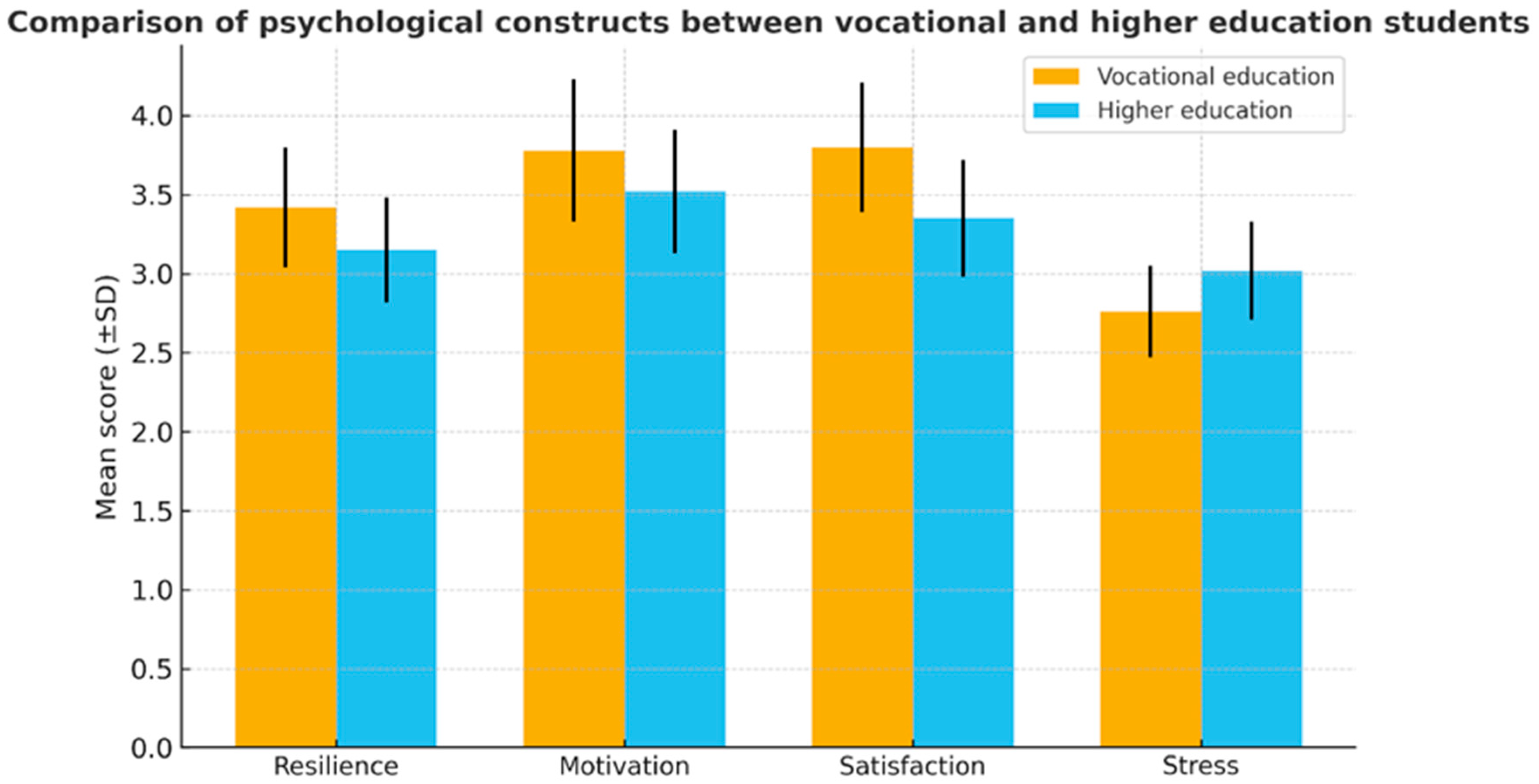
For the dimensions of resilience, motivation, and satisfaction, VET learners scored significantly higher average scores compared to tertiary students. The narrow confidence intervals of the variables studied suggest a relatively homogeneous pattern of respondents, which holds the promise of internal consistency and reliability of the scales. From a methodological point of view, this confirms that the measured constructed constructs (resilience, motivation, satisfaction, stress, and GPA) serve as well-defined psychometrically stable variables in the analysis. The average age of the VET students is 17.4 years (SD = 0.9), and that of the tertiary students is 20.2 years (SD = 0.8). The gender ratios were balanced (48% female, 52% male), and the data collection was voluntary and anonymous, with ethical permission.
Table 1 presents the descriptive statistics of the constructions studied of students in vocational education (N = 75) and higher education (N = 75). On average, students in vocational education and training scored higher in flexibility, motivation, and satisfaction, while those in higher education reported higher stress levels and lower GPA scores. These results indicate significant psychological and academic differences between the two groups (see Table 1).
As shown in Table 2, all psychometric scales showed acceptable or very good reliability, since Cronbach-alpha values (α) exceeded the recommended threshold of 0.70 (Nunnally 1978). GPA, as an objective indicator, was not the subject of a reliability analysis. Narrow confidence intervals between variables indicate homogeneous response patterns within the groups, confirming the internal consistency of the scales (see Table 2).

4.2. Differences Between Groups

Based on the results of the research, the resilience values of the VET students were significantly higher than those of the tertiary education students (t (15) = 4.802, p < 0.001; Cohen’s d = 1.36) (see Figure 1). This large impact suggests that students in dual vocational training have significantly higher mental resilience. This discrepancy can be explained by the specificities of the training structure and the learning environment. The error bands shown in Figure 1, which are based on the standard deviation (SD) values, show the standard deviation of the scales considered within the group, thus giving an idea of the heterogeneity of the sample and the internal stability of the variables.
In dual training, students face challenges in a real-world work environment, which enhances the development of adaptability, problem-solving, and stress management. This experiential learning environment has a resilience-building effect, as learners learn to respond to changing situations on multiple levels—individual, interpersonal, and organisational.
The results obtained are in line with Bronfenbrenner’s ecological systems theory (Bronfenbrenner 1979), according to which the development of the individual takes place in the interaction of different environmental levels (microsystem, mesosystem, and exosystem). In this sense, dual training can be interpreted as a microecological space to build resilience, where learning and work experiences contribute to strengthening psychological flexibility in an integrated way.
The magnitude of the observed association suggests that these results may be relevant not only statistically but also pedagogically and psychologically, as dual training develops learning patterns and coping mechanisms that are of paramount importance in the future labour market. The present result also confirms the need to prioritise the measurement of resilience and psychological well-being as a research direction in dual training, as these indicators may provide important insights into the adaptive capacities of education systems. Although the current study is exploratory, the patterns observed here suggest that further large-scale investigations could clarify the extent to which these indicators might reflect systemic adaptability.

4.3. Correlation Analysis

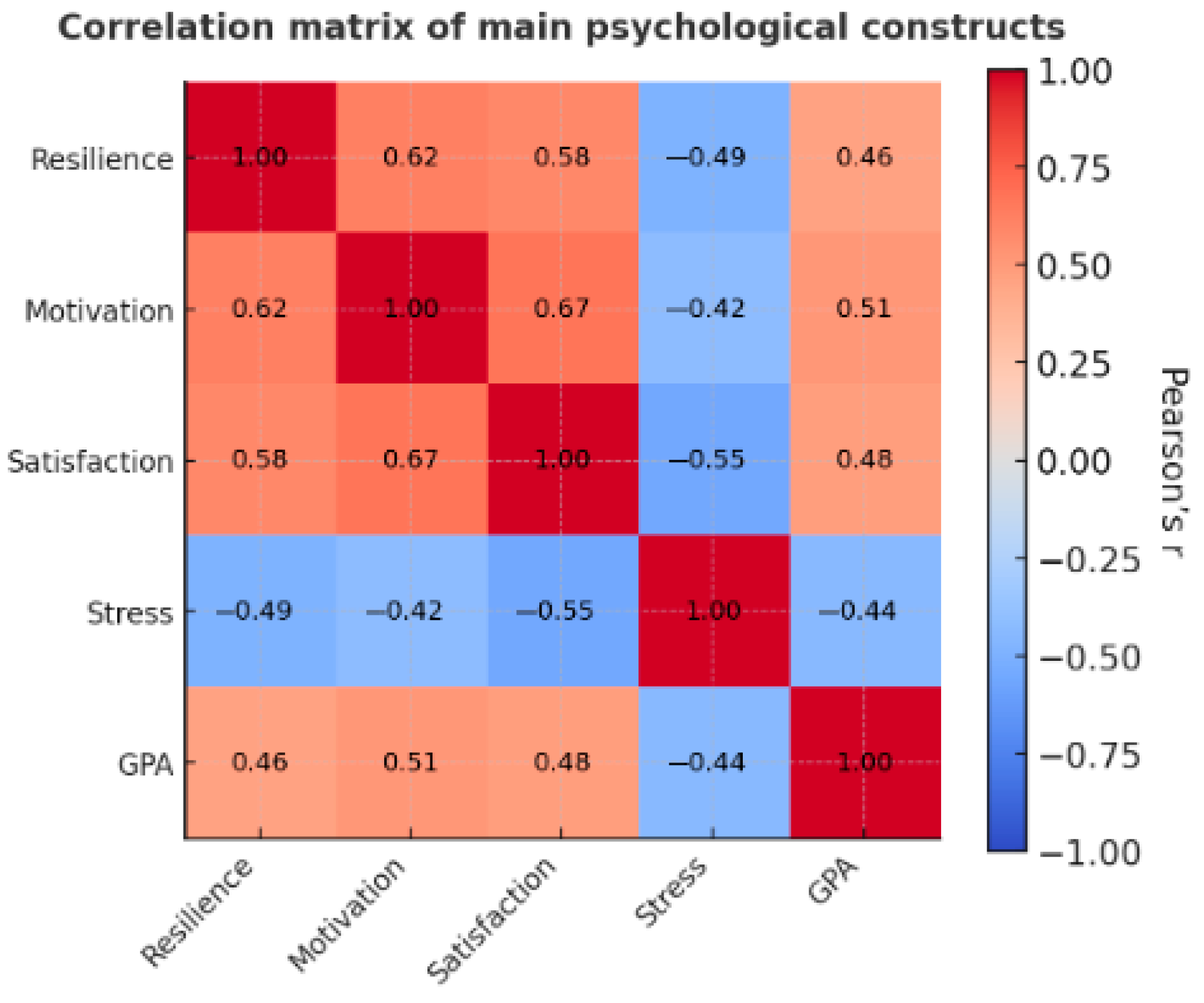
The internal consistency of the scales used in the study exceeded the Cronbach-alpha (α) = 0.70 confidence threshold in all cases, indicating adequate psychometric reliability. The results of the Pearson correlation matrix revealed coherent relationships between psychological constructs, highlighting a pattern of interrelations between resilience, motivation, satisfaction, stress, and academic achievement (GPA) (see Figure 2).
Based on the results, there was a significant, moderately strong, or strong positive relationship between positive psychological factors such as resilience, motivation, and satisfaction. All three constructs were also positively correlated with academic performance.
This suggests that students with higher mental resilience, who are intrinsically motivated and satisfied with their learning environment, are more likely to achieve better outcomes in the educational process. These findings support the theoretical assumption that psychological resources not only promote emotional stability but also contribute to academic perseverance and effective adaptation in training situations with increased stress.
At the same time, stress showed a negative correlation with all positive psychological constructs, especially satisfaction (r = −0.55) and resilience (r = −0.49). This suggests that higher stress levels are associated with lower levels of subjective well-being and poorer academic performance. The results fit well with the theoretical framework of positive psychology (Seligman and Csíkszentmihályi 2000), according to which psychological strengths—such as resilience, optimism and intrinsic motivation—act as protective factors against stress, promoting the preservation of mental health and lasting cognitive engagement (Fredrickson 2001; Tugade and Fredrickson 2004).
From the point of view of educational theory, the results highlight the need for training systems, especially dual vocational training, to consciously incorporate development elements aimed at strengthening resilience and motivation. Students participating in dual training face academic and employee challenges, where stress management and maintaining motivation are key conditions for long-term professional success. Consequently, future research and development should aim to regularly measure psychological factors and incorporate mentoring, supportive, and reflective pedagogical practices. This approach not only increases educational efficiency but also contributes to the development of a more resilient, adaptive, and psychologically aware workforce.

4.4. Regression Analysis

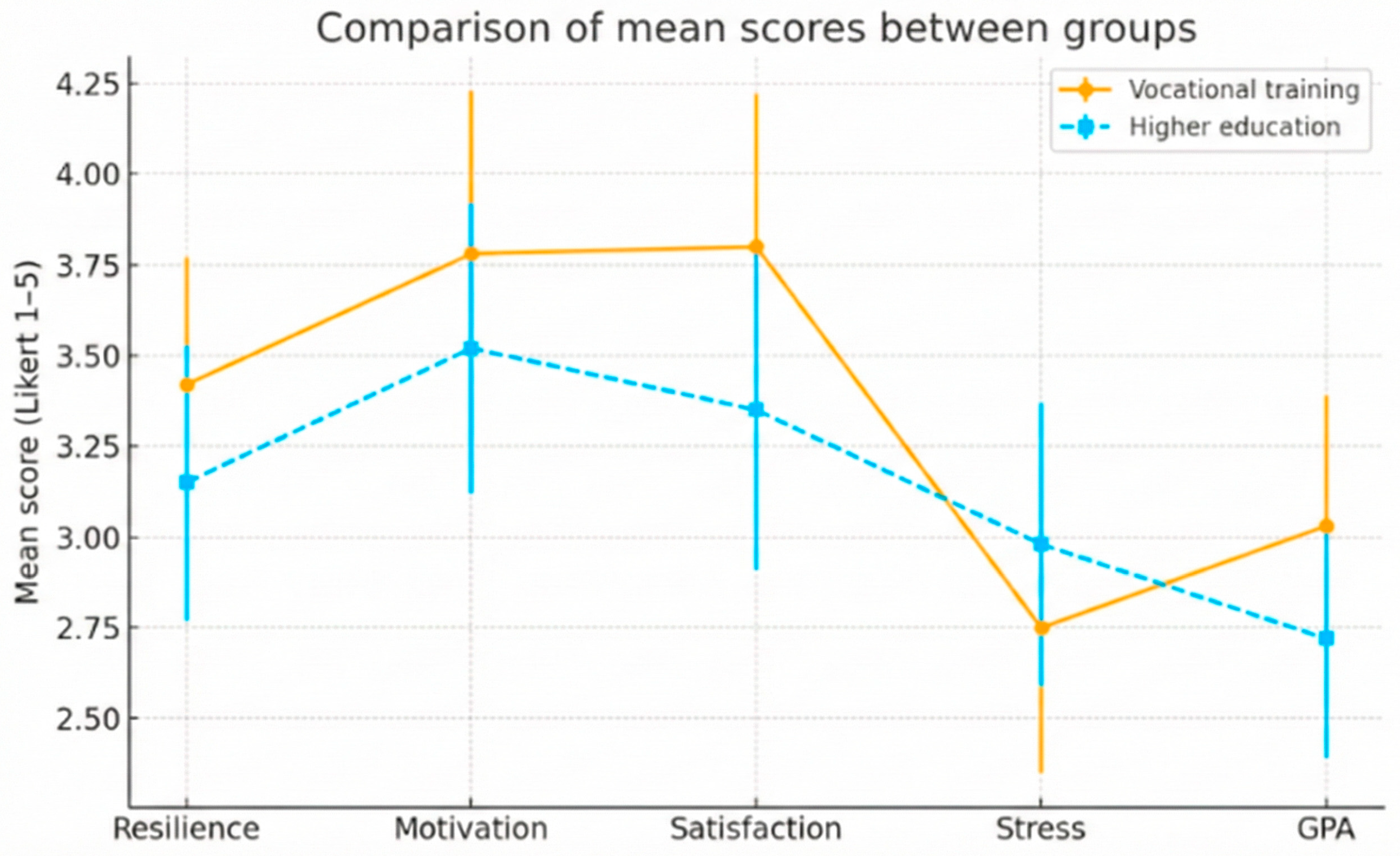
The linear regression model was designed to predict academic performance (GPA). Significant predictors of the model included resilience (β = 0.27, p < 0.05) and the training group (vocational education vs. tertiary; β = 0.22, p < 0.05) (see Figure 3). The variance value explained by the model (R2 = 0.31) can be considered a medium-strength relationship in social sciences (Cohen 1988). This indicates that the psychological and educational factors studied accounted for approximately 31% of the variance in academic performance within our sample.
We initially tested the inclusion of demographic variables (age, gender) in the regression model. However, neither age nor gender proved to be significant predictors of GPA (p > 0.05), and their inclusion did not improve the fit of the model (the change in R2 was negligible). Therefore, to present the most parsimonious model, these variables were excluded from the final analysis presented in Table 3.
Based on Figure 3, it can be concluded that the resilience, motivation, and satisfaction of the VET learners are typically higher, while their stress level is lower than that of the tertiary learners. In the case of GPA, the difference is more moderate, suggesting that psychological factors—especially resilience—may play an important role in effectiveness, while characteristics of the educational environment could also contribute to these results.

5. Discussion

5.1. Resilience Gaps in Vocational Education and Training (VET) and Higher Education

The results of our study on a sample of 150 people highlight that flexibility, motivation, and satisfaction are closely intertwined with students’ academic performance (GPA) in dual education, while stress is inversely related to performance (Martin and Marsh 2009; Cassidy 2015). During the analysis, it became clear that the students in vocational education and training consistently showed stronger psychological protective factors than their peers in higher education. In our interpretation, this difference is not purely statistical, but may be deeply related to the learning environment and mentoring culture of VET (Beltman et al. 2011; Gu and Day 2013; Turner et al. 2017).
Previous studies emphasise that skilled students view their mentors as key figures who help them turn challenges into learning opportunities (Queiruga-Dios et al. 2023; Turner et al. 2017). Our quantitative results complement this by showing that higher education students in more autonomous and performance-oriented environments experience higher levels of stress and greater uncertainty about expectations. This is in line with international findings suggesting that autonomy can increase psychological strain and the risk of burnout without adequate social support.

5.2. Causes of Increased Stress in Higher Education

In the case of the stress dimension, the opposite pattern can be observed: the average stress scores of higher education students are significantly higher than those of vocational students. This may refer to differences in age, developmental, and academic circumstances, which are also reflected in the research sample.
Higher education students—typically older and having greater independence—often face more complex expectations and increased responsibility, whether it is academic performance, financial independence, or planning for the future. At the same time, higher education structures tend to provide less personal support than the VET environment, which can increase psychological stress and stress responses.
Greater autonomy and freedom of decision—although desirable from a developmental point of view—can also lead to increased expectations and psychological strain. Among young people, increased performance expectations and social comparisons increase the risk of psychological exhaustion and academic burnout, which is particularly pronounced in the higher education environment (Salmela-Aro and Tynkkynen 2012).
By contrast, when there is a lack of a structured mentoring and feedback system for dual tertiary students, the pressure of responsibility further increases stress levels. This association is consistent with the conclusions of Salmela-Aro and Upadyaya (2014), who noted that a lack of supportive relationships increases the risk of burnout and stress in the study environment.
In general, higher stress scores among higher education students suggest that the combination of greater autonomy, a competitive environment, and performance expectations is associated with increased psychological strain, especially when support systems are not strong enough to counteract these effects.

5.3. The Link Between Resilience and Academic Performance

The empirical results of our research, including quantitative measurements, supported the previously identified trends. Data indicate that high levels of resistance are closely related to students’ adaptability, academic performance, and the stability of their professional identity.
Our results are consistent with theoretical approaches that hold that resilience is not an innate capacity but a learning and developmental process that can adaptively respond to environmental influences (Luthar et al. 2000).
Our study also confirms that resilience is not only a protective factor against psychological stress but also contributes to academic effectiveness and success in various educational settings (Connor and Davidson 2003; Creswell and Plano Clark 2018). Our results are consistent with previous research by Connor and Davidson (2003) and Ungar (2019), and our own studies have found significant correlations that support these findings.

5.4. Limitations

It is important to note that the sample size of the research (N = 150) is relatively limited, so the results are rather exploratory in nature and their generalisability should be interpreted with caution. At the same time, the reliability of the statistical procedures used and the medium and large impact sizes indicate that the identified patterns are indeed relevant and should be confirmed by further studies on larger samples. Although the sample size is limited, the data reliably reflect the basic patterns of psychological characteristics of higher education students and students in dual training.

6. Conclusions and Future Directions

6.1. Conclusions

In general, the results provide empirical support for the assumption that the integrated functioning of positive psychological factors plays a decisive role in the psychological adaptation, academic achievement, and stress management capacity of students. Our results suggest that resilience development not only supports students’ well-being but also serves as one of the main factors in the effectiveness of the dual training model.
The study showed that VET students had significantly higher levels of resilience, motivation, and satisfaction, while their stress levels were lower than those of higher education students. This suggests that practice-oriented learning environments, mentoring support, and direct feedback structures can contribute to the development of psychological adaptability, emotional stability, and learning effectiveness as significant protective factors.
The results of the regression analysis also confirmed these relationships: resilience was a positive predictor of academic performance (GPA), while educational background (vocational education vs. higher education) appeared as a significant explanatory variable. All this supports the fact that psychological flexibility is not only an individual resource, but also a predictive factor in terms of academic and professional success.
At the same time, the interpretation of resilience goes beyond individual characteristics: the literature increasingly treats it as an ecosystemic construct that is shaped by the dynamic interaction of the individual, the institutional structure, and the social environment (Bronfenbrenner 1979; Masten 2021). Its development, therefore, requires complex, multi-level interventions that cover the entire educational environment.
The research highlighted that the success of dual training depends not only on the acquisition of professional competencies but also on the conscious development of emotional and psychological factors. The effectiveness of a dual education system depends to a large extent on whether learning spaces in schools and workplaces function as a cohesive, supportive ecosystem that promotes students’ mental health, emotional stability, and long-term professional success (Gu and Day 2013; Ryan and Deci 2017).
In conclusion, resilience is not only a determining factor for individual student success but also one of the pillars of pedagogical effectiveness and social sustainability.

6.2. Practical Implications and Recommendations

The results of our study have significant practical implications in the field of educational development and training organisation. Empirical data clearly confirm that resilience development must appear as a conscious pedagogical goal at both the institutional and the workplace levels. Based on the positive correlation between the dual VET environment and resilience, it can be inferred that structural elements such as mentoring support, the development of emotional awareness, and the integration of reflective learning techniques contribute to the strengthening of students’ stress management skills, intrinsic motivation, and academic perseverance.
Resilience as a key competence not only strengthens individual coping skills but also embodies the shared responsibility of educational institutions and corporate partners to maintain the mental well-being of students. One of the basic conditions for future educational innovations is the systematic integration of psychological safety and students’ well-being into the educational process.
Our results can serve as a basis for the development of guidelines and recommendations that specifically support the work of students and teachers participating in dual training. These may include resilience development strategies that aim to develop emotional regulation, stress management, and self-reflection in an integrated way. In future developments, it is recommended to use an approach that takes into account the triple unity of the learning environment, process, and outcome, which is well captured by the approach of the 3P model (Tynjälä 2013).
All of this underscores the need for prevention and intervention programmes aimed at strengthening students’ emotional and cognitive resources, developing mentoring systems, and shaping institutional culture in a direction that promotes psychological safety and student well-being.
Developing resilience is therefore not only a useful but also a strategically important objective for education policy and institutional decision-making, especially in the context of dual education systems, where achieving a balance between learning and work is one of the biggest challenges and opportunities of the future.

6.3. Future Research Proposals

In addition, it would be expedient to repeat the research with a larger number of elements and to extend it to several institutions, and to explore the changes and effects of psychological factors over time with longitudinal studies. In light of this, it is particularly timely to continue empirical studies that evaluate the effectiveness of dual training programmes along psychological factors. Despite its limited sample, this study provides important indicators for future improvements.

Author Contributions

Conceptualization, Z.N. and K.H.; methodology, Z.N. and K.H.; software, Z.N. and K.H.; validation, Z.N. and K.H.; formal analysis, Z.N. and K.H.; investigation, Z.N. and K.H.; resources, Z.N. and K.H.; data curation, Z.N. and K.H.; writing—original draft preparation, Z.N. and K.H.; writing—review and editing, Z.N. and K.H.; visualization, Z.N. and K.H.; supervision, Z.N. and K.H.; project administration, Z.N. and K.H.; funding acquisition, Z.N. and K.H. All authors have read and agreed to the published version of the manuscript.

Funding

The APC was funded by Széchenyi István University.

Institutional Review Board Statement

The study was conducted in accordance with the relevant principles of the Declaration of Helsinki, and approved by the Ethics Committee of Széchenyi István University, University Scientific Council (decision no.: SZE/ETT-74/2025 (X.16.), approval date: 16 October 2025).

Informed Consent Statement

Informed consent was obtained from all subjects involved in the study.

Data Availability Statement

The original contributions presented in this study are included in the article. Further inquiries can be directed to the corresponding author.

Conflicts of Interest

There is no conflict of interest for either the first or the second author.

Abbreviations

BRSBrief Resilience Scale
ECEthics Committee
ETTEgyetemi Tudományos Tanács (University Scientific Council)
GPAGrade Point Average
IRBInstitutional Review Board
OSHOccupational Safety and Health
SDStandard Deviation
VETVocational Education and Training
WMAWorld Medical Association

References

  1. Bakker, Arnold B., and Juriena D. de Vries. 2021. Job Demands–Resources Theory and Self-Regulation: New Explanations and Remedies for Job Burnout. Anxiety, Stress, and Coping 34: 1–21. [Google Scholar] [CrossRef] [PubMed]
  2. Beltman, Susan, Caroline F. Mansfield, and Anne Price. 2011. Thriving Not Just Surviving: A Review of Research on Teacher Resilience. Educational Research Review 6: 185–207. [Google Scholar] [CrossRef]
  3. Bronfenbrenner, Urie. 1979. The Ecology of Human Development: Experiments by Nature and Design. Cambridge, MA: Harvard University Press. [Google Scholar]
  4. Bronfenbrenner, Urie, and Pamela A. Morris. 2007. The Bioecological Model of Human Development. In Handbook of Child Psychology: Theoretical Models of Human Development, 6th ed. Edited by Richard M. Lerner and William Damon. Hoboken: John Wiley and Sons, Inc., pp. 793–828. [Google Scholar] [CrossRef]
  5. Cassidy, Simon. 2015. Resilience Building in Students: The Role of Academic Self-Efficacy. Frontiers in Psychology 6: 1781. [Google Scholar] [CrossRef]
  6. Clarke, Sharon. 2006. The Relationship Between Safety Climate and Safety Performance: A Meta-Analytic Review. Journal of Occupational Health Psychology 11: 315–27. [Google Scholar] [CrossRef]
  7. Cohen, Jacob. 1988. Statistical Power Analysis for the Behavioural Sciences, 2nd ed. Mahwah: Erlbaum. [Google Scholar]
  8. Connor, M. Kathryn, and Jonathan R. T. Davidson. 2003. Development of a New Resilience Scale: The Connor–Davidson Resilience Scale (CD-RISC). Depression and Anxiety 18: 76–82. [Google Scholar] [CrossRef]
  9. Creswell, John W., and Vicki L. Plano Clark. 2018. Designing and Conducting Mixed Methods Research, 3rd ed. Thousand Oaks: Sage. [Google Scholar]
  10. Denson, Samantha Ann. 2023. Long-Term Psychological Adaptation of U.S. Human Resource Personnel in Response to the COVID-19 Pandemic. Ph.D. thesis, Walden University, Minneapolis, MN, USA. Available online: https://scholarworks.waldenu.edu/dissertations/14089/ (accessed on 24 September 2025).
  11. Duckworth, Angela, and James J. Gross. 2014. Self-Control and Grit: Related but Separable Determinants of Success: Related but Separable Determinants of Success. Current Directions in Psychological Science 23: 319–25. [Google Scholar] [CrossRef]
  12. European Parliament and Council of the European Union. 2016. Regulation (EU) 2016/679 of the European Parliament and of the Council on the Protection of Natural Persons with Regard to the Processing of Personal Data and on the Free Movement of Such Data, and Repealing Directive 95/46/EC (General Data Protection Regulation). Available online: https://eur-lex.europa.eu/eli/reg/2016/679/oj/eng (accessed on 3 October 2025).
  13. Field, Andy P. 2018. Discovering Statistics Using IBM SPSS Statistics, 5th ed. Thousand Oaks: Sage. [Google Scholar]
  14. Fredrickson, Barbara L. 2001. The Role of Positive Emotions in Positive Psychology: The Broaden-and-Build Theory of Positive Emotions. American Psychologist 56: 218–26. [Google Scholar] [CrossRef]
  15. Gu, Qing, and Christopher Day. 2013. Challenges to Teacher Resilience: Conditions Count. British Educational Research Journal 39: 22–44. [Google Scholar] [CrossRef]
  16. Hartley, Michael T. 2011. Examining the Relationships Between Resilience, Mental Health, and Academic Persistence in Undergraduate College Students. Journal of American College Health 59: 596–604. [Google Scholar] [CrossRef]
  17. Hofmann, Stefan G., Anu Asnaani, Imke J. Vonk, Alice T. Sawyer, and Angela Fang. 2012. The Efficacy of Cognitive Behavioural Therapy: A Review of Meta-Analyses. Cognitive Therapy and Research 36: 427–40. [Google Scholar] [CrossRef] [PubMed]
  18. Hollnagel, Erik. 2014. Safety-I and Safety-II: The Past and Future of Safety Management, 1st ed. London: CRC Press. [Google Scholar] [CrossRef]
  19. Hungary National Assembly. 2011. Act CXII of 2011 on the Right of Informational Self-Determination and on Freedom of Information. Budapest. Available online: https://net.jogtar.hu/jogszabaly?docid=a1100112.tv (accessed on 3 October 2025).
  20. Kyndt, Eva, Natalie Govaerts, Els Verbeek, and Filip Dochy. 2014. Development and Validation of a Questionnaire on Informal Workplace Learning Outcomes: A Study among Socio-Educational Care Workers. The British Journal of Social Work 44: 2391–410. [Google Scholar] [CrossRef]
  21. Lazarus, Richard, and Susan Folkman. 1984. Stress, Appraisal, and Coping. Berlin: Springer. [Google Scholar]
  22. Luthar, Suniya S. 2015. Resilience in Development: A Synthesis of Research across Five Decades. In Handbook of Child Psychology and Developmental Science, 7th ed. Edited by Richard M. Lerner. Hoboken: Wiley, vol. 3. [Google Scholar] [CrossRef]
  23. Luthar, Suniya S., Dante Cicchetti, and Bronwyn Becker. 2000. The Construct of Resilience: A Critical Evaluation and Guidelines for Future Work. Child Development 71: 543–62. [Google Scholar] [CrossRef]
  24. Martin, Andrew J., and Herbert W. Marsh. 2006. Academic Resilience and Its Psychological and Educational Correlates: A Construct Validity Approach. Psychology in the Schools 43: 267–81. [Google Scholar] [CrossRef]
  25. Martin, Andrew J., and Herbert W. Marsh. 2009. Academic Resilience and Academic Buoyancy: Multidimensional and Hierarchical Conceptual Framing of Causes, Correlates and Cognate Constructs. Oxford Review of Education 35: 353–70. [Google Scholar] [CrossRef]
  26. Masten, Ann S. 2014. Ordinary Magic: Resilience in Development. New York: Guilford Press. [Google Scholar]
  27. Masten, Ann S. 2021. Resilience in Developmental Systems: Principles, Pathways, and Protective Processes in Research and Practice. In Multisystemic Resilience: Adaptation and Transformation in Contexts of Change. Edited by Michael Ungar. New York: Oxford Academic, pp. 113–34. [Google Scholar] [CrossRef]
  28. Masten, Ann S., and Marie-Gabrielle J. Reed. 2002. Resilience in Development. In Handbook of Positive Psychology. Edited by C. R. Snyder and Shane J. Lopez. Oxford: Oxford University Press, pp. 74–88. [Google Scholar]
  29. McGaghie, William C., S. Barry Issenberg, Emil R. Petrusa, and Ross J. Scalese. 2010. A Critical Review of Simulation-Based Medical Education Research: 2003–2009. Medical Education 44: 50–63. [Google Scholar] [CrossRef]
  30. Meichenbaum, Donald. 2007. Stress Inoculation Training: A Preventive and Treatment Approach. In Principles and Practice of Stress Management, 3rd ed. Edited by Paul M. Lehrer, Robert L. Woolfolk and Wesley E. Sime. New York: Guilford Press, pp. 497–516. [Google Scholar]
  31. Mutonyi, Barbara Rebecca, Renate Fredheim, and Terje Slåtten. 2025. The Role of Psychological Safety and Psychological Capital in Linking Leadership Curiosity to Employee Creative Performance. Cogent Social Sciences 11: 2458060. [Google Scholar] [CrossRef]
  32. Nunnally, Jum C. 1978. Psychometric Theory, 2nd ed. New York: McGraw-Hill. [Google Scholar]
  33. Organisation for Economic Co-Operation and Development (OECD). 2018. The Future of Education and Skills: Education 2030. In OECD Perspectives on Education Policy. No. 98. Paris: OECD Publishing. [Google Scholar] [CrossRef]
  34. Organisation for Economic Co-Operation and Development (OECD). 2023. OECD Skills Outlook 2023: Skills for a Resilient Green and Digital Transition. OECD Report. Paris: OECD Publishing. [Google Scholar] [CrossRef]
  35. Queiruga-Dios, Marián, Alvaro Perez-Araujo, Carmen R. de Ávila-Arias, and Araceli Queiruga-Dios. 2023. Improvement of Individual Learning with Mentoring Programs for First-Year Undergraduate Students. Frontiers in Psychology 14: 1046999. [Google Scholar] [CrossRef] [PubMed]
  36. Raetze, Sebastian, Stephanie Duchek, M. Travis Maynard, and Michael Wohlgemuth. 2022. Resilience in Organisation-Related Research: An Integrative Conceptual Review across Disciplines and Levels of Analysis. Journal of Applied Psychology 107: 867–97. [Google Scholar] [CrossRef]
  37. Rutter, Michael. 2012. Resilience as a Dynamic Concept. Development and Psychopathology 24: 335–44. [Google Scholar] [CrossRef]
  38. Ryan, Richard M., and Edward L. Deci. 2017. Self-Determination Theory: Basic Psychological Needs in Motivation, Development, and Wellness. New York: Guilford Press. [Google Scholar] [CrossRef]
  39. Salmela-Aro, Katariina, and Katja Upadyaya. 2014. School Burnout and Engagement in the Context of the Demands-Resources Model. The British Journal of Educational Psychology 84: 137–51. [Google Scholar] [CrossRef]
  40. Salmela-Aro, Katariina, and Lotta Tynkkynen. 2012. Gendered Pathways in School Burnout among Adolescents. Journal of Adolescence 35: 929–39. [Google Scholar] [CrossRef] [PubMed]
  41. Seligman, Martin E. P., and Mihaly Csíkszentmihályi. 2000. Positive Psychology: An Introduction. American Psychologist 55: 5–14. [Google Scholar] [CrossRef] [PubMed]
  42. Smith, Bruce W., Erin M. Tooley, Paulette J. Christopher, and Virginia S. Kay. 2010. Resilience as the Ability to Bounce Back from Stress: A Neglected Personal Resource? The Journal of Positive Psychology 5: 166–76. [Google Scholar] [CrossRef]
  43. Smith, Bruce W., Jeanne Dalen, Kathryn Wiggins, Erin Tooley, Paulette Christopher, and Jennifer Bernard. 2008. The Brief Resilience Scale: Assessing the Ability to Bounce Back. International Journal of Behavioral Medicine 15: 194–200. [Google Scholar] [CrossRef]
  44. Templeton, Sian, and Rebecca Pritchard. 2020. Resilience, Well-Being and Mental Health: The Role of Education Settings. In Reconsidering Resilience in Education. Edited by A. Ahmed Shafi, T. Middleton, R. Millican and S. Templeton. Berlin: Springer, pp. 115–30. [Google Scholar] [CrossRef]
  45. Tugade, Michele M., and Barbara L. Fredrickson. 2004. Resilient Individuals Use Positive Emotions to Bounce Back from Negative Emotional Experiences. Journal of Personality and Social Psychology 86: 320–33. [Google Scholar] [CrossRef]
  46. Turner, Michelle, Sarah Holdsworth, and Christina M. Scott-Young. 2017. Resilience at University: The Development and Testing of a New Measure. Higher Education Research & Development 36: 386–400. [Google Scholar] [CrossRef]
  47. Tynjälä, Päivi. 2013. Toward a 3-P Model of Workplace Learning: A Literature Review. Vocations and Learning 6: 11–36. [Google Scholar] [CrossRef]
  48. Ungar, Michael. 2012. The Social Ecology of Resilience: A Handbook of Theory and Practice. Berlin: Springer. [Google Scholar] [CrossRef]
  49. Ungar, Michael. 2019. Change Your World: The Science of Resilience and the True Path to Success. Toronto: Sutherland House. [Google Scholar]
  50. Windle, Gill. 2011. What Is Resilience? A Review and Concept Analysis. Reviews in Clinical Gerontology 21: 152–69. [Google Scholar] [CrossRef]
  51. Zenner, Charlotte, and Harald Walach. 2014. Mindfulness-Based Interventions in Schools—A Systematic Review and Meta-Analysis. Frontiers in Psychology 5: 603. [Google Scholar] [CrossRef]
Figure 1. Average levels of resilience, motivation, satisfaction and stress among students in VET and tertiary education (Source: own editing).
Socsci 15 00015 g001
Figure 2. Matrix of Pearson’s correlation coefficients between the psychological constructs studied (Source: own editing).
Socsci 15 00015 g002
Figure 3. Predicted and observed GPA values by educational groups. (Standard).
Socsci 15 00015 g003
Table 1. Descriptive statistics (Source: own editing).
ConstructVocational Education and Training (N = 75) M ± SD Tertiary Education (N = 75) M ± SD
Resilience3.42 ± 0.383.15 ± 0.33
Motivation3.78 ± 0.453.52 ± 0.39
Satisfaction3.80 ± 0.413.35 ± 0.37
Stress2.76 ± 0.293.02 ± 0.31
GPA3.04 ± 0.182.71 ± 0.16
Table 2. Reliability (Source: own edit).
ScaleCronbach–αReliability
Resilience0.812good
Motivation0.861very good
Satisfaction0.834good
Stress0.773corresponding
Table 3. Linear regression model—GPA prediction. (Source: own editing).
ScaleBNEITHERt (df = 144)p95% CI
Resilience0.270.0525.20<0.001[0.17, 0.37]
Motivation0.180.0463.89<0.001[0.09, 0.27]
Satisfaction0.110.0402.720.007[0.03, 0.19]
Stress−0.210.052−4.05<0.001[−0.31, −0.10]
Group (1 = vocational training)0.220.0583.81<0.001[0.11, 0.33]
Disclaimer/Publisher’s Note: The statements, opinions and data contained in all publications are solely those of the individual author(s) and contributor(s) and not of MDPI and/or the editor(s). MDPI and/or the editor(s) disclaim responsibility for any injury to people or property resulting from any ideas, methods, instructions or products referred to in the content.