1. Introduction
Sexual violence is one of the most persistent social problems in contemporary societies. Despite legislative advances and growing awareness of equality issues, research shows that attitudes and beliefs that contribute to its normalisation and hinder its eradication still persist (
Gutiérrez and Leaper 2024;
León-Ruiz et al. 2016;
Pazos-González et al. 2014;
Sanz Barbero et al. 2024;
Serrano-Rodríguez et al. 2025). In the university setting, these beliefs take on special relevance, as the years of higher education training become a key period for the consolidation of identities, values and interpersonal relationships (
Pazos-González et al. 2014). In this context, it is essential to address the persistence of two closely related phenomena: modern myths about sexual aggression and ambivalent sexism.
Ambivalent sexism (
Glick and Fiske 1996) combines two dimensions that, although seemingly opposite, function in a complementary manner: hostile sexism, which encompasses attitudes of contempt towards women, and benevolent sexism, which presents itself as protective or affectionate, but which equally perpetuates gender inequality. The latter is articulated around protective paternalism, complementary gender differentiation, and heterosexual intimacy, dimensions that mask female subordination in socially accepted forms (
Expósito et al. 2010;
Lameiras et al. 2021).
Benevolent sexism is particularly problematic because it tends to be internalised without resistance, reinforcing the traditional division of roles and naturalising emotional dependence (
De Lemus et al. 2010). Despite advances, studies conducted with university populations confirm the prevalence of these attitudes, which are related to the acceptance of symbolic violence and the justification of controlling behaviour in intimate relationships (
Fedina et al. 2024;
Fernández et al. 2014;
Pazos-González et al. 2014;
Russo and Borelli 2024).
Closely related to the above are modern myths about sexual assault, defined as subtle and plausible beliefs that minimise sexual violence or blame the victims (
Bohner et al. 2012). These myths are expressed in four dimensions: victim blaming, distrust of complainants, exaggeration of the problem, and pro-aggressor bias. Their seemingly reasonable nature facilitates their spread in environments where equality is considered an already achieved value.
The acceptance of these myths is directly related to the construction of the so-called rape culture, a symbolic framework that legitimises sexual violence by normalising it (
Ortiz and García 2023). In university settings, this culture is reflected in the difficulty in identifying situations of non-consent, in the minimisation of harassment in informal contexts, and in the tendency to question the credibility of victims (
Lameiras et al. 2021). According to recent research, men have significantly higher levels of acceptance of sexist myths and attitudes than women, revealing an unequal distribution of these beliefs (
De Lemus et al. 2010;
Grubb and Turner 2012).
Addressing these issues in the educational sphere is essential. It is necessary to promote programmes that facilitate media literacy and critical analysis of social discourses, enabling the identification and delegitimization of sexist stereotypes and narratives that perpetuate myths about sexual violence (
Figueira and González 2023;
Lameiras et al. 2021). In this sense, universities not only have a responsibility to train professionals, but also to consolidate democratic values and relationships based on equity and respect.
The Spanish regulatory framework supports this need. Organic Law 1/2004 (
Spain 2004) on Comprehensive Protection Measures against Gender Violence was a milestone in the protection against gender-based violence. More recently, Organic Law 10/2022 (
Spain 2022) on Comprehensive Guarantees of Sexual Freedom has placed consent at the centre of the definition of sexual assault, extending coverage to areas such as universities through prevention and action protocols. At the international level, the Istanbul Convention (
Council of Europe 2011) insists on the obligation of states to transform cultural patterns that perpetuate sexual violence.
Added to this are the commitments of the 2030 Agenda (
United Nations 2015) and the Sustainable Development Goals (SDGs). SDG 5, dedicated to gender equality, sets the elimination of all forms of violence against women and girls as a global priority. The connection with other goals, such as SDG 4 (quality education) and SDG 16 (just and inclusive societies), reinforces the importance of research such as this, aimed at highlighting the cultural factors that sustain sexual violence and promoting educational interventions to prevent it.
The close relationship between ambivalent sexism and modern myths about sexual assault is evident, as is their influence on the normalisation of violence among university students, in several recent studies. Both hostile and benevolent sexism have been associated with the justification of sexual violence and victim blaming and are consistent predictors of the acceptance of beliefs that minimise or legitimise sexual assault (
Blame et al. 2021;
Gutiérrez and Leaper 2024;
León and Rollero 2021). Addressing these beliefs through research and educational intervention not only responds to regulatory and international commitments but is also essential for building violence-free university environments and advancing towards more egalitarian societies.
This study aims to analyse the acceptance of modern myths about sexual assault and ambivalent sexism among students at the University of Granada, using a quantitative descriptive approach. Comparative and correlational analyses are used as a complement to explore differences between groups and relationships between dimensions, ensuring consistency between the research question, design, and analytical strategy. This approach allows us to identify patterns of thinking and beliefs that are still prevalent in the university environment, as well as differences based on the gender of the participants. The results provide relevant information for designing educational and preventive interventions, both in the academic and social spheres, aimed at transforming attitudes and building more egalitarian and safer environments.
In summary, this research seeks to contribute to knowledge about how certain beliefs related to sexual violence and sexism among university students are formed and maintained in relation to gender, providing an empirical basis for socio-educational intervention and for the development of institutional and academic policies aimed at gender equality and the prevention of violence.
3. Results
Based on the Modern Myths About Sexual Aggression Acceptance Scale (AMMSA-21) (
Bohner et al. 2022), the variables were grouped into four dimensions for analysis, based on the thematic content of the aforementioned instrument.
The
victim-blaming dimension examines the extent to which individuals attribute responsibility for sexual assault to women, based on their behaviour, appearance, or personal decisions. This dimension reflects beliefs that contribute to the social legitimisation of sexual violence by shifting the blame from the perpetrator to the victim (
Suarez and Gadalla 2010).
Regarding the statement “when women play hard to get, it does not mean they do not want sex”, 35.6% of participants strongly disagree, while 7.3% strongly agree. Similar patterns are observed in other items, such as “most women prefer to be complimented on their physical appearance rather than their intelligence” or “nowadays, women who share explicit photos become sexual objects themselves”, obtaining results consistent with the previously analysed variables.
However, in statements that more explicitly assign responsibility to women, such as “most rape victims took a risk by walking down dark streets at night”, the percentage of participants who strongly disagree increases notably—by more than 20% compared to the items above—indicating a clearer rejection of this form of victim blaming.
Finally, in the item “attractive women are more at risk of being victims of sexual violence”, 35.6% of participants disagree and 7.1% strongly disagree, revealing that a considerable proportion of respondents reject the assumption that physical attractiveness determines vulnerability to sexual violence.
The dimension Distrust of complainants (false accusations) refers to the belief that many women lie or exaggerate when reporting sexual assault, whether for revenge, attention, personal gain or psychological problems. These ideas perpetuate the myth that false reports of sexual violence are common, when in fact empirical studies show that their prevalence is very low (
Lisak et al. 2010). In “women often accuse a man of rape to hurt him,” no participants agreed, and 85 participants (40.8%) said they strongly disagreed. In other items in this dimension, such as “in a custody battle, women often falsely accuse their ex-husbands of sexual violence” or “women often accuse famous men of rape to further their own careers,” the responses are very similar to those for the previous item.
Other statements such as “women with emotional problems often complain of being raped” and “women often accuse their husbands of marital rape just to get revenge for a failed relationship” obtained very similar results, ranging between percentages above 50% in the strongly disagree or very strongly disagree responses. More specifically, 54.8% of the sample disagreed that women with emotional problems often complain of having been raped.
This trend, in which more than 50% of the sample strongly disagrees, is observed in other items in this dimension, such as “currently, most accusations of rape are false” (58%). In relation to the items, “in a custody battle, women often falsely accuse their ex-husbands of sexual violence” and “when it comes to a real rape, the woman always defends herself,” the percentage that totally disagrees decreases to 41.9% and 47.1%, respectively, with responses concentrated in strongly disagree, 26.6% and 18%, and disagree, 12.4% and 11.4%.
Finally, the item with which most participants strongly disagree is “some women actually enjoy pretending to be victims of rape”, with more than 150 responses (72.8%) and 39 strongly disagree responses (18.5%).
The dimension of exaggeration of the problem or victimhood refers to beliefs that do not explicitly deny the existence of sexual violence, but interpret it as something exaggerated, manipulated or overemphasised, with a general tendency to overstate the magnitude of the problem of sexual violence, presenting victims as overly sensitive or seeking social advantage. This type of attitude is often associated with modern or subtle sexism (
Swim et al. 1995) and operates by delegitimising feminist discourses, social movements and public policies focused on the protection of women, which contributes to making the social structures that perpetuate it invisible and minimising the need to support victims.
Regarding “although armed robberies pose a danger to the lives of victims, these individuals receive much less psychological support than victims of rape,” we find that the responses are widely distributed between strongly disagree 18.3%, strongly disagree 14.9%, disagree 16.1%, 21.2% neutral, 12.5% agree, 7.7% strongly agree, and 8.6% strongly agree. In others, such as “there is already enough support for victims of sexual violence today” and “there is enough support for rape victims”, there is an increase in responses in the strongly disagree option (40.9% and 50.2%) and strongly disagree option (18% and 15%).
With regard to the item on “our society’s sensitivity to sexual crimes”, there is a slight variation. The sample that strongly disagrees is reduced to 31.8%, thus showing a difference with respect to the items referring to support. Thus, the percentage of the sample that remains neutral rises to 24.7%.
The dimension of minimisation of sexual harassment and pro-aggressor bias, according to
Grubb and Turner (
2012), reflects attitudes that downplay the importance or seriousness of sexual harassment behaviours and tend to justify, excuse or trivialise the actions of aggressors, particularly in contexts such as work, intimate relationships or seduction dynamics. This is a form of social legitimisation of sexual violence that not only renders the harm suffered by victims invisible but also reduces the perception of responsibility on the part of those who commit the assault. It suggests that harassment is misunderstood or that men are at risk of false accusations.
Regarding the first item, which refers to “women liking to submit to men’s sexual desires,” it can be seen (
Table 1) that the majority disagree with the statement, but 23.1% of participants remain neutral. The item “on numerous occasions, the debate on sexual harassment at work has led to harmless behaviour being misinterpreted as harassment” received similar responses to the previous one.
In reference to the statement, “women easily confuse well-intentioned gestures with harassment,” 51.9% say they strongly disagree, with more than 100 responses and more than 30 strongly disagreeing. The same is true for the variable “men always have to be on guard so they are not accused of sexual harassment,” where the percentage of respondents who disagree is 42.8% and those who strongly disagree is 29%.
Next, we describe the results obtained with the Ambivalent Sexism questionnaire (
Expósito et al. 1998), grouped into the dimensions of analysis: the dimension on hostile sexism corresponds to variables related to explicitly negative attitudes and contempt of men towards women (
Glick and Fiske 1996). Thus, in the statement, “most women interpret innocent comments or behaviours as sexist, that is, as expressions of prejudice or discrimination against them,” the majority of responses are in strongly disagree (41.6%), although there is a higher percentage of responses that range from disagreement to agreement, specifically, 31 participants (14.8%) disagree; 43 (20.5%) somewhat disagree; and 14.8% somewhat agree. The response percentages to the statements “there are many women who, in order to mock men, first make sexual advances towards them and then reject their advances” and “feminist women are making completely irrational demands on men” show very similar results to the previous variable.
In relation to “under the pretext of demanding equality, many women seek special privileges, such as working conditions that favour them over men”, 46.8% of respondents strongly disagreed. On the other hand, in “women are easily offended,” there is an increase in the number of respondents who strongly disagree, with a total of 107, exceeding 50% of the total responses (51.1%). In the item “women, compared to men, tend to have a more refined sense of culture and good taste,” the responses are similar to the previous statement.
As for the items “even if a man achieves many things in his life, he can never feel truly complete unless he has the love of a woman,” “women try to gain power by controlling men,” “once a woman gets a man to commit to her, she usually tries to control him closely” and “when women are defeated by men in fair competition, they usually complain of being discriminated against”, there are similar response percentages (between 51.2% and 59.6%) for the statement “disagree”.
Finally, it is worth noting that in “people cannot be truly happy in their lives unless they have a partner of the opposite sex,” the largest number of responses are concentrated in “strongly disagree” with a total of 178 (85.1%), the second largest volume of disagree responses, with 13 (6.2%).
The dimension of benevolent sexism manifests itself in attitudes that are apparently positive but reinforce the idea that women should be protected, cared for and subordinate to men, limiting their autonomy (
Glick and Fiske 1996). Within benevolent sexism, we find the following dimensions: protective paternalism (PP), gender differentiation (GD) and heterosexual intimacy (HI).
Protective paternalism (PP) refers to the belief that men should assume roles as protectors and caregivers of women. First, it is observed that “women, compared to men, tend to have a more refined sense of culture and good taste,” which obtains a percentage distribution in the different responses. However, other items show an increase in the percentage of responses in total agreement, for example, “in the event of a disaster, women should be rescued before men,” with a total of 96 participants, exceeding 40% (45.9%), 32 responses in total disagreement (15.3%) and 33 responses (15.7%) in disagreement. On the other hand, in “women should be loved and protected by men,” there is an upward trend in strongly disagree responses, with a total of 112 responses (53.5%) of the total sample.
Gender differentiation (GD) refers to the belief that women and men possess innate and complementary qualities that justify the division of tasks and responsibilities according to sex. The trend in responses has been similar for the items ‘many women are characterised by a purity that few men possess,’ ‘a good woman should be put on a pedestal by her man,’ and ‘women, compared to men, tend to have greater moral sensitivity.’ There are more than 90 responses that strongly disagree, more than 20 that disagree, and more than 20 responses in the total sample that somewhat disagree, although the variable ‘a good woman should be put on a pedestal by her man’ differs in response, with a considerable decrease in disagreement to 18 responses (8.7%) and an increase in strong agreement to 21 responses, 10.1% more than the other variables.
The heterosexual intimacy (HI) dimension reflects the normative and romantic view of heterosexual relationships, in which women are considered essential to men’s emotional well-being. Key elements include: ‘Every man should have a woman to love,’ ‘A man is incomplete without a woman,’ and ‘Men should be willing to sacrifice their own well-being to provide economic security for women.’
Focusing on the disagreement responses, 141 participants (68.4%) strongly disagreed with the first two statements (‘Every man should have a woman to love’ and ‘A man is incomplete without a woman’), while another 38 participants (18.4%) disagreed with these items (
Table 2). This indicates that the majority of participants did not support traditional HI beliefs, highlighting a tendency to reject the idea that men need women to achieve emotional fulfilment or personal fulfilment.
The results of the Mann–Whitney U test (
Table 3) indicate that there are statistically significant differences between women and men in the victim-blaming dimension (
p = 0.038). However, the effect size was small (r), suggesting that, despite reaching statistical significance, the magnitude of the difference between groups is limited. Median scores for both groups were similar, indicating a largely comparable distribution of victim-blaming attitudes within the sample.
On the contrary, there are statistically significant differences in the dimensions of distrust of complainants (p = 0.000), exaggeration of the problem or perception of victimhood (p = 0.004) and minimisation of sexual harassment and pro-aggressor bias (p = 0.000). In all of these, men have higher averages, suggesting greater internalisation of myths that trivialise sexual violence, delegitimise victims’ testimonies, or reinforce narratives that exonerate the aggressor. This trend could be linked to patterns of socialisation that reproduce attitudes of hostile sexism or permissiveness towards symbolic violence.
In the case of hostile sexism (p = 0.001), statistically significant differences were also identified, with men scoring higher. This indicates greater adherence to traditional beliefs of male domination, as well as hostility towards women who challenge normative gender roles.
On the other hand, in the dimension of benevolent sexism (p = 0.000), men also score significantly higher. This type of sexism, although more subtle, reinforces gender inequality through seemingly positive attitudes towards women, provided they remain within the traditional ideal of femininity.
Furthermore, when breaking down the sub-dimensions of benevolent sexism, statistically significant differences are observed in Protective Paternalism (p = 0.008) and Heterosexual Intimacy (p = 0.011), both with higher scores in men. This suggests that the men in the sample show greater adherence to traditional ideas of protection and emotional dependence towards women. No significant differences were found in the dimension of Gender Differentiation (p = 0.494), indicating a similar internalisation of these stereotypes in both sexes.
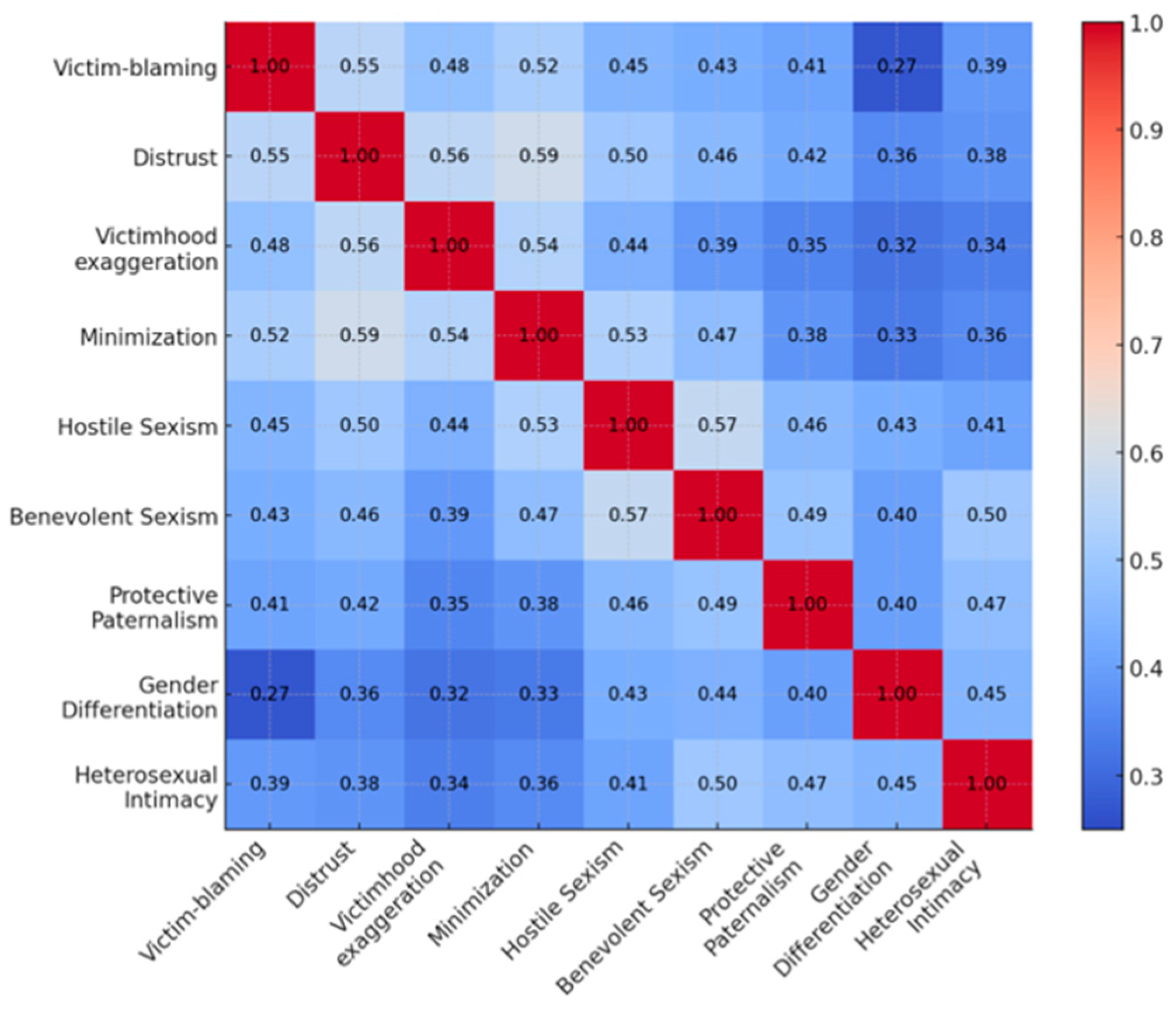
Finally, the correlations between the dimensions under study were analysed using Spearman’s rho correlation coefficient, as the data did not follow a normal distribution (
p < 0.05 according to the Kolmogorov–Smirnov test). This coefficient allows positive or negative relationships between non-parametric variables to be identified. Positive values close to 1 indicate a strong direct correlation, while values close to 0 indicate a weak or non-existent relationship. The results obtained (
Figure 1) show positive and significant correlations. For example, the dimension of victim blaming shows a moderate correlation with distrust of complainants (r = 0.55), exaggeration of the problem (r = 0.48) and minimisation of harassment (r = 0.52), suggesting that these beliefs tend to coexist in the same individuals. Likewise, hostile sexism is positively correlated with benevolent sexism (r = 0.57), indicating that both forms of sexism can manifest simultaneously in social perception.
Also noteworthy are the relationships between benevolent sexism and its subdimensions: protective paternalism (r = 0.49), gender differentiation (r = 0.44) and heterosexual intimacy (r = 0.50), which reinforce the structural validity of the theoretical model used. These correlations allow us to understand how the system of sexist beliefs is articulated, both in its most explicit form and in more subtle and socially accepted forms.
4. Discussion and Conclusions
With regard to the acceptance of modern myths about sexual assault among students at the University of Granada, the data reveal a medium-low level of general acceptance, with a total mean of 2.12 (SD = 0.73). However, problematic beliefs persist in certain items of the AMMSA questionnaire. For example, a sector of the sample agrees with statements that blame the victim, especially for their behaviour or clothing, or that minimise sexual violence in intimate partner contexts. These results coincide with previous studies (
Bohner et al. 2022), which warn of the persistence of these myths in the social imagination of young people.
Similarly, the results show higher levels of benevolent sexism (M = 2.65; SD = 0.85) than hostile sexism (M = 2.48; SD = 0.91). This finding shows similar results to the studies by
Moya and Expósito (
2007), which indicate that benevolent sexism is more tolerated because of its protective appearance. Items such as “Women should be cared for by men” reflect a traditional view of the female role, based on dependence.
In the relationship between acceptance of modern myths of sexual aggression and ambivalent sexism, based on gender, men obtained higher scores (t = 3.94;
p < 0.001), indicating greater acceptance of sexual myths. Men also showed higher levels of both hostile and benevolent sexism (
p < 0.001). These results support previous research (
Megías et al. 2018;
Ortiz and García 2023), which attributes these differences to socialisation patterns based on traditional gender norms.
On the other hand, a moderate positive correlation (r = 0.54;
p < 0.001) was identified between acceptance of sexual myths and ambivalent sexism, indicating that both constructs are related and mutually reinforcing. This finding supports the hypothesis that adherence to sexist ideas increases the likelihood of justifying or trivialising sexual violence (
Delgado and Fernández 2022). Bivariate analyses also show relevant relationships between specific dimensions. Hostile sexism correlates with beliefs that blame victims or minimise sexual violence, while benevolent sexism is related to items that reinforce traditional gender roles and paternalism. These relationships show that gender stereotypes continue to act as a normative framework in interpersonal relationships among young people.
In summary, this study shows that, although the degree of acceptance of modern myths about sexual aggression and sexism is not alarming, attitudes that could favour tolerance of sexual violence persist. The significant differences based on gender underscore the need for educational interventions that incorporate a critical gender perspective, as suggested by
Pazos-González et al. (
2014) and
Valls-Carol and Gómez (
2020).
These results are highly relevant to the educational sphere, especially at university level, as they show that the academic environment is not free from sexist attitudes or distorted beliefs about sexual violence. It is therefore essential to implement pedagogical strategies that promote critical reflection, the questioning of stereotypes and the construction of egalitarian relationships between men and women at university. Taken together, the findings provide useful evidence for institutional intervention, highlighting the need for training strategies that address subtle forms of sexism and beliefs that normalise sexual violence, especially among gender-differentiated groups, where higher levels of acceptance are observed.
Some limitations encountered during the development of this research were related to the time available, access to a larger sample, and the methodological characteristics of the study itself. Firstly, the sample was limited to students at the University of Granada, which means that the results obtained are confined to a specific academic and cultural context. Although this group is of great interest because it consists of young people at a key stage of their education, it is recognised that it does not represent the entire youth population. Therefore, it is important to note that the results obtained cannot be generalised, bearing in mind that other contextual variables (such as rural-urban environment, socioeconomic status, or type of studies) could influence perceptions of myths about sexual assault and sexist attitudes. It should also be noted that although the instruments used have proven validity and reliability, they have limitations inherent to self-reporting methods. The use of closed-ended questionnaires may restrict the variety of responses and is subject to social desirability bias, especially on sensitive topics such as sexual assault and sexism. Furthermore, the interpretation of certain items may vary depending on the participants’ level of understanding of the language used or their previous experience with these issues.
It also implies a limitation that, participants identified themselves only as male or female. This result limits the generalisation of the findings to people with non-binary or trans gender identities. Future research should consider more diverse samples and incorporate gender identity as a variable, which would allow for a more comprehensive analysis of attitudes towards sexual violence and ambivalent sexism.
In terms of future lines of research, it would be appropriate to expand the sample to include students from other universities and, if possible, non-university students, in order to obtain a more representative view of today’s youth. It would also be relevant to carry out comparative studies between autonomous communities or even at the national level, incorporating variables such as sexual orientation, gender identity or family context, to enrich the analysis of the factors that influence the acceptance of sexist myths and attitudes. Similarly, it is recommended that the quantitative approach be complemented with qualitative methodologies, such as interviews or focus groups, which allow for the analysis of nuances and discourses that closed questionnaires do not capture, facilitating a deeper understanding of underlying beliefs and attitudes.
Although the study is set in a Spanish context, it addresses universal dynamics such as ambivalent sexism and myths about sexual assault, which are present in higher education institutions in many countries. Its findings provide recent evidence in an under-studied context, broadening the geographical diversity in the literature and offering transferable inputs for the design of preventive and educational policies in universities internationally.





 ,
,