Engineering Performance of Copper Slag in Sustainable Construction: A Systematic Review

 ,
,  ,
,  , ,
, ,  and
and 
Abstract
1. Introduction
2. Review Methodology
3. Copper Slag as Fine Aggregate Replacement
4. Copper Slag as Cementitious Material
5. Durability Performance
6. Emerging Applications of CS in Construction
7. Environmental and Economic Assessment
8. Statistical Validation and Optimization of Copper Slag Utilization
9. Conclusions
Supplementary Materials
Author Contributions
Funding
Data Availability Statement
Acknowledgments
Conflicts of Interest
References
- Phiri, T.C.; Singh, P.; Nikoloski, A.N. The Potential for Copper Slag Waste as a Resource for a Circular Economy: A Review—Part I. Miner. Eng. 2022, 180, 107474. [Google Scholar] [CrossRef]
- Nikoloski, A.; Singh, P.; Chanda-Phiri, T. An Overview of Global Copper Smelting Slag Production and Reprocessing Approaches. In Proceedings of the XVI International Mineral Processing and Recycling Conference—Zbornik Radova, Belgrade, Serbia, 28–30 May 2025; University of Belgrade, Technical Faculty: Bor, Serbia, 2025; pp. 25–36. [Google Scholar]
- Prem, P.R.; Verma, M.; Ambily, P.S. Sustainable Cleaner Production of Concrete with High Volume Copper Slag. J. Clean. Prod. 2018, 193, 43–58. [Google Scholar] [CrossRef]
- Gabasiane, T.S.; Danha, G.; Mamvura, T.A.; Mashifana, T.; Dzinomwa, G. Environmental and Socioeconomic Impact of Copper Slag—A Review. Crystals 2021, 11, 1504. [Google Scholar] [CrossRef]
- Kim, J.-M.; Choi, S.-M.; Shin, S.-C. Engineering Properties as a Supplement Cementitious Material of Ground Copper Reduction Slag Extracted Valuable Metal from Cu Slag. Heliyon 2024, 10, e34139. [Google Scholar] [CrossRef] [PubMed]
- Singh, J.; Singh, S. Development of Alkali-Activated Cementitious Material Using Copper Slag. Constr. Build. Mater. 2019, 211, 73–79. [Google Scholar] [CrossRef]
- Liu, J.; Xie, H.; Han, B. The Utilization of the Copper Smelting Slag: A Critical Review. Minerals 2025, 15, 926. [Google Scholar] [CrossRef]
- Harimana, J.; Makangila, M.; Mundike, J.; Maseka, K.K. Effect of Particle Size, pH, and Residence Time on Mobility of Copper and Cobalt from Copper Slag. Sci. Afr. 2024, 23, e02117. [Google Scholar] [CrossRef]
- Zhang, C.; Zhang, Y.; Zhang, Z.; Zhang, G. Effective Separation and Recovery of Valuable Metals from Copper Slag: A Comprehensive Review. Environ. Res. 2025, 283, 122145. [Google Scholar] [CrossRef]
- Zhang, Z.; Wang, Q.; Huang, Z. Value-Added Utilization of Copper Slag to Enhance the Performance of Magnesium Potassium Phosphate Cement. Resour. Conserv. Recycl. 2022, 180, 106212. [Google Scholar] [CrossRef]
- He, R.; Zhang, S.; Zhang, X.; Zhang, Z.; Zhao, Y.; Ding, H. Copper Slag: The Leaching Behavior of Heavy Metals and Its Applicability as a Supplementary Cementitious Material. J. Environ. Chem. Eng. 2021, 9, 105132. [Google Scholar] [CrossRef]
- Xu, Q.; Liu, S.; Qian, J.; Xu, R.; Ma, W. Effects of Three Different Types of Fibers and Dosage on the Properties of Alkali-Activated Copper Slag–Slag Cementitious Materials. Sci. Rep. 2025, 15, 26438. [Google Scholar] [CrossRef] [PubMed]
- Arredondo, P.W.C.; Silva, Y.F.; Araya-Letelier, G.; Hernández, H. Valorization of Recycled Aggregate and Copper Slag for Sustainable Concrete Mixtures: Mechanical, Physical, and Environmental Performance. Sustainability 2024, 16, 11239. [Google Scholar] [CrossRef]
- Sharma, R.; Khan, R.A. Sustainable Use of Copper Slag in Self Compacting Concrete Containing Supplementary Cementitious Materials. J. Clean. Prod. 2017, 151, 179–192. [Google Scholar] [CrossRef]
- Arif, R.; Javed, M.F.; Asghar, R.; Iqtidar, A.; Ahmed, B.; Alyousef, R.; Khan, M.A. A Scientometric Review on the Utilization of Copper Slag as a Substitute Constituent of Ordinary Portland Cement Concrete. Rev. Adv. Mater. Sci. 2025, 64, 20240082. [Google Scholar] [CrossRef]
- Zhang, Y.; Yang, Y.; Guo, D.; Xu, H. Synergistic Environmental Benefits from Copper Slag Recycling in China: Pollutant Mitigation and Carbon Reduction. J. Environ. Manag. 2024, 370, 122907. [Google Scholar] [CrossRef]
- Jin, Q.; Chen, L. A Review of the Influence of Copper Slag on the Properties of Cement-Based Materials. Materials 2022, 15, 8594. [Google Scholar] [CrossRef] [PubMed]
- Gammons, C.H.; Kaplan, J. Mineralogy and Environmental Geochemistry of Copper Slag from Butte, Montana. J. Geochem. Explor. 2024, 267, 107599. [Google Scholar] [CrossRef]
- Prithiviraj, C.; Swaminathan, P.; Kumar, D.R.; Murali, G.; Vatin, N.I. Fresh and Hardened Properties of Self-Compacting Concrete Comprising a Copper Slag. Buildings 2022, 12, 965. [Google Scholar] [CrossRef]
- Mitrašinović, A.M.; Yuankun, Y.; Stopic, S.; Radosavljević, M. Feasibility of Recovering Valuable and Toxic Metals from Copper Slag Using Iron-Containing Additives. Metals 2023, 13, 1467. [Google Scholar] [CrossRef]
- Sarfo, P.; Das, A.; Wyss, G.; Young, C. Recovery of Metal Values from Copper Slag and Reuse of Residual Secondary Slag. Waste Manag. 2017, 70, 272–281. [Google Scholar] [CrossRef]
- Lemougna, P.N.; Yliniemi, J.; Adesanya, E.; Tanskanen, P.; Kinnunen, P.; Roning, J.; Illikainen, M. Reuse of Copper Slag in High-Strength Building Ceramics Containing Spodumene Tailings as Fluxing Agent. Miner. Eng. 2020, 155, 106448. [Google Scholar] [CrossRef]
- You, M.; Hu, Y.; Zhou, C.; Liu, G. Speciation Characterization and Environmental Stability of Arsenic in Arsenic-Containing Copper Slag Tailing. Molecules 2024, 29, 1502. [Google Scholar] [CrossRef] [PubMed]
- Phiri, T.C.; Singh, P.; Nikoloski, A.N. Mineralogical Characterisation of Copper Slag and Phase Transformation after Carbocatalytic Reduction for Hydrometallurgical Extraction of Copper and Cobalt. Metals 2024, 14, 1119. [Google Scholar] [CrossRef]
- Dzinomwa, G.; Mapani, B.; Nghipulile, T.; Maweja, K.; Kurasha, J.T.; Amwaama, M.; Chigayo, K. Mineralogical Characterization of Historic Copper Slag to Guide the Recovery of Valuable Metals: A Namibian Case Study. Materials 2023, 16, 6126. [Google Scholar] [CrossRef]
- Wu, L.; Li, H.; Liu, K.; Mei, H.; Xia, Y.; Dong, Y. An Efficient Approach to Utilize Copper Smelting Slag: Separating Nonferrous Metals and Reducing Iron Oxide at High Temperature. Waste Manag. 2023, 172, 182–191. [Google Scholar] [CrossRef]
- Kaksonen, A.H.; Särkijärvi, S.; Puhakka, J.A.; Peuraniemi, E.; Junnikkala, S.; Tuovinen, O.H. Solid Phase Changes in Chemically and Biologically Leached Copper Smelter Slag. Miner. Eng. 2017, 106, 97–101. [Google Scholar] [CrossRef]
- Klaffenbach, E.; Montenegro, V.; Guo, M.; Blanpain, B. Sustainable and Comprehensive Utilization of Copper Slag: A Review and Critical Analysis. J. Sustain. Metall. 2023, 9, 468–496. [Google Scholar] [CrossRef]
- Chithra, S.; Senthil Kumar, S.R.R.; Chinnaraju, K. The Effect of Colloidal Nano-Silica on Workability, Mechanical and Durability Properties of High Performance Concrete with Copper Slag as Partial Fine Aggregate. Constr. Build. Mater. 2016, 113, 794–804. [Google Scholar] [CrossRef]
- Kuranlı, Ö.F.; Uysal, M.; Abbas, M.T.; Cosgun, T.; Niş, A.; Aygörmez, Y.; Canpolat, O.; Al-mashhadani, M.M. Evaluation of Slag/Fly Ash Based Geopolymer Concrete with Steel, Polypropylene and Polyamide Fibers. Constr. Build. Mater. 2022, 325, 126747. [Google Scholar] [CrossRef]
- Abdalla, T.A.; Alahmari, T.S. Mechanical Strength and Microstructure Properties of Concrete Incorporating Copper Slag as Fine Aggregate: A State-of-the-Art Review. Adv. Civ. Eng. 2024, 2024, 4389616. [Google Scholar] [CrossRef]
- Al-Jabri, K.S.; Al-Saidy, A.H.; Taha, R. Effect of Copper Slag as a Fine Aggregate on the Properties of Cement Mortars and Concrete. Constr. Build. Mater. 2011, 25, 933–938. [Google Scholar] [CrossRef]
- Deep, A.; Sarkar, P. Enhancing Sustainability in Concrete Construction: Utilizing Copper Slag for Improved Properties of Geopolymer Concrete. Constr. Build. Mater. 2024, 453, 139044. [Google Scholar] [CrossRef]
- Sheikh, E.; Mousavi, S.R.; Afshoon, I. Producing Green Roller Compacted Concrete (RCC) Using Fine Copper Slag Aggregates. J. Clean. Prod. 2022, 368, 133005. [Google Scholar] [CrossRef]
- Wang, R.; Shi, Q.; Li, Y.; Cao, Z.; Si, Z. A Critical Review on the Use of Copper Slag (CS) as a Substitute Constituent in Concrete. Constr. Build. Mater. 2021, 292, 123371. [Google Scholar] [CrossRef]
- Gupta, N.; Siddique, R. Durability Characteristics of Self-Compacting Concrete Made with Copper Slag. Constr. Build. Mater. 2020, 247, 118580. [Google Scholar] [CrossRef]
- ASTM C1202-25; Test Method for Electrical Indication of Concretes Ability to Resist Chloride Ion Penetration. ASTM International: West Conshohocken, PA, USA, 2025. [CrossRef]
- Li, J.; Liu, X.; Chen, M.; Tian, L.; Liu, J. A Study on Chloride Corrosion Resistance of Reactive Powder Concrete (RPC) with Copper Slag Replacing Quartz Sand under Freeze–Thaw Conditions. Materials 2023, 17, 212. [Google Scholar] [CrossRef] [PubMed]
- Kinnunen, P.; Mäkinen, J.; Salo, M.; Soth, R.; Komnitsas, K. Efficiency of Chemical and Biological Leaching of Copper Slag for the Recovery of Metals and Valorisation of the Leach Residue as Raw Material in Cement Production. Minerals 2020, 10, 654. [Google Scholar] [CrossRef]
- Rathee, M.; Misra, A. Copper Slag as a Sustainable Resource: Investigating Heavy Metal Leaching and the Use of Copper Slag as a Replacement for Natural Fine Aggregate in Geopolymer Concrete. J. Mater. Civ. Eng. 2025, 37, 04025262. [Google Scholar] [CrossRef]
- Arunachelam, N.; Maheswaran, J.; Chellapandian, M.; Murali, G.; Vatin, N.I. Development of High-Strength Geopolymer Concrete Incorporating High-Volume Copper Slag and Micro Silica. Sustainability 2022, 14, 7601. [Google Scholar] [CrossRef]
- Izydorczyk, G.; Mikula, K.; Skrzypczak, D.; Moustakas, K.; Witek-Krowiak, A.; Chojnacka, K. Potential Environmental Pollution from Copper Metallurgy and Methods of Management. Environ. Res. 2021, 197, 111050. [Google Scholar] [CrossRef]
- Zhang, Y.; Ji, Y.; Xu, H.; Yang, Y.; Tian, L. Life Cycle Assessment of Valuable Metal Extraction from Copper Pyrometallurgical Solid Waste. Resour. Conserv. Recycl. 2023, 191, 106875. [Google Scholar] [CrossRef]
- Mitrašinović, A.M.; Stopic, S.; Yu, D. Removal of the Heavy Metals from Copper Slag by Using Carbonless Additives. Waste Manag. 2024, 187, 218–224. [Google Scholar] [CrossRef]
- Al-Jabri, K.S.; Hisada, M.; Al-Saidy, A.H.; Al-Oraimi, S.K. Performance of High Strength Concrete Made with Copper Slag as a Fine Aggregate. Constr. Build. Mater. 2009, 23, 2132–2140. [Google Scholar] [CrossRef]
- Ambily, P.S.; Umarani, C.; Ravisankar, K.; Prem, P.R.; Bharatkumar, B.H.; Iyer, N.R. Studies on Ultra High-Performance Concrete Incorporating Copper Slag as Fine Aggregate. Constr. Build. Mater. 2015, 77, 233–240. [Google Scholar] [CrossRef]
- Sharma, R.; Khan, R.A. Durability Assessment of Self Compacting Concrete Incorporating Copper Slag as Fine Aggregates. Constr. Build. Mater. 2017, 155, 617–629. [Google Scholar] [CrossRef]
- Selvi, P.T. Experimental Study on Concrete Using Copper Slag as Replacement Material of Fine Aggregate. J. Civ. Environ. Eng. 2014, 3188, 070025. [Google Scholar] [CrossRef]
- Dos Anjos, M.A.G.; Sales, A.T.C.; Andrade, N. Blasted Copper Slag as Fine Aggregate in Portland Cement Concrete. J. Environ. Manag. 2017, 196, 607–613. [Google Scholar] [CrossRef] [PubMed]
- Ambily, P.S.; Kaliyavaradhan, S.K.; Sebastian, S.; Shekar, D. Sustainable 3D Printable Concrete Mix Using Copper Slag. J. Build. Eng. 2025, 101, 111950. [Google Scholar] [CrossRef]
- Mavroulidou, M. Mechanical Properties and Durability of Concrete with Water Cooled Copper Slag Aggregate. Waste Biomass Valorization 2017, 8, 1841–1854. [Google Scholar] [CrossRef]
- Filipović, S.; Đokić, O.; Radević, A.; Zakić, D. Copper Slag of Pyroxene Composition as a Partial Replacement of Natural Aggregate for Concrete Production. Minerals 2021, 11, 439. [Google Scholar] [CrossRef]
- Maharishi, A.; Singh, S.P.; Gupta, L.K. Shehnazdeep Strength and Durability Studies on Slag Cement Concrete Made with Copper Slag as Fine Aggregates. Mater. Today Proc. 2021, 38, 2639–2648. [Google Scholar] [CrossRef]
- Sharifi, Y.; Afshoon, I.; Asad-Abadi, S.; Aslani, F. Environmental Protection by Using Waste Copper Slag as a Coarse Aggregate in Self-Compacting Concrete. J. Environ. Manag. 2020, 271, 111013. [Google Scholar] [CrossRef] [PubMed]
- Sahu, A.; Kumar, P.; Pratap, B.; Gogineni, A.; Sembeta, R.Y. Thermal and Mechanical Performance of Geopolymer Concrete with Recycled Aggregate and Copper Slag as Fine Aggregate. Sci. Rep. 2025, 15, 28968. [Google Scholar] [CrossRef] [PubMed]
- Turkane, S.D.; Chouksey, S.K.; Nawale, A.V.; Sahu, R.T.; Gayake, S.B.; Gunjal, S.M. Utilization of Copper Slag as Fine Sand Replacement in Concrete: A Response Surface Methodology Approach. Discov. Civ. Eng. 2024, 1, 129. [Google Scholar] [CrossRef]
- Mithun, B.M.; Narasimhan, M.C. Performance of Alkali Activated Slag Concrete Mixes Incorporating Copper Slag as Fine Aggregate. J. Clean. Prod. 2016, 112, 837–844. [Google Scholar] [CrossRef]
- Veeraiah, R.; Chakrawarthi, V. An Experimental Investigation on Longevity and Mechanical Characteristics of High-Performance Concrete Incorporating Copper Slag as Replacement of Fine Aggregate. Mater. Res. Express 2026, 13, 7. [Google Scholar] [CrossRef]
- Rohini, I.; Padmapriya, R. Properties of Bacterial Copper Slag Concrete. Buildings 2023, 13, 290. [Google Scholar] [CrossRef]
- Chakrawarthi, V.; Avudaiappan, S.; Amran, M.; Dharmar, B.; Raj Jesuarulraj, L.; Fediuk, R.; Aepuru, R.; Vatin, N.; Saavedra Flores, E. Impact Resistance of Polypropylene Fibre-Reinforced Alkali–Activated Copper Slag Concrete. Materials 2021, 14, 7735. [Google Scholar] [CrossRef]
- Silva, Y.F.; Villaquirán-Caicedo, M.; Izquierdo, S. Exploring the Potential of Alternative Materials in Concrete Mixtures: Effect of Copper Slag on Mechanical Properties and Carbonation Resistance. Materials 2023, 16, 6677. [Google Scholar] [CrossRef] [PubMed]
- Ahmad, J.; Majdi, A.; Deifalla, A.F.; Isleem, H.F.; Rahmawati, C. Concrete Made with Partially Substitutions of Copper Slag (CPS): State of the Art Review. Materials 2022, 15, 5196. [Google Scholar] [CrossRef]
- MacLennan, S.; Almeida, F.C.R.; Klemm, A.J. The Effect of Superabsorbent Polymers on Mechanical Characteristics and Cracking Susceptibility of Alkali-Activated Mortars Containing Ground Granulated Blast-Furnace Slag and Copper Slag. CivilEng 2022, 3, 1077–1090. [Google Scholar] [CrossRef]
- De Pedro, J.P.Q.; Lagao, J.A.T.; Ongpeng, J.M.C. Life Cycle Assessment of Concrete Using Copper Slag as a Partial Cement Substitute in Reinforced Concrete Buildings. Buildings 2023, 13, 746. [Google Scholar] [CrossRef]
- Chithra, S.; Kumar, S.R.R.S.; Chinnaraju, K.; Alfin Ashmita, F. A Comparative Study on the Compressive Strength Prediction Models for High Performance Concrete Containing Nano Silica and Copper Slag Using Regression Analysis and Artificial Neural Networks. Constr. Build. Mater. 2016, 114, 528–535. [Google Scholar] [CrossRef]
- Silva, Y.F.; Burbano-Garcia, C.; Araya-Letelier, G.; Izquierdo, S. Sulfate Attack Performance of Concrete Mixtures with Use of Copper Slag as Supplementary Cementitious Material. Case Stud. Constr. Mater. 2025, 22, e04846. [Google Scholar] [CrossRef]
- Nieświec, M.; Chajec, A.; Šavija, B. Effect of Ground Copper Slag on the Fresh Properties of 3d Printed Cementitious Composites. Sci. Rep. 2025, 15, 18117. [Google Scholar] [CrossRef]
- Feng, Y.; Kero, J.; Yang, Q.; Chen, Q.; Engström, F.; Samuelsson, C.; Qi, C. Mechanical Activation of Granulated Copper Slag and Its Influence on Hydration Heat and Compressive Strength of Blended Cement. Materials 2019, 12, 772. [Google Scholar] [CrossRef]
- Raju, S.; Rathinam, J.; Dharmar, B.; Rekha, S.; Avudaiappan, S.; Amran, M.; Usanova, K.I.; Fediuk, R.; Guindos, P.; Ramamoorthy, R.V. Cyclically Loaded Copper Slag Admixed Reinforced Concrete Beams with Cement Partially Replaced with Fly Ash. Materials 2022, 15, 3101. [Google Scholar] [CrossRef]
- Chakrawarthi, V.; Dharmar, B.; Avudaiappan, S.; Amran, M.; Flores, E.S.; Alam, M.A.; Fediuk, R.; Vatin, N.I.; Rashid, R.S.M. Destructive and Non-Destructive Testing of the Performance of Copper Slag Fiber-Reinforced Concrete. Materials 2022, 15, 4536. [Google Scholar] [CrossRef]
- Nicula, L.M.; Corbu, O.; Ardelean, I.; Sandu, A.V.; Iliescu, M.; Simedru, D. Freeze–Thaw Effect on Road Concrete Containing Blast Furnace Slag: NMR Relaxometry Investigations. Materials 2021, 14, 3288. [Google Scholar] [CrossRef]
- Zhang, L.; Gong, H.; Liu, J.; Li, H. Mechanical Properties and Chloride Penetration Resistance of Copper Slag Aggregate Concrete. Fractal Fract. 2022, 6, 427. [Google Scholar] [CrossRef]
- Afshoon, I.; Sharifi, Y. Utilization of Micro Copper Slag in SCC Subjected to High Temperature. J. Build. Eng. 2020, 29, 101128. [Google Scholar] [CrossRef]
- Eu, H.; Kim, G.; Son, M.; Sasui, S.; Lee, Y.; Choi, H.; Kang, S.; Nam, J. Alkali-Silica Reaction and Residual Mechanical Properties of High-Strength Mortar Containing Waste Glass Fine Aggregate and Supplementary Cementitious Materials. Int. J. Concr. Struct. Mater. 2024, 18, 69. [Google Scholar] [CrossRef]
- Zhang, T.; Zhi, S.; Li, T.; Zhou, Z.; Li, M.; Han, J.; Li, W.; Zhang, D.; Guo, L.; Wu, Z. Alkali Activation of Copper and Nickel Slag Composite Cementitious Materials. Materials 2020, 13, 1155. [Google Scholar] [CrossRef]
- Rajasekar, A.; Arunachalam, K.; Kottaisamy, M. Assessment of Strength and Durability Characteristics of Copper Slag Incorporated Ultra High Strength Concrete. J. Clean. Prod. 2019, 208, 402–414. [Google Scholar] [CrossRef]
- Sandra, N.; Kawaai, K.; Ujike, I. Effect of Copper Slag Fine Aggregate on Corrosion Processes and Behavior in Reinforced Concrete Prism Specimen. Constr. Build. Mater. 2021, 271, 121909. [Google Scholar] [CrossRef]
- Silva, Y.F.; Burbano-Garcia, C.; Rueda, E.J.; Reyes-Román, A.; Araya-Letelier, G. Short- and Long-Term Mechanical and Durability Performance of Concrete with Copper Slag and Recycled Coarse Aggregate Under Magnesium Sulfate Attack. Appl. Sci. 2025, 15, 8329. [Google Scholar] [CrossRef]
- Velumani, M.; Kumar, K.N. Effect of copper slag on mechanical and durability aspects for different strength concretes. Cem. Wapno Beton 2021, 26, 156–166. [Google Scholar] [CrossRef]
- Mitrašinović, A.; Kamberović, Ž.; Yu, D. Toward Zero Waste Mining: Circular Economy of Copper Slags. Glob. Chall. 2025, 9, e00392. [Google Scholar] [CrossRef]
- Košir, M. Applications of Copper Slag in the Construction Sector. Geol. Maced. 2021, 35, 59–66. [Google Scholar] [CrossRef]
- Zhang, D.; Zhang, Y.; Cao, Z.; Cheng, T. Optimization of Roots and Copper Slag to Reinforce Soft Soil Using Response Surface Method. J. Renew. Mater. 2020, 8, 1391–1409. [Google Scholar] [CrossRef]
- Sivasuriyan, A.; Vijayan, D.S.; Piętocha, A.; Górski, W.; Wodzyński, Ł.; Koda, E. Advanced Sensing and Digital Monitoring Technologies for Structural Health Assessment of Civil Infrastructure. Buildings 2026, 16, 656. [Google Scholar] [CrossRef]
- Sanijya, G.; R, B.M.; P, S.C. Sustainable Stabilization of Native Subgrade Soil for Low-Volume Roads Using Copper Slag and Cementitious Materials. Res. Eng. Struct. Mat. 2025, 1683–1702. [Google Scholar] [CrossRef]
- Panda, S.; Sarkar, P.; Davis, R. Abrasion Resistance and Slake Durability of Copper Slag Aggregate Concrete. J. Build. Eng. 2021, 35, 101987. [Google Scholar] [CrossRef]
- Siddique, R.; Singh, M.; Jain, M. Recycling Copper Slag in Steel Fibre Concrete for Sustainable Construction. J. Clean. Prod. 2020, 271, 122559. [Google Scholar] [CrossRef]
- Yadav, A.; Gajbhiye, A.; Agrawal, D.; Ansari, K.; Alsabhan, A.H.; Arunachalam, K.P.; Avudaiappan, S.; Maureira-Carsalade, N.; Alsareji, O.J. Mechanical, Durability, and Microstructure Analysis of Concrete Made with Metakaolin and Copper Slag for Sustainable Construction. Rev. Adv. Mater. Sci. 2025, 64, 20250138. [Google Scholar] [CrossRef]
- Demirtaş, H.; Dayı, M. A Proposal for Electromagnetic Performance in Cementitious Systems: Carbon Fiber and Copper Slag. Buildings 2025, 15, 3634. [Google Scholar] [CrossRef]
- Yan, Z.; Sun, Z.; Yang, J.; Yang, H.; Ji, Y.; Hu, K. Mechanical Performance and Reaction Mechanism of Copper Slag Activated with Sodium Silicate or Sodium Hydroxide. Constr. Build. Mater. 2021, 266, 120900. [Google Scholar] [CrossRef]
- Leiva-Guajardo, S.I.; Maya, M.F.; Cáceres, L.; Jimenez-Arevalo, V.M.; Soliz, Á.; Toro, N.; Murcia, J.Á.C.; Cruz, V.E.R.; Morel, M.; Fuentealba, E.; et al. Copper Slag Cathodes for Eco-Friendly Hydrogen Generation: Corrosion and Electrochemical Insights for Saline Water Splitting. Materials 2025, 18, 3092. [Google Scholar] [CrossRef]
- Fuentes, M.; Pulido, D.; Fuentealba, E.; Soliz, A.; Toro, N.; Sagade, A.; Madrid, F.M.G. Direct Solar Thermal Water-Splitting Using Iron and Iron Oxides at High Temperatures: A Review. Appl. Sci. 2024, 14, 7056. [Google Scholar] [CrossRef]
- Fuentes, M.; Leiva-Guajardo, S.; Sagade, A.; Sepúlveda, F.; Soliz, A.; Toro, N.; Murcia, J.Á.C.; Cruz, V.E.R.; Toledo, M.; Fuentealba, E.; et al. The Use of Copper Slag in the Thermolysis Process for Solar Hydrogen Production—A Novel Alternative for the Circular Economy. Appl. Sci. 2025, 15, 4988. [Google Scholar] [CrossRef]
- Gursel, A.P.; Ostertag, C. Life-Cycle Assessment of High-Strength Concrete Mixtures with Copper Slag as Sand Replacement. Adv. Civ. Eng. 2019, 2019, 6815348. [Google Scholar] [CrossRef]
- Zhou, H.; Basarir, H.; Poulet, T.; Li, W.; Kleiv, R.A.; Karrech, A. Life Cycle Assessment of Recycling Copper Slags as Cement Replacement Material in Mine Backfill. Resour. Conserv. Recycl. 2024, 205, 107591. [Google Scholar] [CrossRef]
- Zhang, Q.; Zhang, B.; Wang, D. Environmental Benefit Assessment of Blended Cement with Modified Granulated Copper Slag. Materials 2022, 15, 5359. [Google Scholar] [CrossRef]
- Filipović, S.; Marinković, S.; Zakić, D. Environmental Assessment of Copper Slag Aggregate Concrete. Gradjevinski Mater. Konstr. 2022, 65, 57–83. [Google Scholar] [CrossRef]
- Wang, J.-P.; Erdenebold, U. A Study on Reduction of Copper Smelting Slag by Carbon for Recycling into Metal Values and Cement Raw Material. Sustainability 2020, 12, 1421. [Google Scholar] [CrossRef]
- Nikoloski, A.N.; Singh, P.; Chanda Phiri, T. From Waste to Resource: Critical Mineral Recovery and Environmental Impact Mitigation in Copper Smelting Slag. Minerals 2026, 16, 206. [Google Scholar] [CrossRef]
- Piętocha, A.; Koda, E. Sustainable Design and Energy Efficiency in Supertall and Megatall Buildings: Challenges of Multi-Criteria Certification Implementation. Energies 2025, 19, 133. [Google Scholar] [CrossRef]
- You, N.; Chen, Z.; Gao, Z.; Song, X. The Effect of Copper Slag as a Precursor on the Mechanical Properties, Shrinkage and Pore Structure of Alkali-Activated Slag-Copper Slag Mortar. J. Build. Eng. 2024, 98, 111151. [Google Scholar] [CrossRef]



| (a) | ||||
|---|---|---|---|---|
| Category | Parameter | Typical Range/Value | Scientific and Engineering Significance | Citations |
| Physical Properties | Specific Gravity | 2.8–3.91 | Increases concrete density about 2800–3800 kg/m3, contributing to improved strength and stability. | [4,29] |
| Hardness (Mohs Scale) | 6–7 | Provides high abrasion resistance and durability under mechanical loading. | [4,30] | |
| Water Absorption | 0.13–0.5% | Low absorption increases free water content, enhancing workability but requiring mix control. | [31] | |
| Particle Morphology | Angular, glassy, irregular | Improves mechanical interlocking and internal friction within the matrix. | [17,19] | |
| Chemical Composition | Iron Oxide (Fe2O3) | 20.40–62.00% | Governs high density and contributes to stiffness. | [17] |
| Silicon Dioxide (SiO2) | 19.08–40.00% | Provides potential pozzolanic reactivity when finely ground. | [6,9] | |
| Aluminum Oxide (Al2O3) | 0.22–15.60% | Participates in secondary hydration reactions forming C–A–S–H phases. | [9,17] | |
| Mineralogical Phases | Major Phases | Fayalite (Fe2SiO4), Magnetite (Fe3O4) | Dominant crystalline phases about 80–85%, which contribute to structural stability and chemical inertness. | [9,17] |
| (b) | ||||
| Property | CS Role and Replacement Level | Test Conditions/Mix Parameters | Observed Impact and Governing Mechanism | Citations |
| Workability (Slump) | Fine Aggregate replaced up to 100% | w/b value range from 0.40 to 0.55 through the slump cone test | Significant increase in slump value ranges from 65 to 200 mm due to low water absorption and glassy surface. | [32] |
| Compressive Strength | Fine Aggregate replaced at 40% optimum | In HPC, the curing duration ranges from 28 to 91 days | Strength increases up to 20–25% due to improved packing and ITZ densification. | [33,34] |
| Setting Time | SCM replacement | Particle size found less than 30 µm | Initial setting time may extend >250 min due to the dilution effect and low CaO content. | [15,35] |
| Chloride Permeability | Fine Aggregate replaced at 20–30% | In SCC/UHSC, as per ASTM C1202, the curing period 90–365 days | Reduced permeability value of about 300–500 coulombs due to compact C–S–H structure. | [36,37] |
| Freeze–Thaw Resistance | Fine Aggregate replaced up to 100% | RPC value about 250 cycles | Lower strength loss compared to control due to reduced pore connectivity and improved matrix integrity. | [38] |
| (c) | ||||
| Leaching Context/Test Method | Target Element(s) | Behavior and Environmental Implications | Citations | |
| TCLP (Toxicity Characteristic Leaching Procedure) | Cu, Zn | Untreated slag may exhibit elevated leaching values, found Cu as 64.7 mg/L and Zn as 10.8 mg/L, which require stabilization. | [39] | |
| Acidic- pH ranges between 2 and 3 | Pb, As | Maximum leaching occurs under acidic conditions; amorphous slag shows higher release than crystalline slag. | [11,28] | |
| Neutral pH value 4–8 | As | Minimum leaching observed; represents relatively stable environmental conditions. | [28] | |
| Alkaline Conditions: pH greater than 10 | Ni, Pb, Zn | Increased leaching due to dissolution under high pH conditions. | [11] | |
| Sequential Extraction | Cd | High mobility, with about 66% exchangeable fraction, indicating potential environmental risk if not stabilized. | [11] | |
| Encapsulation in Concrete/Geopolymers | Multiple heavy metals | Significant immobilization through physical encapsulation and chemical bonding (e.g., near-complete immobilization of Pb and Cd). | [40,41] | |
| Parameter | Description |
|---|---|
| Concrete/Binder Type | Ordinary Portland Cement, blended cement, geopolymer |
| Copper Slag Replacement (%) | Percentage replacement of fine aggregate or cement |
| Copper Slag Grading | Particle size distribution and fineness |
| Water–Binder Ratio (w/b) | Mix proportion |
| Curing Age | 7, 28, 56, 90 days |
| Mechanical Properties | Compressive, tensile, and flexural strength |
| Durability Properties | Water absorption, chloride penetration, sulfate resistance |
| Exposure Conditions | Marine, acidic, sulfate, or normal environment |
| Testing Methods | ASTM/IS/EN standards followed |
| (a) | |||||
|---|---|---|---|---|---|
| CS Replacement (%) | Strength | Durability | Environment | Cost | Performance Index (PI) |
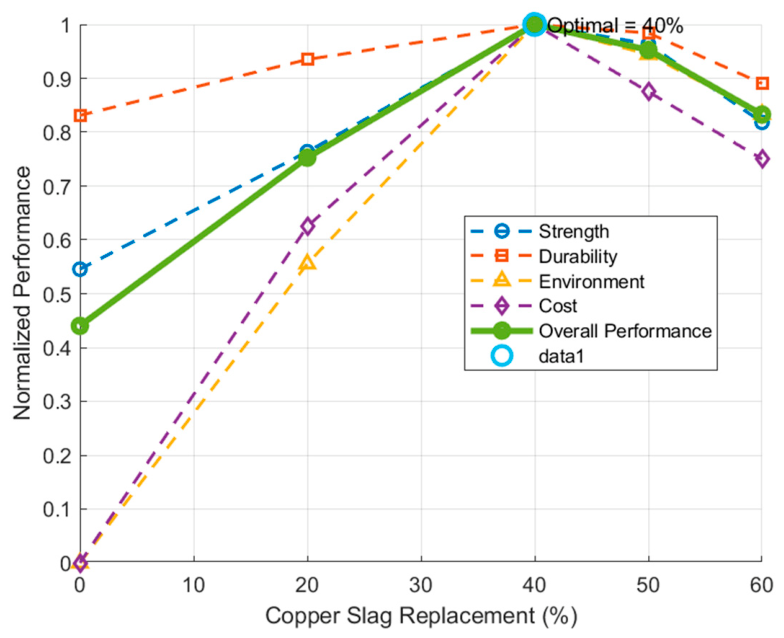
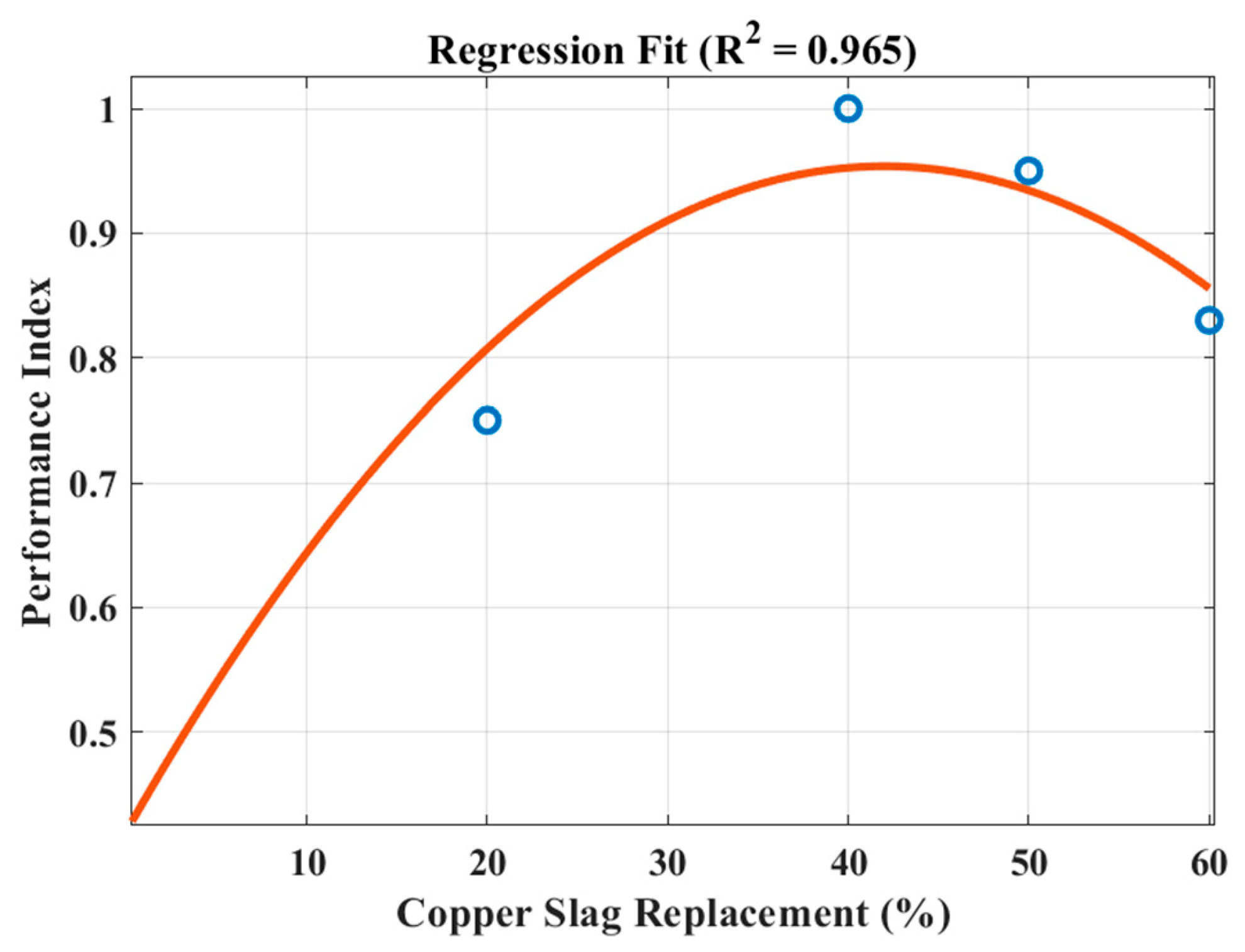
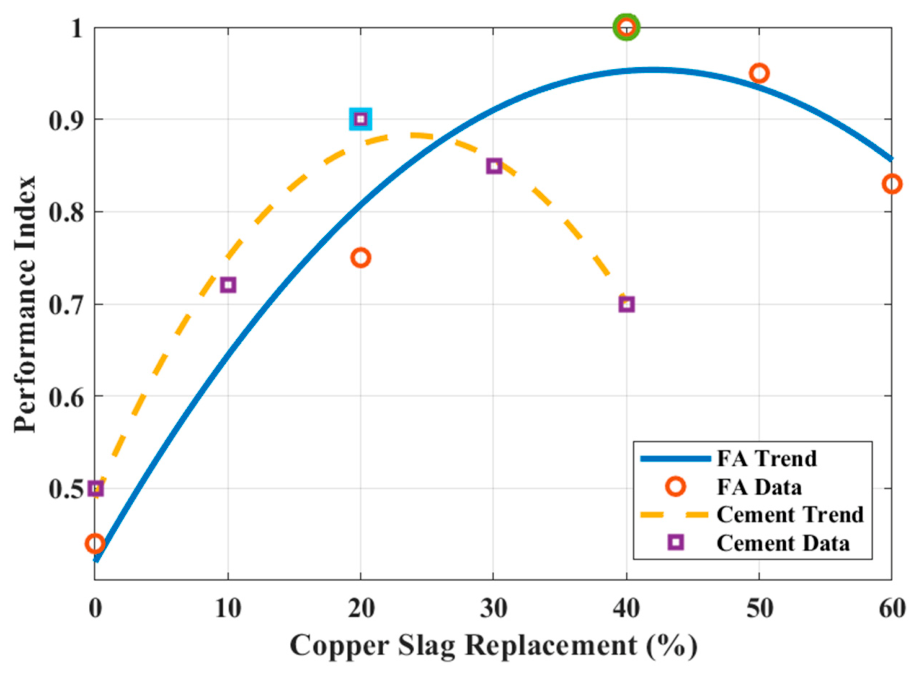
| 0% | 0.54 | 0.83 | 0.00 | 0.00 | 0.44 |
| 20% | 0.76 | 0.93 | 0.55 | 0.62 | 0.75 |
| 40% | 1.00 | 1.00 | 1.00 | 1.00 | 1.00 |
| 50% | 0.95 | 0.98 | 0.95 | 0.87 | 0.95 |
| 60% | 0.81 | 0.89 | 0.83 | 0.75 | 0.83 |
| (b) | |||||
| CS Replacement (%) | Strength | Durability | Environment | Cost | Performance Index (PI) |
| 0% | 0.76 | 0.78 | 0.00 | 0.00 | 0.50 |
| 10% | 0.88 | 0.90 | 0.40 | 0.41 | 0.72 |
| 20% | 1.00 | 1.00 | 0.70 | 0.73 | 0.90 |
| 30% | 0.75 | 0.80 | 1.00 | 0.98 | 0.85 |
| 40% | 0.50 | 0.58 | 1.00 | 1.00 | 0.70 |
| Material Role | Concrete System | Optimal Range | Required Conditions and Parameters | Citation |
|---|---|---|---|---|
| Fine Aggregate | Conventional Concrete | 30–40% | w/b: 0.40–0.55; Curing: 28–90 days; Gradation: 0.15–4.75 mm | [32,34,48] |
| SCC/UHPC | 20–30% | w/b: <0.40 Controlled fines Extended curing | [14,36,47] | |
| Geopolymer Concrete | 40–60% | Alkali activation; Heat/ambient curing; Angular particles | [33,55] | |
| SCM (Binder) | Conventional Concrete | 10–20% | w/b: 0.40–0.50; Fine grinding ranging less than 30 µm with long curing about 90–360 days. | [64,76] |
| Alkali-Activated Systems | Up to 50% | NaOH/Na2SiO3 activation; Heat curing; High alkalinity | [6,75,100] |
Disclaimer/Publisher’s Note: The statements, opinions and data contained in all publications are solely those of the individual author(s) and contributor(s) and not of MDPI and/or the editor(s). MDPI and/or the editor(s) disclaim responsibility for any injury to people or property resulting from any ideas, methods, instructions or products referred to in the content. |
© 2026 by the authors. Licensee MDPI, Basel, Switzerland. This article is an open access article distributed under the terms and conditions of the Creative Commons Attribution (CC BY) license.
Share and Cite
Vijayan, D.S.; Devarajan, P.; Nartowska, E.; Sivasuriyan, A.; Piętocha, A.; Koda, E. Engineering Performance of Copper Slag in Sustainable Construction: A Systematic Review. Buildings 2026, 16, 1849. https://doi.org/10.3390/buildings16091849
Vijayan DS, Devarajan P, Nartowska E, Sivasuriyan A, Piętocha A, Koda E. Engineering Performance of Copper Slag in Sustainable Construction: A Systematic Review. Buildings. 2026; 16(9):1849. https://doi.org/10.3390/buildings16091849
Chicago/Turabian StyleVijayan, Dhanasingh Sivalinga, Parthiban Devarajan, Edyta Nartowska, Arvindan Sivasuriyan, Anna Piętocha, and Eugeniusz Koda. 2026. "Engineering Performance of Copper Slag in Sustainable Construction: A Systematic Review" Buildings 16, no. 9: 1849. https://doi.org/10.3390/buildings16091849
APA StyleVijayan, D. S., Devarajan, P., Nartowska, E., Sivasuriyan, A., Piętocha, A., & Koda, E. (2026). Engineering Performance of Copper Slag in Sustainable Construction: A Systematic Review. Buildings, 16(9), 1849. https://doi.org/10.3390/buildings16091849