Article

Analysis of Hydraulic Jig Efficiency in Separation and Concentration of Ceramic Particles from Construction and Demolition Waste (CDW)

by
Hassan Barkat
1,*,
Artur Bressanelli Teixeira
1,
Asfandyaar Saifullah Khan
1,
Carlos Hoffmann Sampaio
1,
Josep Oliva Moncunill
1,
Weslei Monteiro Ambrós
2,
Fortunato Lucas Quembo Raposo
3 and
Bruna de Oliveira Gomes
4
1
Departament d’Enginyeria Minera, Industrial i TIC, Escola Politècnica Superior d’Enginyeria de Manresa, Universitat Politècnica de Catalunya, Av. Bases de Manresa 61-63, 08242 Manresa, Spain
2
Mineral Processing Laboratory, Federal University of Rio Grande do Sul, Porto Alegre 91501-970, Brazil
3
Department of Natural Sciences, Púnguè University, Heróis Moçambicanos, Chimoio 323, Mozambique
4
Laboratory for Modelling and Research in Mineral Processing, Federal University of Catalão, Catalão 75705-220, Brazil
*
Author to whom correspondence should be addressed.
Buildings 2026, 16(9), 1847; https://doi.org/10.3390/buildings16091847
Submission received: 24 March 2026 / Revised: 23 April 2026 / Accepted: 27 April 2026 / Published: 6 May 2026
(This article belongs to the Special Issue Advanced Characterization and Evaluation of Construction Materials)

Abstract

Construction and demolition waste (CDW) poses a significant environmental challenge, and the efficient recovery of high-quality recycled aggregates (RA) is vital for sustainable resource use. This study assesses how water jigging functions as a gravimetric separation method for ceramics, bricks, gypsum, and concrete, emulating the composition of inert CDW components. Material parameters, including bulk density, specific gravity, and shape factor, were initially measured to evaluate their effect on separation performance. Laboratory jig tests employed various controlled feed combinations, and the material stratification was analyzed at different levels of the jigging bed. The results exhibited that separation performance is dependent strongly on mixture complexity and density contrast. In binary mixtures, the B3 mixture showed the sharpest separation, reaching ceramic recovery to 92.65% in dense layer and separation efficiency of 90.59%. The materials with similar properties, particularly ceramics and bricks, showed greater overlap in layers and weaker stratification. In ternary systems the ceramics recovered mainly in intermediate layer with recovery range 46.8–49.6% and the maximum separation efficiency was 19.21%. Results indicating that addition of third component reduces the separation sharpness due to differences in particle morphology and overlapping density ranges. This investigation shows that water jigging has potential for ceramic-rich fractions upgrading in CDW, especially if differences between density of components are significant.

1. Introduction

CDW is the largest waste stream in the European Union (EU), making up about 37% of total solid waste, with annual volumes between 310 and 700 million tons [1]. A major portion of CDW consists of inert materials such as concrete, bricks, ceramics, and gypsum, which are also the focus of this study. Proper classification and separation of these fractions are essential to improve recycling efficiency, reduce landfilling, and promote the sustainable reuse of the CDW constituent parts [1]. Most CDW recycling plants start by crushing the waste and separating light materials such as plastics, paper, wood, and metals. This leaves an “inert CDW”, a fraction made up mostly of concrete, bricks, ceramics, gypsum and aggregates. These materials make up almost 76% of CDW, but their properties, like high porosity in bricks and ceramics or sulfate content (mainly caused by gypsum mixed in the material), can make recycled aggregates less useful. So, to get rid of harmful contaminants and make sure that recycled aggregates are safe to use in new concrete formulations, it is necessary to use effective separation methods [2].
Policies for CDW follow the 3R/4R hierarchy (reduce, reuse, recycle, recover), which promotes the efficiency of resources and minimizes environmental impact related to construction and demolition activities [3]. In the EU, set a minimum 70% (by weight) recovery/recycling target for non-hazardous CDW by 2030 [4], which has driven member-state regulations and market demand for higher-quality materials, such as recycled aggregates [5,6]. Comparable frameworks exist worldwide: Germany mandates classification and reuse/recycling responsibilities for waste holders [3]; Spain defines obligations for all actors in the construction chain [7]; the UK emphasizes on-site sorting and recycling; Taiwan requires monitored transfer to treatment facilities [8]; Australian state policies promote on-site reuse and sustainable building practices [9]; the USA, Japan, Brazil, China, and Hong Kong have sector-specific rules that encourage or mandate recycled material use in infrastructure and demolition streams [10]. Collectively, these policies create a regulatory push for scalable, quality-assured separation technologies that can deliver specification-compliant recycled aggregates.
The treatment plants of CDW, generally in Europe, rely on size separation, removal of light metal fractions, and crushing. Inert fractions, such as bricks, concrete, ceramics, and gypsum, remain mixed in CDW. The recycled aggregates generated by these processes are widely used in road sub-bases, landfills, etc. But in new concrete, its applications are limited because of the presence of contaminants, especially ceramics and gypsum materials, which are restricted to less than 1% according to European standards. The recent European research proposes sorting technologies, which include gravity concentration, just like jigging, improving the quality of recycled aggregates that ensures their sustainable reuse in applications of construction [11]. The reuse of recycled RA in concrete is limited by the presence of contaminants that can lead to compromised durability and workability, and can inhibit the reuse, leading to this material being sent to landfill or reused in applications with low added value. Even small concentrations (above 1%) negatively affect RA properties, enabling the formation of chemical agents that can destabilize the concrete, reducing its durability and, depending on the environmental and anthropogenic conditions to which it is exposed, potentially causing cracks and loss of strength. Crushing CDW and classifying the materials into 5–20 mm fractions, followed by water jigging, offers an efficient route to concentrate dense particles and remove low-density impurities (gypsum, cement paste, ceramics, and bricks), generating aggregates suitable for reuse in concrete [12,13,14,15].
Despite the strong policy drive, technical evidence for the efficient separation of realistic, multi-material CDW mixtures remains limited. Much of the prior work, informing regulations and practice, addresses general recycling targets or single-material/simplified streams, while actual CDW contains heterogeneous blends (e.g., concrete, bricks, ceramics, gypsum, aggregates and other materials) that challenge conventional processing. Existing policies [5,9,10] and national frameworks specify what should be achieved (high recovery, reduced landfilling) but provide little guidance on how to systematically separate materials with overlapping size and differing density/shape characteristics to meet aggregate quality constraints. Consequently, there is a clear gap for studies that quantify the layer-by-layer separation efficiency of density-based processes particularly water jigging on mixed streams containing concrete, bricks/ceramics, and gypsum, and that report recoveries, purities, and mass balances at a level suitable for compliance with these policy targets. This work addresses that gap. This study provides new experimental evidence on how water jigs partition CDW into dense/light fractions across bed layers, yielding quantitative recovery and purity, support recycled aggregates production that may comply with requirements of European Standard.
The main concern in using water jigs for CDW processing lies in ensuring that the separated material meets the required standards for reuse in concrete applications. Gypsum, due to its high sulfate content, can compromise the durability of recycled aggregates by triggering expansive reactions and reducing the long-term stability of concrete [2]. Bricks, which represent a significant portion of CDW by volume, present low mechanical strength and high porosity; their inclusion as coarse aggregates reduces the compressive strength of concrete, restricting its use in structural applications. The challenge is therefore not only in separating contaminants but also in guaranteeing that the concentrated fraction, predominantly composed of concrete and ceramics, possesses sufficient purity and density to be safely reused. Water jigging offers a promising solution by exploiting density contrasts to remove these problematic fractions while recovering high-quality aggregates suitable for recycling.
According to Sampaio et al. [14], the jigging concentration process is a density-based process in which a particle bed undergoes repeated expansion and compression cycles in a fluid medium, usually water or air. During these pulsations, particles of higher density percolate downward due to their greater settling velocity, while lighter particles concentrate in the top layers of the jig chamber. As noted by Sampaio [16,17,18], although air jigging avoids water use, water-based jigging is generally more efficient in producing a clear density-based stratification.
The majority of water jigs have two primary parts: the separation chamber and the pulsation system. The pulsation system is responsible for subjecting the feed material to oscillatory water movement while it rests on a sieve, which creates vertical water flow that stratifies particles [18]. A plunger or specialized valves may mechanically generate the pulsation by infusing water or air at regular intervals. Particle stratification may be achieved in some jig designs by simply moving the sieve vertically.
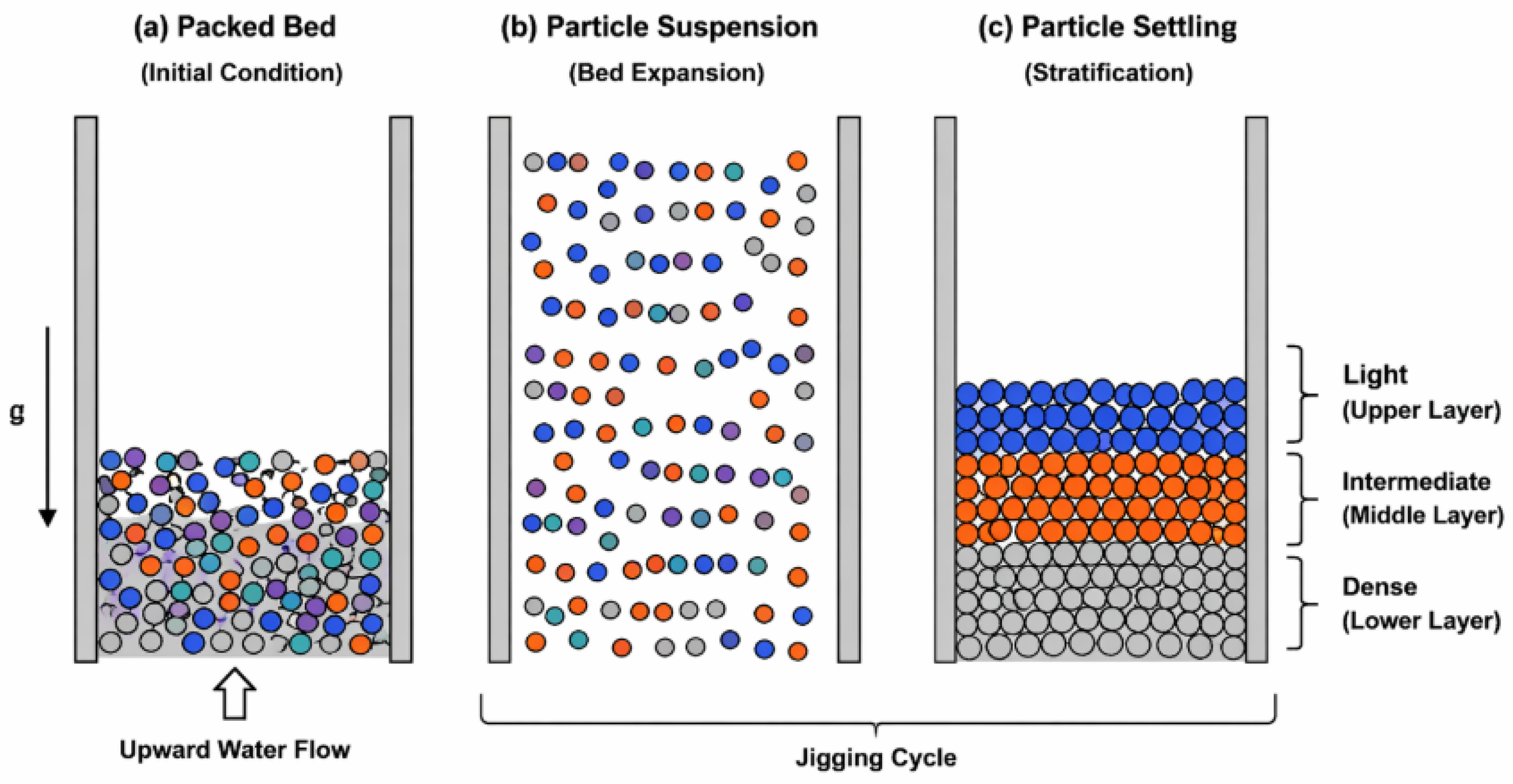
The “Jigging Potential Energy Theory”, proposed by [19,20], explains that stratification occurs due to differences in gravitational potential energy between a fully mixed bed and a stratified bed, with this energy difference driving the separation process. Figure 1 shows a jigging process in which a packed bed is fluidized with mixed particles (blue—light, orange—middle, gray—heavy), promoting stratification. Amplitude induces periodic particle suspension and a pulsating fluid flow at a controlled frequency.
As the construction sector moves towards sustainable practices, it also adopts circular-economy strategies; consequently, the importance of the ability to recover materials from CDW has increased. Among these materials, ceramics are a valuable fraction, as most research has focused on the management of general CDW rather than targeted separation [15,16,17,18]. The present experiments explore how water jigging can serve as a useful density-based method for enriching and recovering ceramic particles from mixed CDW. The study combines detailed physical characterization with jigging experiments to demonstrate how effectively ceramics, gypsum, concrete, and bricks can be concentrated, and how practical this technique is for recycling operations. The experiments aim to support the development of improved recycling processes for CDW and encourage its use as recycled aggregates in new construction applications.
Although previous studies investigated gravity-based separation of individual CDW material, the behavior of stratification of multi-component mixtures remains less understood. Particularly, ceramics separation, because of its intermediate density and morphology received limited attention. Therefore, this study provides evaluation of binary and ternary CDW mixtures, including the layer by layer analysis, purity, quantification of recovery, and mass balance.

2. Materials and Methods

The experimental samples were prepared to represent and emulate the composition of typical “Inert-CDW” and to include contaminants most commonly observed in RA. Four materials were chosen for this study: brick, concrete, gypsum, and ceramics. The bricks (red ceramic) were made from commercial ceramic blocks that were not intended for structural or refractory use. Conventional structural concrete (C16/20 MPa), manufactured with silicate-crushed gravel in accordance with Structural Concrete Instruction—EHE/08 [20], was used, and the gypsum materials were manufactured in accordance with EN13297-1 [21]. The ceramic (ceramic tiles) material used in the tests was regular coating building ceramics with no special glazes or treatments.
All materials were crushed using a jaw crusher (Wedag Española, Sociedad Anónima.) with a top size aperture of 20 mm. The resulting materials were sieved, and the 5–20 mm fraction was retained for testing as coarse aggregates. The fine fraction (<5 mm) was excluded from this study and retained for future analyses. The proportions of concrete, brick, gypsum, and ceramics after the jig tests were determined by manual sorting and weighing. After each jig separation, the material from each layer was oven-dried at 70 °C for approximately 8 h to remove residual moisture. Each component was then visually identified, manually separated, and weighed using a precision balance (±0.01 g). The manual sorting may introduce some operator-related uncertainty; it was minimized by applying consistent visual identification criteria and by the procedure under controlled laboratory conditions. Particularly, ceramics were distinguishable from the bricks because of the presence of a surface coating layer. The percentage content of each material was calculated relative to the total sample mass, ensuring consistent evaluation of material purity across all experiment.

2.1. Materials Characterization

2.1.1. Form Factor

The EN 933-4 standard [13] was used to assess aggregate morphology. The guideline stipulates that 200 aggregate particles must be selected based on the mass fractions for the size ranges 9.5–12.7 mm and 12.7–19.5 mm. This maintains uniform representation across all samples. Since the standard is intended for the analysis of coarse aggregates, the 5–12.5 mm fraction is not analyzed in this analysis. A caliper measures the maximum length and minimum thickness of each selected particle. The form factor is determined by averaging the ratios of these two metrics across all particles. Ratios approaching 1 indicate spherical particles, whilst higher ratios suggest more flattened or lamellar particles.

2.1.2. Densimetric and Particle Size Distribution Analysis

To determine the granulometric distribution of the material, dry sieving was performed using openings of 5 mm, 8 mm, 12.5 mm, and 20 mm. In the analysis, a solution of sodium polytungstate was used to conduct sink-and-float tests to determine the densimetric distribution of the concrete. The test was conducted using solutions of different densities—2.40 g/cm3, 2.50 g/cm3, 2.55 g/cm3, 2.60 g/cm3, 2.65 g/cm3, 2.70 g/cm3, 2.75 g/cm3, and 2.80 g/cm3—measured with a manual Anton Paar Density Meter (DMA 35).
The particle size distribution of the material was determined by sieving the samples and analyzing the material retained on the 20 mm, 12 mm, 8 mm, and 5 mm sieves, as well as the fine aggregate fraction with sizes under 5 mm.
The analysis was conducted for concrete, as it is the most compositionally heterogeneous and represents the densest material in studied system. Due to differences in aggregate content and cement paste, the internal variability of concrete may influence significantly its behavior of stratification. In contrast, ceramics, bricks and gypsum exhibit relatively narrower density ranges and homogeneous composition, that allows their behavior to be interpreted from specific gravity and bulk density measurements.

2.1.3. Specific Density (OD-Oven Dried), Saturated Specific Density (SSD), Apparent Density (OD-Oven Dried), and Water Absorption

The evaluation of densimetric properties and the influence of some parameters, such as porosity and water absorption at different concentration stages, requires the material to be tested in saturated and dry conditions. The presence of porous material (cement paste, gypsum, bricks, and ceramics) modifies several important physical properties when the material becomes saturated. For this reason, the determination of bulk density, specific gravity under saturated surface-dry (SSD) and oven-dry conditions (OD), and water absorption was carried out following the procedures described in ASTM C127-07 [17,22]. These measurements provide a basis for understanding how contaminants affect the physical behavior of recycled aggregates.
According to the standard testing procedure, the samples are first oven-dried at a temperature of 110 ± 5 °C until a constant mass is obtained. After drying, the material is allowed to cool under ambient laboratory conditions for approximately one to three hours. Aggregate samples with a nominal maximum particle size of 37.5 mm are used for the analysis, with adjustments applied when larger particles are present. The samples are then immersed in water at room temperature for a period of 24 ± 4 h in order to reach a saturated condition prior to further measurements.
The sample is returned to the oven and maintained at a temperature of 110 ± 5 °C until a constant mass is obtained. After drying, the sample is removed and allowed to cool under ambient laboratory conditions for approximately one to three hours, or it can be safely handled. Once cooled, the oven-dry mass is determined and recorded, enabling the completion of the calculations required for the determination of the densimetric parameters.

2.2. Concentration Criteria

Another way to observe the separation inside the jig is through the concentration criteria (CC) proposed by Taggart [23]. CC measures the ratio between the densities of two particles with different densities being separated. When the process uses water, it is necessary to subtract the buoyancy force, as shown in Equation (1):
C C = r d r f r l r f q
where rd and rl represent the densities of the dense and light constituents, respectively, and rf is the fluid’s density. A higher CC value indicates easier separation of particles in a fluid using a density-based process, such as jigging. This ratio applies across all flow regimes and is expressed by the quotient q, where q = 0.5 is for the Stokes regime, q = 1 is for the Newton regime (most common), and 0.5 < q < 1 is for intermediate regimes. In this study, q was taken as 1, which is corresponding to linear form of concentration criteria (CC) and it is commonly adopted for simplified evaluation of density-based separation.
A large CC value signifies a significant density difference between particles, leading to a greater reduction in potential energy and thus easier stratification. Conversely, particles with similar densities are more difficult to stratify than those with larger density differences [20,21,24]

2.3. Jigging Equipment

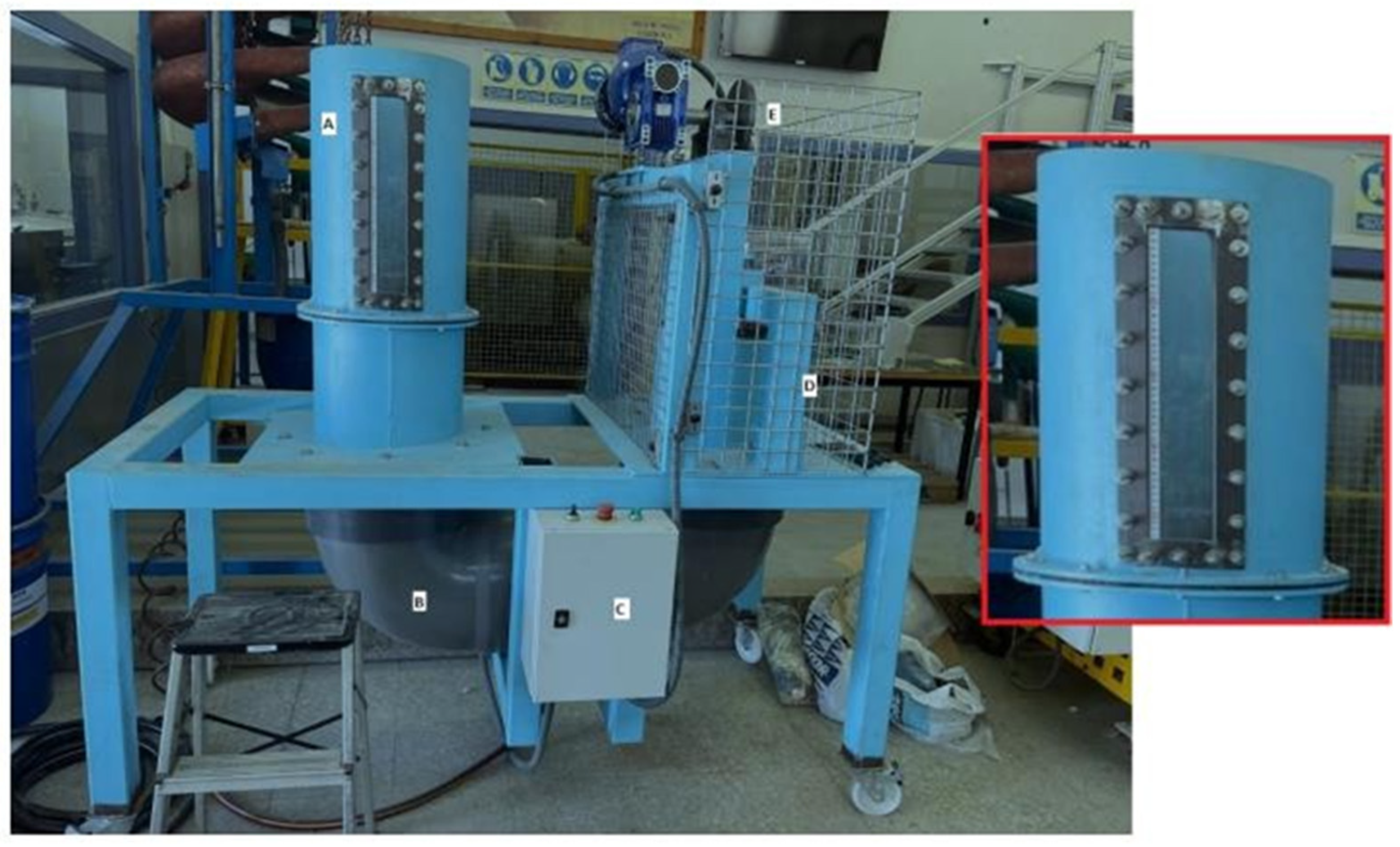
The experimental tests were performed using a pilot-scale water jig designed specifically for laboratory research (Figure 2). In this apparatus, water circulation is driven by a piston (D) connected to a motor (E), which propels the flow through the water duct (B) into the jig chamber (A). The chamber, equipped with an observation window, allows visualization of the particle bed expansion and the range of bed heights within the equipment. Inside the jig chamber, the ascending and descending water pulses promote both expansion and compaction of the particle bed, resulting in stratification of the material according to particle density and spatial characteristics. After each test, the stratified layers are manually collected from the top of the chamber at heights predetermined for each experimental run.
Further details regarding the hydraulic jig mechanism and the forces responsible for the stratification process are available in the literature [24,25,26]. Following preliminary efficiency assessments, the operational parameters of the jig were standardized as follows: pulse frequency of 35 cycles per minute, amplitude of 14 cm, and total test duration of 3 min.
The selected operating conditions were guided by preliminary exploratory tests and defined in previous studies on similar materials [2], aimed to obtaining stable visible stratification and bed expansion. However, these tests were not designed as formal optimization study, therefore the sensitivity of amplitude, duration and separation performance remains a subject for future study work.

2.4. Jigging Experiments Design

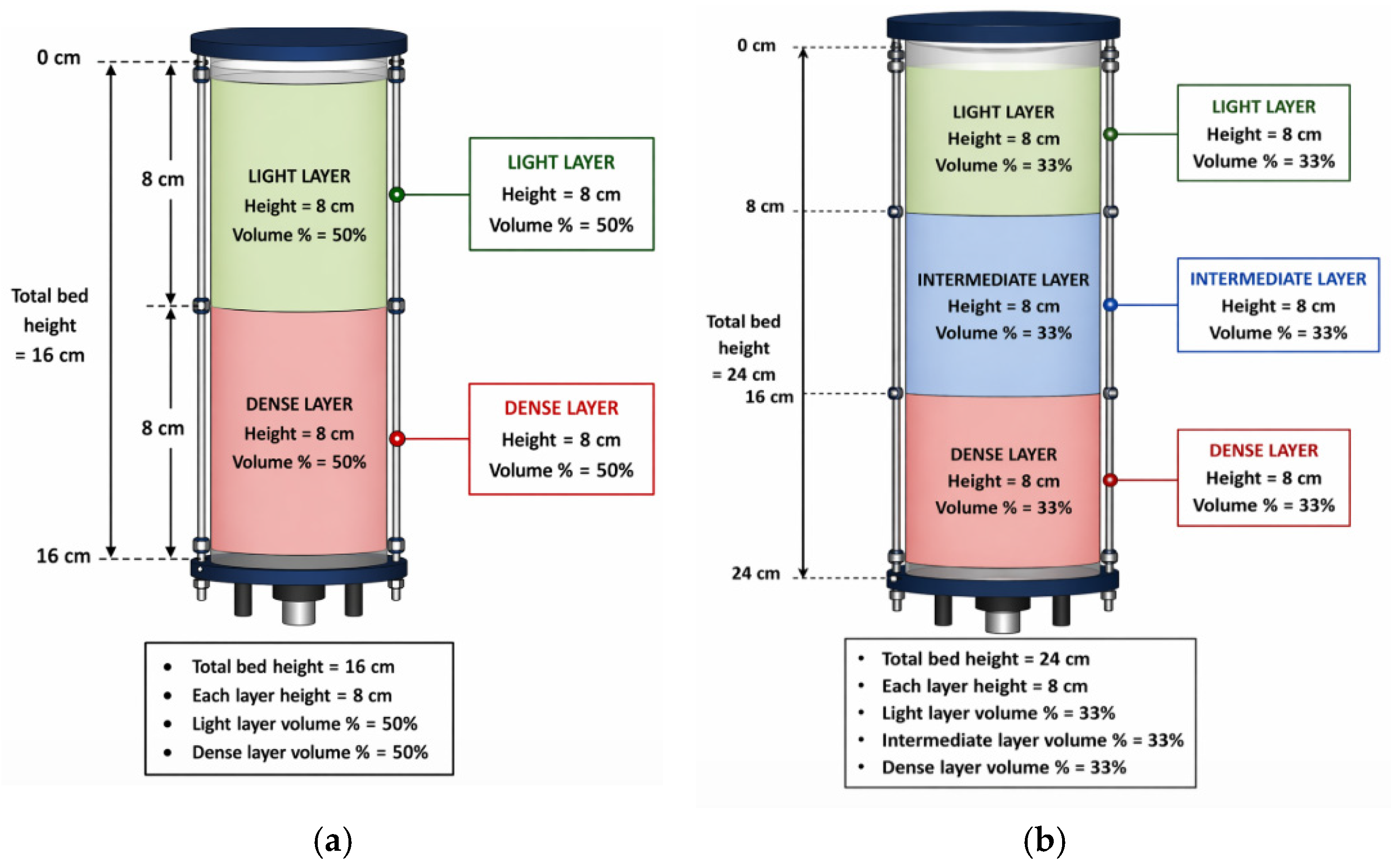
A total of six different jigging tests were designed to examine the stratification behavior of the generated materials under controlled conditions. These tests consisted of three experiments with a binary mixture (B1 to B3—Table 1) of materials and three experiments with a ternary mixture (T1 to T3—Table 1), selected to represent typical materials found in CDW. Each test was designed to simulate realistic CDW material interactions and to evaluate how differences in density and particle properties influence stratification efficiency during jigging. After each experiment, the stratified layers within the jig chamber were carefully dismantled. Materials were manually separated by their position in the bed, and parameters such as weight, bulk volume, and bed height for each component were recorded and summarized in Table 1. Figure 3 is the flowchart of the binary and ternary jigging process conducted in the study.
Use of controlled mixtures with equal bulk volume was intentionally designed to isolate the effect of the material properties on behavior of stratification. However real CDW streams are more heterogeneous, which enables a clearer understanding of mechanism of separation.
Each ternary and binary mixtures were subjected to a single stage jigging under the selected operating conditions. Therefore, the reported purities, separation efficiencies, and the recoveries should be interpreted as comparative exploratory observations under controlled laboratory conditions.

2.5. Separation Efficiency Calculations

In this study, the separation efficiency index of ceramic was defined on grade-recovery relationships, combining the ceramic recovery with the improvement in content of ceramic relative to feed. The parameter combines both recovery and improvement in their concentration relative with the feed.
Separation efficiency was calculated as:
R C p Y c 100 Y c
where ‘R’ is the recovery of ceramics in considered layer (%), R = mass of ceramic in layer/total mass of ceramics in feed
‘Cp’ (is the ceramic content in that layer (%), Cp = mass of ceramic in the layer/total mass of that layer
‘Yc’ is content of ceramics yield relative to feed (%). Yc = mass of ceramic in layer/total feed mass.
Here, the term ‘100-Yc’ represents the maximum possible purity increase relative to the feed that corresponds to an ideal separation condition.
Use of Yc instead of ceramic grade feed was because the aim is to define layer-specific comparative index which combines recovery of ceramics and enrichment of ceramics within same product layer. The proposed index intended to compare relative effectiveness of different bed layers of jig under the tested conditions, rather than standard universal beneficiation metric.


3. Results and Discussion

3.1. Particle Size Distribution Analysis

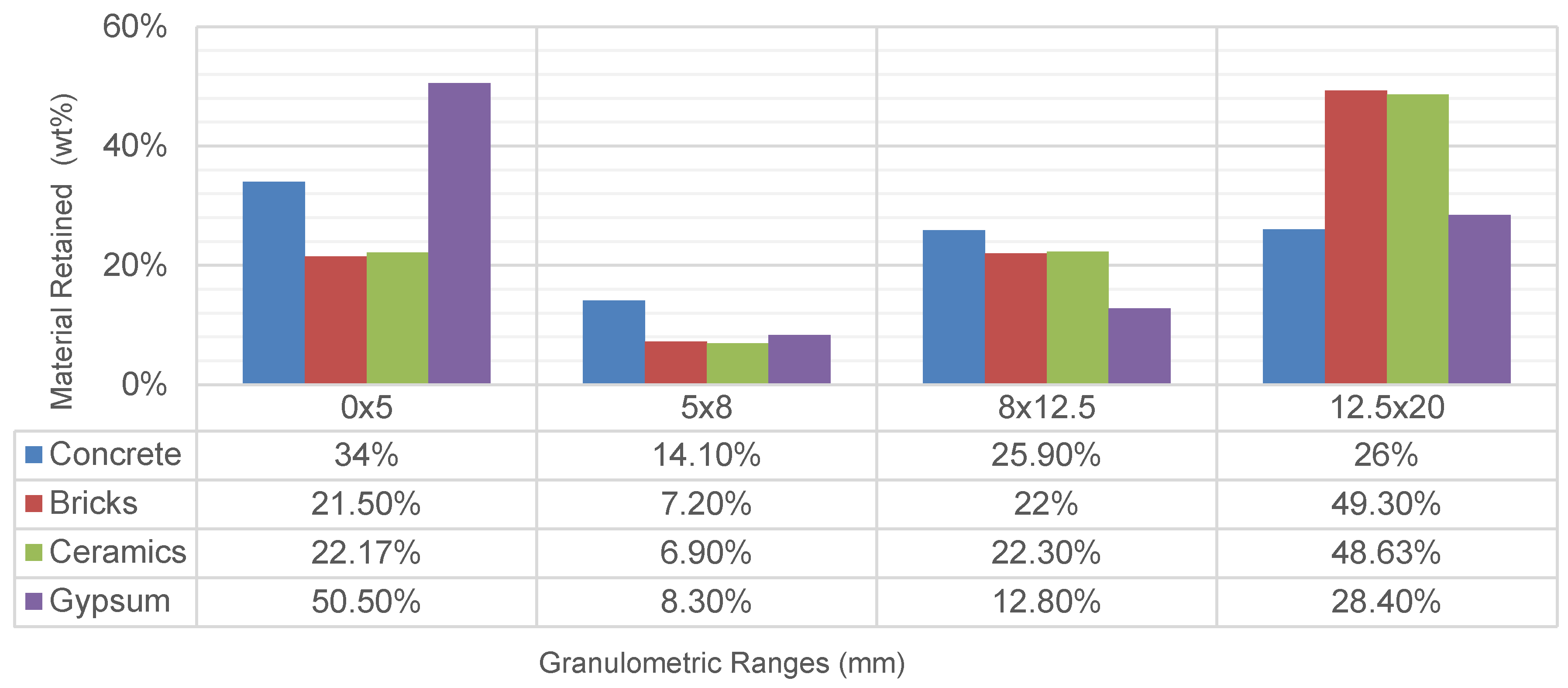
Figure 4 shows the particle size distribution of the investigated materials, which highlights the difference in the particle size ranges generated during the comminution. There is a uniform distribution in concrete particles in all size fractions of 34% in 0–5 mm, 14.1% in 5–8 mm, 25.9% in 8–12.5 mm, and 26% in 12.5–20 mm fraction, that is typical for concrete-recycled aggregates because of the difference between the strength of the cement paste and the coarse aggregates present [2]. The 0–5 mm fraction of the concrete is composed basically of cement paste and fine aggregates [24].
Particles of bricks show a different pattern in which 21.5% of material is retained in the finest fraction, with a large amount in the coarse range of 12.5–20 mm (49.3%), remaining material distributed between 5 and 8 mm (7.2%) and 22% with in 8–12.5 mm fractions. Ceramic materials exhibited a distribution more balanced that lay between fine and coarse fractions, 22.17% in the 0–5 mm range, and retained within the size of 12.5–20 mm is 48.63%, intermediate fractions contain 22.3% in 8–12.5 mm and 6.9% in 5–8 mm. On the other hand, gypsum is concentrated strongly within the fine fraction, about 50.5% of material retained within the size of 0–5 mm, 8.3% in 5–8 mm, 12.8% within 8–12.5 mm, and the coarse fraction contained 28.4%, which indicates its low mechanical strength. In general, bricks and ceramics are mainly presented in coarser fractions, gypsum tends to be in finer particle size, and concrete shows a more uniform size distribution. These differences in size distribution are particularly relevant to gravity-based processes of separation, as they influence both density and particle stratification and separation efficiency in jigging operations [1,2].
The results indicating particle size distribution plays significant role in the stratification. However, the density remains the dominant factor, the difference in particle size may hinder separation efficiency or enhance by modifying hydrodynamic behavior and settling velocity. Between bricks and ceramics, this effective is particularly relevant in such cases where density contrasts are very small and here particle size distribution may contribute the observed overlap in the layer distribution.

3.2. Physical Properties Analysis

Table 2 presents the results of the analysis of the materials’ physical properties. The main way the form factor influences jig dynamics is that lower form factor values allow more efficient packing in a granular bed, as particles can arrange themselves with fewer voids between them. This improved packing results in higher bulk density and more stable bed structures during gravity-based separation processes. Ceramics and bricks exhibit a more lamellar shape, resulting in higher form factor values than those of gypsum and concrete. When the form factor approaches 1 [24,27], the particles display a more spherical or equidimensional geometry, as in a material with a higher form factor, or a lamellar particle that could prevent the material from packing.
The ceramics examined have a bulk density of 1.22 g/cm3 and densities that fall within the median range (1.78 g/cm3 OD and 2.05 g/cm3 SSD). These characteristics place ceramics between the gypsum (1.09–1.60 g/cm3) and the heavier particles of concrete (2.03–2.12 g/cm3). It exhibits that small changes in jigging conditions, such as how often the water flows and how fast it pulsates, can have a big effect on how they behave. While analyzing the ceramic recovery, it is important to understand that it makes it easy to separate them from both lighter contaminants (gypsum) and heavier materials (concrete) [21].
Ceramics absorbed water at a rate of 13.10%, which was very close to the rate for bricks (13.23%). This shows that ceramics are porous. This comparable absorption behavior suggests that both materials possess a relatively high level of porosity and an interconnected pore structure. According to previous studies on CDW materials, ceramic-based components such as bricks and tiles generally present higher porosity than natural aggregates (NA) due to their manufacturing process and internal microstructure [13,28]. Gypsum, on the other hand, is lighter, and when it was completely saturated, it accounted for 46.91% of water absorption. The form factor of ceramics (3.45) shows lamellar particles, as do those from bricks (3.48); on the other hand, concrete had more spherical-shaped particles (2.20). Because of its lamellar shape, these particles create more drag during pulsation, modifying the concentration process. This slows down the settling velocity and makes it easier for particles to build up in the mid-bed zone. The density, absorption, and shape of ceramics give them a unique hydraulic response. It can favor the selective concentration under suitable density contrasts.
The results show that ceramic aggregates work as a transitional phase in construction and demolition waste (CDW) mixtures. They are dense enough to separate from light gypsum, but besides the similar density, they are not as dense as concrete, and also have a lamellar shape [13]. This makes them the most responsive material for density-based beneficiation and an important focus of CDW valorization research.
The bulk density plays a dominant role to describe jigging behavior, it reflects combined the effects of density of the particles, porosity, packing and shape, as these factors influence directly the particle stratification under pulsation fluid conditions; on the other hand the specific density represents intrinsic materials property.

3.2.1. Concentration Criteria Calculation

The concentration criteria were first calculated, using the specific density OD (presented in Table 3), to eliminate variability introduced by moisture content. By using these values of OD specific density, the analysis showed consistency and accuracy when it was assessed for the potential of separation [20,21]. To better reflect the effective behavior of porous and irregular particles during jigging, additionally examined using the bulk density (Table 4).
The values of CC provide information about the feasibility of the separation of the materials from the CDW, according to its mixtures, correlating the materials’ densities and the fluid density. There is a highest value of 1.63 that occurred between ceramics and gypsum (B3), indicating a strong potential for effective separation due to a big density gap. In contrast, the CC between ceramics and bricks (B1) is only 1.01, indicating the minimal difference in their densities and also highlighting that the separation efficiency between these materials is unfeasible. The concrete and ceramics (B2) pair, yields a CC of 1.14, which is an increase, but still theoretically unfeasible for the gravity separation, according to Taggart [23]. The higher CC values for gypsum, particularly in ceramics and concrete (B2), indicate that gypsum can be removed efficiently. However, distinguishing ceramics from bricks remains a complex task that may require some additional process stages.
When analyzing the CC in relation to the bulk density (OD) of the material, another perspective regarding the gravimetric separation of the material can be observed. Table 4 shows the CC values obtained when analyzing the relationship of the materials based on the bulk density (OD) of the material. It is possible to observe an increase in the measured values according to a greater difference in the observed bulk density (OD) values of each material.
Although concentration criterion is based on particle density, the stratification of irregular and porous particles in jigging is influenced by the effects of apparent density, as the size distribution, particle shape affects the bed segregation; therefore, in this study, bulk density was considered as a complementary interpretative parameter [21].

3.2.2. Analysis of Densimetric Distribution

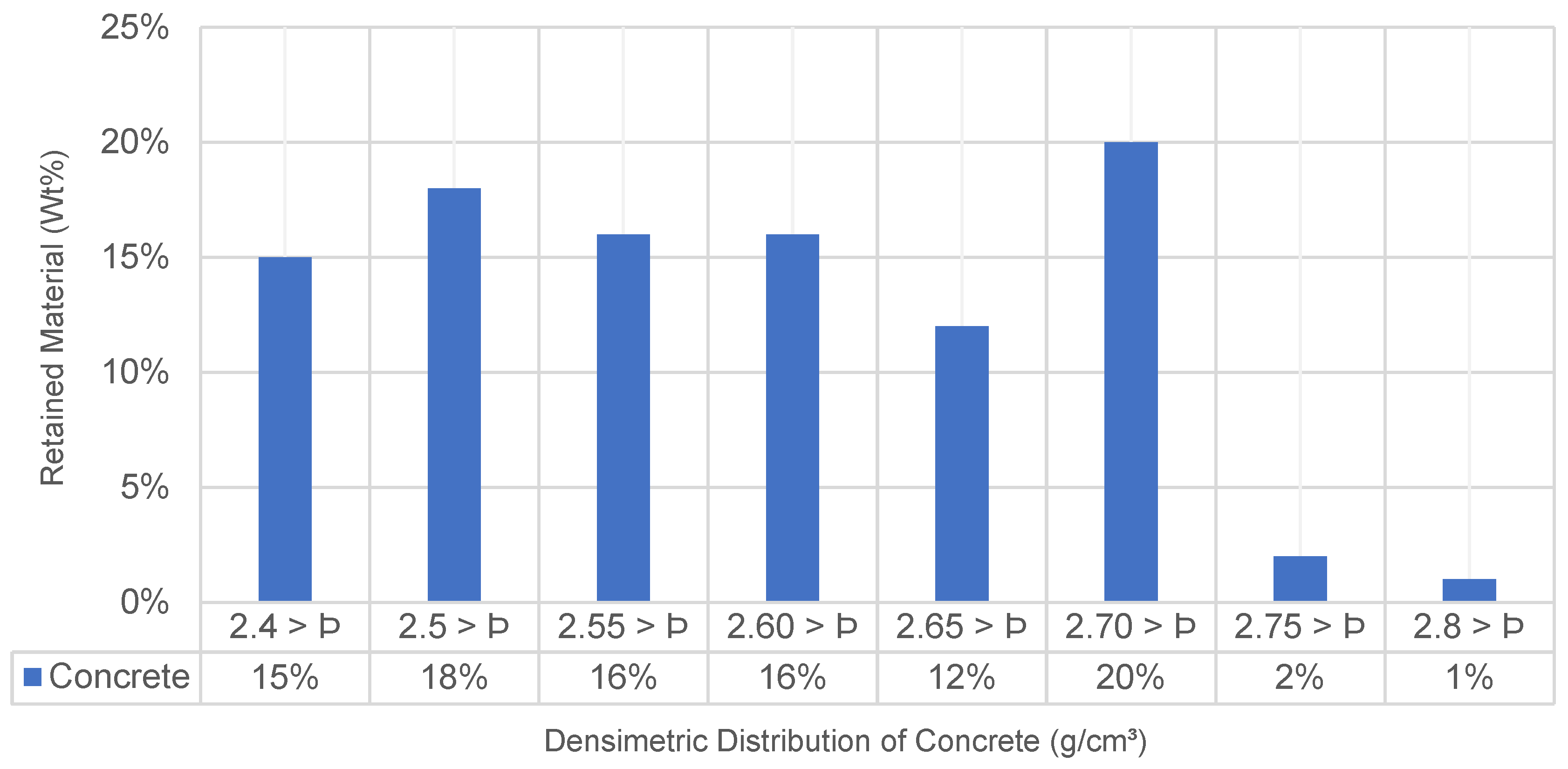
The sink and float analysis were conducted on the concrete fraction. (Figure 5) showed a broad spread in particle density values. Almost 97% of the material ranged between 2.4 and 2.70 g/cm3, with notable concentration at intervals such as above 2.50 g/cm3 (18%). This variability demonstrates the heterogeneous nature of the concrete whose particles may consist of cement paste with low density with partially attached aggregates (intermediate density) and fully liberated aggregates with higher density [1,2,16,24,29].
Previous studies [2,24]-related recycled-concrete aggregates contain similar resported densimetric variability that highlights the particle composition influence on the separation behavior in density-based process.
A notable thing is that densimetric analysis was conducted only for the concrete because it represents most compositionally heterogeneous material. In contrast, gypsum, bricks and ceramics showed relatively narrower density ranges with more uniform composition; therefore its behavior may be interpreted based on the bulk and specific density values (Table 2) [20,21].
As a result, densimetric profile of the concrete gives a significant reference for the interpretation of the upper density range in the system that offers an indication of the stratification behavior during jigging process, although the separation behavior is also influenced by the morphology of particles, such as surface characteristics and effects of packing, that significantly affect the particles in fluid medium.

3.3. Jigging Results—Materials Stratification

3.3.1. Binary Tests

Six jigging tests were performed, comprising three binary (B1, B2, B3) and three were ternary (T1, T2, T3). To study fundamental density-based separation trends, the binary tests were designed accordingly, while the ternary mixtures simulated more realistically CDW mixtures to assess jigging performance under more complex material interactions.
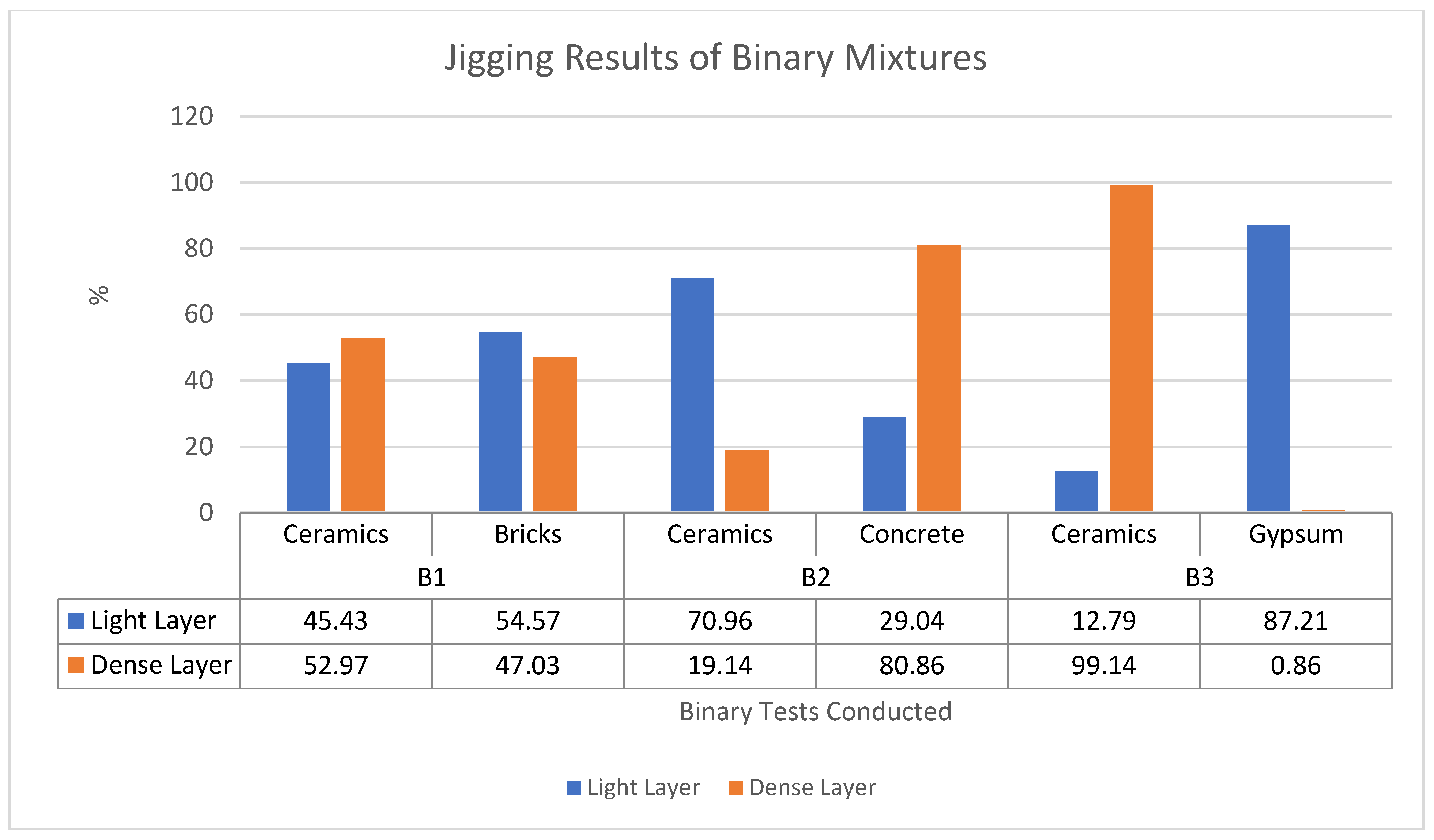
A full mass balance of binary test is represented in Table 5. The separation patterns identified that the binary jigging experiments (Figure 6) exhibit trends that agree with the observations reported in earlier studies concerning the stratification of CDW component materials. In the present investigation, the distribution of particles within the dense, and light layers depended largely on the physical characteristics of the materials forming each mixture. For the B1 mixture system, the materials were spread across the two layers, with bricks showing their highest quantity remained in the light fraction (54.57%), while ceramics were mainly detected in the dense layer (52.97%). The behavior of separation between both materials is relatively weak, as demonstrated their presence significantly in both layers. This behavior may be due to their particle characteristics and similar densities that highlight a limitation of jigging when the processing of materials with low-density contrasts. A comparable behavior was identified in the B2 mixture system, where concrete predominantly accumulated in the dense layer (80.86%), whereas ceramics appeared mainly within the light layer (70.96%) and dense fractions (19.14%). In contrast, the B3 system produced a more pronounced stratification, with gypsum largely concentrated in the light layer (87.21%) and ceramics primarily remained in the dense layer (99.14%). These findings indicate that greater differences in the physical properties of the materials favor a clearer separation between layers during the jigging process.
The clear stratification observed suggests that density contrast is the primary factor in binary systems.
Similar stratification characteristics have been reported in previous research on gravity concentration of CDW particles. Investigations [29,30,31,32,33] involving the jigging of concrete, brick, and gypsum mixtures have shown that particles tend to organize along the jig bed, with increasing specific and apparent density from the top toward the bottom, as a result of repetitive fluidization and sedimentation cycles generated by pulsation. Under such conditions, gypsum particles, which possess relatively low density and high porosity, generally accumulate in the upper portion of the bed, whereas heavier concrete particles are recovered near the bottom, with brick particles typically occupying lighter zones. The outcomes of the present study follow the same pattern, particularly in the B3 experiment, where the lighter gypsum particles were strongly enriched in the upper layer, highlighting the capability of jigging to separate lighter contaminants from mineral aggregates.
Nevertheless, when the density contrast between materials is limited, as in the B1 mixture, the separation interface becomes less defined, and particles tend to distribute across multiple layers. This observation suggests that, beyond density differences, additional parameters such as particle form factor, surface texture, packing capacity, and internal porosity can affect the hydrodynamic behavior of particles during jigging and consequently influence their final stratification position [13,24,34]. Therefore, while density remains the primary factor controlling separation efficiency, the combined effects of granulometric and morphological characteristics also contribute to the recovery distribution observed in the experiments.

3.3.2. Ternary Tests

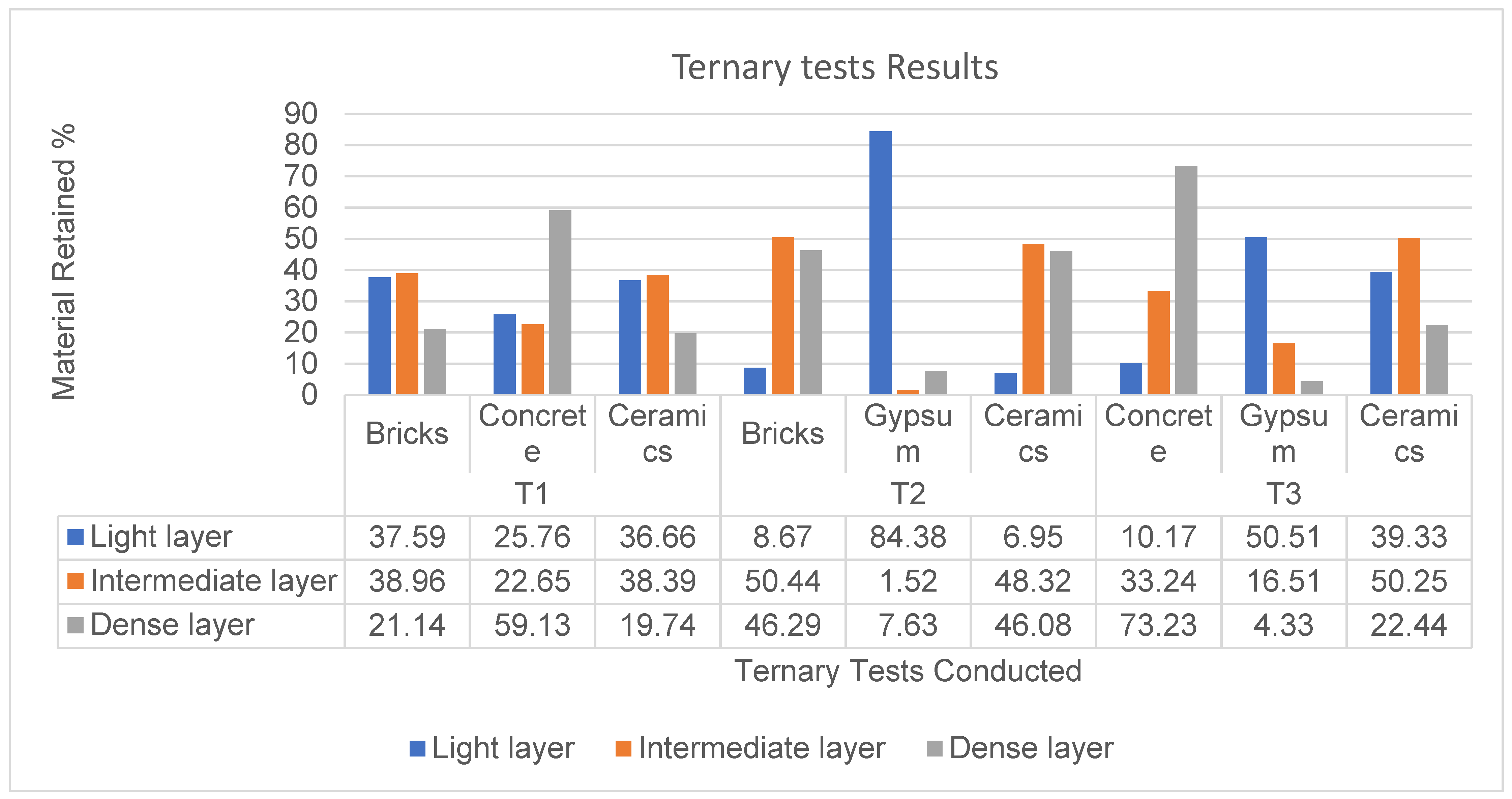
The experiments of ternary jigging presented in Figure 7 and a full mass balance of each layer after jigging is presented in Table 6, provide clear insight within the stratification behavior of multi-component CDW under hydraulic expansion contraction conditions. In the T1 mixture, the stratification pattern follows the expected separation order. Predominantly, the concrete is remained in the dense layer (59.13%), confirming its higher density and stronger tendency to settle at the bottom of the jigging bed. The bricks are distributed mainly in the intermediate (38.96%) and light (37.59%), indicates moderate settling behavior influenced by density differences and characteristics of particles. The ceramic exhibits their highest-remained quantity in the intermediate layer (38.39%); on the other hand, a considerable portion is observed in light (36.66%) and dense layers (19.74%). This suggests that ceramics possess characteristics of intermediate settling, making their position between lighter bricks and heavier concrete fragments in the stratified bed [14].
A different separation pattern is observed in T2 mixtures, where the influence of gypsum significantly changes the pattern of separation. In the light layer, gypsum shows a strong concentration with a rate of 84.38% reflecting its high porosity and low density that promotes a rapid movement to the light layer. Bricks are mainly remained in the intermediate fraction (50.44%), a significant portion also present in the dense layer (46.29%) and only minor fraction in the light layer (8.67%). Ceramics once again demonstrate a dominant presence in the intermediate zone (48.32%), while noticeable amounts appear in the dense (46.08%) and light layer with lower value of 6.95. The results confirm that gypsum acts as the light component, altering the overall stratification behavior of system. This behavior is highlighting the limitations of jigging when separating the materials with similar morphology and density, where stratification becomes low efficient due to overlapping of physical properties.
The mixture of T3 shows a density-controlled stratification. The concrete remains concentrated in dense fractions (73.23%). The particles of concrete remaining outside of the dense layer are composed of cement paste content and fine aggregates, resulting in lower effective density and presenting a lower density appear in light layer (10.17%). Gypsum is accumulated primarily in the upper layer (50.51%), while ceramics show the highest quantity in the intermediate layer (50.25%); on the other hand, a smaller portion is distributed in dense (22.44%) and light fractions (39.33%), which highlights the stable hydrodynamic behavior of ceramics under jigging conditions.

3.3.3. General Tests Comparison

The results shown in Table 7 reveal recovery and separation efficiency of ceramics in both binary and ternary mixture systems. In B1–B3, ceramic separation efficiency with high percentages occurred in both layers, such as B2 light layer (43.31%) and B3 dense layer (90.59%). This stratification works on a basic jigging mechanism, where continuous contraction and expansion of the particle bed help them to rearrange according to density differences and shape factor [30,31]. While, the light layer shows lowest efficiency, which ranges 13.58% in B1 and 0.61% in B3, indicating that a small portion of ceramic particles remains in that zone, the dense layer shows a minimum efficiency of 2.30% in B2. In B1, the efficiency in light and dense layer contains closer values because of ceramics and brick very close density and form factor.
In T1 to T3, the intermediate layer’s efficiency was higher than light and dense layers, which is different than calculated for binary materials. Similar observations have been described in previous studies that are related to construction and demolition waste recycling, where the mixtures that contain several materials often generate separation zones due to overlapping density ranges and variation in the shapes of particles [23,35]. Previous studies also demonstrated that density-based techniques (jigging) can improve the quality of recycled aggregates by removing the lighter contaminants while concentrating valuable components of minerals. In T2 the separation efficiency in intermediate and dense layers is very close due to the presence of gypsum that strongly is concentrated in the light layer and leaves ceramics and brick competing within the narrower density range. As a result, both of the materials are distributed between the intermediate and dense layers with very comparable recoveries that lead to the reducing of separation sharpness and the similar efficiency values in these layers.
When the ternary and binary mixtures are compared, the separation efficiency decreases from binary to ternary (~90% in B3 and ~19% in T3) which indicates the reduction in separation sharpness due to increased complexity of mixture. The consistent recovery of ceramics in the intermediate layer indicates that this fraction can be selectively recovered and concentrated for potential recycling applications [36,37].

4. Conclusions

  • This investigation indicates that hydraulic jigging can concentrate and separate the particles of ceramic from controlled mixtures of construction and demolition waste (CDW) but the performance depends upon the contrast of density and complexity of feed, and decreases as mixture complexity increases.
  • After a single stage jigging, sharpest separation was obtained in B3 of binary mixture, where the recovery reached in dense layer 92.65% and the separation efficiency was 90.59%. On the other hand the materials with closer physical properties (ceramic and brick) showed greater overlap in layers and weaker stratification.
  • In ternary systems, the ceramic was recovered in the intermediate layer mainly, achieving maximum recovery rate between 46.8% and 49.6%; the highest separation efficiency in these mixtures was 19.21% in intermediate layer. It shows that addition of a third component reduces separation efficiency because of differences in particle size, porosity, packing behavior and overlapping of density ranges. Although the jigging remains to be able to demonstrate a clear density-based stratification, which is decreased for ceramics in more complex mixtures.
  • Overall, according to results, the water jigging has a potential for ceramic-rich fractions upgrading in CDW under controlled laboratory conditions. Its great potential is within a strong density contrast system, with materials containing components with similar properties that may require further optimization. Present investigation provides useful evidence for density-based separation of CDW constituents, as each mixture was tested once. The results should be interpreted in laboratory-controlled conditions, as comparable evidence and the repeatability. Additionally, scaling it up to industrial operation would require evaluation of recirculation and consumption of water, automated collection of product, process control, and the effect of feed characteristics on separation selectivity. The present wok should be understood on the basis of future studies as controlled experiments when aiming at optimization of process and validation.

Author Contributions

Conceptualization, C.H.S. and J.O.M.; methodology, H.B. and J.O.M.; software, W.M.A.; validation, C.H.S., J.O.M. and W.M.A.; formal analysis, A.B.T., A.S.K. and F.L.Q.R.; investigation, H.B., A.S.K., C.H.S. and B.d.O.G.; resources, J.O.M. and B.d.O.G.; data curation, A.B.T., A.S.K. and W.M.A.; writing—original draft preparation, H.B.; writing—review and editing, H.B.; visualization, H.B., A.B.T., C.H.S. and F.L.Q.R. All authors have read and agreed to the published version of the manuscript.

Funding

This work was funded by Agencia de Gestió d’Ajuts Universitaris i de Recerca (AGAUR), Joan Oro, file number: 2024 FI-1 00779. This project is also funded by the European Union, QUEEN Quartz Enrichment Enabling Near-Zero Silicon Production. (GA 101178144).

Data Availability Statement

Data are contained within the article.

Acknowledgments

The authors would like to thank the Agencia de Gestió d’Ajuts Universitaris i de Recerca (AGAUR) and Joan Oro for the funding received.

Conflicts of Interest

The authors declare no conflicts of interest.

References

  1. Teixeira, A.B.; Barkat, H.; Sampaio, C.H.; Moncunill, J.O. Recovery of Demolished House Rocks from Construction and Demolition Waste with Water Jigs. Minerals 2024, 14, 39. [Google Scholar] [CrossRef]
  2. Barkat, H.; Teixeira, A.B.; Sampaio, C.H.; Moncunill, J.O. Contaminants removal from construction and demolition waste (CDW) with water jigs. Minerals 2025, 15, 981. [Google Scholar] [CrossRef]
  3. Esa, M.R.; Halog, A.; Rigamonti, L. Strategies for minimizing construction and demolition wastes in Malaysia. Resour. Conserv. Recycl. 2017, 120, 219–229. [Google Scholar] [CrossRef]
  4. Deloitte. Study on Resource Efficient Use of Mixed Wastes, Improving Management of Construction and Demolition Waste; Final Report; European Commission, DG ENV: Bruxelles, Belgium, 2017. [Google Scholar]
  5. Faleschini, F.; Zanini, M.A.; Hofer, L.; Zampieri, P.; Pellegrino, C. Sustainable management of demolition waste in post-quake recovery processes: The Italian experience. Int. J. Disaster Risk Reduct. 2017, 24, 172–182. [Google Scholar] [CrossRef]
  6. Zheng, L.; Wu, H.; Zhang, H.; Duan, H.; Wang, J.; Jiang, W.; Dong, B.; Liu, G.; Zuo, J.; Song, Q. Characterizing the generation and flows of construction and demolition waste in China. Constr. Build. Mater. 2017, 136, 405–413. [Google Scholar] [CrossRef]
  7. Kleemann, F.; Lehner, H.; Szczypińska, A.; Lederer, J.; Fellner, J. Using change detection data to assess amount and composition of demolition waste from buildings in Vienna. Resour. Conserv. Recycl. 2017, 123, 37–46. [Google Scholar] [CrossRef]
  8. Lai, Y.-Y.; Yeh, L.-H.; Chen, P.-F.; Sung, P.-H.; Lee, Y.-M. Management and Recycling of Construction Waste in Taiwan. Procedia Environ. Sci. 2016, 35, 723–730. [Google Scholar] [CrossRef]
  9. Park, J.; Tucker, R. Overcoming barriers to the reuse of construction waste material in Australia: A review of the literature. Int. J. Constr. Manag. 2017, 17, 228–237. [Google Scholar] [CrossRef]
  10. Ulubeyli, S.; Kazaz, A.; Arslan, V. Construction and Demolition Waste Recycling Plants Revisited: Management Issues. Procedia Eng. 2017, 172, 1190–1197. [Google Scholar] [CrossRef]
  11. Hoffmann Sampaio, C.; Cazacliu, B.; Ambrós, W.; Kronbauer, M.; Tubino, R.; Molin, D.D.; Moncunill, J.O.; Miltzarek, G.; Waskow, R.; dos Santos, V.; et al. Characterization of demolished concretes with three different strengths for recycling as coarse aggregate. Minerals 2021, 11, 803. [Google Scholar] [CrossRef]
  12. Galderisi, A.; Bravo, M.; Iezzi, G.; Cruciani, G.; Paris, E.; Brito, J.d. Physico-Mechanical Performances of Mortars Prepared with Sorted Earthquake Rubble: The Role of CDW Type and Contained Crystalline Phases. Materials 2023, 16, 2855. [Google Scholar] [CrossRef]
  13. Galderisi, A.; Iezzi, G.; Bianchini, G.; Paris, E.; de Brito, J. Petrography of construction and demolition waste (CDW) from Abruzzo region (Central Italy). Waste Manag. 2022, 137, 61–71. [Google Scholar] [CrossRef] [PubMed]
  14. Sampaio, C.H.; Cazacliu, B.G.; Miltzarek, G.L.; Huchet, F.; Guen, L.L.; Petter, C.O.; Paranhos, R.; Ambrós, W.M.; Oliveira, M.L.S. Stratification in air jigs of concrete/brick/gypsum particles. Constr. Build. Mater. 2016, 109, 63–72. [Google Scholar] [CrossRef]
  15. Agrela, F.; de Juan, M.S.; Ayuso, J.; Geraldes, V.; Jiménez, J. Limiting properties in the characterization of mixed recycled aggregates for use in the manufacture of concrete. Constr. Build. Mater. 2011, 25, 3950–3955. [Google Scholar] [CrossRef]
  16. Sampaio, C.H.; Tavares, L.M.M. Beneficiamento Gravimétrico: Uma Introdução Aos Processos de Concentração Mineral e Reciclagem de Materiais Por Densidade; Editora UFRGS: Porto Alegre, Brazil, 2005. [Google Scholar]
  17. Royal Decree 1247; (EHE-08): Structural Concrete Instruction. Ministerio de Fomento: Madrid, Spain, 2008. Available online: https://www.boe.es/boe/dias/2008/08/22/pdfs/C00001-00304.pdf (accessed on 12 January 2024).
  18. Spanish Normative-EN 13279-1:2008; Gypsum Binders and Gypsum Plasters Part 1: Definitions and Requirements. European Committee for Standardization: Brussels, Belgium, 2008. Available online: https://standards.iteh.ai/catalog/standards/cen/3330e92c-2203-4118-934c-da6b441a6cb3/en-13279-1-2008 (accessed on 12 January 2024).
  19. Ambrós, W.M. Jigging: A Review of Fundamentals and Future Directions. Minerals 2020, 10, 998. [Google Scholar] [CrossRef]
  20. Mayer, F. A new theory concerning the mechanism of settling with its consequences for the rational shape of the diagram of the washing stroke and development of the corresponding regulator of a non-plunger jig. In Proceedings of the 1st First International Coal Preparation Conference, Paris, France, 12–17 June 1950; pp. 316–322. [Google Scholar]
  21. Mayer, F. Fundamentals of potential theory of the jigging process. In Proceedings of the 7th International Mineral Processing Congress, New York, NY, USA, 20–24 September 1964; pp. 750–786. [Google Scholar]
  22. ASTM C127-07; Standard Test Method for Density, Relative Density (Specific Gravity), and Absorption of Coarse Aggregate. ASTM: West Conshohocken, PA, USA, 2009.
  23. Taggart, A.F. Handbook of Mineral Dressing; Wiley: Hoboken, NJ, USA, 1945; Volume 1. [Google Scholar]
  24. Teixeira, A.B.; Sampaio, C.H.; Moncunill, J.O.; Cortina Palas, J.L.; Lima, M.M.D.; La Rosa, G.T.H. Analysis of Physical Properties of Coarse Aggregates Recovered from Demolished Concrete with a Two-Stage Water Jigs Process for Reuse as Aggregates in Concrete. Buildings 2024, 14, 2226. [Google Scholar] [CrossRef]
  25. Brito, J.; Saikia, N. Recycled Aggregate in Concrete—Use of Industrial, Construction, and Demolition Waste; Chapter 3; Springer: London, UK, 2013; p. 81. [Google Scholar]
  26. Angulo, S.C.; John, V.M.; Ulsen, C.K.H.; Müller, A. Separação óptica do material cerâmico dos agregados mistos de resíduos de construção e demolição. Ambiente Construído Porto Alegre 2013, 13, 61–73. [Google Scholar] [CrossRef]
  27. Leite, M. Evaluation of the Mechanical Properties of Concrete Made with Recycled Aggregates from Construction and Demolition Waste; Federal University of Rio Grande do Sul Porto Alegre: Porto Alegre, Brazil, 2001; Available online: http://hdl.handle.net/10183/21839 (accessed on 10 November 2023).
  28. Neville, A.M. Concrete Properties, 5th ed.; Bookman: Porto Alegre, Brazil, 2016. [Google Scholar]
  29. Teixeira, A.B.; Sampaio, C.H.; Moncunill, J.O.; Lima, M.M.D.; Herrera La Rosa, G.T.; Veras, M.M.; Ambrós, W.M.; Cazacliu, B.G.; Solsona, A. Reuse of Coarse Aggregates Recovered from Demolished Concrete Through the Jigging Concentration Process in New Concrete Formulations. Materials 2025, 18, 4310. [Google Scholar] [CrossRef]
  30. Burt, R.O. Gravity Concentration Technology; Elsevier: Amsterdam, The Netherlands, 1984. [Google Scholar]
  31. Wills, B.A.; Napier-Munn, T. Wills’ Mineral Processing Technology; Butterworth-Heinemann: Amsterdam, The Netherlands, 2006. [Google Scholar]
  32. Tam, V.W.Y.; Tam, C.M. A review on the viable technology for construction waste recycling. Resour. Conserv. Recycl. 2006, 47, 209–221. [Google Scholar] [CrossRef]
  33. Gschwenter, V.L.S.; Tubino, R.M.C.; Ambrós, W.M.; Miltzarek, G.L.; Sampaio, C.H.; Moncunill, J.O.; Cazacliu, B.G.; Dal Molin, D.C.C. Production of High-Quality Coarse Recycled Aggregates through a Two-Stage Jigging Process. Minerals 2022, 12, 532. [Google Scholar] [CrossRef]
  34. Neubert, K.; Wotruba, H. Investigations on the detectability of rare-earth minerals using dual-energy X-ray transmission sorting. J. Sustain. Met. 2017, 3, 3–12. [Google Scholar] [CrossRef]
  35. Angulo, S.C.; Carrijo, P.M.; Figueiredo, A.D.; Chaves, A.P.; John, V.M. On the classification of mixed construction and demolition waste aggregate by porosity and its impact on the mechanical performance of concrete. Mater. Struct. 2010, 43, 519–528. [Google Scholar] [CrossRef]
  36. Recena, F.A.P. Técnicas Aplicáveis a Trabalhos de Restauração de Edificações de Interesse Histórico e Cultural; IPSDP: Porto Alegre, Brazil, 2014; p. 207. [Google Scholar]
  37. Park, S.-S.; Kim, S.-J.; Chen, K.; Lee, Y.-J.; Lee, S.-B. Crushing characteristics of a recycled aggregate from waste concrete. Constr. Build. Mater. 2018, 160, 100–105. [Google Scholar] [CrossRef]
Figure 1. Bed movement during the jigging stratification process, modified from Sampaio et al. [13], showing (a) initial conditions of Packed bed under upward water flow, (b) particle suspension during bed expansion, (c) stratification of particles in density-based layer.
Buildings 16 01847 g001
Figure 2. The image of the jig equipment used in the experiments. (A) Piston, (B) motor, (C) water duct, (D) Jig chamber, (E) Electrical panel.
Buildings 16 01847 g002
Figure 3. Schematic illustration of sampling methodology of layers in the jigging chamber. (a) Binary system that contains two layers, light and dense, each with a height of 8 cm and 50% of bulk volume; (b) ternary system contains three layers, light, intermediate, and dense, with 8 cm of height and 33 of bulk volume. The boundaries of a layer are defined according to the vertical position in stratified bed.
Buildings 16 01847 g003
Figure 4. Comparison between the granulometric distribution of all materials studied.
Buildings 16 01847 g004
Figure 5. Particle Densimetric Distribution of individual material grains of the structural (16/20 MPa) concrete used in the experiment.
Buildings 16 01847 g005
Figure 6. Jigging results for the binary tests conducted.
Buildings 16 01847 g006
Figure 7. Jigging results for Ternary (three-material) mixtures.
Buildings 16 01847 g007
Table 1. The experimental matrix used in the binary and ternary experiments.
Binary Experiments
TestsMaterialsBed Height (cm)Bulk Volume (%)
B1 Bricks850
Ceramics850
B2Concrete850
Ceramics850
B3Gypsum850
Ceramics850
Ternary Experiments
TestsMaterialsBed Height (cm)Bulk Volume (%)
T1Bricks833
Concrete833
Ceramics833
T2Bricks833
Gypsum833
Ceramics833
T3Concrete833
Gypsum833
Ceramics833
Table 2. Physical properties of concrete, bricks, ceramics, and gypsum.
Material’s Physical Characterization
MaterialSpecific Density (OD) (g/cm3)Specific Density (SSD) (g/cm3)Bulk Density (OD) (g/cm3)Water Absorption (%)Form Factor
Concrete2.032.121.374.922.20
Bricks1.762.011.2013.233.48
Ceramics1.782.051.2213.103.45
Gypsum1.091.600.6146.912.21
Table 3. Concentration criteria values from specific density (OD).
Concentration Criteria—Specific Density Analysis
B1B2B3T1T2T3
1.011.141.631.01 ≤ CC ≤ 1.141.01 ≤ CC ≤ 1.631.14 ≤ CC ≤ 1.63
Table 4. Concentration criteria values from bulk density (OD).
Concentration Criteria—Bulk Density Analysis
B1B2B3T1T2T3
1.021.122.01.02 ≤ CC ≤ 1.121.02 ≤ CC ≤ 2.01.12 ≤ CC ≤ 2.0
Table 5. Full mass balance for Binary tests.
TestFeed Mass (g)Composition (g)Light Layer (8–16 cm) (g)Dense Layer (0–8 cm) (g)
B120,226.1Bricks: 10,276.1010,125.3910,100.71
Ceramics: 9950.00
B222,572.8Concrete: 12,622.8010,862.811,710
Ceramics: 9950.00
B315,016Gypsum: 5066.005717.229298.80
Ceramics: 9950.00
Table 6. Full Mass Balance of Ternary tests.
TestsFeed Mass (g)Composition (g)Light Layer (16–24 cm) (g)Intermediate Layer (8–16 cm) (g)Dense Layer (0–8 cm) (g)
T132,888.90Bricks: 10,276.107084.3012,115.2013,689.45
Ceramics: 9950.00
Concrete: 12,662.80
T225,466.10Gypsum: 5240.005146.3410,213.610,106.20
Ceramics: 9950.00
Bricks: 10,276.10
T327,852.80Gypsum: 5240.006225.109524.0012,103.70
Ceramics: 9950.00
Concrete: 12,662.80
Table 7. Recovery and separation efficiency of ceramics in different mixtures systems of CDW.
TestsB1B2B3T1T2T3
AnalysisLayers
Ceramic Recovery (Wt%)Light 46.2377.477.3526.103.5924.60
Intermediate------46.8049.6048.10
Dense 53.7722.5392.6527.1022.827.30
Separation Efficiency (Wt%)Light 13.5843.310.618.150.208.240
Intermediate------13.2017.8019.21
Dense19.392.3090.593.4115.923.84
Disclaimer/Publisher’s Note: The statements, opinions and data contained in all publications are solely those of the individual author(s) and contributor(s) and not of MDPI and/or the editor(s). MDPI and/or the editor(s) disclaim responsibility for any injury to people or property resulting from any ideas, methods, instructions or products referred to in the content.