Supply Chain Complexity and Resilience Management Strategies in Megaprojects: A Literature Review




Abstract
1. Introduction
- What are the factors contributing to supply chain complexity in megaprojects?
- How does supply chain complexity affect megaproject performance?
- What are the resilience strategies to manage supply chain complexity in megaprojects?
2. Overview of Megaproject, SCC and Management Strategies
2.1. Megaprojects—Definition, Issues and Challenges
2.2. Supply Chain Complexity in Megaprojects
2.3. Supply Chain Complexity Classification
2.4. Supply Chain Complexity Factors
2.5. Supply Chain Resilience Management Strategies
3. Methodology
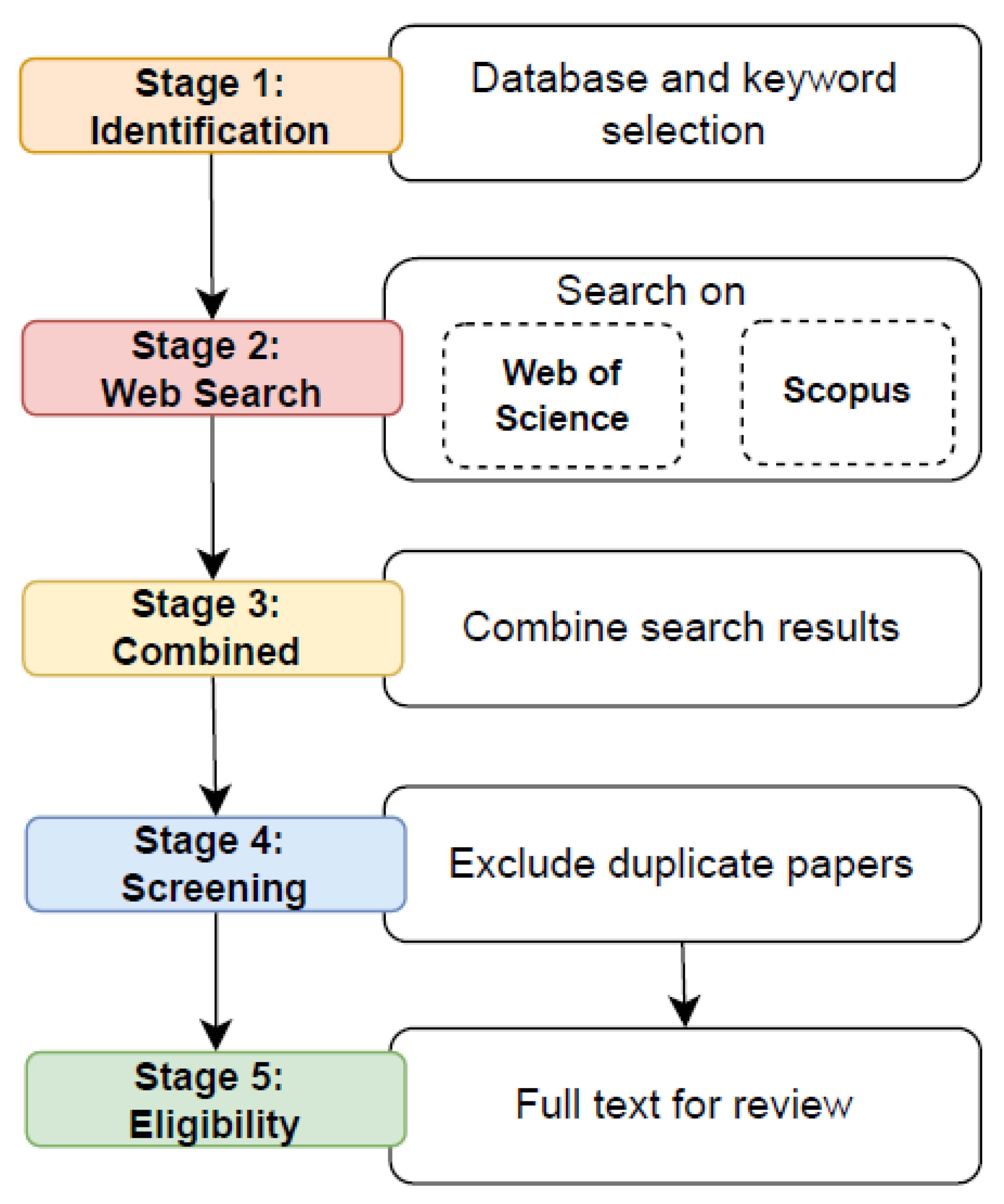
3.1. Stage 1: Keyword Search Identification
- Key factors contributing to supply chain complexity in megaprojects:
| Scopus | TITLE-ABS-KEY ((“supply chain” AND “complexity” AND (“drivers” OR “factors” OR “determinants”) AND (megaproject* OR “mega project*” OR “large-scale project*”)) |
| Web of Science | TS ((“supply chain” AND “complexity” AND (factors OR drivers OR determinants) AND (megaproject* OR “mega project*” OR “large scale project*”)) |
- Supply Chain Complexity Affects Megaproject Performance:
| Scopus | TITLE-ABS-KEY (“supply chain” AND “complexity” AND (“performance” OR “project performance” OR “project outcomes” OR “delivery outcomes” OR efficiency OR effectiveness OR cost OR schedule OR risk) AND (megaproject* OR “mega project*” OR “large-scale project*”)) |
| Web of Science | TS (“supply chain” AND complexity AND (performance OR “project performance” OR outcomes OR efficiency OR effectiveness OR cost OR schedule OR risk) AND (megaproject* OR “mega project*” OR “large scale project*”)) |
- Resilience Strategies to Manage Supply Chain Complexity in Megaprojects:
| Scopus | TITLE-ABS-KEY ((“supply chain” OR supply-chain) AND complexity AND (resilience OR resilient OR “resilience strategies” OR “adaptive capacity” OR mitigation OR flexibility OR agility OR robustness) AND (megaproject* OR “mega project*” OR “large-scale project*”)) |
| Web of Science | TS (“supply chain” AND complexity AND (resilience OR resilient OR “resilience strategies” OR agility OR flexibility OR robustness OR mitigation) AND (megaproject* OR “mega project*” OR “large scale project*”)) |
- For a Comprehensive Search (combined search):
| Scopus | TITLE-ABS-KEY (“supply chain complexity” OR “complex supply chain*” OR complexity) AND (“megaproject*” OR “mega project*” OR “large scale project*”) AND (factor* OR driver* OR determinant* OR cause* OR performance OR outcome OR resilience OR “resilience strategy*” OR manage* OR mitigate* OR framework*) |
| Web of Science | TS ((“supply chain” OR supply-chain) AND complexity AND (megaproject* OR “mega project*” OR “large-scale project*”) AND (drivers OR determinants) AND (performance OR outcomes OR resilience)) |
3.2. Stage 2: Web Search
- Articles published between 2015 and 2025 were selected based on availability and cover a wide range of disciplines relevant to the research scope, including Engineering, Business Management, Building Construction, and Energy. This multidisciplinary approach was adopted to capture the diverse perspectives that influence supply chain complexity and resilience within the megaproject context.The review was limited to the last 10 years (2015–2025) to capture the most recent trends and practices in supply chain complexity and resilience in construction megaprojects. Earlier studies, while valuable, primarily focus on traditional supply chain approaches and do not fully address emerging complexities, global sourcing and resilience strategies [55]. This targeted span ensures the framework reflects contemporary challenges and industry-relevant practices.
- The study includes only full-text articles published in English to ensure accessibility and consistency in analysis.
- The selected articles were derived from peer-reviewed publications, ensuring the academic credibility and quality of the reviewed sources.
- The abstracts, keywords, and citations of the identified studies were downloaded and organised using EndNote 21, a reference management software, which facilitated systematic storage, categorisation, and citation tracking throughout the review process.
- Articles were further screened to ensure they aligned with the theme of megaproject supply chain complexity and resilience.
3.3. Stage 3: Data Combined
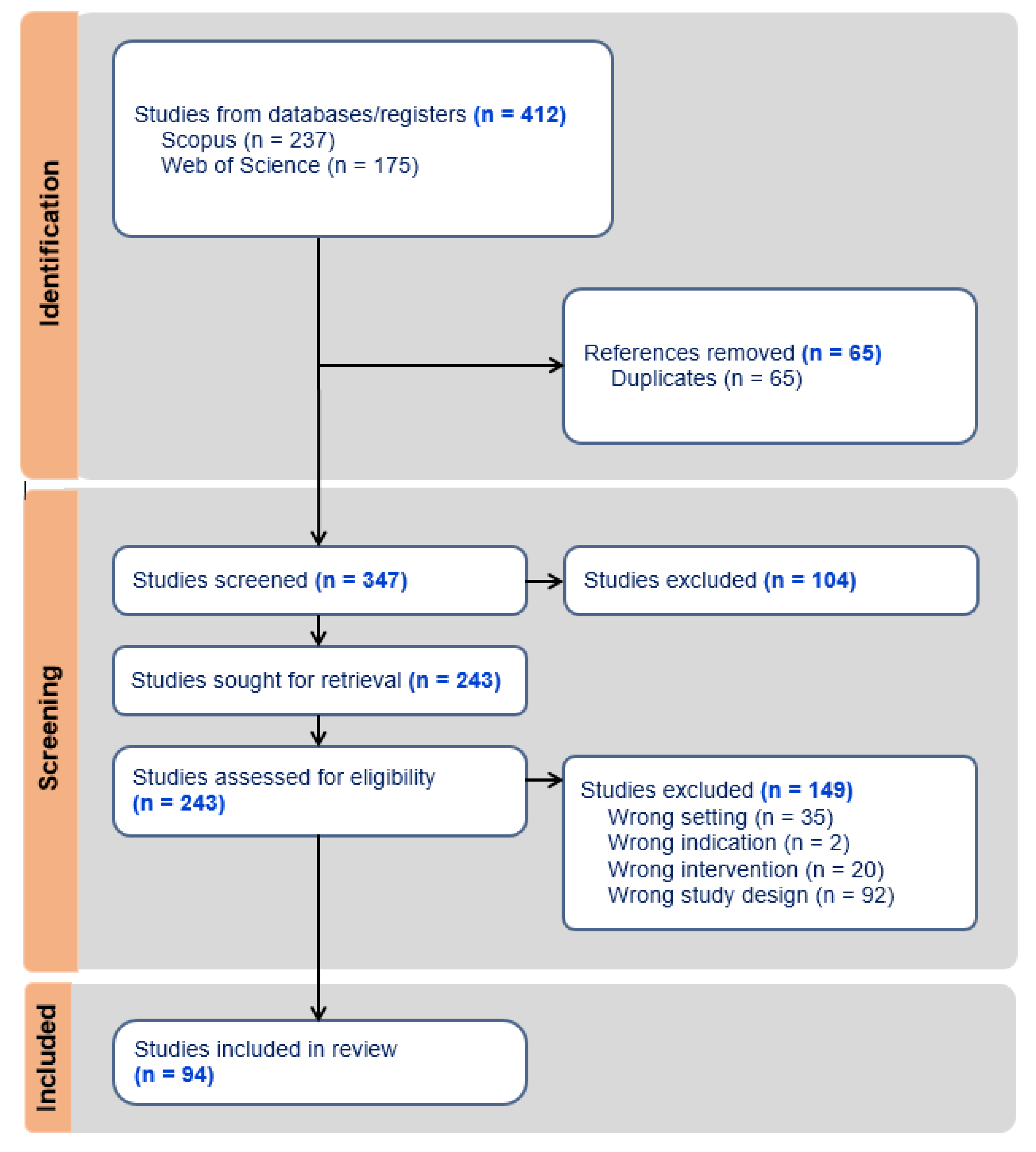
3.4. Stage 4: Data Screening
3.5. Stage 5: Eligibility
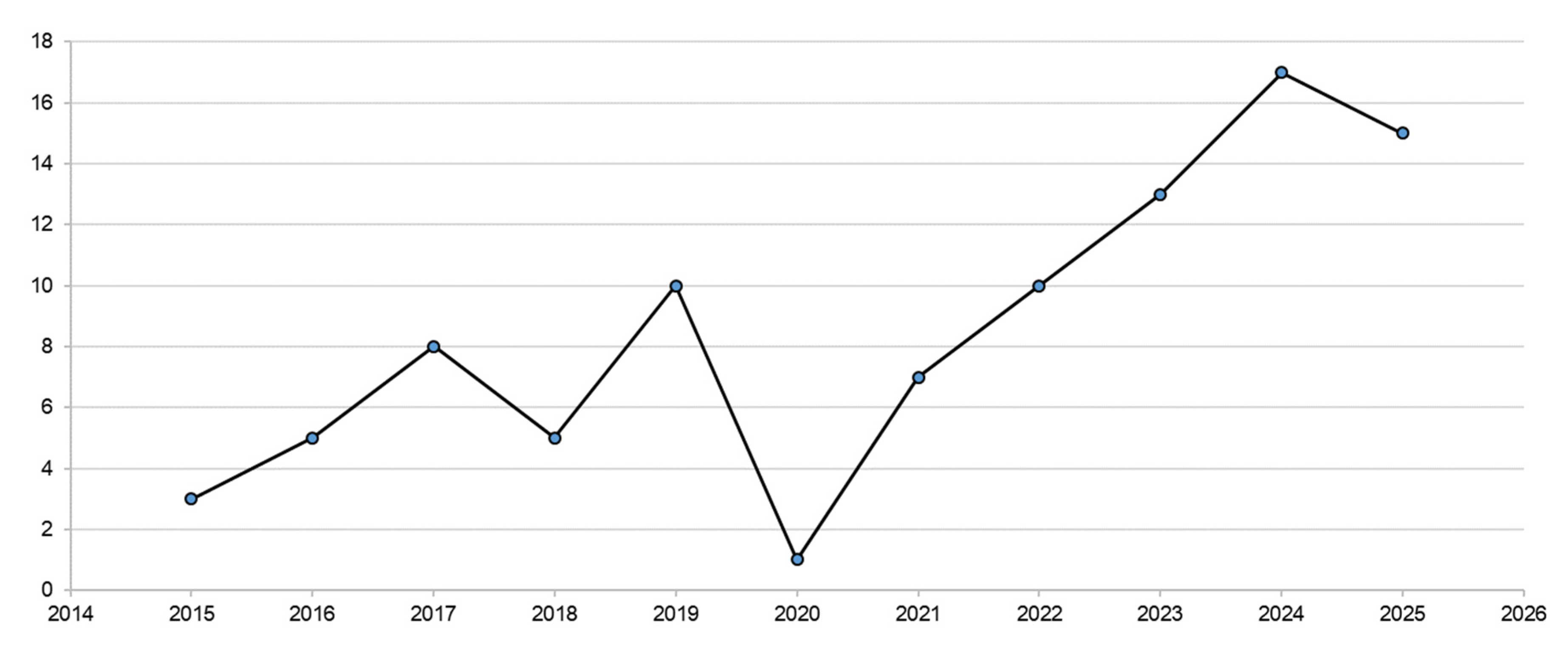
3.6. Descriptive Analysis
4. Discussion of Results
4.1. Factors Contributing to Supply Chain Complexity in Megaprojects
4.1.1. Upstream Supply Chain Complexity Drivers
4.1.2. Internal Supply Chain Complexity Drivers
4.1.3. Downstream Supply Chain Complexity Drivers
4.1.4. External Supply Chain Complexity Drivers
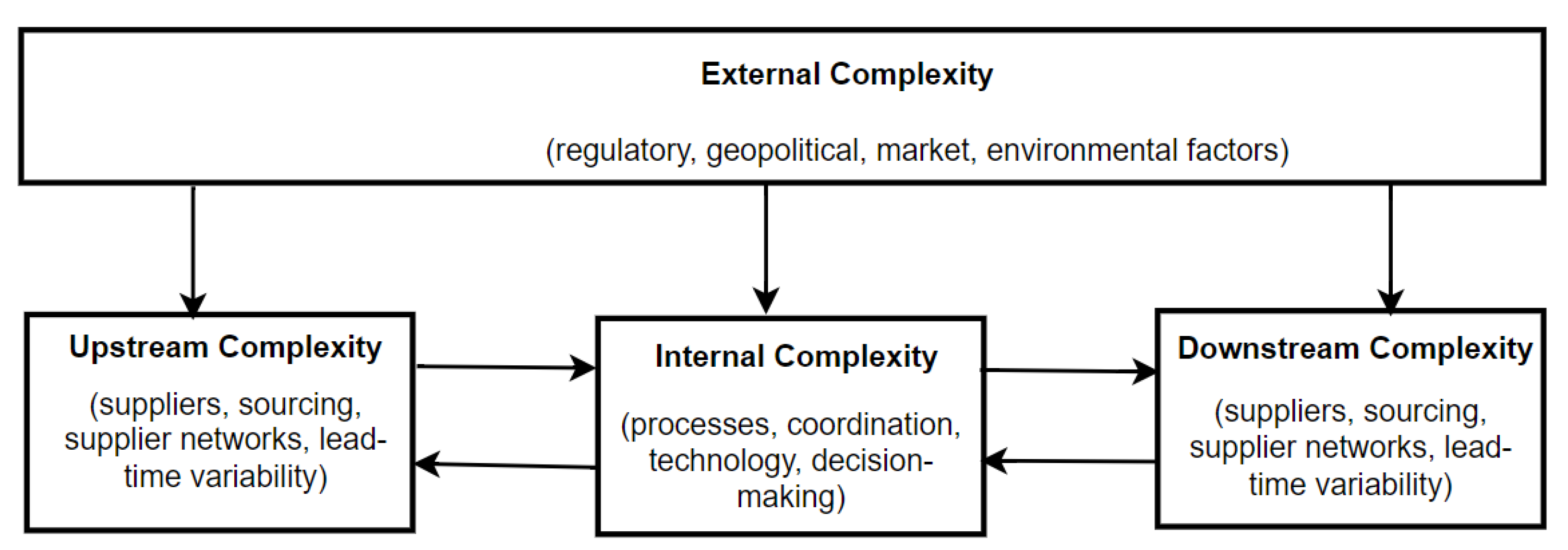
4.1.5. Relationships Between Supply Chain Complexity (Upstream, Internal, Downstream and External)
4.2. Effect of Supply Chain Complexity on Megaproject Performance
4.3. Resilience Strategies to Manage Supply Chain Complexity in Megaprojects
4.4. Integration of Supply Chain Complexity Management and Resilience Strategies
5. Multi-Level Conceptual Framework
6. Conclusions
Supplementary Materials
Author Contributions
Funding
Data Availability Statement
Acknowledgments
Conflicts of Interest
Abbreviations
| DSCC | Downstream supply chain complexity factor |
| ESCC | External supply chain complexity factor |
| ISCC | Internal supply chain complexity factor |
| IT | Information Technology |
| PICO | Population, Intervention, Comparator/Context, Outcome, and Study Characteristics |
| PRISMA | Preferred Reporting Items for Systematic Review and Meta-analysis |
| SC | Supply Chain |
| SCC | Supply chain complexity |
| SME | Small-Medium Enterprises |
| USCC | Upstream supply chain complexity factor |
References
- Flyvbjerg, B. What you Should Know about Megaprojects and Why: An Overview. Proj. Manag. J. 2014, 45, 6–19. [Google Scholar] [CrossRef]
- Mohseni, M.; Tabassi, A.; Kamal, E.; Bryde, D.; Michaelides, R. Complexity factors in mega projects: A literature review. Eur. Proc. Multidiscip. Sci. 2019, 2, 54–67. [Google Scholar] [CrossRef]
- Flyvbjerg, B. Introduction: The Iron Law of Megaproject Management. In The Oxford Handbook of Megaproject Management; Oxford Academic: Oxford, UK, 2017; pp. 1–18. [Google Scholar]
- Denicol, J.; Davies, A.; Krystallis, I. What Are the Causes and Cures of Poor Megaproject Performance? A Systematic Literature Review and Research Agenda. Proj. Manag. J. 2020, 51, 328–345. [Google Scholar] [CrossRef]
- Flyvbjerg, B. Curbing Optimism Bias and Strategic Misrepresentation in Planning: Reference Class Forecasting in Practice. Eur. Plan. Stud. 2008, 16, 3–21. [Google Scholar] [CrossRef]
- Flyvbjerg, B. Cost Overruns and Demand Shortfalls in Urban Rail and Other Infrastructure. Transp. Plan. Technol. 2007, 30, 9–30. [Google Scholar] [CrossRef]
- Merrow, E.W. Industrial Megaprojects: Concepts, Strategies, and Practices for Success; John Wiley & Sons, Incorporated: Hoboken, NJ, USA, 2011. [Google Scholar]
- Denicol, J. Managing megaproject supply chains: Life after Heathrow Terminal 5. In Successful Construction Supply Chain Management: Concepts and Case Studies; Wiley: Hoboken, NJ, USA, 2020; pp. 211–235. [Google Scholar]
- Gerschberger, M.; Fawcet, S.E.; Fawcett, A.M.; Gerschberger, M. Why supply chain complexity prevails: Mapping the complexity capability development process. Int. J. Logist. Manag. 2024, 35, 112–135. [Google Scholar] [CrossRef]
- Fawcett, S.E.; Magnan, G.M.; Ogden, J. Achieving World-Class Supply Chain collaboration: Managing the Transformation; Institute for Supply Management: Tempe, AZ, USA, 2007. [Google Scholar]
- Ateş, A.M.; Suurmond, R.; Luzzini, D.; Krause, D. Order from chaos: A meta-analysis of supply chain complexity and firm performance. J. Supply Chain Manag. 2022, 58, 3–30. [Google Scholar] [CrossRef]
- Choi, T.Y.; Krause, D.R. The supply base and its complexity: Implications for transaction costs, risks, responsiveness, and innovation. J. Oper. Manag. 2006, 24, 637–652. [Google Scholar] [CrossRef]
- Brockmann, C. Advanced Construction Management: The Complexity of Megaprojects; Wiley Blackwell: Hoboken, NJ, USA, 2020. [Google Scholar]
- Stefano, G.; Denicol, J.; Broyd, T.; Davies, A. What are the strategies to manage megaproject supply chains? A systematic literature review and research agenda. Int. J. Proj. Manag. 2023, 41, 102457. [Google Scholar] [CrossRef]
- Ponomarov, S.Y.; Holcomb, M.C. Understanding the concept of supply chain resilience. Int. J. Logist. Manag. 2009, 20, 124–143. [Google Scholar] [CrossRef]
- Katsaliaki, K.; Galetsi, P.; Kumar, S. Supply chain disruptions and resilience: A major review and future research agenda. Ann. Oper. Res. 2022, 319, 965–1002. [Google Scholar] [CrossRef]
- KPMG. Supply Chain Must Be Future Ready. Available online: https://assets.kpmg.com/content/dam/kpmgsites/au/pdf/2023/future-of-supply-chain-2023.pdf (accessed on 12 December 2025).
- Ivanov, D. Introduction to Supply Chain Resilience: Management, Modelling, Technology; Springer: Cham, Switzerland, 2021. [Google Scholar]
- Wright, J. Taking a broader view of supply chain resilience. Supply Chain Manag. Rev. 2013, 17, 26–31. [Google Scholar]
- Hosseini Shekarabi, S.A.; Kiani Mavi, R.; Romero Macau, F. Supply chain resilience: A critical review of risk mitigation, robust optimisation, and technological solutions and future research directions. Glob. J. Flex. Syst. Manag. 2025, 26, 681–735. [Google Scholar] [CrossRef]
- Vugrin, E.D.; Warren, D.E.; Ehlen, M.A.; Camphouse, R.C. A framework for assessing the resilience of infrastructure and economic systems. In Sustainable and Resilient Critical Infrastructure Systems: Simulation, Modeling, and Intelligent Engineering; Springer: Berlin/Heidelberg, Germany, 2010; pp. 77–116. [Google Scholar]
- Hong, L.J.; Li, J.; Wu, X.; Yi, S. Future Research of Supply chain Resilience: Network Perspectives and Incorporation of More Stakeholders. Fundam. Res. 2025, 5, 486–495. [Google Scholar] [CrossRef] [PubMed]
- Piya, S.; Shamsuzzoha, A.; Khadem, M. An approach for analysing supply chain complexity drivers through interpretive structural modelling. Int. J. Logist. Res. Appl. 2020, 23, 311–336. [Google Scholar] [CrossRef]
- Bode, C.; Wagner, S.M. Structural drivers of upstream supply chain complexity and the frequency of supply chain disruptions. J. Oper. Manag. 2015, 36, 215–228. [Google Scholar] [CrossRef]
- Manuj, I.; Sahin, F. A model of supply chain and supply chain decision-making complexity. Int. J. Phys. Distrib. Logist. Manag. 2011, 41, 511–549. [Google Scholar] [CrossRef]
- Pettit, T.J.; Croxton, K.L.; Fiksel, J. Ensuring Supply Chain Resilience: Development and Implementation of an Assessment Tool. J. Bus. Logist. 2013, 34, 46–76. [Google Scholar] [CrossRef]
- Birkie, S.E.; Trucco, P. Do not expect others do what you should! Supply chain complexity and mitigation of the ripple effect of disruptions. Int. J. Logist. Manag. 2020, 31, 123–144. [Google Scholar] [CrossRef]
- Birkie, S.E.; Trucco, P.; Campos, P.F. Effectiveness of resilience capabilities in mitigating disruptions: Leveraging on supply chain structural complexity. Supply Chain Manag. Int. J. 2017, 22, 506–521. [Google Scholar] [CrossRef]
- Kamalahmadi, M.; Parast, M.M. A review of the literature on the principles of enterprise and supply chain resilience: Major findings and directions for future research. Int. J. Prod. Econ. 2016, 171, 116–133. [Google Scholar] [CrossRef]
- Ming, L.Y.; Omain, S.Z.B.; Kowang, T.O. Supply chain resilience: A review and research direction. Int. J. Acad. Res. Bus. Soc. Sci. 2021, 11, 2591–2603. [Google Scholar] [CrossRef] [PubMed]
- Chen, L.; Zhao, X.; Tang, O.; Price, L.; Zhang, S.; Zhu, W. Supply chain collaboration for sustainability: A literature review and future research agenda. Int. J. Prod. Econ. 2017, 194, 73–87. [Google Scholar] [CrossRef]
- Wiengarten, F.; Humphreys, P.; Gimenez, C.; McIvor, R. Risk, risk management practices, and the success of supply chain integration. Int. J. Prod. Econ. 2016, 171, 361–370. [Google Scholar] [CrossRef]
- Shi, Q.; Chen, X.; Xiao, C.; Han, Y. Network Perspective in Megaproject Management: A Systematic Review. J. Constr. Eng. Manag. 2022, 148, 03122002. [Google Scholar] [CrossRef]
- Porter, M. Supply chain integration: Does organizational culture matter? Oper. Supply Chain Manag. Int. J. 2019, 12, 49–59. [Google Scholar] [CrossRef]
- Williams, T.M. Managing and Modelling Complex Projects; Springer: Dordrecht, The Netherlands, 2013. [Google Scholar]
- Hassan, T.M.; Mccaffer, R.; Thorpe, T. Emerging clients’ needs for Large Scale Engineering projects. Eng. Constr. Archit. Manag. 1999, 6, 21–29. [Google Scholar] [CrossRef]
- Grün, O. Taming Giant Projects: Management of Multi-Organization Enterprises; Springer Science & Business Media: Berlin/Heidelberg, Germany, 2004. [Google Scholar]
- Ruuska, I.; Teigland, R. Ensuring project success through collective competence and creative conflict in public–private partnerships—A case study of Bygga Villa, a Swedish triple helix e-government initiative. Int. J. Proj. Manag. 2009, 27, 323–334. [Google Scholar] [CrossRef]
- Caldas, C.; Gupta, A. Critical factors impacting the performance of mega-projects. Eng. Constr. Archit. Manag. 2017, 24, 920–934. [Google Scholar] [CrossRef]
- Priemus, H.; Bosch-Rekveldt, M.; Giezen, M. Dealing with complexity, uncertainties and risk of mega-projects: Redundancy, resilience and adaptivity. In International Handbook on Mega-Projects; Edward Elgar Publishing: Cheltenham, UK, 2013; pp. 83–110. [Google Scholar]
- Chapman, R.J. A framework for examining the dimensions and characteristics of complexity inherent within rail megaprojects. Int. J. Proj. Manag. 2016, 34, 937–956. [Google Scholar] [CrossRef]
- Kardes, I.; Ozturk, A.; Cavusgil, S.T.; Cavusgil, E. Managing global megaprojects: Complexity and risk management. Int. Bus. Rev. 2013, 22, 905–917. [Google Scholar] [CrossRef]
- Bozarth, C.C.; Warsing, D.P.; Flynn, B.B.; Flynn, E.J. The impact of supply chain complexity on manufacturing plant performance. J. Oper. Manag. 2009, 27, 78–93. [Google Scholar] [CrossRef]
- Wiedmer, R.; Rogers, Z.S.; Polyviou, M.; Mena, C.; Chae, S. The Dark and Bright Sides of Complexity: A Dual Perspective on Supply Network Resilience. J. Bus. Logist. 2021, 42, 336–359. [Google Scholar] [CrossRef]
- Serdarasan, S. A review of supply chain complexity drivers. Comput. Ind. Eng. 2013, 66, 533–540. [Google Scholar] [CrossRef]
- Lu, G.; Shang, G. Impact of supply base structural complexity on financial performance: Roles of visible and not-so-visible characteristics. J. Oper. Manag. 2017, 53–56, 23–44. [Google Scholar] [CrossRef]
- Campos, P.F.; Trucco, P.; Huatuco, L.H. Managing structural and dynamic complexity in supply chains: Insights from four case studies. Prod. Plan. Control 2019, 30, 611–623. [Google Scholar] [CrossRef]
- Lin, Y.H.; Wang, Y.; Lee, L.H.; Chew, E.P. Consistency matters: Revisiting the structural complexity for supply chain networks. Phys. A Stat. Mech. Its Appl. 2021, 572, 125862. [Google Scholar] [CrossRef]
- Serdarasan, S.; Tanyas, M. Dealing with Complexity in the Supply Chain: The Effect of Supply Chain Management Initiatives. 2012. Available online: https://ssrn.com/abstract=2056331 (accessed on 6 December 2025).
- Goffin, K.; Lemke, F.; Szwejczewski, M. An exploratory study of ‘close’ supplier–manufacturer relationships. J. Oper. Manag. 2006, 24, 189–209. [Google Scholar] [CrossRef]
- Cho, J.; Kang, J. Benefits and challenges of global sourcing: Perceptions of US apparel retail firms. Int. Mark. Rev. 2001, 18, 542–561. [Google Scholar] [CrossRef]
- Piya, S.; Shamsuzzoha, A.; Khadem, M.; Al-Kindi, M. Supply chain complexity drivers and solution methods. Int. J. Supply Chain Manag. 2017, 6, 43–50. [Google Scholar]
- Milgate, M. Antecedents of delivery performance: An international exploratory study of supply chain complexity. Ir. Mark. Rev. 2000, 13, 42–54. [Google Scholar]
- Ateş, M.A.; Memiş, H. Embracing supply base complexity: The contingency role of strategic purchasing. Int. J. Oper. Prod. Manag. 2021, 41, 830–859. [Google Scholar] [CrossRef]
- Ali, A.; Mahfouz, A.; Arisha, A. Analysing supply chain resilience: Integrating the constructs in a concept mapping framework via a systematic literature review. Supply Chain Manag. Int. J. 2017, 22, 16–39. [Google Scholar] [CrossRef]
- Mascaritolo, J.; Holcomb, M.C. Moving towards a resilient supply chain. J. Transp. Manag. 2008, 19, 7. [Google Scholar] [CrossRef]
- Ponomarov, S.Y. Antecedents and Consequences of Supply Chain Resilience: A Dynamic Capabilities Perspective. Doctoral Dissertation, University of Tennessee, Knoxville, TN, USA, 2012. [Google Scholar]
- Rice, J.B.; Caniato, F. Building a secure and resilient supply network. Supply Chain. Manag. Rev. 2003, 7, 22–30. [Google Scholar]
- Johnson, N.; Elliott, D.; Drake, P. Exploring the role of social capital in facilitating supply chain resilience. Supply Chain Manag. Int. J. 2013, 18, 324–336. [Google Scholar] [CrossRef]
- Tang, C.S. Robust strategies for mitigating supply chain disruptions. Int. J. Logist. Res. Appl. 2006, 9, 33–45. [Google Scholar] [CrossRef]
- Christopher, M.; Peck, H. Building the Resilient Supply Chain. Int. J. Logist. Manag. 2004, 15, 1–14. [Google Scholar] [CrossRef]
- Peck, H. Drivers of supply chain vulnerability: An integrated framework. Int. J. Phys. Distrib. Logist. Manag. 2005, 35, 210–232. [Google Scholar] [CrossRef]
- Carvalho, H.; Duarte, S.; Cruz Machado, V. Lean, agile, resilient and green: Divergencies and synergies. Int. J. Lean Six Sigma 2011, 2, 151–179. [Google Scholar] [CrossRef]
- Urciuoli, L.; Mohanty, S.; Hintsa, J.; Gerine Boekesteijn, E. The resilience of energy supply chains: A multiple case study approach on oil and gas supply chains to Europe. Supply Chain Manag. Int. J. 2014, 19, 46–63. [Google Scholar] [CrossRef]
- Brandon-Jones, E.; Squire, B.; Autry, C.W.; Petersen, K.J. A Contingent Resource-Based Perspective of Supply Chain Resilience and Robustness. J. Supply Chain Manag. 2014, 50, 55–73. [Google Scholar] [CrossRef]
- Hart, C. Doing a Literature Review: Releasing the Research Imagination; Sage: London, UK, 2018. [Google Scholar]
- Hupe, M. Covidence. J. Electron. Resour. Med. Libr. 2025, 22, 139–147. [Google Scholar] [CrossRef]
- Babineau, J. Product review: Covidence (systematic review software). J. Can. Health Libr. Assoc./J. L’association Bibliothèques Santé Can. 2014, 35, 68–71. [Google Scholar] [CrossRef]
- Kellermeyer, L.; Harnke, B.; Knight, S. Covidence and rayyan. J. Med. Libr. Assoc. JMLA 2018, 106, 580. [Google Scholar] [CrossRef]
- Aviv-Reuven, S.; Rosenfeld, A. Publication patterns’ changes due to the COVID-19 pandemic: A longitudinal and short-term scientometric analysis. Scientometrics 2021, 126, 6761–6784. [Google Scholar] [CrossRef]
- Whitaker, M.; Rodrigues, S.; Cooke, G.; Virlon, B.; Donnelly, C.A.; Ward, H.; Elliott, P.; Chadeau-Hyam, M. How COVID-19 affected academic publishing: A 3-year study of 17 million research papers. Int. J. Epidemiol. 2025, 54, dyaf058. [Google Scholar] [CrossRef] [PubMed]
- Kadan, R.; Wium, J. Fuzzy synthesis analysis of social network risk factors in supply chains of African megaprojects. Built Environ. Proj. Asset Manag. 2024, 15, 125–148. [Google Scholar] [CrossRef]
- Aitken, J.; Bozarth, C.; Garn, W. To eliminate or absorb supply chain complexity: A conceptual model and case study. Supply Chain Manag. 2016, 21, 759–774. [Google Scholar] [CrossRef]
- Kavilal, E.G.; Prasanna Venkatesan, S.; Harsh Kumar, K.D. An integrated fuzzy approach for prioritizing supply chain complexity drivers of an Indian mining equipment manufacturer. Resour. Policy 2017, 51, 204–218. [Google Scholar] [CrossRef]
- Ivanov, D. Predicting the impacts of epidemic outbreaks on global supply chains: A simulation-based analysis on the coronavirus outbreak (COVID-19/SARS-CoV-2) case. Transp. Res. Part E Logist. Transp. Rev. 2020, 136, 101922. [Google Scholar] [CrossRef]
- Dolgui, A.; Ivanov, D.; Sokolov, B. Reconfigurable supply chain: The X-network. Int. J. Prod. Res. 2020, 58, 4138–4163. [Google Scholar] [CrossRef]
- Sharma, A.; Pathak, S.; Borah, S.B.; Adhikary, A. Is it too complex? The curious case of supply network complexity and focal firm innovation. J. Oper. Manag. 2020, 66, 839–865. [Google Scholar] [CrossRef]
- Scholten, K.; Stevenson, M.; van Donk, D.P. Dealing with the unpredictable: Supply chain resilience. Int. J. Oper. Prod. Manag. 2020, 40, 1–10. [Google Scholar] [CrossRef]
- Chand, P.; Kumar, A.; Thakkar, J.; Ghosh, K.K. Direct and mediation effect of supply chain complexity drivers on supply chain performance: An empirical evidence of organizational complexity theory. Int. J. Oper. Prod. Manag. 2022, 42, 797–825. [Google Scholar] [CrossRef]
- Ivanov, D.; Dolgui, A. Viability of intertwined supply networks: Extending the supply chain resilience angles towards survivability. A position paper motivated by COVID-19 outbreak. Int. J. Prod. Res. 2020, 58, 2904–2915. [Google Scholar] [CrossRef]
- Dubey, R.; Gunasekaran, A.; Childe, S.J.; Papadopoulos, T.; Luo, Z.; Roubaud, D. Upstream supply chain visibility and complexity effect on focal company’s sustainable performance: Indian manufacturers’ perspective. Ann. Oper. Res. 2020, 290, 343–367. [Google Scholar] [CrossRef]
- Gao, G.Y.; Xie, E.; Zhou, K.Z. How does technological diversity in supplier network drive buyer innovation? Relational process and contingencies. J. Oper. Manag. 2015, 36, 165–177. [Google Scholar] [CrossRef]
- Heckmann, I.; Comes, T.; Nickel, S. A critical review on supply chain risk—Definition, measure and modeling. Omega 2015, 52, 119–132. [Google Scholar] [CrossRef]
- Rossetti, C.L.; Warsing, D.P.; Flynn, B.B.; Bozarth, C.C. Complex and lean or lean and complex? The role of supply chain complexity in lean production. Oper. Manag. Res. 2023, 16, 1382–1412. [Google Scholar] [CrossRef]
- Gray, J.V.; Handley, S.M. Managing contract manufacturer quality in the presence of performance ambiguity. J. Oper. Manag. 2015, 38, 41–55. [Google Scholar] [CrossRef]
- Wieland, A. Dancing the Supply Chain: Toward Transformative Supply Chain Management. J. Supply Chain Manag. 2021, 57, 58–73. [Google Scholar] [CrossRef]
- Sharma, A.; Kumar, V.; Borah, S.B.; Adhikary, A. Complexity in a multinational enterprise’s global supply chain and its international business performance: A bane or a boon? J. Int. Bus. Stud. 2022, 53, 850–878. [Google Scholar] [CrossRef]
- López, C.; Morales-Contreras, M.F.; Langella, I.M.; Alonso-Monge, J. Modeling supply chain disruptions due to geopolitical Reasons: A systematic literature review. Transp. Res. Part E Logist. Transp. Rev. 2025, 202, 104290. [Google Scholar] [CrossRef]
- Ghag, N.; Sonar, H.; Sawant, R.; Bankapalli, K. Examining industry 5.0 and supply chain performance: An empirical study for managing supply chain complexity. Prod. Manuf. Res. 2025, 13, 2501181. [Google Scholar] [CrossRef]
- El-Beheiry, M.; Taha, R.; Ismail, T.; Adel, Y. A novel study of the impact of supply chain complexity on the bullwhip effect. J. Transp. Supply Chain. Manag. 2024, 18, a1077. [Google Scholar] [CrossRef]
- Seif, M.; Jafari, H. Unpacking the role of analytics for supply chain resilience and performance: The complex influence of supply chain integration. Prod. Plan. Control 2025, 37, 272–289. [Google Scholar] [CrossRef]
- Menezes, M.B.C.; Ruiz-Hernández, D.; Chen, Y.-T. On the validity and practical relevance of a measure for structural complexity. Int. J. Prod. Econ. 2021, 240, 108243. [Google Scholar] [CrossRef]
- Vickery, S.K.; Koufteros, X.; Dröge, C.; Calantone, R. Product modularity, process modularity, and new product introduction performance: Does complexity matter? Prod. Oper. Manag. 2016, 25, 751–770. [Google Scholar] [CrossRef]
- Fernández Campos, P.; Huaccho Huatuco, L.; Trucco, P. Framing the interplay mechanisms between structural and dynamic complexity in supply chains. Prod. Plan. Control 2024, 35, 599–617. [Google Scholar] [CrossRef]
- Radujković, M.; Mišić, S. Identification of key supply chain elements for megaprojects success. In International Research Network on Organizing by Projects (IRNOP) 2017; UTS ePRESS: Sydney, NSW, Australia, 2017. [Google Scholar][Green Version]
- Sabbar, M.; Naimi, S. An integrated lean-digital framework for optimizing civil-engineering supply chains: Mixed-methods evidence from multi-project case analyses. Int. J. Comput. Exp. Sci. Eng. 2025, 11. [Google Scholar] [CrossRef]
- Nyarirangwe, M.; Babatunde, O.K. Megaproject complexity attributes and competences: Lessons from IT and construction projects. Int. J. Inf. Syst. Proj. Manag. 2019, 7, 77–99. [Google Scholar] [CrossRef]
- Nikolić, M.; Cerić, A. Classification of key elements of construction project complexity from the contractor perspective. Buildings 2022, 12, 696. [Google Scholar] [CrossRef]
- Lafhaj, Z.; Rebai, S.; AlBalkhy, W.; Hamdi, O.; Mossman, A.; Alves Da Costa, A. Complexity in construction projects: A literature review. Buildings 2024, 14, 680. [Google Scholar] [CrossRef]
- Hohenstein, N.-O.; Feisel, E.; Hartmann, E.; Giunipero, L. Research on the phenomenon of supply chain resilience: A systematic review and paths for further investigation. Int. J. Phys. Distrib. Logist. Manag. 2015, 45, 90–117. [Google Scholar] [CrossRef]
- Ke, Y.; Lu, L.; Luo, X. Identification and formation mechanism of key elements of supply chain resilience: Exploration based on grounded theory and verification of SEM. PLoS ONE 2023, 18, e0293741. [Google Scholar] [CrossRef]
- El-naggar, F.; Ali, M.A. Supply Chain Resilience: A Literature Review and Gap Analysis. In Advanced Technologies and the Management of Disruptive Supply Chains: The Post-COVID Era; Qudrat-Ullah, H., Ali, S.I., Eds.; Springer Nature: Cham, Switzerland, 2023; pp. 55–79. [Google Scholar]
- Chowdhury, M.M.H.; Quaddus, M. Supply chain resilience: Conceptualization and scale development using dynamic capability theory. Int. J. Prod. Econ. 2017, 188, 185–204. [Google Scholar] [CrossRef]
- Ho, W.R.; Maghazei, O.; Netland, T.H. Understanding manufacturing repurposing: A multiple-case study of ad hoc healthcare product production during COVID-19. Oper. Manag. Res. 2022, 15, 1257–1269. [Google Scholar] [CrossRef]
- Tukamuhabwa, B.R.; Stevenson, M.; Busby, J.; Zorzini, M. Supply chain resilience: Definition, review and theoretical foundations for further study. Int. J. Prod. Res. 2015, 53, 5592–5623. [Google Scholar] [CrossRef]
- Ivanov, D.; Dolgui, A.; Sokolov, B. The impact of digital technology and Industry 4.0 on the ripple effect and supply chain risk analytics. Int. J. Prod. Res. 2019, 57, 829–846. [Google Scholar] [CrossRef]
- Dixit, V.; Verma, P.; Tiwari, M.K. Assessment of pre and post-disaster supply chain resilience based on network structural parameters with CVaR as a risk measure. Int. J. Prod. Econ. 2020, 227, 107655. [Google Scholar] [CrossRef]
- Yang, Y.; Peng, C. A prediction-based supply chain recovery strategy under disruption risks. Int. J. Prod. Res. 2023, 61, 7670–7684. [Google Scholar] [CrossRef]
- Yang, Y.; Peng, C.; Cao, E.-Z.; Zou, W. Building resilience in supply chains: A knowledge graph-based risk management framework. IEEE Trans. Comput. Soc. Syst. 2023, 11, 3873–3881. [Google Scholar] [CrossRef]
- Chen, J.; Wang, H.; Zhong, R.Y. A supply chain disruption recovery strategy considering product change under COVID-19. J. Manuf. Syst. 2021, 60, 920–927. [Google Scholar] [CrossRef]
- Schwartz, J.D.; Wang, W.; Rivera, D.E. Simulation-based optimization of process control policies for inventory management in supply chains. Automatica 2006, 42, 1311–1320. [Google Scholar] [CrossRef]
- Chen, J.; Wang, H.; Fu, Y. A multi-stage supply chain disruption mitigation strategy considering product life cycle during COVID-19. Environ. Sci. Pollut. Res. 2022, 1–15. [Google Scholar] [CrossRef]
- Paul, S.K.; Chowdhury, P. A production recovery plan in manufacturing supply chains for a high-demand item during COVID-19. Int. J. Phys. Distrib. Logist. Manag. 2021, 51, 104–125. [Google Scholar] [CrossRef]
- Gholami-Zanjani, S.M.; Klibi, W.; Jabalameli, M.S.; Pishvaee, M.S. The design of resilient food supply chain networks prone to epidemic disruptions. Int. J. Prod. Econ. 2021, 233, 108001. [Google Scholar] [CrossRef]
- Aldrighetti, R.; Battini, D.; Ivanov, D. Efficient resilience portfolio design in the supply chain with consideration of preparedness and recovery investments. Omega 2023, 117, 102841. [Google Scholar] [CrossRef]
- Sawik, T. Selection of resilient supply portfolio under disruption risks. Omega 2013, 41, 259–269. [Google Scholar] [CrossRef]
- Parkouhi, S.V.; Ghadikolaei, A.S. A resilience approach for supplier selection: Using Fuzzy Analytic Network Process and grey VIKOR techniques. J. Clean. Prod. 2017, 161, 431–451. [Google Scholar] [CrossRef]
- Pereira, C.R.; Christopher, M.; Da Silva, A.L. Achieving supply chain resilience: The role of procurement. Supply Chain Manag. Int. J. 2014, 19, 626–642. [Google Scholar] [CrossRef]
- Rajesh, R. A novel advanced grey incidence analysis for investigating the level of resilience in supply chains. Ann. Oper. Res. 2022, 308, 441–490. [Google Scholar] [CrossRef]
- Siva Kumar, P.; Anbanandam, R. Theory building on supply chain resilience: A SAP–LAP analysis. Glob. J. Flex. Syst. Manag. 2020, 21, 113–133. [Google Scholar] [CrossRef]
- Tucker, E.L.; Daskin, M.S.; Sweet, B.V.; Hopp, W.J. Incentivizing resilient supply chain design to prevent drug shortages: Policy analysis using two-and multi-stage stochastic programs. IISE Trans. 2020, 52, 394–412. [Google Scholar] [CrossRef]
- Paul, S.K.; Moktadir, M.A.; Sallam, K.; Choi, T.-M.; Chakrabortty, R.K. A recovery planning model for online business operations under the COVID-19 outbreak. Int. J. Prod. Res. 2023, 61, 2613–2635. [Google Scholar] [CrossRef]
- Sawik, T. Stochastic optimization of supply chain resilience under ripple effect: A COVID-19 pandemic related study. Omega 2022, 109, 102596. [Google Scholar] [CrossRef]
- Alamdari, A.M.; Jabarzadeh, Y.; Samson, D.; Sanoubar, N. Supply chain risk factors in green construction of residential mega projects—Interactions and categorization. Eng. Constr. Archit. Manag. 2023, 30, 568–597. [Google Scholar] [CrossRef]
- Rezapour, S.; Farahani, R.Z.; Pourakbar, M. Resilient supply chain network design under competition: A case study. Eur. J. Oper. Res. 2017, 259, 1017–1035. [Google Scholar] [CrossRef]
- Li, Y.; Zobel, C.W. Exploring supply chain network resilience in the presence of the ripple effect. Int. J. Prod. Econ. 2020, 228, 107693. [Google Scholar] [CrossRef]
- Rajesh, R. A fuzzy approach to analyzing the level of resilience in manufacturing supply chains. Sustain. Prod. Consum. 2019, 18, 224–236. [Google Scholar] [CrossRef]
- Namdar, J.; Torabi, S.A.; Sahebjamnia, N.; Nilkanth Pradhan, N. Business continuity-inspired resilient supply chain network design. Int. J. Prod. Res. 2021, 59, 1331–1367. [Google Scholar] [CrossRef]
- Sabouhi, F.; Jabalameli, M.S.; Jabbarzadeh, A. An optimization approach for sustainable and resilient supply chain design with regional considerations. Comput. Ind. Eng. 2021, 159, 107510. [Google Scholar] [CrossRef]
- Rezaei, A.; Aghsami, A.; Rabbani, M. Supplier selection and order allocation model with disruption and environmental risks in centralized supply chain. Int. J. Syst. Assur. Eng. Manag. 2021, 12, 1036–1072. [Google Scholar] [CrossRef]
- Chen, H.Y.; Das, A.; Ivanov, D. Building resilience and managing post-disruption supply chain recovery: Lessons from the information and communication technology industry. Int. J. Inf. Manag. 2019, 49, 330–342. [Google Scholar] [CrossRef]
- Zhao, K.; Zuo, Z.; Blackhurst, J.V. Modelling supply chain adaptation for disruptions: An empirically grounded complex adaptive systems approach. J. Oper. Manag. 2019, 65, 190–212. [Google Scholar] [CrossRef]
- Machado, S.M.; Paiva, E.L.; da Silva, E.M. Counterfeiting: Addressing mitigation and resilience in supply chains. Int. J. Phys. Distrib. Logist. Manag. 2018, 48, 139–163. [Google Scholar] [CrossRef]
- Schmitt, T.G.; Kumar, S.; Stecke, K.E.; Glover, F.W.; Ehlen, M.A. Mitigating disruptions in a multi-echelon supply chain using adaptive ordering. Omega 2017, 68, 185–198. [Google Scholar] [CrossRef]
- Saghafian, S.; Van Oyen, M.P. The value of flexible backup suppliers and disruption risk information: Newsvendor analysis with recourse. IIE Trans. 2012, 44, 834–867. [Google Scholar] [CrossRef]
- Vanpoucke, E.; Ellis, S.C. Building supply-side resilience—A behavioural view. Int. J. Oper. Prod. Manag. 2019, 40, 11–33. [Google Scholar] [CrossRef]
- Sabouhi, F.; Pishvaee, M.S.; Jabalameli, M.S. Resilient supply chain design under operational and disruption risks considering quantity discount: A case study of pharmaceutical supply chain. Comput. Ind. Eng. 2018, 126, 657–672. [Google Scholar] [CrossRef]
- Ivanov, D.; Keskin, B.B. Post-pandemic adaptation and development of supply chain viability theory. Omega 2023, 116, 102806. [Google Scholar] [CrossRef]
- Thomas, A.; Pham, D.T.; Francis, M.; Fisher, R. Creating resilient and sustainable manufacturing businesses—A conceptual fitness model. Int. J. Prod. Res. 2015, 53, 3934–3946. [Google Scholar] [CrossRef]
- Vecchi, V.; Cusumano, N.; Boyer, E.J. Medical Supply Acquisition in Italy and the United States in the Era of COVID-19: The Case for Strategic Procurement and Public–Private Partnerships. Am. Rev. Public Adm. 2020, 50, 642–649. [Google Scholar] [CrossRef]
- Ivanov, D. A blessing in disguise’ or ‘as if it wasn’t hard enough already’: Reciprocal and aggravate vulnerabilities in the supply chain. Int. J. Prod. Res. 2020, 58, 3252–3262. [Google Scholar] [CrossRef]
- Kaviani, M.A.; Tavana, M.; Kowsari, F.; Rezapour, R. Supply chain resilience: A benchmarking model for vulnerability and capability assessment in the automotive industry. Benchmarking 2020, 27, 1929–1949. [Google Scholar] [CrossRef]
- Ivanov, D. Viable supply chain model: Integrating agility, resilience and sustainability perspectives-lessons from and thinking beyond the COVID-19 pandemic. Ann. Oper. Res. 2022, 319, 1411–1431. [Google Scholar] [CrossRef]
- Dolgui, A.; Ivanov, D.; Sokolov, B. Ripple effect in the supply chain: An analysis and recent literature. Int. J. Prod. Res. 2018, 56, 414–430. [Google Scholar] [CrossRef]
- Belhadi, A.; Kamble, S.; Jabbour, C.J.C.; Gunasekaran, A.; Ndubisi, N.O.; Venkatesh, M. Manufacturing and service supply chain resilience to the COVID-19 outbreak: Lessons learned from the automobile and airline industries. Technol. Forecast. Soc. Change 2021, 163, 120447. [Google Scholar] [CrossRef] [PubMed]
- Ivanov, D.; Dolgui, A. A digital supply chain twin for managing the disruption risks and resilience in the era of Industry 4.0. Prod. Plan. Control 2021, 32, 775–788. [Google Scholar] [CrossRef]
- Varpio, L.; Paradis, E.; Uijtdehaage, S.; Young, M. The distinctions between theory, theoretical framework, and conceptual framework. Acad. Med. 2020, 95, 989–994. [Google Scholar] [CrossRef]
- Stone, J.; Rahimifard, S. Resilience in agri-food supply chains: A critical analysis of the literature and synthesis of a novel framework. Supply Chain Manag. Int. J. 2018, 23, 207–238. [Google Scholar] [CrossRef]
- Zavala-Alcívar, A.; Verdecho, M.-J.; Alfaro-Saiz, J.-J. A Conceptual Framework to Manage Resilience and Increase Sustainability in the Supply Chain. Sustainability 2020, 12, 6300. [Google Scholar] [CrossRef]
- Page, M.J.; McKenzie, J.E.; Bossuyt, P.M.; Boutron, I.; Hoffmann, T.C.; Mulrow, C.D.; Shamseer, L.; Tetzlaff, J.M.; Akl, E.A.; Brennan, S.E.; et al. The PRISMA 2020 statement: An updated guideline for reporting systematic reviews. BMJ 2021, 372, n71. [Google Scholar] [CrossRef] [PubMed]



| Category | Type | Description |
|---|---|---|
| General project management (no supply chain focus) | Irrelevant | Studies focused on project governance, delivery, and performance without supply chain considerations |
| Single-dimension focus | Irrelevant | Studies addressing only risk, performance, sustainability, or trust without integration of SCC and resilience |
| Methodological/optimisation-focused | Irrelevant | Studies dominated by modelling, simulation, and optimisation without contextual integration |
| Technology-centric (no SCC–resilience linkage) | Irrelevant | Studies focusing on BIM, AI, Industry 4.0, and digitalisation without linking complexity and resilience |
| General supply chain (non-megaproject) | Irrelevant | Studies not situated within megaproject or construction-specific contexts |
| Conceptual/theoretical only | Irrelevant | Studies lacking empirical grounding or practical applicability |
| Sector-irrelevant (non-construction industries) | Excluded | Studies from manufacturing, retail, healthcare, etc., not aligned with megaproject supply chains |
| SMEs/small-scale context | Excluded | Studies focusing on SMEs lacking megaproject complexity |
| Complexity Level | Complexity Driver | Description | Key References |
|---|---|---|---|
| Upstream (Supply and Design) Complexity drivers | Number of suppliers and supplier tier | Extensive multi-level supplier networks | [11,24,75] |
| Supplier heterogeneity | Diverse international suppliers with varying technical standards, cultural practices and capabilities | [11,24] | |
| Multi-tier supply network | Limited visibility across upstream and downstream tiers in megaprojects | [24,76] | |
| Geographical dispersion | Global sourcing of specialised materials and equipment in megaprojects | [24,77] | |
| Supplier reliability | The consistency of suppliers in meeting quality, cost and delivery requirements | [11,24] | |
| Regulatory differences | Diverse legal and trade systems | [78] | |
| Lead time variability | Uncertainty in delivery times | [79] | |
| Information irregularity | Fragmented information systems among contractors and suppliers | [80,81] | |
| Technological diversity | Difference in digital and engineering capability among suppliers | [11,79,82] | |
| Internal (Project-Organisation) Complexity drivers | Product variety | Custom-designed components and specialised materials | [75,79] |
| Process interdependence | Interlined construction, logistic and installation processes | [24,75] | |
| Organisational structure | Fragmented departments, roles and responsibilities across organisations | [81] | |
| Decision-making complexity | Multiple stakeholders with conflicting goals and priorities | [78,83] | |
| Technology changes | Frequent adoption of new construction technologies and digital tools | [84,85] | |
| Customisation | Customised designs and components | [11,85] | |
| Changes in schedule | Frequency and unpredictability of schedule changes | [11,79] | |
| Downstream (Delivery and Operation) Complexity drivers | Demand variability | Fluctuation of materials and resource requirements across project phases | [75,79] |
| Market uncertainty | Unpredictable changes in stakeholder expectations and public demand | [75,86] | |
| Distribution channel diversity | Multiple logistics providers and delivery routes | [11,75] | |
| Several levels of expectation | Pressure to meet time, cost and quality targets simultaneously | [78,81] | |
| Information distortion | Forecasting errors and communication delays | [75] | |
| Demand unpredictability | Uncertain future project phases and scope changes | [75,84] | |
| External/Environmental Complexity drivers | Regulatory complexity | Changing environmental, safety and procurement regulations | [79,87] |
| Geopolitical disruptions | Trade restrictions and political instability | [88] | |
| Technological change rate | Rapid evolution of construction and digital technologies | [89] | |
| Market uncertainties | Competitive pressure | [90] | |
| Climate/natural disasters | Extreme weather events and natural hazards | [91] |
| Complexity Type | Complexity Driver | Impact on Megaproject Performance | Sources |
|---|---|---|---|
| Structural Complexity (Network, size and interdependencies) | Number of suppliers and supplier tier | Increased coordination and monitoring challenges; Potential delays and cost overruns | [11,24,75] |
| Multi-tier supply network | Reduced visibility across supply chain tiers; Increased uncertainty | [24,76] | |
| Geographical dispersion | Increase logistical complexity; Transportation delays; Higher costs | [24,77] | |
| Distribution channel diversity | Increased logistics complexity; Coordination challenges | [11,75] | |
| Process interdependence | Amplified disruption effects; Cascading process failures | [24,75] | |
| Operational Complexity (Process, product and flow variability) | Supplier reliability | Unstable performance increases disruption risk; Affects schedule and quality. | [11,24] |
| Product variety | Complexity in procurement; Coordination challenges; Potential quality risks | [23,75,79] | |
| Customisation | Increased engineering and coordination complexity | [11,85] | |
| Demand variability | Influences construction planning; Schedule instability | [75,79] | |
| Information distortion | Increased risk of errors; Inefficient planning | [75] | |
| Organisational Complexity (stakeholders, governance and decision structures) | Supplier heterogeneity | Difficulties in coordination and integration | [11,24] |
| Organisational structure | Fragmented governance; Decision-making delays | [81] | |
| Decision-making complexity | Delayed approvals; Misaligned project objectives | [78,83] | |
| Several levels of expectation | Conflicting demands; Schedule pressure; Risk of inefficiency | [78,81] | |
| Technological Complexity (Digital systems) | Information irregularity | Reduced transparency; Communication delays | [80,81] |
| Technology changes | Integration and resource reallocation challenges; Schedule delays | [84,85] | |
| Technological diversity | Difficulty integrating supplier capabilities; Risk of incompatibility | [11,79,82] | |
| Technological change rate | Long-term planning uncertainty; Adaptation challenges | [89] | |
| Environmental Complexity (External uncertainty) | Regulatory differences | Project delays; Compliance costs; Potential penalties | [78] |
| Regulatory complexity | Disruption of schedule; Increased project costs | [23,77,79] | |
| Market uncertainty | Scope changes; Schedule and cost volatility | [75,86] | |
| Market uncertainties | Resource allocation challenges; Competitive pressures | [90] | |
| Geopolitical disruptions | Disruption of international sourcing; Cost escalation | [88] | |
| Climate/natural disasters | Construction and logistics delays; Increased risk | [91] | |
| Temporal Complexity (Uncertainty and dynamics) | Lead time variability | Procurement delays; Schedule instability | [73] |
| Changes in schedule | Affects timelines and resource reallocation | [11,79] | |
| Demand unpredictability | Unstable procurement and scheduling; Risk of delays | [75,84] |
| Strategy Type | Resilience Strategies | Description | Scope | Effectiveness to Enhance Performance | References |
|---|---|---|---|---|---|
| Proactive (Preparedness) | Backup suppliers or multiple sourcing | Engaging multiple suppliers for critical construction materials | Upstream/External |
| [107,108] |
| Multi-sourcing (procure from multiple suppliers concurrently) | Procuring critical materials or services from several suppliers simultaneously | Upstream/External |
| [109] | |
| Safety stock/strategic reserves | Pre-staging inventory at construction sites or storage hubs | Upstream/Internal |
| [110,111,112] | |
| Planned capacity increase | Expanding supplier, on-site, or contractor capacity for peak construction phases | Internal/Upstream |
| [113,114] | |
| Facility protection/protected suppliers | Securing key subcontractors, critical suppliers, and construction facilities | Upstream/Internal |
| [115,116] | |
| Strong supplier relationship and collaboration | Collaborating with reliable suppliers and contractors | Upstream/Internal |
| [26,117,118] | |
| Strategic sourcing/flexibility in sourcing | Planning alternative procurement routes and flexible sourcing agreements | Upstream/Internal |
| [119,120] | |
| Supply continuity compliance provisions | Contractual penalties for supplier non-performance | Upstream |
| [121] | |
| Reactive (Recovery) | Capacity recovery | Mobilising additional crews, subcontractors, or site resources to make up for delays | Internal/Upstream |
| [115,122] |
| RMI (Rapid Material/Resource Injection)/virtual RMI | Quick Material/Resource available across sites, using digital tools to reallocate resources | Internal/Upstream |
| [123,124] | |
| Product change/alternative production | Using substitute materials, alternative modules, or construction methods | Internal/Downstream |
| [108,110] | |
| Emergency stock/safety stock at suppliers, DCs, retailers | Reserve materials pre-positioned at multiple construction sites or distribution centres | Upstream/Internal |
| [125,126] | |
| Contracting with backup/alternative suppliers | Pre-arranged secondary vendors for specialised equipment or labour | Upstream/External |
| [127,128,129] | |
| Geographic diversification and segregation | Sourcing from multiple regions or countries to reduce localised risks | Upstream/External |
| [130,131] | |
| Flexible sourcing and order fulfilment | Adjusting material flows dynamically between sites, subcontractors, or phases. | Internal/Downstream |
| [132,133] | |
| Dynamic order-up-to policies/recourse options | Adjusting procurement dynamically based on demand, project phase, or disruptions | Internal/Upstream |
| [134,135] | |
| Risk-based supplier ranking/discontinuation | Identifying and deprioritising unreliable suppliers or subcontractors | Upstream/External |
| [131,136] | |
| Emergency planning and quantity discounts | Fast procurement under urgent circumstances, possibly at a higher cost | Internal/Upstream |
| [126,137] | |
| Integrated (Hybrid) | Multi-sourcing/product change/delayed delivery | Combines proactive inventory management and reactive recovery measures | Upstream/Internal, Downstream |
| [112,138] |
| Collaboration with suppliers/PPPs | Joint planning with subcontractors, government agencies, and stakeholders | Upstream/Internal/Downstream |
| [139,140] | |
| Contingent/multiple sourcing | Pre-arranged secondary suppliers ready to activate when needed | Upstream/External/Downstream |
| [141,142] |
| Reference | Key Findings | Framework Components | Framework Contribution |
|---|---|---|---|
| [55] | Identifies key resilience constructs such as flexibility, redundancy, visibility and collaboration | Resilience dimensions | Provides fundamental constructs for designing resilience mechanisms within a framework |
| [61] | Emphasises identifying vulnerabilities, risk assessment and building responsive, adaptive strategies | Risk mitigation and adaptive strategies | Guides the inclusion of proactive and reactive strategies to strengthen supply chain resilience |
| [148] | Highlights stakeholder interdependencies, dynamic disruptions and integration of resilience into operational processes | Network integration and stakeholder collaboration | Supports designing coordination mechanisms and network-level integration to manage complexity and interdependencies |
| [149] | Integrates resilience and sustainability; provides monitoring strategies | Integration of resilience and sustainability | Informs the design of the framework to balance resilience and sustainability, ensuring long-term performance |
Disclaimer/Publisher’s Note: The statements, opinions and data contained in all publications are solely those of the individual author(s) and contributor(s) and not of MDPI and/or the editor(s). MDPI and/or the editor(s) disclaim responsibility for any injury to people or property resulting from any ideas, methods, instructions or products referred to in the content. |
© 2026 by the authors. Licensee MDPI, Basel, Switzerland. This article is an open access article distributed under the terms and conditions of the Creative Commons Attribution (CC BY) license.
Share and Cite
Gurung, C.N.; Alashwal, A.; Osei-Kyei, R. Supply Chain Complexity and Resilience Management Strategies in Megaprojects: A Literature Review. Buildings 2026, 16, 1745. https://doi.org/10.3390/buildings16091745
Gurung CN, Alashwal A, Osei-Kyei R. Supply Chain Complexity and Resilience Management Strategies in Megaprojects: A Literature Review. Buildings. 2026; 16(9):1745. https://doi.org/10.3390/buildings16091745
Chicago/Turabian StyleGurung, Chet Narayan, Ali Alashwal, and Robert Osei-Kyei. 2026. "Supply Chain Complexity and Resilience Management Strategies in Megaprojects: A Literature Review" Buildings 16, no. 9: 1745. https://doi.org/10.3390/buildings16091745
APA StyleGurung, C. N., Alashwal, A., & Osei-Kyei, R. (2026). Supply Chain Complexity and Resilience Management Strategies in Megaprojects: A Literature Review. Buildings, 16(9), 1745. https://doi.org/10.3390/buildings16091745