The Numerical Study of the Vertical Collapse Capacity of Reinforced Concrete Spatial Beam–Slab Structures with Unequal Spans

Abstract
1. Introduction
2. Finite Element Model Establishment and Verification
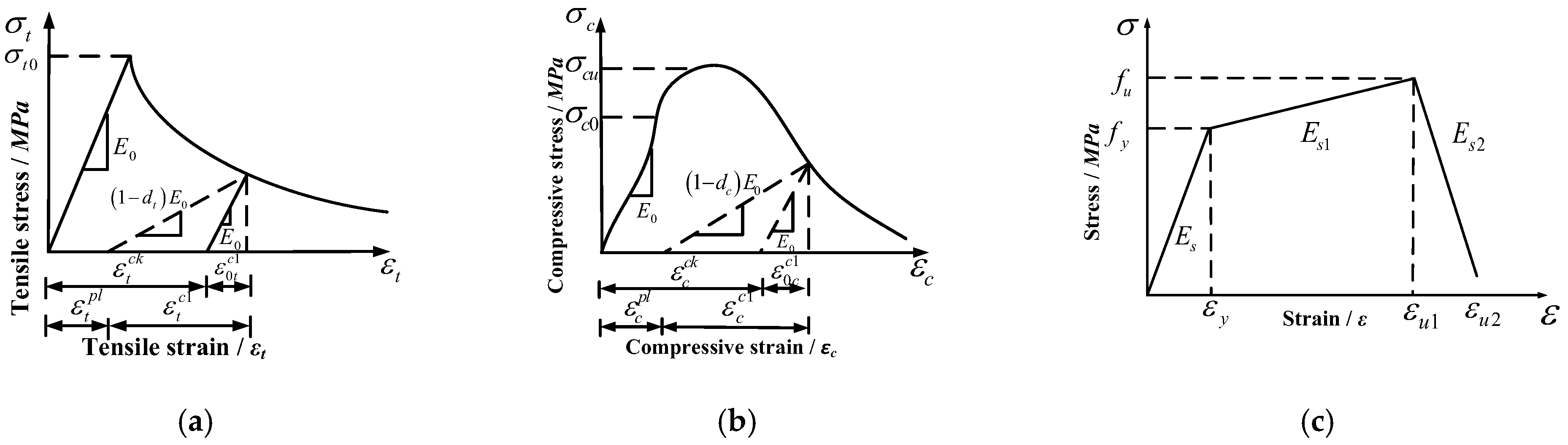
2.1. Materials and Methods
2.2. Element Types
2.3. Finite Element Model Meshing
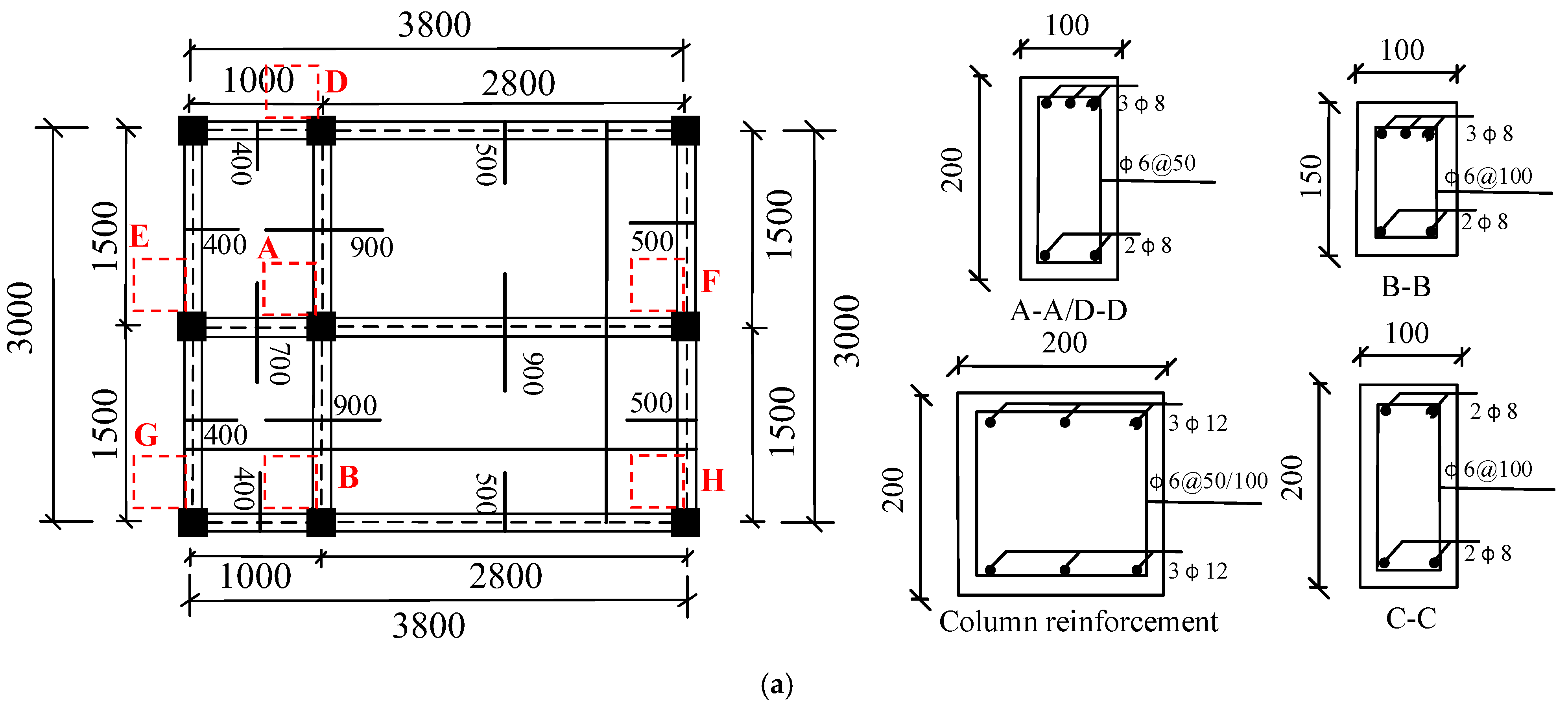
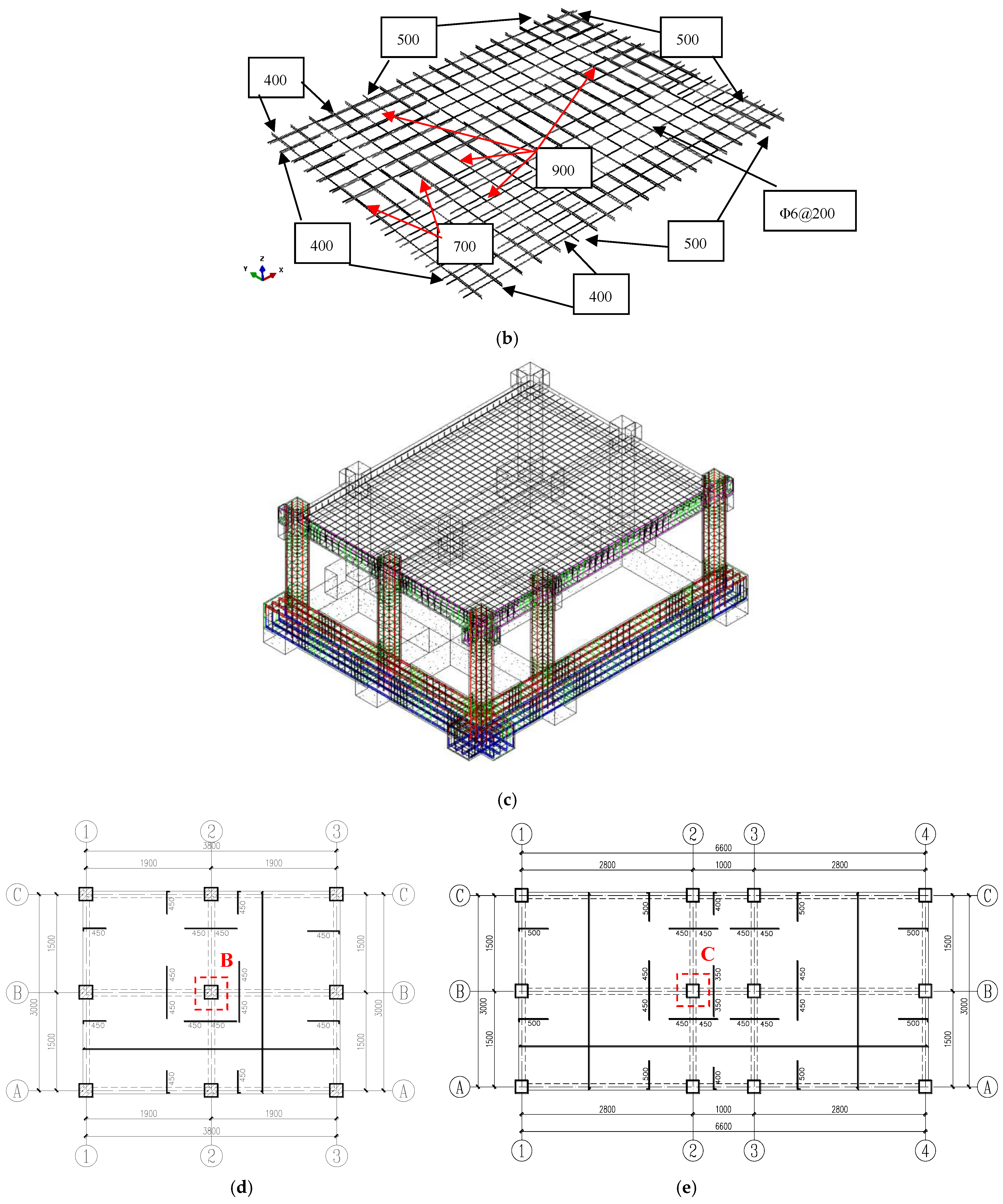
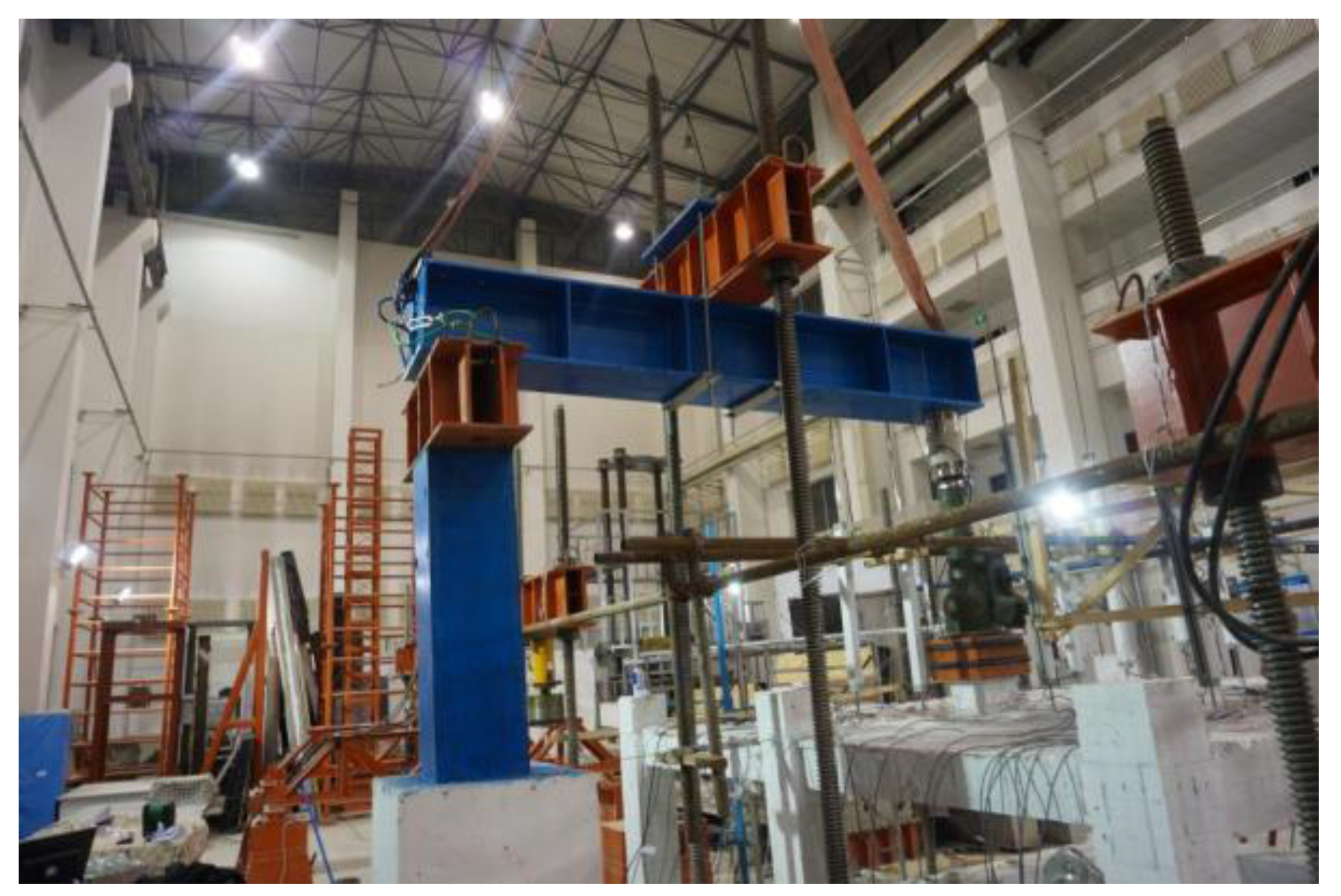
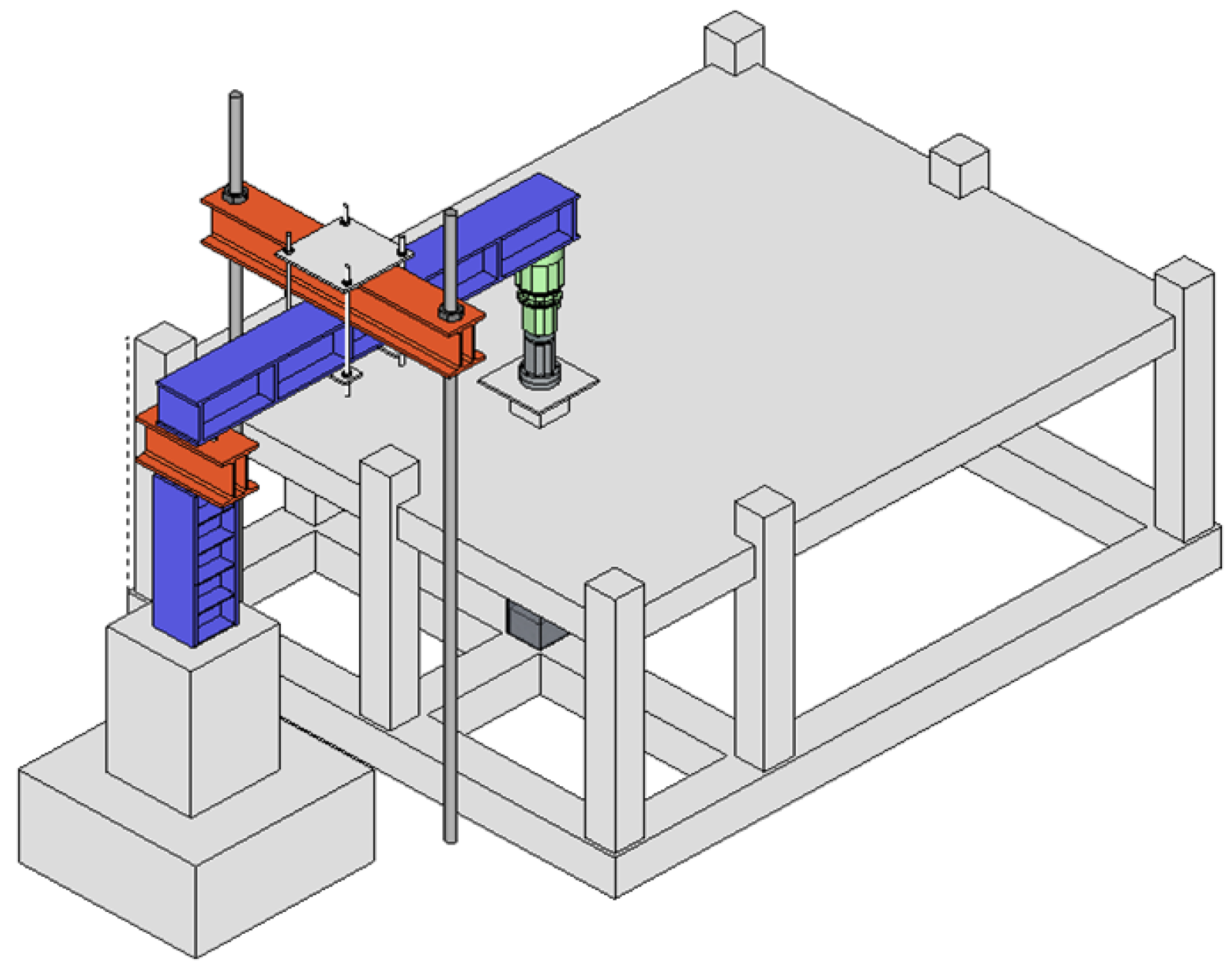
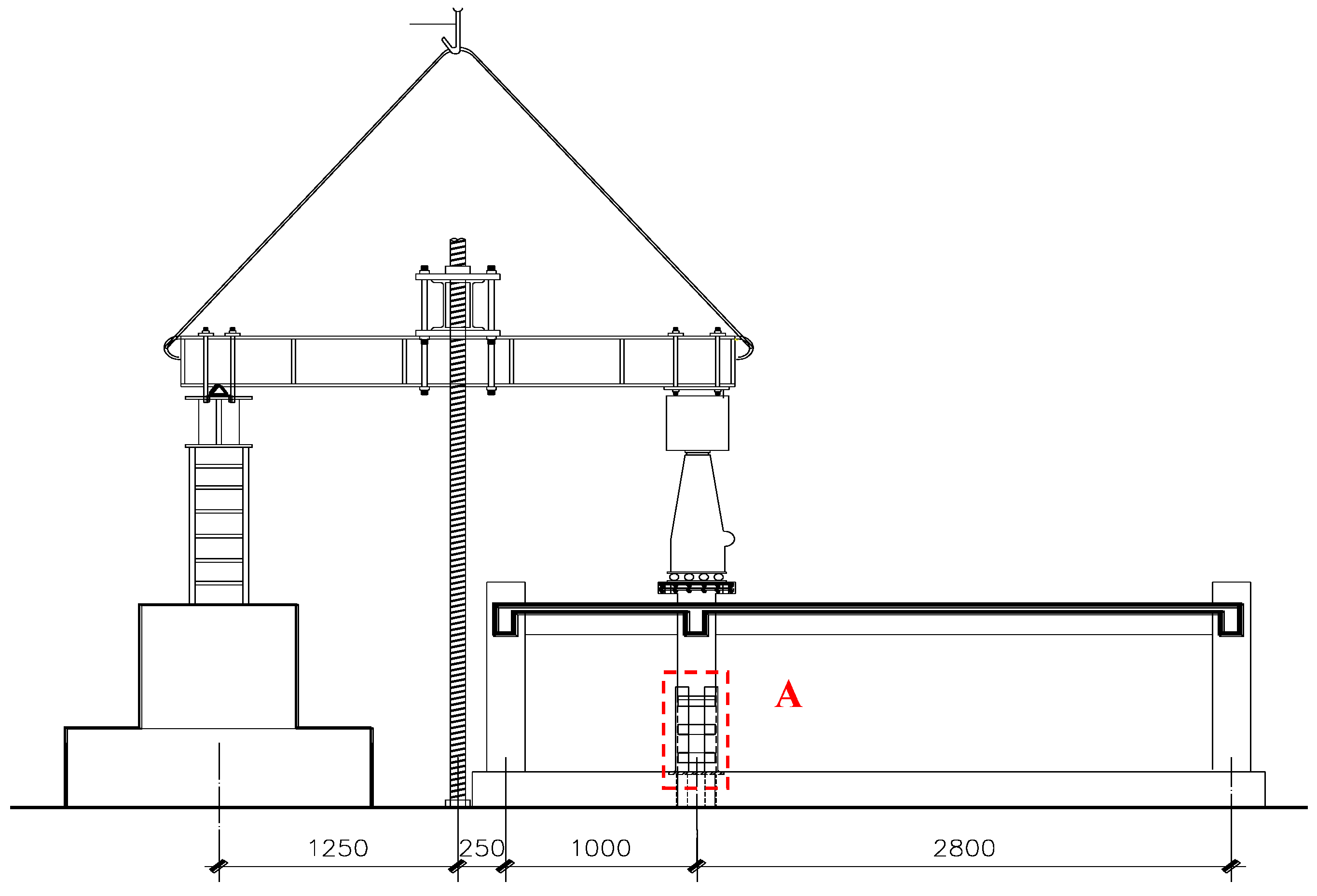
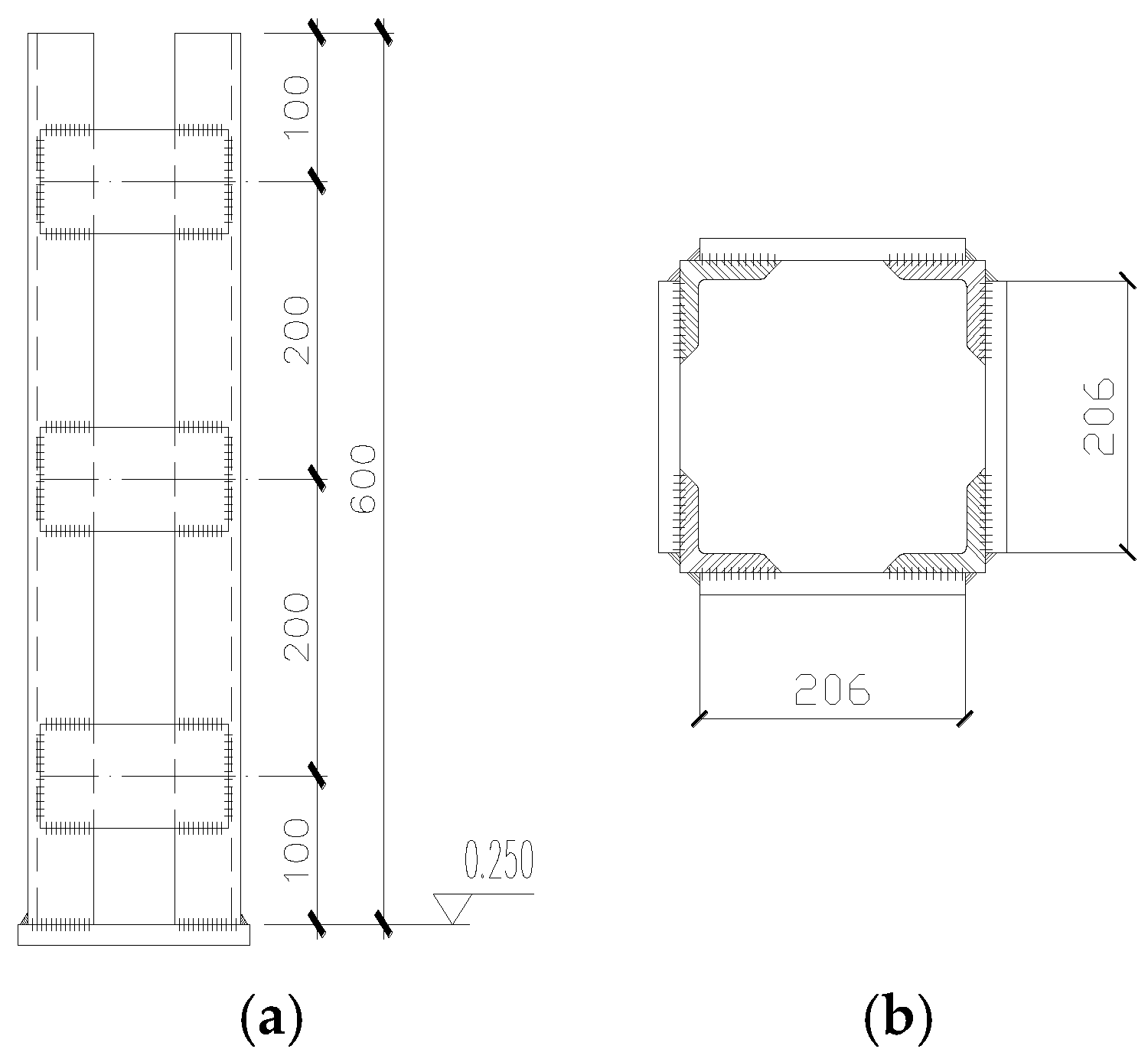
2.4. Trial Overview
2.5. Boundary Conditions and Loading Methods
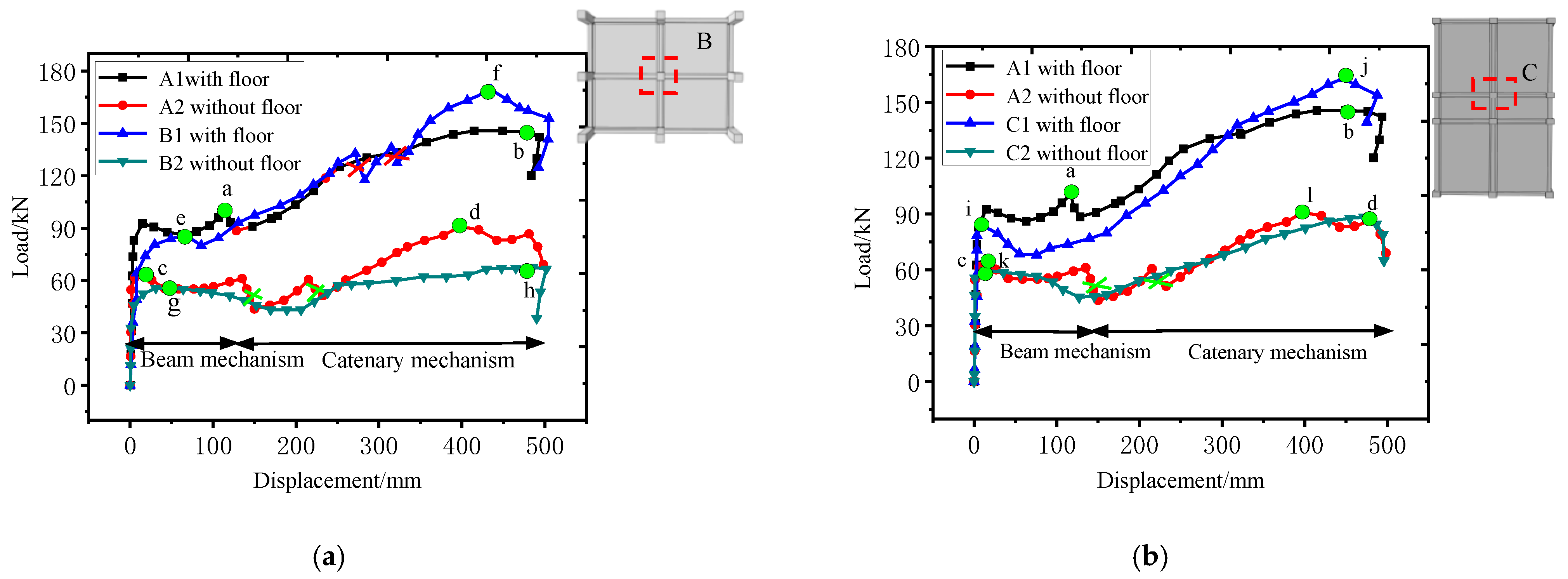
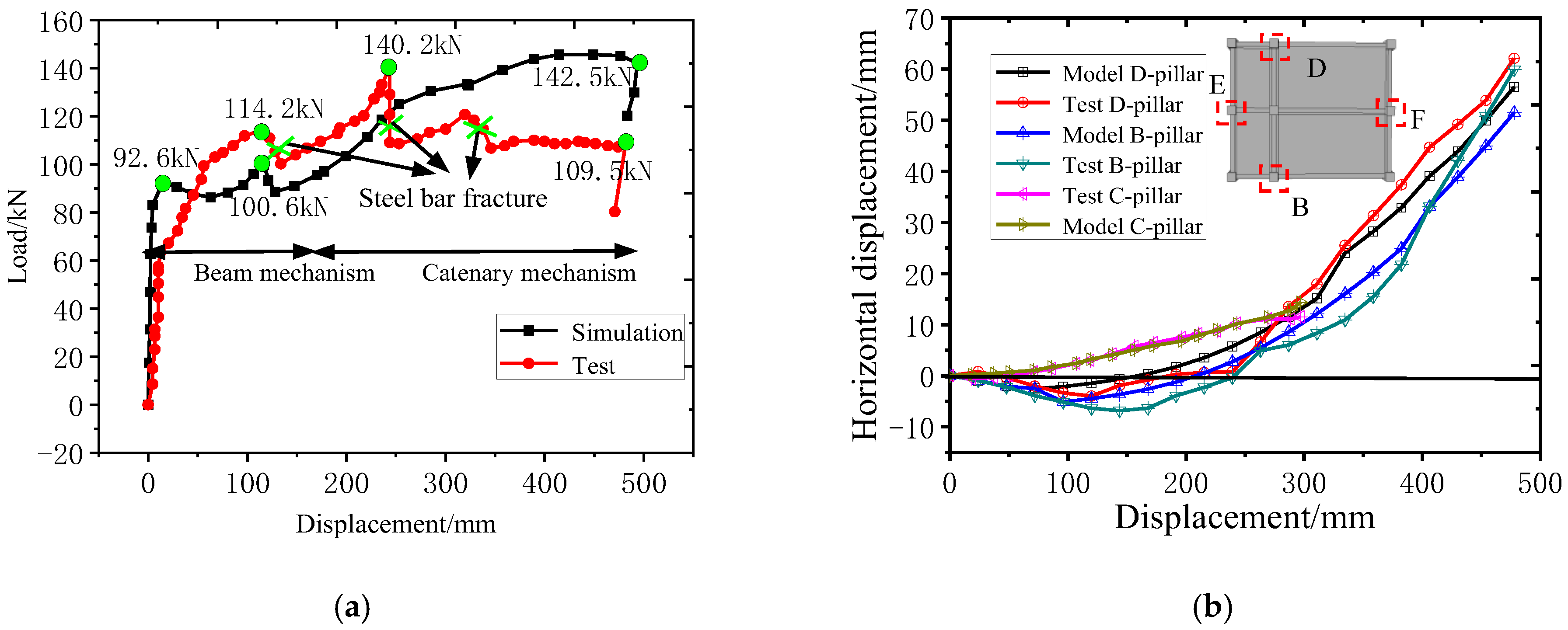
2.6. Load–Displacement Curve and Column Horizontal Displacement
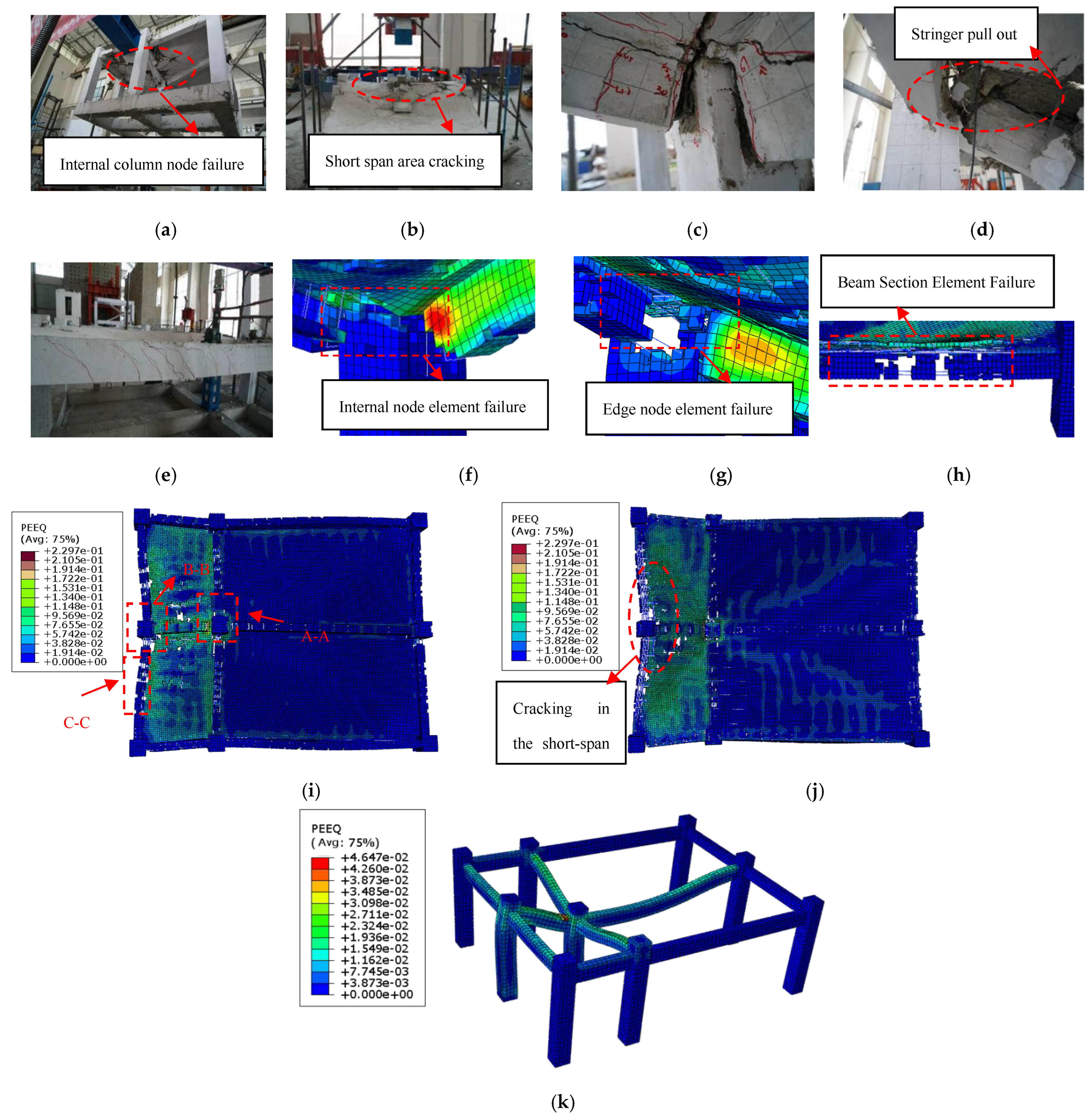
2.7. Failure Mode Comparison
3. Factors Affecting Vertical Collapse
3.1. Unequal Span Layout
3.2. Failure Location of the Key Columns and Beam Span
3.3. Floor Parameters
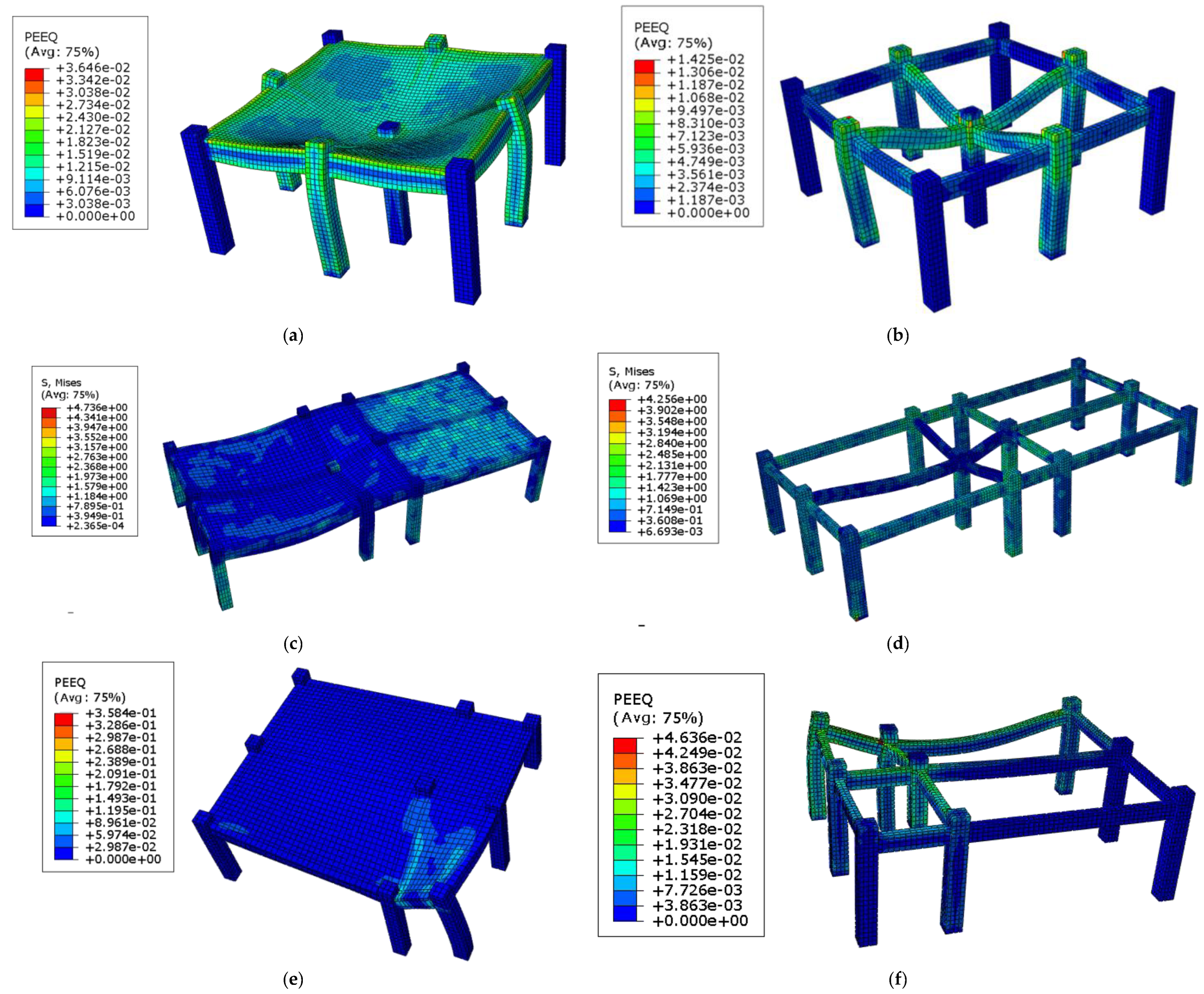
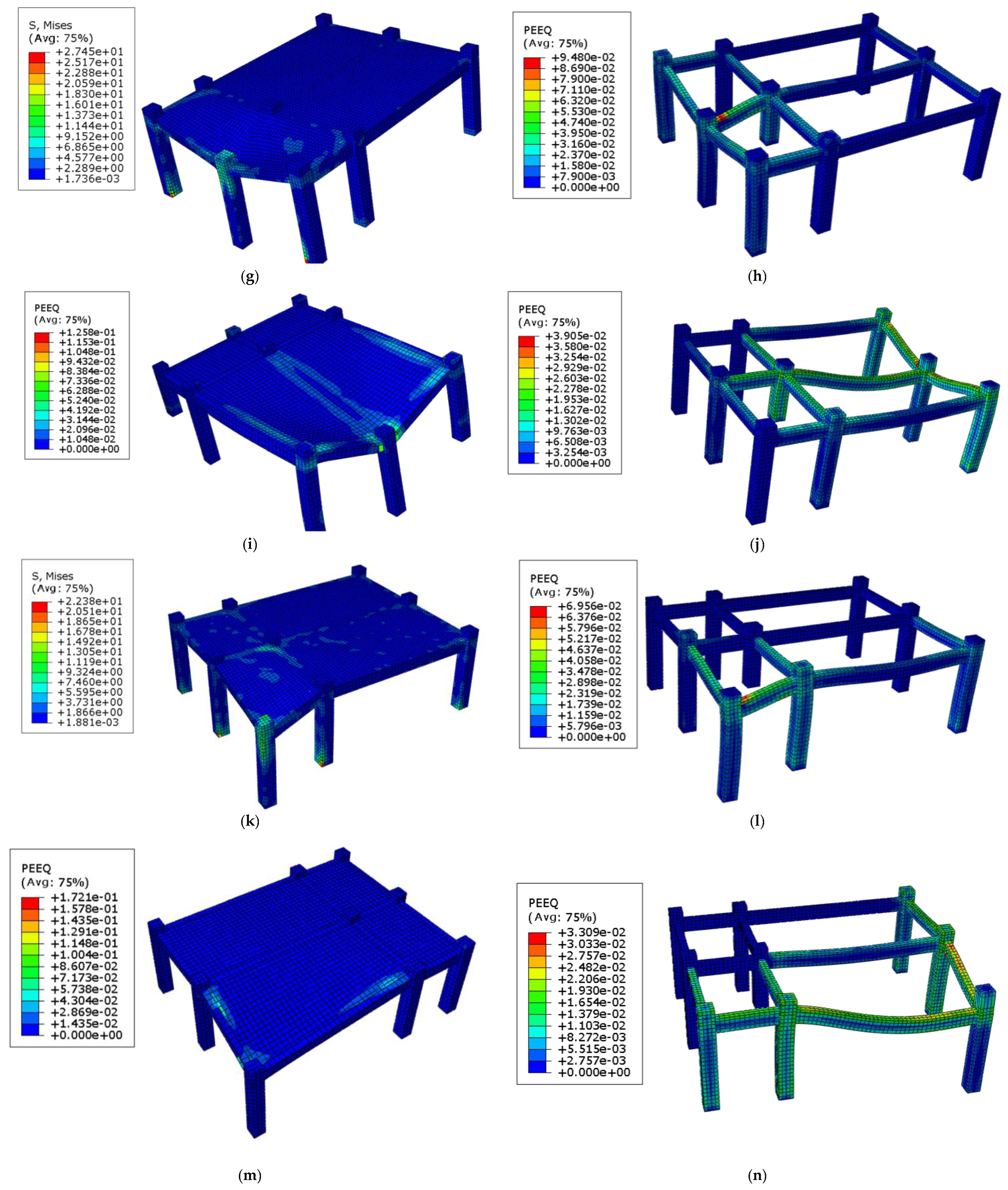
3.4. Floor Damage Mechanism
4. Analysis of Internal Forces in Key Sections
4.1. Beam–Slab Section Stress Analysis
4.2. Beam Axial Force Analysis
5. Discussion
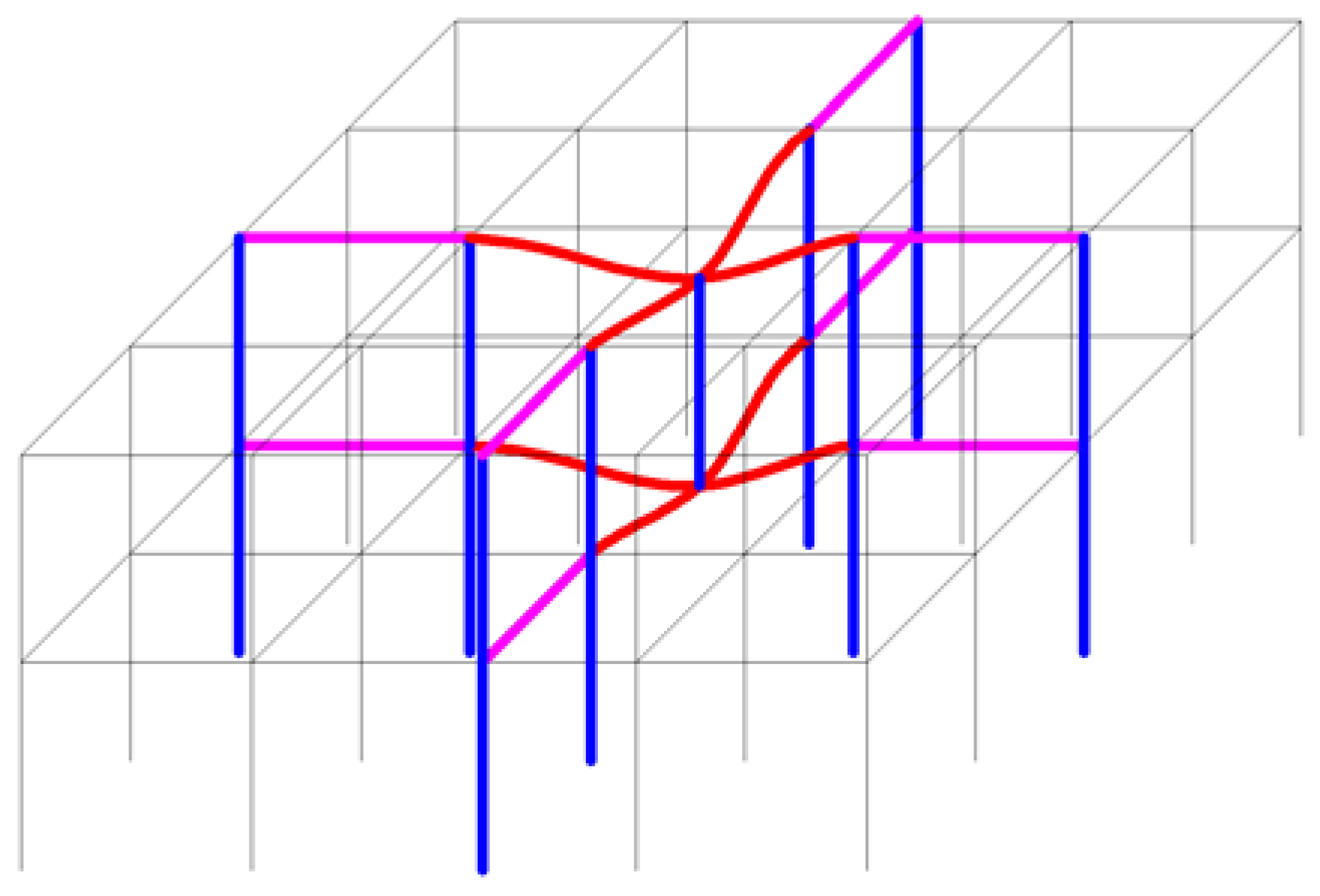
5.1. Mechanism of Progressive Collapse in Unequal-Span Structures
5.2. Mechanism of Progressive Collapse in Equal-Span Structures
5.3. Comparison of Progressive Collapse Between Equal-Span and Unequal-Span Structures
6. Theoretical Analysis
6.1. Analysis of the Beam Resistance at the Large Deformation Stage
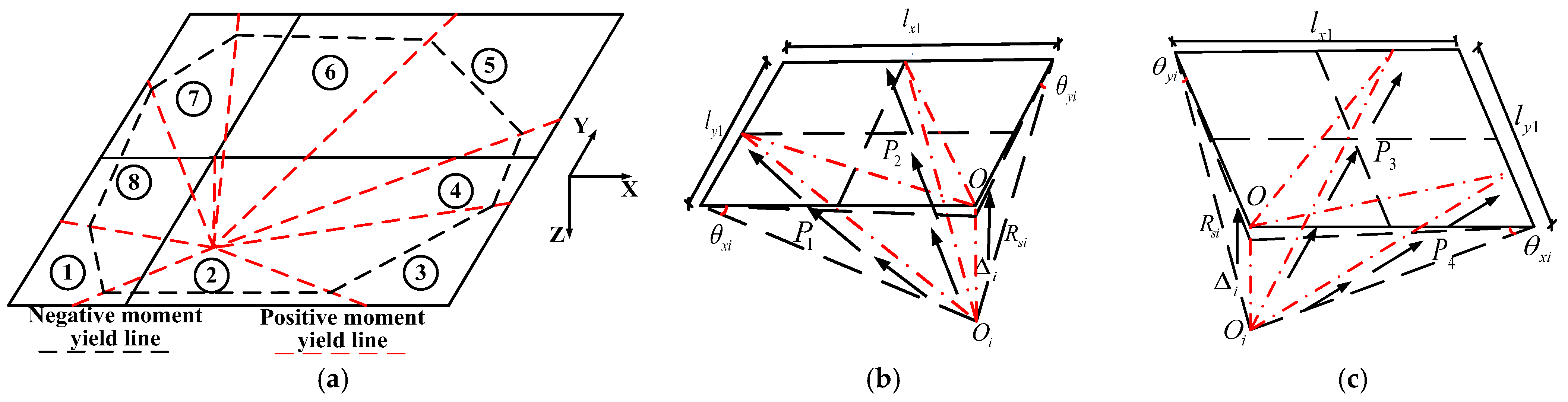
6.2. Analysis of Floor Resistance at the Large Deformation Stage
7. Conclusions
- (1)
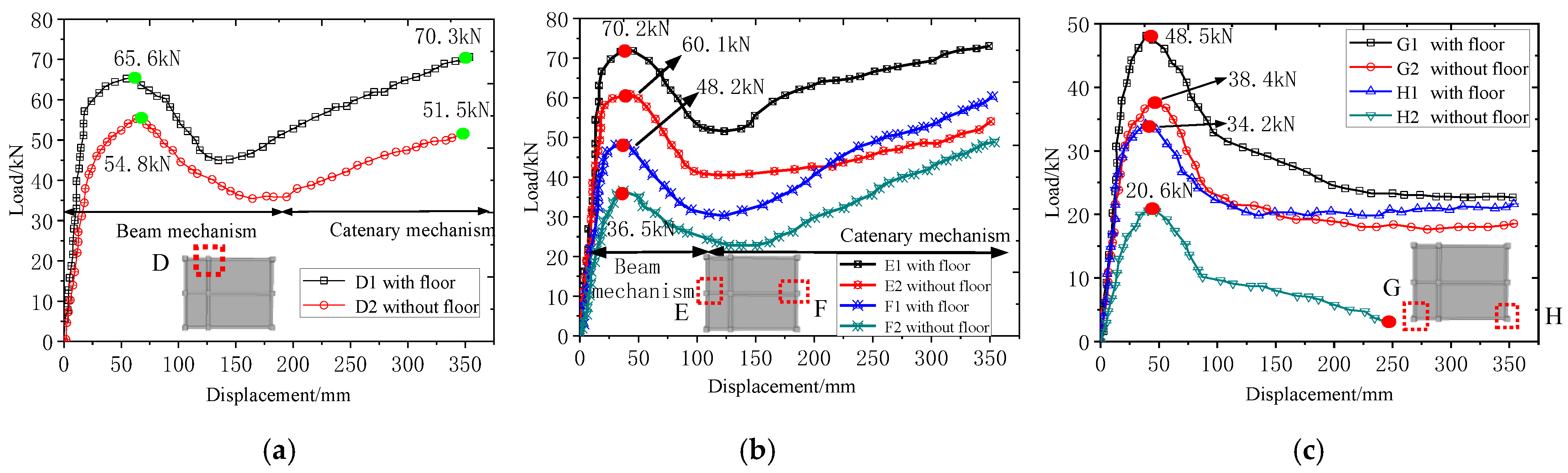
- Under an internal column removal scenario, the progressive collapse resistance is significantly influenced by span layout. With floor slabs present, the equal-span structure benefits from slab reinforcement collaboration, achieving a catenary-stage capacity of 169.1 kN, which exceeds the 145.2 kN of the external corridor unequal-span structure. Without slabs, the unequal-span structure exhibits a capacity of 90.9 kN due to short-span stress concentration, surpassing the equal-span structure by 23.3 kN. The internal corridor unequal-span structure reaches 162.6 kN but is prone to asymmetric failure and severe long-span damage caused by uneven lateral restraints. Although the equal-span structure shows a delayed load-resisting response, its overall performance is superior and its failure mode more coordinated.
- (2)
- The collapse resistance varies markedly with the location of the failed column. For side column failure, the floor slab substantially enhances load capacity; a longer span connected to the failed column induces greater internal forces and thus a lower overall capacity. After corner column removal, no catenary action develops, and the load capacity experiences no secondary increase. Corner column failure adjacent to a long span yields the lowest capacity and the most rapid strength loss.
- (3)
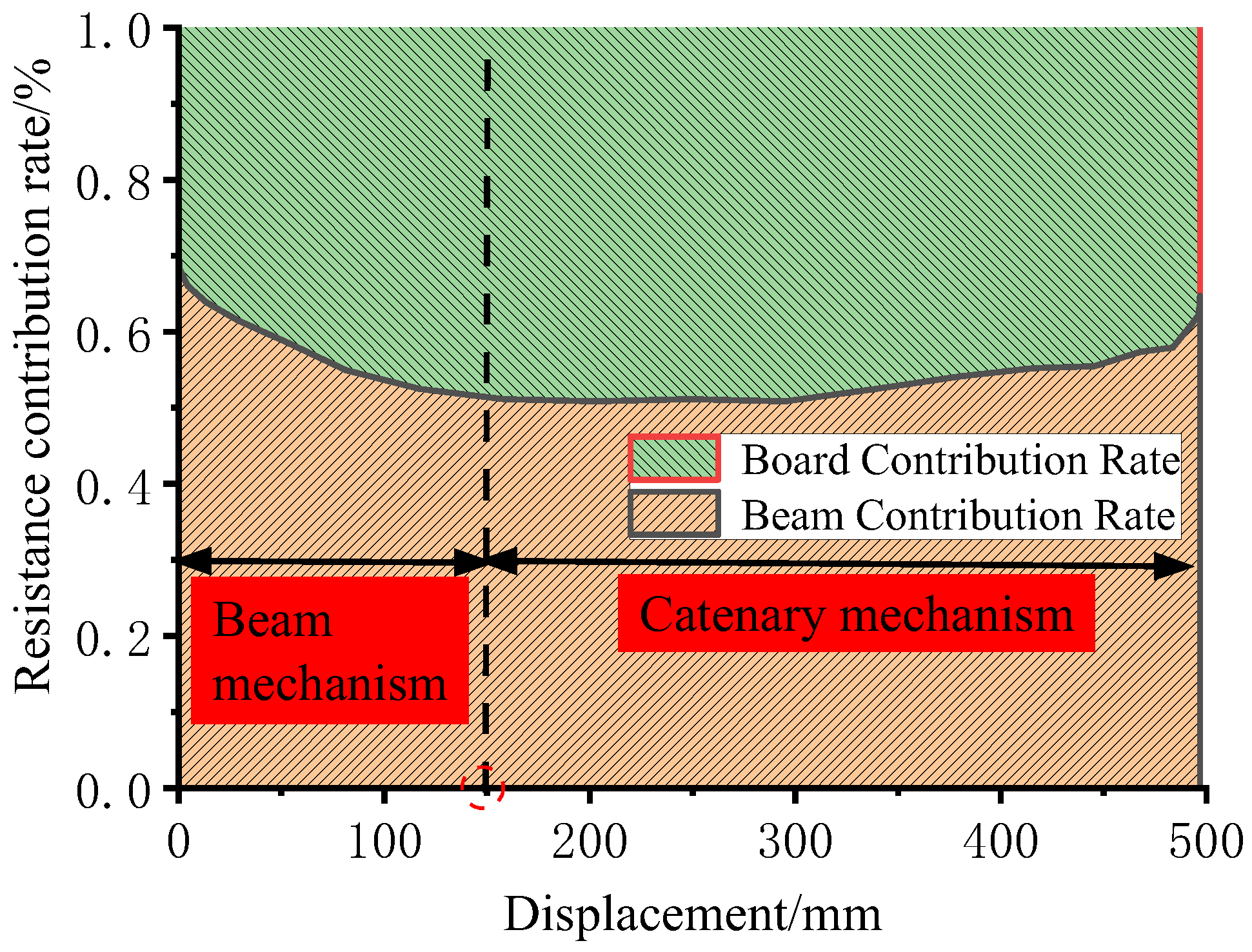
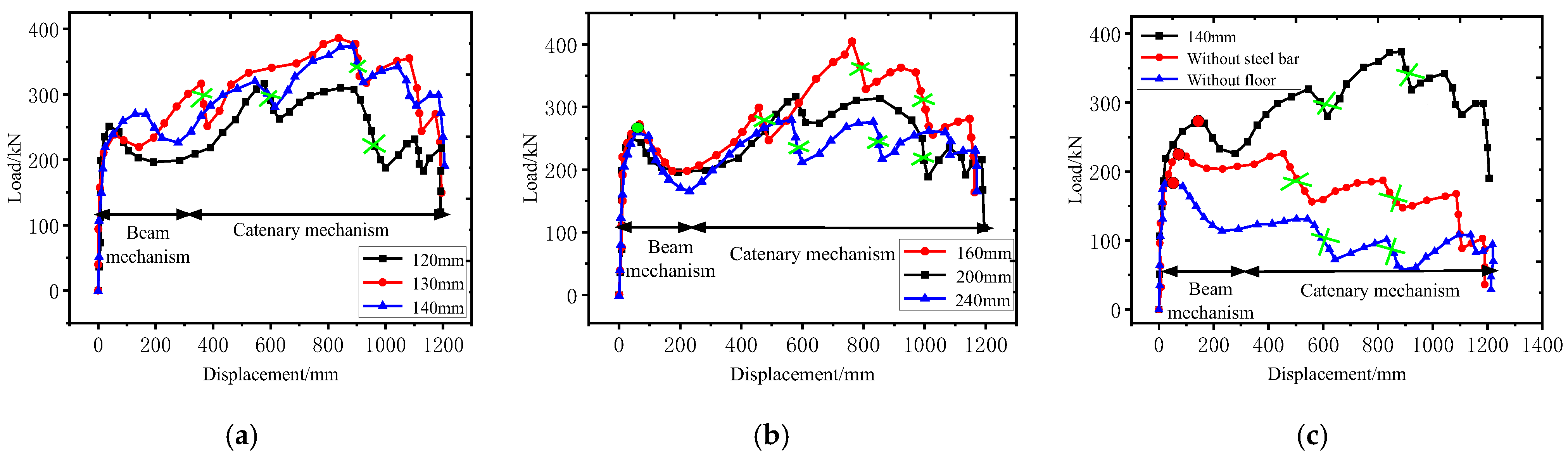
- Increasing slab thickness from 120 mm to 130 mm raises the load capacity by 15–20%, attributed to a thicker concrete cover delaying flange crushing. Further increase to 140 mm gives a saturated capacity enhancement, while the added self-weight introduces a punching shear risk. The reinforcement ratio primarily affects resistance at large deformations: reducing bottom rebar spacing to 160 mm increases post-peak capacity by 20–30%, whereas increasing spacing to 240 mm reduces it by 10–20%. During the beam mechanism stage, slab-beam composite action boosts capacity by 100–130%, and slab reinforcement provides critical tensile action in the catenary stage.
- (4)
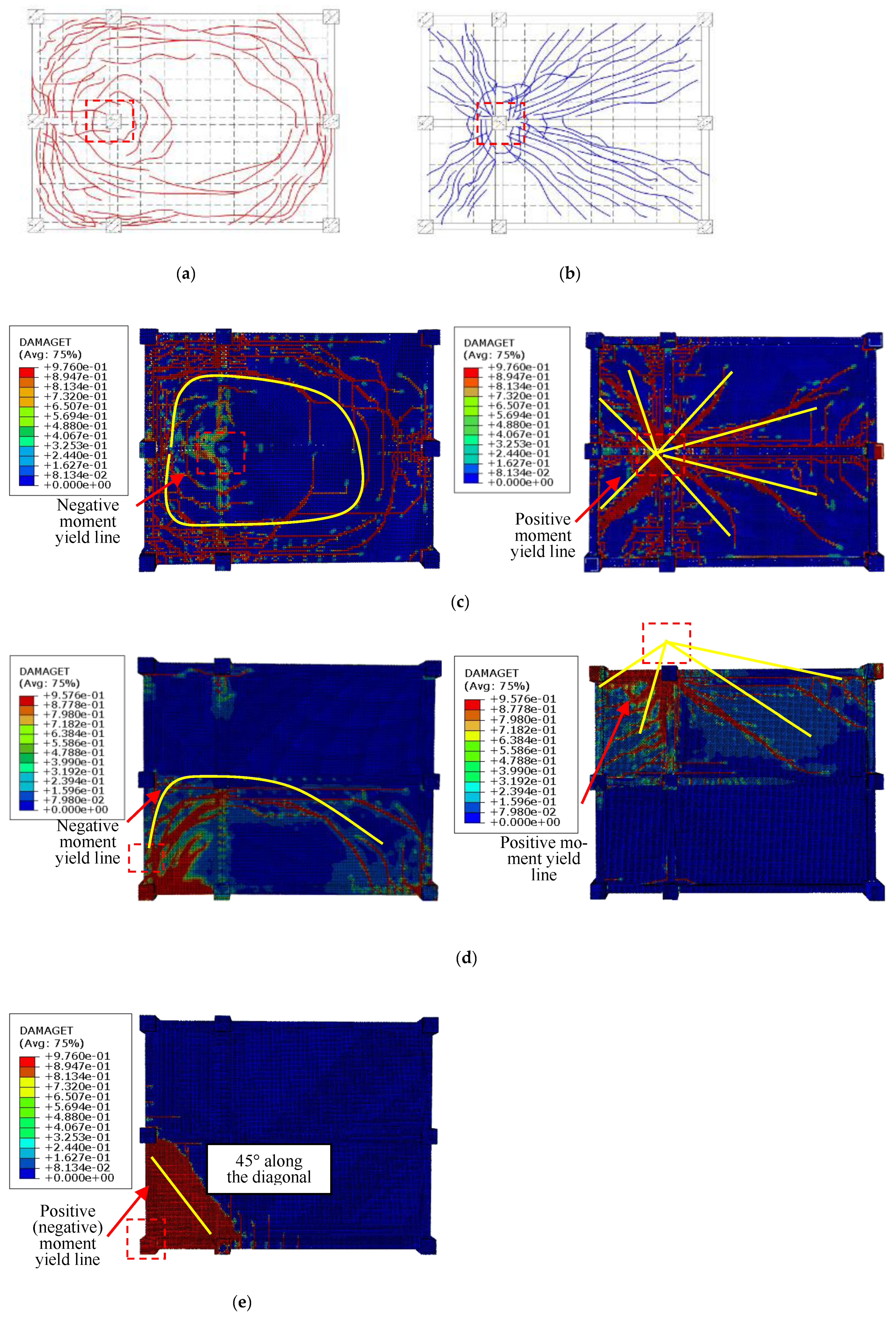
- Damage patterns in the slab vary systematically with column failure location. Internal column failure creates an annular stress zone on the slab top; side column failure produces a quarter-elliptical pattern; corner column failure induces damage propagating along a 45° diagonal. Early slab damage characteristics effectively predict subsequent crack propagation.
- (5)
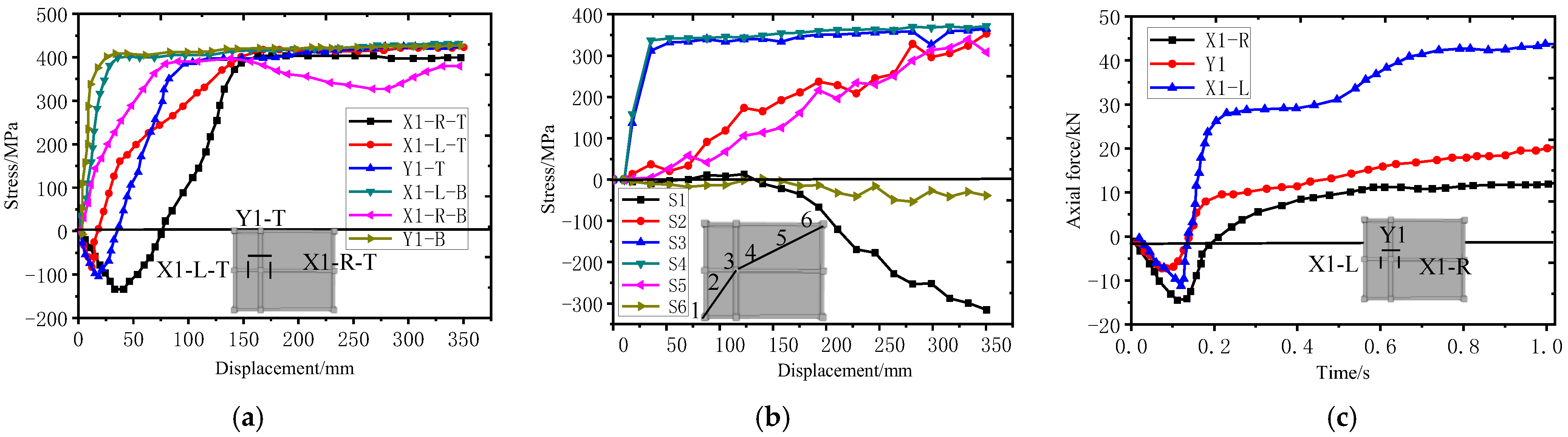
- Stresses in beam and slab reinforcement show distinct spatial distributions during progressive collapse. Top beam reinforcement transitions from initial compression to tension, reflecting the shift from compressive arch action to a catenary mechanism, while bottom reinforcement yields early in tension. Slab reinforcement stress becomes more pronounced near the failed column. The beam span-to-depth ratio is a critical factor influencing axial force, with smaller ratios generating larger axial forces during collapse.
- (6)
- Future research on unequal-span frames should focus on the spatial composite action of floor slabs and the full-range evolution of resistance mechanisms. Through refined modeling and parametric analysis, a quantitative theoretical model for the slab contribution should be established, along with a progressive collapse assessment framework applicable to complex structural configurations.
- (7)
- In design, priority should be given to protecting corner columns adjacent to long spans, as their failure produces the lowest capacity and fastest strength degradation. Differentiated detailing measures should be adopted for side columns and corner columns based on their distinct failure characteristics.
- (8)
- Slab thickness should not be increased blindly beyond 130 mm to avoid punching shear risk. A bottom rebar spacing of approximately 160 mm is recommended to enhance post-peak ductility. Slabs should be designed as two-way systems to fully mobilize their tensile membrane action.
- (9)
- For unequal-span structures, the proposed assessment framework should be used to improve existing anti-collapse design methods, with special attention to the asymmetric failure mode of long spans caused by uneven lateral restraints.
Author Contributions
Funding
Data Availability Statement
Conflicts of Interest
References
- CECS392-2014; Code for Design of Anti-Collapse of Building Structures. China Planning Press: Beijing, China, 2015.
- DOD2010; Design of Buildings to Resist Progressive Collapse. Department of Defense: Washington, DC, USA, 2010.
- Cheng, W. Disaster Memory and Place Identity Toward the Yingxiu Epicenter Memorial Site of the Wenchuan Earthquake of 2008. Ph.D. Thesis, Chengdu University of Technology, Chengdu, China, 2023. [Google Scholar]
- Li, Z.; Xue, T.; Yuan, X.; Zhang, Y.; Qian, K. Load resisting mechanism of RC spatial beam-column substructures with unequal spans in the loss of a corner column scenario. J. Vib. Shock 2023, 42, 115–125+179. [Google Scholar]
- Li, Z.; Huang, X.H.; Ji, F.Q.; Zhong, Y.; Deng, X.F. Research on dynamic response analysis and evaluation method of resistance to progressive collapse of reinforced concrete frame structures at high temperatures. J. Vib. Shock 2025, 44, 298–307. [Google Scholar]
- Gan, Y.; Yu, J.; Chen, J.; Shen, J. Study on Analytical Model and Robustness Ranking Index of RC Frames With Unequal Spans Against Progressive Collapse. Eng. Mech. 2022, 39, 210–222. [Google Scholar]
- Wang, Z.; Yu, Q.H.; Li, X.W.; Cheng, X.J.; Wu, B. Efficient Analysis Method For The Entire Progressive Collapse Process of RC Frame Structures Based on Opensees. J. Vib. Shock 2025, 44, 132–140. [Google Scholar]
- Deng, X.F.; Lan, D.Q.; Jin, L.; Du, X.L. Study on Progressive Collapse Behavor of RC Frame Under a Penultimate Column Removal Scenario. Eng. Mech. 2024, 41, 12–23. [Google Scholar]
- Huang, Y.Z.; Liang, Z.H.; Wang, S.N.; Xue, X.G.; Li, Y. Influences of Primary Design Parameters on Progressive Collapse Resistance of Regular RC Frame Structures. Eng. Mech. 2023, 40, 184–190. [Google Scholar]
- Xiong, J.G.; Li, Z.C.; Hu, S.J.; Wang, Y.C.; Lan, Q.Y. Experimental research on anti-progressive collapse performance of beam-column substructure in prefabricated RCS composite frame. J. Build. Struct. 2021, 42, 22–30. [Google Scholar]
- Chen, Z.F.; Lin, K.Q.; Lu, X.Z.; Li, Y. Uncertainty Analysis on Progressive Collapse Resistance of RC Beam-Column Substructures. Eng. Mech. 2021, 38, 72–80+90. [Google Scholar]
- Huang, Y.; Hong, L.; Yi, W. Analysis on Compressive Membrane Mechanism Based Progressive Collapse Bearing Capacity of RC Frame Considering Floor Slab Action. J. Hunan Univ. (Nat. Sci.) 2021, 48, 10–18. [Google Scholar]
- Du, K.; Teng, N.; Yan, D.; Sun, J. Experimental Study on the Effect of Floor Slab on the Progressive Collapse Resistance of RC Spatial Frame Structure. China Civ. Eng. J. 2019, 52, 14–23. [Google Scholar]
- Yu, J.; Luo, L.; Li, Y. Numerical Study of Progressive Collapse Resistance of RC Beam-Slab Substructures under Perimeter Column Removal Scenarios. Eng. Struct. 2018, 159, 14–27. [Google Scholar] [CrossRef] [Scilit]
- Qian, K.; Li, Z.; Weng, Y.; Deng, X. Behavior of RC Beam-Slab Sub-Structures to Resist Progressive Collapse. Eng. Mech. 2019, 36, 239–247. [Google Scholar]
- Qian, K.; Luo, D.; He, S.; Li, Z.; Weng, Y.H. Progressive Collapse Performance of Reinforced Concrete Frame Structures Subjected to Ground Two-Column Removal Scenario. J. Build. Struct. 2018, 39, 61–68. [Google Scholar]
- Xiao, Y.; Li, Y.; Lu, X.; Ren, P.; He, H. Experimental Study on the Dynamic Effects in Progressive Collapse of Beam-Column Concrete Substructures. Eng. Mech. 2019, 36, 44–52. [Google Scholar]
- Sagiroglu, S.; Sasani, M. Progressive Collapse-Resisting Mechanisms of Reinforced Concrete Structures and Effects of Initial Damage Locations. J. Struct. Eng. 2014, 140, 04013073. [Google Scholar] [CrossRef] [Scilit]
- Sasani, M.; Werner, A.; Kazemi, A. Bar fracture modeling in progressive collapse analysis of reinforced concrete structures. Eng. Struct. 2011, 33, 401–409. [Google Scholar] [CrossRef] [Scilit]
- Choi, H.; Kim, J. Progressive collapse-resisting capacity of RC beam–column sub-assemblage. Mag. Concr. Res. 2011, 63, 297–310. [Google Scholar] [CrossRef] [Scilit]
- Orton, S.L. Development of a CFRP System to Provide Continuity in Existing Reinforced Concrete Buildings Vulnerable to Progressive Collapse. Ph.D. Thesis, The University of Texas at Austin, Austin, TX, USA, 2007. [Google Scholar]
- Galal, M.A.; Bandyopadhyay, M.; Banik, A.K. Dual effect of axial tension force developed in catenary action during progressive collapse of 3D composite semi-rigid jointed frames. Structures 2019, 19, 507–519. [Google Scholar] [CrossRef] [Scilit]
- Tohidi, M.; Baniotopoulos, C. Effect of floor joint design on catenary actions of precast floor slab system. Eng. Struct. 2017, 152, 274–288. [Google Scholar] [CrossRef] [Scilit]
- Ling, L.; Wei, W.; Teh, L.H.; Chen, Y. Effects of span-to-depth ratios on moment connection damage evolution under catenary action. J. Constr. Steel Res. 2017, 139, 18–29. [Google Scholar]
- GB 50010-2010; Code for Design of Concrete Structures. China Architecture & Building Press: Beijing, China, 2015.
- Teng, N. Study on Progressive Collapse Resistance of RC Frame Structure Considering Catenary Mechanism. Ph.D. Thesis, Institute of Engineering Mechanics, China Earthquake Administration, Harbin, China, 2018. [Google Scholar]
- Liu, W.; Qian, C.; Han, S. Analyzing and Dealing with the Collapse Resistance of the Reinforced Concrete Frame after the Frame Column Failure. Earthq. Resist. Eng. Retrofit. 2018, 44, 95–101. [Google Scholar]
- Qiao, H.; Yang, Y.; Zhong, W. Progressive Collapse Analysis and Mechanism Study for Multistory Frame Structures with Middle-Column Demolition. J. Vib. Shock 2018, 37, 136–143. [Google Scholar]
- Xie, Y.; Jia, L. Calculation Method and Experimental Study on Ultimate Displacement of Reinforced Concrete Column. Build. Struct. 2014, 44, 66–70. [Google Scholar]
- Qian, K.; Li, B.; Ma, J.X. Load-carrying mechanism to resist progressive collapse of RC buildings. J. Struct. Eng. 2015, 141, 04014164. [Google Scholar] [CrossRef] [Scilit]
- Pham, A.T.; Tan, K.H. Analytical Model for Tensile Membrane Action in RC Beam-Slab Structures under Internal Column Removal. J. Struct. Eng. 2019, 145, 04018259. [Google Scholar] [CrossRef] [Scilit]
- Zhang, Q.; Li, Y. Experimental and modeling study on the progressive collapse resistance of a reinforced concrete frame structure under a middle column removal scenario. Struct. Des. Tall Spec. Build. 2020, 29, e1693. [Google Scholar] [CrossRef] [Scilit]
- Du, K.; Bai, J.; Teng, N.; Yan, D.; Chen, H.; Sun, J. Progressive-collapse test of slab effects on reinforced concrete spatial frame substructures. Mag. Concr. Res. 2021, 73, 1081–1099. [Google Scholar] [CrossRef] [Scilit]
- Du, K.; Bai, J.; Teng, N.; Yan, D.; Sun, J. Experimental investigation of asymmetrical reinforced concrete spatial frame substructures against progressive collapse under different column removal scenarios. Struct. Des. Tall Spec. Build. 2020, 29, e16711. [Google Scholar] [CrossRef] [Scilit]
- Wang, J.-L.; Zou, Y.; Liu, H.; Wu, Y.; Li, Z.; Xue, T.-Q. Dynamic Response Analysis of Infilled RC Frames with Openings Under Instantaneous Column Removal Scenarios. Buildings 2025, 15, 3778. [Google Scholar] [CrossRef] [Scilit]
- Shao, G.-D.; Xiao, C.; Zhu, M.-X.; Hassan, F.S.; Ma, C.-S.; Zhang, S.-Y.; Tian, L. Seismic Performance and Collapse Fragility of a 765 kV Transmission Tower–Line System. Buildings 2025, 15, 4206. [Google Scholar] [CrossRef] [Scilit]
- Kılıçer, S.; Kılıçer, S.T. Progressive-Collapse Robustness Assessment of Existing Reinforced Concrete Buildings in Diverse Geographical Regions Using the Tie-Force Method. Buildings 2026, 16, 1090. [Google Scholar] [CrossRef] [Scilit]
- Qu, T.; Zeng, B.; Zhou, Z.; Huang, L. Failure mode discrimination and theoretical prediction method for unequal span bonded prestressed concrete substructures against progressive collapse. Eng. Fail. Anal. 2024, 156, 107470. [Google Scholar] [CrossRef] [Scilit]
- Wang, C.C.; Kong, K.H.; Poh, L.H. Collapse behavior of asymmetrical cast-in and precast concrete subassemblages under internal column loss scenarios. Structures 2026, 85, 107839. [Google Scholar] [CrossRef] [Scilit]
- Qu, T.; Zeng, B.; Zhou, Z.; Huang, L. Experimental investigation of progressive collapse resistance of bonded local prestressed concrete frame substructures. Eng. Struct. 2025, 323, 119232. [Google Scholar] [CrossRef] [Scilit]
- Qu, T.; Zeng, B.; Zhou, Z.; Huang, L. Progressive collapse resistance of local prestressed concrete sub-structures: Numerical analysis and theoretical verification. J. Build. Eng. 2024, 90, 109430. [Google Scholar] [CrossRef] [Scilit]
- Chen, G.S.; Cheng, X.W.; Diao, M.Z. Progressive collapse resistance of one-way wet-connected precast concrete beam-slab-column substructures: Experimental and numerical investigations. Eng. Struct. 2025, 344, 122468. [Google Scholar] [CrossRef] [Scilit]
- Qu, T.; Zeng, B.; Zhou, Z. Dynamic and uncertainty-based assessment of the progressive collapse probability of prestressed concrete frame structures with infill walls. Structures 2024, 61, 106105. [Google Scholar] [CrossRef] [Scilit]
- Liu, Y.; Cheng, X.; Diao, M.; Li, Y.; Zhang, Y. Explicit analytical method for compressive arch action in full-scale reinforced concrete continuous beams: Validation and improvement of existing models. Eng. Struct. 2025, 339, 120606. [Google Scholar] [CrossRef] [Scilit]









| Poisson’s Ratio | Expansion Angle | Eccentricity | K | Viscosity Coefficient | |
|---|---|---|---|---|---|
| 0.2 | 30 | 0.1 | 1.16 | 0.667 | 0.005 |
| Steel Bar Diameter | Yield Strength/MPa | Ultimate Strength/MPa | Elastic Modulus/GPa | Elongation/% |
|---|---|---|---|---|
| Φ6 | 340.1 | 491.9 | 206 | 17.4 |
| Φ8 | 420.4 | 572.0 | 207 | 29.0 |
| Φ12 | 430.3 | 578.7 | 208 | 25.1 |
| Working Conditions | Plate Thickness/mm | X-Axis Beam Top | X-Axis Beam Bottom | Y-Axis Beam Top | Y-Axis Beam Bottom | ||
|---|---|---|---|---|---|---|---|
| End | Cross | End | Cross | ||||
| S1 | 40 | 3Φ8 | 2Φ8 | 2Φ8 | 3Φ8 | 2Φ8 | 2Φ8 |
| Serial Number | References | Specimen Mark | Slabless/Slab-on-Frame | Test Value/kN | Theoretical Value/kN | Deviation % |
|---|---|---|---|---|---|---|
| 1 | [13] | B1 | Slabless frame | 85 | 77.7 | 9.3 |
| 2 | [13] | S1 | Slab-on-frame | 140 | 131.7 | 6.3 |
| 3 | [30] | Specimen S1 | Slab-on-frame | 169 | 159 | 6.3 |
| 4 | [30] | Specimen S2 | Slab-on-frame | 165 | 179 | 7.8 |
| 5 | [31] | S1 | Slab-on-frame | 121.3 | 111.2 | 9.1 |
| 6 | [31] | S2 | Slab-on-frame | 125.3 | 113.9 | 10 |
| 7 | [32] | FRAME-1 | Slabless frame | 43.6 | 48.1 | 9.3 |
| 8 | [32] | FRAME-2 | Slab-on-frame | 91.4 | 87.2 | 4.8 |
| 9 | [33] | S2 | Slab-on-frame | 123 | 131.2 | 6.3 |
| 10 | [34] | EXT-X | Slab-on-frame | 115 | 123.1 | 6.6 |
| 11 | [34] | EXT-Y | Slabless frame | 94 | 89 | 5.6 |
| 12 | [34] | COR-L | Slabless frame | 37 | 34.2 | 8.2 |
Disclaimer/Publisher’s Note: The statements, opinions and data contained in all publications are solely those of the individual author(s) and contributor(s) and not of MDPI and/or the editor(s). MDPI and/or the editor(s) disclaim responsibility for any injury to people or property resulting from any ideas, methods, instructions or products referred to in the content. |
© 2026 by the authors. Licensee MDPI, Basel, Switzerland. This article is an open access article distributed under the terms and conditions of the Creative Commons Attribution (CC BY) license.
Share and Cite
Zhang, Y.; Ding, G.; Rong, M.; Wang, C.; Mu, C. The Numerical Study of the Vertical Collapse Capacity of Reinforced Concrete Spatial Beam–Slab Structures with Unequal Spans. Buildings 2026, 16, 1718. https://doi.org/10.3390/buildings16091718
Zhang Y, Ding G, Rong M, Wang C, Mu C. The Numerical Study of the Vertical Collapse Capacity of Reinforced Concrete Spatial Beam–Slab Structures with Unequal Spans. Buildings. 2026; 16(9):1718. https://doi.org/10.3390/buildings16091718
Chicago/Turabian StyleZhang, Youjia, Gang Ding, Mianshui Rong, Chong Wang, and Chendong Mu. 2026. "The Numerical Study of the Vertical Collapse Capacity of Reinforced Concrete Spatial Beam–Slab Structures with Unequal Spans" Buildings 16, no. 9: 1718. https://doi.org/10.3390/buildings16091718
APA StyleZhang, Y., Ding, G., Rong, M., Wang, C., & Mu, C. (2026). The Numerical Study of the Vertical Collapse Capacity of Reinforced Concrete Spatial Beam–Slab Structures with Unequal Spans. Buildings, 16(9), 1718. https://doi.org/10.3390/buildings16091718