


Abstract
A three-dimensional steady-state thermomechanical contact formulation based on the Boundary Element Method is presented for the analysis of systems involving internal linear heat sources. The formulation consistently couples thermal conduction and thermoelastic contact effects within a boundary integral framework and is suitable for layered configurations governed by interface interactions. The approach is first validated through benchmark problems and subsequently applied to the analysis of a radiant floor system composed of a self-levelling compound and a surface floor covering supported by an elastic foundation. Linear heat sources representative of heating pipes are embedded within the compound layer, and the influence of their vertical position on the thermal and mechanical response of the system is investigated. The results show that the mean surface temperature exhibits an approximately linear dependence on the depth of the heat sources, indicating a high sensitivity of the thermal response to installation parameters. An extended scenario accounting for constrained displacements at the upper edge is also analysed in order to represent more realistic boundary conditions. Under these conditions, partial interface separation induced by thermal expansion leads to a reduction in the heat transferred towards the surface and to lower surface temperature levels. The proposed formulation provides a physically consistent and efficient framework for the analysis of thermomechanical contact problems with localized heat sources, offering an alternative tool for the investigation of layered floor systems and related engineering applications.
1. Introduction
Flooring systems play a central role in the thermal and mechanical performance of buildings, particularly in applications involving radiant floor heating or cooling. Multilayer floor configurations, such as parquet and laminated flooring systems, combine materials with markedly different thermal and mechanical properties, leading to complex temperature distributions and stress states under thermal loading. In these systems, the floor surface temperature, heat transfer through the layers and the thermally induced deformations are key parameters governing comfort, durability and long-term performance.
Radiant floor systems have been extensively studied from a thermal point of view, owing to their high energy efficiency and their ability to operate with low temperature gradients. Numerous works have addressed the prediction of floor surface temperature and heat transfer in multilayer floors using numerical and semi-analytical approaches, mainly based on finite difference, finite volume or finite element methods [1,2,3,4,5]. These studies highlight the strong influence of the floor stratigraphy, material properties and localized heat input on the temperature field, particularly in floors incorporating wooden or laminated surface layers.
More recent investigations have focused on advanced floor configurations, including multilayer systems with phase change materials or complex material combinations, with the aim of improving thermal inertia and energy efficiency [6,7,8,9,10,11]. While these contributions provide valuable insight into the thermal behaviour of floor systems, they typically neglect or adopt simplified representations of the mechanical response induced by thermal expansion and by the interaction between adjacent layers. In practice, temperature gradients in parquet or laminated floors may induce significant thermoelastic stresses, interface tractions and contact pressure variations, which can lead to damage, loss of adhesion or degradation of the contact between layers.
The accurate modelling of such phenomena requires a coupled thermomechanical framework capable of accounting for both heat generation and mechanical contact effects. In this context, the Finite Element Method (FEM) has traditionally been employed to analyse thermoelastic problems in layered solids [12,13,14,15,16]. Although the FEM is well suited for general-purpose analyses, its application to three-dimensional contact problems with localized heat sources often entails high computational costs due to volumetric discretization and the need for refined meshes in regions of steep thermal gradients, such as those arising near heat sources or contact interfaces.
An attractive alternative is provided by the Boundary Element Method (BEM), which reduces the dimensionality of the problem by requiring discretization only of the boundary. The BEM has proven to be particularly efficient for steady-state thermal and thermoelastic analyses, especially when the dominant phenomena are governed by boundary interactions [17,18,19,20,21]. This feature makes the BEM well suited for the analysis of contact problems, where the mechanical and thermal coupling is concentrated at interfaces.
Recent advances in the Boundary Element Method have extended its applicability to complex thermoelastic problems, including anisotropic materials, internal heat sources and sensitivity analyses [22,23]. In particular, significant efforts have been devoted to the treatment of domain terms arising from heat generation through approaches such as the dual reciprocity method, radial integration techniques and direct transformation of domain integrals into boundary-only formulations [24,25,26]. Moreover, alternative strategies based on the method of fundamental solutions have been proposed to model point and line heat sources in thermoelastic problems [27]. Despite these developments, the incorporation of physically distributed internal heat sources within a fully coupled thermomechanical contact framework remains limited, especially in three-dimensional multilayer systems.
Several BEM formulations for thermomechanical contact problems have been proposed in the literature, including the modelling of thermal contact resistance, frictional heating and coupled thermoelastic effects [28,29,30,31]. However, most existing approaches introduce heat generation through prescribed boundary fluxes, which may not accurately represent physically distributed heat sources embedded within the domain. While mathematically convenient, such representations may be less suitable when the heat generation is distributed along known geometric features, such as heating pipes or linear heat sources embedded within a solid.
In the context of BEM formulations with internal heat generation, alternative strategies such as the dual reciprocity method (DRM) or domain integral approaches have been widely employed to transform domain terms into equivalent boundary contributions. These techniques typically rely on the approximation of source terms using global interpolation functions or require the evaluation of additional domain integrals, which may increase computational complexity.
In contrast to these approaches, the specific scope and capabilities of the present approach differ in several key aspects. In particular, the proposed formulation enables the incorporation of internal linear heat sources within a fully coupled thermomechanical contact framework, while preserving the boundary-only character of the method and avoiding any form of domain discretization. Furthermore, the methodology is specifically conceived for problems in which heat generation, heat transfer and mechanical contact interaction are strongly coupled, as occurs in multilayer flooring systems. In this sense, the present work extends existing formulations by providing a consistent and efficient framework for the analysis of coupled thermomechanical contact problems with distributed internal heat sources.
In the present work, a three-dimensional steady-state thermomechanical contact formulation based on the Boundary Element Method is developed. Heat generation is modelled through internal linear heat sources characterized by a power per unit length, extending classical approaches originally proposed by Anza [32,33]. In contrast to these earlier contributions, which were restricted to purely thermal analyses, the present formulation incorporates the analytical treatment of linear heat sources within a fully coupled thermomechanical contact framework. Their contribution is incorporated analytically into the boundary integral equations by means of line integrals. This approach preserves the classical structure of the BEM formulation while allowing an accurate representation of localized heat sources typical of radiant floor systems.
The resulting formulation yields coupled boundary integral equations for the thermal and mechanical fields, including explicit thermal, elastic and thermoelastic fundamental solutions. Contact conditions and thermoelastic coupling are handled through a staggered and doubly iterative solution strategy, ensuring consistency between temperature, contact tractions and displacements.
Finally, the proposed methodology is applied to the thermoelastic analysis of a flooring system subjected to localized heat sources. Such systems are representative of practical engineering applications in building technology, where the interaction between thermal loading and contact behaviour plays a critical role in performance and durability. The example illustrates the capability of the proposed BEM formulation to analyse thermomechanical contact problems in floor systems and offers an alternative approach for the investigation of such configurations.
2. Governing Equations
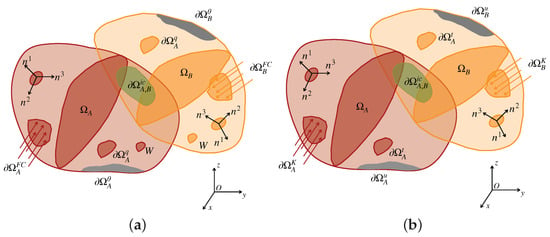
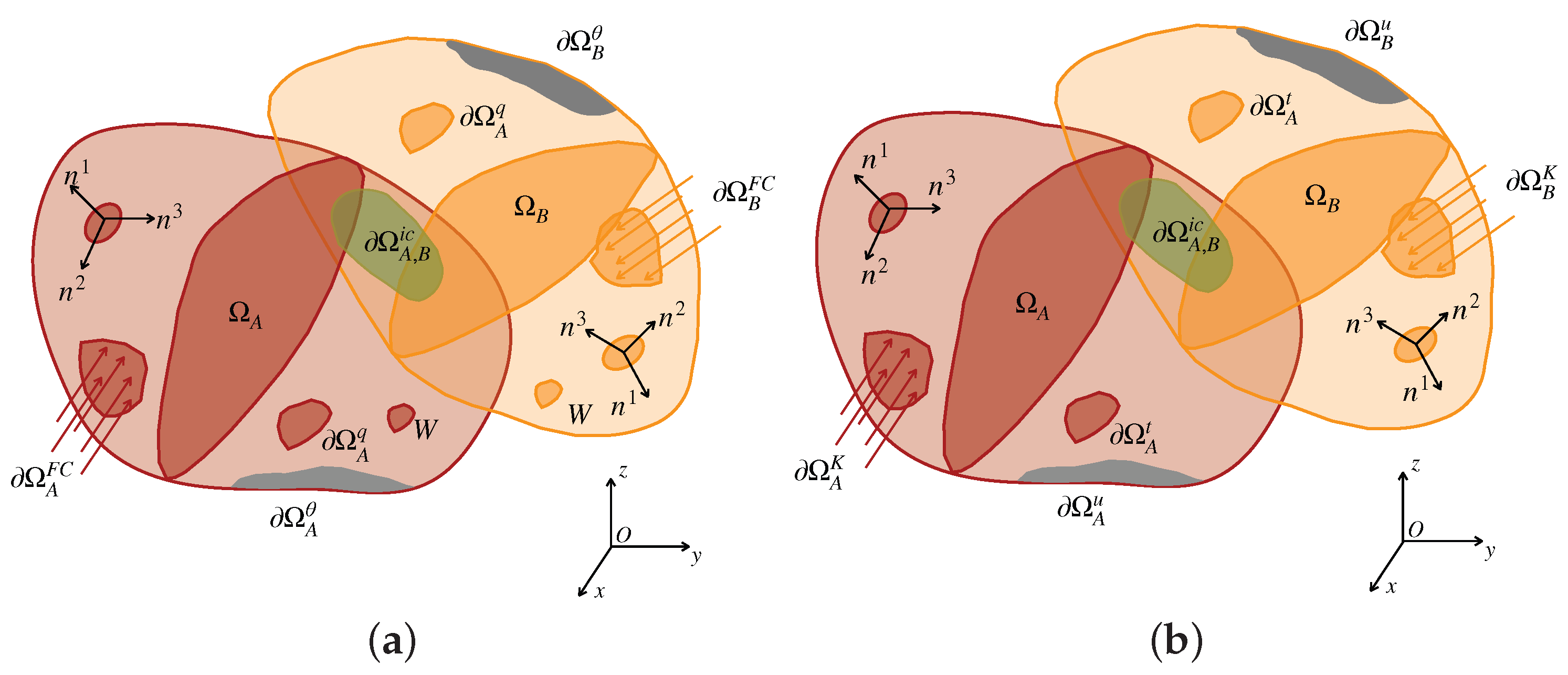
The thermomechanical contact problem addressed in this work involves two isotropic three-dimensional bodies , bounded by smooth surfaces . The solids are described within a Cartesian coordinate system , as shown in Figure 1.
Figure 1.
BEM discretization. (a) Potential problem scheme. (b) Mechanical problem scheme.
Under steady-state conditions, and in the absence of body forces, the governing equations for the thermal and mechanical fields in each domain are given by
where denotes the temperature field, are the components of the Cauchy stress tensor, and is the thermal conductivity of the material.
The coupling between the thermal and mechanical problems is introduced through the constitutive equations of linear thermoelasticity,
where and are the Lamé constants, is the coefficient of thermal expansion, is the reference temperature, and is the Kronecker delta.
The infinitesimal strain tensor is defined in terms of the displacement field as
The boundary of each solid is subdivided in order to define the thermal and mechanical boundary conditions. For the thermal problem, the boundary is partitioned as
where denotes the portion of the boundary with prescribed temperature , corresponds to imposed heat fluxes q, represents forced convection regions, and includes the interstitial region surrounding the contact zone as well as the potential contact surface.
Similarly, for the mechanical problem the boundary is decomposed as
where denotes the portion with prescribed displacements, corresponds to imposed surface tractions, and represents elastic support conditions.
The Dirichlet boundary conditions are expressed as
whereas the Neumann boundary conditions are given by
where denotes the outward unit normal vector to the boundary, is the convective heat transfer coefficient, is the fluid temperature, and represents the stiffness of the elastic support [34,35].
3. Thermomechanical Contact Conditions
3.1. Thermal Contact Conditions
The thermal interaction between the two solids across the potential contact surface is governed by non-linear boundary conditions defined on the contact zone . When contact occurs, heat transfer between the bodies takes place through the real contact area formed by microscopic asperities, as well as through the interstitial microgaps separating the surfaces.
The thermal boundary conditions at the contact interface for each solid are expressed as [29,36]
where and denote the normal heat fluxes at the contact interface for solids A and B, respectively, and are the temperatures at the corresponding contact nodes, and is the thermal contact resistance.
When two rough surfaces are pressed against each other, the actual contact area is smaller than the apparent one due to the presence of microcontacts and microgaps. As a consequence, the thermal conductance at the interface depends on both thermal and mechanical parameters, including surface roughness, material properties and contact pressure.
According to the classical models proposed by Cooper [37] and further developed by Song and Yovanovich [38,39,40,41], the conductance through the microcontacts can be expressed as
where is the harmonic mean thermal conductivity of the interface, is the effective microhardness, is the effective surface roughness, is the effective mean asperity slope, and is the normal contact traction.
In addition, heat transfer through the interstitial microgaps is considered. These gaps are assumed to be filled with a thermal interface material (TIM), allowing heat transfer by conduction. The corresponding conductance is given by [12,38,42]
where denotes the thermal conductivity of the TIM and Y is a quantity dependent on the normal contact pressure, expressed as
The total thermal conductance at the contact interface is obtained by combining the contributions of the microcontacts and the interstitial gaps,
from which the thermal contact resistance is defined as
In addition to the contact zone , a surrounding interstitial region is considered. In this region, the solids do not satisfy the mechanical contact constraints and therefore no heat transfer by solid-to-solid conduction is allowed. Heat exchange across the interstitial region is assumed to occur exclusively through natural convection.
Accordingly, the thermal boundary conditions imposed on are expressed as [18,21,43]
where denotes the normal heat flux on solid l, is the natural convection heat transfer coefficient, is the ambient fluid temperature, and is the temperature at the surface of the solid.
3.2. Mechanical Contact Conditions
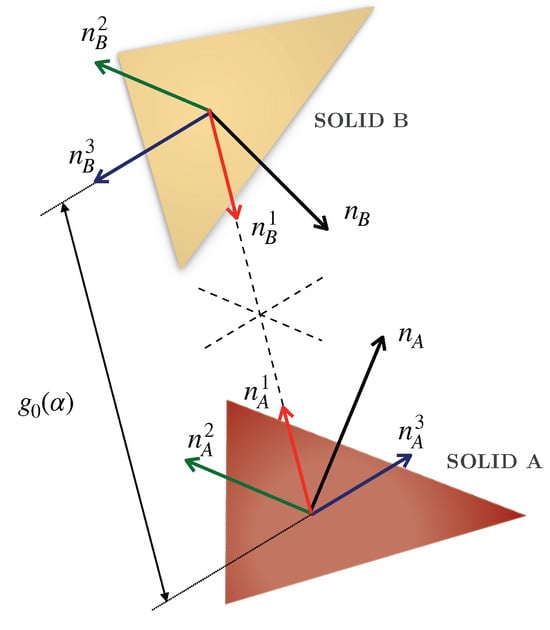
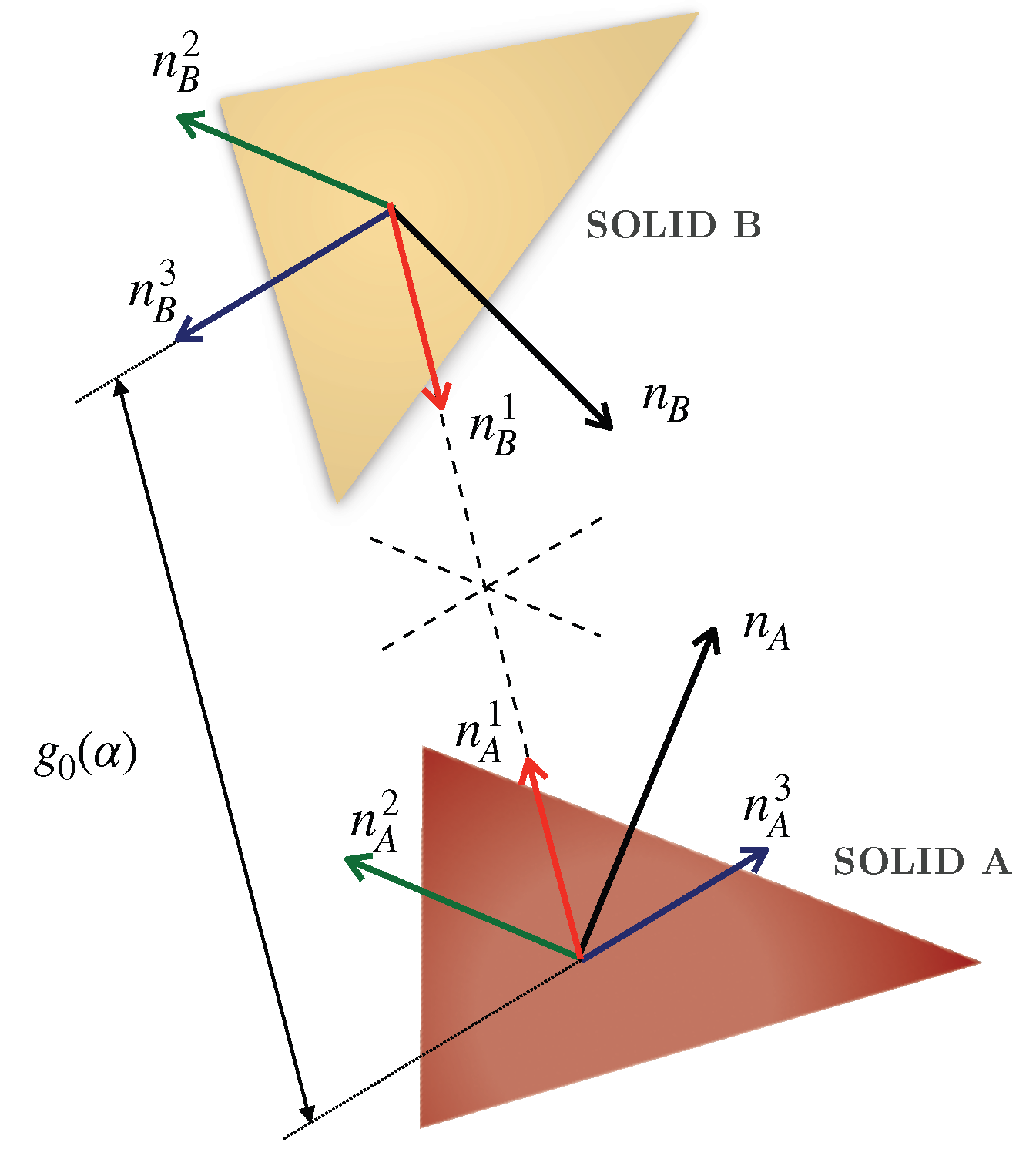
Mechanical interaction between the two solids is defined on the potential contact zone . Small displacements are assumed, and the contact is considered frictionless. Under these hypotheses, a common normal unit vector is defined at each pair of facing points belonging to , as illustrated in Figure 2, and expressed as
where and are the outward unit normal vectors of solids A and B, respectively.
Figure 2.
Local coordinate system at the contact interface.
The mechanical boundary condition at the contact interface is written as
where denotes the contact traction vector. Under frictionless contact conditions, only the normal component of the traction is non-zero, i.e.,
while the tangential components vanish.
The normal contact conditions are enforced through the classical Signorini conditions,
where is the normal gap between the two solids, defined as
with representing the initial gap and
the relative normal displacement between the two bodies.
These conditions ensure non-penetration between the solids, allow separation when the contact traction vanishes, and activate contact tractions only when the normal gap is zero. The mechanical contact conditions introduce a nonlinearity in the problem, which is resolved through an iterative solution procedure described in subsequent sections.
4. Boundary Element Formulation
The boundary element formulation is based on the classical BEM developed by Brebbia [44] for steady-state thermal and elastic problems, and on its extension to contact mechanics proposed by Aliabadi [45]. Internal thermal effects are incorporated through a domain integral term following the formulation introduced by Anza [32,33], which allows the inclusion of heat sources within the boundary integral framework. The governing equations are enforced at collocation points located on the boundary of each solid.
For the thermal problem, the boundary integral equation at a boundary point is written as
where is the fundamental solution of the Laplace operator, q denotes the normal heat flux, and is the free term associated with the boundary geometry.
Similarly, for the thermoelastic problem the boundary integral equation at a boundary point is written as
where the last term accounts for the contribution of internal heat generation.
The fundamental solutions employed in the present formulation are defined as
where
is the Kronecker delta, G is the shear modulus, is Poisson’s ratio, is the coefficient of thermal expansion, and denotes the outward unit normal vector at .
Discretizing the boundary into planar triangular boundary elements and applying a collocation procedure at the barycenter of each element, the boundary integral Equations (23) and (24) can be rewritten in matrix form as
where the vectors , , and collect the nodal values of temperature, heat flux, displacements and tractions, respectively. The matrices , , and contain the influence coefficients associated with the corresponding fundamental solutions, while the vectors and account for the contributions of the domain integrals.
Linear Heat Sources in the Thermoelastic Formulation
The last term in the boundary integral equations governing the thermomechanical problem (Equations (23) and (24)) corresponds to domain integrals that must be evaluated when internal heat generation is present. The treatment of this contribution follows the same approach proposed by Anza [32,33], where the effect of heat sources is incorporated through an additional term in the integral formulation.
The starting point is the governing equation for steady-state heat transfer, which can be written as
where denotes the temperature variation with respect to a reference temperature. The source term Q is defined as
with W representing the constant heat power generated per unit length and time, the specific heat at constant volume, and
where is the thermal conductivity.
When a linear heat source of intensity W is present within the domain , the governing equation becomes non-homogeneous and can be written as
where the parameter characterizes the intensity of the linear heat source. In this case, the effect of the source is introduced through an integration along its geometric support, leading to an additional contribution in the domain integral term of the boundary integral equations. It is important to note that, in the present formulation, the collocation points are located on the boundary , whereas the linear heat sources are strictly embedded within the domain . Under this condition, the resulting integrals do not exhibit singular behaviour, since the fundamental solution remains regular for all admissible configurations.
Substituting Equation (36) into the domain integral term of the thermal boundary integral equation, the contribution of the linear heat source can be written as
where denotes the collocation point, is a generic point of the linear heat source, and is the distance between these points.
Let the linear heat source be defined by its end points and . The geometric support of the source can be expressed in parametric form as
where is the direction vector of the source and the differential length is given by
The distance between the collocation point and a generic point of the linear heat source is therefore written as
Introducing the auxiliary vectors
and their corresponding magnitudes
the integral in Equation (41) admits a closed-form analytical solution.
After performing the integration, the contribution of the linear heat source to the thermal problem is obtained as
where denotes the contribution of the thermal source to the independent term of the boundary element system. Even in configurations where the distance between the collocation point and the linear heat source becomes small, the analytical expression in Equation (44) remains well-defined, as no singularity arises from the source term due to its location within the domain.
In the presence of multiple linear heat sources, the total contribution is obtained by superposition of the individual terms.
The same procedure can be applied to the thermoelastic boundary integral equation. In this case, the contribution of the linear heat source appears through the domain integral involving the thermoelastic fundamental solution . Substituting the governing Equation (36) into the corresponding domain integral term of Equation (24), the thermoelastic contribution can be expressed as
where denotes the thermoelastic fundamental solution.
Using the expression of the thermoelastic fundamental solution adopted in the present formulation (Equation (29)),
Equation (45) can be rewritten as
Introducing the parametric representation of the linear heat source given by Equation (38), the remaining line integral becomes
where denotes the i-th component of the direction vector .
This integral admits a closed-form analytical solution, which can be written as the sum of a logarithmic term and an algebraic term depending on the geometric parameters of the linear heat source and the position of the collocation point. After performing the integration, the thermoelastic contribution of the linear heat source is obtained as
where denotes the contribution of the linear heat source to the independent term of the thermoelastic boundary element system. The same considerations apply to the thermoelastic contribution. Since the linear heat sources are internal to the domain, the corresponding integrals remain regular, and the analytical expression given in Equation (49) is well-defined for all admissible configurations.
As in the thermal case, when multiple linear heat sources are present, the total thermoelastic contribution is obtained by superposition of the individual terms.
5. Thermomechanical Solution Procedure
The coupled thermomechanical contact problem is addressed using a staggered and doubly iterative solution procedure, in which the thermal and mechanical fields are solved sequentially while enforcing the contact constraints [31,46].
- The boundaries of the solids are discretized using planar triangular boundary elements, and the boundary integral equations governing the thermal and mechanical problems are assembled.
- At the beginning of each global iteration, the thermal problem is solved assuming a fixed mechanical configuration. The temperature field along the boundary of each solid is obtained, and the contribution of the linear heat sources is incorporated through the thermal source term .
- Based on the computed temperature field, the thermoelastic contribution associated with the linear heat sources is evaluated. These effects are introduced into the mechanical problem through the corresponding terms in the independent vector.
- The mechanical problem is then solved by enforcing the contact conditions at the potential contact interface. This step provides updated displacement fields and contact tractions.
- The contact status of the interface elements is updated according to the computed normal gaps and contact tractions. The thermal and mechanical problems are subsequently re-solved until convergence of both the thermomechanical fields and the contact variables is achieved.
Convergence is assessed based on the variation in the contact variables, specifically the contact tractions and the thermal contact resistance along the interface. A relative tolerance of is adopted for these quantities. Whenever these variables are updated, the thermal and mechanical problems are recomputed in order to ensure consistency between temperature, displacements and contact conditions.
The solution procedure exhibits a stable behaviour for all the cases analysed, without requiring the use of relaxation or stabilization techniques. In all the simulations presented in this work, convergence is achieved in fewer than 10 global iterations.
6. Numerical Results
6.1. Thermomechanical Contact of Two Blocks Subjected to Linear Heat Sources
To assess the accuracy and robustness of the proposed thermomechanical contact formulation, a benchmark example is first analyzed. This example is designed to validate the numerical implementation by comparison with results obtained using a commercial Finite Element Method (FEM) software under identical geometrical, thermal and mechanical conditions.
The problem consists of two three-dimensional hexahedral solids in potential contact, each one with dimensions , as illustrated in Figure 3. Both solids are assumed to behave as linear, isotropic thermoelastic materials. The corresponding thermal and mechanical properties are summarized in Table 1.
Figure 3.
Geometrical configuration of the benchmark example with two three-dimensional hexahedral solids in potential contact subjected to linear heat sources.
Table 1.
Mechanical and thermal properties of the upper and lower solids used in the thermomechanical model. Values are representative of aluminum and steel and adapted from [31].
The mechanical and thermal boundary conditions considered in this example are summarized as follows:
- Mechanical Boundary Conditions
- -
- Perpendicular displacements are restricted on the external face of both solids, imposing on the upper face of the upper block at and on the lower face of the lower block at .
- -
- On the rest of the faces .
- Thermal boundary conditions
- -
- The temperature on the upper face of the upper solid at is prescribed at a constant value of .
- -
- The temperature on the lower face of the lower solid at is prescribed at a constant value of .
- -
- On the remaining external faces, adiabatic conditions are imposed, i.e., .
For the sake of clarity in the validation process, thermal interaction across the contact interface is modeled assuming ideal contact conditions. Accordingly, the thermal contact resistance is set to , so that the influence of interfacial thermal resistance is excluded from the analysis.
Heat generation is introduced in both numerical models through linear heat sources. In the FEM model, the thermal load is distributed along the elements intersected by the heat source, while in the boundary element formulation the same heat input is imposed directly along the corresponding lines. The geometric definition of each heat source, given by the coordinates of its initial and final points, is summarized in Table 2. Each linear heat source is assigned a constant power per unit length of .
Table 2.
Geometric definition of the linear heat sources.
The BEM discretization adopted is shown in Figure 4a, where the boundary of each solid is discretized using 396 elements. A detailed view of the discretization of the potential contact zone is presented in Figure 4b, which is discretized using 128 elements. Symmetry conditions are applied on the and planes, and therefore the corresponding faces are not discretized.
Figure 4.
BEM discretization. (a) Boundary discretization of the solids. (b) Detail of the discretization of the contact zone.
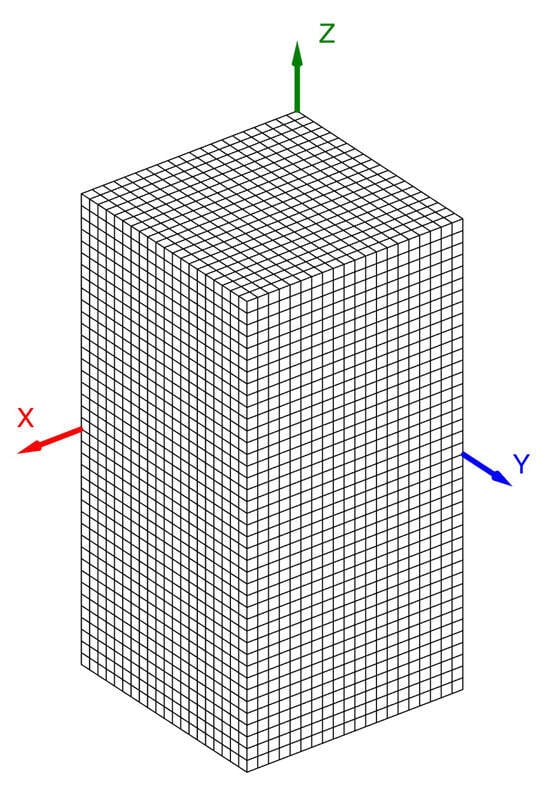
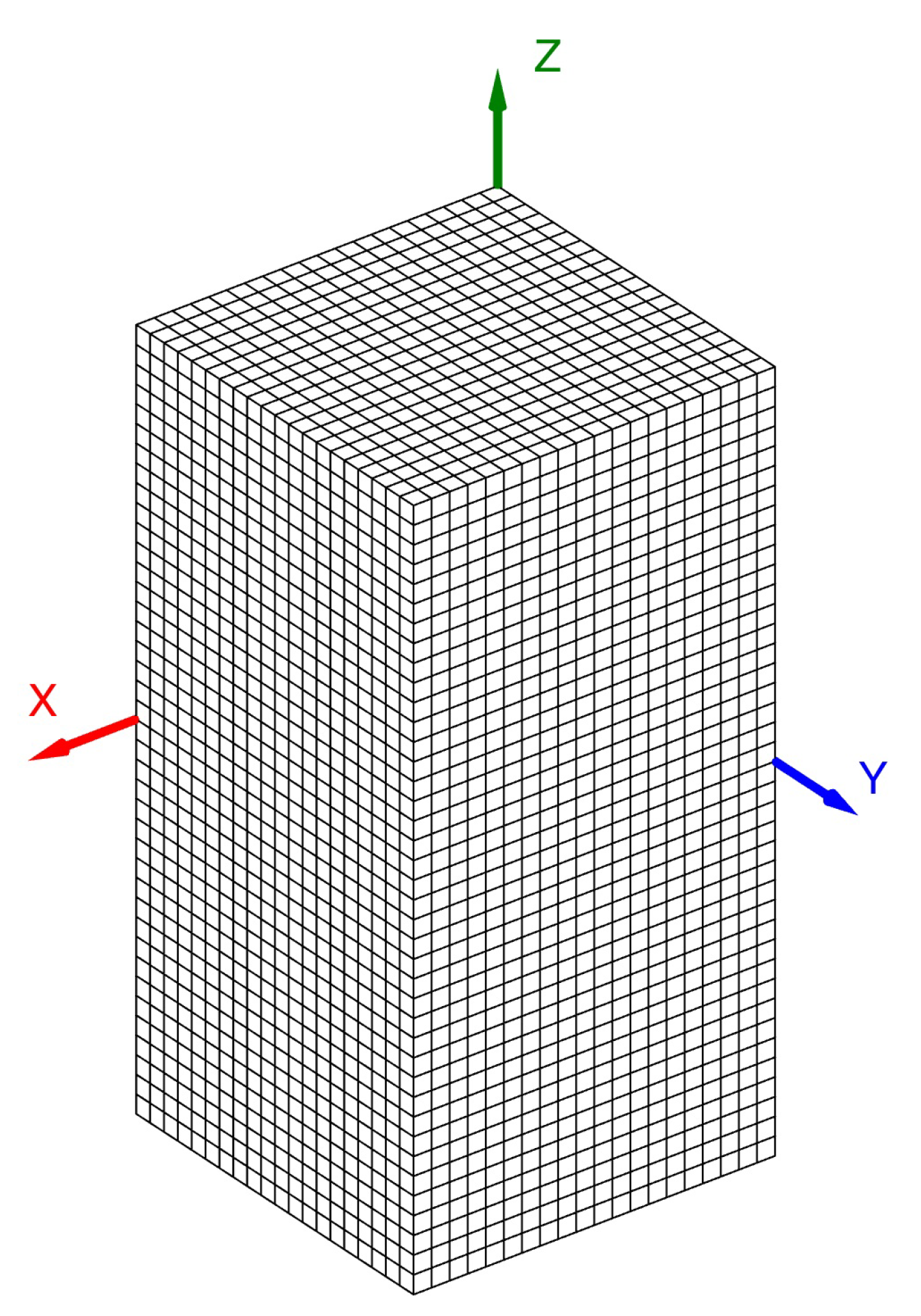
For comparison purposes, an equivalent FEM model is also constructed. The FEM discretization of each solid, shown in Figure 5, consists of 8000 tetrahedral elements. The same symmetry conditions are applied in the FEM analysis.
Figure 5.
FEM discretization of the benchmark example using tetrahedral elements.
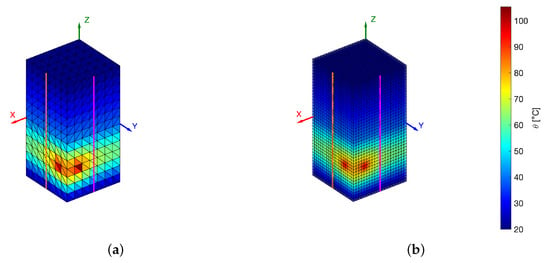
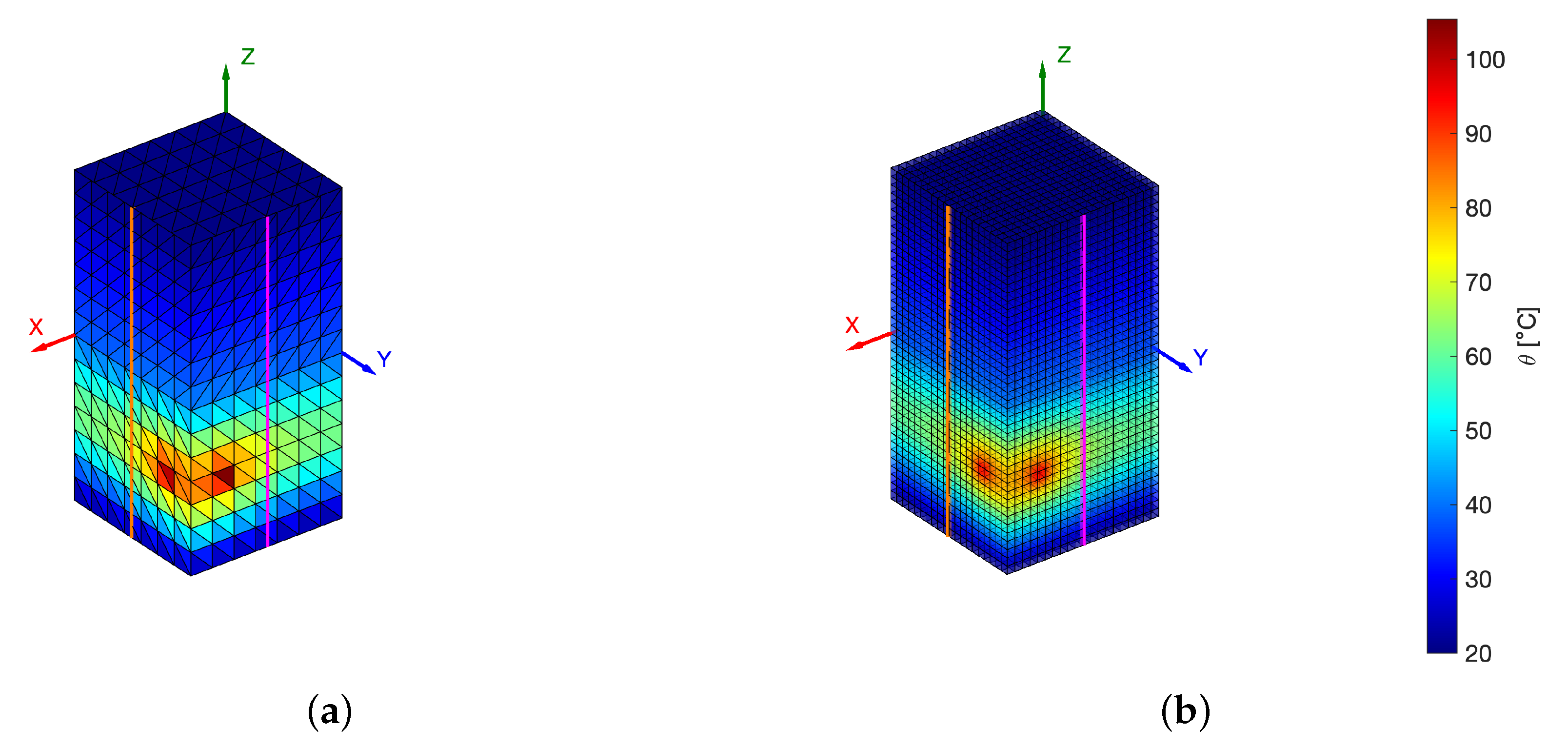
Figure 6 illustrates the three-dimensional temperature distribution obtained with the proposed formulation and the FEM model. In addition, the figure indicates the lines of nodes oriented along the Z-axis from which temperature values are extracted and subsequently represented in Figure 7.
Figure 6.
Three-dimensional temperature distribution in the analysed floor system obtained with (a) the proposed BEM formulation and (b) the FEM model. The figure allows a visual comparison of the thermal fields predicted by both approaches. The indicated lines correspond to the paths along the Z-axis from which the temperature profiles plotted in Figure 7 are extracted.
Figure 7.
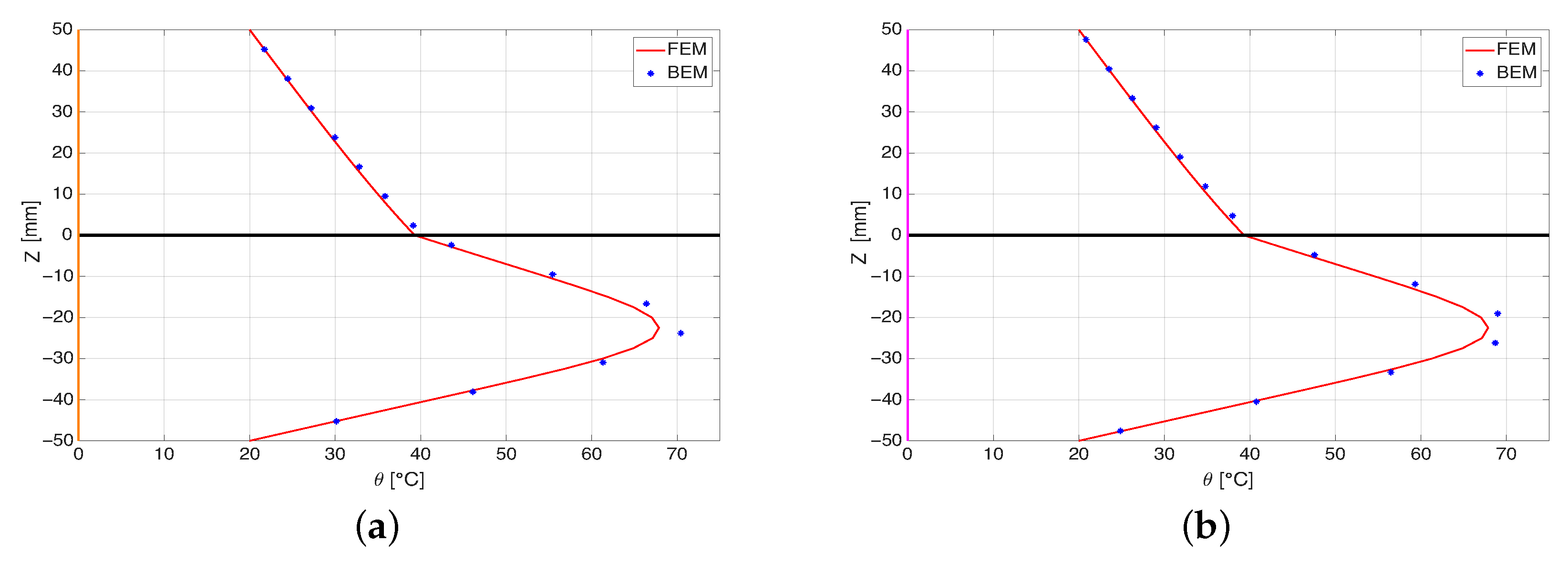
Comparison of temperature values along the Z-axis. (a) Nodes with on faces with . (b) Nodes with on faces with .
Figure 7a shows a comparison of the temperature values along the Z-axis for nodes with a coordinate located on the faces with . Likewise, Figure 7b represents the temperature profiles along the Z-axis for nodes with a coordinate located on the faces with .
Since the nodal distributions of the FEM and BEM solutions do not coincide along the Z-coordinate, a direct point-wise comparison is not feasible. Therefore, the BEM temperature field is linearly interpolated onto the FEM nodal positions, assuming a linear variation in temperature between consecutive nodes.
Once both solutions are defined at the same spatial locations, the discrepancy is quantified using the mean absolute percentage error (MAPE), defined as
where and denote the reference and interpolated temperatures, respectively, and n is the number of comparison points. The comparison is restricted to the common domain of both discretizations.
The resulting MAPE values for the different comparison paths are reported in Table 3.
Table 3.
Mean absolute percentage error (MAPE) between FEM and BEM results for different comparison paths.
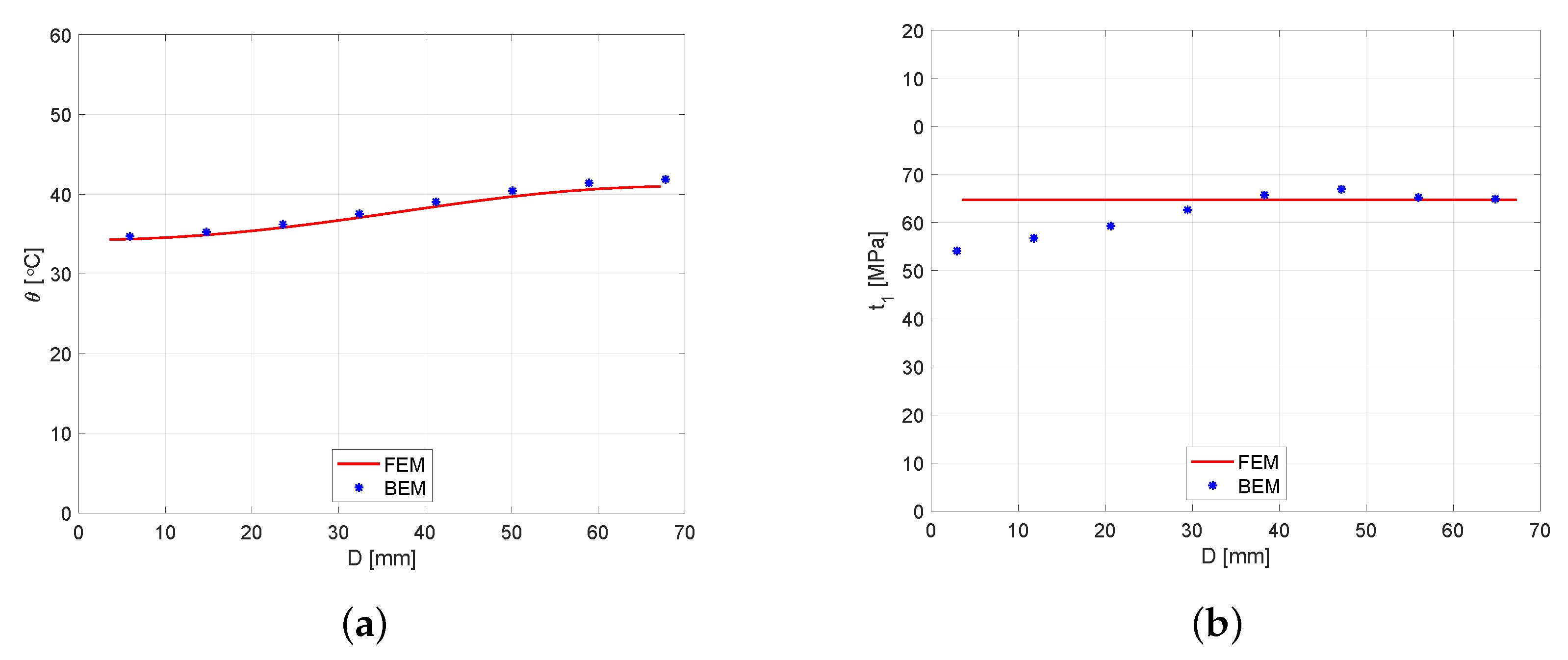
Figure 8a compares the temperature values corresponding to the nodes located along the diagonal of the potential contact zone. The selected nodes are indicated in Figure 4b with a pink line. A quantitative comparison in terms of MAPE is also provided for this set of nodes (see Table 3), showing again a very small discrepancy between both solutions.
Figure 8.
Comparison of thermomechanical results along the diagonal of the potential contact zone. (a) Temperature distribution predicted by the proposed BEM formulation and the FEM model. (b) Normal contact tractions evaluated at the same locations, showing the agreement between both approaches.
In addition, Figure 8b shows the normal contact tractions evaluated at the same nodes considered in Figure 8a. The comparison of contact tractions also exhibits a very good agreement, with discrepancies remaining within a narrow range, further supporting the accuracy of the proposed formulation in predicting thermomechanical contact variables.
The results presented in this section demonstrate the ability of the proposed formulation to accurately reproduce thermomechanical contact effects induced by linear heat sources. The close agreement observed with the FEM solutions confirms the validity of the approach, enabling its application to more practical engineering configurations.
6.2. Radiant Floor System with Embedded Linear Heat Sources at Different Depths
6.2.1. Influence of the Heat Source Position
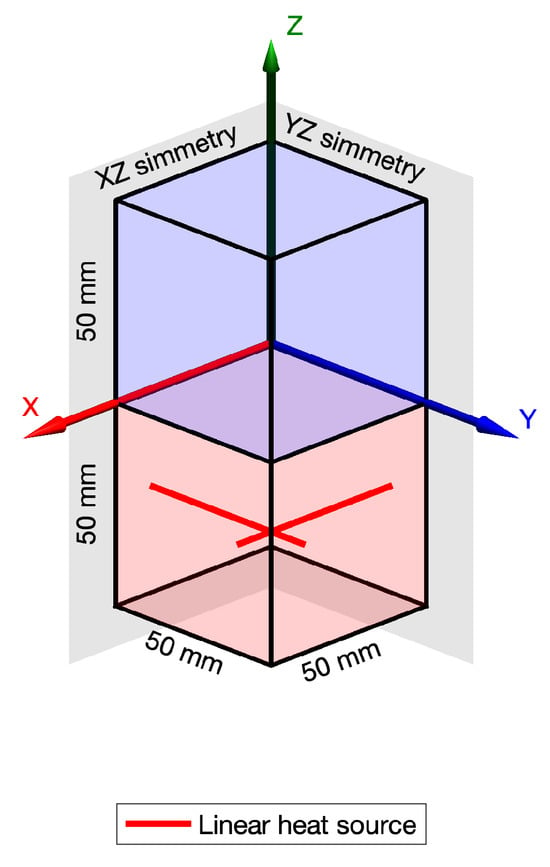
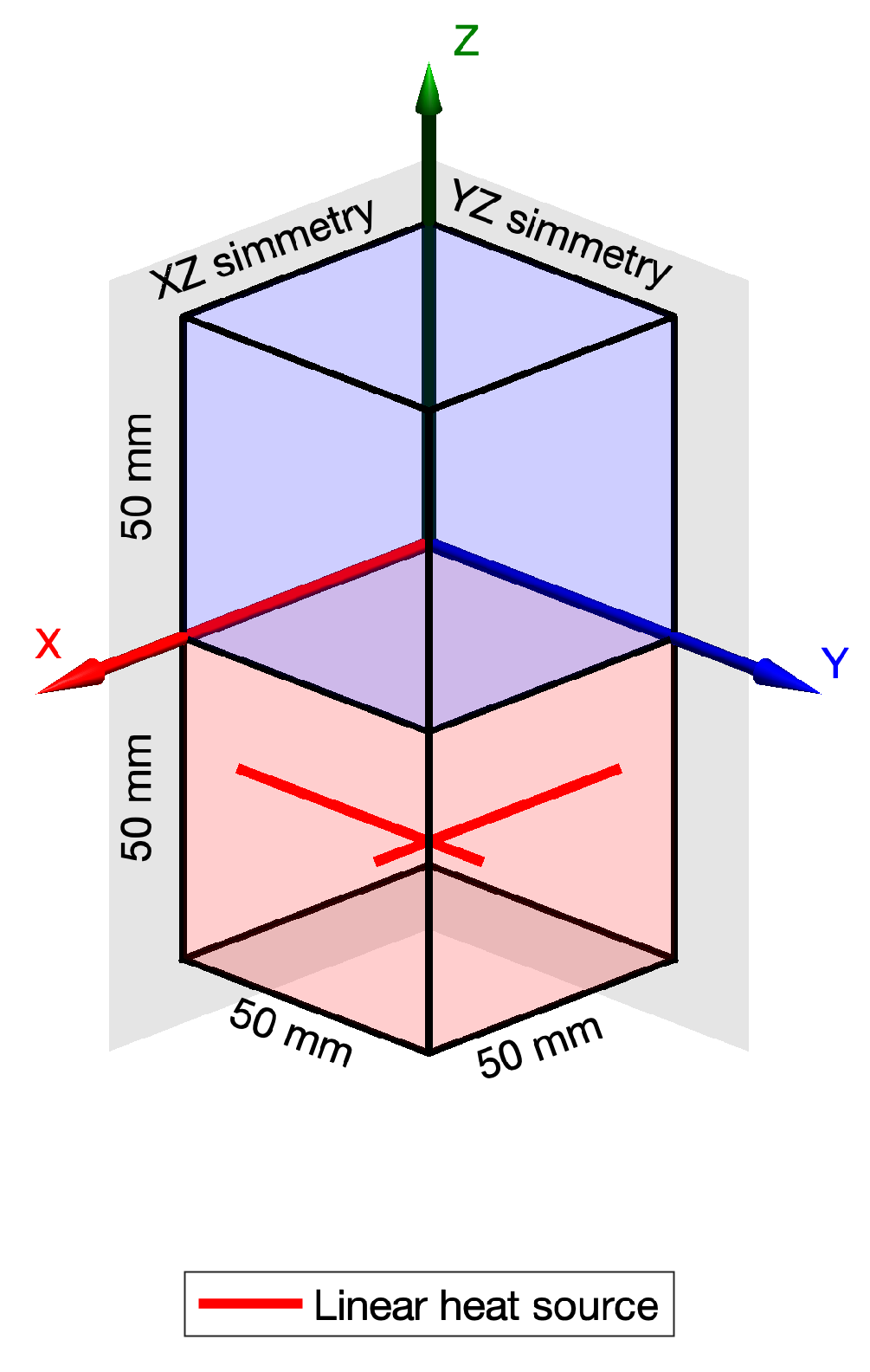
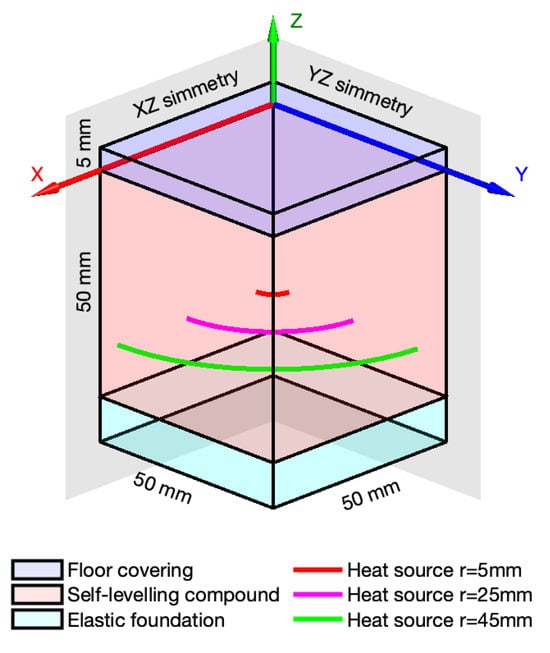
Once the proposed formulation has been validated, this section analyses a thermomechanical system representative of a radiant floor configuration. The system consists of a Winkler elastic foundation supporting a solid composed of a self-levelling compound and a homogeneous surface layer representative of a floor covering. Three linear heat sources are embedded within the compound layer to emulate the thermal behaviour of radiant floor heating pipes. The sources are arranged concentrically with respect to the origin of the coordinate system, with radii of , and . The vertical position of the heat sources, denoted by Z, is considered the main parameter of the study. Each linear heat source is characterised by a power per unit length of .
The objective is to quantify the influence of the parameter Z on the temperature distribution at the floor surface and on the thermally induced deformations generated at the interface between the mortar and the surface layer. To this end, the coupled thermomechanical problem is solved under steady-state heat conduction conditions, assuming linear isotropic materials with constant thermal properties. These assumptions are consistent with the expected behaviour of radiant floor systems under typical operating conditions, where thermomechanical analyses have shown that the stresses induced by thermal loading remain significantly lower than the material strength, indicating that the structural response is governed by small strains [10]. In such multilayer configurations, the interaction between layers is primarily governed by normal contact mechanisms, while tangential stress levels remain limited. Under these conditions a frictionless contact formulation provides a reasonable first approximation of the thermomechanical behaviour.
The geometry of the problem is shown in Figure 9, where symmetry conditions are applied on the and planes. The material properties of the different components are listed in Table 4.
Figure 9.
Geometry of the thermomechanical model analysed. Linear heat sources are embedded within the self-levelling compound at a vertical position Z, and symmetry conditions are applied on the and planes.
Table 4.
Material properties of the floor covering and the self-levelling compound.
The surface parameters employed in the thermal contact resistance model are selected as representative values of the interface between the floor covering and the cement-based compound. For the floor covering, the adopted roughness is consistent with experimentally reported values for laminated wood-based materials, typically characterised by roughness amplitudes in the micrometre range [47]. For the self-levelling compound, a higher roughness is considered to account for the more irregular nature of cementitious surfaces, for which profilometric measurements typically provide characteristic values in the order of several tens of micrometres [48].
It should be noted that these parameters are not intrinsic material constants, but depend on the surface formation process and interface conditions. In particular, the surface texture of granular and cement-based materials is strongly influenced by the production method, which may lead to significant variations in the resulting roughness [49]. Accordingly, the adopted values are intended to provide a physically consistent order-of-magnitude representation of the interface properties.
Thermal interaction between both materials is modelled through an interfacial layer with an equivalent thermal conductivity of . In addition, in the event of interface separation, free air convection is considered with a convective heat transfer coefficient .
The mechanical and thermal boundary conditions are defined as follows.
- Mechanical boundary conditions:
- -
- A uniform pressure of is applied on the upper surface of the top solid ().
- -
- Normal displacements are constrained () on the lateral faces of the upper solid.
- -
- Elastic supports with stiffness are applied on the lower surface of the bottom solid ().
- -
- On the remaining faces, displacements are fully restrained ().
- Thermal boundary conditions:
- -
- Forced air convection is prescribed on the upper surface of the top solid (), with fluid temperature and convective coefficient .
- -
- A fixed temperature is imposed on the lower surface of the bottom solid ().
- -
- On the remaining surfaces, adiabatic conditions are assumed ().
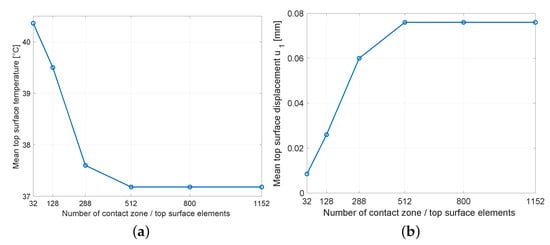
A mesh sensitivity analysis has been carried out in order to evaluate the influence of the discretization on the numerical solution. To this end, the number of boundary elements in both the contact zone and the top surface has been progressively refined using the same discretization pattern. The convergence of the solution is assessed in terms of the mean temperature and the mean displacement at the top surface. The results are presented in Figure 10.
Figure 10.
Mesh convergence study based on the refinement of the contact zone and top surface discretization. (a) Mean top surface temperature. (b) Mean top surface displacement .
As can be observed, both quantities exhibit a clear convergence trend as the number of elements increases. In particular, the variations become negligible beyond a certain level of refinement, indicating that the solution is insensitive to further mesh refinement.
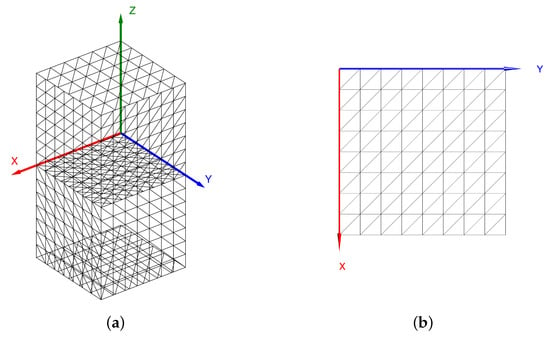
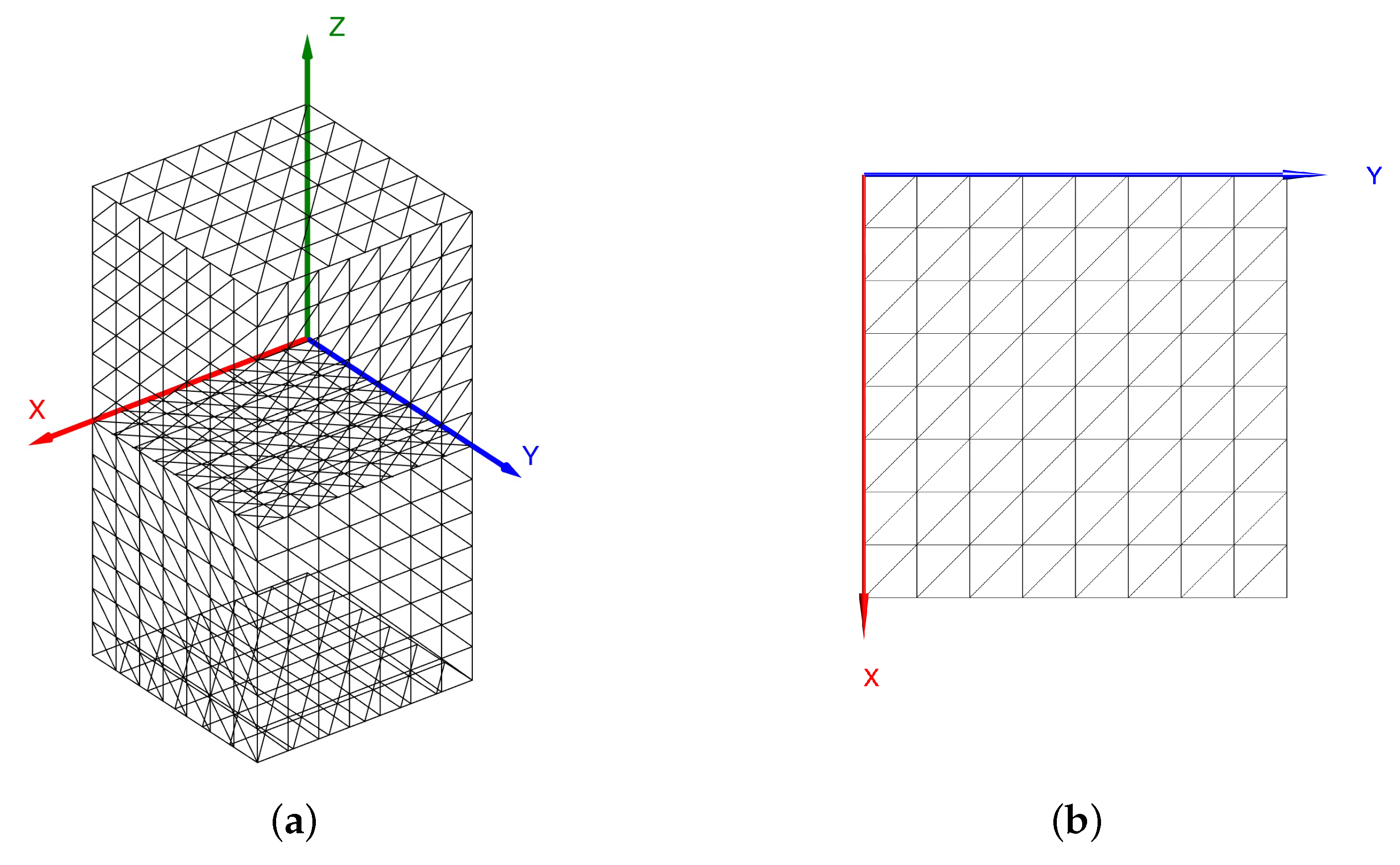
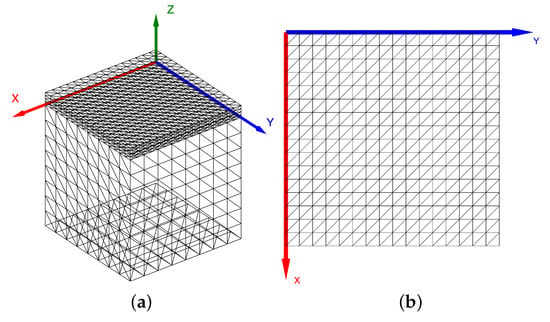
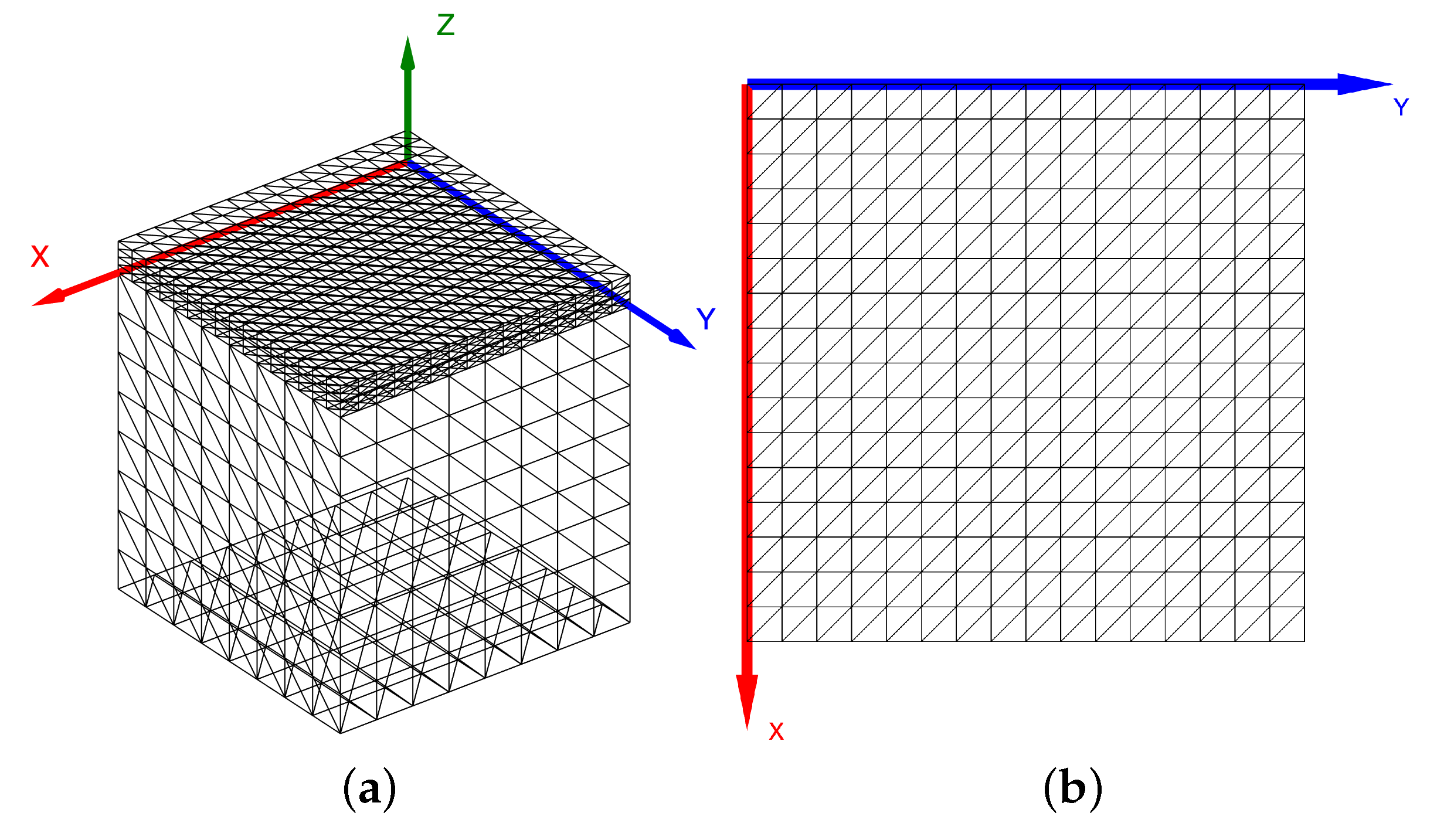
Based on this analysis, 1280 and 896 nodes are used for the upper and lower solids, respectively, as shown in Figure 11a, with 512 of them belonging to the contact region (Figure 11b). Owing to the imposed symmetry conditions, the faces corresponding to the symmetry planes are not discretised.
Figure 11.
BEM discretization. (a) Boundary discretization of the solids. (b) Detail of the discretization of the contact zone.
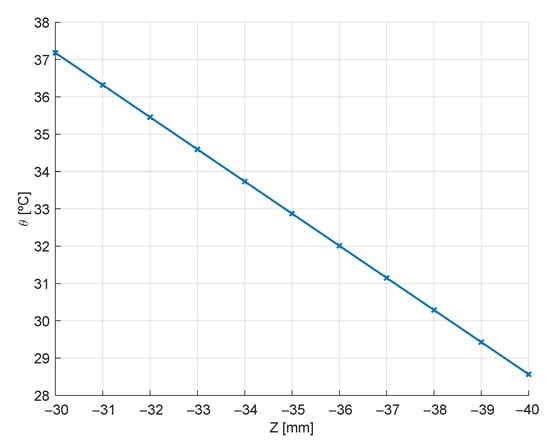
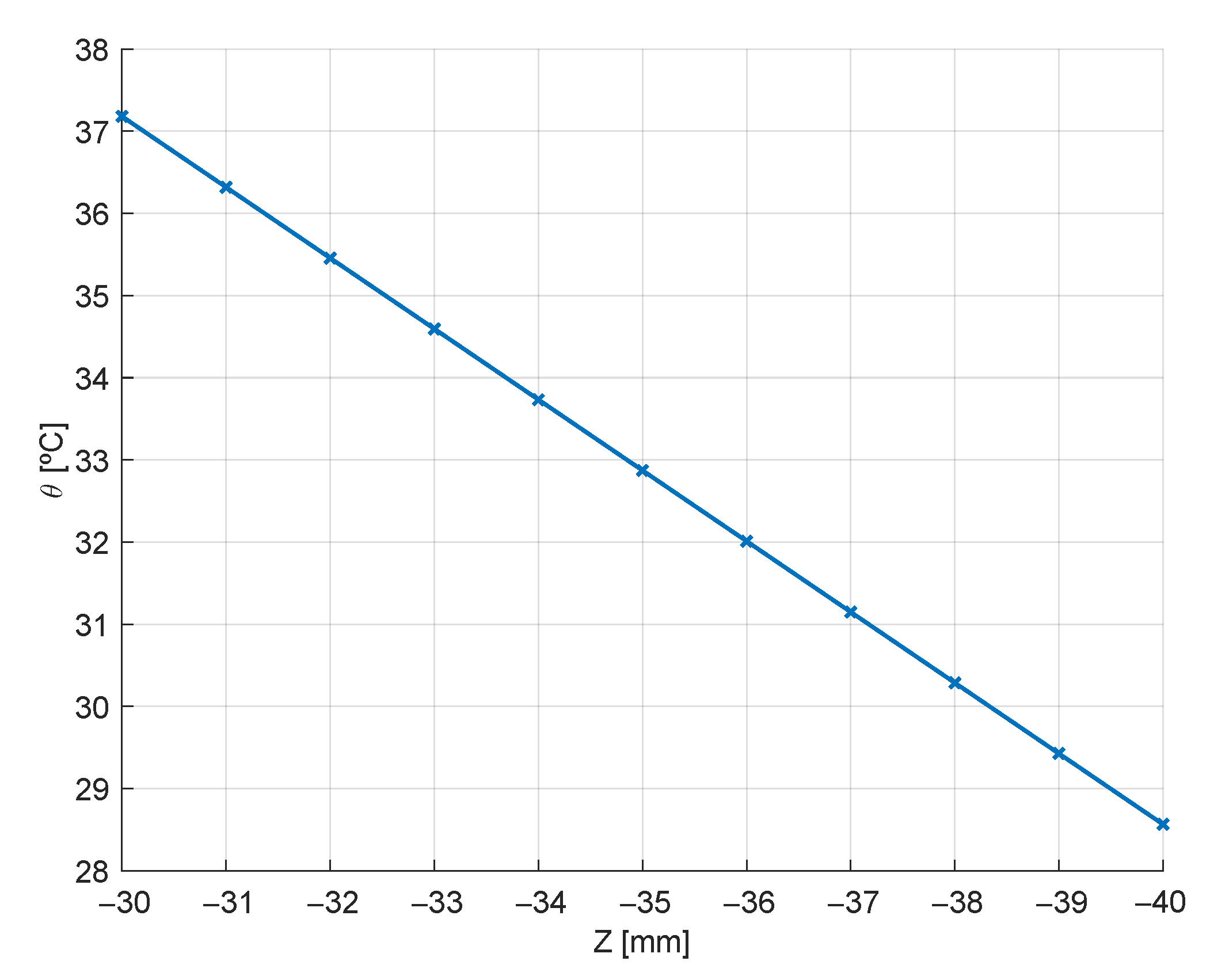
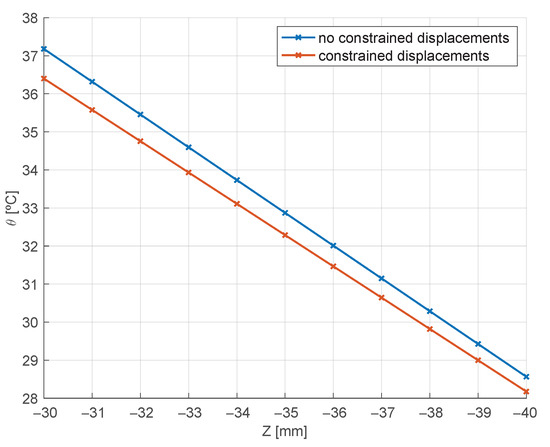
To assess the influence of the heat source position, its vertical coordinate is varied from to using an increment of . As shown in Figure 12, the mean surface temperature increases as the heat source approaches the contact region. Over the analysed range, the mean surface temperature increases by approximately , which confirms the strong sensitivity of the thermal response to the installation position of the heating pipes.
Figure 12.
Mean surface temperature as a function of the vertical position Z of the linear heat sources.
In order to quantify this trend, a linear regression has been performed, leading to the expression
where denotes the mean surface temperature and Z is expressed in mm. This result indicates that the mean surface temperature varies at a rate of approximately within the considered range. The nearly linear behaviour observed in Figure 12 is consistent with the progressive increase in thermal resistance between the heat source and the upper surface as the source is placed deeper inside the system.
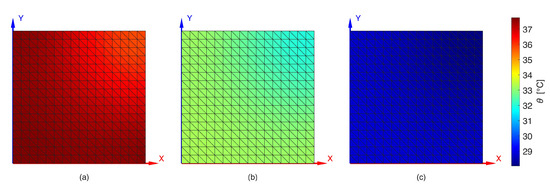
The temperature distribution is depicted in Figure 13 for three representative configurations. For each configuration, the temperature field exhibits smooth spatial variations, while clear differences are observed between cases as a direct consequence of the different vertical positions of the heat sources. As the source depth increases, heat must be conducted through a longer path before reaching the surface, which reduces the mean surface temperature while preserving the overall shape of the thermal field. The stress distribution remains essentially unchanged over the range.
Figure 13.
Temperature distribution for three representative vertical positions of the linear heat sources: (a) , (b) and (c) .
6.2.2. Effect of Constrained Displacements at the Upper Edge
In order to provide a more realistic representation of practical floor configurations, an additional scenario is analysed in which the displacements of the nodes located at the boundary of the upper surface are constrained, as may occur in the presence of a skirting board. In this case, the external mechanical load is removed, while all other geometric, material, thermal and numerical conditions remain identical to those defined in the previous subsection.
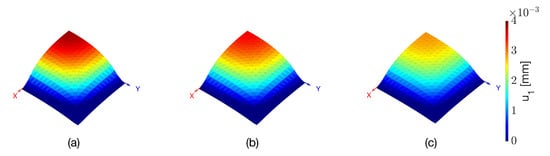
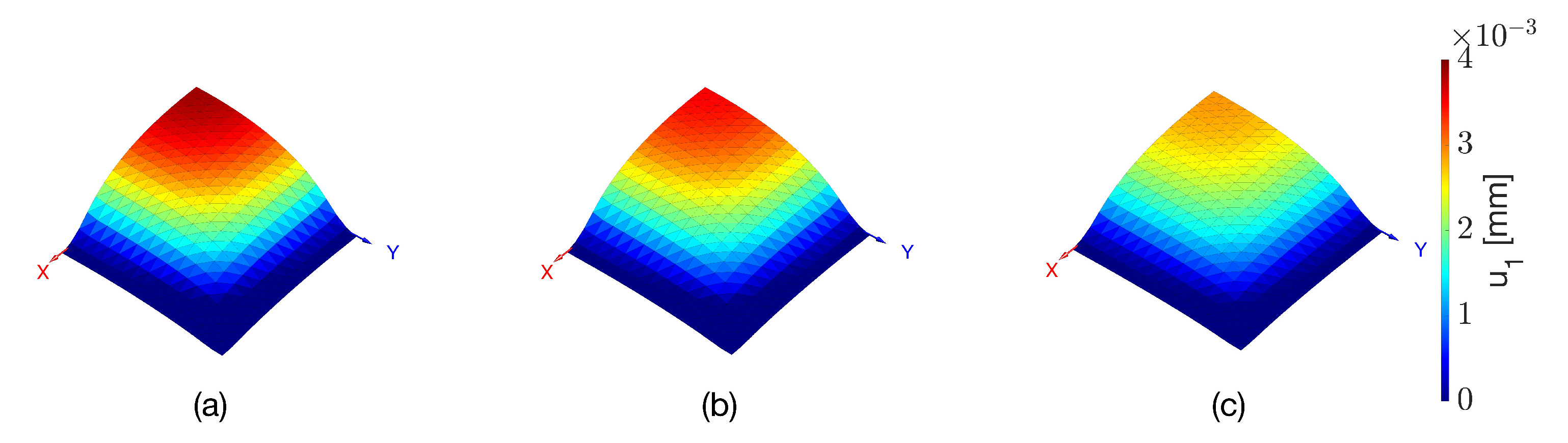
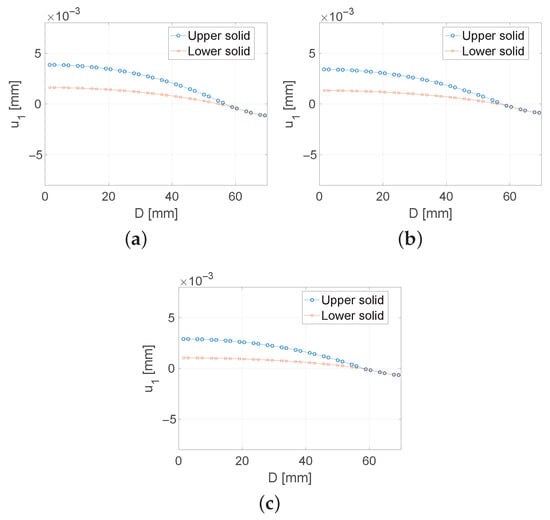
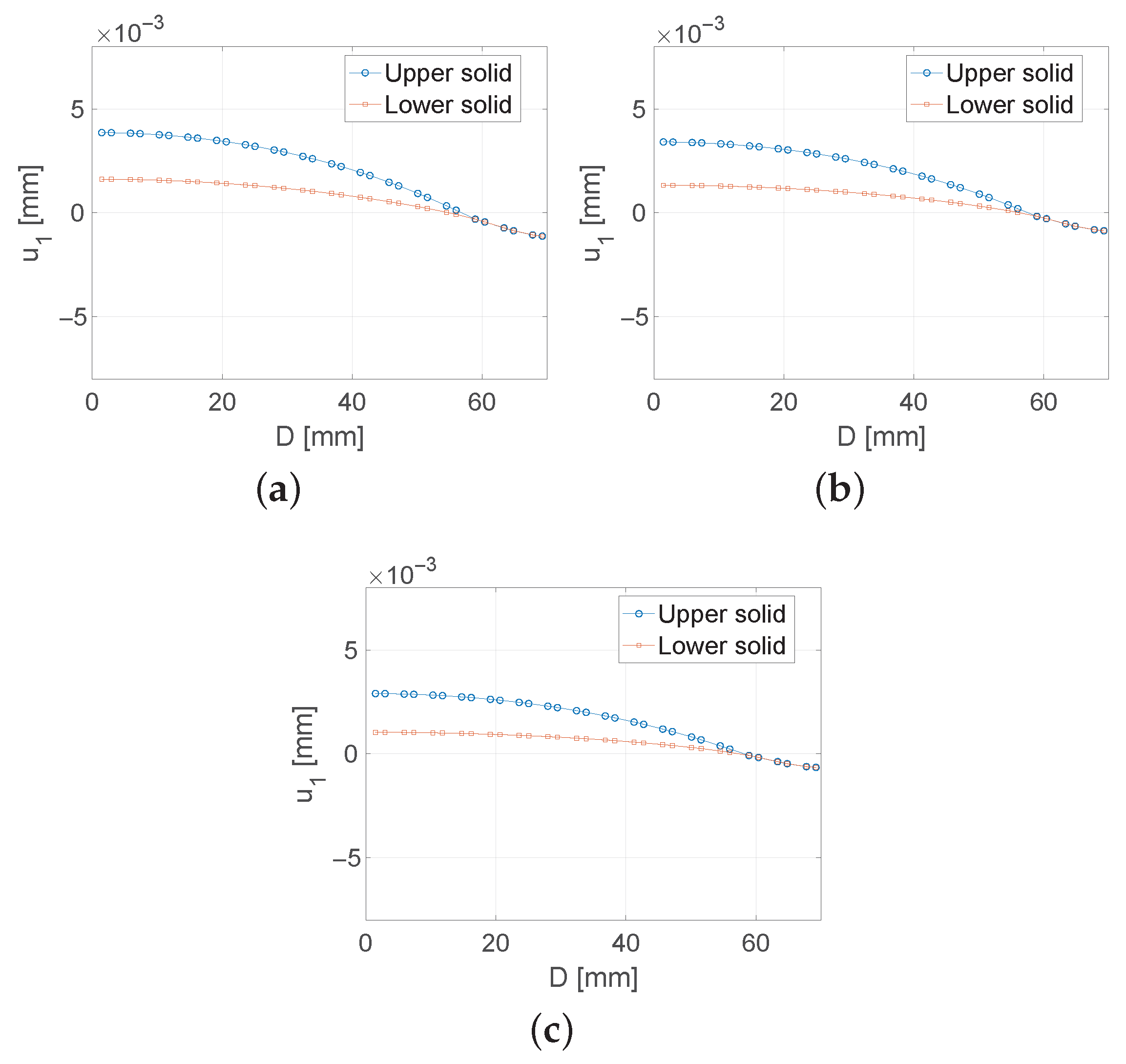
Under these conditions, partial separation at the interface is observed as a consequence of thermal expansion, as illustrated in Figure 14. This behaviour can be further appreciated in Figure 15, where the values of the displacement component are represented for the nodes located along the diagonal of the contact zone for both solids. The results clearly show the relative displacement between the surfaces, indicating the occurrence of local separation at the interface.
Figure 14.
Distribution of the normal displacement at the interface for three representative vertical positions of the linear heat sources: (a) , (b) and (c) .
Figure 15.
Displacement component for the nodes located along the diagonal of the contact zone for both solids, for three representative vertical positions of the linear heat sources: (a) mm, (b) mm and (c) mm. The results show the relative displacement between the two surfaces, clearly indicating the occurrence of interface separation.
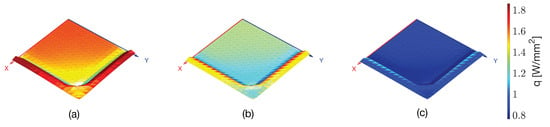
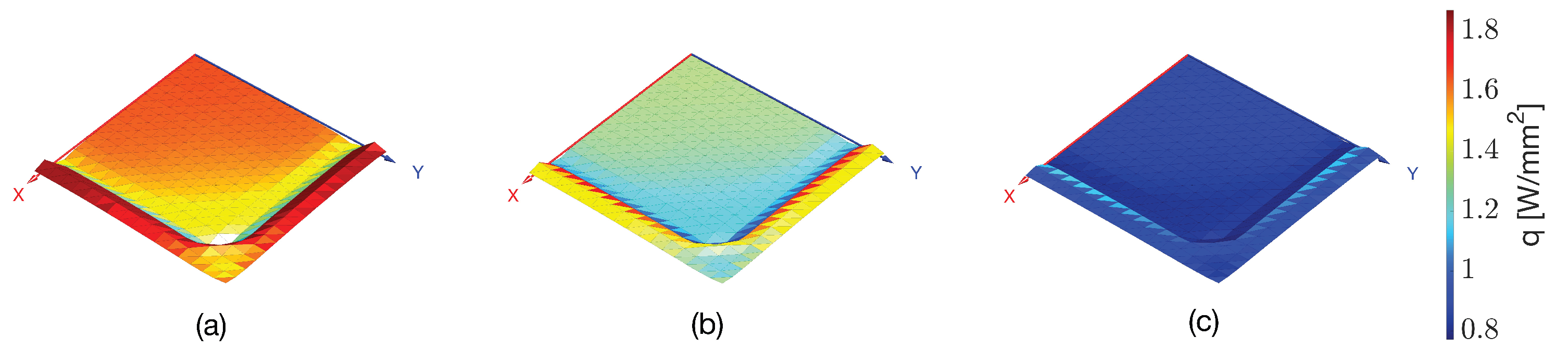
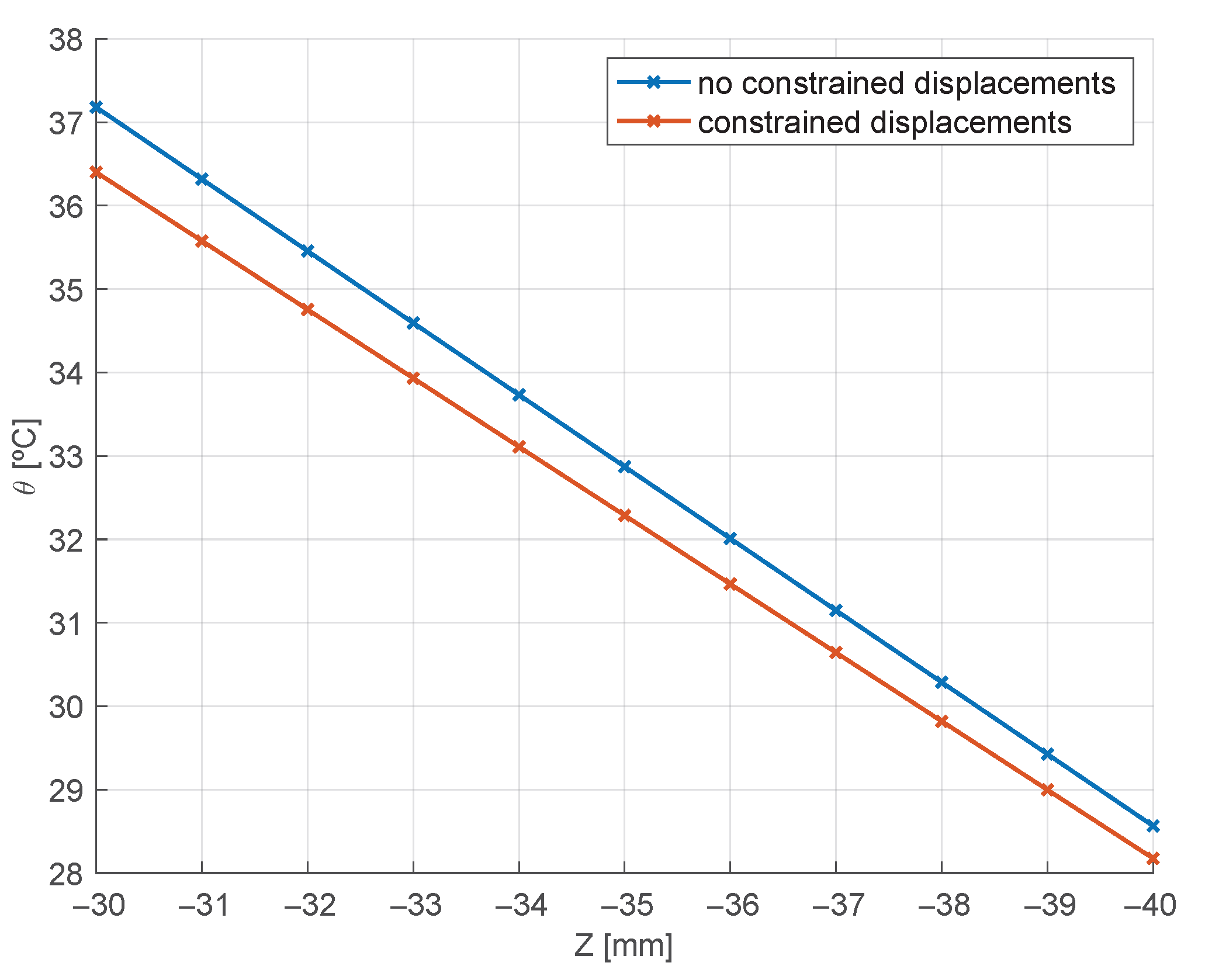
The occurrence of interface separation leads to a reduction in the heat flux transferred through the contact region, as illustrated in Figure 16, where lower heat flux values are observed in the areas affected by separation. As a consequence, a surface temperature is obtained, as shown in Figure 17. From a practical standpoint, such interface separation may not only induce perceptible variations in thermal comfort, but may also give rise to a detectable loss of mechanical continuity at the floor surface, which could be noticed by the user during walking.
Figure 16.
Heat flux distribution at the contact interface for three representative vertical positions of the linear heat sources: (a) , (b) and (c) . Lower heat flux values are observed in the regions affected by interface separation.
Figure 17.
Mean surface temperature for different vertical positions Z of the linear heat sources, comparing cases with and without constrained displacements at the upper edge.
In addition, the dependence of the mean surface temperature on the vertical coordinate Z of the heat sources has been quantified through a linear regression, yielding the expression
where denotes the mean surface temperature and Z is expressed in mm. This result confirms that the temperature exhibits an approximately linear variation with respect to the source position, with a sensitivity of about .
Compared to the previous case, a reduction in the slope is observed, which reflects the influence of the modified mechanical boundary conditions. The partial loss of contact reduces the effective heat transfer across the interface, increasing the overall thermal resistance of the system and consequently diminishing the sensitivity of the surface temperature to variations in the source depth.
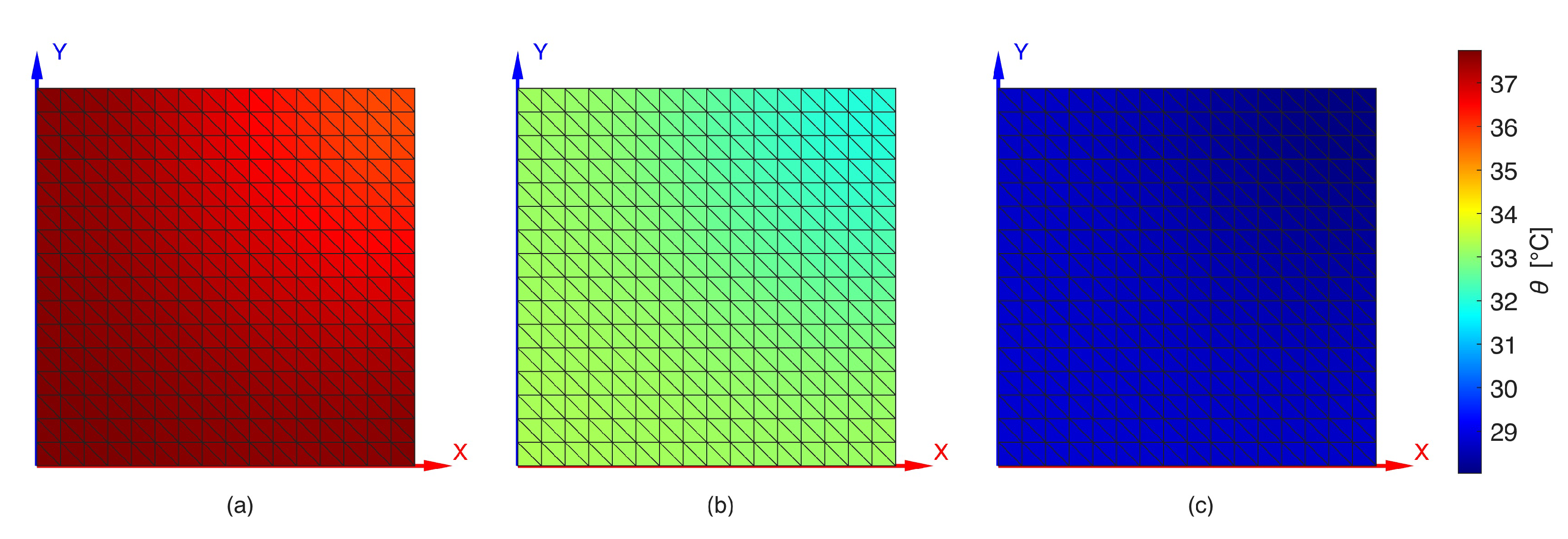
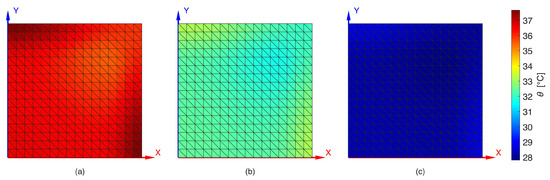
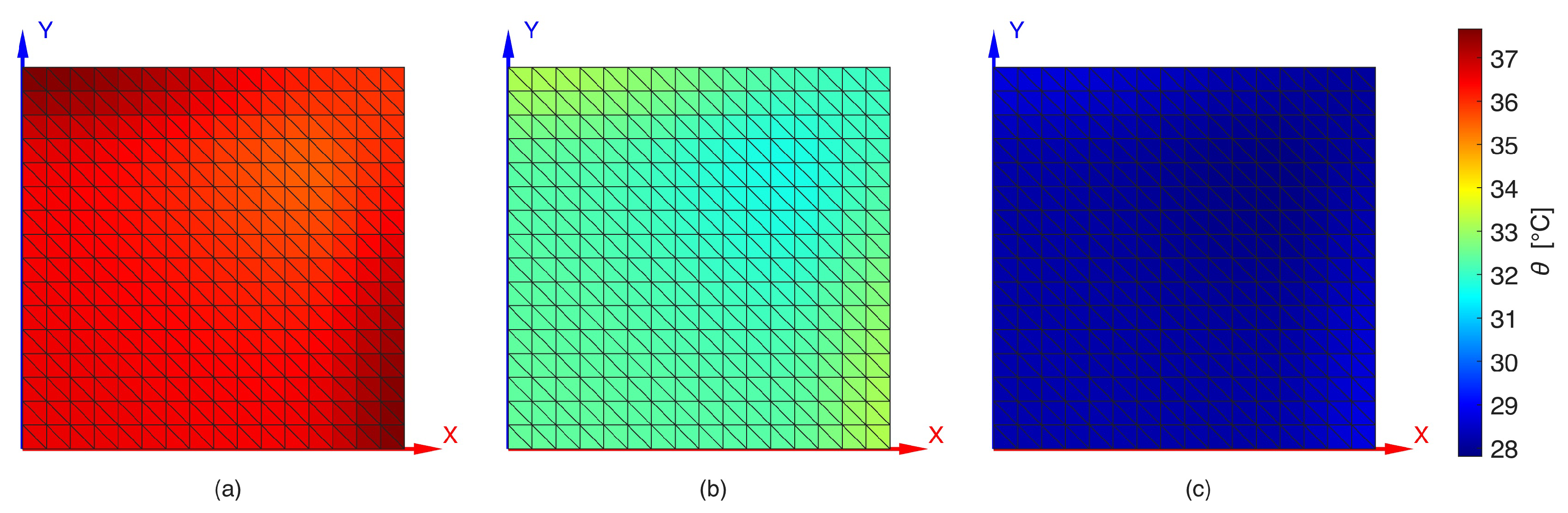
The corresponding two-dimensional temperature distributions are shown in Figure 18 for the same representative values of Z. For each configuration, the temperature field presents smooth spatial variations, while noticeable differences are observed between cases as a direct consequence of both the vertical position of the heat sources and the occurrence of interface separation. As the separation increases, the reduction in heat transfer across the interface leads to lower temperature levels at the surface, while preserving the overall spatial distribution pattern. The overall distribution remains consistent with the trends observed in the previous example, although lower surface temperature levels are obtained due to the modified mechanical boundary conditions.
Figure 18.
Two-dimensional temperature distribution for three representative vertical positions of the linear heat sources under constrained displacements at the upper edge: (a) , (b) and (c) .
7. Conclusions
A three-dimensional steady-state thermomechanical contact formulation based on the Boundary Element Method has been presented and applied to the analysis of systems involving internal linear heat sources. The formulation consistently incorporates thermal conduction, thermoelastic coupling and contact effects, enabling the representation of heat generation through line integrals within the boundary integral framework.
The numerical examples confirm the capability of the proposed approach to capture the coupled thermomechanical response of layered systems under realistic boundary conditions. In the analysed radiant floor configuration, the vertical position of the embedded heat sources has been shown to exert a significant influence on the surface temperature. This dependence has been quantified through linear relationships, with sensitivities of approximately and obtained for the different boundary conditions considered. These results indicate that small variations in the installation depth of the heating pipes may lead to noticeable changes in the thermal response of the floor surface.
The extension of the example to account for constrained displacements at the upper edge highlights the role of mechanical boundary conditions in the thermomechanical behaviour of the system. Under these conditions, partial interface separation induced by thermal expansion leads to a reduction in the heat transferred towards the surface, resulting in lower surface temperature levels and altered temperature gradients. This behaviour reflects an increase in the effective thermal resistance of the interface, which reduces the sensitivity of the surface temperature to the position of the heat sources. From an engineering perspective, this highlights the importance of ensuring adequate mechanical contact between layers in order to maintain the thermal efficiency of radiant floor systems. The occurrence of interface separation may also have practical implications, as it can be associated with both thermal comfort variations and detectable mechanical discontinuities at the floor surface.
The results highlight the importance of both the positioning of the heat sources and the quality of the interfacial contact in the thermal performance of radiant floor systems. The increase in effective thermal resistance associated with interface separation reduces heat transfer towards the surface and diminishes the sensitivity of the temperature to the source depth. These aspects should therefore be carefully controlled in practical applications to ensure thermal efficiency and user comfort.
The proposed BEM formulation proves to be a suitable and efficient framework for the analysis of thermomechanical contact problems involving localized heat sources. Its capability to account for coupled thermal and mechanical effects, together with its boundary-only discretization, makes it a valuable tool for the investigation and design of multilayer floor systems under realistic operating conditions.
Author Contributions
Conceptualization, V.G.-P. and J.V.-E.; Methodology, V.G.-P. and J.V.-E.; Software, V.G.-P. and J.V.-E.; Validation, V.G.-P., J.C.-R. and J.V.-E.; Formal analysis, V.G.-P. and J.V.-E.; Investigation, V.G.-P. and J.V.-E.; Data curation, V.G.-P., J.C.-R. and J.V.-E.; Writing—original draft, V.G.-P. All authors have read and agreed to the published version of the manuscript.
Funding
This research received no external funding.
Data Availability Statement
The original contributions presented in this study are included in the article. Further inquiries can be directed to the corresponding author.
Conflicts of Interest
The authors declare no conflict of interest.
References
- Jin, X.; Zhang, X.; Luo, Y. A calculation method for the floor surface temperature in radiant floor system. Energy Build. 2010, 42, 1753–1758. [Google Scholar] [CrossRef] [Scilit]
- Olesen, B.W. Radiant Floor Heating In Theory and Practice. ASHRAE J. 2002, 44, 19–26. [Google Scholar]
- Song, G.-S. Buttock responses to contact with finishing materials over the ONDOL floor heating system in Korea. Energy Build. 2005, 37, 65–75. [Google Scholar] [CrossRef] [Scilit]
- Song, D.; Kim, T.; Song, S.; Hwang, S.; Leigh, S.-B. Performance evaluation of a radiant floor cooling system integrated with dehumidified ventilation. Appl. Therm. Eng. 2008, 28, 1299–1311. [Google Scholar] [CrossRef] [Scilit]
- Holopainen, R.; Tuomaala, P.; Piippo, J. Uneven gridding of thermal nodal networks in floor heating simulations. Energy Build. 2007, 39, 1107–1114. [Google Scholar] [CrossRef] [Scilit]
- Mazo, J.; Delgado, M.; Marin, J.M.; Zalba, B. Modeling a radiant floor system with Phase Change Material (PCM) integrated into a building simulation tool: Analysis of a case study of a floor heating system coupled to a heat pump. Energy Build. 2012, 47, 458–466. [Google Scholar] [CrossRef] [Scilit]
- Ansuini, R.; Larghetti, R.; Giretti, A.; Lemma, M. Radiant floors integrated with PCM for indoor temperature control. Energy Build. 2011, 43, 3019–3026. [Google Scholar] [CrossRef] [Scilit]
- Lin, K.; Zhang, Y.; Xu, X.; Di, H.; Yang, R.; Qin, P. Modeling and simulation of under-floor electric heating system with shape-stabilized PCM plates. Build. Environ. 2004, 39, 1427–1434. [Google Scholar] [CrossRef] [Scilit]
- Larwa, B.; Cesari, S.; Bottarelli, M. Study on thermal performance of a PCM enhanced hydronic radiant floor heating system. Energy 2021, 225, 120245. [Google Scholar] [CrossRef] [Scilit]
- Karpiesiuk, J.; Chyży, T. Analysis of Deformation and Stresses of a Lightweight Floor System (LFS) under Thermal Action. Materials 2021, 14, 5727. [Google Scholar] [CrossRef] [Scilit]
- Charraou, A.; Errebii, M.; Mourid, A.; Oubenmoh, S.; Saadani, R.; Rahmoune, M.; Alami, M.E. Advanced numerical modeling of the thermal and energy performance of a floor heating system incorporating phase change material. Energy 2025, 334, 137505. [Google Scholar] [CrossRef] [Scilit]
- Zavarise, G.; Wriggers, P.; Stein, E.; Schrefler, B.A. A numerical model for thermomechanical contact based on microscopic interface laws. Mech. Res. Commun. 1992, 19, 173–182. [Google Scholar] [CrossRef] [Scilit]
- Wriggers, P.; Zavarise, G. Thermomechanical contact—A rigorous but simple numerical approach. Comput. Struct. 1993, 46, 47–53. [Google Scholar] [CrossRef] [Scilit]
- Johansson, L.; Klarbring, A. Thermoelastic frictional contact problems: Modelling, finite element approximation and numerical realization. Comput. Methods Appl. Mech. Eng. 1993, 105, 181–210. [Google Scholar] [CrossRef] [Scilit]
- Pantuso, D.; Bathe, K.J.; Bouzinov, P.A. A finite element procedure for the analysis of thermomechanical solids in contact. Comput. Struct. 2000, 1, 551–573. [Google Scholar] [CrossRef] [Scilit]
- Strömberg, N. Finite element treatment of two-dimensional thermoelastic wear problems. Comput. Methods Appl. Mech. Eng. 1999, 177, 441–455. [Google Scholar] [CrossRef] [Scilit]
- Giannopoulos, G.I.; Anifantis, N.K. A BEM analysis for thermomechanical closure of interfacial cracks incorporating friction and thermal resistance. Comput. Methods Appl. Mech. Eng. 2007, 196, 1018–1029. [Google Scholar] [CrossRef] [Scilit]
- Alonso, P.; García, J.A.G. BEM applied to 2D thermoelastic contact problems including conduction and forced convection in interstitial zones. Eng. Anal. Bound. Elem. 1995, 15, 249–259. [Google Scholar] [CrossRef] [Scilit]
- Alonso, M.P.; Garrido, J.A.; Foces, A. Application of BEM to solve two-dimensional thermoelastic contact problems with convection and radiation conditions. Comput. Struct. 1998, 66, 115–125. [Google Scholar] [CrossRef] [Scilit]
- Vallepuga-Espinosa, J.; Ubero-Martinez, I.; Rodríguez-Tembleque, L.; Cifuentes-Rodríguez, J. A boundary element procedure to analyze the thermomechanical contact problem in 3D microelectronic packaging. Eng. Anal. Bound. Elem. 2020, 115, 28–39. [Google Scholar] [CrossRef] [Scilit]
- Vallepuga-Espinosa, J.; Ubero-Martínez, I.; Cifuentes-Rodríguez, J.; Rodríguez-Tembleque, L. Thermoelastic influence of convective and conduction interstitial conditions on the size of the contact zone in three-dimensional receding thermoelastic contact problem. Acta Mech. 2020, 231, 3065–3084. [Google Scholar] [CrossRef] [Scilit]
- Fahmy, M.A. Three-dimensional boundary element sensitivity analysis of anisotropic thermoelastic materials. J. Umm-Al-Qura Univ. Appl. Sci. 2025, 1–13. [Google Scholar] [CrossRef] [Scilit]
- Shiah, Y.C.; Chang, R.Y.; Hematiyan, M.R. Three-dimensional analysis of heat conduction in anisotropic composites with thin adhesive/interstitial media by the boundary element method. Eng. Anal. Bound. Elem. 2021, 123, 36–47. [Google Scholar] [CrossRef] [Scilit]
- Hematiyan, M.R.; Khosravidfard, A.; Shiah, Y.C. A novel inverse method for identification of 3D thermal conductivitycoefficients of anisotropic media by the boundary element analysis. Int. J. Heat Mass Transf. 2015, 89, 685–693. [Google Scholar] [CrossRef] [Scilit]
- Mohammadi, M.; Hematiyan, M.R.; Shiah, Y.C. An efficient boundary-type meshfree method for analysis of two-dimensional laser heating problems. Eng. Anal. Bound. Elem. 2021, 132, 460–468. [Google Scholar] [CrossRef] [Scilit]
- Mohammadi, M.; Hematiyan, M.R. Analysis of transient uncoupled thermoelastic problems involving moving point heat sources using the method of fundamental solutions. Eng. Anal. Bound. Elem. 2021, 123, 122–132. [Google Scholar] [CrossRef] [Scilit]
- Mohammadi, M.; Hematiyan, M.R. The Method of Fundamental Solutions for Two-Dimensional Stationary Thermoelastic Problems Involving Curved Line Heat Sources. In Proceedings of the Advances in Boundary Element & Meshless Techniques XIX, Malaga, Spain, 9–11 July 2018. [Google Scholar]
- Ubero-Martínez, I.; Vallepuga-Espinosa, J.; Rodríguez-Tembleque, L.; Cifuentes-Rodríguez, J. The effect of conduction and convective conditions at interstitial regions on 3D thermoelastic contact problems. Eng. Anal. Bound. Elem. 2019, 107, 243–256. [Google Scholar] [CrossRef] [Scilit]
- Ubero-Martinez, I.; Rodríguez-Tembleque, L.; Cifuentes-Rodríguez, J.; Vallepuga-Espinosa, J. Non-linear interface thermal conditions in three-dimensional thermoelastic contact problems. Comput. Struct. 2020, 241, 106354. [Google Scholar] [CrossRef] [Scilit]
- Gutiérrez-Posada, V.; Ubero-Martínez, I.; Vallepuga-Espinosa, J. A study of the radiation thermal boundary conditions influence in three-dimensional thermomechanical contact problems. Eng. Anal. Bound. Elem. 2023, 155, 121–139. [Google Scholar] [CrossRef] [Scilit]
- Gutierrez-Posada, V.; Martinez, I.U.; Cifuentes-Rodriguez, J.; Vallepuga-Espinosa, J. Bem Formulation for Simulating Heat Dissipation in Microelectronic Packaging with Point Heat Sources. Eng. Anal. Bound. Elem. 2025, 171, 106076. [Google Scholar] [CrossRef] [Scilit]
- Aguirrezabala, J.J.A. El método de los Elementos de Contorno en la TeorÍa de la Termoelasticidad. Ph.D. Thesis, Universidad Politécnica de Madrid, Madrid, Spain, 1981. [Google Scholar]
- Anza, J.J.; Alarcón, E. The effect of boundary conditions in the numerical solution of 3-D thermoelastic problems. Adv. Eng. Softw. (1978) 1982, 4, 112–118. [Google Scholar] [CrossRef] [Scilit]
- Winkler, E. Die Lehre von der Elastizität und Festigkeit mit Besonderer Rücksicht auf ihre Anwendung in der Technik: Für Polytechnische Schulen, Bauakademien, Ingenieure, Maschinenbauer, Architecten, etc.; Dominicius: Berlin, Germany, 1868; Volume 1. [Google Scholar]
- Vallepuga-Espinosa, J.; Sánchez-González, L.; Ubero-Martínez, I. Winkler Support Model and Nonlinear Boundary Conditions Applied to 3D Elastic Contact Problem Using the Boundary Element Method. Acta Mech. Solida Sin. 2019, 32, 230–248. [Google Scholar] [CrossRef] [Scilit]
- Vallepuga-Espinosa, J.; Ubero-Martínez, I.; Sánchez-González, L.; Cifuentes-Rodríguez, J. An incremental-iterative BEM methodology to solve 3D thermoelastic contact problem including variable thermal resistance in the contact zone. Contin. Mech. Thermodyn. 2019, 31, 1543–1558. [Google Scholar] [CrossRef] [Scilit]
- Cooper, M.G.; Mikic, B.B.; Yovanovich, M.M. Thermal contact conductance. J. Heat Mass Transf. 1968, 12, 279–300. [Google Scholar] [CrossRef] [Scilit]
- Savija, I.; Yovanovich, M.M.; Culham, J.R. Thermal joint resistance of conforming rough surfaces with grease-filled interstitial gaps. J. Thermophys. Heat Transf. 2003, 17, 278–282. [Google Scholar] [CrossRef] [Scilit]
- Savija, I.; Culham, J.R.; Yovanovich, M.M. Effective thermophysical properties of thermal interface materials: Part I: Definitions and models. In International Electronic Packaging Technical Conference and Exhibition; ASME: New York, NY, USA, 2003. [Google Scholar]
- Song, S.; Yovanovich, M. Explicit relative contact pressure expression—Dependence upon surface roughness parameters and Vickers microhardness coefficients. In Proceedings of the 25th AIAA Aerospace Sciences Meeting, Reno, NV, USA, 24–26 March 1987. [Google Scholar]
- Yovanovich, M. Micro and Macro Hardness Measurements, Correlations, and Contact Models. In Proceedings of the 44th AIAA Aerospace Sciences Meeting and Exhibit, Reno, NV, USA, 9–12 January 2006. [Google Scholar]
- Zavarise, G.; Wriggers, P.; Stein, E.; Schrefler, B.A. Real contact mechanisms and finite element formulation—A coupled thermomechanical approach. Int. J. Numer. Methods Eng. 1992, 35, 767–785. [Google Scholar] [CrossRef] [Scilit]
- Alonso, P. Thermoelastic Contact Problem Using BEM. Ph.D. Thesis, Universidad de Valladolid, Valladolid, Spain, 1995. [Google Scholar]
- Wrobel, L.C.; Brebbia, C.A. (Eds.) Boundary Element Methods in Heat Transfer; Springer: Dordrecht, The Netherlands, 1992. [Google Scholar]
- Aliabadi, M.H. The Boundary Element Method, Volume 2: Applications in Solids and Structures; John Wiley & Sons: Hoboken, NJ, USA, 2002; Volume 2. [Google Scholar]
- Vallepuga-Espinosa, J.; Foces-Mediavilla, A. Boundary element method applied to three dimensional thermoelastic contact. Eng. Anal. Bound. Elem. 2012, 36, 928–933. [Google Scholar] [CrossRef] [Scilit]
- Kalaycioglu, H.; Hiziroglu, S. Evaluation of surface characteristics of laminated flooring. Build. Environ. 2006, 41, 756–762. [Google Scholar] [CrossRef] [Scilit]
- Garbacz, A.; Courard, L.; Kostana, K. Characterization of concrete surface roughness and its relation to adhesion in repair systems. Mater. Charact. 2006, 56, 281–289. [Google Scholar] [CrossRef] [Scilit]
- Shen, W.; Yang, Z.; Cao, L.; Cao, L.; Liu, Y.; Yang, H.; Lu, Z.; Bai, J. Characterization of manufactured sand: Particle shape, surface texture and behavior in concrete. Constr. Build. Mater. 2016, 114, 595–601. [Google Scholar] [CrossRef] [Scilit]

Disclaimer/Publisher’s Note: The statements, opinions and data contained in all publications are solely those of the individual author(s) and contributor(s) and not of MDPI and/or the editor(s). MDPI and/or the editor(s) disclaim responsibility for any injury to people or property resulting from any ideas, methods, instructions or products referred to in the content. |
© 2026 by the authors. Licensee MDPI, Basel, Switzerland. This article is an open access article distributed under the terms and conditions of the Creative Commons Attribution (CC BY) license.