Human–AI Collaborative Design in Architectural Studios: Evaluating Paradigm Shifts Across the Six Stages of the Design Process


Abstract
1. Introduction
2. Literature Review
2.1. AI as a Pedagogical Tool in Architectural Design Studios
2.2. Approaches to AI Integration Across the Stages of the Design Process
3. Methodological Framework
Analytical Matrix as an Evaluation Tool
4. Case Study Application
4.1. Sample
4.2. Method
4.3. Data Collection and Analysis
4.4. Strategy and AI Tools Used in the Study
5. Results
6. Discussion
Comparative Matrix Analysis: Literature vs. Experimental Results
- (1)
- Design stages;
- (2)
- Evaluation indicators;
- (3)
- Data sources (student surveys, faculty assessment, and project evaluation).
- Efficiency
- Creativity
- Accuracy
- AI Integration
- Adoptability
- Environmental and Architectural Impact
7. Conclusions
Author Contributions
Funding
Data Availability Statement
Conflicts of Interest
References
- Ceylan, S. Artificial Intelligence in Architecture: An Educational Perspective. In Proceedings of the 13th International Conference on Computer Supported Education (CSEDU 2021), Online, 23–25 April 2021. [Google Scholar]
- Fulgione, M.; Palladino, S.; Esposito, L.; Sarfarazi, S.; Modano, M. A multi-stage framework combining experimental testing, numerical calibration, and AI surrogates for composite panel characterization. Buildings 2025, 15, 3900. [Google Scholar] [CrossRef]
- Cudzik, J.; Nyka, L. Artificial intelligence in architectural education—Green campus development research. Glob. J. Eng. Educ. 2024, 26, 20–25. [Google Scholar]
- Beyan, E.V.P.; Rossy, A.G.C. A Review of AI Image Generator: Influences, Challenges, and Future Prospects for Architectural Field. J. Artif. Intell. Archit. 2023, 2, 53–56. [Google Scholar]
- Oxman, R. Thinking difference: Theories and models of parametric design thinking. Des. Stud. 2017, 52, 4–39. [Google Scholar] [CrossRef]
- Moorhouse, B.L.; Yeo, M.A.; Wan, Y. Generative AI tools and assessment: Guidelines of the world’s top-ranking universities. Comput. Educ. Open 2023, 5, 100151. [Google Scholar] [CrossRef]
- Simina, N.A. IA en la enseñanza de arquitectura: Límites y potencial desde el Research by Design. In Jornadas sobre Innovación Docente en Arquitectura; Polytechnic University of Catalonia, Polytechnic Digital Initiative: Barcelona, Spain, 2025. [Google Scholar]
- Atalay, F. Artificial Intelligence in Architectural Education: New Learning and Design Approaches. In Proceedings of the International Conference of Contemporary Affairs in Architecture and Urbanism-ICCAUA, Antalya, Turkey, 8–9 May 2025; Volume 8, pp. 343–355. [Google Scholar]
- Korra, C.; Sadhana, A.; Reddy, A.R.K.; Yelagandula, M.; Vemula, L. Transformative Approaches in Architectural Education: Leveraging Artificial Intelligence for Enhanced Design, Creativity, and Technical Integration. Int. J. Transcontinental Discov. 2022, 9, 33–43. [Google Scholar]
- El Moussaoui, M.; Krois, K. Architectural Pedagogy in the Age of AI: The Transformation of a Domain. In Annual Conference of the European Association for Architectural Education; Springer Nature: Cham, Switzerland, 2024. [Google Scholar] [CrossRef]
- Wang, J.; Shi, Y.; Chen, X.; Lan, Y.; Liu, S. Teaching with Artificial Intelligence in Architecture: Embedding Technical Skills and Ethical Reflection in a Core Design Studio. Buildings 2025, 15, 3069. [Google Scholar] [CrossRef]
- Jin, S.; Tu, H.; Li, J.; Fang, Y.; Qu, Z.; Xu, F.; Liu, K.; Lin, Y. Enhancing Architectural Education through Artificial Intelligence: A Case Study of an AI-Assisted Architectural Programming and Design Course. Buildings 2024, 14, 1613. [Google Scholar] [CrossRef]
- Sadek, M.; Mohamed, N.A.G. Artificial Intelligence as a pedagogical tool for architectural education: What does the empirical evidence tell us? MSA Eng. J. 2023, 2, 133–148. [Google Scholar] [CrossRef]
- Özorhon, G.; Nitelik Gelirli, D.; Lekesiz, G.; Müezzinoğlu, C. AI-assisted architectural design studio (AI-a-ADS): How artificial intelligence join the architectural design studio? Int. J. Technol. Des. Educ. 2025, 35, 1999–2023. [Google Scholar] [CrossRef]
- Karadağ, D.; Ozar, B. A new frontier in design studio: AI and human collaboration in conceptual design. Front. Archit. Res. 2025, 14, 1536–1550. [Google Scholar] [CrossRef]
- Dwijendra, N.K.A.; Dewi, N.M.E.N.; Hendrawan, F.; Dinata, R.D.S.; Pranajaya, I.K.; Suryani, N.K. Integrating Artificial Intelligence in Architectural Education for Sustainable Development: A Case Study in Bali. Eng. Technol. Q. Rev. 2024, 7, 49–57. [Google Scholar] [CrossRef]
- Komatina, D.; Miletić, M.; Mosurović Ružičić, M. Embracing artificial intelligence (AI) in architectural education: A step towards sustainable practice? Buildings 2024, 14, 2578. [Google Scholar] [CrossRef]
- Ahmed, A.; Alymani, A. Integrating Artificial Intelligence Rendering Tools in Design Integrating AI as teaching methods in architectural education. In Proceedings of the 42nd Conference on Education and Research in Computer Aided Architectural Design in Europe (eCAADe), Nicosia, Cyprus, 11–13 September 2024. [Google Scholar] [CrossRef]
- Jang, S.; Roh, H.; Lee, G. Generative AI in architectural design: Application, data, and evaluation methods. Autom. Constr. 2025, 174, 106174. [Google Scholar] [CrossRef]
- Adewale, B.A.; Ene, V.O.; Ogunbayo, B.F.; Aigbavboa, C.O. Application of artificial intelligence (AI) in sustainable building lifecycle; a systematic literature review. Buildings 2024, 14, 2137. [Google Scholar] [CrossRef]
- Li, Y.; Chen, H.; Yu, P.; Yang, L. A review of artificial intelligence in enhancing architectural design efficiency. Appl. Sci. 2025, 15, 1476. [Google Scholar] [CrossRef]
- Alshahrani, A.; Mostafa, A.M. Enhancing the use of artificial intelligence in architectural education–case study Saudi Arabia. Front. Built Environ. 2025, 11, 1610709. [Google Scholar] [CrossRef]
- Zhang, C.; Zou, Y.; Dimyadi, J. A Systematic Review of Automated BIM Modelling for Existing Buildings from 2D Documentation. In ISARC. Proceedings of the International Symposium on Automation and Robotics in Construction; IAARC Publications: Irving, TX, USA, 2021. [Google Scholar] [CrossRef]
- Nag, A.; Boricha, J.; Sarkar, A. Architectural Education: AI Integrative Challenges and Prospects. In Effective Instructional Design Informed by AI; IGI Global Scientific Publishing: Hershey, PA, USA, 2025; pp. 383–408. [Google Scholar]
- Novoselchuk, N.; Shevchenko, L.; Mass, E. Artificial intelligence in Architecture and education: Potential, tendencies, perspectives. In Artificial Intelligence: An Era of New Threats or Opportunities; OKTAN PRINT s.r.o.: Prague, Czechia, 2023; pp. 125–136. [Google Scholar]
- Manmatharasan, P.; Bitsuamlak, G.; Grolinger, K. AI-driven design optimization for sustainable buildings: A systematic review. Energy Build. 2025, 332, 115440. [Google Scholar] [CrossRef]
- Cortiços, N.D.; Zheng, X.; Duarte, C.C. The Impact of Artificial Intelligence on Architecture: A Comprehensive Analysis of AI Software Tools and Their Global Adoption. In Proceedings of the International Conference on Building Materials and Construction; Springer: Berlin/Heidelberg, Germany, 2025; pp. 152–169. [Google Scholar]
- Arisman, A.; Widiastuti, I.; Indraprastha, A.; Sudradjat, I. Creativity in generative design: The impact of architects’ control over geometric parameters in early-stage form-finding using genetic algorithms. Int. J. Archit. Comput. 2025, 14780771251340204. [Google Scholar] [CrossRef]
- Petrova, M.; Kuhnen, C. Artificial Intelligence as a Tool for Individual and Collaborative Creativity in Design Education. Des. Technol. Educ. An Int. J. 2025, 30, 86–101. [Google Scholar]
- Albukhari, I.N. The role of artificial intelligence (AI) in architectural design: A systematic review of emerging technologies and applications. J. Umm Al-Qura Univ. Eng. Archit. 2025, 16, 1457–1476. [Google Scholar] [CrossRef]
- Choudhury, M.M.; Eisenbart, B.; Kuys, B. Artificial intelligence (AI) in the design process–a review and analysis on generative AI perspectives. Proc. Des. Soc. 2025, 5, 631–640. [Google Scholar] [CrossRef]
- Ji, Y.; Wang, W.; He, Y.; Li, L.; Zhang, H.; Zhang, T. Performance in generation: An automatic generalizable generative-design-based performance optimization framework for sustainable building design. Energy Build. 2023, 298, 113512. [Google Scholar] [CrossRef]
- Zeytin, E.; Kösenciğ, K.Ö.; Öner, D. The Role of AI Design Assistance on the Architectural Design Process: An Empirical Research with Novice Designers. J. Comput. Des. 2024, 5, 1–30. [Google Scholar] [CrossRef]
- Matter, N.M.; Gado, N.G. Artificial intelligence in architecture: Integration into architectural design process. Eng. Res. J. 2024, 181, 1–16. [Google Scholar] [CrossRef]
- Sacks, R.; Girolami, M.; Brilakis, I. Building information modelling, artificial intelligence and construction tech. Dev. Built Environ. 2020, 4, 100011. [Google Scholar] [CrossRef]
- Attia, A.R. The impact of integrating artificial intelligence and Building information modeling (BIM) systems on the development of construction methodologies. J. Umm Al-Qura Univ. Eng. Archit. 2025, 16, 1537–1554. [Google Scholar] [CrossRef]
- Saad, S.; Haris, M.; Ammad, S.; Rasheed, K. AI-assisted building design. In AI in Material Science; CRC Press: Boca Raton, FL, USA, 2024; pp. 143–168. ISBN 1003438482. [Google Scholar]
- Bghdadi, M.; Zairul, M. A Thematic Review on Artificial Intelligence (AI), Virtual Reality (VR), and Augmented Reality (AR) in Architecture Education. Alam Cipta Int. J. Sustain. Trop. Des. Res. Pract. 2024, 17, 55–66. [Google Scholar]
- Rodriguez, J.K.C.; Yali, J.B.A.; Torres, V.S.M. Technology and architecture: Impact of artificial intelligence and virtual reality on the perception of architectural design. Civ. Eng. Archit. 2025, 13, 637–652. [Google Scholar] [CrossRef]
- Muslu, O.; Koçyiğit, R.G. Artificial intelligence in the context of photorealism in architectural visualization. Contexto 2025, 19, 15–32. [Google Scholar] [CrossRef]



| Measurement Indicators | |||||||
|---|---|---|---|---|---|---|---|
| Efficiency | Creativity | Accuracy | AI Integration | Adoptability | Environmental/Architectural Impact | ||
| Stages of Design Process | Pre-design | AI tools boost efficiency by speeding up site analysis, program assessment, and data processing [19,20] | AI supports initial idea generation, providing diverse scenarios, though human analytical input remains essential [19,21] | Data accuracy relies on input quality and requires human verification for reliability [22,23] | AI supports early-stage decisions through data analysis and predictions [19,24] | Analytical and research tools can be easily incorporated into pre-design curricula [25] | AI helps assess environmental and contextual factors without directly shaping the design at this stage [26,27] |
| Conceptual Design | AI speeds up the creation of design alternatives, improving decision-making in the conceptual phase [19,21] | Generative AI enhances creativity by offering diverse and novel design solutions during conceptual exploration [28,29] | Conceptual outputs need human refinement to meet project goals and constraints [19,21] | Generative design involves high AI engagement, shaping initial forms and spaces [19,23] | Adopting AI tools requires some training, but integration into studios is practical and achievable [24] | AI supports early sustainable design by guiding initial environmental performance considerations [26,30] | |
| Schematic Design | AI simulations help evaluate design alternatives, enhancing efficiency in spatial and functional assessments [19,27] | Creativity is partly directed toward functional performance rather than purely conceptual innovation [28,31] | Integrating spatial and energy analysis improves the accuracy of schematic layouts and early performance predictions [21,32] | At this stage, AI focuses more on analytical evaluation than on generating forms [32,33] | Effective use of simulation and evaluation tools requires technical proficiency [24] | AI supports environmental performance evaluation, guiding designs toward better sustainability outcomes [26,34] | |
| Design Development | Efficiency is maximized through the integration of building systems, detailing, and optimized workflows [21,23] | Creativity is focused on material and system innovation rather than overall form [22,29] | AI tools enhance accuracy in documenting and coordinating complex design elements [23,35] | AI supports analytical evaluations and detail optimization [35,36] | These tools are easily adopted in both academic and professional design development [23,25] | AI-supported optimization can improve environmental and material efficiency, reducing waste [26,37] | |
| Design Documentation | Automating drawings, schedules, and specifications greatly enhances documentation efficiency [19,23] | This stage is mainly execution-focused, with limited room for creative exploration [22,35] | AI enhances the accuracy of construction documentation, reducing human error [23,38] | AI is mainly used for automated detailing and schedule generation [12,27] | Adoption is high due to practical benefits and ease of integrating AI into documentation workflows [23,24] | Enhanced documentation quality indirectly supports environmental performance by minimizing material waste and construction errors [36,37] | |
| Presentation and Final Critique | AI speeds up the creation of visual presentations, 3D renderings, and interactive models, improving efficiency in communicating design intent [22,38] | AI enhances visual communication, enabling richer and more expressive architectural storytelling [28,39] | The accuracy of representations depends on input quality and requires human verification [22,38] | AI plays a significant role in rendering, AR/VR, and generative visualization [22,39] | These tools are easily adopted, allowing students to use AI for more impactful presentations [39] | Improves understanding of environmental and architectural impacts through clear visual representation [26,40] | |
 Strong Relation
  Moderate Relation
  Weak Relation.
| Stages of Design Process | Activities |
|---|---|
| Pre-Design (Programming) Focus: Understanding the project requirements and site constraints | Research and Analysis: Collecting information about the site, context, client needs, and regulations. |
| Site Analysis: Evaluating site conditions, including climate, topography, and existing structures. | |
| Program Development and Space Requirements: A documented architectural program that guides the conceptual design stage. | |
| Conceptual Design Focus: Refining design concept | Brainstorming: Developing a wide range of design ideas and possibilities. |
| Sketching and Diagramming: Creating rough sketches and diagrams to explore spatial relationships and forms. | |
| Initial Models: Building simple physical or digital models to test ideas. | |
| Schematic Design (SD) Focus: developing the chosen design concept | Space Planning: Developing preliminary floor plans and layouts. |
| Massing Studies: Exploring the building’s form and its impact on the site. | |
| Conceptual Renderings: Creating visual representations of the design. | |
| Design Development (DD) Focus: Adding detail to the design and integrating technical aspects | Detailed Drawings: Developing more detailed floor plans, elevations, and sections. |
| Refinement of Spatial Layout and Form: Developing the approved schematic design into more detailed and accurate spatial configurations | |
| Material Selection: Choosing materials and finishes for the project. | |
| Design Documentation (DC) Focus: Preparing detailed drawings and specifications | Drawings Documentation: Producing detailed architectural drawings, including plans, sections, elevations, and details. |
| Integrating Environmental and Structural Aspects: Ensuring that the design is both sustainable and structurally efficient. | |
| Specifications: Writing detailed descriptions of materials, workmanship, and installation methods. | |
| Presentation and Final Critique Focus: Finalizing the design and presenting it | Final Models and Renderings: Creating detailed models and high-quality renderings to convey the design. |
| Presentation Boards: Assembling visual materials that effectively communicate the design. | |
| Final Critique: Receiving critical input from faculty, peers, and external reviewers. |
| Evaluation Indicator | Primary Measurement Tools | Rationale |
|---|---|---|
| Efficiency | Student Questionnaire | Efficiency was evaluated based on improvements in time management, workflow speed, and overall productivity resulting from the use of AI tools. The assessment considered students’ ability to complete design tasks more effectively across different project stages. |
| Creativity | Project Review | Creativity was evaluated through a structured project review using a standardized rubric to ensure reliability. The assessment focused on the originality of design concepts, the diversity of approaches, and the level of innovation demonstrated in spatial organization, form, and overall design solutions. Each project was scored by multiple reviewers independently evaluated the work to enhance inter-rater reliability and reduce subjectivity. |
| Accuracy | Structured Studio Observation | Accuracy was evaluated through faculty observations focusing on the technical precision, consistency, and reliability of AI-assisted design outputs. The assessment examined the alignment between design intent and final representations, as well as the reduction in technical errors across different project stages. |
| AI integration | Structured Studio Observation | The assessment considered the breadth and depth of AI use across different design stages, the level of critical engagement with AI-generated outputs, and the degree to which AI tools were integrated into the overall design workflow. |
| Adoptability | Student Questionnaire | Adoptability was evaluated through students’ feedback on usability, accessibility, and their willingness to continue using AI tools in future design projects. The assessment reflected overall acceptance of AI within the studio environment. |
| Environmental and architectural impact | Project Review | This indicator was assessed through a project-based analytical review, combining qualitative judgment focusing on how AI-supported designs responded to environmental and contextual factors. |
| Week Number | Traditional Tools | Digital Tools | Out Put | AI Tools Used | |
|---|---|---|---|---|---|
| Week 1 | Introduction Lecture | ||||
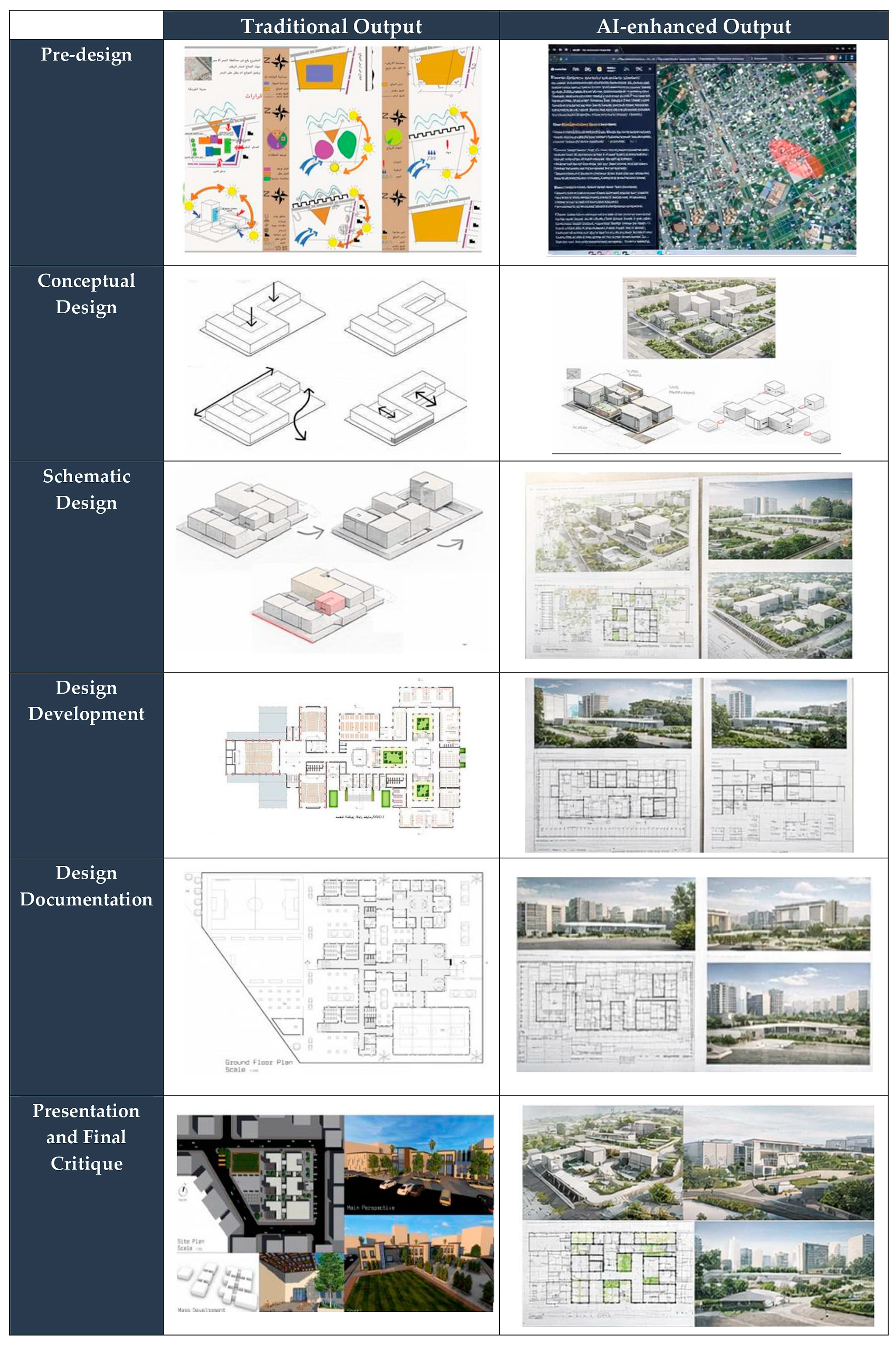
| Pre-design | Week 2 | Site analysis Manual sketches | Google Earth GIS; AutoCAD 2024 (Site Plans) Revit (Site Context) | Site analysis Data collection Problem identification | Chat GPT (data collection & analysis) Microsoft Designer (concept images) AI GIS tools (environmental analysis) |
| Conceptual Design | Week 3, 4 | Hand sketches Physical models | Sketch Up Rhino Grasshopper | Initial design concept Sketches and diagrams | Microsoft Designer (quick ideation) Canva AI Ideogram AI Playground AI (concept images) |
| Schematic Design | Week 5, 6, 7 | Manual plans Group discussions | AutoCAD Revit | Developed design concept, zoning, initial plans | Planner 5D AI (space layouts) Room GPT (layout suggestions) |
| Design Development | Week 8, 9, 10 | Manual detailing Area schedules | AutoCAD Revit | Detailed architectural drawings | Autodesk Forma AI (solar, wind & environmental analysis) Krea.ai (design alternatives—basic use) |
| Design Documentation | Week 11, 12 | Manual construction docs Material schedules | Revit (Construction Docs) AutoCAD (Details) | Architectural drawings supported by structural system | Basic AI floor plan checkers (validation only) Microsoft Copilot 2024 (text & documentation support) |
| Presentation and Final Critique | Week 13, 14 | Printed boards PowerPoint | Photoshop Illustrator InDesign | Final project presentation | Canva AI (presentation boards) Gamma.app (presentation generation) Runway ML (simple video) ChatGPT 2024 (project narrative & explanation) |
| Measurement Indicators | ||||||||
|---|---|---|---|---|---|---|---|---|
| Efficiency | Creativity | Accuracy | AI Integration | Adoptability | Environmental/Architectural Impact | |||
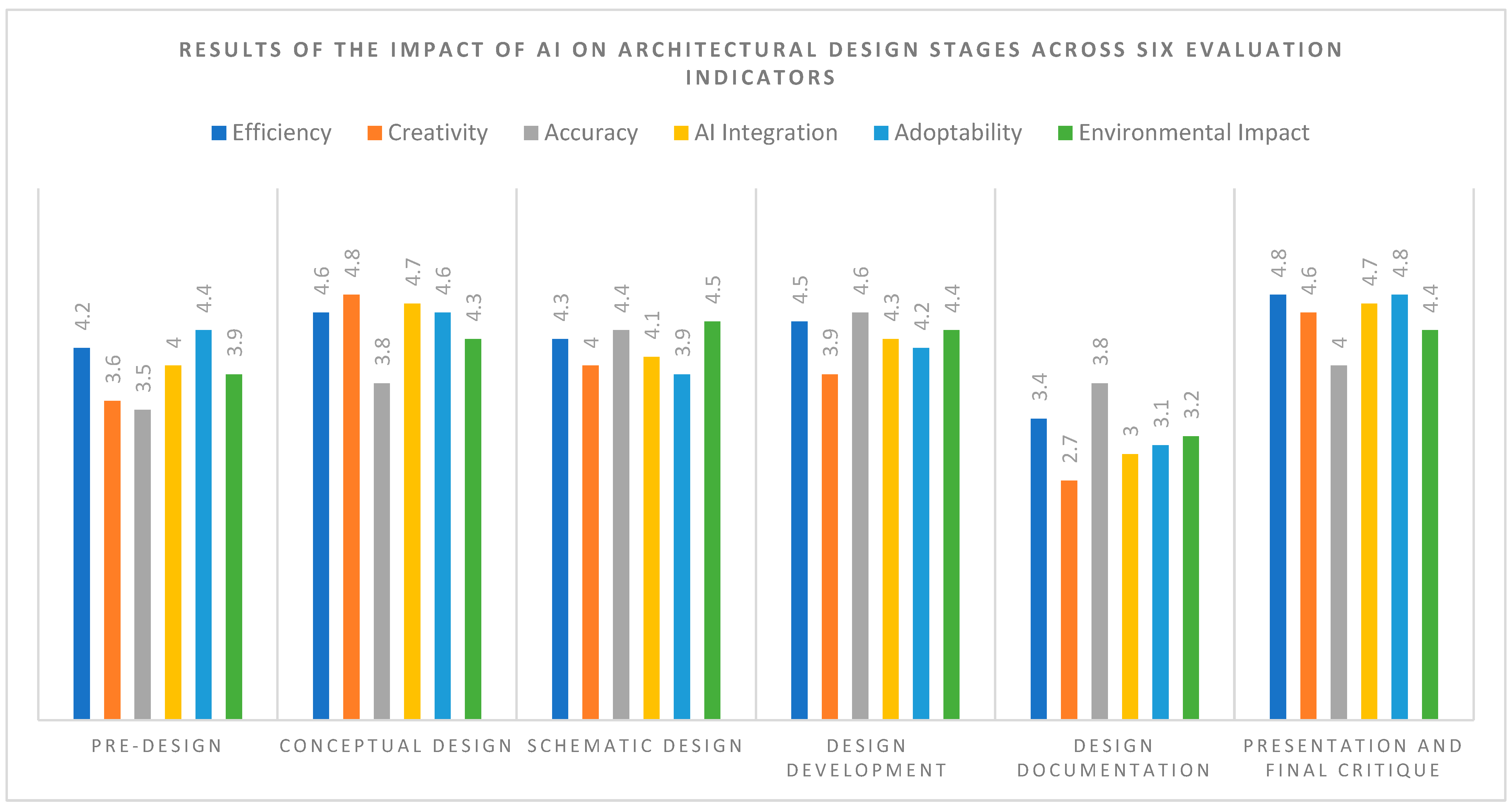
| Stages of Design Process | Pre-design | AI helps during data gathering and contextual analysis, allowing designers to make more informed decisions in the early stages of the project. | AI-generated concept visuals can help spark early design ideas, but they still need human refinement to achieve coherence and convey a clear design intention. | AI can improve site understanding and analysis, but its results still need to be checked and verified by humans to ensure accuracy. | AI tools were smoothly incorporated into analytical tasks, improving both efficiency and clarity. | Students found both text- and image-based AI tools to be intuitive and easy to use throughout the design process. | AI and GIS tools helped with early environmental and contextual analysis, enhancing students’ understanding of the site and the relevance of their design decisions. | Results according to five-point Likert scale |
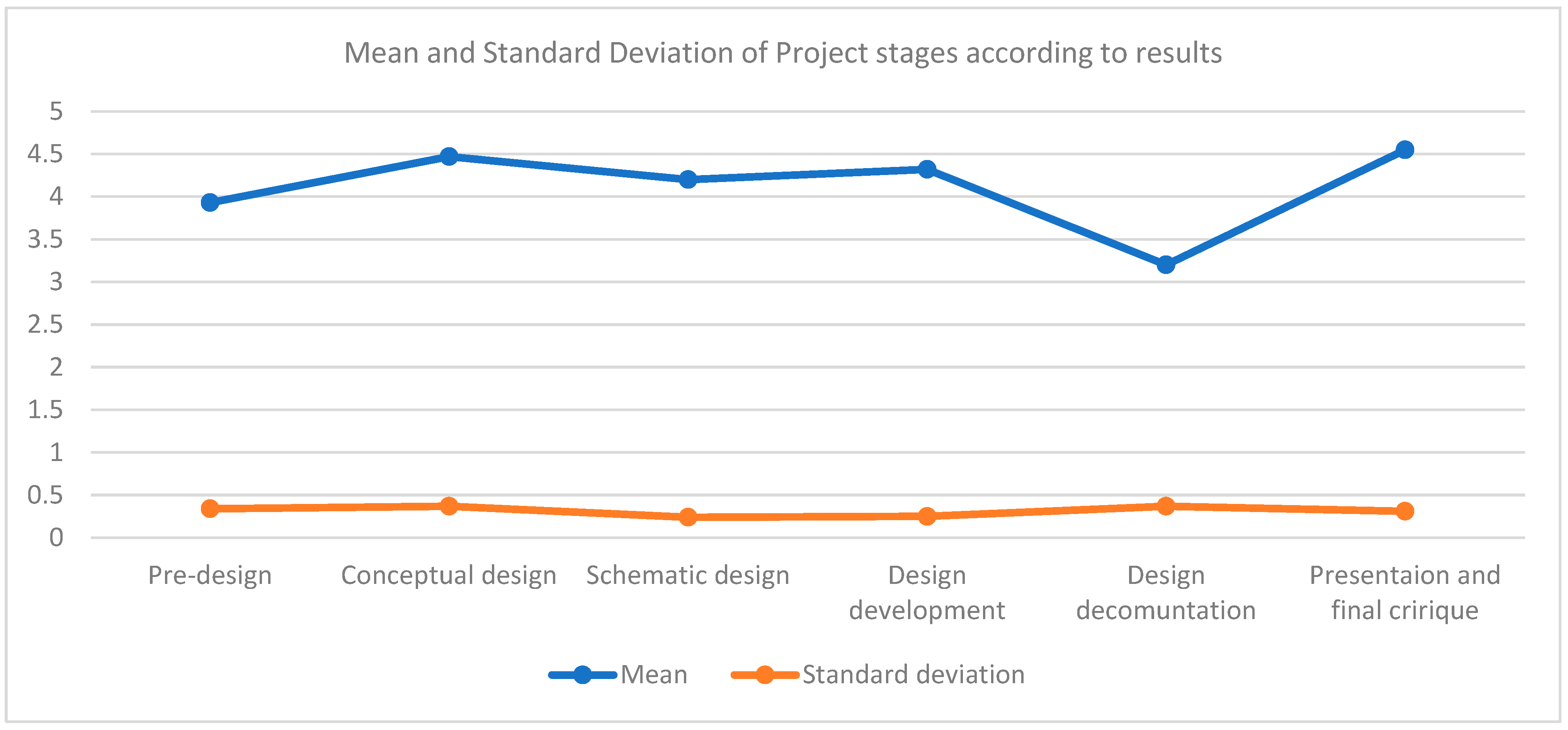
| 4.2 | 3.6 | 3.5 | 4.0 | 4.4 | 3.9 | |||
| Conceptual Design | AI sped up the ideation process and made it easier to quickly generate design forms. | AI tools fostered creative exploration and supported the generation of multiple conceptual alternatives. | Maintaining conceptual alignment still relied on instructor feedback to ensure clarity and coherence in the design. | A high level of integration was achieved, with AI tools effectively supporting digital sketching and early-stage visualization. | Students reported high levels of enjoyment and engagement when working with generative visual AI tools. | Generative AI tools promoted sustainable form-finding and encouraged the exploration of passive design strategies. | ||
| 4.6 | 4.8 | 3.8 | 4.7 | 4.6 | 4.3 | |||
| Schematic Design | AI facilitated efficient testing of space layouts and assessment of functional performance. | Creativity was guided by AI-generated performance feedback, which helped refine design decisions. | AI improved spatial accuracy while also supporting more informed environmental considerations in the design process. | The effective integration of AI depended on students’ technical skills and their familiarity with the tools. | Successful AI integration relied on students’ technical skills and their comfort in using the tools. | Energy simulation tools improved the designs’ lighting and ventilation performance. | ||
| 4.3 | 4.0 | 4.4 | 4.1 | 3.9 | 4.5 | |||
| Design Development | AI helped speed up the detailing process and enabled smoother integration of structural logic. | Innovation was most evident in the selection of materials and the design of building systems. | AI enhanced consistency in drawings and helped coordinate different design elements more effectively. | AI integration was feasible, but its effective use required guidance from instructors. | Students adapted quickly and effectively to using generative visual AI tools. | AI-assisted optimization of structures and materials contributed to reducing construction waste. | ||
| 4.5 | 3.9 | 4.6 | 4.3 | 4.2 | 4.4 | |||
| Design Documentation | The partial automation of tasks helped improve overall workflow efficiency. | At this stage, the focus was more on technical precision than on creative exploration. | AI-assisted clash detection proved useful, but manual drafting remained the primary method. | Integration was limited, with AI use mostly remaining at a basic level. | Students faced challenges in effectively applying AI tools for documentation tasks. | AI played a moderate role in addressing environmental considerations. | ||
| 3.4 | 2.7 | 3.8 | 3.0 | 3.1 | 3.2 | |||
| Presentation and Final Critique | AI significantly reduced the time needed to prepare presentations. | AI tools enhanced storytelling, rendering, and video-based design communication. | Visual outputs still required manual editing and instructor guidance to ensure accuracy. | AI tools played a key role in producing the final project deliverables. | Students enthusiastically embraced AI-based visualization tools throughout the design process. | AI visualization tools improved the representation of environmental factors and enhanced spatial perception. | ||
| 4.8 | 4.6 | 4.0 | 4.7 | 4.8 | 4.4 | |||
| Expected Effect Based on the Literature | Observed Effect (Experimental Results) | Interpretation | ||
|---|---|---|---|---|
| Indicators | Efficiency | High—AI expected to enhance productivity and workflow | High—Students reported improved time management and faster iteration | Confirms literature; AI supports efficiency in early stages |
| Creativity | High—AI anticipated to expand design exploration | High—Participants found AI to significantly inspire idea generation | Experimental results exceed expectations, showing deeper creative engagement | |
| Accuracy | Moderate—AI tools support analysis but depend on user skill | Moderate—Precision improved slightly but still relied on human judgment | Consistent with literature; AI remains a supportive analytical tool | |
| AI integration | Increasing—Adoption expected to grow with accessibility | High—Students integrated AI widely in early and final stages | Shows faster adoption than anticipated in literature | |
| Adoptability | Variable—Predicted to depend on user experience | High—Students showed strong willingness to continue using AI | Surpasses earlier predictions; indicates growing confidence with AI | |
| Environmental and architectural impact | Emerging—AI expected to have limited environmental influence | Moderate—Some progress in contextual analysis but still developing | Partial improvement: AI use in environmental analysis remains early-stage | |
Disclaimer/Publisher’s Note: The statements, opinions and data contained in all publications are solely those of the individual author(s) and contributor(s) and not of MDPI and/or the editor(s). MDPI and/or the editor(s) disclaim responsibility for any injury to people or property resulting from any ideas, methods, instructions or products referred to in the content. |
© 2026 by the authors. Licensee MDPI, Basel, Switzerland. This article is an open access article distributed under the terms and conditions of the Creative Commons Attribution (CC BY) license.
Share and Cite
Alana, H.; Fikry, M.; Hasan, A. Human–AI Collaborative Design in Architectural Studios: Evaluating Paradigm Shifts Across the Six Stages of the Design Process. Buildings 2026, 16, 1445. https://doi.org/10.3390/buildings16071445
Alana H, Fikry M, Hasan A. Human–AI Collaborative Design in Architectural Studios: Evaluating Paradigm Shifts Across the Six Stages of the Design Process. Buildings. 2026; 16(7):1445. https://doi.org/10.3390/buildings16071445
Chicago/Turabian StyleAlana, Hend, Mohamed Fikry, and Asmaa Hasan. 2026. "Human–AI Collaborative Design in Architectural Studios: Evaluating Paradigm Shifts Across the Six Stages of the Design Process" Buildings 16, no. 7: 1445. https://doi.org/10.3390/buildings16071445
APA StyleAlana, H., Fikry, M., & Hasan, A. (2026). Human–AI Collaborative Design in Architectural Studios: Evaluating Paradigm Shifts Across the Six Stages of the Design Process. Buildings, 16(7), 1445. https://doi.org/10.3390/buildings16071445